Prepared by:
VOLLEYBALL
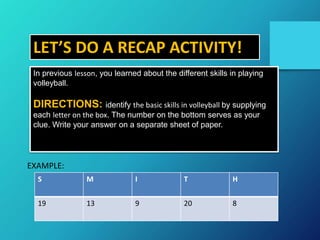
In previous lesson, you learned about the different skills in playing
volleyball.
DIRECTIONS: identify the basic skills in volleyball by supplying
each letter on the box. The number on the bottom serves as your
clue. Write your answer on a separate sheet of paper.
LET’S DO A RECAP ACTIVITY!
S M I T H
19 13 9 20 8
EXAMPLE:
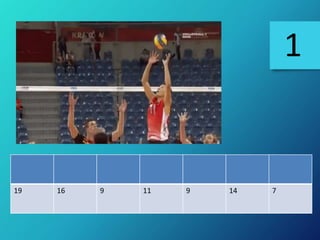
19 16 9 11 9 14 7
1
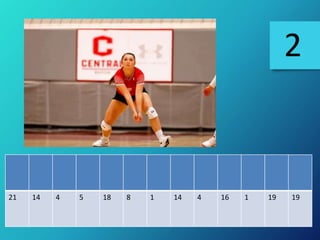
21 14 4 5 18 8 1 14 4 16 1 19 19
2
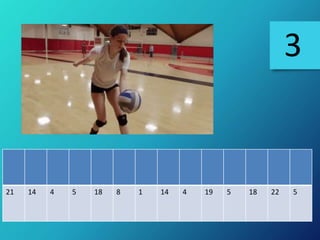
21 14 4 5 18 8 1 14 4 19 5 18 22 5
3
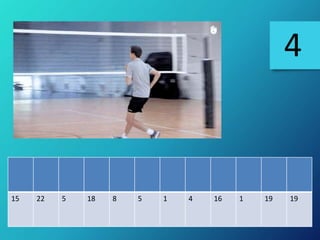
15 22 5 18 8 5 1 4 16 1 19 19
4
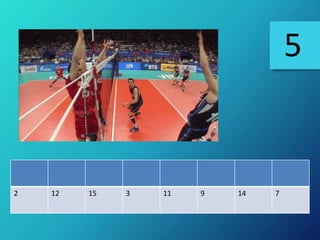
2 12 15 3 11 9 14 7
5
OVERVIEW
- is a team sport in which two teams of
six (6) players are separated by a net.
FIVB International Federation of Volleyball
(Federation Internationale de Volleyball))
-Highest governing body of the sport founded
in Paris, France in 1947.
- And its headquarters are located
in Lausanne, Switzerland.
HISTORY
WILLIAM G. MORGAN
A physical education director in the
YMCA in Holyoke, Massachusetts, USA.
HISTORY
Volleyball was created in 1895 by William G. Morgan, an
instructor at the YMCA in Holyhoke, Massachusetts. It was
first called as “Mintonette” because of it’s similarity with
badminton. As observers watched the game, they noticed
that players were “volleying” the ball back and forth. Thus,
its name was changed to volleyball. The first game was
played at Springfield College in 1896.
• In 1928 it became apparent that official rules were
needed, and the USVBA (United States Volleyball
Association) was formed.
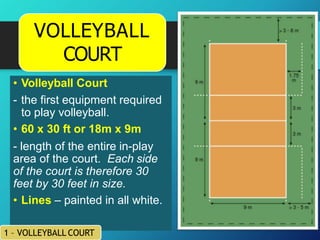
• Volleyball Court
- the first equipment required
to play volleyball.
• 60 x 30 ft or 18m x 9m
- length of the entire in-play
area of the court. Each side
of the court is therefore 30
feet by 30 feet in size.
• Lines – painted in all white.
1 – VOLLEYBALL COURT
VOLLEYBALL
COURT
NOTE: All lines
are 5 cm wide.
Must be of
light color
which is
different from
the color of the
floor and from
any other lines.
1.Service Line
2.Center Line
3.Attack Line
4.Boundary Lines
LINES ON THE COURT
Service Line
NOTE: All lines
are 5 cm wide.
Must be of
light color
which is
different from
the color of the
floor and from
any other lines.
LINES ON THE COURT
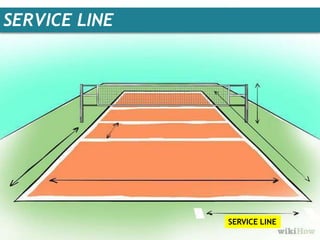
- the area from which the
server may serve the
volleyball.
1
SERVICE LINE
SERVICE LINE
Center Line
All lines are 5
cm wide. Must
be of light color
which is
different from
the color of the
floor and from
any other lines.
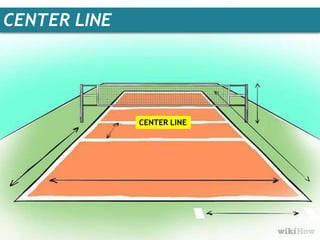
- is marked at the center of the
court dividing it equally into
30 feet squares (9m), above
which the net is placed.
2
LINES ON THE COURT
CENTER LINE
CENTER LINE
Attack Line
All lines are 5
cm wide. Must
be of light color
which is
different from
the color of the
floor and from
any other lines.
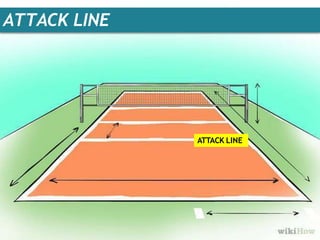
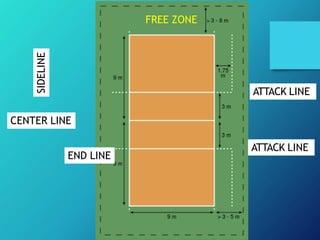
Attack line, whose rear edge
is drawn 3m back from the
axis of the center line, marks
the front zone.
3
LINES ON THE COURT
ATTACK LINE
ATTACK LINE
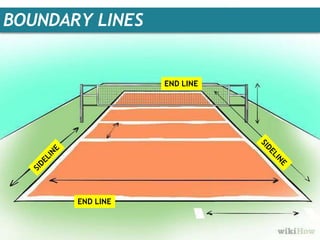
Boundary Lines
All lines are 5
cm wide. Must
be of light color
which is
different from
the color of the
floor and from
any other lines.
Two sidelines and two end
lines mark the playing court.
4
LINES ON THE COURT
BOUNDARY LINES
END LINE
END LINE
FREE ZONE
ATTACK LINE
ATTACK LINE
CENTER LINE
SIDELINE
END LINE
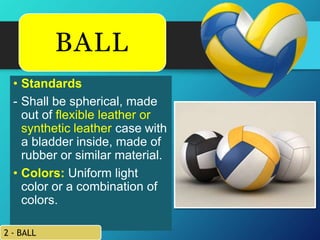
• Standards
- Shall be spherical, made
out of flexible leather or
synthetic leather case with
a bladder inside, made of
rubber or similar material.
• Colors: Uniform light
color or a combination of
colors.
2 - BALL
BALL
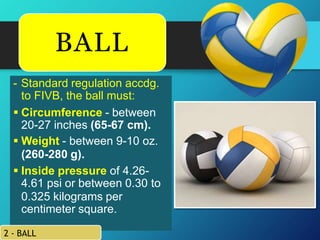
- Standard regulation accdg.
to FIVB, the ball must:
 Circumference - between
20-27 inches (65-67 cm).
 Weight - between 9-10 oz.
(260-280 g).
 Inside pressure of 4.26-
4.61 psi or between 0.30 to
0.325 kilograms per
centimeter square.
2 - BALL
BALL
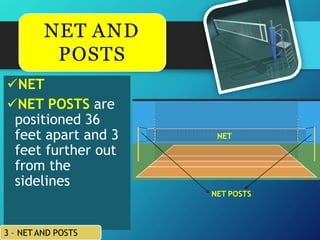
NET
NET POSTS are
positioned 36
feet apart and 3
feet further out
from the
sidelines
3 – NETAND POSTS
NET
NET AND
POSTS
NET POSTS
FACILITIES AND EQUIPMENT
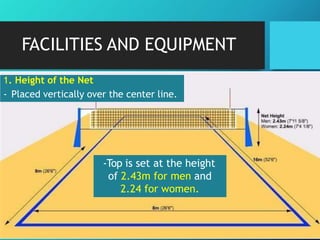
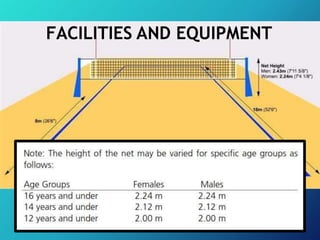
1. Height of the Net
- Placed vertically over the center line.
-Top is set at the height
of 2.43m for men and
2.24 for women.
FACILITIES AND EQUIPMENT
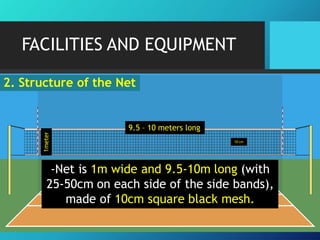
1meter
9.5 – 10 meters long
10 cm
FACILITIES AND EQUIPMENT
2. Structure of the Net
-Net is 1m wide and 9.5-10m long (with
25-50cm on each side of the side bands),
made of 10cm square black mesh.
FACILITIES AND EQUIPMENT
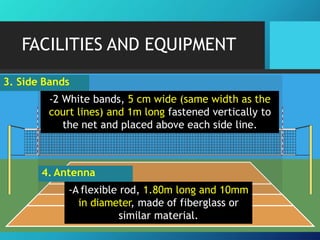
3. Side Bands
-2 White bands, 5 cm wide (same width as the
court lines) and 1m long fastened vertically to
the net and placed above each side line.
4. Antenna
-A flexible rod, 1.80m long and 10mm
in diameter, made of fiberglass or
similar material.
FACILITIES AND EQUIPMENT
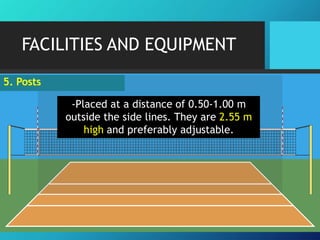
5. Posts
-Placed at a distance of 0.50-1.00 m
outside the side lines. They are 2.55 m
high and preferably adjustable.
BASIC PRINCIPLES /
RULES OF THE GAME
“Knowing and understanding
the basic tenets of volleyball
can be helpful for volleyball
newbies and veterans alike.”
BASIC PRINCIPLES
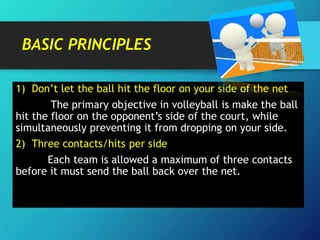
1) Don’t let the ball hit the floor on your side of the net
The primary objective in volleyball is make the ball
hit the floor on the opponent’s side of the court, while
simultaneously preventing it from dropping on your side.
2) Three contacts/hits per side
Each team is allowed a maximum of three contacts
before it must send the ball back over the net.
BASIC PRINCIPLES
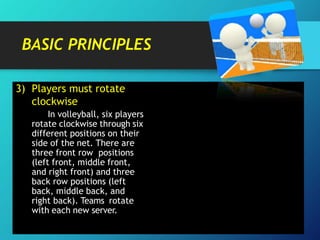
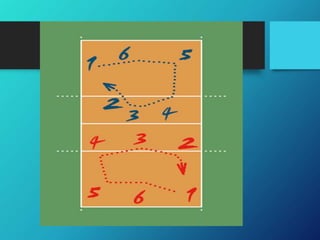
3) Players must rotate
clockwise
In volleyball, six players
rotate clockwise through six
different positions on their
side of the net. There are
three front row positions
(left front, middle front,
and right front) and three
back row positions (left
back, middle back, and
right back). Teams rotate
with each new server.
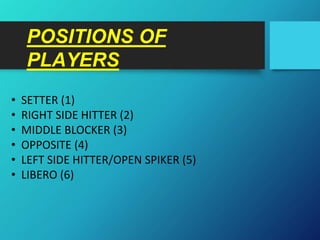
POSITIONS OF PLAYERS
POSITIONS OF
PLAYERS
• SETTER (1)
• RIGHT SIDE HITTER (2)
• MIDDLE BLOCKER (3)
• OPPOSITE (4)
• LEFT SIDE HITTER/OPEN SPIKER (5)
• LIBERO (6)
Basic Skills
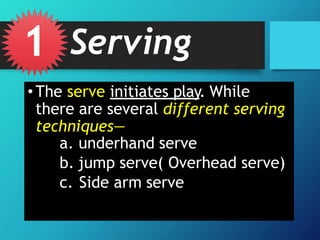
• The serve initiates play. While
there are several different serving
techniques—
a. underhand serve
b. jump serve( Overhead serve)
c. Side arm serve
1 Serving
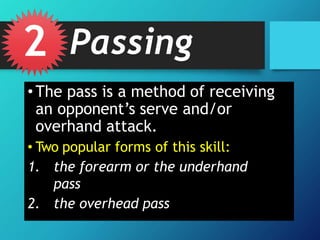
• The pass is a method of receiving
an opponent’s serve and/or
overhand attack.
• Two popular forms of this skill:
1. the forearm or the underhand
pass
2. the overhead pass
2 Passing
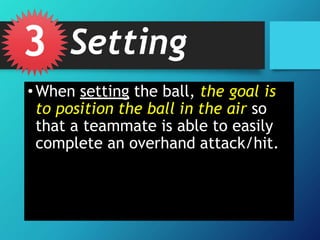
•When setting the ball, the goal is
to position the ball in the air so
that a teammate is able to easily
complete an overhand attack/hit.
3 Setting
• A block is an attempt to halt an
opponent’s attack by jumping with
the hands overhead to create a
barrier at the net. The most
common blocking violation is
touching the net.
4 Blocking
• The attack usually takes place on a
team’s third and final contact. Because
an attacker’s goal is to down the ball
on the other team’s side of the court,
players often jump when striking the
ball to increase the difficulty of
receiving the hit.
5 Hitting
QUIZ!
DIRECTIONS: Choose the letter of the correct
answer. Write the chosen letter on a separate sheet
of paper. (NO ERASURES)
1. How many people on each team
are in the court?
A. 6
B. 10
C. 5
D. 9
2. What was the original name of
volleyball?
A. Volleying Ball
B. Valley Ball
C. Mintonette
D. Bolibol
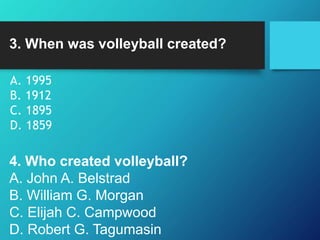
3. When was volleyball created?
A. 1995
B. 1912
C. 1895
D. 1859
4. Who created volleyball?
A. John A. Belstrad
B. William G. Morgan
C. Elijah C. Campwood
D. Robert G. Tagumasin
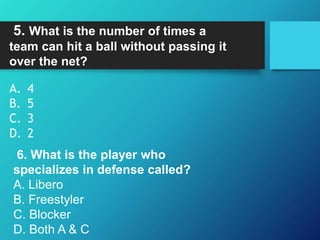
5. What is the number of times a
team can hit a ball without passing it
over the net?
A. 4
B. 5
C. 3
D. 2
6. What is the player who
specializes in defense called?
A. Libero
B. Freestyler
C. Blocker
D. Both A & C
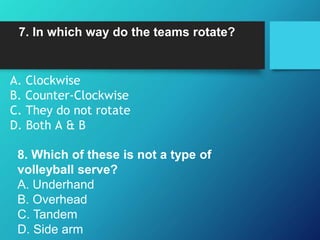
7. In which way do the teams rotate?
A. Clockwise
B. Counter-Clockwise
C. They do not rotate
D. Both A & B
8. Which of these is not a type of
volleyball serve?
A. Underhand
B. Overhead
C. Tandem
D. Side arm
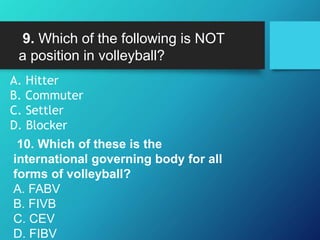
9. Which of the following is NOT
a position in volleyball?
A. Hitter
B. Commuter
C. Settler
D. Blocker
10. Which of these is the
international governing body for all
forms of volleyball?
A. FABV
B. FIVB
C. CEV
D. FIBV
11-15.
ENUMERATE ATLEAST 5 POSITIONS IN VOLLEYBALL.

VOLLEYBALL.pptx

  • 1.
  • 2.
    In previous lesson,you learned about the different skills in playing volleyball. DIRECTIONS: identify the basic skills in volleyball by supplying each letter on the box. The number on the bottom serves as your clue. Write your answer on a separate sheet of paper. LET’S DO A RECAP ACTIVITY! S M I T H 19 13 9 20 8 EXAMPLE:
  • 3.
    19 16 911 9 14 7 1
  • 4.
    21 14 45 18 8 1 14 4 16 1 19 19 2
  • 5.
    21 14 45 18 8 1 14 4 19 5 18 22 5 3
  • 6.
    15 22 518 8 5 1 4 16 1 19 19 4
  • 7.
    2 12 153 11 9 14 7 5
  • 8.
    OVERVIEW - is ateam sport in which two teams of six (6) players are separated by a net. FIVB International Federation of Volleyball (Federation Internationale de Volleyball)) -Highest governing body of the sport founded in Paris, France in 1947. - And its headquarters are located in Lausanne, Switzerland.
  • 9.
    HISTORY WILLIAM G. MORGAN Aphysical education director in the YMCA in Holyoke, Massachusetts, USA.
  • 10.
    HISTORY Volleyball was createdin 1895 by William G. Morgan, an instructor at the YMCA in Holyhoke, Massachusetts. It was first called as “Mintonette” because of it’s similarity with badminton. As observers watched the game, they noticed that players were “volleying” the ball back and forth. Thus, its name was changed to volleyball. The first game was played at Springfield College in 1896. • In 1928 it became apparent that official rules were needed, and the USVBA (United States Volleyball Association) was formed.
  • 12.
    • Volleyball Court -the first equipment required to play volleyball. • 60 x 30 ft or 18m x 9m - length of the entire in-play area of the court. Each side of the court is therefore 30 feet by 30 feet in size. • Lines – painted in all white. 1 – VOLLEYBALL COURT VOLLEYBALL COURT
  • 13.
    NOTE: All lines are5 cm wide. Must be of light color which is different from the color of the floor and from any other lines. 1.Service Line 2.Center Line 3.Attack Line 4.Boundary Lines LINES ON THE COURT
  • 14.
    Service Line NOTE: Alllines are 5 cm wide. Must be of light color which is different from the color of the floor and from any other lines. LINES ON THE COURT - the area from which the server may serve the volleyball. 1
  • 15.
  • 16.
    Center Line All linesare 5 cm wide. Must be of light color which is different from the color of the floor and from any other lines. - is marked at the center of the court dividing it equally into 30 feet squares (9m), above which the net is placed. 2 LINES ON THE COURT
  • 17.
  • 18.
    Attack Line All linesare 5 cm wide. Must be of light color which is different from the color of the floor and from any other lines. Attack line, whose rear edge is drawn 3m back from the axis of the center line, marks the front zone. 3 LINES ON THE COURT
  • 19.
  • 20.
    Boundary Lines All linesare 5 cm wide. Must be of light color which is different from the color of the floor and from any other lines. Two sidelines and two end lines mark the playing court. 4 LINES ON THE COURT
  • 21.
  • 22.
    FREE ZONE ATTACK LINE ATTACKLINE CENTER LINE SIDELINE END LINE
  • 23.
    • Standards - Shallbe spherical, made out of flexible leather or synthetic leather case with a bladder inside, made of rubber or similar material. • Colors: Uniform light color or a combination of colors. 2 - BALL BALL
  • 24.
    - Standard regulationaccdg. to FIVB, the ball must:  Circumference - between 20-27 inches (65-67 cm).  Weight - between 9-10 oz. (260-280 g).  Inside pressure of 4.26- 4.61 psi or between 0.30 to 0.325 kilograms per centimeter square. 2 - BALL BALL
  • 25.
    NET NET POSTS are positioned36 feet apart and 3 feet further out from the sidelines 3 – NETAND POSTS NET NET AND POSTS NET POSTS
  • 26.
    FACILITIES AND EQUIPMENT 1.Height of the Net - Placed vertically over the center line. -Top is set at the height of 2.43m for men and 2.24 for women.
  • 27.
  • 28.
    1meter 9.5 – 10meters long 10 cm FACILITIES AND EQUIPMENT 2. Structure of the Net -Net is 1m wide and 9.5-10m long (with 25-50cm on each side of the side bands), made of 10cm square black mesh.
  • 29.
    FACILITIES AND EQUIPMENT 3.Side Bands -2 White bands, 5 cm wide (same width as the court lines) and 1m long fastened vertically to the net and placed above each side line. 4. Antenna -A flexible rod, 1.80m long and 10mm in diameter, made of fiberglass or similar material.
  • 30.
    FACILITIES AND EQUIPMENT 5.Posts -Placed at a distance of 0.50-1.00 m outside the side lines. They are 2.55 m high and preferably adjustable.
  • 31.
  • 32.
    “Knowing and understanding thebasic tenets of volleyball can be helpful for volleyball newbies and veterans alike.”
  • 33.
    BASIC PRINCIPLES 1) Don’tlet the ball hit the floor on your side of the net The primary objective in volleyball is make the ball hit the floor on the opponent’s side of the court, while simultaneously preventing it from dropping on your side. 2) Three contacts/hits per side Each team is allowed a maximum of three contacts before it must send the ball back over the net.
  • 34.
    BASIC PRINCIPLES 3) Playersmust rotate clockwise In volleyball, six players rotate clockwise through six different positions on their side of the net. There are three front row positions (left front, middle front, and right front) and three back row positions (left back, middle back, and right back). Teams rotate with each new server.
  • 36.
  • 38.
    POSITIONS OF PLAYERS • SETTER(1) • RIGHT SIDE HITTER (2) • MIDDLE BLOCKER (3) • OPPOSITE (4) • LEFT SIDE HITTER/OPEN SPIKER (5) • LIBERO (6)
  • 39.
  • 40.
    • The serveinitiates play. While there are several different serving techniques— a. underhand serve b. jump serve( Overhead serve) c. Side arm serve 1 Serving
  • 41.
    • The passis a method of receiving an opponent’s serve and/or overhand attack. • Two popular forms of this skill: 1. the forearm or the underhand pass 2. the overhead pass 2 Passing
  • 42.
    •When setting theball, the goal is to position the ball in the air so that a teammate is able to easily complete an overhand attack/hit. 3 Setting
  • 43.
    • A blockis an attempt to halt an opponent’s attack by jumping with the hands overhead to create a barrier at the net. The most common blocking violation is touching the net. 4 Blocking
  • 44.
    • The attackusually takes place on a team’s third and final contact. Because an attacker’s goal is to down the ball on the other team’s side of the court, players often jump when striking the ball to increase the difficulty of receiving the hit. 5 Hitting
  • 45.
    QUIZ! DIRECTIONS: Choose theletter of the correct answer. Write the chosen letter on a separate sheet of paper. (NO ERASURES)
  • 46.
    1. How manypeople on each team are in the court? A. 6 B. 10 C. 5 D. 9 2. What was the original name of volleyball? A. Volleying Ball B. Valley Ball C. Mintonette D. Bolibol
  • 47.
    3. When wasvolleyball created? A. 1995 B. 1912 C. 1895 D. 1859 4. Who created volleyball? A. John A. Belstrad B. William G. Morgan C. Elijah C. Campwood D. Robert G. Tagumasin
  • 48.
    5. What isthe number of times a team can hit a ball without passing it over the net? A. 4 B. 5 C. 3 D. 2 6. What is the player who specializes in defense called? A. Libero B. Freestyler C. Blocker D. Both A & C
  • 49.
    7. In whichway do the teams rotate? A. Clockwise B. Counter-Clockwise C. They do not rotate D. Both A & B 8. Which of these is not a type of volleyball serve? A. Underhand B. Overhead C. Tandem D. Side arm
  • 50.
    9. Which ofthe following is NOT a position in volleyball? A. Hitter B. Commuter C. Settler D. Blocker 10. Which of these is the international governing body for all forms of volleyball? A. FABV B. FIVB C. CEV D. FIBV
  • 51.
    11-15. ENUMERATE ATLEAST 5POSITIONS IN VOLLEYBALL.