BASKETBALL
P H Y S I C A L E D U C A T I O N
The Philippines is a
basketball nation.
FRAZIER [1998]
“Basketball leaves its impression on our
lifestyle, our clothes and our fashion
and not just for young people.”
HIST RY of BASKETBALL
HISTORY of BASKETBALL
• Basketball is a fast running game which may be played indoors or outdoors.
• It was invented by Dr. James Naismith a Canadian clergyman, in December, 1981.
• Later, Dr. William G. Morgan, from the International Young Men's Association Training School in
Springfield, Massachusetts USA, invented the sport volleyball.
• Naismith was instructed by his superior, Dr. Luther Gulick to develop an indoor sport that could
be played during the winter months.
• Dr. Naismith nailed two peach baskets on the walls of YMCA gymnasium, threw a ball up and
thus delivered the initial shot for a major sport which later on worldwide interest.
HISTORY of BASKETBALL
• According to National Collegiate Athletic Association, the game of basketball is played by two
teams to throw or tap the ball into its own basket and to prevent the opposing team from scoring
the basket.
• The ball may be thrown, batted, rolled, or dribbled in any direction, subject to restriction laid
down in the following rules.
• Frazier (1998) noted that the first game of basketball had nine players on each team because
there were 18 students in Dr. Naismith gymnastics class when he invented the sport.
HISTORY of BASKETBALL
• Domingo (1985) noted that basketball growth started with its introduction to colleges. The major
breakthrough came in 1934, with a double header game at the Madison Square Garden in New
York. With two games in one program for one admission charge, the pace-setter was a success
which was followed by a series of double-headers.
• The game is simple, with the basic aim throwing or shooting the ball into one basket. It may be
played by amateur or professional teams where they are given time of 24 seconds to shoot after
gaining possession of the ball.
NAISMITH’S
ORIGINAL 13 RULES
THE ORIGINAL 13 RULES OF BASKETBALL
1. The ball may be thrown in any direction with one or both hands.
2. The ball may be batted in any direction with one or both hands (never with the fist).
3. A player cannot run with the ball. The player must throw it from the spot on which he catches it, allowance to
be made for a man who catches the ball at a good speed if he tries to stop.
4. The ball must be held in or between the hands. The arm or body must not be used for holding.
5. No shouldering, holding, pushing, tripping, or sticking in any way the person of a opponent shall be allowed;
the first infringement of this by any player shall count as a foul, the second shall disqualify him until the next
goal is made, or, if there is evident intent to injure the player, for the whole of the game, no substitute is
allowed.
THE ORIGINAL 13 RULES OF BASKETBALL
6. A foul is striking at the ball with the fist, violation of Rules 3, 4 and such as described in Rule 5.
7. If either side makes three consecutive fouls, it shall count as a goal for the opponents (consecutive means without
the opponents in the meantime making a foul).
8. A goal shall be made when the ball is thrown or batted from the ground into the basket and stays there, provided
those defending the goal do not touch or disturb the goal. If the ball rests at the edges and the opponents move the
basket, it shall count as a goal.
9. When the ball goes out of bounds it shall be thrown into the field of the play by the person first touching it. In case
of a dispute, the umpire shall throw it straight into the field. The thrower-in is allowed five seconds, if he holds the ball
longer, it shall go to the opponent. If any side persists in delaying the game, the umpire shall call a foul on that side.
THE ORIGINAL 13 RULES OF BASKETBALL
10. The umpire shall be the judge of men and shall note the fouls and notify the referee when three
consecutive fouls have been made. He shall have the power to disqualify men according to Rule 5.
11. The referee shall be the judge of the ball and shall decide when the ball is in play, in bounds, to which side
it belongs, and shall keep time. He shall decide when a goal has been made, and keep an account of the
goals with any other duties that are usually performed by a referee.
12. The time shall be 15 minute halves, with 5 minutes rest between.
13. The side making the most goals in that time shall be declared the winner. In the case of a draw, the game
may, by agreement of the captains, be continued until another goal is made.
• Basketball is a game between two opposing teams of five players each inside the court. Players are bound
to follow the rules of foul and violation.
• A foul is committed when somebody inside or outside the court uses force just to get the advantage of the
basketball (defensive, offensive and technical foul).
• A violation is committed when players fail to comply with the basic requirement of the game such as
travelling, shot clock, line and many more.
• The game is usually controlled by two officials: a referee and an umpire, each of whom carries a whistle.
They have equal power except that the referee is also in charge of the score table.
Modern Rules of the Game
• When both officials make different calls, a jump ball is taken at the nearest jumping circle or in
consideration of the more severe penalty is applied.
• The officials should be assisted by at least one scorer and one time keeper.
Modern Rules of the Game
COURT of the GAME
Playing basketball can be anywhere. Indoors, in shiny air-
conditioned arenas or aging gyms. As long as the floor or
ground is hard enough for the ball to bounce back up
when players dribble and there's a place high enough to
tack up a basket, its game time.
B
A
S
K
E
T
B
A
L
L
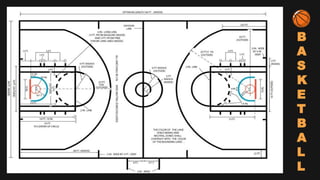
• The Court
The playing court is a rectangular surface free from obstructions and with dimensions of 94 feet in length and
50 feet in width. These are the dimensions for the playing court only.
• Sidelines, End Lines, Restraining Line
The playing court shall be marked with sidelines, end lines, and other lines as shown on the diagram. There
shall be 3 feet (and preferably 10 feet) of unobstructed space outside. It is legal to use contrasting colored
floor areas instead of the 2 inch lines. There shall be a 2-inch wide, broken restraining line, consisting of 12
inches apart, of a color different from the boundary, at a minimum of 6 feet outside the court, extending from
sideline to sideline and parallel to the endline. Non-playing personnel are not permitted in this area.
• Center Circle
A 2-inch wide restraining circle is drawn at the center of the court and has radius of 6 feet measured to the
outside. Space for non-jumpers around the restraining circle is 36 inches deep.
• Free-throw Line
A 2-inch wide line, shall be drawn across each of the semi circle that have outside radius of 6 feet as shown
on the court diagram. The free-throw line shall be parallel to the endline and shall have its farther edge 15
feet from the plane of the face of the backboard.
• Three-Point Field-Goal Line
A line in a form of a semicircle 2 inches wide shall be drawn at each end of the court. The semi-circle has a
radius of 19 feet 9 inches from the center of the basket to the outside of the line. The semi circle line shall be
extended with a 2 inches wide line perpendicular to the endline whose length shall be 63 inches from the
inside edge of the line. The three-point field-goal line shall be the same color as the free-throw line
boundaries.
B
A
S
K
E
T
B
A
L
L
• Backboards, Dimensions and Materials
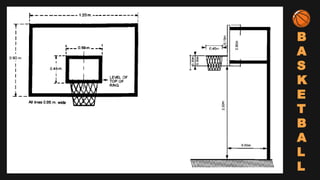
A transparent, rigid, rectangular backboard with a flat surface shall be used (backboards shall not be tinted).
The backboards shall be similar in size at both ends of the court. The size of the backboards may be either of
two dimensions; a) 6 feet horizontally and 3 1⁄2 feet vertically; b) 6 feet horizontally and 4 feet vertically as
shown in the diagram.
It shall be marked as follows: a rectangle shall be centered behind the ring and marked by a 2 inches white
line. The rectangle shall have outside dimension of 24 inches horizontally and 18 inches vertically. The top
edge of the base line shall be level with the ring.
The border on the backboard shall be 2 inches minimum and 3 inches maximum from outside edge of the
backboards.
THE BASIC SKILLS
Basketball Stance
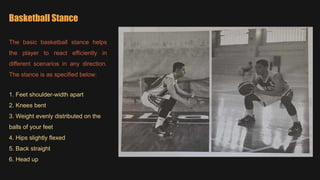
The basic basketball stance helps
the player to react efficiently in
different scenarios in any direction.
The stance is as specified below:
1. Feet shoulder-width apart
2. Knees bent
3. Weight evenly distributed on the
balls of your feet
4. Hips slightly flexed
5. Back straight
6. Head up
Basketball Stance
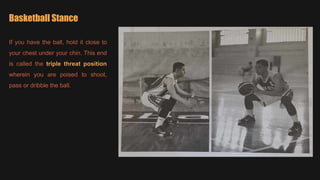
If you have the ball, hold it close to
your chest under your chin. This end
is called the triple threat position
wherein you are poised to shoot,
pass or dribble the ball.
Dribbling
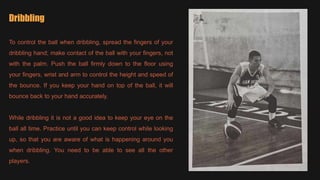
To control the ball when dribbling, spread the fingers of your
dribbling hand; make contact of the ball with your fingers, not
with the palm. Push the ball firmly down to the floor using
your fingers, wrist and arm to control the height and speed of
the bounce. If you keep your hand on top of the ball, it will
bounce back to your hand accurately.
While dribbling it is not a good idea to keep your eye on the
ball all time. Practice until you can keep control while looking
up, so that you are aware of what is happening around you
when dribbling. You need to be able to see all the other
players.
Dribbling
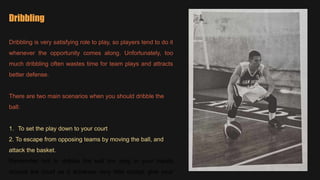
Dribbling is very satisfying role to play, so players tend to do it
whenever the opportunity comes along. Unfortunately, too
much dribbling often wastes time for team plays and attracts
better defense.
There are two main scenarios when you should dribble the
ball:
1. To set the play down to your court
2. To escape from opposing teams by moving the ball, and
attack the basket.
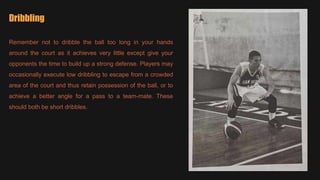
Remember not to dribble the ball too long in your hands
around the court as it achieves very little except give your
Dribbling
Remember not to dribble the ball too long in your hands
around the court as it achieves very little except give your
opponents the time to build up a strong defense. Players may
occasionally execute low dribbling to escape from a crowded
area of the court and thus retain possession of the ball, or to
achieve a better angle for a pass to a team-mate. These
should both be short dribbles.
BALL HANDLING
SKILLS
- THE BASIC SKILLS -
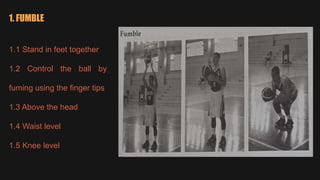
1. FUMBLE
1.1 Stand in feet together
1.2 Control the ball by
fuming using the finger tips
1.3 Above the head
1.4 Waist level
1.5 Knee level
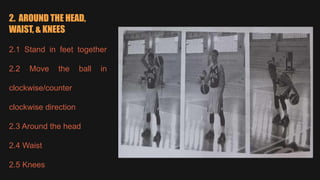
2. AROUND THE HEAD,
WAIST, & KNEES
2.1 Stand in feet together
2.2 Move the ball in
clockwise/counter
clockwise direction
2.3 Around the head
2.4 Waist
2.5 Knees
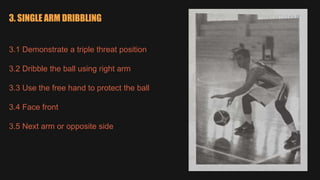
3. SINGLE ARM DRIBBLING
3.1 Demonstrate a triple threat position
3.2 Dribble the ball using right arm
3.3 Use the free hand to protect the ball
3.4 Face front
3.5 Next arm or opposite side
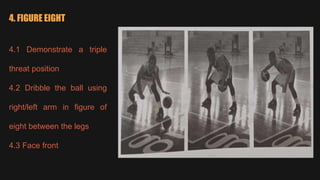
4. FIGURE EIGHT
4.1 Demonstrate a triple
threat position
4.2 Dribble the ball using
right/left arm in figure of
eight between the legs
4.3 Face front
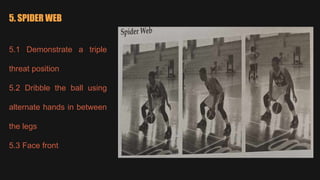
5. SPIDER WEB
5.1 Demonstrate a triple
threat position
5.2 Dribble the ball using
alternate hands in between
the legs
5.3 Face front
PASSING
It is the fundamental skill of transferring the ball without dribbling. It is the most effective way of moving the ball
from one part of the playing court to another teammate. Utilizing both hands will result to accurate control of
the ball whenever possible to assure an effective passing procedure. It takes two to pass, and you both have
to be ready. Always remember the following points:
Passer
1. Is the receiver ready for the ball?
2. Is he free?
3. Are your balanced enough to control the pass accurately?
[ PASSING ] Receivers
1. Is your teammate ready to pass?
2. Can he/she see you?
3. Can you do more to move free of defenders?
4. Signal for the ball! Use clear hand signals-these are
far more effective than shouting which alerts the
defenders just as much as your teammates.
[ PASSING ] Chest Pass
This is the most common pass. It is
a two-handed pass made from in
front of the chest with a forward
follow through and is effective over a
Short range.
1. Start from triple threat position.
2. Hold the ball in front of your chest.
3. Following through fully with your
arms pointing to direction of the
pass.
[ PASSING ] Overhead
Pass
This is a two-handed pass which is
used when you are taller than your
opponent or when you are marked
very closely.
1. Hold the ball above the head with
both hands.
2. Following through fully with your
arms pointing to direction of the
pass.
[ PASSING ] Bounce Pass
This is basically demonstrated
utilizing the floor in moving the ball
to the receiver. A useful pass when
there is a defender between and
your teammate, it is particularly
effective when the opponent is tall
and has his arms up.
1. Start from triple threat position.
2. Hold the ball in front of your chest,
or on top of your head.
3. Follow through fully with your
arms pointing to the floor direction of
the pass.
[ PASSING ] Bounce Pass
This is basically demonstrated
utilizing the floor in moving the ball
to the receiver. A useful pass when
there is a defender between and
your teammate, it is particularly
effective when the opponent is tall
and has his arms up.
1. Start from triple threat position.
2. Hold the ball in front of your chest,
or on top of your head.
3. Follow through fully with your
arms pointing to the floor direction of
the pass.
SHOOTING
Team players cannot score unless they shoot, so this is. The most vital skill of all in basketball is crucial in
winning a game. Most players shoot with one hand, using the other to support the ball before it is released.
Keep the ball in front of your body and close to it. The wrist and elbow of your shooting arm should be almost
under the ball, with your wrist cocked back and your fingers pointing upwards. The shot is made by
straightening the arm upward in the direction of the basket, finishing with a vigorous snap of the wrist and
fingers as the ball released.
[ SHOOTING ] Set Shot
The set shot is the standing shot commonly used for longer shots and when taking free throws. The technique
is very simple:
1. Concentrate on the target.
2. Take up the basic stance, with knees bent.
3. Hold the ball under your chin.
4. Straighten your arm with the ball moving upwards in front of your face. In a continuous action; finish with a
strong wrist and finger snap and follow through.
[ SHOOTING ] Lay-up Shot
This is a shot aiming to penetrate
the basket normally executed with
only one hand on the ball. The basic
technique involves:
1. A run to the basket
2. A jump up and towards the basket
3. Reaching up to gain maximum
height for higher percentage of
scoring
[ SHOOTING ] Lay-up Shot
Learn the lay-up shot by breaking its various parts down into
Separate sections:
1. Starting from point a few meters from the backboard and at
45 degrees to it, run forward to three paces and then jump
and shoot.
2. Practice both side of the arm using different footwork.
3. Once you have mastered the left and right jump, add one
bounce dribble at the start and execute a shot.
[ SHOOTING ] Jump Shot
A common killer shot used in playing basketball. Starting a jump shot from a balanced position
facing the basket. Knees should be bent, feet shoulder width apart and the ball held waist high.
From this position jump upwards while raising the ball to a position in front of your forehead.
Shooting hand should be between the ball and your forehead.
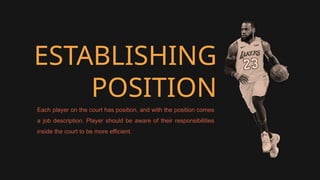
ESTABLISHING
POSITION
Each player on the court has position, and with the position comes
a job description. Player should be aware of their responsibilities
inside the court to be more efficient.
Point Guard [ Ball Handler ]
The quarterback on offense, the point guard's traditional role is to push the ball up court and start
the offensive play, either by dribble penetration into the court or by passing. The point guard is the
coach in the floor and he sets play for his teammates.
Shooting Guard [ Two-Guards ]
The shooting guard, known as the two-guard, is not necessarily a good ball handler. However, he
is normally the team's best perimeter shooter. Being a proficient shooters, these players have been
principal beneficiaries of the tree-point line. That has raised their importance in the game.
Small Forward [ Swingman ]
Small forward must be able to create points from perimeter and inside the paint. They are all
purpose players on offense and should be too tall, physically, or tenacious for a defense's two-
guard to handle.
Power Forward [ the Enforcer ]
The power forward known as the rugged rebounder of the team but atletic to move with some
degree of agility around the painted area offensively and defensively.
Center [ The Big Man ]
Typically the tallest player on the team, the center should be able to up offensively – that is,
receiving the ball with his back to the basket and use pivot moves to hit a variety of short jumpers,
hook shots, and dunks.
DEFINITION of TERMS
• Double Dribbling. A double dribble occurs when a player dribble the ball with the ball with two
hands at the same time, or dribble the ball and stop and resume dribbling.
• Fouls. It's a violation called by the referee when a player engages in illegal contact to its opponents.
• Free throws. Any player who is fouled during the act of shooting, or if the defensive player reach the
allowable fouls to give. The offensive player receives a free shot without any blocker.
• Goaltending. It occurs when defensive players illegally interferes with a shot towards the basket.
• Kicking. It's when a player kick the ball to deflect a pass or to take an advantage of the basketball.
• Technical Foul. It's a violation against someone, either the player, coach, or coaching staff either
spoken or behaved in extremely unsportsmanlike behavior.
• Time-out. A player or a coach calls a time-out to discuss game plans and strategies. Referees also
calls time-out during violation, foul, and end of the quarter.
• Traveling. It's when an offensive player carry the ball without dribbling for more than 2 steps.
• Out of Bounds. When the ball touches the floor outside the borders of the court.
• Overtime. A basketball game cannot end with a tie or a draw. The teams play an extra period until
they break the tie.
• Pass. Involves one player throwing the ball to a teammate, either through the air or bouncing to the
floor. It's the very first step in playing offense.
GOING OFF, BYE.

Basketball - Report. Physical Education pptx

  • 1.
    BASKETBALL P H YS I C A L E D U C A T I O N
  • 2.
    The Philippines isa basketball nation.
  • 4.
    FRAZIER [1998] “Basketball leavesits impression on our lifestyle, our clothes and our fashion and not just for young people.”
  • 5.
    HIST RY ofBASKETBALL
  • 6.
    HISTORY of BASKETBALL •Basketball is a fast running game which may be played indoors or outdoors. • It was invented by Dr. James Naismith a Canadian clergyman, in December, 1981. • Later, Dr. William G. Morgan, from the International Young Men's Association Training School in Springfield, Massachusetts USA, invented the sport volleyball. • Naismith was instructed by his superior, Dr. Luther Gulick to develop an indoor sport that could be played during the winter months. • Dr. Naismith nailed two peach baskets on the walls of YMCA gymnasium, threw a ball up and thus delivered the initial shot for a major sport which later on worldwide interest.
  • 7.
    HISTORY of BASKETBALL •According to National Collegiate Athletic Association, the game of basketball is played by two teams to throw or tap the ball into its own basket and to prevent the opposing team from scoring the basket. • The ball may be thrown, batted, rolled, or dribbled in any direction, subject to restriction laid down in the following rules. • Frazier (1998) noted that the first game of basketball had nine players on each team because there were 18 students in Dr. Naismith gymnastics class when he invented the sport.
  • 8.
    HISTORY of BASKETBALL •Domingo (1985) noted that basketball growth started with its introduction to colleges. The major breakthrough came in 1934, with a double header game at the Madison Square Garden in New York. With two games in one program for one admission charge, the pace-setter was a success which was followed by a series of double-headers. • The game is simple, with the basic aim throwing or shooting the ball into one basket. It may be played by amateur or professional teams where they are given time of 24 seconds to shoot after gaining possession of the ball.
  • 9.
    NAISMITH’S ORIGINAL 13 RULES THEORIGINAL 13 RULES OF BASKETBALL
  • 10.
    THE ORIGINAL 13RULES OF BASKETBALL 1. The ball may be thrown in any direction with one or both hands. 2. The ball may be batted in any direction with one or both hands (never with the fist). 3. A player cannot run with the ball. The player must throw it from the spot on which he catches it, allowance to be made for a man who catches the ball at a good speed if he tries to stop. 4. The ball must be held in or between the hands. The arm or body must not be used for holding. 5. No shouldering, holding, pushing, tripping, or sticking in any way the person of a opponent shall be allowed; the first infringement of this by any player shall count as a foul, the second shall disqualify him until the next goal is made, or, if there is evident intent to injure the player, for the whole of the game, no substitute is allowed.
  • 11.
    THE ORIGINAL 13RULES OF BASKETBALL 6. A foul is striking at the ball with the fist, violation of Rules 3, 4 and such as described in Rule 5. 7. If either side makes three consecutive fouls, it shall count as a goal for the opponents (consecutive means without the opponents in the meantime making a foul). 8. A goal shall be made when the ball is thrown or batted from the ground into the basket and stays there, provided those defending the goal do not touch or disturb the goal. If the ball rests at the edges and the opponents move the basket, it shall count as a goal. 9. When the ball goes out of bounds it shall be thrown into the field of the play by the person first touching it. In case of a dispute, the umpire shall throw it straight into the field. The thrower-in is allowed five seconds, if he holds the ball longer, it shall go to the opponent. If any side persists in delaying the game, the umpire shall call a foul on that side.
  • 12.
    THE ORIGINAL 13RULES OF BASKETBALL 10. The umpire shall be the judge of men and shall note the fouls and notify the referee when three consecutive fouls have been made. He shall have the power to disqualify men according to Rule 5. 11. The referee shall be the judge of the ball and shall decide when the ball is in play, in bounds, to which side it belongs, and shall keep time. He shall decide when a goal has been made, and keep an account of the goals with any other duties that are usually performed by a referee. 12. The time shall be 15 minute halves, with 5 minutes rest between. 13. The side making the most goals in that time shall be declared the winner. In the case of a draw, the game may, by agreement of the captains, be continued until another goal is made.
  • 13.
    • Basketball isa game between two opposing teams of five players each inside the court. Players are bound to follow the rules of foul and violation. • A foul is committed when somebody inside or outside the court uses force just to get the advantage of the basketball (defensive, offensive and technical foul). • A violation is committed when players fail to comply with the basic requirement of the game such as travelling, shot clock, line and many more. • The game is usually controlled by two officials: a referee and an umpire, each of whom carries a whistle. They have equal power except that the referee is also in charge of the score table. Modern Rules of the Game
  • 14.
    • When bothofficials make different calls, a jump ball is taken at the nearest jumping circle or in consideration of the more severe penalty is applied. • The officials should be assisted by at least one scorer and one time keeper. Modern Rules of the Game
  • 15.
  • 16.
    Playing basketball canbe anywhere. Indoors, in shiny air- conditioned arenas or aging gyms. As long as the floor or ground is hard enough for the ball to bounce back up when players dribble and there's a place high enough to tack up a basket, its game time.
  • 17.
  • 18.
    • The Court Theplaying court is a rectangular surface free from obstructions and with dimensions of 94 feet in length and 50 feet in width. These are the dimensions for the playing court only. • Sidelines, End Lines, Restraining Line The playing court shall be marked with sidelines, end lines, and other lines as shown on the diagram. There shall be 3 feet (and preferably 10 feet) of unobstructed space outside. It is legal to use contrasting colored floor areas instead of the 2 inch lines. There shall be a 2-inch wide, broken restraining line, consisting of 12 inches apart, of a color different from the boundary, at a minimum of 6 feet outside the court, extending from sideline to sideline and parallel to the endline. Non-playing personnel are not permitted in this area.
  • 19.
    • Center Circle A2-inch wide restraining circle is drawn at the center of the court and has radius of 6 feet measured to the outside. Space for non-jumpers around the restraining circle is 36 inches deep. • Free-throw Line A 2-inch wide line, shall be drawn across each of the semi circle that have outside radius of 6 feet as shown on the court diagram. The free-throw line shall be parallel to the endline and shall have its farther edge 15 feet from the plane of the face of the backboard.
  • 20.
    • Three-Point Field-GoalLine A line in a form of a semicircle 2 inches wide shall be drawn at each end of the court. The semi-circle has a radius of 19 feet 9 inches from the center of the basket to the outside of the line. The semi circle line shall be extended with a 2 inches wide line perpendicular to the endline whose length shall be 63 inches from the inside edge of the line. The three-point field-goal line shall be the same color as the free-throw line boundaries.
  • 21.
  • 22.
    • Backboards, Dimensionsand Materials A transparent, rigid, rectangular backboard with a flat surface shall be used (backboards shall not be tinted). The backboards shall be similar in size at both ends of the court. The size of the backboards may be either of two dimensions; a) 6 feet horizontally and 3 1⁄2 feet vertically; b) 6 feet horizontally and 4 feet vertically as shown in the diagram. It shall be marked as follows: a rectangle shall be centered behind the ring and marked by a 2 inches white line. The rectangle shall have outside dimension of 24 inches horizontally and 18 inches vertically. The top edge of the base line shall be level with the ring. The border on the backboard shall be 2 inches minimum and 3 inches maximum from outside edge of the backboards.
  • 23.
  • 24.
    Basketball Stance The basicbasketball stance helps the player to react efficiently in different scenarios in any direction. The stance is as specified below: 1. Feet shoulder-width apart 2. Knees bent 3. Weight evenly distributed on the balls of your feet 4. Hips slightly flexed 5. Back straight 6. Head up
  • 25.
    Basketball Stance If youhave the ball, hold it close to your chest under your chin. This end is called the triple threat position wherein you are poised to shoot, pass or dribble the ball.
  • 26.
    Dribbling To control theball when dribbling, spread the fingers of your dribbling hand; make contact of the ball with your fingers, not with the palm. Push the ball firmly down to the floor using your fingers, wrist and arm to control the height and speed of the bounce. If you keep your hand on top of the ball, it will bounce back to your hand accurately. While dribbling it is not a good idea to keep your eye on the ball all time. Practice until you can keep control while looking up, so that you are aware of what is happening around you when dribbling. You need to be able to see all the other players.
  • 27.
    Dribbling Dribbling is verysatisfying role to play, so players tend to do it whenever the opportunity comes along. Unfortunately, too much dribbling often wastes time for team plays and attracts better defense. There are two main scenarios when you should dribble the ball: 1. To set the play down to your court 2. To escape from opposing teams by moving the ball, and attack the basket. Remember not to dribble the ball too long in your hands around the court as it achieves very little except give your
  • 28.
    Dribbling Remember not todribble the ball too long in your hands around the court as it achieves very little except give your opponents the time to build up a strong defense. Players may occasionally execute low dribbling to escape from a crowded area of the court and thus retain possession of the ball, or to achieve a better angle for a pass to a team-mate. These should both be short dribbles.
  • 29.
  • 30.
    1. FUMBLE 1.1 Standin feet together 1.2 Control the ball by fuming using the finger tips 1.3 Above the head 1.4 Waist level 1.5 Knee level
  • 31.
    2. AROUND THEHEAD, WAIST, & KNEES 2.1 Stand in feet together 2.2 Move the ball in clockwise/counter clockwise direction 2.3 Around the head 2.4 Waist 2.5 Knees
  • 32.
    3. SINGLE ARMDRIBBLING 3.1 Demonstrate a triple threat position 3.2 Dribble the ball using right arm 3.3 Use the free hand to protect the ball 3.4 Face front 3.5 Next arm or opposite side
  • 33.
    4. FIGURE EIGHT 4.1Demonstrate a triple threat position 4.2 Dribble the ball using right/left arm in figure of eight between the legs 4.3 Face front
  • 34.
    5. SPIDER WEB 5.1Demonstrate a triple threat position 5.2 Dribble the ball using alternate hands in between the legs 5.3 Face front
  • 35.
    PASSING It is thefundamental skill of transferring the ball without dribbling. It is the most effective way of moving the ball from one part of the playing court to another teammate. Utilizing both hands will result to accurate control of the ball whenever possible to assure an effective passing procedure. It takes two to pass, and you both have to be ready. Always remember the following points: Passer 1. Is the receiver ready for the ball? 2. Is he free? 3. Are your balanced enough to control the pass accurately?
  • 36.
    [ PASSING ]Receivers 1. Is your teammate ready to pass? 2. Can he/she see you? 3. Can you do more to move free of defenders? 4. Signal for the ball! Use clear hand signals-these are far more effective than shouting which alerts the defenders just as much as your teammates.
  • 37.
    [ PASSING ]Chest Pass This is the most common pass. It is a two-handed pass made from in front of the chest with a forward follow through and is effective over a Short range. 1. Start from triple threat position. 2. Hold the ball in front of your chest. 3. Following through fully with your arms pointing to direction of the pass.
  • 38.
    [ PASSING ]Overhead Pass This is a two-handed pass which is used when you are taller than your opponent or when you are marked very closely. 1. Hold the ball above the head with both hands. 2. Following through fully with your arms pointing to direction of the pass.
  • 39.
    [ PASSING ]Bounce Pass This is basically demonstrated utilizing the floor in moving the ball to the receiver. A useful pass when there is a defender between and your teammate, it is particularly effective when the opponent is tall and has his arms up. 1. Start from triple threat position. 2. Hold the ball in front of your chest, or on top of your head. 3. Follow through fully with your arms pointing to the floor direction of the pass.
  • 40.
    [ PASSING ]Bounce Pass This is basically demonstrated utilizing the floor in moving the ball to the receiver. A useful pass when there is a defender between and your teammate, it is particularly effective when the opponent is tall and has his arms up. 1. Start from triple threat position. 2. Hold the ball in front of your chest, or on top of your head. 3. Follow through fully with your arms pointing to the floor direction of the pass.
  • 41.
    SHOOTING Team players cannotscore unless they shoot, so this is. The most vital skill of all in basketball is crucial in winning a game. Most players shoot with one hand, using the other to support the ball before it is released. Keep the ball in front of your body and close to it. The wrist and elbow of your shooting arm should be almost under the ball, with your wrist cocked back and your fingers pointing upwards. The shot is made by straightening the arm upward in the direction of the basket, finishing with a vigorous snap of the wrist and fingers as the ball released.
  • 42.
    [ SHOOTING ]Set Shot The set shot is the standing shot commonly used for longer shots and when taking free throws. The technique is very simple: 1. Concentrate on the target. 2. Take up the basic stance, with knees bent. 3. Hold the ball under your chin. 4. Straighten your arm with the ball moving upwards in front of your face. In a continuous action; finish with a strong wrist and finger snap and follow through.
  • 43.
    [ SHOOTING ]Lay-up Shot This is a shot aiming to penetrate the basket normally executed with only one hand on the ball. The basic technique involves: 1. A run to the basket 2. A jump up and towards the basket 3. Reaching up to gain maximum height for higher percentage of scoring
  • 44.
    [ SHOOTING ]Lay-up Shot Learn the lay-up shot by breaking its various parts down into Separate sections: 1. Starting from point a few meters from the backboard and at 45 degrees to it, run forward to three paces and then jump and shoot. 2. Practice both side of the arm using different footwork. 3. Once you have mastered the left and right jump, add one bounce dribble at the start and execute a shot.
  • 45.
    [ SHOOTING ]Jump Shot A common killer shot used in playing basketball. Starting a jump shot from a balanced position facing the basket. Knees should be bent, feet shoulder width apart and the ball held waist high. From this position jump upwards while raising the ball to a position in front of your forehead. Shooting hand should be between the ball and your forehead.
  • 46.
    ESTABLISHING POSITION Each player onthe court has position, and with the position comes a job description. Player should be aware of their responsibilities inside the court to be more efficient.
  • 47.
    Point Guard [Ball Handler ] The quarterback on offense, the point guard's traditional role is to push the ball up court and start the offensive play, either by dribble penetration into the court or by passing. The point guard is the coach in the floor and he sets play for his teammates. Shooting Guard [ Two-Guards ] The shooting guard, known as the two-guard, is not necessarily a good ball handler. However, he is normally the team's best perimeter shooter. Being a proficient shooters, these players have been principal beneficiaries of the tree-point line. That has raised their importance in the game.
  • 48.
    Small Forward [Swingman ] Small forward must be able to create points from perimeter and inside the paint. They are all purpose players on offense and should be too tall, physically, or tenacious for a defense's two- guard to handle. Power Forward [ the Enforcer ] The power forward known as the rugged rebounder of the team but atletic to move with some degree of agility around the painted area offensively and defensively.
  • 49.
    Center [ TheBig Man ] Typically the tallest player on the team, the center should be able to up offensively – that is, receiving the ball with his back to the basket and use pivot moves to hit a variety of short jumpers, hook shots, and dunks.
  • 50.
  • 51.
    • Double Dribbling.A double dribble occurs when a player dribble the ball with the ball with two hands at the same time, or dribble the ball and stop and resume dribbling. • Fouls. It's a violation called by the referee when a player engages in illegal contact to its opponents. • Free throws. Any player who is fouled during the act of shooting, or if the defensive player reach the allowable fouls to give. The offensive player receives a free shot without any blocker. • Goaltending. It occurs when defensive players illegally interferes with a shot towards the basket. • Kicking. It's when a player kick the ball to deflect a pass or to take an advantage of the basketball.
  • 52.
    • Technical Foul.It's a violation against someone, either the player, coach, or coaching staff either spoken or behaved in extremely unsportsmanlike behavior. • Time-out. A player or a coach calls a time-out to discuss game plans and strategies. Referees also calls time-out during violation, foul, and end of the quarter. • Traveling. It's when an offensive player carry the ball without dribbling for more than 2 steps. • Out of Bounds. When the ball touches the floor outside the borders of the court. • Overtime. A basketball game cannot end with a tie or a draw. The teams play an extra period until they break the tie.
  • 53.
    • Pass. Involvesone player throwing the ball to a teammate, either through the air or bouncing to the floor. It's the very first step in playing offense.
  • 54.