Activity: Question???
When readers summarize,
What will they capture
in the text?
Summarize
what this
painting is
about.The Harvesters by Pieter Bruegel
Summaries are not a place for…
 Opinions
 Background knowledge
 Personal information
WHAT IS SUMMARIZING?
-IS USED TO DETERMINE THE ESSENTIAL IDEAS IN A BOOK,
ARTICLE, BOOK CHAPTER, AN ARTICLES OR PARTS OF THE
ARTICLE
Summarizing is an important skill because it helps
you:
 Deepen your understanding of the text
 Learn to identify relevant information or key
ideas
 Combine details or examples that support main
idea/s
 Concentrate on the gist or main idea and key
words presented in the text
 Capture the key ideas in the text and put them
together clearly and concisely
WHAT IS NOT SUMMARIZING?
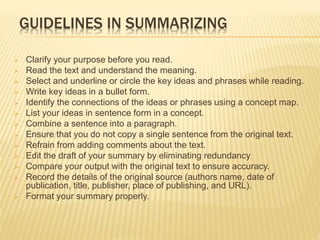
GUIDELINES IN SUMMARIZING
 Clarify your purpose before you read.
 Read the text and understand the meaning.
 Select and underline or circle the key ideas and phrases while reading.
 Write key ideas in a bullet form.
 Identify the connections of the ideas or phrases using a concept map.
 List your ideas in sentence form in a concept.
 Combine a sentence into a paragraph.
 Ensure that you do not copy a single sentence from the original text.
 Refrain from adding comments about the text.
 Edit the draft of your summary by eliminating redundancy
 Compare your output with the original text to ensure accuracy.
 Record the details of the original source (authors name, date of
publication, title, publisher, place of publishing, and URL).
 Format your summary properly.
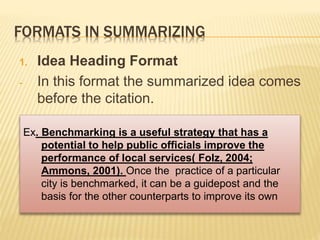
FORMATS IN SUMMARIZING
1. Idea Heading Format
- In this format the summarized idea comes
before the citation.
Ex. Benchmarking is a useful strategy that has a
potential to help public officials improve the
performance of local services( Folz, 2004;
Ammons, 2001). Once the practice of a particular
city is benchmarked, it can be a guidepost and the
basis for the other counterparts to improve its own
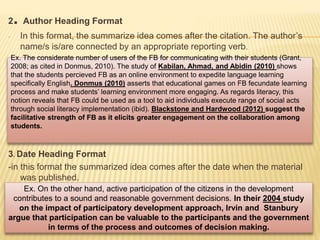
2. Author Heading Format
- In this format, the summarize idea comes after the citation. The author’s
name/s is/are connected by an appropriate reporting verb.
3. Date Heading Format
-in this format the summarized idea comes after the date when the material
was published.
Ex. The considerate number of users of the FB for communicating with their students (Grant,
2008; as cited in Donmus, 2010). The study of Kabilan, Ahmad, and Abidin (2010) shows
that the students percieved FB as an online environment to expedite language learning
specifically English. Donmus (2010) asserts that educational games on FB fecundate learning
process and make students’ learning environment more engaging. As regards literacy, this
notion reveals that FB could be used as a tool to aid individuals execute range of social acts
through social literacy implementation (ibid). Blackstone and Hardwood (2012) suggest the
facilitative strength of FB as it elicits greater engagement on the collaboration among
students.
Ex. On the other hand, active participation of the citizens in the development
contributes to a sound and reasonable government decisions. In their 2004 study
on the impact of participatory development approach, Irvin and Stanbury
argue that participation can be valuable to the participants and the government
in terms of the process and outcomes of decision making.
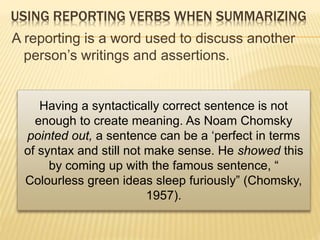
USING REPORTING VERBS WHEN SUMMARIZING
A reporting is a word used to discuss another
person’s writings and assertions.
Having a syntactically correct sentence is not
enough to create meaning. As Noam Chomsky
pointed out, a sentence can be a ‘perfect in terms
of syntax and still not make sense. He showed this
by coming up with the famous sentence, “
Colourless green ideas sleep furiously” (Chomsky,
1957).
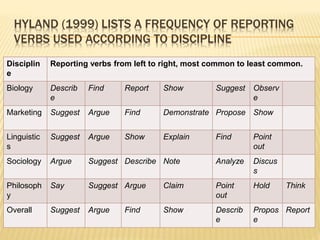
HYLAND (1999) LISTS A FREQUENCY OF REPORTING
VERBS USED ACCORDING TO DISCIPLINE
Disciplin
e
Reporting verbs from left to right, most common to least common.
Biology Describ
e
Find Report Show Suggest Observ
e
Marketing Suggest Argue Find Demonstrate Propose Show
Linguistic
s
Suggest Argue Show Explain Find Point
out
Sociology Argue Suggest Describe Note Analyze Discus
s
Philosoph
y
Say Suggest Argue Claim Point
out
Hold Think
Overall Suggest Argue Find Show Describ
e
Propos
e
Report
THANK YOU FOR
LISTENING!!!!

Basics summarizing

  • 2.
    Activity: Question??? When readerssummarize, What will they capture in the text?
  • 3.
    Summarize what this painting is about.TheHarvesters by Pieter Bruegel
  • 4.
    Summaries are nota place for…  Opinions  Background knowledge  Personal information
  • 5.
    WHAT IS SUMMARIZING? -ISUSED TO DETERMINE THE ESSENTIAL IDEAS IN A BOOK, ARTICLE, BOOK CHAPTER, AN ARTICLES OR PARTS OF THE ARTICLE Summarizing is an important skill because it helps you:  Deepen your understanding of the text  Learn to identify relevant information or key ideas  Combine details or examples that support main idea/s  Concentrate on the gist or main idea and key words presented in the text  Capture the key ideas in the text and put them together clearly and concisely
  • 6.
    WHAT IS NOTSUMMARIZING?
  • 7.
    GUIDELINES IN SUMMARIZING Clarify your purpose before you read.  Read the text and understand the meaning.  Select and underline or circle the key ideas and phrases while reading.  Write key ideas in a bullet form.  Identify the connections of the ideas or phrases using a concept map.  List your ideas in sentence form in a concept.  Combine a sentence into a paragraph.  Ensure that you do not copy a single sentence from the original text.  Refrain from adding comments about the text.  Edit the draft of your summary by eliminating redundancy  Compare your output with the original text to ensure accuracy.  Record the details of the original source (authors name, date of publication, title, publisher, place of publishing, and URL).  Format your summary properly.
  • 8.
    FORMATS IN SUMMARIZING 1.Idea Heading Format - In this format the summarized idea comes before the citation. Ex. Benchmarking is a useful strategy that has a potential to help public officials improve the performance of local services( Folz, 2004; Ammons, 2001). Once the practice of a particular city is benchmarked, it can be a guidepost and the basis for the other counterparts to improve its own
  • 9.
    2. Author HeadingFormat - In this format, the summarize idea comes after the citation. The author’s name/s is/are connected by an appropriate reporting verb. 3. Date Heading Format -in this format the summarized idea comes after the date when the material was published. Ex. The considerate number of users of the FB for communicating with their students (Grant, 2008; as cited in Donmus, 2010). The study of Kabilan, Ahmad, and Abidin (2010) shows that the students percieved FB as an online environment to expedite language learning specifically English. Donmus (2010) asserts that educational games on FB fecundate learning process and make students’ learning environment more engaging. As regards literacy, this notion reveals that FB could be used as a tool to aid individuals execute range of social acts through social literacy implementation (ibid). Blackstone and Hardwood (2012) suggest the facilitative strength of FB as it elicits greater engagement on the collaboration among students. Ex. On the other hand, active participation of the citizens in the development contributes to a sound and reasonable government decisions. In their 2004 study on the impact of participatory development approach, Irvin and Stanbury argue that participation can be valuable to the participants and the government in terms of the process and outcomes of decision making.
  • 10.
    USING REPORTING VERBSWHEN SUMMARIZING A reporting is a word used to discuss another person’s writings and assertions. Having a syntactically correct sentence is not enough to create meaning. As Noam Chomsky pointed out, a sentence can be a ‘perfect in terms of syntax and still not make sense. He showed this by coming up with the famous sentence, “ Colourless green ideas sleep furiously” (Chomsky, 1957).
  • 11.
    HYLAND (1999) LISTSA FREQUENCY OF REPORTING VERBS USED ACCORDING TO DISCIPLINE Disciplin e Reporting verbs from left to right, most common to least common. Biology Describ e Find Report Show Suggest Observ e Marketing Suggest Argue Find Demonstrate Propose Show Linguistic s Suggest Argue Show Explain Find Point out Sociology Argue Suggest Describe Note Analyze Discus s Philosoph y Say Suggest Argue Claim Point out Hold Think Overall Suggest Argue Find Show Describ e Propos e Report
  • 12.