BASICS OF REPORT WRITING
TEAM 1 PGDM 12’14
Anju
Aishwarya
Neeru
Amit
Ajay
REPORT WRITING - MEANING
WHAT IS A REPORT ?
 Assessment of a situation or results from data analysis

 Precise, concise and succinct (to the point)
 Tightly focused

Era Business School
Era Business School
Ajay K Raina

Ajay K Raina
WHAT IS A REPORT?
 A document in which a given problem is examined, for the

purpose of conveying information & findings, putting
forward ideas first & sometimes making recommendations.

Era Business School
Era Business School
Ajay K Raina

Ajay K Raina
Preparation before writing:
 Define the problem, purpose, scope and ask:
 What is wanted?
 How much?
 Why?
 When?

This will determine the purpose that can be written in one clear
statement.

Era Business School
Era Business School
Ajay K Raina

Ajay K Raina
Determining the report’s scope
 Common fault of many reports - making the scope of a

report too general or too vague
 After choosing the subject is to narrow the scope to the
report’s length
 Scope is determined by the factors you will study
 Limit amount of information to the most needed and most
important factors

Era Business School
Era Business School
Ajay K Raina

Ajay K Raina
STEPS FOR WRITING REPORTS…..
 Make an initial plan

 Locate your information and take notes
 Prepare the first draft
 Evaluate your draft carefully

Era Business School
Era Business School
Ajay K Raina

Ajay K Raina
Era Business School
Ajay K Raina
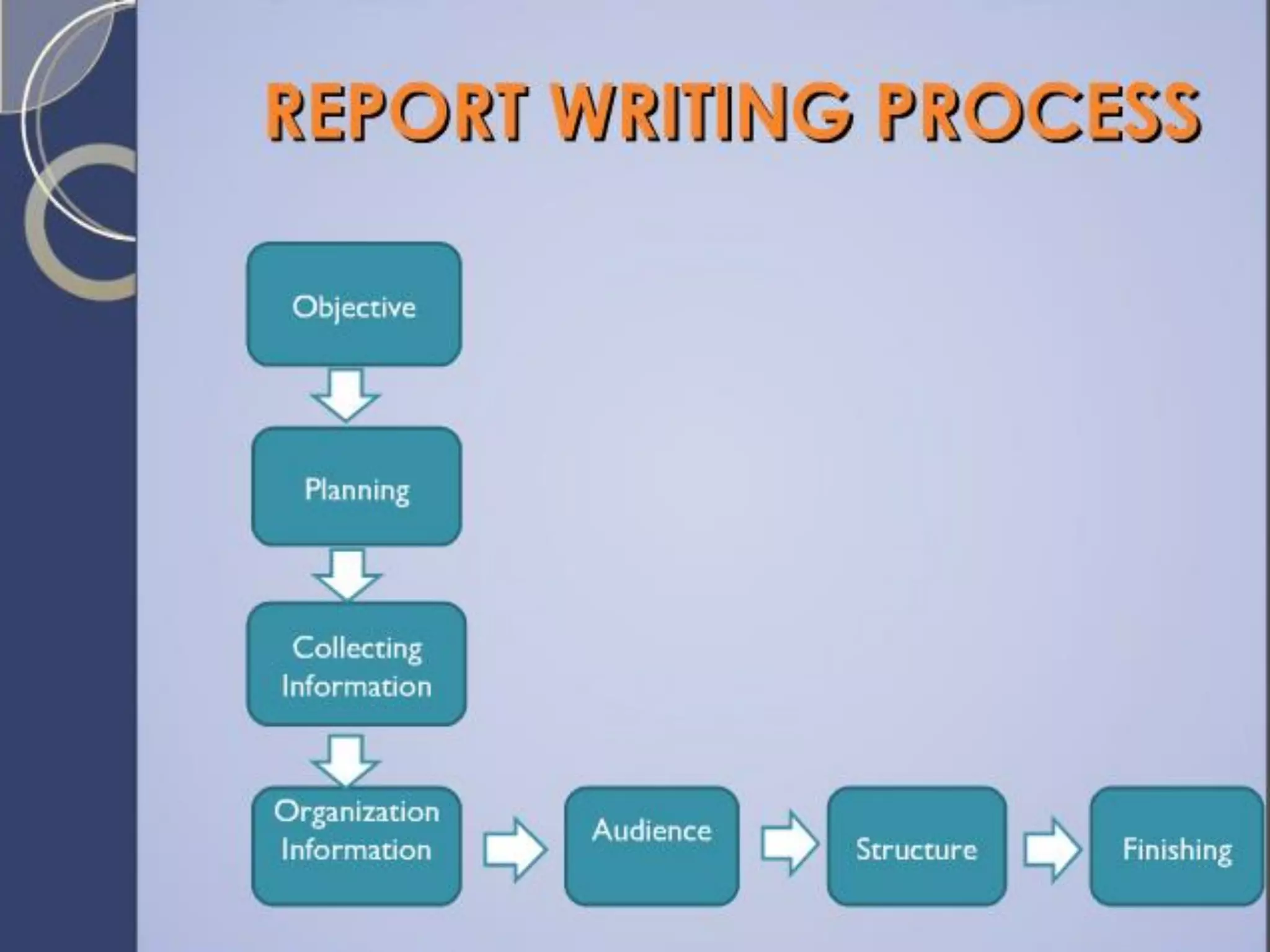
THE OBJECTIVE…
 It defines the scope of our investigation

 Identify the purpose
 To inform
 To convince

Era Business School
Era Business School
Ajay K Raina

Ajay K Raina
Planning your report
 How much time do you have to write the report?

 How can your work be divided into stages?
 Set yourself deadlines for the various stages?

Era Business School
Era Business School
Ajay K Raina

Ajay K Raina
Collecting information
 What is the information you need?

 Where do you find it?
 Survey
 Organizations

 Online
 Publications

How much do you need?

Era Business School
Era Business School
Ajay K Raina

Ajay K Raina
Organizing Information
 Discriminate between relevant and irrelevant information

 Sort/ organize information under main ideas/ details

Era Business School
Era Business School
Ajay K Raina

Ajay K Raina
Analyse your information
 After gathering info, you need to analyse it
 The purpose of the analysis is to make sense objectively, out

of the information you have gathered
 Avoid personal bias of any kind entering into analysis

Era Business School
Era Business School
Ajay K Raina

Ajay K Raina
Characteristics of report
 Reader-centered beginning and ending

 Objectivity
 Time consistency
 Present

 Past

 Transition
 Interest

 Personal and impersonal writing

Era Business School
Era Business School
Ajay K Raina

Ajay K Raina
Wording of Headings
 Parallel Construction: Equal level headings should be in the

same grammatical format—for example, all noun phrases, all
sentences, or all truncated (headline-style) sentences.
 Conciseness in Wording: Headings should be as short as
possible while still conveying clear meaning
 Variety of Expression: Replace monotonous repetitions
of words in topic headings with a variety of words.

Era Business School
Era Business School
Ajay K Raina

Ajay K Raina
Write the Report
 Put the report in context with your beginning and ending.

 Be objective.
 Believability
 Impersonal vs. personal writing

 Maintain a consistent time viewpoint.
 Use smooth transitions.
 Maintain interest.

Era Business School
Era Business School
Ajay K Raina

Ajay K Raina
Beginnings and Endings
 A good beginning . . .
 states the subject of the report
 reveals what kind of data it is based upon
 indicates its likely significance to the reader

 A good ending . . .
 may summarize; or summarize and interpret; or summarize,

interpret, and recommend—depending on the reader
 must make the informational “gist” clear
 must make the contents’ significance clear

Era Business School
Era Business School
Ajay K Raina

Ajay K Raina
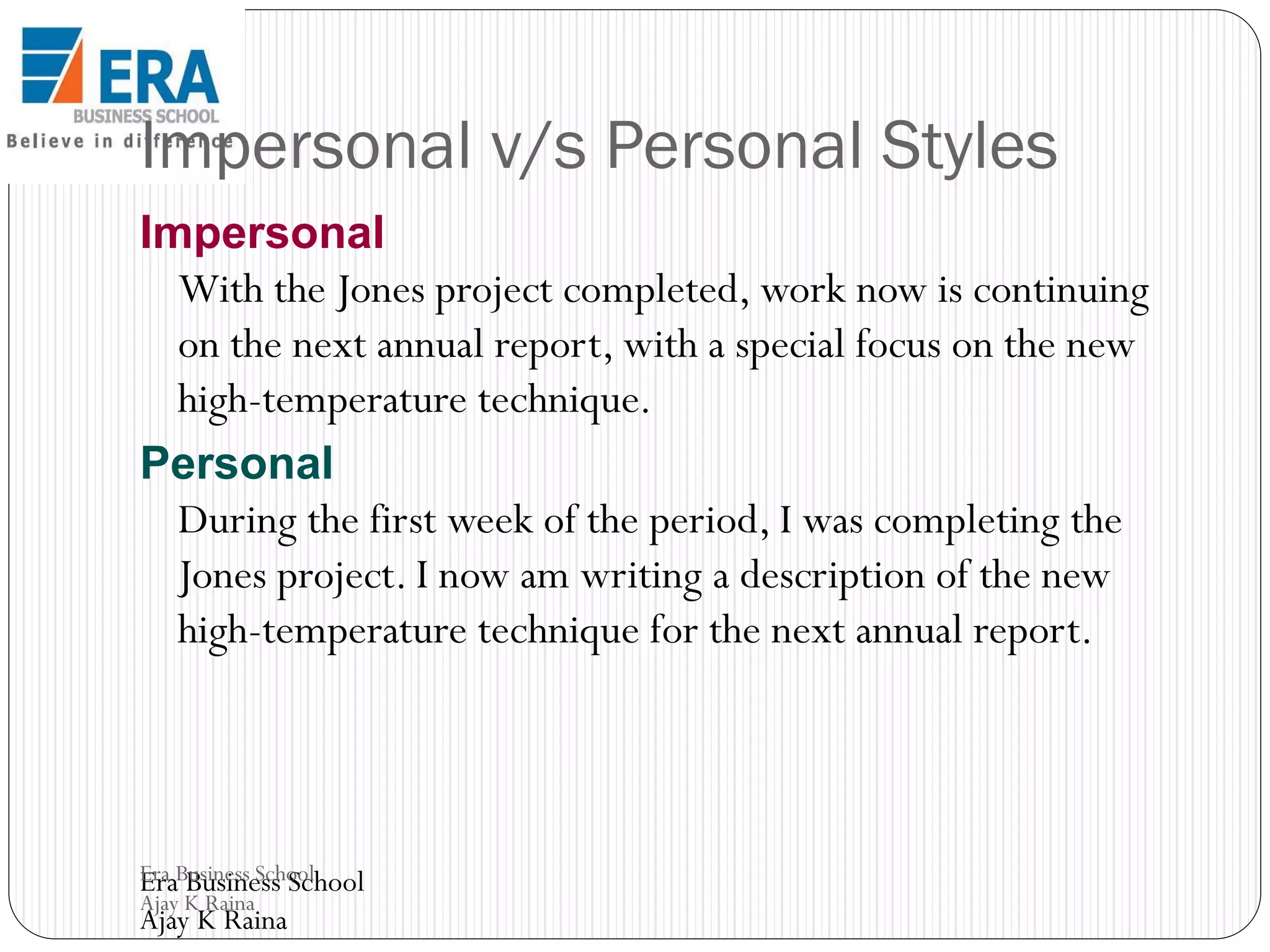
Impersonal v/s Personal Styles
Impersonal
With the Jones project completed, work now is continuing
on the next annual report, with a special focus on the new
high-temperature technique.
Personal
During the first week of the period, I was completing the
Jones project. I now am writing a description of the new
high-temperature technique for the next annual report.

Era Business School
Era Business School
Ajay K Raina

Ajay K Raina
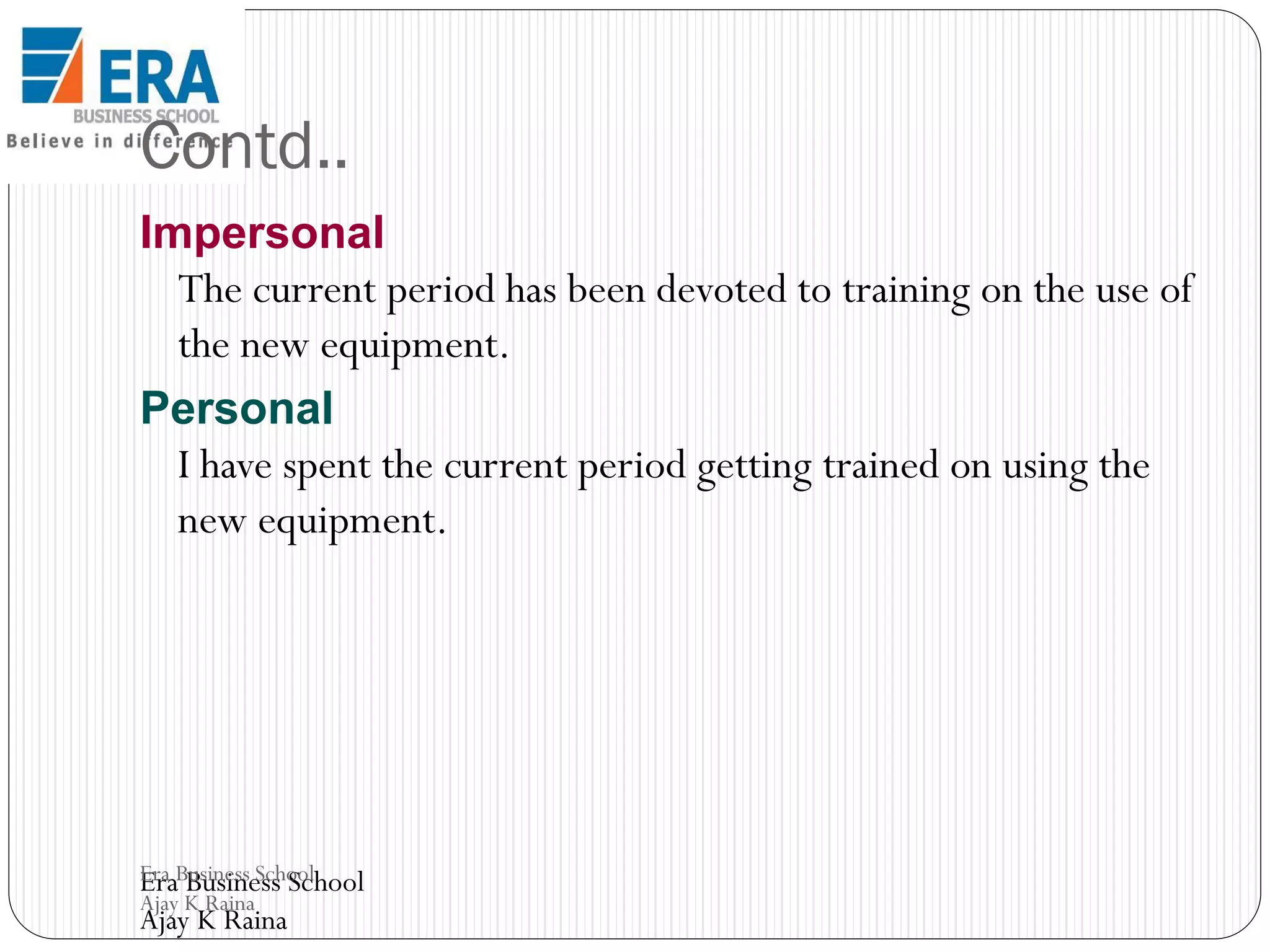
Contd..
Impersonal
The current period has been devoted to training on the use of
the new equipment.
Personal
I have spent the current period getting trained on using the
new equipment.

Era Business School
Era Business School
Ajay K Raina

Ajay K Raina
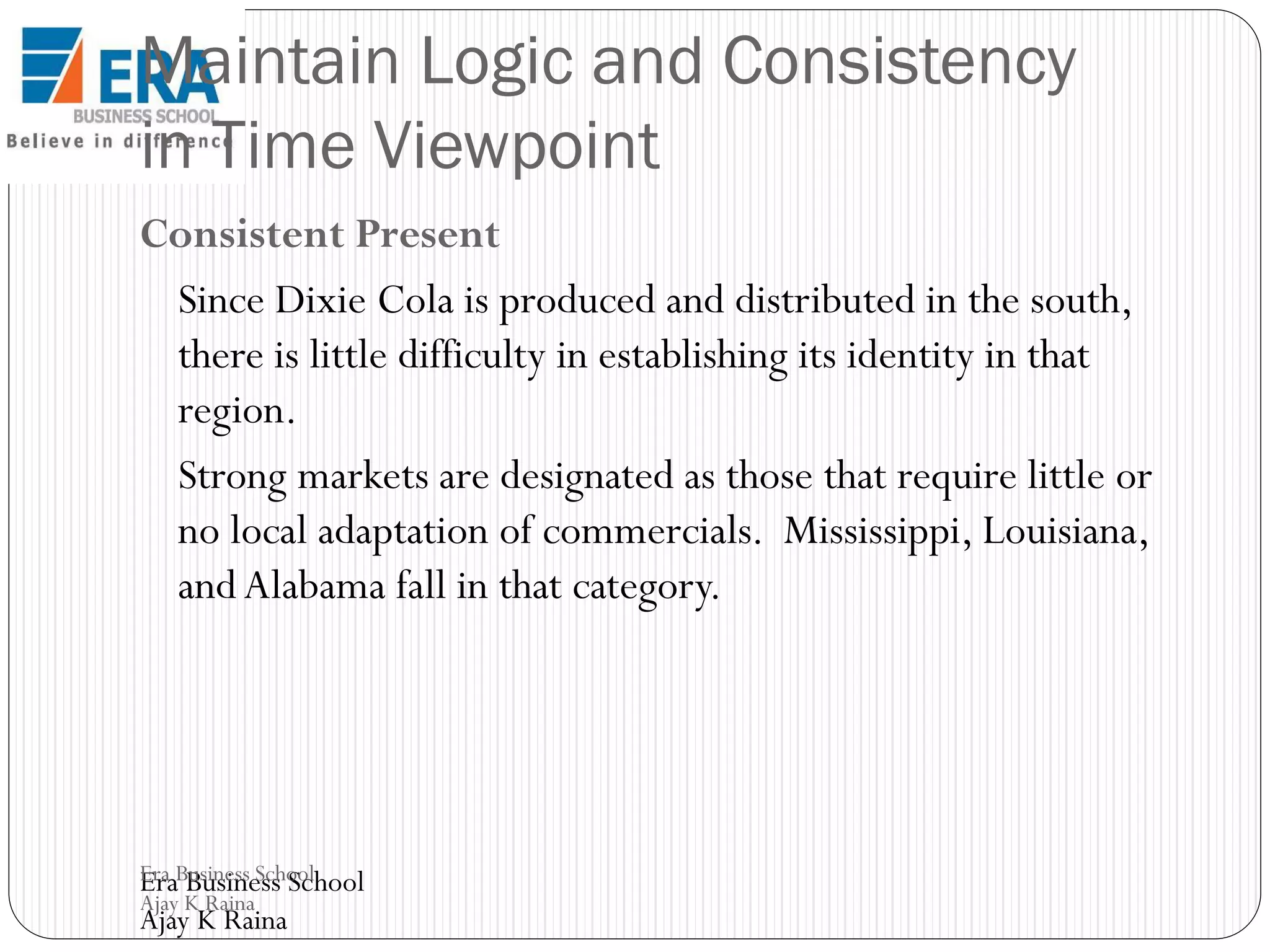
Maintain Logic and Consistency
in Time Viewpoint
Consistent Present
Since Dixie Cola is produced and distributed in the south,
there is little difficulty in establishing its identity in that
region.
Strong markets are designated as those that require little or
no local adaptation of commercials. Mississippi, Louisiana,
and Alabama fall in that category.

Era Business School
Era Business School
Ajay K Raina

Ajay K Raina
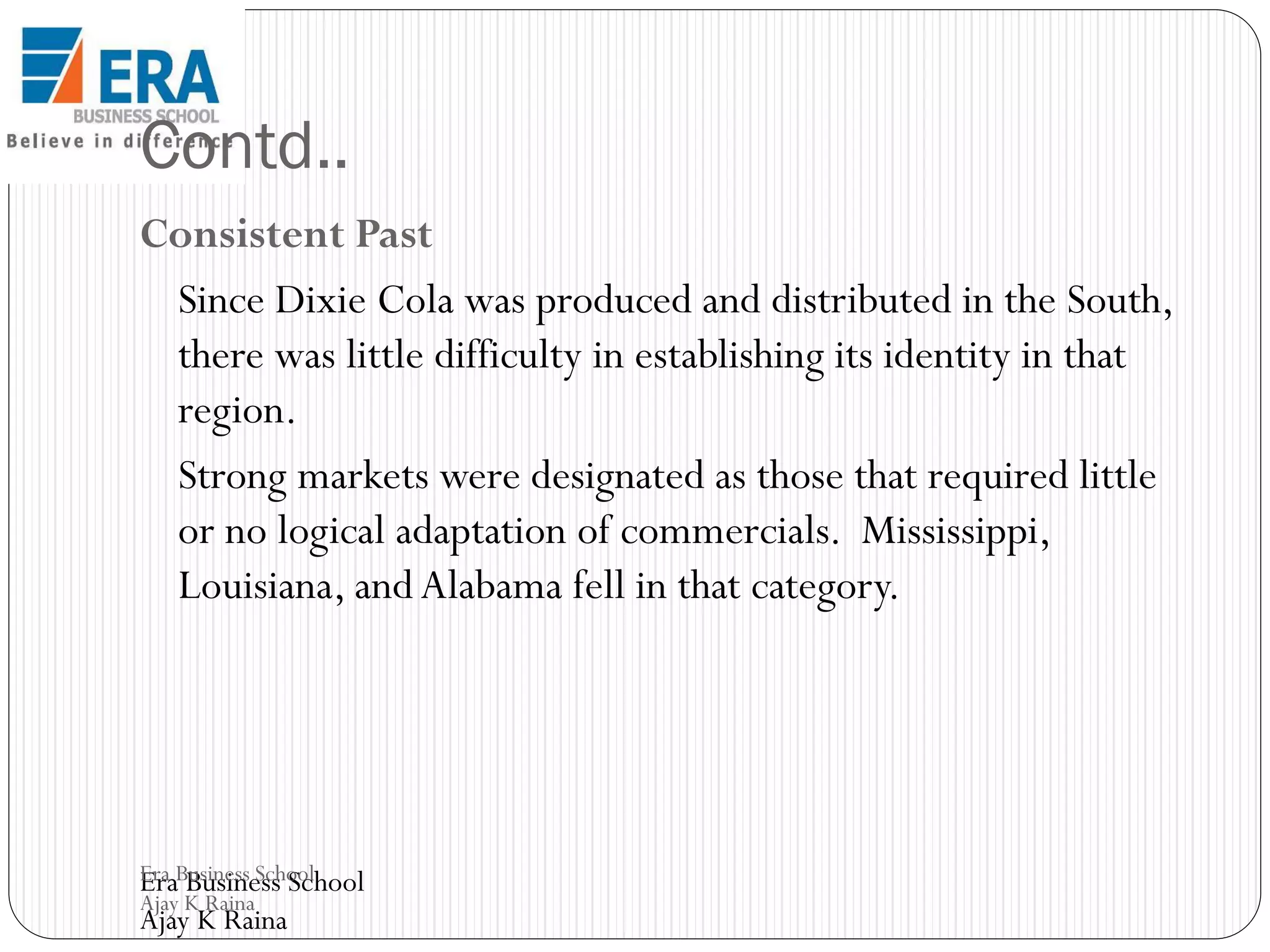
Contd..
Consistent Past
Since Dixie Cola was produced and distributed in the South,
there was little difficulty in establishing its identity in that
region.
Strong markets were designated as those that required little
or no logical adaptation of commercials. Mississippi,
Louisiana, and Alabama fell in that category.

Era Business School
Era Business School
Ajay K Raina

Ajay K Raina
Need for transition
 Transition means “bridging across”

 Transitions are used to connect the parts of the report
 For connecting large parts, transition sentences may be used
 Transitional words show relationships between lesser parts

Era Business School
Era Business School
Ajay K Raina

Ajay K Raina
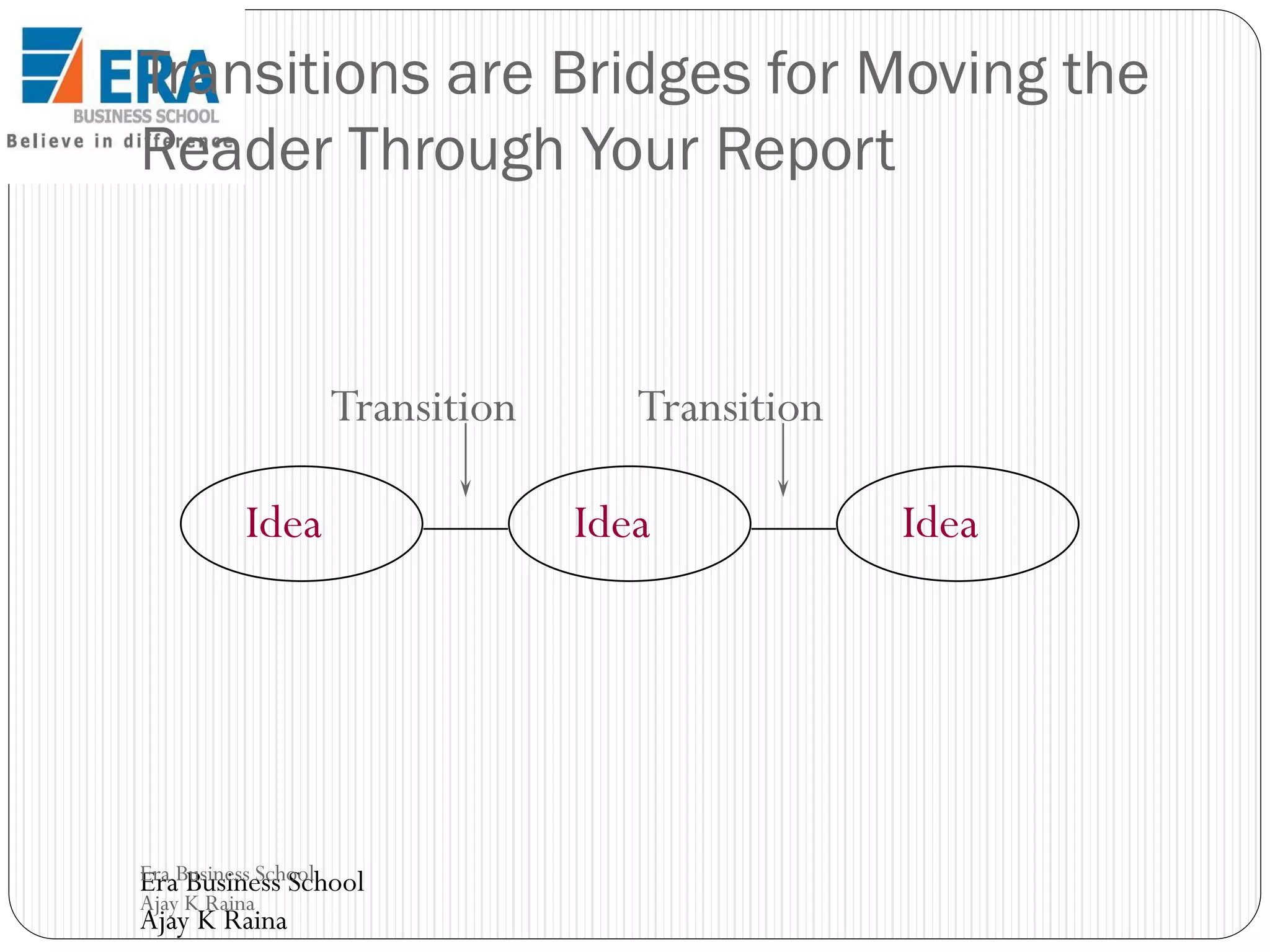
Transitions are Bridges for Moving the
Reader Through Your Report

Transition
Idea

Era Business School
Era Business School
Ajay K Raina

Ajay K Raina

Transition
Idea

Idea
Language
 Present facts as they are

 Paragraph length about 7 type written lines
 All paragraphs should have topic sentence as the opening line








even if there is a heading
Apply the seven Cs
Sentences averaging 16-20 words
Concrete nouns
Few adverbs & adjectives
Generally written in past tense

Era Business School
Era Business School
Ajay K Raina

Ajay K Raina
Maintaining interest
 Interesting writing is necessary for good communication

 Attention should be on main information
 Use concrete words and active-voice verbs
 Avoid rubber stamp jargon
 Select words carefully.
 Watch the rhythm of expression.
 Stress content over techniques.
 Be complete without using more words than necessary.

Era Business School
Era Business School
Ajay K Raina

Ajay K Raina
Thank You

Era Business School
Ajay K Raina

Basics of report writing

  • 1.
    BASICS OF REPORTWRITING TEAM 1 PGDM 12’14 Anju Aishwarya Neeru Amit Ajay
  • 2.
    REPORT WRITING -MEANING WHAT IS A REPORT ?  Assessment of a situation or results from data analysis  Precise, concise and succinct (to the point)  Tightly focused Era Business School Era Business School Ajay K Raina Ajay K Raina
  • 3.
    WHAT IS AREPORT?  A document in which a given problem is examined, for the purpose of conveying information & findings, putting forward ideas first & sometimes making recommendations. Era Business School Era Business School Ajay K Raina Ajay K Raina
  • 4.
    Preparation before writing: Define the problem, purpose, scope and ask:  What is wanted?  How much?  Why?  When? This will determine the purpose that can be written in one clear statement. Era Business School Era Business School Ajay K Raina Ajay K Raina
  • 5.
    Determining the report’sscope  Common fault of many reports - making the scope of a report too general or too vague  After choosing the subject is to narrow the scope to the report’s length  Scope is determined by the factors you will study  Limit amount of information to the most needed and most important factors Era Business School Era Business School Ajay K Raina Ajay K Raina
  • 6.
    STEPS FOR WRITINGREPORTS…..  Make an initial plan  Locate your information and take notes  Prepare the first draft  Evaluate your draft carefully Era Business School Era Business School Ajay K Raina Ajay K Raina
  • 7.
  • 8.
    THE OBJECTIVE…  Itdefines the scope of our investigation  Identify the purpose  To inform  To convince Era Business School Era Business School Ajay K Raina Ajay K Raina
  • 9.
    Planning your report How much time do you have to write the report?  How can your work be divided into stages?  Set yourself deadlines for the various stages? Era Business School Era Business School Ajay K Raina Ajay K Raina
  • 10.
    Collecting information  Whatis the information you need?  Where do you find it?  Survey  Organizations  Online  Publications How much do you need? Era Business School Era Business School Ajay K Raina Ajay K Raina
  • 11.
    Organizing Information  Discriminatebetween relevant and irrelevant information  Sort/ organize information under main ideas/ details Era Business School Era Business School Ajay K Raina Ajay K Raina
  • 12.
    Analyse your information After gathering info, you need to analyse it  The purpose of the analysis is to make sense objectively, out of the information you have gathered  Avoid personal bias of any kind entering into analysis Era Business School Era Business School Ajay K Raina Ajay K Raina
  • 13.
    Characteristics of report Reader-centered beginning and ending  Objectivity  Time consistency  Present  Past  Transition  Interest  Personal and impersonal writing Era Business School Era Business School Ajay K Raina Ajay K Raina
  • 14.
    Wording of Headings Parallel Construction: Equal level headings should be in the same grammatical format—for example, all noun phrases, all sentences, or all truncated (headline-style) sentences.  Conciseness in Wording: Headings should be as short as possible while still conveying clear meaning  Variety of Expression: Replace monotonous repetitions of words in topic headings with a variety of words. Era Business School Era Business School Ajay K Raina Ajay K Raina
  • 15.
    Write the Report Put the report in context with your beginning and ending.  Be objective.  Believability  Impersonal vs. personal writing  Maintain a consistent time viewpoint.  Use smooth transitions.  Maintain interest. Era Business School Era Business School Ajay K Raina Ajay K Raina
  • 16.
    Beginnings and Endings A good beginning . . .  states the subject of the report  reveals what kind of data it is based upon  indicates its likely significance to the reader  A good ending . . .  may summarize; or summarize and interpret; or summarize, interpret, and recommend—depending on the reader  must make the informational “gist” clear  must make the contents’ significance clear Era Business School Era Business School Ajay K Raina Ajay K Raina
  • 17.
    Impersonal v/s PersonalStyles Impersonal With the Jones project completed, work now is continuing on the next annual report, with a special focus on the new high-temperature technique. Personal During the first week of the period, I was completing the Jones project. I now am writing a description of the new high-temperature technique for the next annual report. Era Business School Era Business School Ajay K Raina Ajay K Raina
  • 18.
    Contd.. Impersonal The current periodhas been devoted to training on the use of the new equipment. Personal I have spent the current period getting trained on using the new equipment. Era Business School Era Business School Ajay K Raina Ajay K Raina
  • 19.
    Maintain Logic andConsistency in Time Viewpoint Consistent Present Since Dixie Cola is produced and distributed in the south, there is little difficulty in establishing its identity in that region. Strong markets are designated as those that require little or no local adaptation of commercials. Mississippi, Louisiana, and Alabama fall in that category. Era Business School Era Business School Ajay K Raina Ajay K Raina
  • 20.
    Contd.. Consistent Past Since DixieCola was produced and distributed in the South, there was little difficulty in establishing its identity in that region. Strong markets were designated as those that required little or no logical adaptation of commercials. Mississippi, Louisiana, and Alabama fell in that category. Era Business School Era Business School Ajay K Raina Ajay K Raina
  • 21.
    Need for transition Transition means “bridging across”  Transitions are used to connect the parts of the report  For connecting large parts, transition sentences may be used  Transitional words show relationships between lesser parts Era Business School Era Business School Ajay K Raina Ajay K Raina
  • 22.
    Transitions are Bridgesfor Moving the Reader Through Your Report Transition Idea Era Business School Era Business School Ajay K Raina Ajay K Raina Transition Idea Idea
  • 23.
    Language  Present factsas they are  Paragraph length about 7 type written lines  All paragraphs should have topic sentence as the opening line      even if there is a heading Apply the seven Cs Sentences averaging 16-20 words Concrete nouns Few adverbs & adjectives Generally written in past tense Era Business School Era Business School Ajay K Raina Ajay K Raina
  • 24.
    Maintaining interest  Interestingwriting is necessary for good communication  Attention should be on main information  Use concrete words and active-voice verbs  Avoid rubber stamp jargon  Select words carefully.  Watch the rhythm of expression.  Stress content over techniques.  Be complete without using more words than necessary. Era Business School Era Business School Ajay K Raina Ajay K Raina
  • 25.
    Thank You Era BusinessSchool Ajay K Raina