Basics of Mechanical
Ventilation
Hooman Poor
123
Basics of Mechanical
Ventilation
Freemedicalbooks4download
Hooman Poor
Basics of Mechanical
Ventilation
ISBN 978-3-319-89980-0    ISBN 978-3-319-89981-7 (eBook)
https://doi.org/10.1007/978-3-319-89981-7
Library of Congress Control Number: 2018944605
© Springer International Publishing AG, part of Springer Nature 2018
Thisworkissubjecttocopyright.Allrightsare reservedby thePublisher,whether
the whole or part of the material is concerned, specifically the rights of transla-
tion, reprinting, reuse of illustrations, recitation, broadcasting, reproduction on
microfilms or in any other physical way,and transmission or information storage
and retrieval, electronic adaptation, computer software, or by similar or dissimi-
lar methodology now known or hereafter developed.
The use of general descriptive names, registered names, trademarks, service
marks, etc. in this publication does not imply, even in the absence of a specific
statement, that such names are exempt from the relevant protective laws and
regulations and therefore free for general use.
The publisher,the authors and the editors are safe to assume that the advice and
information in this book are believed to be true and accurate at the date of pub-
lication. Neither the publisher nor the authors or the editors give a warranty,
express or implied,with respect to the material contained herein or for any errors
or omissions that may have been made. The publisher remains neutral with
regard to jurisdictional claims in published maps and institutional affiliations.
Printed on acid-free paper
This Springer imprint is published by the registered company Springer
International Publishing AG part of Springer Nature
The registered company address is: Gewerbestrasse 11, 6330 Cham, Switzerland
Hooman Poor
Mount Sinai – National Jewish Health Respiratory Institute
Icahn School of Medicine
New York, NY
USA
Freemedicalbooks4download
Dedicated to Conner, Ellery, and Alden
vii
Preface
Mechanical ventilators can be mysterious and intimidating.
When using the ventilator, one is taking on the responsibility
of breathing for another human being. Mechanical ventila-
tion is one of the most complex and integral aspects of critical
care medicine.
As a pulmonary and critical care physician, I have taught
mechanical ventilation to many medical students, residents,
and fellows. During these teaching sessions, I have encoun-
tered many shared misconceptions about how ventilators
work. Much of this misunderstanding stems from the fact that
the current nomenclature used in mechanical ventilation is
inconsistent and confusing. My hope is that this book clarifies
the fundamental concepts of mechanical ventilation.
The ventilator does not function in isolation—it works in
concert with the patient’s respiratory system. One cannot
simply set the ventilator and walk away. Instead, it is impor-
tant to monitor and adjust the ventilator settings based upon
the complex interactions between the ventilator and the
patient. Proper ventilator management is not merely a set of
prescriptive steps; ventilator settings must be individually and
continuously tailored to each patient and unique situation.
Therefore, an in-depth understanding of how a ventilator
operates is essential to achieving increased patient comfort
and optimal patient outcomes.
Learning how to manage patients on ventilators can be
daunting. While there are many excellent, comprehensive
Freemedicalbooks4download
viii
textbooks on mechanical ventilation, these tomes can be
overwhelming to even the most dedicated students.The avail-
able “shorter” books are insufficient as they often glance over
crucial basic principles. As is the case with learning medicine
in general, it is more effective to understand the foundational
concepts than to simply memorize algorithms. This book
delves into those foundational concepts, and does so clearly
and succinctly.
This book is written for anyone who cares for patients
requiring mechanical ventilation—physicians, nurses, respira-
tory therapists—and is intended for providers at all levels of
training. It provides the nuts and bolts of how to properly
manage the ventilator and serves as a practical resource in
the intensive care unit in order to better care for critically ill
patients.
New York, NY, USA Hooman Poor
Preface
Contents
1	Respiratory Mechanics . . . . . . . . . . . . . . . . . . . . . . . . . 	1
Lung Volume . . . . . . . . . . . . . . . . . . . . . . . . . . . . . . . . 	1
Transpulmonary Pressure . . . . . . . . . . . . . . . . . . . . . . 	2
Spontaneous Breathing . . . . . . . . . . . . . . . . . . . . . . . 	3
Modeling the Respiratory System . . . . . . . . . . . . . . . 	7
Suggested Readings  . . . . . . . . . . . . . . . . . . . . . . . . . . 	10
2	Phase Variables . . . . . . . . . . . . . . . . . . . . . . . . . . . . . . . 	11
Anatomy of a Breath . . . . . . . . . . . . . . . . . . . . . . . . . 	11
Trigger  . . . . . . . . . . . . . . . . . . . . . . . . . . . . . . . . . . . . . 	12
Target . . . . . . . . . . . . . . . . . . . . . . . . . . . . . . . . . . . . . . 	18
Cycle . . . . . . . . . . . . . . . . . . . . . . . . . . . . . . . . . . . . . . . 	25
Baseline . . . . . . . . . . . . . . . . . . . . . . . . . . . . . . . . . . . . 	26
Suggested Readings  . . . . . . . . . . . . . . . . . . . . . . . . . . 	27
3	
Basic Modes of Ventilation . . . . . . . . . . . . . . . . . . . . . 	29
Volume-Controlled Ventilation . . . . . . . . . . . . . . . . . 	29
Pressure-Controlled Ventilation . . . . . . . . . . . . . . . . 	30
Pressure Support Ventilation . . . . . . . . . . . . . . . . . . . 	33
Volume-Controlled Ventilation Vs.
Pressure-­Controlled Ventilation . . . . . . . . . . . . . . . . 	35
Pressure-Controlled Ventilation Vs. Pressure
Support Ventilation . . . . . . . . . . . . . . . . . . . . . . . . . . . 	37
Suggested Readings  . . . . . . . . . . . . . . . . . . . . . . . . . . 	38
4	
Monitoring Respiratory Mechanics . . . . . . . . . . . . . . 	39
Two-Component Model . . . . . . . . . . . . . . . . . . . . . . . 	39
Airway Pressures . . . . . . . . . . . . . . . . . . . . . . . . . . . . . 	42
ix
Freemedicalbooks4download
x
Diagnostic Algorithm . . . . . . . . . . . . . . . . . . . . . . . . . 	44
Suggested Readings  . . . . . . . . . . . . . . . . . . . . . . . . . . 	48
5	
Acute Respiratory Distress Syndrome . . . . . . . . . . . . 	49
Volutrauma  . . . . . . . . . . . . . . . . . . . . . . . . . . . . . . . . . 	50
Barotrauma . . . . . . . . . . . . . . . . . . . . . . . . . . . . . . . . . 	51
Atelectrauma . . . . . . . . . . . . . . . . . . . . . . . . . . . . . . . . 	52
Permissive Hypercapnia . . . . . . . . . . . . . . . . . . . . . . . 	55
Suggested Readings  . . . . . . . . . . . . . . . . . . . . . . . . . . 	60
6	
Obstructive Lung Diseases  . . . . . . . . . . . . . . . . . . . . . 	61
Breath Stacking and Auto-PEEP . . . . . . . . . . . . . . . 	61
Ventilator Management Strategies . . . . . . . . . . . . . . 	68
Suggested Readings  . . . . . . . . . . . . . . . . . . . . . . . . . . 	73
7	Patient-Ventilator Dyssynchrony . . . . . . . . . . . . . . . . 	75
Trigger-Related Dyssynchrony . . . . . . . . . . . . . . . . . 	75
Target-Related Dyssynchrony . . . . . . . . . . . . . . . . . . 	88
Cycle-Related Dyssynchrony  . . . . . . . . . . . . . . . . . . 	89
Suggested Readings  . . . . . . . . . . . . . . . . . . . . . . . . . . 	93
8	Indications for Mechanical Ventilation . . . . . . . . . . . 	95
Increased Work of Breathing  . . . . . . . . . . . . . . . . . . 	95
Increased Demand . . . . . . . . . . . . . . . . . . . . . . . . . . . 	98
Neuromuscular Weakness . . . . . . . . . . . . . . . . . . . . . 	100
Alveolar Hypoventilation . . . . . . . . . . . . . . . . . . . . . 	100
Hypoxemia . . . . . . . . . . . . . . . . . . . . . . . . . . . . . . . . . . 	101
Airway Protection . . . . . . . . . . . . . . . . . . . . . . . . . . . . 	102
Suggested Readings  . . . . . . . . . . . . . . . . . . . . . . . . . . 	103
9	Weaning from the Ventilator . . . . . . . . . . . . . . . . . . . . 	105
Assessing Readiness to Wean . . . . . . . . . . . . . . . . . . 	105
Spontaneous Breathing Trial . . . . . . . . . . . . . . . . . . . 	106
Cuff Leak Test . . . . . . . . . . . . . . . . . . . . . . . . . . . . . . . 	112
Suggested Readings  . . . . . . . . . . . . . . . . . . . . . . . . . . 	114
10	
Hemodynamic Effects of Mechanical Ventilation . . 	115
Cardiopulmonary System . . . . . . . . . . . . . . . . . . . . . . 	115
Intrathoracic Pressure . . . . . . . . . . . . . . . . . . . . . . . . .	117
Preload . . . . . . . . . . . . . . . . . . . . . . . . . . . . . . . . . . . . . 	118
Afterload . . . . . . . . . . . . . . . . . . . . . . . . . . . . . . . . . . . 	119
Specific Hemodynamic Conditions . . . . . . . . . . . . . .	123
Suggested Readings  . . . . . . . . . . . . . . . . . . . . . . . . . . 	127
Index . . . . . . . . . . . . . . . . . . . . . . . . . . . . . . . . . . . . . . . . . . . 	129
Contents
1
© Springer International Publishing AG,
part of Springer Nature 2018
H. Poor, Basics of Mechanical Ventilation,
https://doi.org/10.1007/978-3-319-89981-7_1
Understanding mechanical ventilation must start with a
review of the physiology and mechanics of normal spontane-
ous breathing. Spontaneous breathing is defined as move-
ment of air into and out of the lungs as a result of work done
by an individual’s respiratory muscles. Positive pressure
­ventilation, on the other hand, is defined as movement of air
into the lungs by the application of positive pressure to the
airway through an endotracheal tube, tracheostomy tube, or
noninvasive mask.
Lung Volume
The lungs sit inside a chest cavity surrounded by the chest
wall.The potential space between the lungs and the chest wall
is known as the pleural space. The lungs, composed of elastic
tissue, have a tendency to recoil inward, and the chest wall has
a tendency to spring outward. If the lungs were removed from
the chest cavity and were no longer being influenced by the
chest wall or the pleural space, they would collapse like a
deflated balloon. Similarly, removing the lungs from the chest
cavity would cause the chest wall, no longer being influenced
by the lungs or the pleural space, to spring outward.The equi-
librium achieved between the lungs’ inward recoil and the
Chapter 1
Respiratory Mechanics
Freemedicalbooks4download
2
chest wall’s outward recoil determines lung volume at the
end of expiration.As a result of the coupling of the lungs and
the chest wall, pressure in the pleural space, known as pleural
pressure (Ppl
), is less than atmospheric pressure at the end of
expiration.This subatmospheric pleural pressure prevents the
chest wall from springing outward and the lungs from collaps-
ing inward (Fig. 1.1).
Transpulmonary Pressure
For a given lung volume at equilibrium, the forces pushing the
alveolar walls outward must equal the forces pushing the
alveolar walls inward.The expanding outward force is ­
alveolar
Chest wall
recoil
Pleural
space
Lung
recoil
Figure 1.1  Chest wall springing outward and lung recoiling inward.
Because of these opposing forces, the pleural space has subatmo-
spheric pressure at the end of expiration.
Key Concept #1
Balance between lung recoil inward and chest wall
recoil outward determines lung volume at end of
expiration
Chapter 1.  Respiratory Mechanics
3
pressure (Palv
). The collapsing inward forces are pleural pres-
sure and lung elastic recoil pressure (Pel
). The difference
between alveolar pressure and pleural pressure, known as
transpulmonary pressure (Ptp
), is equal and opposite to lung
elastic recoil pressure for a given lung volume (Fig. 1.2).
Transpulmonary pressure determines lung volume.
Increasing transpulmonary pressure increases the outward
distending pressure of the lung, resulting in a larger lung vol-
ume. Thus, the lungs can be inflated either by decreasing
pleural pressure, as occurs in spontaneous breathing, or by
increasing alveolar pressure, as occurs in positive pressure
ventilation (Fig. 1.3).
The relationship between the transpulmonary pressure
and lung volume is not linear, but rather curvilinear, because
as lung volume increases, the lungs become stiffer and less
compliant. That is, larger increases in transpulmonary pres-
sure are necessary to achieve the same increase in lung vol-
ume at higher lung volume than at lower lung volume.
Similarly,increasing transpulmonary pressure by a set amount
will lead to a larger increase in lung volume at lower lung
volume than at higher lung volume (Fig. 1.4).
Spontaneous Breathing
Inspiration
During spontaneous breathing, inspiration occurs by decreas-
ing pleural pressure, which increases transpulmonary pressure
Key Concept #2
•	 To inflate lungs, Ptp
must increase
•	 Ptp
 = Palv
− Ppl
•	 To increase Ptp
, either decrease Ppl
(spontaneous
breathing) or increase Palv
(positive pressure
ventilation)
Spontaneous Breathing
Freemedicalbooks4download
4
Ppl
Palv = Ppl + Pel
Pel
Palv
a
b
Ptp = Palv – Ppl
Ppl
Palv Ptp
Figure 1.2  (a)At equilibrium,the sum of the expanding outward forces
must equal the sum of the collapsing inward forces at equilibrium.
Therefore,alveolar pressure equals the sum of pleural pressure and lung
elastic recoil pressure. (b) Transpulmonary pressure is the difference
between alveolar pressure and pleural pressure. It is equal and opposite
to lung elastic recoil pressure for a given lung volume (Ptp
 = −Pel
).
Palv
alveolar pressure; Pel
lung elastic recoil pressure; Ppl
pleural pres-
sure; Ptp
transpulmonary pressure
Chapter 1.  Respiratory Mechanics
5
(remember Ptp
 = Palv
− Ppl
). Under normal conditions, alveolar
pressure is equal to atmospheric pressure at the end of expira-
tion. During inspiration, the diaphragm and other inspiratory
muscles contract, pushing the abdominal contents downward
and the rib cage upward and outward, ultimately increasing
intrathoracic volume. Boyle’s law states that, for a fixed
Ppl
Palv
↓Ppl
Inflation by
decreasing Ppl
(spontaneous breathing)
Inflation by
increasing Palv
(positive pressure ventilation)
Palv
Ppl
↑Palv
Figure 1.3  Lung inflation occurs either by decreasing pleural pres-
sure (spontaneous breathing) or by increasing alveolar pressure
(positive pressure ventilation). In both cases, transpulmonary pres-
sure increases.
Palv
alveolar pressure; Ppl
pleural pressure
Spontaneous Breathing
Freemedicalbooks4download
6
amount of gas kept at constant temperature, pressure and
volume are inversely proportional (pressure  =  1/volume).
Thus,this increase in intrathoracic volume results in a decrease
in intrathoracic pressure and therefore a decrease in pleural
pressure. Decreased pleural pressure increases transpulmo-
nary pressure and causes the lungs to inflate. This increase in
lung volume, as explained by Boyle’s law, results in a decrease
in alveolar pressure, making it lower than atmospheric pres-
sure. Because gas flows from regions of higher pressure to
regions of lower pressure, air flows into the lungs until alveo-
lar pressure equals atmospheric pressure.
Expiration
Quiet expiration is passive. That is, no active contraction of
respiratory muscles is required for expiration to occur.The dia-
phragm and inspiratory muscles relax, the abdominal contents
∆P
∆P
∆V
Transpulmonary pressure
Lung
volume ∆V
Figure 1.4  Relationship between lung volume and transpulmonary
pressure. For a given increase in transpulmonary pressure (ΔP), the
resultant increase in lung volume (ΔV) is greater at lower lung vol-
ume, where the lung is more compliant, than at higher lung volume.
Chapter 1.  Respiratory Mechanics
7
return to their previous position, and the chest wall recoils,
ultimately resulting in a decrease in intrathoracic volume. The
decrease in intrathoracic volume results in an increase in intra-
thoracic pressure and thus an increase in pleural pressure.
Increased pleural pressure decreases transpulmonary pressure
and causes the lungs to deflate. This decrease in lung volume
results in an increase in alveolar pressure, making it higher than
atmospheric pressure. Because of this pressure gradient, air
flows out of the lungs until alveolar pressure equals atmo-
spheric pressure.

Modeling the Respiratory System
The flow of air in and out of the lungs can be modeled in a
manner similar to an electrical circuit using Ohm’s law, where
the voltage (V) across a resistor is equal to the electric cur-
rent (I) multiplied by the electrical resistance (R). The differ-
ence between proximal airway pressure (Pair
) measured at the
mouth and alveolar pressure (Palv
) is analogous to the voltage
difference within a circuit. Similarly, flow (Q) and airway
resistance (R) in the respiratory system are analogous to the
electric current and electrical resistance in the circuit, respec-
tively (Fig. 1.5).
The equation for the respiratory system can be rearranged
to solve for flow:
	
Q
P P
R
=
-
air alv
	
By convention, flow into the patient (inspiration) is desig-
nated as positive, and flow out of the patient (expiration) is
designated as negative. Note that when proximal airway pres-
sure equals alveolar pressure, there is no flow present in
either direction (Q = 0). Under normal conditions, this sce-
nario occurs twice during the breathing cycle, at the end of
expiration and at the end of inspiration.
Modeling the Respiratory System
Freemedicalbooks4download
8
With spontaneous breathing, proximal airway pressure is
equal to atmospheric pressure. During inspiration, the dia-
phragm and other inspiratory muscles contract, which
increases lung volume and decreases alveolar pressure, as
previously discussed. This process results in alveolar pressure
being less than proximal airway pressure, which remains at
atmospheric pressure. Therefore, flow will become a positive
value, indicating that air flows into the patient. During expira-
tion, alveolar pressure is higher than proximal airway pres-
sure, which makes flow a negative value, indicating that air
flows out of the patient.
With positive pressure ventilation, as occurs with mechani-
cal ventilation, the ventilator increases proximal airway pres-
sure during inspiration. This increase in proximal airway
pressure relative to alveolar pressure results in a positive
value for flow, causing air to flow into the patient. Expiration
Q
Pair
I
R
R
V
V = I x R
Palv
Pair = Q x R
– Palv
Figure 1.5 The respiratory system modeled as an electrical circuit.
I electric current; Pair
proximal airway pressure; Palv
alveolar pres-
sure; Q flow; R resistance; V voltage
Chapter 1.  Respiratory Mechanics
9
with positive pressure ventilation is passive and occurs in a
manner  similar to that which occurs in spontaneous
breathing.
The sequence of events for inspiration is different for
spontaneous breathing than for positive pressure ventilation.
In spontaneous breathing, increased intrathoracic volume
leads to decreased alveolar pressure, which leads to air flow-
ing into the patient because of the pressure gradient. With
positive pressure ventilation, increased proximal airway pres-
sure leads to air flowing into the patient, which, because of
Boyle’s law, results in an increase in lung volume (Fig. 1.6).
Spontaneous ventilation Positive pressure ventilation
Inspiratory muscles contract Ventilator increases proximal
airway pressure
↑ Intrathoracic volume
↓ Intrathoracic pressure ↑ Alveolar pressure
↓ Alveolar pressure
Air flows into lungs until
alveolar pressure
equals atmospheric pressure
↓ Pleural pressure ↑ Transpulmonary pressure
↑ Transpulmonary pressure ↑ Lung volume
↑ Lung volume
Air flows into lungs
Figure 1.6 Sequence of events during inspiration for spontaneous
breathing and positive pressure ventilation.
Modeling the Respiratory System
Freemedicalbooks4download
10
Suggested Readings
	
1.	 Cairo J. Pilbeam’s mechanical ventilation: physiological and clini-
cal applications. 5th ed. St. Louis: Mosby; 2012.
	
2.	 Costanzo L. Physiology. 5th ed. Beijing: Saunders; 2014.
	
3.	 Rhoades R, Bell D.  Medical physiology: principles for clinical
medicine. 4th ed. Philadelphia: Lippincott Williams  Wilkins;
2013.
	
4.	 Broaddus V, Ernst J. Murray and Nadel’s textbook of respiratory
medicine. 5th ed. Philadelphia: Saunders; 2010.
	5.	 West J. Respiratory physiology:the essentials.9th ed.Philadelphia:
Lippincott Williams  Wilkins; 2012.
Key Concept #3
•	 Inspiration with spontaneous breathing: Palv
made
lower than atmospheric pressure to suck air into
lungs
•	 Inspiration with positive pressure ventilation: Pair
made higher than atmospheric pressure to push air
into lungs
Chapter 1.  Respiratory Mechanics
11
© Springer International Publishing AG,
part of Springer Nature 2018
H. Poor, Basics of Mechanical Ventilation,
https://doi.org/10.1007/978-3-319-89981-7_2
A ventilator is a machine that delivers a flow of gas for a
certain amount of time by increasing proximal airway pres-
sure, a process which culminates in a delivered tidal volume.
Because of the imprecise, inconsistent, and outdated termi-
nology used to describe modern ventilators, many clinicians
often misunderstand exactly how a ventilator functions.
Understanding the exact instructions that a ventilator follows
to deliver a breath for the various modes of ventilation is
crucial for optimal ventilator management.
Anatomy of a Breath
Breathing is a periodic event, composed of repeated cycles of
inspiration and expiration. Each breath, defined as one cycle
of inspiration followed by expiration, can be broken down
into four components, known as phase variables.These phase
variables determine when inspiration begins (trigger), how
flow is delivered during inspiration (target), when inspiration
ends (cycle), and proximal airway pressure during expiration
(baseline) (Fig. 2.1).
Chapter 2
Phase Variables
Freemedicalbooks4download
12
Trigger
The trigger variable determines when to initiate inspiration.
Breaths can either be ventilator-triggered or patient-triggered.
Ventilator-triggered breaths use time as the trigger variable.
Patient-triggered breaths are initiated by patient respiratory
efforts, utilizing pressure or flow for the trigger variable.
Time Trigger
With time triggering, the ventilator initiates a breath after a
set amount of time has elapsed since the initiation of the pre-
vious breath.The most common manner to set the time trigger
is by setting the respiratory rate (time = 1/rate). For example,
Trigger
Inspiration Expiration
Target Baseline
Cycle
Figure 2.1  Schematic of a breath cycle. The trigger variable deter-
mines when expiration ends and inspiration begins. The cycle vari-
able determines when inspiration ends and expiration begins. The
target variable determines flow during inspiration. The baseline
variable determines proximal airway pressure during expiration.
Key Concept #1
Ventilator phase variables:
•	 Trigger: when inspiration begins
•	 Target: how flow is delivered during inspiration
•	 Cycle: when inspiration ends
•	 Baseline: proximal airway pressure during
expiration
Chapter 2.  Phase Variables
13
setting the ventilator respiratory rate to 12 breaths per minute
is equivalent to setting the time trigger to 5 seconds because
one breath every 5 seconds will result in 12 breaths per min-
ute.When a breath is initiated by a time ­
trigger, that breath is
classified as a ventilator-triggered, or control, breath.
Patient Trigger
Changes in pressure and flow in the circuit as a result of
patient respiratory efforts are detected by the ventilator.
When the patient makes an inspiratory effort, as discussed in
Chap. 1, the diaphragm and inspiratory muscles contract, low-
ering pleural pressure, which ultimately reduces proximal
airway pressure. This reduced airway pressure is transmitted
along the ventilator tubing and measured by the ventilator. If
a pressure trigger is set and the magnitude of the reduction in
proximal airway pressure as measured by the ventilator is
greater than the set pressure trigger, a breath will be initiated
and delivered by the ventilator (Fig. 2.2).
For flow-triggering, a continuous amount of gas flows from
the inspiratory limb of the ventilator to the expiratory limb of
the ventilator during the expiratory (baseline) phase. This
flow is continuously measured by the ventilator. In the
absence of any patient inspiratory efforts, the flow of gas
leaving the ventilator through the inspiratory limb should
equal the flow of gas returning to the ventilator through the
expiratory limb. During a patient inspiratory effort, some of
this flow will enter the patient instead of returning to the
ventilator, and the ventilator will detect decreased flow into
the expiratory limb. If this reduction in flow returning to the
ventilator exceeds the set flow trigger, a breath will be initi-
ated and delivered by the ventilator (Fig. 2.3).
Key Concept #2
•	 Control breath = ventilator-triggered breath
•	 Trigger variable for control breath = time
Trigger
Freemedicalbooks4download
14
PATIENT Pair = –3 cm H2O Pair = –3 cm H2O
Pair = –3 cm H2O
Pair = –3 cm H2O
Expiratory
limb
V
E
N
T
I
L
A
T
O
R
Endotracheal
tube
Inspiratory
limb
PATIENT Pair = 0 cm H2O Pair = 0 cm H2O
Pair = 0 cm H2O
Pair = 0 cm H2O
Expiratory
limb
V
E
N
T
I
L
A
T
O
R
Endotracheal
tube
Inspiratory
limb
a
b
Figure 2.2 Respiratory circuit demonstrating the pressure trigger
mechanism. (a) Assuming that no external positive end-expiratory
pressure is added, pressure in the respiratory circuit at baseline is
0 cm H2
O. (b) A patient’s inspiratory effort will cause a decrease in
the patient’s proximal airway pressure, leading to a decrease in air-
way pressure of the respiratory circuit, which can be detected by the
ventilator. In this example, pressure in the respiratory circuit has
decreased by 3 cm H2
O. If the pressure trigger threshold is set at
3 cm H2
O or less, this inspiratory effort would trigger the ventilator
to deliver a breath.
Pair
proximal airway pressure
Chapter 2.  Phase Variables
15
PATIENT
Expiratory
limb
V
E
N
T
I
L
A
T
O
R
Endotracheal
tube
Inspiratory
limb
PATIENT
Expiratory
limb
V
E
N
T
I
L
A
T
O
R
Endotracheal
tube
Inspiratory
limb
10 L/min
10 L/min
a
b 7 L/min
3 L/min
10 L/min
Figure 2.3  Respiratory circuit demonstrating the flow trigger mech-
anism. (a) A continuous amount of gas flows from the inspiratory
limb to the expiratory limb of the ventilator. In this example, the
continuous gas flow is 10 L/min. (b) A patient’s inspiratory effort will
cause some of the flow to enter the patient instead of returning to the
ventilator. In this example, 3 L/min of flow is entering the patient,
resulting in 3 L/min less flow returning to the ventilator. If the flow
trigger threshold is set at 3 L/min or less, this inspiratory effort would
trigger the ventilator to deliver a breath.
Trigger
Freemedicalbooks4download
16
When a breath is initiated by a pressure or flow trigger, that
breath is classified as a patient-triggered, or assist, breath.The
difference between pressure and flow triggers in modern ven-
tilators is generally clinically insignificant. A patient can trig-
ger the ventilator only during the expiratory (baseline) phase.
Patient respiratory efforts during inspiration after a breath has
been initiated will not trigger another breath.
Assist-Control
A patient trigger (assist) and a ventilator trigger (control) can
be combined to create a hybrid trigger mode known as assist-­
control (A/C). With this hybrid trigger, both a control respira-
tory rate (time trigger) and either a pressure or flow trigger are
set. If an amount of time as set by the time trigger has elapsed
without a patient-triggered breath, the ventilator will initiate a
“control” breath. However, if the patient triggers the ventila-
tor, via the pressure or flow trigger, prior to elapsing of the
time trigger, the ventilator will initiate an “assist” breath and
the time trigger clock will reset. It is important to note that
there are no differences in the other characteristics of a breath
(i.e., target, cycle, and baseline) between a time-­
triggered “con-
trol” breath and a patient-triggered “assist” breath. “Assist”
and “control” only describe whether the breath was triggered
by the patient or by the ventilator, respectively.
Key Concept #3
•	 Assist breath = patient-triggered breath
•	 Trigger variable for assist breath = pressure or flow
Key Concept #4
•	 A/C combines two triggers: patient trigger (assist)
and ventilator trigger (control)
•	 A/C refers only to the trigger, not to other phase
variables
Chapter 2.  Phase Variables
17
Many ventilators indicate whether the delivered breath
was a “control” or “assist” breath, often with a flashing “A” or
“C” on the display. Additionally, one can determine whether
a delivered breath was a “control” or “assist” breath by
­
examining the pressure curve on the ventilator screen.
Patient-­
triggered “assist” breaths will have a negative deflec-
tion on the pressure curve right before inspiration, whereas
time-­
triggered “control” breaths will not.A downward deflec-
tion of the pressure tracing for patient-triggered breaths is
reflective of the patient inspiratory effort, resulting in a
reduction in proximal airway pressure (Fig. 2.4).
The actual respiratory rate of the ventilator will depend on
the relationship between the time-triggered control rate and
the rate of inspiratory effort by the patient. Assuming the
intrinsic breathing pattern of the patient is regular, if the time
trigger is set such that the control rate is 10 breaths per min-
ute (one breath every 6  seconds), and the rate of patient
inspiratory efforts is 20 breaths per minute (one breath every
3  seconds), then all of the breaths will be “assist” breaths
because the patient will trigger the ventilator prior to the
Downward deflection
in pressure tracing
Time
Control breath Assist breath
Proximal
airway
pressure
Figure 2.4 Pressure tracing demonstrating a ventilator-triggered
“control” breath and a patient-triggered “assist” breath. Proximal
airway pressure is plotted on the vertical (y) axis, and time is plotted
on the horizontal (x) axis. Note the downward deflection in the pres-
sure tracing prior to the assist breath, indicating that a patient inspi-
ratory effort triggered the ventilator.
Trigger
Freemedicalbooks4download
18
time trigger elapsing. Therefore, the actual respiratory rate
will be 20 breaths per minute. In this case, increasing the con-
trol respiratory rate on the ventilator from 10 to 15 breaths
per minute (reducing the time trigger from 6 to 4 seconds)
will have no effect on the respiratory rate if the patient con-
tinues to trigger the ventilator every 3  seconds. However,
increasing the set respiratory rate to above 20 breaths per
minute (decreasing the time trigger to below 3 seconds) will
result in all of the breaths being time-triggered control
breaths.The set time-triggered respiratory rate is essentially a
“backup” rate—if the patient does not trigger the ventilator
at a frequency higher than the backup rate, the ventilator will
deliver time-triggered control breaths at the set backup respi-
ratory rate.
Most ventilators display the actual respiratory rate. If the
actual respiratory rate is higher than the time-triggered “con-
trol” respiratory rate, there must be patient-triggered “assist”
breaths present. For patients with irregular breathing pat-
terns where the time between patient inspiratory efforts var-
ies, there can be a combination of patient-triggered “assist”
breaths and time-triggered “control” breaths.
Target
The target variable is probably the most misunderstood of
the phase variables. Part of this confusion arises from the fact
that other names are commonly used for this variable, includ-
ing “control” and “limit.”
The target variable regulates how flow is administered
during inspiration.The variables most commonly used for the
target include flow and pressure. Volume, specifically tidal
volume, is technically not a target variable because it does not
clarify how the flow is to be delivered—setting a tidal volume
does not determine whether that volume is to be delivered
over a short period of time (high flow rate) or a long period
of time (low flow rate). Note that volume delivered per unit
time, which is the definition of flow, is a target variable.
Chapter 2.  Phase Variables
19
The equation from Chap. 1 relating flow, pressure, and
resistance of the respiratory system helps elucidate the role of
the target variable:
	
Q
P P
R
=
-
air alv
	
Q = flow
Pair
 = proximal airway pressure
Palv
 = alveolar pressure
R = airway resistance
The target variable is the independent variable in this
equation, its value set by the provider and dutifully achieved
by the ventilator. The target can be either flow or proximal
airway pressure, but not both at the same time. When either
flow or proximal airway pressure is set by the ventilator as
the target variable, the other variable becomes a dependent
variable, its value determined by the target variable, resis-
tance, and alveolar pressure.
Flow Target
With a flow target, flow is selected as the independent vari-
able. The ventilator simply delivers the flow as set by the
provider. Therefore, proximal airway pressure becomes
dependent on flow (target variable), resistance, and alveolar
pressure.The flow waveform pattern, which describes the pat-
tern of gas flow, is also selected. The most commonly used
flow waveforms are constant flow and decelerating ramp.
Key Concept #5
•	 Target variable can be flow or pressure
•	 Volume is not a target variable (but can be a cycle
variable)
Target
Freemedicalbooks4download
20
With the constant flow waveform pattern, also known as the
square or rectangle waveform pattern, the inspiratory flow
rate instantly rises to the set level and remains constant dur-
ing the inspiratory cycle.With the decelerating ramp ­waveform
pattern, the inspiratory flow rate is highest at the beginning
of inspiration, when patient flow demand is often greatest,
and then depreciates to zero flow (Fig. 2.5).
Pressure Target
With a pressure target, the proximal airway pressure is
selected as the independent variable. The ventilator delivers
flow to quickly achieve and maintain proximal airway pres-
sure during inspiration. Therefore, flow becomes dependent
on proximal airway pressure (target variable), resistance, and
alveolar pressure (Fig. 2.6).
Pressure-targeted modes naturally produce a decelerating
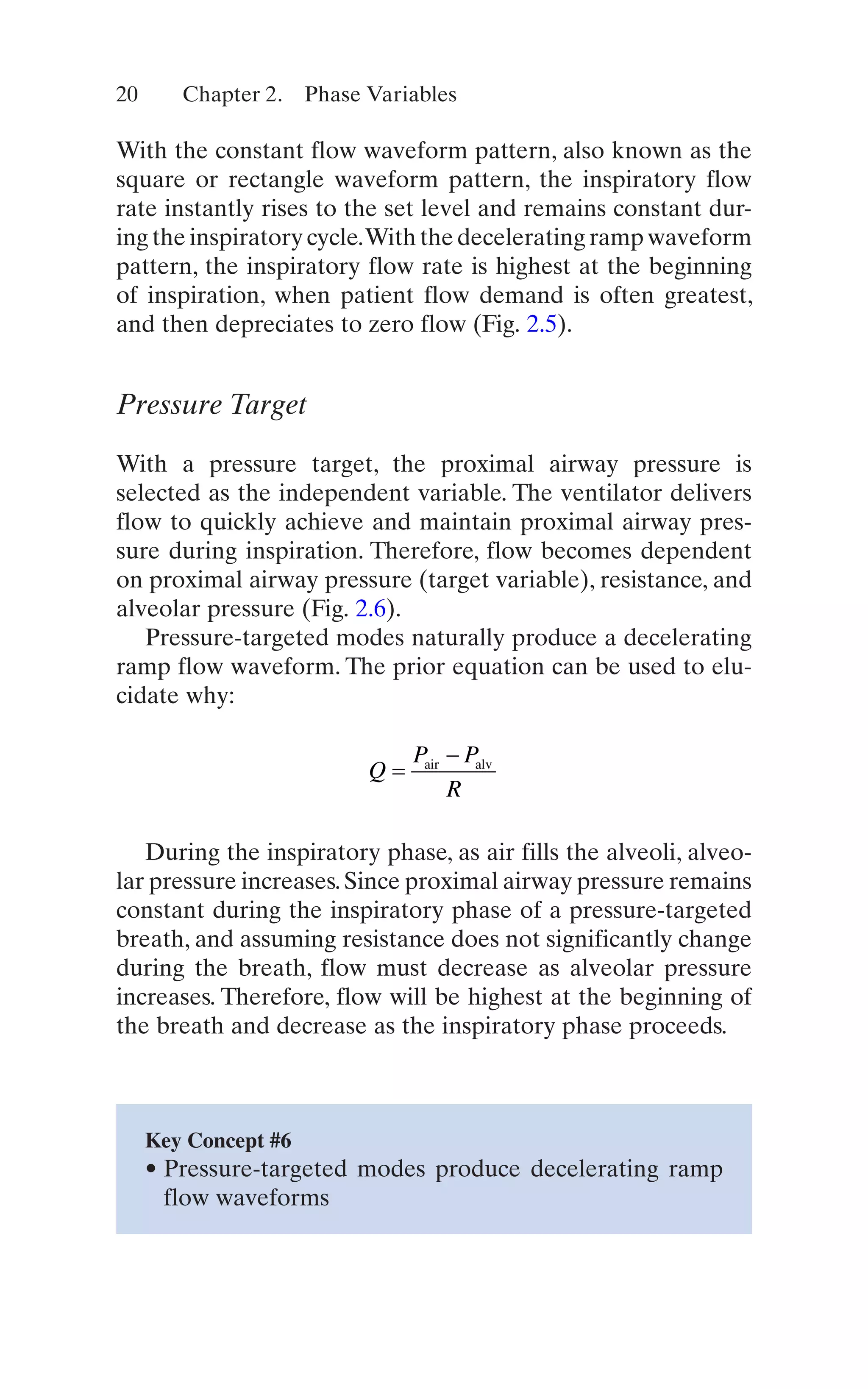
ramp flow waveform. The prior equation can be used to elu-
cidate why:
	
Q
P P
R
=
-
air alv
	
During the inspiratory phase, as air fills the alveoli, alveo-
lar pressure increases.Since proximal airway pressure remains
constant during the inspiratory phase of a pressure-targeted
breath, and assuming resistance does not significantly change
during the breath, flow must decrease as alveolar pressure
increases. Therefore, flow will be highest at the beginning of
the breath and decrease as the inspiratory phase proceeds.
Key Concept #6
• 
Pressure-targeted modes produce decelerating ramp
flow waveforms
Chapter 2.  Phase Variables
21

Flow Vs. Pressure Target
The difference between modes using flow and pressure targets
is most evident when there is a change in the respiratory sys-
tem, either because of a change in resistance or compliance or
Constant
flow
Decelerating
ramp
Time
Negative
Positive
Flow
0
Flow into the
patient
(inspiration)
Flow out of the
patient
(expiration)
Figure 2.5 Constant flow and decelerating ramp waveform pat-
terns. Flow is plotted on the vertical (y) axis, and time is plotted on
the horizontal (x) axis. Flow going into the patient (inspiration) is
denoted as positive flow, while flow coming out of the patient (expi-
ration) is denoted as negative flow.
Time
Inspiration
Proximal
airway
pressure
Figure 2.6  Pressure waveform. Proximal airway pressure is plotted
on the vertical (y) axis, and time is plotted on the horizontal (x) axis.
Note that proximal airway pressure is constant during inspiration.
Target
Freemedicalbooks4download
22
as a result of patient respiratory efforts.When a change in the
respiratory system occurs, the set target variable remains
unchanged, while the other, dependent variable changes, as
the ventilator cannot set both flow and proximal airway pres-
sure simultaneously.
To illustrate this difference, imagine two patients, Patient
A and Patient B, with identical respiratory systems receiving
mechanical ventilation (Fig.  2.7). Patient A has a flow-­
targeted mode, while Patient B has a pressure-targeted mode.
If the two patients bite their endotracheal tubes during the
inspiratory phase, each patient will experience an acute rise
in airway resistance. In this scenario, the two ventilator
modes will respond differently to the change in the respira-
tory system. For Patient A, since the target variable is flow,
flow remains unaffected, and higher proximal airway pres-
sure is required to maintain the set flow. For Patient B, since
the target variable is pressure, proximal airway pressure
remains unaffected, and lower flow is required to maintain
the set proximal airway pressure.
If, instead of biting the endotracheal tubes, the patients
make a sustained respiratory effort by contracting their inspi-
ratory muscles during inspiration, each patient will experi-
ence a decrease in alveolar pressure. In this scenario, the two
ventilator modes will again respond differently to the change
in the respiratory system. For Patient A, since the target vari-
able is flow, flow remains unaffected, and lower proximal
airway pressure is required to maintain the set flow. For
Patient B, since the target variable is pressure, proximal air-
way pressure remains unaffected, and higher flow is required
to maintain the set proximal airway pressure.
Key Concept #7
• 
Flow and proximal airway pressure cannot be set as
the target simultaneously
• 
When one variable is set as the target, the other will
vary with changes in the respiratory system
Chapter 2.  Phase Variables
23
Flow-targeted
(Patient A)
Unaffected
Q
↑Pair - Palv
↑R
=
Pressure-targeted
(Patient B)
Q =
Pair - Palv
Biting endotracheal tube
↑R
Q =
Pair - Palv
R
Unaffected
↓Q
Pair - Palv
↑R
=
Unaffected
Unaffected
Flow-targeted
(Patient A)
Q
↓Pair - ↓Palv
R
=
Pressure-targeted
(Patient B)
Q =
Pair - ↓Palv
Sustained inspiratory effort
R
Q =
Pair - Palv
R
↑Q
Pair - ↓Palv
R
=
a
b
Figure 2.7  Flow chart demonstrating the response of flow-targeted
and pressure-targeted modes to changes in the respiratory system.
(a) Biting of the endotracheal tube increases airway resistance. In
flow-targeted modes, because flow is set, it remains unaffected, and
therefore proximal airway pressure increases. In pressure-targeted
modes, because proximal airway pressure is set, it remains unaf-
fected, and therefore flow decreases. (b) Sustained inspiratory effort
by the patient reduces pleural pressure, which reduces alveolar pres-
sure. In flow-targeted modes, because flow is set, it remains unaf-
fected, and therefore proximal airway pressure decreases. In
pressure-targeted modes, because proximal airway pressure is set, it
remains unaffected, and therefore flow increases.
Pair
proximal airway pressure; Palv
alveolar pressure; Q flow; R resis-
tance
Target
Freemedicalbooks4download
24
Significant inspiratory efforts by a patient can be detected
in those receiving flow-targeted ventilation by examining the
pressure waveform. Because proximal airway pressure
decreases with inspiratory efforts, divots in the pressure
waveform during a flow-targeted mode are indicative of
patient inspiratory efforts (Fig. 2.8). It is important to note
that a patient, despite making inspiratory efforts that reduce
airway pressure, cannot trigger the ventilator during the
inspiratory phase. The patient can only trigger the ventilator
during the expiratory (baseline) phase.
No patient
inspiratory effort
Patient
inspiratory effort
Divot in pressure
waveform
Time
Proximal
airway
pressure
Time
Flow
Figure 2.8  Flow and pressure waveforms of a flow-targeted mode
demonstrating the response to a sustained patient inspiratory effort.
A patient inspiratory effort, which decreases alveolar pressure, will
not affect the flow waveform because the flow waveform is set in a
flow-targeted mode. Instead, there will be a decrease in proximal
airway pressure during the inspiratory effort, as represented by a
divot in the pressure waveform.
Chapter 2.  Phase Variables
25
Cycle
The cycle variable determines when to terminate the inspira-
tory phase of a breath. The term “to cycle” is synonymous
with “to terminate inspiration.” The variables most com-
monly used for the cycle include volume, time, and flow.
For volume-cycled breaths, the inspiratory phase continues
until a set volume has been delivered. For time-cycled
breaths, the inspiratory phase continues until a set time has
elapsed. For flow-cycled breaths, the inspiratory phase con-
tinues until the inspiratory flow diminishes to a set value.
Flow-cycling is most commonly utilized with pressure-­
targeted modes, where flow is delivered to maintain a speci-
fied airway pressure. As mentioned above, pressure-targeted
modes naturally produce a decelerating ramp flow waveform,
with flow highest at the beginning of the breath and decreas-
ing as the inspiratory phase proceeds. With flow-cycling, the
ventilator is set to terminate the breath when the inspiratory
flow diminishes to a selected percentage of the peak inspira-
tory flow. Increasing the percentage of the peak inspiratory
flow for cycling to occur decreases the inspiratory time and
vice versa (Fig. 2.9).
Pressure-cycling is not commonly used as an exclusive
cycling modality but is often employed in conjunction with
flow-targeted, volume-cycled modes as a safety mechanism to
prevent the generation of dangerously high airway pressures.
If excessively high airway pressures are reached before the
set tidal volume has been delivered, the pressure-cycling
mechanism will terminate inspiration.
Key Concept #8
• 
In a flow-targeted mode, divots in the pressure wave-
form indicate patient inspiratory efforts
Cycle
Freemedicalbooks4download
26
Proximal
airway
pressure
Time
Q =
Pair - Palv
R
Constant
a
Proximal
airway
pressure
Time
b
Flow
Time
Peak inspiratory
flow rate
25% of peak
inspiratory
flow rate
Flow
Time
Beginning of inspiration
- Low Palv
- High Q
End of inspiration
- High Palv
- Low Q
Figure 2.9 (a) Pressure and flow waveforms in a pressure-targeted
mode demonstrating a decelerating ramp flow waveform. With pres-
sure-targeted modes, proximal airway pressure is constant during the
inspiratory phase. As air fills the alveoli, alveolar pressure increases.
Assuming resistance does not significantly change, flow decreases as
inspiration progresses, producing a decelerating ramp flow waveform.
(b) Pressure and flow waveforms in a pressure-­
targeted, flow-cycled
mode. With a pressure-targeted mode, inspiratory flow is highest at
the beginning of inspiration, depreciating as inspiration continues.
With flow-cycling,the breath terminates once flow depreciates to a set
­
percentage of the peak inspiratory flow, in this case 25%.
Pair
proximal airway pressure; Palv
alveolar pressure; Q flow; R resis-
tance
Baseline
The baseline variable refers to the proximal airway pressure
during the expiratory phase. This pressure can be equal to
atmospheric pressure, known as zero end-expiratory pressure
(ZEEP), in which the ventilator allows for complete recoil of
Chapter 2.  Phase Variables
27
the lung and chest wall, or it can be held above atmospheric
pressure by the ventilator, known as positive end-expiratory
pressure (PEEP) (Fig. 2.10). The utility of PEEP will be dis-
cussed in Chap. 5 (Acute Respiratory Distress Syndrome)
and Chap. 6 (Obstructive Lung Diseases).
In the next chapter, these phase variables will be mixed
and matched to construct the common modes of ventilation.
Suggested Readings
	
1.	 Cairo J. Pilbeam’s mechanical ventilation: physiological and clini-
cal applications. 5th ed. St. Louis: Mosby; 2012.
	
2.	 Chatburn R. Classification of ventilator modes: update and pro-
posal for implementation. Respir Care. 2007;52:301–23.
	
3.	 Chatburn R, El-Khatib M, Mireles-Cabodevila E. A taxonomy
for mechanical ventilation: 10 fundamental maxims. Respir Care.
2014;59:1747–63.
	
4.	 MacIntyre N. Design features of modern mechanical ventilators.
Clin Chest Med. 2016;37:607–13.
	
5.	MacIntyre N, Branson R.  Mechanical ventilation. 2nd ed.
Philadelphia: Saunders; 2009.
	
6.	 Tobin M. Principles and practice of mechanical ventilation. 3rd
ed. Beijing: McGraw-Hill; 2013.
Time
PEEP
Inspiration Expiration
Proximal
airway
pressure
Figure 2.10 
Pressure waveform demonstrating positive end-­
expiratory pressure.
PEEP positive end-expiratory pressure
Suggested Readings
Freemedicalbooks4download
29
© Springer International Publishing AG,
part of Springer Nature 2018
H. Poor, Basics of Mechanical Ventilation,
https://doi.org/10.1007/978-3-319-89981-7_3
Each mode of ventilation is defined by its phase variable
components: trigger, target, and cycle. These phase variables
are explained in detail in Chap. 2. The three basic modes of
ventilation include volume-controlled ventilation (VCV),
pressure-controlled ventilation (PCV), and pressure support
ventilation (PSV).
Volume-Controlled Ventilation
The trigger variable for VCV is assist-control, a hybrid
between a patient trigger and a ventilator trigger. The
patient-triggered (assist) component of the trigger can utilize
either a pressure or flow trigger. The ventilator-triggered
(control) component of the trigger is set by selecting the
respiratory rate, which dictates the time between control
breaths (rate = 1/time).
The target variable is flow. Both the flow rate and the flow
waveform pattern are selected on the ventilator. The most
commonly used flow waveform patterns are the constant flow
and the decelerating ramp.
The cycle variable is volume. Tidal volume is selected on
the ventilator. Because flow is set, setting tidal volume will
also determine inspiratory time (time  =  volume/flow);
Chapter 3
Basic Modes of Ventilation
30
­
therefore, inspiratory time cannot be altered by patient respi-
ratory effort or by changes in the respiratory system.
In summary, VCV is a flow-targeted, volume-cycled mode
of ventilation in which the ventilator delivers a set flow wave-
form pattern to achieve a set tidal volume.The pressure wave-
form will vary depending on characteristics of the respiratory
system and patient respiratory effort (Fig. 3.1 and Table 3.1).
Pressure-Controlled Ventilation
The trigger variable for PCV is assist-control, exactly the
same as VCV. The target variable is pressure. Proximal airway
pressure is selected on the ventilator. Flow is delivered by the
ventilator to quickly achieve and maintain the set proximal
airway pressure. As described in Chap. 2, a constant airway
pressure during inspiration produces a decelerating ramp
flow waveform.
The cycle variable is time. The inspiratory time is selected
on the ventilator. Inspiration will end after the set inspiratory
time has elapsed. Similar to VCV, inspiratory time cannot be
altered by patient respiratory effort or by changes in the
respiratory system.
Key Concept #1
VCV = flow-targeted, volume-cycled
Figure 3.1 Flow and pressure waveforms in VCV. The target vari-
able for VCV is flow. Both decelerating ramp (a) and constant flow
(b) waveforms are demonstrated. The cycle variable for VCV is vol-
ume, which equals the area under the flow waveform curve (shaded
region). The inspiratory flow waveform is set by the clinician. The
pressure waveform is a result of the interaction between the set vari-
ables (flow-targeted and volume-cycled) and the respiratory system.
VCV volume-controlled ventilation
Chapter 3.  Basic Modes of Ventilation
Freemedicalbooks4download
31
Time
Set by clinician
Flow
Time
Proximal
airway
pressure
Time
Set by clinician
Flow
Time
Proximal
airway
pressure
b
a
Pressure-Controlled Ventilation
32
In summary, PCV is a pressure-targeted, time-cycled mode
of ventilation, in which the ventilator delivers flow to quickly
achieve and maintain a set proximal airway pressure for a set
amount of time. The flow waveform will vary depending on
characteristics of the respiratory system and patient respira-
tory effort (Fig. 3.2 and Table 3.1).
Flow
Time
Pair
TI
Set by clinician
Proximal
airway
pressure
Time
Figure 3.2  Flow and pressure waveforms in PCV. The target vari-
able for PCV is pressure. The cycle variable for PCV is time.
Proximal airway pressure and inspiratory time are set by the clini-
cian.The flow waveform is a result of the interaction between the set
variables (pressure-targeted and time-cycled) and the respiratory
system. The resultant flow waveform in PCV is a decelerating ramp.
Pair
proximal airway pressure; PCV pressure-controlled ventilation;
TI
inspiratory time
Key Concept #2
PCV = pressure-targeted, time-cycled
Chapter 3.  Basic Modes of Ventilation
Freemedicalbooks4download
33
Pressure Support Ventilation
The trigger variable for PSV consists of only the patient
(assist) trigger. As with the assist component of the assist-­
control trigger for both VCV and PCV, the trigger can be set
as either a flow or a pressure trigger. There are no time-­
triggered, control breaths; therefore, this mode of ventilation
can only be used if the patient initiates a sufficient number of
breaths per minute.
The target variable is pressure. Just like with PCV, proxi-
mal airway pressure is selected on the ventilator. Flow is
delivered by the ventilator to quickly achieve and maintain
the set proximal airway pressure. The constant airway pres-
sure during inspiration produces a decelerating ramp flow
waveform, similar to that seen with PCV.
The cycle variable is flow.The ventilator is set to terminate
the breath once flow diminishes to a specified percentage of
peak inspiratory flow (e.g., 25%). This cycling mechanism
utilizes the fact that a constant proximal airway pressure dur-
ing inspiration produces a decelerating ramp flow waveform,
in which flow is highest at the beginning of the breath and
then decreases as the inspiratory phase proceeds.
While the inspiratory time in VCV and PCV is predeter-
mined and does not change from breath to breath, the inspi-
ratory time in PSV can vary. Inspiratory time in PSV is not
constrained because breath cycling in this mode depends on
the depreciation of flow. Flow in pressure-targeted modes, as
discussed in Chap. 2, varies with changes in respiratory sys-
tem resistance and compliance, as well as patient respiratory
effort. Thus, patients can regulate inspiratory time with PSV
by adjusting their respiratory effort, resulting in greater
patient comfort and less patient-ventilator dyssynchrony.
In summary, PSV is a pressure-targeted, flow-cycled mode
of ventilation, in which the ventilator delivers flow to quickly
achieve and maintain a set airway pressure until the inspira-
tory flow depreciates to a set percentage of peak inspiratory
flow. The flow waveform, tidal volume, and inspiratory time
vary depending on characteristics of the respiratory system
and patient respiratory effort (Fig. 3.3 and Table 3.1).
Pressure Support Ventilation
34
Key Concept #3
PSV = pressure-targeted, flow-cycled
Flow
Time
Pair
Set by clinician
Proximal
airway
pressure
Time
Peak inspiratory flow rate
Percentage of peak
inspiratory flow rate
(set by clinician)
Figure 3.3 Flow and pressure waveforms in PSV. The target vari-
able for PSV is pressure.The cycle variable for PSV is flow. Proximal
airway pressure and the percentage of peak inspiratory flow for
cycling are set by the clinician. The flow waveform is a result of the
interaction between the set variables (pressure-targeted and flow-­
cycled) and the respiratory system. Similar to PCV, the resultant
flow waveform in PSV is a decelerating ramp.With flow-cycling, the
breath terminates once flow depreciates to a set percentage of the
peak flow, in this case 25%.
Pair
proximal airway pressure; PSV pressure support ventilation
Chapter 3.  Basic Modes of Ventilation
Freemedicalbooks4download
35

Volume-Controlled Ventilation Vs. Pressure-­
Controlled Ventilation
VCV and PCV are similar in that they both use assist-control
as the trigger. Additionally, both modes of ventilation have a
predetermined inspiratory time, which cannot be altered by
patient effort or by changes in the respiratory system. In PCV,
the inspiratory time is directly set, whereas in VCV, inspira-
tory time is determined by setting flow (target) and tidal
volume (cycle).
It is important to note that in both modes of ventilation, a
flow waveform is delivered, resulting in a pressure waveform,
and culminating in a delivered tidal volume. In VCV, flow and
volume are set, producing a resultant proximal airway pres-
sure. In PCV, proximal airway pressure and inspiratory time
Key Concept #4
•	 VCV and PCV use A/C trigger
•	 PSV uses only patient assist trigger
Key Concept #5
•	 VCV and PCV: inspiratory time cannot vary from
breath to breath
•	 PSV: inspiratory time can vary from breath to breath
Table 3.1  Summary of the basic modes of ventilation
Mode of ventilation Trigger Target Cycle
VCV Assist-control Flow Volume
PCV Assist-control Pressure Time
PSV Assist Pressure Flow
Volume-Controlled Vs. Pressure-Controlled
36
are set, producing a resultant flow and volume. If the respira-
tory system (resistance and compliance) remains unchanged,
switching between these modes of ventilation would not
result in changes to the ventilator output.
Imagine a patient receiving PCV with proximal airway
pressure (target) set to 20  cm H2
O and inspiratory time
(cycle) set to 1  second. Now imagine that the respiratory
­
system is such that these PCV settings result in a decelerating
ramp flow waveform with peak flow of 60 L/minute and tidal
volume of 500 mL. If this same patient were switched from
PCV to VCV with a decelerating ramp flow waveform (tar-
get), peak flow set to 60 L/minute (target), and tidal volume
set to 500 mL (cycle), the resultant proximal airway pressure
would be 20 cm H2
O, and the resultant inspiratory time would
be 1  second, which were the previous PCV settings. Given
that the characteristics of the respiratory system have
remained unchanged, flow, tidal volume, proximal airway
pressure, and inspiratory time are the same in both cases
(Fig. 3.4).
What distinguishes these two modes of ventilation is the
response to changes in the respiratory system, either because
of a change in resistance or compliance, or as a result of
patient respiratory efforts. As explained in Chap. 2, the tar-
get and cycle variables remain unchanged, while the other
variables change. If a patient is receiving VCV and bites the
endotracheal tube, causing an increase in airway resistance,
flow (target) and volume (cycle) remain unchanged, while
airway pressure increases. Alternatively, if a patient is
receiving PCV and bites the endotracheal tube, proximal
airway pressure (target) and inspiratory time (cycle) remain
unchanged, while flow, and consequently volume, decrease.
If a patient is receiving VCV and makes a sustained inspira-
tory effort during inspiration, flow (target) and volume
(cycle) remain unchanged, while proximal airway pressure
decreases. Alternatively, if a patient is receiving PCV and
makes a sustained inspiratory effort during inspiration,
proximal airway pressure (target) and inspiratory time
(cycle) remain unchanged, while flow, and consequently
volume, increase.
Chapter 3.  Basic Modes of Ventilation
Freemedicalbooks4download
37

Pressure-Controlled Ventilation Vs. Pressure
Support Ventilation
PCV and PSV are both pressure-targeted modes.That is, dur-
ing the inspiratory phase for each mode, flow is delivered to
achieve and maintain a set pressure. The only differences
between the two modes of ventilation are during the trigger
and cycle phases.
The trigger for PCV is assist-control, a hybrid of a patient
trigger (assist) and a ventilator trigger (control). The trigger
Proximal
airway
pressure
Time
A B
Flow
Time
Figure 3.4  Flow and pressure waveforms. For a given resistance and
compliance of the respiratory system, setting a flow waveform
(as occurs with volume-controlled ventilation) will result in a distinct
pressure waveform (A). If the respiratory system does not change,
setting that same pressure waveform (as occurs with pressure-­
controlled ventilation) will result in the original flow waveform (B).
Pressure-Controlled Vs. Pressure Support
38
for PSV, on the other hand, consists only of a patient trigger
and lacks the ventilator trigger. The patient trigger for both
PCV and PSV are the same and can be set by either using a
pressure or a flow trigger.Therefore, a patient receiving PCV
who is triggering the ventilator at a rate faster than the set
control rate, such that all of the breaths are “assist,” will have
absolutely no change in the triggering mechanism if the mode
were switched to PSV.
The cycle for PCV is time, which does not vary from breath
to breath and cannot be altered by patient effort or by
changes in the respiratory system. The cycle for PSV is flow,
specifically a percentage of the peak inspiratory flow rate. In
contrast to PCV, inspiratory time in PSV can vary with
changes in respiratory system resistance and compliance, as
well as with patient respiratory effort.
Suggested Readings
	
1.	 Cairo J. Pilbeam’s mechanical ventilation: physiological and clini-
cal applications. 5th ed. St. Louis: Mosby; 2012.
	
2.	 Chatburn R. Classification of ventilator modes: update and pro-
posal for implementation. Respir Care. 2007;52:301–23.
	
3.	 Chatburn R, El-Khatib M, Mireles-Cabodevila E. A taxonomy
for mechanical ventilation: 10 fundamental maxims. Respir Care.
2014;59:1747–63.
	
4.	 MacIntyre N. Design features of modern mechanical ventilators.
Clin Chest Med. 2016;37:607–13.
	
5.	MacIntyre N, Branson R.  Mechanical ventilation. 2nd ed.
Philadelphia: Saunders; 2009.
	
6.	 Rittayamai N, Katsios C, Beloncle F, et  al. Pressure-controlled
vs volume-controlled ventilation in acute respiratory fail-
ure: a physiology-based narrative and systemic review. Chest.
2015;148:340–55.
	
7
.	 Tobin M. Principles and practice of mechanical ventilation. 3rd
ed. Beijing: McGraw-Hill; 2013.
Chapter 3.  Basic Modes of Ventilation
Freemedicalbooks4download
39
© Springer International Publishing AG,
part of Springer Nature 2018
H. Poor, Basics of Mechanical Ventilation,
https://doi.org/10.1007/978-3-319-89981-7_4
Not only does the ventilator act therapeutically to support
ventilation and gas exchange; it can also provide critical
information regarding a patient’s respiratory mechanics,
which can aid in the diagnosis of the patient’s respiratory
failure.
Two-Component Model
To understand how the ventilator provides information about
respiratory mechanics, it is helpful to break down the respira-
tory system into two components: the resistive component
and the elastic component. The resistive component is deter-
mined by the airways, which are comprised of the endotra-
cheal tube and the patient’s own airways. The elastic
component is determined by the lung parenchyma and the
chest wall. Elastance, the inverse of compliance, is a measure
of stiffness. The ventilator must provide adequate airway
pressure to push air through the resistive component (creat-
ing flow), an action analogous to blowing air through a tube.
The ventilator must also provide adequate airway pressure to
inflate the elastic component (filling with volume), an action
analogous to inflating a balloon. Therefore, proximal airway
Chapter 4
Monitoring Respiratory
Mechanics
40
pressure is equal to the sum of pressure arising from the resis-
tive ­
component and pressure arising from the elastic compo-
nent (Fig. 4.1).
The resistive component of proximal airway pressure (PR
)
is equal to the product of flow (Q) and resistance (R), a rela-
tionship analogous to Ohm’s law, as described in Chap. 1.
Increasing either flow through the tube or increasing resis-
tance of the tube will increase airway pressure:
	
P Q R
R = ´
	
The elastic component of proximal airway pressure (PE
) is
equal to volume (V) in the lungs divided by compliance (C)
Pair = PR + PE
Elastic component
(lung parenchyma and chest wall)
Resistive component
(airways)
Figure 4.1 Two-component model of the respiratory system. The
respiratory system is composed of a resistive component (airways)
and an elastic component (lung parenchyma and chest wall).
Pair
proximal airway pressure; PE
elastic component of proximal
airway pressure; PR
resistive component of proximal airway pressure
Key Concept #1
Two-component model of the respiratory system:
•	 Resistive component = airways
•	 Elastic component = lung parenchyma and chest wall
Chapter 4.  Monitoring Respiratory Mechanics
Freemedicalbooks4download
41
of the respiratory system. Increasing tidal volume or decreas-
ing compliance (increasing stiffness) will increase airway
pressure:
	
P
V
C
E =
	
Putting these two components together provides the equa-
tion for proximal airway pressure:
	
P Q R
V
C
air = ´ +
	
Note that this equation is merely a rearrangement of the
equation from Chap. 1 (Palv
 = alveolar pressure):
	
Q
P P
R
=
-
air alv
	
V/C is substituted for Palv
:
	
Q
P
V
C
R
=
-
air
	
The equation is rearranged:
	
P Q R
V
C
air = ´ +
	
Key Concept #2
•	 Compliance is a measure of “stretchiness”
•	 Elastance is a measure of “stiffness”
•	 Compliance is the reciprocal of elastance
Two-Component Model
42
Airway Pressures
Ventilators have pressure gauges that continuously report
proximal airway pressure during mechanical ventilation.
Evaluating this proximal airway pressure relative to flow and
tidal volume can provide information about a patient’s respi-
ratory mechanics, specifically resistance and compliance of
the respiratory system.
In the setting of volume-controlled ventilation (VCV), flow
(target) and tidal volume (cycle) are set. Therefore, proximal
airway pressure will depend on resistance of the airways and
compliance of the lung parenchyma and chest wall. Peak air-
way pressure is the maximum proximal airway pressure dur-
ing the respiratory cycle. For a given flow rate and tidal
volume, peak airway pressure will be elevated in the setting of
increased resistance or decreased compliance. In order to
determine whether increased peak airway pressure is a result
of increased resistance or decreased compliance, an inspira-
tory pause maneuver can be performed. With this maneuver,
after the set tidal volume is delivered, the expiratory valve of
the ventilator closes, preventing air from leaving the respira-
tory system for a short period of time. Because air cannot
leave the respiratory system during this time period, pressure
everywhere in the respiratory system equalizes. When pres-
sure across the entire respiratory system has equalized, there
is no longer any pressure gradient to drive flow, so flow ceases
(Q = 0).As noted, PR
 = Q × R, and therefore PR
(the resistive
component of proximal airway pressure) will also be zero,
regardless of airway resistance. Thus, the measured proximal
airway pressure consists only of that which arises from the
elastic component (PE
), which is equal to V/C.
Proximal airway pressure measured at the end of the inspi-
ratory pause maneuver is known as plateau pressure. Plateau
pressure will increase with increased tidal volume or decreased
respiratory system compliance. Plateau pressure can be
viewed as the maximum pressure during the respiratory cycle
in the alveolus. At the beginning of a breath, alveolar pres-
sure is at its lowest. During inspiration, as air fills the alveolus,
pressure within the alveolus rises, reaching a maximum level
Chapter 4.  Monitoring Respiratory Mechanics
Freemedicalbooks4download
43
once the entire tidal volume is delivered.That maximum level
for alveolar pressure is equal to plateau pressure (Fig. 4.2).
Proximal
airway
pressure
Inspiratory
pause
Time
Palv
PE
Pplat
Ppeak
PR
Figure 4.2  Pressure waveform with an inspiratory pause maneuver.
This pressure waveform is from a volume-controlled ventilation
mode with a constant flow waveform. Peak airway pressure is the
maximum proximal airway pressure during the respiratory cycle.
When an inspiratory pause maneuver is performed, inspiratory flow
ceases and exhalation is temporarily prevented. Because flow has
ceased, the resistive component of proximal airway pressure (PR
)
becomes zero, making the measured proximal airway pressure equal
to the elastic component (PE
). PE
at the end of inspiration is equal
to plateau pressure. Note that alveolar pressure is at its lowest value
at the beginning of inspiration and rises to its maximum level by the
end of inspiration, which is equal to plateau pressure.
Pair
proximal airway pressure; Palv
alveolar pressure; PE
elastic compo-
nent of proximal airway pressure; Ppeak
peak airway pressure; Pplat
plateau pressure; PR
resistive component of proximal airway pressure
Key Concept #3
Plateau pressure:
•	 Measure of maximum alveolar pressure during respi-
ratory cycle
•	 Measured by inspiratory pause maneuver
•	 Higher with increased tidal volume and decreased
respiratory system compliance
Airway Pressures
44
Diagnostic Algorithm
Peak and plateau pressures, as measured during VCV, can
provide information about a patient’s respiratory mechanics
(Fig.  4.3). Elevated peak pressure is the result of elevated
pressure from the resistive component, an elevated pressure
from the elastic component, or both. To determine the etiol-
ogy of elevated peak pressure, an inspiratory pause should be
performed to measure plateau pressure. If plateau pressure is
normal, the elevated peak pressure is due to increased airway
resistance (Fig.  4.3b). Common causes of increased airway
resistance include biting of the endotracheal tube, secretions
in the airway, and bronchoconstriction. If plateau pressure is
elevated, the elevated peak pressure is due to decreased
respiratory system compliance or to increased lung volume
(Fig. 4.3c). Common causes of decreased respiratory system
compliance include pulmonary edema, pulmonary fibrosis,
ascites, obesity, and pregnancy. Pneumothorax and atelectasis
increase plateau pressure because the set tidal volume from
VCV has less lung available to enter. Gas trapping, as
explained in Chap. 6, also increases plateau pressure by
increasing the end-expiratory lung volume and pressure—the
addition of a set tidal volume to an elevated end-expiratory
lung volume and pressure will result in elevated plateau
pressure.
Figure 4.3 Pressure waveforms with inspiratory pause maneuver.
(a) Normal peak and plateau pressure. (b) Elevated peak pressure
but normal plateau pressure. The increased peak pressure is due to
elevation in the resistive component of proximal airway pressure
(PR
). (c) Elevated peak pressure and elevated plateau pressure. The
increased peak pressure is due to an elevation in the elastic compo-
nent of proximal airway pressure (PE
).
PE
elastic component of proximal airway pressure; Ppeak
peak airway
pressure; Pplat
plateau pressure; PR
resistive component of proximal
airway pressure
Chapter 4.  Monitoring Respiratory Mechanics
Freemedicalbooks4download
45
Inspiratory
pause
Time
Proximal
airway
pressure
PR
PE
Pplat
Ppeak
Time
Inspiratory
pause
PE
Pplat
Ppeak
Proximal
airway
pressure
PR
Time
Inspiratory
pause
PE
Pplat
PR
Ppeak
Proximal
airway
pressure
a
b
c
Diagnostic Algorithm
46
Decreased peak pressure during VCV can be noted in the
setting of patient inspiratory efforts or an endotracheal tube
cuff leak. Because flow in VCV is set, patient inspiratory
efforts will not alter flow but will reduce proximal airway
pressure. Apposition of the endotracheal tube cuff to the tra-
chea seals the upper airway, allowing for pressurization of the
respiratory system during inspiration. If the cuff does not
form an adequate seal, air can leak outward, reducing peak
airway pressure. Cuff leaks can occur because of cuff under-
inflation, cephalad migration of the endotracheal tube, inad-
vertent intratracheal placement of a gastric tube, or a
defective endotracheal tube cuff (Fig. 4.4).
Key Concept #4
Causes of increased airway resistance:
•	 Biting of endotracheal tube
•	 Airway secretions
•	 Bronchoconstriction
Key Concept #5
Causes of decreased respiratory system compliance:
•	 Pulmonary edema
•	 Pulmonary fibrosis
•	 Pneumothorax
•	 Atelectasis
•	 Gas trapping
•	 Ascites
•	 Obesity
•	 Pregnancy
Chapter 4.  Monitoring Respiratory Mechanics
Freemedicalbooks4download
47
Figure 4.4 Endotracheal tube in the trachea. (a) The inflated cuff
seals the upper airway and allows for pressurization of the respira-
tory system during inspiration. (b) An underinflated cuff results in
air leak around the cuff and out of the upper airway, leading to lower
proximal airway pressure with volume-controlled ventilation.
a
Inflated
cuff
Trachea
Endotracheal
tube
Key Concept #6
Causes of decreased peak airway pressure:
•	 Patient inspiratory efforts
•	 Endotracheal tube cuff leak
Diagnostic Algorithm
48
Suggested Readings
	
1.	 Cairo J. Pilbeam’s mechanical ventilation: physiological and clini-
cal applications. 5th ed. St. Louis: Mosby; 2012.
	
2.	Hess D.  Respiratory mechanics in mechanically ventilated
patients. Respir Care. 2014;59:1773–94.
	
3.	MacIntyre N, Branson R.  Mechanical ventilation. 2nd ed.
Philadelphia: Saunders; 2009.
	4.	 Marino P. Marino’s the ICU book.3rd ed.Philadelphia:Lippincott
Williams  Wilkins; 2007
.
	
5.	 Tobin M. Principles and practice of mechanical ventilation. 3rd
ed. Beijing: McGraw-Hill; 2013.
b
b
Underinflated
cuff
Figure 4.4  (continued)
Chapter 4.  Monitoring Respiratory Mechanics
Freemedicalbooks4download
49
© Springer International Publishing AG,
part of Springer Nature 2018
H. Poor, Basics of Mechanical Ventilation,
https://doi.org/10.1007/978-3-319-89981-7_5
Acute respiratory distress syndrome (ARDS) is a syn-
drome characterized by increased permeability pulmonary
edema, lung inflammation, hypoxemia, and decreased lung
compliance. Clinical criteria include bilateral opacities on
chest imaging, hypoxemia with a PaO2
/FI
O2
ratio  300 mm Hg with positive end-expiratory pressure
(PEEP) ≥  5  cm  H2
O, and the respiratory failure cannot
fully be explained by cardiac failure or fluid overload.
Causes of ARDS can be categorized into those resulting
from direct injury to the lungs (e.g., pneumonia, aspiration,
toxic inhalation, near-drowning) and those from indirect
injury to the lungs (e.g., sepsis, trauma, pancreatitis, blood
transfusions). Lung inflammation in ARDS causes alveolar
injury, leaky pulmonary capillaries, exudation of protein-
aceous fluid into alveoli, and alveolar collapse. Patients
with ARDS often require mechanical ventilation because
of the increased work of breathing from decreased lung
compliance and impaired gas exchange.
Chapter 5
Acute Respiratory Distress
Syndrome
50
Besides treating the underlying etiology, the treatment
of ARDS is predominantly supportive. The goal is to allow
time for the injured lung parenchyma to properly heal
while avoiding damage to the uninjured lung. While
mechanical ventilation is often critically necessary to sus-
tain ventilation and gas exchange in patients with ARDS,
the use of positive pressure ventilation can paradoxically
worsen lung inflammation and damage. Three types of
ventilator-induced lung injury have been described: volu-
trauma, barotrauma, and atelectrauma. Ventilator strate-
gies employed in ARDS are primarily used to minimize
these types of lung injury.
Volutrauma
Higher tidal volumes result in increased stretch of the lung
parenchyma. This increased stretch, in the setting of already
damaged lung parenchyma, results in further inflammation
and lung injury. In a large multicenter, randomized controlled
trial, the use of a low tidal volume strategy of 6 mL per kg of
ideal body weight in patients with ARDS compared with
larger tidal volumes resulted in a reduction in mortality. Ideal
body weight, not actual body weight, is used to calculate the
tidal volume because lung size is better correlated with height
than actual weight—adult lungs do not grow with weight
gain.
Key Concept #1
ARDS criteria:
•	 Acute
•	 Bilateral opacities
•	 PaO2
/FI
O2
ratio  300 mm Hg with PEEP ≥ 5 cm H2
O
•	 Infiltrates not completely explained by cardiac fail-
ure or fluid overload
Chapter 5.  Acute Respiratory Distress Syndrome
Freemedicalbooks4download
51
Both volume and pressure modes of ventilation can be
used for low tidal volume ventilation. As discussed in Chap.
3, with volume-controlled ventilation (VCV), flow (target)
and volume (cycle) are set; therefore, changes in the patient’s
lung compliance, airway resistance, and patient effort will
affect proximal airway pressure and not the delivered tidal
volume. For example, the development of strong inspiratory
efforts by the patient during VCV will not alter tidal volume
but will instead decrease proximal airway pressure.
With pressure-controlled ventilation (PCV), the target vari-
able is proximal airway pressure, and the cycle variable is time.
Tidal volume, not directly set in this mode of ventilation, is
determined by proximal airway pressure, inspiratory time, and
characteristics of the respiratory system (lung compliance, air-
way resistance, and patient effort). Changes in the respiratory
system will not alter proximal airway pressure but will instead
affect flow and consequently tidal volume. For example, the
development of strong inspiratory efforts by the patient during
PCV will not alter proximal airway pressure and will instead
lead to increased inspiratory flow and consequently increased
tidal volume. In this case, tidal volume can be reduced by
decreasing proximal airway pressure. If PCV is used for
patients with ARDS, it is crucial that the resultant tidal volume
be closely monitored to ensure that lung overinflation does not
occur in the setting of changes in the respiratory system.
Barotrauma
Endotracheal tubes and the muscular cartilaginous airways
can withstand high airway pressure; however, excessive air-
way pressure in the alveoli can lead to complications such as
Key Concept #2
Tidal volume should be ≤ 6 mL per kg of ideal body
weight to prevent volutrauma in ARDS
Barotrauma
52
pneumothorax, pneumomediastinum, and subcutaneous
emphysema.As explained in Chap. 4, plateau pressure can be
viewed as the maximum pressure during the respiratory cycle
in the alveolus; preventing high plateau pressure is important
in the management of ARDS. To achieve lower plateau pres-
sure with VCV, tidal volume must be reduced. For patients
with very low lung compliance, tidal volume below 6 mL per
kg may be necessary to achieve an acceptable plateau pres-
sure. The goal plateau pressure is usually below 30 cm H2
O.
With PCV, flow is administered to quickly achieve and
maintain the set proximal airway pressure. As air flows into
the patient, alveolar pressure rises, and less flow is needed to
achieve the set proximal airway pressure. If the inspiratory
time (cycle) is long enough for flow to cease altogether,
alveolar pressure will equal proximal airway pressure. Thus,
setting lower proximal airway pressure will ensure lower
alveolar pressure and help prevent barotrauma.
Atelectrauma
Alveolar collapse is a hallmark of ARDS. The repetitive
opening and closing of collapsed alveoli with mechanical
ventilation is detrimental, as high sheer stresses are generated
at the interface of collapsed and aerated tissue when a col-
lapsed alveolus is reopened. The lung injury that is perpetu-
ated by this repetitive opening and closing of alveoli is known
as atelectrauma. Surfactant is a substance that reduces alveo-
lar wall surface tension, preventing alveolar collapse. Because
of alveolar epithelial damage and inflammation, there are
both a decrease in surfactant production and also a decrease
in surfactant function, resulting in alveolar collapse and
atelectasis.
The use of increased PEEP can minimize atelectrauma.As
discussed in Chap. 1, PEEP is setting proximal airway pres-
sure to be positive during the expiratory phase. Opening
pressure, which is the minimum pressure required to open a
closed alveolus, is higher than closing pressure, which is the
Chapter 5.  Acute Respiratory Distress Syndrome
Freemedicalbooks4download
53
minimum pressure required within an open alveolus to keep
it open. That is, more force is needed to separate alveolar
walls that have become stuck to each other than is needed to
prevent alveolar walls from closing in the first place.Figure 5.1
demonstrates the relationship between alveolar pressure and
the state of the alveolus. An alveolus with alveolar pressure
below closing pressure will be closed (Point A). If alveolar
pressure is increased to above closing pressure, but still below
opening pressure, the alveolus remains closed as it has not
risen above opening pressure (Point B). The alveolus will
open only once alveolar pressure has increased to above
opening pressure (Point C). After the alveolus has opened, if
alveolar pressure is reduced to below opening pressure, yet
still above closing pressure, the alveolus remains open
(Point D). If alveolar pressure is then reduced below closing
pressure, the alveolus will close (Point E). If alveolar pressure
is again increased above closing pressure, but still below
opening pressure, the alveolus remains closed (Point F). Note
Opening
pressure
Closing
pressure
Alveolar
pressure
A
B
C
D
E
F
Figure 5.1  Schematic of an alveolus with varying alveolar pressure.
The solid line represents the alveolus in a closed state, and the dot-
ted line represents the alveolus in an open state. Note that alveolar
pressure at Point B, Point D, and Point F is the same, but the alveolus
is closed at Point B and Point F and open at Point D. Setting PEEP
above closing pressure will prevent open alveoli from closing.
PEEP positive end-expiratory pressure
Atelectrauma
54
that alveolar pressure at Point B, Point D, and Point F is the
same, yet the alveolus is closed at Point B and Point F and
open at Point D. Theoretically, setting PEEP above closing
pressure will prevent open alveoli from closing and will
reduce atelectrauma.
Not only would setting PEEP above closing pressure of
the alveoli prevent atelectrauma, it may maintain alveoli in
an open state that would otherwise remain collapsed during
the entire respiratory cycle. Because these open alveoli can
now receive part of the delivered tidal volume, lung compli-
ance may improve. These open alveoli can now participate in
gas exchange, improving hypoxemia. It is important to note
that PEEP does not actually “open” closed alveoli, but if set
above closing pressure, it can prevent open alveoli from clos-
ing. In order to actually open a closed alveolus, alveolar pres-
sure must exceed opening pressure. Recruitment maneuvers,
which are transient increases in alveolar pressure that are
intended to exceed opening pressure, can be utilized to open
collapsed alveoli. While recruitment maneuvers have been
shown to improve oxygenation in patients with ARDS, they
have not been shown to improve clinically important out-
comes like mortality or hospital length of stay.
PEEP can also have detrimental effects, particularly if it is
not effective in preventing alveolar collapse and atelectasis.
To illustrate this phenomenon, imagine that the administra-
tion of PEEP for a given patient does not lead to more alveoli
remaining open. In this case, PEEP raises end-expiratory
pressure of the open alveoli and thus increases their end-­
expiratory volume. This increased end-expiratory volume
Key Concept #3
•	 Atelectrauma: lung injury from repetitive opening
and closing of alveoli
•	 PEEP can minimize atelectrauma by preventing clo-
sure of open alveoli
Chapter 5.  Acute Respiratory Distress Syndrome
Freemedicalbooks4download
55
places these alveoli on a less compliant portion of the
pressure-­
volume curve because lungs are less compliant at
higher volumes (Fig. 1.4). Given that the administration of
PEEP did not result in more alveoli remaining open for this
patient, the entire tidal volume will be delivered to the same
set of open alveoli. Since these alveoli are starting at an ele-
vated end-expiratory volume and pressure, they will end at an
elevated end-inspiratory volume and pressure. This alveolar
overdistension can cause barotrauma and lung injury.
Additionally, overdistended alveoli may compress their
­
associated capillaries, shunting blood away from open, well-­
ventilated alveoli to collapsed, poorly ventilated alveoli. This
shunted blood does not participate in gas exchange and, in
fact, worsens hypoxemia (Fig. 5.2).
Permissive Hypercapnia
The total amount of air that is inhaled and exhaled per min-
ute, minute ventilation 
VE
( ) , is equal to tidal volume (VT
)
multiplied by respiratory rate (RR):
	

V V RR
E T
= ´
	
Minute ventilation is comprised of air that participates in
gas exchange, known as alveolar ventilation 
VA
( ), and air
that does not participate in gas exchange, known as dead-­
space ventilation 
VD
( ):
	
  
V V V
E A D
= +
	
Key Concept #4
PEEP may paradoxically worsen gas exchange and
decrease lung compliance by causing alveolar
overdistension
Permissive Hypercapnia
56
Because alveolar ventilation is the amount of air that par-
ticipates in gas exchange per unit time, the arterial partial
pressure of carbon dioxide (PaCO2
) is inversely proportional
to alveolar ventilation:
	
PaCO
A
2
1
a

V
	
Therefore, with increased alveolar ventilation, PaCO2
is low,
while with decreased alveolar ventilation, PaCO2
is high.
Employing a low tidal volume strategy in ARDS will result
in decreased minute ventilation if the respiratory rate is not
increased. A decreased minute ventilation will lead to
decreased alveolar ventilation, which will result in elevated
PaCO2
and respiratory acidosis. When low tidal volume ven-
tilation is utilized, the respiratory rate should be increased to
compensate for the reduction in alveolar ventilation.
However, because a certain amount of time is necessary for
inspiration, there is a limit to how high the respiratory rate
Figure 5.2 Two alveolus model of the potential effect of increased
PEEP on alveolar compliance and alveolar perfusion. (a) Without
increased PEEP, the alveolus on the right remains open, while the
alveolus on the left remains closed. Assuming the closed alveolus
has high opening pressure, the entire tidal volume with inspiration
will enter only the open alveolus, leading to high end-inspiratory
(plateau) pressure. The closed alveolus does not participate in gas
exchange with the capillary. (b) If increased PEEP maintains the
collapsed alveolus open, both alveoli remain open at the end of
expiration. The entire tidal volume with inspiration will be distrib-
uted between the two alveoli, improving overall lung compliance
and possibly reducing end-inspiratory (plateau) pressure. Both
alveoli participate in gas exchange with the capillaries. (c) If
increased PEEP does not result in keeping the closed alveolus open,
it may cause overdistension of the already open alveolus with resul-
tant compression of its associated capillary, leading to shunting of
blood to the collapsed, poorly ventilated alveolus.
PEEP positive end-expiratory pressure
Chapter 5.  Acute Respiratory Distress Syndrome
Freemedicalbooks4download
57
a
Open
alveolus
Perfusion
Closed
alveolus
End of expiration
End of inspiration
Tidal volume delivered
Entire tidal
volume enters
this alveolus
Pplat = 30
Tidal volum
of inspira
a Entire
volume
this alv
t =
= 3
30
0
3
3
3
t
p
p
pla
a
p t
ation
P
P
Pp
pla
a
a
p
p
plat
Closed
alveolus
of expira
a
Open
alveolu
ation
PEEP = 0
Figure 5.2  (continued)
Permissive Hypercapnia
58
b
PEEP = 10
PEEP = 10
Tidal volume delivered
Tidal volume
distributed
between both
alveoli
Pplat = 25
Pplat = 25
End of expiration
End of inspiration
Figure 5.2  (continued)
Chapter 5.  Acute Respiratory Distress Syndrome
Freemedicalbooks4download
59
c
PEEP = 10
Tidal volume delivered
Entire tidal
volume enters
this alveolus
Pplat = 45
Capillary
compression
Increased shunting
of blood to the
poorly ventilated
alveolus
End of expiration
End of inspiration
Figure 5.2  (continued)
Permissive Hypercapnia
60
can be set. Permissive hypercapnia refers to hypercapnia
despite the maximum possible respiratory rate in the setting
of low tidal volume ventilation.This increased PaCO2
, a result
of low alveolar ventilation because of low tidal volume, is
“permitted” because of the known benefits of maintaining
low tidal volume in the setting of ARDS. Because low tidal
volume ventilation may lead to patient discomfort and resul-
tant patient-ventilator dyssynchrony, substantial sedation and
even paralysis may be necessary.
Suggested Readings
	
1.	 Brower R, Matthay M, Morris A, et  al. Ventilation with lower
tidal volumes as compared with traditional tidal volumes for
acute lung injury and the acute respiratory distress syndrome. N
Engl J Med. 2000;342:1301–8.
	
2.	 Cairo J. Pilbeam’s mechanical ventilation: physiological and clini-
cal applications. 5th ed. St. Louis: Mosby; 2012.
	
3.	MacIntyre N, Branson R.  Mechanical ventilation. 2nd ed.
Philadelphia: Saunders; 2009.
	
4.	 Broaddus V, Ernst J. Murray and Nadel’s textbook of respiratory
medicine. 5th ed. Philadelphia: Saunders; 2010.
	
5.	Schmidt G.  Managing acute lung injury. Clin Chest Med.
2016;37:647–58.
	
6.	 Tobin M. Principles and practice of mechanical ventilation. 3rd
ed. Beijing: McGraw-Hill; 2013.
	7
.	 West J. Pulmonary pathophysiology:the essentials.8th ed.Beijing:
Lippincott Williams  Wilkins; 2013.
Key Concept #5
Permissive hypercapnia: allowing elevated PaCO2
because of benefit from low tidal volume ventilation
Chapter 5.  Acute Respiratory Distress Syndrome
Freemedicalbooks4download
61
© Springer International Publishing AG,
part of Springer Nature 2018
H. Poor, Basics of Mechanical Ventilation,
https://doi.org/10.1007/978-3-319-89981-7_6
Mechanical ventilation is often used in the setting of acute
exacerbations of obstructive lung diseases like asthma and
chronic obstructive pulmonary disease (COPD).These disor-
ders are characterized by increased airway resistance second-
ary to bronchospasm and airway inflammation, collapse, and
remodeling, often leading to inefficient exhalation and expi-
ratory flow limitation. Patients with obstructive lung disease
and inefficient exhalation require a longer expiratory time to
achieve full exhalation.

Breath Stacking and Auto-PEEP
Mechanical ventilation in patients with inefficient exhalation
can be challenging as patients may not achieve full exhalation
prior to the triggering of another breath, a phenomenon
known as breath stacking. In the setting of breath stacking,
because full exhalation has not occurred, additional air
remains within the alveoli at the end of expiration, a phenom-
enon known as gas trapping. Increased air within the alveoli
at the end of expiration increases end-expiratory pressure, a
phenomenon known as auto-PEEP (Fig. 6.1).
Chapter 6
Obstructive Lung Diseases
62
Key Concept #1
•	 Breath stacking: triggering another breath before
complete exhalation
•	 Gas trapping: retention of extra air in alveoli at end
of expiration because of incomplete exhalation
•	 Auto-PEEP: increase in alveolar end-expiratory
pressure due to gas trapping
Figure 6.1 Effect of significantly increased airway resistance on
exhalation. (a) Example of expiration in the setting of normal air-
way resistance. At the end of inspiration, alveolar pressure is
20 cm H2
O. At the beginning of expiration, proximal airway pressure
is reduced to 5  cm  H2
O (PEEP set on the ventilator). Because a
pressure gradient exists between the alveolus and the proximal air-
way, air flows from the alveolus to the ventilator. In the setting of
normal airway resistance, expiratory flow is fast enough for the
alveolus to empty out a sufficient amount of air to reduce alveolar
pressure to the level of proximal airway pressure. Note that if fur-
ther time were allotted for expiration, no additional air would exit
the alveolus, as no pressure gradient exists at the end of expiration
between alveolar pressure and proximal airway pressure. (b)
Example of expiration in the setting of significantly increased air-
way resistance. At the end of inspiration, alveolar pressure is
40 cm H2
O. At the beginning of expiration, proximal airway pressure
is reduced to 5  cm  H2
O (PEEP set on the ventilator). Because a
pressure gradient exists between the alveolus and the proximal air-
way, air flows from the alveolus to the ventilator. In the setting of
increased airway resistance, expiratory flow is slow—the alveolus is
not able to empty out enough air to reduce alveolar pressure to the
level of proximal airway pressure within the time allowed for expira-
tion. The resultant increased alveolar pressure at the end of expira-
tion is known as “auto-PEEP.” Note that if further time were
allotted for expiration, additional air would leave the alveolus
because alveolar pressure at the end of expiration is still higher than
proximal airway pressure.
Pair
proximal airway pressure; Palv
alveolar pressure; PEEP positive
end-expiratory pressure
Chapter 6.  Obstructive Lung Diseases
Freemedicalbooks4download
63
Breath stacking and gas trapping increase end-expiratory
alveolar pressure and volume; therefore, inspiration begins at
already higher than normal lung volume and pressure. The
administration of a set tidal volume (as occurs with volume-­
controlled ventilation) to lungs that have elevated end-­
expiratory volume and pressure results in elevated
end-inspiratory lung volume and pressure. If breath stacking
and gas trapping are severe enough, barotrauma may result
from the increased pressure in the airways and the alveoli.
Additionally, the increased intrathoracic pressure may com-
press cardiac structures, decreasing venous return to the heart
and ultimately leading to hemodynamic compromise and
even obstructive shock.
Flow
Airway
Lungs
End of
inspiration
V
E
N
T
I
L
A
T
O
R
V
E
N
T
I
L
A
T
O
R
V
E
N
T
I
L
A
T
O
R
Palv = 20 Palv = 5
Pair = 20
Palv = 20 Pair = 5
Pair = 5
End of
expiration
Beginning of
expiration
Time
Proximal
airway
pressure
A
a
A
B C
C
B
Breath Stacking and Auto-PEEP
64
As discussed in Chap. 4, elevated plateau pressure can sug-
gest the presence of elevated end-inspiratory lung volume
and hyperinflation in the setting of obstructive lung disease.
In pressure-targeted modes (pressure-controlled ventilation
and pressure support ventilation), where flow is administered
to quickly achieve and maintain a set inspiratory pressure, the
presence of elevated end-expiratory volume and pressure
results in decreased tidal volume—less flow and volume will
be needed to achieve the set inspiratory pressure, which can
ultimately result in hypoventilation.
Flow
End of
inspiration
V
E
N
T
I
L
A
T
O
R
V
E
N
T
I
L
A
T
O
R
Palv = 40 Palv = 15
Pair = 40
Increased
airway
resistance
Palv = 40 Pair = 5
Pair = 5
End of
expiration
Beginning of
expiration
Time
Proximal
airway
pressure
A
b
A
B C
C
B
V
E
N
T
I
L
A
T
O
R
Figure 6.1  (continued)
Chapter 6.  Obstructive Lung Diseases
Freemedicalbooks4download
65
Evaluation of the expiratory flow curve on the ventilator
can aid in the identification of breath stacking (Fig. 6.2).
Under normal conditions, the expiratory portion of the flow
curve should return to zero before the end of expiration,
Expiratory flow
reaches zero
0
Time
Flow
a
Expiratory flow
does not
reach zero
0
Time
Flow
b
Fig. 6.2 Flow waveform patterns. (a) Normal expiratory flow pat-
tern. Note that expiratory flow reaches zero prior to the initiation of
the subsequent breath. (b) Expiratory flow pattern demonstrating
breath stacking. Note that expiratory flow does not reach zero prior
to the initiation of the subsequent breath. The presence of expira-
tory flow at the end of expiration implies that alveolar pressure is
higher than proximal airway pressure at that time point.
Key Concept #2
Elevated plateau pressure can signify hyperinflation in
the setting of obstructive lung disease
Breath Stacking and Auto-PEEP
66
indicating that expiratory flow has ceased. If a breath is trig-
gered and administered before expiratory flow has reached
zero, breath stacking is present.
Breath stacking can also be identified by listening to lung
sounds. In order for wheezing to occur, flow must be present.
Expiratory wheezing up until the very last moment prior to
the subsequent breath being triggered indicates that
­
expiratory flow has not reached zero at end-expiration and
that breath stacking is present.
The magnitude of auto-PEEP can also be assessed by
employing an expiratory pause maneuver on the ventilator
(Fig. 6.3). With this maneuver, the expiratory valve is closed
at the end of expiration, not allowing any additional air to
leave the respiratory system. If, at the end of expiration,
alveolar pressure is still higher than proximal airway pressure
(PEEP applied at the ventilator), air will continue to flow
from the alveoli to the ventilator, raising proximal airway
pressure. The amount that proximal airway pressure rises
above PEEP applied at the ventilator is referred to as auto-­
PEEP or intrinsic PEEP. Of note, PEEP applied at the ven-
tilator is often referred to as applied PEEP or extrinsic
PEEP.Total PEEP is equal to the sum of intrinsic PEEP and
extrinsic PEEP.  It is important that the expiratory pause
maneuver be performed on a patient who is not making
respiratory efforts—patient inspiratory and expiratory efforts
will change the measured pressure and will not properly
reflect the presence or degree of auto-PEEP.
Key Concept #3
Identifying breath stacking:
•	 Expiratory flow does not reach zero at end of
expiration
•	 Wheezing persists right up to initiation of subse-
quent breath
Chapter 6.  Obstructive Lung Diseases
Freemedicalbooks4download
67
Figure 6.3 Expiratory pause maneuver demonstrating auto-PEEP.
(a) Example of expiratory pause maneuver in the setting of normal
airway resistance.At the end of expiration,the expiratory valve closes,
not allowing any air to leave the respiratory system. Because alveolar
pressure equals proximal airway pressure at the end of expiration,
there is no additional flow from the alveolus to the ventilator; there-
fore, proximal airway pressure remains unchanged at the end of the
expiratory pause maneuver, and there is no intrinsic PEEP.  Total
PEEP is thus equal to extrinsic PEEP. (b) Example of expiratory
pause maneuver in the setting of significantly increased airway resis-
tance.At the end of expiration, the expiratory valve closes, not allow-
ing any air to leave the respiratory system. Because alveolar pressure
is still higher than proximal airway pressure at the end of expiration,
there is additional flow from the alveolus to the ventilator, which
continues to increase proximal airway pressure. The additional
increase in proximal airway pressure at the end of expiration is known
as “intrinsic PEEP” or “auto-PEEP.” In this case, intrinsic PEEP is
7 cm H2
O, extrinsic PEEP is 5 cm H2
O, and total PEEP is 12 cm H2
O.
Pair
proximal airway pressure; Palv
alveolar pressure; PEEP positive
end-expiratory pressure; PEEPe
extrinsic positive end-expiratory
pressure; PEEPi
intrinsic positive end-­
expiratory pressure
End of
inspiration
V
E
N
T
I
L
A
T
O
R
V
E
N
T
I
L
A
T
O
R
V
E
N
T
I
L
A
T
O
R
Palv = 20 Palv = 5
Pair = 20
Palv = 20 Pair = 5
Pair = 5
End of
expiration
Beginning of
expiration
Time
Proximal
airway
pressure
A
a
C
B
V
E
N
T
I
L
A
T
O
R
Palv = 5 Pair = 5
End of
expiratory
pause
Expiratory pause
begins
D
A
B C D
PEEP
Breath Stacking and Auto-PEEP
68

Ventilator Management Strategies
The central principle in managing patients on the ventilator
with obstructive lung disease and expiratory flow limitation is
to increase the time allowed for exhalation and to decrease
tidal volume so that less air needs to be exhaled. By increas-
ing the expiratory time, there is a greater chance that expira-
tory flow will reach zero prior to the subsequent breath,
b
End of
inspiration
V
E
N
T
I
L
A
T
O
R
V
E
N
T
I
L
A
T
O
R
V
E
N
T
I
L
A
T
O
R
Palv = 40 Palv = 15
Pair = 40
Palv = 40 Pair = 5
Pair = 5
End of
expiration
Beginning of
expiration
Time
Proximal
airway
pressure
A C
B
V
E
N
T
I
L
A
T
O
R
Palv = 12 Pair = 12
End of
expiratory
pause
Expiratory pause
begins
D
A
B C
D
PEEPe
Total
PEEP
PEEPi
Flow
Increased
airway
resistance
Figure 6.3  (continued)
Key Concept #4
Magnitude of auto-PEEP can be assessed with the expi-
ratory pause maneuver
Chapter 6.  Obstructive Lung Diseases
Freemedicalbooks4download
69
decreasing the degree of gas trapping, auto-PEEP, and hyper-
inflation (Fig. 6.4).
From the perspective of the ventilator, expiration is
defined as the time during the respiratory cycle that is not
inspiration. Specifically, it is the time between when one
breath cycles off and the next breath is triggered.The relative
time a patient spends in inspiration versus expiration is
I E
0
Flow
Expiratory flow
does not
reach zero
Increase expiratory time
E
I I
I
0
Flow
Time
Expiratory flow
reaches zero
E I
Figure 6.4  Flow waveforms demonstrating that gas trapping can be
diminished by increasing time for expiration. Note that expiratory
flow does not reach zero prior to the subsequent breath in the top
diagram but in the lower diagram, with increased time for expira-
tion, expiratory flow does reach zero.
Ventilator Management Strategies
70
known as the inspiration:expiration ratio (I:E ratio). Patients
with obstructive lung disease and expiratory flow limitation
undergoing mechanical ventilation benefit from low I:E
ratios in order to maximize expiratory time. A patient can be
in only one of two phases of the respiratory cycle: inspiratory
or expiratory. By decreasing the overall time spent in inspira-
tion, expiratory time increases and the I:E ratio decreases.
Time spent in inspiration can be decreased by either
­
decreasing the inspiratory time per breath (i.e., reducing the
time it takes to deliver each breath) or by reducing the num-
ber of inspirations per unit time (i.e., reducing the respiratory
rate) (Fig. 6.5).
I
I:E = 1:1
I:E = 1:3
Decrease
inspiratory time
per breath
E I E I E I E
I
I:E = 1:1
I:E = 1:3
E I E I E I E
I I
E E
a
b
Decrease
respiratory rate
I E I E I E I E
Figure 6.5 Different ways to decrease the I:E ratio and increase
expiratory time. (a) Total inspiratory time and I:E ratio decreased by
reducing inspiratory time per breath. (b) Total inspiratory time and
I:E ratio decreased by reducing respiratory rate. E expiration; I
inspiration
Chapter 6.  Obstructive Lung Diseases
Freemedicalbooks4download
71
While low respiratory rate and tidal volume are optimal for
managing patients with expiratory flow limitation, utilizing this
strategy will often result in hypoventilation and hypercapnia.
This permissive hypercapnia is allowed because of the benefits
of preventing breath stacking, auto-PEEP, and hyperinflation.
Permissive hypercapnia is also utilized in the management of
ARDS with low tidal volume ventilation (Chap. 5).
Assist-Control
For modes of ventilation that use an assist-control trigger
(volume-controlled ventilation or pressure-controlled venti-
lation), decreasing the set respiratory rate will reduce total
inspiratory time and therefore increase expiratory time. For
example, if a patient’s respiratory rate is 20 breaths per min-
ute with an inspiratory time of 1  second per breath, the
patient is spending a total of 20 seconds per minute in the
inspiratory phase. Therefore, the patient is spending 40 sec-
onds per minute in the expiratory phase, which equates to
2  seconds per expiratory cycle. Decreasing the respiratory
rate to 10  breaths per minute would result in the patient
spending a total of 10 seconds per minute in the inspiratory
phase and thus a total of 50 seconds per minute in the expira-
tory phase, which equates to 5 seconds per expiratory cycle.
The respiratory rate can be reduced using the ventilator only
if the breaths are ventilator-triggered breaths. Reducing the
respiratory rate for a patient who has exclusively patient-­
triggered breaths will not affect the respiratory rate. In these
scenarios, sedation, and even paralysis, may be necessary to
reduce the respiratory rate.
Volume-Controlled Ventilation
As previously discussed, in volume-controlled ventilation, the
target is flow, and the cycle is volume. Increasing flow reduces
the time required to deliver the set tidal volume, which
reduces inspiratory time for each breath. Decreasing inspira-
Ventilator Management Strategies
72
tory time for each breath will then increase expiratory time.
Note that, based on the equation from Chap. 4, increasing
flow will also increase proximal airway pressure:
P Q R
V
C
air = ´ +
C = compliance
Q = flow
Pair
 = proximal airway pressure
R = airway resistance
V = volume
However, most of this pressure is dissipated in the endo-
tracheal tube and central airways, which can withstand this
increased pressure. Alveolar pressure will not be affected if
tidal volume remains the same.
Decreasing tidal volume will also increase expiratory time.
By decreasing volume, less time is needed for inspiration at a
given flow, resulting in an increase in expiratory time.
Additionally, with decreased tidal volume, less time is needed
to fully expire the total administered tidal volume.
Pressure-Controlled Ventilation
In pressure-controlled ventilation, the target is proximal air-
way pressure, and the cycle is time. Inspiratory time can be
directly reduced, leading to an increase in expiratory time.
Tidal volume can be reduced by decreasing proximal airway
pressure. With decreased tidal volume, less time is needed to
fully expire the total administered tidal volume.
Key Concept #5
Ventilator strategies to increase expiratory time in VCV:
•	 Decrease respiratory rate
•	 Decrease tidal volume
•	 Increase flow rate
Chapter 6.  Obstructive Lung Diseases
Freemedicalbooks4download
73
Pressure Support Ventilation
In pressure support ventilation, the target is proximal airway
pressure, and the cycle is flow. Similar to pressure-controlled
ventilation, proximal airway pressure can be reduced, which
decreases tidal volume. Inspiratory time can be decreased by
increasing the flow cycle threshold, which is the percentage of
peak flow to which inspiratory flow must diminish in order
for inspiration to be terminated. By increasing this threshold,
flow does not have to reach as low a level, and inspiration will
be terminated sooner, resulting in decreased inspiratory time.
This decreased inspiratory time will also result in decreased
tidal volume.
Suggested Readings
	
1.	 Bergin S, Rackley C. Managing respiratory failure in obstructive
lung disease. Clin Chest Med. 2016;37:659–67
.
	
2.	 Cairo J. Pilbeam’s mechanical ventilation: physiological and clini-
cal applications. 5th ed. St. Louis: Mosby; 2012.
	
3.	MacIntyre N, Branson R.  Mechanical ventilation. 2nd ed.
Philadelphia: Saunders; 2009.
	
4.	 Broaddus V, Ernst J. Murray and Nadel’s textbook of respiratory
medicine. 5th ed. Philadelphia: Saunders; 2010.
	
5.	 Tobin M. Principles and practice of mechanical ventilation. 3rd
ed. Beijing: McGraw-Hill; 2013.
	6.	 West J. Pulmonary pathophysiology:the essentials.8th ed.Beijing:
Lippincott Williams  Wilkins; 2013.
Suggested Readings
75
© Springer International Publishing AG,
part of Springer Nature 2018
H. Poor, Basics of Mechanical Ventilation,
https://doi.org/10.1007/978-3-319-89981-7_7
For patients receiving mechanical ventilation who are not
using their respiratory muscles, all of the work of breathing is
done by the ventilator. This scenario often occurs in the set-
ting of deep sedation, paralysis, or significant neurologic
dysfunction. However, many patients receiving mechanical
ventilation are active participants in the respiratory process
and use their respiratory muscles. The ventilator’s role for
these patients is to reduce the work of breathing. In order for
this collaboration between the patient and the ventilator to
occur successfully, a significant amount of synchrony is neces-
sary for breath initiation (trigger), inspiratory flow determi-
nation (target), and breath termination (cycle). Dyssynchrony
between the patient and the ventilator can result in signifi-
cant patient discomfort and increased work of breathing.The
types of dyssynchrony are characterized as those that occur
during the trigger phase, the target phase, and the cycle phase.
Trigger-Related Dyssynchrony
As described in Chap. 2, patient-triggered breaths are initiated
by patient respiratory efforts. These respiratory efforts alter
pressure and flow in the respiratory circuit. With a pressure
trigger, a breath is initiated when an inspiratory effort reduces
proximal airway pressure by more than the set ­
pressure thresh-
Chapter 7
Patient-Ventilator
Dyssynchrony
Freemedicalbooks4download
76
old on the ventilator (Fig. 2.2). For a flow trigger, a breath is
initiated when an inspiratory effort draws a certain amount of
the continuous ventilator flow away from the ventilator (Fig.
2.3). Ineffective triggering, sometimes called missed triggering,
occurs when patient attempts to trigger the ventilator are
unsuccessful. Extra triggering occurs when breaths are inap-
propriately triggered using the pressure or flow triggering
mechanism in the absence of patient inspiratory effort.
Ineffective Triggering
A patient’s inspiratory effort must achieve a set pressure or
flow threshold in order to trigger a breath. Patients with
severe respiratory weakness may be unable to reliably trig-
ger breaths despite their respiratory efforts. This problem is
exacerbated if the trigger threshold for either the pressure
or the flow trigger is set too high, necessitating stronger
respiratory efforts in order to trigger the ventilator.
Furthermore, if using a flow trigger, the addition of extra
flow to the circuit with continuous-flow nebulizer treat-
ments can produce ineffective triggering. With a flow trig-
ger, in order for the patient to successfully trigger the
ventilator, the patient’s respiratory effort must be strong
enough to inspire all of the additional flow provided by the
nebulizer, in addition to the threshold amount of continuous
flow from the ventilator’s inspiratory limb (Fig.  7.1).
Figure 7.1 Respiratory circuit demonstrating the flow trigger mecha-
nism.(a)A continuous amount of gas flows from the inspiratory limb to
the expiratory limb of the ventilator. (b) A patient’s inspiratory effort
will cause some of the gas flow to enter the patient instead of returning
to the ventilator. If the reduction in flow returning to the ventilator is
above the flow trigger threshold, the inspiratory effort would trigger the
ventilator. (c) The use of continuous-flow nebulizer treatments adds
additional flow into the inspiratory limb of the respiratory circuit. In
order for the patient to successfully trigger the ventilator, the patient
must inspire all of the flow delivered by the nebulizer, in addition to the
threshold amount of continuous flow from the inspiratory limb of the
ventilator that is destined for the expiratory limb.
Chapter 7.  Patient-Ventilator Dyssynchrony
77
PATIENT
Expiratory
limb
V
E
N
T
I
L
A
T
O
R
Endotracheal
tube
Inspiratory
limb
b 7 L/min
3 L/min
10 L/min
PATIENT
Expiratory
limb
V
E
N
T
I
L
A
T
O
R
Endotracheal
tube
Inspiratory
limb
a 10 L/min
10 L/min
PATIENT
Expiratory
limb
V
E
N
T
I
L
A
T
O
R
Endotracheal
tube
Inspiratory
limb
Nebulizer
c
Trigger-Related Dyssynchrony
Freemedicalbooks4download
78
To avoid this problem, the trigger mechanism should be set
to a pressure—not flow—trigger.
Ineffective triggering can also develop in the setting of signifi-
cant auto-PEEP (see Chap.6).In patients with inefficient exhala-
tion and expiratory flow limitation,full ­
exhalation is not achieved
prior to subsequent attempts to trigger a breath. Incomplete
emptying causes alveolar pressure at the end of expiration to be
higher than proximal airway pressure, a phenomenon known as
intrinsic PEEP, or auto-PEEP. As discussed in Chap. 2, proximal
airway pressure during expiration is equal to PEEP set on the
ventilator.To successfully trigger the ventilator, the patient must
reduce alveolar pressure below proximal airway pressure (PEEP
set on the ventilator). This reduction in alveolar pressure below
proximal airway pressure diverts flow away from the ventilator’s
expiratory limb (flow trigger) and reduces proximal airway pres-
sure (pressure trigger). For a patient with auto-PEEP, a larger
decrease in pleural pressure (which requires increased inspira-
tory strength) is needed to sufficiently reduce alveolar pressure
below proximal airway pressure. Inability to sufficiently reduce
alveolar pressure below proximal airway pressure leads to inef-
fective triggering. Additionally, patients with significant auto-
PEEP often have hyperinflated lungs. Hyperinflated lungs flat-
ten the diaphragm and put the muscles of respiration at a
mechanical disadvantage, making them weaker and less able to
properly trigger the ventilator (Fig. 7
.2).
Key Concept #1
Ineffective triggering: patient inspiratory efforts do not
trigger ventilator
Figure 7.2 Auto-PEEP can lead to ineffective triggering. (a) Example
of triggering in the setting of normal airway resistance and absence of
auto-PEEP. Because airway resistance is normal, the alveolus is able to
empty out enough air so that alveolar pressure is reduced to proximal
airway pressure at the end of expiration. A patient inspiratory effort
reduces pleural pressure, which in this example leads to a decrease in
alveolar pressure by 5 cm H2
O and ­
creates a pressure gradient between
Chapter 7.  Patient-Ventilator Dyssynchrony
79
Pair = 5
Palv = 5
Airway
Pleural space
V
E
N
T
I
L
A
T
O
R
Lungs
End of expiration
Inspiratory effort
(∆Palv = 5)
Palv = 0
Flow
Pair = 5
↓Ppl
V
E
N
T
I
L
A
T
O
R
a
proximal airway pressure (PEEP set on the ventilator) and alveolar
pressure. This pressure gradient causes air to flow from the ventilator
into the patient, ultimately reducing proximal airway pressure. With a
pressure trigger, a reduction in proximal airway pressure to a level
below the threshold will trigger the ventilator. With a flow trigger, a
flow rate into the patient that is above the threshold will trigger the
ventilator. (b) Example of triggering in the setting of increased airway
resistance.Because airway resistance is significantly elevated,the alveo-
lus is not able to empty out enough air for alveolar pressure to be
reduced to the level of proximal airway pressure in the allotted time,
resulting in auto-PEEP. A patient inspiratory effort that reduces alveo-
lar pressure by 5 cm H2
O will not reduce alveolar pressure to below the
level of proximal airway pressure.Therefore, air does not flow from the
ventilator into the patient, proximal airway pressure does not drop, and
ultimately the patient inspiratory effort does not trigger a breath. A
stronger inspiratory effort is necessary to trigger a breath in the setting
of auto-PEEP. In this case, the inspiratory effort must reduce alveolar
pressure by 15 cm H2
O in order to achieve the same gradient between
proximal airway pressure and alveolar pressure that was achieved in
example (a).
Pair
proximal airway pressure; Palv
alveolar pressure; PEEP positive
end-expiratory pressure; Ppl
pleural ­
pressure
Trigger-Related Dyssynchrony
Freemedicalbooks4download
80
Inspiratory effort
(∆Palv = 5)
↓Ppl
End of expiration
Increased
airway
resistance
Pair = 5
Palv = 15
V
E
N
T
I
L
A
T
O
R
Pair = 5
Palv = 10
V
E
N
T
I
L
A
T
O
R
Inspiratory effort
(∆Palv = 15)
↓↓↓Ppl
Pair = 5
Palv = 0
V
E
N
T
I
L
A
T
O
R
b
Flow
Flow
Figure 7.2  (continued)
Chapter 7.  Patient-Ventilator Dyssynchrony
81
Key Concept #2
Causes of ineffective triggering:
•	 Respiratory muscle weakness
•	 Trigger threshold set too high (decreased trigger
sensitivity)
•	 Use of continuous-flow nebulizer with flow trigger
•	 Auto-PEEP
Management of ineffective triggering secondary to auto-­
PEEP is primarily to treat the underlying disorder that is causing
increased airway resistance and expiratory flow limitation, usu-
ally with bronchodilators and other medications (e.g.,corticoste-
roids). Ventilator-specific management should employ those
strategies which minimize auto-PEEP as described in Chap. 6.
Increased airway resistance during expiration can be exac-
erbated by airway collapse during expiration, a phenomenon
known as dynamic airway compression. As discussed in
Chap. 1, expiration on the ventilator is generally passive.That
is, no active contraction of respiratory muscles is required for
expiration to occur. However, actively breathing patients may
try to increase expiratory flow by using expiratory muscles to
further increase pleural pressure and alveolar pressure. In
patients with collapsible airways (e.g., COPD), this attempt to
increase expiratory flow by increasing pleural pressure may
be unsuccessful—the increased pleural pressure can com-
press the airways and result in airway collapse. The airway
collapse is particularly pronounced near the end of expiration
when lung volumes are lower and there is less tethering open
of airways. This condition in which increasing expiratory
effort does not increase the expiratory flow rate is known as
expiratory flow limitation (Fig. 7.3).
Airway compression and collapse during expiration may
result in a situation where there is no communication between
the alveolus and the proximal airway. Because there is no com-
munication between the alveolus and the proximal airway,
increasing proximal airway pressure by increasing PEEP to a
Trigger-Related Dyssynchrony
Freemedicalbooks4download
82
critical pressure will not increase alveolar pressure.This scenario
is analogous to a waterfall in a river—increasing the level of the
river downstream to the waterfall will not increase the level of
the river upstream as long as the level of the river downstream
is lower than the level of the river upstream (Fig. 7
.4).
In cases of ineffective triggering secondary to auto-PEEP,
the addition of external PEEP to increase proximal airway
pressure can reduce the work needed to trigger the ventilator
if the increase in proximal airway pressure does not lead to
increased alveolar pressure (i.e., the waterfall effect is pres-
ent). By increasing proximal airway pressure without affecting
alveolar pressure, the extent to which alveolar pressure needs
to be lowered to trigger the ventilator is reduced (Fig. 7
.5).
Pair
Palv
Airway compression
V
E
N
T
I
L
A
T
O
R
Ppl
Ppl
↓
↓
Figure 7.3 Airway collapse and expiratory flow limitation. In the
setting of expiratory flow limitation, increasing alveolar pressure by
increasing pleural pressure will not increase expiratory flow—the
increase in alveolar pressure will be offset by the increased compres-
sive force on the airway from elevated pleural pressure.
Pair
proximal airway pressure; Palv
alveolar pressure; Ppl
pleural
­pressure
Key Concept #3
Ineffective triggering due to auto-PEEP can sometimes
be reduced by adding external PEEP
Chapter 7.  Patient-Ventilator Dyssynchrony
83
If the additional external PEEP is transmitted to the
alveolus (waterfall effect is not present), alveolar pressure is
increased further. In this scenario, the work needed to trigger
the ventilator is not reduced, and the increased alveolar pres-
sure further worsens hyperinflation (Fig. 7.6).
Ineffective triggering can be detected by noting the activ-
ity of accessory inspiratory muscles (e.g., sternocleidomastoid
Figure 7.4 The “waterfall effect.” Increasing the level of the down-
stream river will not affect the level of the upstream river as long as the
level of the downstream river is lower than the level of the upstream
river.The level of the downstream river is analogous to proximal airway
pressure, and the level of the upstream river is analogous to alveolar
pressure.In this example,if alveolar pressure is 15 cm H2
O and proximal
airway pressure is 5 cm H2
O (a), increasing proximal airway pressure to
10 cm H2
O will not affect alveolar pressure (b). However, increasing
proximal airway pressure to 20 cm H2
O will increase alveolar pressure
to 20 cm H2
O (c).
Pair
proximal airway pressure; Palv
alveolar pressure; PEEP positive end-
expiratory pressure
Upstream river
Downstream river
Waterfall
Palv = 15
Pair = 5
PEEP = 5
a
Trigger-Related Dyssynchrony
Freemedicalbooks4download
84
Palv = 20 Pair = 20
PEEP = 20
c
Palv = 15
Pair = 10
PEEP = 10
b
Fig. 4  (continued)
Chapter 7.  Patient-Ventilator Dyssynchrony
85
PEEP = 12
V
E
N
T
I
L
A
T
O
R
Palv = 15 Pair = 12
PEEP = 5
a
b
V
E
N
T
I
L
A
T
O
R
Palv = 15 Pair = 5
Figure 7.5  Increasing proximal airway pressure with external PEEP
can decrease the inspiratory work needed to trigger the ventilator in
the setting of auto-PEEP. (a) At the end of expiration, alveolar pres-
sure is significantly higher than proximal airway pressure, indicating
the presence of auto-­
PEEP.  Assuming a gradient of 5  cm  H2
O
between proximal airway pressure and alveolar pressure is required
to achieve the threshold pressure and/or flow changes to trigger the
ventilator, the patient must reduce alveolar pressure down to
0 cm H2
O (reduction of 15 cm H2
O) in order to trigger the ventila-
tor. (b) If external PEEP is increased to 12 cm H2
O from 5 cm H2
O,
and the waterfall effect is present due to airway collapse, alveolar
pressure will remain unchanged. The patient now only needs to
reduce alveolar pressure to 7 cm H2
O (reduction of 8 cm H2
O) in
order to trigger the ventilator, which requires less work.
Pair
proximal airway pressure; Palv
alveolar pressure; PEEP positive
end-expiratory pressure
Trigger-Related Dyssynchrony
Freemedicalbooks4download
86
a
Pair = 5
Palv = 15
V
E
N
T
I
L
A
T
O
R
b
Pair = 12
Palv = 22
V
E
N
T
I
L
A
T
O
R
PEEP = 12
PEEP = 5
Increased
airway
resistance
Figure 7.6  Increasing proximal airway pressure with external PEEP
can be detrimental if dynamic airway compression is not present. (a)
At the end of expiration, alveolar pressure is significantly higher than
proximal airway pressure, indicating the presence of auto-PEEP.
Assuming that a gradient of 5  cm  H2
O between proximal airway
pressure and alveolar pressure is needed to achieve the threshold
pressure and/or flow changes to trigger the ventilator, the patient
must reduce alveolar pressure down to 0  cm  H2
O (reduction of
15 cm H2
O) in order to trigger the ventilator. (b) If external PEEP is
increased to 12 cm H2
O from 5 cm H2
O, and the waterfall effect is not
present, the additional pressure is transmitted to the alveolus,
increasing alveolar pressure and worsening hyperinflation. The
patient still needs to reduce alveolar pressure by 15 cm H2
O in order
to trigger the ventilator.
Pair
proximal airway pressure; Palv
alveolar pressure; PEEP positive
end-­expiratory pressure
Chapter 7.  Patient-Ventilator Dyssynchrony
87
and scalene muscles) without the triggering of the ventilator.
More invasive techniques, such as diaphragmatic electromy-
ography or measurement of pleural pressure using an esopha-
geal probe, can be utilized as well.
Extra Triggering
Extra triggering occurs when breaths are inappropriately
triggered and are not reflective of the patient’s intrinsic respi-
ratory rate. This type of dyssynchrony can be further classi-
fied into auto-triggering or double triggering.Auto-triggering
occurs in the setting of excessive condensation in the tubing
that results in oscillations of water, small leaks in the circuit,
or cardiac oscillations – all of these conditions result in
changes in flow and pressure that can trigger the ventilator.
Having a lower trigger threshold increases the chance that
these oscillations will trigger a breath. Determining the best
trigger threshold balances the risk of auto-triggering with the
work the patient must do to trigger the breath. That is, the
optimal trigger sensitivity is low enough that the patient trig-
gers every breath with as little effort as possible but high
enough to avoid auto-triggering.
Key Concept #4
Accessory inspiratory muscle activity that does not trig-
ger the ventilator may indicate ineffective triggering
Key Concept #5
•	 Trigger threshold too high → increased risk of inef-
fective triggering
•	 Trigger threshold too low → increased risk of
auto-triggering
Trigger-Related Dyssynchrony
Freemedicalbooks4download
88
Target-Related Dyssynchrony
The target variable determines how flow is delivered during
inspiration. With flow-targeted modes like volume-controlled
ventilation,flow is set and cannot be changed by patient respira-
tory efforts. A patient who makes increased inspiratory efforts
due to a desire to increase flow will not affect the flow rate.
Instead, those increased inspiratory efforts will result in a drop
in proximal airway pressure, yielding a characteristic “scooping
out” of the pressure curve, as discussed in Chap. 2 (Fig. 7
.7).
No patient
inspiratory effort
Patient
inspiratory effort
Divot in pressure
waveform
Time
Proximal
airway
pressure
Time
Flow
Figure 7.7  Flow and pressure waveforms of a flow-targeted mode
demonstrating the response to a sustained patient inspiratory effort.
A patient inspiratory effort, which decreases alveolar pressure, will
not affect the flow waveform because the flow waveform is set in
flow-targeted mode. Instead, there will be a decrease in proximal
airway pressure during the inspiratory effort, as represented by a
divot in the pressure waveform.
Chapter 7.  Patient-Ventilator Dyssynchrony
89
This mismatch between the patient’s desired flow and
machine-delivered flow can result in significant patient dis-
comfort and even greater increases in inspiratory efforts.
Flow dyssynchrony resulting from inadequate flow delivery
can be addressed by either increasing the flow rate to match
patient demands or by treating the underlying cause for
increased flow demand (e.g., agitation or pain). Additionally,
switching the mode to a pressure-targeted mode (pressure-­
controlled ventilation or pressure support ventilation) allows
the patient to regulate flow. If utilizing this method, one must
be cognizant of lung volume, as exuberant inspiratory efforts
in pressure-targeted modes can result in very high volume,
which may be deleterious.
Flow dyssynchrony can also occur in the setting of exces-
sively high flow rate. Lung expansion at a rate faster than that
desired by the patient’s ventilatory control center can lead to
activation of expiratory muscles and “fighting” or “bucking”
the ventilator.
Cycle-Related Dyssynchrony
The cycle variable determines inspiratory phase duration.
With normal spontaneous breathing, inspiration occurs
because of a drop in pleural pressure due to contraction of
inspiratory muscles. The duration of inspiratory muscle con-
traction leading to inspiration is known as the patient’s­
neural inspiratory time (neural TI
). Patient-ventilator dys-
synchrony can occur when there is a mismatch between a
patient’s neural TI
and the cycle length, also known as the
ventilator’s TI
.
Premature cycling occurs when neural TI
is longer than the
ventilator’s TI
.This form of dyssynchrony can result in double
triggering. In this situation, the patient continues to have sus-
tained diaphragmatic contraction after the ventilator has
cycled off inspiration. Since the ventilator is now in the expi-
ratory (baseline) phase, the sustained diaphragmatic contrac-
tion and resultant drop in proximal airway pressure will
immediately trigger another breath (Fig. 7.8).
Cycle-Related Dyssynchrony
Freemedicalbooks4download
90
In volume-controlled ventilation, double triggering will
result in two breaths being delivered without exhalation in
between, which is essentially the delivery of one breath with
double the tidal volume.This large tidal volume can be prob-
lematic. In acute respiratory distress syndrome, it can lead to
volutrauma. In obstructive lung disease, it can worsen
hyperinflation.
In pressure-controlled ventilation, double triggering will
result in two breaths being delivered without exhalation in
between. However, the tidal volume of the second breath will
be much lower—less flow and volume will be necessary to
achieve the set proximal airway pressure because there is
already air in the lungs from the previous inspiration.
Flow
Time
Ventilator TI
Neural TI
Figure 7.8 Flow waveform in volume-controlled ventilation demon-
strating double triggering. In this case, the ventilator TI
is shorter than
neural TI
. During neural TI
, the patient is contracting the inspiratory
muscles, resulting in a reduction in pleural pressure and proximal air-
way pressure.Active patient inspiratory efforts during ventilator TI
do
not trigger the ventilator and will instead decrease proximal airway
pressure in flow-targeted modes and increase flow in pressure-targeted
modes. However, active inspiratory efforts during expiration (after
ventilator TI
has elapsed) can trigger the ventilator again. In this case,
one patient inspiratory effort has triggered the ventilator twice.
TI
inspiratory time
Chapter 7.  Patient-Ventilator Dyssynchrony
91
Double triggering can be addressed by increasing the ven-
tilator’s TI
. In volume-controlled ventilation, this can be
achieved by decreasing the flow rate or by increasing tidal
volume. Additionally, an end-inspiratory pause can be
added—after the entire tidal volume has been delivered and
flow has stopped, the expiratory valve is closed, and the lung
remains at full inflation, during which another breath cannot
be triggered. In pressure-controlled ventilation, inspiratory
time can be increased. In pressure support ventilation, double
triggering is not a common phenomenon because the cycle
variable for PSV is flow (specifically, a diminishing to a set
percentage of the peak flow). Lastly, if the ventilator settings
are optimal and changes would increase the risk of harm,
additional sedation, or even paralytics, can be administered.
Another form of double triggering is entrainement, also
referred to as reverse triggering. Entrainment occurs when
the administration of a control breath by the ventilator stimu-
lates diaphragmatic contraction, resulting in the triggering of
another breath immediately after the initial breath. A double
triggering pattern which consists of a “control” breath imme-
diately followed by an “assist” breath raises the suspicion of
entrainment.
Key Concept #6
Suspect entrainment when double triggering pattern
consists of control breath immediately followed by
assist breath
Delayed cycling occurs when the ventilator’s TI
is longer
than the neural TI
. In this case, the ventilator is still in inspira-
tion when the patient would like to be in expiration. In some
cases, this can lead to significant patient discomfort, and
patients may actively try to exhale during the time period
when there is mismatch. In volume-controlled ventilation,
this can be seen as notching of the pressure curve at the end
of inspiration (Fig. 7.9).
Cycle-Related Dyssynchrony
Freemedicalbooks4download
92
Time
Flow
Proximal
airway
pressure
Neural TI
Time
Ventilator TI Notching of
pressure curve
Figure 7.9  Flow and pressure waveforms in volume-controlled ven-
tilation demonstrating delayed cycling.The beginning of neural TI
is
marked by a negative deflection in the pressure waveform, indicat-
ing the contraction of inspiratory muscles, which decreases pleural
pressure and proximal airway pressure. In this example, the ventila-
tor terminates inspiration later than the patient does — ventilator TI
extends beyond the end of neural TI
.After neural TI
has elapsed, the
patient attempts to actively exhale by contracting the expiratory
muscles in order to further increase alveolar pressure; however, the
beginning of this exhalation maneuver is occurring during the venti-
lator’s inspiratory phase. Because the target in this mode of ventila-
tion is flow, the  flow waveform is not affected by the exhalation
attempt, and instead proximal airway pressure rises, as noted by the
notching at the end of the pressure curve.
TI
inspiratory time
Chapter 7.  Patient-Ventilator Dyssynchrony
93
Suggested Readings
	
1.	 Branson R, Blakeman T, Robinson B. Asynchrony and dyspnea.
Respir Care. 2013;58:973–89.
	
2.	 Cairo J. Pilbeam’s mechanical ventilation: physiological and clini-
cal applications. 5th ed. St. Louis: Mosby; 2012.
	
3.	 Gentile M. Cycling of the mechanical ventilator breath. Respir
Care. 2011;56:52–60.
	
4.	
Gilstrap D, MacIntyre N.  Patient-ventilator interactions.
Implications for clinical management. Am J Respir Crit Care
Med. 2013;188:1058–68.
	
5.	MacIntyre N, Branson R.  Mechanical ventilation. 2nd ed.
Philadelphia: Saunders; 2009.
	
6.	 Nilstestuen J, Hargett K.  Using ventilator graphics to identify
patient-ventilator asynchrony. Respir Care. 2005;52:202–34.
	
7
.	 Tobin M, Lodato R.  PEEP, auto-PEEP, and waterfalls. Chest.
1989;96:449–51.
	
8.	 Tobin M. Principles and practice of mechanical ventilation. 3rd
ed. Beijing: McGraw-Hill; 2013.
Key Concept #7
•	 Double triggering: neural TI
  ventilator TI
•	 Delayed cycling: neural TI
  ventilator TI
Suggested Readings
Freemedicalbooks4download
95
© Springer International Publishing AG,
part of Springer Nature 2018
H. Poor, Basics of Mechanical Ventilation,
https://doi.org/10.1007/978-3-319-89981-7_8
The main indication for mechanical ventilation is respiratory
failure, defined as the inability of the lungs to perform ade-
quate gas exchange. Mechanical ventilators utilize positive
pressure to support gas exchange and unload the muscles of
respiration. This chapter will review some of the common
causes of respiratory failure.
Increased Work of Breathing
As described in Chap. 4, the respiratory system can be broken
down into two components: the resistive component and the
elastic component. In spontaneously breathing patients, the
muscles of respiration must make alveolar pressure substan-
tially negative to draw air through the resistive component
(airways) as well as inflate the elastic component (lungs and
chest wall). If there is an increase in either airway resistance
or lung or chest stiffness, the respiratory muscles must work
harder to achieve the same degree of airflow. This increased
work can ultimately result in respiratory muscle fatigue and
respiratory failure.
Chapter 8
Indications for Mechanical
Ventilation
96
This concept can be viewed mathematically using the
equation of motion for the respiratory system, as described in
Chap. 1:
	
Q
P P
R
=
-
air alv
	
Pair
 = proximal airway pressure
Palv
 = alveolar pressure
Q = flow
R = resistance
During spontaneous breathing, the inspiratory muscles
contract, causing a drop in pleural pressure, which reduces
alveolar pressure. Once alveolar pressure is less than proxi-
mal airway pressure, air will flow into the patient (repre-
sented by a positive Q in the above equation).Neuromuscular
weakness and increased lung or chest wall stiffness make
generating low alveolar pressure more difficult.The presence
of increased airway resistance necessitates even lower alveo-
lar pressure to achieve the same inspiratory flow. If a patient
is unable to sufficiently reduce alveolar pressure to achieve
adequate inspiratory flow, hypoventilation and respiratory
failure may develop.
Positive pressure from mechanical ventilation decreases
the work of breathing by increasing proximal airway pressure.
With increased proximal airway pressure, the patient needs to
produce a smaller reduction in alveolar pressure to achieve
the same inspiratory flow (Fig. 8.1).
Key Concept #1
Mechanical ventilation reduces work of breathing by
providing the driving force for inspiration
Chapter 8.  Indications for Mechanical Ventilation
Freemedicalbooks4download
97
Increased airway resistance can occur not only from lower
airway disorders like asthma and chronic obstructive pulmo-
nary disease (COPD) but also from upper airway disorders
such as laryngeal edema. Increased stiffness of the lungs can
occur with accumulation of fluid in the lung parenchyma
(cardiogenic or non-cardiogenic pulmonary edema), pulmo-
nary infection, pulmonary hemorrhage, and pulmonary
Lung parenchyma and
chest wall Ventilator
increases Pair
to get air into
the lungs
Patient reduces Palv
to get air into the lungs
Airway
Pair
Palv
V
E
N
T
I
L
A
T
O
R
R
Q =
Patient assumes
work of breathing
by decreasing Palv
Ventilator assumes
work of breathing
by increasing Pair
a
b
Pair – Palv
Figure 8.1  Diagram (a) and equation (b) of the respiratory system.
The patient assumes the work of breathing during inspiration by
contracting inspiratory muscles, which reduces pleural and alveolar
pressure.The ventilator assumes the work of breathing during inspi-
ration by increasing proximal airway pressure.
Pair
proximal airway pressure; Palv
alveolar pressure; Q flow; R resis-
tance
Increased Work of Breathing
98
­
fibrosis. Increased stiffness of the chest wall can develop in
kyphoscoliosis. Of note, abdominal distension, whether it be
from massive ascites, obesity, or pregnancy, will increase the
work of breathing because the diaphragm must expend more
energy in order to descend during inspiration.
Increased Demand
Patients may develop respiratory failure in the setting of
increased ventilatory demands.Total minute ventilation,defined
as the total amount of air per unit time that enters the lungs, is
equal to the product of tidal volume and respiratory rate:
			

V V
E T RR
= ´
	
RR = respiratory rate

VE  = total minute ventilation
VT
 = tidal volume
A common reason for increased demand for ventilation
includes severe metabolic acidosis, in which hyperventila-
tion is necessary for compensation of acidemia. This
increased ventilatory demand is particularly problematic for
patients with baseline ventilatory insufficiency like COPD
or interstitial lung disease. In such cases, these patients may
not be able to meet the high ventilatory requirements, ulti-
mately developing respiratory muscle fatigue and respira-
tory failure.
Another cause of increased ventilatory demand is an
increase in dead-space ventilation.Tidal volume can be parti-
tioned into the volume of air that participates in gas exchange
(alveolar volume) and the volume of air that does not partici-
pate in gas exchange (dead-space volume):
	
V V V
T A D
= +
	
VA
 = alveolar volume
VD
 = dead-space volume
VT
 = tidal volume
Chapter 8.  Indications for Mechanical Ventilation
Freemedicalbooks4download
99
Similarly, total minute ventilation can be divided into the
volume of air per unit time that participates in gas exchange
(alveolar ventilation) and the volume of air per unit time that
does not participate in gas exchange (dead-space
ventilation):
	
  
V V V
E A D
= +
	

VA  = alveolar ventilation

VD  = dead-space ventilation

VE  = total minute ventilation
In the setting of pathology that increases dead-space ven-
tilation, like pulmonary embolism, a patient would have to
increase total minute ventilation either by increasing respira-
tory rate or by increasing tidal volume, in order to achieve
normal alveolar ventilation.
Mechanical ventilation is also indicated for patients with
severe circulatory shock, a state of decreased global oxygen
delivery. The muscles of respiration require oxygen-rich
blood flow in order to properly function. With quiet resting
breathing, the muscles of respiration receive approximately
5% of the cardiac output; however, in states of critical illness
like shock, they may receive as much as 20% of the cardiac
output. With mechanical ventilation, work of breathing is
taken over by the ventilator, and the respiratory muscles are
unloaded.With this unloading, the muscles of respiration will
require a lower percentage of the cardiac output, and blood
flow will be diverted to more essential organs, such as the
brain, heart, and kidneys.
Key Concept #2
Mechanical ventilation is indicated in severe circulatory
shock to reduce respiratory muscle oxygen
consumption
Increased Demand
100
Neuromuscular Weakness
Neuromuscular weakness resulting in respiratory failure can
develop secondary to acute conditions such as Guillain-Barre
syndrome, chronic and relapsing conditions such as myasthe-
nia gravis, or progressive conditions such as amyotrophic
­
lateral sclerosis. Ventilators provide assistance by decreasing
the work of breathing in these scenarios.
Alveolar Hypoventilation
As described above, alveolar ventilation is defined as the
volume of air per unit time that participates in gas exchange.
Arterial partial pressure of carbon dioxide (PaCO2
) is
inversely proportional to alveolar ventilation. When alveolar
ventilation is high, PaCO2
is low (below 40 mm Hg). When
alveolar ventilation is low, PaCO2
is high (above 40 mm Hg):
	
PaCO
A
2
1
a

V
	
Alveolar hypoventilation is defined as decreased ventilation
of the gas exchanging units. This condition develops in
patients who either “won’t breathe” or “can’t breathe.”
“Won’t breathe” refers to hypoventilation because of a
decrease in respiratory drive. Common reasons for decreased
respiratory drive include drug-induced sedation, central ner-
vous system disorders, or profound systemic disorders such as
circulatory shock and metabolic encephalopathy. Apnea,
defined as the complete cessation of breathing, is the extreme
form of“won’t breathe”hypoventilation.In the setting of apnea,
mechanical ventilators assume all of the work of breathing.
“Can’t breathe” refers to hypoventilation secondary to
neuromuscular weakness or conditions that increase the
work of breathing. For patients with this form of hypoventila-
tion, ventilation is difficult because of increased airway resis-
tance, stiff lungs or chest wall, or neuromuscular weakness,
Chapter 8.  Indications for Mechanical Ventilation
Freemedicalbooks4download
101
leading to decreased ventilation and ultimately hypercapnia.
It is important to note that severely elevated PaCO2
from
“can’t breathe” can paradoxically reduce respiratory drive,
adding an additional “won’t breathe” component. This
­
additional alveolar hypoventilation from hypercapnia is
known as CO2
narcosis.
Key Concept #3
Causes of alveolar hypoventilation: won’t breathe or
can’t breathe
Alveolar hypoventilation is one of the pathophysio-
logic  causes of hypoxemia. Additionally, elevated PaCO2
results in acidemia, a condition known as respiratory acidosis.
Mechanical ventilation can correct alveolar hypoventilation
by triggering breaths for adequate ventilation in cases of
“won’t breathe” and by reducing the patient’s work of breath-
ing in cases of “can’t breathe.”
Hypoxemia
Hypoxemia is defined as a low arterial partial pressure of
oxygen (PaO2
). The five pathophysiologic causes of hypox-
emia include low partial pressure of inspired oxygen (PI
O2
),
alveolar hypoventilation, ventilation-perfusion (V/Q) mis-
match, shunt, and diffusion abnormality.
Key Concept #4
Five pathophysiologic causes of hypoxemia:
•	 Alveolar hypoventilation
•	 Low PI
O2
•	 V/Q mismatch
•	 Shunt
•	 Diffusion abnormality
Hypoxemia
102
PI
O2
is the product of atmospheric pressure (Patm
) and frac-
tion of inspired oxygen (FI
O2
):
	
P O F O
I I atm
2 2
= ´ P
	
Low PI
O2
as the cause of hypoxemia is rare in clinical prac-
tice given that there are no clinical scenarios in which a
patient is administered less than 21% FI
O2
, and hypoxemia
caused by low atmospheric pressure occurs only at very high
altitudes. Alveolar hypoventilation, defined as high PaCO2
, is
described above. Ventilation-perfusion mismatch produces
hypoxemia in areas of the lung where there is low ventilation
relative to perfusion, such that the blood exiting that portion
of the lung has low partial pressure of oxygen. Shunt is the
extreme and singular point of V/Q mismatch, where blood
passes from the venous circulation into the arterial circula-
tion without receiving any ventilation or exchanging gas.
Shunt can occur through the heart (e.g., patent foramen
ovale) or lungs (e.g., pneumonia). Diffusion abnormality
occurs when it takes oxygen longer than normal to diffuse
from the alveolus into the blood because the alveoli are filled
with a substance (e.g., edema, inflammatory cells) or because
the alveolar-capillary membrane is thickened.
Mechanical ventilation is helpful because of its ability to
deliver high concentrations of oxygen (high FI
O2
).
Additionally, positive pressure may assist in improving gas
exchange by maintaining alveolar patency.
Airway Protection
The airway is located perilously close to the esophagus, a tract
through which food and oral secretions enter.The oropharynx
has a number of sophisticated mechanisms that prevent food
and secretions from entering the lungs. When these mecha-
nisms are compromised,secretions can enter the lungs,leading
Chapter 8.  Indications for Mechanical Ventilation
Freemedicalbooks4download
103
to aspiration pneumonitis, pneumonia, and mucus plugging
with resultant atelectasis. Cough, one of the lungs’ most
important defense mechanisms, causes the expulsion of for-
eign objects and secretions. Patients may be deemed as unable
to “protect the airway” if there is impaired sensorium and
secretion control or inability to produce an effective cough.
These factors portend a risk of imminent respiratory failure.
Endotracheal intubation may be necessary to assist with the
clearance of secretions and to further “protect the airway”
from aspiration and additional secretions.
It is important to note that many patients develop respira-
tory failure because of a combination of the above etiologies.
For example, a patient with underlying myasthenia gravis
who acutely develops septic shock and acute respiratory dis-
tress syndrome will likely have components of neuromuscu-
lar weakness, increased work of breathing, increased
ventilatory demand, hypoxemia, and hypoventilation, neces-
sitating mechancial ventilation to support gas exchange and
reduce work of breathing.
Suggested Readings
	
1.	 Costanzo L. Physiology. 5th ed. Beijing: Saunders; 2014.
	
2.	MacIntyre N, Branson R.  Mechanical ventilation. 2nd ed.
Philadelphia: Saunders; 2009.
	
3.	 Broaddus V, Ernst J. Murray and Nadel’s textbook of respiratory
medicine. 5th ed. Philadelphia: Saunders; 2010.
	
4.	 Rhoades R, Bell D.  Medical physiology: principles for clinical
medicine. 4th ed. Philadelphia: Lippincott Williams  Wilkins;
2013.
	
5.	 Tobin M. Principles and practice of mechanical ventilation. 3rd
ed. Beijing: McGraw-Hill; 2013.
	
6.	 West J.  Respiratory physiology: the essentials. 9th ed. Beijing:
Lippincott Williams  Wilkins; 2012.
	7
.	 West J. Pulmonary pathophysiology:the essentials.8th ed.Beijing:
Lippincott Williams  Wilkins; 2013.
Suggested Readings
105
© Springer International Publishing AG,
part of Springer Nature 2018
H. Poor, Basics of Mechanical Ventilation,
https://doi.org/10.1007/978-3-319-89981-7_9
While mechanical ventilation may be necessary to support
ventilation and gas exchange, prolonged time on the ventila-
tor is associated with significant complications, including lung
injury, infections, and neuromuscular weakness. Therefore, in
patients deemed to no longer require ventilatory support, it is
important to discontinue mechanical ventilation as soon as
possible. However, prematurely discontinuing mechanical
ventilation may necessitate reintubation, a procedure that is
associated with increased risk of adverse outcomes. The
weaning process begins with an assessment of readiness to
wean, followed by a diagnostic test, known as the spontane-
ous breathing trial, to determine the likelihood of successful
extubation.

Assessing Readiness to Wean
Three major criteria should be fulfilled prior to initiating the
weaning process:
	
1.	 Significant improvement in the initial cause of respiratory
failure, either with therapy (e.g., antibiotics, diuresis, ste-
roids) or with time (e.g., wearing off of sedation, resolution
of pulmonary inflammation).
Chapter 9
Weaning from the Ventilator
Freemedicalbooks4download
106
	
2.	
Adequate oxygenation with minimal FI
O2
and
PEEP. Generally accepted parameters are oxygen satura-
tion above 90% with FI
O2
 ≤ 0.4 and PEEP ≤ 8 cm H2
O.
	
3.	 Ability to initiate breaths spontaneously.
Other parameters that should be assessed include mental
status, respiratory secretions, cough strength, respiratory
demand, and cardiovascular status. A patient with depressed
sensorium or poor cough strength may not adequately expel
secretions to protect the airway after extubation. Retained
secretions can cause mucus plugging of airways and subse-
quent atelectasis, leading to respiratory failure.
Patients with high ventilatory demand (e.g., significant
acidemia or fever) may not be able to meet the high ventila-
tory requirements after extubation, resulting in post-­
extubationrespiratoryfailure.Thisphenomenonisparticularly
important in patients with underlying lung disease.
As discussed in Chap. 8, mechanical ventilation is useful in
states of severe circulatory shock, a state of decreased global
oxygen delivery. By decreasing the patient’s work of breathing,
mechanical ventilation decreases the oxygen requirement of the
respiratory muscles, allowing for the allotment of more cardiac
output toward other essential organs such as the brain,heart,and
kidneys.A patient requiring high doses of vasopressor or inotro-
pic medications may be at high risk for decompensation after
extubation as the muscles of respiration would then“steal”some
of the cardiac output previously allotted to more essential organs.
Spontaneous Breathing Trial
A spontaneous breathing trial (SBT) should be conducted in
patients deemed ready to wean. The SBT simulates post-­
extubation conditions. Its purpose is to assess whether the
patient has adequate respiratory strength and stamina for the
imposed respiratory load.The trial helps determine whether a
patient will adequately meet ventilatory and gas exchange
requirements without the assistance of mechanical ­
ventilation.
Two common ways to conduct the SBT are either using a
T-piece or low-level pressure support ventilation (PSV) mode.
SBTs usually last between thirty minutes and two hours.
Chapter 9.  Weaning from the Ventilator
107
T-piece adapater
Endotracheal tube
Tubing from oxygen source
O2
Fig. 9.1  T-piece setup. The patient is disconnected from the ventila-
tor, but the endotracheal tube remains in the airway. A T-shaped
adapter is affixed to the end of the endotracheal tube, allowing for
the delivery of humidified oxygen.
Key Concept #1
Spontaneous breathing trials simulate post-extubation
conditions
T-Piece Trial
A method to simulate post-extubation conditions is to simply
disconnect the endotracheal tube from the ventilator. The
endotracheal tube remains secured in the airway, but no posi-
tive pressure is delivered. In these cases, a T-shaped adapter
(“T-piece”) is connected to the endotracheal tube through
which supplemental humidified oxygen is delivered. In
essence, the T-piece apparatus can be viewed as a nasal can-
nula for the endotracheal tube (Fig. 9.1).
During this trial, the patient is monitored for signs of
impending respiratory failure including tachypnea, accessory
muscle use, hypoxemia, agitation or somnolence, hemody-
namic changes (e.g., tachycardia, hypertension), and diapho-
Spontaneous Breathing Trial
Freemedicalbooks4download
108
resis. If significant signs of respiratory failure develop, the
SBT is considered failed and is terminated by reconnecting
the endotracheal to the ventilator. As the patient was not
extubated, there is no need to reintubate the patient, and the
risks of reintubation are avoided. The emergence of signs of
respiratory failure during a T-piece trial implies that positive
pressure from the ventilator is still necessary to reduce work
of breathing and that without positive pressure, the patient
would likely experience respiratory failure.
There are several limitations of a T-piece trial. The endo-
tracheal tube’s long, narrow lumen results in increased airway
resistance compared to a normal airway. This higher resis-
tance necessitates increased work of breathing in order to
achieve the same degree of flow and ventilation, akin to
breathing through a straw. Therefore, the T-piece trial may
impose an unnecessarily high respiratory load and can under-
estimate readiness for extubation. It is important to note that
airway resistance and work of breathing during a T-piece trial
depend on endotracheal tube diameter. A smaller diameter
endotracheal tube will require more work to achieve the
same inspiratory flow compared with a larger diameter endo-
tracheal tube.
For patients with upper airway (e.g., laryngeal) edema or
obstruction, the endotracheal tube reduces resistance as it acts
to stent open the upper airway. In these scenarios, work of
breathing during the trial is less than after extubation, overesti-
mating the likelihood of successful extubation. The cuff leak
test can help predict increased airway resistance after extuba-
tion.This concept will be further explored later in this chapter.
Key Concept #2
T-piece trial:
•	 Patient disconnected from ventilator
•	 Endotracheal tube remains in airway
•	 Oxygen delivered via T-piece
•	 No positive pressure provided
Chapter 9.  Weaning from the Ventilator
109
Pressure Support Ventilation
PSV is one of the basic modes of ventilation described in
Chap. 3. PSV is a patient-triggered, pressure-targeted, flow-­
cycled mode of ventilation. The ventilator delivers flow to
quickly achieve and maintain a set proximal airway pressure,
until flow depreciates to a set percentage of peak inspiratory
flow. The flow waveform, tidal volume, and inspiratory time
vary based on characteristics of the respiratory system and
patient respiratory effort.
PSV has two characteristics that make it particularly suit-
able for determining the likelihood of successful extubation.
First, the trigger for PSV consists only of a patient (assist)
trigger and lacks the ventilator (control) trigger. Therefore,
patients must be able to initiate breaths by themselves in this
mode of ventilation. Second, proximal airway pressure (tar-
get) is set at a level that offsets the increased work of breath-
ing caused by increased airway resistance of the endotracheal
tube. While it is difficult to determine the exact proximal
airway pressure required to offset the endotracheal tube’s
increased resistive load, proximal airway pressure of about
5 cm H2
O is generally used for this purpose. If a patient can
generate enough inspiratory flow to achieve sufficiently high
tidal volume at this low proximal airway pressure, then there
is likely sufficient respiratory muscle strength for the load to
breathe without mechanical ventilation.
Key Concept #3
High tidal volume during PSV with low Pair
indicates
adequate respiratory muscle strength relative to respi-
ratory load
This concept can be further understood with the equation
from Chap. 1:
	
Q
P P
R
=
-
air alv
	
Spontaneous Breathing Trial
Freemedicalbooks4download
110
Pair
 = proximal airway pressure
Palv
 = alveolar pressure
Q = flow
R = resistance
During PSV, proximal airway pressure (target) is set by the
clinician. When the patient makes an inspiratory effort, alveo-
lar pressure decreases.To maintain proximal airway pressure at
the set target, the ventilator increases flow, thereby increasing
tidal volume. Imagine a patient with extremely weak respira-
tory muscles who cannot significantly reduce alveolar pressure
with inspiratory efforts but can still trigger the ventilator.
Proximal airway pressure can be set at a high level to produce
inspiratory flow and tidal volume that are normal. For this
patient, assume that proximal airway pressure of 20 cm H2
O
leads to tidal volume of 500 mL with a respiratory rate of 10
breaths per minute. Therefore, total minute ventilation is 5 L/
minute. With this high level of proximal airway pressure, the
ventilator is essentially assuming all of the work of breathing.
If proximal airway pressure is then reduced and the patient still
cannot significantly reduce alveolar pressure because of severe
weakness, the ventilator must provide less flow to maintain the
lower proximal airway pressure. Therefore, tidal volume will
decrease. For our patient, assume that decreasing proximal
airway pressure to 5  cm  H2
O leads to tidal volume of
100 mL. This decrease in tidal volume results in hypoventila-
tion. As a compensatory response, the patient will increase his
or her respiratory rate in an attempt to maintain minute venti-
lation. This breathing pattern of low tidal volume with a high
respiratory rate is referred to as rapid shallow breathing.Rapid
shallow breathing is a sign of respiratory weakness relative to
the imposed respiratory load and suggests that extubation will
likely not be tolerated. For our patient with proximal airway
pressure of 5  cm  H2
O who is achieving a tidal volume of
100 mL, a respiratory rate of 50 breaths per minute would be
necessary to produce a minute ventilation of 5 L/minute. Even
if this patient were able to reach such a high respiratory rate,
he or she would not be able to maintain this rate for a sus-
tained period and respiratory failure would recur.
Chapter 9.  Weaning from the Ventilator
111
Key Concept #4
Rapid shallow breathing: sign of respiratory muscle
weakness relative to respiratory load
Now imagine a patient with strong respiratory muscles. If
the ventilator provides normal inspiratory flow, with resultant
normal tidal volume, on a setting of low proximal airway
pressure (assume 5  cm  H2
O), the patient is demonstrating
that he or she is significantly reducing alveolar pressure with
his or her own inspiratory efforts.The ability to appropriately
reduce alveolar pressure with inspiratory efforts is an indica-
tion of good respiratory strength relative to respiratory load.
As discussed in Chap. 8, higher inspiratory force is necessary
to sufficiently reduce alveolar pressure for stiff lungs than for
compliant lungs. Similarly, lower alveolar pressure must be
generated to achieve adequate flow in the setting of increased
airway resistance. Therefore, a patient achieving adequate
tidal volume during PSV with low set proximal airway pres-
sure will likely have the respiratory strength to sustain appro-
priate spontaneous ventilation after extubation.
It is crucial to appreciate that simply being on PSV does
not indicate a spontaneous breathing trial. A spontaneous
breathing trial with PSV requires low proximal airway pres-
sure. PSV with high proximal airway pressure significantly
decreases patient work of breathing and does not allow for
proper assessment of inspiratory strength relative to respira-
tory load. Therefore, it is not sufficient to say that a patient
“tolerates PSV.” Instead, a patient on PSV with a low proxi-
mal airway pressure setting must achieve adequate tidal
­
volume while breathing at a reasonable (i.e., not fast) respira-
tory rate.
Key Concept #5
Pair
must be low if PSV is used for a SBT
Spontaneous Breathing Trial
Freemedicalbooks4download
112
Cuff Leak Test
Placement of an endotracheal tube increases airway resis-
tance for most patients. This increase occurs because the
endotracheal tube’s lumen is usually narrower than a patient’s
airway. However, in patients with upper airway obstruction
(e.g., laryngeal edema), placement of an endotracheal tube
decreases airway resistance.This decrease occurs because the
endotracheal tube stents open the narrow, obstructed por-
tions of the patient’s airway. Intubation itself can cause laryn-
geal injury and edema, leading to upper airway obstruction
after the endotracheal tube is removed, even in patients
without preexisting upper airway obstruction.
In patients with known or suspected upper airway obstruc-
tion, it is important to determine whether the airway will
remain patent after removal of the endotracheal tube; reintu-
bation of a patient with upper airway obstruction may be
difficult and risky. The cuff leak test is a noninvasive method
that helps predict whether the airway will remain patent after
removal of the endotracheal tube.
To perform a cuff leak test, the patient is placed on
volume-­
controlled ventilation. When the endotracheal tube
cuff is inflated, the volume of air that returns to the ventilator
during exhalation equals the tidal volume delivered to the
patient as there is no other route for air to escape the circuit
(Fig. 9.2a).The endotracheal cuff is then deflated. If the expi-
ratory return volume to the ventilator significantly decreases
when the cuff is deflated, a portion of the expired air is not
returning to the ventilator through the endotracheal tube but
is instead going around the endotracheal tube and out of the
patient’s mouth. This “leak” implies that there is space
between the endotracheal tube and the larynx and that the
patient’s airway will likely remain patent when the endotra-
cheal tube is removed (Fig. 9.2b).When a leak is present, one
can often hear gurgling in the patient’s mouth during expira-
tion. If there is no decrease in expiratory return volume to the
ventilator (i.e., no leak), then there is no passageway for air
to exit the patient from around the endotracheal tube. In this
scenario, the endotracheal tube may be stenting open the
Chapter 9.  Weaning from the Ventilator
113
Inflated
cuff
Trachea
Endotracheal
tube
Deflated
cuff
Deflated
cuff
Laryngeal
edema
a
c
b
Fig. 9.2  Cuff leak test. (a) Because the cuff of the endotracheal tube
is occluding the trachea,the entire expiratory volume goes through the
endotracheal tube and back to the ventilator. Therefore, expiratory
return volume is equal to tidal volume. (b) When the cuff is deflated,
some of the expiratory volume goes around the endotracheal tube and
does not return to the ventilator. Therefore, expiratory return volume
is less than tidal volume. (c) The cuff is deflated, but because of laryn-
geal edema, there is no room for expiratory air to leak around the
endotracheal tube.All of the expiratory volume returns to the ventila-
tor.Therefore, expiratory return volume is equal to tidal volume.
Cuff Leak Test
Freemedicalbooks4download
114
airway, and extubation may lead to airway collapse, upper
airway obstruction, and post-extubation stridor (Fig.  9.2c).
While a leak can be absent in the setting of laryngeal edema
or other laryngeal injuries, it can also be absent if there are
secretions or if the endotracheal tube diameter is large rela-
tive to the laryngeal diameter. Therefore, the test should be
considered only in patients with high risk of post-extubation
stridor, such as those with a traumatic intubation or known
upper airway obstruction.
Key Concept #6
Cuff leak test helps predict whether airway will remain
patent after extubation
Suggested Readings
	
1.	 Boles J, Bion J, Connors A, et al.Weaning from mechanical venti-
lation. Eur Respir J. 2007;29:1033–56.
	
2.	 Cairo J. Pilbeam’s mechanical ventilation: physiological and clini-
cal applications. 5th ed. St. Louis: Mosby; 2012.
	
3.	MacIntyre N, Branson R.  Mechanical ventilation. 2nd ed.
Philadelphia: Saunders; 2009.
	
4.	 Tobin M. Principles and practice of mechanical ventilation. 3rd
ed. Beijing: McGraw-Hill; 2013.
Chapter 9.  Weaning from the Ventilator
115
© Springer International Publishing AG,
part of Springer Nature 2018
H. Poor, Basics of Mechanical Ventilation,
https://doi.org/10.1007/978-3-319-89981-7_10
Critically ill patients that require mechanical ventilation
often have concomitant hemodynamic instability. The direct
hemodynamic effects of mechanical ventilation can further
complicate their condition. Specifically, increases in intratho-
racic pressure due to positive pressure ventilation can signifi-
cantly impact cardiac function. It is therefore crucial to
understand this interaction in order to minimize any untow-
ard effects of mechanical ventilation.
Cardiopulmonary System
The main purpose of the cardiopulmonary system is to
deliver oxygen-rich blood to the organs of the body in order
to support cellular metabolism. Ventilation, the process of
exchanging air within the lungs, brings oxygen to alveoli.
Oxygen then diffuses into the pulmonary capillary blood.
Oxygen-rich blood travels to the left side of the heart via the
pulmonary veins and is ejected by the left ventricle into the
systemic circulation to perfuse the body’s tissues. Stroke vol-
ume is the amount of blood that the heart pumps out per
contraction. Cardiac output, defined as the amount of blood
Chapter 10
Hemodynamic Effects
of Mechanical Ventilation
Freemedicalbooks4download
116
that the heart pumps out per unit time, is equal to the product
of stroke volume and heart rate:
	 CO SV HR
= ´ 	
CO = cardiac output
HR = heart rate
SV = stroke volume
Note that because the right ventricle and the left ventricle
are in series, right ventricular cardiac output is equal to left
ventricular cardiac output in the steady state.
Oxygen in blood is present in two forms:dissolved and bound
to hemoglobin.Approximately 98% of oxygen in blood is bound
to hemoglobin.The remaining 2% is dissolved. Arterial oxygen
content is the amount of oxygen bound to hemoglobin plus the
amount of oxygen dissolved in arterial blood:
Oxygen bound
to hemoglobin
Dissolved oxygen
CaO2 = (1.34 × Hgb × SaO2) + (0.003 × PaO2)
CaO2
 = arterial oxygen content (mL of O2
per dL of blood)
Hgb = hemoglobin (g/dL)
PaO2
 = arterial partial pressure of oxygen (mm Hg)
SaO2
 = arterial hemoglobin oxygen saturation (%)
Oxygen delivery, the amount of oxygen delivered to the
body by the heart, is equal to the product of cardiac output
and arterial oxygen content:
	 DO CO CaO
2 2
= ´
	
CaO2
 = arterial oxygen content
CO = cardiac output
DO2
 = oxygen delivery
Decreased oxygen delivery can be a result of decreased
cardiac output (i.e., cardiogenic shock and hypovolemic
Chapter 10.  Hemodynamic Effects
117
shock) or a result of decreased arterial oxygen content.
Decreased arterial oxygen content can occur from anemia
(low hemoglobin) or hypoxemia (low PaO2
, which leads to
low SaO2
). Maintaining adequate oxygen delivery is a key
treatment goal in the management of critically ill patients.
Therefore, it is essential to understand the effect of mechani-
cal ventilation on cardiac output in order to prevent signifi-
cant decreases in oxygen delivery.
Intrathoracic Pressure
As discussed in Chap. 1, during spontaneous breathing, intra-
thoracic pressure decreases with inspiration. In contrast, during
positive pressure ventilation, intrathoracic pressure increases
with inspiration—the increased airway pressure is transmitted
to the pleural space. The pleural space is the potential space
that surrounds the lungs. The degree to which the increase in
airway pressure is transmitted to the pleural space depends on
lung compliance. Transmission of airway pressure is greatest
when lung compliance is high (e.g., emphysema) and least
when lung compliance is low (e.g., acute respiratory distress
syndrome).This concept is analogous to the difference between
a latex balloon and a hollow steel ball. Imagine holding a par-
tially inflated balloon with two hands. If more air is adminis-
tered into the balloon, the pressure within the balloon will
increase, and the balloon will inflate. As the balloon inflates,
the balloon will push your hands further apart. Because the
balloon is compliant, the increase in pressure within the bal-
loon is transmitted to your hands. Now imagine holding a hol-
low steel ball with two hands. If more air is administered into
the steel ball, the pressure within the steel ball will increase.
Key Concept #1
Decreased oxygen delivery can be a result of decreased
cardiac output or decreased arterial oxygen content
Intrathoracic Pressure
Freemedicalbooks4download
118
However, because the walls of the steel ball are stiff and not
compliant, the volume of the steel ball will not appreciably
increase.Therefore, the steel ball will not push your hands fur-
ther apart—in fact, your hands would probably not notice that
the pressure within the steel ball had increased.
Increases in intrathoracic pressure can result in compres-
sion of cardiac structures and intrathoracic blood vessels.
This compression can lead to alterations in the loading con-
ditions of the heart, ultimately affecting cardiac
performance.
Preload
Preload is a major determinant of cardiac function. Preload
is defined as the degree of ventricular stretch prior to con-
traction. The higher the preload, the higher the ventricular
contractile force and resultant stroke volume. The relation-
ship between preload and stroke volume is depicted by the
Frank-­
Starling curve (Fig.  10.1). Patients existing on the
steep portion of the curve are referred to as being preload
sensitive, where small changes in preload result in large
changes in stroke volume. Patients existing on the flat por-
tion of the curve are referred to as preload insensitive, where
changes in preload do not significantly affect stroke
volume.
Mechanical ventilation decreases preload. As discussed
above, positive pressure ventilation increases intrathoracic
pressure. The increased intrathoracic pressure causes com-
pression of the right heart chambers, effectively raising right
Key Concept #2
Transmission of airway pressure to the pleural space is
greatest with compliant lungs and least with stiff lungs
Chapter 10.  Hemodynamic Effects
119
heart pressure. The increased right heart pressure impedes
venous return to the heart, resulting in reduced end-diastolic
right ventricular stretch. The decrease in right ventricular
preload reduces right ventricular stroke volume, which then
reduces cardiac output. As the right ventricle and left ventri-
cle are in series, less blood is pumped to the left side of the
heart, decreasing left ventricular preload. The lower left ven-
tricular preload reduces left ventricular stroke volume and
cardiac output (Fig. 10.2).
Afterload
Afterload is defined as the amount of work the heart has to
do to eject blood. It is also defined as ventricular wall stress
during systole. When the ventricular myocardium contracts,
A
A
Stroke
volume
Preload
Preload
B
B
Figure 10.1 Frank-Starling curve. A patient at point A is preload
sensitive—changes in preload lead to significant changes in stroke
volume. A patient at point B is preload insensitive—changes in pre-
load do not significantly affect stroke volume.
Key Concept #3
Positive pressure ventilation decreases  both right and
left ventricular preload
Afterload
Freemedicalbooks4download
120
wall stress rises, which increases ventricular pressure.The wall
stress creates transmural pressure, which is the difference
between ventricular pressure (inside the ventricle) and peri-
cardial pressure (outside the ventricle).The sum of the forces
pushing the ventricular wall outward must equal the sum of
the forces pushing the ventricular wall inward.The expanding
outward force is ventricular pressure. The collapsing inward
forces are pericardial pressure and transmural pressure
(Fig.  10.3). Note that this equilibrium is analogous to the
alveolus described in Chap. 1, where alveolar pressure (out-
ward force) is equal to the sum of pleural pressure and lung
elastic recoil pressure (inward forces).
Increasing afterload shifts the Frank-Starling curve down-
ward and to the right—stroke volume is lower for a given
preload. Decreasing afterload shifts the curve upward and to
the left—stroke volume is higher for a given preload (Fig. 10.4).
Increased intrathoracic pressure from positive pressure
ventilation is transmitted to the pericardial space, increasing
↑ intrathoracic pressure
↑ right heart pressure
↓ venous return
↓ RV preload
↓ RV cardiac output
↓ LV cardiac output
↓ LV preload
Figure 10.2  Increased intrathoracic pressure reduces preload.
RV right ventricle; LV left ventricle
Chapter 10.  Hemodynamic Effects
121
pericardial pressure. Increased pericardial pressure reduces
left ventricular afterload because the left ventricle requires a
lower transmural pressure to achieve the same ventricular
pressure. Imagine that pericardial pressure is 2 mm Hg. If the
left ventricle needs to increase ventricular pressure to
120  mm  Hg during systole, it must generate wall stress to
achieve a transmural pressure of 118  mm  Hg (remember
Ptm
  =  Pvent
−  Pper
). If pericardial pressure is increased to
15 mm Hg with positive pressure ventilation, the left ventricle
now needs to generate wall stress to achieve a transmural
Pper
Pvent = Pper + Ptm
Ptm
Pvent
Figure 10.3  Diagram of a ventricular cavity.The sum of the expand-
ing outward forces must equal the sum of the collapsing inward
forces at equilibrium.Therefore, ventricular pressure equals the sum
of pericardial pressure and transmural pressure.
Pper
pericardial pressure; Ptm
transmural pressure; Pvent
ventricular
pressure
Afterload
Freemedicalbooks4download
122
pressure of only 105 mm Hg. In essence, the increased peri-
cardial pressure around the left ventricle can be viewed as
“squeezing” the left ventricle; therefore, the left ventricular
myocardium has to do less work. In contrast, but by the same
mechanism, the decrease in intrathoracic pressure during
spontaneous breathing results in an increase in left ventricu-
lar afterload.This phenomenon is particularly evident during
scenarios where intrathoracic pressure is very low during
inspiration (e.g., status asthmaticus).
In contrast, right ventricular afterload increases with posi-
tive pressure ventilation. Within the lungs, pulmonary capil-
laries course adjacent to the alveoli. Gas exchange occurs at
this interface between alveoli and pulmonary capillaries.
Elevated alveolar pressure from positive pressure ventilation
can lead to compression of pulmonary capillaries, which
increases the resistance of the pulmonary vasculature.
Increased pulmonary vascular resistance increases the
Preload
Increased afterload
Decreased afterload
Stroke
volume
Figure 10.4  Frank-Starling curves demonstrating effect of changing
afterload. Increasing afterload shifts the curve downward and to the
right. Decreasing afterload shifts the curve upward and to the left.
Key Concept #4
Positive pressure ventilation decreases left ventricular
afterload
Chapter 10.  Hemodynamic Effects
123
amount of work the right ventricle must do to eject blood;
therefore, right ventricular afterload is increased (Fig. 10.5).

Specific Hemodynamic Conditions
As evident from the prior sections in this chapter, the inter-
play between positive pressure ventilation and hemodynam-
ics are multifaceted and complex. Ultimately, the effect of
mechanical ventilation on cardiac function will vary, depend-
ing on the underlying hemodynamic condition.
A
LA
RV PV
PA PC
A
PV
PA
PC
RV LA
a
b
Figure 10.5  Schematic of the pulmonary vasculature. (a) The pulmo-
nary capillaries course by alveoli. (b) With alveolar distension from
positive pressure ventilation, the pulmonary capillaries can become
compressed, increasing pulmonary vascular resistance and right ven-
tricular afterload.
A alveolus; LA left atrium; PA pulmonary artery; PC pulmonary
capillary; PV pulmonary vein; RV right ventricle
Key Concept #5
Positive pressure ventilation increases right ventricular
afterload
Specific Hemodynamic Conditions
Freemedicalbooks4download
124
Hypovolemia
Hypovolemia is a state of low circulating blood volume. This
low blood volume results in low preload, placing patients on
the preload-sensitive portion of the Frank-Starling curve,
where changes in preload lead to significant changes in stroke
volume (Point A in Fig. 10.1).As further decreases in preload
can ensue with positive pressure ventilation, mechanical ven-
tilation can significantly reduce stroke volume in hypovole-
mic patients. Many patients with hypovolemia (e.g.,
hemorrhage) are already in a precarious hemodynamic
state—a reduction in cardiac output from mechanical ventila-
tion may precipitate or worsen shock. Prompt and adequate
fluid administration to counteract the preload reduction from
positive pressure ventilation is often necessary.
Left Ventricular Failure
Patients with left ventricular failure (both systolic and dia-
stolic dysfunction) often have high left-sided filling pressures
and are in a state of volume overload, particularly in the set-
ting of acute illness. High left-sided filling pressures lead to
increased pulmonary capillary pressures, which can result in
cardiogenic (hydrostatic) pulmonary edema. Additionally,
volume overload results in high preload, placing these
patients on the preload-insensitive portion of the Frank-­
Starling curve, where changes in preload do not significantly
affect stroke volume (Point B in Fig. 10.1). Preload reduction
is a fundamental therapeutic goal in the management of
decompensated left ventricular failure. It decreases left-sided
filling pressures, which decreases pulmonary capillary pres-
sure and improves pulmonary edema. Positive pressure ven-
tilation is helpful in patients with high left-sided filling
pressures because it reduces preload without significantly
affecting cardiac output, as they are often on the preload-­
insensitive portion of the Frank-Starling curve.
Chapter 10.  Hemodynamic Effects
125
Patients with left ventricular systolic failure are particu-
larly sensitive to changes in left ventricular afterload—
increases in afterload will cause significant decreases in
stroke volume and cardiac output. Positive pressure ventila-
tion can improve hemodynamics for these patients as it
decreases left ventricular afterload. As detailed above, the
increased pericardial pressure helps to “squeeze” the left ven-
tricle and reduces myocardial work.
Cardiogenic pulmonary edema occurs when high pulmo-
nary capillary hydrostatic pressure results in transudation of
fluid into the interstitium and alveoli. Pulmonary capillary
pressure is often high in the setting of left ventricular failure.
In addition to its beneficial effects on left ventricular preload
and afterload, positive pressure ventilation increases alveolar
pressure, which reduces the pressure gradient between the
alveolus and the pulmonary capillary. As a result of the
reduced pressure gradient, there is less transudation of fluid
into the alveolus (Fig. 10.6).
For intubated patients with left ventricular failure, the ben-
eficial effects of positive pressure ventilation on preload, after-
PA
Pulmonary
capillary
Alveolus
PC
Figure 10.6 Relationship between pulmonary capillary pressure
and alveolar pressure in the development of cardiogenic (hydro-
static) pulmonary edema. When alveolar pressure is increased due
to positive pressure ventilation, the pressure gradient between the
pulmonary capillary and the alveolus is reduced, decreasing fluid
transudation into the alveolus.
PA
alveolar pressure; PC
pulmonary capillary pressure
Specific Hemodynamic Conditions
Freemedicalbooks4download
126
load, and alveolar-capillary fluid dynamics should be taken
into account when considering discontinuation of mechanical
ventilation. These beneficial effects are still present during
spontaneous breathing trials that use pressure support ventila-
tion because the ventilator provides positive pressure.
Extubation and discontinuation of positive pressure ventila-
tion will result in an acute rise in left ventricular preload and
afterload, as well as an increase in the capillary-­
alveolar pres-
sure gradient.These changes can precipitate or exacerbate left
ventricular failure and pulmonary edema.Therefore,spontane-
ous breathing trials using pressure support ventilation may not
adequately simulate the post-­
extubation respiratory workload.
Patients requiring ventilatory support for left ventricular dys-
function should have optimal cardiac loading conditions prior
to extubation, ensuring euvolemia with diuresis and good con-
trol of systemic blood pressure. A T-piece trial (Chap. 9) does
not use positive pressure and may therefore better simulate
post-­
extubation cardiac loading conditions.

Pulmonary Hypertension and Right
Ventricular Failure
Patients with pulmonary hypertension and right ventricular
failure have increased right ventricular afterload. Additional
increases in right ventricular afterload with positive pressure
ventilation can significantly exacerbate this condition.
Preload is also reduced with positive pressure ventilation,
which can further decrease cardiac output (Fig. 10.7).While it
is important to limit airway pressures and lung volumes dur-
ing mechanical ventilation in these patients, it is equally
important to avoid the deleterious consequences from atelec-
tasis and hypoxia. Hypoxia is a strong stimulus for pulmonary
vasoconstriction, which increases right ventricular afterload.
Ideally, intubation and mechanical ventilation would be
avoided in patients with severe pulmonary hypertension and
right ventricular failure, but if mechanical ventilation is
­
absolutely necessary, care must be taken to limit and counter-
act the adverse hemodynamic consequences.
Chapter 10.  Hemodynamic Effects
127
Suggested Readings
	
1.	 Mann D, Zipes D. Braunwald’s heart disease: a textbook of car-
diovascular medicine. 10th ed. Philadelphia: Saunders; 2009.
	
2.	 Cairo J. Pilbeam’s mechanical ventilation: physiological and clini-
cal applications. 5th ed. St. Louis: Mosby; 2012.
	
3.	 Costanzo L. Physiology. 5th ed. Beijing: Saunders; 2014.
	
4.	MacIntyre N, Branson R.  Mechanical ventilation. 2nd ed.
Philadelphia: Saunders; 2009.
	5.	 Marino P. Marino’s the ICU book.3rd ed.Philadelphia:Lippincott
Williams  Wilkins; 2007
.
	
6.	 Poor H, Ventetuolo C. Pulmonary hypertension in the intensive
care unit. Prog Cardiovasc Dis. 2012;55(2):187–98.
	
7
.	 Rhoades R, Bell D.  Medical physiology: principles for clinical
medicine. 4th ed. Philadelphia: Lippincott Williams  Wilkins;
2013.
	
8.	 Tobin M. Principles and practice of mechanical ventilation. 3rd
ed. Beijing: McGraw-Hill; 2013.
↑ intrathoracic pressure
↓ RV preload ↑ RV afterload
↓ LV cardiac output
↓ LV preload
↓ RV cardiac output
Figure 10.7  Increased intrathoracic pressure affects right ventricu-
lar loading conditions, leading to decreased cardiac output.
RV right ventricle; LV left ventricle
Suggested Readings
Freemedicalbooks4download
129
© Springer International Publishing AG,
part of Springer Nature 2018
H. Poor, Basics of Mechanical Ventilation,
https://doi.org/10.1007/978-3-319-89981-7
Index
A
Acute respiratory distress
syndrome (ARDS)
atelectrauma, 52–55
barotrauma, 51, 52
lung inflammation, 49, 50
permissive hypercapnia,
55, 60
volutrauma, 50, 51
Afterload, 119, 120, 122
Airway compression, 81
Airway pressure, 21
Airway protection, 102, 103
Airway resistance, 7
Alveolar collapse, 52
Alveolar hypoventilation,
100, 101
Alveolar pressure, 2–3, 7, 125
Alveolar ventilation, 56, 99
Alveolar volume, 98
Apnea, 100
Applied PEEP, 66
ARDS, see Acute respiratory
distress syndrome
Arterial oxygen content,
116, 117
Assist-control (A/C), 16, 17, 71
Atelectrauma, 50, 52, 55
Auto-PEEP, 61, 66, 67
, 78–79,
85, 86
Auto-triggering, 87
B
Barotrauma, 50, 52
Baseline variable, 26
Boyle’s law, 9
Breath stacking, 61, 63, 65, 66
C
Cardiac output, 115, 125
Cardiogenic pulmonary edema,125
Cardiopulmonary system, 115
Chronic obstructive pulmonary
disease (COPD), 61
Closing pressure, 53
CO2
narcosis, 101
Continuous-flow nebulizer
treatments, 76
COPD, see Chronic obstructive
pulmonary disease
Cuff leak test, 108, 112, 113
Cycle-related dyssynchrony,
89–93
Cycle variable, 25
D
Dead-space ventilation, 98, 99
Dead-space volume, 98
Delayed cycling, 92, 93
Double triggering, 87, 90, 91
Dyssynchrony, 76–87
130
cycle-related, 89–93
target-related, 88, 89
trigger-related, 75
extra triggering, 87
ineffective triggering,
76–87
E
Elastance, 39
Entrainment, defined, 91
Exhalation, airway resistance, 62
Expiration, defined, 69
Expiratory flow limitation, 81, 82
Expiratory pause maneuver,
66, 67
Extra triggering, 76, 87
Extrinsic PEEP, 66
F
Flow dyssynchrony, 89
Flow vs. pressure target,
21, 22, 24
Flow waveform patterns,
expiratory flow, 65
Flow-triggering, 13
Frank-Starling curve,
120, 122, 124
G
Gas trapping, 61, 63, 69
Guillain-Barre syndrome, 100
H
Hemodynamic effects, mechanical
ventilation, 115
afterload, 119, 122, 123
cardiopulmonary system,
115–117
hypovolemia, 124
intrathoracic pressure, 117, 118
left ventricular failure,
124, 125
preload, 118
pulmonary hypertension, 126
right ventricular failure, 126
Hypercapnia, 55, 60, 71
Hyperventilation, 98
Hypovolemia, 124
Hypoxemia, 101
I
I:E ratio, 70
Ineffective triggering, 76, 83
auto-PEEP, 78–79, 81, 82
expiratory flow limitation, 81
flow trigger mechanism, 76
Inspiration vs. expiration, 69
Inspiratory pause maneuver,
42–44
Intrathoracic pressure,
117, 118, 127
Intrinsic PEEP, 66, 78
L
Left ventricular systolic failure,
124, 125
Lung elastic recoil pressure, 3
Lung inflation, 5
Lung parenchyma, 97
Lung volume, 1, 2, 6
M
Mechanical ventilation,
61, 95–103, 115–120,
123–126
hemodynamic effects, 115, 123
afterload, 119, 120, 123
cardiopulmonary system,
115, 116
hypovolemia, 124
intrathoracic pressure,
117, 118
left ventricular failure,
124–126
preload, 118, 119
pulmonary hypertension
and right ventricular
failure, 126
indication for
Index
Freemedicalbooks4download
131
airway protection, 102, 103
alveolar ventilation,
100, 101
breathing, 95–97
defined, 95
hypoxemia, 101, 102
increased ventilatory
demands, 98, 99
neuromuscular
weakness, 100
Minute ventilation, 55
Missed triggering, 76
Mode of ventilation, see
Ventilation modes
N
Neural inspiratory time, 89
Neuromuscular weakness,
respiratory failure, 100
O
Obstructive pulmonary disease,
71–73
auto-PEEP, 61
breath stacking, 61
ventilator management
strategies, 68, 70
assist-control, 71
pressure support
ventilation, 73
pressure-controlled
ventilation, 72
volume-controlled
ventilation, 71, 72
Opening pressure, 52
Oxygen delivery, 116, 117
P
Patient-triggered breaths, 12, 17
PCV, see Pressure-controlled
ventilation
Peak airway pressure, 42
Permissive hypercapnia, 55, 60, 71
Phase variables, 11–21
baseline variable, 26, 27
breathing, anatomy, 11, 12
cycle variable, 25
defined, 11
target variable, 18, 19
flow target, 19, 20
pressure target, 20, 21
trigger variable, 12
assist-control, 16–18
patient trigger, 13–16
time trigger, 12
Plateau pressure, 42, 44
Pleural pressure, 2
Pleural space, 1
Positive end-expiratory pressure
(PEEP), 27, 49, 52, 54,
56, 83, 86
Positive pressure ventilation,
defined, 1, 9
Preload, 119, 126
insensitive, 118
sensitive, 118
Premature cycling, 89
Pressure support ventilation
(PSV), 29, 33, 34, 73,
106, 109, 110
Pressure vs. flow target, 21, 22, 24
Pressure waveform, 21
Pressure-controlled ventilation
(PCV), 29, 30, 32,
51, 72, 90
vs. pressure-support
ventilation, 37
Pressure-cycling, 25
Pressure-targeted modes,
26, 64
Proximal airway pressure, 7, 8, 21,
42, 110
PSV, see Pressure support
ventilation
Pulmonary capillary pressure, 125
Pulmonary hypertension, 126
Pulmonary vasculature, 123
R
Rapid shallow breathing, 110
Respiratory acidosis, 101
Respiratory mechanics, 3, 6, 7
Index
132
airway pressures, 42, 43
diagnostic algorithm, 44, 46
elastic component, 39
lung volume, 1, 2
modeling of, 7
, 9
resistive component, 39
spontaneous breathing
expiration, 6, 7
inspiration, 3
transpulmonary pressure,
2, 3, 6
two-component model, 39–41
Respiratory system, 97
elastic component, 95
resistive component, 95
Reverse triggering, 91
Right ventricular failure, 126
S
SBT, see Spontaneous breathing
trial
Spontaneous breathing, 8, 9, 96
defined, 1
expiration, 6, 7
inspiration, 3
Spontaneous breathing trial
(SBT), 105, 106
pressure support ventilation,
109–111
T-piece trial, 107
, 108
Stroke volume, 115, 118, 119
T
Target variable, 18, 19
flow target, 19
pressure target, 20, 21
Target-related dyssynchrony, 88
Total minute ventilation, 98, 99
T-piece trial, 107
, 108
Trachea, endotracheal tube, 47
Transmural pressure, 120, 121
Transpulmonary pressure,
2–4, 6, 7
Trigger variable, 12
assist-control, 16, 17
patient trigger, 13–15
time trigger, 12, 13
Trigger-related dyssynchrony, 75
extra triggering, 87
ineffective
triggering, 76–87
V
VCV, see Volume-controlled
ventilation
Ventilation
defined, 29, 115
PCV, 30, 32
phase variables, 29
PSV, 33, 34
VCV, 29, 30
Ventilation-perfusion
mismatch, 102
Ventilator, roles, 42, 75
Ventilator-specific
management, 81
Ventilator-triggered breath, 12
Ventricular cavity, 121
Volume-controlled ventilation
(VCV), 29, 30, 42, 44,
47, 51, 71, 72, 90, 92
vs. pressure-controlled
ventilation, 35, 36
Volume-cycled breaths, 25
Volutrauma, 50–51
W
Wall stress, 119, 120
Waterfall effect, 83
Weaning process, 105, 107–111
cuff leak test, 112, 113
spontaneous breathing
trial, 106
pressure support
ventilation, 109–111
T-piece trial, 107, 108
Index
Freemedicalbooks4download

Basics of Mechanical Ventilation 2018.pdf

  • 1.
  • 2.
  • 3.
  • 4.
    ISBN 978-3-319-89980-0    ISBN 978-3-319-89981-7 (eBook) https://doi.org/10.1007/978-3-319-89981-7 Libraryof Congress Control Number: 2018944605 © Springer International Publishing AG, part of Springer Nature 2018 Thisworkissubjecttocopyright.Allrightsare reservedby thePublisher,whether the whole or part of the material is concerned, specifically the rights of transla- tion, reprinting, reuse of illustrations, recitation, broadcasting, reproduction on microfilms or in any other physical way,and transmission or information storage and retrieval, electronic adaptation, computer software, or by similar or dissimi- lar methodology now known or hereafter developed. The use of general descriptive names, registered names, trademarks, service marks, etc. in this publication does not imply, even in the absence of a specific statement, that such names are exempt from the relevant protective laws and regulations and therefore free for general use. The publisher,the authors and the editors are safe to assume that the advice and information in this book are believed to be true and accurate at the date of pub- lication. Neither the publisher nor the authors or the editors give a warranty, express or implied,with respect to the material contained herein or for any errors or omissions that may have been made. The publisher remains neutral with regard to jurisdictional claims in published maps and institutional affiliations. Printed on acid-free paper This Springer imprint is published by the registered company Springer International Publishing AG part of Springer Nature The registered company address is: Gewerbestrasse 11, 6330 Cham, Switzerland Hooman Poor Mount Sinai – National Jewish Health Respiratory Institute Icahn School of Medicine New York, NY USA Freemedicalbooks4download
  • 5.
    Dedicated to Conner,Ellery, and Alden
  • 6.
    vii Preface Mechanical ventilators canbe mysterious and intimidating. When using the ventilator, one is taking on the responsibility of breathing for another human being. Mechanical ventila- tion is one of the most complex and integral aspects of critical care medicine. As a pulmonary and critical care physician, I have taught mechanical ventilation to many medical students, residents, and fellows. During these teaching sessions, I have encoun- tered many shared misconceptions about how ventilators work. Much of this misunderstanding stems from the fact that the current nomenclature used in mechanical ventilation is inconsistent and confusing. My hope is that this book clarifies the fundamental concepts of mechanical ventilation. The ventilator does not function in isolation—it works in concert with the patient’s respiratory system. One cannot simply set the ventilator and walk away. Instead, it is impor- tant to monitor and adjust the ventilator settings based upon the complex interactions between the ventilator and the patient. Proper ventilator management is not merely a set of prescriptive steps; ventilator settings must be individually and continuously tailored to each patient and unique situation. Therefore, an in-depth understanding of how a ventilator operates is essential to achieving increased patient comfort and optimal patient outcomes. Learning how to manage patients on ventilators can be daunting. While there are many excellent, comprehensive Freemedicalbooks4download
  • 7.
    viii textbooks on mechanicalventilation, these tomes can be overwhelming to even the most dedicated students.The avail- able “shorter” books are insufficient as they often glance over crucial basic principles. As is the case with learning medicine in general, it is more effective to understand the foundational concepts than to simply memorize algorithms. This book delves into those foundational concepts, and does so clearly and succinctly. This book is written for anyone who cares for patients requiring mechanical ventilation—physicians, nurses, respira- tory therapists—and is intended for providers at all levels of training. It provides the nuts and bolts of how to properly manage the ventilator and serves as a practical resource in the intensive care unit in order to better care for critically ill patients. New York, NY, USA Hooman Poor Preface
  • 8.
    Contents 1 Respiratory Mechanics .. . . . . . . . . . . . . . . . . . . . . . . . 1 Lung Volume . . . . . . . . . . . . . . . . . . . . . . . . . . . . . . . . 1 Transpulmonary Pressure . . . . . . . . . . . . . . . . . . . . . . 2 Spontaneous Breathing . . . . . . . . . . . . . . . . . . . . . . . 3 Modeling the Respiratory System . . . . . . . . . . . . . . . 7 Suggested Readings . . . . . . . . . . . . . . . . . . . . . . . . . . 10 2 Phase Variables . . . . . . . . . . . . . . . . . . . . . . . . . . . . . . . 11 Anatomy of a Breath . . . . . . . . . . . . . . . . . . . . . . . . . 11 Trigger . . . . . . . . . . . . . . . . . . . . . . . . . . . . . . . . . . . . . 12 Target . . . . . . . . . . . . . . . . . . . . . . . . . . . . . . . . . . . . . . 18 Cycle . . . . . . . . . . . . . . . . . . . . . . . . . . . . . . . . . . . . . . . 25 Baseline . . . . . . . . . . . . . . . . . . . . . . . . . . . . . . . . . . . . 26 Suggested Readings . . . . . . . . . . . . . . . . . . . . . . . . . . 27 3 Basic Modes of Ventilation . . . . . . . . . . . . . . . . . . . . . 29 Volume-Controlled Ventilation . . . . . . . . . . . . . . . . . 29 Pressure-Controlled Ventilation . . . . . . . . . . . . . . . . 30 Pressure Support Ventilation . . . . . . . . . . . . . . . . . . . 33 Volume-Controlled Ventilation Vs. Pressure-­Controlled Ventilation . . . . . . . . . . . . . . . . 35 Pressure-Controlled Ventilation Vs. Pressure Support Ventilation . . . . . . . . . . . . . . . . . . . . . . . . . . . 37 Suggested Readings . . . . . . . . . . . . . . . . . . . . . . . . . . 38 4 Monitoring Respiratory Mechanics . . . . . . . . . . . . . . 39 Two-Component Model . . . . . . . . . . . . . . . . . . . . . . . 39 Airway Pressures . . . . . . . . . . . . . . . . . . . . . . . . . . . . . 42 ix Freemedicalbooks4download
  • 9.
    x Diagnostic Algorithm .. . . . . . . . . . . . . . . . . . . . . . . . 44 Suggested Readings . . . . . . . . . . . . . . . . . . . . . . . . . . 48 5 Acute Respiratory Distress Syndrome . . . . . . . . . . . . 49 Volutrauma . . . . . . . . . . . . . . . . . . . . . . . . . . . . . . . . . 50 Barotrauma . . . . . . . . . . . . . . . . . . . . . . . . . . . . . . . . . 51 Atelectrauma . . . . . . . . . . . . . . . . . . . . . . . . . . . . . . . . 52 Permissive Hypercapnia . . . . . . . . . . . . . . . . . . . . . . . 55 Suggested Readings . . . . . . . . . . . . . . . . . . . . . . . . . . 60 6 Obstructive Lung Diseases . . . . . . . . . . . . . . . . . . . . . 61 Breath Stacking and Auto-PEEP . . . . . . . . . . . . . . . 61 Ventilator Management Strategies . . . . . . . . . . . . . . 68 Suggested Readings . . . . . . . . . . . . . . . . . . . . . . . . . . 73 7 Patient-Ventilator Dyssynchrony . . . . . . . . . . . . . . . . 75 Trigger-Related Dyssynchrony . . . . . . . . . . . . . . . . . 75 Target-Related Dyssynchrony . . . . . . . . . . . . . . . . . . 88 Cycle-Related Dyssynchrony . . . . . . . . . . . . . . . . . . 89 Suggested Readings . . . . . . . . . . . . . . . . . . . . . . . . . . 93 8 Indications for Mechanical Ventilation . . . . . . . . . . . 95 Increased Work of Breathing . . . . . . . . . . . . . . . . . . 95 Increased Demand . . . . . . . . . . . . . . . . . . . . . . . . . . . 98 Neuromuscular Weakness . . . . . . . . . . . . . . . . . . . . . 100 Alveolar Hypoventilation . . . . . . . . . . . . . . . . . . . . . 100 Hypoxemia . . . . . . . . . . . . . . . . . . . . . . . . . . . . . . . . . . 101 Airway Protection . . . . . . . . . . . . . . . . . . . . . . . . . . . . 102 Suggested Readings . . . . . . . . . . . . . . . . . . . . . . . . . . 103 9 Weaning from the Ventilator . . . . . . . . . . . . . . . . . . . . 105 Assessing Readiness to Wean . . . . . . . . . . . . . . . . . . 105 Spontaneous Breathing Trial . . . . . . . . . . . . . . . . . . . 106 Cuff Leak Test . . . . . . . . . . . . . . . . . . . . . . . . . . . . . . . 112 Suggested Readings . . . . . . . . . . . . . . . . . . . . . . . . . . 114 10 Hemodynamic Effects of Mechanical Ventilation . . 115 Cardiopulmonary System . . . . . . . . . . . . . . . . . . . . . . 115 Intrathoracic Pressure . . . . . . . . . . . . . . . . . . . . . . . . . 117 Preload . . . . . . . . . . . . . . . . . . . . . . . . . . . . . . . . . . . . . 118 Afterload . . . . . . . . . . . . . . . . . . . . . . . . . . . . . . . . . . . 119 Specific Hemodynamic Conditions . . . . . . . . . . . . . . 123 Suggested Readings . . . . . . . . . . . . . . . . . . . . . . . . . . 127 Index . . . . . . . . . . . . . . . . . . . . . . . . . . . . . . . . . . . . . . . . . . . 129 Contents
  • 10.
    1 © Springer InternationalPublishing AG, part of Springer Nature 2018 H. Poor, Basics of Mechanical Ventilation, https://doi.org/10.1007/978-3-319-89981-7_1 Understanding mechanical ventilation must start with a review of the physiology and mechanics of normal spontane- ous breathing. Spontaneous breathing is defined as move- ment of air into and out of the lungs as a result of work done by an individual’s respiratory muscles. Positive pressure ­ventilation, on the other hand, is defined as movement of air into the lungs by the application of positive pressure to the airway through an endotracheal tube, tracheostomy tube, or noninvasive mask. Lung Volume The lungs sit inside a chest cavity surrounded by the chest wall.The potential space between the lungs and the chest wall is known as the pleural space. The lungs, composed of elastic tissue, have a tendency to recoil inward, and the chest wall has a tendency to spring outward. If the lungs were removed from the chest cavity and were no longer being influenced by the chest wall or the pleural space, they would collapse like a deflated balloon. Similarly, removing the lungs from the chest cavity would cause the chest wall, no longer being influenced by the lungs or the pleural space, to spring outward.The equi- librium achieved between the lungs’ inward recoil and the Chapter 1 Respiratory Mechanics Freemedicalbooks4download
  • 11.
    2 chest wall’s outwardrecoil determines lung volume at the end of expiration.As a result of the coupling of the lungs and the chest wall, pressure in the pleural space, known as pleural pressure (Ppl ), is less than atmospheric pressure at the end of expiration.This subatmospheric pleural pressure prevents the chest wall from springing outward and the lungs from collaps- ing inward (Fig. 1.1). Transpulmonary Pressure For a given lung volume at equilibrium, the forces pushing the alveolar walls outward must equal the forces pushing the alveolar walls inward.The expanding outward force is ­ alveolar Chest wall recoil Pleural space Lung recoil Figure 1.1  Chest wall springing outward and lung recoiling inward. Because of these opposing forces, the pleural space has subatmo- spheric pressure at the end of expiration. Key Concept #1 Balance between lung recoil inward and chest wall recoil outward determines lung volume at end of expiration Chapter 1.  Respiratory Mechanics
  • 12.
    3 pressure (Palv ). Thecollapsing inward forces are pleural pres- sure and lung elastic recoil pressure (Pel ). The difference between alveolar pressure and pleural pressure, known as transpulmonary pressure (Ptp ), is equal and opposite to lung elastic recoil pressure for a given lung volume (Fig. 1.2). Transpulmonary pressure determines lung volume. Increasing transpulmonary pressure increases the outward distending pressure of the lung, resulting in a larger lung vol- ume. Thus, the lungs can be inflated either by decreasing pleural pressure, as occurs in spontaneous breathing, or by increasing alveolar pressure, as occurs in positive pressure ventilation (Fig. 1.3). The relationship between the transpulmonary pressure and lung volume is not linear, but rather curvilinear, because as lung volume increases, the lungs become stiffer and less compliant. That is, larger increases in transpulmonary pres- sure are necessary to achieve the same increase in lung vol- ume at higher lung volume than at lower lung volume. Similarly,increasing transpulmonary pressure by a set amount will lead to a larger increase in lung volume at lower lung volume than at higher lung volume (Fig. 1.4). Spontaneous Breathing Inspiration During spontaneous breathing, inspiration occurs by decreas- ing pleural pressure, which increases transpulmonary pressure Key Concept #2 • To inflate lungs, Ptp must increase • Ptp  = Palv − Ppl • To increase Ptp , either decrease Ppl (spontaneous breathing) or increase Palv (positive pressure ventilation) Spontaneous Breathing Freemedicalbooks4download
  • 13.
    4 Ppl Palv = Ppl+ Pel Pel Palv a b Ptp = Palv – Ppl Ppl Palv Ptp Figure 1.2  (a)At equilibrium,the sum of the expanding outward forces must equal the sum of the collapsing inward forces at equilibrium. Therefore,alveolar pressure equals the sum of pleural pressure and lung elastic recoil pressure. (b) Transpulmonary pressure is the difference between alveolar pressure and pleural pressure. It is equal and opposite to lung elastic recoil pressure for a given lung volume (Ptp  = −Pel ). Palv alveolar pressure; Pel lung elastic recoil pressure; Ppl pleural pres- sure; Ptp transpulmonary pressure Chapter 1.  Respiratory Mechanics
  • 14.
    5 (remember Ptp  = Palv − Ppl ).Under normal conditions, alveolar pressure is equal to atmospheric pressure at the end of expira- tion. During inspiration, the diaphragm and other inspiratory muscles contract, pushing the abdominal contents downward and the rib cage upward and outward, ultimately increasing intrathoracic volume. Boyle’s law states that, for a fixed Ppl Palv ↓Ppl Inflation by decreasing Ppl (spontaneous breathing) Inflation by increasing Palv (positive pressure ventilation) Palv Ppl ↑Palv Figure 1.3  Lung inflation occurs either by decreasing pleural pres- sure (spontaneous breathing) or by increasing alveolar pressure (positive pressure ventilation). In both cases, transpulmonary pres- sure increases. Palv alveolar pressure; Ppl pleural pressure Spontaneous Breathing Freemedicalbooks4download
  • 15.
    6 amount of gaskept at constant temperature, pressure and volume are inversely proportional (pressure  =  1/volume). Thus,this increase in intrathoracic volume results in a decrease in intrathoracic pressure and therefore a decrease in pleural pressure. Decreased pleural pressure increases transpulmo- nary pressure and causes the lungs to inflate. This increase in lung volume, as explained by Boyle’s law, results in a decrease in alveolar pressure, making it lower than atmospheric pres- sure. Because gas flows from regions of higher pressure to regions of lower pressure, air flows into the lungs until alveo- lar pressure equals atmospheric pressure. Expiration Quiet expiration is passive. That is, no active contraction of respiratory muscles is required for expiration to occur.The dia- phragm and inspiratory muscles relax, the abdominal contents ∆P ∆P ∆V Transpulmonary pressure Lung volume ∆V Figure 1.4  Relationship between lung volume and transpulmonary pressure. For a given increase in transpulmonary pressure (ΔP), the resultant increase in lung volume (ΔV) is greater at lower lung vol- ume, where the lung is more compliant, than at higher lung volume. Chapter 1.  Respiratory Mechanics
  • 16.
    7 return to theirprevious position, and the chest wall recoils, ultimately resulting in a decrease in intrathoracic volume. The decrease in intrathoracic volume results in an increase in intra- thoracic pressure and thus an increase in pleural pressure. Increased pleural pressure decreases transpulmonary pressure and causes the lungs to deflate. This decrease in lung volume results in an increase in alveolar pressure, making it higher than atmospheric pressure. Because of this pressure gradient, air flows out of the lungs until alveolar pressure equals atmo- spheric pressure. Modeling the Respiratory System The flow of air in and out of the lungs can be modeled in a manner similar to an electrical circuit using Ohm’s law, where the voltage (V) across a resistor is equal to the electric cur- rent (I) multiplied by the electrical resistance (R). The differ- ence between proximal airway pressure (Pair ) measured at the mouth and alveolar pressure (Palv ) is analogous to the voltage difference within a circuit. Similarly, flow (Q) and airway resistance (R) in the respiratory system are analogous to the electric current and electrical resistance in the circuit, respec- tively (Fig. 1.5). The equation for the respiratory system can be rearranged to solve for flow: Q P P R = - air alv By convention, flow into the patient (inspiration) is desig- nated as positive, and flow out of the patient (expiration) is designated as negative. Note that when proximal airway pres- sure equals alveolar pressure, there is no flow present in either direction (Q = 0). Under normal conditions, this sce- nario occurs twice during the breathing cycle, at the end of expiration and at the end of inspiration. Modeling the Respiratory System Freemedicalbooks4download
  • 17.
    8 With spontaneous breathing,proximal airway pressure is equal to atmospheric pressure. During inspiration, the dia- phragm and other inspiratory muscles contract, which increases lung volume and decreases alveolar pressure, as previously discussed. This process results in alveolar pressure being less than proximal airway pressure, which remains at atmospheric pressure. Therefore, flow will become a positive value, indicating that air flows into the patient. During expira- tion, alveolar pressure is higher than proximal airway pres- sure, which makes flow a negative value, indicating that air flows out of the patient. With positive pressure ventilation, as occurs with mechani- cal ventilation, the ventilator increases proximal airway pres- sure during inspiration. This increase in proximal airway pressure relative to alveolar pressure results in a positive value for flow, causing air to flow into the patient. Expiration Q Pair I R R V V = I x R Palv Pair = Q x R – Palv Figure 1.5 The respiratory system modeled as an electrical circuit. I electric current; Pair proximal airway pressure; Palv alveolar pres- sure; Q flow; R resistance; V voltage Chapter 1.  Respiratory Mechanics
  • 18.
    9 with positive pressureventilation is passive and occurs in a manner  similar to that which occurs in spontaneous breathing. The sequence of events for inspiration is different for spontaneous breathing than for positive pressure ventilation. In spontaneous breathing, increased intrathoracic volume leads to decreased alveolar pressure, which leads to air flow- ing into the patient because of the pressure gradient. With positive pressure ventilation, increased proximal airway pres- sure leads to air flowing into the patient, which, because of Boyle’s law, results in an increase in lung volume (Fig. 1.6). Spontaneous ventilation Positive pressure ventilation Inspiratory muscles contract Ventilator increases proximal airway pressure ↑ Intrathoracic volume ↓ Intrathoracic pressure ↑ Alveolar pressure ↓ Alveolar pressure Air flows into lungs until alveolar pressure equals atmospheric pressure ↓ Pleural pressure ↑ Transpulmonary pressure ↑ Transpulmonary pressure ↑ Lung volume ↑ Lung volume Air flows into lungs Figure 1.6 Sequence of events during inspiration for spontaneous breathing and positive pressure ventilation. Modeling the Respiratory System Freemedicalbooks4download
  • 19.
    10 Suggested Readings 1. CairoJ. Pilbeam’s mechanical ventilation: physiological and clini- cal applications. 5th ed. St. Louis: Mosby; 2012. 2. Costanzo L. Physiology. 5th ed. Beijing: Saunders; 2014. 3. Rhoades R, Bell D.  Medical physiology: principles for clinical medicine. 4th ed. Philadelphia: Lippincott Williams Wilkins; 2013. 4. Broaddus V, Ernst J. Murray and Nadel’s textbook of respiratory medicine. 5th ed. Philadelphia: Saunders; 2010. 5. West J. Respiratory physiology:the essentials.9th ed.Philadelphia: Lippincott Williams Wilkins; 2012. Key Concept #3 • Inspiration with spontaneous breathing: Palv made lower than atmospheric pressure to suck air into lungs • Inspiration with positive pressure ventilation: Pair made higher than atmospheric pressure to push air into lungs Chapter 1.  Respiratory Mechanics
  • 20.
    11 © Springer InternationalPublishing AG, part of Springer Nature 2018 H. Poor, Basics of Mechanical Ventilation, https://doi.org/10.1007/978-3-319-89981-7_2 A ventilator is a machine that delivers a flow of gas for a certain amount of time by increasing proximal airway pres- sure, a process which culminates in a delivered tidal volume. Because of the imprecise, inconsistent, and outdated termi- nology used to describe modern ventilators, many clinicians often misunderstand exactly how a ventilator functions. Understanding the exact instructions that a ventilator follows to deliver a breath for the various modes of ventilation is crucial for optimal ventilator management. Anatomy of a Breath Breathing is a periodic event, composed of repeated cycles of inspiration and expiration. Each breath, defined as one cycle of inspiration followed by expiration, can be broken down into four components, known as phase variables.These phase variables determine when inspiration begins (trigger), how flow is delivered during inspiration (target), when inspiration ends (cycle), and proximal airway pressure during expiration (baseline) (Fig. 2.1). Chapter 2 Phase Variables Freemedicalbooks4download
  • 21.
    12 Trigger The trigger variabledetermines when to initiate inspiration. Breaths can either be ventilator-triggered or patient-triggered. Ventilator-triggered breaths use time as the trigger variable. Patient-triggered breaths are initiated by patient respiratory efforts, utilizing pressure or flow for the trigger variable. Time Trigger With time triggering, the ventilator initiates a breath after a set amount of time has elapsed since the initiation of the pre- vious breath.The most common manner to set the time trigger is by setting the respiratory rate (time = 1/rate). For example, Trigger Inspiration Expiration Target Baseline Cycle Figure 2.1  Schematic of a breath cycle. The trigger variable deter- mines when expiration ends and inspiration begins. The cycle vari- able determines when inspiration ends and expiration begins. The target variable determines flow during inspiration. The baseline variable determines proximal airway pressure during expiration. Key Concept #1 Ventilator phase variables: • Trigger: when inspiration begins • Target: how flow is delivered during inspiration • Cycle: when inspiration ends • Baseline: proximal airway pressure during expiration Chapter 2.  Phase Variables
  • 22.
    13 setting the ventilatorrespiratory rate to 12 breaths per minute is equivalent to setting the time trigger to 5 seconds because one breath every 5 seconds will result in 12 breaths per min- ute.When a breath is initiated by a time ­ trigger, that breath is classified as a ventilator-triggered, or control, breath. Patient Trigger Changes in pressure and flow in the circuit as a result of patient respiratory efforts are detected by the ventilator. When the patient makes an inspiratory effort, as discussed in Chap. 1, the diaphragm and inspiratory muscles contract, low- ering pleural pressure, which ultimately reduces proximal airway pressure. This reduced airway pressure is transmitted along the ventilator tubing and measured by the ventilator. If a pressure trigger is set and the magnitude of the reduction in proximal airway pressure as measured by the ventilator is greater than the set pressure trigger, a breath will be initiated and delivered by the ventilator (Fig. 2.2). For flow-triggering, a continuous amount of gas flows from the inspiratory limb of the ventilator to the expiratory limb of the ventilator during the expiratory (baseline) phase. This flow is continuously measured by the ventilator. In the absence of any patient inspiratory efforts, the flow of gas leaving the ventilator through the inspiratory limb should equal the flow of gas returning to the ventilator through the expiratory limb. During a patient inspiratory effort, some of this flow will enter the patient instead of returning to the ventilator, and the ventilator will detect decreased flow into the expiratory limb. If this reduction in flow returning to the ventilator exceeds the set flow trigger, a breath will be initi- ated and delivered by the ventilator (Fig. 2.3). Key Concept #2 • Control breath = ventilator-triggered breath • Trigger variable for control breath = time Trigger Freemedicalbooks4download
  • 23.
    14 PATIENT Pair =–3 cm H2O Pair = –3 cm H2O Pair = –3 cm H2O Pair = –3 cm H2O Expiratory limb V E N T I L A T O R Endotracheal tube Inspiratory limb PATIENT Pair = 0 cm H2O Pair = 0 cm H2O Pair = 0 cm H2O Pair = 0 cm H2O Expiratory limb V E N T I L A T O R Endotracheal tube Inspiratory limb a b Figure 2.2 Respiratory circuit demonstrating the pressure trigger mechanism. (a) Assuming that no external positive end-expiratory pressure is added, pressure in the respiratory circuit at baseline is 0 cm H2 O. (b) A patient’s inspiratory effort will cause a decrease in the patient’s proximal airway pressure, leading to a decrease in air- way pressure of the respiratory circuit, which can be detected by the ventilator. In this example, pressure in the respiratory circuit has decreased by 3 cm H2 O. If the pressure trigger threshold is set at 3 cm H2 O or less, this inspiratory effort would trigger the ventilator to deliver a breath. Pair proximal airway pressure Chapter 2.  Phase Variables
  • 24.
    15 PATIENT Expiratory limb V E N T I L A T O R Endotracheal tube Inspiratory limb PATIENT Expiratory limb V E N T I L A T O R Endotracheal tube Inspiratory limb 10 L/min 10 L/min a b7 L/min 3 L/min 10 L/min Figure 2.3  Respiratory circuit demonstrating the flow trigger mech- anism. (a) A continuous amount of gas flows from the inspiratory limb to the expiratory limb of the ventilator. In this example, the continuous gas flow is 10 L/min. (b) A patient’s inspiratory effort will cause some of the flow to enter the patient instead of returning to the ventilator. In this example, 3 L/min of flow is entering the patient, resulting in 3 L/min less flow returning to the ventilator. If the flow trigger threshold is set at 3 L/min or less, this inspiratory effort would trigger the ventilator to deliver a breath. Trigger Freemedicalbooks4download
  • 25.
    16 When a breathis initiated by a pressure or flow trigger, that breath is classified as a patient-triggered, or assist, breath.The difference between pressure and flow triggers in modern ven- tilators is generally clinically insignificant. A patient can trig- ger the ventilator only during the expiratory (baseline) phase. Patient respiratory efforts during inspiration after a breath has been initiated will not trigger another breath. Assist-Control A patient trigger (assist) and a ventilator trigger (control) can be combined to create a hybrid trigger mode known as assist-­ control (A/C). With this hybrid trigger, both a control respira- tory rate (time trigger) and either a pressure or flow trigger are set. If an amount of time as set by the time trigger has elapsed without a patient-triggered breath, the ventilator will initiate a “control” breath. However, if the patient triggers the ventila- tor, via the pressure or flow trigger, prior to elapsing of the time trigger, the ventilator will initiate an “assist” breath and the time trigger clock will reset. It is important to note that there are no differences in the other characteristics of a breath (i.e., target, cycle, and baseline) between a time-­ triggered “con- trol” breath and a patient-triggered “assist” breath. “Assist” and “control” only describe whether the breath was triggered by the patient or by the ventilator, respectively. Key Concept #3 • Assist breath = patient-triggered breath • Trigger variable for assist breath = pressure or flow Key Concept #4 • A/C combines two triggers: patient trigger (assist) and ventilator trigger (control) • A/C refers only to the trigger, not to other phase variables Chapter 2.  Phase Variables
  • 26.
    17 Many ventilators indicatewhether the delivered breath was a “control” or “assist” breath, often with a flashing “A” or “C” on the display. Additionally, one can determine whether a delivered breath was a “control” or “assist” breath by ­ examining the pressure curve on the ventilator screen. Patient-­ triggered “assist” breaths will have a negative deflec- tion on the pressure curve right before inspiration, whereas time-­ triggered “control” breaths will not.A downward deflec- tion of the pressure tracing for patient-triggered breaths is reflective of the patient inspiratory effort, resulting in a reduction in proximal airway pressure (Fig. 2.4). The actual respiratory rate of the ventilator will depend on the relationship between the time-triggered control rate and the rate of inspiratory effort by the patient. Assuming the intrinsic breathing pattern of the patient is regular, if the time trigger is set such that the control rate is 10 breaths per min- ute (one breath every 6  seconds), and the rate of patient inspiratory efforts is 20 breaths per minute (one breath every 3  seconds), then all of the breaths will be “assist” breaths because the patient will trigger the ventilator prior to the Downward deflection in pressure tracing Time Control breath Assist breath Proximal airway pressure Figure 2.4 Pressure tracing demonstrating a ventilator-triggered “control” breath and a patient-triggered “assist” breath. Proximal airway pressure is plotted on the vertical (y) axis, and time is plotted on the horizontal (x) axis. Note the downward deflection in the pres- sure tracing prior to the assist breath, indicating that a patient inspi- ratory effort triggered the ventilator. Trigger Freemedicalbooks4download
  • 27.
    18 time trigger elapsing.Therefore, the actual respiratory rate will be 20 breaths per minute. In this case, increasing the con- trol respiratory rate on the ventilator from 10 to 15 breaths per minute (reducing the time trigger from 6 to 4 seconds) will have no effect on the respiratory rate if the patient con- tinues to trigger the ventilator every 3  seconds. However, increasing the set respiratory rate to above 20 breaths per minute (decreasing the time trigger to below 3 seconds) will result in all of the breaths being time-triggered control breaths.The set time-triggered respiratory rate is essentially a “backup” rate—if the patient does not trigger the ventilator at a frequency higher than the backup rate, the ventilator will deliver time-triggered control breaths at the set backup respi- ratory rate. Most ventilators display the actual respiratory rate. If the actual respiratory rate is higher than the time-triggered “con- trol” respiratory rate, there must be patient-triggered “assist” breaths present. For patients with irregular breathing pat- terns where the time between patient inspiratory efforts var- ies, there can be a combination of patient-triggered “assist” breaths and time-triggered “control” breaths. Target The target variable is probably the most misunderstood of the phase variables. Part of this confusion arises from the fact that other names are commonly used for this variable, includ- ing “control” and “limit.” The target variable regulates how flow is administered during inspiration.The variables most commonly used for the target include flow and pressure. Volume, specifically tidal volume, is technically not a target variable because it does not clarify how the flow is to be delivered—setting a tidal volume does not determine whether that volume is to be delivered over a short period of time (high flow rate) or a long period of time (low flow rate). Note that volume delivered per unit time, which is the definition of flow, is a target variable. Chapter 2.  Phase Variables
  • 28.
    19 The equation fromChap. 1 relating flow, pressure, and resistance of the respiratory system helps elucidate the role of the target variable: Q P P R = - air alv Q = flow Pair  = proximal airway pressure Palv  = alveolar pressure R = airway resistance The target variable is the independent variable in this equation, its value set by the provider and dutifully achieved by the ventilator. The target can be either flow or proximal airway pressure, but not both at the same time. When either flow or proximal airway pressure is set by the ventilator as the target variable, the other variable becomes a dependent variable, its value determined by the target variable, resis- tance, and alveolar pressure. Flow Target With a flow target, flow is selected as the independent vari- able. The ventilator simply delivers the flow as set by the provider. Therefore, proximal airway pressure becomes dependent on flow (target variable), resistance, and alveolar pressure.The flow waveform pattern, which describes the pat- tern of gas flow, is also selected. The most commonly used flow waveforms are constant flow and decelerating ramp. Key Concept #5 • Target variable can be flow or pressure • Volume is not a target variable (but can be a cycle variable) Target Freemedicalbooks4download
  • 29.
    20 With the constantflow waveform pattern, also known as the square or rectangle waveform pattern, the inspiratory flow rate instantly rises to the set level and remains constant dur- ing the inspiratory cycle.With the decelerating ramp ­waveform pattern, the inspiratory flow rate is highest at the beginning of inspiration, when patient flow demand is often greatest, and then depreciates to zero flow (Fig. 2.5). Pressure Target With a pressure target, the proximal airway pressure is selected as the independent variable. The ventilator delivers flow to quickly achieve and maintain proximal airway pres- sure during inspiration. Therefore, flow becomes dependent on proximal airway pressure (target variable), resistance, and alveolar pressure (Fig. 2.6). Pressure-targeted modes naturally produce a decelerating ramp flow waveform. The prior equation can be used to elu- cidate why: Q P P R = - air alv During the inspiratory phase, as air fills the alveoli, alveo- lar pressure increases.Since proximal airway pressure remains constant during the inspiratory phase of a pressure-targeted breath, and assuming resistance does not significantly change during the breath, flow must decrease as alveolar pressure increases. Therefore, flow will be highest at the beginning of the breath and decrease as the inspiratory phase proceeds. Key Concept #6 • Pressure-targeted modes produce decelerating ramp flow waveforms Chapter 2.  Phase Variables
  • 30.
    21 Flow Vs. PressureTarget The difference between modes using flow and pressure targets is most evident when there is a change in the respiratory sys- tem, either because of a change in resistance or compliance or Constant flow Decelerating ramp Time Negative Positive Flow 0 Flow into the patient (inspiration) Flow out of the patient (expiration) Figure 2.5 Constant flow and decelerating ramp waveform pat- terns. Flow is plotted on the vertical (y) axis, and time is plotted on the horizontal (x) axis. Flow going into the patient (inspiration) is denoted as positive flow, while flow coming out of the patient (expi- ration) is denoted as negative flow. Time Inspiration Proximal airway pressure Figure 2.6  Pressure waveform. Proximal airway pressure is plotted on the vertical (y) axis, and time is plotted on the horizontal (x) axis. Note that proximal airway pressure is constant during inspiration. Target Freemedicalbooks4download
  • 31.
    22 as a resultof patient respiratory efforts.When a change in the respiratory system occurs, the set target variable remains unchanged, while the other, dependent variable changes, as the ventilator cannot set both flow and proximal airway pres- sure simultaneously. To illustrate this difference, imagine two patients, Patient A and Patient B, with identical respiratory systems receiving mechanical ventilation (Fig.  2.7). Patient A has a flow-­ targeted mode, while Patient B has a pressure-targeted mode. If the two patients bite their endotracheal tubes during the inspiratory phase, each patient will experience an acute rise in airway resistance. In this scenario, the two ventilator modes will respond differently to the change in the respira- tory system. For Patient A, since the target variable is flow, flow remains unaffected, and higher proximal airway pres- sure is required to maintain the set flow. For Patient B, since the target variable is pressure, proximal airway pressure remains unaffected, and lower flow is required to maintain the set proximal airway pressure. If, instead of biting the endotracheal tubes, the patients make a sustained respiratory effort by contracting their inspi- ratory muscles during inspiration, each patient will experi- ence a decrease in alveolar pressure. In this scenario, the two ventilator modes will again respond differently to the change in the respiratory system. For Patient A, since the target vari- able is flow, flow remains unaffected, and lower proximal airway pressure is required to maintain the set flow. For Patient B, since the target variable is pressure, proximal air- way pressure remains unaffected, and higher flow is required to maintain the set proximal airway pressure. Key Concept #7 • Flow and proximal airway pressure cannot be set as the target simultaneously • When one variable is set as the target, the other will vary with changes in the respiratory system Chapter 2.  Phase Variables
  • 32.
    23 Flow-targeted (Patient A) Unaffected Q ↑Pair -Palv ↑R = Pressure-targeted (Patient B) Q = Pair - Palv Biting endotracheal tube ↑R Q = Pair - Palv R Unaffected ↓Q Pair - Palv ↑R = Unaffected Unaffected Flow-targeted (Patient A) Q ↓Pair - ↓Palv R = Pressure-targeted (Patient B) Q = Pair - ↓Palv Sustained inspiratory effort R Q = Pair - Palv R ↑Q Pair - ↓Palv R = a b Figure 2.7  Flow chart demonstrating the response of flow-targeted and pressure-targeted modes to changes in the respiratory system. (a) Biting of the endotracheal tube increases airway resistance. In flow-targeted modes, because flow is set, it remains unaffected, and therefore proximal airway pressure increases. In pressure-targeted modes, because proximal airway pressure is set, it remains unaf- fected, and therefore flow decreases. (b) Sustained inspiratory effort by the patient reduces pleural pressure, which reduces alveolar pres- sure. In flow-targeted modes, because flow is set, it remains unaf- fected, and therefore proximal airway pressure decreases. In pressure-targeted modes, because proximal airway pressure is set, it remains unaffected, and therefore flow increases. Pair proximal airway pressure; Palv alveolar pressure; Q flow; R resis- tance Target Freemedicalbooks4download
  • 33.
    24 Significant inspiratory effortsby a patient can be detected in those receiving flow-targeted ventilation by examining the pressure waveform. Because proximal airway pressure decreases with inspiratory efforts, divots in the pressure waveform during a flow-targeted mode are indicative of patient inspiratory efforts (Fig. 2.8). It is important to note that a patient, despite making inspiratory efforts that reduce airway pressure, cannot trigger the ventilator during the inspiratory phase. The patient can only trigger the ventilator during the expiratory (baseline) phase. No patient inspiratory effort Patient inspiratory effort Divot in pressure waveform Time Proximal airway pressure Time Flow Figure 2.8  Flow and pressure waveforms of a flow-targeted mode demonstrating the response to a sustained patient inspiratory effort. A patient inspiratory effort, which decreases alveolar pressure, will not affect the flow waveform because the flow waveform is set in a flow-targeted mode. Instead, there will be a decrease in proximal airway pressure during the inspiratory effort, as represented by a divot in the pressure waveform. Chapter 2.  Phase Variables
  • 34.
    25 Cycle The cycle variabledetermines when to terminate the inspira- tory phase of a breath. The term “to cycle” is synonymous with “to terminate inspiration.” The variables most com- monly used for the cycle include volume, time, and flow. For volume-cycled breaths, the inspiratory phase continues until a set volume has been delivered. For time-cycled breaths, the inspiratory phase continues until a set time has elapsed. For flow-cycled breaths, the inspiratory phase con- tinues until the inspiratory flow diminishes to a set value. Flow-cycling is most commonly utilized with pressure-­ targeted modes, where flow is delivered to maintain a speci- fied airway pressure. As mentioned above, pressure-targeted modes naturally produce a decelerating ramp flow waveform, with flow highest at the beginning of the breath and decreas- ing as the inspiratory phase proceeds. With flow-cycling, the ventilator is set to terminate the breath when the inspiratory flow diminishes to a selected percentage of the peak inspira- tory flow. Increasing the percentage of the peak inspiratory flow for cycling to occur decreases the inspiratory time and vice versa (Fig. 2.9). Pressure-cycling is not commonly used as an exclusive cycling modality but is often employed in conjunction with flow-targeted, volume-cycled modes as a safety mechanism to prevent the generation of dangerously high airway pressures. If excessively high airway pressures are reached before the set tidal volume has been delivered, the pressure-cycling mechanism will terminate inspiration. Key Concept #8 • In a flow-targeted mode, divots in the pressure wave- form indicate patient inspiratory efforts Cycle Freemedicalbooks4download
  • 35.
    26 Proximal airway pressure Time Q = Pair -Palv R Constant a Proximal airway pressure Time b Flow Time Peak inspiratory flow rate 25% of peak inspiratory flow rate Flow Time Beginning of inspiration - Low Palv - High Q End of inspiration - High Palv - Low Q Figure 2.9 (a) Pressure and flow waveforms in a pressure-targeted mode demonstrating a decelerating ramp flow waveform. With pres- sure-targeted modes, proximal airway pressure is constant during the inspiratory phase. As air fills the alveoli, alveolar pressure increases. Assuming resistance does not significantly change, flow decreases as inspiration progresses, producing a decelerating ramp flow waveform. (b) Pressure and flow waveforms in a pressure-­ targeted, flow-cycled mode. With a pressure-targeted mode, inspiratory flow is highest at the beginning of inspiration, depreciating as inspiration continues. With flow-cycling,the breath terminates once flow depreciates to a set ­ percentage of the peak inspiratory flow, in this case 25%. Pair proximal airway pressure; Palv alveolar pressure; Q flow; R resis- tance Baseline The baseline variable refers to the proximal airway pressure during the expiratory phase. This pressure can be equal to atmospheric pressure, known as zero end-expiratory pressure (ZEEP), in which the ventilator allows for complete recoil of Chapter 2.  Phase Variables
  • 36.
    27 the lung andchest wall, or it can be held above atmospheric pressure by the ventilator, known as positive end-expiratory pressure (PEEP) (Fig. 2.10). The utility of PEEP will be dis- cussed in Chap. 5 (Acute Respiratory Distress Syndrome) and Chap. 6 (Obstructive Lung Diseases). In the next chapter, these phase variables will be mixed and matched to construct the common modes of ventilation. Suggested Readings 1. Cairo J. Pilbeam’s mechanical ventilation: physiological and clini- cal applications. 5th ed. St. Louis: Mosby; 2012. 2. Chatburn R. Classification of ventilator modes: update and pro- posal for implementation. Respir Care. 2007;52:301–23. 3. Chatburn R, El-Khatib M, Mireles-Cabodevila E. A taxonomy for mechanical ventilation: 10 fundamental maxims. Respir Care. 2014;59:1747–63. 4. MacIntyre N. Design features of modern mechanical ventilators. Clin Chest Med. 2016;37:607–13. 5. MacIntyre N, Branson R.  Mechanical ventilation. 2nd ed. Philadelphia: Saunders; 2009. 6. Tobin M. Principles and practice of mechanical ventilation. 3rd ed. Beijing: McGraw-Hill; 2013. Time PEEP Inspiration Expiration Proximal airway pressure Figure 2.10  Pressure waveform demonstrating positive end-­ expiratory pressure. PEEP positive end-expiratory pressure Suggested Readings Freemedicalbooks4download
  • 37.
    29 © Springer InternationalPublishing AG, part of Springer Nature 2018 H. Poor, Basics of Mechanical Ventilation, https://doi.org/10.1007/978-3-319-89981-7_3 Each mode of ventilation is defined by its phase variable components: trigger, target, and cycle. These phase variables are explained in detail in Chap. 2. The three basic modes of ventilation include volume-controlled ventilation (VCV), pressure-controlled ventilation (PCV), and pressure support ventilation (PSV). Volume-Controlled Ventilation The trigger variable for VCV is assist-control, a hybrid between a patient trigger and a ventilator trigger. The patient-triggered (assist) component of the trigger can utilize either a pressure or flow trigger. The ventilator-triggered (control) component of the trigger is set by selecting the respiratory rate, which dictates the time between control breaths (rate = 1/time). The target variable is flow. Both the flow rate and the flow waveform pattern are selected on the ventilator. The most commonly used flow waveform patterns are the constant flow and the decelerating ramp. The cycle variable is volume. Tidal volume is selected on the ventilator. Because flow is set, setting tidal volume will also determine inspiratory time (time  =  volume/flow); Chapter 3 Basic Modes of Ventilation
  • 38.
    30 ­ therefore, inspiratory timecannot be altered by patient respi- ratory effort or by changes in the respiratory system. In summary, VCV is a flow-targeted, volume-cycled mode of ventilation in which the ventilator delivers a set flow wave- form pattern to achieve a set tidal volume.The pressure wave- form will vary depending on characteristics of the respiratory system and patient respiratory effort (Fig. 3.1 and Table 3.1). Pressure-Controlled Ventilation The trigger variable for PCV is assist-control, exactly the same as VCV. The target variable is pressure. Proximal airway pressure is selected on the ventilator. Flow is delivered by the ventilator to quickly achieve and maintain the set proximal airway pressure. As described in Chap. 2, a constant airway pressure during inspiration produces a decelerating ramp flow waveform. The cycle variable is time. The inspiratory time is selected on the ventilator. Inspiration will end after the set inspiratory time has elapsed. Similar to VCV, inspiratory time cannot be altered by patient respiratory effort or by changes in the respiratory system. Key Concept #1 VCV = flow-targeted, volume-cycled Figure 3.1 Flow and pressure waveforms in VCV. The target vari- able for VCV is flow. Both decelerating ramp (a) and constant flow (b) waveforms are demonstrated. The cycle variable for VCV is vol- ume, which equals the area under the flow waveform curve (shaded region). The inspiratory flow waveform is set by the clinician. The pressure waveform is a result of the interaction between the set vari- ables (flow-targeted and volume-cycled) and the respiratory system. VCV volume-controlled ventilation Chapter 3.  Basic Modes of Ventilation Freemedicalbooks4download
  • 39.
    31 Time Set by clinician Flow Time Proximal airway pressure Time Setby clinician Flow Time Proximal airway pressure b a Pressure-Controlled Ventilation
  • 40.
    32 In summary, PCVis a pressure-targeted, time-cycled mode of ventilation, in which the ventilator delivers flow to quickly achieve and maintain a set proximal airway pressure for a set amount of time. The flow waveform will vary depending on characteristics of the respiratory system and patient respira- tory effort (Fig. 3.2 and Table 3.1). Flow Time Pair TI Set by clinician Proximal airway pressure Time Figure 3.2  Flow and pressure waveforms in PCV. The target vari- able for PCV is pressure. The cycle variable for PCV is time. Proximal airway pressure and inspiratory time are set by the clini- cian.The flow waveform is a result of the interaction between the set variables (pressure-targeted and time-cycled) and the respiratory system. The resultant flow waveform in PCV is a decelerating ramp. Pair proximal airway pressure; PCV pressure-controlled ventilation; TI inspiratory time Key Concept #2 PCV = pressure-targeted, time-cycled Chapter 3.  Basic Modes of Ventilation Freemedicalbooks4download
  • 41.
    33 Pressure Support Ventilation Thetrigger variable for PSV consists of only the patient (assist) trigger. As with the assist component of the assist-­ control trigger for both VCV and PCV, the trigger can be set as either a flow or a pressure trigger. There are no time-­ triggered, control breaths; therefore, this mode of ventilation can only be used if the patient initiates a sufficient number of breaths per minute. The target variable is pressure. Just like with PCV, proxi- mal airway pressure is selected on the ventilator. Flow is delivered by the ventilator to quickly achieve and maintain the set proximal airway pressure. The constant airway pres- sure during inspiration produces a decelerating ramp flow waveform, similar to that seen with PCV. The cycle variable is flow.The ventilator is set to terminate the breath once flow diminishes to a specified percentage of peak inspiratory flow (e.g., 25%). This cycling mechanism utilizes the fact that a constant proximal airway pressure dur- ing inspiration produces a decelerating ramp flow waveform, in which flow is highest at the beginning of the breath and then decreases as the inspiratory phase proceeds. While the inspiratory time in VCV and PCV is predeter- mined and does not change from breath to breath, the inspi- ratory time in PSV can vary. Inspiratory time in PSV is not constrained because breath cycling in this mode depends on the depreciation of flow. Flow in pressure-targeted modes, as discussed in Chap. 2, varies with changes in respiratory sys- tem resistance and compliance, as well as patient respiratory effort. Thus, patients can regulate inspiratory time with PSV by adjusting their respiratory effort, resulting in greater patient comfort and less patient-ventilator dyssynchrony. In summary, PSV is a pressure-targeted, flow-cycled mode of ventilation, in which the ventilator delivers flow to quickly achieve and maintain a set airway pressure until the inspira- tory flow depreciates to a set percentage of peak inspiratory flow. The flow waveform, tidal volume, and inspiratory time vary depending on characteristics of the respiratory system and patient respiratory effort (Fig. 3.3 and Table 3.1). Pressure Support Ventilation
  • 42.
    34 Key Concept #3 PSV = pressure-targeted,flow-cycled Flow Time Pair Set by clinician Proximal airway pressure Time Peak inspiratory flow rate Percentage of peak inspiratory flow rate (set by clinician) Figure 3.3 Flow and pressure waveforms in PSV. The target vari- able for PSV is pressure.The cycle variable for PSV is flow. Proximal airway pressure and the percentage of peak inspiratory flow for cycling are set by the clinician. The flow waveform is a result of the interaction between the set variables (pressure-targeted and flow-­ cycled) and the respiratory system. Similar to PCV, the resultant flow waveform in PSV is a decelerating ramp.With flow-cycling, the breath terminates once flow depreciates to a set percentage of the peak flow, in this case 25%. Pair proximal airway pressure; PSV pressure support ventilation Chapter 3.  Basic Modes of Ventilation Freemedicalbooks4download
  • 43.
    35 Volume-Controlled Ventilation Vs.Pressure-­ Controlled Ventilation VCV and PCV are similar in that they both use assist-control as the trigger. Additionally, both modes of ventilation have a predetermined inspiratory time, which cannot be altered by patient effort or by changes in the respiratory system. In PCV, the inspiratory time is directly set, whereas in VCV, inspira- tory time is determined by setting flow (target) and tidal volume (cycle). It is important to note that in both modes of ventilation, a flow waveform is delivered, resulting in a pressure waveform, and culminating in a delivered tidal volume. In VCV, flow and volume are set, producing a resultant proximal airway pres- sure. In PCV, proximal airway pressure and inspiratory time Key Concept #4 • VCV and PCV use A/C trigger • PSV uses only patient assist trigger Key Concept #5 • VCV and PCV: inspiratory time cannot vary from breath to breath • PSV: inspiratory time can vary from breath to breath Table 3.1  Summary of the basic modes of ventilation Mode of ventilation Trigger Target Cycle VCV Assist-control Flow Volume PCV Assist-control Pressure Time PSV Assist Pressure Flow Volume-Controlled Vs. Pressure-Controlled
  • 44.
    36 are set, producinga resultant flow and volume. If the respira- tory system (resistance and compliance) remains unchanged, switching between these modes of ventilation would not result in changes to the ventilator output. Imagine a patient receiving PCV with proximal airway pressure (target) set to 20  cm H2 O and inspiratory time (cycle) set to 1  second. Now imagine that the respiratory ­ system is such that these PCV settings result in a decelerating ramp flow waveform with peak flow of 60 L/minute and tidal volume of 500 mL. If this same patient were switched from PCV to VCV with a decelerating ramp flow waveform (tar- get), peak flow set to 60 L/minute (target), and tidal volume set to 500 mL (cycle), the resultant proximal airway pressure would be 20 cm H2 O, and the resultant inspiratory time would be 1  second, which were the previous PCV settings. Given that the characteristics of the respiratory system have remained unchanged, flow, tidal volume, proximal airway pressure, and inspiratory time are the same in both cases (Fig. 3.4). What distinguishes these two modes of ventilation is the response to changes in the respiratory system, either because of a change in resistance or compliance, or as a result of patient respiratory efforts. As explained in Chap. 2, the tar- get and cycle variables remain unchanged, while the other variables change. If a patient is receiving VCV and bites the endotracheal tube, causing an increase in airway resistance, flow (target) and volume (cycle) remain unchanged, while airway pressure increases. Alternatively, if a patient is receiving PCV and bites the endotracheal tube, proximal airway pressure (target) and inspiratory time (cycle) remain unchanged, while flow, and consequently volume, decrease. If a patient is receiving VCV and makes a sustained inspira- tory effort during inspiration, flow (target) and volume (cycle) remain unchanged, while proximal airway pressure decreases. Alternatively, if a patient is receiving PCV and makes a sustained inspiratory effort during inspiration, proximal airway pressure (target) and inspiratory time (cycle) remain unchanged, while flow, and consequently volume, increase. Chapter 3.  Basic Modes of Ventilation Freemedicalbooks4download
  • 45.
    37 Pressure-Controlled Ventilation Vs.Pressure Support Ventilation PCV and PSV are both pressure-targeted modes.That is, dur- ing the inspiratory phase for each mode, flow is delivered to achieve and maintain a set pressure. The only differences between the two modes of ventilation are during the trigger and cycle phases. The trigger for PCV is assist-control, a hybrid of a patient trigger (assist) and a ventilator trigger (control). The trigger Proximal airway pressure Time A B Flow Time Figure 3.4  Flow and pressure waveforms. For a given resistance and compliance of the respiratory system, setting a flow waveform (as occurs with volume-controlled ventilation) will result in a distinct pressure waveform (A). If the respiratory system does not change, setting that same pressure waveform (as occurs with pressure-­ controlled ventilation) will result in the original flow waveform (B). Pressure-Controlled Vs. Pressure Support
  • 46.
    38 for PSV, onthe other hand, consists only of a patient trigger and lacks the ventilator trigger. The patient trigger for both PCV and PSV are the same and can be set by either using a pressure or a flow trigger.Therefore, a patient receiving PCV who is triggering the ventilator at a rate faster than the set control rate, such that all of the breaths are “assist,” will have absolutely no change in the triggering mechanism if the mode were switched to PSV. The cycle for PCV is time, which does not vary from breath to breath and cannot be altered by patient effort or by changes in the respiratory system. The cycle for PSV is flow, specifically a percentage of the peak inspiratory flow rate. In contrast to PCV, inspiratory time in PSV can vary with changes in respiratory system resistance and compliance, as well as with patient respiratory effort. Suggested Readings 1. Cairo J. Pilbeam’s mechanical ventilation: physiological and clini- cal applications. 5th ed. St. Louis: Mosby; 2012. 2. Chatburn R. Classification of ventilator modes: update and pro- posal for implementation. Respir Care. 2007;52:301–23. 3. Chatburn R, El-Khatib M, Mireles-Cabodevila E. A taxonomy for mechanical ventilation: 10 fundamental maxims. Respir Care. 2014;59:1747–63. 4. MacIntyre N. Design features of modern mechanical ventilators. Clin Chest Med. 2016;37:607–13. 5. MacIntyre N, Branson R.  Mechanical ventilation. 2nd ed. Philadelphia: Saunders; 2009. 6. Rittayamai N, Katsios C, Beloncle F, et  al. Pressure-controlled vs volume-controlled ventilation in acute respiratory fail- ure: a physiology-based narrative and systemic review. Chest. 2015;148:340–55. 7 . Tobin M. Principles and practice of mechanical ventilation. 3rd ed. Beijing: McGraw-Hill; 2013. Chapter 3.  Basic Modes of Ventilation Freemedicalbooks4download
  • 47.
    39 © Springer InternationalPublishing AG, part of Springer Nature 2018 H. Poor, Basics of Mechanical Ventilation, https://doi.org/10.1007/978-3-319-89981-7_4 Not only does the ventilator act therapeutically to support ventilation and gas exchange; it can also provide critical information regarding a patient’s respiratory mechanics, which can aid in the diagnosis of the patient’s respiratory failure. Two-Component Model To understand how the ventilator provides information about respiratory mechanics, it is helpful to break down the respira- tory system into two components: the resistive component and the elastic component. The resistive component is deter- mined by the airways, which are comprised of the endotra- cheal tube and the patient’s own airways. The elastic component is determined by the lung parenchyma and the chest wall. Elastance, the inverse of compliance, is a measure of stiffness. The ventilator must provide adequate airway pressure to push air through the resistive component (creat- ing flow), an action analogous to blowing air through a tube. The ventilator must also provide adequate airway pressure to inflate the elastic component (filling with volume), an action analogous to inflating a balloon. Therefore, proximal airway Chapter 4 Monitoring Respiratory Mechanics
  • 48.
    40 pressure is equalto the sum of pressure arising from the resis- tive ­ component and pressure arising from the elastic compo- nent (Fig. 4.1). The resistive component of proximal airway pressure (PR ) is equal to the product of flow (Q) and resistance (R), a rela- tionship analogous to Ohm’s law, as described in Chap. 1. Increasing either flow through the tube or increasing resis- tance of the tube will increase airway pressure: P Q R R = ´ The elastic component of proximal airway pressure (PE ) is equal to volume (V) in the lungs divided by compliance (C) Pair = PR + PE Elastic component (lung parenchyma and chest wall) Resistive component (airways) Figure 4.1 Two-component model of the respiratory system. The respiratory system is composed of a resistive component (airways) and an elastic component (lung parenchyma and chest wall). Pair proximal airway pressure; PE elastic component of proximal airway pressure; PR resistive component of proximal airway pressure Key Concept #1 Two-component model of the respiratory system: • Resistive component = airways • Elastic component = lung parenchyma and chest wall Chapter 4.  Monitoring Respiratory Mechanics Freemedicalbooks4download
  • 49.
    41 of the respiratorysystem. Increasing tidal volume or decreas- ing compliance (increasing stiffness) will increase airway pressure: P V C E = Putting these two components together provides the equa- tion for proximal airway pressure: P Q R V C air = ´ + Note that this equation is merely a rearrangement of the equation from Chap. 1 (Palv  = alveolar pressure): Q P P R = - air alv V/C is substituted for Palv : Q P V C R = - air The equation is rearranged: P Q R V C air = ´ + Key Concept #2 • Compliance is a measure of “stretchiness” • Elastance is a measure of “stiffness” • Compliance is the reciprocal of elastance Two-Component Model
  • 50.
    42 Airway Pressures Ventilators havepressure gauges that continuously report proximal airway pressure during mechanical ventilation. Evaluating this proximal airway pressure relative to flow and tidal volume can provide information about a patient’s respi- ratory mechanics, specifically resistance and compliance of the respiratory system. In the setting of volume-controlled ventilation (VCV), flow (target) and tidal volume (cycle) are set. Therefore, proximal airway pressure will depend on resistance of the airways and compliance of the lung parenchyma and chest wall. Peak air- way pressure is the maximum proximal airway pressure dur- ing the respiratory cycle. For a given flow rate and tidal volume, peak airway pressure will be elevated in the setting of increased resistance or decreased compliance. In order to determine whether increased peak airway pressure is a result of increased resistance or decreased compliance, an inspira- tory pause maneuver can be performed. With this maneuver, after the set tidal volume is delivered, the expiratory valve of the ventilator closes, preventing air from leaving the respira- tory system for a short period of time. Because air cannot leave the respiratory system during this time period, pressure everywhere in the respiratory system equalizes. When pres- sure across the entire respiratory system has equalized, there is no longer any pressure gradient to drive flow, so flow ceases (Q = 0).As noted, PR  = Q × R, and therefore PR (the resistive component of proximal airway pressure) will also be zero, regardless of airway resistance. Thus, the measured proximal airway pressure consists only of that which arises from the elastic component (PE ), which is equal to V/C. Proximal airway pressure measured at the end of the inspi- ratory pause maneuver is known as plateau pressure. Plateau pressure will increase with increased tidal volume or decreased respiratory system compliance. Plateau pressure can be viewed as the maximum pressure during the respiratory cycle in the alveolus. At the beginning of a breath, alveolar pres- sure is at its lowest. During inspiration, as air fills the alveolus, pressure within the alveolus rises, reaching a maximum level Chapter 4.  Monitoring Respiratory Mechanics Freemedicalbooks4download
  • 51.
    43 once the entiretidal volume is delivered.That maximum level for alveolar pressure is equal to plateau pressure (Fig. 4.2). Proximal airway pressure Inspiratory pause Time Palv PE Pplat Ppeak PR Figure 4.2  Pressure waveform with an inspiratory pause maneuver. This pressure waveform is from a volume-controlled ventilation mode with a constant flow waveform. Peak airway pressure is the maximum proximal airway pressure during the respiratory cycle. When an inspiratory pause maneuver is performed, inspiratory flow ceases and exhalation is temporarily prevented. Because flow has ceased, the resistive component of proximal airway pressure (PR ) becomes zero, making the measured proximal airway pressure equal to the elastic component (PE ). PE at the end of inspiration is equal to plateau pressure. Note that alveolar pressure is at its lowest value at the beginning of inspiration and rises to its maximum level by the end of inspiration, which is equal to plateau pressure. Pair proximal airway pressure; Palv alveolar pressure; PE elastic compo- nent of proximal airway pressure; Ppeak peak airway pressure; Pplat plateau pressure; PR resistive component of proximal airway pressure Key Concept #3 Plateau pressure: • Measure of maximum alveolar pressure during respi- ratory cycle • Measured by inspiratory pause maneuver • Higher with increased tidal volume and decreased respiratory system compliance Airway Pressures
  • 52.
    44 Diagnostic Algorithm Peak andplateau pressures, as measured during VCV, can provide information about a patient’s respiratory mechanics (Fig.  4.3). Elevated peak pressure is the result of elevated pressure from the resistive component, an elevated pressure from the elastic component, or both. To determine the etiol- ogy of elevated peak pressure, an inspiratory pause should be performed to measure plateau pressure. If plateau pressure is normal, the elevated peak pressure is due to increased airway resistance (Fig.  4.3b). Common causes of increased airway resistance include biting of the endotracheal tube, secretions in the airway, and bronchoconstriction. If plateau pressure is elevated, the elevated peak pressure is due to decreased respiratory system compliance or to increased lung volume (Fig. 4.3c). Common causes of decreased respiratory system compliance include pulmonary edema, pulmonary fibrosis, ascites, obesity, and pregnancy. Pneumothorax and atelectasis increase plateau pressure because the set tidal volume from VCV has less lung available to enter. Gas trapping, as explained in Chap. 6, also increases plateau pressure by increasing the end-expiratory lung volume and pressure—the addition of a set tidal volume to an elevated end-expiratory lung volume and pressure will result in elevated plateau pressure. Figure 4.3 Pressure waveforms with inspiratory pause maneuver. (a) Normal peak and plateau pressure. (b) Elevated peak pressure but normal plateau pressure. The increased peak pressure is due to elevation in the resistive component of proximal airway pressure (PR ). (c) Elevated peak pressure and elevated plateau pressure. The increased peak pressure is due to an elevation in the elastic compo- nent of proximal airway pressure (PE ). PE elastic component of proximal airway pressure; Ppeak peak airway pressure; Pplat plateau pressure; PR resistive component of proximal airway pressure Chapter 4.  Monitoring Respiratory Mechanics Freemedicalbooks4download
  • 53.
  • 54.
    46 Decreased peak pressureduring VCV can be noted in the setting of patient inspiratory efforts or an endotracheal tube cuff leak. Because flow in VCV is set, patient inspiratory efforts will not alter flow but will reduce proximal airway pressure. Apposition of the endotracheal tube cuff to the tra- chea seals the upper airway, allowing for pressurization of the respiratory system during inspiration. If the cuff does not form an adequate seal, air can leak outward, reducing peak airway pressure. Cuff leaks can occur because of cuff under- inflation, cephalad migration of the endotracheal tube, inad- vertent intratracheal placement of a gastric tube, or a defective endotracheal tube cuff (Fig. 4.4). Key Concept #4 Causes of increased airway resistance: • Biting of endotracheal tube • Airway secretions • Bronchoconstriction Key Concept #5 Causes of decreased respiratory system compliance: • Pulmonary edema • Pulmonary fibrosis • Pneumothorax • Atelectasis • Gas trapping • Ascites • Obesity • Pregnancy Chapter 4.  Monitoring Respiratory Mechanics Freemedicalbooks4download
  • 55.
    47 Figure 4.4 Endotracheal tubein the trachea. (a) The inflated cuff seals the upper airway and allows for pressurization of the respira- tory system during inspiration. (b) An underinflated cuff results in air leak around the cuff and out of the upper airway, leading to lower proximal airway pressure with volume-controlled ventilation. a Inflated cuff Trachea Endotracheal tube Key Concept #6 Causes of decreased peak airway pressure: • Patient inspiratory efforts • Endotracheal tube cuff leak Diagnostic Algorithm
  • 56.
    48 Suggested Readings 1. CairoJ. Pilbeam’s mechanical ventilation: physiological and clini- cal applications. 5th ed. St. Louis: Mosby; 2012. 2. Hess D.  Respiratory mechanics in mechanically ventilated patients. Respir Care. 2014;59:1773–94. 3. MacIntyre N, Branson R.  Mechanical ventilation. 2nd ed. Philadelphia: Saunders; 2009. 4. Marino P. Marino’s the ICU book.3rd ed.Philadelphia:Lippincott Williams Wilkins; 2007 . 5. Tobin M. Principles and practice of mechanical ventilation. 3rd ed. Beijing: McGraw-Hill; 2013. b b Underinflated cuff Figure 4.4  (continued) Chapter 4.  Monitoring Respiratory Mechanics Freemedicalbooks4download
  • 57.
    49 © Springer InternationalPublishing AG, part of Springer Nature 2018 H. Poor, Basics of Mechanical Ventilation, https://doi.org/10.1007/978-3-319-89981-7_5 Acute respiratory distress syndrome (ARDS) is a syn- drome characterized by increased permeability pulmonary edema, lung inflammation, hypoxemia, and decreased lung compliance. Clinical criteria include bilateral opacities on chest imaging, hypoxemia with a PaO2 /FI O2 ratio  300 mm Hg with positive end-expiratory pressure (PEEP) ≥  5  cm  H2 O, and the respiratory failure cannot fully be explained by cardiac failure or fluid overload. Causes of ARDS can be categorized into those resulting from direct injury to the lungs (e.g., pneumonia, aspiration, toxic inhalation, near-drowning) and those from indirect injury to the lungs (e.g., sepsis, trauma, pancreatitis, blood transfusions). Lung inflammation in ARDS causes alveolar injury, leaky pulmonary capillaries, exudation of protein- aceous fluid into alveoli, and alveolar collapse. Patients with ARDS often require mechanical ventilation because of the increased work of breathing from decreased lung compliance and impaired gas exchange. Chapter 5 Acute Respiratory Distress Syndrome
  • 58.
    50 Besides treating theunderlying etiology, the treatment of ARDS is predominantly supportive. The goal is to allow time for the injured lung parenchyma to properly heal while avoiding damage to the uninjured lung. While mechanical ventilation is often critically necessary to sus- tain ventilation and gas exchange in patients with ARDS, the use of positive pressure ventilation can paradoxically worsen lung inflammation and damage. Three types of ventilator-induced lung injury have been described: volu- trauma, barotrauma, and atelectrauma. Ventilator strate- gies employed in ARDS are primarily used to minimize these types of lung injury. Volutrauma Higher tidal volumes result in increased stretch of the lung parenchyma. This increased stretch, in the setting of already damaged lung parenchyma, results in further inflammation and lung injury. In a large multicenter, randomized controlled trial, the use of a low tidal volume strategy of 6 mL per kg of ideal body weight in patients with ARDS compared with larger tidal volumes resulted in a reduction in mortality. Ideal body weight, not actual body weight, is used to calculate the tidal volume because lung size is better correlated with height than actual weight—adult lungs do not grow with weight gain. Key Concept #1 ARDS criteria: • Acute • Bilateral opacities • PaO2 /FI O2 ratio  300 mm Hg with PEEP ≥ 5 cm H2 O • Infiltrates not completely explained by cardiac fail- ure or fluid overload Chapter 5.  Acute Respiratory Distress Syndrome Freemedicalbooks4download
  • 59.
    51 Both volume andpressure modes of ventilation can be used for low tidal volume ventilation. As discussed in Chap. 3, with volume-controlled ventilation (VCV), flow (target) and volume (cycle) are set; therefore, changes in the patient’s lung compliance, airway resistance, and patient effort will affect proximal airway pressure and not the delivered tidal volume. For example, the development of strong inspiratory efforts by the patient during VCV will not alter tidal volume but will instead decrease proximal airway pressure. With pressure-controlled ventilation (PCV), the target vari- able is proximal airway pressure, and the cycle variable is time. Tidal volume, not directly set in this mode of ventilation, is determined by proximal airway pressure, inspiratory time, and characteristics of the respiratory system (lung compliance, air- way resistance, and patient effort). Changes in the respiratory system will not alter proximal airway pressure but will instead affect flow and consequently tidal volume. For example, the development of strong inspiratory efforts by the patient during PCV will not alter proximal airway pressure and will instead lead to increased inspiratory flow and consequently increased tidal volume. In this case, tidal volume can be reduced by decreasing proximal airway pressure. If PCV is used for patients with ARDS, it is crucial that the resultant tidal volume be closely monitored to ensure that lung overinflation does not occur in the setting of changes in the respiratory system. Barotrauma Endotracheal tubes and the muscular cartilaginous airways can withstand high airway pressure; however, excessive air- way pressure in the alveoli can lead to complications such as Key Concept #2 Tidal volume should be ≤ 6 mL per kg of ideal body weight to prevent volutrauma in ARDS Barotrauma
  • 60.
    52 pneumothorax, pneumomediastinum, andsubcutaneous emphysema.As explained in Chap. 4, plateau pressure can be viewed as the maximum pressure during the respiratory cycle in the alveolus; preventing high plateau pressure is important in the management of ARDS. To achieve lower plateau pres- sure with VCV, tidal volume must be reduced. For patients with very low lung compliance, tidal volume below 6 mL per kg may be necessary to achieve an acceptable plateau pres- sure. The goal plateau pressure is usually below 30 cm H2 O. With PCV, flow is administered to quickly achieve and maintain the set proximal airway pressure. As air flows into the patient, alveolar pressure rises, and less flow is needed to achieve the set proximal airway pressure. If the inspiratory time (cycle) is long enough for flow to cease altogether, alveolar pressure will equal proximal airway pressure. Thus, setting lower proximal airway pressure will ensure lower alveolar pressure and help prevent barotrauma. Atelectrauma Alveolar collapse is a hallmark of ARDS. The repetitive opening and closing of collapsed alveoli with mechanical ventilation is detrimental, as high sheer stresses are generated at the interface of collapsed and aerated tissue when a col- lapsed alveolus is reopened. The lung injury that is perpetu- ated by this repetitive opening and closing of alveoli is known as atelectrauma. Surfactant is a substance that reduces alveo- lar wall surface tension, preventing alveolar collapse. Because of alveolar epithelial damage and inflammation, there are both a decrease in surfactant production and also a decrease in surfactant function, resulting in alveolar collapse and atelectasis. The use of increased PEEP can minimize atelectrauma.As discussed in Chap. 1, PEEP is setting proximal airway pres- sure to be positive during the expiratory phase. Opening pressure, which is the minimum pressure required to open a closed alveolus, is higher than closing pressure, which is the Chapter 5.  Acute Respiratory Distress Syndrome Freemedicalbooks4download
  • 61.
    53 minimum pressure requiredwithin an open alveolus to keep it open. That is, more force is needed to separate alveolar walls that have become stuck to each other than is needed to prevent alveolar walls from closing in the first place.Figure 5.1 demonstrates the relationship between alveolar pressure and the state of the alveolus. An alveolus with alveolar pressure below closing pressure will be closed (Point A). If alveolar pressure is increased to above closing pressure, but still below opening pressure, the alveolus remains closed as it has not risen above opening pressure (Point B). The alveolus will open only once alveolar pressure has increased to above opening pressure (Point C). After the alveolus has opened, if alveolar pressure is reduced to below opening pressure, yet still above closing pressure, the alveolus remains open (Point D). If alveolar pressure is then reduced below closing pressure, the alveolus will close (Point E). If alveolar pressure is again increased above closing pressure, but still below opening pressure, the alveolus remains closed (Point F). Note Opening pressure Closing pressure Alveolar pressure A B C D E F Figure 5.1  Schematic of an alveolus with varying alveolar pressure. The solid line represents the alveolus in a closed state, and the dot- ted line represents the alveolus in an open state. Note that alveolar pressure at Point B, Point D, and Point F is the same, but the alveolus is closed at Point B and Point F and open at Point D. Setting PEEP above closing pressure will prevent open alveoli from closing. PEEP positive end-expiratory pressure Atelectrauma
  • 62.
    54 that alveolar pressureat Point B, Point D, and Point F is the same, yet the alveolus is closed at Point B and Point F and open at Point D. Theoretically, setting PEEP above closing pressure will prevent open alveoli from closing and will reduce atelectrauma. Not only would setting PEEP above closing pressure of the alveoli prevent atelectrauma, it may maintain alveoli in an open state that would otherwise remain collapsed during the entire respiratory cycle. Because these open alveoli can now receive part of the delivered tidal volume, lung compli- ance may improve. These open alveoli can now participate in gas exchange, improving hypoxemia. It is important to note that PEEP does not actually “open” closed alveoli, but if set above closing pressure, it can prevent open alveoli from clos- ing. In order to actually open a closed alveolus, alveolar pres- sure must exceed opening pressure. Recruitment maneuvers, which are transient increases in alveolar pressure that are intended to exceed opening pressure, can be utilized to open collapsed alveoli. While recruitment maneuvers have been shown to improve oxygenation in patients with ARDS, they have not been shown to improve clinically important out- comes like mortality or hospital length of stay. PEEP can also have detrimental effects, particularly if it is not effective in preventing alveolar collapse and atelectasis. To illustrate this phenomenon, imagine that the administra- tion of PEEP for a given patient does not lead to more alveoli remaining open. In this case, PEEP raises end-expiratory pressure of the open alveoli and thus increases their end-­ expiratory volume. This increased end-expiratory volume Key Concept #3 • Atelectrauma: lung injury from repetitive opening and closing of alveoli • PEEP can minimize atelectrauma by preventing clo- sure of open alveoli Chapter 5.  Acute Respiratory Distress Syndrome Freemedicalbooks4download
  • 63.
    55 places these alveolion a less compliant portion of the pressure-­ volume curve because lungs are less compliant at higher volumes (Fig. 1.4). Given that the administration of PEEP did not result in more alveoli remaining open for this patient, the entire tidal volume will be delivered to the same set of open alveoli. Since these alveoli are starting at an ele- vated end-expiratory volume and pressure, they will end at an elevated end-inspiratory volume and pressure. This alveolar overdistension can cause barotrauma and lung injury. Additionally, overdistended alveoli may compress their ­ associated capillaries, shunting blood away from open, well-­ ventilated alveoli to collapsed, poorly ventilated alveoli. This shunted blood does not participate in gas exchange and, in fact, worsens hypoxemia (Fig. 5.2). Permissive Hypercapnia The total amount of air that is inhaled and exhaled per min- ute, minute ventilation  VE ( ) , is equal to tidal volume (VT ) multiplied by respiratory rate (RR):  V V RR E T = ´ Minute ventilation is comprised of air that participates in gas exchange, known as alveolar ventilation  VA ( ), and air that does not participate in gas exchange, known as dead-­ space ventilation  VD ( ):    V V V E A D = + Key Concept #4 PEEP may paradoxically worsen gas exchange and decrease lung compliance by causing alveolar overdistension Permissive Hypercapnia
  • 64.
    56 Because alveolar ventilationis the amount of air that par- ticipates in gas exchange per unit time, the arterial partial pressure of carbon dioxide (PaCO2 ) is inversely proportional to alveolar ventilation: PaCO A 2 1 a  V Therefore, with increased alveolar ventilation, PaCO2 is low, while with decreased alveolar ventilation, PaCO2 is high. Employing a low tidal volume strategy in ARDS will result in decreased minute ventilation if the respiratory rate is not increased. A decreased minute ventilation will lead to decreased alveolar ventilation, which will result in elevated PaCO2 and respiratory acidosis. When low tidal volume ven- tilation is utilized, the respiratory rate should be increased to compensate for the reduction in alveolar ventilation. However, because a certain amount of time is necessary for inspiration, there is a limit to how high the respiratory rate Figure 5.2 Two alveolus model of the potential effect of increased PEEP on alveolar compliance and alveolar perfusion. (a) Without increased PEEP, the alveolus on the right remains open, while the alveolus on the left remains closed. Assuming the closed alveolus has high opening pressure, the entire tidal volume with inspiration will enter only the open alveolus, leading to high end-inspiratory (plateau) pressure. The closed alveolus does not participate in gas exchange with the capillary. (b) If increased PEEP maintains the collapsed alveolus open, both alveoli remain open at the end of expiration. The entire tidal volume with inspiration will be distrib- uted between the two alveoli, improving overall lung compliance and possibly reducing end-inspiratory (plateau) pressure. Both alveoli participate in gas exchange with the capillaries. (c) If increased PEEP does not result in keeping the closed alveolus open, it may cause overdistension of the already open alveolus with resul- tant compression of its associated capillary, leading to shunting of blood to the collapsed, poorly ventilated alveolus. PEEP positive end-expiratory pressure Chapter 5.  Acute Respiratory Distress Syndrome Freemedicalbooks4download
  • 65.
    57 a Open alveolus Perfusion Closed alveolus End of expiration Endof inspiration Tidal volume delivered Entire tidal volume enters this alveolus Pplat = 30 Tidal volum of inspira a Entire volume this alv t = = 3 30 0 3 3 3 t p p pla a p t ation P P Pp pla a a p p plat Closed alveolus of expira a Open alveolu ation PEEP = 0 Figure 5.2  (continued) Permissive Hypercapnia
  • 66.
    58 b PEEP = 10 PEEP= 10 Tidal volume delivered Tidal volume distributed between both alveoli Pplat = 25 Pplat = 25 End of expiration End of inspiration Figure 5.2  (continued) Chapter 5.  Acute Respiratory Distress Syndrome Freemedicalbooks4download
  • 67.
    59 c PEEP = 10 Tidalvolume delivered Entire tidal volume enters this alveolus Pplat = 45 Capillary compression Increased shunting of blood to the poorly ventilated alveolus End of expiration End of inspiration Figure 5.2  (continued) Permissive Hypercapnia
  • 68.
    60 can be set.Permissive hypercapnia refers to hypercapnia despite the maximum possible respiratory rate in the setting of low tidal volume ventilation.This increased PaCO2 , a result of low alveolar ventilation because of low tidal volume, is “permitted” because of the known benefits of maintaining low tidal volume in the setting of ARDS. Because low tidal volume ventilation may lead to patient discomfort and resul- tant patient-ventilator dyssynchrony, substantial sedation and even paralysis may be necessary. Suggested Readings 1. Brower R, Matthay M, Morris A, et  al. Ventilation with lower tidal volumes as compared with traditional tidal volumes for acute lung injury and the acute respiratory distress syndrome. N Engl J Med. 2000;342:1301–8. 2. Cairo J. Pilbeam’s mechanical ventilation: physiological and clini- cal applications. 5th ed. St. Louis: Mosby; 2012. 3. MacIntyre N, Branson R.  Mechanical ventilation. 2nd ed. Philadelphia: Saunders; 2009. 4. Broaddus V, Ernst J. Murray and Nadel’s textbook of respiratory medicine. 5th ed. Philadelphia: Saunders; 2010. 5. Schmidt G.  Managing acute lung injury. Clin Chest Med. 2016;37:647–58. 6. Tobin M. Principles and practice of mechanical ventilation. 3rd ed. Beijing: McGraw-Hill; 2013. 7 . West J. Pulmonary pathophysiology:the essentials.8th ed.Beijing: Lippincott Williams Wilkins; 2013. Key Concept #5 Permissive hypercapnia: allowing elevated PaCO2 because of benefit from low tidal volume ventilation Chapter 5.  Acute Respiratory Distress Syndrome Freemedicalbooks4download
  • 69.
    61 © Springer InternationalPublishing AG, part of Springer Nature 2018 H. Poor, Basics of Mechanical Ventilation, https://doi.org/10.1007/978-3-319-89981-7_6 Mechanical ventilation is often used in the setting of acute exacerbations of obstructive lung diseases like asthma and chronic obstructive pulmonary disease (COPD).These disor- ders are characterized by increased airway resistance second- ary to bronchospasm and airway inflammation, collapse, and remodeling, often leading to inefficient exhalation and expi- ratory flow limitation. Patients with obstructive lung disease and inefficient exhalation require a longer expiratory time to achieve full exhalation. Breath Stacking and Auto-PEEP Mechanical ventilation in patients with inefficient exhalation can be challenging as patients may not achieve full exhalation prior to the triggering of another breath, a phenomenon known as breath stacking. In the setting of breath stacking, because full exhalation has not occurred, additional air remains within the alveoli at the end of expiration, a phenom- enon known as gas trapping. Increased air within the alveoli at the end of expiration increases end-expiratory pressure, a phenomenon known as auto-PEEP (Fig. 6.1). Chapter 6 Obstructive Lung Diseases
  • 70.
    62 Key Concept #1 • Breath stacking: triggering another breath before complete exhalation • Gas trapping: retention of extra air in alveoli at end of expiration because of incomplete exhalation • Auto-PEEP: increase in alveolar end-expiratory pressure due to gas trapping Figure 6.1 Effect of significantly increased airway resistance on exhalation. (a) Example of expiration in the setting of normal air- way resistance. At the end of inspiration, alveolar pressure is 20 cm H2 O. At the beginning of expiration, proximal airway pressure is reduced to 5  cm  H2 O (PEEP set on the ventilator). Because a pressure gradient exists between the alveolus and the proximal air- way, air flows from the alveolus to the ventilator. In the setting of normal airway resistance, expiratory flow is fast enough for the alveolus to empty out a sufficient amount of air to reduce alveolar pressure to the level of proximal airway pressure. Note that if fur- ther time were allotted for expiration, no additional air would exit the alveolus, as no pressure gradient exists at the end of expiration between alveolar pressure and proximal airway pressure. (b) Example of expiration in the setting of significantly increased air- way resistance. At the end of inspiration, alveolar pressure is 40 cm H2 O. At the beginning of expiration, proximal airway pressure is reduced to 5  cm  H2 O (PEEP set on the ventilator). Because a pressure gradient exists between the alveolus and the proximal air- way, air flows from the alveolus to the ventilator. In the setting of increased airway resistance, expiratory flow is slow—the alveolus is not able to empty out enough air to reduce alveolar pressure to the level of proximal airway pressure within the time allowed for expira- tion. The resultant increased alveolar pressure at the end of expira- tion is known as “auto-PEEP.” Note that if further time were allotted for expiration, additional air would leave the alveolus because alveolar pressure at the end of expiration is still higher than proximal airway pressure. Pair proximal airway pressure; Palv alveolar pressure; PEEP positive end-expiratory pressure Chapter 6.  Obstructive Lung Diseases Freemedicalbooks4download
  • 71.
    63 Breath stacking andgas trapping increase end-expiratory alveolar pressure and volume; therefore, inspiration begins at already higher than normal lung volume and pressure. The administration of a set tidal volume (as occurs with volume-­ controlled ventilation) to lungs that have elevated end-­ expiratory volume and pressure results in elevated end-inspiratory lung volume and pressure. If breath stacking and gas trapping are severe enough, barotrauma may result from the increased pressure in the airways and the alveoli. Additionally, the increased intrathoracic pressure may com- press cardiac structures, decreasing venous return to the heart and ultimately leading to hemodynamic compromise and even obstructive shock. Flow Airway Lungs End of inspiration V E N T I L A T O R V E N T I L A T O R V E N T I L A T O R Palv = 20 Palv = 5 Pair = 20 Palv = 20 Pair = 5 Pair = 5 End of expiration Beginning of expiration Time Proximal airway pressure A a A B C C B Breath Stacking and Auto-PEEP
  • 72.
    64 As discussed inChap. 4, elevated plateau pressure can sug- gest the presence of elevated end-inspiratory lung volume and hyperinflation in the setting of obstructive lung disease. In pressure-targeted modes (pressure-controlled ventilation and pressure support ventilation), where flow is administered to quickly achieve and maintain a set inspiratory pressure, the presence of elevated end-expiratory volume and pressure results in decreased tidal volume—less flow and volume will be needed to achieve the set inspiratory pressure, which can ultimately result in hypoventilation. Flow End of inspiration V E N T I L A T O R V E N T I L A T O R Palv = 40 Palv = 15 Pair = 40 Increased airway resistance Palv = 40 Pair = 5 Pair = 5 End of expiration Beginning of expiration Time Proximal airway pressure A b A B C C B V E N T I L A T O R Figure 6.1  (continued) Chapter 6.  Obstructive Lung Diseases Freemedicalbooks4download
  • 73.
    65 Evaluation of theexpiratory flow curve on the ventilator can aid in the identification of breath stacking (Fig. 6.2). Under normal conditions, the expiratory portion of the flow curve should return to zero before the end of expiration, Expiratory flow reaches zero 0 Time Flow a Expiratory flow does not reach zero 0 Time Flow b Fig. 6.2 Flow waveform patterns. (a) Normal expiratory flow pat- tern. Note that expiratory flow reaches zero prior to the initiation of the subsequent breath. (b) Expiratory flow pattern demonstrating breath stacking. Note that expiratory flow does not reach zero prior to the initiation of the subsequent breath. The presence of expira- tory flow at the end of expiration implies that alveolar pressure is higher than proximal airway pressure at that time point. Key Concept #2 Elevated plateau pressure can signify hyperinflation in the setting of obstructive lung disease Breath Stacking and Auto-PEEP
  • 74.
    66 indicating that expiratoryflow has ceased. If a breath is trig- gered and administered before expiratory flow has reached zero, breath stacking is present. Breath stacking can also be identified by listening to lung sounds. In order for wheezing to occur, flow must be present. Expiratory wheezing up until the very last moment prior to the subsequent breath being triggered indicates that ­ expiratory flow has not reached zero at end-expiration and that breath stacking is present. The magnitude of auto-PEEP can also be assessed by employing an expiratory pause maneuver on the ventilator (Fig. 6.3). With this maneuver, the expiratory valve is closed at the end of expiration, not allowing any additional air to leave the respiratory system. If, at the end of expiration, alveolar pressure is still higher than proximal airway pressure (PEEP applied at the ventilator), air will continue to flow from the alveoli to the ventilator, raising proximal airway pressure. The amount that proximal airway pressure rises above PEEP applied at the ventilator is referred to as auto-­ PEEP or intrinsic PEEP. Of note, PEEP applied at the ven- tilator is often referred to as applied PEEP or extrinsic PEEP.Total PEEP is equal to the sum of intrinsic PEEP and extrinsic PEEP.  It is important that the expiratory pause maneuver be performed on a patient who is not making respiratory efforts—patient inspiratory and expiratory efforts will change the measured pressure and will not properly reflect the presence or degree of auto-PEEP. Key Concept #3 Identifying breath stacking: • Expiratory flow does not reach zero at end of expiration • Wheezing persists right up to initiation of subse- quent breath Chapter 6.  Obstructive Lung Diseases Freemedicalbooks4download
  • 75.
    67 Figure 6.3 Expiratory pausemaneuver demonstrating auto-PEEP. (a) Example of expiratory pause maneuver in the setting of normal airway resistance.At the end of expiration,the expiratory valve closes, not allowing any air to leave the respiratory system. Because alveolar pressure equals proximal airway pressure at the end of expiration, there is no additional flow from the alveolus to the ventilator; there- fore, proximal airway pressure remains unchanged at the end of the expiratory pause maneuver, and there is no intrinsic PEEP.  Total PEEP is thus equal to extrinsic PEEP. (b) Example of expiratory pause maneuver in the setting of significantly increased airway resis- tance.At the end of expiration, the expiratory valve closes, not allow- ing any air to leave the respiratory system. Because alveolar pressure is still higher than proximal airway pressure at the end of expiration, there is additional flow from the alveolus to the ventilator, which continues to increase proximal airway pressure. The additional increase in proximal airway pressure at the end of expiration is known as “intrinsic PEEP” or “auto-PEEP.” In this case, intrinsic PEEP is 7 cm H2 O, extrinsic PEEP is 5 cm H2 O, and total PEEP is 12 cm H2 O. Pair proximal airway pressure; Palv alveolar pressure; PEEP positive end-expiratory pressure; PEEPe extrinsic positive end-expiratory pressure; PEEPi intrinsic positive end-­ expiratory pressure End of inspiration V E N T I L A T O R V E N T I L A T O R V E N T I L A T O R Palv = 20 Palv = 5 Pair = 20 Palv = 20 Pair = 5 Pair = 5 End of expiration Beginning of expiration Time Proximal airway pressure A a C B V E N T I L A T O R Palv = 5 Pair = 5 End of expiratory pause Expiratory pause begins D A B C D PEEP Breath Stacking and Auto-PEEP
  • 76.
    68 Ventilator Management Strategies Thecentral principle in managing patients on the ventilator with obstructive lung disease and expiratory flow limitation is to increase the time allowed for exhalation and to decrease tidal volume so that less air needs to be exhaled. By increas- ing the expiratory time, there is a greater chance that expira- tory flow will reach zero prior to the subsequent breath, b End of inspiration V E N T I L A T O R V E N T I L A T O R V E N T I L A T O R Palv = 40 Palv = 15 Pair = 40 Palv = 40 Pair = 5 Pair = 5 End of expiration Beginning of expiration Time Proximal airway pressure A C B V E N T I L A T O R Palv = 12 Pair = 12 End of expiratory pause Expiratory pause begins D A B C D PEEPe Total PEEP PEEPi Flow Increased airway resistance Figure 6.3  (continued) Key Concept #4 Magnitude of auto-PEEP can be assessed with the expi- ratory pause maneuver Chapter 6.  Obstructive Lung Diseases Freemedicalbooks4download
  • 77.
    69 decreasing the degreeof gas trapping, auto-PEEP, and hyper- inflation (Fig. 6.4). From the perspective of the ventilator, expiration is defined as the time during the respiratory cycle that is not inspiration. Specifically, it is the time between when one breath cycles off and the next breath is triggered.The relative time a patient spends in inspiration versus expiration is I E 0 Flow Expiratory flow does not reach zero Increase expiratory time E I I I 0 Flow Time Expiratory flow reaches zero E I Figure 6.4  Flow waveforms demonstrating that gas trapping can be diminished by increasing time for expiration. Note that expiratory flow does not reach zero prior to the subsequent breath in the top diagram but in the lower diagram, with increased time for expira- tion, expiratory flow does reach zero. Ventilator Management Strategies
  • 78.
    70 known as theinspiration:expiration ratio (I:E ratio). Patients with obstructive lung disease and expiratory flow limitation undergoing mechanical ventilation benefit from low I:E ratios in order to maximize expiratory time. A patient can be in only one of two phases of the respiratory cycle: inspiratory or expiratory. By decreasing the overall time spent in inspira- tion, expiratory time increases and the I:E ratio decreases. Time spent in inspiration can be decreased by either ­ decreasing the inspiratory time per breath (i.e., reducing the time it takes to deliver each breath) or by reducing the num- ber of inspirations per unit time (i.e., reducing the respiratory rate) (Fig. 6.5). I I:E = 1:1 I:E = 1:3 Decrease inspiratory time per breath E I E I E I E I I:E = 1:1 I:E = 1:3 E I E I E I E I I E E a b Decrease respiratory rate I E I E I E I E Figure 6.5 Different ways to decrease the I:E ratio and increase expiratory time. (a) Total inspiratory time and I:E ratio decreased by reducing inspiratory time per breath. (b) Total inspiratory time and I:E ratio decreased by reducing respiratory rate. E expiration; I inspiration Chapter 6.  Obstructive Lung Diseases Freemedicalbooks4download
  • 79.
    71 While low respiratoryrate and tidal volume are optimal for managing patients with expiratory flow limitation, utilizing this strategy will often result in hypoventilation and hypercapnia. This permissive hypercapnia is allowed because of the benefits of preventing breath stacking, auto-PEEP, and hyperinflation. Permissive hypercapnia is also utilized in the management of ARDS with low tidal volume ventilation (Chap. 5). Assist-Control For modes of ventilation that use an assist-control trigger (volume-controlled ventilation or pressure-controlled venti- lation), decreasing the set respiratory rate will reduce total inspiratory time and therefore increase expiratory time. For example, if a patient’s respiratory rate is 20 breaths per min- ute with an inspiratory time of 1  second per breath, the patient is spending a total of 20 seconds per minute in the inspiratory phase. Therefore, the patient is spending 40 sec- onds per minute in the expiratory phase, which equates to 2  seconds per expiratory cycle. Decreasing the respiratory rate to 10  breaths per minute would result in the patient spending a total of 10 seconds per minute in the inspiratory phase and thus a total of 50 seconds per minute in the expira- tory phase, which equates to 5 seconds per expiratory cycle. The respiratory rate can be reduced using the ventilator only if the breaths are ventilator-triggered breaths. Reducing the respiratory rate for a patient who has exclusively patient-­ triggered breaths will not affect the respiratory rate. In these scenarios, sedation, and even paralysis, may be necessary to reduce the respiratory rate. Volume-Controlled Ventilation As previously discussed, in volume-controlled ventilation, the target is flow, and the cycle is volume. Increasing flow reduces the time required to deliver the set tidal volume, which reduces inspiratory time for each breath. Decreasing inspira- Ventilator Management Strategies
  • 80.
    72 tory time foreach breath will then increase expiratory time. Note that, based on the equation from Chap. 4, increasing flow will also increase proximal airway pressure: P Q R V C air = ´ + C = compliance Q = flow Pair  = proximal airway pressure R = airway resistance V = volume However, most of this pressure is dissipated in the endo- tracheal tube and central airways, which can withstand this increased pressure. Alveolar pressure will not be affected if tidal volume remains the same. Decreasing tidal volume will also increase expiratory time. By decreasing volume, less time is needed for inspiration at a given flow, resulting in an increase in expiratory time. Additionally, with decreased tidal volume, less time is needed to fully expire the total administered tidal volume. Pressure-Controlled Ventilation In pressure-controlled ventilation, the target is proximal air- way pressure, and the cycle is time. Inspiratory time can be directly reduced, leading to an increase in expiratory time. Tidal volume can be reduced by decreasing proximal airway pressure. With decreased tidal volume, less time is needed to fully expire the total administered tidal volume. Key Concept #5 Ventilator strategies to increase expiratory time in VCV: • Decrease respiratory rate • Decrease tidal volume • Increase flow rate Chapter 6.  Obstructive Lung Diseases Freemedicalbooks4download
  • 81.
    73 Pressure Support Ventilation Inpressure support ventilation, the target is proximal airway pressure, and the cycle is flow. Similar to pressure-controlled ventilation, proximal airway pressure can be reduced, which decreases tidal volume. Inspiratory time can be decreased by increasing the flow cycle threshold, which is the percentage of peak flow to which inspiratory flow must diminish in order for inspiration to be terminated. By increasing this threshold, flow does not have to reach as low a level, and inspiration will be terminated sooner, resulting in decreased inspiratory time. This decreased inspiratory time will also result in decreased tidal volume. Suggested Readings 1. Bergin S, Rackley C. Managing respiratory failure in obstructive lung disease. Clin Chest Med. 2016;37:659–67 . 2. Cairo J. Pilbeam’s mechanical ventilation: physiological and clini- cal applications. 5th ed. St. Louis: Mosby; 2012. 3. MacIntyre N, Branson R.  Mechanical ventilation. 2nd ed. Philadelphia: Saunders; 2009. 4. Broaddus V, Ernst J. Murray and Nadel’s textbook of respiratory medicine. 5th ed. Philadelphia: Saunders; 2010. 5. Tobin M. Principles and practice of mechanical ventilation. 3rd ed. Beijing: McGraw-Hill; 2013. 6. West J. Pulmonary pathophysiology:the essentials.8th ed.Beijing: Lippincott Williams Wilkins; 2013. Suggested Readings
  • 82.
    75 © Springer InternationalPublishing AG, part of Springer Nature 2018 H. Poor, Basics of Mechanical Ventilation, https://doi.org/10.1007/978-3-319-89981-7_7 For patients receiving mechanical ventilation who are not using their respiratory muscles, all of the work of breathing is done by the ventilator. This scenario often occurs in the set- ting of deep sedation, paralysis, or significant neurologic dysfunction. However, many patients receiving mechanical ventilation are active participants in the respiratory process and use their respiratory muscles. The ventilator’s role for these patients is to reduce the work of breathing. In order for this collaboration between the patient and the ventilator to occur successfully, a significant amount of synchrony is neces- sary for breath initiation (trigger), inspiratory flow determi- nation (target), and breath termination (cycle). Dyssynchrony between the patient and the ventilator can result in signifi- cant patient discomfort and increased work of breathing.The types of dyssynchrony are characterized as those that occur during the trigger phase, the target phase, and the cycle phase. Trigger-Related Dyssynchrony As described in Chap. 2, patient-triggered breaths are initiated by patient respiratory efforts. These respiratory efforts alter pressure and flow in the respiratory circuit. With a pressure trigger, a breath is initiated when an inspiratory effort reduces proximal airway pressure by more than the set ­ pressure thresh- Chapter 7 Patient-Ventilator Dyssynchrony Freemedicalbooks4download
  • 83.
    76 old on theventilator (Fig. 2.2). For a flow trigger, a breath is initiated when an inspiratory effort draws a certain amount of the continuous ventilator flow away from the ventilator (Fig. 2.3). Ineffective triggering, sometimes called missed triggering, occurs when patient attempts to trigger the ventilator are unsuccessful. Extra triggering occurs when breaths are inap- propriately triggered using the pressure or flow triggering mechanism in the absence of patient inspiratory effort. Ineffective Triggering A patient’s inspiratory effort must achieve a set pressure or flow threshold in order to trigger a breath. Patients with severe respiratory weakness may be unable to reliably trig- ger breaths despite their respiratory efforts. This problem is exacerbated if the trigger threshold for either the pressure or the flow trigger is set too high, necessitating stronger respiratory efforts in order to trigger the ventilator. Furthermore, if using a flow trigger, the addition of extra flow to the circuit with continuous-flow nebulizer treat- ments can produce ineffective triggering. With a flow trig- ger, in order for the patient to successfully trigger the ventilator, the patient’s respiratory effort must be strong enough to inspire all of the additional flow provided by the nebulizer, in addition to the threshold amount of continuous flow from the ventilator’s inspiratory limb (Fig.  7.1). Figure 7.1 Respiratory circuit demonstrating the flow trigger mecha- nism.(a)A continuous amount of gas flows from the inspiratory limb to the expiratory limb of the ventilator. (b) A patient’s inspiratory effort will cause some of the gas flow to enter the patient instead of returning to the ventilator. If the reduction in flow returning to the ventilator is above the flow trigger threshold, the inspiratory effort would trigger the ventilator. (c) The use of continuous-flow nebulizer treatments adds additional flow into the inspiratory limb of the respiratory circuit. In order for the patient to successfully trigger the ventilator, the patient must inspire all of the flow delivered by the nebulizer, in addition to the threshold amount of continuous flow from the inspiratory limb of the ventilator that is destined for the expiratory limb. Chapter 7.  Patient-Ventilator Dyssynchrony
  • 84.
    77 PATIENT Expiratory limb V E N T I L A T O R Endotracheal tube Inspiratory limb b 7 L/min 3L/min 10 L/min PATIENT Expiratory limb V E N T I L A T O R Endotracheal tube Inspiratory limb a 10 L/min 10 L/min PATIENT Expiratory limb V E N T I L A T O R Endotracheal tube Inspiratory limb Nebulizer c Trigger-Related Dyssynchrony Freemedicalbooks4download
  • 85.
    78 To avoid thisproblem, the trigger mechanism should be set to a pressure—not flow—trigger. Ineffective triggering can also develop in the setting of signifi- cant auto-PEEP (see Chap.6).In patients with inefficient exhala- tion and expiratory flow limitation,full ­ exhalation is not achieved prior to subsequent attempts to trigger a breath. Incomplete emptying causes alveolar pressure at the end of expiration to be higher than proximal airway pressure, a phenomenon known as intrinsic PEEP, or auto-PEEP. As discussed in Chap. 2, proximal airway pressure during expiration is equal to PEEP set on the ventilator.To successfully trigger the ventilator, the patient must reduce alveolar pressure below proximal airway pressure (PEEP set on the ventilator). This reduction in alveolar pressure below proximal airway pressure diverts flow away from the ventilator’s expiratory limb (flow trigger) and reduces proximal airway pres- sure (pressure trigger). For a patient with auto-PEEP, a larger decrease in pleural pressure (which requires increased inspira- tory strength) is needed to sufficiently reduce alveolar pressure below proximal airway pressure. Inability to sufficiently reduce alveolar pressure below proximal airway pressure leads to inef- fective triggering. Additionally, patients with significant auto- PEEP often have hyperinflated lungs. Hyperinflated lungs flat- ten the diaphragm and put the muscles of respiration at a mechanical disadvantage, making them weaker and less able to properly trigger the ventilator (Fig. 7 .2). Key Concept #1 Ineffective triggering: patient inspiratory efforts do not trigger ventilator Figure 7.2 Auto-PEEP can lead to ineffective triggering. (a) Example of triggering in the setting of normal airway resistance and absence of auto-PEEP. Because airway resistance is normal, the alveolus is able to empty out enough air so that alveolar pressure is reduced to proximal airway pressure at the end of expiration. A patient inspiratory effort reduces pleural pressure, which in this example leads to a decrease in alveolar pressure by 5 cm H2 O and ­ creates a pressure gradient between Chapter 7.  Patient-Ventilator Dyssynchrony
  • 86.
    79 Pair = 5 Palv= 5 Airway Pleural space V E N T I L A T O R Lungs End of expiration Inspiratory effort (∆Palv = 5) Palv = 0 Flow Pair = 5 ↓Ppl V E N T I L A T O R a proximal airway pressure (PEEP set on the ventilator) and alveolar pressure. This pressure gradient causes air to flow from the ventilator into the patient, ultimately reducing proximal airway pressure. With a pressure trigger, a reduction in proximal airway pressure to a level below the threshold will trigger the ventilator. With a flow trigger, a flow rate into the patient that is above the threshold will trigger the ventilator. (b) Example of triggering in the setting of increased airway resistance.Because airway resistance is significantly elevated,the alveo- lus is not able to empty out enough air for alveolar pressure to be reduced to the level of proximal airway pressure in the allotted time, resulting in auto-PEEP. A patient inspiratory effort that reduces alveo- lar pressure by 5 cm H2 O will not reduce alveolar pressure to below the level of proximal airway pressure.Therefore, air does not flow from the ventilator into the patient, proximal airway pressure does not drop, and ultimately the patient inspiratory effort does not trigger a breath. A stronger inspiratory effort is necessary to trigger a breath in the setting of auto-PEEP. In this case, the inspiratory effort must reduce alveolar pressure by 15 cm H2 O in order to achieve the same gradient between proximal airway pressure and alveolar pressure that was achieved in example (a). Pair proximal airway pressure; Palv alveolar pressure; PEEP positive end-expiratory pressure; Ppl pleural ­ pressure Trigger-Related Dyssynchrony Freemedicalbooks4download
  • 87.
    80 Inspiratory effort (∆Palv =5) ↓Ppl End of expiration Increased airway resistance Pair = 5 Palv = 15 V E N T I L A T O R Pair = 5 Palv = 10 V E N T I L A T O R Inspiratory effort (∆Palv = 15) ↓↓↓Ppl Pair = 5 Palv = 0 V E N T I L A T O R b Flow Flow Figure 7.2  (continued) Chapter 7.  Patient-Ventilator Dyssynchrony
  • 88.
    81 Key Concept #2 Causesof ineffective triggering: • Respiratory muscle weakness • Trigger threshold set too high (decreased trigger sensitivity) • Use of continuous-flow nebulizer with flow trigger • Auto-PEEP Management of ineffective triggering secondary to auto-­ PEEP is primarily to treat the underlying disorder that is causing increased airway resistance and expiratory flow limitation, usu- ally with bronchodilators and other medications (e.g.,corticoste- roids). Ventilator-specific management should employ those strategies which minimize auto-PEEP as described in Chap. 6. Increased airway resistance during expiration can be exac- erbated by airway collapse during expiration, a phenomenon known as dynamic airway compression. As discussed in Chap. 1, expiration on the ventilator is generally passive.That is, no active contraction of respiratory muscles is required for expiration to occur. However, actively breathing patients may try to increase expiratory flow by using expiratory muscles to further increase pleural pressure and alveolar pressure. In patients with collapsible airways (e.g., COPD), this attempt to increase expiratory flow by increasing pleural pressure may be unsuccessful—the increased pleural pressure can com- press the airways and result in airway collapse. The airway collapse is particularly pronounced near the end of expiration when lung volumes are lower and there is less tethering open of airways. This condition in which increasing expiratory effort does not increase the expiratory flow rate is known as expiratory flow limitation (Fig. 7.3). Airway compression and collapse during expiration may result in a situation where there is no communication between the alveolus and the proximal airway. Because there is no com- munication between the alveolus and the proximal airway, increasing proximal airway pressure by increasing PEEP to a Trigger-Related Dyssynchrony Freemedicalbooks4download
  • 89.
    82 critical pressure willnot increase alveolar pressure.This scenario is analogous to a waterfall in a river—increasing the level of the river downstream to the waterfall will not increase the level of the river upstream as long as the level of the river downstream is lower than the level of the river upstream (Fig. 7 .4). In cases of ineffective triggering secondary to auto-PEEP, the addition of external PEEP to increase proximal airway pressure can reduce the work needed to trigger the ventilator if the increase in proximal airway pressure does not lead to increased alveolar pressure (i.e., the waterfall effect is pres- ent). By increasing proximal airway pressure without affecting alveolar pressure, the extent to which alveolar pressure needs to be lowered to trigger the ventilator is reduced (Fig. 7 .5). Pair Palv Airway compression V E N T I L A T O R Ppl Ppl ↓ ↓ Figure 7.3 Airway collapse and expiratory flow limitation. In the setting of expiratory flow limitation, increasing alveolar pressure by increasing pleural pressure will not increase expiratory flow—the increase in alveolar pressure will be offset by the increased compres- sive force on the airway from elevated pleural pressure. Pair proximal airway pressure; Palv alveolar pressure; Ppl pleural ­pressure Key Concept #3 Ineffective triggering due to auto-PEEP can sometimes be reduced by adding external PEEP Chapter 7.  Patient-Ventilator Dyssynchrony
  • 90.
    83 If the additionalexternal PEEP is transmitted to the alveolus (waterfall effect is not present), alveolar pressure is increased further. In this scenario, the work needed to trigger the ventilator is not reduced, and the increased alveolar pres- sure further worsens hyperinflation (Fig. 7.6). Ineffective triggering can be detected by noting the activ- ity of accessory inspiratory muscles (e.g., sternocleidomastoid Figure 7.4 The “waterfall effect.” Increasing the level of the down- stream river will not affect the level of the upstream river as long as the level of the downstream river is lower than the level of the upstream river.The level of the downstream river is analogous to proximal airway pressure, and the level of the upstream river is analogous to alveolar pressure.In this example,if alveolar pressure is 15 cm H2 O and proximal airway pressure is 5 cm H2 O (a), increasing proximal airway pressure to 10 cm H2 O will not affect alveolar pressure (b). However, increasing proximal airway pressure to 20 cm H2 O will increase alveolar pressure to 20 cm H2 O (c). Pair proximal airway pressure; Palv alveolar pressure; PEEP positive end- expiratory pressure Upstream river Downstream river Waterfall Palv = 15 Pair = 5 PEEP = 5 a Trigger-Related Dyssynchrony Freemedicalbooks4download
  • 91.
    84 Palv = 20Pair = 20 PEEP = 20 c Palv = 15 Pair = 10 PEEP = 10 b Fig. 4  (continued) Chapter 7.  Patient-Ventilator Dyssynchrony
  • 92.
    85 PEEP = 12 V E N T I L A T O R Palv= 15 Pair = 12 PEEP = 5 a b V E N T I L A T O R Palv = 15 Pair = 5 Figure 7.5  Increasing proximal airway pressure with external PEEP can decrease the inspiratory work needed to trigger the ventilator in the setting of auto-PEEP. (a) At the end of expiration, alveolar pres- sure is significantly higher than proximal airway pressure, indicating the presence of auto-­ PEEP.  Assuming a gradient of 5  cm  H2 O between proximal airway pressure and alveolar pressure is required to achieve the threshold pressure and/or flow changes to trigger the ventilator, the patient must reduce alveolar pressure down to 0 cm H2 O (reduction of 15 cm H2 O) in order to trigger the ventila- tor. (b) If external PEEP is increased to 12 cm H2 O from 5 cm H2 O, and the waterfall effect is present due to airway collapse, alveolar pressure will remain unchanged. The patient now only needs to reduce alveolar pressure to 7 cm H2 O (reduction of 8 cm H2 O) in order to trigger the ventilator, which requires less work. Pair proximal airway pressure; Palv alveolar pressure; PEEP positive end-expiratory pressure Trigger-Related Dyssynchrony Freemedicalbooks4download
  • 93.
    86 a Pair = 5 Palv= 15 V E N T I L A T O R b Pair = 12 Palv = 22 V E N T I L A T O R PEEP = 12 PEEP = 5 Increased airway resistance Figure 7.6  Increasing proximal airway pressure with external PEEP can be detrimental if dynamic airway compression is not present. (a) At the end of expiration, alveolar pressure is significantly higher than proximal airway pressure, indicating the presence of auto-PEEP. Assuming that a gradient of 5  cm  H2 O between proximal airway pressure and alveolar pressure is needed to achieve the threshold pressure and/or flow changes to trigger the ventilator, the patient must reduce alveolar pressure down to 0  cm  H2 O (reduction of 15 cm H2 O) in order to trigger the ventilator. (b) If external PEEP is increased to 12 cm H2 O from 5 cm H2 O, and the waterfall effect is not present, the additional pressure is transmitted to the alveolus, increasing alveolar pressure and worsening hyperinflation. The patient still needs to reduce alveolar pressure by 15 cm H2 O in order to trigger the ventilator. Pair proximal airway pressure; Palv alveolar pressure; PEEP positive end-­expiratory pressure Chapter 7.  Patient-Ventilator Dyssynchrony
  • 94.
    87 and scalene muscles) withoutthe triggering of the ventilator. More invasive techniques, such as diaphragmatic electromy- ography or measurement of pleural pressure using an esopha- geal probe, can be utilized as well. Extra Triggering Extra triggering occurs when breaths are inappropriately triggered and are not reflective of the patient’s intrinsic respi- ratory rate. This type of dyssynchrony can be further classi- fied into auto-triggering or double triggering.Auto-triggering occurs in the setting of excessive condensation in the tubing that results in oscillations of water, small leaks in the circuit, or cardiac oscillations – all of these conditions result in changes in flow and pressure that can trigger the ventilator. Having a lower trigger threshold increases the chance that these oscillations will trigger a breath. Determining the best trigger threshold balances the risk of auto-triggering with the work the patient must do to trigger the breath. That is, the optimal trigger sensitivity is low enough that the patient trig- gers every breath with as little effort as possible but high enough to avoid auto-triggering. Key Concept #4 Accessory inspiratory muscle activity that does not trig- ger the ventilator may indicate ineffective triggering Key Concept #5 • Trigger threshold too high → increased risk of inef- fective triggering • Trigger threshold too low → increased risk of auto-triggering Trigger-Related Dyssynchrony Freemedicalbooks4download
  • 95.
    88 Target-Related Dyssynchrony The targetvariable determines how flow is delivered during inspiration. With flow-targeted modes like volume-controlled ventilation,flow is set and cannot be changed by patient respira- tory efforts. A patient who makes increased inspiratory efforts due to a desire to increase flow will not affect the flow rate. Instead, those increased inspiratory efforts will result in a drop in proximal airway pressure, yielding a characteristic “scooping out” of the pressure curve, as discussed in Chap. 2 (Fig. 7 .7). No patient inspiratory effort Patient inspiratory effort Divot in pressure waveform Time Proximal airway pressure Time Flow Figure 7.7  Flow and pressure waveforms of a flow-targeted mode demonstrating the response to a sustained patient inspiratory effort. A patient inspiratory effort, which decreases alveolar pressure, will not affect the flow waveform because the flow waveform is set in flow-targeted mode. Instead, there will be a decrease in proximal airway pressure during the inspiratory effort, as represented by a divot in the pressure waveform. Chapter 7.  Patient-Ventilator Dyssynchrony
  • 96.
    89 This mismatch betweenthe patient’s desired flow and machine-delivered flow can result in significant patient dis- comfort and even greater increases in inspiratory efforts. Flow dyssynchrony resulting from inadequate flow delivery can be addressed by either increasing the flow rate to match patient demands or by treating the underlying cause for increased flow demand (e.g., agitation or pain). Additionally, switching the mode to a pressure-targeted mode (pressure-­ controlled ventilation or pressure support ventilation) allows the patient to regulate flow. If utilizing this method, one must be cognizant of lung volume, as exuberant inspiratory efforts in pressure-targeted modes can result in very high volume, which may be deleterious. Flow dyssynchrony can also occur in the setting of exces- sively high flow rate. Lung expansion at a rate faster than that desired by the patient’s ventilatory control center can lead to activation of expiratory muscles and “fighting” or “bucking” the ventilator. Cycle-Related Dyssynchrony The cycle variable determines inspiratory phase duration. With normal spontaneous breathing, inspiration occurs because of a drop in pleural pressure due to contraction of inspiratory muscles. The duration of inspiratory muscle con- traction leading to inspiration is known as the patient’s­ neural inspiratory time (neural TI ). Patient-ventilator dys- synchrony can occur when there is a mismatch between a patient’s neural TI and the cycle length, also known as the ventilator’s TI . Premature cycling occurs when neural TI is longer than the ventilator’s TI .This form of dyssynchrony can result in double triggering. In this situation, the patient continues to have sus- tained diaphragmatic contraction after the ventilator has cycled off inspiration. Since the ventilator is now in the expi- ratory (baseline) phase, the sustained diaphragmatic contrac- tion and resultant drop in proximal airway pressure will immediately trigger another breath (Fig. 7.8). Cycle-Related Dyssynchrony Freemedicalbooks4download
  • 97.
    90 In volume-controlled ventilation,double triggering will result in two breaths being delivered without exhalation in between, which is essentially the delivery of one breath with double the tidal volume.This large tidal volume can be prob- lematic. In acute respiratory distress syndrome, it can lead to volutrauma. In obstructive lung disease, it can worsen hyperinflation. In pressure-controlled ventilation, double triggering will result in two breaths being delivered without exhalation in between. However, the tidal volume of the second breath will be much lower—less flow and volume will be necessary to achieve the set proximal airway pressure because there is already air in the lungs from the previous inspiration. Flow Time Ventilator TI Neural TI Figure 7.8 Flow waveform in volume-controlled ventilation demon- strating double triggering. In this case, the ventilator TI is shorter than neural TI . During neural TI , the patient is contracting the inspiratory muscles, resulting in a reduction in pleural pressure and proximal air- way pressure.Active patient inspiratory efforts during ventilator TI do not trigger the ventilator and will instead decrease proximal airway pressure in flow-targeted modes and increase flow in pressure-targeted modes. However, active inspiratory efforts during expiration (after ventilator TI has elapsed) can trigger the ventilator again. In this case, one patient inspiratory effort has triggered the ventilator twice. TI inspiratory time Chapter 7.  Patient-Ventilator Dyssynchrony
  • 98.
    91 Double triggering canbe addressed by increasing the ven- tilator’s TI . In volume-controlled ventilation, this can be achieved by decreasing the flow rate or by increasing tidal volume. Additionally, an end-inspiratory pause can be added—after the entire tidal volume has been delivered and flow has stopped, the expiratory valve is closed, and the lung remains at full inflation, during which another breath cannot be triggered. In pressure-controlled ventilation, inspiratory time can be increased. In pressure support ventilation, double triggering is not a common phenomenon because the cycle variable for PSV is flow (specifically, a diminishing to a set percentage of the peak flow). Lastly, if the ventilator settings are optimal and changes would increase the risk of harm, additional sedation, or even paralytics, can be administered. Another form of double triggering is entrainement, also referred to as reverse triggering. Entrainment occurs when the administration of a control breath by the ventilator stimu- lates diaphragmatic contraction, resulting in the triggering of another breath immediately after the initial breath. A double triggering pattern which consists of a “control” breath imme- diately followed by an “assist” breath raises the suspicion of entrainment. Key Concept #6 Suspect entrainment when double triggering pattern consists of control breath immediately followed by assist breath Delayed cycling occurs when the ventilator’s TI is longer than the neural TI . In this case, the ventilator is still in inspira- tion when the patient would like to be in expiration. In some cases, this can lead to significant patient discomfort, and patients may actively try to exhale during the time period when there is mismatch. In volume-controlled ventilation, this can be seen as notching of the pressure curve at the end of inspiration (Fig. 7.9). Cycle-Related Dyssynchrony Freemedicalbooks4download
  • 99.
    92 Time Flow Proximal airway pressure Neural TI Time Ventilator TINotching of pressure curve Figure 7.9  Flow and pressure waveforms in volume-controlled ven- tilation demonstrating delayed cycling.The beginning of neural TI is marked by a negative deflection in the pressure waveform, indicat- ing the contraction of inspiratory muscles, which decreases pleural pressure and proximal airway pressure. In this example, the ventila- tor terminates inspiration later than the patient does — ventilator TI extends beyond the end of neural TI .After neural TI has elapsed, the patient attempts to actively exhale by contracting the expiratory muscles in order to further increase alveolar pressure; however, the beginning of this exhalation maneuver is occurring during the venti- lator’s inspiratory phase. Because the target in this mode of ventila- tion is flow, the  flow waveform is not affected by the exhalation attempt, and instead proximal airway pressure rises, as noted by the notching at the end of the pressure curve. TI inspiratory time Chapter 7.  Patient-Ventilator Dyssynchrony
  • 100.
    93 Suggested Readings 1. BransonR, Blakeman T, Robinson B. Asynchrony and dyspnea. Respir Care. 2013;58:973–89. 2. Cairo J. Pilbeam’s mechanical ventilation: physiological and clini- cal applications. 5th ed. St. Louis: Mosby; 2012. 3. Gentile M. Cycling of the mechanical ventilator breath. Respir Care. 2011;56:52–60. 4. Gilstrap D, MacIntyre N.  Patient-ventilator interactions. Implications for clinical management. Am J Respir Crit Care Med. 2013;188:1058–68. 5. MacIntyre N, Branson R.  Mechanical ventilation. 2nd ed. Philadelphia: Saunders; 2009. 6. Nilstestuen J, Hargett K.  Using ventilator graphics to identify patient-ventilator asynchrony. Respir Care. 2005;52:202–34. 7 . Tobin M, Lodato R.  PEEP, auto-PEEP, and waterfalls. Chest. 1989;96:449–51. 8. Tobin M. Principles and practice of mechanical ventilation. 3rd ed. Beijing: McGraw-Hill; 2013. Key Concept #7 • Double triggering: neural TI   ventilator TI • Delayed cycling: neural TI   ventilator TI Suggested Readings Freemedicalbooks4download
  • 101.
    95 © Springer InternationalPublishing AG, part of Springer Nature 2018 H. Poor, Basics of Mechanical Ventilation, https://doi.org/10.1007/978-3-319-89981-7_8 The main indication for mechanical ventilation is respiratory failure, defined as the inability of the lungs to perform ade- quate gas exchange. Mechanical ventilators utilize positive pressure to support gas exchange and unload the muscles of respiration. This chapter will review some of the common causes of respiratory failure. Increased Work of Breathing As described in Chap. 4, the respiratory system can be broken down into two components: the resistive component and the elastic component. In spontaneously breathing patients, the muscles of respiration must make alveolar pressure substan- tially negative to draw air through the resistive component (airways) as well as inflate the elastic component (lungs and chest wall). If there is an increase in either airway resistance or lung or chest stiffness, the respiratory muscles must work harder to achieve the same degree of airflow. This increased work can ultimately result in respiratory muscle fatigue and respiratory failure. Chapter 8 Indications for Mechanical Ventilation
  • 102.
    96 This concept canbe viewed mathematically using the equation of motion for the respiratory system, as described in Chap. 1: Q P P R = - air alv Pair  = proximal airway pressure Palv  = alveolar pressure Q = flow R = resistance During spontaneous breathing, the inspiratory muscles contract, causing a drop in pleural pressure, which reduces alveolar pressure. Once alveolar pressure is less than proxi- mal airway pressure, air will flow into the patient (repre- sented by a positive Q in the above equation).Neuromuscular weakness and increased lung or chest wall stiffness make generating low alveolar pressure more difficult.The presence of increased airway resistance necessitates even lower alveo- lar pressure to achieve the same inspiratory flow. If a patient is unable to sufficiently reduce alveolar pressure to achieve adequate inspiratory flow, hypoventilation and respiratory failure may develop. Positive pressure from mechanical ventilation decreases the work of breathing by increasing proximal airway pressure. With increased proximal airway pressure, the patient needs to produce a smaller reduction in alveolar pressure to achieve the same inspiratory flow (Fig. 8.1). Key Concept #1 Mechanical ventilation reduces work of breathing by providing the driving force for inspiration Chapter 8.  Indications for Mechanical Ventilation Freemedicalbooks4download
  • 103.
    97 Increased airway resistancecan occur not only from lower airway disorders like asthma and chronic obstructive pulmo- nary disease (COPD) but also from upper airway disorders such as laryngeal edema. Increased stiffness of the lungs can occur with accumulation of fluid in the lung parenchyma (cardiogenic or non-cardiogenic pulmonary edema), pulmo- nary infection, pulmonary hemorrhage, and pulmonary Lung parenchyma and chest wall Ventilator increases Pair to get air into the lungs Patient reduces Palv to get air into the lungs Airway Pair Palv V E N T I L A T O R R Q = Patient assumes work of breathing by decreasing Palv Ventilator assumes work of breathing by increasing Pair a b Pair – Palv Figure 8.1  Diagram (a) and equation (b) of the respiratory system. The patient assumes the work of breathing during inspiration by contracting inspiratory muscles, which reduces pleural and alveolar pressure.The ventilator assumes the work of breathing during inspi- ration by increasing proximal airway pressure. Pair proximal airway pressure; Palv alveolar pressure; Q flow; R resis- tance Increased Work of Breathing
  • 104.
    98 ­ fibrosis. Increased stiffnessof the chest wall can develop in kyphoscoliosis. Of note, abdominal distension, whether it be from massive ascites, obesity, or pregnancy, will increase the work of breathing because the diaphragm must expend more energy in order to descend during inspiration. Increased Demand Patients may develop respiratory failure in the setting of increased ventilatory demands.Total minute ventilation,defined as the total amount of air per unit time that enters the lungs, is equal to the product of tidal volume and respiratory rate:  V V E T RR = ´ RR = respiratory rate  VE  = total minute ventilation VT  = tidal volume A common reason for increased demand for ventilation includes severe metabolic acidosis, in which hyperventila- tion is necessary for compensation of acidemia. This increased ventilatory demand is particularly problematic for patients with baseline ventilatory insufficiency like COPD or interstitial lung disease. In such cases, these patients may not be able to meet the high ventilatory requirements, ulti- mately developing respiratory muscle fatigue and respira- tory failure. Another cause of increased ventilatory demand is an increase in dead-space ventilation.Tidal volume can be parti- tioned into the volume of air that participates in gas exchange (alveolar volume) and the volume of air that does not partici- pate in gas exchange (dead-space volume): V V V T A D = + VA  = alveolar volume VD  = dead-space volume VT  = tidal volume Chapter 8.  Indications for Mechanical Ventilation Freemedicalbooks4download
  • 105.
    99 Similarly, total minuteventilation can be divided into the volume of air per unit time that participates in gas exchange (alveolar ventilation) and the volume of air per unit time that does not participate in gas exchange (dead-space ventilation):    V V V E A D = +  VA  = alveolar ventilation  VD  = dead-space ventilation  VE  = total minute ventilation In the setting of pathology that increases dead-space ven- tilation, like pulmonary embolism, a patient would have to increase total minute ventilation either by increasing respira- tory rate or by increasing tidal volume, in order to achieve normal alveolar ventilation. Mechanical ventilation is also indicated for patients with severe circulatory shock, a state of decreased global oxygen delivery. The muscles of respiration require oxygen-rich blood flow in order to properly function. With quiet resting breathing, the muscles of respiration receive approximately 5% of the cardiac output; however, in states of critical illness like shock, they may receive as much as 20% of the cardiac output. With mechanical ventilation, work of breathing is taken over by the ventilator, and the respiratory muscles are unloaded.With this unloading, the muscles of respiration will require a lower percentage of the cardiac output, and blood flow will be diverted to more essential organs, such as the brain, heart, and kidneys. Key Concept #2 Mechanical ventilation is indicated in severe circulatory shock to reduce respiratory muscle oxygen consumption Increased Demand
  • 106.
    100 Neuromuscular Weakness Neuromuscular weaknessresulting in respiratory failure can develop secondary to acute conditions such as Guillain-Barre syndrome, chronic and relapsing conditions such as myasthe- nia gravis, or progressive conditions such as amyotrophic ­ lateral sclerosis. Ventilators provide assistance by decreasing the work of breathing in these scenarios. Alveolar Hypoventilation As described above, alveolar ventilation is defined as the volume of air per unit time that participates in gas exchange. Arterial partial pressure of carbon dioxide (PaCO2 ) is inversely proportional to alveolar ventilation. When alveolar ventilation is high, PaCO2 is low (below 40 mm Hg). When alveolar ventilation is low, PaCO2 is high (above 40 mm Hg): PaCO A 2 1 a  V Alveolar hypoventilation is defined as decreased ventilation of the gas exchanging units. This condition develops in patients who either “won’t breathe” or “can’t breathe.” “Won’t breathe” refers to hypoventilation because of a decrease in respiratory drive. Common reasons for decreased respiratory drive include drug-induced sedation, central ner- vous system disorders, or profound systemic disorders such as circulatory shock and metabolic encephalopathy. Apnea, defined as the complete cessation of breathing, is the extreme form of“won’t breathe”hypoventilation.In the setting of apnea, mechanical ventilators assume all of the work of breathing. “Can’t breathe” refers to hypoventilation secondary to neuromuscular weakness or conditions that increase the work of breathing. For patients with this form of hypoventila- tion, ventilation is difficult because of increased airway resis- tance, stiff lungs or chest wall, or neuromuscular weakness, Chapter 8.  Indications for Mechanical Ventilation Freemedicalbooks4download
  • 107.
    101 leading to decreasedventilation and ultimately hypercapnia. It is important to note that severely elevated PaCO2 from “can’t breathe” can paradoxically reduce respiratory drive, adding an additional “won’t breathe” component. This ­ additional alveolar hypoventilation from hypercapnia is known as CO2 narcosis. Key Concept #3 Causes of alveolar hypoventilation: won’t breathe or can’t breathe Alveolar hypoventilation is one of the pathophysio- logic  causes of hypoxemia. Additionally, elevated PaCO2 results in acidemia, a condition known as respiratory acidosis. Mechanical ventilation can correct alveolar hypoventilation by triggering breaths for adequate ventilation in cases of “won’t breathe” and by reducing the patient’s work of breath- ing in cases of “can’t breathe.” Hypoxemia Hypoxemia is defined as a low arterial partial pressure of oxygen (PaO2 ). The five pathophysiologic causes of hypox- emia include low partial pressure of inspired oxygen (PI O2 ), alveolar hypoventilation, ventilation-perfusion (V/Q) mis- match, shunt, and diffusion abnormality. Key Concept #4 Five pathophysiologic causes of hypoxemia: • Alveolar hypoventilation • Low PI O2 • V/Q mismatch • Shunt • Diffusion abnormality Hypoxemia
  • 108.
    102 PI O2 is the productof atmospheric pressure (Patm ) and frac- tion of inspired oxygen (FI O2 ): P O F O I I atm 2 2 = ´ P Low PI O2 as the cause of hypoxemia is rare in clinical prac- tice given that there are no clinical scenarios in which a patient is administered less than 21% FI O2 , and hypoxemia caused by low atmospheric pressure occurs only at very high altitudes. Alveolar hypoventilation, defined as high PaCO2 , is described above. Ventilation-perfusion mismatch produces hypoxemia in areas of the lung where there is low ventilation relative to perfusion, such that the blood exiting that portion of the lung has low partial pressure of oxygen. Shunt is the extreme and singular point of V/Q mismatch, where blood passes from the venous circulation into the arterial circula- tion without receiving any ventilation or exchanging gas. Shunt can occur through the heart (e.g., patent foramen ovale) or lungs (e.g., pneumonia). Diffusion abnormality occurs when it takes oxygen longer than normal to diffuse from the alveolus into the blood because the alveoli are filled with a substance (e.g., edema, inflammatory cells) or because the alveolar-capillary membrane is thickened. Mechanical ventilation is helpful because of its ability to deliver high concentrations of oxygen (high FI O2 ). Additionally, positive pressure may assist in improving gas exchange by maintaining alveolar patency. Airway Protection The airway is located perilously close to the esophagus, a tract through which food and oral secretions enter.The oropharynx has a number of sophisticated mechanisms that prevent food and secretions from entering the lungs. When these mecha- nisms are compromised,secretions can enter the lungs,leading Chapter 8.  Indications for Mechanical Ventilation Freemedicalbooks4download
  • 109.
    103 to aspiration pneumonitis,pneumonia, and mucus plugging with resultant atelectasis. Cough, one of the lungs’ most important defense mechanisms, causes the expulsion of for- eign objects and secretions. Patients may be deemed as unable to “protect the airway” if there is impaired sensorium and secretion control or inability to produce an effective cough. These factors portend a risk of imminent respiratory failure. Endotracheal intubation may be necessary to assist with the clearance of secretions and to further “protect the airway” from aspiration and additional secretions. It is important to note that many patients develop respira- tory failure because of a combination of the above etiologies. For example, a patient with underlying myasthenia gravis who acutely develops septic shock and acute respiratory dis- tress syndrome will likely have components of neuromuscu- lar weakness, increased work of breathing, increased ventilatory demand, hypoxemia, and hypoventilation, neces- sitating mechancial ventilation to support gas exchange and reduce work of breathing. Suggested Readings 1. Costanzo L. Physiology. 5th ed. Beijing: Saunders; 2014. 2. MacIntyre N, Branson R.  Mechanical ventilation. 2nd ed. Philadelphia: Saunders; 2009. 3. Broaddus V, Ernst J. Murray and Nadel’s textbook of respiratory medicine. 5th ed. Philadelphia: Saunders; 2010. 4. Rhoades R, Bell D.  Medical physiology: principles for clinical medicine. 4th ed. Philadelphia: Lippincott Williams Wilkins; 2013. 5. Tobin M. Principles and practice of mechanical ventilation. 3rd ed. Beijing: McGraw-Hill; 2013. 6. West J.  Respiratory physiology: the essentials. 9th ed. Beijing: Lippincott Williams Wilkins; 2012. 7 . West J. Pulmonary pathophysiology:the essentials.8th ed.Beijing: Lippincott Williams Wilkins; 2013. Suggested Readings
  • 110.
    105 © Springer InternationalPublishing AG, part of Springer Nature 2018 H. Poor, Basics of Mechanical Ventilation, https://doi.org/10.1007/978-3-319-89981-7_9 While mechanical ventilation may be necessary to support ventilation and gas exchange, prolonged time on the ventila- tor is associated with significant complications, including lung injury, infections, and neuromuscular weakness. Therefore, in patients deemed to no longer require ventilatory support, it is important to discontinue mechanical ventilation as soon as possible. However, prematurely discontinuing mechanical ventilation may necessitate reintubation, a procedure that is associated with increased risk of adverse outcomes. The weaning process begins with an assessment of readiness to wean, followed by a diagnostic test, known as the spontane- ous breathing trial, to determine the likelihood of successful extubation. Assessing Readiness to Wean Three major criteria should be fulfilled prior to initiating the weaning process: 1. Significant improvement in the initial cause of respiratory failure, either with therapy (e.g., antibiotics, diuresis, ste- roids) or with time (e.g., wearing off of sedation, resolution of pulmonary inflammation). Chapter 9 Weaning from the Ventilator Freemedicalbooks4download
  • 111.
    106 2. Adequate oxygenation withminimal FI O2 and PEEP. Generally accepted parameters are oxygen satura- tion above 90% with FI O2  ≤ 0.4 and PEEP ≤ 8 cm H2 O. 3. Ability to initiate breaths spontaneously. Other parameters that should be assessed include mental status, respiratory secretions, cough strength, respiratory demand, and cardiovascular status. A patient with depressed sensorium or poor cough strength may not adequately expel secretions to protect the airway after extubation. Retained secretions can cause mucus plugging of airways and subse- quent atelectasis, leading to respiratory failure. Patients with high ventilatory demand (e.g., significant acidemia or fever) may not be able to meet the high ventila- tory requirements after extubation, resulting in post-­ extubationrespiratoryfailure.Thisphenomenonisparticularly important in patients with underlying lung disease. As discussed in Chap. 8, mechanical ventilation is useful in states of severe circulatory shock, a state of decreased global oxygen delivery. By decreasing the patient’s work of breathing, mechanical ventilation decreases the oxygen requirement of the respiratory muscles, allowing for the allotment of more cardiac output toward other essential organs such as the brain,heart,and kidneys.A patient requiring high doses of vasopressor or inotro- pic medications may be at high risk for decompensation after extubation as the muscles of respiration would then“steal”some of the cardiac output previously allotted to more essential organs. Spontaneous Breathing Trial A spontaneous breathing trial (SBT) should be conducted in patients deemed ready to wean. The SBT simulates post-­ extubation conditions. Its purpose is to assess whether the patient has adequate respiratory strength and stamina for the imposed respiratory load.The trial helps determine whether a patient will adequately meet ventilatory and gas exchange requirements without the assistance of mechanical ­ ventilation. Two common ways to conduct the SBT are either using a T-piece or low-level pressure support ventilation (PSV) mode. SBTs usually last between thirty minutes and two hours. Chapter 9.  Weaning from the Ventilator
  • 112.
    107 T-piece adapater Endotracheal tube Tubingfrom oxygen source O2 Fig. 9.1  T-piece setup. The patient is disconnected from the ventila- tor, but the endotracheal tube remains in the airway. A T-shaped adapter is affixed to the end of the endotracheal tube, allowing for the delivery of humidified oxygen. Key Concept #1 Spontaneous breathing trials simulate post-extubation conditions T-Piece Trial A method to simulate post-extubation conditions is to simply disconnect the endotracheal tube from the ventilator. The endotracheal tube remains secured in the airway, but no posi- tive pressure is delivered. In these cases, a T-shaped adapter (“T-piece”) is connected to the endotracheal tube through which supplemental humidified oxygen is delivered. In essence, the T-piece apparatus can be viewed as a nasal can- nula for the endotracheal tube (Fig. 9.1). During this trial, the patient is monitored for signs of impending respiratory failure including tachypnea, accessory muscle use, hypoxemia, agitation or somnolence, hemody- namic changes (e.g., tachycardia, hypertension), and diapho- Spontaneous Breathing Trial Freemedicalbooks4download
  • 113.
    108 resis. If significantsigns of respiratory failure develop, the SBT is considered failed and is terminated by reconnecting the endotracheal to the ventilator. As the patient was not extubated, there is no need to reintubate the patient, and the risks of reintubation are avoided. The emergence of signs of respiratory failure during a T-piece trial implies that positive pressure from the ventilator is still necessary to reduce work of breathing and that without positive pressure, the patient would likely experience respiratory failure. There are several limitations of a T-piece trial. The endo- tracheal tube’s long, narrow lumen results in increased airway resistance compared to a normal airway. This higher resis- tance necessitates increased work of breathing in order to achieve the same degree of flow and ventilation, akin to breathing through a straw. Therefore, the T-piece trial may impose an unnecessarily high respiratory load and can under- estimate readiness for extubation. It is important to note that airway resistance and work of breathing during a T-piece trial depend on endotracheal tube diameter. A smaller diameter endotracheal tube will require more work to achieve the same inspiratory flow compared with a larger diameter endo- tracheal tube. For patients with upper airway (e.g., laryngeal) edema or obstruction, the endotracheal tube reduces resistance as it acts to stent open the upper airway. In these scenarios, work of breathing during the trial is less than after extubation, overesti- mating the likelihood of successful extubation. The cuff leak test can help predict increased airway resistance after extuba- tion.This concept will be further explored later in this chapter. Key Concept #2 T-piece trial: • Patient disconnected from ventilator • Endotracheal tube remains in airway • Oxygen delivered via T-piece • No positive pressure provided Chapter 9.  Weaning from the Ventilator
  • 114.
    109 Pressure Support Ventilation PSVis one of the basic modes of ventilation described in Chap. 3. PSV is a patient-triggered, pressure-targeted, flow-­ cycled mode of ventilation. The ventilator delivers flow to quickly achieve and maintain a set proximal airway pressure, until flow depreciates to a set percentage of peak inspiratory flow. The flow waveform, tidal volume, and inspiratory time vary based on characteristics of the respiratory system and patient respiratory effort. PSV has two characteristics that make it particularly suit- able for determining the likelihood of successful extubation. First, the trigger for PSV consists only of a patient (assist) trigger and lacks the ventilator (control) trigger. Therefore, patients must be able to initiate breaths by themselves in this mode of ventilation. Second, proximal airway pressure (tar- get) is set at a level that offsets the increased work of breath- ing caused by increased airway resistance of the endotracheal tube. While it is difficult to determine the exact proximal airway pressure required to offset the endotracheal tube’s increased resistive load, proximal airway pressure of about 5 cm H2 O is generally used for this purpose. If a patient can generate enough inspiratory flow to achieve sufficiently high tidal volume at this low proximal airway pressure, then there is likely sufficient respiratory muscle strength for the load to breathe without mechanical ventilation. Key Concept #3 High tidal volume during PSV with low Pair indicates adequate respiratory muscle strength relative to respi- ratory load This concept can be further understood with the equation from Chap. 1: Q P P R = - air alv Spontaneous Breathing Trial Freemedicalbooks4download
  • 115.
    110 Pair  = proximal airway pressure Palv  = alveolarpressure Q = flow R = resistance During PSV, proximal airway pressure (target) is set by the clinician. When the patient makes an inspiratory effort, alveo- lar pressure decreases.To maintain proximal airway pressure at the set target, the ventilator increases flow, thereby increasing tidal volume. Imagine a patient with extremely weak respira- tory muscles who cannot significantly reduce alveolar pressure with inspiratory efforts but can still trigger the ventilator. Proximal airway pressure can be set at a high level to produce inspiratory flow and tidal volume that are normal. For this patient, assume that proximal airway pressure of 20 cm H2 O leads to tidal volume of 500 mL with a respiratory rate of 10 breaths per minute. Therefore, total minute ventilation is 5 L/ minute. With this high level of proximal airway pressure, the ventilator is essentially assuming all of the work of breathing. If proximal airway pressure is then reduced and the patient still cannot significantly reduce alveolar pressure because of severe weakness, the ventilator must provide less flow to maintain the lower proximal airway pressure. Therefore, tidal volume will decrease. For our patient, assume that decreasing proximal airway pressure to 5  cm  H2 O leads to tidal volume of 100 mL. This decrease in tidal volume results in hypoventila- tion. As a compensatory response, the patient will increase his or her respiratory rate in an attempt to maintain minute venti- lation. This breathing pattern of low tidal volume with a high respiratory rate is referred to as rapid shallow breathing.Rapid shallow breathing is a sign of respiratory weakness relative to the imposed respiratory load and suggests that extubation will likely not be tolerated. For our patient with proximal airway pressure of 5  cm  H2 O who is achieving a tidal volume of 100 mL, a respiratory rate of 50 breaths per minute would be necessary to produce a minute ventilation of 5 L/minute. Even if this patient were able to reach such a high respiratory rate, he or she would not be able to maintain this rate for a sus- tained period and respiratory failure would recur. Chapter 9.  Weaning from the Ventilator
  • 116.
    111 Key Concept #4 Rapidshallow breathing: sign of respiratory muscle weakness relative to respiratory load Now imagine a patient with strong respiratory muscles. If the ventilator provides normal inspiratory flow, with resultant normal tidal volume, on a setting of low proximal airway pressure (assume 5  cm  H2 O), the patient is demonstrating that he or she is significantly reducing alveolar pressure with his or her own inspiratory efforts.The ability to appropriately reduce alveolar pressure with inspiratory efforts is an indica- tion of good respiratory strength relative to respiratory load. As discussed in Chap. 8, higher inspiratory force is necessary to sufficiently reduce alveolar pressure for stiff lungs than for compliant lungs. Similarly, lower alveolar pressure must be generated to achieve adequate flow in the setting of increased airway resistance. Therefore, a patient achieving adequate tidal volume during PSV with low set proximal airway pres- sure will likely have the respiratory strength to sustain appro- priate spontaneous ventilation after extubation. It is crucial to appreciate that simply being on PSV does not indicate a spontaneous breathing trial. A spontaneous breathing trial with PSV requires low proximal airway pres- sure. PSV with high proximal airway pressure significantly decreases patient work of breathing and does not allow for proper assessment of inspiratory strength relative to respira- tory load. Therefore, it is not sufficient to say that a patient “tolerates PSV.” Instead, a patient on PSV with a low proxi- mal airway pressure setting must achieve adequate tidal ­ volume while breathing at a reasonable (i.e., not fast) respira- tory rate. Key Concept #5 Pair must be low if PSV is used for a SBT Spontaneous Breathing Trial Freemedicalbooks4download
  • 117.
    112 Cuff Leak Test Placementof an endotracheal tube increases airway resis- tance for most patients. This increase occurs because the endotracheal tube’s lumen is usually narrower than a patient’s airway. However, in patients with upper airway obstruction (e.g., laryngeal edema), placement of an endotracheal tube decreases airway resistance.This decrease occurs because the endotracheal tube stents open the narrow, obstructed por- tions of the patient’s airway. Intubation itself can cause laryn- geal injury and edema, leading to upper airway obstruction after the endotracheal tube is removed, even in patients without preexisting upper airway obstruction. In patients with known or suspected upper airway obstruc- tion, it is important to determine whether the airway will remain patent after removal of the endotracheal tube; reintu- bation of a patient with upper airway obstruction may be difficult and risky. The cuff leak test is a noninvasive method that helps predict whether the airway will remain patent after removal of the endotracheal tube. To perform a cuff leak test, the patient is placed on volume-­ controlled ventilation. When the endotracheal tube cuff is inflated, the volume of air that returns to the ventilator during exhalation equals the tidal volume delivered to the patient as there is no other route for air to escape the circuit (Fig. 9.2a).The endotracheal cuff is then deflated. If the expi- ratory return volume to the ventilator significantly decreases when the cuff is deflated, a portion of the expired air is not returning to the ventilator through the endotracheal tube but is instead going around the endotracheal tube and out of the patient’s mouth. This “leak” implies that there is space between the endotracheal tube and the larynx and that the patient’s airway will likely remain patent when the endotra- cheal tube is removed (Fig. 9.2b).When a leak is present, one can often hear gurgling in the patient’s mouth during expira- tion. If there is no decrease in expiratory return volume to the ventilator (i.e., no leak), then there is no passageway for air to exit the patient from around the endotracheal tube. In this scenario, the endotracheal tube may be stenting open the Chapter 9.  Weaning from the Ventilator
  • 118.
    113 Inflated cuff Trachea Endotracheal tube Deflated cuff Deflated cuff Laryngeal edema a c b Fig. 9.2  Cuffleak test. (a) Because the cuff of the endotracheal tube is occluding the trachea,the entire expiratory volume goes through the endotracheal tube and back to the ventilator. Therefore, expiratory return volume is equal to tidal volume. (b) When the cuff is deflated, some of the expiratory volume goes around the endotracheal tube and does not return to the ventilator. Therefore, expiratory return volume is less than tidal volume. (c) The cuff is deflated, but because of laryn- geal edema, there is no room for expiratory air to leak around the endotracheal tube.All of the expiratory volume returns to the ventila- tor.Therefore, expiratory return volume is equal to tidal volume. Cuff Leak Test Freemedicalbooks4download
  • 119.
    114 airway, and extubationmay lead to airway collapse, upper airway obstruction, and post-extubation stridor (Fig.  9.2c). While a leak can be absent in the setting of laryngeal edema or other laryngeal injuries, it can also be absent if there are secretions or if the endotracheal tube diameter is large rela- tive to the laryngeal diameter. Therefore, the test should be considered only in patients with high risk of post-extubation stridor, such as those with a traumatic intubation or known upper airway obstruction. Key Concept #6 Cuff leak test helps predict whether airway will remain patent after extubation Suggested Readings 1. Boles J, Bion J, Connors A, et al.Weaning from mechanical venti- lation. Eur Respir J. 2007;29:1033–56. 2. Cairo J. Pilbeam’s mechanical ventilation: physiological and clini- cal applications. 5th ed. St. Louis: Mosby; 2012. 3. MacIntyre N, Branson R.  Mechanical ventilation. 2nd ed. Philadelphia: Saunders; 2009. 4. Tobin M. Principles and practice of mechanical ventilation. 3rd ed. Beijing: McGraw-Hill; 2013. Chapter 9.  Weaning from the Ventilator
  • 120.
    115 © Springer InternationalPublishing AG, part of Springer Nature 2018 H. Poor, Basics of Mechanical Ventilation, https://doi.org/10.1007/978-3-319-89981-7_10 Critically ill patients that require mechanical ventilation often have concomitant hemodynamic instability. The direct hemodynamic effects of mechanical ventilation can further complicate their condition. Specifically, increases in intratho- racic pressure due to positive pressure ventilation can signifi- cantly impact cardiac function. It is therefore crucial to understand this interaction in order to minimize any untow- ard effects of mechanical ventilation. Cardiopulmonary System The main purpose of the cardiopulmonary system is to deliver oxygen-rich blood to the organs of the body in order to support cellular metabolism. Ventilation, the process of exchanging air within the lungs, brings oxygen to alveoli. Oxygen then diffuses into the pulmonary capillary blood. Oxygen-rich blood travels to the left side of the heart via the pulmonary veins and is ejected by the left ventricle into the systemic circulation to perfuse the body’s tissues. Stroke vol- ume is the amount of blood that the heart pumps out per contraction. Cardiac output, defined as the amount of blood Chapter 10 Hemodynamic Effects of Mechanical Ventilation Freemedicalbooks4download
  • 121.
    116 that the heartpumps out per unit time, is equal to the product of stroke volume and heart rate: CO SV HR = ´ CO = cardiac output HR = heart rate SV = stroke volume Note that because the right ventricle and the left ventricle are in series, right ventricular cardiac output is equal to left ventricular cardiac output in the steady state. Oxygen in blood is present in two forms:dissolved and bound to hemoglobin.Approximately 98% of oxygen in blood is bound to hemoglobin.The remaining 2% is dissolved. Arterial oxygen content is the amount of oxygen bound to hemoglobin plus the amount of oxygen dissolved in arterial blood: Oxygen bound to hemoglobin Dissolved oxygen CaO2 = (1.34 × Hgb × SaO2) + (0.003 × PaO2) CaO2  = arterial oxygen content (mL of O2 per dL of blood) Hgb = hemoglobin (g/dL) PaO2  = arterial partial pressure of oxygen (mm Hg) SaO2  = arterial hemoglobin oxygen saturation (%) Oxygen delivery, the amount of oxygen delivered to the body by the heart, is equal to the product of cardiac output and arterial oxygen content: DO CO CaO 2 2 = ´ CaO2  = arterial oxygen content CO = cardiac output DO2  = oxygen delivery Decreased oxygen delivery can be a result of decreased cardiac output (i.e., cardiogenic shock and hypovolemic Chapter 10.  Hemodynamic Effects
  • 122.
    117 shock) or aresult of decreased arterial oxygen content. Decreased arterial oxygen content can occur from anemia (low hemoglobin) or hypoxemia (low PaO2 , which leads to low SaO2 ). Maintaining adequate oxygen delivery is a key treatment goal in the management of critically ill patients. Therefore, it is essential to understand the effect of mechani- cal ventilation on cardiac output in order to prevent signifi- cant decreases in oxygen delivery. Intrathoracic Pressure As discussed in Chap. 1, during spontaneous breathing, intra- thoracic pressure decreases with inspiration. In contrast, during positive pressure ventilation, intrathoracic pressure increases with inspiration—the increased airway pressure is transmitted to the pleural space. The pleural space is the potential space that surrounds the lungs. The degree to which the increase in airway pressure is transmitted to the pleural space depends on lung compliance. Transmission of airway pressure is greatest when lung compliance is high (e.g., emphysema) and least when lung compliance is low (e.g., acute respiratory distress syndrome).This concept is analogous to the difference between a latex balloon and a hollow steel ball. Imagine holding a par- tially inflated balloon with two hands. If more air is adminis- tered into the balloon, the pressure within the balloon will increase, and the balloon will inflate. As the balloon inflates, the balloon will push your hands further apart. Because the balloon is compliant, the increase in pressure within the bal- loon is transmitted to your hands. Now imagine holding a hol- low steel ball with two hands. If more air is administered into the steel ball, the pressure within the steel ball will increase. Key Concept #1 Decreased oxygen delivery can be a result of decreased cardiac output or decreased arterial oxygen content Intrathoracic Pressure Freemedicalbooks4download
  • 123.
    118 However, because thewalls of the steel ball are stiff and not compliant, the volume of the steel ball will not appreciably increase.Therefore, the steel ball will not push your hands fur- ther apart—in fact, your hands would probably not notice that the pressure within the steel ball had increased. Increases in intrathoracic pressure can result in compres- sion of cardiac structures and intrathoracic blood vessels. This compression can lead to alterations in the loading con- ditions of the heart, ultimately affecting cardiac performance. Preload Preload is a major determinant of cardiac function. Preload is defined as the degree of ventricular stretch prior to con- traction. The higher the preload, the higher the ventricular contractile force and resultant stroke volume. The relation- ship between preload and stroke volume is depicted by the Frank-­ Starling curve (Fig.  10.1). Patients existing on the steep portion of the curve are referred to as being preload sensitive, where small changes in preload result in large changes in stroke volume. Patients existing on the flat por- tion of the curve are referred to as preload insensitive, where changes in preload do not significantly affect stroke volume. Mechanical ventilation decreases preload. As discussed above, positive pressure ventilation increases intrathoracic pressure. The increased intrathoracic pressure causes com- pression of the right heart chambers, effectively raising right Key Concept #2 Transmission of airway pressure to the pleural space is greatest with compliant lungs and least with stiff lungs Chapter 10.  Hemodynamic Effects
  • 124.
    119 heart pressure. Theincreased right heart pressure impedes venous return to the heart, resulting in reduced end-diastolic right ventricular stretch. The decrease in right ventricular preload reduces right ventricular stroke volume, which then reduces cardiac output. As the right ventricle and left ventri- cle are in series, less blood is pumped to the left side of the heart, decreasing left ventricular preload. The lower left ven- tricular preload reduces left ventricular stroke volume and cardiac output (Fig. 10.2). Afterload Afterload is defined as the amount of work the heart has to do to eject blood. It is also defined as ventricular wall stress during systole. When the ventricular myocardium contracts, A A Stroke volume Preload Preload B B Figure 10.1 Frank-Starling curve. A patient at point A is preload sensitive—changes in preload lead to significant changes in stroke volume. A patient at point B is preload insensitive—changes in pre- load do not significantly affect stroke volume. Key Concept #3 Positive pressure ventilation decreases  both right and left ventricular preload Afterload Freemedicalbooks4download
  • 125.
    120 wall stress rises,which increases ventricular pressure.The wall stress creates transmural pressure, which is the difference between ventricular pressure (inside the ventricle) and peri- cardial pressure (outside the ventricle).The sum of the forces pushing the ventricular wall outward must equal the sum of the forces pushing the ventricular wall inward.The expanding outward force is ventricular pressure. The collapsing inward forces are pericardial pressure and transmural pressure (Fig.  10.3). Note that this equilibrium is analogous to the alveolus described in Chap. 1, where alveolar pressure (out- ward force) is equal to the sum of pleural pressure and lung elastic recoil pressure (inward forces). Increasing afterload shifts the Frank-Starling curve down- ward and to the right—stroke volume is lower for a given preload. Decreasing afterload shifts the curve upward and to the left—stroke volume is higher for a given preload (Fig. 10.4). Increased intrathoracic pressure from positive pressure ventilation is transmitted to the pericardial space, increasing ↑ intrathoracic pressure ↑ right heart pressure ↓ venous return ↓ RV preload ↓ RV cardiac output ↓ LV cardiac output ↓ LV preload Figure 10.2  Increased intrathoracic pressure reduces preload. RV right ventricle; LV left ventricle Chapter 10.  Hemodynamic Effects
  • 126.
    121 pericardial pressure. Increasedpericardial pressure reduces left ventricular afterload because the left ventricle requires a lower transmural pressure to achieve the same ventricular pressure. Imagine that pericardial pressure is 2 mm Hg. If the left ventricle needs to increase ventricular pressure to 120  mm  Hg during systole, it must generate wall stress to achieve a transmural pressure of 118  mm  Hg (remember Ptm   =  Pvent −  Pper ). If pericardial pressure is increased to 15 mm Hg with positive pressure ventilation, the left ventricle now needs to generate wall stress to achieve a transmural Pper Pvent = Pper + Ptm Ptm Pvent Figure 10.3  Diagram of a ventricular cavity.The sum of the expand- ing outward forces must equal the sum of the collapsing inward forces at equilibrium.Therefore, ventricular pressure equals the sum of pericardial pressure and transmural pressure. Pper pericardial pressure; Ptm transmural pressure; Pvent ventricular pressure Afterload Freemedicalbooks4download
  • 127.
    122 pressure of only105 mm Hg. In essence, the increased peri- cardial pressure around the left ventricle can be viewed as “squeezing” the left ventricle; therefore, the left ventricular myocardium has to do less work. In contrast, but by the same mechanism, the decrease in intrathoracic pressure during spontaneous breathing results in an increase in left ventricu- lar afterload.This phenomenon is particularly evident during scenarios where intrathoracic pressure is very low during inspiration (e.g., status asthmaticus). In contrast, right ventricular afterload increases with posi- tive pressure ventilation. Within the lungs, pulmonary capil- laries course adjacent to the alveoli. Gas exchange occurs at this interface between alveoli and pulmonary capillaries. Elevated alveolar pressure from positive pressure ventilation can lead to compression of pulmonary capillaries, which increases the resistance of the pulmonary vasculature. Increased pulmonary vascular resistance increases the Preload Increased afterload Decreased afterload Stroke volume Figure 10.4  Frank-Starling curves demonstrating effect of changing afterload. Increasing afterload shifts the curve downward and to the right. Decreasing afterload shifts the curve upward and to the left. Key Concept #4 Positive pressure ventilation decreases left ventricular afterload Chapter 10.  Hemodynamic Effects
  • 128.
    123 amount of workthe right ventricle must do to eject blood; therefore, right ventricular afterload is increased (Fig. 10.5). Specific Hemodynamic Conditions As evident from the prior sections in this chapter, the inter- play between positive pressure ventilation and hemodynam- ics are multifaceted and complex. Ultimately, the effect of mechanical ventilation on cardiac function will vary, depend- ing on the underlying hemodynamic condition. A LA RV PV PA PC A PV PA PC RV LA a b Figure 10.5  Schematic of the pulmonary vasculature. (a) The pulmo- nary capillaries course by alveoli. (b) With alveolar distension from positive pressure ventilation, the pulmonary capillaries can become compressed, increasing pulmonary vascular resistance and right ven- tricular afterload. A alveolus; LA left atrium; PA pulmonary artery; PC pulmonary capillary; PV pulmonary vein; RV right ventricle Key Concept #5 Positive pressure ventilation increases right ventricular afterload Specific Hemodynamic Conditions Freemedicalbooks4download
  • 129.
    124 Hypovolemia Hypovolemia is astate of low circulating blood volume. This low blood volume results in low preload, placing patients on the preload-sensitive portion of the Frank-Starling curve, where changes in preload lead to significant changes in stroke volume (Point A in Fig. 10.1).As further decreases in preload can ensue with positive pressure ventilation, mechanical ven- tilation can significantly reduce stroke volume in hypovole- mic patients. Many patients with hypovolemia (e.g., hemorrhage) are already in a precarious hemodynamic state—a reduction in cardiac output from mechanical ventila- tion may precipitate or worsen shock. Prompt and adequate fluid administration to counteract the preload reduction from positive pressure ventilation is often necessary. Left Ventricular Failure Patients with left ventricular failure (both systolic and dia- stolic dysfunction) often have high left-sided filling pressures and are in a state of volume overload, particularly in the set- ting of acute illness. High left-sided filling pressures lead to increased pulmonary capillary pressures, which can result in cardiogenic (hydrostatic) pulmonary edema. Additionally, volume overload results in high preload, placing these patients on the preload-insensitive portion of the Frank-­ Starling curve, where changes in preload do not significantly affect stroke volume (Point B in Fig. 10.1). Preload reduction is a fundamental therapeutic goal in the management of decompensated left ventricular failure. It decreases left-sided filling pressures, which decreases pulmonary capillary pres- sure and improves pulmonary edema. Positive pressure ven- tilation is helpful in patients with high left-sided filling pressures because it reduces preload without significantly affecting cardiac output, as they are often on the preload-­ insensitive portion of the Frank-Starling curve. Chapter 10.  Hemodynamic Effects
  • 130.
    125 Patients with leftventricular systolic failure are particu- larly sensitive to changes in left ventricular afterload— increases in afterload will cause significant decreases in stroke volume and cardiac output. Positive pressure ventila- tion can improve hemodynamics for these patients as it decreases left ventricular afterload. As detailed above, the increased pericardial pressure helps to “squeeze” the left ven- tricle and reduces myocardial work. Cardiogenic pulmonary edema occurs when high pulmo- nary capillary hydrostatic pressure results in transudation of fluid into the interstitium and alveoli. Pulmonary capillary pressure is often high in the setting of left ventricular failure. In addition to its beneficial effects on left ventricular preload and afterload, positive pressure ventilation increases alveolar pressure, which reduces the pressure gradient between the alveolus and the pulmonary capillary. As a result of the reduced pressure gradient, there is less transudation of fluid into the alveolus (Fig. 10.6). For intubated patients with left ventricular failure, the ben- eficial effects of positive pressure ventilation on preload, after- PA Pulmonary capillary Alveolus PC Figure 10.6 Relationship between pulmonary capillary pressure and alveolar pressure in the development of cardiogenic (hydro- static) pulmonary edema. When alveolar pressure is increased due to positive pressure ventilation, the pressure gradient between the pulmonary capillary and the alveolus is reduced, decreasing fluid transudation into the alveolus. PA alveolar pressure; PC pulmonary capillary pressure Specific Hemodynamic Conditions Freemedicalbooks4download
  • 131.
    126 load, and alveolar-capillaryfluid dynamics should be taken into account when considering discontinuation of mechanical ventilation. These beneficial effects are still present during spontaneous breathing trials that use pressure support ventila- tion because the ventilator provides positive pressure. Extubation and discontinuation of positive pressure ventila- tion will result in an acute rise in left ventricular preload and afterload, as well as an increase in the capillary-­ alveolar pres- sure gradient.These changes can precipitate or exacerbate left ventricular failure and pulmonary edema.Therefore,spontane- ous breathing trials using pressure support ventilation may not adequately simulate the post-­ extubation respiratory workload. Patients requiring ventilatory support for left ventricular dys- function should have optimal cardiac loading conditions prior to extubation, ensuring euvolemia with diuresis and good con- trol of systemic blood pressure. A T-piece trial (Chap. 9) does not use positive pressure and may therefore better simulate post-­ extubation cardiac loading conditions. Pulmonary Hypertension and Right Ventricular Failure Patients with pulmonary hypertension and right ventricular failure have increased right ventricular afterload. Additional increases in right ventricular afterload with positive pressure ventilation can significantly exacerbate this condition. Preload is also reduced with positive pressure ventilation, which can further decrease cardiac output (Fig. 10.7).While it is important to limit airway pressures and lung volumes dur- ing mechanical ventilation in these patients, it is equally important to avoid the deleterious consequences from atelec- tasis and hypoxia. Hypoxia is a strong stimulus for pulmonary vasoconstriction, which increases right ventricular afterload. Ideally, intubation and mechanical ventilation would be avoided in patients with severe pulmonary hypertension and right ventricular failure, but if mechanical ventilation is ­ absolutely necessary, care must be taken to limit and counter- act the adverse hemodynamic consequences. Chapter 10.  Hemodynamic Effects
  • 132.
    127 Suggested Readings 1. MannD, Zipes D. Braunwald’s heart disease: a textbook of car- diovascular medicine. 10th ed. Philadelphia: Saunders; 2009. 2. Cairo J. Pilbeam’s mechanical ventilation: physiological and clini- cal applications. 5th ed. St. Louis: Mosby; 2012. 3. Costanzo L. Physiology. 5th ed. Beijing: Saunders; 2014. 4. MacIntyre N, Branson R.  Mechanical ventilation. 2nd ed. Philadelphia: Saunders; 2009. 5. Marino P. Marino’s the ICU book.3rd ed.Philadelphia:Lippincott Williams Wilkins; 2007 . 6. Poor H, Ventetuolo C. Pulmonary hypertension in the intensive care unit. Prog Cardiovasc Dis. 2012;55(2):187–98. 7 . Rhoades R, Bell D.  Medical physiology: principles for clinical medicine. 4th ed. Philadelphia: Lippincott Williams Wilkins; 2013. 8. Tobin M. Principles and practice of mechanical ventilation. 3rd ed. Beijing: McGraw-Hill; 2013. ↑ intrathoracic pressure ↓ RV preload ↑ RV afterload ↓ LV cardiac output ↓ LV preload ↓ RV cardiac output Figure 10.7  Increased intrathoracic pressure affects right ventricu- lar loading conditions, leading to decreased cardiac output. RV right ventricle; LV left ventricle Suggested Readings Freemedicalbooks4download
  • 133.
    129 © Springer InternationalPublishing AG, part of Springer Nature 2018 H. Poor, Basics of Mechanical Ventilation, https://doi.org/10.1007/978-3-319-89981-7 Index A Acute respiratory distress syndrome (ARDS) atelectrauma, 52–55 barotrauma, 51, 52 lung inflammation, 49, 50 permissive hypercapnia, 55, 60 volutrauma, 50, 51 Afterload, 119, 120, 122 Airway compression, 81 Airway pressure, 21 Airway protection, 102, 103 Airway resistance, 7 Alveolar collapse, 52 Alveolar hypoventilation, 100, 101 Alveolar pressure, 2–3, 7, 125 Alveolar ventilation, 56, 99 Alveolar volume, 98 Apnea, 100 Applied PEEP, 66 ARDS, see Acute respiratory distress syndrome Arterial oxygen content, 116, 117 Assist-control (A/C), 16, 17, 71 Atelectrauma, 50, 52, 55 Auto-PEEP, 61, 66, 67 , 78–79, 85, 86 Auto-triggering, 87 B Barotrauma, 50, 52 Baseline variable, 26 Boyle’s law, 9 Breath stacking, 61, 63, 65, 66 C Cardiac output, 115, 125 Cardiogenic pulmonary edema,125 Cardiopulmonary system, 115 Chronic obstructive pulmonary disease (COPD), 61 Closing pressure, 53 CO2 narcosis, 101 Continuous-flow nebulizer treatments, 76 COPD, see Chronic obstructive pulmonary disease Cuff leak test, 108, 112, 113 Cycle-related dyssynchrony, 89–93 Cycle variable, 25 D Dead-space ventilation, 98, 99 Dead-space volume, 98 Delayed cycling, 92, 93 Double triggering, 87, 90, 91 Dyssynchrony, 76–87
  • 134.
    130 cycle-related, 89–93 target-related, 88,89 trigger-related, 75 extra triggering, 87 ineffective triggering, 76–87 E Elastance, 39 Entrainment, defined, 91 Exhalation, airway resistance, 62 Expiration, defined, 69 Expiratory flow limitation, 81, 82 Expiratory pause maneuver, 66, 67 Extra triggering, 76, 87 Extrinsic PEEP, 66 F Flow dyssynchrony, 89 Flow vs. pressure target, 21, 22, 24 Flow waveform patterns, expiratory flow, 65 Flow-triggering, 13 Frank-Starling curve, 120, 122, 124 G Gas trapping, 61, 63, 69 Guillain-Barre syndrome, 100 H Hemodynamic effects, mechanical ventilation, 115 afterload, 119, 122, 123 cardiopulmonary system, 115–117 hypovolemia, 124 intrathoracic pressure, 117, 118 left ventricular failure, 124, 125 preload, 118 pulmonary hypertension, 126 right ventricular failure, 126 Hypercapnia, 55, 60, 71 Hyperventilation, 98 Hypovolemia, 124 Hypoxemia, 101 I I:E ratio, 70 Ineffective triggering, 76, 83 auto-PEEP, 78–79, 81, 82 expiratory flow limitation, 81 flow trigger mechanism, 76 Inspiration vs. expiration, 69 Inspiratory pause maneuver, 42–44 Intrathoracic pressure, 117, 118, 127 Intrinsic PEEP, 66, 78 L Left ventricular systolic failure, 124, 125 Lung elastic recoil pressure, 3 Lung inflation, 5 Lung parenchyma, 97 Lung volume, 1, 2, 6 M Mechanical ventilation, 61, 95–103, 115–120, 123–126 hemodynamic effects, 115, 123 afterload, 119, 120, 123 cardiopulmonary system, 115, 116 hypovolemia, 124 intrathoracic pressure, 117, 118 left ventricular failure, 124–126 preload, 118, 119 pulmonary hypertension and right ventricular failure, 126 indication for Index Freemedicalbooks4download
  • 135.
    131 airway protection, 102,103 alveolar ventilation, 100, 101 breathing, 95–97 defined, 95 hypoxemia, 101, 102 increased ventilatory demands, 98, 99 neuromuscular weakness, 100 Minute ventilation, 55 Missed triggering, 76 Mode of ventilation, see Ventilation modes N Neural inspiratory time, 89 Neuromuscular weakness, respiratory failure, 100 O Obstructive pulmonary disease, 71–73 auto-PEEP, 61 breath stacking, 61 ventilator management strategies, 68, 70 assist-control, 71 pressure support ventilation, 73 pressure-controlled ventilation, 72 volume-controlled ventilation, 71, 72 Opening pressure, 52 Oxygen delivery, 116, 117 P Patient-triggered breaths, 12, 17 PCV, see Pressure-controlled ventilation Peak airway pressure, 42 Permissive hypercapnia, 55, 60, 71 Phase variables, 11–21 baseline variable, 26, 27 breathing, anatomy, 11, 12 cycle variable, 25 defined, 11 target variable, 18, 19 flow target, 19, 20 pressure target, 20, 21 trigger variable, 12 assist-control, 16–18 patient trigger, 13–16 time trigger, 12 Plateau pressure, 42, 44 Pleural pressure, 2 Pleural space, 1 Positive end-expiratory pressure (PEEP), 27, 49, 52, 54, 56, 83, 86 Positive pressure ventilation, defined, 1, 9 Preload, 119, 126 insensitive, 118 sensitive, 118 Premature cycling, 89 Pressure support ventilation (PSV), 29, 33, 34, 73, 106, 109, 110 Pressure vs. flow target, 21, 22, 24 Pressure waveform, 21 Pressure-controlled ventilation (PCV), 29, 30, 32, 51, 72, 90 vs. pressure-support ventilation, 37 Pressure-cycling, 25 Pressure-targeted modes, 26, 64 Proximal airway pressure, 7, 8, 21, 42, 110 PSV, see Pressure support ventilation Pulmonary capillary pressure, 125 Pulmonary hypertension, 126 Pulmonary vasculature, 123 R Rapid shallow breathing, 110 Respiratory acidosis, 101 Respiratory mechanics, 3, 6, 7 Index
  • 136.
    132 airway pressures, 42,43 diagnostic algorithm, 44, 46 elastic component, 39 lung volume, 1, 2 modeling of, 7 , 9 resistive component, 39 spontaneous breathing expiration, 6, 7 inspiration, 3 transpulmonary pressure, 2, 3, 6 two-component model, 39–41 Respiratory system, 97 elastic component, 95 resistive component, 95 Reverse triggering, 91 Right ventricular failure, 126 S SBT, see Spontaneous breathing trial Spontaneous breathing, 8, 9, 96 defined, 1 expiration, 6, 7 inspiration, 3 Spontaneous breathing trial (SBT), 105, 106 pressure support ventilation, 109–111 T-piece trial, 107 , 108 Stroke volume, 115, 118, 119 T Target variable, 18, 19 flow target, 19 pressure target, 20, 21 Target-related dyssynchrony, 88 Total minute ventilation, 98, 99 T-piece trial, 107 , 108 Trachea, endotracheal tube, 47 Transmural pressure, 120, 121 Transpulmonary pressure, 2–4, 6, 7 Trigger variable, 12 assist-control, 16, 17 patient trigger, 13–15 time trigger, 12, 13 Trigger-related dyssynchrony, 75 extra triggering, 87 ineffective triggering, 76–87 V VCV, see Volume-controlled ventilation Ventilation defined, 29, 115 PCV, 30, 32 phase variables, 29 PSV, 33, 34 VCV, 29, 30 Ventilation-perfusion mismatch, 102 Ventilator, roles, 42, 75 Ventilator-specific management, 81 Ventilator-triggered breath, 12 Ventricular cavity, 121 Volume-controlled ventilation (VCV), 29, 30, 42, 44, 47, 51, 71, 72, 90, 92 vs. pressure-controlled ventilation, 35, 36 Volume-cycled breaths, 25 Volutrauma, 50–51 W Wall stress, 119, 120 Waterfall effect, 83 Weaning process, 105, 107–111 cuff leak test, 112, 113 spontaneous breathing trial, 106 pressure support ventilation, 109–111 T-piece trial, 107, 108 Index Freemedicalbooks4download