MINISTRY OF EDUCATION, SCIENCE, YOUTH AND SPORTS OF UKRAINE

      National Aerospace University named after M.Ye. Zhukovsky
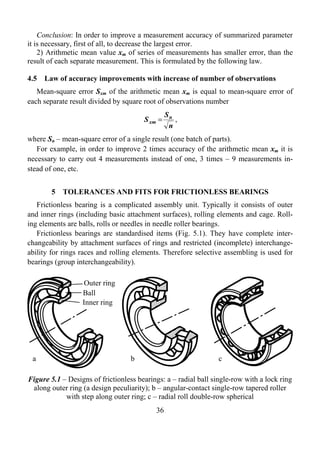
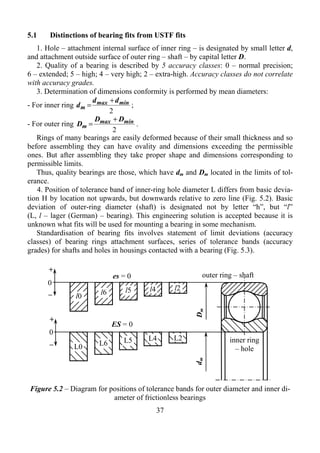
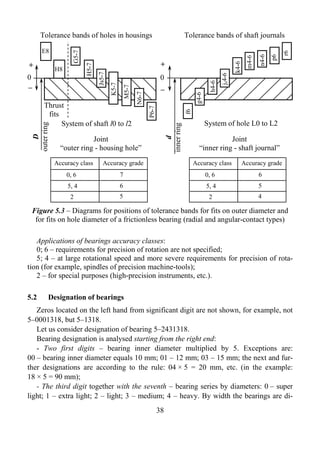
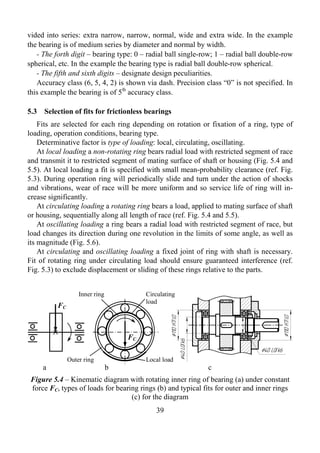
                      “Kharkiv Aviation Institute”


        M.K. Knyazyev, V.O. Dyadin, B.S. Bilokon, M.O. Kurin


         BASICS OF INTERCHANGEABILITY
                         Summary lectures


                        Kharkiv «KhAI» 2012
UDC 621.002: 006.015.3: 621.713 (075.8)
                   O–75

   Наведено основні норми взаємозамінності та єдиної системи допусків та поса-
док. Подано норми взаємозамінності в застосуванні до різьбових, шпонкових і
шліцьових з’єднань, підшипників кочення та зубчастих передач. Викладено осно-
вні положення вимірювань і контролю калібрами, розрахунку розмірних ланцю-
гів і статистичних методів контролю якості продукції. Розглянуто визначення
відхилень і допуски форми та розташування поверхонь, шорсткість і хвилястість
поверхонь.
   Для студентів механічних спеціальностей, які вивчають дисципліну «Основи
взаємозамінності».


Reviewers: Yu.O. Plesnyetsov, Candidate of Engineering Science, Associate Professor,
           N.V. Tychyna, Candidate of Philological Science, Associate Professor


Basics of Interchangeability: Summary lectures / M.K. Knyazyev, V.O. Dyadin,
B.S. Bilokon, M.O. Kurin. – Kharkiv: National Aerospace University named after
M.Ye. Zhukovsky “Kharkiv Aviation Institute”, 2012. – 92 p.

   Basic norms of interchangeability and unified system of tolerances and fits are sub-
mitted. Interchangeability norms in applications to threaded, key and spline joins, fric-
tionless bearings and gearings are considered. Basic concepts for measurements and
check with gauges, calculations of dimension chains and statistical methods for prod-
ucts quality control are submitted. Determination of deviations and tolerances for sur-
faces form and position, surfaces roughness and waviness are considered.
   For students of mechanical engineering specialties studying discipline “Basics of In-
terchangeability”.

                                                 UDC 621.002: 006.015.3: 621.713 (075.8)
Figures 66. Tables 17. Bibliogr.: 5 references


                      © Knyazyev M.K., Dyadin V.O., Bilokon B.S., Kurin M.O., 2012
                       © National Aerospace University named after M.Ye. Zhukovsky
                                    “Kharkiv Aviation Institute”, 2012

                                            2
INTRODUCTION
   Interchangeability of parts and units of modern machines and mechanisms greatly
reduces costs in production cycle and repair works with ensuring high reliability and
long service life. Standardisation is a basis for interchangeability. Standardisation es-
tablishes unified norms for elements of machines that allow producing them in different
countries and factories with assembling machines at any other production area. Techni-
cal metrology is a basic component for construction of quality control system.
   Discipline “Basics of interchangeability” is a natural and obligatory stage in educa-
tion of engineering specialists. The discipline applies knowledge of other subjects
(mathematics, physics, etc.) and is a basis for subjects of more specialized level directly
connected with designing of machines and development of manufacturing processes.
Knowledge of this discipline is also necessary for proper performance of design and
manufacturing documentation.

1 INTERCHANGEABILITY, QUALITY AND STANDARDISATION BY ISO
1.1 Basic concepts and definitions
    Interchangeability (complete) is a property of independently produced parts or as-
sembly units to provide state of operability and reliability of mechanisms and machines
under conditions of fittingless assembling or at repair.
    State of operability (operability) is a state of an item, at which values of all actual
parameters correspond to the requirements of technical specifications or normative
technical documentation.
    Reliability is a property of an item to keep in time the values of all parameters in
specified limits, that is, to ensure state of operability with time.
    Concepts of interchangeability are fundamental ones for designing. They are also
provided at manufacture and used at exploitation of items.
    Parameters of interchangeability:
    - Geometric (dimension, shape, relative position of surfaces and others);
    - Physical and mechanical (specific gravity, hardness, strength and others);
    - Chemical (chemical composition, admixtures);
    - Electrical.
    Types of interchangeability:
    - complete (functional);
    - incomplete (restricted).
    Complete interchangeability is an interchangeability, at which all types of parame-
ters are ensured with the accuracy that allows to perform fittingless assembling (or re-
placement at repair) of any independently produced parts to obtain finished items. That
is, parts can be manufactured independently in several shops (factories, towns, coun-
tries), and be assembled into assembly units or items in other factories.
    Basic advantages of products produced under conditions of complete interchange-
ability are:

                                            3
1) Development works for creation of new items are easier, faster, and cheaper, be-
cause basic elements are standardised (threads, splines, toothed gearing, etc.);
    2) Manufacture of items is easier and cheaper (accuracy of blanks is specified, im-
proved inspection methods, easier assembling and others);
    3) Exploitation is cheaper (shortening of repair period and its high quality).
    Along with complete interchangeability the restricted (incomplete) interchangeabil-
ity is permitted. Its types are:
    1) Group interchangeability (selective assembling);
    2) Assembling on the basis of probability calculations;
    3) Assembling with adjusting of dimensions or positions of separate parts;
    4) Assembling with fitting of one of several assembling parts.
    There is also difference between external and internal interchangeability.
    External interchangeability is interchangeability of finished items, mainly, deliver-
ables (aggregates, instruments, frictionless bearings, etc.), from which interchangeabil-
ity is required by service indexes and geometric parameters of joint surfaces. External
interchangeability is always complete. For example, when replacing the failed electric
motor, a new motor is mounted on the same place, on the same joint surfaces, with the
same dimensions. This is interchangeability by joint dimensions or dimensional inter-
changeability. New motor should be interchangeable also by operation indexes – by
power, rotational velocity and other indexes. This is parametric interchangeability.
    Internal interchangeability is interchangeability of separate parts, assembly units
and mechanism inside of each item. For example, complete interchangeability by joint
diameters of bearing rings and restricted interchangeability by rolling elements. That is,
internal interchangeability can be complete and incomplete.
    Interchangeability is inconceivable without accuracy.
    Accuracy is a degree of conformity of real part (assembly unit) to design accuracy
specified by a designer or by normative technical documentation.
    Accuracy is an opposite characteristic of a tolerance. It is impossible to produce a
part with exact dimension, for example, of 20 mm, because it means an infinite level of
accuracy – 20.000000000000000000… For real parts the dimension is specified by two
limit dimensions – maximum and minimum limit dimensions (e.g., 20.1 and 19.9 mm).
Performed dimension of a part should be between these two specified limits. The larger
difference between them, the larger permissible tolerance (specified error) for produc-
tion is. And it is evident that the higher accuracy of specified parameter (smaller toler-
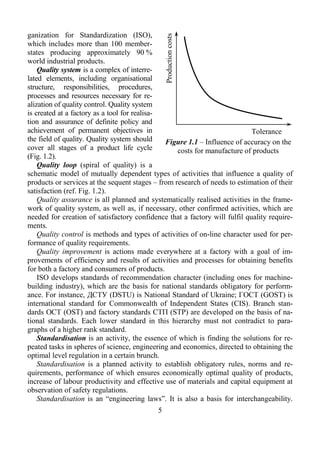
ance for a dimension), the larger production expenses are (Fig. 1.1). Therefore, the as-
signed level of accuracy should be always thoroughly substantiated.
    Quality is a set of properties and characteristics of products or services, which gives
them an ability to satisfy the specified or prospective needs.
    Products or service is a result of activity or process. They may be material or non-
material, that is, intellectual.
    Quality level is a relative characteristic of products based on comparison of quality
indexes of estimated products with basic values of corresponding indexes.
    Problems of products quality and standardisation are regulated by International Or-
                                            4
ganization for Standardization (ISO),


                                                Production costs
which includes more than 100 member-
states producing approximately 90 %
world industrial products.
    Quality system is a complex of interre-
lated elements, including organisational
structure, responsibilities, procedures,
processes and resources necessary for re-
alization of quality control. Quality system
is created at a factory as a tool for realisa-
tion and assurance of definite policy and
achievement of permanent objectives in                                      Tolerance
the field of quality. Quality system should    Figure 1.1 – Influence of accuracy on the
cover all stages of a product life cycle           costs for manufacture of products
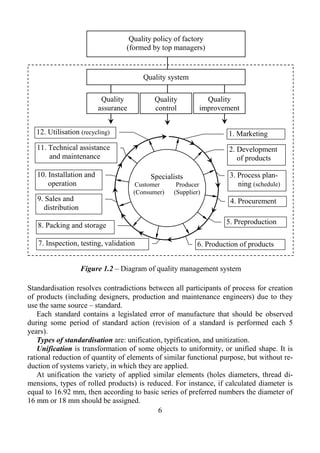
(Fig. 1.2).
    Quality loop (spiral of quality) is a
schematic model of mutually dependent types of activities that influence a quality of
products or services at the sequent stages – from research of needs to estimation of their
satisfaction (ref. Fig. 1.2).
    Quality assurance is all planned and systematically realised activities in the frame-
work of quality system, as well as, if necessary, other confirmed activities, which are
needed for creation of satisfactory confidence that a factory will fulfil quality require-
ments.
    Quality control is methods and types of activities of on-line character used for per-
formance of quality requirements.
    Quality improvement is actions made everywhere at a factory with a goal of im-
provements of efficiency and results of activities and processes for obtaining benefits
for both a factory and consumers of products.
    ISO develops standards of recommendation character (including ones for machine-
building industry), which are the basis for national standards obligatory for perform-
ance. For instance, ДСТУ (DSTU) is National Standard of Ukraine; ГОСТ (GOST) is
international standard for Commonwealth of Independent States (CIS). Branch stan-
dards ОСТ (OST) and factory standards СТП (STP) are developed on the basis of na-
tional standards. Each lower standard in this hierarchy must not contradict to para-
graphs of a higher rank standard.
    Standardisation is an activity, the essence of which is finding the solutions for re-
peated tasks in spheres of science, engineering and economics, directed to obtaining the
optimal level regulation in a certain brunch.
    Standardisation is a planned activity to establish obligatory rules, norms and re-
quirements, performance of which ensures economically optimal quality of products,
increase of labour productivity and effective use of materials and capital equipment at
observation of safety regulations.
    Standardisation is an “engineering laws”. It is also a basis for interchangeability.
                                            5
Quality policy of factory
                                  (formed by top managers)


                                         Quality system

                           Quality          Quality           Quality
                          assurance         control         improvement


   12. Utilisation (recycling)                                       1. Marketing
   11. Technical assistance                                          2. Development
       and maintenance                                                  of products

   10. Installation and                    Specialists               3. Process plan-
       operation                       Customer     Producer            ning (schedule)
                                      (Consumer)   (Supplier)
   9. Sales and                                                      4. Procurement
     distribution

   8. Packing and storage                                           5. Preproduction

   7. Inspection, testing, validation                      6. Production of products


                    Figure 1.2 – Diagram of quality management system

Standardisation resolves contradictions between all participants of process for creation
of products (including designers, production and maintenance engineers) due to they
use the same source – standard.
    Each standard contains a legislated error of manufacture that should be observed
during some period of standard action (revision of a standard is performed each 5
years).
    Types of standardisation are: unification, typification, and unitization.
    Unification is transformation of some objects to uniformity, or unified shape. It is
rational reduction of quantity of elements of similar functional purpose, but without re-
duction of systems variety, in which they are applied.
    At unification the variety of applied similar elements (holes diameters, thread di-
mensions, types of rolled products) is reduced. For instance, if calculated diameter is
equal to 16.92 mm, then according to basic series of preferred numbers the diameter of
16 mm or 18 mm should be assigned.
                                            6
Typification is development and establishment of typical design or manufacturing
solutions for several items, which have similar characteristics. For example, branch
typification of manufacturing processes.
   Unitization is a kind of standardisation, at which machine, equipment or production
tools are composed from unificated aggregates (assembly units). When recomposing,
the purpose of aggregates can be changed in a small degree. For example, multi-head
machines, modular jigs and others.
   Technical specifications are normative engineering documentation for a specific
item, material or other product.
   Technical requirements (spec) are established set of requirements to products, their
manufacture, inspection, acceptance, etc.

1.2 System of tolerances and fits. Basic definitions
    International Unified System of Tolerances and Fits (USTF) is a family of series of
limits and fits, constructed in a relationship on a basis of experience, theoretical and
experimental investigations and issued in the form of standards. USTF is applied for
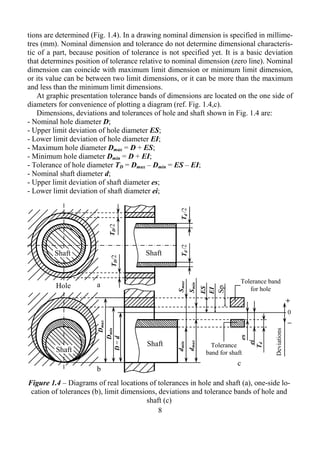
slick joints of cylindrical and flat parallel surfaces (Fig. 1.3).
    According to ISO and USTF each internal element is called a “hole” (female sur-
face), and each outside element is called a “shaft” (male surface). Parameters relating to
a hole are designated by capital letters, and those relating to a shaft – by small letters
(ref. Fig. 1.3).

1.2.1 Dimensions
   Dimension is a numerical value of linear parameter (diameter, length, etc.) in se-
lected units of measurement (millimetre, micrometer, etc.).
   Limit dimensions are two permissible limits of size (maximum and minimum limit
dimensions), between which the actual size of quality part should be or it can be equal
to one of them.
   Nominal dimension (D, d, L, l, b, c) is a size, which is specified in a drawing on the
basis of engineering calculations, design experience, etc., relative to which the devia-

                  D>d                      D<d
       hole       Clearance
                  S=D–d                                                    l
                                                                                      c
                                                   d
                                   D
D


                                                             b
                      d


              shaft                                                        L
                                            Interference
                                            N=d–D
    Figure 1.3 – Female and male dimensions of parts: D, L – hole-type dimensions;
       d, l – shaft-type dimensions; b, c – neither shaft nor hole type dimensions
                                             7
tions are determined (Fig. 1.4). In a drawing nominal dimension is specified in millime-
tres (mm). Nominal dimension and tolerance do not determine dimensional characteris-
tic of a part, because position of tolerance is not specified yet. It is a basic deviation
that determines position of tolerance relative to nominal dimension (zero line). Nominal
dimension can coincide with maximum limit dimension or minimum limit dimension,
or its value can be between two limit dimensions, or it can be more than the maximum
and less than the minimum limit dimensions.
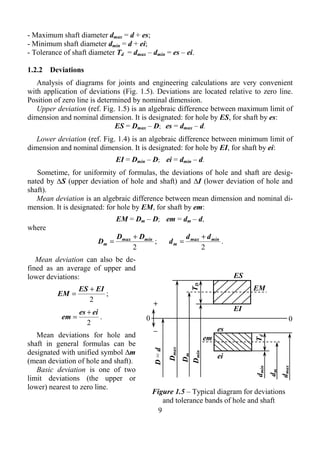
    At graphic presentation tolerance bands of dimensions are located on the one side of
diameters for convenience of plotting a diagram (ref. Fig. 1.4,c).
    Dimensions, deviations and tolerances of hole and shaft shown in Fig. 1.4 are:
- Nominal hole diameter D;
- Upper limit deviation of hole diameter ES;
- Lower limit deviation of hole diameter EI;
- Maximum hole diameter Dmах = D + ES;
- Minimum hole diameter Dmin = D + EI;
- Tolerance of hole diameter ТD = Dmах – Dmin = ES – EI;
- Nominal shaft diameter d;
- Upper limit deviation of shaft diameter es;
- Lower limit deviation of shaft diameter ei;
                                                    Td /2
                                TD/2


                                                     Td /2


         Shaft                          Shaft
                                 TD/2


                                                                                 Tolerance band
                                                   Smax


                       a
                                                             Smin


         Hole
                                                                         Sp
                                                                    ES


                                                                                    for hole
                                                                    EI


                                                                                                          +
                                                                                                          0
                                                                                                          –
                        Dmax
                                 Dmin


                                                                                             Deviations
                                                                                 es
                               D=d


                                                                                       ei
                                                             dmax


                                        Shaft
                                                   dmin


                                                                                      Td


                                                                      Tolerance
         Shaft                                                      band for shaft
                                                                                c
                       b
Figure 1.4 – Diagrams of real locations of tolerances in hole and shaft (a), one-side lo-
 cation of tolerances (b), limit dimensions, deviations and tolerance bands of hole and
                                         shaft (c)
                                             8
- Maximum shaft diameter dmах = d + es;
- Minimum shaft diameter dmin = d + ei;
- Tolerance of shaft diameter Тd = dmах – dmin = es – ei.

1.2.2 Deviations
   Analysis of diagrams for joints and engineering calculations are very convenient
with application of deviations (Fig. 1.5). Deviations are located relative to zero line.
Position of zero line is determined by nominal dimension.
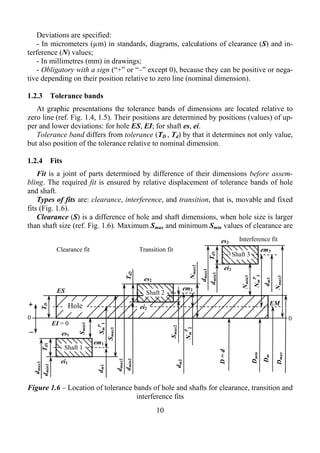
   Upper deviation (ref. Fig. 1.5) is an algebraic difference between maximum limit of
dimension and nominal dimension. It is designated: for hole by ES, for shaft by es:
                              ES = Dmах – D; es = dmах – d.
   Lower deviation (ref. Fig. 1.4) is an algebraic difference between minimum limit of
dimension and nominal dimension. It is designated: for hole by EI, for shaft by ei:
                               EI = Dmin – D; ei = dmin – d.
   Sometime, for uniformity of formulas, the deviations of hole and shaft are desig-
nated by ∆S (upper deviation of hole and shaft) and ∆I (lower deviation of hole and
shaft).
   Mean deviation is an algebraic difference between mean dimension and nominal di-
mension. It is designated: for hole by EM, for shaft by em:
                               EM = Dm – D; em = dm – d,
where
                               Dmax + Dmin                d max + d min
                        Dm =               ;       dm =                 .
                                    2                           2
   Mean deviation can also be de-
fined as an average of upper and
lower deviations:                                                           ES
                                                            TD


                 ES + EI                                                         EM
          EM =           ;
                    2
                                            +
                es + ei                                                     EI
           em =         .               0                                                       0
                   2
                                            –                         es
   Mean deviations for hole and
                                                                                 Td


                                                                 em
shaft in general formulas can be
                                                   Dmax
                                             D=d


designated with unified symbol ∆m
                                                          Dmin
                                                          Dm


                                                                      ei
(mean deviation of hole and shaft).
                                                                                             dmax
                                                                                 dmin


   Basic deviation is one of two
                                                                                        dm


limit deviations (the upper or
lower) nearest to zero line.
                                            Figure 1.5 – Typical diagram for deviations
                                                and tolerance bands of hole and shaft
                                              9
Deviations are specified:
   - In micrometers (µm) in standards, diagrams, calculations of clearance (S) and in-
terference (N) values;
   - In millimetres (mm) in drawings;
   - Obligatory with a sign (“+” or “–” except 0), because they can be positive or nega-
tive depending on their position relative to zero line (nominal dimension).

1.2.3 Tolerance bands
   At graphic presentations the tolerance bands of dimensions are located relative to
zero line (ref. Fig. 1.4, 1.5). Their positions are determined by positions (values) of up-
per and lower deviations: for hole ES, EI; for shaft es, ei.
   Tolerance band differs from tolerance (TD , Td) by that it determines not only value,
but also position of the tolerance relative to nominal dimension.

1.2.4 Fits
    Fit is a joint of parts determined by difference of their dimensions before assem-
bling. The required fit is ensured by relative displacement of tolerance bands of hole
and shaft.
    Types of fits are: clearance, interference, and transition, that is, movable and fixed
fits (Fig. 1.6).
    Clearance (S) is a difference of hole and shaft dimensions, when hole size is larger
than shaft size (ref. Fig. 1.6). Maximum Smaх and minimum Smin values of clearance are

                                                                                                    es3       Interference fit
              Clearance fit                               Transition fit                                                       em3
                                                                                              Td3


                                                                                                            Shaft 3
                                                                                   Nmax2


                                                                                                      ei3
                                                                                            dmax3
                                                    Td2


                                                                                           dmin3


                                                                                                                        NmP3
                                                                                                                Nmin3


                                                            es2                                                                       Nmax3
                                                                                                                                dm3


              ES                                                               em2
                                                            Shaft 2
+                                                                                                                                 EM
      TD


                      Hole                                ei2
0                                                                                                                                             0
             EI = 0
                         Smin1


                                  SmP1


                                                                                                                                              T
                                                                       Smax2

                                                                                 NmP2
                                         Smax1


–               es1
                                 em1
       Td1


                 Shaft 1
                                                                                                    D=d


                                                                                                                        Dmin


                                                                                                                                      Dmax
                                                                                                                               Dm
                                                 dmin2
                                                 dmax2


                ei1
                                                                           dm2
     dmax1
    dmin1


                                  dm1


Figure 1.6 – Location of tolerance bands of hole and shafts for clearance, transition and
                                    interference fits
                                                                  10
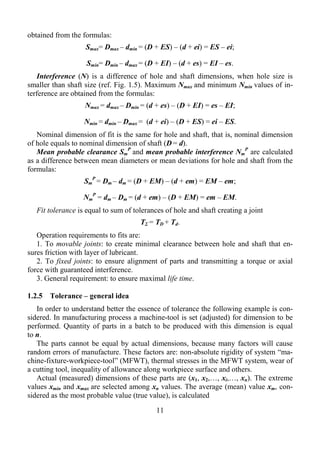
obtained from the formulas:
                   Smaх= Dmaх – dmin = (D + ES) – (d + ei) = ES – ei;

                    Smin= Dmin – dmaх = (D + EI) – (d + es) = EI – es.
   Interference (N) is a difference of hole and shaft dimensions, when hole size is
smaller than shaft size (ref. Fig. 1.5). Maximum Nmaх and minimum Nmin values of in-
terference are obtained from the formulas:
                   Nmaх = dmaх – Dmin = (d + es) – (D + EI) = es – EI;

                   Nmin = dmin – Dmaх = (d + ei) – (D + ES) = ei – ES.
   Nominal dimension of fit is the same for hole and shaft, that is, nominal dimension
of hole equals to nominal dimension of shaft (D = d).
   Mean probable clearance SmP and mean probable interference NmP are calculated
as a difference between mean diameters or mean deviations for hole and shaft from the
formulas:
                   SmP = Dm – dm = (D + EM) – (d + em) = EM – em;

                   NmP = dm – Dm = (d + em) – (D + EM) = em – EM.
   Fit tolerance is equal to sum of tolerances of hole and shaft creating a joint
                                      TΣ = TD + Td.
   Operation requirements to fits are:
   1. To movable joints: to create minimal clearance between hole and shaft that en-
sures friction with layer of lubricant.
   2. To fixed joints: to ensure alignment of parts and transmitting a torque or axial
force with guaranteed interference.
   3. General requirement: to ensure maximal life time.

1.2.5 Tolerance – general idea
   In order to understand better the essence of tolerance the following example is con-
sidered. In manufacturing process a machine-tool is set (adjusted) for dimension to be
performed. Quantity of parts in a batch to be produced with this dimension is equal
to n.
   The parts cannot be equal by actual dimensions, because many factors will cause
random errors of manufacture. These factors are: non-absolute rigidity of system “ma-
chine-fixture-workpiece-tool” (MFWT), thermal stresses in the MFWT system, wear of
a cutting tool, inequality of allowance along workpiece surface and others.
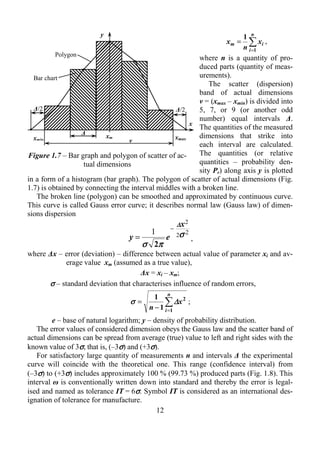
   Actual (measured) dimensions of these parts are (х1, х2,…, хi,…, хn). The extreme
values хmin and хmах are selected among хn values. The average (mean) value хm, con-
sidered as the most probable value (true value), is calculated
                                            11
y                                               1 n
                                                                    xm = ∑ xi ,
                                                                         n i =1
          Polygon
                                                          where n is a quantity of pro-
                                                          duced parts (quantity of meas-
  Bar chart                                               urements).
                                                              The scatter (dispersion)
                                                          band of actual dimensions
                                                          v = (хmах – хmin) is divided into
  ∆/2                                             ∆/2     5, 7, or 9 (or another odd
                                                          number) equal intervals ∆.
                                                      x
                                                          The quantities of the measured
                  ∆        xm                             dimensions that strike into
  xmin                            v              xmax
                                                          each interval are calculated.
Figure 1.7 – Bar graph and polygon of scatter of ac-      The quantities (or relative
                   tual dimensions                        quantities – probability den-
                                                          sity Pr) along axis y is plotted
in a form of a histogram (bar graph). The polygon of scatter of actual dimensions (Fig.
1.7) is obtained by connecting the interval middles with a broken line.
   The broken line (polygon) can be smoothed and approximated by continuous curve.
This curve is called Gauss error curve; it describes normal law (Gauss law) of dimen-
sions dispersion
                                                     ∆х 2
                                                 −
                                  y=
                                         1
                                            e        2σ 2
                                                            ,
                                       σ 2π
where ∆х – error (deviation) – difference between actual value of parameter хi and av-
            erage value хm (assumed as a true value),
                                     ∆х = хi – хm;
      σ – standard deviation that characterises influence of random errors,
                                        1 n
                                   σ=       ∑ ∆x 2 ;
                                      n − 1 i =1
         е – base of natural logarithm; у – density of probability distribution.
   The error values of considered dimension obeys the Gauss law and the scatter band of
actual dimensions can be spread from average (true) value to left and right sides with the
known value of 3σ, that is, (–3σ) and (+3σ).
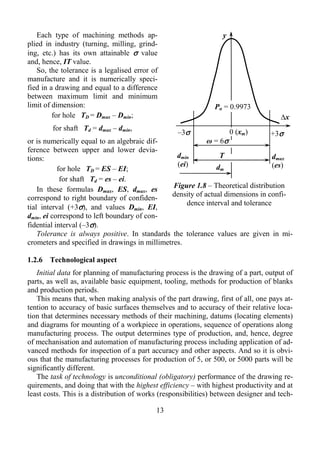
   For satisfactory large quantity of measurements n and intervals ∆ the experimental
curve will coincide with the theoretical one. This range (confidence interval) from
(–3σ) to (+3σ) includes approximately 100 % (99.73 %) produced parts (Fig. 1.8). This
interval ω is conventionally written down into standard and thereby the error is legal-
ised and named as tolerance IT = 6σ. Symbol IT is considered as an international des-
ignation of tolerance for manufacture.
                                             12
Each type of machining methods ap-                             y
plied in industry (turning, milling, grind-
ing, etc.) has its own attainable σ value
and, hence, IT value.
   So, the tolerance is a legalised error of
manufacture and it is numerically speci-
fied in a drawing and equal to a difference
between maximum limit and minimum
limit of dimension:                                            Pα = 0.9973
         for hole ТD = Dmах – Dmin;                                                  ∆x
        for shaft Тd = dmах – dmin,
                                                  –3σ                 0 (xm)    +3σ
or is numerically equal to an algebraic dif-               ω = 6σ
ference between upper and lower devia-
tions:                                           dmin          T                 dmax
                                                 (ei)         dm                 (es)
           for hole ТD = ES – EI;
            for shaft Тd = es – ei.
    In these formulas Dmах, ES, dmах, es        Figure 1.8 – Theoretical distribution
correspond to right boundary of confiden-      density of actual dimensions in confi-
                                                    dence interval and tolerance
tial interval (+3σ), and values Dmin, EI,
dmin, ei correspond to left boundary of con-
fidential interval (–3σ).
    Tolerance is always positive. In standards the tolerance values are given in mi-
crometers and specified in drawings in millimetres.

1.2.6 Technological aspect
   Initial data for planning of manufacturing process is the drawing of a part, output of
parts, as well as, available basic equipment, tooling, methods for production of blanks
and production periods.
   This means that, when making analysis of the part drawing, first of all, one pays at-
tention to accuracy of basic surfaces themselves and to accuracy of their relative loca-
tion that determines necessary methods of their machining, datums (locating elements)
and diagrams for mounting of a workpiece in operations, sequence of operations along
manufacturing process. The output determines type of production, and, hence, degree
of mechanisation and automation of manufacturing process including application of ad-
vanced methods for inspection of a part accuracy and other aspects. And so it is obvi-
ous that the manufacturing processes for production of 5, or 500, or 5000 parts will be
significantly different.
   The task of technology is unconditional (obligatory) performance of the drawing re-
quirements, and doing that with the highest efficiency – with highest productivity and at
least costs. This is a distribution of works (responsibilities) between designer and tech-

                                           13
nologist during creation of products.
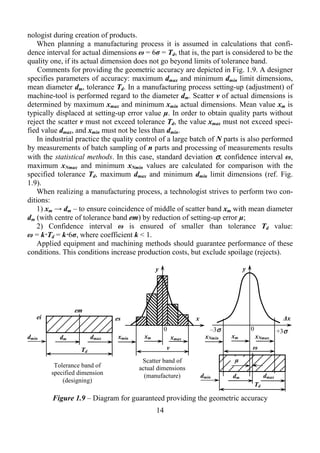
    When planning a manufacturing process it is assumed in calculations that confi-
dence interval for actual dimensions ω = 6σ = Td, that is, the part is considered to be the
quality one, if its actual dimension does not go beyond limits of tolerance band.
    Comments for providing the geometric accuracy are depicted in Fig. 1.9. A designer
specifies parameters of accuracy: maximum dmax and minimum dmin limit dimensions,
mean diameter dm, tolerance Td. In a manufacturing process setting-up (adjustment) of
machine-tool is performed regard to the diameter dm. Scatter v of actual dimensions is
determined by maximum xmax and minimum xmin actual dimensions. Mean value xm is
typically displaced at setting-up error value µ. In order to obtain quality parts without
reject the scatter v must not exceed tolerance Td, the value xmax must not exceed speci-
fied value dmax, and xmin must not be less than dmin.
    In industrial practice the quality control of a large batch of N parts is also performed
by measurements of batch sampling of n parts and processing of measurements results
with the statistical methods. In this case, standard deviation σ, confidence interval ω,
maximum xNmax and minimum xNmin values are calculated for comparison with the
specified tolerance Td, maximum dmax and minimum dmin limit dimensions (ref. Fig.
1.9).
    When realizing a manufacturing process, a technologist strives to perform two con-
ditions:
    1) xm → dm – to ensure coincidence of middle of scatter band xm with mean diameter
dm (with centre of tolerance band em) by reduction of setting-up error µ;
    2) Confidence interval ω is ensured of smaller than tolerance Td value:
ω = k·Td = k·6σ, where coefficient k < 1.
    Applied equipment and machining methods should guarantee performance of these
conditions. This conditions increase production costs, but exclude spoilage (rejects).

                                             y                                 y


                em
   ei                         es                             x                                      ∆x
                                                 0                  –3σ            0               +3σ
dmin       dm          dmax    xmin     xm            xmax        xNmin   xm           xNmax

                  Td                              v                                ω

                                       Scatter band of                     µ
         Tolerance band of            actual dimensions
        specified dimension             (manufacture)            dmin                       dmax
                                                                          dm
            (designing)
                                                                                       Td

        Figure 1.9 – Diagram for guaranteed providing the geometric accuracy
                                             14
1.2.7       Preferred numbers of linear series
   In order to reduce variety of dimensions, specified after calculations, a nominal
dimension, as a rule, is rounded off with increase for shafts and with decrease for
holes to the values of preferred numbers.
   Preferred numbers and their series are the basis for selection of numerical values
of parameters. Their purpose is to agree items, semi-products, materials, manufac-
turing equipment, inspection and other equipment.
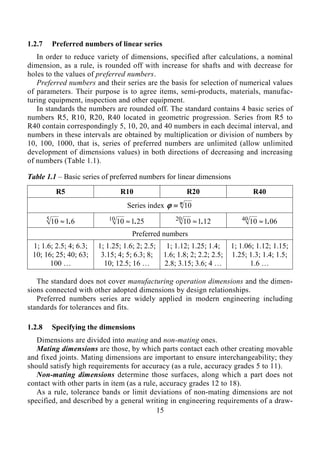
   In standards the numbers are rounded off. The standard contains 4 basic series of
numbers R5, R10, R20, R40 located in geometric progression. Series from R5 to
R40 contain correspondingly 5, 10, 20, and 40 numbers in each decimal interval, and
numbers in these intervals are obtained by multiplication or division of numbers by
10, 100, 1000, that is, series of preferred numbers are unlimited (allow unlimited
development of dimensions values) in both directions of decreasing and increasing
of numbers (Table 1.1).

Table 1.1 – Basic series of preferred numbers for linear dimensions
             R5                    R10                      R20                     R40
                                     Series index ϕ = n 10
        5
            10 ≈ 1.6         10
                                  10 ≈ 1.25           20
                                                           10 ≈ 1.12          40
                                                                                   10 ≈ 1.06
                                       Preferred numbers
 1; 1.6; 2.5; 4; 6.3;     1; 1.25; 1.6; 2; 2.5;    1; 1.12; 1.25; 1.4;     1; 1.06; 1.12; 1.15;
 10; 16; 25; 40; 63;       3.15; 4; 5; 6.3; 8;    1.6; 1.8; 2; 2.2; 2.5;   1.25; 1.3; 1.4; 1.5;
       100 …                10; 12.5; 16 …        2.8; 3.15; 3.6; 4 …             1.6 …

   The standard does not cover manufacturing operation dimensions and the dimen-
sions connected with other adopted dimensions by design relationships.
   Preferred numbers series are widely applied in modern engineering including
standards for tolerances and fits.

1.2.8       Specifying the dimensions
   Dimensions are divided into mating and non-mating ones.
   Mating dimensions are those, by which parts contact each other creating movable
and fixed joints. Mating dimensions are important to ensure interchangeability; they
should satisfy high requirements for accuracy (as a rule, accuracy grades 5 to 11).
   Non-mating dimensions determine those surfaces, along which a part does not
contact with other parts in item (as a rule, accuracy grades 12 to 18).
   As a rule, tolerance bands or limit deviations of non-mating dimensions are not
specified, and described by a general writing in engineering requirements of a draw-
                                           15
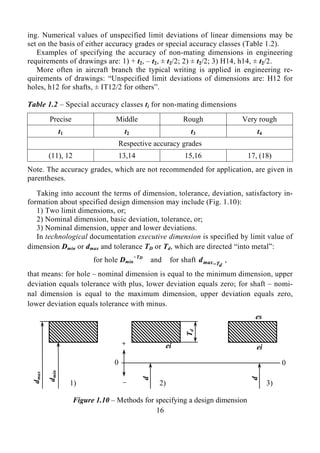
ing. Numerical values of unspecified limit deviations of linear dimensions may be
set on the basis of either accuracy grades or special accuracy classes (Table 1.2).
   Examples of specifying the accuracy of non-mating dimensions in engineering
requirements of drawings are: 1) + t2, – t2, ± t2/2; 2) ± t2/2; 3) H14, h14, ± t2/2.
   More often in aircraft branch the typical writing is applied in engineering re-
quirements of drawings: “Unspecified limit deviations of dimensions are: H12 for
holes, h12 for shafts, ± IT12/2 for others”.

Table 1.2 – Special accuracy classes t i for non-mating dimensions
         Precise                  Middle                     Rough              Very rough
                t1                    t2                        t3                  t4
                                   Respective accuracy grades
         (11), 12                  13,14                      15,16              17, (18)
Note. The accuracy grades, which are not recommended for application, are given in
parentheses.

   Taking into account the terms of dimension, tolerance, deviation, satisfactory in-
formation about specified design dimension may include (Fig. 1.10):
   1) Two limit dimensions, or;
   2) Nominal dimension, basic deviation, tolerance, or;
   3) Nominal dimension, upper and lower deviations.
   In technological documentation executive dimension is specified by limit value of
dimension Dmin or dmax and tolerance ТD or Тd, which are directed “into metal”:
                           for hole Dmin+ТD       and    for shaft d max −T ,
                                                                          d
that means: for hole – nominal dimension is equal to the minimum dimension, upper
deviation equals tolerance with plus, lower deviation equals zero; for shaft – nomi-
nal dimension is equal to the maximum dimension, upper deviation equals zero,
lower deviation equals tolerance with minus.
                                                                                   es
                                                               Td


                                      +                 ei                          ei

                                  0                                                           0
         dmin
  dmax


                                              d


                                                                                  d


                     1)               –             2)                                   3)

                     Figure 1.10 – Methods for specifying a design dimension
                                               16
2 BASIC STANDARDS OF INTERCHAGEABILITY
   Unified system of tolerances and fits (USTF) is a family of limits and fits series is-
sued in the form of standards. Systems for typical joints have been developed: slick,
conical, threaded, key, spline, gear and other joints. Each system is determined by a
number of basic features.
   Principles of system of tolerances and fits for slick joints are the following:
   1. Intervals of nominal dimensions.
   2. Unit of tolerance.
   3. Grades of accuracy.
   4. Basic part.
   5. Positions of tolerance bands (basic deviation).
   6. System of hole and system of shaft.
   7. Temperature conditions.

2.1   Intervals of nominal dimensions
   The first principles states that nominal dimensions are divided into ranges and inter-
vals to simplify the tables of tolerances and fits.
   Ranges are:
   - Less than 1 mm – the small range;
   - From 1 to 500 mm – the middle – is in the widest practice;
   - More than 500 to 3150 mm – the large;
   - More than 3150 to 10000 mm – the very large.
   In their turn, the ranges are divided into intervals (basic and intermediate). For all
dimensions, which are in the interval, the same tolerance is specified. The purpose of
such an approach is to exclude the inconvenience of tables (for instance, 500 values
with step of 1 mm for middle range) and excessive fractions of tolerance values of
neighbouring dimensions included in this interval.
   Here the following rule should be observed: dimensions are spread along intervals in
such a manner that the tolerances, calculated from extreme values of each interval, dif-
fer not more than (5–8) % from the tolerances, calculated from average value of dimen-
sion in the same interval.
   Calculations of tolerances and limit deviations for each interval are performed from
geometric average value Di and its limit values Di min and Di max:
                                 Di =   Di min ⋅ Di max .
    For example, according to standard the nominal dimension of 90 mm falls into in-
terval (80–120) mm. The geometric average value of interval equals to Di = 80 ⋅ 120 ≈
≈ 98 mm.
    If difference of (5–8) % for tolerances, calculated from average value of dimension,
is unacceptable, then basic intervals are additionally divided into intermediate intervals
in respective places of the standard (Table 2.1).

                                           17
Table 2.1 – Example of basic and intermediate intervals of dimensions
               Basic interval                           Intermediate intervals
                                                               120-140
                  120-180                                      140-160
                                                               160-180
   If dimension value is equal to the extreme value of interval, deviations should be
taken from that interval of the standard, in which this dimension appears first.

2.2     Tolerance unit
   The second principle of USTF is a tolerance unit accepted in accordance with the
rule of scale coefficients. The necessity of this term is explained with application of the
following examples (Table 2.2).

Table 2.2 – Relative accuracy of dimensions
 Case     Nominal dimension, mm        Tolerance, mm       Accuracy of dimension, mm
                    40                      0.3                  more accurate
   1
                    40                      0.6                   less accurate
                   120                      0.3                 more accurate*
   2
                    40                      0.3                   less accurate
                   120                      0.35                        ?
   3
                    40                      0.25                        ?
* With dimension increase it is more difficult to ensure the same tolerance, because ac-
curacy of enlarged dimension increases too.

   If nominal values of dimensions are equal, the more accurate will be that dimension,
which has the smaller tolerance (see Table 2.2, case 1). If tolerances are equal, the more
accurate will be that dimension, which has the larger nominal value (see Table 2.2, case
2). Accuracy comparison of dimensions with different nominal values and different tol-
erances is a certain problem (see Table 2.2, case 3). Therefore, it is reasonable to intro-
duce term of “tolerance unit”.
   For determination of tolerance value it is necessary to separate the tolerance portions
depending on nominal dimension and accuracy:
                                         IT = i·a,
where i – tolerance unit (function of dimension); a – number of tolerance units (func-
tion of accuracy).
   In order to specify tolerances it is necessary to determine the relationship of their
change depending on value of nominal dimension. Therefore, for construction of toler-
ances system the tolerance unit i is stated; i is a multiplier factor in tolerance formula,
being the function of nominal dimension and serving for determination of numerical
value of tolerance.
                                            18
For middle dimension range (1–500) mm the tolerance unit is calculated from em-
pirical relationship
                      i = 0.45 ⋅ 3 Di + 0.001Di , micrometer (µm),
 where Di – geometric average value of interval specified in millimetres (mm).
   For example, for dimension of 90 mm (interval (80–120) mm) the geometric aver-
age value Di ≈ 98 mm, and tolerance unit is
                i = 0.45 ⋅ 3 98 + 0.001 ⋅ 98 = 0.45 ⋅ 4.61 + 0.098 ≈ 2.17 µm.
   Tolerance unit values have been calculated, rounded off and adopted in the form of
standard.

2.3   Gradation of accuracy
   The third principle of USTF system is gradation of accuracy (accuracy series). In
each item the parts of different purpose are produced with different accuracy depending
on specified requirements. In order to normalise specified accuracy the accuracy
grades are introduced.
   There are naturally constructed series of tolerances for each accuracy grade. In one
series the different dimensions have the same relative accuracy determined by coeffi-
cient a. Tolerances of dimensions of the same accuracy contains equal number a of tol-
erance units.
   20 accuracy grades are established. They are designated by numbers increasing with
tolerance value increase: 01; 0; 1; 2; 3… 17; 18.
   Tolerance value is specified by letters IT (ISO Tolerance) and number of accuracy
grade, for example: IT6, IT12.
   Tolerance values for the 5–18 accuracy grades are determined by relationship
IT = i·a (Table 2.3). For other grades the tolerance values are determined from other
relationships.

Table 2.3 – Number of tolerance units in accuracy grades 5 to 18 for dimensions of
            (1–500) mm
Grades          5 6 7 8 9 10 11 12 13 14 15                    16     17     18
Number of tol-
                7 10 16 25 40 64 100 160 250 400 640 1000 1600 2500
erance units а

   Starting from the 6th grade the number of tolerance units а changes according to
geometric progression with the ratio φ = 1.6 (basic series R5 of preferred numbers).
And so, neighbouring tolerances differ in 60 %, and when making steps in each 5
grades the tolerance value 10 times increases.
   An accuracy grade determines tolerance value for machining, and, hence, determines
methods and equipment for production of machine parts.
   Knowing values of both multipliers in the formula for IT, one can determine toler-
ance value for a dimension (Table 2.4). For example, for dimension of 90 mm in the 7th
                                           19
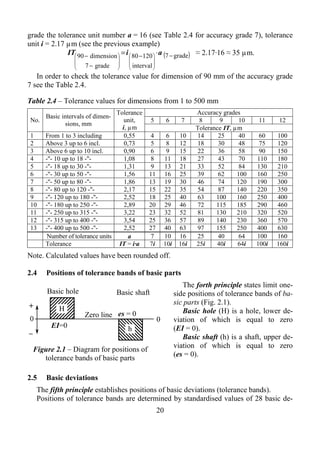
grade the tolerance unit number а = 16 (see Table 2.4 for accuracy grade 7), tolerance
unit i = 2.17 µm (see the previous example)
              IT 90 − dimension  = i  80 −120  ⋅ а (7 − grade) ≈ 2.17·16 ≈ 35 µm.
                                                
                      7 − grade        interval 
                                                
   In order to check the tolerance value for dimension of 90 mm of the accuracy grade
7 see the Table 2.4.

Table 2.4 – Tolerance values for dimensions from 1 to 500 mm
                                   Tolerance                            Accuracy grades
        Basic intervals of dimen-
No.                                   unit,       5         6      7     8       9      10   11     12
               sions, mm
                                     i, µm                              Tolerance IT, µm
1       From 1 to 3 including         0,55       4          6     10    14      25     40     60    100
2       Above 3 up to 6 incl.         0,73       5          8     12    18      30     48     75    120
3       Above 6 up to 10 incl.        0,90       6          9     15    22      36     58     90    150
4       -''- 10 up to 18 -''-         1,08       8         11     18    27      43     70    110    180
5       -''- 18 up to 30 -''-         1,31       9         13     21    33      52      84   130    210
6       -''- 30 up to 50 -''-         1,56       11        16     25    39      62     100   160    250
7       -''- 50 up to 80 -''-         1,86       13        19     30    46      74     120   190    300
8       -''- 80 up to 120 -''-        2,17       15        22     35    54      87     140   220    350
9       -''- 120 up to 180 -''-       2,52       18        25     40    63     100     160   250    400
10      -''- 180 up to 250 -''-       2,89       20        29     46    72     115     185   290    460
11      -''- 250 up to 315 -''-       3,22       23        32     52    81     130     210   320    520
12      -''- 315 up to 400 -''-       3,54       25        36     57    89     140     230   360    570
13      -''- 400 up to 500 -''-       2,52       27        40     63    97     155     250   400    630
         Number of tolerance units      а        7         10     16    25      40      64   100    160
        Tolerance                   IT = i·a     7i        10i    16i   25i    40i     64i   100i   160i
Note. Calculated values have been rounded off.

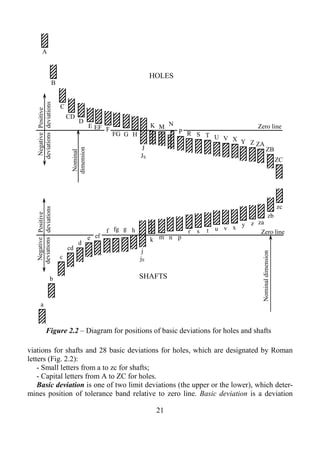
2.4     Positions of tolerance bands of basic parts
                                                                    The forth principle states limit one-
        Basic hole                  Basic shaft                  side positions of tolerance bands of ba-
+                                                                sic parts (Fig. 2.1).
             H                                                      Basic hole (H) is a hole, lower de-
                       Zero line es = 0
0                                                      0         viation of which is equal to zero
          EI=0                          h                        (EI = 0).
–                                                                   Basic shaft (h) is a shaft, upper de-
                                                                 viation of which is equal to zero
    Figure 2.1 – Diagram for positions of
                                                                 (es = 0).
       tolerance bands of basic parts

2.5     Basic deviations
     The fifth principle establishes positions of basic deviations (tolerance bands).
     Positions of tolerance bands are determined by standardised values of 28 basic de-
                                                       20
A


                                                                   HOLES
                       B
   deviations deviations


                           C
    Negative Positive


                               CD
                                    D
                                            E EF                   K M N                      Zero line
                                                 F                         P R S
                                                     FG G H                      T U V
                                                                                       X Y
                                                                                           Z ZA
                                                              J
                                dimension


                                                                                                ZB
                                 Nominal


                                                              JS
                                                                                                                         ZC


                                                                                                                         zc
   deviations deviations
    Negative Positive


                                                                                                    zb
                                                                                               z za
                                                                                           x y
                                                   f fg g h                  r   s   t u v        Zero line
                                            e ef                   k m n p
                                    d
                               cd                              j

                                                                                                     Nominal dimension
                           c                                  jS


                     b                                        SHAFTS


       a


               Figure 2.2 – Diagram for positions of basic deviations for holes and shafts

viations for shafts and 28 basic deviations for holes, which are designated by Roman
letters (Fig. 2.2):
    - Small letters from a to zc for shafts;
    - Capital letters from А to ZС for holes.
    Basic deviation is one of two limit deviations (the upper or the lower), which deter-
mines position of tolerance band relative to zero line. Basic deviation is a deviation

                                                                    21
Hole        Shaft              nearest to zero line.
                                                 Basic deviations are standardised and their
                                             numerical values nave been determined from the
 + EI A to H                       ei        empirical formulas for shafts depending on in-
0                                      0     tervals of nominal dimensions, for example:
                         J to ZC                 - Basic deviations “e” and “f” (upper devia-
 –      es                          ES       tions):
                                                       ese = – 11⋅Di0.41; esf = – 5.5⋅Di0.34 ;
                Shaft      Hole                  - Basic deviations “v” and “x” (lower devia-
                                             tions):
Figure 2.3 – Diagram of symmet-
  ric positions of basic deviations                eiv = IT7 + 1.25⋅Di ; eix = IT7 + 1.6⋅Di,
           of shaft and hole                 where Di – geometric average value of interval
                                             of nominal dimensions.
    Basic deviations for holes are mirror-like images of basic deviations for shafts
(Fig. 2.3, see also Fig. 2.2 for comparison).
    General rule: basic deviation for hole should be symmetric to basic deviation for
shaft of the same letter designation relative to zero line.
    Basic deviations for holes from A to H are calculated from the formula
                                             EI = – es.
    Basic deviations for holes from J to ZC are calculated from the formula
                                             ES = – ei.
    There is an exception from the general rule.
    Special rule: two fits in the system of hole and system of shaft, in which holes of cer-
                                                                       tain accuracy grade are
                                                                       joined with shafts of
      ITn–1


                                Nmax                                   higher accuracy grade,
                                      Nmin                             should have the same
             ei
                                                                       clearances and interfer-
                                                 Fit in system         ences (Fig. 2.4).
                                                    of shaft               Special rule is actual
      ITn


 +              H                                                      for holes with basic devia-
0                                                                 0 tions J, K, M, N from the
                                                          ITn–1


        Fit in system                                  h               5th to the 8th accuracy
–          of hole                                                     grades (transition fits) and
                                                                       for holes with basic devia-
                                                      ES               tions from P to Z from the
                   ES'
                                      Special rule                     5th to the 7th accuracy
                                                          ITn


       General rule                                                    grades (interference fits).
                              ∆ = ITn – ITn–1                              According to the spe-
                                                                       cial rule basic deviation
Figure 2.4 – Analytical diagram for calculations of ba-                for hole is calculated from
      sic deviation of hole according to special rule                  the formula
                                                  22
ES = – ei + ∆,
where ∆ = ITn – ITn–1 is a difference between tolerance of the considered accuracy
grade and tolerance of the nearest more accurate grade.
   Special rule ensures obtaining the same limit interferences of the same-name fits in
system of hole and system of shaft at the condition that the hole tolerance is one accu-
racy grade lower than the shaft tolerance.
   Basic deviations for all dimensions included into a certain interval of nominal di-
mensions are the same (equal) and do not depend on accuracy grade, because basic de-
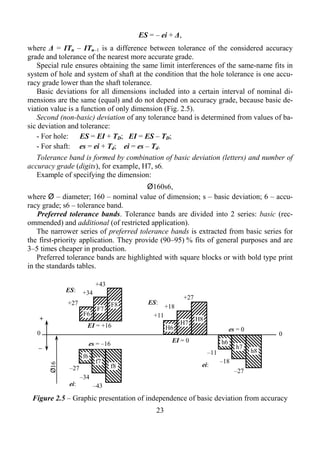
viation value is a function of only dimension (Fig. 2.5).
   Second (non-basic) deviation of any tolerance band is determined from values of ba-
sic deviation and tolerance:
   - For hole: ES = EI + ТD; EI = ES – ТD;
   - For shaft: es = ei + Td; ei = es – Td.
   Tolerance band is formed by combination of basic deviation (letters) and number of
accuracy grade (digits), for example, Н7, s6.
   Example of specifying the dimension:
                                         Ø160s6,
where Ø – diameter; 160 – nominal value of dimension; s – basic deviation; 6 – accu-
racy grade; s6 – tolerance band.
    Preferred tolerance bands. Tolerance bands are divided into 2 series: basic (rec-
ommended) and additional (of restricted application).
    The narrower series of preferred tolerance bands is extracted from basic series for
the first-priority application. They provide (90–95) % fits of general purposes and are
3–5 times cheaper in production.
    Preferred tolerance bands are highlighted with square blocks or with bold type print
in the standards tables.

                             +43
              ES:    +34
                                                            +27
              +27                     F8      ES:
                              F7                     +18
                      F6                       +11
    +                                                             H8
                       EI = +16                            H7
                                                     H6                           es = 0
   0                                                                                            0
                                                       EI = 0                h6
                           es = –16                                                 h7
   –                                                                                       h8
                                                                       –11
                      f6
                             f7                                              –18
        Ø16


                                      f8                           ei:
               –27                                                                  –27
                     –34
               ei:          –43
 Figure 2.5 – Graphic presentation of independence of basic deviation from accuracy
                                                23
2.6 System of hole and system of shaft
   The sixth principle establishes fits in the system of hole and in the system of shaft
(Fig. 2.6).
              Tolerance bands
                 of shafts                                       Tolerance bands
                                                                     of holes
  +
          H
  0                                                                                    0
                                                    h
  –
                Fits in system of hole
                                                   Fits in system of shaft
 Figure 2.6 – Diagram of positions of tolerance bands in system of hole and system of
                                         shaft

   In the system of hole the required clearances and interferences of fits are formed by
combination of various tolerance bands of shafts with tolerance band of basic hole (H).
   In the system of shaft the required clearances and interferences of fits are formed by
combination of various tolerance bands of holes with tolerance band of basic shaft (h).
   In a fit typically a hole has lower accuracy (larger grade number ITn) and a shaft has
higher accuracy (smaller grade number ITn–1).
   Systems of hole and shaft are formally equal. But system of hole is preferable in the
most of cases. It is more economically sound, because shafts are easier and cheaper for
production as compared with holes. For machining of shafts mainly versatile cutting
tools are applied, access to work surfaces (outside open surfaces) is convenient. For
machining of holes more complicated and precision cutting tools (drills, core drills,
reamers, broaches, cutting tools fixed on boring bars) are applied, access to work sur-
faces (internal semi-closed surfaces) is restricted. These precision cutting tools are pro-
duced in a great amount for machining of H holes (basic holes).
   But in some cases the system of shaft is more preferable – cheaper and technically
more reasonable:
   - When single-diameter smooth shaft should be inserted into several holes with dif-
ferent types of fits (Fig. 2.7);
   - When applying the standardised units and parts produced under certain systems,
for example, outside diameter of frictionless bearings is produced under the system of
shaft, because it is unknown with what fit it will be mounted in a mechanism;
   - When it is not reasonable to make multi-diameter (stepped) shaft to avoid stress
concentration at the places of fillets.

                                            24
Piston                       Piston pin
   Connecting rod
                                       Interference


                                  n5
    H6


                                                                       N6


                                                                              G6


                                                                                                h5
                                           g5
                                             Grinding of pin is                              Grinding of pin is
                                               problematic                                      favourable
                                 Clearance
                 Fits in system of hole                                             Fits in system of shaft

  Figure 2.7 – “Piston-pin-connecting rod” assembly in system of hole and system of
                                        shaft

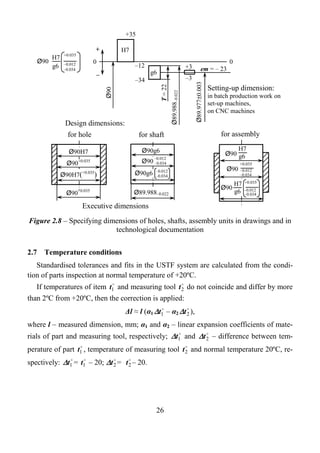
   Specifying the dimensions. For example, the dimension of fit Ø90Н7/g6 can be
specified several variants (Fig. 2.8). In drawing a designer, as a rule, specifies dimen-
sions in the form convenient for him: hole Ø90Н7, shaft Ø90g6, fit Ø90Н7/g6. It is
permissible to specify dimensions with numerical values of upper and lower deviations:
                                                           +0.035
hole Ø90     +0.035
                      , shaft   Ø90 −0.012 ,
                                    − 0.034     fit Ø90    − 0.012
                                                                     . The last form is also convenient for a
                                                           − 0.034
technologist, because it gives numerical values of deviations. It is also permissible to a
designer to specify dimensions in a combined form: hole Ø90H7(+0.035), shaft
                               + 0.035 
                         H7 
         (
         − 0.012
                  )
Ø90g6 − 0.034 , fit Ø90      
                          g6  −0.012 
                                       .
                              −0.034 
   Executive dimensions are dimensions, which are specified in operation sketches for
machining the parts (ref. Fig. 2.8). For holes executive dimension is a minimum limit
dimension with positive upper deviation (equal to the tolerance ТD); for shaft it is a
maximum limit dimension with negative lower deviation (equal to the tolerance Тd).
That is, in technological sketches deviations are specified “into body” of workpiece
(into metal) that ensures maximum material condition for manufacture and higher prob-
ability of quality items.
   Setting-up dimensions are dimensions, by which setting-up (adjustment) of ma-
chine-tools is performed in batch production, as well as of machines with computer
numerical control (CNC). Numerically setting-up dimension is equal to the mean value
of maximum and minimum limit dimensions. Graphically it is shown in the middle of
tolerance band of shaft (ref. Fig. 2.8). Tolerance for a setting-up dimension approxi-
mately equals (20–30) % tolerance of executive dimension.

                                                            25
+35

                          +         H7
             +0.035
       H7
   Ø90       –0.012       0                                                                               0
       g6                                –12                                 +3
             –0.034                                                                       em = – 23
                          –                    g6
                                         –34                                 –3


                                                                                  Ø89.977±0.003
                                                    T = 22
                                                                                                  Setting-up dimension:

                              Ø90


                                                             Ø89.988–0.022
                                                                                                  in batch production work on
                                                                                                  set-up machines,
                                                                                                  on CNC machines
             Design dimensions:
               for hole                    for shaft                                                  for assembly

               Ø90H7                        Ø90g6                                                           H7
                                                                                                        Ø90 g6
                                                 –0.012
              Ø90+0.035                     Ø90 –0.034                                                         +0.035
                                                 –0.012                                                  Ø90   –0.012
            Ø90H7(+0.035)                Ø90g6   –0.034                                                        –0.034

                                                                                                              H7   +0.035
                                                                                                      Ø90          –0.012
              Ø90+0.035                  Ø89.988–0.022                                                        g6   –0.034

                      Executive dimensions
Figure 2.8 – Specifying dimensions of holes, shafts, assembly units in drawings and in
                           technological documentation


2.7 Temperature conditions
   Standardised tolerances and fits in the USTF system are calculated from the condi-
tion of parts inspection at normal temperature of +20ºC.
                            o                      o
   If temperatures of item t1 and measuring tool t 2 do not coincide and differ by more
than 2ºC from +20ºC, then the correction is applied:
                                     ∆l ≈ l (α1 ∆t1 – α2 ∆t 2 ),
                                                  o         o


where l – measured dimension, mm; α1 and α2 – linear expansion coefficients of mate-
rials of part and measuring tool, respectively; ∆t1 and ∆t 2 – difference between tem-
                                                  o        o

                  o                                   o
perature of part t1 , temperature of measuring tool t 2 and normal temperature 20ºC, re-
spectively: ∆t1 = t1 – 20; ∆t 2 = t 2 – 20.
              o    o          o     o


                                                  26
3 MEASUREMENTS AND INSPECTION
3.1 Basic definitions
    Measurement is a determination of value of physical parameter with aid of special
measuring means, for example, rule, vernier calliper, micrometer, that is, measuring
means with a graduated scale.
    Measurements are performed in pilot or small-batch productions, at repair and ex-
perimental works, and in batch and mass production – at setting-up of machine-tools or
statistical methods of inspection (samplings).
    Actual dimension is a dimension determined by measurement with permissible er-
ror.
    Measurement is a determination of actual value of physical parameter by experimen-
tal way with aid of special measuring means.
    Measuring error (inaccuracy) is a deviation of measurement result from true value
of measured parameter. It depends on accuracy of measuring equipment. Accuracy of
readings from scale and rounding-off, as a rule, is equal to half-division of scale (0.5
div.).
    Error value is a difference between actual (real) value and specified value of pa-
rameter. The following types of errors are distinguished.
    Systematic errors are called those errors, which are constant by absolute value and
sign or changing by a certain law depending on character of non-random factors. For
example, if there is an error in calibration of scale of measuring device, then this error
is included into all readings. So as the error magnitude and sign are known, these errors
are eliminated with corrections.
    Correction is a value of parameter similar to the measured one, added to the value
obtained at measurement with aim to exclude systematic error.
    Random errors are called those errors, which are non-constant by absolute value
and sign, which appear at manufacture and measurement and depend on random factors
(uneven allowance removed from workpiece, inaccuracy of workpiece mounting, etc.).
    Blunders or rough mistakes are called those errors, which significantly exceed ex-
pected systematic or random errors under the specified conditions of measurements.
    Direct measurement is a measurement, at which desired value of parameter is ob-
tained directly (by reading of measuring instrument), for example, measurement of
length with a vernier calliper or micrometer.
    Indirect measurement is a measurement, at which desired value of parameter is cal-
culated from the known relationship between this parameter and parameters obtained
from experimental data. For example, determination of area of a rectangle is performed
by multiplication of measured values of length and width.
    Relative measurement is a measurement, at which deviation of dimension from the

                                           27
selected measure or reference part, conventionally assumed as a unit, is measured. For
example, measurement with a dial indicator set-up to dimension with gauge-block as-
sembly is used.
   Measurement methods can be of contact or non-contact type.
   Contact measurement method is a method, at which sensitive element of instrument
comes in contact with a subject being measured, for example, temperature measure-
ment with a thermometer contacting with a part.
   Non-contact measurement method is a method, at which sensitive element of in-
strument does not come in contact with a subject being measured, for example, tem-
perature measurement with a pyrometer not contacting with a part.
   Inspection is an ascertainment of the fact that parameter being checked complies
with the specified accuracy without determination of its actual value (whether the ac-
tual value falls into specified tolerance band or does not), for example, inspection of
parts with fixed gauges.

3.2 Material limits
   Maximum limit condition is a limit size, to which the largest quantity (volume) of a
part material corresponds, that is, maximum limit dimension of shaft or minimum limit
dimension of hole.
   Minimum limit condition is a limit size, to which the smallest quantity (volume) of a
part material corresponds, that is, minimum limit dimension of shaft or maximum limit
dimension of hole.
   In batch production the limit dimensions of shaft and hole are checked with gauges.
Maximum limit dimension of shaft and minimum limit dimension of hole are checked
with GO-gauges. These limits are called maximum material limits. Minimum limit di-
mension of shaft and maximum limit dimension of hole are checked with NOT-GO
gauges and respective limits are called minimum material limits.

3.3 Check of parts with gauges
    The similarity principle is a basis for check of parts with fixed gauges.
    Similarity principle: fixed gauge should imitate a segment of that item, with which a
checked part will be in contact. Hole is checked by gauge-shaft (plug gauge), and shaft
is checked by gauge-hole (ring gauge and snap gauge).
    Perfect gauges should be combined, that is, should check both dimension and shape.
If, for example, plug gauge is a flat part, then only dimension is checked, but not form.
    There are in-process and post-process inspection methods.
    When applying in-process inspection methods in batch and mass productions (for
example, in-process snap gauge), in essence, performance of manufacturing process is
checked. Warning is generated when certain deviation of checked parameter appears
                                              28
Dmax
                                                              Minimum ma-
                                              Maximum          terial limit    NOT GO
Minimum ma-
 terial limit                                material limit          Dw
                       reclaimable reject
                  Td
                                                                    waste
                                                                               GO
                                                               Maximum
                                                              material limit
  NOT-GO


                                                                               Dmin


                                             dmax
                                                         GO                             TD

                                   drr
           dmin


                          waste
                            dw


                  shaft
                                                                       hole

 NOT-GO snap gauge                          GO snap gauge                       Drr
                                                                         reclaimable reject
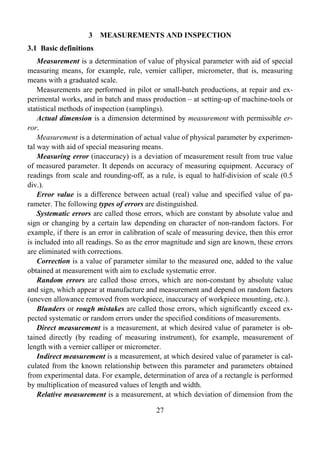
 Figure 3.1 – Diagram for check of a shaft with snap gauges and check of a hole with
                                    plug gauges

before the moment when spoilage is produced – the tuning of manufacturing process is
needed.
   Post-process inspection methods (for example, fixed gauges) check conformity of
ready-made parts with the specified dimensions in the drawing. Figure 3.1 shows that:
   - This is inspection, but not measurement;
   - Shaft is checked with a “hole” – snap gauge;
   - Hole is checked with a “shaft” – plug gauge.
   Snap gauge checks only dimension, in contrast to a complex gauge – ring gauge,
which checks both dimension and form.
   The part is good by dimension, if go-gauge (GO) goes through the part dimension,
and not-go gauge (NOT GO) – does not go. If the part does not satisfy one of these
conditions, it is a faulty part (reject).
   Rejects can be reclaimable or waste. Reclaimable rejects are those faulty parts,
which have actual dimension of shaft drr more than maximum limit dimension dmax and
actual dimension of hole Drr less than minimum limit dimension Dmin. Wastes are shafts
of diameter dw smaller then minimum limit dimension dmin and holes of dimension Dw
larger then maximum limit dimension Dmax.
   Variants of gauges are:
   1) single-end single-limit;
   2) double-end double-limit;
   3) single-end double-limit.
   Inspection rules:
   - A worker checks with a new gauge, inspector – with a partially worn gauge;
   - Must not apply large force;
                                                    29
0.002                                        H7(+0.018)
                           0.002                                                                                         Ø16
                                                                                                                                         – 0.006
                                                                                                                                  g6     – 0.017
                          Ra 0.08                                         Ra 0.08
          –H


                                                                                              –H
dNOTmax


                                                                                     dGOmax
                                              NOT-GO +0.018 Ø16Н7 GO 0
                                                                                                                  Single-end double-limit
                                                                                                                  snap gauge for check of
                                   Double-end double-limit plug gauge for                                                  shaft
                                               check of hole                                               Ø16g6
                                              2nd type error
                    H/2


                                              1st type error
                                                                                                        Ra 0.08
                                              NOT-GO                +18
                                                                                     NOT-GO                                     –0.017
          dNOTmax


                              H H


                                                                                         GO                                     –0.006
                                                                                                           DNOTmin+H1
                                                               H7
+                                                                                0.002                     DGOmin+H1                         0.002
                                                GO
                    Z


0                                                                                                                                    0
                                                Y


                                                                                                            Wear limit
 –                                                                                                                                R-W
                                                                                                   Z1 Y1


                                                  Limit of wear           –6


                                                                                                                                         HP
                                                                                                             GO                  R-GO
                                     dGOmin
                          dGOmax


                                                                                                                         HP/2
                                                                                g6
          Ø16


                                                                                                                                          HP
                                                                                                                  H1
                                                                                              Td


                                                                                                           NOT-GO               R-NOT
                                                                          –17                                                           HP
                                                                                                                       H1/2
                                                                                                   H1


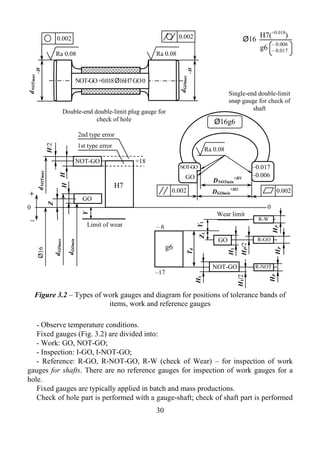
     Figure 3.2 – Types of work gauges and diagram for positions of tolerance bands of
                            items, work and reference gauges

   - Observe temperature conditions.
   Fixed gauges (Fig. 3.2) are divided into:
   - Work: GO, NOT-GO;
   - Inspection: I-GO, I-NOT-GO;
   - Reference: R-GO, R-NOT-GO, R-W (check of Wear) – for inspection of work
gauges for shafts. There are no reference gauges for inspection of work gauges for a
hole.
   Fixed gauges are typically applied in batch and mass productions.
   Check of hole part is performed with a gauge-shaft; check of shaft part is performed
                                                                          30
with a gauge-hole, and check of gauge-hole is performed with a countergauge-shaft.
   Errors of inspection with gauges. When item dimensions are near to the tolerance
limits, there is a probability to make the following mistakes (ref. Fig. 3.2):
   - Errors of the 1st type – when proper dimension is considered as a reject;
   - Errors of the 2nd type – when reject is accepted as quality product.
   Rules for rounding off the executive dimensions of fixed gauges:
   1. Dimensions of work and inspection gauges for items are rounded off to the value
divisible by 0.5 µm (0.0005 mm).
   2. Dimensions, which end in 0.25 and 0.75 µm, are rounded off to the value divisible
by 0.5 µm with decrease of manufacture tolerance (TD or Td).
   3. In a drawing the deviations of executive dimensions are specified “into body” of
gauge (ref. Fig. 3.2).


     4 STATISTICAL METHODS FOR PRODUCT QUALITY CONTROL
   In production the actual dimensions of parts are varying depend on systematic and
random factors (errors). Systematic errors are essentially reduced by corrections at the
stage of tuning (adjustment) of a manufacturing process.
   Random errors are difficult or impossible to exclude. They should be reduced to the
permissible value that does not exceed the value of tolerance for dimension or form.
Random errors of measuring instruments and errors of manufacture are typically de-
scribed by the normal distribution law.
   In order to estimate quality of the parts produced under influence of random factors
the statistical methods are applied.

4.1 Rules for measurements with errors
    1. If systematic error is determinative, that is, its value is essentially larger than
value of random error, then a measurement can be performed only one time.
    2. If random error is determinative, the measurement should be performed several
times.
    Number of measurements should be selected in such a manner that random error of
arithmetic mean xm is less than the systematic error in order to the latter determines to-
tal error of measurements results.
    For many parts random errors are described by statistical characteristics.

4.2 Basic statistical parameters and formulas
   Basic statistical parameters and formulas are submitted in Table 4.1.


                                           31
Table 4.1 – Statistical characteristics of random errors for batch of parts
  Statistical
                                               Definition, formula
 characteristic
                  Empirical centre of grouping or arithmetic mean of considered pa-
                                          1 n
      xm          rameter values, x m = ∑ x i , assumed as a true value of measured
                                          n 1
                  parameter
                  Statistical expectation – theoretically constant parameter, character-
     M(x)
                  ises centre of scatter of random errors, M(x) ≈ xm
      ∆xi         Absolute error, ∆xi = xi – xm
                  Scatter band, v = xmax – xmin, where xmax and xmin – maximum and
       v
                  minimum actual (measured) dimensions, respectively
                  Standard deviation of random values of parameter from grouping cen-
       σ          tre, dimension parameter. It is a convenient characteristic for estima-
                  tion of random errors values

                  Mean-square error for n measurements, S n =
                                                                      1 n
                                                                         ∑
                                                                    n −1 1
                                                                           (         )2
                                                                             x i − x m . If

                  number of observations (measurements) is very large, then
      Sn
                  Sn → σ, that is, σ = lim S n (statistical limit). In reality one always
                                        n →∞
                  calculates not σ, but its approximate value Sn , which is nearer to σ
                  with n increase
                  Dispersion, D = σ 2. It characterises degree of scatter of random errors
                  around scatter centre.
                                             1 n
       D          Sample variance S n =2
                                                ∑ ( xi − x m )2 .
                                           n −1 1
                  General dispersion σ 2 = lim S n .
                                                 2
                                               n →∞

                                                      −
                                                          (∆x ) 2
                                                1          2        t
       y          Probability density, y =           e 2σ or у = ,
                                            σ 2π                    σ
                  dimension function ([1/mm], [1/µm], etc.)
                  Probability, integral of the y function, Pα = P(–∆x ≤ ∆x ≤ +∆x) for
                  confidence interval from (–∆x) to (+∆x). It characterises level of reli-
      Pα
                  ability of obtained result. It is an area under the distribution curve
                  bounded by abscissa axis and limits of interval
                  Risk, sum of two quantiles, Pβ = (1 – Pα)·100%,
      Pβ
                  Pβ = 0.27 % at Pα = 0.9973


                                               32
Table 4.1, continued
  Statistical
                                                        Definition, formula
 characteristic
                  Confidence interval, ω = 2zσ, between (– ∆x = – zσ) and
       ω
                  (+∆x = +zσ )
                                                     ∆x x − x m
                  Argument of Laplace function z i = i = i         , dimensionless pa-
       z                                                            σ         σ
                  rameter
                  Probability density or probability distribution of random value
                                      z2
       t               1          −
                  t=        e          2
                                , dimensionless function
                        2π
                  Integral probability or Laplace normalised function,
                                           z       z2
    Ф0(Z)                 1     −

                          2π ∫
                  Ф0(Z) =      e 2 dz , dimensionless function
                             0


   Distribution laws for random errors state relationships between values of random er-
rors and probability of their appearance.
   The mostly applied law in practice is normal law of random errors distribution –
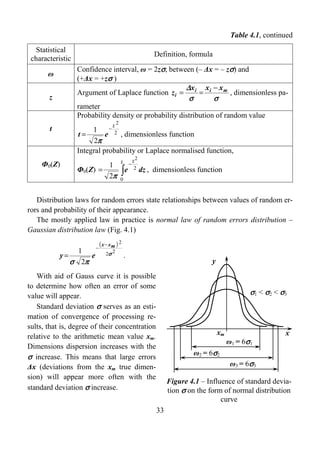
Gaussian distribution law (Fig. 4.1)

                         −
                             ( x − xm ) 2
                  1             2σ 2
           y=        e                         .
                σ 2π                                                         y
   With aid of Gauss curve it is possible
to determine how often an error of some
value will appear.                                                                           σ1 < σ2 < σ3
   Standard deviation σ serves as an esti-
mation of convergence of processing re-
sults, that is, degree of their concentration
                                                                                 xm                     x
relative to the arithmetic mean value xm.
                                                                                      ω1 = 6σ1
Dimensions dispersion increases with the
                                                                        ω2 = 6σ2
σ increase. This means that large errors
∆x (deviations from the xm true dimen-                                                 ω3 = 6σ3
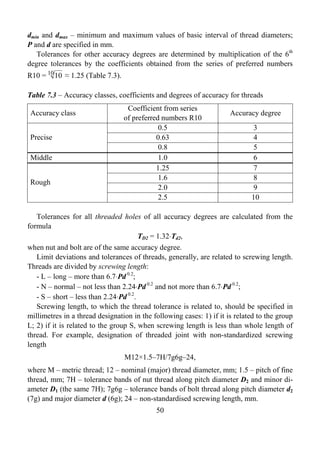
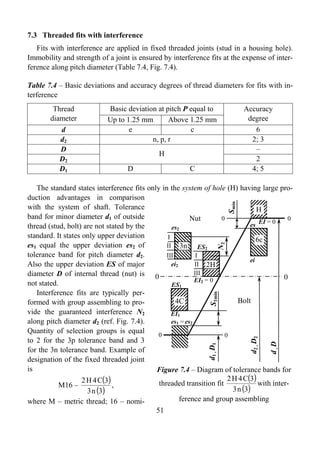
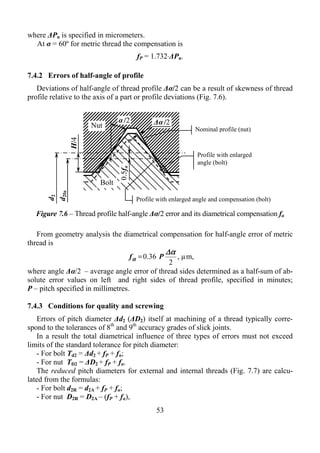
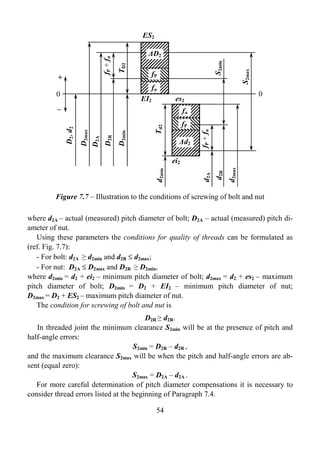
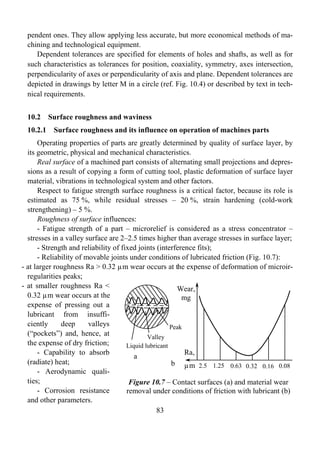
sion) will appear more often with the
                                                             Figure 4.1 – Influence of standard devia-
standard deviation σ increase.                               tion σ on the form of normal distribution
                                                                               curve
                                                        33
4.3   Properties and peculiarities of Gauss curve
1. The curve has two points of inflexion (convexity, concavity) at two values ∆x = ± σ
   (Fig. 4.2).
2. Curve is symmetric relative to the уmax value.
3. Two branches of curve tend to zero: at ∆x → ± ∞, y → 0.
4. Probability of sure event equals one (area under the curve)
                                             +∞ − ∆
                                                    x2
                                     1
                              Р=               e 2σ dx
                                                     2

                                   σ 2π
                                             ∫                 = 1.
                                             −∞

5. The integral submitted in the paragraph 4 was transformed to obtain dimensionless
   argument of probability function: z = ∆x /σ, ∆x = zσ, and dx = σdz.
   Integral probability function (Laplace normalized function)
                                                           z2
                                                   z   −
                                Φ 0 (z ) =
                                              1
                                                 ∫e
                                              2π 0
                                                           2 dz .


   This function has the following properties: Φ0(0) = 0, Φ0(–z) = Φ0(+z),
Φ0(–∞) = Φ0(+∞) = 0.5, 2Φ0= P = 1 (Fig. 4.3).
   Function Φ0(z) is more convenient form of Gauss function, because it is dimen-
                          y        y(0) = ymax               sionless function and its
                                                convex       values depends on only
                 y(–σ)              y(+σ)                    the values of dimen-
   34.136 %                                    34.136 %      sionless z number. It is
                                                             applicable for any process
                                                concave      and measurements results
                                                             obeying Gauss distribu-
  13.592 %                                     13.592 %      tion low. Therefore the
                                                             function values are calcu-
                                                             lated and given in refer-
  2.137 %                                        2.137 %     ence books in the form of
                                                             table. Using these values
                                                          ∆x
                                                             and above formulas (ref.
          –3σ –2σ –σ        0 +σ +2σ +3σ            0.135 %  Table 4.1) it is easy to
0.135 %
quantile                    2σ                Pα ≈ 0.68      calculate values of func-
                            4σ               Pα ≈ 0.95       tion y and probability P.
                                                                Application of the σ
Pβ ≈ 0.27 %              ω = 6σ              Pα ≈ 0.9973     standard deviation is con-
   Risk            Confidence interval       Confidence      venient due to this pa-
                                             probability     rameter has respective
 Figure 4.2 – Properties of the Gauss normal distribution    certain value of confi-
            curve y and areas P under the curve              dence probability (ref.

                                              34
Fig. 4.2).                                                    t
   When random parameters are
distributed according to the Gaus-                 t(–z)                  t(+z)
sian law, dispersion band ω = 6σ (in
the interval from (– ∆x to +∆x) is
assumed as practical limit confi-                                        Φ0(3) = 0.49865
dence interval of these parameters,                                      P(6σ) = 0.9973
that is, with probability very near to
one (0.9973). Here the probability
of coming a random parameter out
                                        Φ0(–∞) = 0.5          P =1          Φ0(+∞) = 0.5
of the limits of (±3σ) is equal to
Pβ = 0.0027 (0.27 %), that is, only 3                                                   z
parts will be reject of batch of 1000
parts. So it is possible to assume that   –3             – z 0 +z                  +3
the random parameter will not come                          ω = 2zσ
out the limits of (±3σ).
                                                      Confidence interval
   Normal distribution law is ap-
plied only then, when total error ap-     Figure 4.3 – Properties of dimensionless dis-
pears as a result of several random       tribution function t (analog of the y function)
factors and each of them brings
small portion into total error. That is, the main condition is absence of factors with
dominant error.

4.4    Summation law for random parameters
   Theory of probability proves that mean-square error (standard deviation) of sum or
difference of two or several parameters, their measurement results being independent,
equals the square root of sum of dispersions of separate addendums and for determina-
tion of total error it is necessary to add not errors themselves, but their squared values
                                      p                  p
                             S∑ =    ∑    S2
                                           j   ; σ∑ =   ∑ σ 2j   .
                                      1                 1

   These follow from the law:
1) Significance (role) of separate errors very quickly decreases with their decrease. For
example, for fit of hole and shaft the formula is S ∑ = S D + S d .
                                                          2     2

Let us assume that Sd = ½SD, then
                                                2
                                      1      5 2
                         S∑ =    2
                                SD   + SD  =   S D ≈1.1 S D .
                                      2      4
    Total error only 10 % increases at the expense of the second error (equals 50 % the
first error).

                                               35
Conclusion: In order to improve a measurement accuracy of summarized parameter
it is necessary, first of all, to decrease the largest error.
    2) Arithmetic mean value xm of series of measurements has smaller error, than the
result of each separate measurement. This is formulated by the following law.

4.5 Law of accuracy improvements with increase of number of observations
   Mean-square error Sxm of the arithmetic mean xm is equal to mean-square error of
each separate result divided by square root of observations number
                                                Sn
                                       S xm =      ,
                                                 n
where Sn – mean-square error of a single result (one batch of parts).
   For example, in order to improve 2 times accuracy of the arithmetic mean xm it is
necessary to carry out 4 measurements instead of one, 3 times – 9 measurements in-
stead of one, etc.


        5 TOLERANCES AND FITS FOR FRICTIONLESS BEARINGS
   Frictionless bearing is a complicated assembly unit. Typically it consists of outer
and inner rings (including basic attachment surfaces), rolling elements and cage. Roll-
ing elements are balls, rolls or needles in needle roller bearings.
   Frictionless bearings are standardised items (Fig. 5.1). They have complete inter-
changeability by attachment surfaces of rings and restricted (incomplete) interchange-
ability for rings races and rolling elements. Therefore selective assembling is used for
bearings (group interchangeability).

                  Outer ring
                  Ball
                  Inner ring


 a                                 b                            c

Figure 5.1 – Designs of frictionless bearings: a – radial ball single-row with a lock ring
 along outer ring (a design peculiarity); b – angular-contact single-row tapered roller
            with step along outer ring; c – radial roll double-row spherical
                                           36
5.1    Distinctions of bearing fits from USTF fits
   1. Hole – attachment internal surface of inner ring – is designated by small letter d,
and attachment outside surface of outer ring – shaft – by capital letter D.
   2. Quality of a bearing is described by 5 accuracy classes: 0 – normal precision;
6 – extended; 5 – high; 4 – very high; 2 – extra-high. Accuracy classes do not correlate
with accuracy grades.
   3. Determination of dimensions conformity is performed by mean diameters:
                      d     + d min
- For inner ring d m = max          ;
                            2
                       D     + Dmin
- For outer ring Dm = max             .
                             2
   Rings of many bearings are easily deformed because of their small thickness and so
before assembling they can have ovality and dimensions exceeding the permissible
ones. But after assembling they take proper shape and dimensions corresponding to
permissible limits.
   Thus, quality bearings are those, which have dm and Dm located in the limits of tol-
erance.
   4. Position of tolerance band of inner-ring hole diameter L differs from basic devia-
tion H by location not upwards, but downwards relative to zero line (Fig. 5.2). Basic
deviation of outer-ring diameter (shaft) is designated not by letter “h”, but “l”
(L, l – lager (German) – bearing). This engineering solution is accepted because it is
unknown what fits will be used for mounting a bearing in some mechanism.
   Standardisation of bearing fits involves statement of limit deviations (accuracy
classes) of bearing rings attachment surfaces, series of tolerance bands (accuracy
grades) for shafts and holes in housings contacted with a bearing (Fig. 5.3).

       +
                             es = 0                       outer ring – shaft
      0
                                 l5      l4        l2
       –                l6
                l0
                                                        Dm


       +
                             ES = 0
       0
                                L5      L4         L2              inner ring
       –       L0       L6
                                                                     – hole
                                                        dm


Figure 5.2 – Diagram for positions of tolerance bands for outer diameter and inner di-
                          ameter of frictionless bearings
                                              37
Tolerance bands of holes in housings                                                    Tolerance bands of shaft journals

         E8


                        G5-7


                                                                                                                                                         r6
                                                                                                                                             n4-6
                                                                                                                                                    p6
                                                                                                                                      m4-6
                                                                                                                              k4-6
+                                                                              +


                               H5-7
                 H8


                                      Js5-7


                                                                                                                      js4-6
0                                                                              0


                                                                                                               h4-6
                                              K5-7

                                                         M5-7
–                                                                              –


                                                                N6-7


                                                                                                      g4-6
           Thrust


                                                                       P6-7


                                                                                                f6
            fits
                 System of shaft l0 to l2                                                                    System of hole L0 to L2
    outer ring


                                                                                   inner ring
        D


                                                                                       d
                              Joint                                                                                Joint
                   “outer ring - housing hole”                                                          “inner ring - shaft journal”
                 Accuracy class          Accuracy grade                                              Accuracy class                  Accuracy grade
                      0, 6                           7                                                       0, 6                            6
                      5, 4                           6                                                       5, 4                            5
                       2                             5                                                        2                              4

 Figure 5.3 – Diagrams for positions of tolerance bands for fits on outer diameter and
  for fits on hole diameter of a frictionless bearing (radial and angular-contact types)

   Applications of bearings accuracy classes:
   0; 6 – requirements for precision of rotation are not specified;
   5; 4 – at large rotational speed and more severe requirements for precision of rota-
tion (for example, spindles of precision machine-tools);
   2 – for special purposes (high-precision instruments, etc.).

5.2          Designation of bearings
   Zeros located on the left hand from significant digit are not shown, for example, not
5–0001318, but 5–1318.
   Let us consider designation of bearing 5–2431318.
   Bearing designation is analysed starting from the right end:
   - Two first digits – bearing inner diameter multiplied by 5. Exceptions are:
00 – bearing inner diameter equals 10 mm; 01 – 12 mm; 03 – 15 mm; the next and fur-
ther designations are according to the rule: 04 × 5 = 20 mm, etc. (in the example:
18 × 5 = 90 mm);
   - The third digit together with the seventh – bearing series by diameters: 0 – super
light; 1 – extra light; 2 – light; 3 – medium; 4 – heavy. By width the bearings are di-
                                                                              38
vided into series: extra narrow, narrow, normal, wide and extra wide. In the example
the bearing is of medium series by diameter and normal by width.
   - The forth digit – bearing type: 0 – radial ball single-row; 1 – radial ball double-row
spherical, etc. In the example the bearing type is radial ball double-row spherical.
   - The fifth and sixth digits – designate design peculiarities.
   Accuracy class (6, 5, 4, 2) is shown via dash. Precision class “0” is not specified. In
this example the bearing is of 5th accuracy class.

5.3 Selection of fits for frictionless bearings
    Fits are selected for each ring depending on rotation or fixation of a ring, type of
loading, operation conditions, bearing type.
    Determinative factor is type of loading: local, circulating, oscillating.
    At local loading a non-rotating ring bears radial load with restricted segment of race
and transmit it to restricted segment of mating surface of shaft or housing (Fig. 5.4 and
5.5). At local loading a fit is specified with small mean-probability clearance (ref. Fig.
5.3). During operation ring will periodically slide and turn under the action of shocks
and vibrations, wear of race will be more uniform and so service life of ring will in-
crease significantly.
    At circulating loading a rotating ring bears a load, applied to mating surface of shaft
or housing, sequentially along all length of race (ref. Fig. 5.4 and 5.5).
    At oscillating loading a ring bears a radial load with restricted segment of race, but
load changes its direction during one revolution in the limits of some angle, as well as
its magnitude (Fig. 5.6).
    At circulating and oscillating loading a fixed joint of ring with shaft is necessary.
Fit of rotating ring under circulating load should ensure guaranteed interference (ref.
Fig. 5.3) to exclude displacement or sliding of these rings relative to the parts.


                   Inner ring            Circulating
                                         load
          FC


                                    FC

               Outer ring                Local load
     a                          b                             c
 Figure 5.4 – Kinematic diagram with rotating inner ring of bearing (a) under constant
 force FC, types of loads for bearing rings (b) and typical fits for outer and inner rings
                                   (c) for the diagram
                                            39
FC
                   Local load              Circulating
             FC                            load


         a                  b                                 c
 Figure 5.5 – Kinematic diagram with rotating outer ring of bearing (a) under constant
 force FC, types of loads for bearing rings (b) and typical fits for outer and inner rings
                                   (c) for the diagram

                                          Circulating
              FC                          load


                                  FC
     FV            FV
                                          Oscillating
     a                  b                 load                    c
 Figure 5.6 – Kinematic diagram with rotating inner ring of bearing (a) under constant
 FC and varying FV forces, types of loads for bearing rings (b) and typical fits for outer
                          and inner rings (c) for the diagram

    At oscillating loading if one of loads (FC or FV) significantly exceeds the other, then
the smaller load can be neglected and loading can be considered as local or circulating.
    Main types of loads for frictionless bearings rings are submitted in the Table 5.1.
    Operation conditions of a bearing and its service life are determined by ratio of load
and dynamic load-carrying capacity (Table 5.2).
    Requirements for accuracy of attachment surfaces of mating parts become more se-
vere with increase of bearing accuracy class. Attachment dimensions of parts for bear-
ings is restricted by permissible form deviation for cylindricity and limit deviations for
face runout of shoulders of shafts and housing holes (Fig. 5.7). The parameter skewness
angle between axes of inner and outer rings is established, which takes into account to-
tal errors of axes alignment resulted from all types of errors. Also parameter of rough-
ness Ra is specified for surfaces of shafts and holes in housings.


                                            40
Table 5.1 – Main types of loads for frictionless bearings rings depending on operation
            conditions
                  Operation conditions                            Type of load of
           Radial load                 Rotating ring         inner ring     outer ring
                                  Inner                     Circulating   Local
Constant by direction
                                  Outer                     Local         Circulating
Constant by direction and         Inner                     Circulating   Oscillating
rotating (of smaller value)       Outer                     Oscillating   Circulating
Constant by direction and         Inner                     Local         Circulating
rotating (of bigger value)        Outer                     Circulating   Local
Constant by direction             Inner and outer rings     Circulating   Circulating
Rotating with inner ring          in the same or oppo-      Local         Circulating
Rotating with outer ring          site directions           Circulating   Local

Table 5.2 – Bearing operation conditions
       Light                 Normal                   Heavy            Extra heavy*
              Ratio of load F, N, to dynamic load-carrying capacity C, N
     F                          F                          F
         < 0.07         0.07 ≤     ≤ 0.15           0.15 <
     C                         C                           C
                                     Service life, hours
    More than
                        5 – 10 thousands        2.5 – 5 thousands            –
   10 thousands
*Operation at shock and vibration loads. Fits are the same as for heavy conditions.


                0.008                  0.005   M   АM

                   Ra 0.08
                                                                      0.006
                                                   D
                              d


                                                                      0.012

                                                                      0.012
                                                          Ra 0.16
                  0.004

                                                   А
 Figure 5.7 – Requirements for accuracy and surface finish of attachment surfaces of
                       mating parts for a bearing mounting
                                          41
6 DIMENSION CHAINS
   For proper operation of machines or mechanisms it is necessary that their constituent
parts and surfaces of these parts occupy definite positions relative each other that corre-
spond to design purpose.

6.1 Fundamentals of theory of dimension chains
   Dimension chain is a system of interconnected dimensions, which determine relative
positions of surfaces of one or several parts and create close contour.
   Dimensions included into dimension chain are called links, which are designated in
diagrams with capital letters with indexes, for example, A1, A2, A3, AΣ (Fig. 6.1).
                                        Dimension chains are divided to:
                                        - Related to a part;
                                        - Related to an assembly (ref. Fig. 6.1);
                                        - Linear;
                                        - Angular;
                                        - Design;
                                        - Manufacturing;
                                        - Measuring (metrological).
                                        Linear dimension chains are divided to:
                  AΣ A3
                                        - Spatial;
                                        - Flat: with parallel links (collinear) (ref. Fig. 6.1)
            A1                      and with non-parallel links.
  a               A2                    Links of dimension chain are divided to:
        ←                  ←            - Initial, [AΣ];
        A1        [А∑] A3               - Closing, AΣ;
                                                                             →
            →
           A2                            - Constituent links: increasing, A2 ; decreasing,
                                     ←     ←
   b                                  A1 , A3 (ref. Fig. 6.1).
  Figure 6.1 – Fragment of              Constituent (increasing and decreasing) are called
 drawing (a) and diagram of          those links of dimension chain, change of which re-
     dimension chain (b)             sults in change of closing link AΣ, but can not and
                                     should not change initial link [AΣ]. Enlargement of
                                     increasing link enlarges value of closing link, and
enlargement of decreasing link reduces value of closing link.
   Initial [AΣ] is called that link, to which basic requirement for accuracy is submitted
and which determines quality of an item. It is specified by designer nominal dimension
with tolerance, limit deviations, which should be ensured as a result of solution of di-
mension chain. This term (initial link) is used in design calculations.
                                               42
In manufacturing process of machining or assembling of an item the initial link is
obtained last and thus it closes the dimension chain. Therefore in technological calcula-
tions it is called closing link AΣ. This term (closing link) is used in check calculations.
   Calculations and analysis of dimension chains is an obligatory stage of designing
and manufacture of machines, which enhances providing of interchangeability, reduc-
tion of labour expenditures, quality improvements.
   Essence of dimension chains calculations is in determination of nominal dimensions,
tolerances and limit deviations for all links under the requirements of design or tech-
nology.
   Completeness (closure) of dimension chain is a necessary condition for starting the
calculations
                                         m →      n   ←
                                    AΣ = ∑ A j − ∑ Aq ,
                                         1        1
       →                        ←
where A j – increasing links; Aq – decreasing links; m – number of increasing links; n
– number of decreasing links.
   For example, for the diagram depicted in Fig. 6.1 the equation of dimension chain is
                                      →  ←       ← 
                                AΣ = A2 −  A1 + A3  .
                                                    
                                                    
   When calculating dimension chains 2 types of tasks are solved:
   1) Determination of nominal dimension, tolerance and limit deviations for closing
link AΣ from the given nominal dimensions and limit deviations of constituent links –
check calculations;
   2) Determination of nominal dimension, tolerance and limit deviations for desired
constituent link from other known dimensions of chain and given initial dimension [AΣ]
– design calculations.

6.2 Procedure for design calculations of dimension chains
   1. Plot the diagram of dimension chain from the drawing.
   2. Find the initial link [AΣ]. Determine its nominal dimension, limit deviations, tol-
erance [TΣ], middle coordinate of tolerance band (mean deviation).
   3. Find constituent links (increasing and decreasing).
   4. Compile main equation of dimension chain (closeness equation), calculate nomi-
nal dimensions of all links Ai including the dependent link AX. When selecting a de-
pendent link the condition of minimal production costs is taken into account.
   5. Select method and technique to ensure the given accuracy of closing link AΣ.
   Methods for ensuring a specified accuracy of closing link:
   1) Maximum-minimum method – for complete interchangeability;
                                             43
2) Probabilistic method – for incomplete interchangeability (for example, risk
Pβ = 0.27 % provides low production costs);
   3) Other methods: fitting, adjustment, etc.
   Techniques for ensuring a specified accuracy of closing link: a) of equal tolerances;
b) of equal accuracy grades.
   6. Calculate tolerance for each constituent link Ai:
a) Technique of equal tolerances: Calculate the mean value of tolerance Tmi for each
  constituent link:
   1) Maximum-minimum method: Tmi = Σ ;
                                            [T ]
                                            m+n

   2) Probabilistic method: Tmi =
                                       [TΣ ]   ,
                                       m+n
where [TΣ] – tolerance of initial link (specified in a drawing), m – number of increasing
links; n – number of decreasing links.
   Taking into account the calculated Tmi values assign the nearest standard tolerance
values Ti for each constituent link Ai (except AX) with determination of accuracy
grades;
b) Technique of equal accuracy grades: Select values of tolerance units ii for each con-
  stituent link Ai from the standard by their nominal dimensions. Determine mean level
  of accuracy for all constituent links with mean number am calc of tolerance units:

   1) Maximum-minimum method: a m calc =
                                                          [TΣ ] ;
                                                          ∑ ii
   2) Probabilistic method: a m calc =
                                          [TΣ ]       .
                                          ∑    i i2
   According to the calculations result the nearest standardised value аm and respective
accuracy grade are accepted (ref. Table 2.2). Tolerance Ti for each link Ai (including
AX) is selected from the standard by their nominal dimensions and accuracy grade.
   7. Check validity of determined tolerances and perform corrections, if necessary.
Tolerance of closing link TΣ should be less or equal to the tolerance of initial link
                                       TΣ ≤ [TΣ].
   Tolerance of closing link is determined from the formulas:
         m+n
- TΣ =   ∑ Ti , when calculating with maximum-minimum method;
          1
          m +n
- TΣ =        ∑ Ti2 , when calculating with probabilistic method.
              1
                                                44
Corrections are made by assigning higher accuracy (smaller number of accuracy
grade) and, hence, smaller tolerance value to one or more constituent links.
   8. Assign tolerance bands for each constituent link Ai (except AX) according to the
accuracy grade and type of dimension (for holes – Н basic deviation, for shafts – h, for
others – js).
   9. From the standard for each constituent link Ai (except AX) determine limit devia-
tions and calculate mean deviations
                                   ∆mi = (∆Si + ∆Ii)/2,
where ∆Si – upper deviation of Ai nominal dimension; ∆Ii – lower deviation.
   10. Determine middle coordinate of tolerance band ∆mX of dependent link AX from
the formula
                                         m   →        n   ←
                               [∆m Σ ] = ∑ ∆m j − ∑ ∆m q ,
                                         1            1

where [∆mΣ] – mean deviation of [AΣ] initial link.
   Mean deviation ∆mX can be in the group of increasing links or in the group of de-
ceasing links.
   11. According to the nominal dimension AX, accepted accuracy grade and tolerance
TX select in the standard the tolerance band with mean deviation
∆mST = (∆SST + ∆IST)/2 nearest to the calculated deviation ∆mX.
   12. In order to check correctness of the selection calculate mean deviation ∆mΣ of
closing link with the ∆mST selected value. Mean deviation ∆mΣ should be as near to the
mean deviation [∆mΣ] of initial link as possible
                                   m    →     n     ←
                           ∆m Σ = ∑ ∆m j − ∑ ∆m q → [∆mΣ].
                                    1         1

   13. In order to check correctness of constituent links parameters calculate the upper
∆SΣ and lower ∆IΣ deviations of closing link and limit dimensions AΣmax and AΣmin of
closing link:
                       ∆SΣ = ∆mΣ + 0.5TΣ;         ∆IΣ = ∆mΣ – 0.5TΣ;
                         AΣmax = AΣ + ∆SΣ;        AΣmin = AΣ + ∆IΣ,
where AΣ – nominal dimension of closing link equals nominal dimension of initial link
[AΣ].
   If the calculated values satisfy conditions AΣmax ≤ [AΣmax] and AΣmin ≥ [AΣmin], the
calculation procedure is completed with selected parameters for all constituent links. If
even one of these conditions is not observed, it is necessary to perform respective cor-
rections in parameters of constituent links and, first of all, in parameters of the depend-

                                             45
ent link following with check calculations again.
   When calculating dimension chains with maximum-minimum method only limit de-
viations of constituent links are taken into account. This method ensures complete in-
terchangeability of parts and units. The method is economically reasonable for manu-
facture of items under small-batch and pilot production conditions, for the parts of low
accuracy or for the chains including small number of links. In other cases the tolerances
can be too severe and difficult for manufacture.
   Probabilistic method is applied for manufacture of items under large-scale and mass
production conditions. So as in the tuned and steady production process the random
factors are dominant, it is assumed that dispersion of actual dimensions obeys to the
normal distribution law (Gauss law). This means that the parts with mean dimensions
come to the assembling in the quantity much larger than the quantity of parts with di-
mensions near to both limits. Oscillations of closing link dimension will be less as
compared with maximum-minimum method. Probabilistic method allows greatly in-
crease of tolerances of constituent links at the constant tolerance of closing link. For
example, when calculating the mean tolerance Тmi with technique of equal tolerances
(ref. Paragraph 6.2, Point 6) the probabilistic method allows several times increasing
the tolerances for constituent links:

1) Maximum-minimum method: Tm i =
                                             [TΣ ] = 140 ≈ 46.7 µm;
                                        m+n 3

2) Probabilistic method: Tm i =
                                 [TΣ ] = 140 ≈ 80.8 µm.
                                  m+n      3
   The effect becomes stronger with increase of number of constituent links.


             7 INTERCHANGEABILITY OF THREADED JOINTS
   Threaded joints are widely applied in machine-building industry and in aeronautics
brunch (Fig. 7.1).

  External
  thread


                             Internal
                             thread
                 a                          b              c


                     Figure 7.1 – Bolt (a), nut (b) and threaded joint (c)

                                                46
Threads are divided into the following types by their application purpose:
   - Fastener threads – metric and Whitworth threads – for detachable joints of parts;
   - Kinematic threads – trapezoidal and square threads – ensure precision motions of
mechanism parts. They are applied, for example, for feed screws of turning machines;
   - Buttress threads – transform rotary motion into linear motion. They are applied in
presses and screw-jacks. They provide smoothness of motion at high load-carrying ca-
pacity;
   - Pipe threads (fitting threads) – provide pressure-tightness of joints.


7.1 Main parameters of threads
   Types of threads by profile and their symbols are: M – metric, cylindrical;
MK – metric, taper (conical); Tr – trapezoidal; S – buttress; S×45° – reinforced; Rd –
round; G – pipe.
   Metric cylindrical threads are mostly widely spread in industry, and so parameters of
metric threads and accuracy of the joints are considered in this chapter (Fig. 7.2).
   Initial parameters of threads (Table 7.1) are:
   - d – nominal diameter, equals major diameter of thread;
   - P – pitch of thread.
   Various pitches (one coarse and several fine pitches) are standardised for one thread
diameter. Selection of a thread pitch is performed from design conditions.


                                                 P                   P/8
                                                                              Nut
                                                                                       H
                                                                                       8
                                                                 °
                                                       α = 60
                           TD2/2


                                                                                         H


                                                     30°                                           H = 0.866P
                                                                                             8 H
                                                                                       3
                                                                                       8

                                                                                             5
                                         Td2/2


                                                                                       H
                                                                                       4


                                                           P/4        Bolt
                                           P/2
        d2, D2

                 d1, D1


                          Rgr = 0.125P
 d, D


                                                 90°
                                                                             Thread axis

Figure 7.2 – Nominal profile of metric thread and tolerance bands of threads in internal
                  thread (nut) and external thread (bolt) for H/h fit
                                                            47
Table 7.1 – Main parameters of threads

       d, D               d2, D2             d1, D1                  α                 P
     Major                Pitch             Minor             Angle of thread,       Pitch,
  diameter, mm        diameter, mm       diameter, mm             degree              mm

   Examples of the threads designations are:
- M24: M – metric type of thread; 24 – major diameter. If pitch value is not specified,
  then the pitch is coarse (only one value for thread diameter);
- M24×1.5: symbols are the same, except 1.5 – pitch of fine-pitch thread (1.5 mm);
- M24×3(P1)LH: symbols are the same, except 3 – three-start thread; (Р1) – fine pitch
  of 1 mm; LH – left-hand thread (right-hand thread is not shown in designation).


7.2 Threaded fits with clearance
    Basic line for limit deviations of thread is its nominal profile. Basic deviation that
determines position of tolerance band relative to nominal contour (that is, the nearest to
it) is es for external thread (bolt) and EI for internal thread (nut).
    Deviation is measured from nominal profile in the direction perpendicular to the
thread axis.
    Critical for a thread joint is a character of contact along sides of a thread, that is,
along pitch diameter. Therefore, fits along major diameter d and minor diameter d1 can
differ from fits along pitch diameter d2 (Table 7.2).

Table 7.2 – Thread standardised degrees of accuracy and basic deviations
   Thread type       Thread diameter         Accuracy degree             Basic deviations
External thread     d – major            4, 6, 8
                                                                    d, e, f, g , h
(bolt)              d2 – pitch           3, 4, 5, 6, 7, 8, 9, 10*
Internal thread     D2 – pitch           4, 5, 6, 7, 8, 9*
                                                                    (E), (F), G, H
(nut)               D1 – minor           4, 5, 6, 7, 8
Notes. 1. Accuracy of minor diameter of bolt thread d1 and major diameter of nut
thread D are not standardised. Basic deviations for them are selected equal to the ba-
sic deviations for pitch diameters of bolt and nut respectively. 2. Basic deviations and
accuracy degrees marked: with frame are preferred; with round brackets are of special
purpose; with asterisk are only for threads in plastic parts.

   Thread tolerance band is determined by combination of tolerance bands of diameters
d, d1, d2 (Fig. 7.3).
                                            48
H
                                                                                        EI = 0
                           Nut                                                                      0
              E                                                                         es
                     F                                                              g
        EI                 G
                                  H                                   H
                                                             EI = 0
   0                                      0       0                                      0
                                  h                                            es
                           g                                               g
  es                 f                                           H
              e                                       EI = 0


                                      D1, D2
                                       d, d2
        d                                         0
                                                                      es
                         Bolt                                    g


                                                                               d2, D2
                                                        d1, D1


                                                                                             d, D
        a                                         b

 Figure 7.3 – Basic deviations for fits of bolt and nut with clearance (a) and preferred
                       basic deviations along thread profile (b)

    Tolerance band of certain thread diameter is designated by combination of digit
(number of accuracy degree) and letter (basic deviation). In contrast to slick joints des-
ignation of thread accuracy starts from number of accuracy degree, and letter is put af-
ter the number, for example:
- 7G: 7 – accuracy degree of nut, G – basic deviation, tolerance bands 7G are equal for
       pitch D2 and minor D1 diameters;
- 6h7h – accuracy of bolt along pitch diameter d2 (6h) and major diameter d (7h);
- 5H6H – accuracy of nut along pitch diameter D2 (5H) and minor diameter D1 (6H).
    Values of basic deviations are calculated from the standardised formulas, for exam-
ple:
- For bolts with basic deviation “g”
                                      esg = – (15 + 11·P), µm;
- For nuts with basic deviation “G”
                                      EIG = + (15 + 11·P), µm,
where Р – thread pitch specified in mm.
    Series of the 6th accuracy degree for bolts is adopted as basic series of tolerances for
all diameters. The tolerance value is determined for the bolt pitch diameter d2 from the
formula
                                 Td2(6) = 90 P 0.4d 0.1, µm,
where       d= d   min⋅ d max   – geometric average value of bolt major diameter;

                                                49
dmin and dmax – minimum and maximum values of basic interval of thread diameters;
Р and d are specified in mm.
   Tolerances for other accuracy degrees are determined by multiplication of the 6th
degree tolerances by the coefficients obtained from the series of preferred numbers
R10 = 10 10 ≈ 1.25 (Table 7.3).

Table 7.3 – Accuracy classes, coefficients and degrees of accuracy for threads
                                   Coefficient from series
 Accuracy class                                                       Accuracy degree
                                  of preferred numbers R10
                                              0.5                            3
 Precise                                     0.63                            4
                                              0.8                            5
 Middle                                       1.0                            6
                                             1.25                            7
                                              1.6                            8
 Rough
                                              2.0                            9
                                              2.5                            10

   Tolerances for all threaded holes of all accuracy degrees are calculated from the
formula
                                        TD2 = 1.32⋅Td2,
when nut and bolt are of the same accuracy degree.
   Limit deviations and tolerances of threads, generally, are related to screwing length.
Threads are divided by screwing length:
   - L – long – more than 6.7⋅Pd 0.2;
   - N – normal – not less than 2.24⋅Pd 0.2 and not more than 6.7⋅Pd 0.2;
   - S – short – less than 2.24⋅Pd 0.2.
   Screwing length, to which the thread tolerance is related to, should be specified in
millimetres in a thread designation in the following cases: 1) if it is related to the group
L; 2) if it is related to the group S, when screwing length is less than whole length of
thread. For example, designation of threaded joint with non-standardized screwing
length
                                  M12×1.5–7H/7g6g–24,
where M – metric thread; 12 – nominal (major) thread diameter, mm; 1.5 – pitch of fine
thread, mm; 7H – tolerance bands of nut thread along pitch diameter D2 and minor di-
ameter D1 (the same 7H); 7g6g – tolerance bands of bolt thread along pitch diameter d2
(7g) and major diameter d (6g); 24 – non-standardised screwing length, mm.
                                            50
7.3 Threaded fits with interference
   Fits with interference are applied in fixed threaded joints (stud in a housing hole).
Immobility and strength of a joint is ensured by interference fits at the expense of inter-
ference along pitch diameter (Table 7.4, Fig. 7.4).

Table 7.4 – Basic deviations and accuracy degrees of thread diameters for fits with in-
terference
         Thread             Basic deviation at pitch Р equal to                      Accuracy
        diameter            Up to 1.25 mm       Above 1.25 mm                         degree
           d                       e                   c                                6
           d2                             n, p, r                                      2; 3
           D                                                                            –
                                              H
           D2                                                                           2
           D1                      D                    C                              4; 5

   The standard states interference fits only in the system of hole (H) having large pro-
duction advantages in comparison


                                                                              Smin
with the system of shaft. Tolerance                                               H
band for minor diameter d1 of outside                     Nut       0                       0
thread (stud, bolt) are not stated by the         es2                          es EI = 0
standard. It states only upper deviation        I                                 6c
                                                                         N2


es1 equal the upper deviation es2 of            II 3n          ES2
tolerance band for pitch diameter d2.           III          I
                                                                               ei
Also the upper deviation ES of major              ei2       II 2H
diameter D of internal thread (nut) is 0                    III
                                                            EI2 = 0                        0
not stated.                                       ES1
   Interference fits are typically per-
                                                                S1min


formed with group assembling to pro-                4C                    Bolt
vide the guaranteed interference N2               EI1
along pitch diameter d2 (ref. Fig. 7.4).          es1 = es2
Quantity of selection groups is equal
                                            0                        0
                                                                                       d2 , D2


to 2 for the 3p tolerance band and 3
                                                                                                 d,D
                                                               d1 , D1


for the 3n tolerance band. Example of
designation of the fixed threaded joint
is                                          Figure 7.4 – Diagram of tolerance bands for
                    2 H 4 C(3)                                        2 H 4 C(3)
                                             threaded transition fit              with inter-
                                                                        3 n (3)
           M16 –               ,
                      3 n (3)
where M – metric thread; 16 – nomi-                   ference and group assembling
                                             51
nal (major) thread diameter, mm; pitch of coarse thread (2 mm) is not shown; 2Н – tol-
erance band of pitch diameter D2 in housing (hole); 4С – tolerance band of minor di-
ameter D1 in housing; 3n – tolerance band of stud pitch diameter d2; tolerance band (6c
for pitch more than 1.25 mm) of stud major diameter d is not shown; (3) – number of
selection groups (group assembling). Data for nut (housing hole) is given in numerator,
for bolt (stud) – in denominator.
   When making assembling with a selective method, the bolts from selection group I
go in fits with the nuts from respective group I, bolts of the II group are coupled with
nuts of the II group, respectively bolts of the III group – the III-group nuts (ref. Fig.
7.4). In the example considered above the interference is guaranteed along pitch diame-
ter at typical transition fits (when both interference and clearance are possible) due to
application of selective method.

7.4 Errors of thread machining
   Errors of thread machining are determined by deviations of its geometric parame-
ters: d (D), d2(D2), d1(D1), P, α/2, as well as thread groove radii of bolt and nut and
form of side surfaces of thread.

7.4.1 Errors of pitch
   Deviation of thread pitch ∆Pn consists of progressing pitch errors ∆P proportional to
number n of threads along screwing length (Fig. 7.5). The errors appear because of ki-
nematic error of a machine (pitch inaccuracy of a machine’s feed screw). From geome-
try analysis the diametrical compensation of pitch error is
                                                 α
                                     f P = ctg       ⋅ ∆ Pn , µm,
                                                 2
                                  Nominal                 Profile with enlarged
                                  profile (nut)           pitch (bolt)
                        α
                                                                    P              ∆Pn
                                                                                                0.5fP


                               Nut
                                                                                           fP


                                             Bolt                          ∆Pn

                                                 ∆P                               fP
                                                                                    α /2
  d2fP


                 Profile with enlarged pitch and compensation (bolt)
  d2


        Figure 7.5 – Thread pitch error ∆Pn and its diametrical compensation fP
                                                 52
where ∆Pn is specified in micrometers.
  At α = 60º for metric thread the compensation is
                                         fP = 1.732⋅∆Pn.

7.4.2 Errors of half-angle of profile
   Deviations of half-angle of thread profile ∆α/2 can be a result of skewness of thread
profile relative to the axis of a part or profile deviations (Fig. 7.6).


                               α /2            ∆α /2
                     Nut                                       Nominal profile (nut)
              H/4


                                                                Profile with enlarged
                                                                angle (bolt)
                               0.5fα


                        Bolt
       d2fα
       d2


                                         Profile with enlarged angle and compensation (bolt)
                                         (bolt)
  Figure 7.6 – Thread profile half-angle ∆α/2 error and its diametrical compensation fα

   From geometry analysis the diametrical compensation for half-angle error of metric
thread is
                                                     ∆α
                                       fα = 0.36 P
                                                , µm,
                                             2
where angle ∆α/2 – average angle error of thread sides determined as a half-sum of ab-
solute error values on left and right sides of thread profile, specified in minutes;
P – pitch specified in millimetres.

7.4.3 Conditions for quality and screwing
   Errors of pitch diameter ∆d2 (∆D2) itself at machining of a thread typically corre-
spond to the tolerances of 8th and 9th accuracy grades of slick joints.
   In a result the total diametrical influence of three types of errors must not exceed
limits of the standard tolerance for pitch diameter:
   - For bolt Td2 = ∆d2 + fP + fα;
   - For nut TD2 = ∆D2 + fP + fα.
   The reduced pitch diameters for external and internal threads (Fig. 7.7) are calcu-
lated from the formulas:
   - For bolt d2R = d2A + fP + fα;
   - For nut D2R = D2A – (fP + fα),
                                                53
ES2

                                                         ∆D2


                                     fP + fα


                                                                                               S2min
                                               TD2


                                                                                                               S2max
          +                                                  fP
                                                             fα
         0                                                                                                             0
                                                       EI2                 es2
         –                                                                      fα
                                                                                fP


                                                              Td2
              D2, d2


                                                                                     fP + fα
                       D2max


                                               D2min
                                      D2R
                               D2A


                                                                            ∆d2

                                                                          ei2


                                                                                                       d2max
                                                                  d2min


                                                                                               d2R
                                                                                      d2A
         Figure 7.7 – Illustration to the conditions of screwing of bolt and nut

where d2A – actual (measured) pitch diameter of bolt; D2A – actual (measured) pitch di-
ameter of nut.
   Using these parameters the conditions for quality of threads can be formulated as
(ref. Fig. 7.7):
   - For bolt: d2A ≥ d2min and d2R ≤ d2max;
   - For nut: D2A ≤ D2max and D2R ≥ D2min,
where d2min = d2 + ei2 – minimum pitch diameter of bolt; d2max = d2 + es2 – maximum
pitch diameter of bolt; D2min = D2 + EI2 – minimum pitch diameter of nut;
D2max = D2 + ES2 – maximum pitch diameter of nut.
   The condition for screwing of bolt and nut is
                                         D2R ≥ d2R.
   In threaded joint the minimum clearance S2min will be at the presence of pitch and
half-angle errors:
                                     S2min = D2R – d2R ,
and the maximum clearance S2max will be when the pitch and half-angle errors are ab-
sent (equal zero):
                                     S2max = D2A – d2A .
   For more careful determination of pitch diameter compensations it is necessary to
consider thread errors listed at the beginning of Paragraph 7.4.

                                                              54
7.5 Check of metric threads with gauges
   Check of tread quality may be performed by elements or in complex. If errors ∆Pn
and ∆α/2 are limited by tolerance of pitch diameter, then reduced pitch diameter is cal-
culated and conclusion on quality is made. This method is not rational and under pro-
duction conditions a thread is checked in complex – by thread gauges.
   Major diameter d of bolts and minor diameter D of nuts are checked with ordinary
plain gauges.
   Quality control of the rest elements is performed by GO and NOT-GO thread
gauges. Term “go” means that a controlled quality part is screwed easily with a GO
gauge, ant term “not-go” means that a controlled quality part is not screwed with a
NOT-GO gauge.
   According to the Taylor’s principle thread go gauges are replicas of mating parts
and have full profile and normal screwing length.
   Go-gauges check assembling ability of parts, and so they should limit the dimension
of reduced pitch diameter (d2R, D2R) and actual major (dA, DA) and minor (d1A, D1A) di-
ameters. In order to check three diameters and thread half-angle (α/2), a go gauge
should have thread of full profile (Fig. 7.8, positions 1 and 2), and to check all pitch P
errors – work thread length of not less than 0.8 screwing length. In essence, go-gauges
should be made according to nominal thread profile and be by shape the largest quality
nut and the smallest quality bolt.
   Not-go gauges check only quality of actual pitch diameter (d2A, D2A). In order to di-
minish influence of pitch errors, not-go gauges have a shortened length (2.5–3 turns of
thread), and to diminish influence of errors of thread half-angle they have a shortened
tread depth and widened groove. Due to this feature the side surfaces of gauge thread
contact with thread turns of a part only along narrow band near to pitch diameter (ref.
Fig. 7.8, position 3). Rules for gauges applications allow screwing of a not-go gauge
with a quality checked part up to 2 turns.
   Work gauges for check of bolts (ref. Fig. 7.9,a) have the similar geometry configura-
tions (profiles) and control surfaces (mirror-like reflected contours) like work gauges
for nuts (ref. Fig. 7.8,a). Thread ring gauges and adjustable snaps (in the shape of chas-
ers or rollers) are used for check of a bolt thread.
   Tolerance bands for thread gauges (ref. Figures 7.8,b and 7.9,b) are constructed like
for plain gauges, but separately for each of three diameters. There are several tolerance
bands, which are designed not for check of parts dimensions, but only for production of
gauges (symbolised with words “No check”), because these surfaces of gauges are not
in contact with parts surfaces to be checked.
   As distinct from threaded parts, tolerances for thread gauges are stated separately for
each of five thread parameters (ref. Table 7.1).
   System of gauges includes work plain and thread go (GO) and not-go (NOT-GO)
gauges (ref. Figures 7.8 and 7.9) and counter-gauges (RGO-GO, RNOT-GO, RNOT-
NOT, RW-NOT, S-NOT, S-GO) for check (R) and setting (S) of work thread snaps and
rings.
   Setting gauges S-NOT and S-GO are applied only in those cases, when work thread
snaps and rings are of adjustable type.
                                              55
2TPL
                                   1 – DA ≥ Dmin                            GO                TD


                                                            ZPL
                                                 No check


                                                                                       2TPL
                                                                           NOT-GO
       D


                                                                                              DA
                 2F1


                          3 – D2A ≤ D2max  TPL


                                  NOT-GO
                  WNG


                          Wear limit
                                                                                    Check of internal threads with
                 2 – D2R ≥ D2min                       TD2                            plain and thread gauges
                                           TPL


                                      GO
                          ZPL
                  WGO


                              Wear limit
                                                 D2R
       D2


                                                        D2A


     4 – D1min ≤ D1A ≤ D1max
H1


     NOT-GO                                                                      Nut                     1
      Plain                                                                                                  2
                       TD1
                                                              TD2/2


     gauges
                                                                                                    GO
                                                                                                                 3
H1


       GO                                                                                 NOT-GO
            Z1


                                                                                           GO
                                                                                                   NOT-GO
                 r2


                                                             TD1/2


                                                                                    r2


          GO
                                                 D
  D1


                                                       D2


        NOT-GO
                        D1A


                                                              D1


                                  b                                          a
        No check

Figure 7.8 – Profiles of GO and NOT-GO work thread plug gauges for a nut (a), loca-
tions of tolerance bands for work gauges (b) and quality conditions checked by control
      surfaces of gauges: 1 – DA ≥ Dmin (GO gauge); 2 – D2R ≥ D2min (GO gauge);
  3 – D2A ≤ D2max (NOT-GO gauge); 4 – D1min ≤ D1A ≤ D1max (plain GO and NOT-GO
                                        gauges)

                                                                      56
No check


                                               r1


                                                                Td/2
                                                                                                                   GO
                                                                                                                 NOT-GO


                                                                                                        r1
               NOT-GO
                                     GO


                                                                                                                 Z2
   3                               NOT-GO


                                                                                                                                H2
                                                                                                                        GO


                                                                                     d
                                                                Td2/2
           2       GO                                                                                   Td             Plain
                                                                                                                      gauges
               1
                                                   Bolt


                                                                               d
                                                                         d2
                                                                d1


                                                                                                                                H2
                                                                                                                       NOT-GO
                        d3


       a


                                                                                                  dA
                                                                                                   4 – dmin ≤ dA ≤ dmax
            Check of external threads
           with plain and thread gauges


                                                                                   Wear limit


                                                                                            WGO
                                                                              ZR


                                                                Td2                  GO                2 – d2R ≤ d2max
                                         d2


                                                                                    Wear limit
                                                                                            WNG


                                                                                   NOT-GO              3 – d2A ≥ d2min
                                                          d2A
                                                                 d2R
                                                                        2F1


                                                      No check
                                   2TR


                                         NOT-GO

                                                            1 – d1A ≤ d1max
                                                     TR


                                              GO
                             Td1
                                                                                                             b
                   d1


                              d1A


Figure 7.9 – Profiles of GO and NOT-GO work thread snap gauges for a bolt (a), loca-
tions of tolerance bands for work gauges (b) and quality conditions checked by control
      surfaces of gauges: 1 – d1A ≤ d1max (GO gauge); 2 – d2R ≤ d2max (GO gauge);
3 – d2A ≥ d2min (NOT-GO gauge); 4 – dmin ≤ dA ≤ dmax (plain GO and NOT-GO gauges)


                                                            57
8 INTERCHANGEABILITY OF TOOTHED GEARINGS

8.1 Types and parameters of toothed gears
   Toothed gearings are widely applied in modern machines and aeronautical equip-
ment.
   By purpose toothed gearings are divided into:
   - Measurement gearings – provide high kinematic precision, that is, coordination of
rotation;
   - High-speed gearings – operate smoothly and noiselessly at high rotation speeds;
   - Power gearings – transmit large forces, large teeth contact patch should be en-
sured;
   - General-purpose gearings – gearings without high requirements for accuracy.
   By position and shape of teeth gearings are divided into cylindrical (spur), helical,
herringbone, and with curvilinear teeth. Involute cylindrical gearings with basic-rack
profile angle α = 20º (Fig. 8.1) are mostly spread in industry.
   The basic geometric parameters of spur gear are:
- Base circle diameter db;                      - Tooth thickness s = P/2;
- Pitch circle diameter d = m·z = P·z /π;       - Space width e = P/2;
- Pitch along pitch circle P = πd/z;            - Tooth addendum height ha = m;
- Teeth number (quantity) z;                    - Tooth dedendum height hf = 1.25m.
- Module m = d /z = P/π;
 Centre distance aw


                                Drive gear                Root          Pitch circle
                                 (pinion)                surface          d = m·z
                                                                                       Base
                                                 Tip
                                                                                       circle db
                                               surface

                                Driven gear                                               Tooth
                                  (gear)       Flank                                      thickness
                                                                                          s = P/2
                                              Space
                                               Tooth
                                                                                           Space
                                               Gear ring                                   width
                                              (toothing)                                   e = P/2
                                                    Tooth profile (involute)   Pitch P = πd/z
                         a                                        b
Figure 8.1 – Typical spur (cylindrical toothed) gearing (a) and gear wheel features and
                                    parameters (b)
                                           58
8.2 Accuracy standardisation of toothed gears
   By accuracy of manufacture toothed gears are divided into 12 accuracy degrees
(Fig. 8.2). For the highest accuracy degrees (1 and 2) tolerances and deviations are not
stated, because they are planned for future development.
   All tolerances are specified for the 6th accuracy degree. Tolerance values for other
degrees are determined by multiplication with converting coefficient.
   Combined action of errors caused by inaccuracies of profiles of tooth-cutting tools,
their mounting in machines, deviations of dimensions and shape of blank, inaccuracy of
their mounting and processing in machines, inaccuracies in kinematic links of machines
result in errors of gear wheels. These errors are limited by 3 norms of accuracy (ref.
Fig. 8.2):
   1) Kinematic accuracy norm;
   2) Norm of operation smoothness;
   3) Norm of contact patch between teeth in a gearing.
   Symbols for normalised deviations (tolerances) for all types of toothed gearings are
the following: F – kinematic accuracy; f – operation smoothness; o – symbol of toothed

                   System of tolerances for cylindrical toothed gear wheels


                              Accuracy degrees                                       Types of teeth engagement


           3     4        5   6      7      8       9      10       11   12             A    B   C    D    E    H


                  Standardised indexes for norms


                                     Operation                                                 Indexes of circum-
 Kinematic accuracy                                                 Teeth contact patch
                                    smoothness                                                 ferential backlash
      For gearing                   For gearing                        For gearing                  For gearing
       '                               '                         Instant contact patch,      fa – adjustable CD
     Fio (accuracy                  f io , fzko, fzzo             Total contact patch,       jn.min – non-adjust-
    degrees 3 to 8)               (degrees 3 to 8)              fx, fy (degrees 3 to 12)     able CD
       For wheel                     For wheel                          For wheel                    For wheel
                                                                 Instant contact patch,
   Fi' , Fi'' , Fc, Fr,        f i' , f i'' , fzk, fzz, fPb,    Total contact patch, Fβ,
                                                                                         EHs, EWms, Ecs, TH,
    FvW, FPk, FP                        fPt, ff, ,                            FPxn         TWm, EWs, Ea''s

                 Figure 8.2 – System of tolerances for cylindrical gearings
                                                               59
gearing; ' – single tooth contact; '' – double tooth contact.
    The requirements for circumferential backlash between non-contact surfaces of teeth in
assembled gearing, gathered in the norm of circumferential backlash, are specified inde-
pendently to manufacturing accuracy. Six types of engagements (A, B, C, D, E, H) deter-
mining the guaranteed circumferential backlashes jn.min, 8 types of tolerances for backlash
(x, y, z, a, b, c, d, h) and 6 classes for centre distance (CD) deviations (and deviations ± fa
themselves) are established (Fig. 8.3, Table 8.1).
    In a gearing with single tooth contact a circumferential backlash jn should be be-
tween non-work (non-contacting) flanks of teeth (ref. Fig. 8.3)
                                              jn = jn.min + kj,
where kj – compensation backlash necessary for manufacture of gears and mounting of
a gearing. It includes random errors of manufacturing and assembling.
   Minimum guaranteed circumferential backlash jn.min is necessary to avoid possible
cramping (seizure) at warming-up of a gearing and to ensure lubrication conditions.
   The minimum guaranteed circumferential backlash jn.min and CD deviations ± fa are
selected depending on CD absolute value aw.
   Example of designation of toothed gearing accuracy for combination of parameters
                             8-6-7-Ca/V-128 DSTU 1643–81,
where 8-6-7 – accuracy degrees for kinematic, operation smoothness, teeth contact
norms respectively; C – type of engagement (ref. Table 8.1); a – type of tolerance
for circumferential backlash; V – accuracy class of centre distance deviations; 128
                                                     red
– reduced designed circumferential backlash, µm, j n .min = jn.min – 0.68 (| fal | – | fa |);
fal – deviation of lower accuracy.

                                                            Accuracy
                                                                           3-11
                                                                           3-12


                                                                                           3-7
                                                                                                 3-7
                                                                           3-8
                                                                           3-9


                                                            degrees
                      Gear
                                                            Types of
            ω2                jn                            engagement     А B C D E H

                                                 x
                                     jn.max


                                                     y                     a
aw


                                                          z a
                                                                               b
                                                                                   c
           ω1                                                                          d
                                   Backlash tolerance Tjn
                                   depending on its type                                    h
                                                                       +                         h
                        Pinion                                         0                               0
                                    Guaranteed backlash                            jn.min = 0
                                    jn.min depending on                –
       a                             engagement type                           b

Figure 8.3 – Circumferential backlash jn (a) and types of engagement and backlash tol-
                               erances (b) in a gearing
                                                     60
Table 8.1 – Tolerances for circumferential backlash depending on types of engagement
and accuracy of centre distance (CD)
Parameters                                                Values
Type of gears engagement               А      В      С      D       Е            Н      –
Type of tolerance
                      x y z            a      b       c      d               h          –
Tjn for backlash
Accuracy class of CD
                                       VI    V       IV     III     II           II     (I)
deviations
                                     IT11   IT10   IT9   IT8                 IT7       IT6 
CD deviations, fa = ± 0.5 jn.min   ±      ±      ±     ±                 ±            ±    
                                       2      2     2     2                   2        2 
Guaranteed backlash, jn.min         IT11   IT10   IT9   IT8      IT7     0               –
Minimum additional modifica-
                                 –IT11 –IT10 –IT9 –IT8 –IT7 –0.4·IT7              –
tion shift of basic rack, EHs
Tolerance for additional
addendum modification shift of     TH > Fr (tolerance for radial motion of toothing)
basic rack, TH
Note. Class (I) is not recommended for application.

   If, for example, accuracy degree “7” for all accuracy norms, type of tolerance for
circumferential backlash “c” and CD (centre distance) accuracy class “IV” are specified
according to type of gears engagement “C” (ref. Table 8.1, column C), the designation
will be simple:
                                 7-C DSTU 1643–81.

8.3 Measurements of gearing accuracy parameters
   Most of measurements of cylindrical gearing are performed in special equipment for
combined control (Fig. 8.4-a). Drive and driven gear wheels are in single tooth contact,
that is, contact is on one side (flank) of a tooth, and clearance (backlash) is on another
side. High accuracy (reference) rotation is supplied by friction discs, diameters of
which are strictly equal to pitch diameters of drive and driven wheels.
   At rotation of a drive wheel the friction couple rotates too. Rotation mismatch (er-
ror) between driven friction disc and driven gear wheel is recorded by a measuring de-
vice. The device is fixed on pitch diameter of driven wheel.
   Spindle of driven friction disc reproduces reference rotation and is displaced in such
a manner that the errors are measured on pitch diameter. With such a principle the mis-
match between actual ϕ 2 and nominal ϕ 3 rotation angles of driven wheel are measured.
The mismatch is calculated as an arc length of pitch circle. Cycle of measurements of
relative position of gear wheels is complete when the first tooth of driven wheel will
come in contact again with the first tooth of drive wheel. At further rotation the shapes
of curves will be reproduced.
                                             61
×
                                                                 ×                  ×
                                                                 Friction discs
                    Driven gear wheel                                     CD
                                                                                                 Drive gear wheel

                 Measuring device                                                  ω1
                                                                   ω2

                                                            O2                 r1       O1
                                                                     r2
                                             ϕ2
                   a
                                                                                            ϕ1
                                            ϕ3
                                                                  (ϕ 2 – ϕ 3) r2

                                     '
                                   Fior
                              '
                           f ior
(ϕ 2 – ϕ 3) r2


                                                  jn.maxr


                                                                                                         Angle of wheel ro-
                                                                                                         tation clockwise
                       jn.minr


                                            '
                                          Fior


                                                                                                      Angle of wheel rotation
                   Complete cycle of measurements of relative                                         counterclockwise
     b
                            position of gear wheels


   Figure 8.4 – Diagram for combined quality control of toothed gearing (a) and typical
   curves obtained at direct and opposite rotations (b): r1 and r2 – pitch radii of drive and
   driven wheels respectively; ω1 and ω2 – angular rotation speeds; ϕ 1 – rotation angle of
   drive wheel; ϕ 2 – actual rotation angle of driven wheel; ϕ 3 – nominal rotation angle of
                              driven wheel; CD – centre distance

8.3.1 Measurements of kinematic accuracy parameters
                                                    '
   Maximum kinematic error of toothed gearing Fior is a maximum algebraic differ-
ence of values of kinematic error of gearing in duration of complete cycle of measure-
                                                                     62
ments of relative position of gear wheels (Fig. 8.4,b). It is expressed in linear units as an
arc length of pitch circle of a driven wheel. Tolerance for kinematic error of gearing is
  '
Fio (ref. Fig. 8.2).
                                                  '
   Maximum kinematic error of gear wheel Fir (Fig. 8.5) is a maximum algebraic dif-
ference of values of kinematic error of gear wheel (mounted as a driven wheel) at a
complete turn around its work axis rotated by measuring (master) gear wheel (mounted
as a drive wheel) at nominal mutual position of these wheels’ axes in the range of
measured wheel complete turn (2π). It is expressed in linear units as an arc length of
pitch circle of measured wheel. It is in a relationship with other gear errors:
                                                        '
                                                      Fir = FPr + ffr ,
where FPr – accumulated error of gear wheel pitch; ffr – tooth profile error.
                          '       2
                       f ir
    (ϕ 2 – ϕ 3) r2


                                                                     FPr
                                                                                k angle pitches
                                                                                    '
                                      1                                           Fikr FPkr
                                                                   fPtr                                ϕ3
                     τ τ τ
                                  τ               '
                                                Fir
                                  τ
                                  τ

                                                2π = z· τ


                              3            A1                             fzkr (k = 1) = 2 A1
                                                                                                  ϕ3
            0
                              fzzr (k = z) = 2 A2
                       4              A2

                                                                                                  ϕ3
             0


 Figure 8.5 – Diagrams for kinematic and operation smoothness errors at single tooth
 contact of gears: 1 – curve of kinematic error; 2 – curve of accumulated pitch devia-
  tions; 3 – the 1st harmonic of curve 1 with amplitude A1; 4 – harmonic of tooth fre-
    quency of curve 1 with amplitude A2; τ – angle pitch between two like points on
                                 neighbour teeth profiles
                                                            63
Tolerance for kinematic error of gear wheel is Fi' (ref. Fig. 8.2).
                                                      '
   Kinematic error of gear wheel at k angle pitches Fikr (ref. Fig. 8.5) is a difference
between actual and nominal angles of gear rotation on its work axis (by considered
number of teeth k) driven by measuring gear wheel at nominal position of both wheels
axes. It is in a relationship with other gear errors:
                                       '
                                     Fikr = FPkr + ffr .
                                                                       '
   Tolerance for kinematic error of gear wheel at k angle pitches is Fik .
   Accumulated error of k angle pitches FPkr (ref. Fig. 8.5) is a maximum difference of
discrete values of accumulated pitch error of gear wheel at its nominal rotation by k in-
teger angle pitches (τ).
   Tolerance for accumulated error of k angle pitches is FPk (ref. Fig. 8.2).
   Accumulated error of gear wheel pitch FPr (ref. Fig. 8.5) is a maximum algebraic
difference of accumulated pitch errors around gear wheel.
   Tolerance for accumulated error of gear wheel pitch is FP (ref. Fig. 8.2).
   Radial motion of toothing Frr is a difference of actual extreme positions of basic
rack along a gear wheel turn from its work axis. The Frr appears because of non-
coincidence of work axis of gear wheel with geometric (manufacturing) axes of tooth-
ing.
   Tolerance for radial motion of toothing of gear wheel is Fr (ref. Fig. 8.2).

8.3.2 Measurements of operation smoothness parameters
                                                '
   Local kinematic error of toothed gearing f ior is a maximum difference between
neighbour extreme values of gearing kinematic error in duration of complete cycle of
measurements of relative position of gear wheels (ref. Fig. 8.4,b). Tolerance for kine-
                             '
matic error of gearing is f io (ref. Fig. 8.2).
                                              '
   Local kinematic error of gear wheel f ir (ref. Fig. 8.5) is a maximum difference be-
tween neighbour extreme values of gear wheel kinematic error in the range of its com-
plete turn (2π). It is in a relationship with other gear errors
                                        '
                                     f ir = | fPtr | + ffr ,
where fPtr – pitch error of gear wheel; ffr – tooth profile error.
  Tolerance for kinematic error of gear wheel is f i' (ref. Fig. 8.2).
  Cyclic error of gear wheel fzkr (at k = 1) is equal to double amplitude of harmonic
component of kinematic error of gear (ref. Fig. 8.5). Tolerance for cyclic error of gear
wheel is fzk (ref. Fig. 8.2).
  The first harmonic component (k = 1) by its value is practically equal to kinematic
                                              64
'
error Fir . The second harmonic component (k = z) is a determining factor for operation
smoothness that defines a wavy shape of kinematic curve.
   Cyclic error of tooth frequency of gear wheel fzzr (at k = z) is a cyclic error in en-
gagement with measuring gear (in a gearing) with frequency of repetitions equal to fre-
quency of teeth coming in contact (ref. Fig. 8.5). Tolerance for cyclic tooth-frequency
error of gear wheel is fzz (ref. Fig. 8.2).
   Pitch error of gear wheel fPtr (ref. Fig. 8.5) is a discrete value of kinematic error of
gear wheel at its rotation in one nominal angle step (τ). Limit deviations for pitch error
of gear wheel are: the upper +fPt and the lower –fPt (ref. Fig. 8.2).
   Base pitch error of gear wheel fPbr is a difference between actual and nominal base
pitches. Limit deviations for base pitch error are: the upper +fPb and the lower –fPb (ref.
Fig. 8.2).
   Base pitch error and pitch error values are in dependency
                                    | fPb | = | fPt |·cos α.

8.3.3 Measurements of teeth contact patch parameters
   If teeth flanks of a drive wheel are covered with paint and both wheels are rotated in
a complete turn with slight breaking to provide reliable contact of both wheels teeth,
then paint imprints will appear on the teeth flanks of a driven wheel (Fig. 8.6).
   Relative dimensions of a contact patch are determined from formulas in percents:
                          a−c
   - Along tooth length        × 100% ;
                            b
                          hm
   - Along tooth height      × 100% ,
                          hp
                                                                             b
where a – patch length; b – tooth width; c – gap                                 a
in a patch length; hm – patch height; hp – height
                                                                                     c
of active tooth flank.
   Relative dimensions of a contact patch char-
acterise teeth contact for gearing and wheels.
                                                           hp


                                                                                             hm


   Instant contact patch is a part of active tooth
flank of gear in the assembled gearing, on which
paint imprints appear after rotation of the gear in
a complete turn with slight breaking.
   Total contact patch is a part of active tooth
flank of gear in the assembled gearing, on which               Figure 8.6 – Geometric parame-
paint imprints appear after rotation of the gear               ters of contact patch along tooth
under the load specified by a designer.                                      flank

                                              65
8.3.4 Measurements of circumferential backlash parameters
   Additional addendum modification shift of basic rack EH from nominal position of
basic rack into a body of gear wheel is performed with aim to ensure the minimum
guaranteed circumferential backlash jn.min in a gearing (Fig. 8.7).
   The minimum additional addendum modification shift equals to:
   - For a gear wheel with external teeth –EHs (upper deviation);
   - For a gear wheel with internal teeth +EHi (lower deviation).
   Tolerance for additional addendum modification shift is TH.
   According to the Fig. 8.7 the minimum additional addendum modification shift
equals to
                                            j n .min + k j
                                  E Hs = −                 .
                                               4 sin α
   Minimum (upper) deviation of tooth thickness S c is
                                                                   Ecs = EHs · 2tgα.
   Tolerance for tooth thickness S c is
                                                                   Tc = TH · 2tgα.

      +                                                                 Sc
      0
                                                                                        EHs


      –                                                    α   α
                                                                                              EHi


                                                                                                       EHs

                                           Basic
                                           rack
                                                                                        TH
          Nominal position of basic rack


                                           Addendum
                                           part of tooth                                            Ecs/2
                                                                                                     jn/4
                                                                    α        α
                                                                                 df    db
                                                               d
                                           Dedendum
                                           part of tooth


                                             O
 Figure 8.7 – Diagram for additional addendum modification shift from nominal posi-
 tion of basic rack into a body of gear wheel: d – pitch circle; df – root circle; db – base
             circle; S c – nominal thickness of tooth along permanent chord
                                                                          66
Minimum guaranteed standardised circumferential backlash per one gear wheel
without random errors of manufacturing and assembling (kj = 0) equals to
                                    jn.min = EHs · 2sinα.
   Minimum guaranteed standardised circumferential backlash for a gearing equals to
                               jn.min = (EHs1 + EHs2)· 2sinα,
where EHs1 – minimum additional addendum modification shift of the 1st gear;
EHs2 – minimum additional addendum modification shift of the 2nd gear.
  Maximum circumferential backlash for a gearing (ref. Fig. 8.3) is
                                    jn.max = jn.min + Tjn,
                             Tjn = (TH1 + TH2 + 2| fa|)· 2sinα,
where TH1 – tolerance for additional addendum modification shift of the 1st gear;
TH2 – tolerance for additional addendum modification shift of the 2nd gear.
   Difference between measured values of jn.maxr and jn.minr (ref. Fig. 8.4,b) is the largest
interval of teeth flank clearance in a gearing.


8.4 Specifying accuracy of toothed gears in drawings
    Because of peculiarities of gear wheels the requirements for performance of their
drawings (Fig. 8.8) are described by special standards. The standards prescribe rules for
specifying all elements of toothing in a drawing of gear wheel. The rest of elements are
performed as ordinary items of machine-building in accordance with general require-
ments of standards of unified system for design documentation (USDD).
    Information about toothing is partially placed directly on the picture of gear, and
partially – in special table (ref. Fig. 8.8) in the upper right-hand corner of a drawing. On
the picture of gear, in particular, diameter of tip circle diameter (∅92h12) is shown and,
if necessary, tolerance for its radial motion variation, toothing width, permissible mo-
tion variation of datum face, dimensions of chamfers and rounding radii for teeth edges,
roughness of tooth flanks, etc.
    The table with toothing parameters is divided in three segments with solid thick
lines. In the first (upper) segment main data is submitted: module, helix angle and its
direction, basic rack, addendum modification coefficient, as well as specified accuracy
and type of engagement. The second segment is designed for inspection parameters, the
third – for reference data.


                                             67
68
9 BASIC NORMS OF INTERCHANGEABILITY FOR KEY
                             AND SPLINE JOINTS
   Key and spline joints are designed for creation of detachable joints transmitting
torque.

9. 1       Key joints and their accuracy
   Key joints (Fig. 9.1) are applied when requirements for alignment accuracy are not
severe. Types of keys are: straight, woodruff, taper, tangential.
   Dimension of key width b with tolerance band h9 is accepted as a nominal dimen-
sion of key joint. Fits of a key with shaft and bushing depends on type of engagement:
loose, normal or tight.
   Standard designations of key joints for loose engagement (Fig. 9.2) are:
             H9                                    D10
           b     for fit of shaft and key and b         for fit of bushing and key,
              h9                                   h9
where b – key width, mm; H9 – tolerance band for keyway width in shaft; D10 – toler-
ance band for keyway width in bushing; h9 – tolerance band for key width.
   Standard designations of other key joints (ref. Fig. 9.2) are:
                                N9                                 Js9
- For normal engagement: b           for fit of shaft and key; b         for fit of bushing and
                                h9                                  h9
key;
                             P9                              P9
- For tight engagement: b       for fit of shaft and key; b      for fit of bushing and key.
                             h9                              h9


               L


                                   l          b


                                             h
       a
                               b                         c


  Figure 9.1 – Shaft (a) with keyway, straight key (b) with main dimensions and key
                                       joint (c)
                                              69
8 Js9/h9               Loose               Normal                Tight

                          bushing            bushing D10

                                                                      bushing
                                    +       shaft H9
                                    0                                     Js9                      0
                                    –        h9        key   h9                 h9       key
          shaft
                                                                   N9
                                                                                 P9        P9
                                        b
                                                                  shaft
                                                                                shaft    bushing
                        8 N9/h9
      a                                                b

Figure 9.2 – Specifying the fits of key joint in assembly drawing (a) and diagrams for
locations of tolerance bands of key-joint elements (b) depending on type of engagement

   Tolerance bands of straight key dimensions (ref. Fig. 9.1) are:
   - For height h: h11;
   - For length l: h14;
   - For keyway length L: H15.
   Example of designation of straight key with dimensions                               b = 16 mm,
h = 10 mm and l = 80 mm is
                               Key 16×10×80 GOST 23360-78.

9.2       Spline joints and their accuracy
   Spline joints (Fig. 9.3) have significant advantages as compared with key joints by
alignment accuracy, transmitting torque, strength.


 a                                      b                                  c

              Figure 9.3 – Spline shaft (a), spline bushing (b) and spline joint (c)
                                                   70
By teeth profile splines are divided into straight (ref. Fig. 9.3), involute, triangular,
trapezoidal.

   9.2.1     Straight spline joints
    Methods for alignment of shaft and bushing (Fig. 9.4) both for sliding and fixed
joints are:
    1) Along minor diameter d – high alignment accuracy. It is applied for movable
joints;
    2) Along major diameter D – for joints transmitting small torque values;
    3) Along teeth sides – not high alignment accuracy. It is applied for transmitting
large torque values and for transmission reversals.
    Example of standard designation of straight-spline sliding joint with alignment
along minor diameter d is
                                H7      H12 D9
                     d − 8 × 36    × 40     ×7      GOST 25346-89,
                                f7      a11    h9
where 8 – number of teeth z; 36 – minor diame-                          b
              H7
ter d, mm;         – clearance fit for alignment
              f7                                           bushing
along surface d; 40 – major diameter D, mm;
 H12
       – clearance fit for loose surface D;                      shaft
  a11
                                 D9
7 – width of tooth b, mm;            – clearance fit              d         D
                                 h9
along tooth width b.
    The standard states recommended fits accord-           Figure 9.4 – Fragment of
ing to operation conditions, type of joint (sliding     straight spline joint with main
or fixed) and method of alignment.                                parameters

9.2.2      Involute spline joints
   Involute spline joints surpass straight spline joints by transmitting torque value, ac-
curacy of alignment and teeth direction, cyclic strength and service life. They are rela-
tively easier in manufacture.
   Basic characteristics of involute joints (Fig. 9.5) are:
   - m – module;
   - z – number of teeth;
   - α = 30º – profile angle of basic rack;
   - D – nominal diameter (major diameter – diameter of bushing root circle);
   - d – reference circle diameter;
   - s – shaft tooth thickness along reference circle (circumferential thickness);
   - e – bushing tooth space width along reference circle (circumferential width).
                                            71
e=s                         Alignment methods for involute spline joints are:
                      bushing      1) Along flanks of teeth and spaces surfaces (s, e) –
                                   preferable method;
                                   2) Along major diameter D – ensures maximal
                                   alignment accuracy of parts with a shaft;
                          D        3) Along minor diameter d1 – permitted, but not rec-
                                   ommended.
                                      Tolerances for width of bushing space e and shaft
    shaft     d                    tooth thickness s are stated with accuracy degrees,
                                   but not with accuracy grades:
                                   - For e – accuracy degrees 7, 9, 11;
                                   - For s – accuracy degrees 7, 8, 9, 10, 11.
 Figure 9.5 – Fragment of in-         Basic deviation for bushing space e is only one H,
 volute spline joint with main     basic deviations for bushing tooth thickness s are ten:
          parameters               a, c, d, f, g, h, k, n, p, r. Total tolerance Т for tooth
                                   space (or for tooth thickness) consists of two por-
                                   tions: Тe (or Тs) – tolerance for deviation of space
width dimension e (or tooth thickness s) and tolerance for deviations of form and posi-
tion of space (tooth) profile elements from theoretical profile (Fig. 9.6). Example of
designation of involute spline joint with alignment along teeth sides is
                                              9H
                                   50 × 2 ×      GOST 6063-80,
                                              9g
where 50 – nominal diameter of joint D, mm; 2 – module m, mm; 9Н – accuracy de-
gree for bushing tooth space width e; 9g – accuracy degree for tooth thickness s.
                                                                                           r
                                                                                   p
        ES
                                                                             n
                          Te


                 H                                                     k
                               T


+       EIe                                                       h
0                                                             g                                 0
        EI = 0                                         f
–        es                                      d
                                          c
        ess                         a
                               T
                          Ts
 e, s


         ei

        Bushing space e                 Shaft tooth thickness s       Tolerance band for form
        tolerance band                  tolerance band                and position deviations

Figure 9.6 – Relative position of bushing space e and shaft tooth thickness s tolerance
    bands and their tolerance bands for form and position in involute spline joint


                                                 72
10 STANDARDISATION OF DEVIATIONS OF FORM AND POSITION.
            ROUGHNESS AND WAVINESS OF SURFACES

10.1     Deviations and tolerances of surfaces form and position
    Shape of parts applied in machine-building is a combination of simple and double-
curvature geometric surfaces. Basically they are cylindrical parts (70 %), flat (12 %),
toothed gears (3 %), body-type parts (4 %) and others. It is impossible to obtain perfect
form and relative positions of surfaces during manufacturing process because of errors
of machine-tools, workholding devices, workpiece, tools, etc., that is, form and position
of any real surface will differ from the perfect one.
    In movable joints these deviations cause decrease of the parts wear-resistance be-
cause of increased contact pressure at the peaks of surface irregularities, violations of
operation smoothness, increased noise, etc.
    In the fixed joints deviations of form and position of surfaces cause non-uniform in-
terference that result in decrease of a joint strength, pressure-tightness and accuracy of
alignment.
    In assemblies these deviations cause errors of locating of parts relative each other,
unequal clearances that result in violations of normal operation of mechanisms and ma-
chines. For example, frictionless bearings are very sensitive to deviations of form and
relative position of mating surfaces.
    Deviations of surfaces form and position reduce technological indexes of manufac-
ture because they worsen accuracy and increase labour-intensiveness of assembling,
enlarge volume of preparatory operations, reduce accuracy of dimensions measure-
ments, worsen accuracy of locating of a part at manufacture and control.

10.1.1    Deviations and tolerances of surfaces form
   Form deviation is a deviation of form of real (actual) element (surface, line) from a
nominal (perfect) form that is estimated by the largest distance from points of actual
element to adjoining element along a normal. Numerical values of tolerances for form
are specified depending on accuracy degree.
   Surface microirregularities, related to surface roughness, are not included into the
form deviations.
   Deviations of and tolerances of form, profile and position of surfaces are submitted
in Table 10.1.
   Selection of tolerances for form depends on design and manufacturing requirements
and related with a dimension tolerance. Tolerance band of dimension for mating sur-
faces limits also any deviations of form along the length of a joint. No one of form de-
viations must exceed a dimension tolerance. Form tolerances are specified in those
cases, when they should be less than dimension tolerance.

                                           73
Table 10.1 – Deviations and tolerances of form, profile and position of surfaces
                                                                                Tolerance
            Deviation name                         Tolerance name
                                                                                 symbol
                           Deviations and tolerances of form
 Deviation of straightness             Tolerance for straightness                   ―
 Deviation of flatness                 Tolerance for flatness
 Deviation of roundness                Tolerance for roundness
 Deviation of cylindricity             Tolerance for cylindricity
 Deviation of longitudinal-section     Tolerance for longitudinal-
 profile                               section profile                              =
                          Deviations and tolerances of position
 Deviation from parallelism              Tolerance for parallelism                  ⁄⁄
 Deviation from perpendicularity         Tolerance for perpendicularity
                                                                                    ┴
 Deviation from angularity               Tolerance for angularity
 Deviation from concentricity            Tolerance for concentricity
 Deviation from symmetry                 Tolerance for symmetry
 Deviation from true position            Tolerance for true position
 Deviation from axes intersection        Tolerance for axes intersection
            Total deviations and tolerances of surfaces forms and positions
 Radial runout                           Tolerance for radial runout
 Face runout                             Tolerance for face runout
 Motion variation in specified direc-    Tolerance for motion variation in
 tion                                    specified direction
 Total radial runout                     Tolerance for total radial runout
 Total face runout                       Tolerance for total face runout
 Deviation from form of specified        Tolerance for form of specified
 profile                                 profile
 Deviation from form of specified        Tolerance for form of specified
 surface                                 surface

   Several types of form deviations and designations of form tolerances in drawings are
shown in Fig. 10.1. Symbol of tolerance and its numerical value are depicted in the
standardised frame. Specified tolerance can be applied to whole length L of element
(ref. Fig. 10.1,a and 10.1,c), or it can be spread only along the specified length (ref. Fig.
10.1,b). In this case roundness deviations are checked in any cross section along the
length of 50 mm.
                                             74
Adjoining cylinder
            0.01                                       L


                                                                            Actual surface


              L                                                             Cylindricity deviation
                                    a

                                                                Cylindricity tolerance 0.01 mm

            0.01 50
                                                           Adjoining circle
                                                           Actual surface


       50                       b                               Roundness tolerance 0.01 mm
                                          Roundness deviation

                                    Adjoining profile
            0.01                           Deviation from profile of longitudinal section

                                                                      Longitudinal-section
                                                                      profile tolerance 0.01 mm

                                                                      Longitudinal-section
              L                                                       profile tolerance 0.01 mm
                                                L
                            c
Figure 10.1 – Designations of form tolerances in drawings and schematic diagrams of
   deviations for: a – cylindricity; b – roundness; c – profile of longitudinal section

   Tolerance for cylindricity includes tolerances for roundness and profile of longitudi-
nal section.
   Particular types of deviations from roundness are ovality and lobing (faceting).
Ovality is a deviation from roundness, at which actual cross-section profile has an oval
contour with perpendicular maximum and minimum dimensions (Fig. 10.2,a). Lobing is
a deviation from roundness, at which actual cross-section profile has a form of multi-
faceted figure (Fig. 10.2,b).
   Particular types of deviations from profile of longitudinal section are taper, barrel
and bow. Taper is a deviation of longitudinal-section profile, at which generating lines

                                              75
Adjoining circle
                            Actual surface                                           Adjoining circle
                                                                                     Actual surface
       dmin


                    dmax      Roundness deviation                                     Roundness deviation
                                 (dmax – dmin)/2
                              a                                           b

                           Deviations of longitudinal-section profile (dmax – dmin)/2
                                        dmin
dmin


                                                                              dmin
                                                                   dmax
                              dmax


                                                                                                            dmax
                c                                      d                                      e
   Figure 10.2 – Particular types of form deviations: a – ovality; b – lobing; c – taper;
                                   d – barrel; e – bow

are straight, but not parallel (Fig. 10.2,c). Barrel is a deviation of longitudinal-section
profile, at which generating lines are curved and diameters enlarge from ends to middle
of the section (Fig. 10.2,d). Bow is a deviation of longitudinal-section profile, at which
generating lines are curved and diameters decrease from ends to middle of the section
(Fig. 10.2,e).

10.1.2        Deviations and tolerances of surfaces position
    Position deviation is a deviation of actual position of considered element from its
nominal position (ref. Table 10.1). Nominal position is a position determined by nomi-
nal linear and angle dimensions (Fig. 10.3).
    For estimation of surfaces position accuracy, as a rule, datums are specified.
    Datum (locating element) is a part element (point, line, surface), which is used for
coordinating a position of other part element. In drawings datums are specified by capi-
tal letters in square frames with a triangle and connecting line.
    Numerical values of tolerances for position are specified depending on accuracy
degree.
    Estimation of position deviation value is performed by position of adjoining surface
plotted on actual surface; thus deviations of form are excluded from a consideration.
    Dimensions in frames (ref. Fig. 10.3,c) are dimensions with tolerances, values of
which are determined by position tolerance of the hole axis. Actual deviations ∆x and
∆y of dimensions x and y appeared because of deviation of actual hole axis position
from its nominal position.
                                                      76
0.008 A               Adjoining plane


                                                                                               Amax
                                                                                            Adjoining plane


                                       Amin
                                                                                     Deviation from parallelism
                           a                                                         Amax – Amin ≤ 0.008 mm
            A
                                                                     Actual surfaces

        b          T 0.2   B                                                 Symmetry deviation ≤ 0.1 mm

                                                                                     Symmetry plane of
                                                                                     considered element
                                                                                       Symmetry plane of
                                                                                       locating element
                                       b                                            Symmetry tolerance band
                    B                                                         Symmetry tolerance 0.2 mm

                                                       Nominal dimensions
            x      D            Ø0.2 CD                                  x
                                                                                               Position deviation
                                                                               Δx                  ≤ 0.1 mm
                                                                                               Position tolerance
                                                   y
 y


                                                                    Δy


                                                                                                   Ø0.2 mm
                                                                                               mm
C
                                   c

                                   Position tolerance band                       Actual axes
                                                                                                       Axes intersection de-
                                                Axes intersection
                                                tolerance 0.2 mm


                                                                                                       viation ≤ 0.1 mm

                                                                                        Datum axis
                               T 0.2 E


E
                               d                                                           Actual axis position
                                                               Axes intersection tolerance band

Figure 10.3 – Designations of position tolerances in drawings and schematic diagrams
of deviations for: a – parallelism; b – symmetry; c – true position; d – axes intersection

                                              77
There are two methods for specifying limit deviations for position of holes axes
(Fig. 10.4).
   1. Position tolerances of holes axes. This method is preferable for a quantity of
holes more than two. In this case tolerance band is a cylinder of permissible positions
of axis of actual hole. Thus, all linear and angular deviations are limited in complex.
   2. Limit deviations of dimensions that determine position of holes axes in orthogonal
or polar coordinate system.
   There is a correlation between these methods (Fig. 10.5). Position tolerances Tp can
be transformed into limit deviations of coordinate dimensions ±∆L, ±∆R, ±Tα/2 by
means of geometric formulas.


                              4 holes Ø8.4H12(+0.15)              4 holes Ø8.4H12(+0.15)
                                   Ø0.3 M                              Ø0.3 M

                                                        90°                        180°
50


                                                   b
            a      50                                                              270°
                                                              Ø70
                                        +0.15
                               Ø8.4H12(       )
                               4 holes                  4 holes Ø8.4H12(+0.15)

                                       ±0.18° M
                                     90°                                     ±0.18° M
                                                                          180°
50±0.22 M


                50±0.22 M                 d
            c                                                                 ±0.18° M
                                                                           270°
                                          Ø70±0.22 M

    Figure 10.4 – Methods for specifying limit deviations for position of holes axes:
a – position tolerances in orthogonal coordinate system; b – position tolerances in polar
coordinate system; c – limit deviations of coordinate dimensions in orthogonal system;
              d – limit deviations of coordinate dimensions in polar system
                                            78
y         Lx ± ∆Lx                                                   1    2
                            Tx                                                    ØTp
            1
                      ∆Lx    ∆Lx      ØTp
           2


                                                                                   TR
                                     ∆Ly
                                    Ty


                                                                TR'
     Ty'


                                    ∆Ly                                         R ±∆R
                                                                          Tα
                            Tx'             Ly ± ∆Ly                      Tα'

 0                                                     x
                                                                       b
                      a
Figure 10.5 – Diagrams for transformation of position tolerances into limit deviations
of coordinate dimensions in orthogonal (a) and polar (b) coordinate systems: 1 – round
area (projection of cylinder) of possible positions of actual hole axis; 2 – area of possi-
        ble positions of actual hole axis along coordinate dimensions tolerances


10.1.3          Total deviations and tolerances of surfaces form and position
    Total deviation of form and position is a deviation resulting from total action of
form deviation and position deviation of a considered surface or considered profile rela-
tive to datums (ref. Table 10.1).
    Total deviations of surface form and position include (Fig. 10.6):
    - Face runout (face motion variation) is a difference of maximum and minimum dis-
tances from the points of actual face surface to a plane perpendicular to datum axis at
the specified diameter or at any diameter, if its value is not specified;
    - Total face runout (total face motion variation) is a difference of maximum and
minimum distances from the points of whole actual face surface to a plane perpendicu-
lar to datum axis. It is a result of deviation from flatness of a considered surface and
deviation of its perpendicularity relative to datum axis;
    - Radial runout (radial motion variation) is a difference of maximum and minimum
distances from the points of actual surface of revolution to datum axis (to axis of datum
surface or common axis) in any cross-section perpendicular to datum axis. It is a result
of deviation from roundness of a considered profile and deviation of its centre from da-
tum axis;
    - Total radial runout (total radial motion variation) is a difference of maximum and

                                                           79
Face runout ≤ 0.012 mm

                                                                                     Datum axis
    0.012 A


                                                              d
                            A                 a                         Adjoining plane


              0.012 B                             Total radial runout (Rmax – Rmin) ≤ 0.012 mm
                                                                       Rmax


                                           Rmin

                                                                              Datum axis
                 B                                        L
                                    b
                                                              Specified direction
                                                                      Runout in specified direction
    0.012 C                                                             (Rmax – Rmin) ≤ 0.012 mm
                                                                       Rmax


                                                                     Rmin        Datum axis
                           C              c

   Figure 10.6 – Designations of total form and position tolerances in drawings and
     schematic diagrams of deviations for: a – face runout; b – total radial runout;
                          c – runout in specified direction

minimum distances from the points of whole actual surface of revolution to datum axis
along a specified length of the surface. It is a result of deviation from cylindricity of a
surface and deviation of its concentricity relative to datum axis;
   - Tolerance for runout (motion variation) in specified direction is a difference of
maximum and minimum distances from the points of actual surface of revolution to da-
tum axis (to axis of datum surface or common axis) in any conical section to datum
axis with a specified cone angle;
   - Other total deviations.
                                             80
The standard states 16 accuracy degrees for each type of tolerance for form and sur-
face position. Numerical values of tolerances increase with coefficient 1.6 from one de-
gree to another. The standard also states levels of relative geometric accuracy depend-
ing on the ratio between a tolerance of dimension and tolerances for form and surface
position. These levels are the following: A – normal relative geometric accuracy (toler-
ances for form or surface position are approximately equal to 60 % dimension toler-
ance); B – improved relative geometric accuracy (tolerances for form or surface posi-
tion approximately equal 40 % dimension tolerance); C – high relative geometric accu-
racy (tolerances for form or surface position approximately equal 25 % dimension tol-
erance).
    Tolerances for form of cylindrical surfaces are approximately equal to 30, 20 and
12 % dimension tolerance respectively to the levels A, B and C, because tolerance of
form limits deviations of radius, and tolerance of dimension – deviations of surface di-
ameter.
    It is permitted to limit the tolerances for form and surface position by tolerance of
dimension.
    The tolerances for form and surface position are specified only in those cases, when
they should be less than tolerances of dimensions according to functional or manufac-
turing reasons.


10.1.4   Independent and dependent tolerances
   Tolerances of form and position can be independent or dependent.
   Independent tolerance is a tolerance, value of which is constant for all items pro-
duced by this drawing and does not depend on actual dimensions of a considered ele-
ment (feature).
   Dependent tolerance is a tolerance of position or form, minimum magnitude of
which is permitted to exceed by the value depending on deviations from a maximum
material condition (shaft maximum limit dimension or hole minimum limit dimension)
of actual dimensions of a considered element and/or datum element:
                                    Tdep = Tmin + Tad,
where Tmin is a portion of dependent tolerance constant for all parts specified in a draw-
ing (minimum value); Tad is an additional portion of dependent tolerance depending on
actual dimensions of considered elements of an item.
   As a rule, dependent tolerances are recommended for those elements of parts, which
are assembled with guaranteed clearance.
   Minimum value of dependent tolerance Tmin is specified in a drawing picture (ref.
Fig. 10.4) or technical requirements. It can be enlarged at a value equals a deviation of
actual dimension of a part element from maximum material condition.
                                            81
At any of the methods for specifying limit deviations for position, first the minimum
value of position tolerance Tmin in diametrical direction is determined (ref. Fig. 10.5).
The position tolerance depends on type of joint (A or B), minimum designed clearance
Sdes for a fastener and degree of use of this clearance for compensation of deviations of
axes positions.
   For the joint type A (fastening with bolts, rivets, when clearances are in both mating
parts) position tolerance is calculated from
                                       Tmin = Sdes.
   For the joint type B (fastening with screws, studs, pins, when clearance is only in
one part) position tolerance is calculated from
                                    Tmin = 0.5 · Sdes.
  There are two methods for calculations of a designed clearance Sdes.
  The first method applies coefficient K for determination of degree of use of the
minimum clearance for compensation of deviations of axes positions
                                     Sdes = K · Smin,
where Smin – guaranteed (minimum) diametrical clearance for a fastener stated by the
standard.
   The K coefficient equals 1.0 or 0.8 for joints that do not need adjustment of relative
position of parts; 0.8 or 0.6 (or even a smaller value) for joints that need some adjust-
ment of relative position of parts.
   Another method includes more careful consideration. The designed clearance Sdes
per diameter under condition of complete interchangeability is calculated from the for-
mula
                              Sdes = Smin – Sadj – Tperp – TC,
where Sadj – minimal radial clearance between through holes and a fastener for sequent
adjustment of relative position of parts or for easier assembling;
Tperp – total tolerance for perpendicularity of holes axes to rest planes in all joining
parts; TC – coaxiality tolerance for a stepped fastener or/and stepped hole.
    Constant portion Tmin of dependent tolerance can be equal to zero (specified as
zero). In this case total value of position dependent tolerance Tdep is formed only by ad-
ditional portion Tad, that is, at the expense of dimensions tolerances of specified ele-
ments.
    The Tad additional portion of dependent tolerance is calculated from the geometric
formulas with the difference between actual dimensions of joined elements (for exam-
ple, bolts and holes) and their dimensions at maximum material condition (maximum
limit dimension for shafts and minimum limit dimension for holes).
    Dependent tolerances of position are more economical for manufacturing than inde-
                                             82
pendent ones. They allow applying less accurate, but more economical methods of ma-
 chining and technological equipment.
    Dependent tolerances are specified for elements of holes and shafts, as well as for
 such characteristics as tolerances for position, coaxiality, symmetry, axes intersection,
 perpendicularity of axes or perpendicularity of axis and plane. Dependent tolerances are
 depicted in drawings by letter M in a circle (ref. Fig. 10.4) or described by text in tech-
 nical requirements.


 10.2     Surface roughness and waviness
 10.2.1    Surface roughness and its influence on operation of machines parts
      Operating properties of parts are greatly determined by quality of surface layer, by
  its geometric, physical and mechanical characteristics.
      Real surface of a machined part consists of alternating small projections and depres-
  sions as a result of copying a form of cutting tool, plastic deformation of surface layer
  material, vibrations in technological system and other factors.
      Respect to fatigue strength surface roughness is a critical factor, because its role is
  estimated as 75 %, while residual stresses – 20 %, strain hardening (cold-work
  strengthening) – 5 %.
      Roughness of surface influences:
      - Fatigue strength of a part – microrelief is considered as a stress concentrator –
  stresses in a valley surface are 2–2.5 times higher than average stresses in surface layer;
      - Strength and reliability of fixed joints (interference fits);
      - Reliability of movable joints under conditions of lubricated friction (Fig. 10.7):
- at larger roughness Ra > 0.32 µm wear occurs at the expense of deformation of microir-
  regularities peaks;
- at smaller roughness Ra <                              Wear,
  0.32 µm wear occurs at the                               mg
  expense of pressing out a
  lubricant from insuffi-
  ciently     deep      valleys                        Peak
  (“pockets”) and, hence, at                  Valley
  the expense of dry friction;        Liquid lubricant
      - Capability to absorb                                Ra,
                                         a
  (radiate) heat;                                      b µm 2.5 1.25 0.63 0.32 0.16 0.08
      - Aerodynamic quali-
  ties;                                Figure 10.7 – Contact surfaces (a) and material wear
      - Corrosion resistance          removal under conditions of friction with lubricant (b)
  and other parameters.
                                                  83
10.2.2     Surface roughness parameters
    Surface roughness is a totality of microirregularities located on surface with rela-
tively small spacing in the range of sampling length l (Fig. 10.8).

     y                                     l
                       Si                               Smi
                                                                               Peak line


                                                                                                p
                 yp1


                                                                               yp5
                            Fi                     bi
                                                                                                m        x
 0


                                                                     Rmax
                                     Fi'                                                            yn


                                                                                          yv5
         yv1


               yi
                                                                            Valley line

               Figure 10.8 – Enlarged surface profile and roughness parameters

    Base line, relative to which numerical parameters of roughness are determined, is a
mean profile line m.
    Mean profile line m is a base line, which divides actual profile in such a manner that
sum of squares of distances yi from profile points to this line in the range of sampling
length l is minimal, or total area of projections and total area of depressions are equal
(ref. Fig. 10.8):
                                 l                            n       n

                                 ∫y       dx = min or         ∑ Fi = ∑ Fi' .
                                      2

                                 0                            1       1
   Such a system in the international practice is called the system M.
   For quantitative estimation of roughness the standard introduces 6 parameters:
   1) Maximum height of the profile Rmax (ref. Fig. 10.8) is a distance between line of
profile peaks and line of profile valleys along sampling length;
   2) Arithmetical mean deviation of profile Ra is an arithmetical mean from absolute
values of profile deviations in a range of sampling length l
                                               l
                                         1          1 n
                                     Ra = ∫ y(x)dx ≈ ∑ y i ,
                                         l0         n i =1
where y(x) – profile function; yi – profile discrete deviation value in M system equal to
distance between any point of profile and mean line measured along a normal plotted to
mean line via this point (ref. Fig. 10.8); n – number of measured discrete deviations
along profile sampling length;
                                            84
3) Ten-point height of profile irregularities Rz is a sum of mean absolute values of
heights of five largest peaks and depths of five largest valleys in a range of sampling
length l
                                     1 5          5     
                               Rz =  ∑ y pi − ∑ y vi  ,
                                     5  i =1
                                                i =1
                                                         
                                                         
where ypi – height of the i largest peak (ref. Fig. 10.8); yvi – depth of the i largest valley;
    4) Mean spacing of profile irregularities Sm is a mean value of spacing along mean
line m between like sides of neighbour irregularities in a range of sampling length l
                                            1 n
                                       S m = ∑ S mi ,
                                            n i =1

where Smi – length of mean-line segment between two like sides of neighbour irregu-
larities (ref. Fig. 10.8); n – number of segments along sampling length;
    5) Mean spacing of profile irregularities in crests S is a mean spacing value of pro-
file local peaks (crests) in a range of sampling length l
                                           1 n
                                        S = ∑ Si ,
                                           n i =1

where Si – length of segment between two neighbour peaks of profile along sampling
length (ref. Fig. 10.8);
   6) Relative reference length of profile tp is a ratio of profile reference length to sam-
pling length l (Fig. 10.8)
                      1 n
                 t p = ∑ bi ,
                      l i =1
                                                    p, %                      The most wear-
where p – level of profile section – distance                                 resistant profile
between peak line and line crossing the              20
profile equidistantly expressed in percents
of distance between peak line and valley             40
line Rmax; bi – segment length cut by line at
the specified level p in material of peaks
                                                     60
(ref. Fig. 10.8). Reference length of profile
is a sum of segments lengths bi along sam-
                                                     80
pling line.
    The tp value sufficiently describes shape
                                                     100
of profile irregularities that allows to stan-             0   20     40      60      80 tp, %
dardise many important operating surface           Figure 10.9 – Influence of valleys form
parameters (Fig. 10.9). The sharper peaks              on reference length of profile
                                              85
of profile irregularities, the smaller reference length and wear resistance are.
   International Organization for Standardization introduced numerical values of
roughness parameters in the standard ISO 1302 (Table 10.2).

Table 10.2 – Preferred and recommended numerical values of surface roughness pa-
rameters
 Ra ,                                                14 preferred(total 48)
µm        400 100 50           25 12.5 6.3 3.2 1.6 0.8 0.4 0.2 0.100 0.050 0.025 0.012 0.008
Rz,                                                     15 preferred (total 49)
Rmax, 1600 400 200 100 50                       25 12.5 6.3 3.2 1.6 0.8        0.4    0.2   0.100 0.050 0.025
µm
                                                       5 recommended
l, mm         25         8                2.5          0.8                    0.25              0.08       0.03


10.2.3    Surface roughness specifying in drawings
   Surface roughness is specified in a drawing for all surfaces of a part.
   Structure of roughness designation is shown in Fig. 10.10. The height h of rough-
ness symbol should be equal to the height of dimensions digits. The height H equals
(1.5…5.0)h. Thickness of lines of roughness symbols approximately equal half-
thickness of basic solid lines in a drawing.
   Numerical values of roughness parameters are specified after corresponding symbol,
for example, Ra0.8, Rz20, Rmax10.
   Sampling length is not written, if it equals to the standardised recommended value
(ref. Table 10.2).
   In a designation of surface roughness a designer may use the following symbols.

                                                                       Method for surface machining and(or)
                                                                       other additional instructions
                               H


                                                                                     Sampling length /
        60°                                                                          Roughness parameters:
h


                                                                                     - height of profile
                                                                  Conventional          irregularities
                             Basic line                           designation of     - spacing parameter
                   60°
                                                                   irregularities    - relative reference length
                                                                     direction


Figure 10.10 – Structure of designation of surface roughness parameters in a drawing

                                                          86
Symbol, shown in Fig. 10.11,a, means that
method of processing is not specified by a de-
signer. This symbol is preferred for application,
                                                            a             b          c
because it does not limit a production engineer in
selection of processing method. Another symbol           Figure 10.11 – Types of sym-
(ref. Fig. 10.11,b) is used, when methods with            bols depending on methods of
                                                                    processing
removal of material from the surface should be
applied (metal-cutting processes). When surface
should be created without material removal (casting, rolling, forging, etc.), the symbol
depicted in Fig. 10.11,c should be used.
    In a drawing designation of critical surface roughness parameters can be submitted
in a full form (Fig. 10.12,a) or in less complicated form (Fig. 10.12,b). According to the
designation structure (ref. Fig. 10.10) the sampling length is shown before a roughness
parameter. If sampling length is equal to the recommended value, it is not written down
(compare parameter Ra in Fig. 10.12,a and 10.12,b). Roughness parameters can be
specified by two limit values – maximum and minimum (see parameter Sm in Fig.
10.12,a) and by nominal value and deviations (see parameter t50 in Fig. 10.12,a)
    Typically surface finish is specified in a simple form (Fig. 10.12,c). Actual surface
roughness must not be larger than the specified value.
    When specifying similar roughness for several surfaces of a part, a designation of
similar roughness and roughness symbol in parentheses are depicted in a right upper
corner of a drawing (Fig. 10.12,d). The symbol in parentheses means that all surfaces,
which have no designation of roughness in a picture of part, should have the roughness
value shown before the symbol in parentheses.
    Sizes and lines thickness of the roughness symbols in the right upper corner should
be approximately 1.5 times more than in the symbols depicted in the picture of part
(ref. Fig. 10.12,d).
    When necessary, irregularities direction is shown by special standard symbols (Ta-
ble 10.3).

          Grind                            Polish
          Ra 0.1                          M 0.8/Ra 0.05
                                                                         Rz 25
                                                              5…10


          0.8/Sm 0.063             b
                  0.040
          0.25/t5080+10%                                                    5…10
      C                                    Rz 12.5
  a                                c                                 d
Figure 10.12 – Examples of specifying the surface roughness parameters in drawings

                                           87
Table 10.3 – Preferred and recommended numerical values of surface roughness pa-
rameters
    Types of irregularities                       Types of irregularities
                                   Symbol                                       Symbol
         directions                                    directions
Parallel                                      Circular
                                                                                   C

Perpendicular                                 Radial
                                                                                   R
Crosswise                                     Punctated
                                                                                   P

Arbitrary
                                       M


10.2.4   Surface waviness parameters
   Deviations from the perfect smooth surface can be of three types:
                          irregularities interval S m
   - Surface roughness:                               < 50;
                          height of irregularities Rz
   - Surface waviness: Sm/Rz ≈ (50 … 1000);
   - Form deviations (taper, barrel, bow): Sm/Rz > 1000.
    Irregularity of cutting forces, presence of unbalanced masses, errors of machine-
tools and other factors result in vibrations in technological system “machine-fixture-
workpiece-tool”, which are a cause of waviness of machined surface.
    Waviness of surface is a combination of periodically repeated irregularities with dis-
tance between neighbour peaks or valleys exceeding the sampling length l. Waviness
are estimated by 2 parameters: waviness height Wz and waviness spacing Sw.
    Height of waviness Wz is an arithmetic mean from 5 waviness values located in se-
ries along measuring length.
    Mean spacing of waviness Sw is a mean value of distances between like sides of
neighbour waves measured along mean line of profile.


                                            88
List of literature used
1. Желєзна, А.М. Основи взаємозамінності, стандартизації та технічних вимірю-
   вань [Текст]: навч. посіб. / А.М. Желєзна, В.А. Кирилович. – К.: Кондор, 2004.
   – 796 с.
2. Единая система допусков и посадок СЭВ в машиностроении и приборострое-
   нии: справочник: в 2 т. – 2-е изд., перераб. и доп. – М.: Изд-во стандартов,
   1989. – Т. 1. – 263 с. – Т. 2. – 208 с.
3. Анухин, В.И. Допуски и посадки [Текст]: учеб. пособие. – 4-е изд. / В.И. Ану-
   хин. – СПб.: Питер, 2007. – 207 с.
4. Якушев, А.И. Взаимозаменяемость, стандартизация и технические измерения
   [Текст]: учеб. для втузов / А.И. Якушев, Л.Н. Воронцов, Н.М. Федотов. – 6-е
   изд., перераб. и доп. – М.: Машиностроение, 1987. – 352 с.
5. Болдин, Л.А. Основы взаимозаменяемости и стандартизации в машинострое-
   нии [Текст]: учеб. пособие для вузов / Л.А. Болдин. – 2-е изд., перераб. и доп.
   – М.: Машиностроение, 1984. – 272 с.


                                        89
CONTENT
INRODUCTION ………………………………………………………………...                                  3
1 INTERCHANGEABILITY, QUALITY AND STANDARDISATION
   BY ISO ……………………………………………………………………...                                  3
   1.1 Basic concepts and definitions …………………………………………                   3
   1.2 System of tolerances and fits. Basic definitions ………………………        7
      1.2.1 Dimensions ……………………………………………………….                            7
      1.2.2 Deviations ………………………………………………………..                           9
      1.2.3 Tolerance bands ………………………………………………….                        10
      1.2.4 Fits ……………………………………………………………….                              10
      1.2.5 Tolerance – general idea …………………………………………                   11
      1.2.6 Technological aspect …………………………………………….                     13
      1.2.7 Preferred numbers of linear series ………………………………             15
      1.2.8 Specifying the dimensions ………………………………………                   15
2 BASIC STANDARDS OF INTERCHAGEABILITY ………………………                        17
   2.1 Intervals of nominal dimensions ……………………………………...                17
   2.2 Tolerance unit ………………………………………………………...                          18
   2.3 Gradation of accuracy ………………………………………………...                      19
   2.4 Positions of tolerance bands of basic parts …………………………...        20
   2.5 Basic deviations ………………………………………………………                           20
   2.6 System of hole and system of shaft ……………………………………                24
   2.7 Temperature conditions ……………………………………………….                       26
3 MEASUREMENTS AND INSPECTION …………………………………..                           27
   3.1 Basic definitions ………………………………………………………...                       27
   3.2 Material limits …………………………………………………………                           28
   3.3 Check of parts with gauges ……………………………………………                     28
4 STATISTICAL METHODS FOR PRODUCT QUALITY CONTROL …….                   31
   4.1 Rules for measurements with errors …………………………………..               31
   4.2 Basic statistical parameters and formulas ……………………………..          31
   4.3 Properties and peculiarities of Gauss curve …………………………..         34
   4.4 Summation law for random parameters ……………………………….                35
   4.5 Law of accuracy improvements with increase of number
        of observations ………………………………………………………...                        36
5 TOLERANCES AND FITS FOR FRICTIONLESS BEARINGS …………..                  36
   5.1 Distinctions of bearing fits from USTF fits …………………………...        37
   5.2 Designation of bearings ……………………………………………….                      38
   5.3 Selection of fits for frictionless bearings ……………………………...       39
6 DIMENSION CHAINS ……………………………………………………...                              42
   6.1 Fundamentals of theory of dimension chains ………………………….           42
   6.2 Procedure for design calculations of dimension chains ………………..   43
7 INTERCHANGEABILITY OF THREADED JOINTS …………………….                       46
   7.1 Main parameters of threads …………………………………………….                    47

                                    90
7.2 Threaded fits with clearance …………………………………………...                           48
    7.3 Threaded fits with interference ………………………………………...                         51
    7.4 Errors of thread machining …………………………………………….                              52
        7.4.1 Errors of pitch …………………………………………………….                                52
        7.4.2 Errors of half-angle of profile …………………………………….                      53
        7.4.3 Conditions for quality and screwing ……………………………...                   53
    7.5 Check of metric threads with gauges …………………………………..                        55
8 INTERCHANGEABILITY OF TOOTHED GEARINGS …………………..                                 58
    8.1 Types and parameters of toothed gears ………………………………...                      58
    8.2 Accuracy standardisation of toothed gears …………………………….                     59
    8.3 Measurements of gearing accuracy parameters ………………………..                    61
        8.3.1 Measurements of kinematic accuracy parameters ………………..               62
        8.3.2 Measurements of operation smoothness parameters ……………..              64
        8.3.3 Measurements of teeth contact patch parameters ………………...             65
        8.3.4 Measurements of circumferential backlash parameters ………….            66
    8.4 Specifying accuracy of toothed gears in drawings …………………….                 67
9 BASIC NORMS FOR INTERCHANGEABILITY OF KEY
   AND SPLINE JOINTS ………………………………………………………                                         69
    9. 1 Key joints and their accuracy …………………………………………                            69
    9.2 Spline joints and their accuracy ……………………………………….                          70
        9.2.1 Straight spline joints …………………………………………….                            71
        9.2.2 Involute spline joints ……………………………………………                             71
10 STANDARDISATION OF DEVIATIONS OF FORM AND POSITION.
     ROUGHNESS AND WAVINESS OF SURFACES ……………………….                                 73
    10.1 Deviations and tolerances of surfaces form and position ……………             73
        10.1.1 Deviations and tolerances of surfaces form …………………….                73
        10.1.2 Deviations and tolerances of surfaces position ………………...            76
        10.1.3 Total deviations and tolerances of surfaces form and position ...   79
        10.1.4 Independent and dependent tolerances …………………………                     81
    10.2 Surface roughness and waviness …………………………………….                            83
        10.2.1 Surface roughness and its influence on operation of machines
                   parts ……………………………………………………………                                   83
        10.2.2 Surface roughness parameters ………………………………….                         84
        10.2.3 Surface roughness specifying in drawings ……………………..                 86
        10.2.4 Surface waviness parameters …………………………………...                        88
List of literature used ……………………………………………………………                                    89


                                         91
Навчальне видання


                          Князєв Михайло Климович
                        Дядін Володимир Олексійович
                          Білоконь Борис Сергійович
                        Курін Максим Олександрович


                       ОСНОВИ ВЗАЄМОЗАМІННОСТІ
                              (Англійською мовою)


                             Редактор Л.М. Лобачова

                       Технічний редактор Л.О. Кузьменко


Зв. план, 2012
Підписано до друку 23.02.2012
Формат 60×84 1/16. Папір офс. № 2. Офс. друк
Ум. друк. арк. 5,1. Обл.-вид. арк. 5,75. Наклад 150 пр. Замовлення 48. Ціна вільна
        Національний аерокосмічний університет ім. М. Є. Жуковського
                      «Харківський авіаційний інститут»
                      61070, Харків-70, вул. Чкалова, 17
                             http://www.khai.edu
                          Видавничий центр «ХАІ»
                      61070, Харків-70, вул. Чкалова, 17
                                izdat@khai.edu
             Свідоцтво про внесення суб’єкта видавничої справи
      до Державного реєстру видавців, виготовлювачів і розповсюджувачів
              видавничої продукції сер. ДК № 391 від 30.03.2001
                                      92

Basics of interchangeability

  • 1.
    MINISTRY OF EDUCATION,SCIENCE, YOUTH AND SPORTS OF UKRAINE National Aerospace University named after M.Ye. Zhukovsky “Kharkiv Aviation Institute” M.K. Knyazyev, V.O. Dyadin, B.S. Bilokon, M.O. Kurin BASICS OF INTERCHANGEABILITY Summary lectures Kharkiv «KhAI» 2012
  • 2.
    UDC 621.002: 006.015.3:621.713 (075.8) O–75 Наведено основні норми взаємозамінності та єдиної системи допусків та поса- док. Подано норми взаємозамінності в застосуванні до різьбових, шпонкових і шліцьових з’єднань, підшипників кочення та зубчастих передач. Викладено осно- вні положення вимірювань і контролю калібрами, розрахунку розмірних ланцю- гів і статистичних методів контролю якості продукції. Розглянуто визначення відхилень і допуски форми та розташування поверхонь, шорсткість і хвилястість поверхонь. Для студентів механічних спеціальностей, які вивчають дисципліну «Основи взаємозамінності». Reviewers: Yu.O. Plesnyetsov, Candidate of Engineering Science, Associate Professor, N.V. Tychyna, Candidate of Philological Science, Associate Professor Basics of Interchangeability: Summary lectures / M.K. Knyazyev, V.O. Dyadin, B.S. Bilokon, M.O. Kurin. – Kharkiv: National Aerospace University named after M.Ye. Zhukovsky “Kharkiv Aviation Institute”, 2012. – 92 p. Basic norms of interchangeability and unified system of tolerances and fits are sub- mitted. Interchangeability norms in applications to threaded, key and spline joins, fric- tionless bearings and gearings are considered. Basic concepts for measurements and check with gauges, calculations of dimension chains and statistical methods for prod- ucts quality control are submitted. Determination of deviations and tolerances for sur- faces form and position, surfaces roughness and waviness are considered. For students of mechanical engineering specialties studying discipline “Basics of In- terchangeability”. UDC 621.002: 006.015.3: 621.713 (075.8) Figures 66. Tables 17. Bibliogr.: 5 references © Knyazyev M.K., Dyadin V.O., Bilokon B.S., Kurin M.O., 2012 © National Aerospace University named after M.Ye. Zhukovsky “Kharkiv Aviation Institute”, 2012 2
  • 3.
    INTRODUCTION Interchangeability of parts and units of modern machines and mechanisms greatly reduces costs in production cycle and repair works with ensuring high reliability and long service life. Standardisation is a basis for interchangeability. Standardisation es- tablishes unified norms for elements of machines that allow producing them in different countries and factories with assembling machines at any other production area. Techni- cal metrology is a basic component for construction of quality control system. Discipline “Basics of interchangeability” is a natural and obligatory stage in educa- tion of engineering specialists. The discipline applies knowledge of other subjects (mathematics, physics, etc.) and is a basis for subjects of more specialized level directly connected with designing of machines and development of manufacturing processes. Knowledge of this discipline is also necessary for proper performance of design and manufacturing documentation. 1 INTERCHANGEABILITY, QUALITY AND STANDARDISATION BY ISO 1.1 Basic concepts and definitions Interchangeability (complete) is a property of independently produced parts or as- sembly units to provide state of operability and reliability of mechanisms and machines under conditions of fittingless assembling or at repair. State of operability (operability) is a state of an item, at which values of all actual parameters correspond to the requirements of technical specifications or normative technical documentation. Reliability is a property of an item to keep in time the values of all parameters in specified limits, that is, to ensure state of operability with time. Concepts of interchangeability are fundamental ones for designing. They are also provided at manufacture and used at exploitation of items. Parameters of interchangeability: - Geometric (dimension, shape, relative position of surfaces and others); - Physical and mechanical (specific gravity, hardness, strength and others); - Chemical (chemical composition, admixtures); - Electrical. Types of interchangeability: - complete (functional); - incomplete (restricted). Complete interchangeability is an interchangeability, at which all types of parame- ters are ensured with the accuracy that allows to perform fittingless assembling (or re- placement at repair) of any independently produced parts to obtain finished items. That is, parts can be manufactured independently in several shops (factories, towns, coun- tries), and be assembled into assembly units or items in other factories. Basic advantages of products produced under conditions of complete interchange- ability are: 3
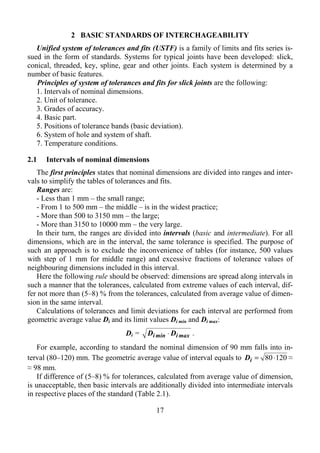
  • 4.
    1) Development worksfor creation of new items are easier, faster, and cheaper, be- cause basic elements are standardised (threads, splines, toothed gearing, etc.); 2) Manufacture of items is easier and cheaper (accuracy of blanks is specified, im- proved inspection methods, easier assembling and others); 3) Exploitation is cheaper (shortening of repair period and its high quality). Along with complete interchangeability the restricted (incomplete) interchangeabil- ity is permitted. Its types are: 1) Group interchangeability (selective assembling); 2) Assembling on the basis of probability calculations; 3) Assembling with adjusting of dimensions or positions of separate parts; 4) Assembling with fitting of one of several assembling parts. There is also difference between external and internal interchangeability. External interchangeability is interchangeability of finished items, mainly, deliver- ables (aggregates, instruments, frictionless bearings, etc.), from which interchangeabil- ity is required by service indexes and geometric parameters of joint surfaces. External interchangeability is always complete. For example, when replacing the failed electric motor, a new motor is mounted on the same place, on the same joint surfaces, with the same dimensions. This is interchangeability by joint dimensions or dimensional inter- changeability. New motor should be interchangeable also by operation indexes – by power, rotational velocity and other indexes. This is parametric interchangeability. Internal interchangeability is interchangeability of separate parts, assembly units and mechanism inside of each item. For example, complete interchangeability by joint diameters of bearing rings and restricted interchangeability by rolling elements. That is, internal interchangeability can be complete and incomplete. Interchangeability is inconceivable without accuracy. Accuracy is a degree of conformity of real part (assembly unit) to design accuracy specified by a designer or by normative technical documentation. Accuracy is an opposite characteristic of a tolerance. It is impossible to produce a part with exact dimension, for example, of 20 mm, because it means an infinite level of accuracy – 20.000000000000000000… For real parts the dimension is specified by two limit dimensions – maximum and minimum limit dimensions (e.g., 20.1 and 19.9 mm). Performed dimension of a part should be between these two specified limits. The larger difference between them, the larger permissible tolerance (specified error) for produc- tion is. And it is evident that the higher accuracy of specified parameter (smaller toler- ance for a dimension), the larger production expenses are (Fig. 1.1). Therefore, the as- signed level of accuracy should be always thoroughly substantiated. Quality is a set of properties and characteristics of products or services, which gives them an ability to satisfy the specified or prospective needs. Products or service is a result of activity or process. They may be material or non- material, that is, intellectual. Quality level is a relative characteristic of products based on comparison of quality indexes of estimated products with basic values of corresponding indexes. Problems of products quality and standardisation are regulated by International Or- 4
  • 5.
    ganization for Standardization(ISO), Production costs which includes more than 100 member- states producing approximately 90 % world industrial products. Quality system is a complex of interre- lated elements, including organisational structure, responsibilities, procedures, processes and resources necessary for re- alization of quality control. Quality system is created at a factory as a tool for realisa- tion and assurance of definite policy and achievement of permanent objectives in Tolerance the field of quality. Quality system should Figure 1.1 – Influence of accuracy on the cover all stages of a product life cycle costs for manufacture of products (Fig. 1.2). Quality loop (spiral of quality) is a schematic model of mutually dependent types of activities that influence a quality of products or services at the sequent stages – from research of needs to estimation of their satisfaction (ref. Fig. 1.2). Quality assurance is all planned and systematically realised activities in the frame- work of quality system, as well as, if necessary, other confirmed activities, which are needed for creation of satisfactory confidence that a factory will fulfil quality require- ments. Quality control is methods and types of activities of on-line character used for per- formance of quality requirements. Quality improvement is actions made everywhere at a factory with a goal of im- provements of efficiency and results of activities and processes for obtaining benefits for both a factory and consumers of products. ISO develops standards of recommendation character (including ones for machine- building industry), which are the basis for national standards obligatory for perform- ance. For instance, ДСТУ (DSTU) is National Standard of Ukraine; ГОСТ (GOST) is international standard for Commonwealth of Independent States (CIS). Branch stan- dards ОСТ (OST) and factory standards СТП (STP) are developed on the basis of na- tional standards. Each lower standard in this hierarchy must not contradict to para- graphs of a higher rank standard. Standardisation is an activity, the essence of which is finding the solutions for re- peated tasks in spheres of science, engineering and economics, directed to obtaining the optimal level regulation in a certain brunch. Standardisation is a planned activity to establish obligatory rules, norms and re- quirements, performance of which ensures economically optimal quality of products, increase of labour productivity and effective use of materials and capital equipment at observation of safety regulations. Standardisation is an “engineering laws”. It is also a basis for interchangeability. 5
  • 6.
    Quality policy offactory (formed by top managers) Quality system Quality Quality Quality assurance control improvement 12. Utilisation (recycling) 1. Marketing 11. Technical assistance 2. Development and maintenance of products 10. Installation and Specialists 3. Process plan- operation Customer Producer ning (schedule) (Consumer) (Supplier) 9. Sales and 4. Procurement distribution 8. Packing and storage 5. Preproduction 7. Inspection, testing, validation 6. Production of products Figure 1.2 – Diagram of quality management system Standardisation resolves contradictions between all participants of process for creation of products (including designers, production and maintenance engineers) due to they use the same source – standard. Each standard contains a legislated error of manufacture that should be observed during some period of standard action (revision of a standard is performed each 5 years). Types of standardisation are: unification, typification, and unitization. Unification is transformation of some objects to uniformity, or unified shape. It is rational reduction of quantity of elements of similar functional purpose, but without re- duction of systems variety, in which they are applied. At unification the variety of applied similar elements (holes diameters, thread di- mensions, types of rolled products) is reduced. For instance, if calculated diameter is equal to 16.92 mm, then according to basic series of preferred numbers the diameter of 16 mm or 18 mm should be assigned. 6
  • 7.
    Typification is developmentand establishment of typical design or manufacturing solutions for several items, which have similar characteristics. For example, branch typification of manufacturing processes. Unitization is a kind of standardisation, at which machine, equipment or production tools are composed from unificated aggregates (assembly units). When recomposing, the purpose of aggregates can be changed in a small degree. For example, multi-head machines, modular jigs and others. Technical specifications are normative engineering documentation for a specific item, material or other product. Technical requirements (spec) are established set of requirements to products, their manufacture, inspection, acceptance, etc. 1.2 System of tolerances and fits. Basic definitions International Unified System of Tolerances and Fits (USTF) is a family of series of limits and fits, constructed in a relationship on a basis of experience, theoretical and experimental investigations and issued in the form of standards. USTF is applied for slick joints of cylindrical and flat parallel surfaces (Fig. 1.3). According to ISO and USTF each internal element is called a “hole” (female sur- face), and each outside element is called a “shaft” (male surface). Parameters relating to a hole are designated by capital letters, and those relating to a shaft – by small letters (ref. Fig. 1.3). 1.2.1 Dimensions Dimension is a numerical value of linear parameter (diameter, length, etc.) in se- lected units of measurement (millimetre, micrometer, etc.). Limit dimensions are two permissible limits of size (maximum and minimum limit dimensions), between which the actual size of quality part should be or it can be equal to one of them. Nominal dimension (D, d, L, l, b, c) is a size, which is specified in a drawing on the basis of engineering calculations, design experience, etc., relative to which the devia- D>d D<d hole Clearance S=D–d l c d D D b d shaft L Interference N=d–D Figure 1.3 – Female and male dimensions of parts: D, L – hole-type dimensions; d, l – shaft-type dimensions; b, c – neither shaft nor hole type dimensions 7
  • 8.
    tions are determined(Fig. 1.4). In a drawing nominal dimension is specified in millime- tres (mm). Nominal dimension and tolerance do not determine dimensional characteris- tic of a part, because position of tolerance is not specified yet. It is a basic deviation that determines position of tolerance relative to nominal dimension (zero line). Nominal dimension can coincide with maximum limit dimension or minimum limit dimension, or its value can be between two limit dimensions, or it can be more than the maximum and less than the minimum limit dimensions. At graphic presentation tolerance bands of dimensions are located on the one side of diameters for convenience of plotting a diagram (ref. Fig. 1.4,c). Dimensions, deviations and tolerances of hole and shaft shown in Fig. 1.4 are: - Nominal hole diameter D; - Upper limit deviation of hole diameter ES; - Lower limit deviation of hole diameter EI; - Maximum hole diameter Dmах = D + ES; - Minimum hole diameter Dmin = D + EI; - Tolerance of hole diameter ТD = Dmах – Dmin = ES – EI; - Nominal shaft diameter d; - Upper limit deviation of shaft diameter es; - Lower limit deviation of shaft diameter ei; Td /2 TD/2 Td /2 Shaft Shaft TD/2 Tolerance band Smax a Smin Hole Sp ES for hole EI + 0 – Dmax Dmin Deviations es D=d ei dmax Shaft dmin Td Tolerance Shaft band for shaft c b Figure 1.4 – Diagrams of real locations of tolerances in hole and shaft (a), one-side lo- cation of tolerances (b), limit dimensions, deviations and tolerance bands of hole and shaft (c) 8
  • 9.
    - Maximum shaftdiameter dmах = d + es; - Minimum shaft diameter dmin = d + ei; - Tolerance of shaft diameter Тd = dmах – dmin = es – ei. 1.2.2 Deviations Analysis of diagrams for joints and engineering calculations are very convenient with application of deviations (Fig. 1.5). Deviations are located relative to zero line. Position of zero line is determined by nominal dimension. Upper deviation (ref. Fig. 1.5) is an algebraic difference between maximum limit of dimension and nominal dimension. It is designated: for hole by ES, for shaft by es: ES = Dmах – D; es = dmах – d. Lower deviation (ref. Fig. 1.4) is an algebraic difference between minimum limit of dimension and nominal dimension. It is designated: for hole by EI, for shaft by ei: EI = Dmin – D; ei = dmin – d. Sometime, for uniformity of formulas, the deviations of hole and shaft are desig- nated by ∆S (upper deviation of hole and shaft) and ∆I (lower deviation of hole and shaft). Mean deviation is an algebraic difference between mean dimension and nominal di- mension. It is designated: for hole by EM, for shaft by em: EM = Dm – D; em = dm – d, where Dmax + Dmin d max + d min Dm = ; dm = . 2 2 Mean deviation can also be de- fined as an average of upper and lower deviations: ES TD ES + EI EM EM = ; 2 + es + ei EI em = . 0 0 2 – es Mean deviations for hole and Td em shaft in general formulas can be Dmax D=d designated with unified symbol ∆m Dmin Dm ei (mean deviation of hole and shaft). dmax dmin Basic deviation is one of two dm limit deviations (the upper or lower) nearest to zero line. Figure 1.5 – Typical diagram for deviations and tolerance bands of hole and shaft 9
  • 10.
    Deviations are specified: - In micrometers (µm) in standards, diagrams, calculations of clearance (S) and in- terference (N) values; - In millimetres (mm) in drawings; - Obligatory with a sign (“+” or “–” except 0), because they can be positive or nega- tive depending on their position relative to zero line (nominal dimension). 1.2.3 Tolerance bands At graphic presentations the tolerance bands of dimensions are located relative to zero line (ref. Fig. 1.4, 1.5). Their positions are determined by positions (values) of up- per and lower deviations: for hole ES, EI; for shaft es, ei. Tolerance band differs from tolerance (TD , Td) by that it determines not only value, but also position of the tolerance relative to nominal dimension. 1.2.4 Fits Fit is a joint of parts determined by difference of their dimensions before assem- bling. The required fit is ensured by relative displacement of tolerance bands of hole and shaft. Types of fits are: clearance, interference, and transition, that is, movable and fixed fits (Fig. 1.6). Clearance (S) is a difference of hole and shaft dimensions, when hole size is larger than shaft size (ref. Fig. 1.6). Maximum Smaх and minimum Smin values of clearance are es3 Interference fit Clearance fit Transition fit em3 Td3 Shaft 3 Nmax2 ei3 dmax3 Td2 dmin3 NmP3 Nmin3 es2 Nmax3 dm3 ES em2 Shaft 2 + EM TD Hole ei2 0 0 EI = 0 Smin1 SmP1 T Smax2 NmP2 Smax1 – es1 em1 Td1 Shaft 1 D=d Dmin Dmax Dm dmin2 dmax2 ei1 dm2 dmax1 dmin1 dm1 Figure 1.6 – Location of tolerance bands of hole and shafts for clearance, transition and interference fits 10
  • 11.
    obtained from theformulas: Smaх= Dmaх – dmin = (D + ES) – (d + ei) = ES – ei; Smin= Dmin – dmaх = (D + EI) – (d + es) = EI – es. Interference (N) is a difference of hole and shaft dimensions, when hole size is smaller than shaft size (ref. Fig. 1.5). Maximum Nmaх and minimum Nmin values of in- terference are obtained from the formulas: Nmaх = dmaх – Dmin = (d + es) – (D + EI) = es – EI; Nmin = dmin – Dmaх = (d + ei) – (D + ES) = ei – ES. Nominal dimension of fit is the same for hole and shaft, that is, nominal dimension of hole equals to nominal dimension of shaft (D = d). Mean probable clearance SmP and mean probable interference NmP are calculated as a difference between mean diameters or mean deviations for hole and shaft from the formulas: SmP = Dm – dm = (D + EM) – (d + em) = EM – em; NmP = dm – Dm = (d + em) – (D + EM) = em – EM. Fit tolerance is equal to sum of tolerances of hole and shaft creating a joint TΣ = TD + Td. Operation requirements to fits are: 1. To movable joints: to create minimal clearance between hole and shaft that en- sures friction with layer of lubricant. 2. To fixed joints: to ensure alignment of parts and transmitting a torque or axial force with guaranteed interference. 3. General requirement: to ensure maximal life time. 1.2.5 Tolerance – general idea In order to understand better the essence of tolerance the following example is con- sidered. In manufacturing process a machine-tool is set (adjusted) for dimension to be performed. Quantity of parts in a batch to be produced with this dimension is equal to n. The parts cannot be equal by actual dimensions, because many factors will cause random errors of manufacture. These factors are: non-absolute rigidity of system “ma- chine-fixture-workpiece-tool” (MFWT), thermal stresses in the MFWT system, wear of a cutting tool, inequality of allowance along workpiece surface and others. Actual (measured) dimensions of these parts are (х1, х2,…, хi,…, хn). The extreme values хmin and хmах are selected among хn values. The average (mean) value хm, con- sidered as the most probable value (true value), is calculated 11
  • 12.
    y 1 n xm = ∑ xi , n i =1 Polygon where n is a quantity of pro- duced parts (quantity of meas- Bar chart urements). The scatter (dispersion) band of actual dimensions v = (хmах – хmin) is divided into ∆/2 ∆/2 5, 7, or 9 (or another odd number) equal intervals ∆. x The quantities of the measured ∆ xm dimensions that strike into xmin v xmax each interval are calculated. Figure 1.7 – Bar graph and polygon of scatter of ac- The quantities (or relative tual dimensions quantities – probability den- sity Pr) along axis y is plotted in a form of a histogram (bar graph). The polygon of scatter of actual dimensions (Fig. 1.7) is obtained by connecting the interval middles with a broken line. The broken line (polygon) can be smoothed and approximated by continuous curve. This curve is called Gauss error curve; it describes normal law (Gauss law) of dimen- sions dispersion ∆х 2 − y= 1 e 2σ 2 , σ 2π where ∆х – error (deviation) – difference between actual value of parameter хi and av- erage value хm (assumed as a true value), ∆х = хi – хm; σ – standard deviation that characterises influence of random errors, 1 n σ= ∑ ∆x 2 ; n − 1 i =1 е – base of natural logarithm; у – density of probability distribution. The error values of considered dimension obeys the Gauss law and the scatter band of actual dimensions can be spread from average (true) value to left and right sides with the known value of 3σ, that is, (–3σ) and (+3σ). For satisfactory large quantity of measurements n and intervals ∆ the experimental curve will coincide with the theoretical one. This range (confidence interval) from (–3σ) to (+3σ) includes approximately 100 % (99.73 %) produced parts (Fig. 1.8). This interval ω is conventionally written down into standard and thereby the error is legal- ised and named as tolerance IT = 6σ. Symbol IT is considered as an international des- ignation of tolerance for manufacture. 12
  • 13.
    Each type ofmachining methods ap- y plied in industry (turning, milling, grind- ing, etc.) has its own attainable σ value and, hence, IT value. So, the tolerance is a legalised error of manufacture and it is numerically speci- fied in a drawing and equal to a difference between maximum limit and minimum limit of dimension: Pα = 0.9973 for hole ТD = Dmах – Dmin; ∆x for shaft Тd = dmах – dmin, –3σ 0 (xm) +3σ or is numerically equal to an algebraic dif- ω = 6σ ference between upper and lower devia- tions: dmin T dmax (ei) dm (es) for hole ТD = ES – EI; for shaft Тd = es – ei. In these formulas Dmах, ES, dmах, es Figure 1.8 – Theoretical distribution correspond to right boundary of confiden- density of actual dimensions in confi- dence interval and tolerance tial interval (+3σ), and values Dmin, EI, dmin, ei correspond to left boundary of con- fidential interval (–3σ). Tolerance is always positive. In standards the tolerance values are given in mi- crometers and specified in drawings in millimetres. 1.2.6 Technological aspect Initial data for planning of manufacturing process is the drawing of a part, output of parts, as well as, available basic equipment, tooling, methods for production of blanks and production periods. This means that, when making analysis of the part drawing, first of all, one pays at- tention to accuracy of basic surfaces themselves and to accuracy of their relative loca- tion that determines necessary methods of their machining, datums (locating elements) and diagrams for mounting of a workpiece in operations, sequence of operations along manufacturing process. The output determines type of production, and, hence, degree of mechanisation and automation of manufacturing process including application of ad- vanced methods for inspection of a part accuracy and other aspects. And so it is obvi- ous that the manufacturing processes for production of 5, or 500, or 5000 parts will be significantly different. The task of technology is unconditional (obligatory) performance of the drawing re- quirements, and doing that with the highest efficiency – with highest productivity and at least costs. This is a distribution of works (responsibilities) between designer and tech- 13
  • 14.
    nologist during creationof products. When planning a manufacturing process it is assumed in calculations that confi- dence interval for actual dimensions ω = 6σ = Td, that is, the part is considered to be the quality one, if its actual dimension does not go beyond limits of tolerance band. Comments for providing the geometric accuracy are depicted in Fig. 1.9. A designer specifies parameters of accuracy: maximum dmax and minimum dmin limit dimensions, mean diameter dm, tolerance Td. In a manufacturing process setting-up (adjustment) of machine-tool is performed regard to the diameter dm. Scatter v of actual dimensions is determined by maximum xmax and minimum xmin actual dimensions. Mean value xm is typically displaced at setting-up error value µ. In order to obtain quality parts without reject the scatter v must not exceed tolerance Td, the value xmax must not exceed speci- fied value dmax, and xmin must not be less than dmin. In industrial practice the quality control of a large batch of N parts is also performed by measurements of batch sampling of n parts and processing of measurements results with the statistical methods. In this case, standard deviation σ, confidence interval ω, maximum xNmax and minimum xNmin values are calculated for comparison with the specified tolerance Td, maximum dmax and minimum dmin limit dimensions (ref. Fig. 1.9). When realizing a manufacturing process, a technologist strives to perform two con- ditions: 1) xm → dm – to ensure coincidence of middle of scatter band xm with mean diameter dm (with centre of tolerance band em) by reduction of setting-up error µ; 2) Confidence interval ω is ensured of smaller than tolerance Td value: ω = k·Td = k·6σ, where coefficient k < 1. Applied equipment and machining methods should guarantee performance of these conditions. This conditions increase production costs, but exclude spoilage (rejects). y y em ei es x ∆x 0 –3σ 0 +3σ dmin dm dmax xmin xm xmax xNmin xm xNmax Td v ω Scatter band of µ Tolerance band of actual dimensions specified dimension (manufacture) dmin dmax dm (designing) Td Figure 1.9 – Diagram for guaranteed providing the geometric accuracy 14
  • 15.
    1.2.7 Preferred numbers of linear series In order to reduce variety of dimensions, specified after calculations, a nominal dimension, as a rule, is rounded off with increase for shafts and with decrease for holes to the values of preferred numbers. Preferred numbers and their series are the basis for selection of numerical values of parameters. Their purpose is to agree items, semi-products, materials, manufac- turing equipment, inspection and other equipment. In standards the numbers are rounded off. The standard contains 4 basic series of numbers R5, R10, R20, R40 located in geometric progression. Series from R5 to R40 contain correspondingly 5, 10, 20, and 40 numbers in each decimal interval, and numbers in these intervals are obtained by multiplication or division of numbers by 10, 100, 1000, that is, series of preferred numbers are unlimited (allow unlimited development of dimensions values) in both directions of decreasing and increasing of numbers (Table 1.1). Table 1.1 – Basic series of preferred numbers for linear dimensions R5 R10 R20 R40 Series index ϕ = n 10 5 10 ≈ 1.6 10 10 ≈ 1.25 20 10 ≈ 1.12 40 10 ≈ 1.06 Preferred numbers 1; 1.6; 2.5; 4; 6.3; 1; 1.25; 1.6; 2; 2.5; 1; 1.12; 1.25; 1.4; 1; 1.06; 1.12; 1.15; 10; 16; 25; 40; 63; 3.15; 4; 5; 6.3; 8; 1.6; 1.8; 2; 2.2; 2.5; 1.25; 1.3; 1.4; 1.5; 100 … 10; 12.5; 16 … 2.8; 3.15; 3.6; 4 … 1.6 … The standard does not cover manufacturing operation dimensions and the dimen- sions connected with other adopted dimensions by design relationships. Preferred numbers series are widely applied in modern engineering including standards for tolerances and fits. 1.2.8 Specifying the dimensions Dimensions are divided into mating and non-mating ones. Mating dimensions are those, by which parts contact each other creating movable and fixed joints. Mating dimensions are important to ensure interchangeability; they should satisfy high requirements for accuracy (as a rule, accuracy grades 5 to 11). Non-mating dimensions determine those surfaces, along which a part does not contact with other parts in item (as a rule, accuracy grades 12 to 18). As a rule, tolerance bands or limit deviations of non-mating dimensions are not specified, and described by a general writing in engineering requirements of a draw- 15
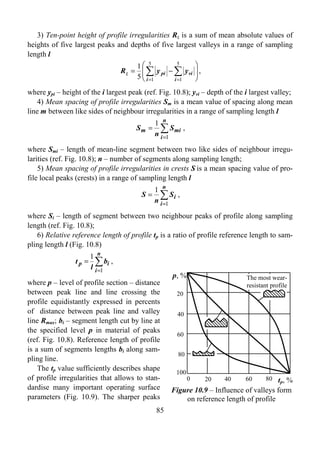
  • 16.
    ing. Numerical valuesof unspecified limit deviations of linear dimensions may be set on the basis of either accuracy grades or special accuracy classes (Table 1.2). Examples of specifying the accuracy of non-mating dimensions in engineering requirements of drawings are: 1) + t2, – t2, ± t2/2; 2) ± t2/2; 3) H14, h14, ± t2/2. More often in aircraft branch the typical writing is applied in engineering re- quirements of drawings: “Unspecified limit deviations of dimensions are: H12 for holes, h12 for shafts, ± IT12/2 for others”. Table 1.2 – Special accuracy classes t i for non-mating dimensions Precise Middle Rough Very rough t1 t2 t3 t4 Respective accuracy grades (11), 12 13,14 15,16 17, (18) Note. The accuracy grades, which are not recommended for application, are given in parentheses. Taking into account the terms of dimension, tolerance, deviation, satisfactory in- formation about specified design dimension may include (Fig. 1.10): 1) Two limit dimensions, or; 2) Nominal dimension, basic deviation, tolerance, or; 3) Nominal dimension, upper and lower deviations. In technological documentation executive dimension is specified by limit value of dimension Dmin or dmax and tolerance ТD or Тd, which are directed “into metal”: for hole Dmin+ТD and for shaft d max −T , d that means: for hole – nominal dimension is equal to the minimum dimension, upper deviation equals tolerance with plus, lower deviation equals zero; for shaft – nomi- nal dimension is equal to the maximum dimension, upper deviation equals zero, lower deviation equals tolerance with minus. es Td + ei ei 0 0 dmin dmax d d 1) – 2) 3) Figure 1.10 – Methods for specifying a design dimension 16
  • 17.
    2 BASIC STANDARDSOF INTERCHAGEABILITY Unified system of tolerances and fits (USTF) is a family of limits and fits series is- sued in the form of standards. Systems for typical joints have been developed: slick, conical, threaded, key, spline, gear and other joints. Each system is determined by a number of basic features. Principles of system of tolerances and fits for slick joints are the following: 1. Intervals of nominal dimensions. 2. Unit of tolerance. 3. Grades of accuracy. 4. Basic part. 5. Positions of tolerance bands (basic deviation). 6. System of hole and system of shaft. 7. Temperature conditions. 2.1 Intervals of nominal dimensions The first principles states that nominal dimensions are divided into ranges and inter- vals to simplify the tables of tolerances and fits. Ranges are: - Less than 1 mm – the small range; - From 1 to 500 mm – the middle – is in the widest practice; - More than 500 to 3150 mm – the large; - More than 3150 to 10000 mm – the very large. In their turn, the ranges are divided into intervals (basic and intermediate). For all dimensions, which are in the interval, the same tolerance is specified. The purpose of such an approach is to exclude the inconvenience of tables (for instance, 500 values with step of 1 mm for middle range) and excessive fractions of tolerance values of neighbouring dimensions included in this interval. Here the following rule should be observed: dimensions are spread along intervals in such a manner that the tolerances, calculated from extreme values of each interval, dif- fer not more than (5–8) % from the tolerances, calculated from average value of dimen- sion in the same interval. Calculations of tolerances and limit deviations for each interval are performed from geometric average value Di and its limit values Di min and Di max: Di = Di min ⋅ Di max . For example, according to standard the nominal dimension of 90 mm falls into in- terval (80–120) mm. The geometric average value of interval equals to Di = 80 ⋅ 120 ≈ ≈ 98 mm. If difference of (5–8) % for tolerances, calculated from average value of dimension, is unacceptable, then basic intervals are additionally divided into intermediate intervals in respective places of the standard (Table 2.1). 17
  • 18.
    Table 2.1 –Example of basic and intermediate intervals of dimensions Basic interval Intermediate intervals 120-140 120-180 140-160 160-180 If dimension value is equal to the extreme value of interval, deviations should be taken from that interval of the standard, in which this dimension appears first. 2.2 Tolerance unit The second principle of USTF is a tolerance unit accepted in accordance with the rule of scale coefficients. The necessity of this term is explained with application of the following examples (Table 2.2). Table 2.2 – Relative accuracy of dimensions Case Nominal dimension, mm Tolerance, mm Accuracy of dimension, mm 40 0.3 more accurate 1 40 0.6 less accurate 120 0.3 more accurate* 2 40 0.3 less accurate 120 0.35 ? 3 40 0.25 ? * With dimension increase it is more difficult to ensure the same tolerance, because ac- curacy of enlarged dimension increases too. If nominal values of dimensions are equal, the more accurate will be that dimension, which has the smaller tolerance (see Table 2.2, case 1). If tolerances are equal, the more accurate will be that dimension, which has the larger nominal value (see Table 2.2, case 2). Accuracy comparison of dimensions with different nominal values and different tol- erances is a certain problem (see Table 2.2, case 3). Therefore, it is reasonable to intro- duce term of “tolerance unit”. For determination of tolerance value it is necessary to separate the tolerance portions depending on nominal dimension and accuracy: IT = i·a, where i – tolerance unit (function of dimension); a – number of tolerance units (func- tion of accuracy). In order to specify tolerances it is necessary to determine the relationship of their change depending on value of nominal dimension. Therefore, for construction of toler- ances system the tolerance unit i is stated; i is a multiplier factor in tolerance formula, being the function of nominal dimension and serving for determination of numerical value of tolerance. 18
  • 19.
    For middle dimensionrange (1–500) mm the tolerance unit is calculated from em- pirical relationship i = 0.45 ⋅ 3 Di + 0.001Di , micrometer (µm), where Di – geometric average value of interval specified in millimetres (mm). For example, for dimension of 90 mm (interval (80–120) mm) the geometric aver- age value Di ≈ 98 mm, and tolerance unit is i = 0.45 ⋅ 3 98 + 0.001 ⋅ 98 = 0.45 ⋅ 4.61 + 0.098 ≈ 2.17 µm. Tolerance unit values have been calculated, rounded off and adopted in the form of standard. 2.3 Gradation of accuracy The third principle of USTF system is gradation of accuracy (accuracy series). In each item the parts of different purpose are produced with different accuracy depending on specified requirements. In order to normalise specified accuracy the accuracy grades are introduced. There are naturally constructed series of tolerances for each accuracy grade. In one series the different dimensions have the same relative accuracy determined by coeffi- cient a. Tolerances of dimensions of the same accuracy contains equal number a of tol- erance units. 20 accuracy grades are established. They are designated by numbers increasing with tolerance value increase: 01; 0; 1; 2; 3… 17; 18. Tolerance value is specified by letters IT (ISO Tolerance) and number of accuracy grade, for example: IT6, IT12. Tolerance values for the 5–18 accuracy grades are determined by relationship IT = i·a (Table 2.3). For other grades the tolerance values are determined from other relationships. Table 2.3 – Number of tolerance units in accuracy grades 5 to 18 for dimensions of (1–500) mm Grades 5 6 7 8 9 10 11 12 13 14 15 16 17 18 Number of tol- 7 10 16 25 40 64 100 160 250 400 640 1000 1600 2500 erance units а Starting from the 6th grade the number of tolerance units а changes according to geometric progression with the ratio φ = 1.6 (basic series R5 of preferred numbers). And so, neighbouring tolerances differ in 60 %, and when making steps in each 5 grades the tolerance value 10 times increases. An accuracy grade determines tolerance value for machining, and, hence, determines methods and equipment for production of machine parts. Knowing values of both multipliers in the formula for IT, one can determine toler- ance value for a dimension (Table 2.4). For example, for dimension of 90 mm in the 7th 19
  • 20.
    grade the toleranceunit number а = 16 (see Table 2.4 for accuracy grade 7), tolerance unit i = 2.17 µm (see the previous example) IT 90 − dimension  = i  80 −120  ⋅ а (7 − grade) ≈ 2.17·16 ≈ 35 µm.      7 − grade   interval      In order to check the tolerance value for dimension of 90 mm of the accuracy grade 7 see the Table 2.4. Table 2.4 – Tolerance values for dimensions from 1 to 500 mm Tolerance Accuracy grades Basic intervals of dimen- No. unit, 5 6 7 8 9 10 11 12 sions, mm i, µm Tolerance IT, µm 1 From 1 to 3 including 0,55 4 6 10 14 25 40 60 100 2 Above 3 up to 6 incl. 0,73 5 8 12 18 30 48 75 120 3 Above 6 up to 10 incl. 0,90 6 9 15 22 36 58 90 150 4 -''- 10 up to 18 -''- 1,08 8 11 18 27 43 70 110 180 5 -''- 18 up to 30 -''- 1,31 9 13 21 33 52 84 130 210 6 -''- 30 up to 50 -''- 1,56 11 16 25 39 62 100 160 250 7 -''- 50 up to 80 -''- 1,86 13 19 30 46 74 120 190 300 8 -''- 80 up to 120 -''- 2,17 15 22 35 54 87 140 220 350 9 -''- 120 up to 180 -''- 2,52 18 25 40 63 100 160 250 400 10 -''- 180 up to 250 -''- 2,89 20 29 46 72 115 185 290 460 11 -''- 250 up to 315 -''- 3,22 23 32 52 81 130 210 320 520 12 -''- 315 up to 400 -''- 3,54 25 36 57 89 140 230 360 570 13 -''- 400 up to 500 -''- 2,52 27 40 63 97 155 250 400 630 Number of tolerance units а 7 10 16 25 40 64 100 160 Tolerance IT = i·a 7i 10i 16i 25i 40i 64i 100i 160i Note. Calculated values have been rounded off. 2.4 Positions of tolerance bands of basic parts The forth principle states limit one- Basic hole Basic shaft side positions of tolerance bands of ba- + sic parts (Fig. 2.1). H Basic hole (H) is a hole, lower de- Zero line es = 0 0 0 viation of which is equal to zero EI=0 h (EI = 0). – Basic shaft (h) is a shaft, upper de- viation of which is equal to zero Figure 2.1 – Diagram for positions of (es = 0). tolerance bands of basic parts 2.5 Basic deviations The fifth principle establishes positions of basic deviations (tolerance bands). Positions of tolerance bands are determined by standardised values of 28 basic de- 20
  • 21.
    A HOLES B deviations deviations C Negative Positive CD D E EF K M N Zero line F P R S FG G H T U V X Y Z ZA J dimension ZB Nominal JS ZC zc deviations deviations Negative Positive zb z za x y f fg g h r s t u v Zero line e ef k m n p d cd j Nominal dimension c jS b SHAFTS a Figure 2.2 – Diagram for positions of basic deviations for holes and shafts viations for shafts and 28 basic deviations for holes, which are designated by Roman letters (Fig. 2.2): - Small letters from a to zc for shafts; - Capital letters from А to ZС for holes. Basic deviation is one of two limit deviations (the upper or the lower), which deter- mines position of tolerance band relative to zero line. Basic deviation is a deviation 21
  • 22.
    Hole Shaft nearest to zero line. Basic deviations are standardised and their numerical values nave been determined from the + EI A to H ei empirical formulas for shafts depending on in- 0 0 tervals of nominal dimensions, for example: J to ZC - Basic deviations “e” and “f” (upper devia- – es ES tions): ese = – 11⋅Di0.41; esf = – 5.5⋅Di0.34 ; Shaft Hole - Basic deviations “v” and “x” (lower devia- tions): Figure 2.3 – Diagram of symmet- ric positions of basic deviations eiv = IT7 + 1.25⋅Di ; eix = IT7 + 1.6⋅Di, of shaft and hole where Di – geometric average value of interval of nominal dimensions. Basic deviations for holes are mirror-like images of basic deviations for shafts (Fig. 2.3, see also Fig. 2.2 for comparison). General rule: basic deviation for hole should be symmetric to basic deviation for shaft of the same letter designation relative to zero line. Basic deviations for holes from A to H are calculated from the formula EI = – es. Basic deviations for holes from J to ZC are calculated from the formula ES = – ei. There is an exception from the general rule. Special rule: two fits in the system of hole and system of shaft, in which holes of cer- tain accuracy grade are joined with shafts of ITn–1 Nmax higher accuracy grade, Nmin should have the same ei clearances and interfer- Fit in system ences (Fig. 2.4). of shaft Special rule is actual ITn + H for holes with basic devia- 0 0 tions J, K, M, N from the ITn–1 Fit in system h 5th to the 8th accuracy – of hole grades (transition fits) and for holes with basic devia- ES tions from P to Z from the ES' Special rule 5th to the 7th accuracy ITn General rule grades (interference fits). ∆ = ITn – ITn–1 According to the spe- cial rule basic deviation Figure 2.4 – Analytical diagram for calculations of ba- for hole is calculated from sic deviation of hole according to special rule the formula 22
  • 23.
    ES = –ei + ∆, where ∆ = ITn – ITn–1 is a difference between tolerance of the considered accuracy grade and tolerance of the nearest more accurate grade. Special rule ensures obtaining the same limit interferences of the same-name fits in system of hole and system of shaft at the condition that the hole tolerance is one accu- racy grade lower than the shaft tolerance. Basic deviations for all dimensions included into a certain interval of nominal di- mensions are the same (equal) and do not depend on accuracy grade, because basic de- viation value is a function of only dimension (Fig. 2.5). Second (non-basic) deviation of any tolerance band is determined from values of ba- sic deviation and tolerance: - For hole: ES = EI + ТD; EI = ES – ТD; - For shaft: es = ei + Td; ei = es – Td. Tolerance band is formed by combination of basic deviation (letters) and number of accuracy grade (digits), for example, Н7, s6. Example of specifying the dimension: Ø160s6, where Ø – diameter; 160 – nominal value of dimension; s – basic deviation; 6 – accu- racy grade; s6 – tolerance band. Preferred tolerance bands. Tolerance bands are divided into 2 series: basic (rec- ommended) and additional (of restricted application). The narrower series of preferred tolerance bands is extracted from basic series for the first-priority application. They provide (90–95) % fits of general purposes and are 3–5 times cheaper in production. Preferred tolerance bands are highlighted with square blocks or with bold type print in the standards tables. +43 ES: +34 +27 +27 F8 ES: F7 +18 F6 +11 + H8 EI = +16 H7 H6 es = 0 0 0 EI = 0 h6 es = –16 h7 – h8 –11 f6 f7 –18 Ø16 f8 ei: –27 –27 –34 ei: –43 Figure 2.5 – Graphic presentation of independence of basic deviation from accuracy 23
  • 24.
    2.6 System ofhole and system of shaft The sixth principle establishes fits in the system of hole and in the system of shaft (Fig. 2.6). Tolerance bands of shafts Tolerance bands of holes + H 0 0 h – Fits in system of hole Fits in system of shaft Figure 2.6 – Diagram of positions of tolerance bands in system of hole and system of shaft In the system of hole the required clearances and interferences of fits are formed by combination of various tolerance bands of shafts with tolerance band of basic hole (H). In the system of shaft the required clearances and interferences of fits are formed by combination of various tolerance bands of holes with tolerance band of basic shaft (h). In a fit typically a hole has lower accuracy (larger grade number ITn) and a shaft has higher accuracy (smaller grade number ITn–1). Systems of hole and shaft are formally equal. But system of hole is preferable in the most of cases. It is more economically sound, because shafts are easier and cheaper for production as compared with holes. For machining of shafts mainly versatile cutting tools are applied, access to work surfaces (outside open surfaces) is convenient. For machining of holes more complicated and precision cutting tools (drills, core drills, reamers, broaches, cutting tools fixed on boring bars) are applied, access to work sur- faces (internal semi-closed surfaces) is restricted. These precision cutting tools are pro- duced in a great amount for machining of H holes (basic holes). But in some cases the system of shaft is more preferable – cheaper and technically more reasonable: - When single-diameter smooth shaft should be inserted into several holes with dif- ferent types of fits (Fig. 2.7); - When applying the standardised units and parts produced under certain systems, for example, outside diameter of frictionless bearings is produced under the system of shaft, because it is unknown with what fit it will be mounted in a mechanism; - When it is not reasonable to make multi-diameter (stepped) shaft to avoid stress concentration at the places of fillets. 24
  • 25.
    Piston Piston pin Connecting rod Interference n5 H6 N6 G6 h5 g5 Grinding of pin is Grinding of pin is problematic favourable Clearance Fits in system of hole Fits in system of shaft Figure 2.7 – “Piston-pin-connecting rod” assembly in system of hole and system of shaft Specifying the dimensions. For example, the dimension of fit Ø90Н7/g6 can be specified several variants (Fig. 2.8). In drawing a designer, as a rule, specifies dimen- sions in the form convenient for him: hole Ø90Н7, shaft Ø90g6, fit Ø90Н7/g6. It is permissible to specify dimensions with numerical values of upper and lower deviations: +0.035 hole Ø90 +0.035 , shaft Ø90 −0.012 , − 0.034 fit Ø90 − 0.012 . The last form is also convenient for a − 0.034 technologist, because it gives numerical values of deviations. It is also permissible to a designer to specify dimensions in a combined form: hole Ø90H7(+0.035), shaft + 0.035  H7  ( − 0.012 ) Ø90g6 − 0.034 , fit Ø90  g6  −0.012  .  −0.034  Executive dimensions are dimensions, which are specified in operation sketches for machining the parts (ref. Fig. 2.8). For holes executive dimension is a minimum limit dimension with positive upper deviation (equal to the tolerance ТD); for shaft it is a maximum limit dimension with negative lower deviation (equal to the tolerance Тd). That is, in technological sketches deviations are specified “into body” of workpiece (into metal) that ensures maximum material condition for manufacture and higher prob- ability of quality items. Setting-up dimensions are dimensions, by which setting-up (adjustment) of ma- chine-tools is performed in batch production, as well as of machines with computer numerical control (CNC). Numerically setting-up dimension is equal to the mean value of maximum and minimum limit dimensions. Graphically it is shown in the middle of tolerance band of shaft (ref. Fig. 2.8). Tolerance for a setting-up dimension approxi- mately equals (20–30) % tolerance of executive dimension. 25
  • 26.
    +35 + H7 +0.035 H7 Ø90 –0.012 0 0 g6 –12 +3 –0.034 em = – 23 – g6 –34 –3 Ø89.977±0.003 T = 22 Setting-up dimension: Ø90 Ø89.988–0.022 in batch production work on set-up machines, on CNC machines Design dimensions: for hole for shaft for assembly Ø90H7 Ø90g6 H7 Ø90 g6 –0.012 Ø90+0.035 Ø90 –0.034 +0.035 –0.012 Ø90 –0.012 Ø90H7(+0.035) Ø90g6 –0.034 –0.034 H7 +0.035 Ø90 –0.012 Ø90+0.035 Ø89.988–0.022 g6 –0.034 Executive dimensions Figure 2.8 – Specifying dimensions of holes, shafts, assembly units in drawings and in technological documentation 2.7 Temperature conditions Standardised tolerances and fits in the USTF system are calculated from the condi- tion of parts inspection at normal temperature of +20ºC. o o If temperatures of item t1 and measuring tool t 2 do not coincide and differ by more than 2ºC from +20ºC, then the correction is applied: ∆l ≈ l (α1 ∆t1 – α2 ∆t 2 ), o o where l – measured dimension, mm; α1 and α2 – linear expansion coefficients of mate- rials of part and measuring tool, respectively; ∆t1 and ∆t 2 – difference between tem- o o o o perature of part t1 , temperature of measuring tool t 2 and normal temperature 20ºC, re- spectively: ∆t1 = t1 – 20; ∆t 2 = t 2 – 20. o o o o 26
  • 27.
    3 MEASUREMENTS ANDINSPECTION 3.1 Basic definitions Measurement is a determination of value of physical parameter with aid of special measuring means, for example, rule, vernier calliper, micrometer, that is, measuring means with a graduated scale. Measurements are performed in pilot or small-batch productions, at repair and ex- perimental works, and in batch and mass production – at setting-up of machine-tools or statistical methods of inspection (samplings). Actual dimension is a dimension determined by measurement with permissible er- ror. Measurement is a determination of actual value of physical parameter by experimen- tal way with aid of special measuring means. Measuring error (inaccuracy) is a deviation of measurement result from true value of measured parameter. It depends on accuracy of measuring equipment. Accuracy of readings from scale and rounding-off, as a rule, is equal to half-division of scale (0.5 div.). Error value is a difference between actual (real) value and specified value of pa- rameter. The following types of errors are distinguished. Systematic errors are called those errors, which are constant by absolute value and sign or changing by a certain law depending on character of non-random factors. For example, if there is an error in calibration of scale of measuring device, then this error is included into all readings. So as the error magnitude and sign are known, these errors are eliminated with corrections. Correction is a value of parameter similar to the measured one, added to the value obtained at measurement with aim to exclude systematic error. Random errors are called those errors, which are non-constant by absolute value and sign, which appear at manufacture and measurement and depend on random factors (uneven allowance removed from workpiece, inaccuracy of workpiece mounting, etc.). Blunders or rough mistakes are called those errors, which significantly exceed ex- pected systematic or random errors under the specified conditions of measurements. Direct measurement is a measurement, at which desired value of parameter is ob- tained directly (by reading of measuring instrument), for example, measurement of length with a vernier calliper or micrometer. Indirect measurement is a measurement, at which desired value of parameter is cal- culated from the known relationship between this parameter and parameters obtained from experimental data. For example, determination of area of a rectangle is performed by multiplication of measured values of length and width. Relative measurement is a measurement, at which deviation of dimension from the 27
  • 28.
    selected measure orreference part, conventionally assumed as a unit, is measured. For example, measurement with a dial indicator set-up to dimension with gauge-block as- sembly is used. Measurement methods can be of contact or non-contact type. Contact measurement method is a method, at which sensitive element of instrument comes in contact with a subject being measured, for example, temperature measure- ment with a thermometer contacting with a part. Non-contact measurement method is a method, at which sensitive element of in- strument does not come in contact with a subject being measured, for example, tem- perature measurement with a pyrometer not contacting with a part. Inspection is an ascertainment of the fact that parameter being checked complies with the specified accuracy without determination of its actual value (whether the ac- tual value falls into specified tolerance band or does not), for example, inspection of parts with fixed gauges. 3.2 Material limits Maximum limit condition is a limit size, to which the largest quantity (volume) of a part material corresponds, that is, maximum limit dimension of shaft or minimum limit dimension of hole. Minimum limit condition is a limit size, to which the smallest quantity (volume) of a part material corresponds, that is, minimum limit dimension of shaft or maximum limit dimension of hole. In batch production the limit dimensions of shaft and hole are checked with gauges. Maximum limit dimension of shaft and minimum limit dimension of hole are checked with GO-gauges. These limits are called maximum material limits. Minimum limit di- mension of shaft and maximum limit dimension of hole are checked with NOT-GO gauges and respective limits are called minimum material limits. 3.3 Check of parts with gauges The similarity principle is a basis for check of parts with fixed gauges. Similarity principle: fixed gauge should imitate a segment of that item, with which a checked part will be in contact. Hole is checked by gauge-shaft (plug gauge), and shaft is checked by gauge-hole (ring gauge and snap gauge). Perfect gauges should be combined, that is, should check both dimension and shape. If, for example, plug gauge is a flat part, then only dimension is checked, but not form. There are in-process and post-process inspection methods. When applying in-process inspection methods in batch and mass productions (for example, in-process snap gauge), in essence, performance of manufacturing process is checked. Warning is generated when certain deviation of checked parameter appears 28
  • 29.
    Dmax Minimum ma- Maximum terial limit NOT GO Minimum ma- terial limit material limit Dw reclaimable reject Td waste GO Maximum material limit NOT-GO Dmin dmax GO TD drr dmin waste dw shaft hole NOT-GO snap gauge GO snap gauge Drr reclaimable reject Figure 3.1 – Diagram for check of a shaft with snap gauges and check of a hole with plug gauges before the moment when spoilage is produced – the tuning of manufacturing process is needed. Post-process inspection methods (for example, fixed gauges) check conformity of ready-made parts with the specified dimensions in the drawing. Figure 3.1 shows that: - This is inspection, but not measurement; - Shaft is checked with a “hole” – snap gauge; - Hole is checked with a “shaft” – plug gauge. Snap gauge checks only dimension, in contrast to a complex gauge – ring gauge, which checks both dimension and form. The part is good by dimension, if go-gauge (GO) goes through the part dimension, and not-go gauge (NOT GO) – does not go. If the part does not satisfy one of these conditions, it is a faulty part (reject). Rejects can be reclaimable or waste. Reclaimable rejects are those faulty parts, which have actual dimension of shaft drr more than maximum limit dimension dmax and actual dimension of hole Drr less than minimum limit dimension Dmin. Wastes are shafts of diameter dw smaller then minimum limit dimension dmin and holes of dimension Dw larger then maximum limit dimension Dmax. Variants of gauges are: 1) single-end single-limit; 2) double-end double-limit; 3) single-end double-limit. Inspection rules: - A worker checks with a new gauge, inspector – with a partially worn gauge; - Must not apply large force; 29
  • 30.
    0.002 H7(+0.018) 0.002 Ø16 – 0.006 g6 – 0.017 Ra 0.08 Ra 0.08 –H –H dNOTmax dGOmax NOT-GO +0.018 Ø16Н7 GO 0 Single-end double-limit snap gauge for check of Double-end double-limit plug gauge for shaft check of hole Ø16g6 2nd type error H/2 1st type error Ra 0.08 NOT-GO +18 NOT-GO –0.017 dNOTmax H H GO –0.006 DNOTmin+H1 H7 + 0.002 DGOmin+H1 0.002 GO Z 0 0 Y Wear limit – R-W Z1 Y1 Limit of wear –6 HP GO R-GO dGOmin dGOmax HP/2 g6 Ø16 HP H1 Td NOT-GO R-NOT –17 HP H1/2 H1 Figure 3.2 – Types of work gauges and diagram for positions of tolerance bands of items, work and reference gauges - Observe temperature conditions. Fixed gauges (Fig. 3.2) are divided into: - Work: GO, NOT-GO; - Inspection: I-GO, I-NOT-GO; - Reference: R-GO, R-NOT-GO, R-W (check of Wear) – for inspection of work gauges for shafts. There are no reference gauges for inspection of work gauges for a hole. Fixed gauges are typically applied in batch and mass productions. Check of hole part is performed with a gauge-shaft; check of shaft part is performed 30
  • 31.
    with a gauge-hole,and check of gauge-hole is performed with a countergauge-shaft. Errors of inspection with gauges. When item dimensions are near to the tolerance limits, there is a probability to make the following mistakes (ref. Fig. 3.2): - Errors of the 1st type – when proper dimension is considered as a reject; - Errors of the 2nd type – when reject is accepted as quality product. Rules for rounding off the executive dimensions of fixed gauges: 1. Dimensions of work and inspection gauges for items are rounded off to the value divisible by 0.5 µm (0.0005 mm). 2. Dimensions, which end in 0.25 and 0.75 µm, are rounded off to the value divisible by 0.5 µm with decrease of manufacture tolerance (TD or Td). 3. In a drawing the deviations of executive dimensions are specified “into body” of gauge (ref. Fig. 3.2). 4 STATISTICAL METHODS FOR PRODUCT QUALITY CONTROL In production the actual dimensions of parts are varying depend on systematic and random factors (errors). Systematic errors are essentially reduced by corrections at the stage of tuning (adjustment) of a manufacturing process. Random errors are difficult or impossible to exclude. They should be reduced to the permissible value that does not exceed the value of tolerance for dimension or form. Random errors of measuring instruments and errors of manufacture are typically de- scribed by the normal distribution law. In order to estimate quality of the parts produced under influence of random factors the statistical methods are applied. 4.1 Rules for measurements with errors 1. If systematic error is determinative, that is, its value is essentially larger than value of random error, then a measurement can be performed only one time. 2. If random error is determinative, the measurement should be performed several times. Number of measurements should be selected in such a manner that random error of arithmetic mean xm is less than the systematic error in order to the latter determines to- tal error of measurements results. For many parts random errors are described by statistical characteristics. 4.2 Basic statistical parameters and formulas Basic statistical parameters and formulas are submitted in Table 4.1. 31
  • 32.
    Table 4.1 –Statistical characteristics of random errors for batch of parts Statistical Definition, formula characteristic Empirical centre of grouping or arithmetic mean of considered pa- 1 n xm rameter values, x m = ∑ x i , assumed as a true value of measured n 1 parameter Statistical expectation – theoretically constant parameter, character- M(x) ises centre of scatter of random errors, M(x) ≈ xm ∆xi Absolute error, ∆xi = xi – xm Scatter band, v = xmax – xmin, where xmax and xmin – maximum and v minimum actual (measured) dimensions, respectively Standard deviation of random values of parameter from grouping cen- σ tre, dimension parameter. It is a convenient characteristic for estima- tion of random errors values Mean-square error for n measurements, S n = 1 n ∑ n −1 1 ( )2 x i − x m . If number of observations (measurements) is very large, then Sn Sn → σ, that is, σ = lim S n (statistical limit). In reality one always n →∞ calculates not σ, but its approximate value Sn , which is nearer to σ with n increase Dispersion, D = σ 2. It characterises degree of scatter of random errors around scatter centre. 1 n D Sample variance S n =2 ∑ ( xi − x m )2 . n −1 1 General dispersion σ 2 = lim S n . 2 n →∞ − (∆x ) 2 1 2 t y Probability density, y = e 2σ or у = , σ 2π σ dimension function ([1/mm], [1/µm], etc.) Probability, integral of the y function, Pα = P(–∆x ≤ ∆x ≤ +∆x) for confidence interval from (–∆x) to (+∆x). It characterises level of reli- Pα ability of obtained result. It is an area under the distribution curve bounded by abscissa axis and limits of interval Risk, sum of two quantiles, Pβ = (1 – Pα)·100%, Pβ Pβ = 0.27 % at Pα = 0.9973 32
  • 33.
    Table 4.1, continued Statistical Definition, formula characteristic Confidence interval, ω = 2zσ, between (– ∆x = – zσ) and ω (+∆x = +zσ ) ∆x x − x m Argument of Laplace function z i = i = i , dimensionless pa- z σ σ rameter Probability density or probability distribution of random value z2 t 1 − t= e 2 , dimensionless function 2π Integral probability or Laplace normalised function, z z2 Ф0(Z) 1 − 2π ∫ Ф0(Z) = e 2 dz , dimensionless function 0 Distribution laws for random errors state relationships between values of random er- rors and probability of their appearance. The mostly applied law in practice is normal law of random errors distribution – Gaussian distribution law (Fig. 4.1) − ( x − xm ) 2 1 2σ 2 y= e . σ 2π y With aid of Gauss curve it is possible to determine how often an error of some value will appear. σ1 < σ2 < σ3 Standard deviation σ serves as an esti- mation of convergence of processing re- sults, that is, degree of their concentration xm x relative to the arithmetic mean value xm. ω1 = 6σ1 Dimensions dispersion increases with the ω2 = 6σ2 σ increase. This means that large errors ∆x (deviations from the xm true dimen- ω3 = 6σ3 sion) will appear more often with the Figure 4.1 – Influence of standard devia- standard deviation σ increase. tion σ on the form of normal distribution curve 33
  • 34.
    4.3 Properties and peculiarities of Gauss curve 1. The curve has two points of inflexion (convexity, concavity) at two values ∆x = ± σ (Fig. 4.2). 2. Curve is symmetric relative to the уmax value. 3. Two branches of curve tend to zero: at ∆x → ± ∞, y → 0. 4. Probability of sure event equals one (area under the curve) +∞ − ∆ x2 1 Р= e 2σ dx 2 σ 2π ∫ = 1. −∞ 5. The integral submitted in the paragraph 4 was transformed to obtain dimensionless argument of probability function: z = ∆x /σ, ∆x = zσ, and dx = σdz. Integral probability function (Laplace normalized function) z2 z − Φ 0 (z ) = 1 ∫e 2π 0 2 dz . This function has the following properties: Φ0(0) = 0, Φ0(–z) = Φ0(+z), Φ0(–∞) = Φ0(+∞) = 0.5, 2Φ0= P = 1 (Fig. 4.3). Function Φ0(z) is more convenient form of Gauss function, because it is dimen- y y(0) = ymax sionless function and its convex values depends on only y(–σ) y(+σ) the values of dimen- 34.136 % 34.136 % sionless z number. It is applicable for any process concave and measurements results obeying Gauss distribu- 13.592 % 13.592 % tion low. Therefore the function values are calcu- lated and given in refer- 2.137 % 2.137 % ence books in the form of table. Using these values ∆x and above formulas (ref. –3σ –2σ –σ 0 +σ +2σ +3σ 0.135 % Table 4.1) it is easy to 0.135 % quantile 2σ Pα ≈ 0.68 calculate values of func- 4σ Pα ≈ 0.95 tion y and probability P. Application of the σ Pβ ≈ 0.27 % ω = 6σ Pα ≈ 0.9973 standard deviation is con- Risk Confidence interval Confidence venient due to this pa- probability rameter has respective Figure 4.2 – Properties of the Gauss normal distribution certain value of confi- curve y and areas P under the curve dence probability (ref. 34
  • 35.
    Fig. 4.2). t When random parameters are distributed according to the Gaus- t(–z) t(+z) sian law, dispersion band ω = 6σ (in the interval from (– ∆x to +∆x) is assumed as practical limit confi- Φ0(3) = 0.49865 dence interval of these parameters, P(6σ) = 0.9973 that is, with probability very near to one (0.9973). Here the probability of coming a random parameter out Φ0(–∞) = 0.5 P =1 Φ0(+∞) = 0.5 of the limits of (±3σ) is equal to Pβ = 0.0027 (0.27 %), that is, only 3 z parts will be reject of batch of 1000 parts. So it is possible to assume that –3 – z 0 +z +3 the random parameter will not come ω = 2zσ out the limits of (±3σ). Confidence interval Normal distribution law is ap- plied only then, when total error ap- Figure 4.3 – Properties of dimensionless dis- pears as a result of several random tribution function t (analog of the y function) factors and each of them brings small portion into total error. That is, the main condition is absence of factors with dominant error. 4.4 Summation law for random parameters Theory of probability proves that mean-square error (standard deviation) of sum or difference of two or several parameters, their measurement results being independent, equals the square root of sum of dispersions of separate addendums and for determina- tion of total error it is necessary to add not errors themselves, but their squared values p p S∑ = ∑ S2 j ; σ∑ = ∑ σ 2j . 1 1 These follow from the law: 1) Significance (role) of separate errors very quickly decreases with their decrease. For example, for fit of hole and shaft the formula is S ∑ = S D + S d . 2 2 Let us assume that Sd = ½SD, then 2 1  5 2 S∑ = 2 SD + SD  = S D ≈1.1 S D . 2  4 Total error only 10 % increases at the expense of the second error (equals 50 % the first error). 35
  • 36.
    Conclusion: In orderto improve a measurement accuracy of summarized parameter it is necessary, first of all, to decrease the largest error. 2) Arithmetic mean value xm of series of measurements has smaller error, than the result of each separate measurement. This is formulated by the following law. 4.5 Law of accuracy improvements with increase of number of observations Mean-square error Sxm of the arithmetic mean xm is equal to mean-square error of each separate result divided by square root of observations number Sn S xm = , n where Sn – mean-square error of a single result (one batch of parts). For example, in order to improve 2 times accuracy of the arithmetic mean xm it is necessary to carry out 4 measurements instead of one, 3 times – 9 measurements in- stead of one, etc. 5 TOLERANCES AND FITS FOR FRICTIONLESS BEARINGS Frictionless bearing is a complicated assembly unit. Typically it consists of outer and inner rings (including basic attachment surfaces), rolling elements and cage. Roll- ing elements are balls, rolls or needles in needle roller bearings. Frictionless bearings are standardised items (Fig. 5.1). They have complete inter- changeability by attachment surfaces of rings and restricted (incomplete) interchange- ability for rings races and rolling elements. Therefore selective assembling is used for bearings (group interchangeability). Outer ring Ball Inner ring a b c Figure 5.1 – Designs of frictionless bearings: a – radial ball single-row with a lock ring along outer ring (a design peculiarity); b – angular-contact single-row tapered roller with step along outer ring; c – radial roll double-row spherical 36
  • 37.
    5.1 Distinctions of bearing fits from USTF fits 1. Hole – attachment internal surface of inner ring – is designated by small letter d, and attachment outside surface of outer ring – shaft – by capital letter D. 2. Quality of a bearing is described by 5 accuracy classes: 0 – normal precision; 6 – extended; 5 – high; 4 – very high; 2 – extra-high. Accuracy classes do not correlate with accuracy grades. 3. Determination of dimensions conformity is performed by mean diameters: d + d min - For inner ring d m = max ; 2 D + Dmin - For outer ring Dm = max . 2 Rings of many bearings are easily deformed because of their small thickness and so before assembling they can have ovality and dimensions exceeding the permissible ones. But after assembling they take proper shape and dimensions corresponding to permissible limits. Thus, quality bearings are those, which have dm and Dm located in the limits of tol- erance. 4. Position of tolerance band of inner-ring hole diameter L differs from basic devia- tion H by location not upwards, but downwards relative to zero line (Fig. 5.2). Basic deviation of outer-ring diameter (shaft) is designated not by letter “h”, but “l” (L, l – lager (German) – bearing). This engineering solution is accepted because it is unknown what fits will be used for mounting a bearing in some mechanism. Standardisation of bearing fits involves statement of limit deviations (accuracy classes) of bearing rings attachment surfaces, series of tolerance bands (accuracy grades) for shafts and holes in housings contacted with a bearing (Fig. 5.3). + es = 0 outer ring – shaft 0 l5 l4 l2 – l6 l0 Dm + ES = 0 0 L5 L4 L2 inner ring – L0 L6 – hole dm Figure 5.2 – Diagram for positions of tolerance bands for outer diameter and inner di- ameter of frictionless bearings 37
  • 38.
    Tolerance bands ofholes in housings Tolerance bands of shaft journals E8 G5-7 r6 n4-6 p6 m4-6 k4-6 + + H5-7 H8 Js5-7 js4-6 0 0 h4-6 K5-7 M5-7 – – N6-7 g4-6 Thrust P6-7 f6 fits System of shaft l0 to l2 System of hole L0 to L2 outer ring inner ring D d Joint Joint “outer ring - housing hole” “inner ring - shaft journal” Accuracy class Accuracy grade Accuracy class Accuracy grade 0, 6 7 0, 6 6 5, 4 6 5, 4 5 2 5 2 4 Figure 5.3 – Diagrams for positions of tolerance bands for fits on outer diameter and for fits on hole diameter of a frictionless bearing (radial and angular-contact types) Applications of bearings accuracy classes: 0; 6 – requirements for precision of rotation are not specified; 5; 4 – at large rotational speed and more severe requirements for precision of rota- tion (for example, spindles of precision machine-tools); 2 – for special purposes (high-precision instruments, etc.). 5.2 Designation of bearings Zeros located on the left hand from significant digit are not shown, for example, not 5–0001318, but 5–1318. Let us consider designation of bearing 5–2431318. Bearing designation is analysed starting from the right end: - Two first digits – bearing inner diameter multiplied by 5. Exceptions are: 00 – bearing inner diameter equals 10 mm; 01 – 12 mm; 03 – 15 mm; the next and fur- ther designations are according to the rule: 04 × 5 = 20 mm, etc. (in the example: 18 × 5 = 90 mm); - The third digit together with the seventh – bearing series by diameters: 0 – super light; 1 – extra light; 2 – light; 3 – medium; 4 – heavy. By width the bearings are di- 38
  • 39.
    vided into series:extra narrow, narrow, normal, wide and extra wide. In the example the bearing is of medium series by diameter and normal by width. - The forth digit – bearing type: 0 – radial ball single-row; 1 – radial ball double-row spherical, etc. In the example the bearing type is radial ball double-row spherical. - The fifth and sixth digits – designate design peculiarities. Accuracy class (6, 5, 4, 2) is shown via dash. Precision class “0” is not specified. In this example the bearing is of 5th accuracy class. 5.3 Selection of fits for frictionless bearings Fits are selected for each ring depending on rotation or fixation of a ring, type of loading, operation conditions, bearing type. Determinative factor is type of loading: local, circulating, oscillating. At local loading a non-rotating ring bears radial load with restricted segment of race and transmit it to restricted segment of mating surface of shaft or housing (Fig. 5.4 and 5.5). At local loading a fit is specified with small mean-probability clearance (ref. Fig. 5.3). During operation ring will periodically slide and turn under the action of shocks and vibrations, wear of race will be more uniform and so service life of ring will in- crease significantly. At circulating loading a rotating ring bears a load, applied to mating surface of shaft or housing, sequentially along all length of race (ref. Fig. 5.4 and 5.5). At oscillating loading a ring bears a radial load with restricted segment of race, but load changes its direction during one revolution in the limits of some angle, as well as its magnitude (Fig. 5.6). At circulating and oscillating loading a fixed joint of ring with shaft is necessary. Fit of rotating ring under circulating load should ensure guaranteed interference (ref. Fig. 5.3) to exclude displacement or sliding of these rings relative to the parts. Inner ring Circulating load FC FC Outer ring Local load a b c Figure 5.4 – Kinematic diagram with rotating inner ring of bearing (a) under constant force FC, types of loads for bearing rings (b) and typical fits for outer and inner rings (c) for the diagram 39
  • 40.
    FC Local load Circulating FC load a b c Figure 5.5 – Kinematic diagram with rotating outer ring of bearing (a) under constant force FC, types of loads for bearing rings (b) and typical fits for outer and inner rings (c) for the diagram Circulating FC load FC FV FV Oscillating a b load c Figure 5.6 – Kinematic diagram with rotating inner ring of bearing (a) under constant FC and varying FV forces, types of loads for bearing rings (b) and typical fits for outer and inner rings (c) for the diagram At oscillating loading if one of loads (FC or FV) significantly exceeds the other, then the smaller load can be neglected and loading can be considered as local or circulating. Main types of loads for frictionless bearings rings are submitted in the Table 5.1. Operation conditions of a bearing and its service life are determined by ratio of load and dynamic load-carrying capacity (Table 5.2). Requirements for accuracy of attachment surfaces of mating parts become more se- vere with increase of bearing accuracy class. Attachment dimensions of parts for bear- ings is restricted by permissible form deviation for cylindricity and limit deviations for face runout of shoulders of shafts and housing holes (Fig. 5.7). The parameter skewness angle between axes of inner and outer rings is established, which takes into account to- tal errors of axes alignment resulted from all types of errors. Also parameter of rough- ness Ra is specified for surfaces of shafts and holes in housings. 40
  • 41.
    Table 5.1 –Main types of loads for frictionless bearings rings depending on operation conditions Operation conditions Type of load of Radial load Rotating ring inner ring outer ring Inner Circulating Local Constant by direction Outer Local Circulating Constant by direction and Inner Circulating Oscillating rotating (of smaller value) Outer Oscillating Circulating Constant by direction and Inner Local Circulating rotating (of bigger value) Outer Circulating Local Constant by direction Inner and outer rings Circulating Circulating Rotating with inner ring in the same or oppo- Local Circulating Rotating with outer ring site directions Circulating Local Table 5.2 – Bearing operation conditions Light Normal Heavy Extra heavy* Ratio of load F, N, to dynamic load-carrying capacity C, N F F F < 0.07 0.07 ≤ ≤ 0.15 0.15 < C C C Service life, hours More than 5 – 10 thousands 2.5 – 5 thousands – 10 thousands *Operation at shock and vibration loads. Fits are the same as for heavy conditions. 0.008 0.005 M АM Ra 0.08 0.006 D d 0.012 0.012 Ra 0.16 0.004 А Figure 5.7 – Requirements for accuracy and surface finish of attachment surfaces of mating parts for a bearing mounting 41
  • 42.
    6 DIMENSION CHAINS For proper operation of machines or mechanisms it is necessary that their constituent parts and surfaces of these parts occupy definite positions relative each other that corre- spond to design purpose. 6.1 Fundamentals of theory of dimension chains Dimension chain is a system of interconnected dimensions, which determine relative positions of surfaces of one or several parts and create close contour. Dimensions included into dimension chain are called links, which are designated in diagrams with capital letters with indexes, for example, A1, A2, A3, AΣ (Fig. 6.1). Dimension chains are divided to: - Related to a part; - Related to an assembly (ref. Fig. 6.1); - Linear; - Angular; - Design; - Manufacturing; - Measuring (metrological). Linear dimension chains are divided to: AΣ A3 - Spatial; - Flat: with parallel links (collinear) (ref. Fig. 6.1) A1 and with non-parallel links. a A2 Links of dimension chain are divided to: ← ← - Initial, [AΣ]; A1 [А∑] A3 - Closing, AΣ; → → A2 - Constituent links: increasing, A2 ; decreasing, ← ← b A1 , A3 (ref. Fig. 6.1). Figure 6.1 – Fragment of Constituent (increasing and decreasing) are called drawing (a) and diagram of those links of dimension chain, change of which re- dimension chain (b) sults in change of closing link AΣ, but can not and should not change initial link [AΣ]. Enlargement of increasing link enlarges value of closing link, and enlargement of decreasing link reduces value of closing link. Initial [AΣ] is called that link, to which basic requirement for accuracy is submitted and which determines quality of an item. It is specified by designer nominal dimension with tolerance, limit deviations, which should be ensured as a result of solution of di- mension chain. This term (initial link) is used in design calculations. 42
  • 43.
    In manufacturing processof machining or assembling of an item the initial link is obtained last and thus it closes the dimension chain. Therefore in technological calcula- tions it is called closing link AΣ. This term (closing link) is used in check calculations. Calculations and analysis of dimension chains is an obligatory stage of designing and manufacture of machines, which enhances providing of interchangeability, reduc- tion of labour expenditures, quality improvements. Essence of dimension chains calculations is in determination of nominal dimensions, tolerances and limit deviations for all links under the requirements of design or tech- nology. Completeness (closure) of dimension chain is a necessary condition for starting the calculations m → n ← AΣ = ∑ A j − ∑ Aq , 1 1 → ← where A j – increasing links; Aq – decreasing links; m – number of increasing links; n – number of decreasing links. For example, for the diagram depicted in Fig. 6.1 the equation of dimension chain is →  ← ←  AΣ = A2 −  A1 + A3  .     When calculating dimension chains 2 types of tasks are solved: 1) Determination of nominal dimension, tolerance and limit deviations for closing link AΣ from the given nominal dimensions and limit deviations of constituent links – check calculations; 2) Determination of nominal dimension, tolerance and limit deviations for desired constituent link from other known dimensions of chain and given initial dimension [AΣ] – design calculations. 6.2 Procedure for design calculations of dimension chains 1. Plot the diagram of dimension chain from the drawing. 2. Find the initial link [AΣ]. Determine its nominal dimension, limit deviations, tol- erance [TΣ], middle coordinate of tolerance band (mean deviation). 3. Find constituent links (increasing and decreasing). 4. Compile main equation of dimension chain (closeness equation), calculate nomi- nal dimensions of all links Ai including the dependent link AX. When selecting a de- pendent link the condition of minimal production costs is taken into account. 5. Select method and technique to ensure the given accuracy of closing link AΣ. Methods for ensuring a specified accuracy of closing link: 1) Maximum-minimum method – for complete interchangeability; 43
  • 44.
    2) Probabilistic method– for incomplete interchangeability (for example, risk Pβ = 0.27 % provides low production costs); 3) Other methods: fitting, adjustment, etc. Techniques for ensuring a specified accuracy of closing link: a) of equal tolerances; b) of equal accuracy grades. 6. Calculate tolerance for each constituent link Ai: a) Technique of equal tolerances: Calculate the mean value of tolerance Tmi for each constituent link: 1) Maximum-minimum method: Tmi = Σ ; [T ] m+n 2) Probabilistic method: Tmi = [TΣ ] , m+n where [TΣ] – tolerance of initial link (specified in a drawing), m – number of increasing links; n – number of decreasing links. Taking into account the calculated Tmi values assign the nearest standard tolerance values Ti for each constituent link Ai (except AX) with determination of accuracy grades; b) Technique of equal accuracy grades: Select values of tolerance units ii for each con- stituent link Ai from the standard by their nominal dimensions. Determine mean level of accuracy for all constituent links with mean number am calc of tolerance units: 1) Maximum-minimum method: a m calc = [TΣ ] ; ∑ ii 2) Probabilistic method: a m calc = [TΣ ] . ∑ i i2 According to the calculations result the nearest standardised value аm and respective accuracy grade are accepted (ref. Table 2.2). Tolerance Ti for each link Ai (including AX) is selected from the standard by their nominal dimensions and accuracy grade. 7. Check validity of determined tolerances and perform corrections, if necessary. Tolerance of closing link TΣ should be less or equal to the tolerance of initial link TΣ ≤ [TΣ]. Tolerance of closing link is determined from the formulas: m+n - TΣ = ∑ Ti , when calculating with maximum-minimum method; 1 m +n - TΣ = ∑ Ti2 , when calculating with probabilistic method. 1 44
  • 45.
    Corrections are madeby assigning higher accuracy (smaller number of accuracy grade) and, hence, smaller tolerance value to one or more constituent links. 8. Assign tolerance bands for each constituent link Ai (except AX) according to the accuracy grade and type of dimension (for holes – Н basic deviation, for shafts – h, for others – js). 9. From the standard for each constituent link Ai (except AX) determine limit devia- tions and calculate mean deviations ∆mi = (∆Si + ∆Ii)/2, where ∆Si – upper deviation of Ai nominal dimension; ∆Ii – lower deviation. 10. Determine middle coordinate of tolerance band ∆mX of dependent link AX from the formula m → n ← [∆m Σ ] = ∑ ∆m j − ∑ ∆m q , 1 1 where [∆mΣ] – mean deviation of [AΣ] initial link. Mean deviation ∆mX can be in the group of increasing links or in the group of de- ceasing links. 11. According to the nominal dimension AX, accepted accuracy grade and tolerance TX select in the standard the tolerance band with mean deviation ∆mST = (∆SST + ∆IST)/2 nearest to the calculated deviation ∆mX. 12. In order to check correctness of the selection calculate mean deviation ∆mΣ of closing link with the ∆mST selected value. Mean deviation ∆mΣ should be as near to the mean deviation [∆mΣ] of initial link as possible m → n ← ∆m Σ = ∑ ∆m j − ∑ ∆m q → [∆mΣ]. 1 1 13. In order to check correctness of constituent links parameters calculate the upper ∆SΣ and lower ∆IΣ deviations of closing link and limit dimensions AΣmax and AΣmin of closing link: ∆SΣ = ∆mΣ + 0.5TΣ; ∆IΣ = ∆mΣ – 0.5TΣ; AΣmax = AΣ + ∆SΣ; AΣmin = AΣ + ∆IΣ, where AΣ – nominal dimension of closing link equals nominal dimension of initial link [AΣ]. If the calculated values satisfy conditions AΣmax ≤ [AΣmax] and AΣmin ≥ [AΣmin], the calculation procedure is completed with selected parameters for all constituent links. If even one of these conditions is not observed, it is necessary to perform respective cor- rections in parameters of constituent links and, first of all, in parameters of the depend- 45
  • 46.
    ent link followingwith check calculations again. When calculating dimension chains with maximum-minimum method only limit de- viations of constituent links are taken into account. This method ensures complete in- terchangeability of parts and units. The method is economically reasonable for manu- facture of items under small-batch and pilot production conditions, for the parts of low accuracy or for the chains including small number of links. In other cases the tolerances can be too severe and difficult for manufacture. Probabilistic method is applied for manufacture of items under large-scale and mass production conditions. So as in the tuned and steady production process the random factors are dominant, it is assumed that dispersion of actual dimensions obeys to the normal distribution law (Gauss law). This means that the parts with mean dimensions come to the assembling in the quantity much larger than the quantity of parts with di- mensions near to both limits. Oscillations of closing link dimension will be less as compared with maximum-minimum method. Probabilistic method allows greatly in- crease of tolerances of constituent links at the constant tolerance of closing link. For example, when calculating the mean tolerance Тmi with technique of equal tolerances (ref. Paragraph 6.2, Point 6) the probabilistic method allows several times increasing the tolerances for constituent links: 1) Maximum-minimum method: Tm i = [TΣ ] = 140 ≈ 46.7 µm; m+n 3 2) Probabilistic method: Tm i = [TΣ ] = 140 ≈ 80.8 µm. m+n 3 The effect becomes stronger with increase of number of constituent links. 7 INTERCHANGEABILITY OF THREADED JOINTS Threaded joints are widely applied in machine-building industry and in aeronautics brunch (Fig. 7.1). External thread Internal thread a b c Figure 7.1 – Bolt (a), nut (b) and threaded joint (c) 46
  • 47.
    Threads are dividedinto the following types by their application purpose: - Fastener threads – metric and Whitworth threads – for detachable joints of parts; - Kinematic threads – trapezoidal and square threads – ensure precision motions of mechanism parts. They are applied, for example, for feed screws of turning machines; - Buttress threads – transform rotary motion into linear motion. They are applied in presses and screw-jacks. They provide smoothness of motion at high load-carrying ca- pacity; - Pipe threads (fitting threads) – provide pressure-tightness of joints. 7.1 Main parameters of threads Types of threads by profile and their symbols are: M – metric, cylindrical; MK – metric, taper (conical); Tr – trapezoidal; S – buttress; S×45° – reinforced; Rd – round; G – pipe. Metric cylindrical threads are mostly widely spread in industry, and so parameters of metric threads and accuracy of the joints are considered in this chapter (Fig. 7.2). Initial parameters of threads (Table 7.1) are: - d – nominal diameter, equals major diameter of thread; - P – pitch of thread. Various pitches (one coarse and several fine pitches) are standardised for one thread diameter. Selection of a thread pitch is performed from design conditions. P P/8 Nut H 8 ° α = 60 TD2/2 H 30° H = 0.866P 8 H 3 8 5 Td2/2 H 4 P/4 Bolt P/2 d2, D2 d1, D1 Rgr = 0.125P d, D 90° Thread axis Figure 7.2 – Nominal profile of metric thread and tolerance bands of threads in internal thread (nut) and external thread (bolt) for H/h fit 47
  • 48.
    Table 7.1 –Main parameters of threads d, D d2, D2 d1, D1 α P Major Pitch Minor Angle of thread, Pitch, diameter, mm diameter, mm diameter, mm degree mm Examples of the threads designations are: - M24: M – metric type of thread; 24 – major diameter. If pitch value is not specified, then the pitch is coarse (only one value for thread diameter); - M24×1.5: symbols are the same, except 1.5 – pitch of fine-pitch thread (1.5 mm); - M24×3(P1)LH: symbols are the same, except 3 – three-start thread; (Р1) – fine pitch of 1 mm; LH – left-hand thread (right-hand thread is not shown in designation). 7.2 Threaded fits with clearance Basic line for limit deviations of thread is its nominal profile. Basic deviation that determines position of tolerance band relative to nominal contour (that is, the nearest to it) is es for external thread (bolt) and EI for internal thread (nut). Deviation is measured from nominal profile in the direction perpendicular to the thread axis. Critical for a thread joint is a character of contact along sides of a thread, that is, along pitch diameter. Therefore, fits along major diameter d and minor diameter d1 can differ from fits along pitch diameter d2 (Table 7.2). Table 7.2 – Thread standardised degrees of accuracy and basic deviations Thread type Thread diameter Accuracy degree Basic deviations External thread d – major 4, 6, 8 d, e, f, g , h (bolt) d2 – pitch 3, 4, 5, 6, 7, 8, 9, 10* Internal thread D2 – pitch 4, 5, 6, 7, 8, 9* (E), (F), G, H (nut) D1 – minor 4, 5, 6, 7, 8 Notes. 1. Accuracy of minor diameter of bolt thread d1 and major diameter of nut thread D are not standardised. Basic deviations for them are selected equal to the ba- sic deviations for pitch diameters of bolt and nut respectively. 2. Basic deviations and accuracy degrees marked: with frame are preferred; with round brackets are of special purpose; with asterisk are only for threads in plastic parts. Thread tolerance band is determined by combination of tolerance bands of diameters d, d1, d2 (Fig. 7.3). 48
  • 49.
    H EI = 0 Nut 0 E es F g EI G H H EI = 0 0 0 0 0 h es g g es f H e EI = 0 D1, D2 d, d2 d 0 es Bolt g d2, D2 d1, D1 d, D a b Figure 7.3 – Basic deviations for fits of bolt and nut with clearance (a) and preferred basic deviations along thread profile (b) Tolerance band of certain thread diameter is designated by combination of digit (number of accuracy degree) and letter (basic deviation). In contrast to slick joints des- ignation of thread accuracy starts from number of accuracy degree, and letter is put af- ter the number, for example: - 7G: 7 – accuracy degree of nut, G – basic deviation, tolerance bands 7G are equal for pitch D2 and minor D1 diameters; - 6h7h – accuracy of bolt along pitch diameter d2 (6h) and major diameter d (7h); - 5H6H – accuracy of nut along pitch diameter D2 (5H) and minor diameter D1 (6H). Values of basic deviations are calculated from the standardised formulas, for exam- ple: - For bolts with basic deviation “g” esg = – (15 + 11·P), µm; - For nuts with basic deviation “G” EIG = + (15 + 11·P), µm, where Р – thread pitch specified in mm. Series of the 6th accuracy degree for bolts is adopted as basic series of tolerances for all diameters. The tolerance value is determined for the bolt pitch diameter d2 from the formula Td2(6) = 90 P 0.4d 0.1, µm, where d= d min⋅ d max – geometric average value of bolt major diameter; 49
  • 50.
    dmin and dmax– minimum and maximum values of basic interval of thread diameters; Р and d are specified in mm. Tolerances for other accuracy degrees are determined by multiplication of the 6th degree tolerances by the coefficients obtained from the series of preferred numbers R10 = 10 10 ≈ 1.25 (Table 7.3). Table 7.3 – Accuracy classes, coefficients and degrees of accuracy for threads Coefficient from series Accuracy class Accuracy degree of preferred numbers R10 0.5 3 Precise 0.63 4 0.8 5 Middle 1.0 6 1.25 7 1.6 8 Rough 2.0 9 2.5 10 Tolerances for all threaded holes of all accuracy degrees are calculated from the formula TD2 = 1.32⋅Td2, when nut and bolt are of the same accuracy degree. Limit deviations and tolerances of threads, generally, are related to screwing length. Threads are divided by screwing length: - L – long – more than 6.7⋅Pd 0.2; - N – normal – not less than 2.24⋅Pd 0.2 and not more than 6.7⋅Pd 0.2; - S – short – less than 2.24⋅Pd 0.2. Screwing length, to which the thread tolerance is related to, should be specified in millimetres in a thread designation in the following cases: 1) if it is related to the group L; 2) if it is related to the group S, when screwing length is less than whole length of thread. For example, designation of threaded joint with non-standardized screwing length M12×1.5–7H/7g6g–24, where M – metric thread; 12 – nominal (major) thread diameter, mm; 1.5 – pitch of fine thread, mm; 7H – tolerance bands of nut thread along pitch diameter D2 and minor di- ameter D1 (the same 7H); 7g6g – tolerance bands of bolt thread along pitch diameter d2 (7g) and major diameter d (6g); 24 – non-standardised screwing length, mm. 50
  • 51.
    7.3 Threaded fitswith interference Fits with interference are applied in fixed threaded joints (stud in a housing hole). Immobility and strength of a joint is ensured by interference fits at the expense of inter- ference along pitch diameter (Table 7.4, Fig. 7.4). Table 7.4 – Basic deviations and accuracy degrees of thread diameters for fits with in- terference Thread Basic deviation at pitch Р equal to Accuracy diameter Up to 1.25 mm Above 1.25 mm degree d e c 6 d2 n, p, r 2; 3 D – H D2 2 D1 D C 4; 5 The standard states interference fits only in the system of hole (H) having large pro- duction advantages in comparison Smin with the system of shaft. Tolerance H band for minor diameter d1 of outside Nut 0 0 thread (stud, bolt) are not stated by the es2 es EI = 0 standard. It states only upper deviation I 6c N2 es1 equal the upper deviation es2 of II 3n ES2 tolerance band for pitch diameter d2. III I ei Also the upper deviation ES of major ei2 II 2H diameter D of internal thread (nut) is 0 III EI2 = 0 0 not stated. ES1 Interference fits are typically per- S1min formed with group assembling to pro- 4C Bolt vide the guaranteed interference N2 EI1 along pitch diameter d2 (ref. Fig. 7.4). es1 = es2 Quantity of selection groups is equal 0 0 d2 , D2 to 2 for the 3p tolerance band and 3 d,D d1 , D1 for the 3n tolerance band. Example of designation of the fixed threaded joint is Figure 7.4 – Diagram of tolerance bands for 2 H 4 C(3) 2 H 4 C(3) threaded transition fit with inter- 3 n (3) M16 – , 3 n (3) where M – metric thread; 16 – nomi- ference and group assembling 51
  • 52.
    nal (major) threaddiameter, mm; pitch of coarse thread (2 mm) is not shown; 2Н – tol- erance band of pitch diameter D2 in housing (hole); 4С – tolerance band of minor di- ameter D1 in housing; 3n – tolerance band of stud pitch diameter d2; tolerance band (6c for pitch more than 1.25 mm) of stud major diameter d is not shown; (3) – number of selection groups (group assembling). Data for nut (housing hole) is given in numerator, for bolt (stud) – in denominator. When making assembling with a selective method, the bolts from selection group I go in fits with the nuts from respective group I, bolts of the II group are coupled with nuts of the II group, respectively bolts of the III group – the III-group nuts (ref. Fig. 7.4). In the example considered above the interference is guaranteed along pitch diame- ter at typical transition fits (when both interference and clearance are possible) due to application of selective method. 7.4 Errors of thread machining Errors of thread machining are determined by deviations of its geometric parame- ters: d (D), d2(D2), d1(D1), P, α/2, as well as thread groove radii of bolt and nut and form of side surfaces of thread. 7.4.1 Errors of pitch Deviation of thread pitch ∆Pn consists of progressing pitch errors ∆P proportional to number n of threads along screwing length (Fig. 7.5). The errors appear because of ki- nematic error of a machine (pitch inaccuracy of a machine’s feed screw). From geome- try analysis the diametrical compensation of pitch error is α f P = ctg ⋅ ∆ Pn , µm, 2 Nominal Profile with enlarged profile (nut) pitch (bolt) α P ∆Pn 0.5fP Nut fP Bolt ∆Pn ∆P fP α /2 d2fP Profile with enlarged pitch and compensation (bolt) d2 Figure 7.5 – Thread pitch error ∆Pn and its diametrical compensation fP 52
  • 53.
    where ∆Pn isspecified in micrometers. At α = 60º for metric thread the compensation is fP = 1.732⋅∆Pn. 7.4.2 Errors of half-angle of profile Deviations of half-angle of thread profile ∆α/2 can be a result of skewness of thread profile relative to the axis of a part or profile deviations (Fig. 7.6). α /2 ∆α /2 Nut Nominal profile (nut) H/4 Profile with enlarged angle (bolt) 0.5fα Bolt d2fα d2 Profile with enlarged angle and compensation (bolt) (bolt) Figure 7.6 – Thread profile half-angle ∆α/2 error and its diametrical compensation fα From geometry analysis the diametrical compensation for half-angle error of metric thread is ∆α fα = 0.36 P , µm, 2 where angle ∆α/2 – average angle error of thread sides determined as a half-sum of ab- solute error values on left and right sides of thread profile, specified in minutes; P – pitch specified in millimetres. 7.4.3 Conditions for quality and screwing Errors of pitch diameter ∆d2 (∆D2) itself at machining of a thread typically corre- spond to the tolerances of 8th and 9th accuracy grades of slick joints. In a result the total diametrical influence of three types of errors must not exceed limits of the standard tolerance for pitch diameter: - For bolt Td2 = ∆d2 + fP + fα; - For nut TD2 = ∆D2 + fP + fα. The reduced pitch diameters for external and internal threads (Fig. 7.7) are calcu- lated from the formulas: - For bolt d2R = d2A + fP + fα; - For nut D2R = D2A – (fP + fα), 53
  • 54.
    ES2 ∆D2 fP + fα S2min TD2 S2max + fP fα 0 0 EI2 es2 – fα fP Td2 D2, d2 fP + fα D2max D2min D2R D2A ∆d2 ei2 d2max d2min d2R d2A Figure 7.7 – Illustration to the conditions of screwing of bolt and nut where d2A – actual (measured) pitch diameter of bolt; D2A – actual (measured) pitch di- ameter of nut. Using these parameters the conditions for quality of threads can be formulated as (ref. Fig. 7.7): - For bolt: d2A ≥ d2min and d2R ≤ d2max; - For nut: D2A ≤ D2max and D2R ≥ D2min, where d2min = d2 + ei2 – minimum pitch diameter of bolt; d2max = d2 + es2 – maximum pitch diameter of bolt; D2min = D2 + EI2 – minimum pitch diameter of nut; D2max = D2 + ES2 – maximum pitch diameter of nut. The condition for screwing of bolt and nut is D2R ≥ d2R. In threaded joint the minimum clearance S2min will be at the presence of pitch and half-angle errors: S2min = D2R – d2R , and the maximum clearance S2max will be when the pitch and half-angle errors are ab- sent (equal zero): S2max = D2A – d2A . For more careful determination of pitch diameter compensations it is necessary to consider thread errors listed at the beginning of Paragraph 7.4. 54
  • 55.
    7.5 Check ofmetric threads with gauges Check of tread quality may be performed by elements or in complex. If errors ∆Pn and ∆α/2 are limited by tolerance of pitch diameter, then reduced pitch diameter is cal- culated and conclusion on quality is made. This method is not rational and under pro- duction conditions a thread is checked in complex – by thread gauges. Major diameter d of bolts and minor diameter D of nuts are checked with ordinary plain gauges. Quality control of the rest elements is performed by GO and NOT-GO thread gauges. Term “go” means that a controlled quality part is screwed easily with a GO gauge, ant term “not-go” means that a controlled quality part is not screwed with a NOT-GO gauge. According to the Taylor’s principle thread go gauges are replicas of mating parts and have full profile and normal screwing length. Go-gauges check assembling ability of parts, and so they should limit the dimension of reduced pitch diameter (d2R, D2R) and actual major (dA, DA) and minor (d1A, D1A) di- ameters. In order to check three diameters and thread half-angle (α/2), a go gauge should have thread of full profile (Fig. 7.8, positions 1 and 2), and to check all pitch P errors – work thread length of not less than 0.8 screwing length. In essence, go-gauges should be made according to nominal thread profile and be by shape the largest quality nut and the smallest quality bolt. Not-go gauges check only quality of actual pitch diameter (d2A, D2A). In order to di- minish influence of pitch errors, not-go gauges have a shortened length (2.5–3 turns of thread), and to diminish influence of errors of thread half-angle they have a shortened tread depth and widened groove. Due to this feature the side surfaces of gauge thread contact with thread turns of a part only along narrow band near to pitch diameter (ref. Fig. 7.8, position 3). Rules for gauges applications allow screwing of a not-go gauge with a quality checked part up to 2 turns. Work gauges for check of bolts (ref. Fig. 7.9,a) have the similar geometry configura- tions (profiles) and control surfaces (mirror-like reflected contours) like work gauges for nuts (ref. Fig. 7.8,a). Thread ring gauges and adjustable snaps (in the shape of chas- ers or rollers) are used for check of a bolt thread. Tolerance bands for thread gauges (ref. Figures 7.8,b and 7.9,b) are constructed like for plain gauges, but separately for each of three diameters. There are several tolerance bands, which are designed not for check of parts dimensions, but only for production of gauges (symbolised with words “No check”), because these surfaces of gauges are not in contact with parts surfaces to be checked. As distinct from threaded parts, tolerances for thread gauges are stated separately for each of five thread parameters (ref. Table 7.1). System of gauges includes work plain and thread go (GO) and not-go (NOT-GO) gauges (ref. Figures 7.8 and 7.9) and counter-gauges (RGO-GO, RNOT-GO, RNOT- NOT, RW-NOT, S-NOT, S-GO) for check (R) and setting (S) of work thread snaps and rings. Setting gauges S-NOT and S-GO are applied only in those cases, when work thread snaps and rings are of adjustable type. 55
  • 56.
    2TPL 1 – DA ≥ Dmin GO TD ZPL No check 2TPL NOT-GO D DA 2F1 3 – D2A ≤ D2max TPL NOT-GO WNG Wear limit Check of internal threads with 2 – D2R ≥ D2min TD2 plain and thread gauges TPL GO ZPL WGO Wear limit D2R D2 D2A 4 – D1min ≤ D1A ≤ D1max H1 NOT-GO Nut 1 Plain 2 TD1 TD2/2 gauges GO 3 H1 GO NOT-GO Z1 GO NOT-GO r2 TD1/2 r2 GO D D1 D2 NOT-GO D1A D1 b a No check Figure 7.8 – Profiles of GO and NOT-GO work thread plug gauges for a nut (a), loca- tions of tolerance bands for work gauges (b) and quality conditions checked by control surfaces of gauges: 1 – DA ≥ Dmin (GO gauge); 2 – D2R ≥ D2min (GO gauge); 3 – D2A ≤ D2max (NOT-GO gauge); 4 – D1min ≤ D1A ≤ D1max (plain GO and NOT-GO gauges) 56
  • 57.
    No check r1 Td/2 GO NOT-GO r1 NOT-GO GO Z2 3 NOT-GO H2 GO d Td2/2 2 GO Td Plain gauges 1 Bolt d d2 d1 H2 NOT-GO d3 a dA 4 – dmin ≤ dA ≤ dmax Check of external threads with plain and thread gauges Wear limit WGO ZR Td2 GO 2 – d2R ≤ d2max d2 Wear limit WNG NOT-GO 3 – d2A ≥ d2min d2A d2R 2F1 No check 2TR NOT-GO 1 – d1A ≤ d1max TR GO Td1 b d1 d1A Figure 7.9 – Profiles of GO and NOT-GO work thread snap gauges for a bolt (a), loca- tions of tolerance bands for work gauges (b) and quality conditions checked by control surfaces of gauges: 1 – d1A ≤ d1max (GO gauge); 2 – d2R ≤ d2max (GO gauge); 3 – d2A ≥ d2min (NOT-GO gauge); 4 – dmin ≤ dA ≤ dmax (plain GO and NOT-GO gauges) 57
  • 58.
    8 INTERCHANGEABILITY OFTOOTHED GEARINGS 8.1 Types and parameters of toothed gears Toothed gearings are widely applied in modern machines and aeronautical equip- ment. By purpose toothed gearings are divided into: - Measurement gearings – provide high kinematic precision, that is, coordination of rotation; - High-speed gearings – operate smoothly and noiselessly at high rotation speeds; - Power gearings – transmit large forces, large teeth contact patch should be en- sured; - General-purpose gearings – gearings without high requirements for accuracy. By position and shape of teeth gearings are divided into cylindrical (spur), helical, herringbone, and with curvilinear teeth. Involute cylindrical gearings with basic-rack profile angle α = 20º (Fig. 8.1) are mostly spread in industry. The basic geometric parameters of spur gear are: - Base circle diameter db; - Tooth thickness s = P/2; - Pitch circle diameter d = m·z = P·z /π; - Space width e = P/2; - Pitch along pitch circle P = πd/z; - Tooth addendum height ha = m; - Teeth number (quantity) z; - Tooth dedendum height hf = 1.25m. - Module m = d /z = P/π; Centre distance aw Drive gear Root Pitch circle (pinion) surface d = m·z Base Tip circle db surface Driven gear Tooth (gear) Flank thickness s = P/2 Space Tooth Space Gear ring width (toothing) e = P/2 Tooth profile (involute) Pitch P = πd/z a b Figure 8.1 – Typical spur (cylindrical toothed) gearing (a) and gear wheel features and parameters (b) 58
  • 59.
    8.2 Accuracy standardisationof toothed gears By accuracy of manufacture toothed gears are divided into 12 accuracy degrees (Fig. 8.2). For the highest accuracy degrees (1 and 2) tolerances and deviations are not stated, because they are planned for future development. All tolerances are specified for the 6th accuracy degree. Tolerance values for other degrees are determined by multiplication with converting coefficient. Combined action of errors caused by inaccuracies of profiles of tooth-cutting tools, their mounting in machines, deviations of dimensions and shape of blank, inaccuracy of their mounting and processing in machines, inaccuracies in kinematic links of machines result in errors of gear wheels. These errors are limited by 3 norms of accuracy (ref. Fig. 8.2): 1) Kinematic accuracy norm; 2) Norm of operation smoothness; 3) Norm of contact patch between teeth in a gearing. Symbols for normalised deviations (tolerances) for all types of toothed gearings are the following: F – kinematic accuracy; f – operation smoothness; o – symbol of toothed System of tolerances for cylindrical toothed gear wheels Accuracy degrees Types of teeth engagement 3 4 5 6 7 8 9 10 11 12 A B C D E H Standardised indexes for norms Operation Indexes of circum- Kinematic accuracy Teeth contact patch smoothness ferential backlash For gearing For gearing For gearing For gearing ' ' Instant contact patch, fa – adjustable CD Fio (accuracy f io , fzko, fzzo Total contact patch, jn.min – non-adjust- degrees 3 to 8) (degrees 3 to 8) fx, fy (degrees 3 to 12) able CD For wheel For wheel For wheel For wheel Instant contact patch, Fi' , Fi'' , Fc, Fr, f i' , f i'' , fzk, fzz, fPb, Total contact patch, Fβ, EHs, EWms, Ecs, TH, FvW, FPk, FP fPt, ff, , FPxn TWm, EWs, Ea''s Figure 8.2 – System of tolerances for cylindrical gearings 59
  • 60.
    gearing; ' –single tooth contact; '' – double tooth contact. The requirements for circumferential backlash between non-contact surfaces of teeth in assembled gearing, gathered in the norm of circumferential backlash, are specified inde- pendently to manufacturing accuracy. Six types of engagements (A, B, C, D, E, H) deter- mining the guaranteed circumferential backlashes jn.min, 8 types of tolerances for backlash (x, y, z, a, b, c, d, h) and 6 classes for centre distance (CD) deviations (and deviations ± fa themselves) are established (Fig. 8.3, Table 8.1). In a gearing with single tooth contact a circumferential backlash jn should be be- tween non-work (non-contacting) flanks of teeth (ref. Fig. 8.3) jn = jn.min + kj, where kj – compensation backlash necessary for manufacture of gears and mounting of a gearing. It includes random errors of manufacturing and assembling. Minimum guaranteed circumferential backlash jn.min is necessary to avoid possible cramping (seizure) at warming-up of a gearing and to ensure lubrication conditions. The minimum guaranteed circumferential backlash jn.min and CD deviations ± fa are selected depending on CD absolute value aw. Example of designation of toothed gearing accuracy for combination of parameters 8-6-7-Ca/V-128 DSTU 1643–81, where 8-6-7 – accuracy degrees for kinematic, operation smoothness, teeth contact norms respectively; C – type of engagement (ref. Table 8.1); a – type of tolerance for circumferential backlash; V – accuracy class of centre distance deviations; 128 red – reduced designed circumferential backlash, µm, j n .min = jn.min – 0.68 (| fal | – | fa |); fal – deviation of lower accuracy. Accuracy 3-11 3-12 3-7 3-7 3-8 3-9 degrees Gear Types of ω2 jn engagement А B C D E H x jn.max y a aw z a b c ω1 d Backlash tolerance Tjn depending on its type h + h Pinion 0 0 Guaranteed backlash jn.min = 0 jn.min depending on – a engagement type b Figure 8.3 – Circumferential backlash jn (a) and types of engagement and backlash tol- erances (b) in a gearing 60
  • 61.
    Table 8.1 –Tolerances for circumferential backlash depending on types of engagement and accuracy of centre distance (CD) Parameters Values Type of gears engagement А В С D Е Н – Type of tolerance x y z a b c d h – Tjn for backlash Accuracy class of CD VI V IV III II II (I) deviations IT11 IT10 IT9 IT8 IT7  IT6  CD deviations, fa = ± 0.5 jn.min ± ± ± ± ± ±  2 2 2 2 2  2  Guaranteed backlash, jn.min IT11 IT10 IT9 IT8 IT7 0 – Minimum additional modifica- –IT11 –IT10 –IT9 –IT8 –IT7 –0.4·IT7 – tion shift of basic rack, EHs Tolerance for additional addendum modification shift of TH > Fr (tolerance for radial motion of toothing) basic rack, TH Note. Class (I) is not recommended for application. If, for example, accuracy degree “7” for all accuracy norms, type of tolerance for circumferential backlash “c” and CD (centre distance) accuracy class “IV” are specified according to type of gears engagement “C” (ref. Table 8.1, column C), the designation will be simple: 7-C DSTU 1643–81. 8.3 Measurements of gearing accuracy parameters Most of measurements of cylindrical gearing are performed in special equipment for combined control (Fig. 8.4-a). Drive and driven gear wheels are in single tooth contact, that is, contact is on one side (flank) of a tooth, and clearance (backlash) is on another side. High accuracy (reference) rotation is supplied by friction discs, diameters of which are strictly equal to pitch diameters of drive and driven wheels. At rotation of a drive wheel the friction couple rotates too. Rotation mismatch (er- ror) between driven friction disc and driven gear wheel is recorded by a measuring de- vice. The device is fixed on pitch diameter of driven wheel. Spindle of driven friction disc reproduces reference rotation and is displaced in such a manner that the errors are measured on pitch diameter. With such a principle the mis- match between actual ϕ 2 and nominal ϕ 3 rotation angles of driven wheel are measured. The mismatch is calculated as an arc length of pitch circle. Cycle of measurements of relative position of gear wheels is complete when the first tooth of driven wheel will come in contact again with the first tooth of drive wheel. At further rotation the shapes of curves will be reproduced. 61
  • 62.
    × × × Friction discs Driven gear wheel CD Drive gear wheel Measuring device ω1 ω2 O2 r1 O1 r2 ϕ2 a ϕ1 ϕ3 (ϕ 2 – ϕ 3) r2 ' Fior ' f ior (ϕ 2 – ϕ 3) r2 jn.maxr Angle of wheel ro- tation clockwise jn.minr ' Fior Angle of wheel rotation Complete cycle of measurements of relative counterclockwise b position of gear wheels Figure 8.4 – Diagram for combined quality control of toothed gearing (a) and typical curves obtained at direct and opposite rotations (b): r1 and r2 – pitch radii of drive and driven wheels respectively; ω1 and ω2 – angular rotation speeds; ϕ 1 – rotation angle of drive wheel; ϕ 2 – actual rotation angle of driven wheel; ϕ 3 – nominal rotation angle of driven wheel; CD – centre distance 8.3.1 Measurements of kinematic accuracy parameters ' Maximum kinematic error of toothed gearing Fior is a maximum algebraic differ- ence of values of kinematic error of gearing in duration of complete cycle of measure- 62
  • 63.
    ments of relativeposition of gear wheels (Fig. 8.4,b). It is expressed in linear units as an arc length of pitch circle of a driven wheel. Tolerance for kinematic error of gearing is ' Fio (ref. Fig. 8.2). ' Maximum kinematic error of gear wheel Fir (Fig. 8.5) is a maximum algebraic dif- ference of values of kinematic error of gear wheel (mounted as a driven wheel) at a complete turn around its work axis rotated by measuring (master) gear wheel (mounted as a drive wheel) at nominal mutual position of these wheels’ axes in the range of measured wheel complete turn (2π). It is expressed in linear units as an arc length of pitch circle of measured wheel. It is in a relationship with other gear errors: ' Fir = FPr + ffr , where FPr – accumulated error of gear wheel pitch; ffr – tooth profile error. ' 2 f ir (ϕ 2 – ϕ 3) r2 FPr k angle pitches ' 1 Fikr FPkr fPtr ϕ3 τ τ τ τ ' Fir τ τ 2π = z· τ 3 A1 fzkr (k = 1) = 2 A1 ϕ3 0 fzzr (k = z) = 2 A2 4 A2 ϕ3 0 Figure 8.5 – Diagrams for kinematic and operation smoothness errors at single tooth contact of gears: 1 – curve of kinematic error; 2 – curve of accumulated pitch devia- tions; 3 – the 1st harmonic of curve 1 with amplitude A1; 4 – harmonic of tooth fre- quency of curve 1 with amplitude A2; τ – angle pitch between two like points on neighbour teeth profiles 63
  • 64.
    Tolerance for kinematicerror of gear wheel is Fi' (ref. Fig. 8.2). ' Kinematic error of gear wheel at k angle pitches Fikr (ref. Fig. 8.5) is a difference between actual and nominal angles of gear rotation on its work axis (by considered number of teeth k) driven by measuring gear wheel at nominal position of both wheels axes. It is in a relationship with other gear errors: ' Fikr = FPkr + ffr . ' Tolerance for kinematic error of gear wheel at k angle pitches is Fik . Accumulated error of k angle pitches FPkr (ref. Fig. 8.5) is a maximum difference of discrete values of accumulated pitch error of gear wheel at its nominal rotation by k in- teger angle pitches (τ). Tolerance for accumulated error of k angle pitches is FPk (ref. Fig. 8.2). Accumulated error of gear wheel pitch FPr (ref. Fig. 8.5) is a maximum algebraic difference of accumulated pitch errors around gear wheel. Tolerance for accumulated error of gear wheel pitch is FP (ref. Fig. 8.2). Radial motion of toothing Frr is a difference of actual extreme positions of basic rack along a gear wheel turn from its work axis. The Frr appears because of non- coincidence of work axis of gear wheel with geometric (manufacturing) axes of tooth- ing. Tolerance for radial motion of toothing of gear wheel is Fr (ref. Fig. 8.2). 8.3.2 Measurements of operation smoothness parameters ' Local kinematic error of toothed gearing f ior is a maximum difference between neighbour extreme values of gearing kinematic error in duration of complete cycle of measurements of relative position of gear wheels (ref. Fig. 8.4,b). Tolerance for kine- ' matic error of gearing is f io (ref. Fig. 8.2). ' Local kinematic error of gear wheel f ir (ref. Fig. 8.5) is a maximum difference be- tween neighbour extreme values of gear wheel kinematic error in the range of its com- plete turn (2π). It is in a relationship with other gear errors ' f ir = | fPtr | + ffr , where fPtr – pitch error of gear wheel; ffr – tooth profile error. Tolerance for kinematic error of gear wheel is f i' (ref. Fig. 8.2). Cyclic error of gear wheel fzkr (at k = 1) is equal to double amplitude of harmonic component of kinematic error of gear (ref. Fig. 8.5). Tolerance for cyclic error of gear wheel is fzk (ref. Fig. 8.2). The first harmonic component (k = 1) by its value is practically equal to kinematic 64
  • 65.
    ' error Fir .The second harmonic component (k = z) is a determining factor for operation smoothness that defines a wavy shape of kinematic curve. Cyclic error of tooth frequency of gear wheel fzzr (at k = z) is a cyclic error in en- gagement with measuring gear (in a gearing) with frequency of repetitions equal to fre- quency of teeth coming in contact (ref. Fig. 8.5). Tolerance for cyclic tooth-frequency error of gear wheel is fzz (ref. Fig. 8.2). Pitch error of gear wheel fPtr (ref. Fig. 8.5) is a discrete value of kinematic error of gear wheel at its rotation in one nominal angle step (τ). Limit deviations for pitch error of gear wheel are: the upper +fPt and the lower –fPt (ref. Fig. 8.2). Base pitch error of gear wheel fPbr is a difference between actual and nominal base pitches. Limit deviations for base pitch error are: the upper +fPb and the lower –fPb (ref. Fig. 8.2). Base pitch error and pitch error values are in dependency | fPb | = | fPt |·cos α. 8.3.3 Measurements of teeth contact patch parameters If teeth flanks of a drive wheel are covered with paint and both wheels are rotated in a complete turn with slight breaking to provide reliable contact of both wheels teeth, then paint imprints will appear on the teeth flanks of a driven wheel (Fig. 8.6). Relative dimensions of a contact patch are determined from formulas in percents: a−c - Along tooth length × 100% ; b hm - Along tooth height × 100% , hp b where a – patch length; b – tooth width; c – gap a in a patch length; hm – patch height; hp – height c of active tooth flank. Relative dimensions of a contact patch char- acterise teeth contact for gearing and wheels. hp hm Instant contact patch is a part of active tooth flank of gear in the assembled gearing, on which paint imprints appear after rotation of the gear in a complete turn with slight breaking. Total contact patch is a part of active tooth flank of gear in the assembled gearing, on which Figure 8.6 – Geometric parame- paint imprints appear after rotation of the gear ters of contact patch along tooth under the load specified by a designer. flank 65
  • 66.
    8.3.4 Measurements ofcircumferential backlash parameters Additional addendum modification shift of basic rack EH from nominal position of basic rack into a body of gear wheel is performed with aim to ensure the minimum guaranteed circumferential backlash jn.min in a gearing (Fig. 8.7). The minimum additional addendum modification shift equals to: - For a gear wheel with external teeth –EHs (upper deviation); - For a gear wheel with internal teeth +EHi (lower deviation). Tolerance for additional addendum modification shift is TH. According to the Fig. 8.7 the minimum additional addendum modification shift equals to j n .min + k j E Hs = − . 4 sin α Minimum (upper) deviation of tooth thickness S c is Ecs = EHs · 2tgα. Tolerance for tooth thickness S c is Tc = TH · 2tgα. + Sc 0 EHs – α α EHi EHs Basic rack TH Nominal position of basic rack Addendum part of tooth Ecs/2 jn/4 α α df db d Dedendum part of tooth O Figure 8.7 – Diagram for additional addendum modification shift from nominal posi- tion of basic rack into a body of gear wheel: d – pitch circle; df – root circle; db – base circle; S c – nominal thickness of tooth along permanent chord 66
  • 67.
    Minimum guaranteed standardisedcircumferential backlash per one gear wheel without random errors of manufacturing and assembling (kj = 0) equals to jn.min = EHs · 2sinα. Minimum guaranteed standardised circumferential backlash for a gearing equals to jn.min = (EHs1 + EHs2)· 2sinα, where EHs1 – minimum additional addendum modification shift of the 1st gear; EHs2 – minimum additional addendum modification shift of the 2nd gear. Maximum circumferential backlash for a gearing (ref. Fig. 8.3) is jn.max = jn.min + Tjn, Tjn = (TH1 + TH2 + 2| fa|)· 2sinα, where TH1 – tolerance for additional addendum modification shift of the 1st gear; TH2 – tolerance for additional addendum modification shift of the 2nd gear. Difference between measured values of jn.maxr and jn.minr (ref. Fig. 8.4,b) is the largest interval of teeth flank clearance in a gearing. 8.4 Specifying accuracy of toothed gears in drawings Because of peculiarities of gear wheels the requirements for performance of their drawings (Fig. 8.8) are described by special standards. The standards prescribe rules for specifying all elements of toothing in a drawing of gear wheel. The rest of elements are performed as ordinary items of machine-building in accordance with general require- ments of standards of unified system for design documentation (USDD). Information about toothing is partially placed directly on the picture of gear, and partially – in special table (ref. Fig. 8.8) in the upper right-hand corner of a drawing. On the picture of gear, in particular, diameter of tip circle diameter (∅92h12) is shown and, if necessary, tolerance for its radial motion variation, toothing width, permissible mo- tion variation of datum face, dimensions of chamfers and rounding radii for teeth edges, roughness of tooth flanks, etc. The table with toothing parameters is divided in three segments with solid thick lines. In the first (upper) segment main data is submitted: module, helix angle and its direction, basic rack, addendum modification coefficient, as well as specified accuracy and type of engagement. The second segment is designed for inspection parameters, the third – for reference data. 67
  • 68.
  • 69.
    9 BASIC NORMSOF INTERCHANGEABILITY FOR KEY AND SPLINE JOINTS Key and spline joints are designed for creation of detachable joints transmitting torque. 9. 1 Key joints and their accuracy Key joints (Fig. 9.1) are applied when requirements for alignment accuracy are not severe. Types of keys are: straight, woodruff, taper, tangential. Dimension of key width b with tolerance band h9 is accepted as a nominal dimen- sion of key joint. Fits of a key with shaft and bushing depends on type of engagement: loose, normal or tight. Standard designations of key joints for loose engagement (Fig. 9.2) are: H9 D10 b for fit of shaft and key and b for fit of bushing and key, h9 h9 where b – key width, mm; H9 – tolerance band for keyway width in shaft; D10 – toler- ance band for keyway width in bushing; h9 – tolerance band for key width. Standard designations of other key joints (ref. Fig. 9.2) are: N9 Js9 - For normal engagement: b for fit of shaft and key; b for fit of bushing and h9 h9 key; P9 P9 - For tight engagement: b for fit of shaft and key; b for fit of bushing and key. h9 h9 L l b h a b c Figure 9.1 – Shaft (a) with keyway, straight key (b) with main dimensions and key joint (c) 69
  • 70.
    8 Js9/h9 Loose Normal Tight bushing bushing D10 bushing + shaft H9 0 Js9 0 – h9 key h9 h9 key shaft N9 P9 P9 b shaft shaft bushing 8 N9/h9 a b Figure 9.2 – Specifying the fits of key joint in assembly drawing (a) and diagrams for locations of tolerance bands of key-joint elements (b) depending on type of engagement Tolerance bands of straight key dimensions (ref. Fig. 9.1) are: - For height h: h11; - For length l: h14; - For keyway length L: H15. Example of designation of straight key with dimensions b = 16 mm, h = 10 mm and l = 80 mm is Key 16×10×80 GOST 23360-78. 9.2 Spline joints and their accuracy Spline joints (Fig. 9.3) have significant advantages as compared with key joints by alignment accuracy, transmitting torque, strength. a b c Figure 9.3 – Spline shaft (a), spline bushing (b) and spline joint (c) 70
  • 71.
    By teeth profilesplines are divided into straight (ref. Fig. 9.3), involute, triangular, trapezoidal. 9.2.1 Straight spline joints Methods for alignment of shaft and bushing (Fig. 9.4) both for sliding and fixed joints are: 1) Along minor diameter d – high alignment accuracy. It is applied for movable joints; 2) Along major diameter D – for joints transmitting small torque values; 3) Along teeth sides – not high alignment accuracy. It is applied for transmitting large torque values and for transmission reversals. Example of standard designation of straight-spline sliding joint with alignment along minor diameter d is H7 H12 D9 d − 8 × 36 × 40 ×7 GOST 25346-89, f7 a11 h9 where 8 – number of teeth z; 36 – minor diame- b H7 ter d, mm; – clearance fit for alignment f7 bushing along surface d; 40 – major diameter D, mm; H12 – clearance fit for loose surface D; shaft a11 D9 7 – width of tooth b, mm; – clearance fit d D h9 along tooth width b. The standard states recommended fits accord- Figure 9.4 – Fragment of ing to operation conditions, type of joint (sliding straight spline joint with main or fixed) and method of alignment. parameters 9.2.2 Involute spline joints Involute spline joints surpass straight spline joints by transmitting torque value, ac- curacy of alignment and teeth direction, cyclic strength and service life. They are rela- tively easier in manufacture. Basic characteristics of involute joints (Fig. 9.5) are: - m – module; - z – number of teeth; - α = 30º – profile angle of basic rack; - D – nominal diameter (major diameter – diameter of bushing root circle); - d – reference circle diameter; - s – shaft tooth thickness along reference circle (circumferential thickness); - e – bushing tooth space width along reference circle (circumferential width). 71
  • 72.
    e=s Alignment methods for involute spline joints are: bushing 1) Along flanks of teeth and spaces surfaces (s, e) – preferable method; 2) Along major diameter D – ensures maximal alignment accuracy of parts with a shaft; D 3) Along minor diameter d1 – permitted, but not rec- ommended. Tolerances for width of bushing space e and shaft shaft d tooth thickness s are stated with accuracy degrees, but not with accuracy grades: - For e – accuracy degrees 7, 9, 11; - For s – accuracy degrees 7, 8, 9, 10, 11. Figure 9.5 – Fragment of in- Basic deviation for bushing space e is only one H, volute spline joint with main basic deviations for bushing tooth thickness s are ten: parameters a, c, d, f, g, h, k, n, p, r. Total tolerance Т for tooth space (or for tooth thickness) consists of two por- tions: Тe (or Тs) – tolerance for deviation of space width dimension e (or tooth thickness s) and tolerance for deviations of form and posi- tion of space (tooth) profile elements from theoretical profile (Fig. 9.6). Example of designation of involute spline joint with alignment along teeth sides is 9H 50 × 2 × GOST 6063-80, 9g where 50 – nominal diameter of joint D, mm; 2 – module m, mm; 9Н – accuracy de- gree for bushing tooth space width e; 9g – accuracy degree for tooth thickness s. r p ES n Te H k T + EIe h 0 g 0 EI = 0 f – es d c ess a T Ts e, s ei Bushing space e Shaft tooth thickness s Tolerance band for form tolerance band tolerance band and position deviations Figure 9.6 – Relative position of bushing space e and shaft tooth thickness s tolerance bands and their tolerance bands for form and position in involute spline joint 72
  • 73.
    10 STANDARDISATION OFDEVIATIONS OF FORM AND POSITION. ROUGHNESS AND WAVINESS OF SURFACES 10.1 Deviations and tolerances of surfaces form and position Shape of parts applied in machine-building is a combination of simple and double- curvature geometric surfaces. Basically they are cylindrical parts (70 %), flat (12 %), toothed gears (3 %), body-type parts (4 %) and others. It is impossible to obtain perfect form and relative positions of surfaces during manufacturing process because of errors of machine-tools, workholding devices, workpiece, tools, etc., that is, form and position of any real surface will differ from the perfect one. In movable joints these deviations cause decrease of the parts wear-resistance be- cause of increased contact pressure at the peaks of surface irregularities, violations of operation smoothness, increased noise, etc. In the fixed joints deviations of form and position of surfaces cause non-uniform in- terference that result in decrease of a joint strength, pressure-tightness and accuracy of alignment. In assemblies these deviations cause errors of locating of parts relative each other, unequal clearances that result in violations of normal operation of mechanisms and ma- chines. For example, frictionless bearings are very sensitive to deviations of form and relative position of mating surfaces. Deviations of surfaces form and position reduce technological indexes of manufac- ture because they worsen accuracy and increase labour-intensiveness of assembling, enlarge volume of preparatory operations, reduce accuracy of dimensions measure- ments, worsen accuracy of locating of a part at manufacture and control. 10.1.1 Deviations and tolerances of surfaces form Form deviation is a deviation of form of real (actual) element (surface, line) from a nominal (perfect) form that is estimated by the largest distance from points of actual element to adjoining element along a normal. Numerical values of tolerances for form are specified depending on accuracy degree. Surface microirregularities, related to surface roughness, are not included into the form deviations. Deviations of and tolerances of form, profile and position of surfaces are submitted in Table 10.1. Selection of tolerances for form depends on design and manufacturing requirements and related with a dimension tolerance. Tolerance band of dimension for mating sur- faces limits also any deviations of form along the length of a joint. No one of form de- viations must exceed a dimension tolerance. Form tolerances are specified in those cases, when they should be less than dimension tolerance. 73
  • 74.
    Table 10.1 –Deviations and tolerances of form, profile and position of surfaces Tolerance Deviation name Tolerance name symbol Deviations and tolerances of form Deviation of straightness Tolerance for straightness ― Deviation of flatness Tolerance for flatness Deviation of roundness Tolerance for roundness Deviation of cylindricity Tolerance for cylindricity Deviation of longitudinal-section Tolerance for longitudinal- profile section profile = Deviations and tolerances of position Deviation from parallelism Tolerance for parallelism ⁄⁄ Deviation from perpendicularity Tolerance for perpendicularity ┴ Deviation from angularity Tolerance for angularity Deviation from concentricity Tolerance for concentricity Deviation from symmetry Tolerance for symmetry Deviation from true position Tolerance for true position Deviation from axes intersection Tolerance for axes intersection Total deviations and tolerances of surfaces forms and positions Radial runout Tolerance for radial runout Face runout Tolerance for face runout Motion variation in specified direc- Tolerance for motion variation in tion specified direction Total radial runout Tolerance for total radial runout Total face runout Tolerance for total face runout Deviation from form of specified Tolerance for form of specified profile profile Deviation from form of specified Tolerance for form of specified surface surface Several types of form deviations and designations of form tolerances in drawings are shown in Fig. 10.1. Symbol of tolerance and its numerical value are depicted in the standardised frame. Specified tolerance can be applied to whole length L of element (ref. Fig. 10.1,a and 10.1,c), or it can be spread only along the specified length (ref. Fig. 10.1,b). In this case roundness deviations are checked in any cross section along the length of 50 mm. 74
  • 75.
    Adjoining cylinder 0.01 L Actual surface L Cylindricity deviation a Cylindricity tolerance 0.01 mm 0.01 50 Adjoining circle Actual surface 50 b Roundness tolerance 0.01 mm Roundness deviation Adjoining profile 0.01 Deviation from profile of longitudinal section Longitudinal-section profile tolerance 0.01 mm Longitudinal-section L profile tolerance 0.01 mm L c Figure 10.1 – Designations of form tolerances in drawings and schematic diagrams of deviations for: a – cylindricity; b – roundness; c – profile of longitudinal section Tolerance for cylindricity includes tolerances for roundness and profile of longitudi- nal section. Particular types of deviations from roundness are ovality and lobing (faceting). Ovality is a deviation from roundness, at which actual cross-section profile has an oval contour with perpendicular maximum and minimum dimensions (Fig. 10.2,a). Lobing is a deviation from roundness, at which actual cross-section profile has a form of multi- faceted figure (Fig. 10.2,b). Particular types of deviations from profile of longitudinal section are taper, barrel and bow. Taper is a deviation of longitudinal-section profile, at which generating lines 75
  • 76.
    Adjoining circle Actual surface Adjoining circle Actual surface dmin dmax Roundness deviation Roundness deviation (dmax – dmin)/2 a b Deviations of longitudinal-section profile (dmax – dmin)/2 dmin dmin dmin dmax dmax dmax c d e Figure 10.2 – Particular types of form deviations: a – ovality; b – lobing; c – taper; d – barrel; e – bow are straight, but not parallel (Fig. 10.2,c). Barrel is a deviation of longitudinal-section profile, at which generating lines are curved and diameters enlarge from ends to middle of the section (Fig. 10.2,d). Bow is a deviation of longitudinal-section profile, at which generating lines are curved and diameters decrease from ends to middle of the section (Fig. 10.2,e). 10.1.2 Deviations and tolerances of surfaces position Position deviation is a deviation of actual position of considered element from its nominal position (ref. Table 10.1). Nominal position is a position determined by nomi- nal linear and angle dimensions (Fig. 10.3). For estimation of surfaces position accuracy, as a rule, datums are specified. Datum (locating element) is a part element (point, line, surface), which is used for coordinating a position of other part element. In drawings datums are specified by capi- tal letters in square frames with a triangle and connecting line. Numerical values of tolerances for position are specified depending on accuracy degree. Estimation of position deviation value is performed by position of adjoining surface plotted on actual surface; thus deviations of form are excluded from a consideration. Dimensions in frames (ref. Fig. 10.3,c) are dimensions with tolerances, values of which are determined by position tolerance of the hole axis. Actual deviations ∆x and ∆y of dimensions x and y appeared because of deviation of actual hole axis position from its nominal position. 76
  • 77.
    0.008 A Adjoining plane Amax Adjoining plane Amin Deviation from parallelism a Amax – Amin ≤ 0.008 mm A Actual surfaces b T 0.2 B Symmetry deviation ≤ 0.1 mm Symmetry plane of considered element Symmetry plane of locating element b Symmetry tolerance band B Symmetry tolerance 0.2 mm Nominal dimensions x D Ø0.2 CD x Position deviation Δx ≤ 0.1 mm Position tolerance y y Δy Ø0.2 mm mm C c Position tolerance band Actual axes Axes intersection de- Axes intersection tolerance 0.2 mm viation ≤ 0.1 mm Datum axis T 0.2 E E d Actual axis position Axes intersection tolerance band Figure 10.3 – Designations of position tolerances in drawings and schematic diagrams of deviations for: a – parallelism; b – symmetry; c – true position; d – axes intersection 77
  • 78.
    There are twomethods for specifying limit deviations for position of holes axes (Fig. 10.4). 1. Position tolerances of holes axes. This method is preferable for a quantity of holes more than two. In this case tolerance band is a cylinder of permissible positions of axis of actual hole. Thus, all linear and angular deviations are limited in complex. 2. Limit deviations of dimensions that determine position of holes axes in orthogonal or polar coordinate system. There is a correlation between these methods (Fig. 10.5). Position tolerances Tp can be transformed into limit deviations of coordinate dimensions ±∆L, ±∆R, ±Tα/2 by means of geometric formulas. 4 holes Ø8.4H12(+0.15) 4 holes Ø8.4H12(+0.15) Ø0.3 M Ø0.3 M 90° 180° 50 b a 50 270° Ø70 +0.15 Ø8.4H12( ) 4 holes 4 holes Ø8.4H12(+0.15) ±0.18° M 90° ±0.18° M 180° 50±0.22 M 50±0.22 M d c ±0.18° M 270° Ø70±0.22 M Figure 10.4 – Methods for specifying limit deviations for position of holes axes: a – position tolerances in orthogonal coordinate system; b – position tolerances in polar coordinate system; c – limit deviations of coordinate dimensions in orthogonal system; d – limit deviations of coordinate dimensions in polar system 78
  • 79.
    y Lx ± ∆Lx 1 2 Tx ØTp 1 ∆Lx ∆Lx ØTp 2 TR ∆Ly Ty TR' Ty' ∆Ly R ±∆R Tα Tx' Ly ± ∆Ly Tα' 0 x b a Figure 10.5 – Diagrams for transformation of position tolerances into limit deviations of coordinate dimensions in orthogonal (a) and polar (b) coordinate systems: 1 – round area (projection of cylinder) of possible positions of actual hole axis; 2 – area of possi- ble positions of actual hole axis along coordinate dimensions tolerances 10.1.3 Total deviations and tolerances of surfaces form and position Total deviation of form and position is a deviation resulting from total action of form deviation and position deviation of a considered surface or considered profile rela- tive to datums (ref. Table 10.1). Total deviations of surface form and position include (Fig. 10.6): - Face runout (face motion variation) is a difference of maximum and minimum dis- tances from the points of actual face surface to a plane perpendicular to datum axis at the specified diameter or at any diameter, if its value is not specified; - Total face runout (total face motion variation) is a difference of maximum and minimum distances from the points of whole actual face surface to a plane perpendicu- lar to datum axis. It is a result of deviation from flatness of a considered surface and deviation of its perpendicularity relative to datum axis; - Radial runout (radial motion variation) is a difference of maximum and minimum distances from the points of actual surface of revolution to datum axis (to axis of datum surface or common axis) in any cross-section perpendicular to datum axis. It is a result of deviation from roundness of a considered profile and deviation of its centre from da- tum axis; - Total radial runout (total radial motion variation) is a difference of maximum and 79
  • 80.
    Face runout ≤0.012 mm Datum axis 0.012 A d A a Adjoining plane 0.012 B Total radial runout (Rmax – Rmin) ≤ 0.012 mm Rmax Rmin Datum axis B L b Specified direction Runout in specified direction 0.012 C (Rmax – Rmin) ≤ 0.012 mm Rmax Rmin Datum axis C c Figure 10.6 – Designations of total form and position tolerances in drawings and schematic diagrams of deviations for: a – face runout; b – total radial runout; c – runout in specified direction minimum distances from the points of whole actual surface of revolution to datum axis along a specified length of the surface. It is a result of deviation from cylindricity of a surface and deviation of its concentricity relative to datum axis; - Tolerance for runout (motion variation) in specified direction is a difference of maximum and minimum distances from the points of actual surface of revolution to da- tum axis (to axis of datum surface or common axis) in any conical section to datum axis with a specified cone angle; - Other total deviations. 80
  • 81.
    The standard states16 accuracy degrees for each type of tolerance for form and sur- face position. Numerical values of tolerances increase with coefficient 1.6 from one de- gree to another. The standard also states levels of relative geometric accuracy depend- ing on the ratio between a tolerance of dimension and tolerances for form and surface position. These levels are the following: A – normal relative geometric accuracy (toler- ances for form or surface position are approximately equal to 60 % dimension toler- ance); B – improved relative geometric accuracy (tolerances for form or surface posi- tion approximately equal 40 % dimension tolerance); C – high relative geometric accu- racy (tolerances for form or surface position approximately equal 25 % dimension tol- erance). Tolerances for form of cylindrical surfaces are approximately equal to 30, 20 and 12 % dimension tolerance respectively to the levels A, B and C, because tolerance of form limits deviations of radius, and tolerance of dimension – deviations of surface di- ameter. It is permitted to limit the tolerances for form and surface position by tolerance of dimension. The tolerances for form and surface position are specified only in those cases, when they should be less than tolerances of dimensions according to functional or manufac- turing reasons. 10.1.4 Independent and dependent tolerances Tolerances of form and position can be independent or dependent. Independent tolerance is a tolerance, value of which is constant for all items pro- duced by this drawing and does not depend on actual dimensions of a considered ele- ment (feature). Dependent tolerance is a tolerance of position or form, minimum magnitude of which is permitted to exceed by the value depending on deviations from a maximum material condition (shaft maximum limit dimension or hole minimum limit dimension) of actual dimensions of a considered element and/or datum element: Tdep = Tmin + Tad, where Tmin is a portion of dependent tolerance constant for all parts specified in a draw- ing (minimum value); Tad is an additional portion of dependent tolerance depending on actual dimensions of considered elements of an item. As a rule, dependent tolerances are recommended for those elements of parts, which are assembled with guaranteed clearance. Minimum value of dependent tolerance Tmin is specified in a drawing picture (ref. Fig. 10.4) or technical requirements. It can be enlarged at a value equals a deviation of actual dimension of a part element from maximum material condition. 81
  • 82.
    At any ofthe methods for specifying limit deviations for position, first the minimum value of position tolerance Tmin in diametrical direction is determined (ref. Fig. 10.5). The position tolerance depends on type of joint (A or B), minimum designed clearance Sdes for a fastener and degree of use of this clearance for compensation of deviations of axes positions. For the joint type A (fastening with bolts, rivets, when clearances are in both mating parts) position tolerance is calculated from Tmin = Sdes. For the joint type B (fastening with screws, studs, pins, when clearance is only in one part) position tolerance is calculated from Tmin = 0.5 · Sdes. There are two methods for calculations of a designed clearance Sdes. The first method applies coefficient K for determination of degree of use of the minimum clearance for compensation of deviations of axes positions Sdes = K · Smin, where Smin – guaranteed (minimum) diametrical clearance for a fastener stated by the standard. The K coefficient equals 1.0 or 0.8 for joints that do not need adjustment of relative position of parts; 0.8 or 0.6 (or even a smaller value) for joints that need some adjust- ment of relative position of parts. Another method includes more careful consideration. The designed clearance Sdes per diameter under condition of complete interchangeability is calculated from the for- mula Sdes = Smin – Sadj – Tperp – TC, where Sadj – minimal radial clearance between through holes and a fastener for sequent adjustment of relative position of parts or for easier assembling; Tperp – total tolerance for perpendicularity of holes axes to rest planes in all joining parts; TC – coaxiality tolerance for a stepped fastener or/and stepped hole. Constant portion Tmin of dependent tolerance can be equal to zero (specified as zero). In this case total value of position dependent tolerance Tdep is formed only by ad- ditional portion Tad, that is, at the expense of dimensions tolerances of specified ele- ments. The Tad additional portion of dependent tolerance is calculated from the geometric formulas with the difference between actual dimensions of joined elements (for exam- ple, bolts and holes) and their dimensions at maximum material condition (maximum limit dimension for shafts and minimum limit dimension for holes). Dependent tolerances of position are more economical for manufacturing than inde- 82
  • 83.
    pendent ones. Theyallow applying less accurate, but more economical methods of ma- chining and technological equipment. Dependent tolerances are specified for elements of holes and shafts, as well as for such characteristics as tolerances for position, coaxiality, symmetry, axes intersection, perpendicularity of axes or perpendicularity of axis and plane. Dependent tolerances are depicted in drawings by letter M in a circle (ref. Fig. 10.4) or described by text in tech- nical requirements. 10.2 Surface roughness and waviness 10.2.1 Surface roughness and its influence on operation of machines parts Operating properties of parts are greatly determined by quality of surface layer, by its geometric, physical and mechanical characteristics. Real surface of a machined part consists of alternating small projections and depres- sions as a result of copying a form of cutting tool, plastic deformation of surface layer material, vibrations in technological system and other factors. Respect to fatigue strength surface roughness is a critical factor, because its role is estimated as 75 %, while residual stresses – 20 %, strain hardening (cold-work strengthening) – 5 %. Roughness of surface influences: - Fatigue strength of a part – microrelief is considered as a stress concentrator – stresses in a valley surface are 2–2.5 times higher than average stresses in surface layer; - Strength and reliability of fixed joints (interference fits); - Reliability of movable joints under conditions of lubricated friction (Fig. 10.7): - at larger roughness Ra > 0.32 µm wear occurs at the expense of deformation of microir- regularities peaks; - at smaller roughness Ra < Wear, 0.32 µm wear occurs at the mg expense of pressing out a lubricant from insuffi- ciently deep valleys Peak (“pockets”) and, hence, at Valley the expense of dry friction; Liquid lubricant - Capability to absorb Ra, a (radiate) heat; b µm 2.5 1.25 0.63 0.32 0.16 0.08 - Aerodynamic quali- ties; Figure 10.7 – Contact surfaces (a) and material wear - Corrosion resistance removal under conditions of friction with lubricant (b) and other parameters. 83
  • 84.
    10.2.2 Surface roughness parameters Surface roughness is a totality of microirregularities located on surface with rela- tively small spacing in the range of sampling length l (Fig. 10.8). y l Si Smi Peak line p yp1 yp5 Fi bi m x 0 Rmax Fi' yn yv5 yv1 yi Valley line Figure 10.8 – Enlarged surface profile and roughness parameters Base line, relative to which numerical parameters of roughness are determined, is a mean profile line m. Mean profile line m is a base line, which divides actual profile in such a manner that sum of squares of distances yi from profile points to this line in the range of sampling length l is minimal, or total area of projections and total area of depressions are equal (ref. Fig. 10.8): l n n ∫y dx = min or ∑ Fi = ∑ Fi' . 2 0 1 1 Such a system in the international practice is called the system M. For quantitative estimation of roughness the standard introduces 6 parameters: 1) Maximum height of the profile Rmax (ref. Fig. 10.8) is a distance between line of profile peaks and line of profile valleys along sampling length; 2) Arithmetical mean deviation of profile Ra is an arithmetical mean from absolute values of profile deviations in a range of sampling length l l 1 1 n Ra = ∫ y(x)dx ≈ ∑ y i , l0 n i =1 where y(x) – profile function; yi – profile discrete deviation value in M system equal to distance between any point of profile and mean line measured along a normal plotted to mean line via this point (ref. Fig. 10.8); n – number of measured discrete deviations along profile sampling length; 84
  • 85.
    3) Ten-point heightof profile irregularities Rz is a sum of mean absolute values of heights of five largest peaks and depths of five largest valleys in a range of sampling length l 1 5 5  Rz =  ∑ y pi − ∑ y vi  , 5  i =1  i =1   where ypi – height of the i largest peak (ref. Fig. 10.8); yvi – depth of the i largest valley; 4) Mean spacing of profile irregularities Sm is a mean value of spacing along mean line m between like sides of neighbour irregularities in a range of sampling length l 1 n S m = ∑ S mi , n i =1 where Smi – length of mean-line segment between two like sides of neighbour irregu- larities (ref. Fig. 10.8); n – number of segments along sampling length; 5) Mean spacing of profile irregularities in crests S is a mean spacing value of pro- file local peaks (crests) in a range of sampling length l 1 n S = ∑ Si , n i =1 where Si – length of segment between two neighbour peaks of profile along sampling length (ref. Fig. 10.8); 6) Relative reference length of profile tp is a ratio of profile reference length to sam- pling length l (Fig. 10.8) 1 n t p = ∑ bi , l i =1 p, % The most wear- where p – level of profile section – distance resistant profile between peak line and line crossing the 20 profile equidistantly expressed in percents of distance between peak line and valley 40 line Rmax; bi – segment length cut by line at the specified level p in material of peaks 60 (ref. Fig. 10.8). Reference length of profile is a sum of segments lengths bi along sam- 80 pling line. The tp value sufficiently describes shape 100 of profile irregularities that allows to stan- 0 20 40 60 80 tp, % dardise many important operating surface Figure 10.9 – Influence of valleys form parameters (Fig. 10.9). The sharper peaks on reference length of profile 85
  • 86.
    of profile irregularities,the smaller reference length and wear resistance are. International Organization for Standardization introduced numerical values of roughness parameters in the standard ISO 1302 (Table 10.2). Table 10.2 – Preferred and recommended numerical values of surface roughness pa- rameters Ra , 14 preferred(total 48) µm 400 100 50 25 12.5 6.3 3.2 1.6 0.8 0.4 0.2 0.100 0.050 0.025 0.012 0.008 Rz, 15 preferred (total 49) Rmax, 1600 400 200 100 50 25 12.5 6.3 3.2 1.6 0.8 0.4 0.2 0.100 0.050 0.025 µm 5 recommended l, mm 25 8 2.5 0.8 0.25 0.08 0.03 10.2.3 Surface roughness specifying in drawings Surface roughness is specified in a drawing for all surfaces of a part. Structure of roughness designation is shown in Fig. 10.10. The height h of rough- ness symbol should be equal to the height of dimensions digits. The height H equals (1.5…5.0)h. Thickness of lines of roughness symbols approximately equal half- thickness of basic solid lines in a drawing. Numerical values of roughness parameters are specified after corresponding symbol, for example, Ra0.8, Rz20, Rmax10. Sampling length is not written, if it equals to the standardised recommended value (ref. Table 10.2). In a designation of surface roughness a designer may use the following symbols. Method for surface machining and(or) other additional instructions H Sampling length / 60° Roughness parameters: h - height of profile Conventional irregularities Basic line designation of - spacing parameter 60° irregularities - relative reference length direction Figure 10.10 – Structure of designation of surface roughness parameters in a drawing 86
  • 87.
    Symbol, shown inFig. 10.11,a, means that method of processing is not specified by a de- signer. This symbol is preferred for application, a b c because it does not limit a production engineer in selection of processing method. Another symbol Figure 10.11 – Types of sym- (ref. Fig. 10.11,b) is used, when methods with bols depending on methods of processing removal of material from the surface should be applied (metal-cutting processes). When surface should be created without material removal (casting, rolling, forging, etc.), the symbol depicted in Fig. 10.11,c should be used. In a drawing designation of critical surface roughness parameters can be submitted in a full form (Fig. 10.12,a) or in less complicated form (Fig. 10.12,b). According to the designation structure (ref. Fig. 10.10) the sampling length is shown before a roughness parameter. If sampling length is equal to the recommended value, it is not written down (compare parameter Ra in Fig. 10.12,a and 10.12,b). Roughness parameters can be specified by two limit values – maximum and minimum (see parameter Sm in Fig. 10.12,a) and by nominal value and deviations (see parameter t50 in Fig. 10.12,a) Typically surface finish is specified in a simple form (Fig. 10.12,c). Actual surface roughness must not be larger than the specified value. When specifying similar roughness for several surfaces of a part, a designation of similar roughness and roughness symbol in parentheses are depicted in a right upper corner of a drawing (Fig. 10.12,d). The symbol in parentheses means that all surfaces, which have no designation of roughness in a picture of part, should have the roughness value shown before the symbol in parentheses. Sizes and lines thickness of the roughness symbols in the right upper corner should be approximately 1.5 times more than in the symbols depicted in the picture of part (ref. Fig. 10.12,d). When necessary, irregularities direction is shown by special standard symbols (Ta- ble 10.3). Grind Polish Ra 0.1 M 0.8/Ra 0.05 Rz 25 5…10 0.8/Sm 0.063 b 0.040 0.25/t5080+10% 5…10 C Rz 12.5 a c d Figure 10.12 – Examples of specifying the surface roughness parameters in drawings 87
  • 88.
    Table 10.3 –Preferred and recommended numerical values of surface roughness pa- rameters Types of irregularities Types of irregularities Symbol Symbol directions directions Parallel Circular C Perpendicular Radial R Crosswise Punctated P Arbitrary M 10.2.4 Surface waviness parameters Deviations from the perfect smooth surface can be of three types: irregularities interval S m - Surface roughness: < 50; height of irregularities Rz - Surface waviness: Sm/Rz ≈ (50 … 1000); - Form deviations (taper, barrel, bow): Sm/Rz > 1000. Irregularity of cutting forces, presence of unbalanced masses, errors of machine- tools and other factors result in vibrations in technological system “machine-fixture- workpiece-tool”, which are a cause of waviness of machined surface. Waviness of surface is a combination of periodically repeated irregularities with dis- tance between neighbour peaks or valleys exceeding the sampling length l. Waviness are estimated by 2 parameters: waviness height Wz and waviness spacing Sw. Height of waviness Wz is an arithmetic mean from 5 waviness values located in se- ries along measuring length. Mean spacing of waviness Sw is a mean value of distances between like sides of neighbour waves measured along mean line of profile. 88
  • 89.
    List of literatureused 1. Желєзна, А.М. Основи взаємозамінності, стандартизації та технічних вимірю- вань [Текст]: навч. посіб. / А.М. Желєзна, В.А. Кирилович. – К.: Кондор, 2004. – 796 с. 2. Единая система допусков и посадок СЭВ в машиностроении и приборострое- нии: справочник: в 2 т. – 2-е изд., перераб. и доп. – М.: Изд-во стандартов, 1989. – Т. 1. – 263 с. – Т. 2. – 208 с. 3. Анухин, В.И. Допуски и посадки [Текст]: учеб. пособие. – 4-е изд. / В.И. Ану- хин. – СПб.: Питер, 2007. – 207 с. 4. Якушев, А.И. Взаимозаменяемость, стандартизация и технические измерения [Текст]: учеб. для втузов / А.И. Якушев, Л.Н. Воронцов, Н.М. Федотов. – 6-е изд., перераб. и доп. – М.: Машиностроение, 1987. – 352 с. 5. Болдин, Л.А. Основы взаимозаменяемости и стандартизации в машинострое- нии [Текст]: учеб. пособие для вузов / Л.А. Болдин. – 2-е изд., перераб. и доп. – М.: Машиностроение, 1984. – 272 с. 89
  • 90.
    CONTENT INRODUCTION ………………………………………………………………... 3 1 INTERCHANGEABILITY, QUALITY AND STANDARDISATION BY ISO ……………………………………………………………………... 3 1.1 Basic concepts and definitions ………………………………………… 3 1.2 System of tolerances and fits. Basic definitions ……………………… 7 1.2.1 Dimensions ………………………………………………………. 7 1.2.2 Deviations ……………………………………………………….. 9 1.2.3 Tolerance bands …………………………………………………. 10 1.2.4 Fits ………………………………………………………………. 10 1.2.5 Tolerance – general idea ………………………………………… 11 1.2.6 Technological aspect ……………………………………………. 13 1.2.7 Preferred numbers of linear series ……………………………… 15 1.2.8 Specifying the dimensions ……………………………………… 15 2 BASIC STANDARDS OF INTERCHAGEABILITY ……………………… 17 2.1 Intervals of nominal dimensions ……………………………………... 17 2.2 Tolerance unit ………………………………………………………... 18 2.3 Gradation of accuracy ………………………………………………... 19 2.4 Positions of tolerance bands of basic parts …………………………... 20 2.5 Basic deviations ……………………………………………………… 20 2.6 System of hole and system of shaft …………………………………… 24 2.7 Temperature conditions ………………………………………………. 26 3 MEASUREMENTS AND INSPECTION ………………………………….. 27 3.1 Basic definitions ………………………………………………………... 27 3.2 Material limits ………………………………………………………… 28 3.3 Check of parts with gauges …………………………………………… 28 4 STATISTICAL METHODS FOR PRODUCT QUALITY CONTROL ……. 31 4.1 Rules for measurements with errors ………………………………….. 31 4.2 Basic statistical parameters and formulas …………………………….. 31 4.3 Properties and peculiarities of Gauss curve ………………………….. 34 4.4 Summation law for random parameters ………………………………. 35 4.5 Law of accuracy improvements with increase of number of observations ………………………………………………………... 36 5 TOLERANCES AND FITS FOR FRICTIONLESS BEARINGS ………….. 36 5.1 Distinctions of bearing fits from USTF fits …………………………... 37 5.2 Designation of bearings ………………………………………………. 38 5.3 Selection of fits for frictionless bearings ……………………………... 39 6 DIMENSION CHAINS ……………………………………………………... 42 6.1 Fundamentals of theory of dimension chains …………………………. 42 6.2 Procedure for design calculations of dimension chains ……………….. 43 7 INTERCHANGEABILITY OF THREADED JOINTS ……………………. 46 7.1 Main parameters of threads ……………………………………………. 47 90
  • 91.
    7.2 Threaded fitswith clearance …………………………………………... 48 7.3 Threaded fits with interference ………………………………………... 51 7.4 Errors of thread machining ……………………………………………. 52 7.4.1 Errors of pitch ……………………………………………………. 52 7.4.2 Errors of half-angle of profile ……………………………………. 53 7.4.3 Conditions for quality and screwing ……………………………... 53 7.5 Check of metric threads with gauges ………………………………….. 55 8 INTERCHANGEABILITY OF TOOTHED GEARINGS ………………….. 58 8.1 Types and parameters of toothed gears ………………………………... 58 8.2 Accuracy standardisation of toothed gears ……………………………. 59 8.3 Measurements of gearing accuracy parameters ……………………….. 61 8.3.1 Measurements of kinematic accuracy parameters ……………….. 62 8.3.2 Measurements of operation smoothness parameters …………….. 64 8.3.3 Measurements of teeth contact patch parameters ………………... 65 8.3.4 Measurements of circumferential backlash parameters …………. 66 8.4 Specifying accuracy of toothed gears in drawings ……………………. 67 9 BASIC NORMS FOR INTERCHANGEABILITY OF KEY AND SPLINE JOINTS ……………………………………………………… 69 9. 1 Key joints and their accuracy ………………………………………… 69 9.2 Spline joints and their accuracy ………………………………………. 70 9.2.1 Straight spline joints ……………………………………………. 71 9.2.2 Involute spline joints …………………………………………… 71 10 STANDARDISATION OF DEVIATIONS OF FORM AND POSITION. ROUGHNESS AND WAVINESS OF SURFACES ………………………. 73 10.1 Deviations and tolerances of surfaces form and position …………… 73 10.1.1 Deviations and tolerances of surfaces form ……………………. 73 10.1.2 Deviations and tolerances of surfaces position ………………... 76 10.1.3 Total deviations and tolerances of surfaces form and position ... 79 10.1.4 Independent and dependent tolerances ………………………… 81 10.2 Surface roughness and waviness ……………………………………. 83 10.2.1 Surface roughness and its influence on operation of machines parts …………………………………………………………… 83 10.2.2 Surface roughness parameters …………………………………. 84 10.2.3 Surface roughness specifying in drawings …………………….. 86 10.2.4 Surface waviness parameters …………………………………... 88 List of literature used …………………………………………………………… 89 91
  • 92.
    Навчальне видання Князєв Михайло Климович Дядін Володимир Олексійович Білоконь Борис Сергійович Курін Максим Олександрович ОСНОВИ ВЗАЄМОЗАМІННОСТІ (Англійською мовою) Редактор Л.М. Лобачова Технічний редактор Л.О. Кузьменко Зв. план, 2012 Підписано до друку 23.02.2012 Формат 60×84 1/16. Папір офс. № 2. Офс. друк Ум. друк. арк. 5,1. Обл.-вид. арк. 5,75. Наклад 150 пр. Замовлення 48. Ціна вільна Національний аерокосмічний університет ім. М. Є. Жуковського «Харківський авіаційний інститут» 61070, Харків-70, вул. Чкалова, 17 http://www.khai.edu Видавничий центр «ХАІ» 61070, Харків-70, вул. Чкалова, 17 izdat@khai.edu Свідоцтво про внесення суб’єкта видавничої справи до Державного реєстру видавців, виготовлювачів і розповсюджувачів видавничої продукції сер. ДК № 391 від 30.03.2001 92