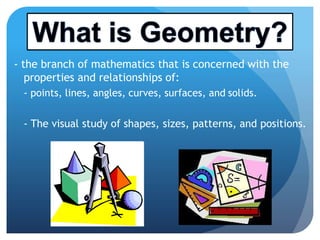
- the branch of mathematics that is concerned with the
properties and relationships of:
- points, lines, angles, curves, surfaces, and solids.
- The visual study of shapes, sizes, patterns, and positions.- The visual study of shapes, sizes, patterns, and positions.
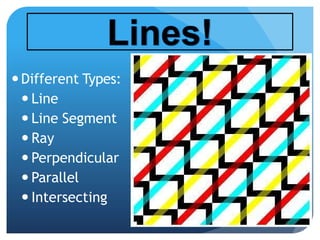
Different Types:
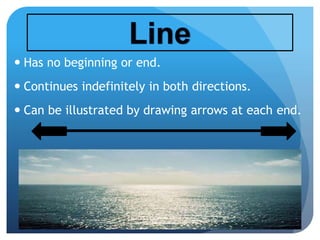
 Line
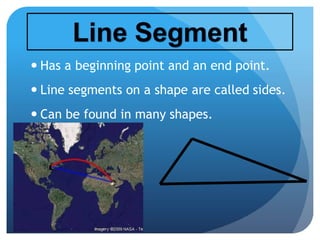
 Line Segment Line Segment
 Ray
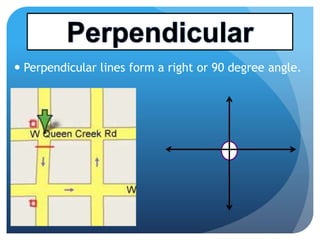
 Perpendicular
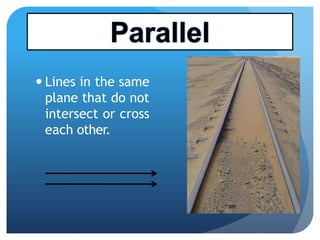
 Parallel
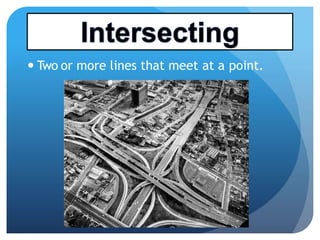
 Intersecting
 Has no beginning or end.
 Continues indefinitely in both directions.
 Can be illustrated by drawing arrows at each end.
 Has a beginning point and an end point.
 Line segments on a shape are called sides.
 Can be found in many shapes. Can be found in many shapes.
 Has a beginning point but no end point.
 Lines in the same
plane that do not
intersect or crossintersect or cross
each other.
 Two or more lines that meet at a point.
 Perpendicular lines form a right or 90 degree angle.
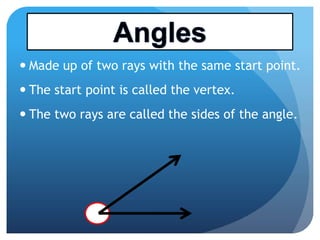
 Made up of two rays with the same start point.
 The start point is called the vertex.
 The two rays are called the sides of the angle. The two rays are called the sides of the angle.
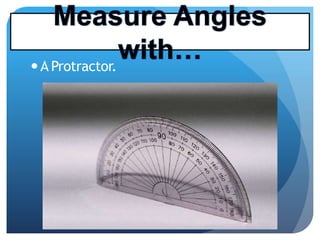
A Protractor.
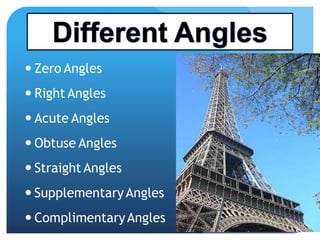
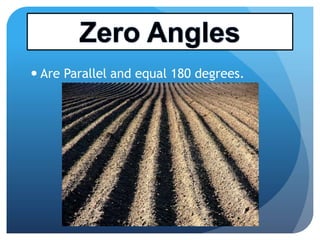
 Zero Angles
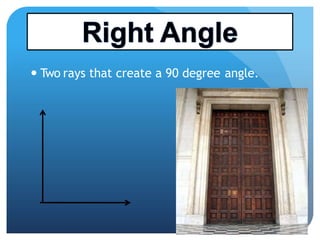
 Right Angles
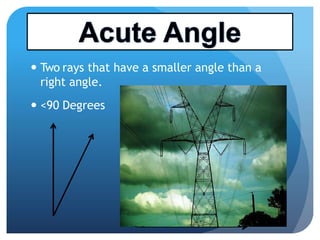
 Acute Angles Acute Angles
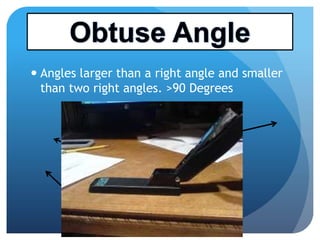
 Obtuse Angles
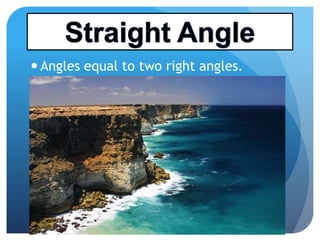
 Straight Angles
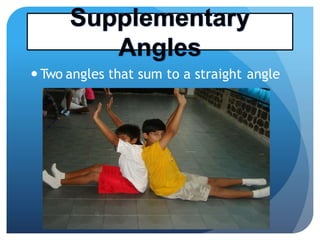
 SupplementaryAngles
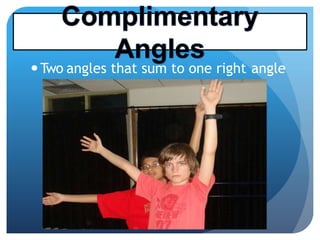
 ComplimentaryAngles
 Are Parallel and equal 180 degrees.
 Two rays that create a 90 degree angle.
 Two rays that have a smaller angle than a
right angle.
 <90 Degrees
 Angles larger than a right angle and smaller
than two right angles. >90 Degrees
 Angles equal to two right angles.
 Two angles that sum to a straight angle
Two angles that sum to one right angle
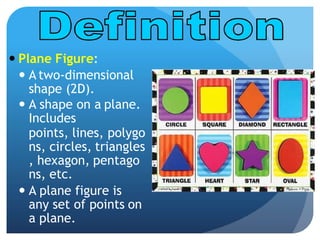
 Plane Figure:
 A two-dimensional
shape (2D).
 A shape on a plane.
IncludesIncludes
points, lines, polygo
ns, circles, triangles
, hexagon, pentago
ns, etc.
 A plane figure is
any set of points on
a plane.
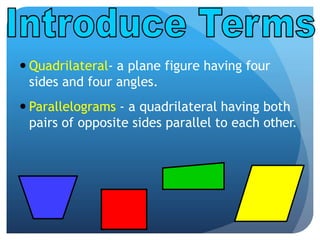
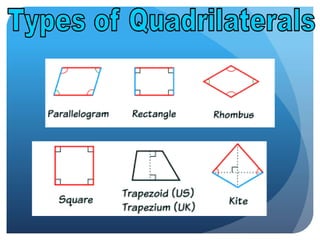
 Quadrilateral- a plane figure having four
sides and four angles.
 Parallelograms - a quadrilateral having both
pairs of opposite sides parallel to each other.pairs of opposite sides parallel to each other.
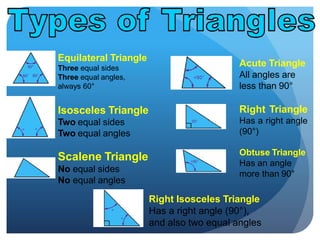
Equilateral Triangle
Three equal sides
Three equal angles,
always 60°
Isosceles Triangle
Two equal sides
Acute Triangle
All angles are
less than 90°
Right Triangle
Has a right angleTwo equal sides
Two equal angles
Scalene Triangle
No equal sides
No equal angles
Has a right angle
(90°)
Obtuse Triangle
Has an angle
more than 90°
Right Isosceles Triangle
Has a right angle (90°),
and also two equal angles
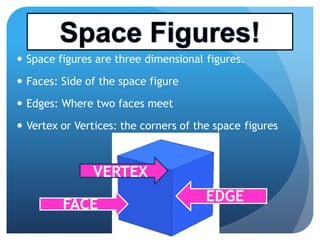
 Space figures are three dimensional figures.
 Faces: Side of the space figure
 Edges: Where two faces meet
Vertex or Vertices: the corners of the space figures
EDGE
FACE
 Vertex or Vertices: the corners of the space figures
VERTEX
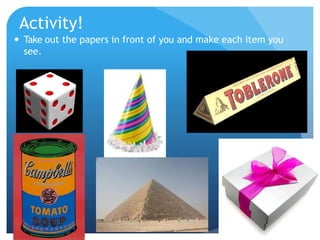
Activity!
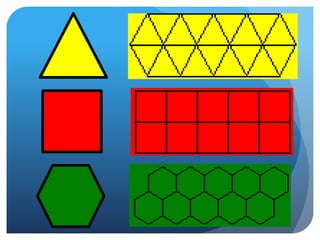
 Take out the papers in front of you and make each item you
see.
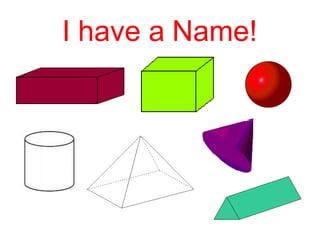
I have a Name!
Repeating a shape over and over
and over and over and over and
over again, leaving no gaps
Tesselation
over again, leaving no gaps
between each shape to form a
BIGGER shape.
Another word for “tesselation” is
TILING!
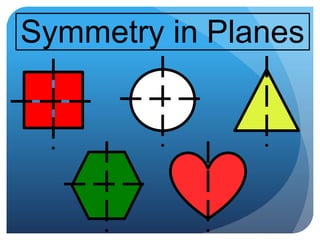
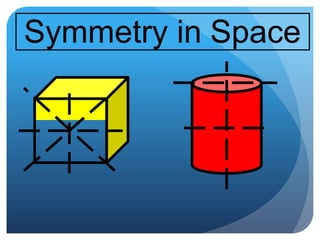
Symmetry
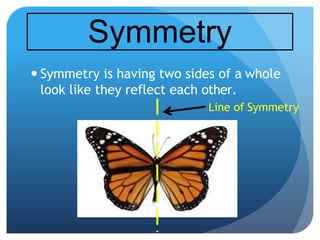
 Symmetry is having two sides of a whole
look like they reflect each other.
Line of Symmetry
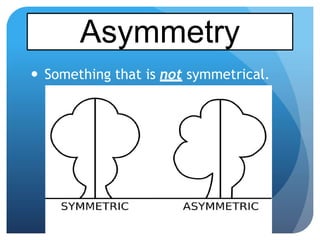
 Something that is not symmetrical.
Asymmetry
Symmetry in Planes
Symmetry in Space
basics of  geometry with practical images

basics of geometry with practical images

  • 2.
    - the branchof mathematics that is concerned with the properties and relationships of: - points, lines, angles, curves, surfaces, and solids. - The visual study of shapes, sizes, patterns, and positions.- The visual study of shapes, sizes, patterns, and positions.
  • 4.
    Different Types:  Line Line Segment Line Segment  Ray  Perpendicular  Parallel  Intersecting
  • 5.
     Has nobeginning or end.  Continues indefinitely in both directions.  Can be illustrated by drawing arrows at each end.
  • 6.
     Has abeginning point and an end point.  Line segments on a shape are called sides.  Can be found in many shapes. Can be found in many shapes.
  • 7.
     Has abeginning point but no end point.
  • 8.
     Lines inthe same plane that do not intersect or crossintersect or cross each other.
  • 9.
     Two ormore lines that meet at a point.
  • 10.
     Perpendicular linesform a right or 90 degree angle.
  • 11.
     Made upof two rays with the same start point.  The start point is called the vertex.  The two rays are called the sides of the angle. The two rays are called the sides of the angle.
  • 12.
  • 13.
     Zero Angles Right Angles  Acute Angles Acute Angles  Obtuse Angles  Straight Angles  SupplementaryAngles  ComplimentaryAngles
  • 14.
     Are Paralleland equal 180 degrees.
  • 15.
     Two raysthat create a 90 degree angle.
  • 16.
     Two raysthat have a smaller angle than a right angle.  <90 Degrees
  • 17.
     Angles largerthan a right angle and smaller than two right angles. >90 Degrees
  • 18.
     Angles equalto two right angles.
  • 19.
     Two anglesthat sum to a straight angle
  • 20.
    Two angles thatsum to one right angle
  • 23.
     Plane Figure: A two-dimensional shape (2D).  A shape on a plane. IncludesIncludes points, lines, polygo ns, circles, triangles , hexagon, pentago ns, etc.  A plane figure is any set of points on a plane.
  • 24.
     Quadrilateral- aplane figure having four sides and four angles.  Parallelograms - a quadrilateral having both pairs of opposite sides parallel to each other.pairs of opposite sides parallel to each other.
  • 25.
    Equilateral Triangle Three equalsides Three equal angles, always 60° Isosceles Triangle Two equal sides Acute Triangle All angles are less than 90° Right Triangle Has a right angleTwo equal sides Two equal angles Scalene Triangle No equal sides No equal angles Has a right angle (90°) Obtuse Triangle Has an angle more than 90° Right Isosceles Triangle Has a right angle (90°), and also two equal angles
  • 28.
     Space figuresare three dimensional figures.  Faces: Side of the space figure  Edges: Where two faces meet Vertex or Vertices: the corners of the space figures EDGE FACE  Vertex or Vertices: the corners of the space figures VERTEX
  • 29.
    Activity!  Take outthe papers in front of you and make each item you see.
  • 30.
    I have aName!
  • 32.
    Repeating a shapeover and over and over and over and over and over again, leaving no gaps Tesselation over again, leaving no gaps between each shape to form a BIGGER shape. Another word for “tesselation” is TILING!
  • 35.
    Symmetry  Symmetry ishaving two sides of a whole look like they reflect each other. Line of Symmetry
  • 36.
     Something thatis not symmetrical. Asymmetry
  • 37.
  • 38.