BASIC CIVIL ENGINEERING
Prof. Vinod Shikhare
Department of Civil Engineering,
ICEEM, Aurangabad
www.iceemabad.com
E-mail : vinodshikhare1988@gmail.com
BRANCHES OF CIVIL ENGINEERING
Structural Engineering
Geotechnical Engineering
Water Resource And Irrigation Engineering
Material Engineering
Transportation Engineering
Construction Management And
Surveying
ROLE OF CIVIL ENGINEER
• A civil engineer has to conceive, plan, estimate, get approval create and maintain all civil engineering activities.
• Civil engineer has very important role in the development of the following infrastructure
1. Measure and map the Earth surface.
2. plan new townships and extension of existing towns
3. build the suitable structures for the ruler and urban areas for various utilities
4. built tanks and dams to exploit water resources.
5. Build river navigation and flood control projects
6. Build canals and distribute to take water to agriculture .
7. Purify and supply water to the needy areas like domestic
8. provide and maintain communication systems like roads railways harbours and airport.
9. devise systems for control and efficient flow of traffic.
10. provide and maintain solid and waste water disposal system.
11. Monitor land water and air pollution and take measures to control them.
Fast growing industry has put heavy responsibilities on civil engineers to preserve and protect the environment
SITE SELECTION OF RESIDENTIAL BUILDINGS
There are many factors which must be taken in to account while selecting a site for a
commercial and residential buildings. Some of these factors are given below.
• Shape of the Plot
• Location of the plot
• Availability of amenities
• Water Table
• Sewerage system
IMPORTANT TERMS
Plinth Area: Plinth area is the covered built-up area measured
at the floor level of any storey or at the floor level of the
basement.
Plinth area is also called as built-up area and is the
entire area occupied by the building including internal and
external walls.
Plinth area is generally 10-20% more than carpet area.
IMPORTANT TERMS
Carpet Area: Carpet area is the area that can be used to
spread a carpet inside the house. It is the net usable area of
the apartment. It includes the thickness of the internal wall
but excludes balcony or terrace. Technically, the distance
between inner walls is carpet area.
IMPORTANT TERMS
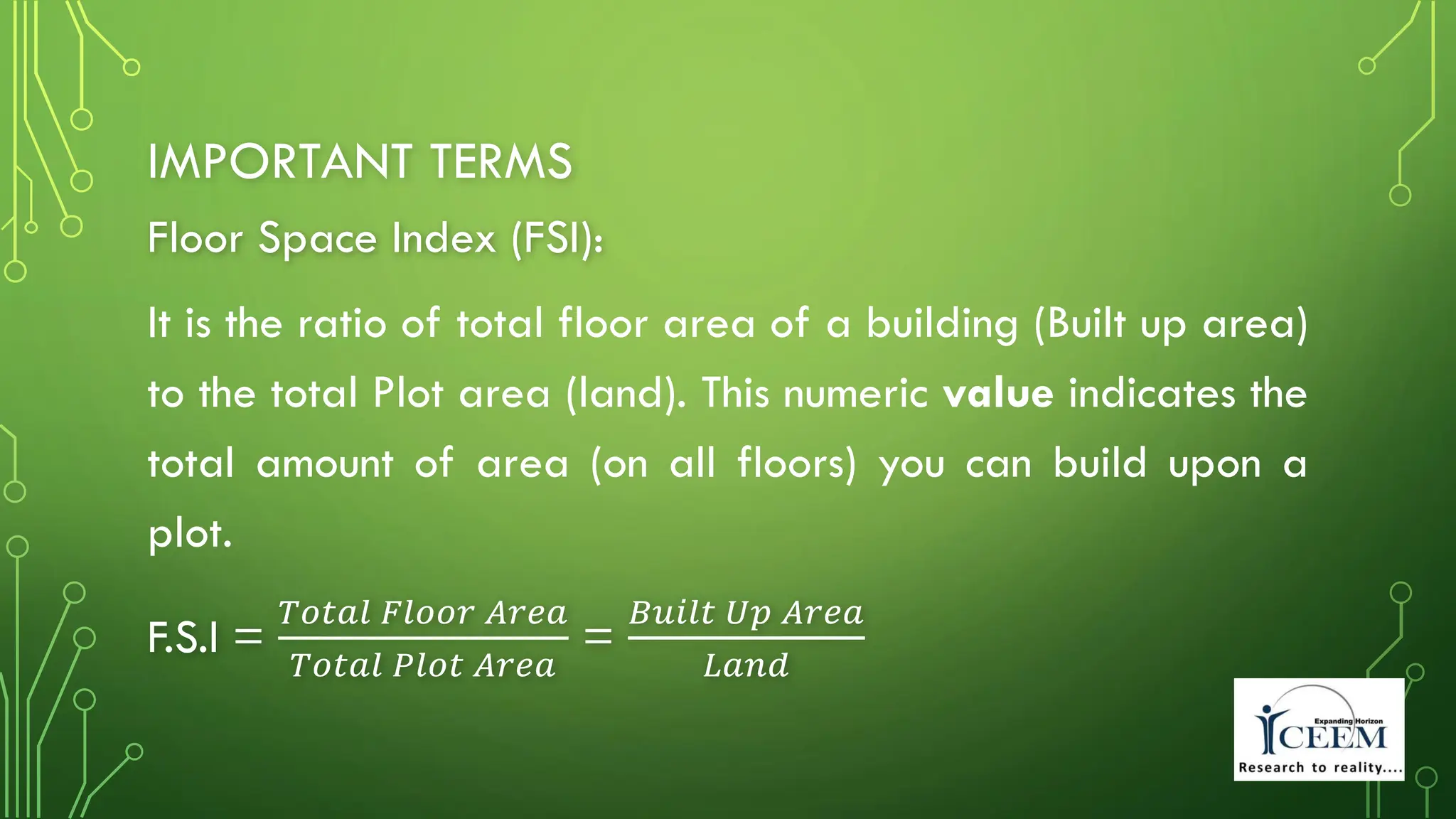
Floor Space Index (FSI):
It is the ratio of total floor area of a building (Built up area)
to the total Plot area (land). This numeric value indicates the
total amount of area (on all floors) you can build upon a
plot.
F.S.I =
𝑇𝑜𝑡𝑎𝑙 𝐹𝑙𝑜𝑜𝑟 𝐴𝑟𝑒𝑎
𝑇𝑜𝑡𝑎𝑙 𝑃𝑙𝑜𝑡 𝐴𝑟𝑒𝑎
=
𝐵𝑢𝑖𝑙𝑡 𝑈𝑝 𝐴𝑟𝑒𝑎
𝐿𝑎𝑛𝑑
TYPES OF STRUCTURE
1. Load Bearing Structure
2. Framed Structure
LOADS COMING ON STRUCTURE
1. Load Bearing Structure
2. Framed Structure
FOUNDATION
1. Load Bearing Structure
2. Framed Structure

BASICS CIVIL ENGG.pdf

  • 1.
    BASIC CIVIL ENGINEERING Prof.Vinod Shikhare Department of Civil Engineering, ICEEM, Aurangabad www.iceemabad.com E-mail : vinodshikhare1988@gmail.com
  • 2.
    BRANCHES OF CIVILENGINEERING Structural Engineering Geotechnical Engineering Water Resource And Irrigation Engineering Material Engineering Transportation Engineering Construction Management And Surveying
  • 3.
    ROLE OF CIVILENGINEER • A civil engineer has to conceive, plan, estimate, get approval create and maintain all civil engineering activities. • Civil engineer has very important role in the development of the following infrastructure 1. Measure and map the Earth surface. 2. plan new townships and extension of existing towns 3. build the suitable structures for the ruler and urban areas for various utilities 4. built tanks and dams to exploit water resources. 5. Build river navigation and flood control projects 6. Build canals and distribute to take water to agriculture . 7. Purify and supply water to the needy areas like domestic 8. provide and maintain communication systems like roads railways harbours and airport. 9. devise systems for control and efficient flow of traffic. 10. provide and maintain solid and waste water disposal system. 11. Monitor land water and air pollution and take measures to control them. Fast growing industry has put heavy responsibilities on civil engineers to preserve and protect the environment
  • 4.
    SITE SELECTION OFRESIDENTIAL BUILDINGS There are many factors which must be taken in to account while selecting a site for a commercial and residential buildings. Some of these factors are given below. • Shape of the Plot • Location of the plot • Availability of amenities • Water Table • Sewerage system
  • 5.
    IMPORTANT TERMS Plinth Area:Plinth area is the covered built-up area measured at the floor level of any storey or at the floor level of the basement. Plinth area is also called as built-up area and is the entire area occupied by the building including internal and external walls. Plinth area is generally 10-20% more than carpet area.
  • 6.
    IMPORTANT TERMS Carpet Area:Carpet area is the area that can be used to spread a carpet inside the house. It is the net usable area of the apartment. It includes the thickness of the internal wall but excludes balcony or terrace. Technically, the distance between inner walls is carpet area.
  • 7.
    IMPORTANT TERMS Floor SpaceIndex (FSI): It is the ratio of total floor area of a building (Built up area) to the total Plot area (land). This numeric value indicates the total amount of area (on all floors) you can build upon a plot. F.S.I = 𝑇𝑜𝑡𝑎𝑙 𝐹𝑙𝑜𝑜𝑟 𝐴𝑟𝑒𝑎 𝑇𝑜𝑡𝑎𝑙 𝑃𝑙𝑜𝑡 𝐴𝑟𝑒𝑎 = 𝐵𝑢𝑖𝑙𝑡 𝑈𝑝 𝐴𝑟𝑒𝑎 𝐿𝑎𝑛𝑑
  • 8.
    TYPES OF STRUCTURE 1.Load Bearing Structure 2. Framed Structure
  • 9.
    LOADS COMING ONSTRUCTURE 1. Load Bearing Structure 2. Framed Structure
  • 10.
    FOUNDATION 1. Load BearingStructure 2. Framed Structure