“Common terms of Pharmacology-I”
 Introduction to Pharmacology
 Pharmacodynamics
 Pharmacokinetics
 Gastric antacids and antiulcerant
 Anticonstipating agent
☆ Pharmacology
• The word Pharmacology is derived from the Greek words Pharmakon (which
means Drug) and Logos (which means Study).
• Thus Pharmacology defined as the "Study of substances that deals with the
knowledge of drugs and their interactions with living organisms through
chemical process by binding to the regulatory molecules."
☆ Branches of Pharmacology
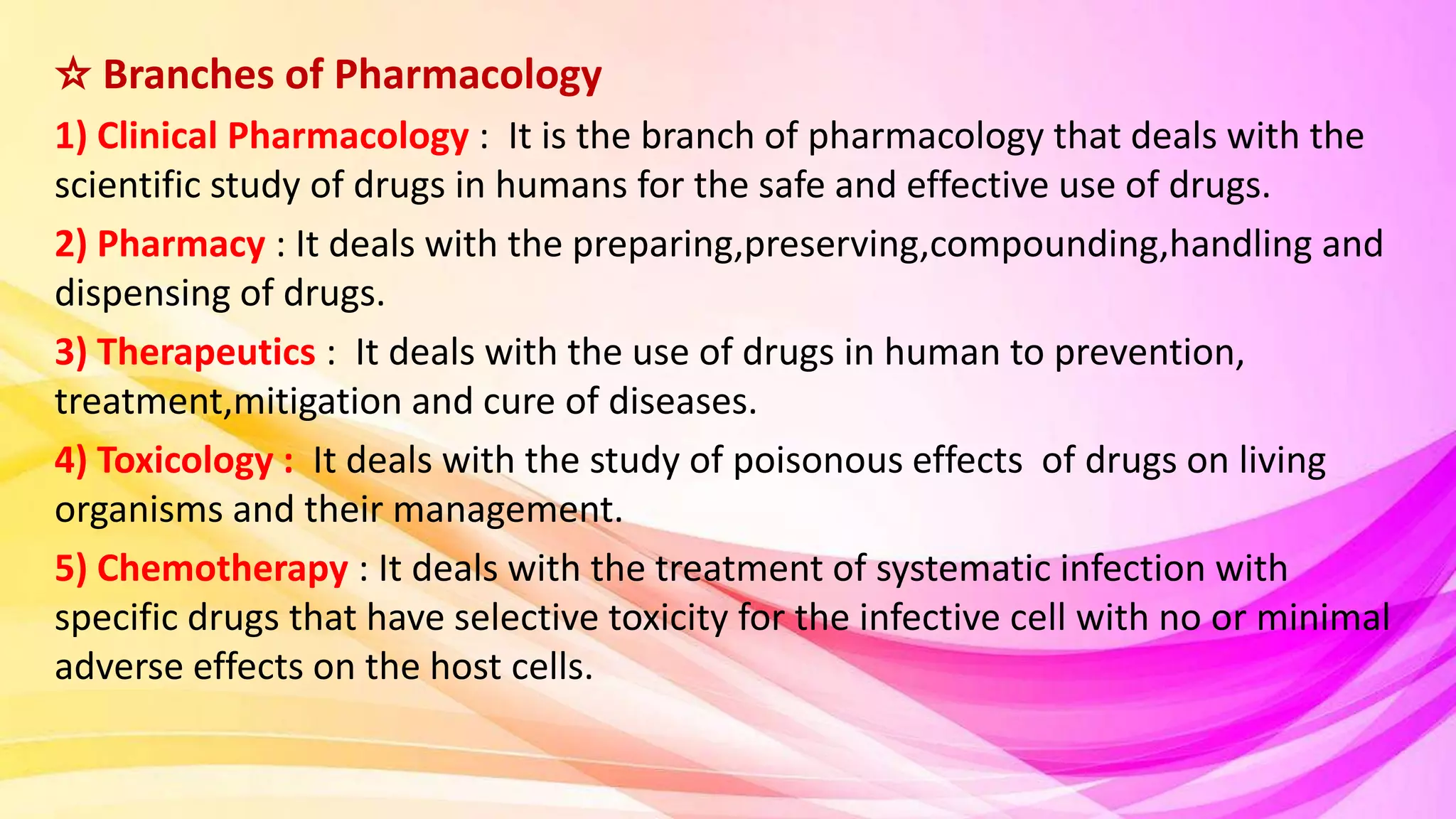
1) Clinical Pharmacology : It is the branch of pharmacology that deals with the
scientific study of drugs in humans for the safe and effective use of drugs.
2) Pharmacy : It deals with the preparing,preserving,compounding,handling and
dispensing of drugs.
3) Therapeutics : It deals with the use of drugs in human to prevention,
treatment,mitigation and cure of diseases.
4) Toxicology : It deals with the study of poisonous effects of drugs on living
organisms and their management.
5) Chemotherapy : It deals with the treatment of systematic infection with
specific drugs that have selective toxicity for the infective cell with no or minimal
adverse effects on the host cells.
6) Pharmacogenetics : Study of the genetic variations that cause differences
in drug response.
7) Pharmacoeconomics : Study of the cost of medicine taking into account
Pharmacology
Clinical
pharmacology
Pharmacy
Therapeutics
ToxicologyChemotherapy
Pharmaco
genetics
Pharmacoecon
omics
☆ Pharmacopoeia
Pharmacopoeia is an official book of publication, recognised by legal authorities
which contains the list of-
 Name and description of the drugs and medicinal substances with their natural
origin
 Formulas for chemical preparation of them
 Test for their identity,purity and potency
 Usage of drugs and medicine
 Dose and dosage forms
Most of the developed countries have their own pharmacopoeia like BP, USP, AP, IP
etc. Bangladesh doesn't have any pharmacopoeia of itself. Bangladesh sually follows
BP and USP.
☆ Formulary
• Formulary is a list of available drugs with descriptions, tests and formulas for
preparing the same that are available to prescribers in the respective
countries.
• Some examples include- BDNF, BNF, ANF etc.
☆ Drug
• The drug is derived from French word Drogue which means "A dry herb."
• According to W.H.O. -
" A drug is any substance or product that is used or intended to be used to
modify or explore physiological systems or pathological states for the benefit of the
recipient."
☆ Prodrug
• Prodrug defined as the chemical that is readily absorbed,distributed &and then
converted to the active drug by biological process inside the body.
• Prodrugs don't produce any pharmacological effects until they chemically altered
within the body.
• Examples : Aspirin and Codeine is the prodrug of Salicylic acid and Morphine
respectively.
☆ OTC drugs
• OTC drugs means Over the trade drugs, referred to the drugs that are sold
directly to the consumer without any prescription. Thereby, they are also known
as non-prescription drugs.
• Examples : Paracetamol, omeprazole, antacid, ORS etc.
☆ INN drugs
• INN (International Non-proprietary Names) are the most recent drugs which
haven't been included in the pharmacopoeias but still are being used globally.
They are managed by WHO.
• Ex: Iron polymatose.
☆ Drug Nomenclature
Any drugs may have names in all 3 of the following classes :
• Chemical name : It is the name used by the organic chemist to indicate the
chemical structure of drug. ex : N-(4-hydroxyphenyl)ethanamide.
• Non-proprietary (generic) name: It is used in pharmacopoeias & recognised
by the official bodies. ex : Paracetamol, Omeprazole.
• Proprietary (Brand) name : It is the commercial name used by the
pharmaceutical companies. ex : Napa, Seclo/Losectil
☆ Prescription
• A prescription is an written by a physician,dentist or any other medical
practitioner to the pharmacist for compounding & dispensing specific medication
to the patient.
• A prescription contains of some parts. These are : Date, patient's details,
superscription, inscription, subscription & prescriber name,address & signature.
Figure : An ideal Prescription
☆ Dose
• Dose refers to the quantity of drug administrated at one time.
• ex- 500 mg of paracetamol
☆ Dosage
• Dosage refers to the prescribed administration of a specific amount, number
and frequency of doses over a specific period of time.
• ex- 500 mg of paracetamol twice a day for 3 days
☆ Dosage form
• Dosage Form refers to the physical form of a dose of a chemical compound used
as a drug or medication intended for administration or consumption
• ex- tablet and solution are solid and liquid dosage form respectively
☆ Route of drug administration
Route of drug administration means way of getting a drug into the body.
Common routes of drug administration :
• Intramascular route
Drug injected into the skeletal muscle like deltoid, gluteus, rectus femoris.
• Subcutaneous route
The drug is injected under the skin. Drug is absorbed in the SC tissues.
• Intradermal route
The drug is injected into the skin layer(dermis). The drug is slowly absorbed. Only
small amounts of drug can be given.
•
• Transdermal route
This route of administration achieves systemic effects by application of
drugs to the skin, usually by transdermal patch.
• Topical routes
Topical routes are used when a local effect of the drug is required. The
drug is usually applied to the skin surface or mucas membrane in form of
Ointments, creams, lotions and powders
☆ Pharmacodynamics
• The word 'Pharmacodynamics' is derived from the Greek words Pharmakon
(Drug) and Dynamics (Power)
• Pharmacodynamics is defined as the study
of biochemical and physiological effects of
drugs and their mechanism of action.
• Simply means, What the drug does to the body.
☆ Principal of drug action
1. Stimulation
Selective enhancement of specialized cell activity.
e.g. CNS stimulants - Morphine, Cocaine
CVS stimulants - ,Adrenaline, Digoxin
2. Depression
Selective attenuation/weakening of specialized cell activity.
e.g. CNS depressant : Benzodiazepine
CVS depressant : Quinidine
3. Irritation
Non-selective, often noxious or may have toxic effect and applied to less
specialized tissues like, epithelium tissue.
4. Replacement
Uses of natural metabolites or hormones in case of deficiency.
e.g. Insulin, Vit-therapy, Iron etc.
5. Cytotoxic action
Selective cytotoxic activity for invading parasites and cancer cell without
affecting the host cells.
e.g. Antibiotics, anticancer drugs.
☆ Common keywords
• Ligand: Molecule which binds with active site of receptors and to form a coordinate
complex.
It may be a hormone, antibody, neurotransmitter or drug molecule . It's mainly 2 types :
Agonist or Antagonist.
• Agonist: The agent which binds with receptor to cause its activation and subsequently
causes cellular response.
Agonist have both affinity and efficacy. Therefore they can trigger the maximal
pharmacological response.
Ex : alpha-adrenoceptor agonist - adrenaline
• Antagonist: The agent which binds with receptor without causing its activation and
also Prevents agonist from binding on that receptor.
Antagonist have only affinity but not have any efficacy. Therefore they haven't any effect
of their own.
Ex : H2 receptor antagonist - Ranitidine
• Partial agonist: The agent which binds with receptor and to produce a
submaximal effect but prevents agonist from binding on that receptor
Partial agonists have full affinity but low efficacy.
• Inverse agonist : The agent which binds with receptor to cause its activation
and to produce a cellular response in an opposite direction.
Inverse agonists have affinity but efficacy with a minus sign.
☆ Receptor
• Receptor is a macromolecular component of cell, containing a binding site in
which a drug interacts to produce pharmacological effect.
• Receptors are protein in nature. They are situated on the cell surface or
cytoplasm that has a particular binding site.
• Binding of a drug within its binding site, results in the formation of drug
receptor complex, which is responsible for triggering the biological
response.
Drug + Receptor = Drug-Receptor complex --> Response
☆ Types of Receptors
1. G- Protein Coupled Receptors (ex-Cholinergic receptor)
2. Ligand Gated Ion Channels (ex-alpha and beta adrenoreceptor)
3. Tyrosine Kinase /Enzyme Receptors (ex - Insulin receptor)
4. Nuclear Receptors (ex- Steroid receptor)
☆ Lock and Key Hypothesis
• In lock-and-key hypothesis, the drug-receptor interaction suggests that the
receptor and the Drug molecule possess a specific complementary geometric
shapes that fit exactly into one another. It states,
“ The drug molecule must fit into the receptor and produce its action
like a key fits into the lock and opens it”.
• In this analogy, the lock is the Receptor and the key is the Drug molecule. Only
the correctly sized key fits into the key hole (active site) of the lock.
☆ Induced-Fit Hypothesis
• In many cases, the Lock and key hypothesis isn't appropriate to elucidate Drug-
Receptor interaction. So, the Induced fit hypothesis is propounded.
• The active site and the ligand initially not perfect match for each other . Because,
receptors exist in dynamic state with flexible shapes. Accordingly,
"The binding of the ligand to the receptor must cause a change in the shape of
the receptor that results in the proper alignment of the catalytic groups on
its surface."
☆ Receptor occupation theory
• Drug action is based on the occupation of receptors by specific drug. The theory
states that,
" The pharmacologic effect of drugs depend on the perchantage of
receptors occupied."
• Intensity of pharmacological effect is directly proportional to fraction of
receptors occupied.
☆ Hypothesis of Paton – Rate Theory
The theory states that-
“Effectiveness of a drug does not depend on the actual occupation of the
receptor but by obtaining proper stimulus.”
☆ The receptors activity is regulated by 2 types of process :
1. Down regulation
• Prolonged high concentration of agonist causes a decrease in sensitivity and in
the number of Receptors available for activation, is called receptor down
regulation.
• It reduces the drug effect.
2. Up regulation
• Prolonged high concentration of antagonist causes a increase in sensitivity and in
the number of Receptors available for activation, is called Receptor up regulation.
• It increases the drug effect.
☆ Dose-response relationship
The relationship between the concentration of drug at the receptor site and the
magnitude of the response is called the dose-response relationship.
▪ Potency
• Absolute amount of drug required to produce an effect
• More potent drug is the one that is required in lower amount to cause same effect.
▪ Efficacy
• Maximal response that can be elicited by a drug.
• Agonists demonstrating high efficacy can result in a maximal effect, even when
only a small fraction of the receptors is occupied
▪ Therapeutic Index
• The gap between the minimum therapeutic effect of drug and the minimum
adverse effect of drug is defined as safety margin or therapeutic index of a drug.
The index used for judging drug's safety.
• Therapeutic index = LD50 / ED50
▪ ED50 (Median effective dose):The dose at which 50% of individuals
(experimental animals) exhibits specified effect.
▪ LD50(Median lethal dose):The dose required to produce death in 50% of
individuals.
▪ Affinity
Ability of drug to combine with the receptor.
▪ Efficacy
Ability of a drug to activate the receptor after receptor occupation.
▪ Drug action
Combination of the drug with its receptor resulting a conformational change of the
receptor (in case of agonist) or preventing the change by the agonist ( in case of
antagonist).
▪ Drug effect
The ultimate change in the biological function due to the consequence of drug action,
through a series of intermediate steps (transduction).
☆ Combination of drugs
▪ Synergism
• Definition: “Drug synergy occurs when drugs can interact in ways that enhance or
magnify one or more effects, or side - effects, of those drugs
• Two types
1) Summation:
• Definition : Combined effect of drugs which are given simultaneously is equal to
the sum of magnitude of effect produced by individual drugs.
• Example: General Anesthetics
2) Potentiation:
• Definition: Combined effect of two simultaneously given drugs is greater than the
algebraic sum of action of individual drugs.
• Example: NH4Cl potentiates the diuretic effect of Organic Mercurials
2. Antagonism
• Definition: Opposing action of two drugs on same biological system.
• Two types:
a. Competitive:
• Antagonist competes with agonist for the same receptor site
• Reversible phenomenon
• Can be overcome by increasing the conc. of agonist.
b. Non competitive:
• Binds to an allosteric site other than the agonist binding site
• Prevent the receptor activation by the agonist
☆ Drug interaction
• Drug interactions involve combinations of a medication with other substances that
alter the medication’s effect on the body. This can cause the medication to be less
or more potent than intended or result in unexpected side effects
There are 3 types of drug interactions:
• Drug-drug interaction: A reaction between two or more drugs.
• Drug-food interaction: A reaction between a drug and a food or beverage.
• Drug-condition interaction: A reaction that occurs when taking a drug while
having a certain medical condition.
☆ Drug abuse
▪ Drug Tolerance
• Tolerance happens when a person no longer responds to a drug in the way they
did at first. So it takes a higher dose of the drug to achieve the same effect as
when the person first used it.
• It can develop when the body is regularly exposed to a medication. With
tolerance, certain cell receptors in the body that activate when the drug is present,
stop responding as effectively as it once did. The body might clear the medication
faster, too.
• The body’s condition might worsen since the medication isn’t working as well.
When the body develops tolerance, using higher doses may increase the risk of
overdose.
▪ Drug dependance
• Drug dependence means, if the drug isn’t present or the dose is suddenly reduced,
body might experience withdrawal. This means the body can only function normally
when the drug is present.
• Many people who take a prescription medicine every day over a long period of time
can become dependent to it ; when they go off the drug, they need to do it gradually,
to avoid withdrawal discomfort.
▪ Drug toxicity
• Unlike tolerance and dependence, addiction is a disease; addiction can result
from taking drugs or alcohol repeatedly.
• If a person keeps using a drug and can’t stop, despite negative consequences from
using the drug, they have an addiction. It involves changes in brain activity:
Neurotransmitters like dopamine are repeatedly triggered in such case.
• Drugs that result in the development of tolerance and dependence often have the
potential to cause addiction.
☆ Drug dosage and dose
 A dose refers to a specified amount of medication taken at one time
 Dosage refers to the prescribed administration of a specific amount, number &
frequency of doses over a specific period of time. ex- 500 mg of paracetamol
twice a day for 3 days
• Standard Dose: The assumed average maintenance dose per day for a drug used
for its main indication in adults.
• Target Level Dose: Dose of drug administered for achieving a desired
plasma/serum/tissue drug levels in patients.
• Regulated Dose: Dose of drugs which provide drug release in a regulated form,
distinct from that of the conventional dosage forms, so that dosing of drugs can
be controlled.
• Titrated Dose: The continual adjustment of a dose based on patient response.
Dosages are adjusted until the desired clinical effect is achieved
☆ Pharmacokinetics
• The word "Pharmacokinetics" is derived from Greek words Pharmakon (drugs)
and Kinetics (movement).
• It is the study of absorption, distribution,
metabolism and excretion of drugs.
• Simply means, "What the body does to the drug."
☆ Biological membrane
• Referred to all types of cell membrane of the body.
• Biological membranes are present in capillaries except cerebral capillary and
GIT. They have a hydrophilic polar head and hydrophobic nonpolar tail.
• Drug molecules cas pass the biological membrane in unionized form only.
☆ Drug Absorption
• It is the process by which drug enters into the circulation from its site of
administration across the biological membrane.
• Sites of drug absorption :
1. GIT - Stomach, small intestine, rectum.
2. Respiratory tract.
3. Muscle & subcutaneous tissue.
4. Skin
☆ Process of drug absorption
It's mainly 2 types : Passive trasport and specialized transport.
1. Passive trasport
a. Passive diffusion :
• It is defined as the movement of drug molecules across the biological membrane
towards the concentration gradient.
• Commonest process of drug absorption
• No energy and carrier is required for this process
b. Filtration
• Defined as the movement of drug molecules that occur through the aqueous pores of
the biological membrane
• Sites of major filtration : Glomerulus of kidney, capillaries
2. Specialized transport
a. Active transport
• Defined as the movement of drug molecules through the biological membrane
against concentration gradient by the help of carrier protein with active
expenditure of energy.
• Examples : amino acids, electrolytes, levodopa, streptomycin.
• Sites of active transport :
• Renal tubular cell, GIT, Biliary tract, Blood-brain barrier.
Depending on the source of driving force there are 2 types of active transport :
1. Primary active transport: Energy is obtained directly by the hydrolysis of the ATP
2. Secondary active transport : Energy is derived from the downhill movement of
another solute. It's further divided into-
a) Co-transport(Symport)- when both the solutes move in the same
direction.
b) Exchange transport(Antiport)- when both the solutes move in the
opposite direction
b. Facilitated diffusion
• Defined as the movement of drug molecules through the biological
membrane which is facilated by a macromolecule.
• Examples - Glucose, VitB12 absorption, Fat soluble vitamins.
c. Endocytosis
• When the membrane engulfs the drug molecule by making a pseudopod is
called endocytosis.
• Types of endocytosis :
1. Pinocytosis : Engulfs water i.e. cell drinking.
2. Phagocytosis : Engulfs other than water.
i.e. cell eating.
☆ Bioavailability
• The fraction of unchanged drug reaching the systemic circulation by
administration of any route is called Bioavailibility.
• Bioavailibility of a drug is represented by %. Different routes of drug
administration have different bioavailibility. Drugs given by intravenously
have bioavailability almost 100%.
• Ex - If a 500 mg tablet is administrated orally and 400 mg of tablet reaches to
systemic circulation, then 400 mg is the bioavailibility of the tablet.
☆ Common keywords
• Therapeutic range : The range of drug level in which a drug has the desired
effect upon the body.
• MEC (minimum effective conc) : The minimum concentration of drug needed
to produce the desired pharmacological effect.
• MTC (minimum toxic conc) : The minimum concentration of drug needed to
produce a toxic effect.
• Onset time : The time required for the drug to reach the MEC/ exert a
pharmacological effect.
• Duration of action : The length of time that a particular drug is effective.
• Cmax : The maximum conc. of drug achieved in blood plasma.
• Tmax : The time taken to reach the Cmax
☆ Distribution
• Drug distribution is a process by which a drug reversibly leaves the
bloodstream & enter into the interstitium or cell of the tissues.
• The major sites of drug distribution :
Plasma, Interstitial fluid, Intracellular fluid, Transcellular fluid, Fat
☆ Volume of distribution
• It's defined as the volume of fluid in which the drug is distributed at the same
concentration as in plasma. Expressed as Vd.
• Vd = Total amount of drug/Plasma conc of drug.
• Ex: Chloroquine- 13000 L, Digoxin – 420 L, Morphine – 250 L, Streptomycin &
Gentamicin – 18 L.
☆ Redistribution
• When a highly soluble drug is distributed into other tissues from its site of
action is called redistribution of drugs.
• Greater the solubility of the drug greater is its redistribution.
☆ Plasma protein binding
• Plasma protein binding refers to the process to which drug molecules attach to the
plasma proteins when the drug appears in the circulation.
• Usually, drugs bind with plasma protein by H bond, Ionic bond or Vander-waals
bond.
• Acidic drugs bind to Albumin & the basic drugs bind to alpha1 glycoprotein
☆ Blood Brain Barrier(BBB)
• BBB is a highly selective semipermeable border that
separates the circulating blood from the brain and
extracellular fluid in the CNS.
• The BBB results from the establishment of tight
junctions between endothelial cells in CNS vessels.
☆ First pass metabolism
• First pass metabolism is a process in which a drug administrated by mouth is
absorbed from the GIT and transported via portal vein to the liver, where it
get metabolized.
• As a result concentration of a drug is greatly reduced before it reaches the
systemic circulation.
• This first pass through the liver thus greatly reduces the bioavailability of the
drug
☆ Biotransformation/Metabolism
• The biochemical alteration of drugs inside the body by the action of enzymes
is called biotransformation.
• Aims of biotransformation :
1. To make the drugs more water soluble and less lipid soluble.
2 To promote excretion of drugs.
3. To convert inactive prodrugd into active drugs .
• The major organ of biotransformation is liver(99%). Others are Lungs, Kidneys,
Intestine, Plasma etc.
There are 2 phases of biotransformation :
1. Phase-l (non-synthetic) : convert the parent drugs to more polar metabolites by
introducing or removing th functional group(-OH,-NH2,-SH).
2. Phase-ll (synthetic) : Here the phase-l metabolites undergo conjugation with an
endogenous substance.
☆ Excretion
Elimination of drugs and its metabolites from the body through the excretion
organs is called drug excretion.
▪ There are 2 types of excretion :
1. Renal excretion
2. Non renal excretion(biliary,pulmonary,salivary,mammary,dermal )
☆ Kinetics of elimination
▪ Clearance : Clearance of a drug is the theoretical value of Plasma from which
drug is totally removed per unit time .
It's the ratio of rate of elimination rate of elimination to the conc of drug in
plasma. Cl = Rate of elimination/Plasma conc.
For instance , a drug has 20 mcg/ml conc and rate of elimination is 100 mcg/min,
then Cl = 100/20 = 5mil/min.
▪ Plasma half life : Defined as the time required to reduce the plasma
concentration by 50% in the body.
T 1/2 = ln2/k [k=elimination rate constant= Cl/V]
So, T 1/2 = ln2×V/ Cl
▪ First order kinetics :
• The rate of elimination is directly proportional to drug concentration
• It follows the Law of mass action.
• Plasma half life remains constant.
• Clearance remains constant.
• Ex : Low dose aspirin
▪ Second order kinetics :
• The rate of elimination remains constant irrespective of drug concentration.
• It doesn't follows the law of mass action .
• Plasma half life varies with the rate of elimination .
• Clearance decreases with increase in concentration .
• Ex : High dose aspirin.
▪ Loading dose :
• A single or few repeated or series of doses that may be given at the very
beginning of the therapy to reach the desire plasma concentration rapidly.
• LD= Target Cp x V / Fraction of dose(F)
▪ Maintenance Dose:
• It is the amount of drug require to give in each intervals to replace the drug
eliminated at that particular interval since the preceding dose require to
maintain a steady state of drug always in the body.
• Maintenance dose = dosing rate x dosing interval
Dosing rate = Target Cp x CL.
☆ Common keywords
▪ Gastric acid
• Gastric acid, gastric juice, or stomach acid, is a digestive fluid formed within
the stomach lining. Composed of hydrochloric acid, potassium chloride,
and sodium chloride.
• Gastric acid plays a key role in digestion of proteins by activating digestive
enzymes, which together break down the long chains of amino acids of proteins.
▪ Parietal cell
• Parietal cells are the oxyntic cells in gastric wall that secret hydrochloric acid.
• Four types of receptors have been identified on the parietal cell: receptors for
gastrin, acetylcholine, and histamine ; whose activation leads to stimulation of
acid secretion, and receptors for prostaglandins of the E series ; whose activation
leads to inhibition of acid secretion.
▪ Gastrin
• Gastrin is a peptide hormone secreted from the G-cell of the stomach.
• Gastrin stimulates the secretion of gastric acid by binding with the
Cholecystokinin B receptor(CCK2) receptor in the parietal cells.
▪ Histamine
• Histamine is an autocoids that act as a local hormone, secreted from the the
enterochromaffin-like cells (ECL cells) of the lining of stomach.
• Histamine stimulates the secretion of gastric acid by binding with the Histamine
H2 receptor in the parietal cells.
▪ Acetycholine
• Acetylcholine is a neurotransmitter, or a chemical messenger secreted by the
cholinergic nerve fibres.
• Acetycholine stimulates the secretion of gastric acid by binding with the
Cholinergic /Muscarinic receptor (M3) in the parietal cells.
Figure : A schemetic representation of gastric acid secretion
☆ Problems due to excess acid in stomach
• Gastric acidity
Gastric acidity is a condition of decrease pH due to increased H+ production or
loss of bicarbonate.
• Acid indigestion
When excess acid is produced a condition is occurred, known as acid indigestion
• Heart burn
If excess acid is forced into the esophagus acid reflux or "heart burn" results
cause intense pain.
• Peptic ulcer
Damage to stomach wall due to high acid concentrations resulting in loss of
tissue and inflammation
☆ Antacids
• Antacids are the medicine that help to combat excess acid in stomach.
• Antacids contain ingredients like aluminium, calcium, magnesium, or sodium
bicarbonate which act as bases (alkalis) to counteract the stomach acid.
• They react with HCl in stomach to produce salt
and water and make its pH more neutral as well as
neutralize the excess acid.
• They are usually used to relieve heart burn, acid
indigestion, upset stomach or sour stomach
1. Systemic antacids
• They are the antacids which are soluble and readily absorbed from the intestine
into the system circulation.
• Examples include - NaHCO3, Na3C6H5O7
• They have quick onset but brief duration of action
• They may cause systemic alkalosis and disturbed the acid base balance
2. Non-systemic antacids
• They are the antacids which are insoluble and poorly absorbed from the intestine
into the system circulation due to formation of insoluble compound.
• Examples include - CaCO3, Al(OH)2, Mg(OH)2
• They have slow onset but longer duration of action
• The don't disturb the acid base balance and not elevate the urinary pH.
☆ Proton pump inhibitor
• Proton pump inhibitors (PPIs) are the drugs which reduce gastric acid secretion by
blocking the action of proton pump in stomach.
• Examples : Omeprazole, Esomeprazole, Lansoprazole, Pantaprazole, Rabeprazole.
• PPIs are the most widely used for peptic ulcer and related disorders because of
their efficacy and safety.
• Proton pump inhibitors act by irreversibly block the action of H+/K+ ATPase
enzyme system (the gastric proton pump) of the gastric parietal cells. This inhibits
the activity of parietal cells leads to prevention of HCl in the stomach.
☆ H2 blockers
• H2 blockers are the drugs which reduce gastric acid secretion by blocking the
action of H2 receptors
• Examples : Ranitidine, Cimetidine, Famotidine, Nizatidine, Roxatidine
• Histamine is a local hormone that stimulates the parietal cells to secret gastric
acid by interacting with the H2 receptor
• H2 blockers reversibly bind to histamine receptors in the stomach and prevent the
acid-making cells in the stomach lining from responding to histamine. This reduces
the amount of acid produced by the stomach.
• They are less potent than PPIs
☆ Anticholinergics
• Anticholinergics are the drugs which reduce the gastric acid secretion by blocking
the action of acetylcholine.
• Example : Pirenzipine, Telenzipine
• Acetylcholine is a neurotransmitter that stimulates the gastric acid secretion by
binding with the M1 receptors in the gastric lining.
• Anticholinergics block the acetylcholine from binding to its receptors on the gastric
lining. This reduces the amount of acid produced by the stomach.
☆ Mucosal Protective Drugs
• Mucosal protective drugs are the drugs that protect the mucosal lining of the
stomach from acidic gastric juices.
• Examples : Sucralfate, Bismuth Subcitrate
• These drugs react with the stomach acid to form a cross linked viscous polymer
that acts as an acid buffer.
• The polymer binds to proteins and form a protective coating on the mucosal lining
particularly in ulcerated areas that restricts further acidic damage in stomach and
stimulates mucosal prostaglandin and bicarbonate secretion.
☆ Anti H. Pylori Drugs
• Helicobacter is a gram negative bacteria which attaches to gastric epithelium and
cause gestritis, dyspepsia, peptic ulcer etc.
• Anti H. Pylori drugs are the drugs which produce large amounts of urease which
hydrolyse urea into amonnia neutralize gastric acid to create a neutral protective
cloud over the bacteria.
• Examples : Amoxicillin, Clarithromycin, Metronidazole etc
• Since no single agent is affective in eradicating the bacteria, a combination regimen
is preferred along with them using PPI or H2 blockers.
☆ Constipation
• Constipation is one of the most common digestive complaints , in which
the stool becomes hard and dry.
• It varies greatly between different people, as each persons have different
bowel movement and metabolic rate.
• Constipation is most common in children and older people and affects
women more than men.
• Most cases of constipation are caused by a low fibre diet or dehydration .
Constipation can be created into 2different types:
1. Primary constipation – slow intestinal movements caused by an
anatomical issue. This is often associated with not consuming enough
fiber or not drinking enough fluids.
2. Secondary constipation – associated with a metabolic disease (such as
diabetes), neurologic diseases (stroke, Parkinson’s disease, multiple
sclerosis), connective tissue disorders, or eating disorders.
☆ Anticonstipating agents
The basic function of them is to enhance peristalsis movement to promote
evacuation of bowel to get rid of constipation and move bowel down. However,
they posses distinction according to the their fiction-
• Laxative/Aparient : milder action, help evacuation of formed fecal material
from rectum.
• Purgative/Cathartic : stronger action, help evacuation of unformed, watery
fecal material from colon. Cathartics are severe in action. Laxative in higher
doses act as purgative/ cathartic.
☆ Types
1. Bulk forming agents
• They are highly fibrous. They aren't absorbed from the intestine. They act by
absorbing water into the intestine, swell, increase faecal bulk and water
content to stool.
• The larger stool help trigger the bowel to contract and move the stools out
quickly through colon.
• Example : Bran, Ispaghula, Methyl cellulose etc
2. Stool softener
• They prevent hardening of feces , help to wet and soften the stool.
• They act by decreasing surface tension of faecal mass to absorb water to
penetrate into stool. Thereby making it slippery and softer and can easily
evacuate from the colon.
• Example : Docustate, liquid paraffin etc
3. Stimulant
• They increase peristalsis via intestinal nerve stimulation. This accelerate the
bowel movement and speed at which the stool moves through the colon.
• They also enhance water and electrolytes secretion from the mucosal cells.
• Example : Senna, Castor oil, Bisacodyl etc.
4. Osmotic purgatives
• They draw more water into the intestine from the surrounding tissues by a
process, called 'Osmosis.'
• More water in the intestine results in the softer stools that are easier to
pass out from the colon.
• Example : Magnesium sulfate and hydroxide, Sodium sulfate and phosphate,
Na-K tartrate
☆ Laxative abuse
Laxative abuse happens when more frequent doses are taken than the
recommendation.
This can results in severe complications such as :
• Rupture of inflamed appendix
• Fluid and mineral imbalance
• Malabsorption
• Spastic colitis
• Increase rectum/colon cancer risk
• Severe dehydration
Basic terms of Pharmacology

Basic terms of Pharmacology

  • 1.
    “Common terms ofPharmacology-I”
  • 2.
     Introduction toPharmacology  Pharmacodynamics  Pharmacokinetics  Gastric antacids and antiulcerant  Anticonstipating agent
  • 4.
    ☆ Pharmacology • Theword Pharmacology is derived from the Greek words Pharmakon (which means Drug) and Logos (which means Study). • Thus Pharmacology defined as the "Study of substances that deals with the knowledge of drugs and their interactions with living organisms through chemical process by binding to the regulatory molecules."
  • 5.
    ☆ Branches ofPharmacology 1) Clinical Pharmacology : It is the branch of pharmacology that deals with the scientific study of drugs in humans for the safe and effective use of drugs. 2) Pharmacy : It deals with the preparing,preserving,compounding,handling and dispensing of drugs. 3) Therapeutics : It deals with the use of drugs in human to prevention, treatment,mitigation and cure of diseases. 4) Toxicology : It deals with the study of poisonous effects of drugs on living organisms and their management. 5) Chemotherapy : It deals with the treatment of systematic infection with specific drugs that have selective toxicity for the infective cell with no or minimal adverse effects on the host cells.
  • 6.
    6) Pharmacogenetics :Study of the genetic variations that cause differences in drug response. 7) Pharmacoeconomics : Study of the cost of medicine taking into account Pharmacology Clinical pharmacology Pharmacy Therapeutics ToxicologyChemotherapy Pharmaco genetics Pharmacoecon omics
  • 7.
    ☆ Pharmacopoeia Pharmacopoeia isan official book of publication, recognised by legal authorities which contains the list of-  Name and description of the drugs and medicinal substances with their natural origin  Formulas for chemical preparation of them  Test for their identity,purity and potency  Usage of drugs and medicine  Dose and dosage forms Most of the developed countries have their own pharmacopoeia like BP, USP, AP, IP etc. Bangladesh doesn't have any pharmacopoeia of itself. Bangladesh sually follows BP and USP.
  • 8.
    ☆ Formulary • Formularyis a list of available drugs with descriptions, tests and formulas for preparing the same that are available to prescribers in the respective countries. • Some examples include- BDNF, BNF, ANF etc.
  • 9.
    ☆ Drug • Thedrug is derived from French word Drogue which means "A dry herb." • According to W.H.O. - " A drug is any substance or product that is used or intended to be used to modify or explore physiological systems or pathological states for the benefit of the recipient." ☆ Prodrug • Prodrug defined as the chemical that is readily absorbed,distributed &and then converted to the active drug by biological process inside the body. • Prodrugs don't produce any pharmacological effects until they chemically altered within the body. • Examples : Aspirin and Codeine is the prodrug of Salicylic acid and Morphine respectively.
  • 10.
    ☆ OTC drugs •OTC drugs means Over the trade drugs, referred to the drugs that are sold directly to the consumer without any prescription. Thereby, they are also known as non-prescription drugs. • Examples : Paracetamol, omeprazole, antacid, ORS etc. ☆ INN drugs • INN (International Non-proprietary Names) are the most recent drugs which haven't been included in the pharmacopoeias but still are being used globally. They are managed by WHO. • Ex: Iron polymatose.
  • 11.
    ☆ Drug Nomenclature Anydrugs may have names in all 3 of the following classes : • Chemical name : It is the name used by the organic chemist to indicate the chemical structure of drug. ex : N-(4-hydroxyphenyl)ethanamide. • Non-proprietary (generic) name: It is used in pharmacopoeias & recognised by the official bodies. ex : Paracetamol, Omeprazole. • Proprietary (Brand) name : It is the commercial name used by the pharmaceutical companies. ex : Napa, Seclo/Losectil
  • 12.
    ☆ Prescription • Aprescription is an written by a physician,dentist or any other medical practitioner to the pharmacist for compounding & dispensing specific medication to the patient. • A prescription contains of some parts. These are : Date, patient's details, superscription, inscription, subscription & prescriber name,address & signature. Figure : An ideal Prescription
  • 13.
    ☆ Dose • Doserefers to the quantity of drug administrated at one time. • ex- 500 mg of paracetamol ☆ Dosage • Dosage refers to the prescribed administration of a specific amount, number and frequency of doses over a specific period of time. • ex- 500 mg of paracetamol twice a day for 3 days ☆ Dosage form • Dosage Form refers to the physical form of a dose of a chemical compound used as a drug or medication intended for administration or consumption • ex- tablet and solution are solid and liquid dosage form respectively
  • 14.
    ☆ Route ofdrug administration Route of drug administration means way of getting a drug into the body. Common routes of drug administration :
  • 17.
    • Intramascular route Druginjected into the skeletal muscle like deltoid, gluteus, rectus femoris. • Subcutaneous route The drug is injected under the skin. Drug is absorbed in the SC tissues. • Intradermal route The drug is injected into the skin layer(dermis). The drug is slowly absorbed. Only small amounts of drug can be given. •
  • 18.
    • Transdermal route Thisroute of administration achieves systemic effects by application of drugs to the skin, usually by transdermal patch. • Topical routes Topical routes are used when a local effect of the drug is required. The drug is usually applied to the skin surface or mucas membrane in form of Ointments, creams, lotions and powders
  • 20.
    ☆ Pharmacodynamics • Theword 'Pharmacodynamics' is derived from the Greek words Pharmakon (Drug) and Dynamics (Power) • Pharmacodynamics is defined as the study of biochemical and physiological effects of drugs and their mechanism of action. • Simply means, What the drug does to the body.
  • 21.
    ☆ Principal ofdrug action 1. Stimulation Selective enhancement of specialized cell activity. e.g. CNS stimulants - Morphine, Cocaine CVS stimulants - ,Adrenaline, Digoxin 2. Depression Selective attenuation/weakening of specialized cell activity. e.g. CNS depressant : Benzodiazepine CVS depressant : Quinidine
  • 22.
    3. Irritation Non-selective, oftennoxious or may have toxic effect and applied to less specialized tissues like, epithelium tissue. 4. Replacement Uses of natural metabolites or hormones in case of deficiency. e.g. Insulin, Vit-therapy, Iron etc. 5. Cytotoxic action Selective cytotoxic activity for invading parasites and cancer cell without affecting the host cells. e.g. Antibiotics, anticancer drugs.
  • 23.
    ☆ Common keywords •Ligand: Molecule which binds with active site of receptors and to form a coordinate complex. It may be a hormone, antibody, neurotransmitter or drug molecule . It's mainly 2 types : Agonist or Antagonist. • Agonist: The agent which binds with receptor to cause its activation and subsequently causes cellular response. Agonist have both affinity and efficacy. Therefore they can trigger the maximal pharmacological response. Ex : alpha-adrenoceptor agonist - adrenaline • Antagonist: The agent which binds with receptor without causing its activation and also Prevents agonist from binding on that receptor. Antagonist have only affinity but not have any efficacy. Therefore they haven't any effect of their own. Ex : H2 receptor antagonist - Ranitidine
  • 24.
    • Partial agonist:The agent which binds with receptor and to produce a submaximal effect but prevents agonist from binding on that receptor Partial agonists have full affinity but low efficacy. • Inverse agonist : The agent which binds with receptor to cause its activation and to produce a cellular response in an opposite direction. Inverse agonists have affinity but efficacy with a minus sign.
  • 25.
    ☆ Receptor • Receptoris a macromolecular component of cell, containing a binding site in which a drug interacts to produce pharmacological effect. • Receptors are protein in nature. They are situated on the cell surface or cytoplasm that has a particular binding site. • Binding of a drug within its binding site, results in the formation of drug receptor complex, which is responsible for triggering the biological response. Drug + Receptor = Drug-Receptor complex --> Response
  • 26.
    ☆ Types ofReceptors 1. G- Protein Coupled Receptors (ex-Cholinergic receptor) 2. Ligand Gated Ion Channels (ex-alpha and beta adrenoreceptor) 3. Tyrosine Kinase /Enzyme Receptors (ex - Insulin receptor) 4. Nuclear Receptors (ex- Steroid receptor)
  • 27.
    ☆ Lock andKey Hypothesis • In lock-and-key hypothesis, the drug-receptor interaction suggests that the receptor and the Drug molecule possess a specific complementary geometric shapes that fit exactly into one another. It states, “ The drug molecule must fit into the receptor and produce its action like a key fits into the lock and opens it”. • In this analogy, the lock is the Receptor and the key is the Drug molecule. Only the correctly sized key fits into the key hole (active site) of the lock.
  • 28.
    ☆ Induced-Fit Hypothesis •In many cases, the Lock and key hypothesis isn't appropriate to elucidate Drug- Receptor interaction. So, the Induced fit hypothesis is propounded. • The active site and the ligand initially not perfect match for each other . Because, receptors exist in dynamic state with flexible shapes. Accordingly, "The binding of the ligand to the receptor must cause a change in the shape of the receptor that results in the proper alignment of the catalytic groups on its surface."
  • 29.
    ☆ Receptor occupationtheory • Drug action is based on the occupation of receptors by specific drug. The theory states that, " The pharmacologic effect of drugs depend on the perchantage of receptors occupied." • Intensity of pharmacological effect is directly proportional to fraction of receptors occupied. ☆ Hypothesis of Paton – Rate Theory The theory states that- “Effectiveness of a drug does not depend on the actual occupation of the receptor but by obtaining proper stimulus.”
  • 30.
    ☆ The receptorsactivity is regulated by 2 types of process : 1. Down regulation • Prolonged high concentration of agonist causes a decrease in sensitivity and in the number of Receptors available for activation, is called receptor down regulation. • It reduces the drug effect. 2. Up regulation • Prolonged high concentration of antagonist causes a increase in sensitivity and in the number of Receptors available for activation, is called Receptor up regulation. • It increases the drug effect.
  • 31.
    ☆ Dose-response relationship Therelationship between the concentration of drug at the receptor site and the magnitude of the response is called the dose-response relationship. ▪ Potency • Absolute amount of drug required to produce an effect • More potent drug is the one that is required in lower amount to cause same effect. ▪ Efficacy • Maximal response that can be elicited by a drug. • Agonists demonstrating high efficacy can result in a maximal effect, even when only a small fraction of the receptors is occupied
  • 32.
    ▪ Therapeutic Index •The gap between the minimum therapeutic effect of drug and the minimum adverse effect of drug is defined as safety margin or therapeutic index of a drug. The index used for judging drug's safety. • Therapeutic index = LD50 / ED50 ▪ ED50 (Median effective dose):The dose at which 50% of individuals (experimental animals) exhibits specified effect. ▪ LD50(Median lethal dose):The dose required to produce death in 50% of individuals.
  • 33.
    ▪ Affinity Ability ofdrug to combine with the receptor. ▪ Efficacy Ability of a drug to activate the receptor after receptor occupation. ▪ Drug action Combination of the drug with its receptor resulting a conformational change of the receptor (in case of agonist) or preventing the change by the agonist ( in case of antagonist). ▪ Drug effect The ultimate change in the biological function due to the consequence of drug action, through a series of intermediate steps (transduction).
  • 34.
    ☆ Combination ofdrugs ▪ Synergism • Definition: “Drug synergy occurs when drugs can interact in ways that enhance or magnify one or more effects, or side - effects, of those drugs • Two types 1) Summation: • Definition : Combined effect of drugs which are given simultaneously is equal to the sum of magnitude of effect produced by individual drugs. • Example: General Anesthetics 2) Potentiation: • Definition: Combined effect of two simultaneously given drugs is greater than the algebraic sum of action of individual drugs. • Example: NH4Cl potentiates the diuretic effect of Organic Mercurials
  • 35.
    2. Antagonism • Definition:Opposing action of two drugs on same biological system. • Two types: a. Competitive: • Antagonist competes with agonist for the same receptor site • Reversible phenomenon • Can be overcome by increasing the conc. of agonist. b. Non competitive: • Binds to an allosteric site other than the agonist binding site • Prevent the receptor activation by the agonist
  • 36.
    ☆ Drug interaction •Drug interactions involve combinations of a medication with other substances that alter the medication’s effect on the body. This can cause the medication to be less or more potent than intended or result in unexpected side effects There are 3 types of drug interactions: • Drug-drug interaction: A reaction between two or more drugs. • Drug-food interaction: A reaction between a drug and a food or beverage. • Drug-condition interaction: A reaction that occurs when taking a drug while having a certain medical condition.
  • 37.
    ☆ Drug abuse ▪Drug Tolerance • Tolerance happens when a person no longer responds to a drug in the way they did at first. So it takes a higher dose of the drug to achieve the same effect as when the person first used it. • It can develop when the body is regularly exposed to a medication. With tolerance, certain cell receptors in the body that activate when the drug is present, stop responding as effectively as it once did. The body might clear the medication faster, too. • The body’s condition might worsen since the medication isn’t working as well. When the body develops tolerance, using higher doses may increase the risk of overdose.
  • 38.
    ▪ Drug dependance •Drug dependence means, if the drug isn’t present or the dose is suddenly reduced, body might experience withdrawal. This means the body can only function normally when the drug is present. • Many people who take a prescription medicine every day over a long period of time can become dependent to it ; when they go off the drug, they need to do it gradually, to avoid withdrawal discomfort. ▪ Drug toxicity • Unlike tolerance and dependence, addiction is a disease; addiction can result from taking drugs or alcohol repeatedly. • If a person keeps using a drug and can’t stop, despite negative consequences from using the drug, they have an addiction. It involves changes in brain activity: Neurotransmitters like dopamine are repeatedly triggered in such case. • Drugs that result in the development of tolerance and dependence often have the potential to cause addiction.
  • 39.
    ☆ Drug dosageand dose  A dose refers to a specified amount of medication taken at one time  Dosage refers to the prescribed administration of a specific amount, number & frequency of doses over a specific period of time. ex- 500 mg of paracetamol twice a day for 3 days • Standard Dose: The assumed average maintenance dose per day for a drug used for its main indication in adults. • Target Level Dose: Dose of drug administered for achieving a desired plasma/serum/tissue drug levels in patients. • Regulated Dose: Dose of drugs which provide drug release in a regulated form, distinct from that of the conventional dosage forms, so that dosing of drugs can be controlled. • Titrated Dose: The continual adjustment of a dose based on patient response. Dosages are adjusted until the desired clinical effect is achieved
  • 41.
    ☆ Pharmacokinetics • Theword "Pharmacokinetics" is derived from Greek words Pharmakon (drugs) and Kinetics (movement). • It is the study of absorption, distribution, metabolism and excretion of drugs. • Simply means, "What the body does to the drug."
  • 42.
    ☆ Biological membrane •Referred to all types of cell membrane of the body. • Biological membranes are present in capillaries except cerebral capillary and GIT. They have a hydrophilic polar head and hydrophobic nonpolar tail. • Drug molecules cas pass the biological membrane in unionized form only.
  • 43.
    ☆ Drug Absorption •It is the process by which drug enters into the circulation from its site of administration across the biological membrane. • Sites of drug absorption : 1. GIT - Stomach, small intestine, rectum. 2. Respiratory tract. 3. Muscle & subcutaneous tissue. 4. Skin
  • 44.
    ☆ Process ofdrug absorption It's mainly 2 types : Passive trasport and specialized transport. 1. Passive trasport a. Passive diffusion : • It is defined as the movement of drug molecules across the biological membrane towards the concentration gradient. • Commonest process of drug absorption • No energy and carrier is required for this process b. Filtration • Defined as the movement of drug molecules that occur through the aqueous pores of the biological membrane • Sites of major filtration : Glomerulus of kidney, capillaries
  • 45.
    2. Specialized transport a.Active transport • Defined as the movement of drug molecules through the biological membrane against concentration gradient by the help of carrier protein with active expenditure of energy. • Examples : amino acids, electrolytes, levodopa, streptomycin. • Sites of active transport : • Renal tubular cell, GIT, Biliary tract, Blood-brain barrier.
  • 46.
    Depending on thesource of driving force there are 2 types of active transport : 1. Primary active transport: Energy is obtained directly by the hydrolysis of the ATP 2. Secondary active transport : Energy is derived from the downhill movement of another solute. It's further divided into- a) Co-transport(Symport)- when both the solutes move in the same direction. b) Exchange transport(Antiport)- when both the solutes move in the opposite direction
  • 48.
    b. Facilitated diffusion •Defined as the movement of drug molecules through the biological membrane which is facilated by a macromolecule. • Examples - Glucose, VitB12 absorption, Fat soluble vitamins. c. Endocytosis • When the membrane engulfs the drug molecule by making a pseudopod is called endocytosis. • Types of endocytosis : 1. Pinocytosis : Engulfs water i.e. cell drinking. 2. Phagocytosis : Engulfs other than water. i.e. cell eating.
  • 49.
    ☆ Bioavailability • Thefraction of unchanged drug reaching the systemic circulation by administration of any route is called Bioavailibility. • Bioavailibility of a drug is represented by %. Different routes of drug administration have different bioavailibility. Drugs given by intravenously have bioavailability almost 100%. • Ex - If a 500 mg tablet is administrated orally and 400 mg of tablet reaches to systemic circulation, then 400 mg is the bioavailibility of the tablet.
  • 51.
    ☆ Common keywords •Therapeutic range : The range of drug level in which a drug has the desired effect upon the body. • MEC (minimum effective conc) : The minimum concentration of drug needed to produce the desired pharmacological effect. • MTC (minimum toxic conc) : The minimum concentration of drug needed to produce a toxic effect. • Onset time : The time required for the drug to reach the MEC/ exert a pharmacological effect. • Duration of action : The length of time that a particular drug is effective. • Cmax : The maximum conc. of drug achieved in blood plasma. • Tmax : The time taken to reach the Cmax
  • 52.
    ☆ Distribution • Drugdistribution is a process by which a drug reversibly leaves the bloodstream & enter into the interstitium or cell of the tissues. • The major sites of drug distribution : Plasma, Interstitial fluid, Intracellular fluid, Transcellular fluid, Fat
  • 53.
    ☆ Volume ofdistribution • It's defined as the volume of fluid in which the drug is distributed at the same concentration as in plasma. Expressed as Vd. • Vd = Total amount of drug/Plasma conc of drug. • Ex: Chloroquine- 13000 L, Digoxin – 420 L, Morphine – 250 L, Streptomycin & Gentamicin – 18 L. ☆ Redistribution • When a highly soluble drug is distributed into other tissues from its site of action is called redistribution of drugs. • Greater the solubility of the drug greater is its redistribution.
  • 54.
    ☆ Plasma proteinbinding • Plasma protein binding refers to the process to which drug molecules attach to the plasma proteins when the drug appears in the circulation. • Usually, drugs bind with plasma protein by H bond, Ionic bond or Vander-waals bond. • Acidic drugs bind to Albumin & the basic drugs bind to alpha1 glycoprotein ☆ Blood Brain Barrier(BBB) • BBB is a highly selective semipermeable border that separates the circulating blood from the brain and extracellular fluid in the CNS. • The BBB results from the establishment of tight junctions between endothelial cells in CNS vessels.
  • 55.
    ☆ First passmetabolism • First pass metabolism is a process in which a drug administrated by mouth is absorbed from the GIT and transported via portal vein to the liver, where it get metabolized. • As a result concentration of a drug is greatly reduced before it reaches the systemic circulation. • This first pass through the liver thus greatly reduces the bioavailability of the drug
  • 56.
    ☆ Biotransformation/Metabolism • Thebiochemical alteration of drugs inside the body by the action of enzymes is called biotransformation. • Aims of biotransformation : 1. To make the drugs more water soluble and less lipid soluble. 2 To promote excretion of drugs. 3. To convert inactive prodrugd into active drugs . • The major organ of biotransformation is liver(99%). Others are Lungs, Kidneys, Intestine, Plasma etc.
  • 57.
    There are 2phases of biotransformation : 1. Phase-l (non-synthetic) : convert the parent drugs to more polar metabolites by introducing or removing th functional group(-OH,-NH2,-SH). 2. Phase-ll (synthetic) : Here the phase-l metabolites undergo conjugation with an endogenous substance.
  • 58.
    ☆ Excretion Elimination ofdrugs and its metabolites from the body through the excretion organs is called drug excretion. ▪ There are 2 types of excretion : 1. Renal excretion 2. Non renal excretion(biliary,pulmonary,salivary,mammary,dermal )
  • 59.
    ☆ Kinetics ofelimination ▪ Clearance : Clearance of a drug is the theoretical value of Plasma from which drug is totally removed per unit time . It's the ratio of rate of elimination rate of elimination to the conc of drug in plasma. Cl = Rate of elimination/Plasma conc. For instance , a drug has 20 mcg/ml conc and rate of elimination is 100 mcg/min, then Cl = 100/20 = 5mil/min. ▪ Plasma half life : Defined as the time required to reduce the plasma concentration by 50% in the body. T 1/2 = ln2/k [k=elimination rate constant= Cl/V] So, T 1/2 = ln2×V/ Cl
  • 60.
    ▪ First orderkinetics : • The rate of elimination is directly proportional to drug concentration • It follows the Law of mass action. • Plasma half life remains constant. • Clearance remains constant. • Ex : Low dose aspirin ▪ Second order kinetics : • The rate of elimination remains constant irrespective of drug concentration. • It doesn't follows the law of mass action . • Plasma half life varies with the rate of elimination . • Clearance decreases with increase in concentration . • Ex : High dose aspirin.
  • 61.
    ▪ Loading dose: • A single or few repeated or series of doses that may be given at the very beginning of the therapy to reach the desire plasma concentration rapidly. • LD= Target Cp x V / Fraction of dose(F) ▪ Maintenance Dose: • It is the amount of drug require to give in each intervals to replace the drug eliminated at that particular interval since the preceding dose require to maintain a steady state of drug always in the body. • Maintenance dose = dosing rate x dosing interval Dosing rate = Target Cp x CL.
  • 63.
    ☆ Common keywords ▪Gastric acid • Gastric acid, gastric juice, or stomach acid, is a digestive fluid formed within the stomach lining. Composed of hydrochloric acid, potassium chloride, and sodium chloride. • Gastric acid plays a key role in digestion of proteins by activating digestive enzymes, which together break down the long chains of amino acids of proteins. ▪ Parietal cell • Parietal cells are the oxyntic cells in gastric wall that secret hydrochloric acid. • Four types of receptors have been identified on the parietal cell: receptors for gastrin, acetylcholine, and histamine ; whose activation leads to stimulation of acid secretion, and receptors for prostaglandins of the E series ; whose activation leads to inhibition of acid secretion.
  • 64.
    ▪ Gastrin • Gastrinis a peptide hormone secreted from the G-cell of the stomach. • Gastrin stimulates the secretion of gastric acid by binding with the Cholecystokinin B receptor(CCK2) receptor in the parietal cells. ▪ Histamine • Histamine is an autocoids that act as a local hormone, secreted from the the enterochromaffin-like cells (ECL cells) of the lining of stomach. • Histamine stimulates the secretion of gastric acid by binding with the Histamine H2 receptor in the parietal cells. ▪ Acetycholine • Acetylcholine is a neurotransmitter, or a chemical messenger secreted by the cholinergic nerve fibres. • Acetycholine stimulates the secretion of gastric acid by binding with the Cholinergic /Muscarinic receptor (M3) in the parietal cells.
  • 65.
    Figure : Aschemetic representation of gastric acid secretion
  • 66.
    ☆ Problems dueto excess acid in stomach • Gastric acidity Gastric acidity is a condition of decrease pH due to increased H+ production or loss of bicarbonate. • Acid indigestion When excess acid is produced a condition is occurred, known as acid indigestion • Heart burn If excess acid is forced into the esophagus acid reflux or "heart burn" results cause intense pain. • Peptic ulcer Damage to stomach wall due to high acid concentrations resulting in loss of tissue and inflammation
  • 67.
    ☆ Antacids • Antacidsare the medicine that help to combat excess acid in stomach. • Antacids contain ingredients like aluminium, calcium, magnesium, or sodium bicarbonate which act as bases (alkalis) to counteract the stomach acid. • They react with HCl in stomach to produce salt and water and make its pH more neutral as well as neutralize the excess acid. • They are usually used to relieve heart burn, acid indigestion, upset stomach or sour stomach
  • 68.
    1. Systemic antacids •They are the antacids which are soluble and readily absorbed from the intestine into the system circulation. • Examples include - NaHCO3, Na3C6H5O7 • They have quick onset but brief duration of action • They may cause systemic alkalosis and disturbed the acid base balance 2. Non-systemic antacids • They are the antacids which are insoluble and poorly absorbed from the intestine into the system circulation due to formation of insoluble compound. • Examples include - CaCO3, Al(OH)2, Mg(OH)2 • They have slow onset but longer duration of action • The don't disturb the acid base balance and not elevate the urinary pH.
  • 69.
    ☆ Proton pumpinhibitor • Proton pump inhibitors (PPIs) are the drugs which reduce gastric acid secretion by blocking the action of proton pump in stomach. • Examples : Omeprazole, Esomeprazole, Lansoprazole, Pantaprazole, Rabeprazole. • PPIs are the most widely used for peptic ulcer and related disorders because of their efficacy and safety. • Proton pump inhibitors act by irreversibly block the action of H+/K+ ATPase enzyme system (the gastric proton pump) of the gastric parietal cells. This inhibits the activity of parietal cells leads to prevention of HCl in the stomach.
  • 70.
    ☆ H2 blockers •H2 blockers are the drugs which reduce gastric acid secretion by blocking the action of H2 receptors • Examples : Ranitidine, Cimetidine, Famotidine, Nizatidine, Roxatidine • Histamine is a local hormone that stimulates the parietal cells to secret gastric acid by interacting with the H2 receptor • H2 blockers reversibly bind to histamine receptors in the stomach and prevent the acid-making cells in the stomach lining from responding to histamine. This reduces the amount of acid produced by the stomach. • They are less potent than PPIs
  • 71.
    ☆ Anticholinergics • Anticholinergicsare the drugs which reduce the gastric acid secretion by blocking the action of acetylcholine. • Example : Pirenzipine, Telenzipine • Acetylcholine is a neurotransmitter that stimulates the gastric acid secretion by binding with the M1 receptors in the gastric lining. • Anticholinergics block the acetylcholine from binding to its receptors on the gastric lining. This reduces the amount of acid produced by the stomach.
  • 72.
    ☆ Mucosal ProtectiveDrugs • Mucosal protective drugs are the drugs that protect the mucosal lining of the stomach from acidic gastric juices. • Examples : Sucralfate, Bismuth Subcitrate • These drugs react with the stomach acid to form a cross linked viscous polymer that acts as an acid buffer. • The polymer binds to proteins and form a protective coating on the mucosal lining particularly in ulcerated areas that restricts further acidic damage in stomach and stimulates mucosal prostaglandin and bicarbonate secretion.
  • 73.
    ☆ Anti H.Pylori Drugs • Helicobacter is a gram negative bacteria which attaches to gastric epithelium and cause gestritis, dyspepsia, peptic ulcer etc. • Anti H. Pylori drugs are the drugs which produce large amounts of urease which hydrolyse urea into amonnia neutralize gastric acid to create a neutral protective cloud over the bacteria. • Examples : Amoxicillin, Clarithromycin, Metronidazole etc • Since no single agent is affective in eradicating the bacteria, a combination regimen is preferred along with them using PPI or H2 blockers.
  • 75.
    ☆ Constipation • Constipationis one of the most common digestive complaints , in which the stool becomes hard and dry. • It varies greatly between different people, as each persons have different bowel movement and metabolic rate. • Constipation is most common in children and older people and affects women more than men. • Most cases of constipation are caused by a low fibre diet or dehydration .
  • 76.
    Constipation can becreated into 2different types: 1. Primary constipation – slow intestinal movements caused by an anatomical issue. This is often associated with not consuming enough fiber or not drinking enough fluids. 2. Secondary constipation – associated with a metabolic disease (such as diabetes), neurologic diseases (stroke, Parkinson’s disease, multiple sclerosis), connective tissue disorders, or eating disorders.
  • 77.
    ☆ Anticonstipating agents Thebasic function of them is to enhance peristalsis movement to promote evacuation of bowel to get rid of constipation and move bowel down. However, they posses distinction according to the their fiction- • Laxative/Aparient : milder action, help evacuation of formed fecal material from rectum. • Purgative/Cathartic : stronger action, help evacuation of unformed, watery fecal material from colon. Cathartics are severe in action. Laxative in higher doses act as purgative/ cathartic.
  • 78.
    ☆ Types 1. Bulkforming agents • They are highly fibrous. They aren't absorbed from the intestine. They act by absorbing water into the intestine, swell, increase faecal bulk and water content to stool. • The larger stool help trigger the bowel to contract and move the stools out quickly through colon. • Example : Bran, Ispaghula, Methyl cellulose etc 2. Stool softener • They prevent hardening of feces , help to wet and soften the stool. • They act by decreasing surface tension of faecal mass to absorb water to penetrate into stool. Thereby making it slippery and softer and can easily evacuate from the colon. • Example : Docustate, liquid paraffin etc
  • 79.
    3. Stimulant • Theyincrease peristalsis via intestinal nerve stimulation. This accelerate the bowel movement and speed at which the stool moves through the colon. • They also enhance water and electrolytes secretion from the mucosal cells. • Example : Senna, Castor oil, Bisacodyl etc. 4. Osmotic purgatives • They draw more water into the intestine from the surrounding tissues by a process, called 'Osmosis.' • More water in the intestine results in the softer stools that are easier to pass out from the colon. • Example : Magnesium sulfate and hydroxide, Sodium sulfate and phosphate, Na-K tartrate
  • 80.
    ☆ Laxative abuse Laxativeabuse happens when more frequent doses are taken than the recommendation. This can results in severe complications such as : • Rupture of inflamed appendix • Fluid and mineral imbalance • Malabsorption • Spastic colitis • Increase rectum/colon cancer risk • Severe dehydration