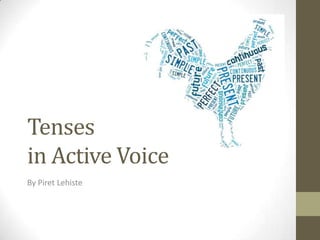
Tenses
in Active Voice
By Piret Lehiste
Present Simple
• Used for scientific facts, permanent truths
• Used for habitual or customary actions
• Used for future reference (for timetables)
E.g. Water boils at 100 degrees by Celsius.
I play tennis every Tuesday.
The plane leaves at 14:00 tomorrow.
Present Simple
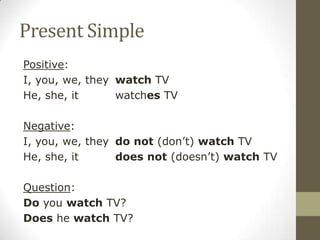
Positive:
I, you, we, they watch TV
He, she, it watches TV
Negative:
I, you, we, they do not (don’t) watch TV
He, she, it does not (doesn’t) watch TV
Question:
Do you watch TV?
Does he watch TV?
Present Simple
Time expressions to use with the Present
Simple:
always, usually, normally, sometimes, often,
every day, every year, seldom, rarely, at
weekends, on Saturdays, etc.
E.g. John tries to exercise every day.
I don’t normally drink tea with milk.
Does she work on Sundays?
Present Continuous
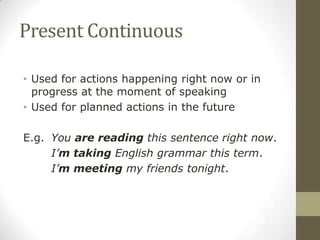
• Used for actions happening right now or in
progress at the moment of speaking
• Used for planned actions in the future
E.g. You are reading this sentence right now.
I’m taking English grammar this term.
I’m meeting my friends tonight.
Present Continuous
Positive:
I am watching TV
He, she, it is watching TV
We, you, they are watching TV
Negative:
I am not watching TV
He, she, it is not watching TV
We, you, they are not watching TV
Question:
Am I watching TV?
Is he watching TV?
Are you watching TV?
Present Continuous
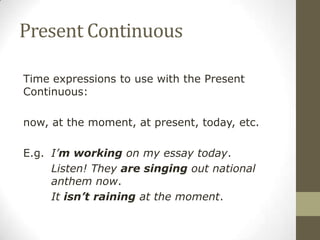
Time expressions to use with the Present
Continuous:
now, at the moment, at present, today, etc.
E.g. I’m working on my essay today.
Listen! They are singing out national
anthem now.
It isn’t raining at the moment.
Present Perfect
• Used for actions beginning in the past and
continuing to the present moment
• Used for actions which happened at an
unspecified time in the past but have present
effects
E.g. He has written five novels so far.
I have lost my keys. I cannot get into
the house.
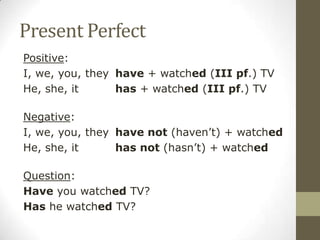
Present Perfect
Positive:
I, we, you, they have + watched (III pf.) TV
He, she, it has + watched (III pf.) TV
Negative:
I, we, you, they have not (haven’t) + watched
He, she, it has not (hasn’t) + watched
Question:
Have you watched TV?
Has he watched TV?
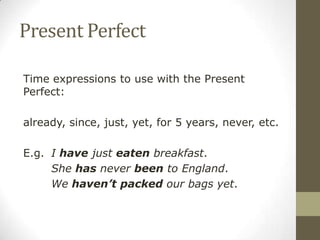
Present Perfect
Time expressions to use with the Present
Perfect:
already, since, just, yet, for 5 years, never, etc.
E.g. I have just eaten breakfast.
She has never been to England.
We haven’t packed our bags yet.
Past Simple
• Used to talk about an activity that began and
ended at a particular time in the past
E.g. I saw a really good film yesterday.
I learnt to swim when I was young.
She graduated from university in 2008.
Past Simple
Positive:
I, you, he, she, it, we, they watched TV
II pf.
Negative:
I, you, he, she, it, we, they did not (didn’t) +
watch TV
Question:
Did you watch TV?
Past Simple
Time expressions to use with the Past Simple:
yesterday, last week, two minutes ago, etc.
E.g. My sister reached home two hours ago.
I finished school last summer.
He didn’t call me last night.
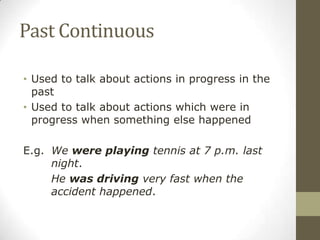
Past Continuous
• Used to talk about actions in progress in the
past
• Used to talk about actions which were in
progress when something else happened
E.g. We were playing tennis at 7 p.m. last
night.
He was driving very fast when the
accident happened.
Past Continuous
Positive:
I, he, she, it was watching TV
We, you, they were watching TV
Negative:
I, he, she, it was not watching TV
We, you, they were not watching TV
Question:
Was he watching TV?
Were you watching TV?
Past Continuous
Time expressions to use with the Past
Continuous:
while, this time yesterday, etc.
E.g. The accident happened while he was
driving home.
This time yesterday I was having
breakfast.
I wasn’t sleeping when you called.
Past Perfect
• Used with reference to ‘an earlier past’, that
is to describe the first of two or more actions
E.g. She suddenly realized that she had left
her textbook home.
He got a bad grade because he had
made too many mistakes in the test.
Past Perfect
Positive:
I, he, she, it, we, you, they had + watched TV
(III pf.)
Negative:
I, he, she, it, we, you, they had not (hadn’t) +
watched TV
Question:
Had she watched TV?
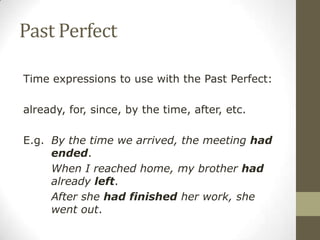
Past Perfect
Time expressions to use with the Past Perfect:
already, for, since, by the time, after, etc.
E.g. By the time we arrived, the meeting had
ended.
When I reached home, my brother had
already left.
After she had finished her work, she
went out.
Future Simple
• Used to make predictions about the future or
about people’s plans
• Used for promises or on-the-spot decisions
E.g. The weather will probably be sunny
tomorrow.
Mum, we haven’t got any milk. – Alright,
I will go and buy some.
Future Simple
Positive:
I, you, he, she, it, we, they will watch TV
Negative:
I, you, he, she, it, we, they will not (won’t) +
watch TV
Question:
Will you watch TV?
Future Simple
Time expressions to use with the Future
Simple:
tomorrow, next year, soon, in the future, etc.
E.g. Do you think it will rain tomorrow?
You will be a great musician one day.
I promise I will be back soon.

Basic Tenses in Active Voice

  • 1.
  • 2.
    Present Simple • Usedfor scientific facts, permanent truths • Used for habitual or customary actions • Used for future reference (for timetables) E.g. Water boils at 100 degrees by Celsius. I play tennis every Tuesday. The plane leaves at 14:00 tomorrow.
  • 3.
    Present Simple Positive: I, you,we, they watch TV He, she, it watches TV Negative: I, you, we, they do not (don’t) watch TV He, she, it does not (doesn’t) watch TV Question: Do you watch TV? Does he watch TV?
  • 4.
    Present Simple Time expressionsto use with the Present Simple: always, usually, normally, sometimes, often, every day, every year, seldom, rarely, at weekends, on Saturdays, etc. E.g. John tries to exercise every day. I don’t normally drink tea with milk. Does she work on Sundays?
  • 5.
    Present Continuous • Usedfor actions happening right now or in progress at the moment of speaking • Used for planned actions in the future E.g. You are reading this sentence right now. I’m taking English grammar this term. I’m meeting my friends tonight.
  • 6.
    Present Continuous Positive: I amwatching TV He, she, it is watching TV We, you, they are watching TV Negative: I am not watching TV He, she, it is not watching TV We, you, they are not watching TV Question: Am I watching TV? Is he watching TV? Are you watching TV?
  • 7.
    Present Continuous Time expressionsto use with the Present Continuous: now, at the moment, at present, today, etc. E.g. I’m working on my essay today. Listen! They are singing out national anthem now. It isn’t raining at the moment.
  • 8.
    Present Perfect • Usedfor actions beginning in the past and continuing to the present moment • Used for actions which happened at an unspecified time in the past but have present effects E.g. He has written five novels so far. I have lost my keys. I cannot get into the house.
  • 9.
    Present Perfect Positive: I, we,you, they have + watched (III pf.) TV He, she, it has + watched (III pf.) TV Negative: I, we, you, they have not (haven’t) + watched He, she, it has not (hasn’t) + watched Question: Have you watched TV? Has he watched TV?
  • 10.
    Present Perfect Time expressionsto use with the Present Perfect: already, since, just, yet, for 5 years, never, etc. E.g. I have just eaten breakfast. She has never been to England. We haven’t packed our bags yet.
  • 11.
    Past Simple • Usedto talk about an activity that began and ended at a particular time in the past E.g. I saw a really good film yesterday. I learnt to swim when I was young. She graduated from university in 2008.
  • 12.
    Past Simple Positive: I, you,he, she, it, we, they watched TV II pf. Negative: I, you, he, she, it, we, they did not (didn’t) + watch TV Question: Did you watch TV?
  • 13.
    Past Simple Time expressionsto use with the Past Simple: yesterday, last week, two minutes ago, etc. E.g. My sister reached home two hours ago. I finished school last summer. He didn’t call me last night.
  • 14.
    Past Continuous • Usedto talk about actions in progress in the past • Used to talk about actions which were in progress when something else happened E.g. We were playing tennis at 7 p.m. last night. He was driving very fast when the accident happened.
  • 15.
    Past Continuous Positive: I, he,she, it was watching TV We, you, they were watching TV Negative: I, he, she, it was not watching TV We, you, they were not watching TV Question: Was he watching TV? Were you watching TV?
  • 16.
    Past Continuous Time expressionsto use with the Past Continuous: while, this time yesterday, etc. E.g. The accident happened while he was driving home. This time yesterday I was having breakfast. I wasn’t sleeping when you called.
  • 17.
    Past Perfect • Usedwith reference to ‘an earlier past’, that is to describe the first of two or more actions E.g. She suddenly realized that she had left her textbook home. He got a bad grade because he had made too many mistakes in the test.
  • 18.
    Past Perfect Positive: I, he,she, it, we, you, they had + watched TV (III pf.) Negative: I, he, she, it, we, you, they had not (hadn’t) + watched TV Question: Had she watched TV?
  • 19.
    Past Perfect Time expressionsto use with the Past Perfect: already, for, since, by the time, after, etc. E.g. By the time we arrived, the meeting had ended. When I reached home, my brother had already left. After she had finished her work, she went out.
  • 20.
    Future Simple • Usedto make predictions about the future or about people’s plans • Used for promises or on-the-spot decisions E.g. The weather will probably be sunny tomorrow. Mum, we haven’t got any milk. – Alright, I will go and buy some.
  • 21.
    Future Simple Positive: I, you,he, she, it, we, they will watch TV Negative: I, you, he, she, it, we, they will not (won’t) + watch TV Question: Will you watch TV?
  • 22.
    Future Simple Time expressionsto use with the Future Simple: tomorrow, next year, soon, in the future, etc. E.g. Do you think it will rain tomorrow? You will be a great musician one day. I promise I will be back soon.