Words, Learning and Networks
Caroline Haythornthwaite
Rafa Absar
Drew Paulin
The iSchool @ UBC
University of British Columbia
Discourse Analytics Workshop
LAK 14, 2014
Social Media and Learning
—  Social Science and Humanities Research Grant (SSHRC)
◦  PIs Anatoliy Gruzd & Caroline Haythornthwaite, with George Siemens
++ Drew Paulin, Rafa Absar, Mick Huggett
—  Primary purpose:
◦  To determine and evaluate measures that help educators manage their use
of social media for teaching and learning through the use of automated
analysis of social media texts and networks
—  Examine facets such as
◦  common patterns of exchange
◦  development of shared language and understanding
◦  emergence of roles and positions
—  Primary approach
◦  Automated analysis of social media texts and networks
◦  Who talks to whom about what via and which (social) media?
—  Research goal is to discover
◦  What forms of social connection – conversational structures of
communication between people in a network – reveal learning, learning
practices, learning roles, etc.
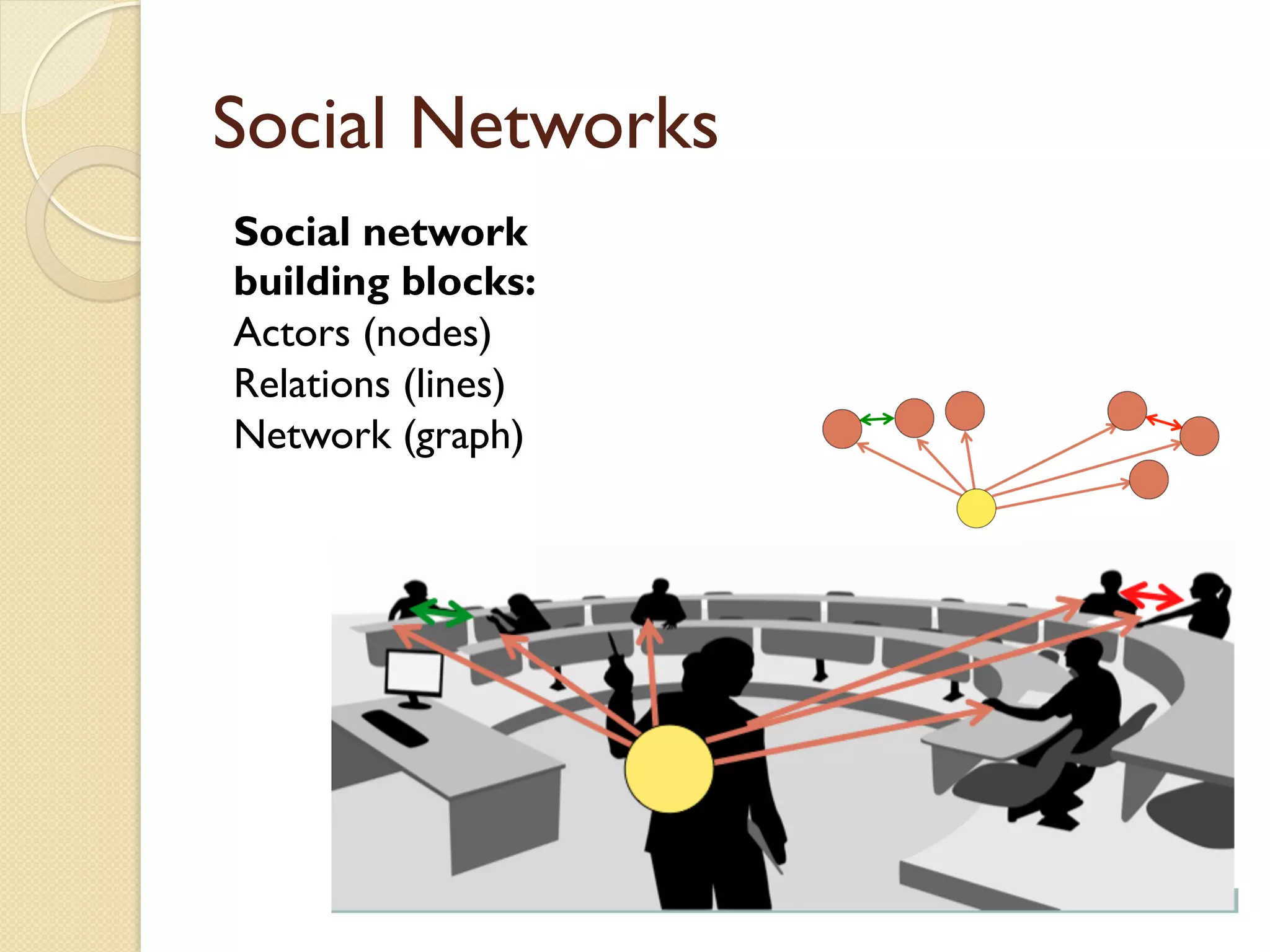
Social Networks
Social network
building blocks:
Actors (nodes)
Relations (lines)
Network (graph)
Networks & Discourse
—  Discourse / Conversation / Communication
◦  Entails using language, often in a symbolic and
prescribed way, that signals relations between objects,
subjects, etc. – i.e., a network!
—  Social Networks
◦  Describe relations between actors that signal social
constructions such as cliques, groups, communities
–  Discourse communities, epistemic communities, learning
communities
—  Relations can be determined from text
◦  The question for use is ‘What text signifies learning
relations?’
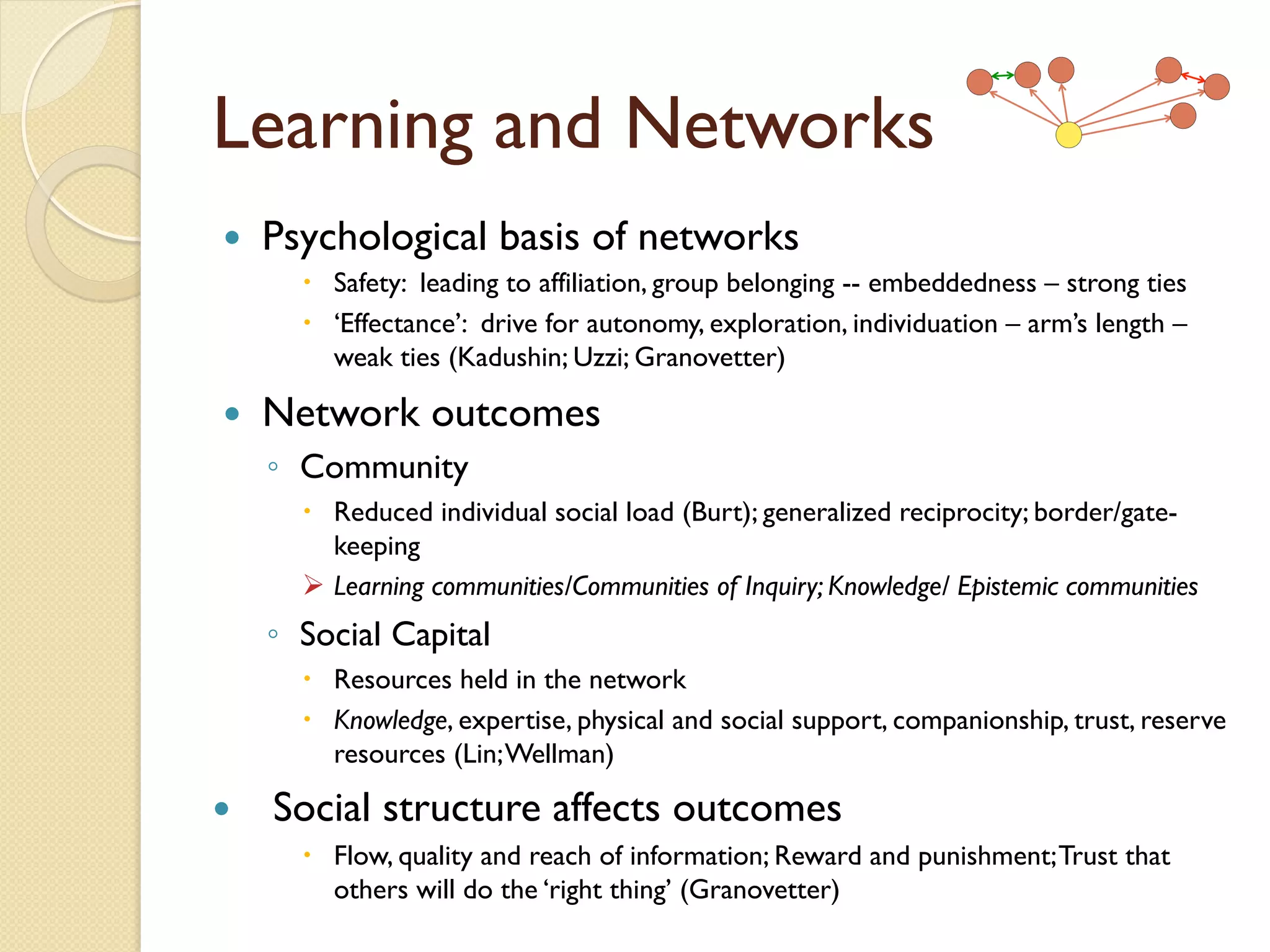
Learning and Networks
—  Psychological basis of networks
–  Safety: leading to affiliation, group belonging -- embeddedness – strong ties
–  ‘Effectance’: drive for autonomy, exploration, individuation – arm’s length –
weak ties (Kadushin; Uzzi; Granovetter)
—  Network outcomes
◦  Community
–  Reduced individual social load (Burt); generalized reciprocity; border/gate-
keeping
Ø  Learning communities/Communities of Inquiry; Knowledge/ Epistemic communities
◦  Social Capital
–  Resources held in the network
–  Knowledge, expertise, physical and social support, companionship, trust, reserve
resources (Lin;Wellman)
—  Social structure affects outcomes
–  Flow, quality and reach of information; Reward and punishment;Trust that
others will do the ‘right thing’ (Granovetter)
Learning Networks
—  Learning as acquisition of knowledge, marked by
a transformation of the individual
–  Information, knowledge, and learning networks
—  Social Learning as learning with, by and through
networks
–  Accomplished through transfer of information, knowledge
dissemination, discussio - trying out ideas on others
—  Transformation evident as adoption or
development of common practices
–  Cultural, disciplinary, group language, discourse, genres, modes
of communication, methodological approaches
–  (Miller, 1984; DeSanctis & Poole, 1994; Haythornthwaite, 2006,
2013)
Learning from a Network Perspective
—  Learning can be a relation
that connects people
—  Learning can be the
characterization of the tie
◦  based on multiple,
contextually determined
relations
—  Learning relations can be
taken as input for design
◦  e.g., when addressing
differences between online
and offline learning
—  Learning can be a
characterization of the
outcome of relations
◦  e.g., when a group becomes
a learning community
—  Learning as the network
outcome of relations
◦  e.g., the social or learning
capital of the network
—  Learning as contact with
ambient influence
◦  e.g., informal and
ubiquitous learning
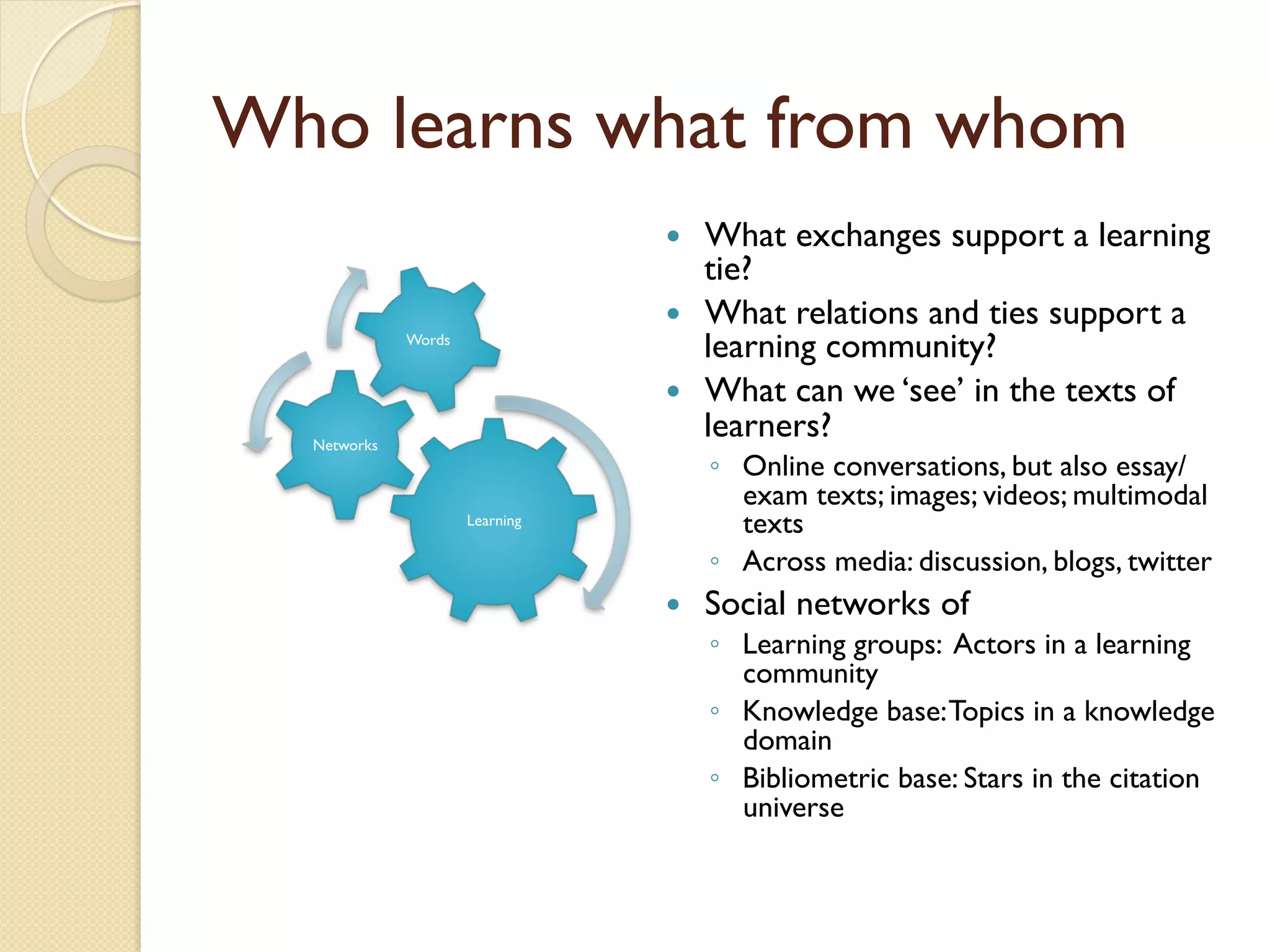
Who learns what from whom
Learning
Networks
Words
—  What exchanges support a learning
tie?
—  What relations and ties support a
learning community?
—  What can we ‘see’ in the texts of
learners?
◦  Online conversations, but also essay/
exam texts; images; videos; multimodal
texts
◦  Across media: discussion, blogs, twitter
—  Social networks of
◦  Learning groups: Actors in a learning
community
◦  Knowledge base:Topics in a knowledge
domain
◦  Bibliometric base: Stars in the citation
universe
Words, Learning and Networks
—  Using text analysis to identify the building
blocks of networks
◦  Actors/nodes, relations, ties
—  Single mode
◦  Using text analysis to discover actors and relations
—  Two mode
◦  Actors x Text ‘events’
à ‘actor x actor’ AND ‘text x text’ networks
Use text analysis to distinguish:
Actors in the network
◦  Who is in the network
Actor relations
◦  What text(s) tie actors in the
network?
◦  What relations do these identify?
◦  2-mode:What actors are tied because
of common text use?
Actor ties
◦  Who talks to whom about what?
◦  Who is tied to whom by the identified
relation(s)
◦  What constitutes weak to strong tie
configurations for these actors
(frequency, intimacy of relational /text
content)
Social networks
◦  What configurations of actors tied by
text defines the network?
Text in the network
◦  What topics/phrases/keywords are
present/prevalent in the network
Text relations
◦  What text should be tied to other
text?
◦  2-mode:What text is tied because of
common use by actors?
Text ties
◦  How is text tied to other text?
Social networks
◦  What configurations of text define the
network?
◦  2-mode:What configurations of text
tied by actors defines the network
***
This is the work in progress considering
what the text side means
***
Outcomes
Actor-Text networks
Collaboration
—  What information sharing is or should
(according to theory, pedagogical intent)
be observed?
Innovation
—  What external information is or should
brought to the network?
Autonomy
—  What independent thought is or should
be evidenced in the network?
SN concepts
—  Weak vs strong ties
—  Roles and positions
—  Social capital
Text
Argumentation
—  What co-location/configuration of text
is or should (according to theory,
pedagogical intent) be observed?
Transformation
—  What change in language/concept use is
or should be evident?
Emotion
—  What emotion is or should be evident?
Learning and literacy concepts
—  Collaborative learning,Transformative
learning
—  Common language, Discourse
communities
—  Engagement (emotion)
—  Enculturation, learning ‘to be’ an expert,
a member of a group, a social media
user, etc.
Three Studies (briefly – as time permits)
—  Relational discovery
◦  Qualitative analysis to determine what
constituted a ‘learning tie’
—  Node discovery
◦  Enhancing identification of network actors
through text analysis
—  Tie discovery
◦  Identifying network connections through
common use of text
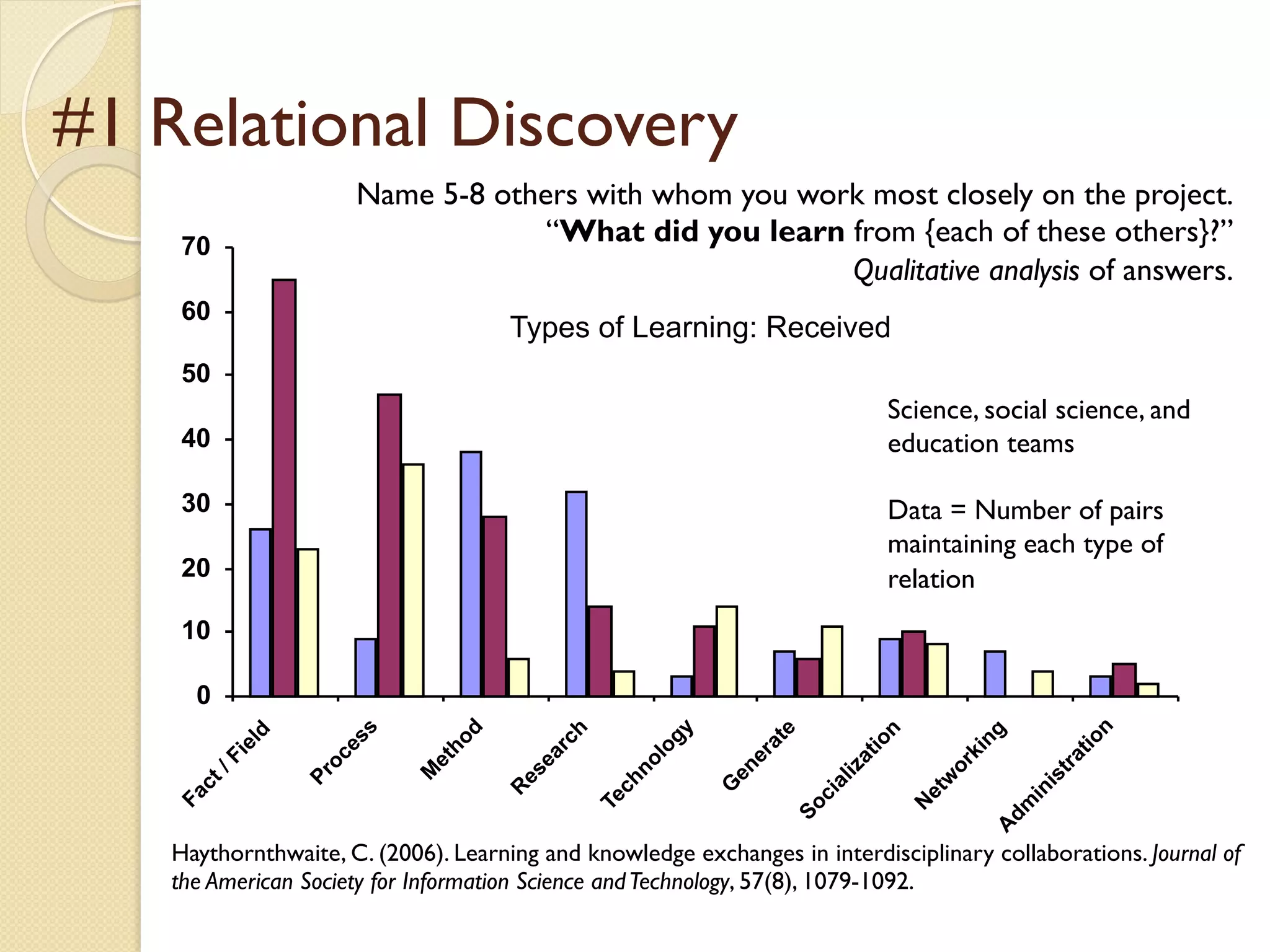
#1 Relational Discovery
0
10
20
30
40
50
60
70
Fact/Field
Process
M
ethod
R
esearch
Technology
G
enerate
Socialization
N
etw
orkingA
dm
inistration
Types of Learning: Received
Science, social science, and
education teams
Data = Number of pairs
maintaining each type of
relation
Haythornthwaite, C. (2006). Learning and knowledge exchanges in interdisciplinary collaborations. Journal of
the American Society for Information Science andTechnology, 57(8), 1079-1092.
Name 5-8 others with whom you work most closely on the project.
“What did you learn from {each of these others}?”
Qualitative analysis of answers.
#2 Node and tie discovery
Previous post is by Gabriel, Sam replies:
‘Nick,Ann, Gina, Gabriel:
I apologize for not backing this up with a good source,
but I know from reading about this topic that libraries…’	
  
Previous posts by Gabriel, Sam, Gina, and Eva, then:
‘Gina, I owe you a cookie.This is exactly what I wanted to know.
I was already planning on taking 302 next semester,
and now I have something to look forward to!’	
  
Post by Fred:
‘I wonder if that could be why other libraries
around the world have resisted changing –
it's too much work, and as Dan pointed out, too expensive.’	
  
Ex.1	
  
Ex.2	
  
Ex.3	
  
Gruzd,A. & Haythornthwaite, C. (2008). Automated discovery and analysis of social networks from threaded discussions. International
Sunbelt Social Network conference, Jan. 22-27, St. Pete’s Beach, Florida. [http://hdl.handle.net/2142/11528]
Issues:
Actor identification
Name resolution
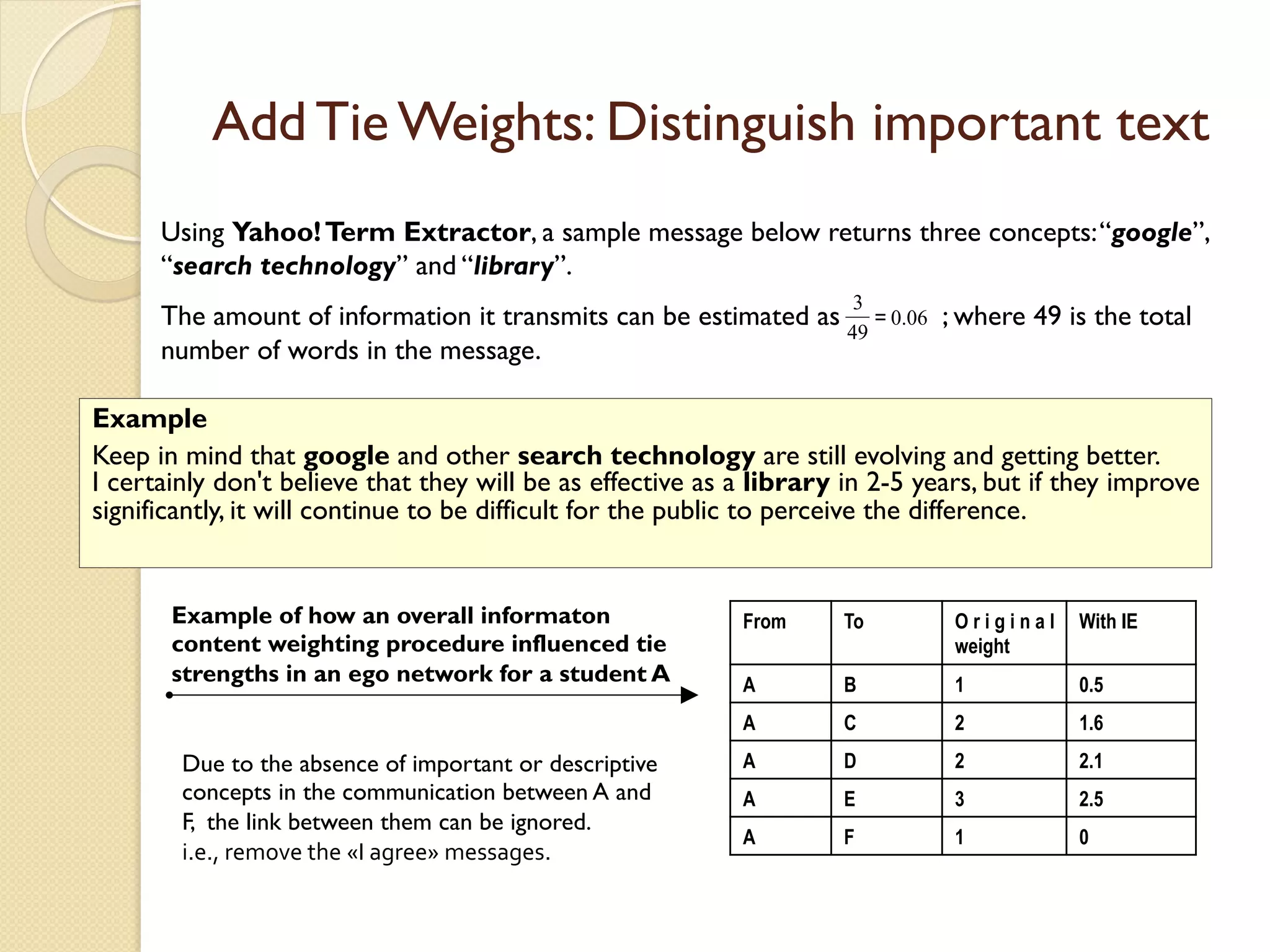
Add Tie Weights: Distinguish important text
Example
Keep in mind that google and other search technology are still evolving and getting better.
I certainly don't believe that they will be as effective as a library in 2-5 years, but if they improve
significantly, it will continue to be difficult for the public to perceive the difference.	
  
From To O r i g i n a l
weight
With IE
A B 1 0.5
A C 2 1.6
A D 2 2.1
A E 3 2.5
A F 1 0
Using Yahoo!Term Extractor, a sample message below returns three concepts:“google”,
“search technology” and “library”.
The amount of information it transmits can be estimated as ; where 49 is the total
number of words in the message.	
  
06.0
49
3
=
Example of how an overall informaton
content weighting procedure influenced tie
strengths in an ego network for a student A	
  	
  
Due to the absence of important or descriptive
concepts in the communication between A and
F, the link between them can be ignored.	
  	
  
i.e.,	
  remove	
  the	
  «I	
  agree»	
  messages.
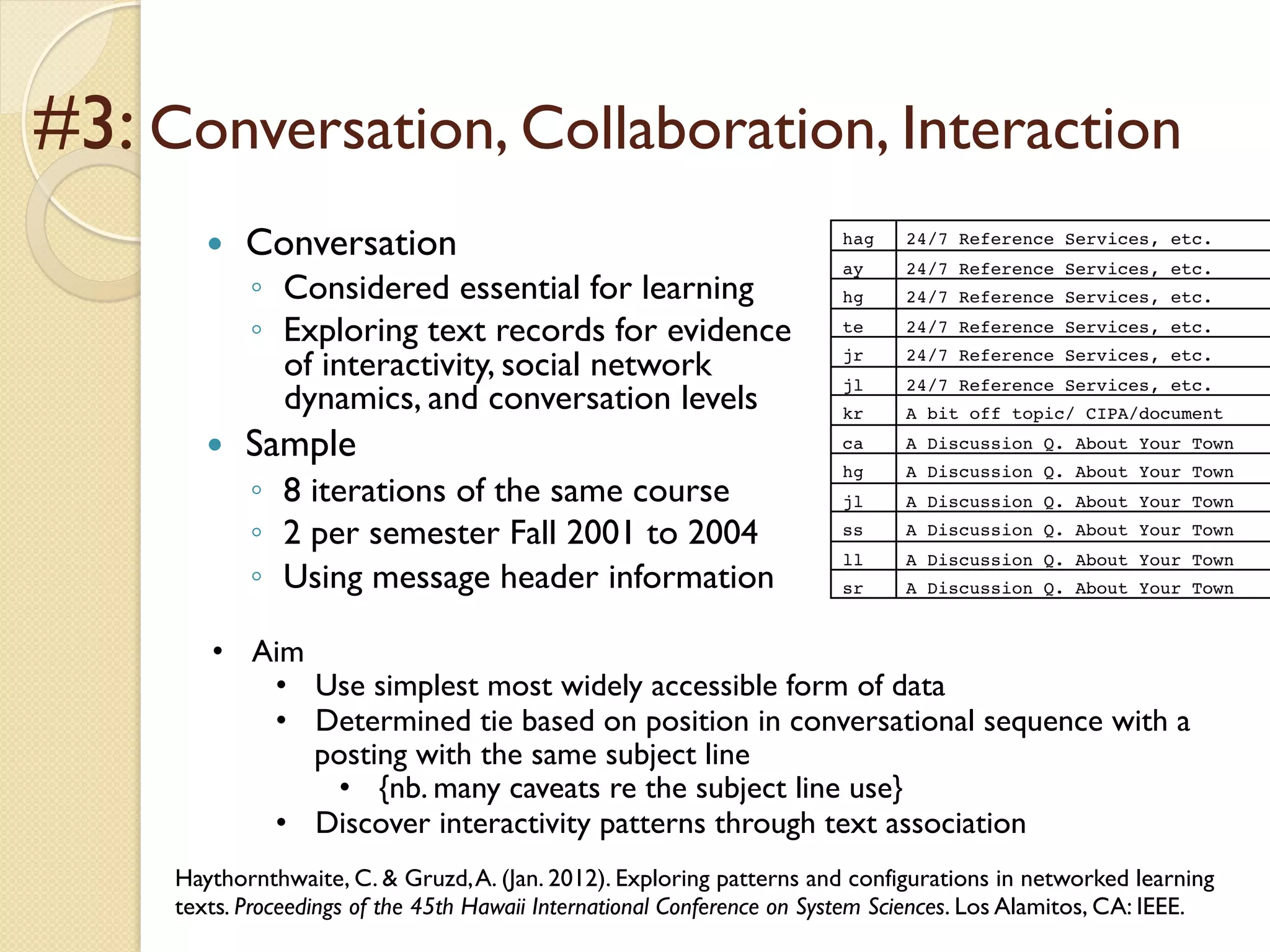
#3: Conversation, Collaboration, Interaction
—  Conversation
◦  Considered essential for learning
◦  Exploring text records for evidence
of interactivity, social network
dynamics, and conversation levels
—  Sample
◦  8 iterations of the same course
◦  2 per semester Fall 2001 to 2004
◦  Using message header information
•  Aim
•  Use simplest most widely accessible form of data
•  Determined tie based on position in conversational sequence with a
posting with the same subject line
•  {nb. many caveats re the subject line use}
•  Discover interactivity patterns through text association
Haythornthwaite, C. & Gruzd,A. (Jan. 2012). Exploring patterns and configurations in networked learning
texts. Proceedings of the 45th Hawaii International Conference on System Sciences. Los Alamitos, CA: IEEE.
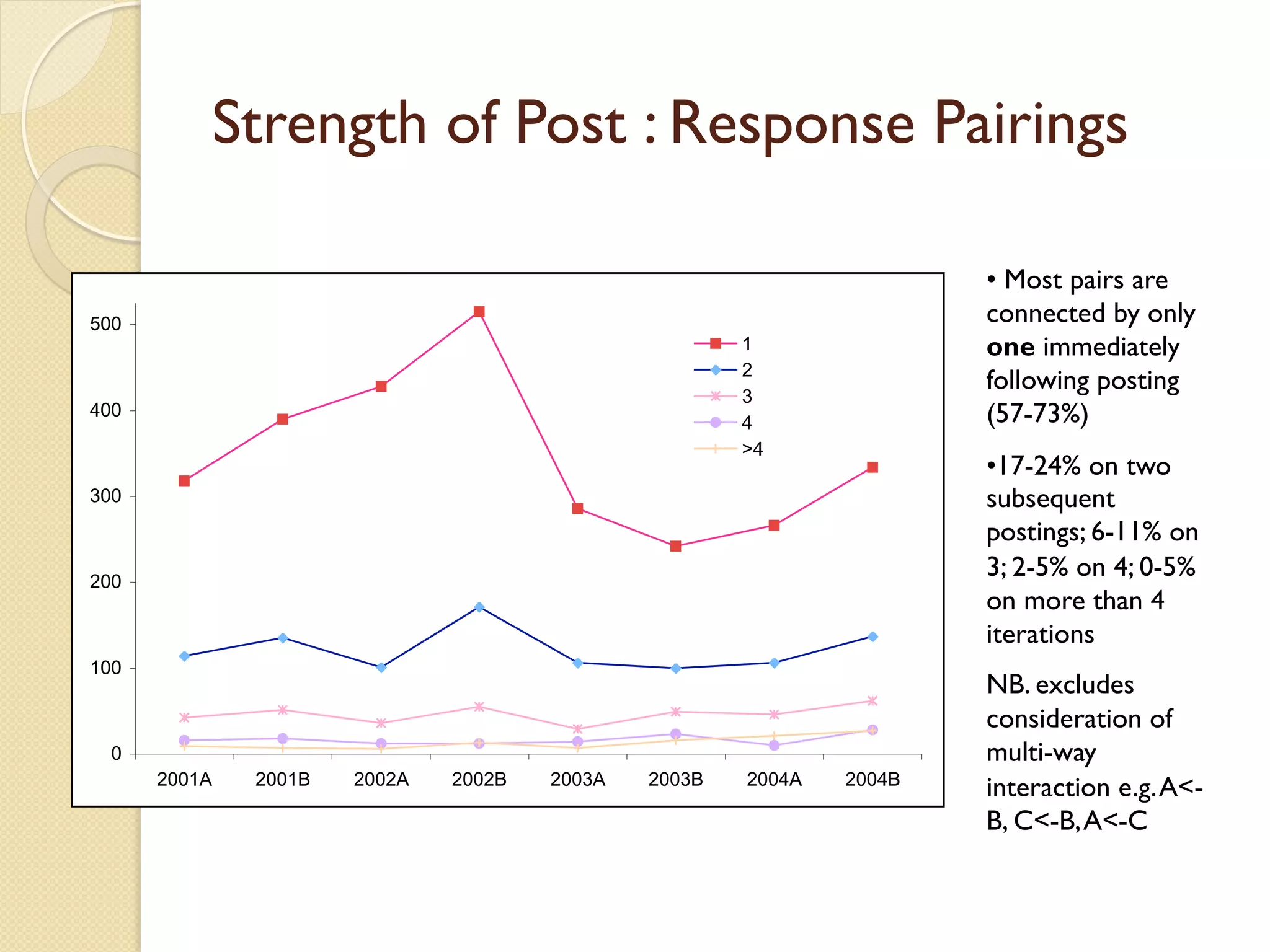
Strength of Post : Response Pairings
• Most pairs are
connected by only
one immediately
following posting
(57-73%)
• 17-24% on two
subsequent
postings; 6-11% on
3; 2-5% on 4; 0-5%
on more than 4
iterations
NB. excludes
consideration of
multi-way
interaction e.g.A<-
B, C<-B,A<-C
0
100
200
300
400
500
2001A 2001B 2002A 2002B 2003A 2003B 2004A 2004B
1
2
3
4
>4
Network Structures
Dichotomized at 1, 2, 3 and 4 Ties
[density, undirected]
.56 .20
.07 .02
Conversational ‘turns’
Revealing a ‘core
discussion’ group
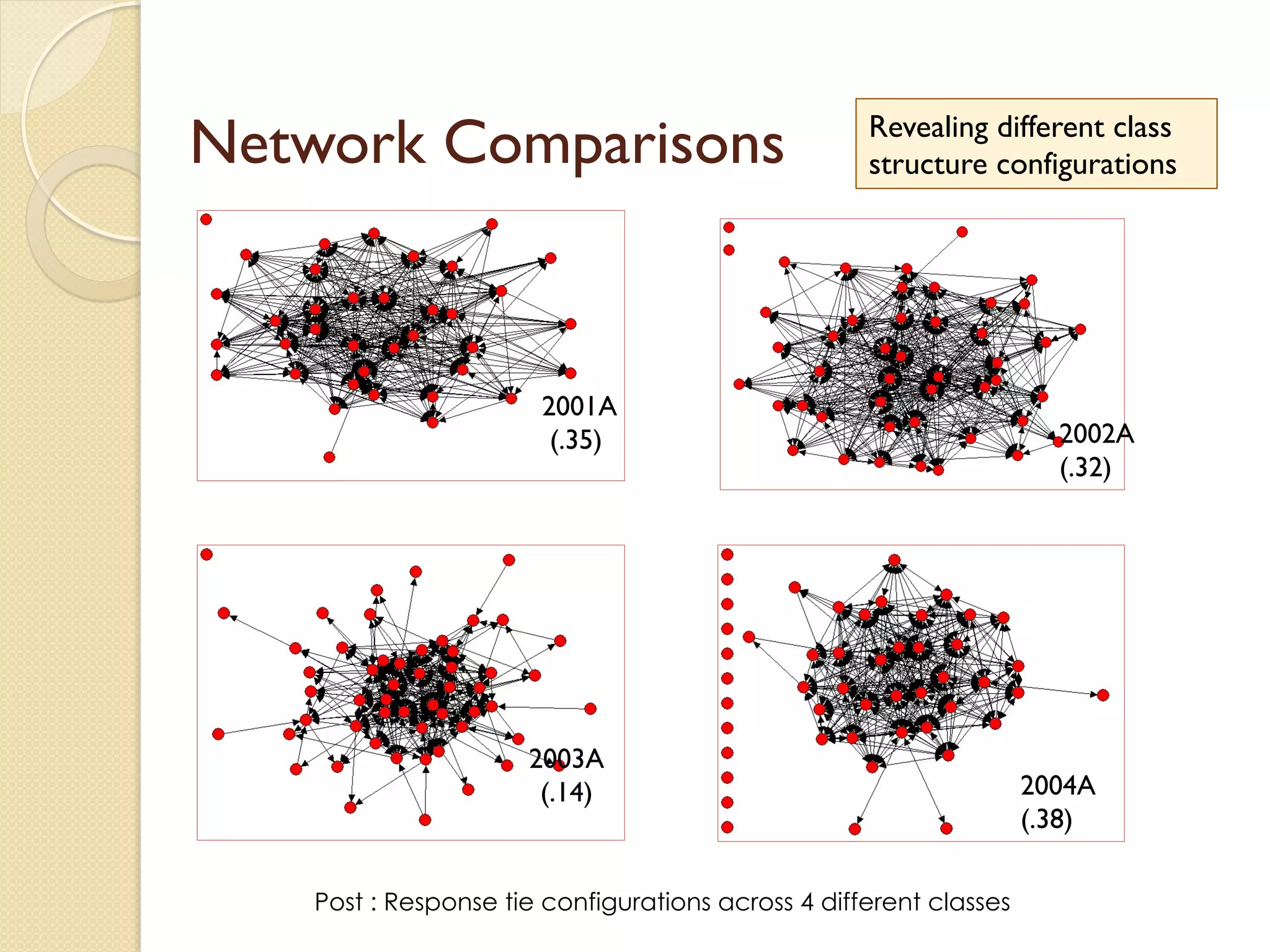
Network Comparisons
Post : Response tie configurations across 4 different classes
2001A
(.35) 2002A
(.32)
2004A
(.38)
2003A
(.14)
Revealing different class
structure configurations
Words, Learning and Networks
—  Who is in the network – actors
◦  Text analysis for name identification,
separation of named entities from
named actors
—  What is exchanged – relations
◦  Text analysis for identification of
relations, key discussions, pivotal
text or topics that connect
conversations and thus the network
—  Who is talking to whom – ties
◦  Discover how conversations happen
across the the network.
—  Who maintains what relations
with whom
◦  What combinations of topics/texts/
keywords, etc. create what kinds of
ties between people: work, social,
support; instrumental, emotional
—  From text to network structures
◦  Assess what leads to, confers, or
sustains network positions such as
network stars and brokers, weak
and strong ties
◦  Identify structural holes, topic
lacunae and avoidance
◦  Compare networks for similarities
across structure, and conversational
text
—  From networks to text
◦  Use network ties to inform the
analysis of text, e.g., where close ties
use a variety of terms that appear to
represent the same object or topic.
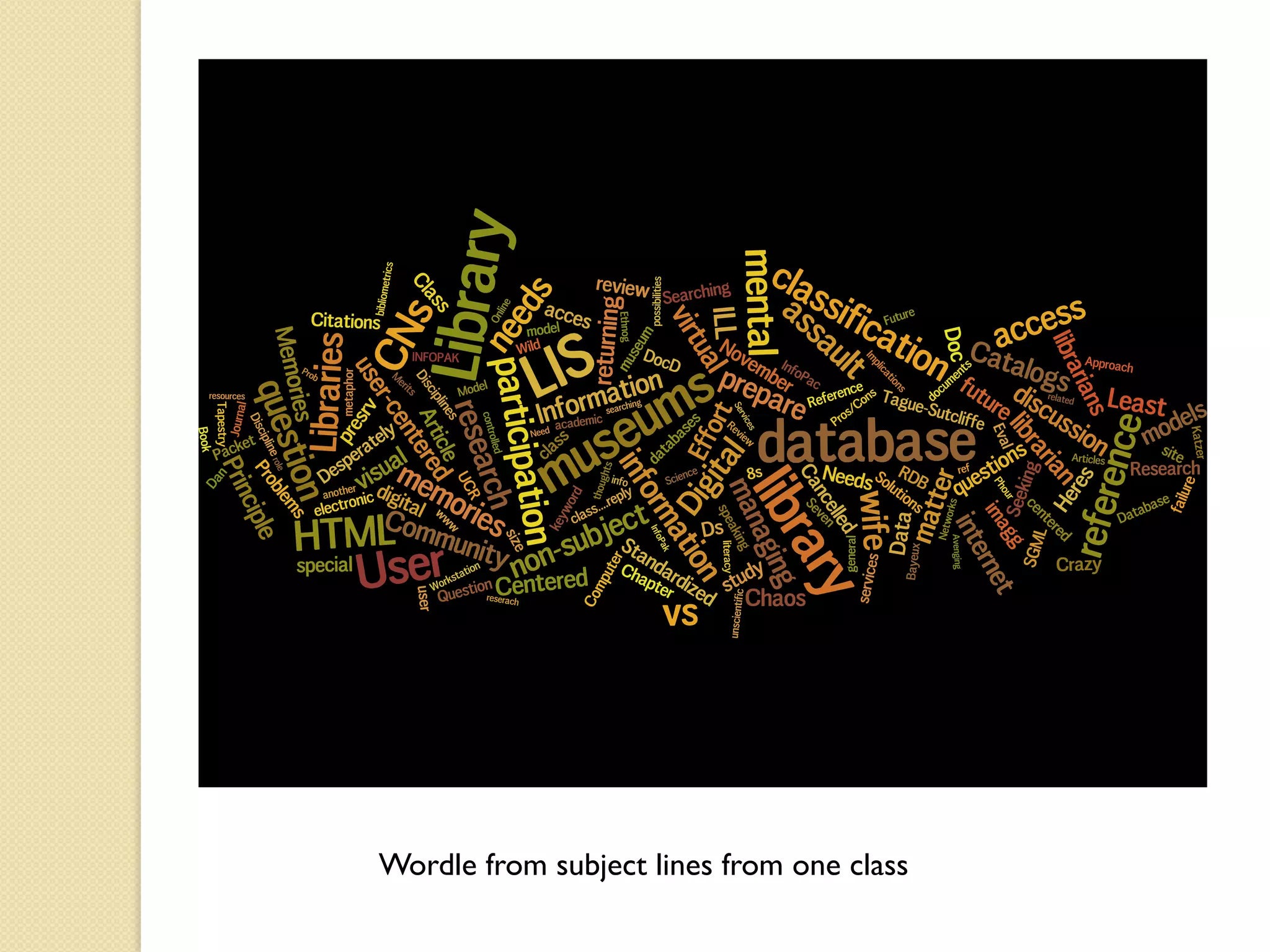
Wordle from subject lines from one class
MOOC data overview
and challenges
Rafa Absar
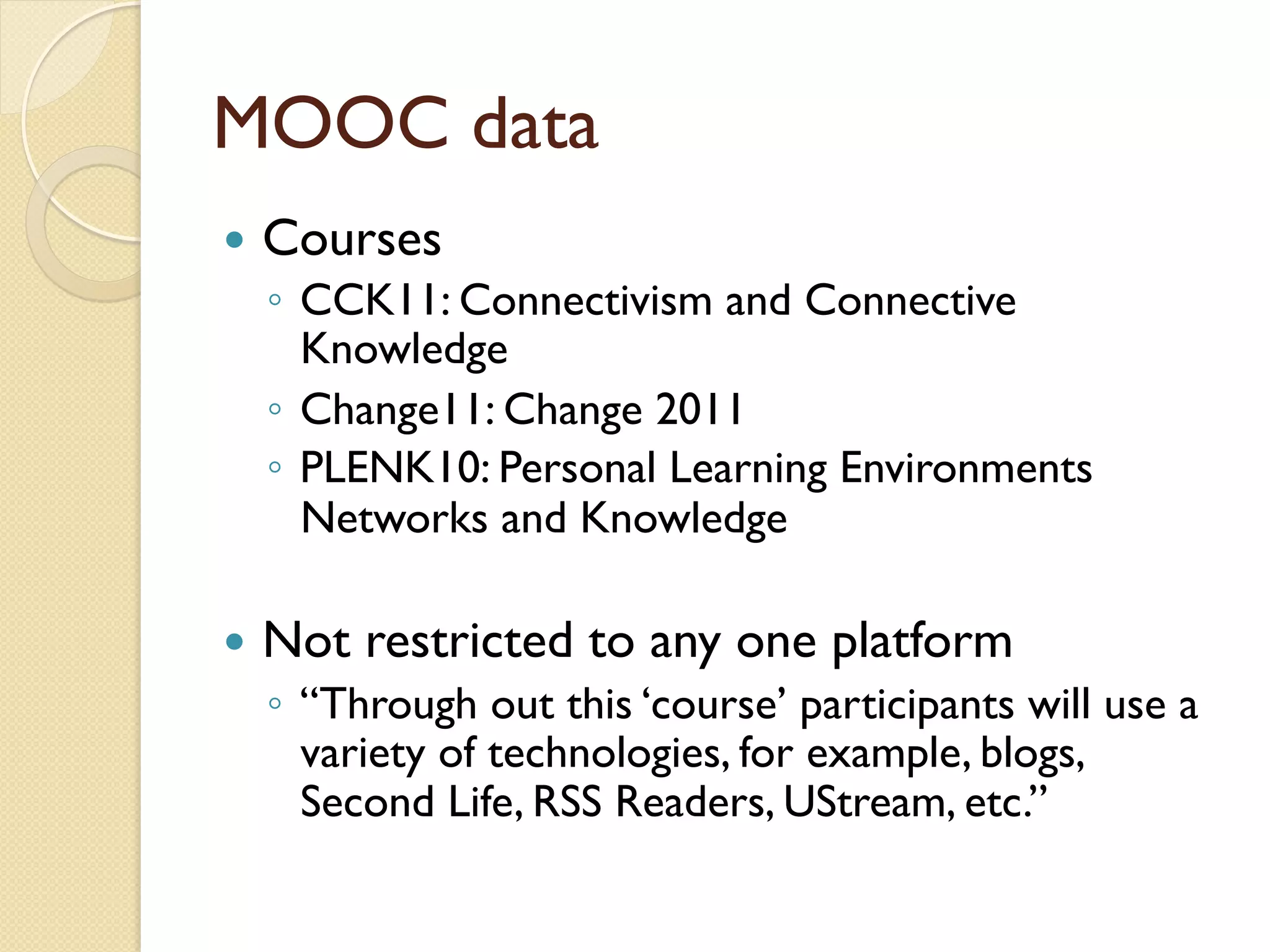
MOOC data
—  Courses
◦  CCK11: Connectivism and Connective
Knowledge
◦  Change11: Change 2011
◦  PLENK10: Personal Learning Environments
Networks and Knowledge
—  Not restricted to any one platform
◦  “Through out this ‘course’ participants will use a
variety of technologies, for example, blogs,
Second Life, RSS Readers, UStream, etc.”
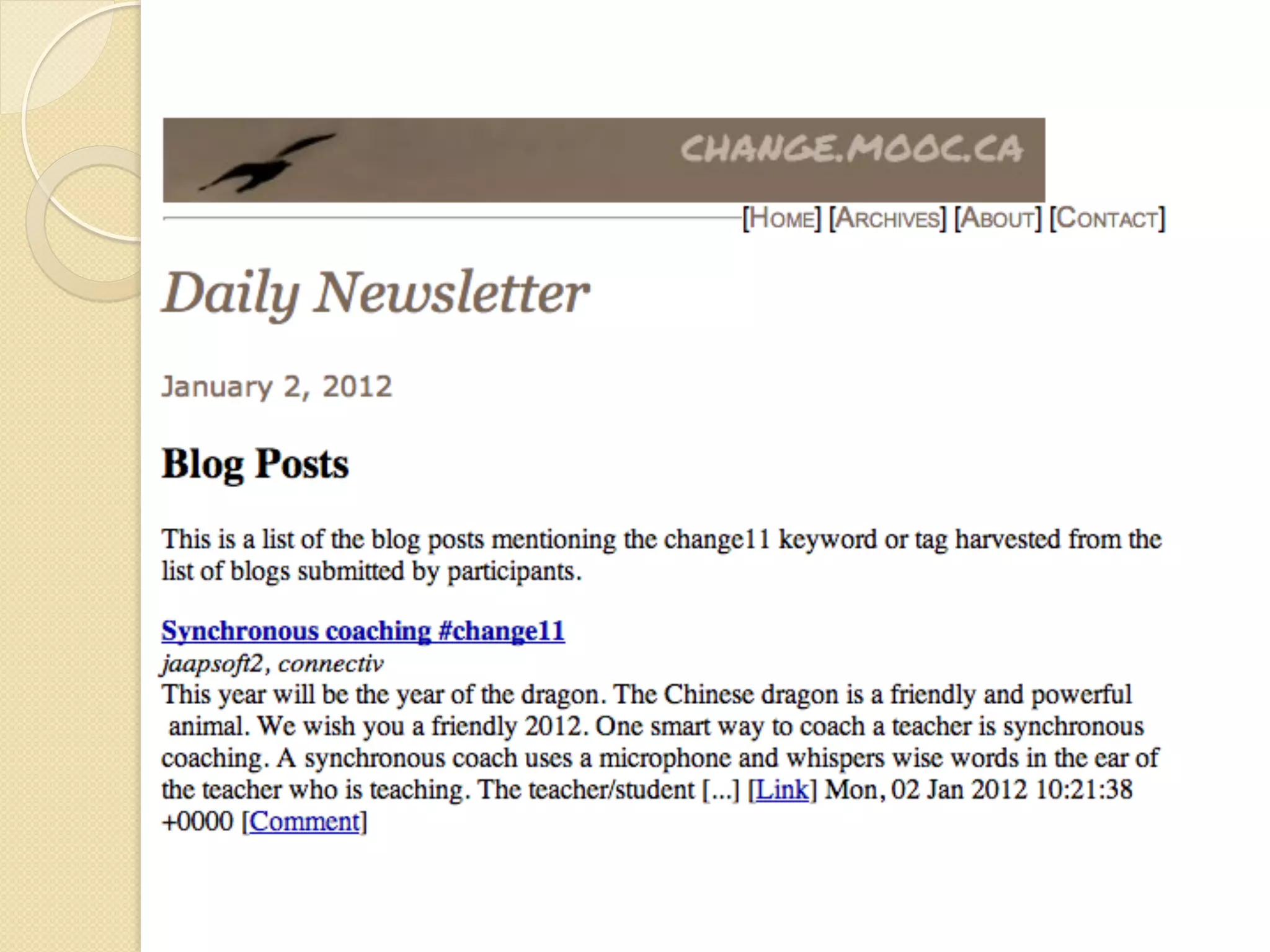
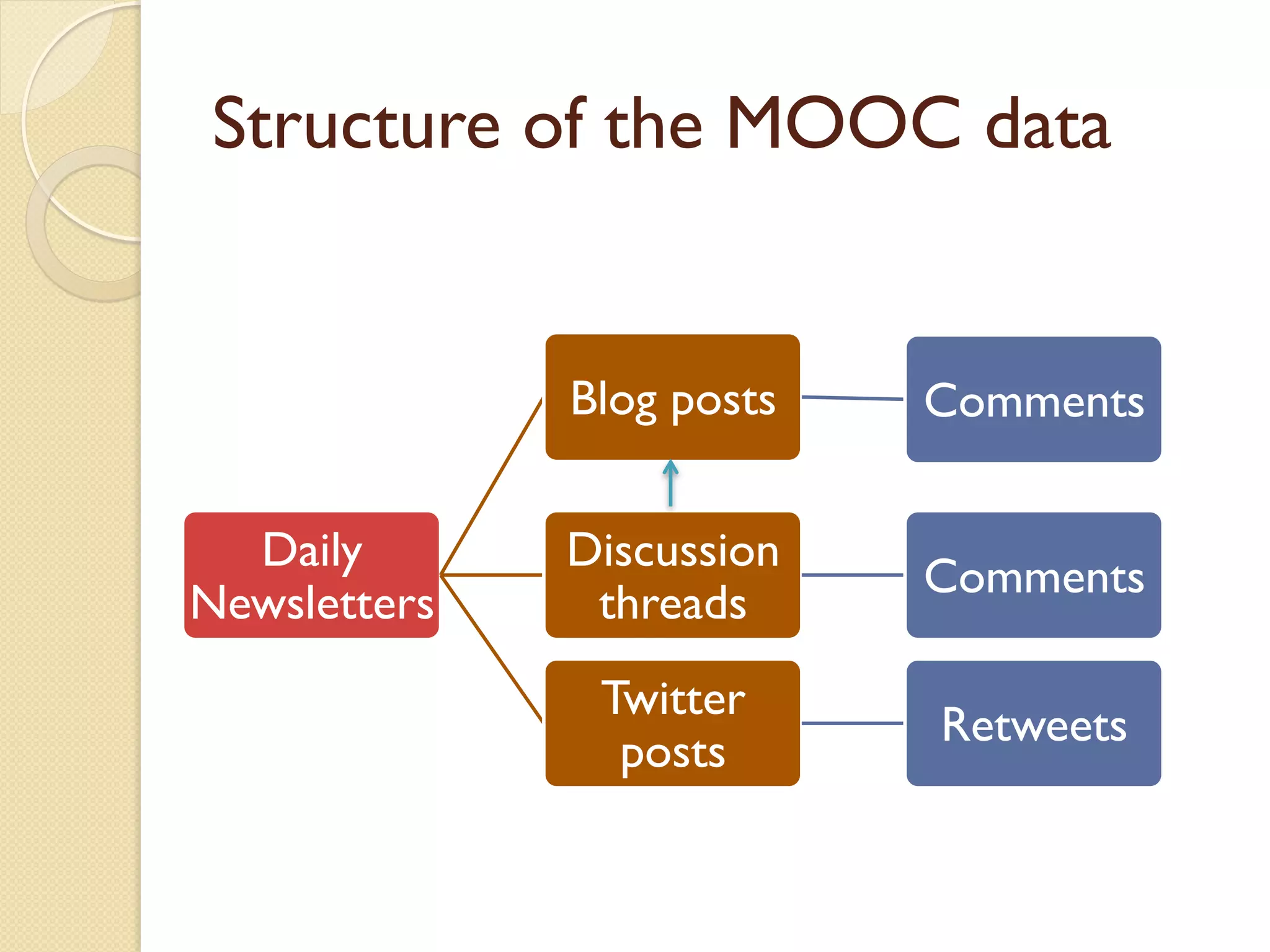
Structure of the MOOC data
Daily
Newsletters
Blog posts Comments
Discussion
threads
Comments
Twitter
posts
Retweets
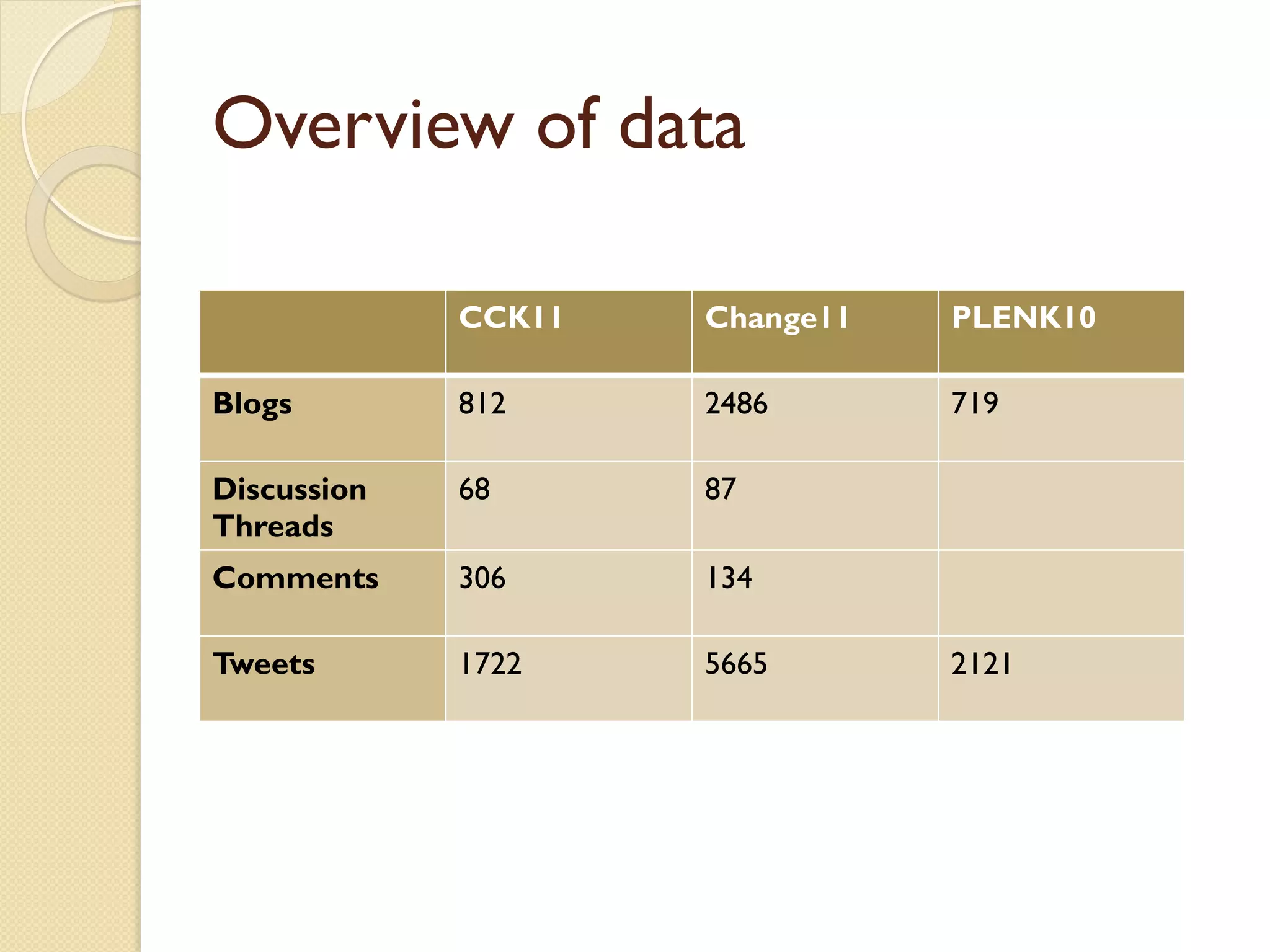
Overview of data
CCK11 Change11 PLENK10
Blogs 812 2486 719
Discussion
Threads
68 87
Comments 306 134
Tweets 1722 5665 2121
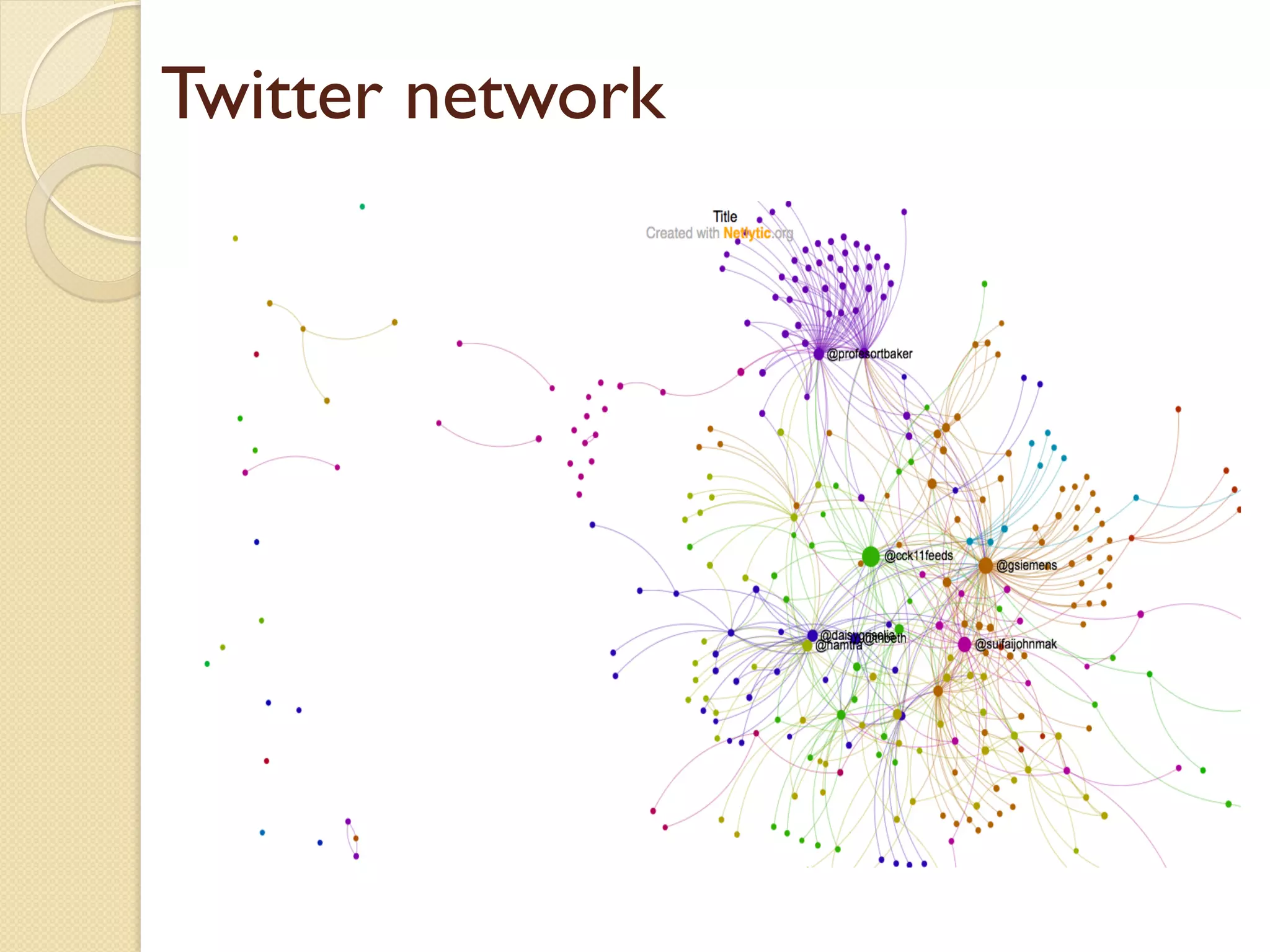
Twitter network
Issues: Identity resolution
—  Coreference resolution
◦  How to identify single identities across
platforms?
—  Alias resolution
◦  How to identify two or more people with the
same alias?
Social relations and learning
	
  
29
“… it	
  made	
  me	
  think	
  
of	
  [an example] that	
  
Karen	
  posted.. ”	
  
Learn
“ Anne	
  and	
  I	
  have	
  been	
  
corresponding	
  via	
  e-­‐mail	
  and	
  
she	
  reminded	
  me	
  that	
  we	
  
should	
  be	
  having	
  discussion	
  
here.."
“ [Instructor’s name], if
you see this posting
would you please clarify
for us..”
Collaborative
Work
Help
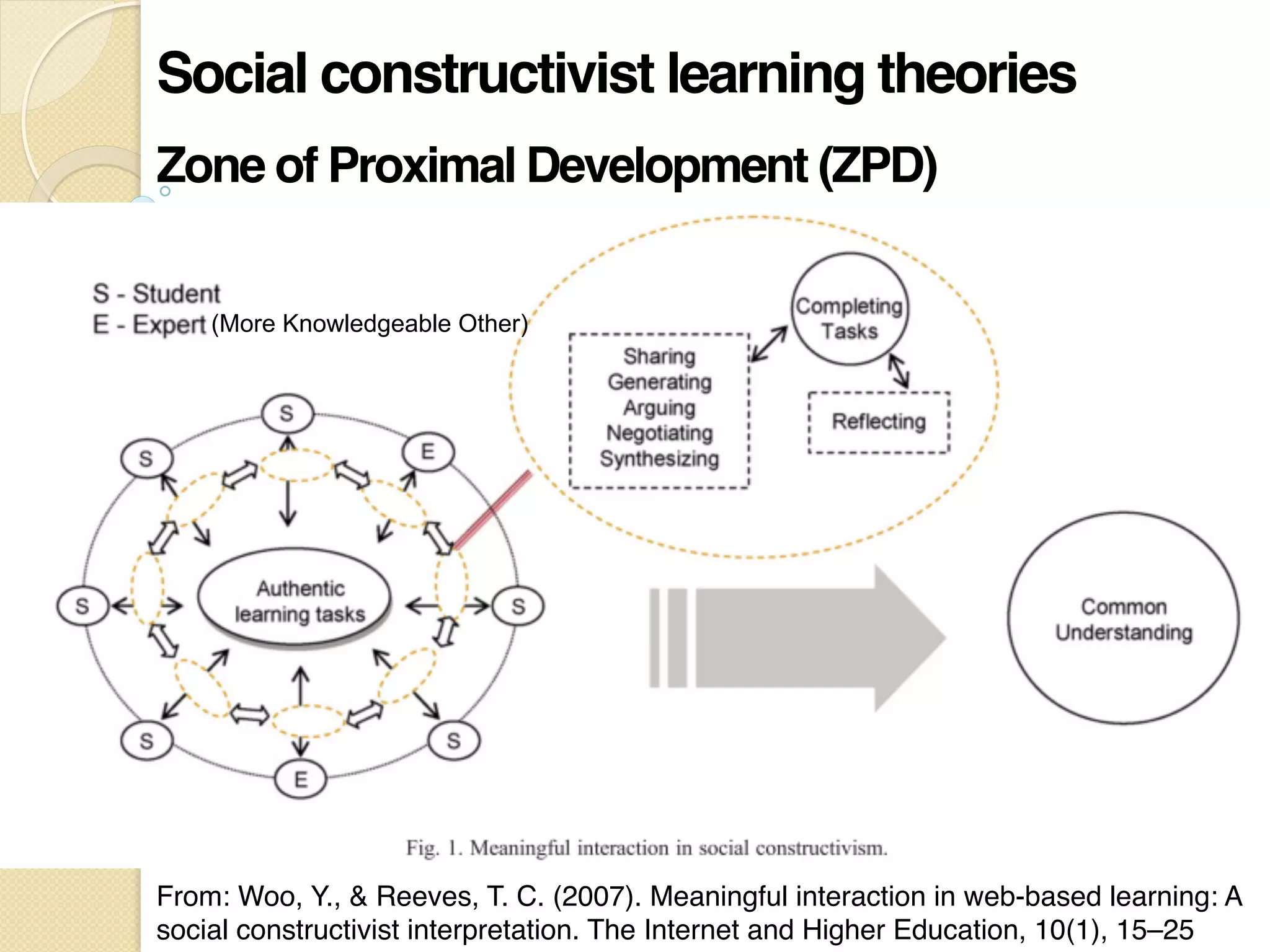
Social constructivist learning theories!
Zone of Proximal Development (ZPD)!
From: Woo, Y., & Reeves, T. C. (2007). Meaningful interaction in web-based learning: A
social constructivist interpretation. The Internet and Higher Education, 10(1), 15–25"
(More Knowledgeable Other)
Who are the More Knowledgeable Others in
a learning community?!
External indicators!
•  Previous roles of leadership or expertise in a knowledge
community"
•  History of publications and presentations"
•  Bibliometric measures (citations)"
Internal indicators!
•  Contributions to the discussion; evidence of knowledge and
expertise"
•  Mentions, references by others, quotes, retweets, etc."
•  Productive roles (brokers, question-askers, critical thinkers)"
Why do we want to know who are the MKO?!
Practical: !
•  Organize optimal ZPD for learning sub-groups"
Analysis:!
•  How do MKO contributions disseminate/resonate/
diffuse through the network?

"
•  Is there a correlation between ‘expertise’and
network centrality measures?!
Do you use social media in your courses?!
!
Please participate in our online survey:"
(You could win 1 of 3 iPad Minis!)"
http://tinyurl.com/SMlearningsurvey"

DCLA14_Haythornthwaite_Absar_Paulin

  • 1.
    Words, Learning andNetworks Caroline Haythornthwaite Rafa Absar Drew Paulin The iSchool @ UBC University of British Columbia Discourse Analytics Workshop LAK 14, 2014
  • 2.
    Social Media andLearning —  Social Science and Humanities Research Grant (SSHRC) ◦  PIs Anatoliy Gruzd & Caroline Haythornthwaite, with George Siemens ++ Drew Paulin, Rafa Absar, Mick Huggett —  Primary purpose: ◦  To determine and evaluate measures that help educators manage their use of social media for teaching and learning through the use of automated analysis of social media texts and networks —  Examine facets such as ◦  common patterns of exchange ◦  development of shared language and understanding ◦  emergence of roles and positions —  Primary approach ◦  Automated analysis of social media texts and networks ◦  Who talks to whom about what via and which (social) media? —  Research goal is to discover ◦  What forms of social connection – conversational structures of communication between people in a network – reveal learning, learning practices, learning roles, etc.
  • 3.
    Social Networks Social network buildingblocks: Actors (nodes) Relations (lines) Network (graph)
  • 4.
    Networks & Discourse — Discourse / Conversation / Communication ◦  Entails using language, often in a symbolic and prescribed way, that signals relations between objects, subjects, etc. – i.e., a network! —  Social Networks ◦  Describe relations between actors that signal social constructions such as cliques, groups, communities –  Discourse communities, epistemic communities, learning communities —  Relations can be determined from text ◦  The question for use is ‘What text signifies learning relations?’
  • 5.
    Learning and Networks — Psychological basis of networks –  Safety: leading to affiliation, group belonging -- embeddedness – strong ties –  ‘Effectance’: drive for autonomy, exploration, individuation – arm’s length – weak ties (Kadushin; Uzzi; Granovetter) —  Network outcomes ◦  Community –  Reduced individual social load (Burt); generalized reciprocity; border/gate- keeping Ø  Learning communities/Communities of Inquiry; Knowledge/ Epistemic communities ◦  Social Capital –  Resources held in the network –  Knowledge, expertise, physical and social support, companionship, trust, reserve resources (Lin;Wellman) —  Social structure affects outcomes –  Flow, quality and reach of information; Reward and punishment;Trust that others will do the ‘right thing’ (Granovetter)
  • 6.
    Learning Networks —  Learningas acquisition of knowledge, marked by a transformation of the individual –  Information, knowledge, and learning networks —  Social Learning as learning with, by and through networks –  Accomplished through transfer of information, knowledge dissemination, discussio - trying out ideas on others —  Transformation evident as adoption or development of common practices –  Cultural, disciplinary, group language, discourse, genres, modes of communication, methodological approaches –  (Miller, 1984; DeSanctis & Poole, 1994; Haythornthwaite, 2006, 2013)
  • 7.
    Learning from aNetwork Perspective —  Learning can be a relation that connects people —  Learning can be the characterization of the tie ◦  based on multiple, contextually determined relations —  Learning relations can be taken as input for design ◦  e.g., when addressing differences between online and offline learning —  Learning can be a characterization of the outcome of relations ◦  e.g., when a group becomes a learning community —  Learning as the network outcome of relations ◦  e.g., the social or learning capital of the network —  Learning as contact with ambient influence ◦  e.g., informal and ubiquitous learning
  • 8.
    Who learns whatfrom whom Learning Networks Words —  What exchanges support a learning tie? —  What relations and ties support a learning community? —  What can we ‘see’ in the texts of learners? ◦  Online conversations, but also essay/ exam texts; images; videos; multimodal texts ◦  Across media: discussion, blogs, twitter —  Social networks of ◦  Learning groups: Actors in a learning community ◦  Knowledge base:Topics in a knowledge domain ◦  Bibliometric base: Stars in the citation universe
  • 9.
    Words, Learning andNetworks —  Using text analysis to identify the building blocks of networks ◦  Actors/nodes, relations, ties —  Single mode ◦  Using text analysis to discover actors and relations —  Two mode ◦  Actors x Text ‘events’ à ‘actor x actor’ AND ‘text x text’ networks
  • 10.
    Use text analysisto distinguish: Actors in the network ◦  Who is in the network Actor relations ◦  What text(s) tie actors in the network? ◦  What relations do these identify? ◦  2-mode:What actors are tied because of common text use? Actor ties ◦  Who talks to whom about what? ◦  Who is tied to whom by the identified relation(s) ◦  What constitutes weak to strong tie configurations for these actors (frequency, intimacy of relational /text content) Social networks ◦  What configurations of actors tied by text defines the network? Text in the network ◦  What topics/phrases/keywords are present/prevalent in the network Text relations ◦  What text should be tied to other text? ◦  2-mode:What text is tied because of common use by actors? Text ties ◦  How is text tied to other text? Social networks ◦  What configurations of text define the network? ◦  2-mode:What configurations of text tied by actors defines the network *** This is the work in progress considering what the text side means ***
  • 11.
    Outcomes Actor-Text networks Collaboration —  Whatinformation sharing is or should (according to theory, pedagogical intent) be observed? Innovation —  What external information is or should brought to the network? Autonomy —  What independent thought is or should be evidenced in the network? SN concepts —  Weak vs strong ties —  Roles and positions —  Social capital Text Argumentation —  What co-location/configuration of text is or should (according to theory, pedagogical intent) be observed? Transformation —  What change in language/concept use is or should be evident? Emotion —  What emotion is or should be evident? Learning and literacy concepts —  Collaborative learning,Transformative learning —  Common language, Discourse communities —  Engagement (emotion) —  Enculturation, learning ‘to be’ an expert, a member of a group, a social media user, etc.
  • 12.
    Three Studies (briefly– as time permits) —  Relational discovery ◦  Qualitative analysis to determine what constituted a ‘learning tie’ —  Node discovery ◦  Enhancing identification of network actors through text analysis —  Tie discovery ◦  Identifying network connections through common use of text
  • 13.
    #1 Relational Discovery 0 10 20 30 40 50 60 70 Fact/Field Process M ethod R esearch Technology G enerate Socialization N etw orkingA dm inistration Typesof Learning: Received Science, social science, and education teams Data = Number of pairs maintaining each type of relation Haythornthwaite, C. (2006). Learning and knowledge exchanges in interdisciplinary collaborations. Journal of the American Society for Information Science andTechnology, 57(8), 1079-1092. Name 5-8 others with whom you work most closely on the project. “What did you learn from {each of these others}?” Qualitative analysis of answers.
  • 14.
    #2 Node andtie discovery Previous post is by Gabriel, Sam replies: ‘Nick,Ann, Gina, Gabriel: I apologize for not backing this up with a good source, but I know from reading about this topic that libraries…’   Previous posts by Gabriel, Sam, Gina, and Eva, then: ‘Gina, I owe you a cookie.This is exactly what I wanted to know. I was already planning on taking 302 next semester, and now I have something to look forward to!’   Post by Fred: ‘I wonder if that could be why other libraries around the world have resisted changing – it's too much work, and as Dan pointed out, too expensive.’   Ex.1   Ex.2   Ex.3   Gruzd,A. & Haythornthwaite, C. (2008). Automated discovery and analysis of social networks from threaded discussions. International Sunbelt Social Network conference, Jan. 22-27, St. Pete’s Beach, Florida. [http://hdl.handle.net/2142/11528] Issues: Actor identification Name resolution
  • 15.
    Add Tie Weights:Distinguish important text Example Keep in mind that google and other search technology are still evolving and getting better. I certainly don't believe that they will be as effective as a library in 2-5 years, but if they improve significantly, it will continue to be difficult for the public to perceive the difference.   From To O r i g i n a l weight With IE A B 1 0.5 A C 2 1.6 A D 2 2.1 A E 3 2.5 A F 1 0 Using Yahoo!Term Extractor, a sample message below returns three concepts:“google”, “search technology” and “library”. The amount of information it transmits can be estimated as ; where 49 is the total number of words in the message.   06.0 49 3 = Example of how an overall informaton content weighting procedure influenced tie strengths in an ego network for a student A     Due to the absence of important or descriptive concepts in the communication between A and F, the link between them can be ignored.     i.e.,  remove  the  «I  agree»  messages.
  • 16.
    #3: Conversation, Collaboration,Interaction —  Conversation ◦  Considered essential for learning ◦  Exploring text records for evidence of interactivity, social network dynamics, and conversation levels —  Sample ◦  8 iterations of the same course ◦  2 per semester Fall 2001 to 2004 ◦  Using message header information •  Aim •  Use simplest most widely accessible form of data •  Determined tie based on position in conversational sequence with a posting with the same subject line •  {nb. many caveats re the subject line use} •  Discover interactivity patterns through text association Haythornthwaite, C. & Gruzd,A. (Jan. 2012). Exploring patterns and configurations in networked learning texts. Proceedings of the 45th Hawaii International Conference on System Sciences. Los Alamitos, CA: IEEE.
  • 17.
    Strength of Post: Response Pairings • Most pairs are connected by only one immediately following posting (57-73%) • 17-24% on two subsequent postings; 6-11% on 3; 2-5% on 4; 0-5% on more than 4 iterations NB. excludes consideration of multi-way interaction e.g.A<- B, C<-B,A<-C 0 100 200 300 400 500 2001A 2001B 2002A 2002B 2003A 2003B 2004A 2004B 1 2 3 4 >4
  • 18.
    Network Structures Dichotomized at1, 2, 3 and 4 Ties [density, undirected] .56 .20 .07 .02 Conversational ‘turns’ Revealing a ‘core discussion’ group
  • 19.
    Network Comparisons Post :Response tie configurations across 4 different classes 2001A (.35) 2002A (.32) 2004A (.38) 2003A (.14) Revealing different class structure configurations
  • 20.
    Words, Learning andNetworks —  Who is in the network – actors ◦  Text analysis for name identification, separation of named entities from named actors —  What is exchanged – relations ◦  Text analysis for identification of relations, key discussions, pivotal text or topics that connect conversations and thus the network —  Who is talking to whom – ties ◦  Discover how conversations happen across the the network. —  Who maintains what relations with whom ◦  What combinations of topics/texts/ keywords, etc. create what kinds of ties between people: work, social, support; instrumental, emotional —  From text to network structures ◦  Assess what leads to, confers, or sustains network positions such as network stars and brokers, weak and strong ties ◦  Identify structural holes, topic lacunae and avoidance ◦  Compare networks for similarities across structure, and conversational text —  From networks to text ◦  Use network ties to inform the analysis of text, e.g., where close ties use a variety of terms that appear to represent the same object or topic.
  • 21.
    Wordle from subjectlines from one class
  • 22.
    MOOC data overview andchallenges Rafa Absar
  • 23.
    MOOC data —  Courses ◦ CCK11: Connectivism and Connective Knowledge ◦  Change11: Change 2011 ◦  PLENK10: Personal Learning Environments Networks and Knowledge —  Not restricted to any one platform ◦  “Through out this ‘course’ participants will use a variety of technologies, for example, blogs, Second Life, RSS Readers, UStream, etc.”
  • 25.
    Structure of theMOOC data Daily Newsletters Blog posts Comments Discussion threads Comments Twitter posts Retweets
  • 26.
    Overview of data CCK11Change11 PLENK10 Blogs 812 2486 719 Discussion Threads 68 87 Comments 306 134 Tweets 1722 5665 2121
  • 27.
  • 28.
    Issues: Identity resolution — Coreference resolution ◦  How to identify single identities across platforms? —  Alias resolution ◦  How to identify two or more people with the same alias?
  • 29.
    Social relations andlearning   29 “… it  made  me  think   of  [an example] that   Karen  posted.. ”   Learn “ Anne  and  I  have  been   corresponding  via  e-­‐mail  and   she  reminded  me  that  we   should  be  having  discussion   here.." “ [Instructor’s name], if you see this posting would you please clarify for us..” Collaborative Work Help
  • 30.
    Social constructivist learningtheories! Zone of Proximal Development (ZPD)! From: Woo, Y., & Reeves, T. C. (2007). Meaningful interaction in web-based learning: A social constructivist interpretation. The Internet and Higher Education, 10(1), 15–25" (More Knowledgeable Other)
  • 31.
    Who are theMore Knowledgeable Others in a learning community?! External indicators! •  Previous roles of leadership or expertise in a knowledge community" •  History of publications and presentations" •  Bibliometric measures (citations)" Internal indicators! •  Contributions to the discussion; evidence of knowledge and expertise" •  Mentions, references by others, quotes, retweets, etc." •  Productive roles (brokers, question-askers, critical thinkers)"
  • 32.
    Why do wewant to know who are the MKO?! Practical: ! •  Organize optimal ZPD for learning sub-groups" Analysis:! •  How do MKO contributions disseminate/resonate/ diffuse through the network?
 " •  Is there a correlation between ‘expertise’and network centrality measures?!
  • 33.
    Do you usesocial media in your courses?! ! Please participate in our online survey:" (You could win 1 of 3 iPad Minis!)" http://tinyurl.com/SMlearningsurvey"