JALA MAHABHUTA
जल महाभूत
Guided by:
Dr.T. Rambabu
(Reader: Samhita Dept.)
Presented by:
Pakhi Sharma, 58
Batch- 2021
CONTENTS
 5 Mahabhutas & their few characteristic features.
• ‘Jalama’- Definition & Lakshana/Characteristic features.
• ‘Jalama’- Synonyms/Paryayanama.
• ‘Jalama’- Contextual Meanings.
• ‘Jalama’- Some facts about Jala.
• ‘Jalama’- Bheda/Classification/Types/Division.
• ‘Jalama’- Stages of occurrence of water.
• ‘Jalama’- Gunas/Attributes.
• ‘Jalama’- Karma/Functions.
• ‘Jalama’- Importance in clinical practice.
• References/Bibliography.
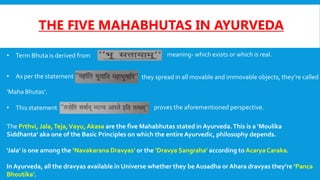
THE FIVE MAHABHUTAS IN AYURVEDA
• Term Bhuta is derived from meaning- which exists or which is real.
• As per the statement they spread in all movable and immovable objects, they’re called
‘Maha Bhutas’.
• This statement proves the aforementioned perspective.
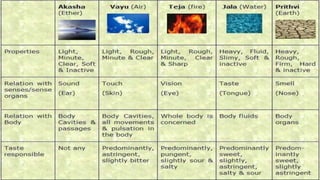
The Prthvi, Jala,Teja,Vayu, Akasa are the five Mahabhutas stated in Ayurveda.This is a ‘Moulika
Siddhanta’ aka one of the Basic Principles on which the entire Ayurvedic, philosophy depends.
‘Jala’ is one among the ‘Navakarana Dravyas’ or the ‘Dravya Sangraha’ according to Acarya Caraka.
In Ayurveda, all the dravyas available in Universe whether they be Ausadha or Ahara dravyas they’re ‘Panca
Bhoutika’.
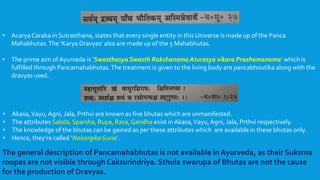
• Acarya Caraka in Sutrasthana, states that every single entity in this Universe is made up of the Panca
Mahabhutas.The ‘Karya Dravyas’ also are made up of the 5 Mahabhutas.
• The prime aim of Ayurveda is ‘Swasthasya Swasth Rakshanama Aturasya vikara Prashamanama’ which is
fulfilled through Pancamahabhutas.The treatment is given to the living body are pancabhoutika along with the
dravyas used.
• Akasa,Vayu, Agni, Jala, Prthvi are known as five bhutas which are unmanifested.
• The attributes Sabda, Sparsha, Rupa, Rasa, Gandha exist inAkasa,Vayu, Agni, Jala, Prthvi respectively.
• The knowledge of the bhutas can be gained as per these attributes which are available in these bhutas only.
• Hence, they’re called ‘NaisargikaGuna’.
The general description of Pancamahabhutas is not available in Ayurveda, as their Suksma
roopas are not visible through Caksurindriya. Sthula swarupa of Bhutas are not the cause
for the production of Dravyas.
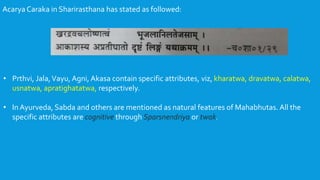
Acarya Caraka in Sharirasthana has stated as followed:
• Prthvi, Jala,Vayu, Agni, Akasa contain specific attributes, viz, kharatwa, dravatwa, calatwa,
usnatwa, apratighatatwa, respectively.
• In Ayurveda, Sabda and others are mentioned as natural features of Mahabhutas. All the
specific attributes are cognitive through Sparsnendriya or twak.
ORIGIN OF PANCA MAHABHUTAS &THEIR
INTERMINGLING
The Mahabhutas possessing distinct features and attributes are of ‘moola prakrtimaya’.
Acarya Susruta described how the Mahabhutas and their attributes are used in Ayurveda treatment science like in
the evolution process of mahabhutas, the later bhuta is produced from the former one.
Hence, the attributes or gunas of the former bhutas are passed through into the later bhuta.
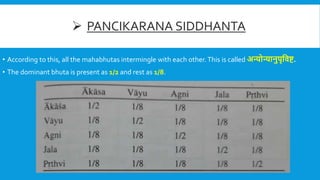
 PANCIKARANA SIDDHANTA
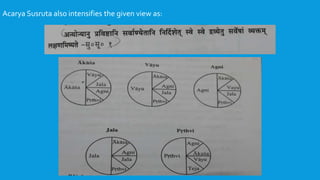
• According to this, all the mahabhutas intermingle with each other.This is called अन्योन्यानुपृविष्ट.
• The dominant bhuta is present as 1/2 and rest as 1/8.
Acarya Susruta also intensifies the given view as:
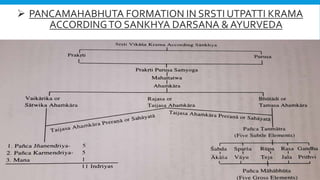
 PANCAMAHABHUTA FORMATION IN SRSTI UTPATTI KRAMA
ACCORDINGTO SANKHYA DARSANA & AYURVEDA
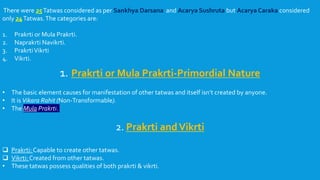
There were 25Tatwas considered as per Sankhya Darsana and Acarya Sushruta but Acarya Caraka considered
only 24Tatwas.The categories are:
1. Prakrti or Mula Prakrti.
2. Naprakrti Navikrti.
3. PrakrtiVikrti
4. Vikrti.
1. Prakrti or Mula Prakrti-Primordial Nature
• The basic element causes for manifestation of other tatwas and itself isn’t created by anyone.
• It is Vikara Rahit (Non-Transformable).
• The Mula Prakrti.
2. Prakrti andVikrti
 Prakrti: Capable to create other tatwas.
 Vikrti: Created from other tatwas.
• These tatwas possess qualities of both prakrti & vikrti.
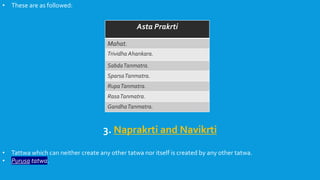
• These are as followed:
Asta Prakrti
Mahat.
Trividha Ahankara.
SabdaTanmatra.
SparsaTanmatra.
RupaTanmatra.
RasaTanmatra.
GandhaTanmatra.
3. Naprakrti and Navikrti
• Tattwa which can neither create any other tatwa nor itself is created by any other tatwa.
• Purusa tatwa.
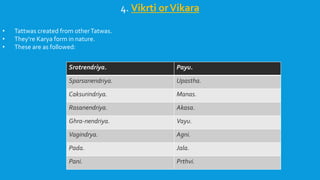
4. Vikrti orVikara
• Tattwas created from otherTatwas.
• They’re Karya form in nature.
• These are as followed:
Srotrendriya. Payu.
Sparsanendriya. Upastha.
Caksurindriya. Manas.
Rasanendriya. Akasa.
Ghra-nendriya. Vayu.
Vagindrya. Agni.
Pada. Jala.
Pani. Prthvi.
JALA MAHABHUTA LAKSANA & IT’S DESCRIPTION
JALAM- DEFINITION &
LAKSHANA/CHARACTERISTIC FEATURES.
 The common feature of Jala bhuta is ‘cold’ in touch. ‘शीत स्पशश:’
 As per Manusmrti,
That Jala bhuta which has attribute of Rasa is borne out ofTejo Bhuta.
• Acarya Susruta describes that water has abundance of ‘Sattwa,Tamo’ guna.
• Jala is one of the six basic constituents of ‘holistic human being’ or purusha as per CarakaSarira sthana 05/04.
• In human beings, Jala is represented in the form of moisture (kleda).
• Jala is one of the substances possessing the ability to cure plethora of diseases and this Jala therapy
is established as an important ‘non-invasive’ Medicine in the field of medical science.
• The importance of Jala for life expectancy (ayushya) has been proved in Ayurveda.
• The origin of ‘Rasa’ is due to Jala.
• Jala is not only necessary for the metabolic actions but also necessary for performing daily drudgery.
• Acarya Bhavaprakasha, by mentioning the importance of water said that water intake is essential
for life.
• Ayurveda says jala helps in trsna (thirst), bhrama (giddiness), anindra (insomnia), visha-vyadhi
(toxins), bala (strength), virya (potency), pushti (energy), and many more.
• Ayurveda described the importance of purified water and ayurvedic cikitsa granthas have mentioned
plethora of therapeutic roles of jala and purification techniques of impure jala while Nighantus
explained the types of water, their properties, and actions.
JALAM- SYNONYMS/PARYAYANAMA
1. Paniya: water to drink.
2. Nira: clear jala.
3. Jeevana: life.
4. Amruta: good quality of water.
5. Salil: flowing water.
6. Keelal: a drink like nectar.
7. Ambu: rainy water.
8. Toya: ocean water.
9. Soma: is cold in nature.
And many more like Apa, Udaka, etc.
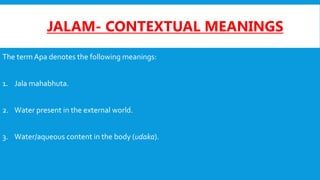
JALAM- CONTEXTUAL MEANINGS
The term Apa denotes the following meanings:
1. Jala mahabhuta.
2. Water present in the external world.
3. Water/aqueous content in the body (udaka).
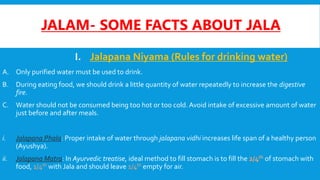
JALAM- SOME FACTS ABOUT JALA
I. Jalapana Niyama (Rules for drinking water)
A. Only purified water must be used to drink.
B. During eating food, we should drink a little quantity of water repeatedly to increase the digestive
fire.
C. Water should not be consumed being too hot or too cold. Avoid intake of excessive amount of water
just before and after meals.
i. Jalapana Phala: Proper intake of water through jalapana vidhi increases life span of a healthy person
(Ayushya).
ii. Jalapana Matra: In Ayurvedic treatise, ideal method to fill stomach is to fill the 2/4th of stomach with
food, 1/4th with Jala and should leave 1/4th empty for air.
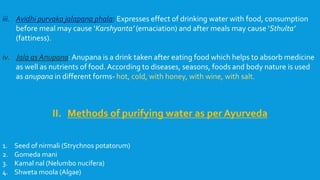
iii. Avidhi purvaka jalapana phala: Expresses effect of drinking water with food, consumption
before meal may cause ‘Karshyanta’ (emaciation) and after meals may cause ‘Sthulta’
(fattiness).
iv. Jala as Anupana: Anupana is a drink taken after eating food which helps to absorb medicine
as well as nutrients of food. According to diseases, seasons, foods and body nature is used
as anupana in different forms- hot, cold, with honey, with wine, with salt.
II. Methods of purifying water as per Ayurveda
1. Seed of nirmali (Strychnos potatorum)
2. Gomeda mani
3. Kamal nal (Nelumbo nucifera)
4. Shweta moola (Algae)
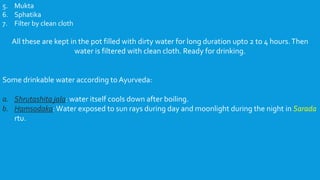
5. Mukta
6. Sphatika
7. Filter by clean cloth
All these are kept in the pot filled with dirty water for long duration upto 2 to 4 hours.Then
water is filtered with clean cloth. Ready for drinking.
Some drinkable water according to Ayurveda:
a. Shrutashita jala: water itself cools down after boiling.
b. Hamsodaka:Water exposed to sun rays during day and moonlight during the night in Sarada
rtu.
III. Utilization ofTraditional Herbs with water
1. Tulsi (Ocimum sanctum)
2. Patragaha (Cesalpinia sapan)
3. Jeera (Cuminum cyminum)
4. Lemon grass (Cymbopogon citrates)
5. Lemon (Citrus lemon)
6. Khadira (Acacia catechu)
7. Dhaniya (Coriandrum sativum)
8. Tejpatra (Cinnamomum)
All these herbs may be dissolved in drinking water to enhance the health benefits of a
person according to suitability.
JALAM-BHEDA/CLASSIFICATION
Jala classified into 3 types:
A. Sarira sanjnaka. B. Indriya sanjnaka. C. Visaya sanjnaka.
A. Sarira sanjnaka
• The live bodies residing in Varuna Loka are called Sarira sanjnaka.
• These are also called for experience of Sukha & Dukha to Atma.
• Hence also known as ‘Bhogayatana’ of Atma.
• Varuna loka is main habitat for Jala.
B. Indriya sanjnaka
• The Rasanendriya existing on the Jihwagra bhaga, and perceives the Rasa jnana of Madhura, etc Rasa
is called Indriya sanjnaka.
C. Visaya sanjnaka
• Water present in the seas, rivers, lakes, etc is calledVisaya sanjnaka.
 Water classification based on Occurrence:
A. Divya jala. B. Bhauma jala. C. Dusta jala.
A. Divya jala
• Also called Antariksa jala meaning rain from akasa.
• It possesses Avyakta rasa, laghu guna, Madhura vipaka.
• Has properties of klamahara, pipasanashaka, tandranashaka, shramahara.
B. Bhauma jala
• Represents the water sources of land (bhauma).
• Main source of drinking water.
C. Dusta jala
• Means polluted water not required for drinking.
Based on Kala according to Acarya Bhavaprakasha:
A. Sarojata jala. B. Tadagaja jala. C. Nairjara jala. D. Divya jala. E. Sarva jala
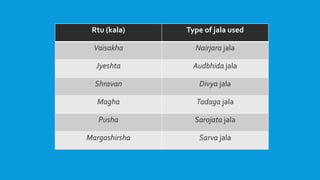
 According to use in different rtus (kala):
Rtu (kala) Type of jala used
Vaisakha Nairjara jala
Jyeshta Audbhida jala
Shravan Divya jala
Magha Tadaga jala
Pusha Sarojata jala
Margashirsha Sarva jala
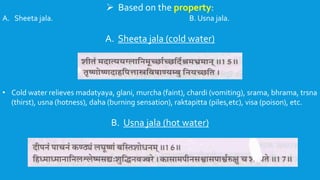
 Based on the property:
A. Sheeta jala. B. Usna jala.
A. Sheeta jala (cold water)
• Cold water relieves madatyaya, glani, murcha (faint), chardi (vomiting), srama, bhrama, trsna
(thirst), usna (hotness), daha (burning sensation), raktapitta (piles,etc), visa (poison), etc.
B. Usna jala (hot water)
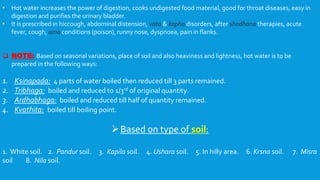
• Hot water increases the power of digestion, cooks undigested food material, good for throat diseases, easy in
digestion and purifies the urinary bladder.
• It is prescribed in hiccough, abdominal distension, vata & kapha disorders, after shodhana therapies, acute
fever, cough, ama conditions (poison), runny nose, dyspnoea, pain in flanks.
 NOTE: Based on seasonal variations, place of soil and also heaviness and lightness, hot water is to be
prepared in the following ways:
1. Ksinapada: 4 parts of water boiled then reduced till 3 parts remained.
2. Tribhaga: boiled and reduced to 1/3rd of original quantity.
3. Ardhabhaga: boiled and reduced till half of quantity remained.
4. Kvathita: boiled till boiling point.
Based on type of soil:
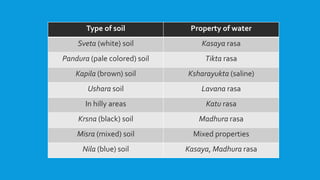
1. White soil. 2. Pandur soil. 3. Kapila soil. 4. Ushara soil. 5. In hilly area. 6. Krsna soil. 7. Misra
soil 8. Nila soil.
Type of soil Property of water
Sveta (white) soil Kasaya rasa
Pandura (pale colored) soil Tikta rasa
Kapila (brown) soil Ksharayukta (saline)
Ushara soil Lavana rasa
In hilly areas Katu rasa
Krsna (black) soil Madhura rasa
Misra (mixed) soil Mixed properties
Nila (blue) soil Kasaya, Madhura rasa
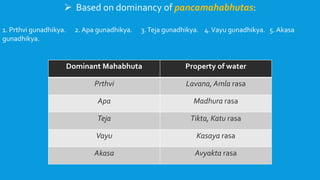
 Based on dominancy of pancamahabhutas:
1. Prthvi gunadhikya. 2. Apa gunadhikya. 3.Teja gunadhikya. 4.Vayu gunadhikya. 5. Akasa
gunadhikya.
Dominant Mahabhuta Property of water
Prthvi Lavana, Amla rasa
Apa Madhura rasa
Teja Tikta, Katu rasa
Vayu Kasaya rasa
Akasa Avyakta rasa
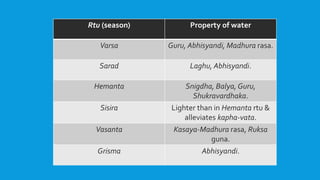
Rtu (season) Property of water
Varsa Guru, Abhisyandi, Madhura rasa.
Sarad Laghu, Abhisyandi.
Hemanta Snigdha, Balya, Guru,
Shukravardhaka.
Sisira Lighter than in Hemanta rtu &
alleviates kapha-vata.
Vasanta Kasaya-Madhura rasa, Ruksa
guna.
Grisma Abhisyandi.
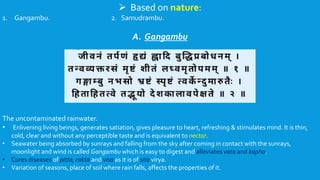
 Based on nature:
1. Gangambu. 2. Samudrambu.
A. Gangambu
The uncontaminated rainwater.
• Enlivening living beings, generates satiation, gives pleasure to heart, refreshing & stimulates mind. It is thin,
cold, clear and without any perceptible taste and is equivalent to nectar.
• Seawater being absorbed by sunrays and falling from the sky after coming in contact with the sunrays,
moonlight and wind is called Gangambu which is easy to digest and alleviates vata and kapha.
• Cures diseases of pitta, rakta and visa as it is of sita virya.
• Variation of seasons, place of soil where rain falls, affects the properties of it.
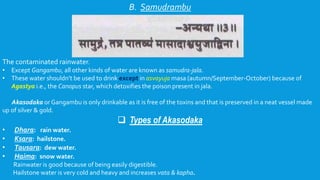
B. Samudrambu
The contaminated rainwater.
• Except Gangambu, all other kinds of water are known as samudra-jala.
• These water shouldn’t be used to drink except in asvayuja masa (autumn/September-October) because of
Agastya i.e., the Canopus star, which detoxifies the poison present in jala.
Akasodaka or Gangambu is only drinkable as it is free of the toxins and that is preserved in a neat vessel made
up of silver & gold.
 Types of Akasodaka
• Dhara: rain water.
• Ksara: hailstone.
• Tausara: dew water.
• Haima: snow water.
Rainwater is good because of being easily digestible.
Hailstone water is very cold and heavy and increases vata & kapha.
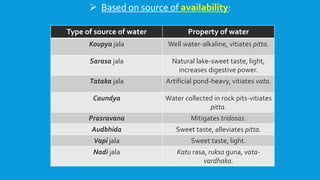
 Based on source of availability:
Type of source of water Property of water
Koupya jala Well water-alkaline, vitiates pitta.
Sarasa jala Natural lake-sweet taste, light,
increases digestive power.
Tataka jala Artificial pond-heavy, vitiates vata.
Caundya Water collected in rock pits-vitiates
pitta.
Prasravana Mitigates tridosas.
Audbhida Sweet taste, alleviates pitta.
Vapi jala Sweet taste, light.
Nadi jala Katu rasa, ruksa guna, vata-
vardhaka.
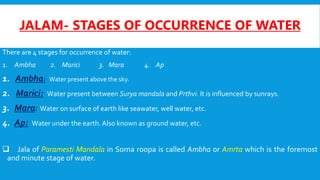
JALAM- STAGES OF OCCURRENCE OF WATER
There are 4 stages for occurrence of water:
1. Ambha 2. Marici 3. Mara 4. Ap
1. Ambha: Water present above the sky.
2. Marici: Water present between Surya mandala and Prthvi. It is influenced by sunrays.
3. Mara: Water on surface of earth like seawater, well water, etc.
4. Ap: Water under the earth. Also known as ground water, etc.
 Jala of Paramesti Mandala in Soma roopa is called Ambha or Amrta which is the foremost
and minute stage of water.
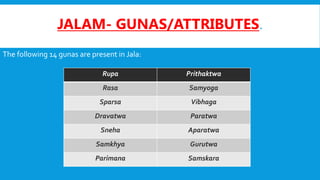
JALAM- GUNAS/ATTRIBUTES.
The following 14 gunas are present in Jala:
Rupa Prithaktwa
Rasa Samyoga
Sparsa Vibhaga
Dravatwa Paratwa
Sneha Aparatwa
Samkhya Gurutwa
Parimana Samskara
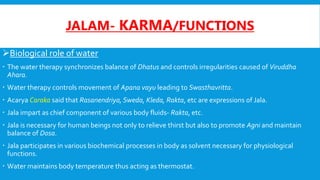
JALAM- KARMA/FUNCTIONS
Biological role of water
 The water therapy synchronizes balance of Dhatus and controls irregularities caused of Viruddha
Ahara.
 Water therapy controls movement of Apana vayu leading to Swasthavritta.
 Acarya Caraka said that Rasanendriya, Sweda, Kleda, Rakta, etc are expressions of Jala.
 Jala impart as chief component of various body fluids- Rakta, etc.
 Jala is necessary for human beings not only to relieve thirst but also to promote Agni and maintain
balance of Dosa.
 Jala participates in various biochemical processes in body as solvent necessary for physiological
functions.
 Water maintains body temperature thus acting as thermostat.
Functions in embryogenesis & human body
• Shukra has predominance of ap Mahabhuta. (Su. Sha. 3/3)
• Jala Mahabhuta maintains moisture in foetus. (Su. Sha. 5/3)
• Gustatory systems have predominance of jala. (Cha. Su. 8/14)
• The whitish part in eyeball represents jala. (Su. Sa. Utt. 1/11)
 Marma points
• Injury to Kalantara Pranahara marma leads to death because of predominance of jala with agni
bhuta.
• Vaikalyakara marama possesses jala bhuta predominance. Because of stability and coldness, it helps
in sustaining life.
JALAM- IMPORTANCE IN CLINICAL PRACTICE
Application in diagnosis
• Abnormalities in functions like moistness, softness, etc are observed to assess varying proportions of jala bhuta in
body. (Cha. Su. 26/11)
• Change in kapha dosa depends upon jala. (Cha.Chi. 22/16)
• Depletion of rasa dhatu may occur because of ap bhuta. (Cha.Chi. 22/16)
Application in treatment
Qualities of jala bhuta are applied in specific treatments:
• Moisture: dryness because of agni, vayu.
• Fluidity: improve volume of depleted body constituents.
• Coldness: reduce heat.
• Softness: reduce roughness.
• Delightfulness: applied to reduce grief & anger.
• Udaka form: producing soothing effect used in psycho-neurological disorders.
• Jala produces astringent effect.
• Jala is responsible for manifestation and differentiation of rasa (taste).
• Treatment of kapha dosa aggravation diseases can be done by avoiding diet and lifestyle measures
with jala dominancy.
• Apbhutagni digests and metabolises food substances having jala dominancy.
CONCLUSION
This ppt summarizes the various traditional and modern aspects of jala or water in
simplified way.The significance of water in terms of biological role, clinical pov, etc.
Also described the classification of water to ensure its characters and purity.
Presentation of scientific overview of water to explore new era of research using jala for
therapeutic purposes and thereby helping achieve the motto of ourAyurveda.
“सिे भिन्तु सुखिनः सिे सन्तु वनरामयाः।”
REFERENCES USED/BIBLIOGRAPHY
1. Website: www.carakasamhitaonline.com
2. PadarthaVijnana book by Dr. Dingari Lakshmana Chary.
3. International Journal for Research in Applied Science and EngineeringTechnology (IJRASET).
4. Astanga Hrdaya ofVagbhata by Dr. R.Vidyanath, Chowkhamba publications,Varanasi, Sutrasthana.
5. Treatise of Nyaya Darsana, Sankhya Darsana,Tarkasangraha andYoga Darsana.
6. Agnivesha, Caraka Samhita Revised by Caraka and Drdhbala with Ayurveda Dipika commentary of
Cakrapanidatta, translated by Dr. Shashirekha H.K. and Dr. Bargale Sushant Sukumar , Chowkhamba
publications,Varanasi, Sutasthana,Chikitsasthana.
7. Susruta, Susruta Samhita,Text English translation by Prof. K.R. Srikantha Murthy, Chowkhamba
publications, Sutrasthana.
8. Website: www.google.com
9. PadarthaVijnana book by Prof. K.V.L. Narsimhacharyulu, Chowkhamba Krishnadas Academy,
Varanasi.

Jala Mahabhuta.pptx

  • 2.
    JALA MAHABHUTA जल महाभूत Guidedby: Dr.T. Rambabu (Reader: Samhita Dept.) Presented by: Pakhi Sharma, 58 Batch- 2021
  • 3.
    CONTENTS  5 Mahabhutas& their few characteristic features. • ‘Jalama’- Definition & Lakshana/Characteristic features. • ‘Jalama’- Synonyms/Paryayanama. • ‘Jalama’- Contextual Meanings. • ‘Jalama’- Some facts about Jala. • ‘Jalama’- Bheda/Classification/Types/Division. • ‘Jalama’- Stages of occurrence of water. • ‘Jalama’- Gunas/Attributes. • ‘Jalama’- Karma/Functions. • ‘Jalama’- Importance in clinical practice. • References/Bibliography.
  • 4.
    THE FIVE MAHABHUTASIN AYURVEDA • Term Bhuta is derived from meaning- which exists or which is real. • As per the statement they spread in all movable and immovable objects, they’re called ‘Maha Bhutas’. • This statement proves the aforementioned perspective. The Prthvi, Jala,Teja,Vayu, Akasa are the five Mahabhutas stated in Ayurveda.This is a ‘Moulika Siddhanta’ aka one of the Basic Principles on which the entire Ayurvedic, philosophy depends. ‘Jala’ is one among the ‘Navakarana Dravyas’ or the ‘Dravya Sangraha’ according to Acarya Caraka. In Ayurveda, all the dravyas available in Universe whether they be Ausadha or Ahara dravyas they’re ‘Panca Bhoutika’.
  • 5.
    • Acarya Carakain Sutrasthana, states that every single entity in this Universe is made up of the Panca Mahabhutas.The ‘Karya Dravyas’ also are made up of the 5 Mahabhutas. • The prime aim of Ayurveda is ‘Swasthasya Swasth Rakshanama Aturasya vikara Prashamanama’ which is fulfilled through Pancamahabhutas.The treatment is given to the living body are pancabhoutika along with the dravyas used. • Akasa,Vayu, Agni, Jala, Prthvi are known as five bhutas which are unmanifested. • The attributes Sabda, Sparsha, Rupa, Rasa, Gandha exist inAkasa,Vayu, Agni, Jala, Prthvi respectively. • The knowledge of the bhutas can be gained as per these attributes which are available in these bhutas only. • Hence, they’re called ‘NaisargikaGuna’. The general description of Pancamahabhutas is not available in Ayurveda, as their Suksma roopas are not visible through Caksurindriya. Sthula swarupa of Bhutas are not the cause for the production of Dravyas.
  • 6.
    Acarya Caraka inSharirasthana has stated as followed: • Prthvi, Jala,Vayu, Agni, Akasa contain specific attributes, viz, kharatwa, dravatwa, calatwa, usnatwa, apratighatatwa, respectively. • In Ayurveda, Sabda and others are mentioned as natural features of Mahabhutas. All the specific attributes are cognitive through Sparsnendriya or twak.
  • 7.
    ORIGIN OF PANCAMAHABHUTAS &THEIR INTERMINGLING The Mahabhutas possessing distinct features and attributes are of ‘moola prakrtimaya’. Acarya Susruta described how the Mahabhutas and their attributes are used in Ayurveda treatment science like in the evolution process of mahabhutas, the later bhuta is produced from the former one. Hence, the attributes or gunas of the former bhutas are passed through into the later bhuta.
  • 8.
     PANCIKARANA SIDDHANTA •According to this, all the mahabhutas intermingle with each other.This is called अन्योन्यानुपृविष्ट. • The dominant bhuta is present as 1/2 and rest as 1/8.
  • 9.
    Acarya Susruta alsointensifies the given view as:
  • 10.
     PANCAMAHABHUTA FORMATIONIN SRSTI UTPATTI KRAMA ACCORDINGTO SANKHYA DARSANA & AYURVEDA
  • 11.
    There were 25Tatwasconsidered as per Sankhya Darsana and Acarya Sushruta but Acarya Caraka considered only 24Tatwas.The categories are: 1. Prakrti or Mula Prakrti. 2. Naprakrti Navikrti. 3. PrakrtiVikrti 4. Vikrti. 1. Prakrti or Mula Prakrti-Primordial Nature • The basic element causes for manifestation of other tatwas and itself isn’t created by anyone. • It is Vikara Rahit (Non-Transformable). • The Mula Prakrti. 2. Prakrti andVikrti  Prakrti: Capable to create other tatwas.  Vikrti: Created from other tatwas. • These tatwas possess qualities of both prakrti & vikrti.
  • 12.
    • These areas followed: Asta Prakrti Mahat. Trividha Ahankara. SabdaTanmatra. SparsaTanmatra. RupaTanmatra. RasaTanmatra. GandhaTanmatra. 3. Naprakrti and Navikrti • Tattwa which can neither create any other tatwa nor itself is created by any other tatwa. • Purusa tatwa.
  • 13.
    4. Vikrti orVikara •Tattwas created from otherTatwas. • They’re Karya form in nature. • These are as followed: Srotrendriya. Payu. Sparsanendriya. Upastha. Caksurindriya. Manas. Rasanendriya. Akasa. Ghra-nendriya. Vayu. Vagindrya. Agni. Pada. Jala. Pani. Prthvi.
  • 15.
    JALA MAHABHUTA LAKSANA& IT’S DESCRIPTION
  • 16.
    JALAM- DEFINITION & LAKSHANA/CHARACTERISTICFEATURES.  The common feature of Jala bhuta is ‘cold’ in touch. ‘शीत स्पशश:’  As per Manusmrti, That Jala bhuta which has attribute of Rasa is borne out ofTejo Bhuta. • Acarya Susruta describes that water has abundance of ‘Sattwa,Tamo’ guna. • Jala is one of the six basic constituents of ‘holistic human being’ or purusha as per CarakaSarira sthana 05/04. • In human beings, Jala is represented in the form of moisture (kleda).
  • 17.
    • Jala isone of the substances possessing the ability to cure plethora of diseases and this Jala therapy is established as an important ‘non-invasive’ Medicine in the field of medical science. • The importance of Jala for life expectancy (ayushya) has been proved in Ayurveda. • The origin of ‘Rasa’ is due to Jala. • Jala is not only necessary for the metabolic actions but also necessary for performing daily drudgery. • Acarya Bhavaprakasha, by mentioning the importance of water said that water intake is essential for life. • Ayurveda says jala helps in trsna (thirst), bhrama (giddiness), anindra (insomnia), visha-vyadhi (toxins), bala (strength), virya (potency), pushti (energy), and many more. • Ayurveda described the importance of purified water and ayurvedic cikitsa granthas have mentioned plethora of therapeutic roles of jala and purification techniques of impure jala while Nighantus explained the types of water, their properties, and actions.
  • 18.
    JALAM- SYNONYMS/PARYAYANAMA 1. Paniya:water to drink. 2. Nira: clear jala. 3. Jeevana: life. 4. Amruta: good quality of water. 5. Salil: flowing water. 6. Keelal: a drink like nectar. 7. Ambu: rainy water. 8. Toya: ocean water. 9. Soma: is cold in nature. And many more like Apa, Udaka, etc.
  • 19.
    JALAM- CONTEXTUAL MEANINGS Theterm Apa denotes the following meanings: 1. Jala mahabhuta. 2. Water present in the external world. 3. Water/aqueous content in the body (udaka).
  • 20.
    JALAM- SOME FACTSABOUT JALA I. Jalapana Niyama (Rules for drinking water) A. Only purified water must be used to drink. B. During eating food, we should drink a little quantity of water repeatedly to increase the digestive fire. C. Water should not be consumed being too hot or too cold. Avoid intake of excessive amount of water just before and after meals. i. Jalapana Phala: Proper intake of water through jalapana vidhi increases life span of a healthy person (Ayushya). ii. Jalapana Matra: In Ayurvedic treatise, ideal method to fill stomach is to fill the 2/4th of stomach with food, 1/4th with Jala and should leave 1/4th empty for air.
  • 21.
    iii. Avidhi purvakajalapana phala: Expresses effect of drinking water with food, consumption before meal may cause ‘Karshyanta’ (emaciation) and after meals may cause ‘Sthulta’ (fattiness). iv. Jala as Anupana: Anupana is a drink taken after eating food which helps to absorb medicine as well as nutrients of food. According to diseases, seasons, foods and body nature is used as anupana in different forms- hot, cold, with honey, with wine, with salt. II. Methods of purifying water as per Ayurveda 1. Seed of nirmali (Strychnos potatorum) 2. Gomeda mani 3. Kamal nal (Nelumbo nucifera) 4. Shweta moola (Algae)
  • 22.
    5. Mukta 6. Sphatika 7.Filter by clean cloth All these are kept in the pot filled with dirty water for long duration upto 2 to 4 hours.Then water is filtered with clean cloth. Ready for drinking. Some drinkable water according to Ayurveda: a. Shrutashita jala: water itself cools down after boiling. b. Hamsodaka:Water exposed to sun rays during day and moonlight during the night in Sarada rtu.
  • 23.
    III. Utilization ofTraditionalHerbs with water 1. Tulsi (Ocimum sanctum) 2. Patragaha (Cesalpinia sapan) 3. Jeera (Cuminum cyminum) 4. Lemon grass (Cymbopogon citrates) 5. Lemon (Citrus lemon) 6. Khadira (Acacia catechu) 7. Dhaniya (Coriandrum sativum) 8. Tejpatra (Cinnamomum) All these herbs may be dissolved in drinking water to enhance the health benefits of a person according to suitability.
  • 24.
    JALAM-BHEDA/CLASSIFICATION Jala classified into3 types: A. Sarira sanjnaka. B. Indriya sanjnaka. C. Visaya sanjnaka. A. Sarira sanjnaka • The live bodies residing in Varuna Loka are called Sarira sanjnaka. • These are also called for experience of Sukha & Dukha to Atma. • Hence also known as ‘Bhogayatana’ of Atma. • Varuna loka is main habitat for Jala.
  • 25.
    B. Indriya sanjnaka •The Rasanendriya existing on the Jihwagra bhaga, and perceives the Rasa jnana of Madhura, etc Rasa is called Indriya sanjnaka. C. Visaya sanjnaka • Water present in the seas, rivers, lakes, etc is calledVisaya sanjnaka.  Water classification based on Occurrence: A. Divya jala. B. Bhauma jala. C. Dusta jala. A. Divya jala • Also called Antariksa jala meaning rain from akasa. • It possesses Avyakta rasa, laghu guna, Madhura vipaka. • Has properties of klamahara, pipasanashaka, tandranashaka, shramahara.
  • 26.
    B. Bhauma jala •Represents the water sources of land (bhauma). • Main source of drinking water. C. Dusta jala • Means polluted water not required for drinking. Based on Kala according to Acarya Bhavaprakasha: A. Sarojata jala. B. Tadagaja jala. C. Nairjara jala. D. Divya jala. E. Sarva jala  According to use in different rtus (kala):
  • 27.
    Rtu (kala) Typeof jala used Vaisakha Nairjara jala Jyeshta Audbhida jala Shravan Divya jala Magha Tadaga jala Pusha Sarojata jala Margashirsha Sarva jala
  • 28.
     Based onthe property: A. Sheeta jala. B. Usna jala. A. Sheeta jala (cold water) • Cold water relieves madatyaya, glani, murcha (faint), chardi (vomiting), srama, bhrama, trsna (thirst), usna (hotness), daha (burning sensation), raktapitta (piles,etc), visa (poison), etc. B. Usna jala (hot water)
  • 29.
    • Hot waterincreases the power of digestion, cooks undigested food material, good for throat diseases, easy in digestion and purifies the urinary bladder. • It is prescribed in hiccough, abdominal distension, vata & kapha disorders, after shodhana therapies, acute fever, cough, ama conditions (poison), runny nose, dyspnoea, pain in flanks.  NOTE: Based on seasonal variations, place of soil and also heaviness and lightness, hot water is to be prepared in the following ways: 1. Ksinapada: 4 parts of water boiled then reduced till 3 parts remained. 2. Tribhaga: boiled and reduced to 1/3rd of original quantity. 3. Ardhabhaga: boiled and reduced till half of quantity remained. 4. Kvathita: boiled till boiling point. Based on type of soil: 1. White soil. 2. Pandur soil. 3. Kapila soil. 4. Ushara soil. 5. In hilly area. 6. Krsna soil. 7. Misra soil 8. Nila soil.
  • 30.
    Type of soilProperty of water Sveta (white) soil Kasaya rasa Pandura (pale colored) soil Tikta rasa Kapila (brown) soil Ksharayukta (saline) Ushara soil Lavana rasa In hilly areas Katu rasa Krsna (black) soil Madhura rasa Misra (mixed) soil Mixed properties Nila (blue) soil Kasaya, Madhura rasa
  • 31.
     Based ondominancy of pancamahabhutas: 1. Prthvi gunadhikya. 2. Apa gunadhikya. 3.Teja gunadhikya. 4.Vayu gunadhikya. 5. Akasa gunadhikya. Dominant Mahabhuta Property of water Prthvi Lavana, Amla rasa Apa Madhura rasa Teja Tikta, Katu rasa Vayu Kasaya rasa Akasa Avyakta rasa
  • 32.
    Rtu (season) Propertyof water Varsa Guru, Abhisyandi, Madhura rasa. Sarad Laghu, Abhisyandi. Hemanta Snigdha, Balya, Guru, Shukravardhaka. Sisira Lighter than in Hemanta rtu & alleviates kapha-vata. Vasanta Kasaya-Madhura rasa, Ruksa guna. Grisma Abhisyandi.
  • 33.
     Based onnature: 1. Gangambu. 2. Samudrambu. A. Gangambu The uncontaminated rainwater. • Enlivening living beings, generates satiation, gives pleasure to heart, refreshing & stimulates mind. It is thin, cold, clear and without any perceptible taste and is equivalent to nectar. • Seawater being absorbed by sunrays and falling from the sky after coming in contact with the sunrays, moonlight and wind is called Gangambu which is easy to digest and alleviates vata and kapha. • Cures diseases of pitta, rakta and visa as it is of sita virya. • Variation of seasons, place of soil where rain falls, affects the properties of it.
  • 34.
    B. Samudrambu The contaminatedrainwater. • Except Gangambu, all other kinds of water are known as samudra-jala. • These water shouldn’t be used to drink except in asvayuja masa (autumn/September-October) because of Agastya i.e., the Canopus star, which detoxifies the poison present in jala. Akasodaka or Gangambu is only drinkable as it is free of the toxins and that is preserved in a neat vessel made up of silver & gold.  Types of Akasodaka • Dhara: rain water. • Ksara: hailstone. • Tausara: dew water. • Haima: snow water. Rainwater is good because of being easily digestible. Hailstone water is very cold and heavy and increases vata & kapha.
  • 35.
     Based onsource of availability: Type of source of water Property of water Koupya jala Well water-alkaline, vitiates pitta. Sarasa jala Natural lake-sweet taste, light, increases digestive power. Tataka jala Artificial pond-heavy, vitiates vata. Caundya Water collected in rock pits-vitiates pitta. Prasravana Mitigates tridosas. Audbhida Sweet taste, alleviates pitta. Vapi jala Sweet taste, light. Nadi jala Katu rasa, ruksa guna, vata- vardhaka.
  • 36.
    JALAM- STAGES OFOCCURRENCE OF WATER There are 4 stages for occurrence of water: 1. Ambha 2. Marici 3. Mara 4. Ap 1. Ambha: Water present above the sky. 2. Marici: Water present between Surya mandala and Prthvi. It is influenced by sunrays. 3. Mara: Water on surface of earth like seawater, well water, etc. 4. Ap: Water under the earth. Also known as ground water, etc.  Jala of Paramesti Mandala in Soma roopa is called Ambha or Amrta which is the foremost and minute stage of water.
  • 37.
    JALAM- GUNAS/ATTRIBUTES. The following14 gunas are present in Jala: Rupa Prithaktwa Rasa Samyoga Sparsa Vibhaga Dravatwa Paratwa Sneha Aparatwa Samkhya Gurutwa Parimana Samskara
  • 38.
    JALAM- KARMA/FUNCTIONS Biological roleof water  The water therapy synchronizes balance of Dhatus and controls irregularities caused of Viruddha Ahara.  Water therapy controls movement of Apana vayu leading to Swasthavritta.  Acarya Caraka said that Rasanendriya, Sweda, Kleda, Rakta, etc are expressions of Jala.  Jala impart as chief component of various body fluids- Rakta, etc.  Jala is necessary for human beings not only to relieve thirst but also to promote Agni and maintain balance of Dosa.  Jala participates in various biochemical processes in body as solvent necessary for physiological functions.  Water maintains body temperature thus acting as thermostat.
  • 39.
    Functions in embryogenesis& human body • Shukra has predominance of ap Mahabhuta. (Su. Sha. 3/3) • Jala Mahabhuta maintains moisture in foetus. (Su. Sha. 5/3) • Gustatory systems have predominance of jala. (Cha. Su. 8/14) • The whitish part in eyeball represents jala. (Su. Sa. Utt. 1/11)  Marma points • Injury to Kalantara Pranahara marma leads to death because of predominance of jala with agni bhuta. • Vaikalyakara marama possesses jala bhuta predominance. Because of stability and coldness, it helps in sustaining life.
  • 40.
    JALAM- IMPORTANCE INCLINICAL PRACTICE Application in diagnosis • Abnormalities in functions like moistness, softness, etc are observed to assess varying proportions of jala bhuta in body. (Cha. Su. 26/11) • Change in kapha dosa depends upon jala. (Cha.Chi. 22/16) • Depletion of rasa dhatu may occur because of ap bhuta. (Cha.Chi. 22/16) Application in treatment Qualities of jala bhuta are applied in specific treatments: • Moisture: dryness because of agni, vayu. • Fluidity: improve volume of depleted body constituents. • Coldness: reduce heat. • Softness: reduce roughness. • Delightfulness: applied to reduce grief & anger.
  • 41.
    • Udaka form:producing soothing effect used in psycho-neurological disorders. • Jala produces astringent effect. • Jala is responsible for manifestation and differentiation of rasa (taste). • Treatment of kapha dosa aggravation diseases can be done by avoiding diet and lifestyle measures with jala dominancy. • Apbhutagni digests and metabolises food substances having jala dominancy.
  • 42.
    CONCLUSION This ppt summarizesthe various traditional and modern aspects of jala or water in simplified way.The significance of water in terms of biological role, clinical pov, etc. Also described the classification of water to ensure its characters and purity. Presentation of scientific overview of water to explore new era of research using jala for therapeutic purposes and thereby helping achieve the motto of ourAyurveda. “सिे भिन्तु सुखिनः सिे सन्तु वनरामयाः।”
  • 43.
    REFERENCES USED/BIBLIOGRAPHY 1. Website:www.carakasamhitaonline.com 2. PadarthaVijnana book by Dr. Dingari Lakshmana Chary. 3. International Journal for Research in Applied Science and EngineeringTechnology (IJRASET). 4. Astanga Hrdaya ofVagbhata by Dr. R.Vidyanath, Chowkhamba publications,Varanasi, Sutrasthana. 5. Treatise of Nyaya Darsana, Sankhya Darsana,Tarkasangraha andYoga Darsana. 6. Agnivesha, Caraka Samhita Revised by Caraka and Drdhbala with Ayurveda Dipika commentary of Cakrapanidatta, translated by Dr. Shashirekha H.K. and Dr. Bargale Sushant Sukumar , Chowkhamba publications,Varanasi, Sutasthana,Chikitsasthana. 7. Susruta, Susruta Samhita,Text English translation by Prof. K.R. Srikantha Murthy, Chowkhamba publications, Sutrasthana. 8. Website: www.google.com 9. PadarthaVijnana book by Prof. K.V.L. Narsimhacharyulu, Chowkhamba Krishnadas Academy, Varanasi.