BASIC MODELS ON
HUMAN RESOURCE DEVELOPMENT
MASLOW (1908-1970)


Abrahman Maslo well kno n humanistic psychologist is
            Maslow ell known                  ps chologist
best known for his developmental theory of human
motivation. Maslow believed that actualization of one’s
inherent potential was the driving force of human
personality.
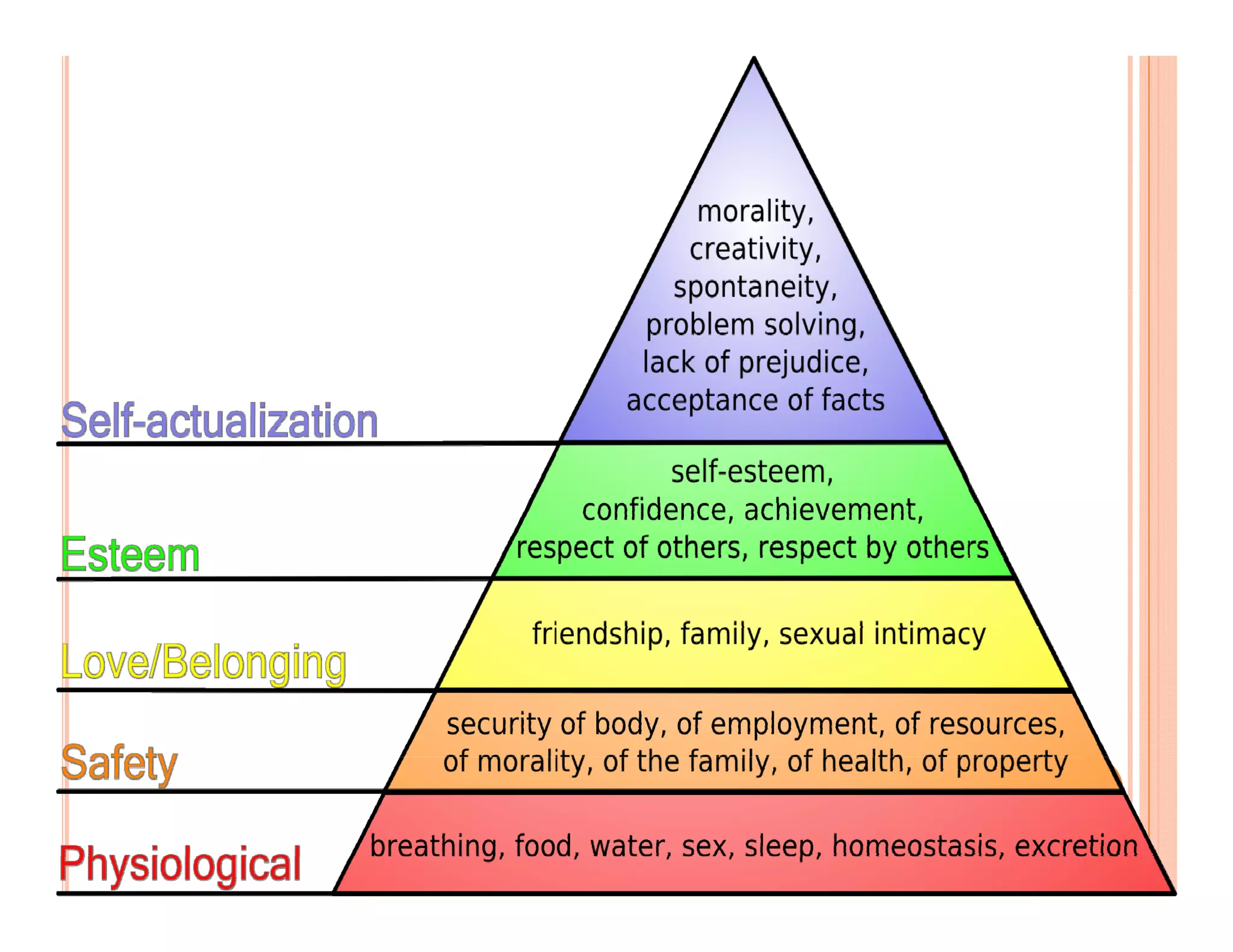
Maslow placed self actualization into a hierarchy of
                self-actualization
motivation or his famous “hierarchy of needs.
” Self-actualization is identified as the highest drive but
before a person can turn to it, he or she must satisfy other
lower motivations like physiological, safety, social and
esteem needs respectively
        needs, respectively.
SKINNER (1904-1990)
B.F.
B F Skinner is recognized as a leader
in the field of behaviorist theory.
B.F.
B F Skinner is recognized as a leader
in the field of behaviorist theory.
Skinner believed that changes in behavior are the
result of an individual’s response to events (stimuli)
that occur in the environment. The response or
behavior
b h i produces a consequence and the nature of
              d                       d th    t     f
the consequence either reinforces or weakens the
probability of the behavior occurring again
                                       again.
So if you wish to alter someone’s behavior, you
reinforce the behavior you want people to do again
and ignore or punish the behavior you want people
to stop doing.
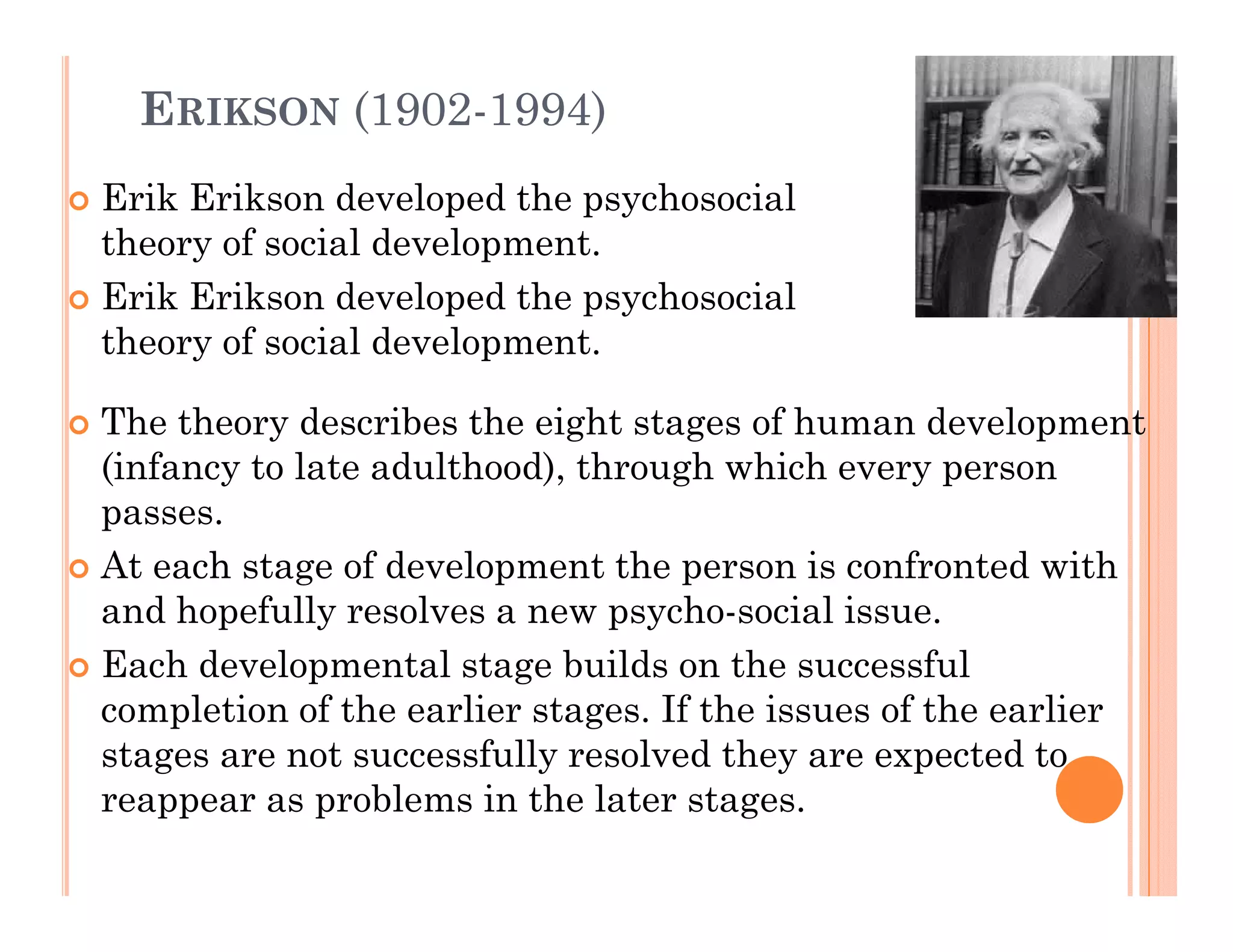
ERIKSON (1902-1994)
Erik Erikson developed the psychosocial
theory of social development.
Erik Erikson developed the psychosocial
theory of social development.

The theory describes the eight stages of human development
Th th        d    ib th i ht t           fh        d    l      t
(infancy to late adulthood), through which every person
passes.
At each stage of development the person is confronted with
and hopefully resolves a new psycho-social issue.
Each developmental stage b ild on th successful
E hd       l       t l t    builds     the         f l
completion of the earlier stages. If the issues of the earlier
stages are not successfully resolved they are expected to
reappear as problems in the later stages.
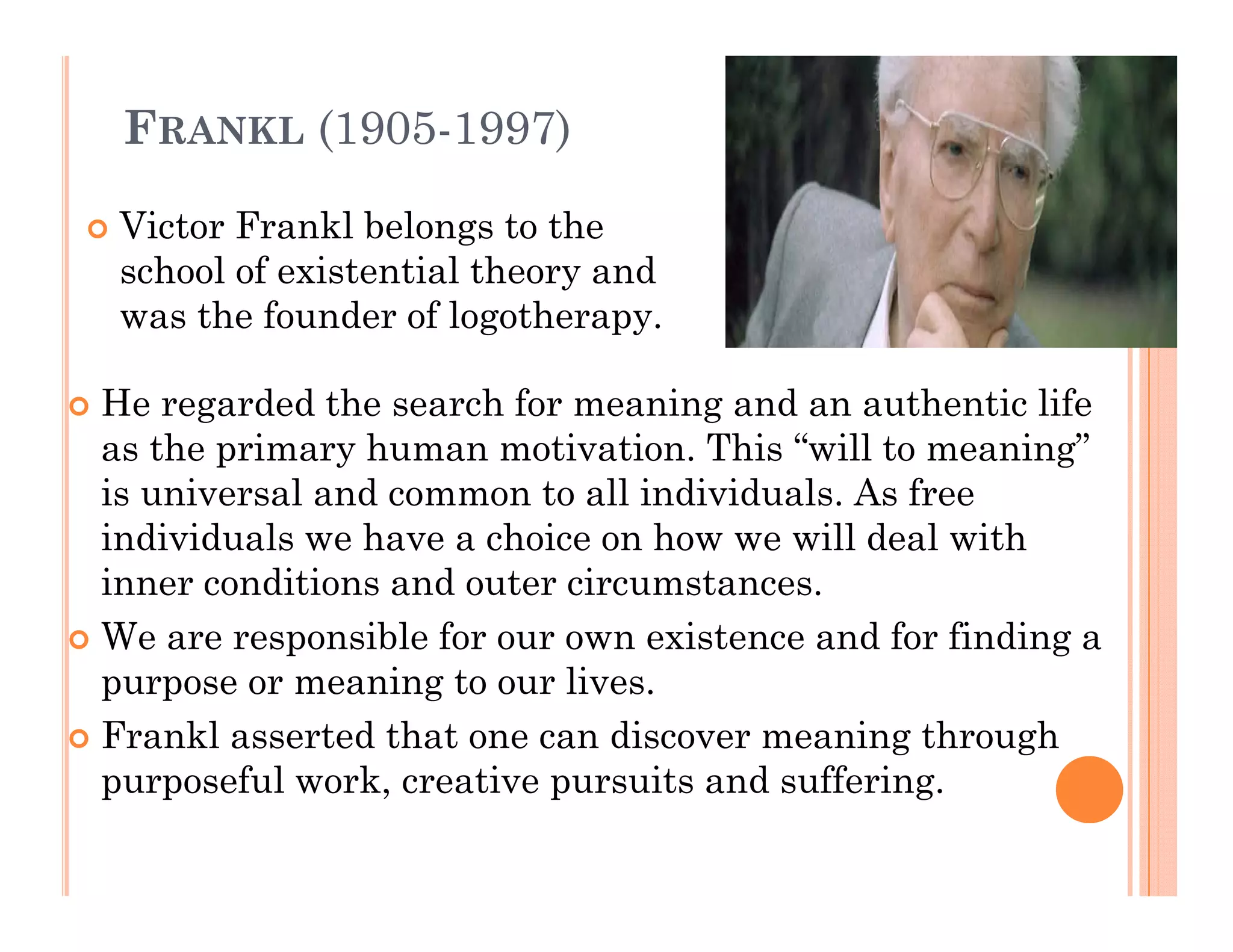
FRANKL (1905-1997)

 Victor Frankl belongs to the
 school of existential theory and
 was the founder of logotherapy.

He regarded t e sea c for meaning a d a aut e t c life
  e ega ded the search o      ea   g and an authentic e
as the primary human motivation. This “will to meaning”
is universal and common to all individuals. As free
individuals we have a choice on how we will deal with
inner conditions and outer circumstances.
We are responsible for our own existence and for finding a
           p                                           g
purpose or meaning to our lives.
Frankl asserted that one can discover meaning through
purposeful work, creati e pursuits and suffering
              ork creative             suffering.

Basic Models On Human Resource Development

  • 1.
    BASIC MODELS ON HUMANRESOURCE DEVELOPMENT
  • 2.
    MASLOW (1908-1970) Abrahman Maslowell kno n humanistic psychologist is Maslow ell known ps chologist best known for his developmental theory of human motivation. Maslow believed that actualization of one’s inherent potential was the driving force of human personality. Maslow placed self actualization into a hierarchy of self-actualization motivation or his famous “hierarchy of needs. ” Self-actualization is identified as the highest drive but before a person can turn to it, he or she must satisfy other lower motivations like physiological, safety, social and esteem needs respectively needs, respectively.
  • 4.
    SKINNER (1904-1990) B.F. B FSkinner is recognized as a leader in the field of behaviorist theory. B.F. B F Skinner is recognized as a leader in the field of behaviorist theory. Skinner believed that changes in behavior are the result of an individual’s response to events (stimuli) that occur in the environment. The response or behavior b h i produces a consequence and the nature of d d th t f the consequence either reinforces or weakens the probability of the behavior occurring again again. So if you wish to alter someone’s behavior, you reinforce the behavior you want people to do again and ignore or punish the behavior you want people to stop doing.
  • 5.
    ERIKSON (1902-1994) Erik Eriksondeveloped the psychosocial theory of social development. Erik Erikson developed the psychosocial theory of social development. The theory describes the eight stages of human development Th th d ib th i ht t fh d l t (infancy to late adulthood), through which every person passes. At each stage of development the person is confronted with and hopefully resolves a new psycho-social issue. Each developmental stage b ild on th successful E hd l t l t builds the f l completion of the earlier stages. If the issues of the earlier stages are not successfully resolved they are expected to reappear as problems in the later stages.
  • 6.
    FRANKL (1905-1997) VictorFrankl belongs to the school of existential theory and was the founder of logotherapy. He regarded t e sea c for meaning a d a aut e t c life e ega ded the search o ea g and an authentic e as the primary human motivation. This “will to meaning” is universal and common to all individuals. As free individuals we have a choice on how we will deal with inner conditions and outer circumstances. We are responsible for our own existence and for finding a p g purpose or meaning to our lives. Frankl asserted that one can discover meaning through purposeful work, creati e pursuits and suffering ork creative suffering.