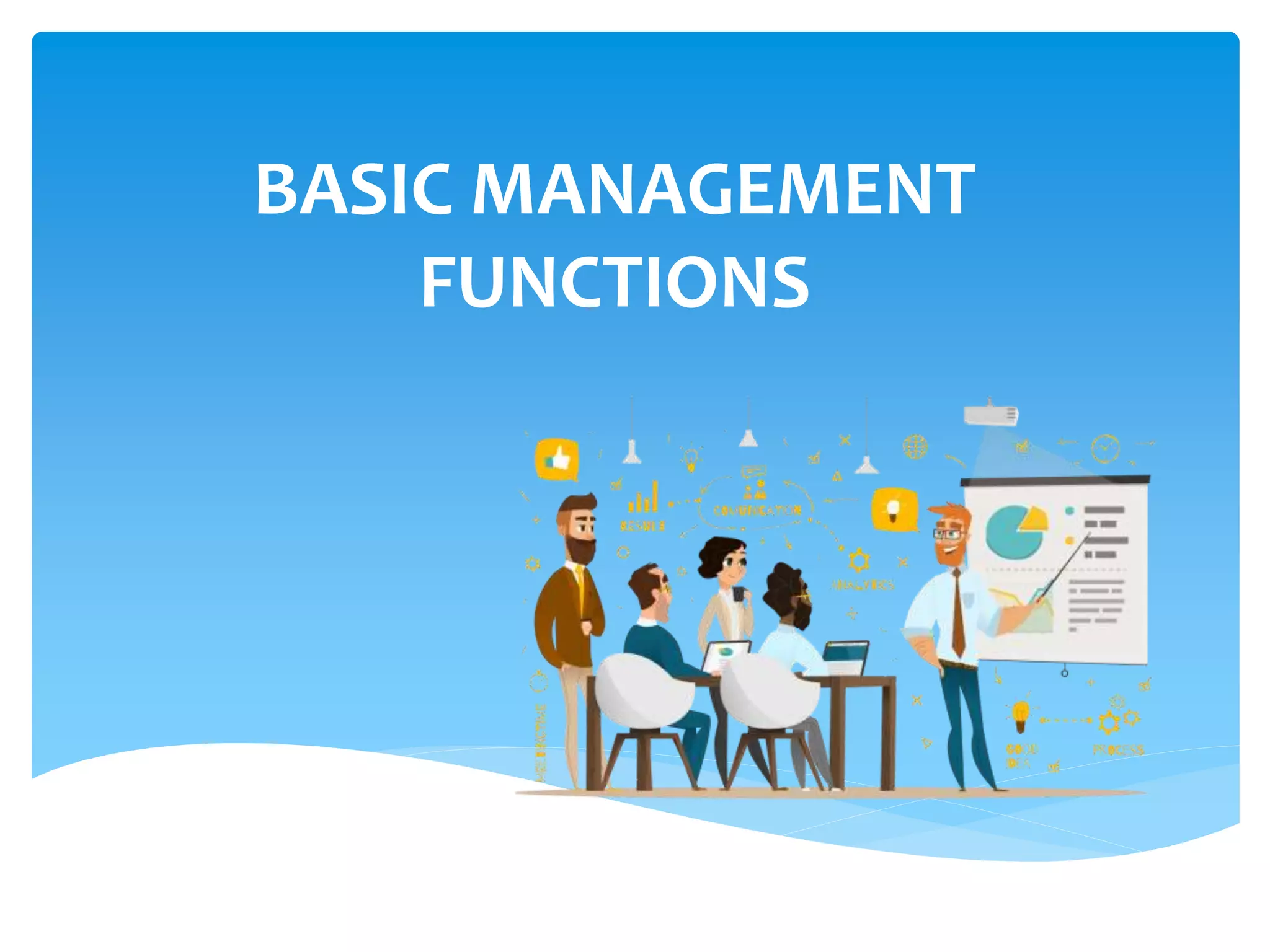
BASIC MANAGEMENT
FUNCTIONS
Keep an open mind.
Actively participate.
Share what you know.
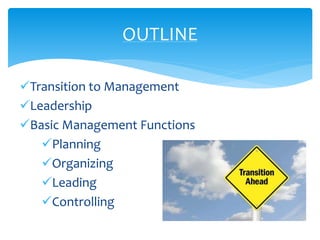
Transition to Management
Leadership
Basic Management Functions
Planning
Organizing
Leading
Controlling
OUTLINE
 A transition to management refers to the
advancement or promotion of an employee
from an individual contributor to manager of
a larger team or department of an
organization. Employees who advance into
management roles develop their skills and
expertise in order to qualify for leadership
positions.
I. TRANSITION TO MANAGEMENT
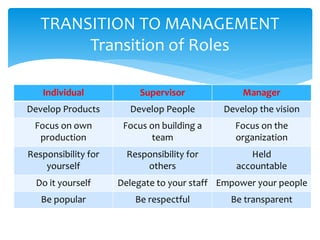
TRANSITION TO MANAGEMENT
Transition of Roles
Individual Supervisor Manager
Develop Products Develop People Develop the vision
Focus on own
production
Focus on building a
team
Focus on the
organization
Responsibility for
yourself
Responsibility for
others
Held
accountable
Do it yourself Delegate to your staff Empower your people
Be popular Be respectful Be transparent
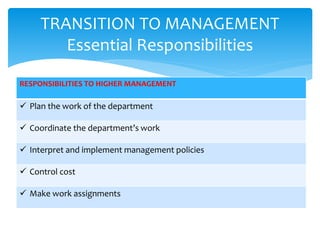
TRANSITION TO MANAGEMENT
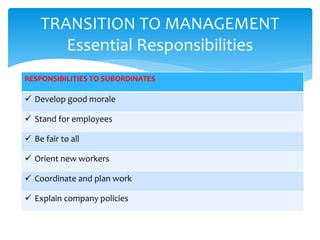
Essential Responsibilities
RESPONSIBILITIES TO HIGHER MANAGEMENT
 Plan the work of the department
 Coordinate the department’s work
 Interpret and implement management policies
 Control cost
 Make work assignments
TRANSITION TO MANAGEMENT
Essential Responsibilities
RESPONSIBILITIES TO SUBORDINATES
 Develop good morale
 Stand for employees
 Be fair to all
 Orient new workers
 Coordinate and plan work
 Explain company policies
TRANSITION TO MANAGEMENT
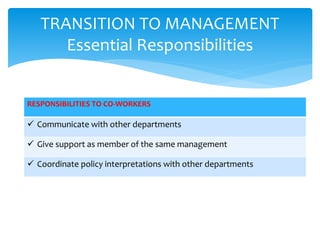
Essential Responsibilities
RESPONSIBILITIES TO CO-WORKERS
 Communicate with other departments
 Give support as member of the same management
 Coordinate policy interpretations with other departments
TRANSITION TO MANAGEMENT
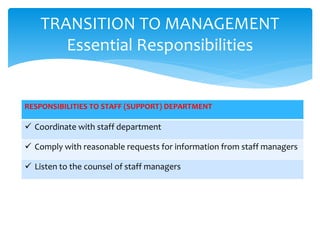
Essential Responsibilities
RESPONSIBILITIES TO STAFF (SUPPORT) DEPARTMENT
 Coordinate with staff department
 Comply with reasonable requests for information from staff managers
 Listen to the counsel of staff managers
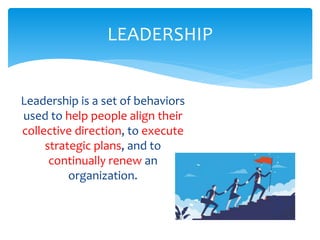
Leadership is a set of behaviors
used to help people align their
collective direction, to execute
strategic plans, and to
continually renew an
organization.
LEADERSHIP
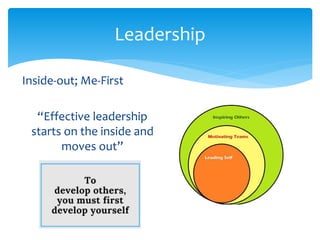
Inside-out; Me-First
“Effective leadership
starts on the inside and
moves out”
Leadership
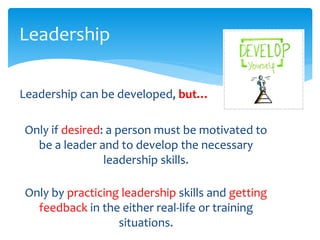
Leadership can be developed, but…
Only if desired: a person must be motivated to
be a leader and to develop the necessary
leadership skills.
Only by practicing leadership skills and getting
feedback in the either real-life or training
situations.
Leadership
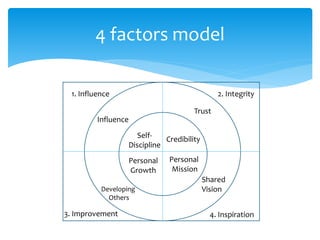
4 factors model
Trust
Shared
Vision
Personal
Mission
Influence
Self-
Discipline
Credibility
Personal
Growth
Developing
Others
1. Influence 2. Integrity
3. Improvement 4. Inspiration
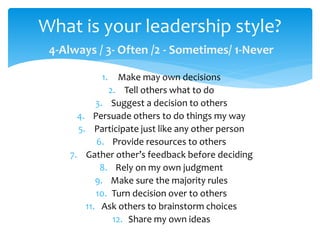
4-Always / 3- Often /2 - Sometimes/ 1-Never
1. Make may own decisions
2. Tell others what to do
3. Suggest a decision to others
4. Persuade others to do things my way
5. Participate just like any other person
6. Provide resources to others
7. Gather other’s feedback before deciding
8. Rely on my own judgment
9. Make sure the majority rules
10. Turn decision over to others
11. Ask others to brainstorm choices
12. Share my own ideas
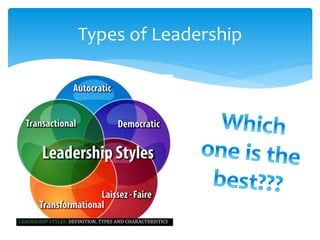
What is your leadership style?
Types of Leadership
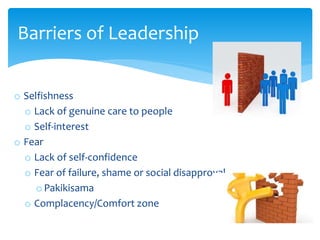
o Selfishness
o Lack of genuine care to people
o Self-interest
o Fear
o Lack of self-confidence
o Fear of failure, shame or social disapproval
o Pakikisama
o Complacency/Comfort zone
Barriers of Leadership
Are you ready to be a leader in ASEC?
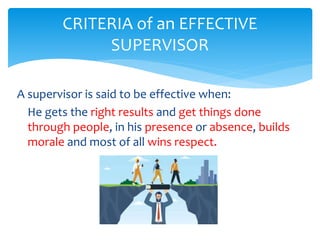
CRITERIA of an EFFECTIVE
SUPERVISOR
A supervisor is said to be effective when:
He gets the right results and get things done
through people, in his presence or absence, builds
morale and most of all wins respect.
CRITERIA of an EFFECTIVE
SUPERVISOR
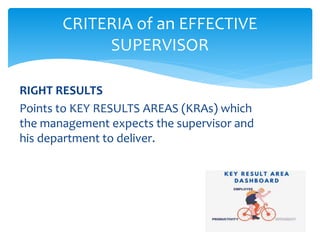
RIGHT RESULTS
Points to KEY RESULTS AREAS (KRAs) which
the management expects the supervisor and
his department to deliver.
CRITERIA of an EFFECTIVE
SUPERVISOR
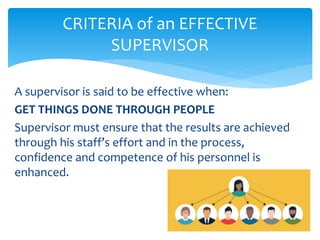
A supervisor is said to be effective when:
GET THINGS DONE THROUGH PEOPLE
Supervisor must ensure that the results are achieved
through his staff’s effort and in the process,
confidence and competence of his personnel is
enhanced.
CRITERIA of an EFFECTIVE
SUPERVISOR
A supervisor is said to be effective when:
IN HIS PRESENCE OR ABSENCE
even in the supervisor’s absence, he can expect a
very good performance from his people.
CRITERIA of an EFFECTIVE
SUPERVISOR
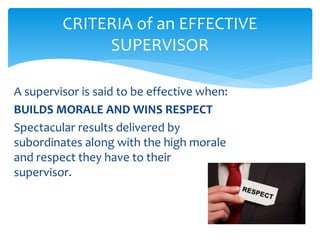
A supervisor is said to be effective when:
BUILDS MORALE AND WINS RESPECT
Spectacular results delivered by
subordinates along with the high morale
and respect they have to their
supervisor.
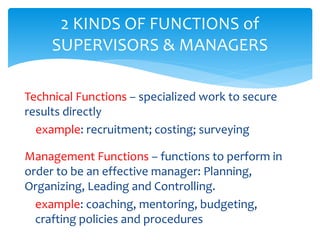
2 KINDS OF FUNCTIONS of
SUPERVISORS & MANAGERS
Technical Functions – specialized work to secure
results directly
example: recruitment; costing; surveying
Management Functions – functions to perform in
order to be an effective manager: Planning,
Organizing, Leading and Controlling.
example: coaching, mentoring, budgeting,
crafting policies and procedures
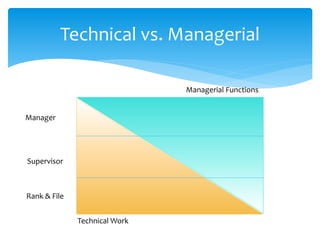
Technical vs. Managerial
Rank & File
Supervisor
Manager
Technical Work
Managerial Functions
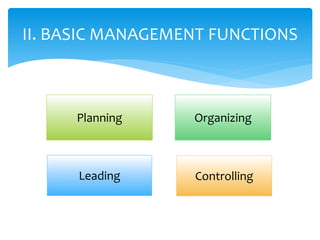
II. BASIC MANAGEMENT FUNCTIONS
Planning Organizing
Leading Controlling
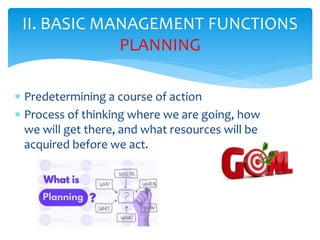
II. BASIC MANAGEMENT FUNCTIONS
PLANNING
 Predetermining a course of action
 Process of thinking where we are going, how
we will get there, and what resources will be
acquired before we act.
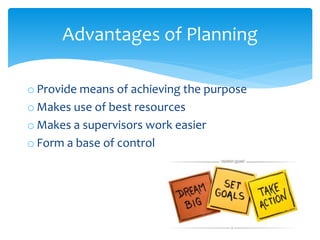
o Provide means of achieving the purpose
o Makes use of best resources
o Makes a supervisors work easier
o Form a base of control
Advantages of Planning
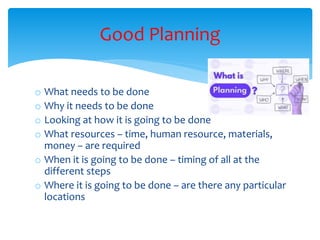
o What needs to be done
o Why it needs to be done
o Looking at how it is going to be done
o What resources – time, human resource, materials,
money – are required
o When it is going to be done – timing of all at the
different steps
o Where it is going to be done – are there any particular
locations
Good Planning
Activities in Planning
Forecasting
Developing Objectives
Programming
Budgeting
Developing Policies
Developing Procedures
II. BASIC MANAGEMENT FUNCTIONS
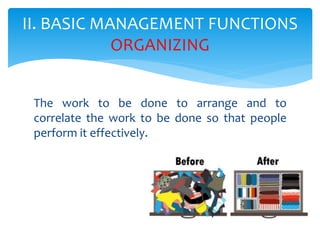
ORGANIZING
The work to be done to arrange and to
correlate the work to be done so that people
perform it effectively.
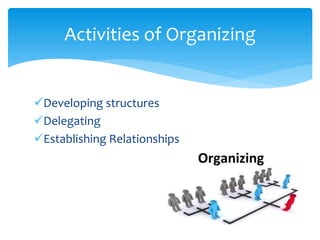
Developing structures
Delegating
Establishing Relationships
Activities of Organizing
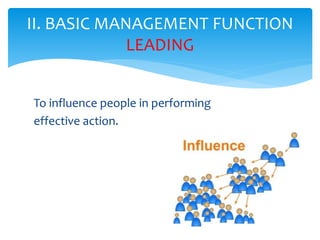
To influence people in performing
effective action.
II. BASIC MANAGEMENT FUNCTION
LEADING
Activities in Leading
Decision Making
Team building
Communicating
Motivating
Selecting people
Developing People
Assess and regulate the work in progress and to
assess the results secured.
II. BASIC MANAGEMENT FUNCTION
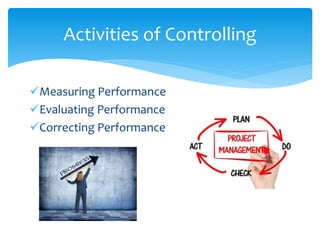
CONTROLLING
Activities of Controlling
Measuring Performance
Evaluating Performance
Correcting Performance
THANK YOU!!!
End of Presentation

BASIC MANAGEMENT FUNCTIONS.pptx

  • 1.
  • 2.
    Keep an openmind. Actively participate. Share what you know.
  • 4.
    Transition to Management Leadership BasicManagement Functions Planning Organizing Leading Controlling OUTLINE
  • 5.
     A transitionto management refers to the advancement or promotion of an employee from an individual contributor to manager of a larger team or department of an organization. Employees who advance into management roles develop their skills and expertise in order to qualify for leadership positions. I. TRANSITION TO MANAGEMENT
  • 6.
    TRANSITION TO MANAGEMENT Transitionof Roles Individual Supervisor Manager Develop Products Develop People Develop the vision Focus on own production Focus on building a team Focus on the organization Responsibility for yourself Responsibility for others Held accountable Do it yourself Delegate to your staff Empower your people Be popular Be respectful Be transparent
  • 7.
    TRANSITION TO MANAGEMENT EssentialResponsibilities RESPONSIBILITIES TO HIGHER MANAGEMENT  Plan the work of the department  Coordinate the department’s work  Interpret and implement management policies  Control cost  Make work assignments
  • 8.
    TRANSITION TO MANAGEMENT EssentialResponsibilities RESPONSIBILITIES TO SUBORDINATES  Develop good morale  Stand for employees  Be fair to all  Orient new workers  Coordinate and plan work  Explain company policies
  • 9.
    TRANSITION TO MANAGEMENT EssentialResponsibilities RESPONSIBILITIES TO CO-WORKERS  Communicate with other departments  Give support as member of the same management  Coordinate policy interpretations with other departments
  • 10.
    TRANSITION TO MANAGEMENT EssentialResponsibilities RESPONSIBILITIES TO STAFF (SUPPORT) DEPARTMENT  Coordinate with staff department  Comply with reasonable requests for information from staff managers  Listen to the counsel of staff managers
  • 11.
    Leadership is aset of behaviors used to help people align their collective direction, to execute strategic plans, and to continually renew an organization. LEADERSHIP
  • 12.
    Inside-out; Me-First “Effective leadership startson the inside and moves out” Leadership
  • 13.
    Leadership can bedeveloped, but… Only if desired: a person must be motivated to be a leader and to develop the necessary leadership skills. Only by practicing leadership skills and getting feedback in the either real-life or training situations. Leadership
  • 14.
  • 15.
    4-Always / 3-Often /2 - Sometimes/ 1-Never 1. Make may own decisions 2. Tell others what to do 3. Suggest a decision to others 4. Persuade others to do things my way 5. Participate just like any other person 6. Provide resources to others 7. Gather other’s feedback before deciding 8. Rely on my own judgment 9. Make sure the majority rules 10. Turn decision over to others 11. Ask others to brainstorm choices 12. Share my own ideas What is your leadership style?
  • 16.
  • 17.
    o Selfishness o Lackof genuine care to people o Self-interest o Fear o Lack of self-confidence o Fear of failure, shame or social disapproval o Pakikisama o Complacency/Comfort zone Barriers of Leadership
  • 18.
    Are you readyto be a leader in ASEC?
  • 19.
    CRITERIA of anEFFECTIVE SUPERVISOR A supervisor is said to be effective when: He gets the right results and get things done through people, in his presence or absence, builds morale and most of all wins respect.
  • 20.
    CRITERIA of anEFFECTIVE SUPERVISOR RIGHT RESULTS Points to KEY RESULTS AREAS (KRAs) which the management expects the supervisor and his department to deliver.
  • 21.
    CRITERIA of anEFFECTIVE SUPERVISOR A supervisor is said to be effective when: GET THINGS DONE THROUGH PEOPLE Supervisor must ensure that the results are achieved through his staff’s effort and in the process, confidence and competence of his personnel is enhanced.
  • 22.
    CRITERIA of anEFFECTIVE SUPERVISOR A supervisor is said to be effective when: IN HIS PRESENCE OR ABSENCE even in the supervisor’s absence, he can expect a very good performance from his people.
  • 23.
    CRITERIA of anEFFECTIVE SUPERVISOR A supervisor is said to be effective when: BUILDS MORALE AND WINS RESPECT Spectacular results delivered by subordinates along with the high morale and respect they have to their supervisor.
  • 24.
    2 KINDS OFFUNCTIONS of SUPERVISORS & MANAGERS Technical Functions – specialized work to secure results directly example: recruitment; costing; surveying Management Functions – functions to perform in order to be an effective manager: Planning, Organizing, Leading and Controlling. example: coaching, mentoring, budgeting, crafting policies and procedures
  • 25.
    Technical vs. Managerial Rank& File Supervisor Manager Technical Work Managerial Functions
  • 26.
    II. BASIC MANAGEMENTFUNCTIONS Planning Organizing Leading Controlling
  • 27.
    II. BASIC MANAGEMENTFUNCTIONS PLANNING  Predetermining a course of action  Process of thinking where we are going, how we will get there, and what resources will be acquired before we act.
  • 28.
    o Provide meansof achieving the purpose o Makes use of best resources o Makes a supervisors work easier o Form a base of control Advantages of Planning
  • 29.
    o What needsto be done o Why it needs to be done o Looking at how it is going to be done o What resources – time, human resource, materials, money – are required o When it is going to be done – timing of all at the different steps o Where it is going to be done – are there any particular locations Good Planning
  • 30.
    Activities in Planning Forecasting DevelopingObjectives Programming Budgeting Developing Policies Developing Procedures
  • 31.
    II. BASIC MANAGEMENTFUNCTIONS ORGANIZING The work to be done to arrange and to correlate the work to be done so that people perform it effectively.
  • 32.
  • 33.
    To influence peoplein performing effective action. II. BASIC MANAGEMENT FUNCTION LEADING
  • 34.
    Activities in Leading DecisionMaking Team building Communicating Motivating Selecting people Developing People
  • 35.
    Assess and regulatethe work in progress and to assess the results secured. II. BASIC MANAGEMENT FUNCTION CONTROLLING
  • 36.
    Activities of Controlling MeasuringPerformance Evaluating Performance Correcting Performance
  • 37.
    THANK YOU!!! End ofPresentation