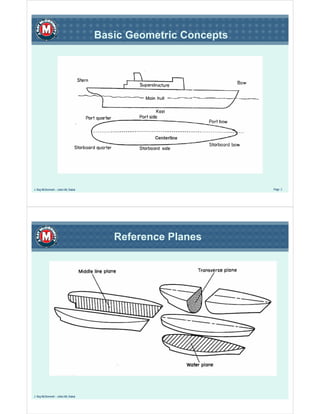
Basic Geometric Concepts


J. Ray McDermott – Jebel Ali, Dubai                              Page 2


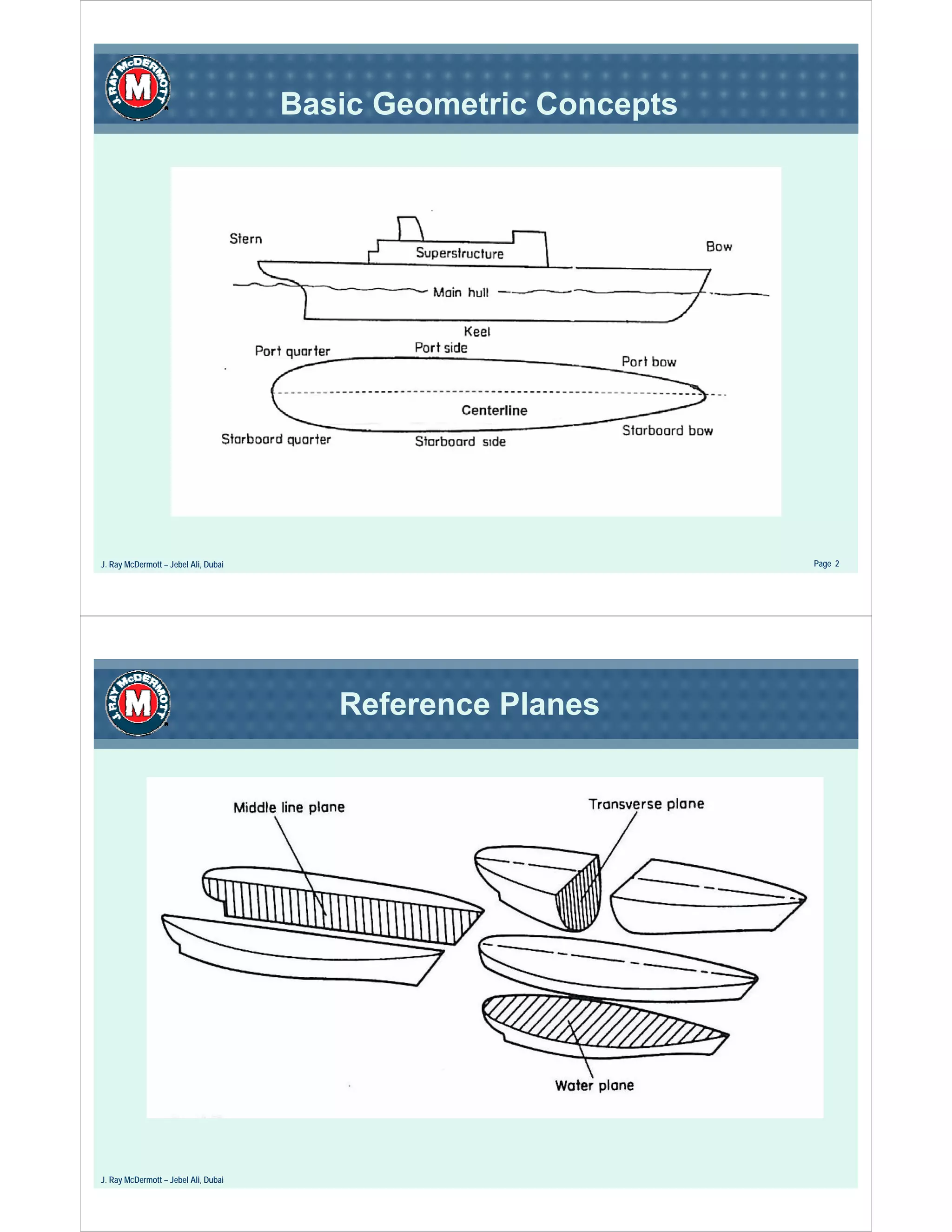
                                         Reference Planes


J. Ray McDermott – Jebel Ali, Dubai
Ship Geometry


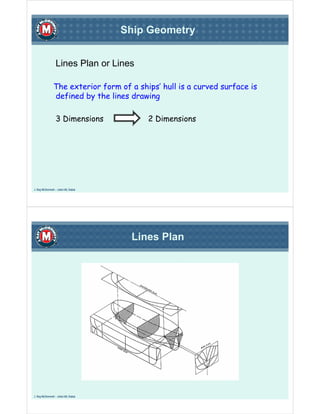
                  Lines Plan or Lines

                The exterior form of a ships’ hull is a curved surface is
                defined by the lines drawing

                  3 Dimensions            2 Dimensions


J. Ray McDermott – Jebel Ali, Dubai


                                       Lines Plan


J. Ray McDermott – Jebel Ali, Dubai
Lines Plan


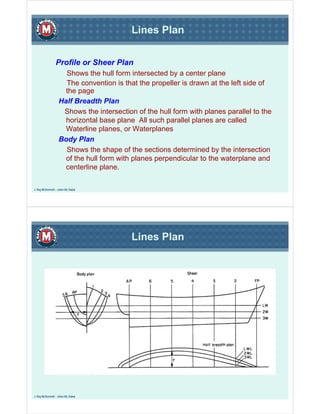
                  Profile or Sheer Plan
                      Shows the hull form intersected by a center plane
                      The convention is that the propeller is drawn at the left side of
                      the page
                    Half Breadth Plan
                     Shows the intersection of the hull form with planes parallel to the
                      horizontal base plane All such parallel planes are called
                      Waterline planes, or Waterplanes
                    Body Plan
                      Shows the shape of the sections determined by the intersection
                      of the hull form with planes perpendicular to the waterplane and
                      centerline plane.

J. Ray McDermott – Jebel Ali, Dubai


                                           Lines Plan


J. Ray McDermott – Jebel Ali, Dubai
Lines Plan


          Forward Perpendicular (FP)
                  A reference point at the forward end of the ship is provided by
                  the intersection of the load waterline and the bow contour,
                  and the line perpendicular to the LWL through this point is
                  called the forward perpendicular.
          After Perpendicular (AP)
                  Line perpendicular to LWL through the point of intersection of
                  LWL and stern contour is AP. When there is a rudder post,
                  the AP is located where the after side of the rudder post
                  intersects the LWL.


J. Ray McDermott – Jebel Ali, Dubai


                                        Lines Plan


          Length between Perpendiculars (LBP or LPP)

                  The distance between Forward and After perpendiculars is
                  called the Length Between Perpendiculars.

                  The distance between perpendiculars is divided into a
                  convenient number of equal spaces, often twenty, to give,
                  including the FP and the AP, twenty-one evenly spaced
                  ordinates. These ordinates are referred as Stations.


J. Ray McDermott – Jebel Ali, Dubai
Moulded Dimensions

          Moulded                       Excluding Plate Thickness


J. Ray McDermott – Jebel Ali, Dubai


                                      Moulded Dimensions

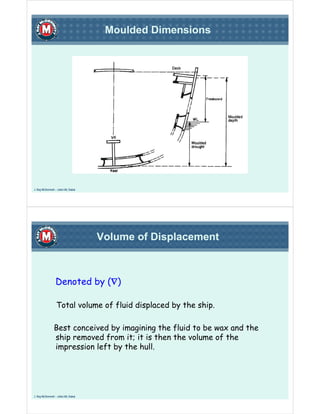
          Moulded Draught
           The perpendicular distance in a transverse plane from the top
           of the flat keel to the waterline.

          Moulded Depth
           The perpendicular distance in a transverse plane from the top
           of the flat keel to the underside of deck plating at the ship’s
           side.


J. Ray McDermott – Jebel Ali, Dubai
Moulded Dimensions


J. Ray McDermott – Jebel Ali, Dubai


                                      Volume of Displacement


                  Denoted by (∇)

                  Total volume of fluid displaced by the ship.

                Best conceived by imagining the fluid to be wax and the
                ship removed from it; it is then the volume of the
                impression left by the hull.


J. Ray McDermott – Jebel Ali, Dubai
Modes of Motion

                  Ship moving on a surface of a sea is almost always in
                  Motion


J. Ray McDermott – Jebel Ali, Dubai


                                      Modes of Motion


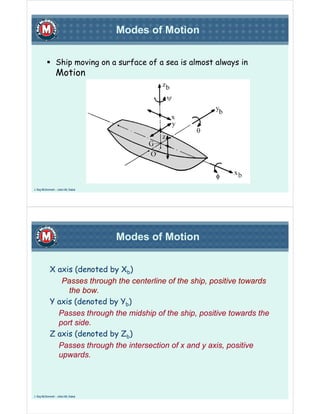
             X axis (denoted by Xb)
                Passes through the centerline of the ship, positive towards
                  the bow.
             Y axis (denoted by Yb)
               Passes through the midship of the ship, positive towards the
               port side.
             Z axis (denoted by Zb)
               Passes through the intersection of x and y axis, positive
               upwards.


J. Ray McDermott – Jebel Ali, Dubai
Modes of Motion

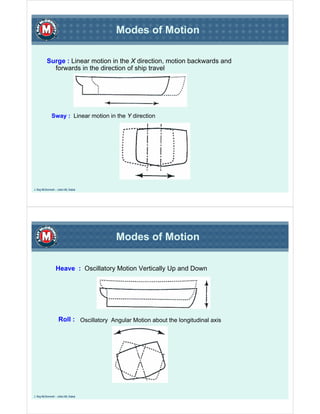
          Surge : Linear motion in the X direction, motion backwards and
            forwards in the direction of ship travel


              Sway : Linear motion in the Y direction


J. Ray McDermott – Jebel Ali, Dubai


                                         Modes of Motion

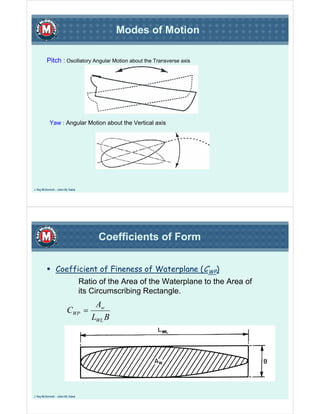
                  Heave : Oscillatory Motion Vertically Up and Down


                    Roll : Oscillatory Angular Motion about the longitudinal axis


J. Ray McDermott – Jebel Ali, Dubai
Modes of Motion

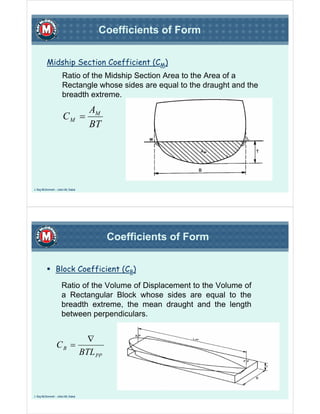
          Pitch : Oscillatory Angular Motion about the Transverse axis


             Yaw : Angular Motion about the Vertical axis


J. Ray McDermott – Jebel Ali, Dubai


                                           Coefficients of Form

                  Coefficient of Fineness of Waterplane (CWP)
                                      Ratio of the Area of the Waterplane to the Area of
                                      its Circumscribing Rectangle.
                                          Aw
                           CWP =
                                         LWL B


J. Ray McDermott – Jebel Ali, Dubai
Coefficients of Form

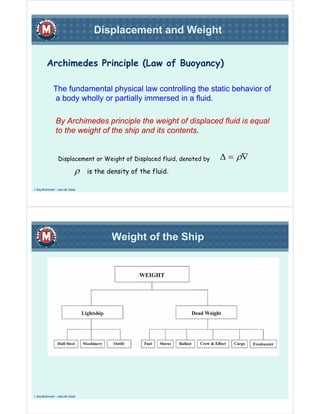
          Midship Section Coefficient (CM)
                       Ratio of the Midship Section Area to the Area of a
                       Rectangle whose sides are equal to the draught and the
                       breadth extreme.
                                        AM
                        CM            =
                                        BT


J. Ray McDermott – Jebel Ali, Dubai


                                               Coefficients of Form

                  Block Coefficient (CB)

                       Ratio of the Volume of Displacement to the Volume of
                       a Rectangular Block whose sides are equal to the
                       breadth extreme, the mean draught and the length
                       between perpendiculars.


                                        ∇
                   CB =
                                      BTL PP


J. Ray McDermott – Jebel Ali, Dubai
Displacement and Weight


          Archimedes Principle (Law of Buoyancy)

                The fundamental physical law controlling the static behavior of
                a body wholly or partially immersed in a fluid.

                  By Archimedes principle the weight of displaced fluid is equal
                  to the weight of the ship and its contents.


                    Displacement or Weight of Displaced fluid, denoted by   Δ = ρ∇
                                  ρ   is the density of the fluid.

J. Ray McDermott – Jebel Ali, Dubai


                                              Weight of the Ship


J. Ray McDermott – Jebel Ali, Dubai
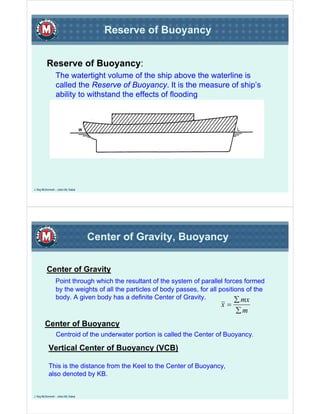
Reserve of Buoyancy


          Reserve of Buoyancy:
                  The watertight volume of the ship above the waterline is
                  called the Reserve of Buoyancy. It is the measure of ship’s
                  ability to withstand the effects of flooding


J. Ray McDermott – Jebel Ali, Dubai


                                      Center of Gravity, Buoyancy


          Center of Gravity
                  Point through which the resultant of the system of parallel forces formed
                  by the weights of all the particles of body passes, for all positions of the
                  body. A given body has a definite Center of Gravity.              ∑ mx
                                                                              x=
                                                                                   ∑m
         Center of Buoyancy
                  Centroid of the underwater portion is called the Center of Buoyancy.

            Vertical Center of Buoyancy (VCB)

            This is the distance from the Keel to the Center of Buoyancy,
            also denoted by KB.


J. Ray McDermott – Jebel Ali, Dubai
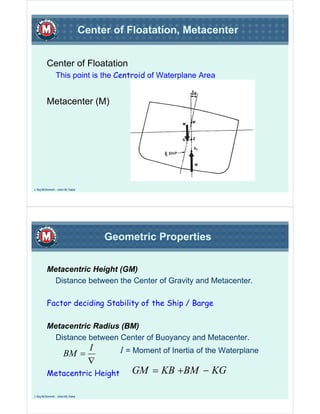
Center of Floatation, Metacenter


          Center of Floatation
                  This point is the Centroid of Waterplane Area


          Metacenter (M)


J. Ray McDermott – Jebel Ali, Dubai


                                            Geometric Properties


          Metacentric Height (GM)
           Distance between the Center of Gravity and Metacenter.

          Factor deciding Stability of the Ship / Barge

          Metacentric Radius (BM)
            Distance between Center of Buoyancy and Metacenter.
                                        I     I = Moment of Inertia of the Waterplane
                        BM =
                                        ∇
          Metacentric Height                     GM = KB +BM − KG

J. Ray McDermott – Jebel Ali, Dubai
Free Surface Effect


                  When a barge with partially filled tanks heels over, contents
                  will shift.
                   This results in shifting of center of gravity, making vessel less
                  stable
                     Reduction is Stability can be equated to reduction in GM

                                                        ρl I l
                                      GM F = GM S −              g
                                                         Δs
          Our aim shall be to reduce the number of slack tanks
            (partially filled tanks)


J. Ray McDermott – Jebel Ali, Dubai


                                                       TRIM

          TRIM is the difference in drafts Forward and Aft.

                            Trim = TA − TF
          TA is Draft Aft and TF is Draft Fwd.

          An excess draft aft is called Trim by Stern, while an excess forward is
            called Trim by Bow

                                            T A − TF
          Angle of Trim,               θ=
                                                L
          Trim by Aft is preferred, which is Positive Trim. It shall be 0.5% - 1.0%
             of Length


J. Ray McDermott – Jebel Ali, Dubai

Basic Geometric Concepts

  • 1.
    Basic Geometric Concepts J.Ray McDermott – Jebel Ali, Dubai Page 2 Reference Planes J. Ray McDermott – Jebel Ali, Dubai
  • 2.
    Ship Geometry Lines Plan or Lines The exterior form of a ships’ hull is a curved surface is defined by the lines drawing 3 Dimensions 2 Dimensions J. Ray McDermott – Jebel Ali, Dubai Lines Plan J. Ray McDermott – Jebel Ali, Dubai
  • 3.
    Lines Plan Profile or Sheer Plan Shows the hull form intersected by a center plane The convention is that the propeller is drawn at the left side of the page Half Breadth Plan Shows the intersection of the hull form with planes parallel to the horizontal base plane All such parallel planes are called Waterline planes, or Waterplanes Body Plan Shows the shape of the sections determined by the intersection of the hull form with planes perpendicular to the waterplane and centerline plane. J. Ray McDermott – Jebel Ali, Dubai Lines Plan J. Ray McDermott – Jebel Ali, Dubai
  • 4.
    Lines Plan Forward Perpendicular (FP) A reference point at the forward end of the ship is provided by the intersection of the load waterline and the bow contour, and the line perpendicular to the LWL through this point is called the forward perpendicular. After Perpendicular (AP) Line perpendicular to LWL through the point of intersection of LWL and stern contour is AP. When there is a rudder post, the AP is located where the after side of the rudder post intersects the LWL. J. Ray McDermott – Jebel Ali, Dubai Lines Plan Length between Perpendiculars (LBP or LPP) The distance between Forward and After perpendiculars is called the Length Between Perpendiculars. The distance between perpendiculars is divided into a convenient number of equal spaces, often twenty, to give, including the FP and the AP, twenty-one evenly spaced ordinates. These ordinates are referred as Stations. J. Ray McDermott – Jebel Ali, Dubai
  • 5.
    Moulded Dimensions Moulded Excluding Plate Thickness J. Ray McDermott – Jebel Ali, Dubai Moulded Dimensions Moulded Draught The perpendicular distance in a transverse plane from the top of the flat keel to the waterline. Moulded Depth The perpendicular distance in a transverse plane from the top of the flat keel to the underside of deck plating at the ship’s side. J. Ray McDermott – Jebel Ali, Dubai
  • 6.
    Moulded Dimensions J. RayMcDermott – Jebel Ali, Dubai Volume of Displacement Denoted by (∇) Total volume of fluid displaced by the ship. Best conceived by imagining the fluid to be wax and the ship removed from it; it is then the volume of the impression left by the hull. J. Ray McDermott – Jebel Ali, Dubai
  • 7.
    Modes of Motion Ship moving on a surface of a sea is almost always in Motion J. Ray McDermott – Jebel Ali, Dubai Modes of Motion X axis (denoted by Xb) Passes through the centerline of the ship, positive towards the bow. Y axis (denoted by Yb) Passes through the midship of the ship, positive towards the port side. Z axis (denoted by Zb) Passes through the intersection of x and y axis, positive upwards. J. Ray McDermott – Jebel Ali, Dubai
  • 8.
    Modes of Motion Surge : Linear motion in the X direction, motion backwards and forwards in the direction of ship travel Sway : Linear motion in the Y direction J. Ray McDermott – Jebel Ali, Dubai Modes of Motion Heave : Oscillatory Motion Vertically Up and Down Roll : Oscillatory Angular Motion about the longitudinal axis J. Ray McDermott – Jebel Ali, Dubai
  • 9.
    Modes of Motion Pitch : Oscillatory Angular Motion about the Transverse axis Yaw : Angular Motion about the Vertical axis J. Ray McDermott – Jebel Ali, Dubai Coefficients of Form Coefficient of Fineness of Waterplane (CWP) Ratio of the Area of the Waterplane to the Area of its Circumscribing Rectangle. Aw CWP = LWL B J. Ray McDermott – Jebel Ali, Dubai
  • 10.
    Coefficients of Form Midship Section Coefficient (CM) Ratio of the Midship Section Area to the Area of a Rectangle whose sides are equal to the draught and the breadth extreme. AM CM = BT J. Ray McDermott – Jebel Ali, Dubai Coefficients of Form Block Coefficient (CB) Ratio of the Volume of Displacement to the Volume of a Rectangular Block whose sides are equal to the breadth extreme, the mean draught and the length between perpendiculars. ∇ CB = BTL PP J. Ray McDermott – Jebel Ali, Dubai
  • 11.
    Displacement and Weight Archimedes Principle (Law of Buoyancy) The fundamental physical law controlling the static behavior of a body wholly or partially immersed in a fluid. By Archimedes principle the weight of displaced fluid is equal to the weight of the ship and its contents. Displacement or Weight of Displaced fluid, denoted by Δ = ρ∇ ρ is the density of the fluid. J. Ray McDermott – Jebel Ali, Dubai Weight of the Ship J. Ray McDermott – Jebel Ali, Dubai
  • 12.
    Reserve of Buoyancy Reserve of Buoyancy: The watertight volume of the ship above the waterline is called the Reserve of Buoyancy. It is the measure of ship’s ability to withstand the effects of flooding J. Ray McDermott – Jebel Ali, Dubai Center of Gravity, Buoyancy Center of Gravity Point through which the resultant of the system of parallel forces formed by the weights of all the particles of body passes, for all positions of the body. A given body has a definite Center of Gravity. ∑ mx x= ∑m Center of Buoyancy Centroid of the underwater portion is called the Center of Buoyancy. Vertical Center of Buoyancy (VCB) This is the distance from the Keel to the Center of Buoyancy, also denoted by KB. J. Ray McDermott – Jebel Ali, Dubai
  • 13.
    Center of Floatation,Metacenter Center of Floatation This point is the Centroid of Waterplane Area Metacenter (M) J. Ray McDermott – Jebel Ali, Dubai Geometric Properties Metacentric Height (GM) Distance between the Center of Gravity and Metacenter. Factor deciding Stability of the Ship / Barge Metacentric Radius (BM) Distance between Center of Buoyancy and Metacenter. I I = Moment of Inertia of the Waterplane BM = ∇ Metacentric Height GM = KB +BM − KG J. Ray McDermott – Jebel Ali, Dubai
  • 14.
    Free Surface Effect When a barge with partially filled tanks heels over, contents will shift. This results in shifting of center of gravity, making vessel less stable Reduction is Stability can be equated to reduction in GM ρl I l GM F = GM S − g Δs Our aim shall be to reduce the number of slack tanks (partially filled tanks) J. Ray McDermott – Jebel Ali, Dubai TRIM TRIM is the difference in drafts Forward and Aft. Trim = TA − TF TA is Draft Aft and TF is Draft Fwd. An excess draft aft is called Trim by Stern, while an excess forward is called Trim by Bow T A − TF Angle of Trim, θ= L Trim by Aft is preferred, which is Positive Trim. It shall be 0.5% - 1.0% of Length J. Ray McDermott – Jebel Ali, Dubai