Foot Anatomy and FootFoot Anatomy and Foot
MechanicsMechanics
Session ContentSession Content
1. Familiarization with Foot Anatomy
2. Familiarization with Foot Mechanics
3. Basics of Measuring Foot Size
4. Size Systems
5. Shoe Fitting
Foot Anatomy
and Foot
Mechanics
Foot KnowledgeFoot Knowledge
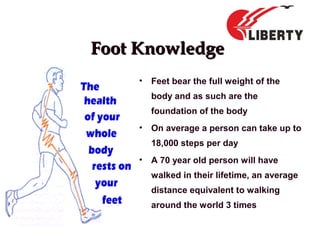
• Feet bear the full weight of the
body and as such are the
foundation of the body
• On average a person can take up to
18,000 steps per day
• A 70 year old person will have
walked in their lifetime, an average
distance equivalent to walking
around the world 3 times
Foot AnatomyFoot Anatomy
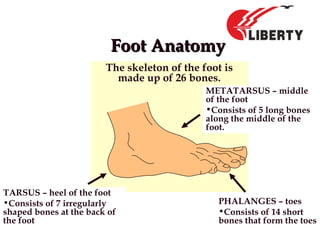
The skeleton of the foot is
made up of 26 bones.
TARSUS – heel of the foot
•Consists of 7 irregularly
shaped bones at the back of
the foot
METATARSUS – middle
of the foot
•Consists of 5 long bones
along the middle of the
foot.
PHALANGES – toes
•Consists of 14 short
bones that form the toes
Foot AnantomyFoot Anantomy
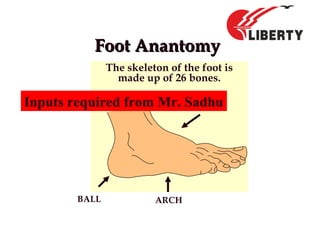
The skeleton of the foot is
made up of 26 bones.
BALL ARCH
Inputs required from Mr. Sadhu
Foot AnatomyFoot Anatomy
1. The main joints of the foot are:
2. Ankle Joint – a hinge joint
3. Sub Taler – a gliding joint
4. Mid Tarsal – a gliding & ball-and-socket
joint
5. The skeleton of the foot is held together
by:
6. 109 ligaments
7. 32 Muscles and tendons (for movement)
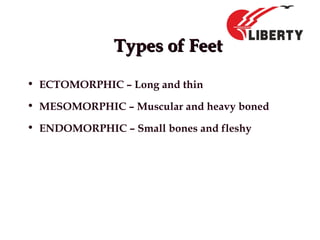
Types of FeetTypes of Feet
• ECTOMORPHIC – Long and thin
• MESOMORPHIC – Muscular and heavy boned
• ENDOMORPHIC – Small bones and fleshy
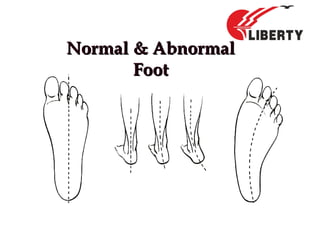
Normal & AbnormalNormal & Abnormal
FootFoot
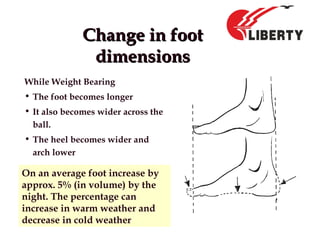
Change in footChange in foot
dimensionsdimensions
While Weight Bearing
• The foot becomes longer
• It also becomes wider across the
ball.
• The heel becomes wider and
arch lower
On an average foot increase by
approx. 5% (in volume) by the
night. The percentage can
increase in warm weather and
decrease in cold weather
Measuring Foot size
Measuring Foot sizeMeasuring Foot size
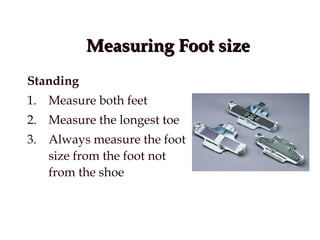
Standing
1. Measure both feet
2. Measure the longest toe
3. Always measure the foot
size from the foot not
from the shoe
Measuring Foot sizeMeasuring Foot size
Sitting
1. The foot must be correctly positioned in the
foot gauge
2. The stool must be in line with the leg
3. The heel must be right back to the pillar
4. The angle between the leg and foot must be
90 degrees
5. The foot must be correctly aligned
VISUAL OF SCALE
Sizing
Size ChartsSize Charts
Revolutions Mens Womens Kids
English   
French   
Two commonly accepted size systems :
English : Measured in inches eg.
Mens size 8 = 11 inches
French : Measured in centimeters eg.
Mens size 42 = 28 cms
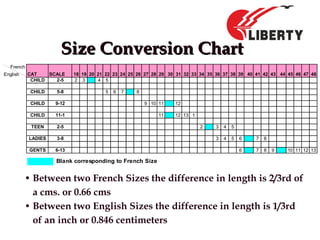
Size Conversion ChartSize Conversion Chart
English CAT SCALE 18 19 20 21 22 23 24 25 26 27 28 29 30 31 32 33 34 35 36 37 38 39 40 41 42 43 44 45 46 47 48
CHILD 2-5 2 3 4 5
CHILD 5-8 5 6 7 8
CHILD 9-12 9 10 11 12
CHILD 11-1 11 12 13 1
TEEN 2-5 2 3 4 5
LADIES 3-8 3 4 5 6 7 8
GENTS 6-13 6 7 8 9 10 11 12 13
French
• Between two French Sizes the difference in length is 2/3rd of
a cms. or 0.66 cms
• Between two English Sizes the difference in length is 1/3rd
of an inch or 0.846 centimeters
Blank corresponding to French Size
Shoe Fitting
Check points whileCheck points while
fitting a shoefitting a shoe
1. For what activity will the
shoe be worn ?
2. Where will the shoe be
worn ?
3. Any extreme variations in
temperature?
4. How long will the customer
wear the shoe at a stretch?
5. Style Preference ?
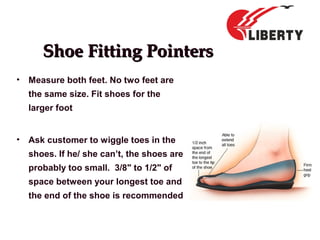
Shoe Fitting PointersShoe Fitting Pointers
• Measure both feet. No two feet are
the same size. Fit shoes for the
larger foot
• Ask customer to wiggle toes in the
shoes. If he/ she can’t, the shoes are
probably too small. 3/8" to 1/2" of
space between your longest toe and
the end of the shoe is recommended
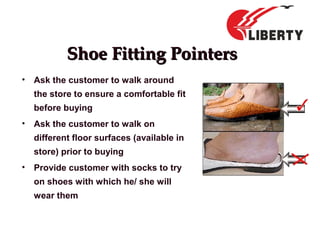
Shoe Fitting PointersShoe Fitting Pointers
• Ask the customer to walk around
the store to ensure a comfortable fit
before buying
• Ask the customer to walk on
different floor surfaces (available in
store) prior to buying
• Provide customer with socks to try
on shoes with which he/ she will
wear them
Check points whileCheck points while
fitting a shoefitting a shoe
• Mr. Sadhu
Shoe fitting forShoe fitting for
ChildrenChildren
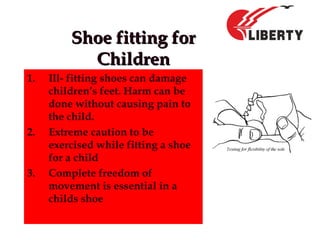
1. Ill- fitting shoes can damage
children’s feet. Harm can be
done without causing pain to
the child.
2. Extreme caution to be
exercised while fitting a shoe
for a child
3. Complete freedom of
movement is essential in a
childs shoe
Shoe fitting forShoe fitting for
Abnormal feetAbnormal feet
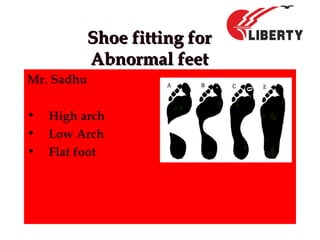
Mr. Sadhu
• High arch
• Low Arch
• Flat foot
Shoe fitting forShoe fitting for
Abnormal feetAbnormal feet
Mr. Sadhu
• High arch
• Low Arch
• Flat foot
• Hammer Toe
• Ingrown Toenails
Shoe fitting forShoe fitting for
feet with minor foot ailmentsfeet with minor foot ailments
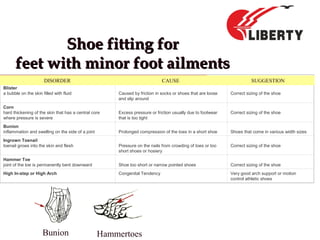
DISORDER CAUSE SUGGESTION
Blister
a bubble on the skin filled with fluid Caused by friction in socks or shoes that are loose
and slip around
Correct sizing of the shoe
Corn
hard thickening of the skin that has a central core
where pressure is severe
Excess pressure or friction usually due to footwear
that is too tight
Correct sizing of the shoe
Bunion
inflammation and swelling on the side of a joint Prolonged compression of the toes in a short shoe Shoes that come in various width sizes
Ingrown Toenail
toenail grows into the skin and flesh Pressure on the nails from crowding of toes or too
short shoes or hosiery
Correct sizing of the shoe
Hammer Toe
joint of the toe is permanently bent downward Shoe too short or narrow pointed shoes Correct sizing of the shoe
High In-step or High Arch Congenital Tendency Very good arch support or motion
control athletic shoes
DISORDER CAUSE SUGGESTION
Bunion Hammertoes
Worn Shoe EvaluationWorn Shoe Evaluation
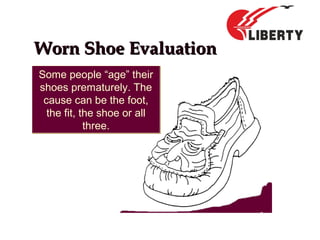
Some people “age” their
shoes prematurely. The
cause can be the foot,
the fit, the shoe or all
three.
Some people “age” their
shoes prematurely. The
cause can be the foot,
the fit, the shoe or all
three.
Worn Shoe EvaluationWorn Shoe Evaluation
at Revolutionsat Revolutions
1. Evaluate worn shoe
2. Assess if ‘age’/ wear and tear
is due to
– FIT
– SHOE
1. If yes, inform the customer of the shoe wear
and tear due to appropriate fit/ shoe
2. Recommend a more appropriate fit or shoe
to the customer
Worn Shoe EvaluationWorn Shoe Evaluation
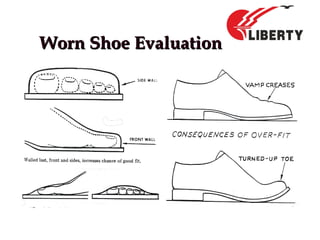
1. Wear on the sole should be even
2. If the wear is forward, then the shoe is too
short
3. If the shoe is worn on the outside edge or
the inside, then the shoe is too narrow or the
person leans outwards or inwards
4. If the toe of the shoe is turning up then the
shoe is too long
PICTURES
Worn Shoe EvaluationWorn Shoe Evaluation
1. Normally the vamp will not develop
excessive wrinkles or creases, nor it will
have pronounced indications of each of the
toes
2. A shoe that is too wide will develop large
creases or folds across the vamp
3. A shoe that has toes impressions on vamp is
too short or too narrow, or made on the last
which isn’t appropriate
PICTURES
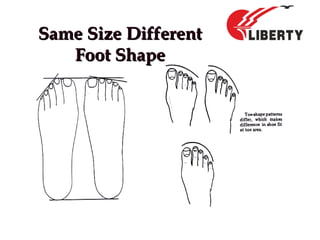
Same Size DifferentSame Size Different
Foot ShapeFoot Shape
Check List forCheck List for
Assessing Shoe FitAssessing Shoe Fit
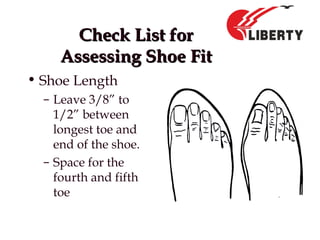
• Shoe Length
– Leave 3/8” to
1/2” between
longest toe and
end of the shoe.
– Space for the
fourth and fifth
toe
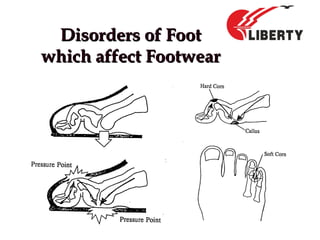
Disorders of FootDisorders of Foot
which affect Footwearwhich affect Footwear
Check List forCheck List for
Assessing Shoe FitAssessing Shoe Fit
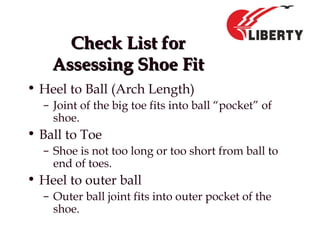
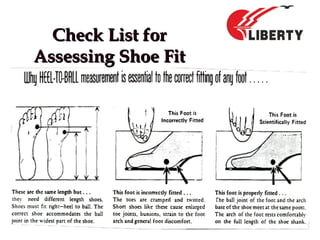
• Heel to Ball (Arch Length)
– Joint of the big toe fits into ball “pocket” of
shoe.
• Ball to Toe
– Shoe is not too long or too short from ball to
end of toes.
• Heel to outer ball
– Outer ball joint fits into outer pocket of the
shoe.
Check List forCheck List for
Assessing Shoe FitAssessing Shoe Fit
Check List forCheck List for
Assessing Shoe FitAssessing Shoe Fit
• Ball Width and Vamp Room
– Adequate space across the vamp of
the shoe
– Width of the insole same as the width
of the foot.
• Heel Fit
– Not too tight or too loose, “snug” fit.
– Top of counter does not “cut into”
heel tendon
– Inside and outside ankle bones do not
rub against top line of shoe.
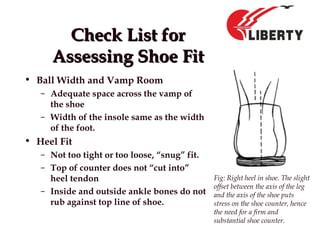
Fig: Right heel in shoe. The slight
offset between the axis of the leg
and the axis of the shoe puts
stress on the shoe counter, hence
the need for a firm and
substantial shoe counter.
Check List forCheck List for
Assessing Shoe FitAssessing Shoe Fit
• Top Line
– Fits snugly to sides of the foot.
• Instep of Waist
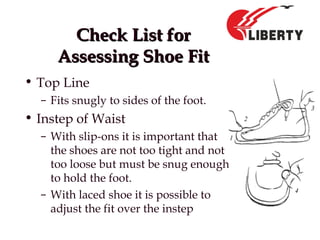
– With slip-ons it is important that
the shoes are not too tight and not
too loose but must be snug enough
to hold the foot.
– With laced shoe it is possible to
adjust the fit over the instep
Check List forCheck List for
Assessing Shoe FitAssessing Shoe Fit
• Arch Fit
– Shoe hugs closely to the foot on the inside of the
shoe under the longitudinal arch.
• Tread
– Shoe fits securely, customer feels balanced and
stable and walks comfortably.
Worn Shoe EvaluationWorn Shoe Evaluation
ExerciseExercise
• Identifying parts of a foot
• Measuring foot size
• Assessing shoe fits

Basic Foot Anatomy and Foot Mechanics

  • 1.
    Foot Anatomy andFootFoot Anatomy and Foot MechanicsMechanics
  • 2.
    Session ContentSession Content 1.Familiarization with Foot Anatomy 2. Familiarization with Foot Mechanics 3. Basics of Measuring Foot Size 4. Size Systems 5. Shoe Fitting
  • 3.
  • 4.
    Foot KnowledgeFoot Knowledge •Feet bear the full weight of the body and as such are the foundation of the body • On average a person can take up to 18,000 steps per day • A 70 year old person will have walked in their lifetime, an average distance equivalent to walking around the world 3 times
  • 5.
    Foot AnatomyFoot Anatomy Theskeleton of the foot is made up of 26 bones. TARSUS – heel of the foot •Consists of 7 irregularly shaped bones at the back of the foot METATARSUS – middle of the foot •Consists of 5 long bones along the middle of the foot. PHALANGES – toes •Consists of 14 short bones that form the toes
  • 6.
    Foot AnantomyFoot Anantomy Theskeleton of the foot is made up of 26 bones. BALL ARCH Inputs required from Mr. Sadhu
  • 7.
    Foot AnatomyFoot Anatomy 1.The main joints of the foot are: 2. Ankle Joint – a hinge joint 3. Sub Taler – a gliding joint 4. Mid Tarsal – a gliding & ball-and-socket joint 5. The skeleton of the foot is held together by: 6. 109 ligaments 7. 32 Muscles and tendons (for movement)
  • 8.
    Types of FeetTypesof Feet • ECTOMORPHIC – Long and thin • MESOMORPHIC – Muscular and heavy boned • ENDOMORPHIC – Small bones and fleshy
  • 9.
    Normal & AbnormalNormal& Abnormal FootFoot
  • 10.
    Change in footChangein foot dimensionsdimensions While Weight Bearing • The foot becomes longer • It also becomes wider across the ball. • The heel becomes wider and arch lower On an average foot increase by approx. 5% (in volume) by the night. The percentage can increase in warm weather and decrease in cold weather
  • 11.
  • 12.
    Measuring Foot sizeMeasuringFoot size Standing 1. Measure both feet 2. Measure the longest toe 3. Always measure the foot size from the foot not from the shoe
  • 13.
    Measuring Foot sizeMeasuringFoot size Sitting 1. The foot must be correctly positioned in the foot gauge 2. The stool must be in line with the leg 3. The heel must be right back to the pillar 4. The angle between the leg and foot must be 90 degrees 5. The foot must be correctly aligned VISUAL OF SCALE
  • 14.
  • 15.
    Size ChartsSize Charts RevolutionsMens Womens Kids English    French    Two commonly accepted size systems : English : Measured in inches eg. Mens size 8 = 11 inches French : Measured in centimeters eg. Mens size 42 = 28 cms
  • 16.
    Size Conversion ChartSizeConversion Chart English CAT SCALE 18 19 20 21 22 23 24 25 26 27 28 29 30 31 32 33 34 35 36 37 38 39 40 41 42 43 44 45 46 47 48 CHILD 2-5 2 3 4 5 CHILD 5-8 5 6 7 8 CHILD 9-12 9 10 11 12 CHILD 11-1 11 12 13 1 TEEN 2-5 2 3 4 5 LADIES 3-8 3 4 5 6 7 8 GENTS 6-13 6 7 8 9 10 11 12 13 French • Between two French Sizes the difference in length is 2/3rd of a cms. or 0.66 cms • Between two English Sizes the difference in length is 1/3rd of an inch or 0.846 centimeters Blank corresponding to French Size
  • 17.
  • 18.
    Check points whileCheckpoints while fitting a shoefitting a shoe 1. For what activity will the shoe be worn ? 2. Where will the shoe be worn ? 3. Any extreme variations in temperature? 4. How long will the customer wear the shoe at a stretch? 5. Style Preference ?
  • 19.
    Shoe Fitting PointersShoeFitting Pointers • Measure both feet. No two feet are the same size. Fit shoes for the larger foot • Ask customer to wiggle toes in the shoes. If he/ she can’t, the shoes are probably too small. 3/8" to 1/2" of space between your longest toe and the end of the shoe is recommended
  • 20.
    Shoe Fitting PointersShoeFitting Pointers • Ask the customer to walk around the store to ensure a comfortable fit before buying • Ask the customer to walk on different floor surfaces (available in store) prior to buying • Provide customer with socks to try on shoes with which he/ she will wear them
  • 21.
    Check points whileCheckpoints while fitting a shoefitting a shoe • Mr. Sadhu
  • 22.
    Shoe fitting forShoefitting for ChildrenChildren 1. Ill- fitting shoes can damage children’s feet. Harm can be done without causing pain to the child. 2. Extreme caution to be exercised while fitting a shoe for a child 3. Complete freedom of movement is essential in a childs shoe
  • 23.
    Shoe fitting forShoefitting for Abnormal feetAbnormal feet Mr. Sadhu • High arch • Low Arch • Flat foot
  • 24.
    Shoe fitting forShoefitting for Abnormal feetAbnormal feet Mr. Sadhu • High arch • Low Arch • Flat foot • Hammer Toe • Ingrown Toenails
  • 25.
    Shoe fitting forShoefitting for feet with minor foot ailmentsfeet with minor foot ailments DISORDER CAUSE SUGGESTION Blister a bubble on the skin filled with fluid Caused by friction in socks or shoes that are loose and slip around Correct sizing of the shoe Corn hard thickening of the skin that has a central core where pressure is severe Excess pressure or friction usually due to footwear that is too tight Correct sizing of the shoe Bunion inflammation and swelling on the side of a joint Prolonged compression of the toes in a short shoe Shoes that come in various width sizes Ingrown Toenail toenail grows into the skin and flesh Pressure on the nails from crowding of toes or too short shoes or hosiery Correct sizing of the shoe Hammer Toe joint of the toe is permanently bent downward Shoe too short or narrow pointed shoes Correct sizing of the shoe High In-step or High Arch Congenital Tendency Very good arch support or motion control athletic shoes DISORDER CAUSE SUGGESTION Bunion Hammertoes
  • 26.
    Worn Shoe EvaluationWornShoe Evaluation Some people “age” their shoes prematurely. The cause can be the foot, the fit, the shoe or all three. Some people “age” their shoes prematurely. The cause can be the foot, the fit, the shoe or all three.
  • 27.
    Worn Shoe EvaluationWornShoe Evaluation at Revolutionsat Revolutions 1. Evaluate worn shoe 2. Assess if ‘age’/ wear and tear is due to – FIT – SHOE 1. If yes, inform the customer of the shoe wear and tear due to appropriate fit/ shoe 2. Recommend a more appropriate fit or shoe to the customer
  • 28.
    Worn Shoe EvaluationWornShoe Evaluation 1. Wear on the sole should be even 2. If the wear is forward, then the shoe is too short 3. If the shoe is worn on the outside edge or the inside, then the shoe is too narrow or the person leans outwards or inwards 4. If the toe of the shoe is turning up then the shoe is too long PICTURES
  • 29.
    Worn Shoe EvaluationWornShoe Evaluation 1. Normally the vamp will not develop excessive wrinkles or creases, nor it will have pronounced indications of each of the toes 2. A shoe that is too wide will develop large creases or folds across the vamp 3. A shoe that has toes impressions on vamp is too short or too narrow, or made on the last which isn’t appropriate PICTURES
  • 30.
    Same Size DifferentSameSize Different Foot ShapeFoot Shape
  • 31.
    Check List forCheckList for Assessing Shoe FitAssessing Shoe Fit • Shoe Length – Leave 3/8” to 1/2” between longest toe and end of the shoe. – Space for the fourth and fifth toe
  • 32.
    Disorders of FootDisordersof Foot which affect Footwearwhich affect Footwear
  • 33.
    Check List forCheckList for Assessing Shoe FitAssessing Shoe Fit • Heel to Ball (Arch Length) – Joint of the big toe fits into ball “pocket” of shoe. • Ball to Toe – Shoe is not too long or too short from ball to end of toes. • Heel to outer ball – Outer ball joint fits into outer pocket of the shoe.
  • 34.
    Check List forCheckList for Assessing Shoe FitAssessing Shoe Fit
  • 35.
    Check List forCheckList for Assessing Shoe FitAssessing Shoe Fit • Ball Width and Vamp Room – Adequate space across the vamp of the shoe – Width of the insole same as the width of the foot. • Heel Fit – Not too tight or too loose, “snug” fit. – Top of counter does not “cut into” heel tendon – Inside and outside ankle bones do not rub against top line of shoe. Fig: Right heel in shoe. The slight offset between the axis of the leg and the axis of the shoe puts stress on the shoe counter, hence the need for a firm and substantial shoe counter.
  • 36.
    Check List forCheckList for Assessing Shoe FitAssessing Shoe Fit • Top Line – Fits snugly to sides of the foot. • Instep of Waist – With slip-ons it is important that the shoes are not too tight and not too loose but must be snug enough to hold the foot. – With laced shoe it is possible to adjust the fit over the instep
  • 37.
    Check List forCheckList for Assessing Shoe FitAssessing Shoe Fit • Arch Fit – Shoe hugs closely to the foot on the inside of the shoe under the longitudinal arch. • Tread – Shoe fits securely, customer feels balanced and stable and walks comfortably.
  • 38.
    Worn Shoe EvaluationWornShoe Evaluation
  • 39.
    ExerciseExercise • Identifying partsof a foot • Measuring foot size • Assessing shoe fits