Structure of the C Program
The basic structure of a C program is divided into 6 parts which makes it easy to read,
modify, document, and understand in a particular format.
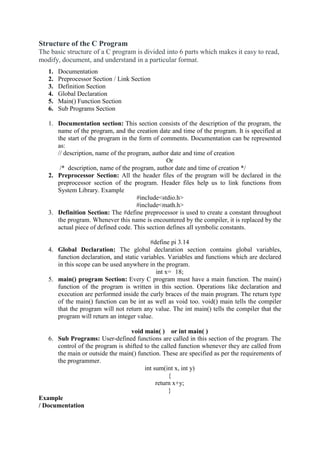
1. Documentation
2. Preprocessor Section / Link Section
3. Definition Section
4. Global Declaration
5. Main() Function Section
6. Sub Programs Section
1. Documentation section: This section consists of the description of the program, the
name of the program, and the creation date and time of the program. It is specified at
the start of the program in the form of comments. Documentation can be represented
as:
// description, name of the program, author date and time of creation
Or
/* description, name of the program, author date and time of creation */
2. Preprocessor Section: All the header files of the program will be declared in the
preprocessor section of the program. Header files help us to link functions from
System Library. Example
#include<stdio.h>
#include<math.h>
3. Definition Section: The #define preprocessor is used to create a constant throughout
the program. Whenever this name is encountered by the compiler, it is replaced by the
actual piece of defined code. This section defines all symbolic constants.
#define pi 3.14
4. Global Declaration: The global declaration section contains global variables,
function declaration, and static variables. Variables and functions which are declared
in this scope can be used anywhere in the program.
int x= 18;
5. main() program Section: Every C program must have a main function. The main()
function of the program is written in this section. Operations like declaration and
execution are performed inside the curly braces of the main program. The return type
of the main() function can be int as well as void too. void() main tells the compiler
that the program will not return any value. The int main() tells the compiler that the
program will return an integer value.
void main( ) or int main( )
6. Sub Programs: User-defined functions are called in this section of the program. The
control of the program is shifted to the called function whenever they are called from
the main or outside the main() function. These are specified as per the requirements of
the programmer.
int sum(int x, int y)
{
return x+y;
}
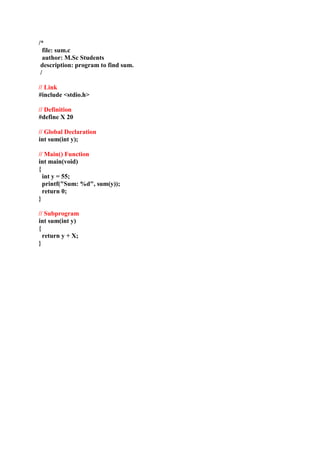
Example
/ Documentation
/*
file: sum.c
author: M.Sc Students
description: program to find sum.
/
// Link
#include <stdio.h>
// Definition
#define X 20
// Global Declaration
int sum(int y);
// Main() Function
int main(void)
{
int y = 55;
printf("Sum: %d", sum(y));
return 0;
}
// Subprogram
int sum(int y)
{
return y + X;
}

Structure of the C Program.docx

  • 1.
    Structure of theC Program The basic structure of a C program is divided into 6 parts which makes it easy to read, modify, document, and understand in a particular format. 1. Documentation 2. Preprocessor Section / Link Section 3. Definition Section 4. Global Declaration 5. Main() Function Section 6. Sub Programs Section 1. Documentation section: This section consists of the description of the program, the name of the program, and the creation date and time of the program. It is specified at the start of the program in the form of comments. Documentation can be represented as: // description, name of the program, author date and time of creation Or /* description, name of the program, author date and time of creation */ 2. Preprocessor Section: All the header files of the program will be declared in the preprocessor section of the program. Header files help us to link functions from System Library. Example #include<stdio.h> #include<math.h> 3. Definition Section: The #define preprocessor is used to create a constant throughout the program. Whenever this name is encountered by the compiler, it is replaced by the actual piece of defined code. This section defines all symbolic constants. #define pi 3.14 4. Global Declaration: The global declaration section contains global variables, function declaration, and static variables. Variables and functions which are declared in this scope can be used anywhere in the program. int x= 18; 5. main() program Section: Every C program must have a main function. The main() function of the program is written in this section. Operations like declaration and execution are performed inside the curly braces of the main program. The return type of the main() function can be int as well as void too. void() main tells the compiler that the program will not return any value. The int main() tells the compiler that the program will return an integer value. void main( ) or int main( ) 6. Sub Programs: User-defined functions are called in this section of the program. The control of the program is shifted to the called function whenever they are called from the main or outside the main() function. These are specified as per the requirements of the programmer. int sum(int x, int y) { return x+y; } Example / Documentation
  • 2.
    /* file: sum.c author: M.ScStudents description: program to find sum. / // Link #include <stdio.h> // Definition #define X 20 // Global Declaration int sum(int y); // Main() Function int main(void) { int y = 55; printf("Sum: %d", sum(y)); return 0; } // Subprogram int sum(int y) { return y + X; }