DRILLING
BENCH BLASTING
&
ECONOMY
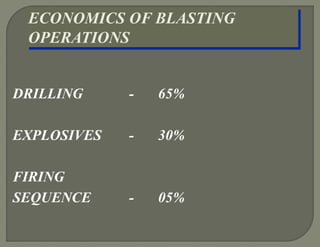
ECONOMICS OF BLASTING
OPERATIONS
DRILLING - 65%
EXPLOSIVES - 30%
FIRING
SEQUENCE - 05%
DRRILLING:
FACTORS TO BE CONSIDERED BEFORE
DRILLING:
• Nature of area
• Depth of hole
• Extent to which rock is broken..
• Out put size.
CLASSIFICATION OF DRILLS:
• Hand Held - Small
• Wheel Mounted - Medium
• Track Mounted - Heavy
BENCH BLAST DESIGN
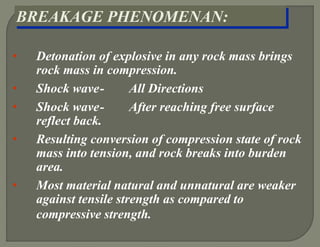
BREAKAGE PHENOMENAN:
• Detonation of explosive in any rock mass brings
rock mass in compression.
• Shock wave- All Directions
• Shock wave- After reaching free surface
reflect back.
• Resulting conversion of compression state of rock
mass into tension, and rock breaks into burden
area.
• Most material natural and unnatural are weaker
against tensile strength as compared to
compressive strength.
BENCH BLAST TERMINOLOGY
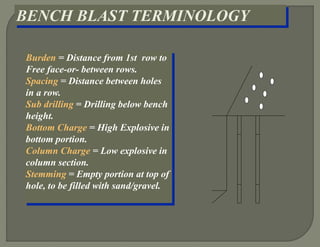
Burden = Distance from 1st row to
Free face-or- between rows.
Spacing = Distance between holes
in a row.
Sub drilling = Drilling below bench
height.
Bottom Charge = High Explosive in
bottom portion.
Column Charge = Low explosive in
column section.
Stemming = Empty portion at top of
hole, to be filled with sand/gravel.
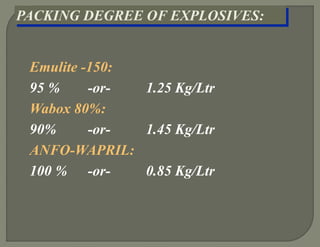
PACKING DEGREE OF EXPLOSIVES:
Emulite -150:
95 % -or- 1.25 Kg/Ltr
Wabox 80%:
90% -or- 1.45 Kg/Ltr
ANFO-WAPRIL:
100 % -or- 0.85 Kg/Ltr
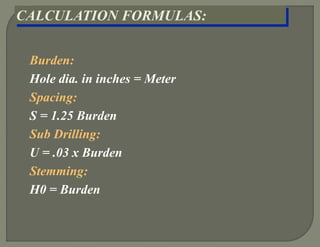
CALCULATION FORMULAS:
Burden:
Hole dia. in inches = Meter
Spacing:
S = 1.25 Burden
Sub Drilling:
U = .03 x Burden
Stemming:
H0 = Burden
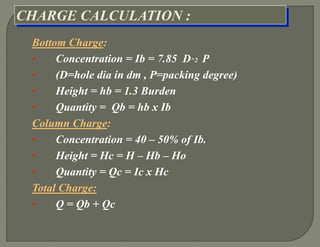
CHARGE CALCULATION :
Bottom Charge:
• Concentration = Ib = 7.85 D^2 P
• (D=hole dia in dm , P=packing degree)
• Height = hb = 1.3 Burden
• Quantity = Qb = hb x Ib
Column Charge:
• Concentration = 40 – 50% of Ib.
• Height = Hc = H – Hb – Ho
• Quantity = Qc = Ic x Hc
Total Charge:
• Q = Qb + Qc
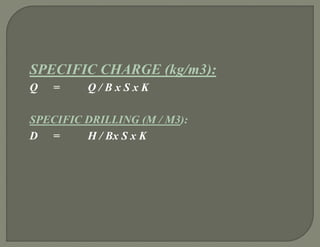
SPECIFIC CHARGE (kg/m3):
Q = Q / B x S x K
SPECIFIC DRILLING (M / M3):
D = H / Bx S x K
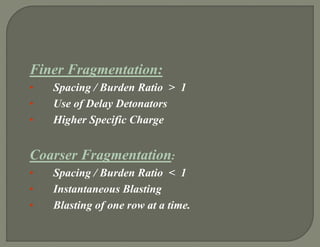
Finer Fragmentation:
• Spacing / Burden Ratio > 1
• Use of Delay Detonators
• Higher Specific Charge
Coarser Fragmentation:
• Spacing / Burden Ratio < 1
• Instantaneous Blasting
• Blasting of one row at a time.

Bench Blasting.pptx

  • 1.
  • 2.
    ECONOMICS OF BLASTING OPERATIONS DRILLING- 65% EXPLOSIVES - 30% FIRING SEQUENCE - 05%
  • 3.
    DRRILLING: FACTORS TO BECONSIDERED BEFORE DRILLING: • Nature of area • Depth of hole • Extent to which rock is broken.. • Out put size. CLASSIFICATION OF DRILLS: • Hand Held - Small • Wheel Mounted - Medium • Track Mounted - Heavy
  • 4.
  • 5.
    BREAKAGE PHENOMENAN: • Detonationof explosive in any rock mass brings rock mass in compression. • Shock wave- All Directions • Shock wave- After reaching free surface reflect back. • Resulting conversion of compression state of rock mass into tension, and rock breaks into burden area. • Most material natural and unnatural are weaker against tensile strength as compared to compressive strength.
  • 6.
    BENCH BLAST TERMINOLOGY Burden= Distance from 1st row to Free face-or- between rows. Spacing = Distance between holes in a row. Sub drilling = Drilling below bench height. Bottom Charge = High Explosive in bottom portion. Column Charge = Low explosive in column section. Stemming = Empty portion at top of hole, to be filled with sand/gravel.
  • 7.
    PACKING DEGREE OFEXPLOSIVES: Emulite -150: 95 % -or- 1.25 Kg/Ltr Wabox 80%: 90% -or- 1.45 Kg/Ltr ANFO-WAPRIL: 100 % -or- 0.85 Kg/Ltr
  • 8.
    CALCULATION FORMULAS: Burden: Hole dia.in inches = Meter Spacing: S = 1.25 Burden Sub Drilling: U = .03 x Burden Stemming: H0 = Burden
  • 9.
    CHARGE CALCULATION : BottomCharge: • Concentration = Ib = 7.85 D^2 P • (D=hole dia in dm , P=packing degree) • Height = hb = 1.3 Burden • Quantity = Qb = hb x Ib Column Charge: • Concentration = 40 – 50% of Ib. • Height = Hc = H – Hb – Ho • Quantity = Qc = Ic x Hc Total Charge: • Q = Qb + Qc
  • 10.
    SPECIFIC CHARGE (kg/m3): Q= Q / B x S x K SPECIFIC DRILLING (M / M3): D = H / Bx S x K
  • 11.
    Finer Fragmentation: • Spacing/ Burden Ratio > 1 • Use of Delay Detonators • Higher Specific Charge Coarser Fragmentation: • Spacing / Burden Ratio < 1 • Instantaneous Blasting • Blasting of one row at a time.