TYPES, KINDS
AND
CLASSIFICATIO
N OF BAKERY
PRODUCTS
TLE BPP 9/10
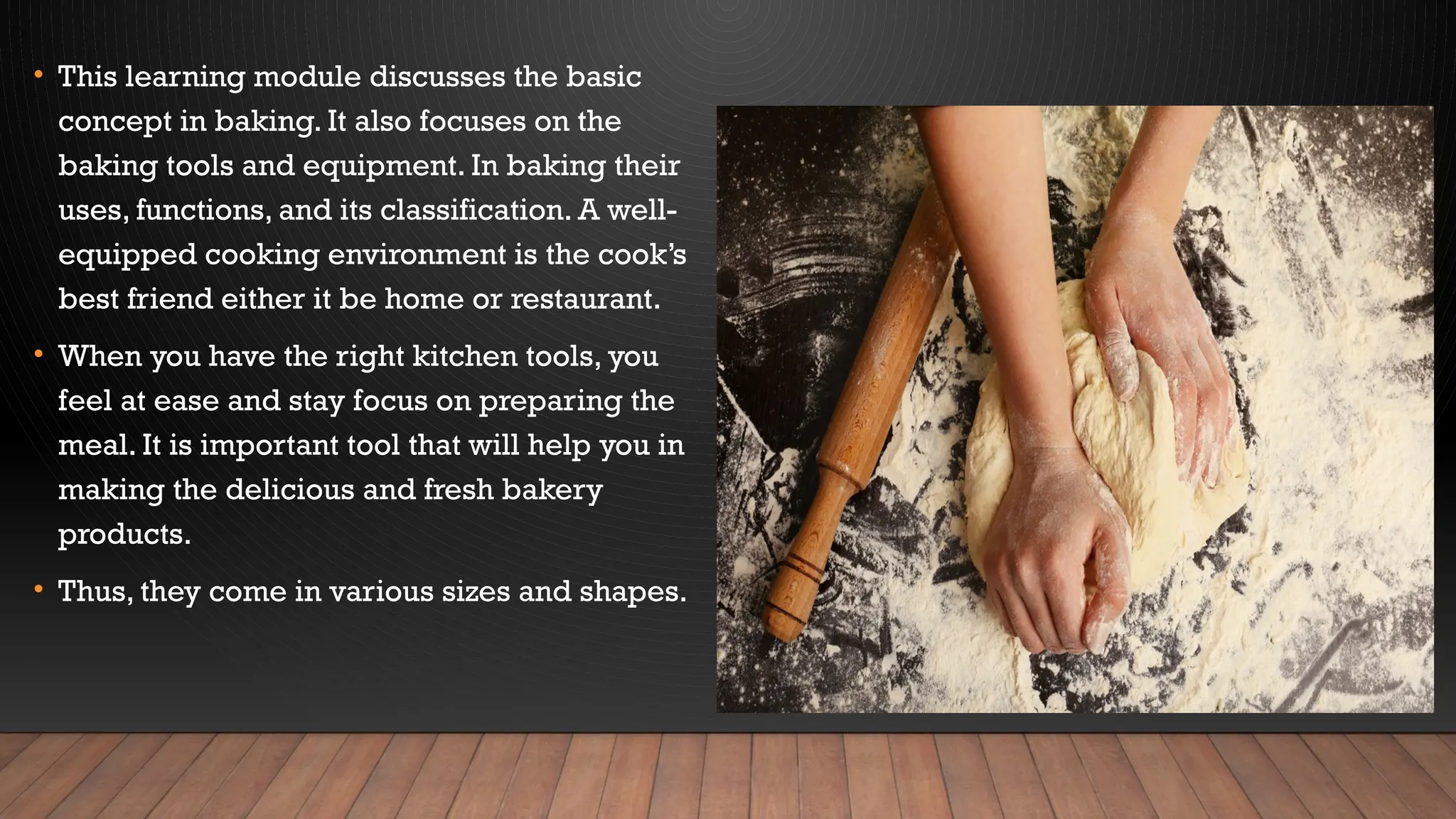
• This learning module discusses the basic
concept in baking. It also focuses on the
baking tools and equipment. In baking their
uses, functions, and its classification. A well-
equipped cooking environment is the cook’s
best friend either it be home or restaurant.
• When you have the right kitchen tools, you
feel at ease and stay focus on preparing the
meal. It is important tool that will help you in
making the delicious and fresh bakery
products.
• Thus, they come in various sizes and shapes.
VOCABULARY LIST
• Bake – To cook food in a dry heat method in an oven.
• Batter- a mixture of flour and liquid such as water, milk, and eggs used to
prepare various food.
• Beat- To make the mixture smooth using a hand or electric mixer
• Blend- To combine ingredients and produce a homogeneous mixture.
• Dough-a A soft thick mass or mixture of dry and liquid ingredients that is
kneaded and shape
• Dust- To sprinkle a surface with flour to avoid a mixture to stick into it.
• Egg wash- It is composed of a mixture of a beaten eggs mixed with liquid,
usually water or milk which is brushed onto the bread
VOCABULARY LIST
Fermentation- The process of converting sugarinto alcohol to produce carbon dioxide.
Grease- To brush baking pans with shortening.
Knead- To press, stretch and fold dough until gluten is developed.
Mis-en-Place- A French term which means “put in place” that includes assembling all
the necessary ingredients, equipment and tools.
Pre-heat- to heat the oven prior to baking to achieve the required heat.
Sift- To pass through a sifter
Stir In – To add another ingredient in the mixture
Yeast- Microorganisms that produce carbon dioxide gas when it mixes with
carbohydrates, causing the dough to rise.
PRE-TEST
COLUMN A
1. It is a dough which is low fat and sugar.
2. It is a staple food prepared from dough of flour and water,
usually by baking.
3. It is a general term that includes stirring, beating, blending,
binding, creaming, whipping and folding.
4. They are really “little cakes”, flat, sweet and small.
5. It is utilized for combining enriched dough, meaning dough
that contains fat, sugar, and sometimes eggs and milk.
COLUMN B
a. Mixing
b. Bread
c. Modified straight
Dough
d. Cookies
e. Lean Dough
TYPES, KINDS CLASSIFICATION OF BAKERY
PRODUCTS
BREAD
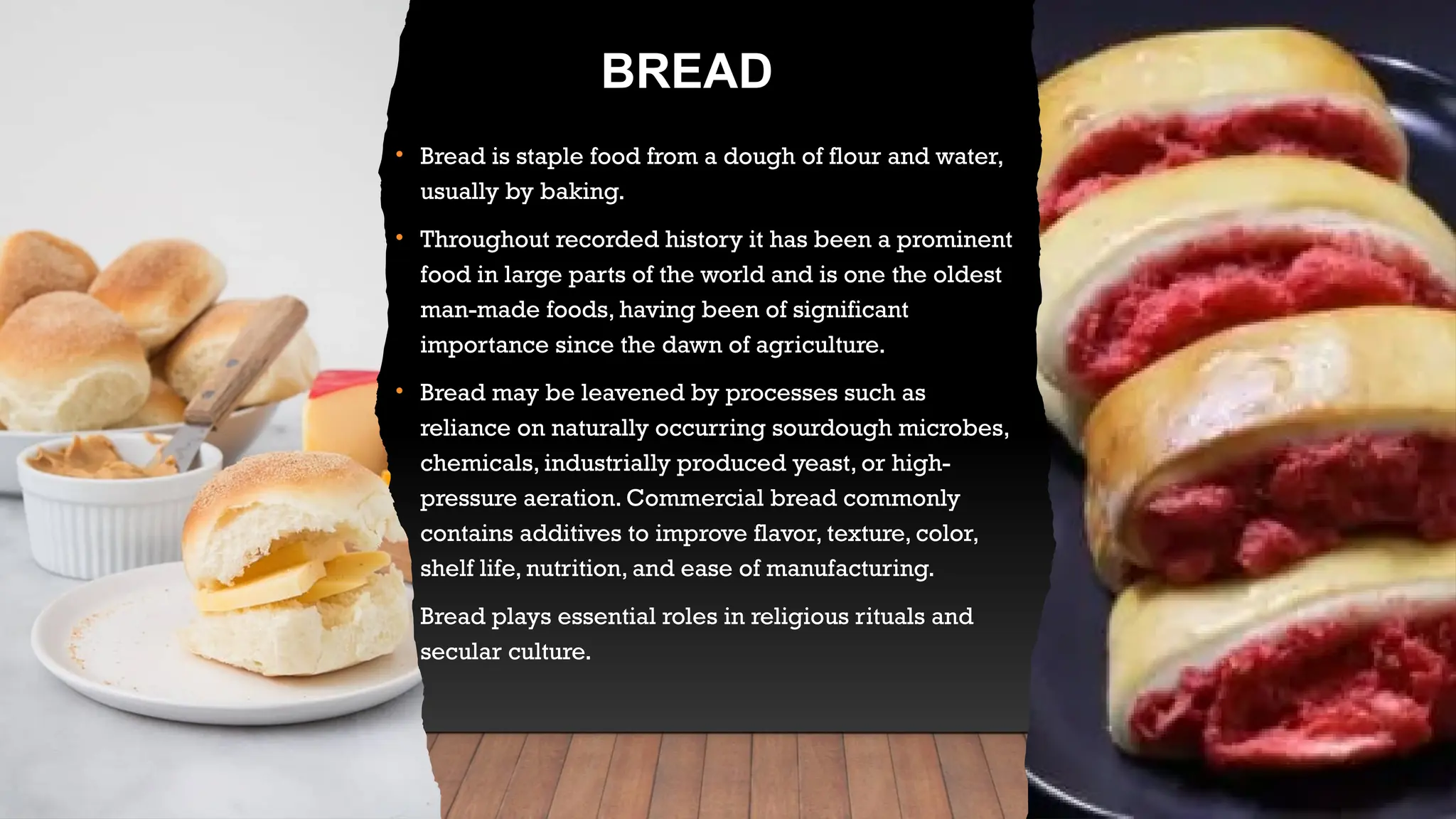
• Bread is staple food from a dough of flour and water,
usually by baking.
• Throughout recorded history it has been a prominent
food in large parts of the world and is one the oldest
man-made foods, having been of significant
importance since the dawn of agriculture.
• Bread may be leavened by processes such as
reliance on naturally occurring sourdough microbes,
chemicals, industrially produced yeast, or high-
pressure aeration. Commercial bread commonly
contains additives to improve flavor, texture, color,
shelf life, nutrition, and ease of manufacturing.
• Bread plays essential roles in religious rituals and
secular culture.
KINDS OF DOUGH IN BAKING
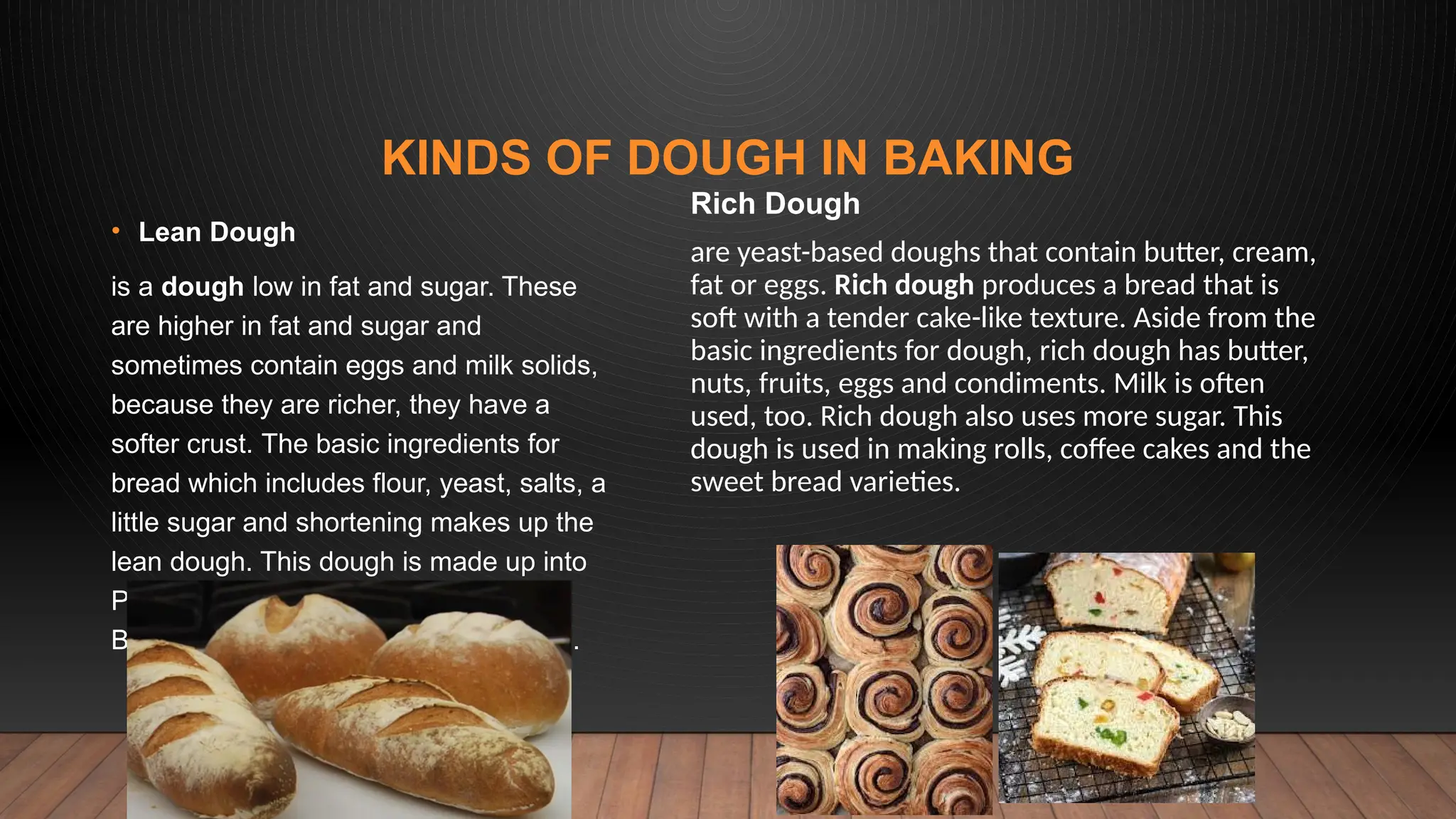
• Lean Dough
is a dough low in fat and sugar. These
are higher in fat and sugar and
sometimes contain eggs and milk solids,
because they are richer, they have a
softer crust. The basic ingredients for
bread which includes flour, yeast, salts, a
little sugar and shortening makes up the
lean dough. This dough is made up into
Pan de Sal, Pan Amerikano, French
Bread and other crusty bread varieties.
Rich Dough
are yeast-based doughs that contain butter, cream,
fat or eggs. Rich dough produces a bread that is
soft with a tender cake-like texture. Aside from the
basic ingredients for dough, rich dough has butter,
nuts, fruits, eggs and condiments. Milk is often
used, too. Rich dough also uses more sugar. This
dough is used in making rolls, coffee cakes and the
sweet bread varieties.
METHODS OF MIXING DOUGH:
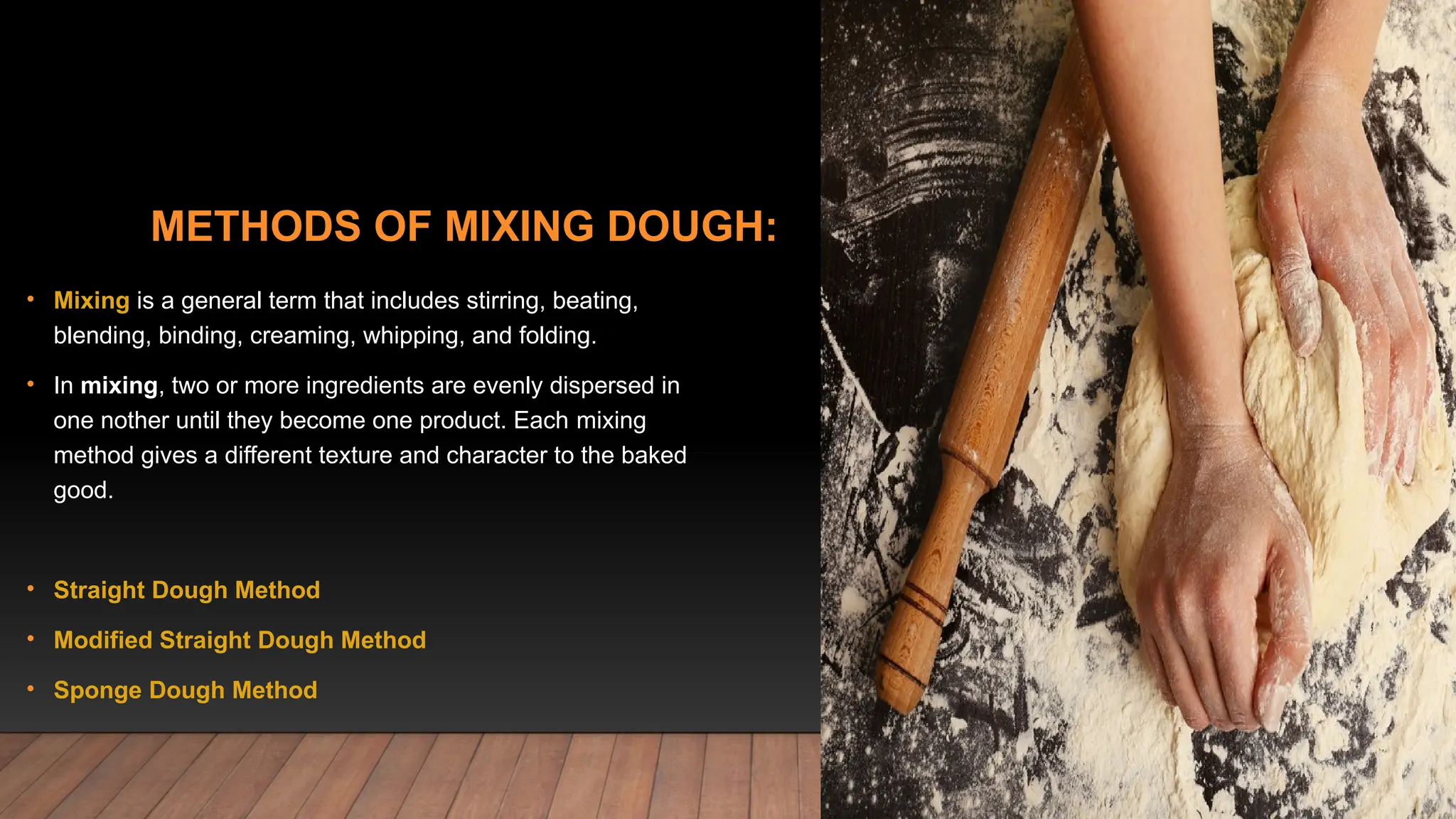
• Mixing is a general term that includes stirring, beating,
blending, binding, creaming, whipping, and folding.
• In mixing, two or more ingredients are evenly dispersed in
one nother until they become one product. Each mixing
method gives a different texture and character to the baked
good.
• Straight Dough Method
• Modified Straight Dough Method
• Sponge Dough Method
STRAIGHT DOUGH METHOD
 This method combines all the ingredients together at one time to make the dough.
The dough is kneaded and set aside to rise.
•Steps involved in the straight dough method:
•Step 1: Mixing the Dough. Bread dough can be mixed by hand
or in a machine
•Step 2: Kneading the dough by hand
• Step 3: First rise
• Step 4: Shaping the dough and the final rise
• Step 5: Testing
• Step 6: Baking
MODIFIED STRAIGHT DOUGH METHOD
•utilized for combining enriched dough, meaning dough that contains fat, sugar, and
sometimes eggs and milk. The purpose of the modified straight dough method is to
ensure even distribution of the fat and sugar present in enriched dough. This method
is very simple but requires a few more steps compared to The Straight Dough Method.
Steps in Making Modified Straight Dough Method
1. Mix the yeast with the liquid.
2. Combine the fat, sugar, salt, and flavorings. If the bread includes dry milk powder, this
will also be added in this step.
3. Add the eggs, one at a time, mixing until fully combined before adding the next egg.
4. Add the liquid/yeast mixture and stir to combine.
5. Add the flour and mix until it is all saturated.
6. Follow the recipe’s procedure for either kneading or
following the stretch and fold method for building the gluten
structure.
7.Follow the recipe’s procedure for fermentation.
8.Release the gas out of the dough by pressing down in the
middle and folding the sides over the top of the dough,
“punching”.
10Shape the bread and let it rise until double in volume.
11.Bake.
SPONGE DOUGH METHOD
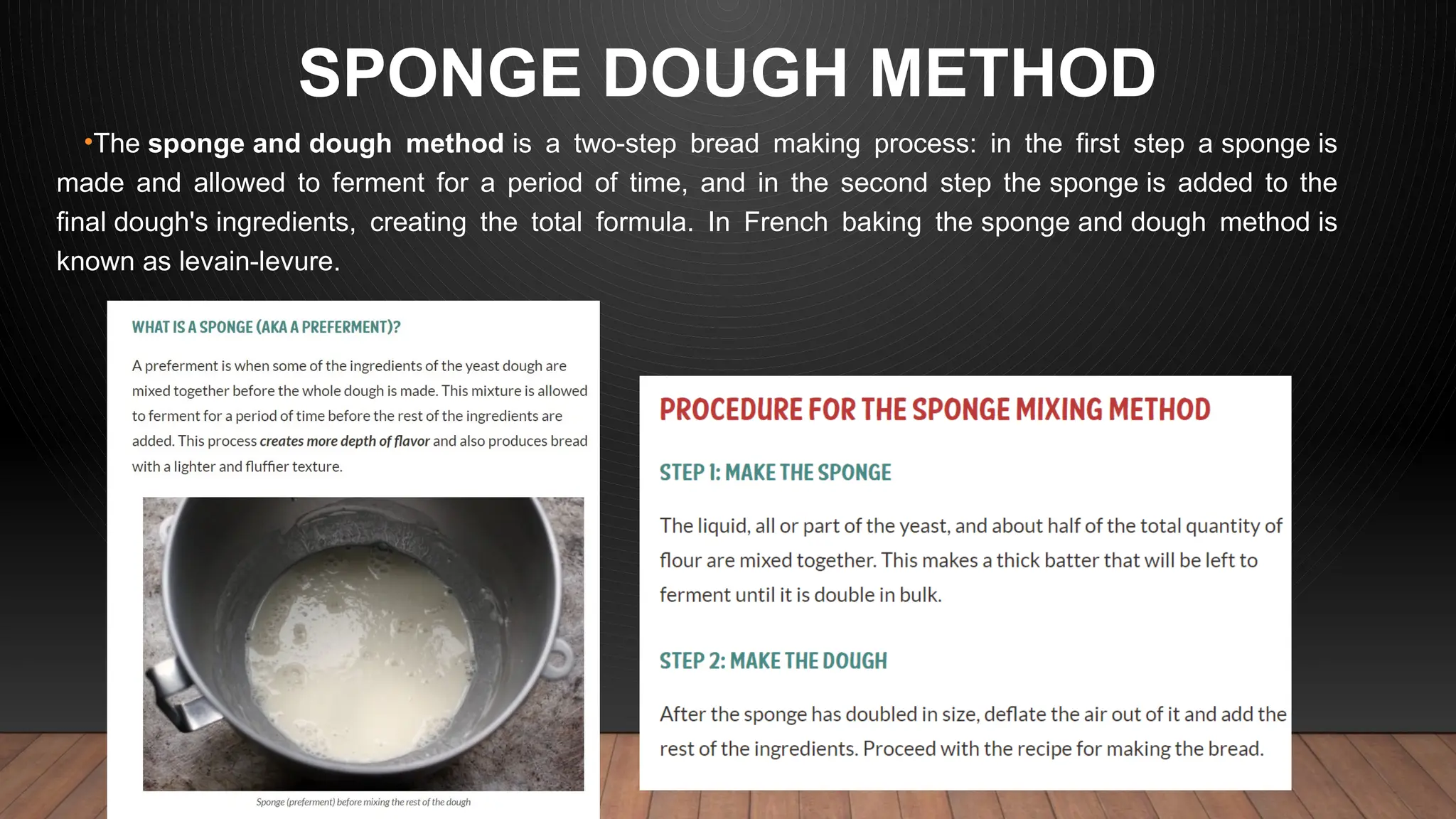
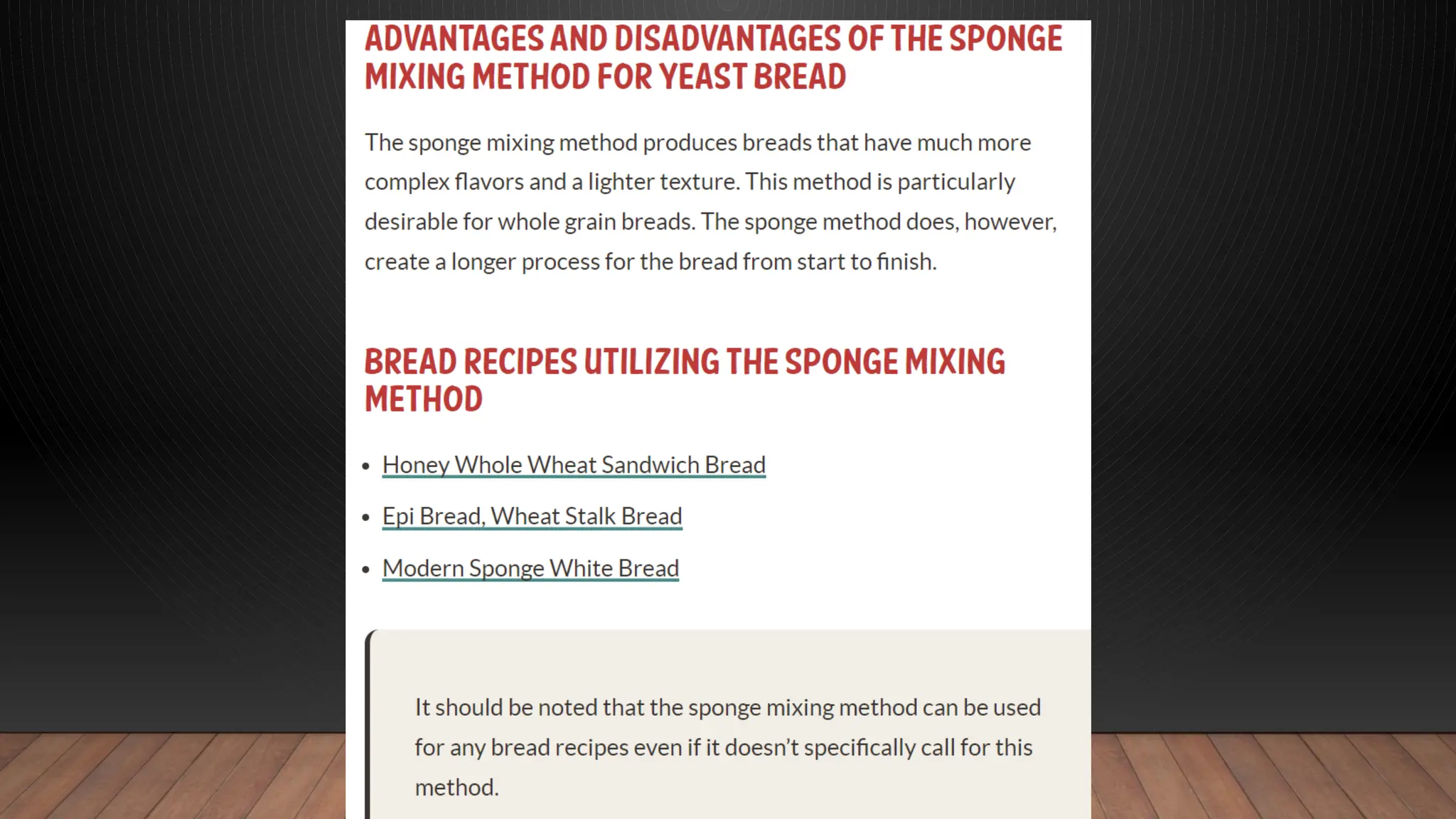
•The sponge and dough method is a two-step bread making process: in the first step a sponge is
made and allowed to ferment for a period of time, and in the second step the sponge is added to the
final dough's ingredients, creating the total formula. In French baking the sponge and dough method is
known as levain-levure.
CHARACTERISTICS OF
A WELL-MADE BREAD
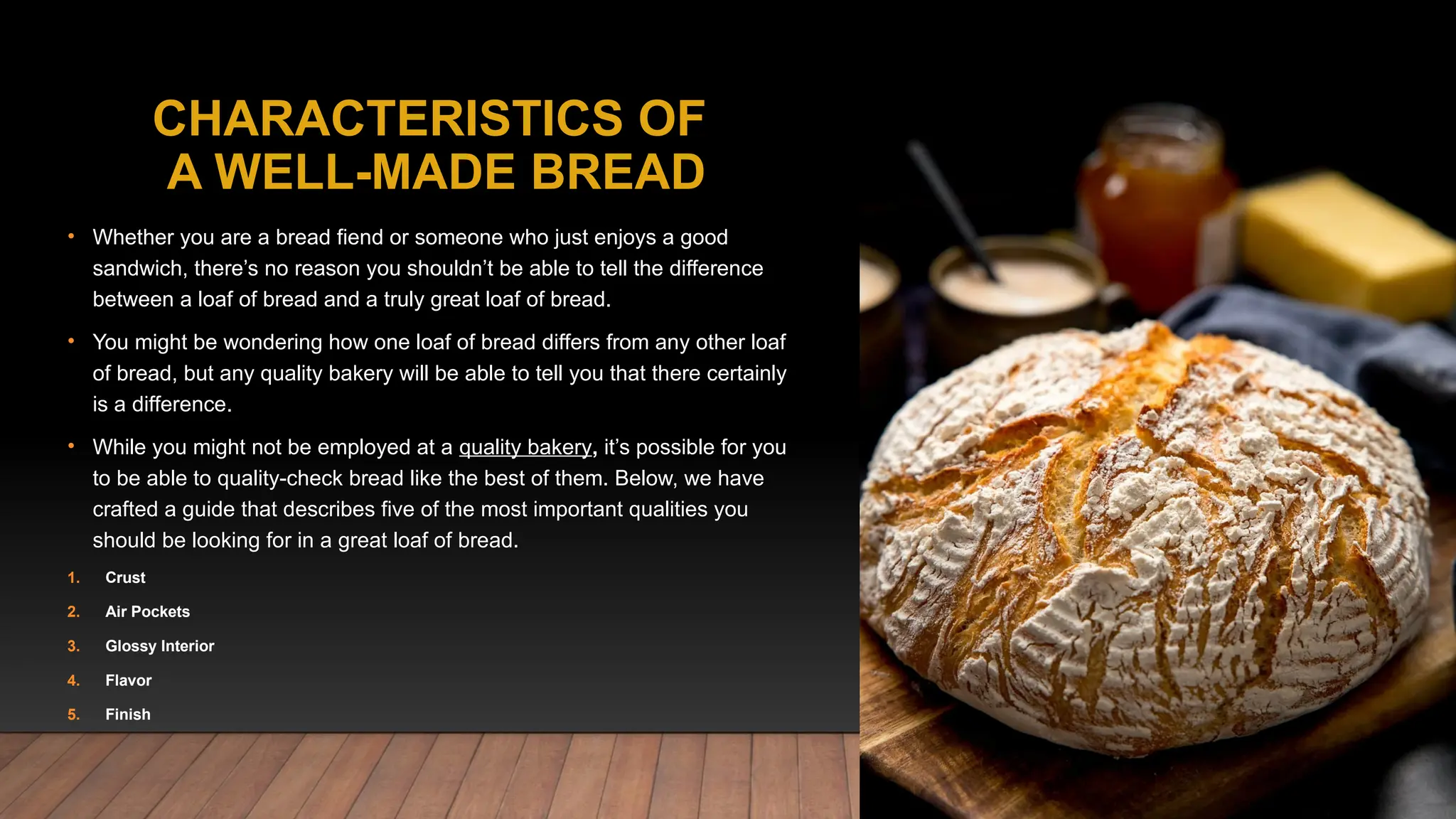
• Whether you are a bread fiend or someone who just enjoys a good
sandwich, there’s no reason you shouldn’t be able to tell the difference
between a loaf of bread and a truly great loaf of bread.
• You might be wondering how one loaf of bread differs from any other loaf
of bread, but any quality bakery will be able to tell you that there certainly
is a difference.
• While you might not be employed at a quality bakery, it’s possible for you
to be able to quality-check bread like the best of them. Below, we have
crafted a guide that describes five of the most important qualities you
should be looking for in a great loaf of bread.
1. Crust
2. Air Pockets
3. Glossy Interior
4. Flavor
5. Finish
CRUST
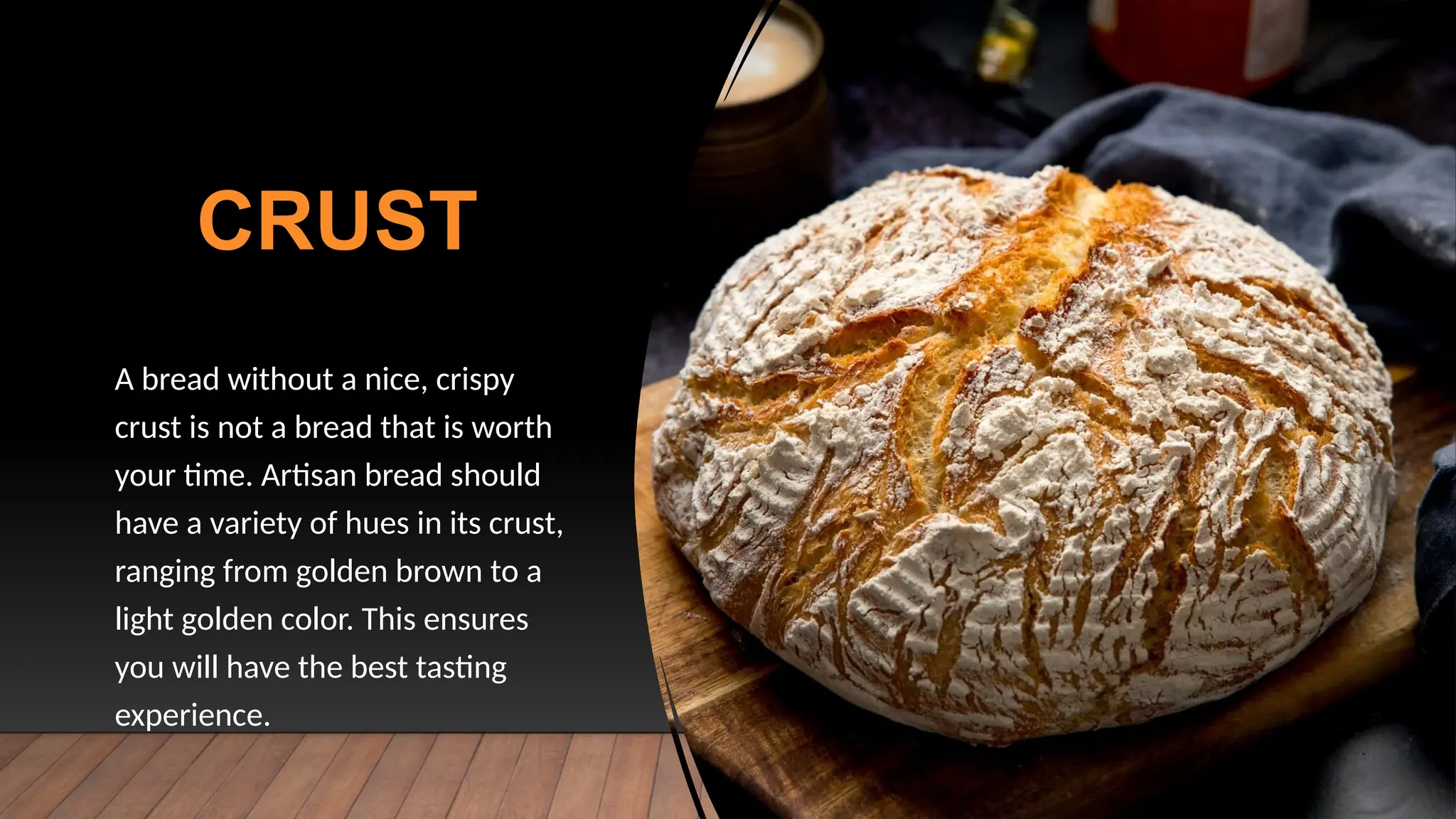
A bread without a nice, crispy
crust is not a bread that is worth
your time. Artisan bread should
have a variety of hues in its crust,
ranging from golden brown to a
light golden color. This ensures
you will have the best tasting
experience.
AIR
POCKETS
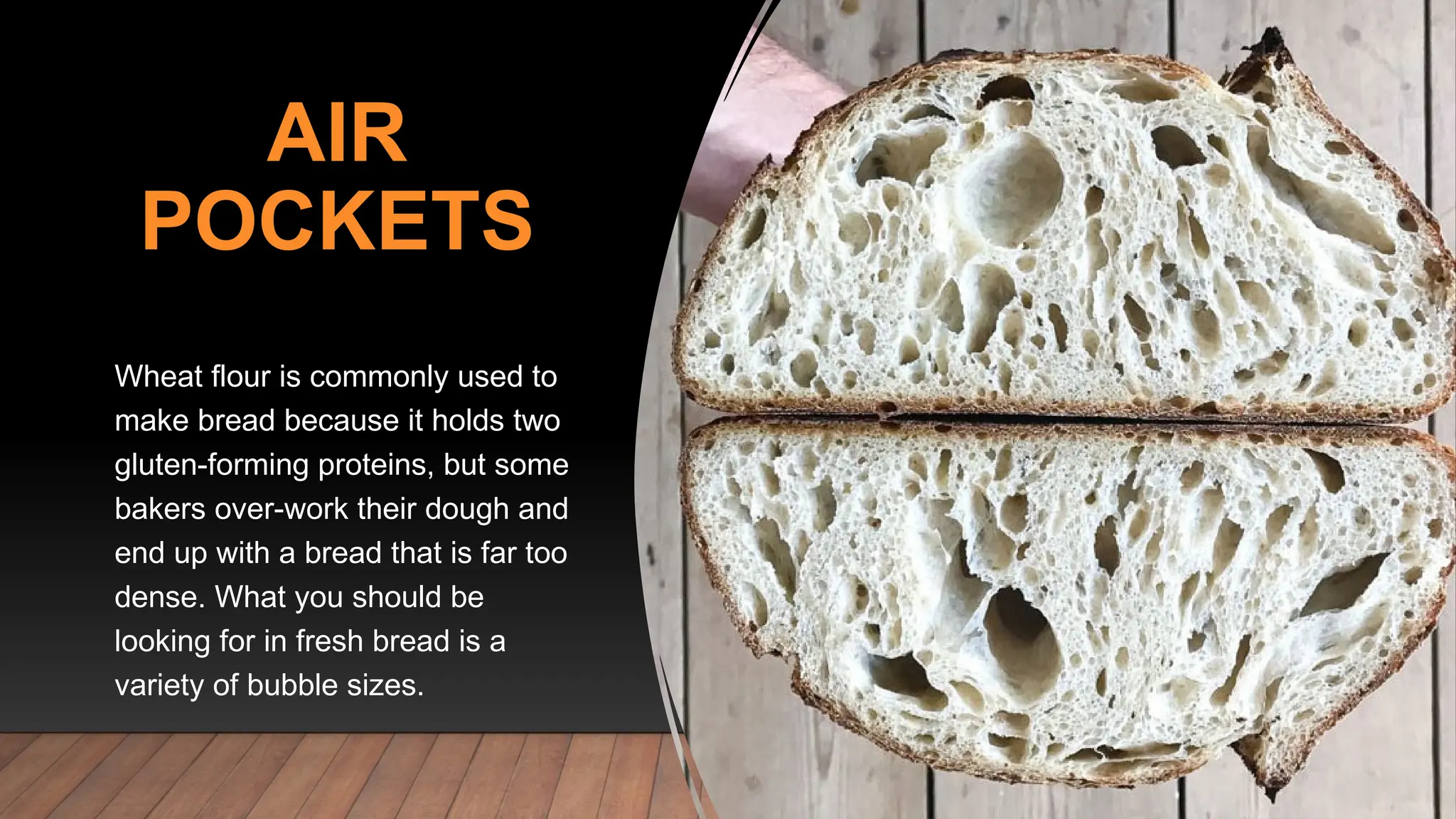
Wheat flour is commonly used to
make bread because it holds two
gluten-forming proteins, but some
bakers over-work their dough and
end up with a bread that is far too
dense. What you should be
looking for in fresh bread is a
variety of bubble sizes.
GLOSSY
INTERIOR
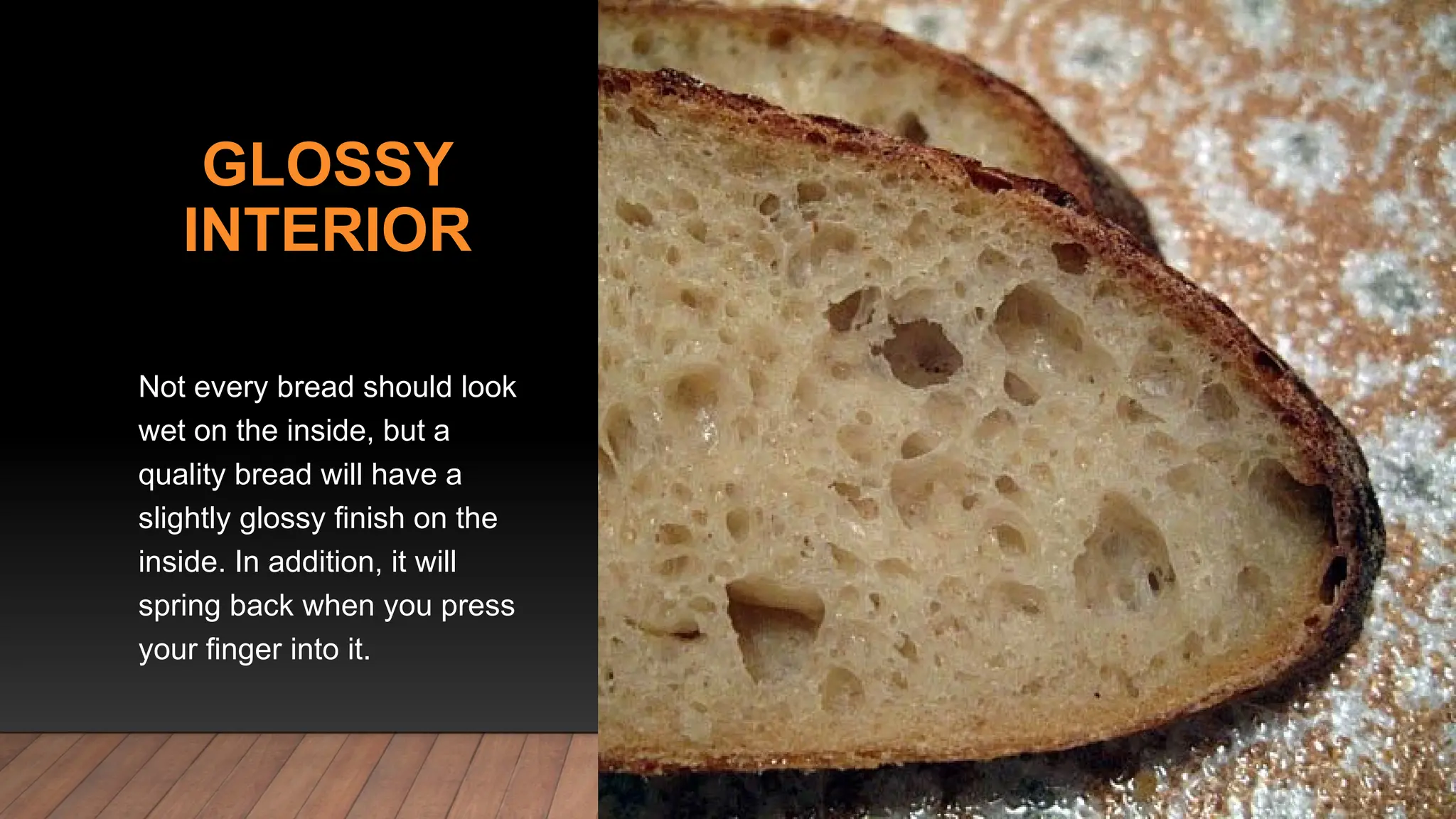
Not every bread should look
wet on the inside, but a
quality bread will have a
slightly glossy finish on the
inside. In addition, it will
spring back when you press
your finger into it.
FLAVOR
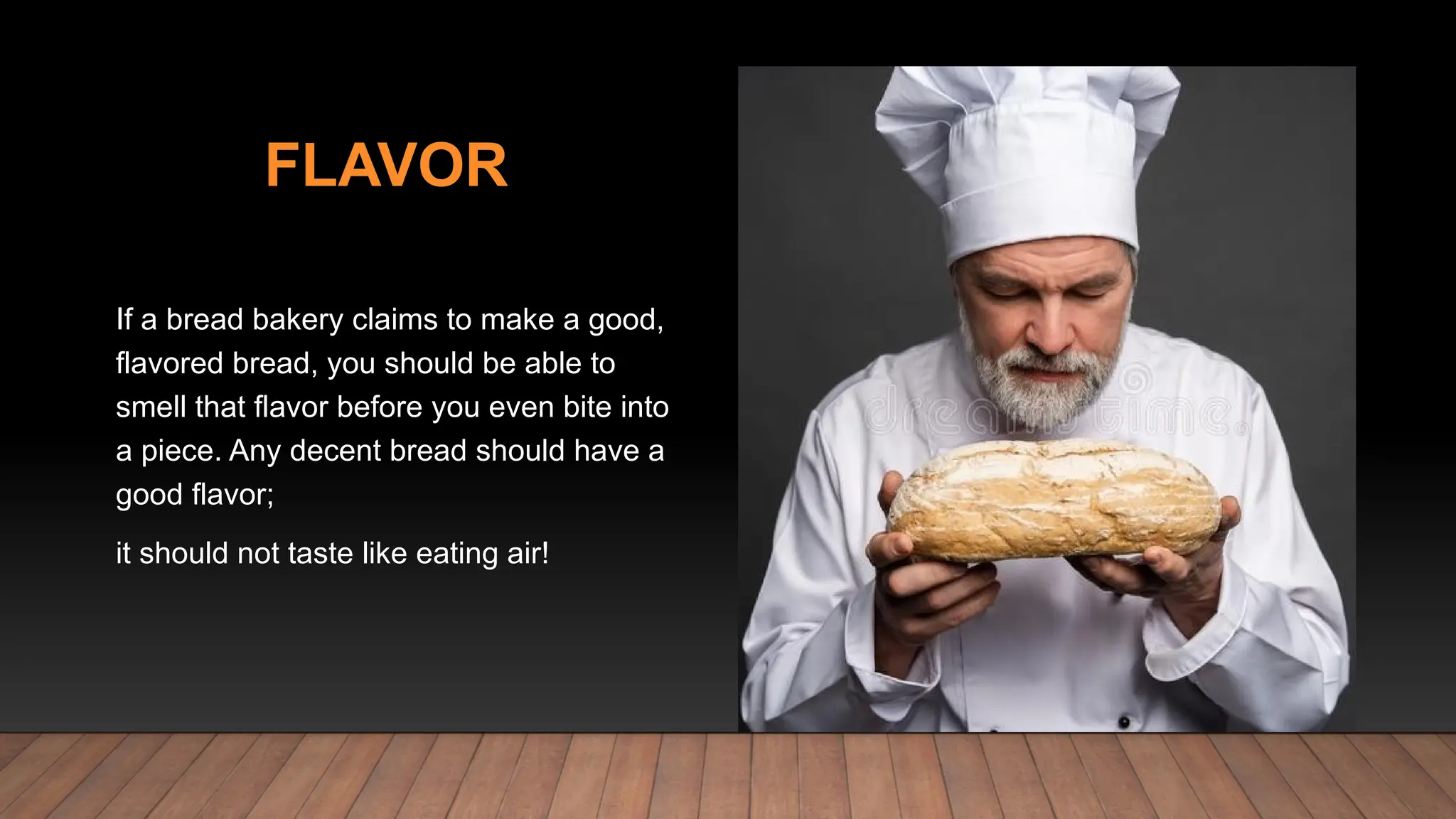
If a bread bakery claims to make a good,
flavored bread, you should be able to
smell that flavor before you even bite into
a piece. Any decent bread should have a
good flavor;
it should not taste like eating air!
FINISH
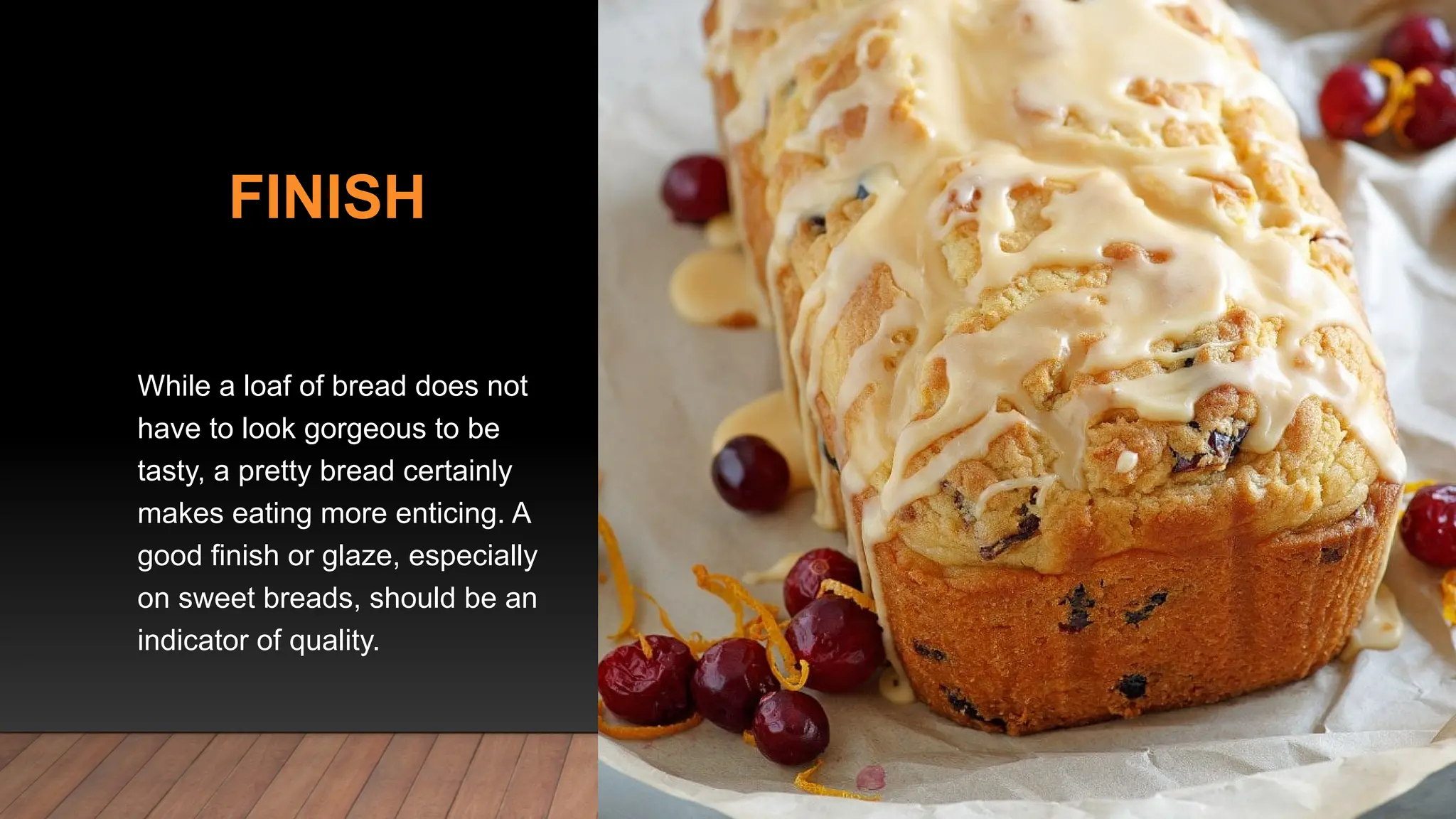
While a loaf of bread does not
have to look gorgeous to be
tasty, a pretty bread certainly
makes eating more enticing. A
good finish or glaze, especially
on sweet breads, should be an
indicator of quality.
COOKIES
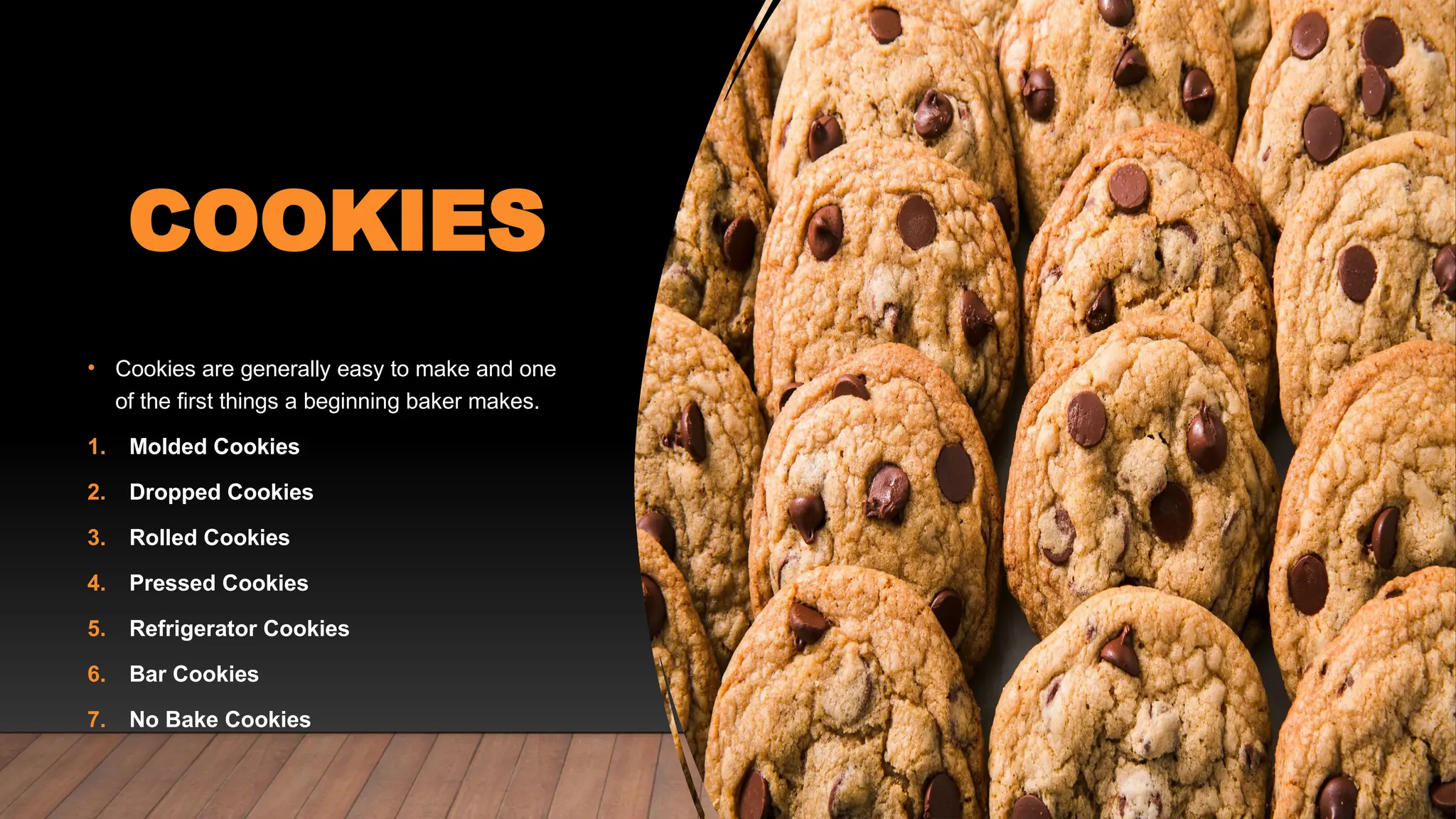
• Cookies are generally easy to make and one
of the first things a beginning baker makes.
1. Molded Cookies
2. Dropped Cookies
3. Rolled Cookies
4. Pressed Cookies
5. Refrigerator Cookies
6. Bar Cookies
7. No Bake Cookies
MOLDED COOKIES
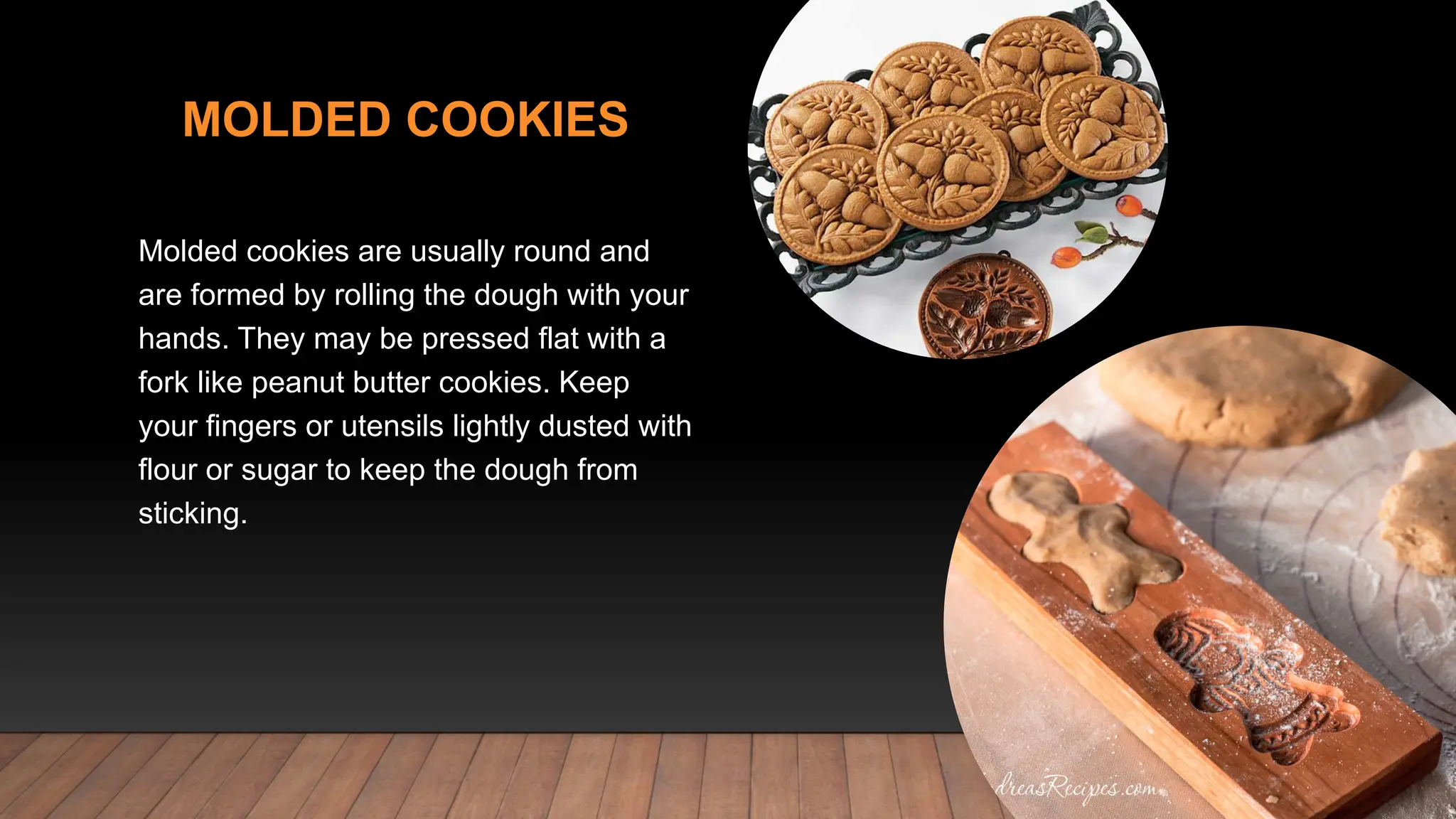
Molded cookies are usually round and
are formed by rolling the dough with your
hands. They may be pressed flat with a
fork like peanut butter cookies. Keep
your fingers or utensils lightly dusted with
flour or sugar to keep the dough from
sticking.
DROPPED COOKIES
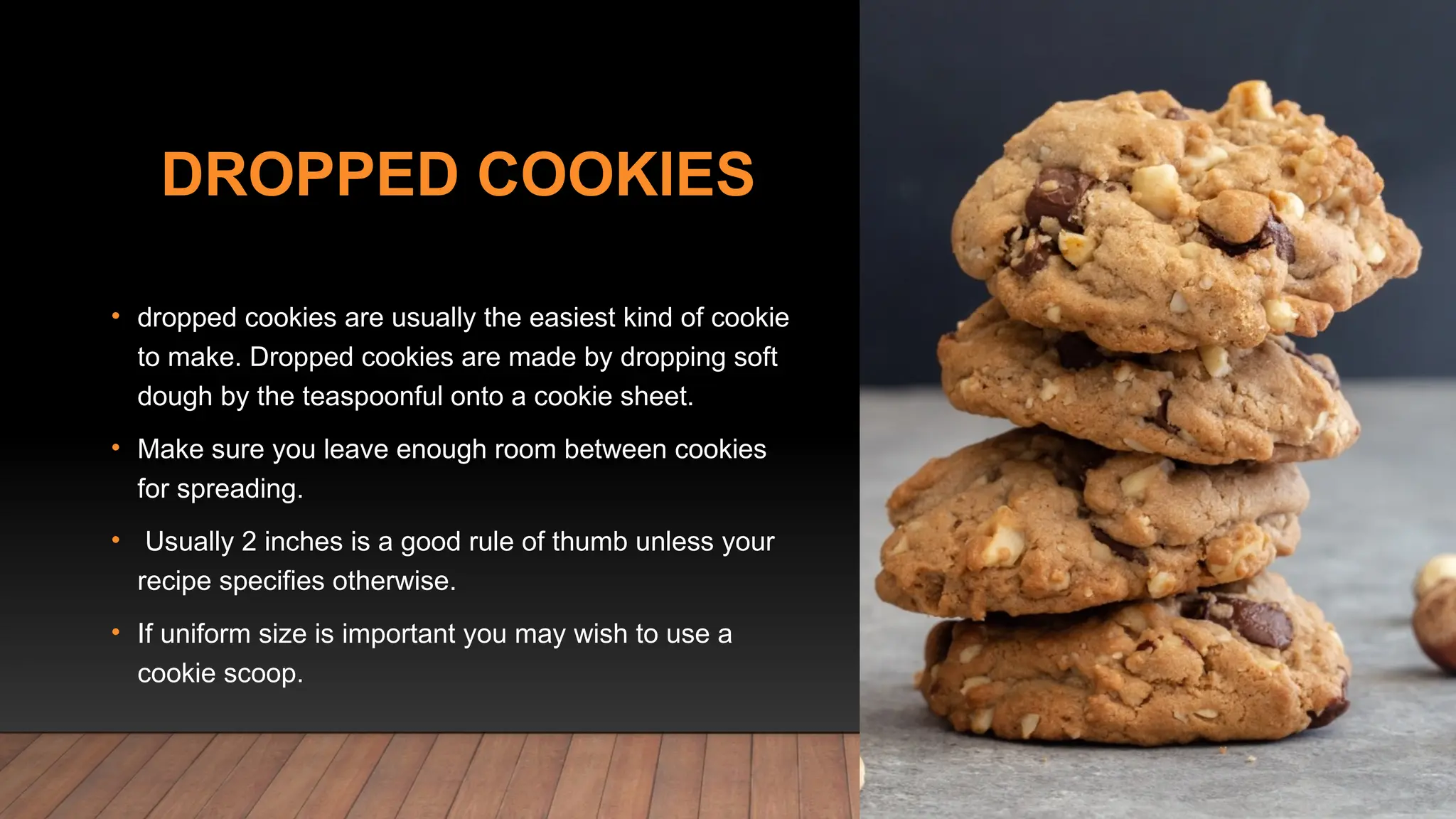
• dropped cookies are usually the easiest kind of cookie
to make. Dropped cookies are made by dropping soft
dough by the teaspoonful onto a cookie sheet.
• Make sure you leave enough room between cookies
for spreading.
• Usually 2 inches is a good rule of thumb unless your
recipe specifies otherwise.
• If uniform size is important you may wish to use a
cookie scoop.
ROLLED COOKIES
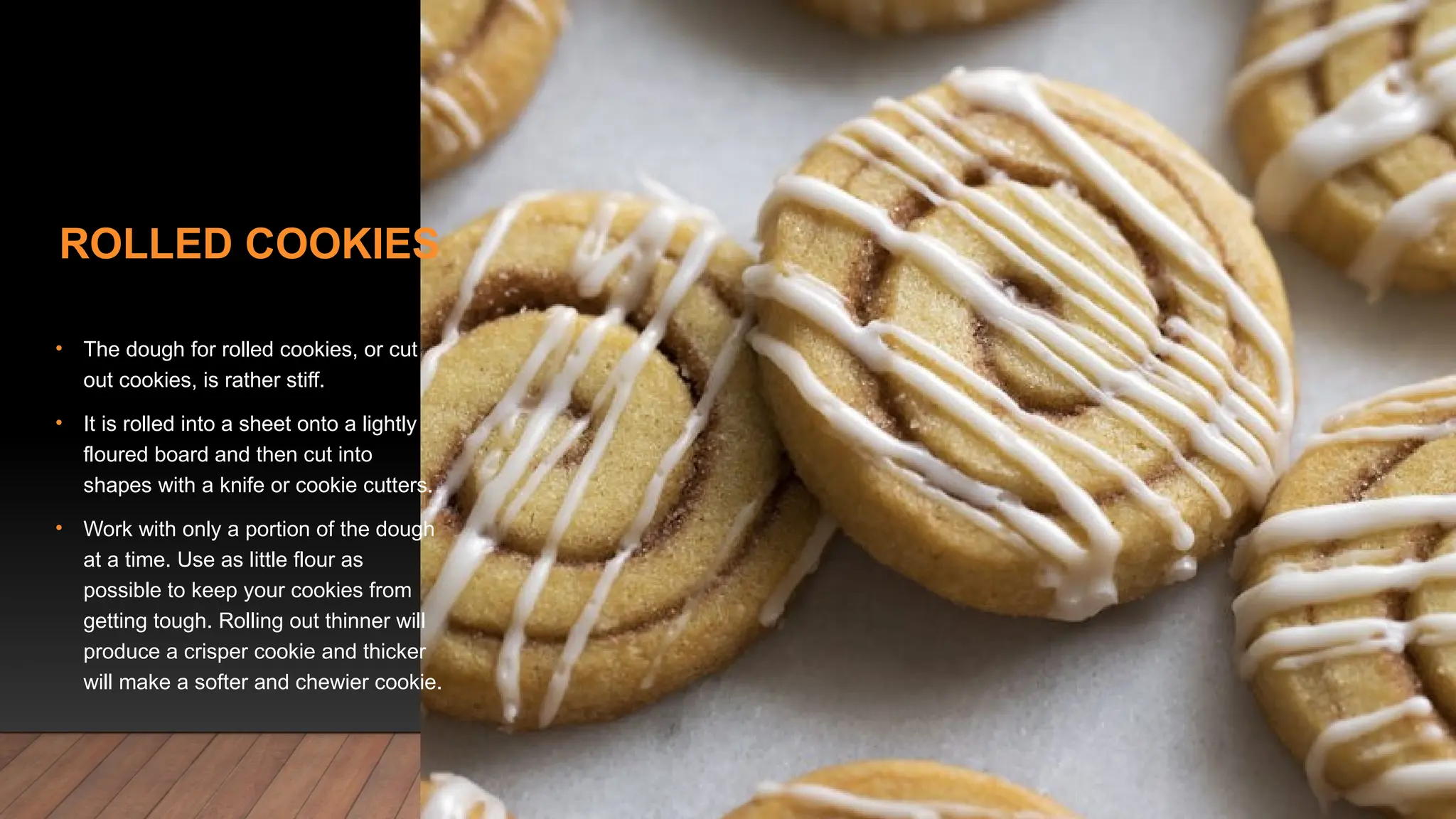
• The dough for rolled cookies, or cut
out cookies, is rather stiff.
• It is rolled into a sheet onto a lightly
floured board and then cut into
shapes with a knife or cookie cutters.
• Work with only a portion of the dough
at a time. Use as little flour as
possible to keep your cookies from
getting tough. Rolling out thinner will
produce a crisper cookie and thicker
will make a softer and chewier cookie.
PRESSED COOKIES
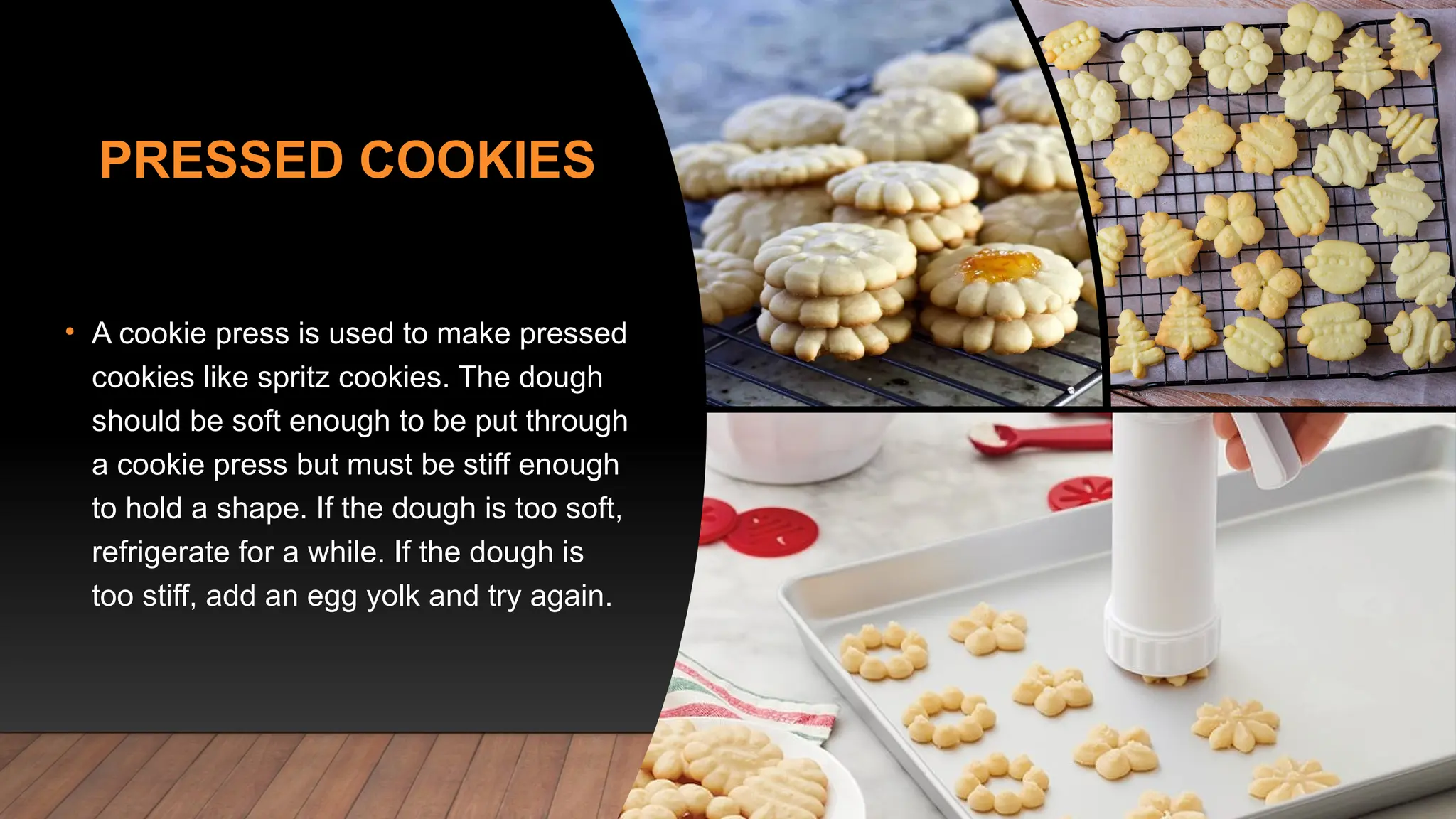
• A cookie press is used to make pressed
cookies like spritz cookies. The dough
should be soft enough to be put through
a cookie press but must be stiff enough
to hold a shape. If the dough is too soft,
refrigerate for a while. If the dough is
too stiff, add an egg yolk and try again.
REFRIGERATOR
COOKIES
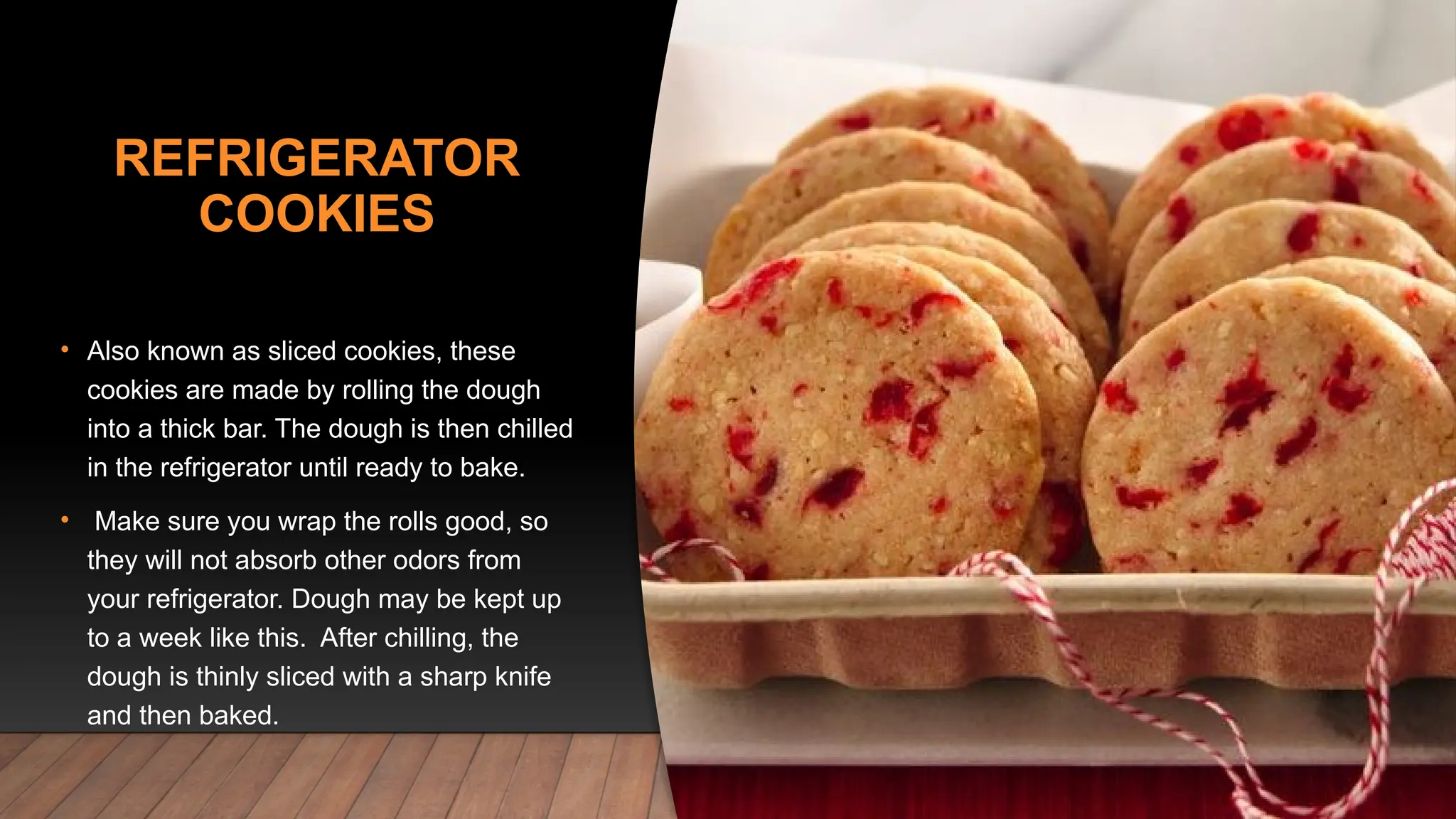
• Also known as sliced cookies, these
cookies are made by rolling the dough
into a thick bar. The dough is then chilled
in the refrigerator until ready to bake.
• Make sure you wrap the rolls good, so
they will not absorb other odors from
your refrigerator. Dough may be kept up
to a week like this. After chilling, the
dough is thinly sliced with a sharp knife
and then baked.
BAR COOKIES
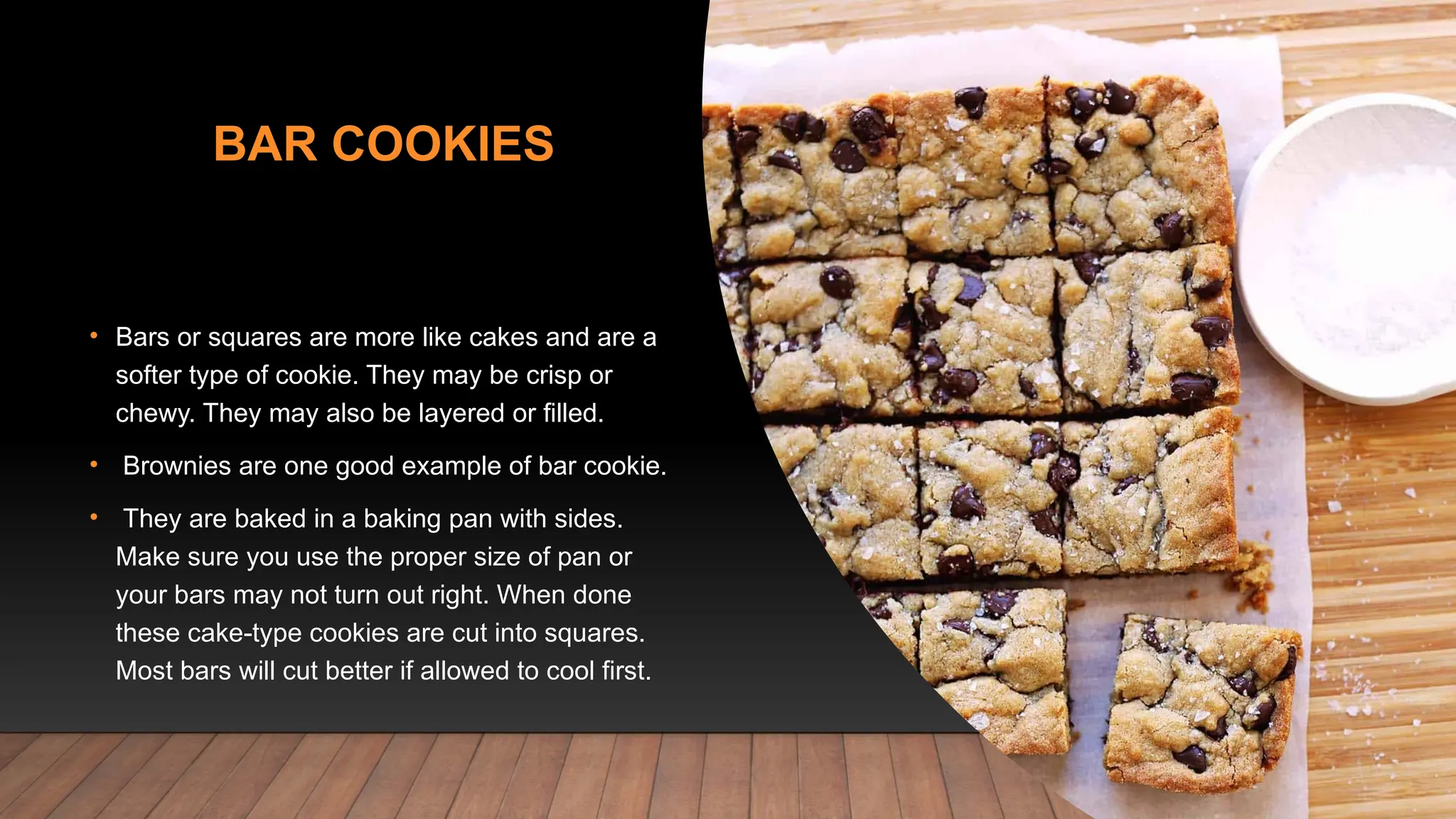
• Bars or squares are more like cakes and are a
softer type of cookie. They may be crisp or
chewy. They may also be layered or filled.
• Brownies are one good example of bar cookie.
• They are baked in a baking pan with sides.
Make sure you use the proper size of pan or
your bars may not turn out right. When done
these cake-type cookies are cut into squares.
Most bars will cut better if allowed to cool first.
NO BAKE COOKIES
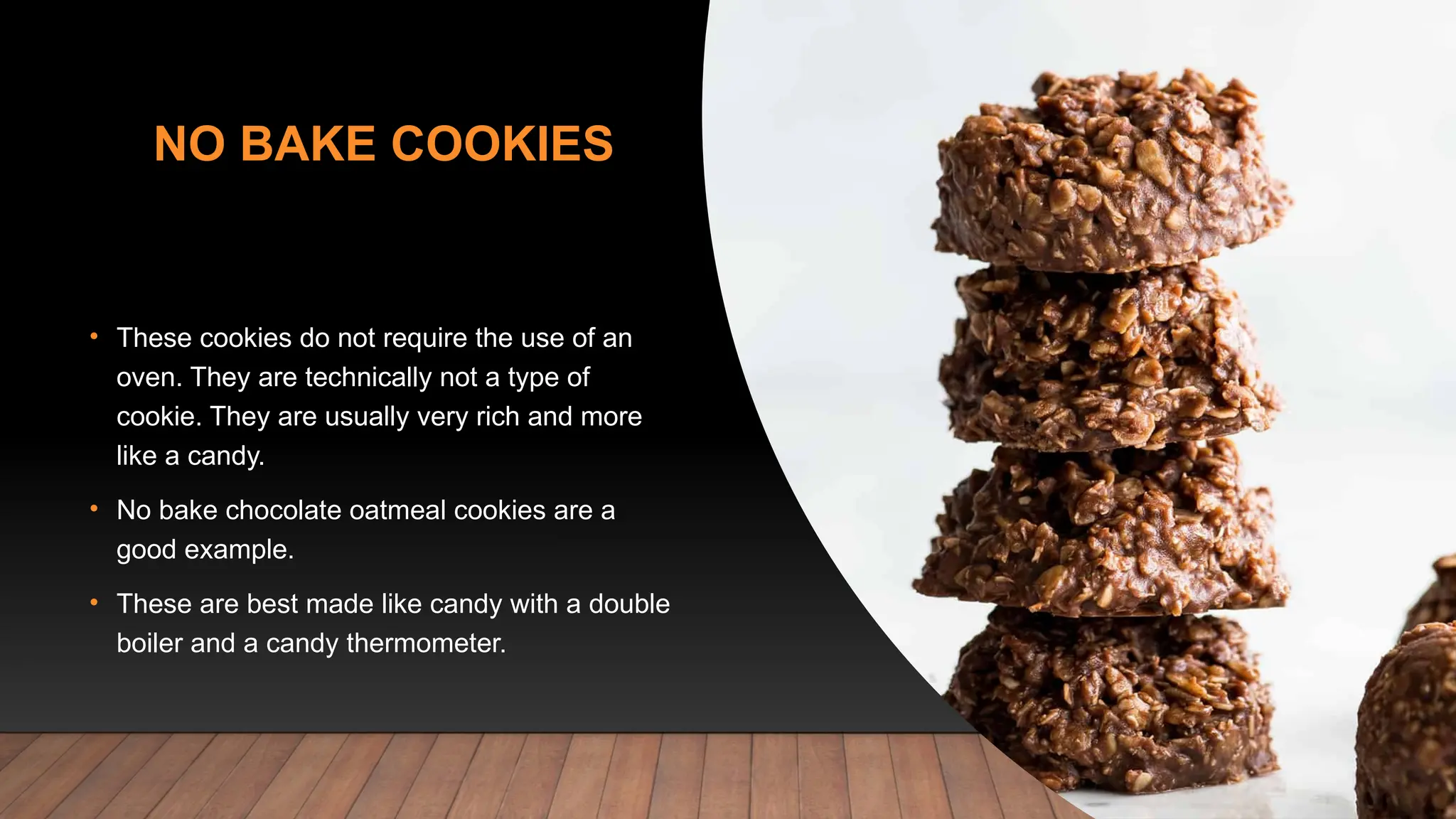
• These cookies do not require the use of an
oven. They are technically not a type of
cookie. They are usually very rich and more
like a candy.
• No bake chocolate oatmeal cookies are a
good example.
• These are best made like candy with a double
boiler and a candy thermometer.
MIXING
TECHNIQUES
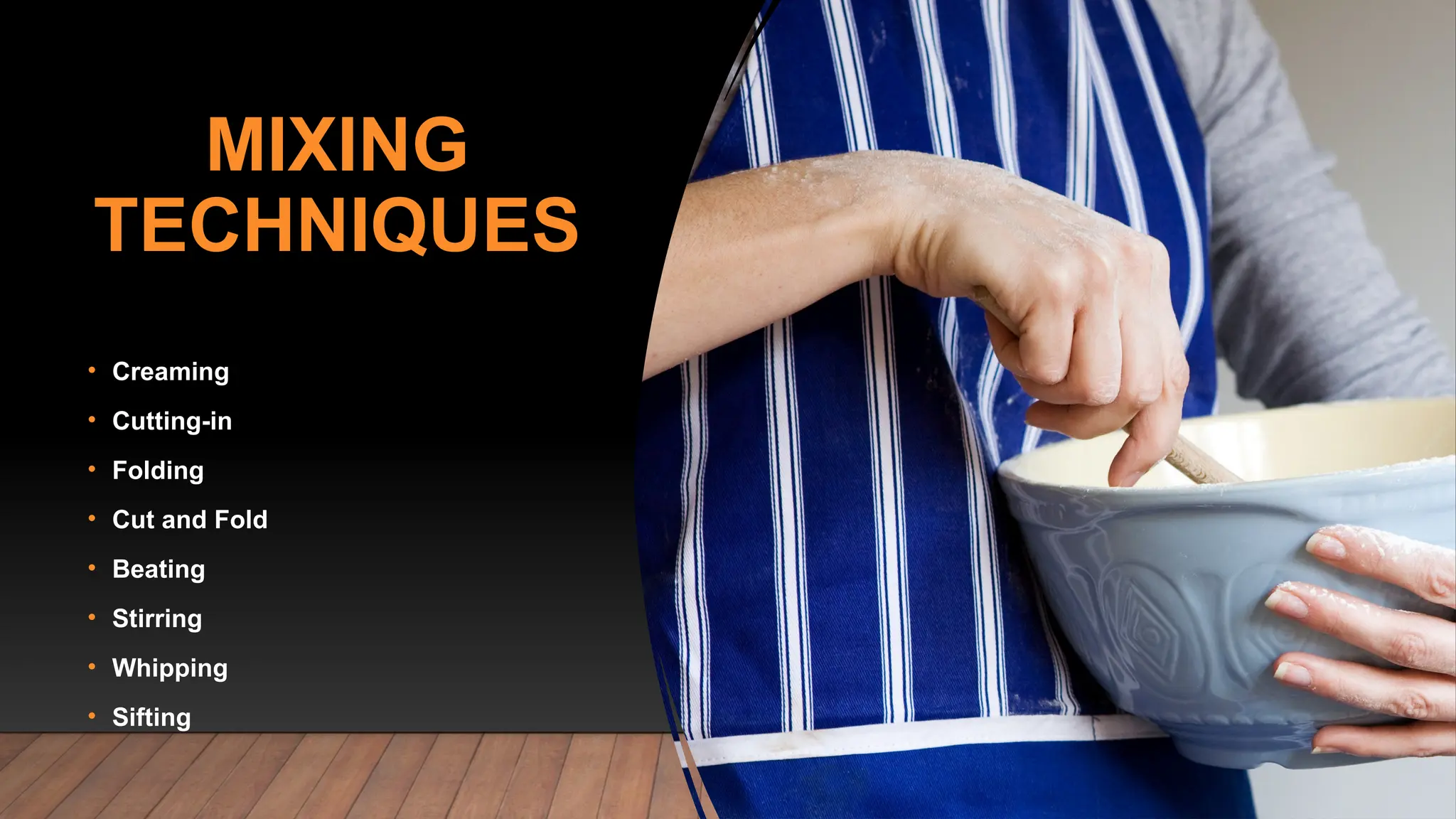
• Creaming
• Cutting-in
• Folding
• Cut and Fold
• Beating
• Stirring
• Whipping
• Sifting
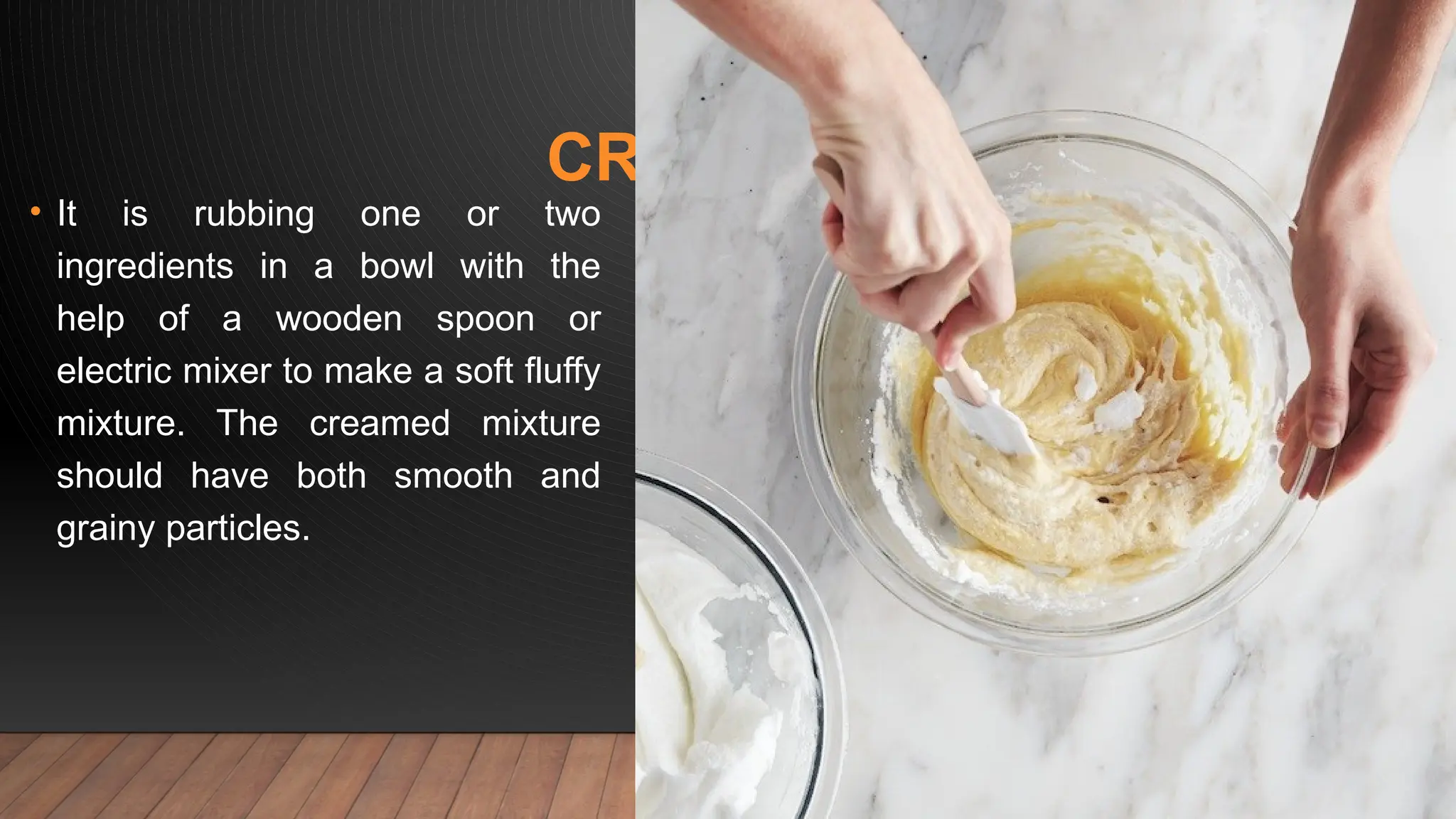
CREAMING
• It is rubbing one or two
ingredients in a bowl with the
help of a wooden spoon or
electric mixer to make a soft fluffy
mixture. The creamed mixture
should have both smooth and
grainy particles.
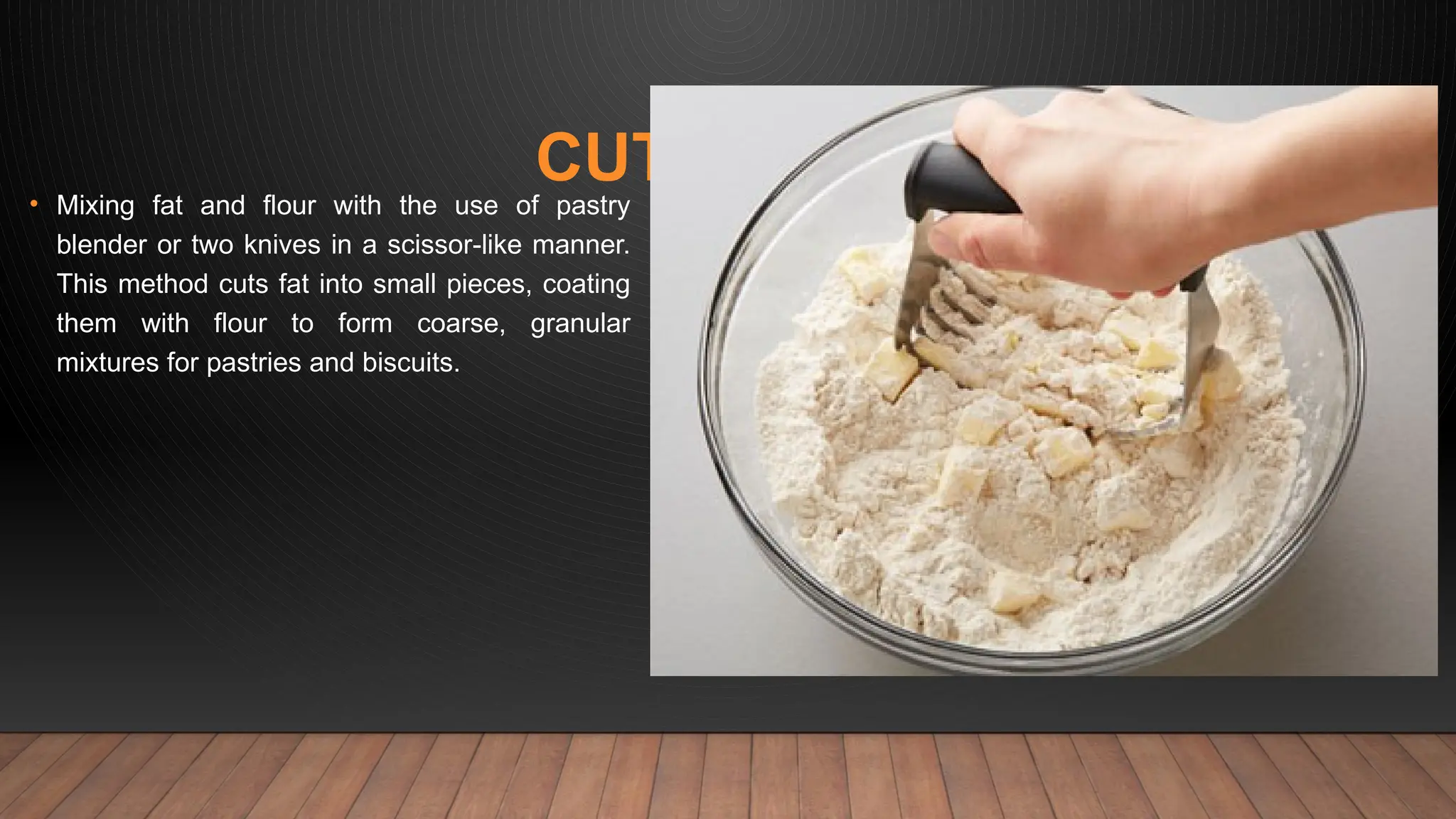
CUTTING-IN
• Mixing fat and flour with the use of pastry
blender or two knives in a scissor-like manner.
This method cuts fat into small pieces, coating
them with flour to form coarse, granular
mixtures for pastries and biscuits.
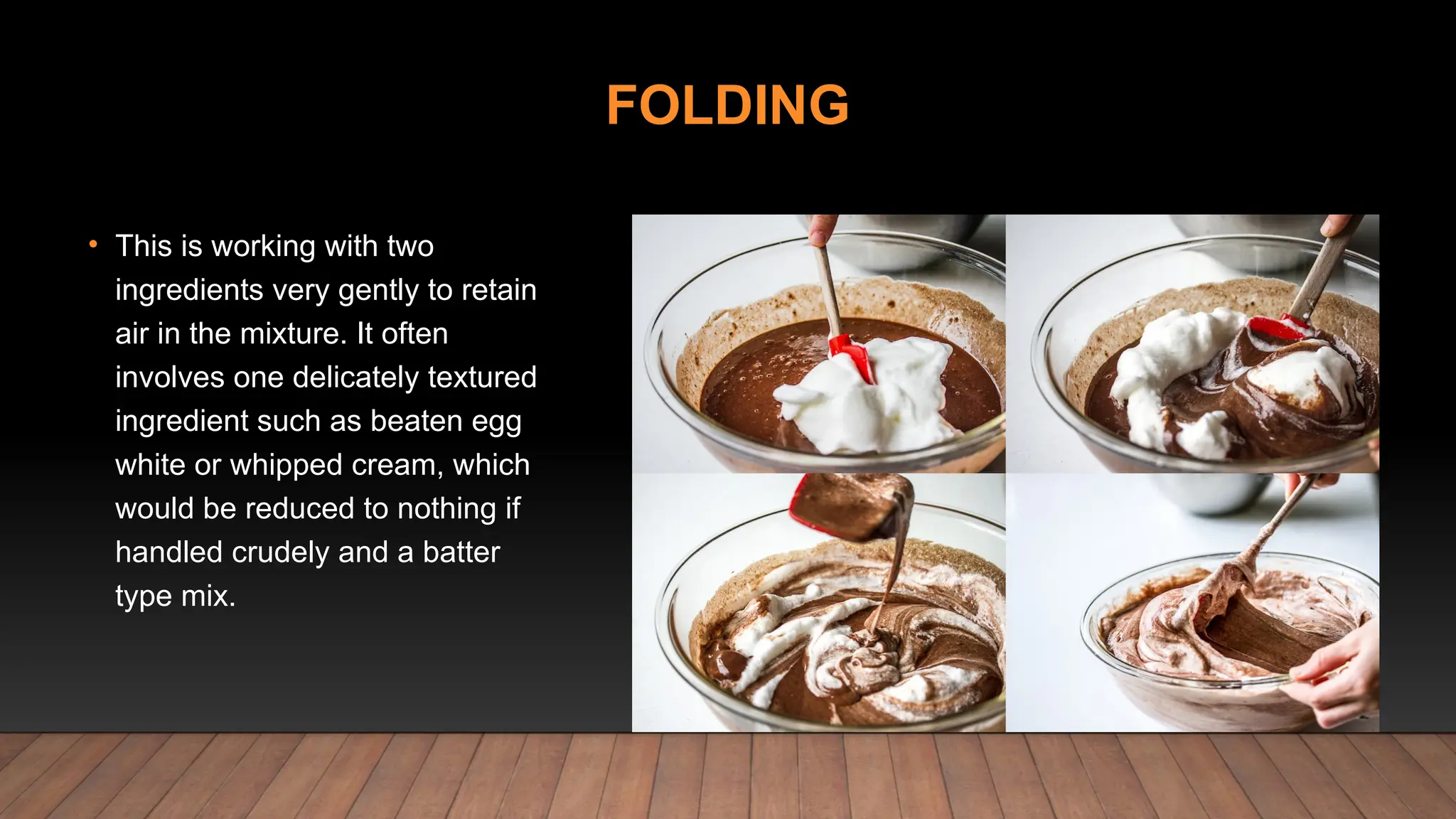
FOLDING
• This is working with two
ingredients very gently to retain
air in the mixture. It often
involves one delicately textured
ingredient such as beaten egg
white or whipped cream, which
would be reduced to nothing if
handled crudely and a batter
type mix.
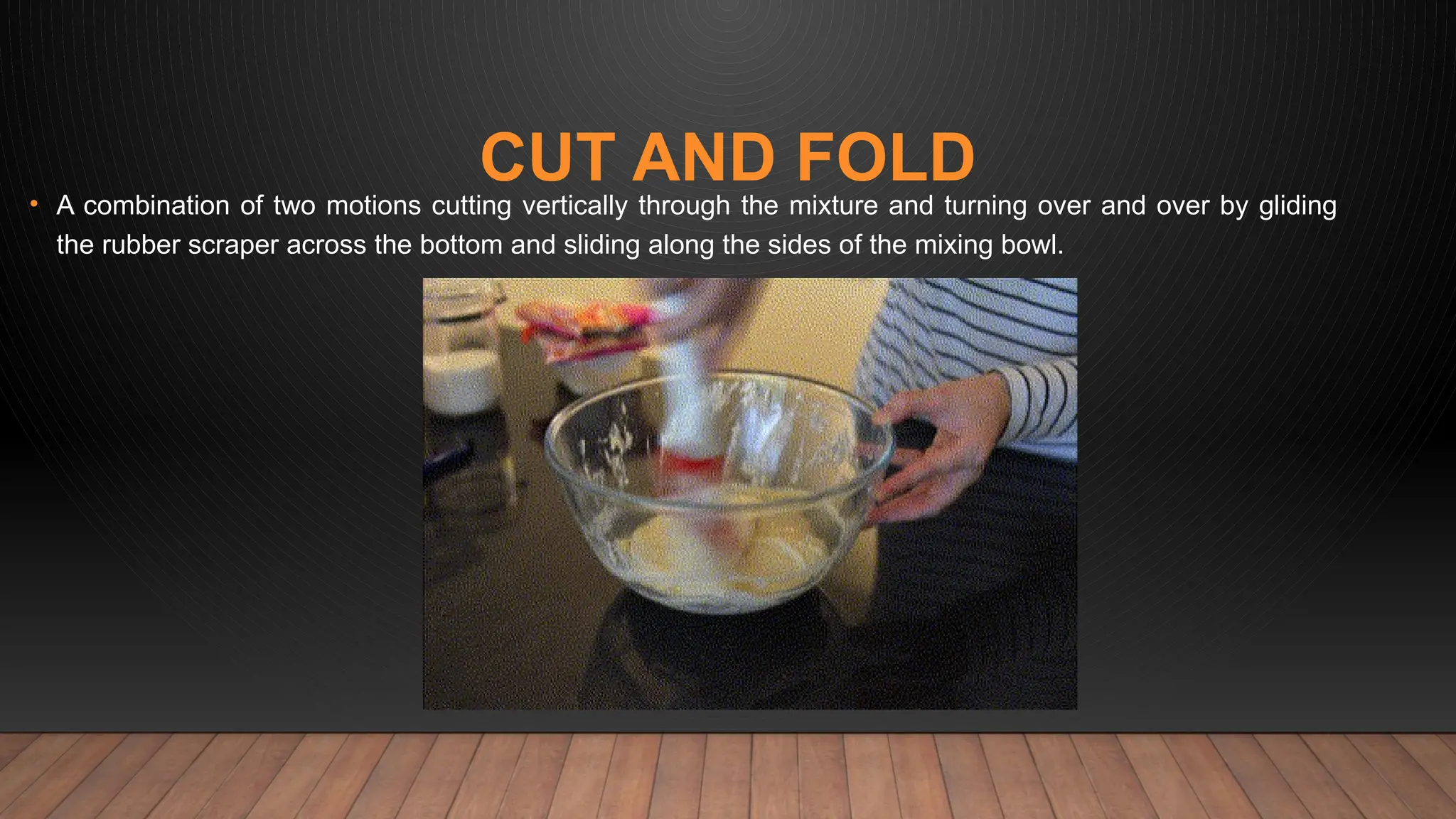
CUT AND FOLD
• A combination of two motions cutting vertically through the mixture and turning over and over by gliding
the rubber scraper across the bottom and sliding along the sides of the mixing bowl.
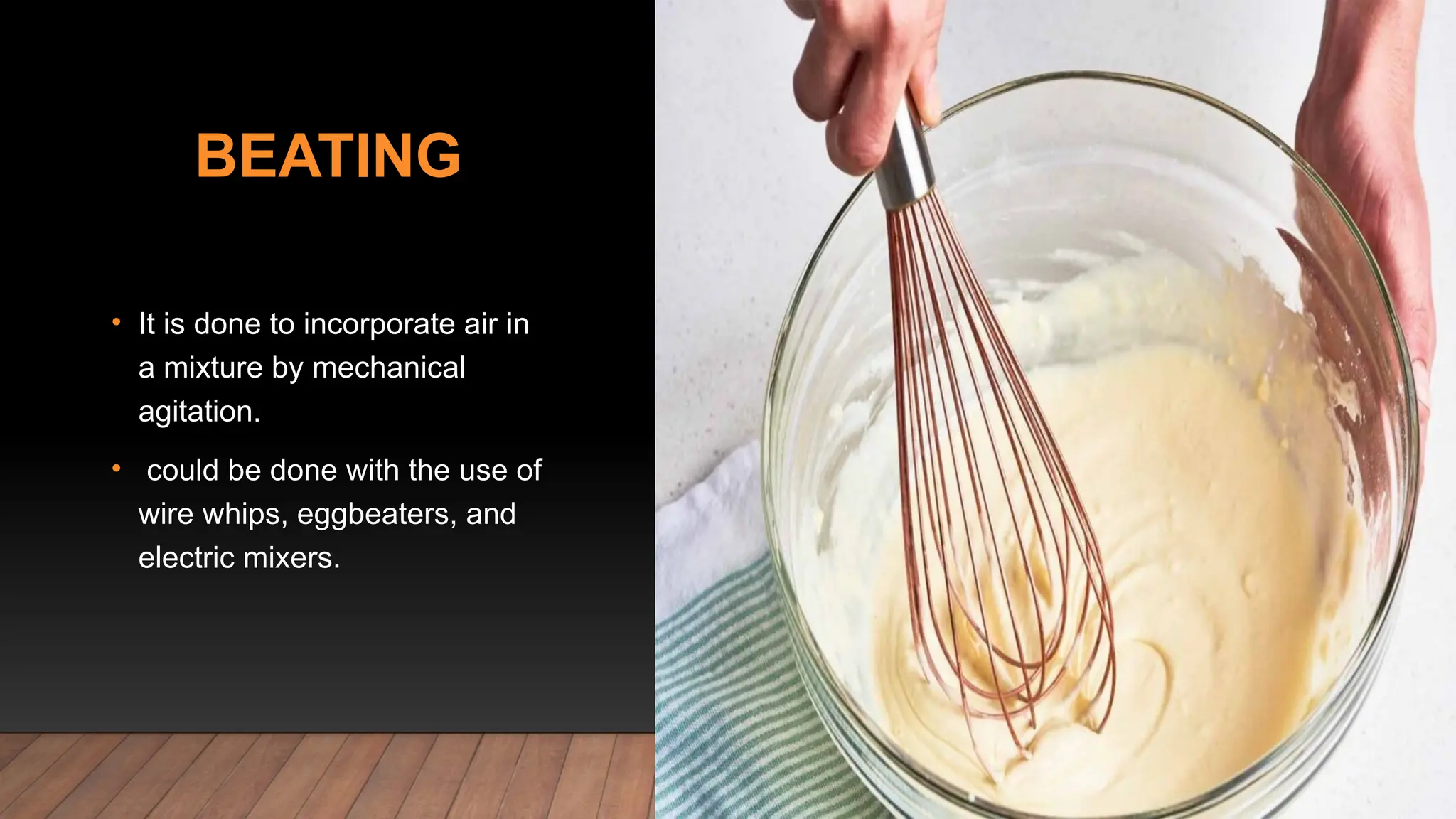
BEATING
• It is done to incorporate air in
a mixture by mechanical
agitation.
• could be done with the use of
wire whips, eggbeaters, and
electric mixers.
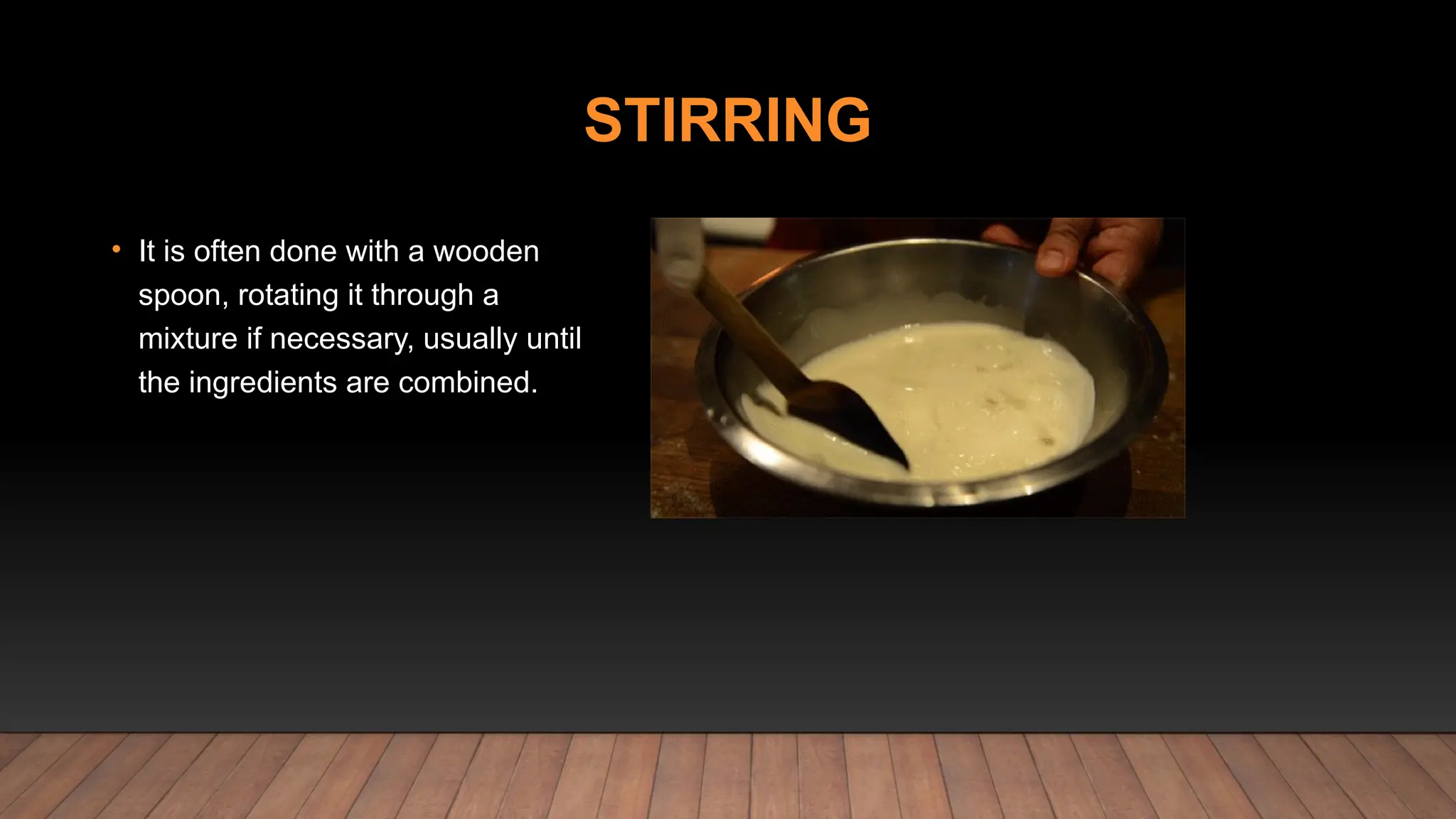
STIRRING
• It is often done with a wooden
spoon, rotating it through a
mixture if necessary, usually until
the ingredients are combined.
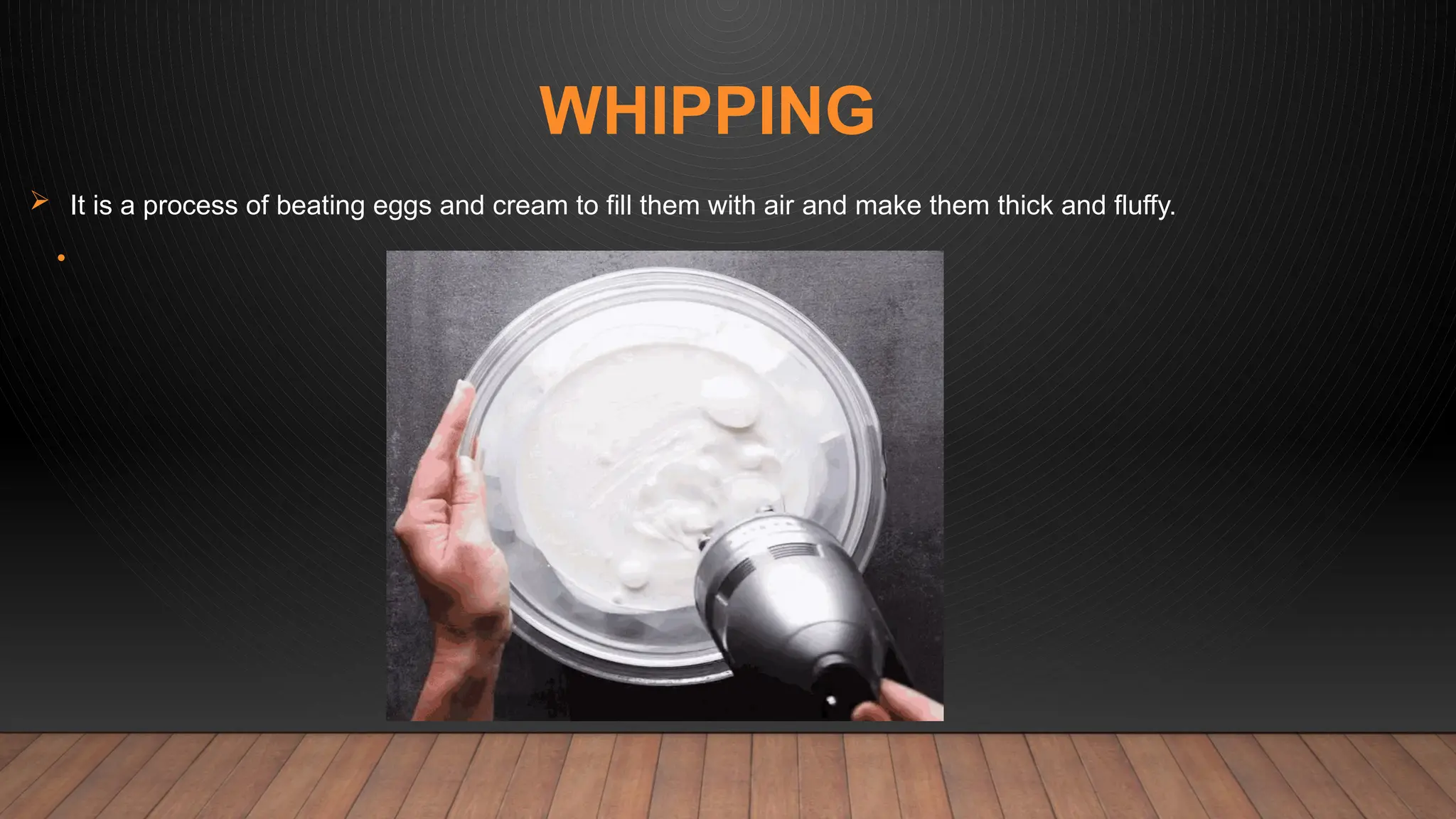
WHIPPING
 It is a process of beating eggs and cream to fill them with air and make them thick and fluffy.
•
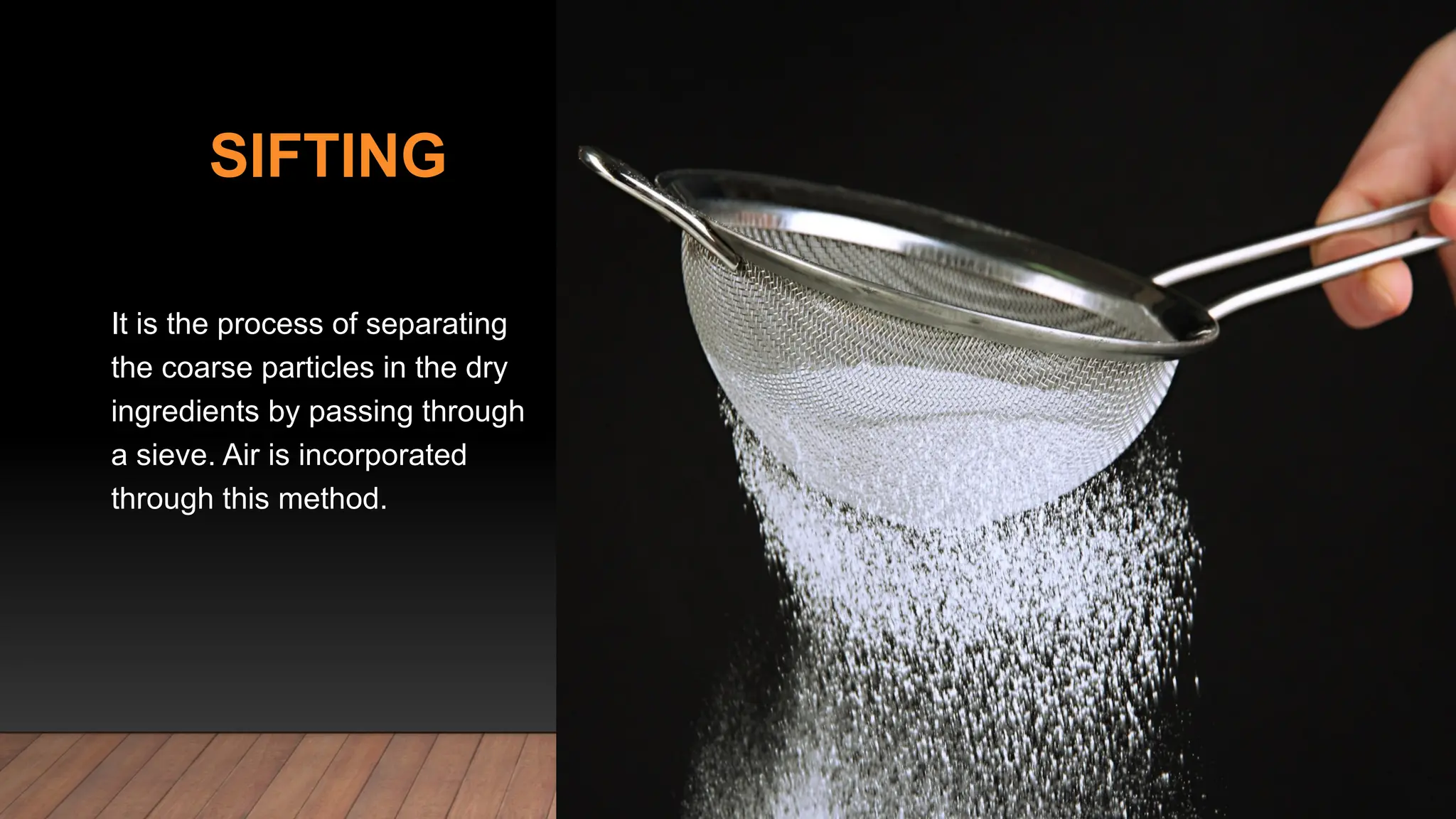
SIFTING
It is the process of separating
the coarse particles in the dry
ingredients by passing through
a sieve. Air is incorporated
through this method.
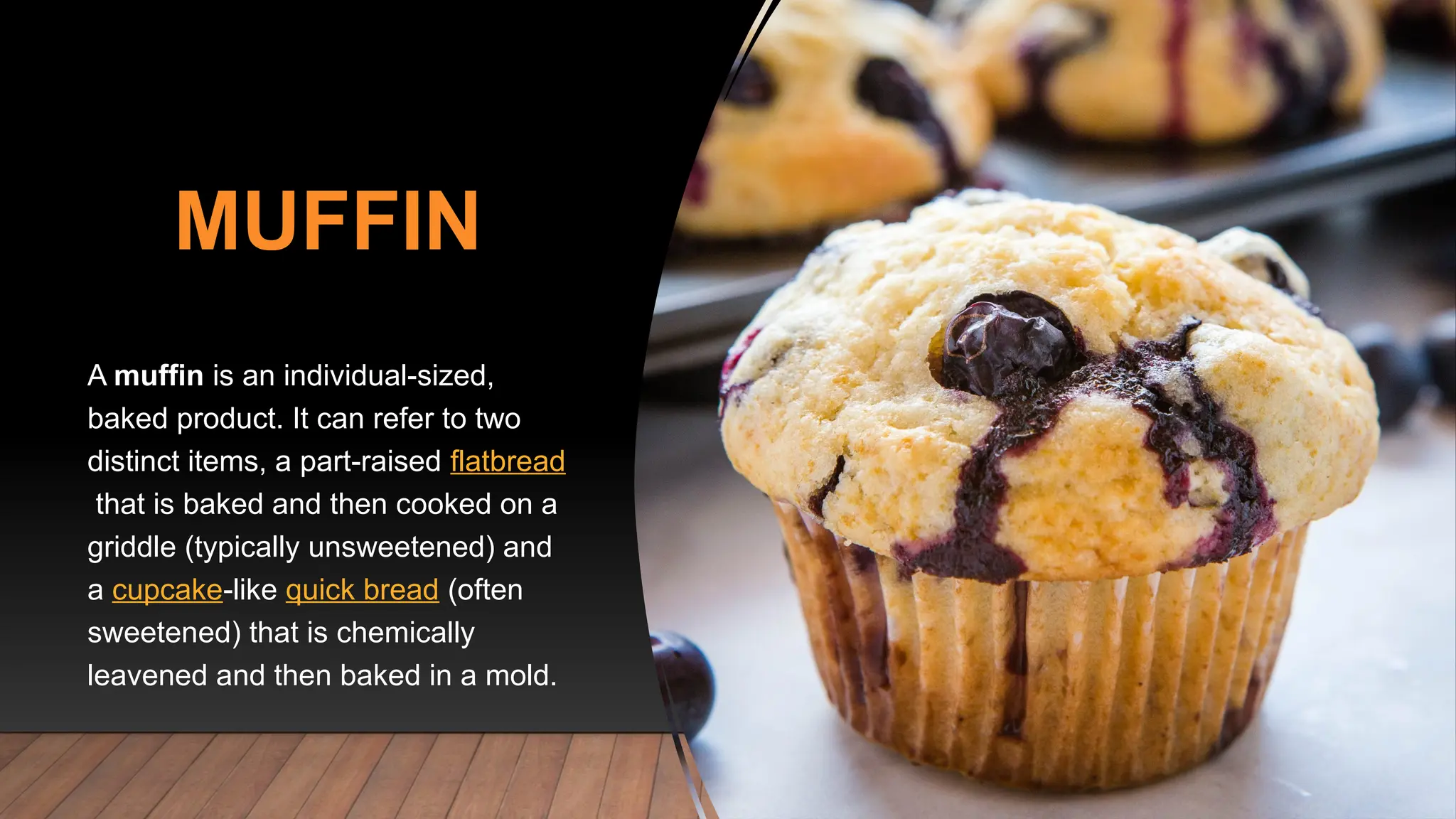
MUFFIN
A muffin is an individual-sized,
baked product. It can refer to two
distinct items, a part-raised flatbread
that is baked and then cooked on a
griddle (typically unsweetened) and
a cupcake-like quick bread (often
sweetened) that is chemically
leavened and then baked in a mold.
MUFFIN
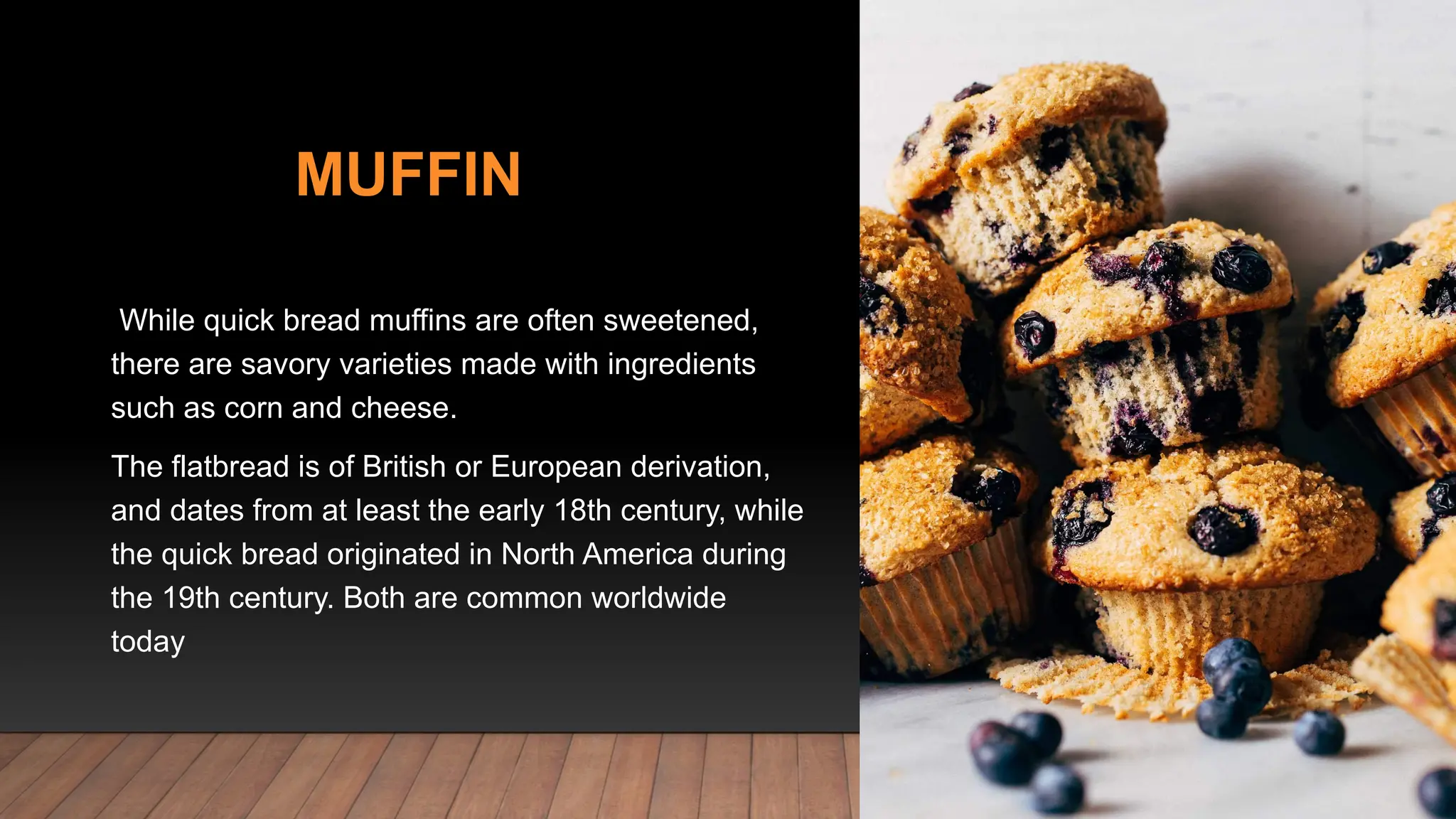
While quick bread muffins are often sweetened,
there are savory varieties made with ingredients
such as corn and cheese.
The flatbread is of British or European derivation,
and dates from at least the early 18th century, while
the quick bread originated in North America during
the 19th century. Both are common worldwide
today
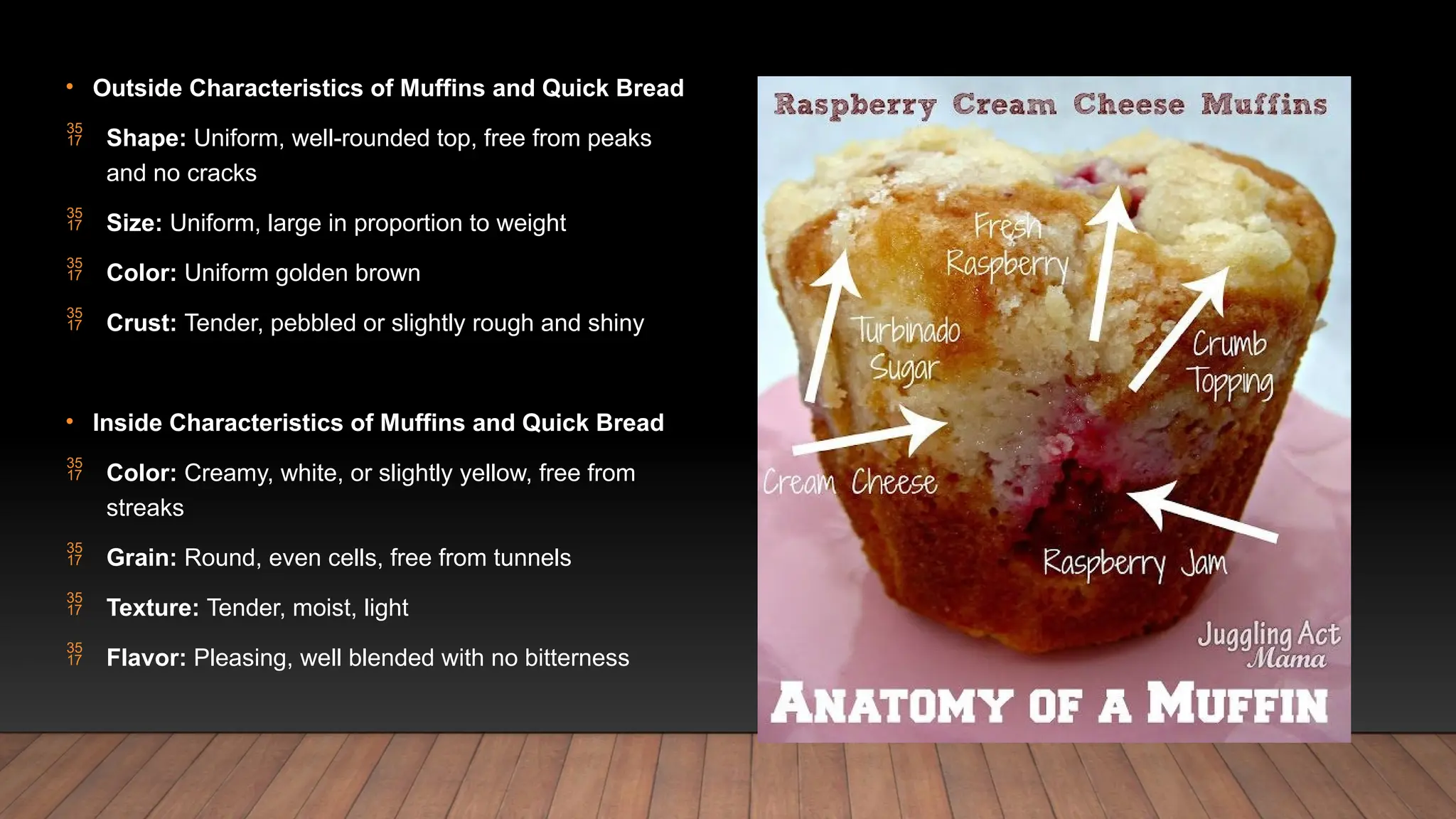
• Outside Characteristics of Muffins and Quick Bread
 Shape: Uniform, well-rounded top, free from peaks
and no cracks
 Size: Uniform, large in proportion to weight
 Color: Uniform golden brown
 Crust: Tender, pebbled or slightly rough and shiny
• Inside Characteristics of Muffins and Quick Bread
 Color: Creamy, white, or slightly yellow, free from
streaks
 Grain: Round, even cells, free from tunnels
 Texture: Tender, moist, light
 Flavor: Pleasing, well blended with no bitterness
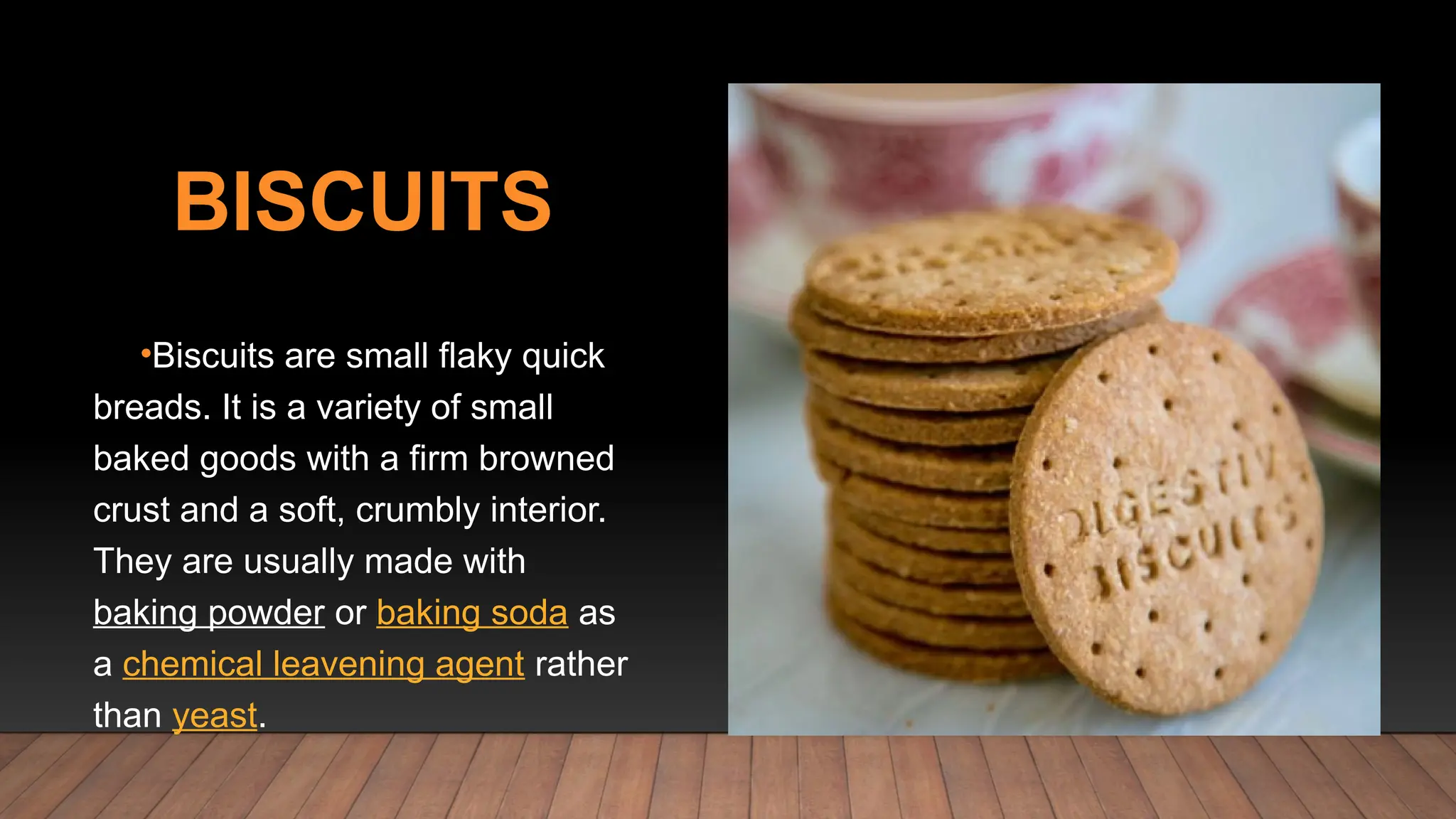
BISCUITS
•Biscuits are small flaky quick
breads. It is a variety of small
baked goods with a firm browned
crust and a soft, crumbly interior.
They are usually made with
baking powder or baking soda as
a chemical leavening agent rather
than yeast.
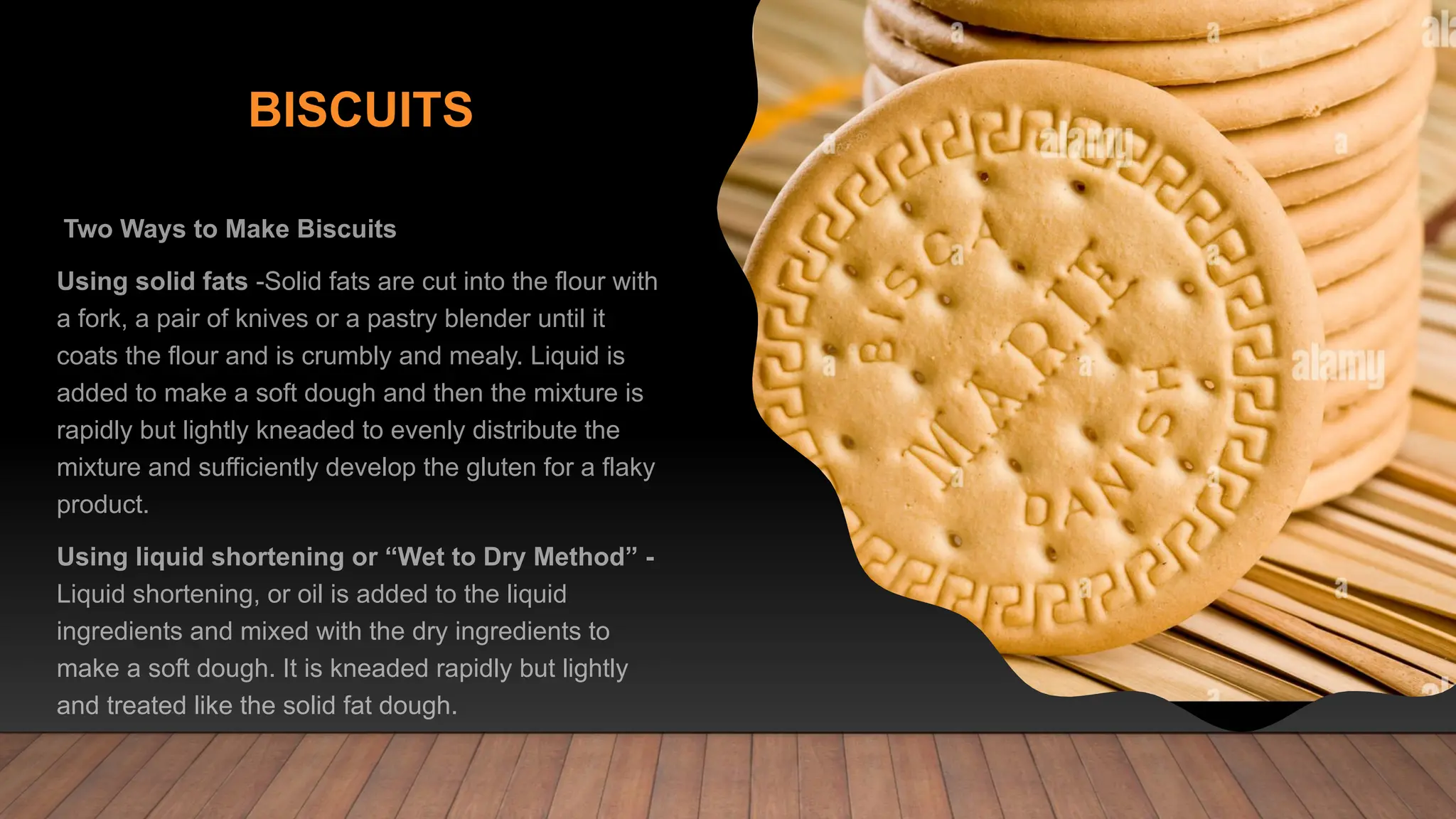
BISCUITS
Two Ways to Make Biscuits
Using solid fats -Solid fats are cut into the flour with
a fork, a pair of knives or a pastry blender until it
coats the flour and is crumbly and mealy. Liquid is
added to make a soft dough and then the mixture is
rapidly but lightly kneaded to evenly distribute the
mixture and sufficiently develop the gluten for a flaky
product.
Using liquid shortening or “Wet to Dry Method” -
Liquid shortening, or oil is added to the liquid
ingredients and mixed with the dry ingredients to
make a soft dough. It is kneaded rapidly but lightly
and treated like the solid fat dough.
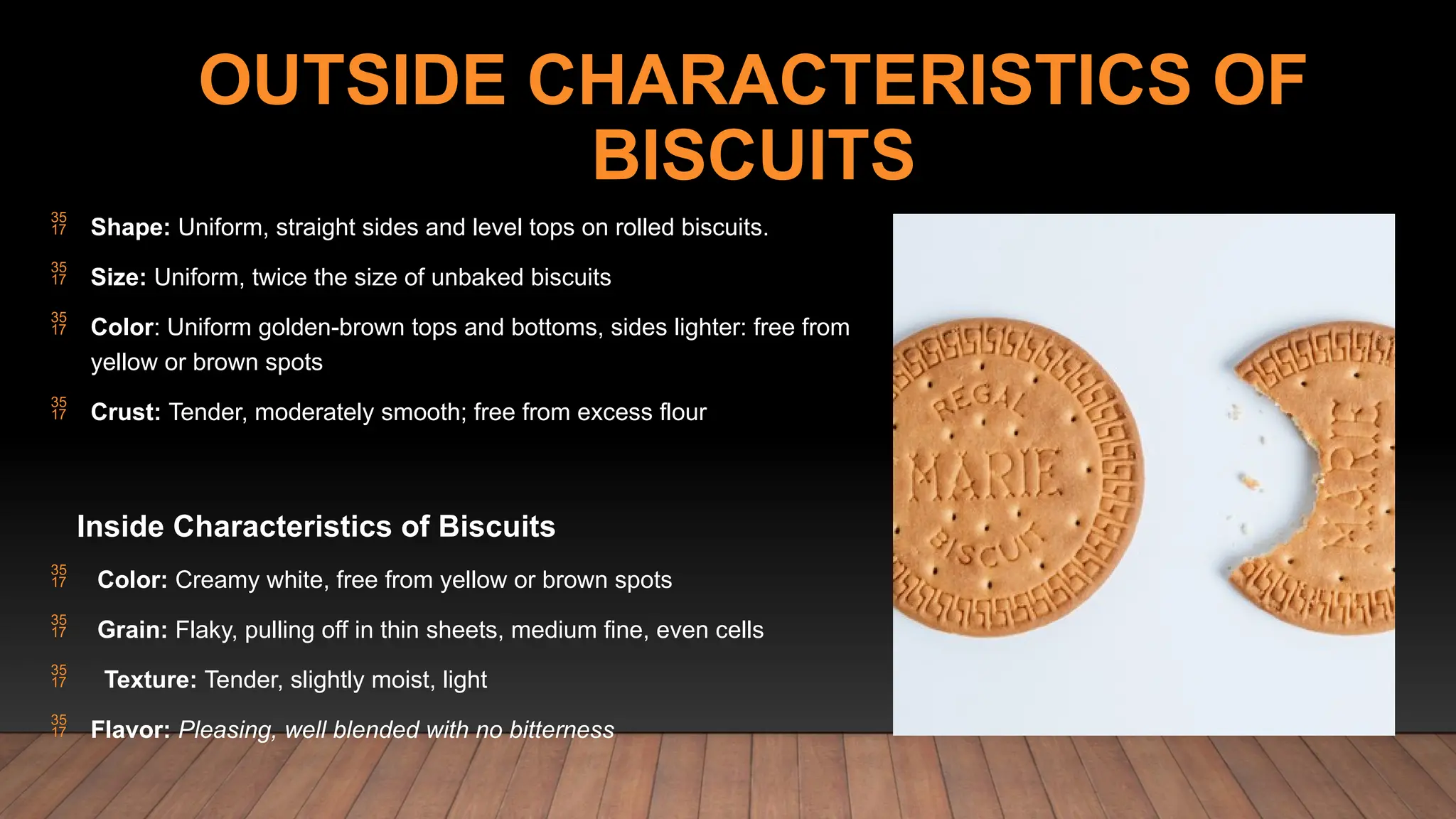
OUTSIDE CHARACTERISTICS OF
BISCUITS
 Shape: Uniform, straight sides and level tops on rolled biscuits.
 Size: Uniform, twice the size of unbaked biscuits
 Color: Uniform golden-brown tops and bottoms, sides lighter: free from
yellow or brown spots
 Crust: Tender, moderately smooth; free from excess flour
Inside Characteristics of Biscuits
 Color: Creamy white, free from yellow or brown spots
 Grain: Flaky, pulling off in thin sheets, medium fine, even cells
 Texture: Tender, slightly moist, light
 Flavor: Pleasing, well blended with no bitterness
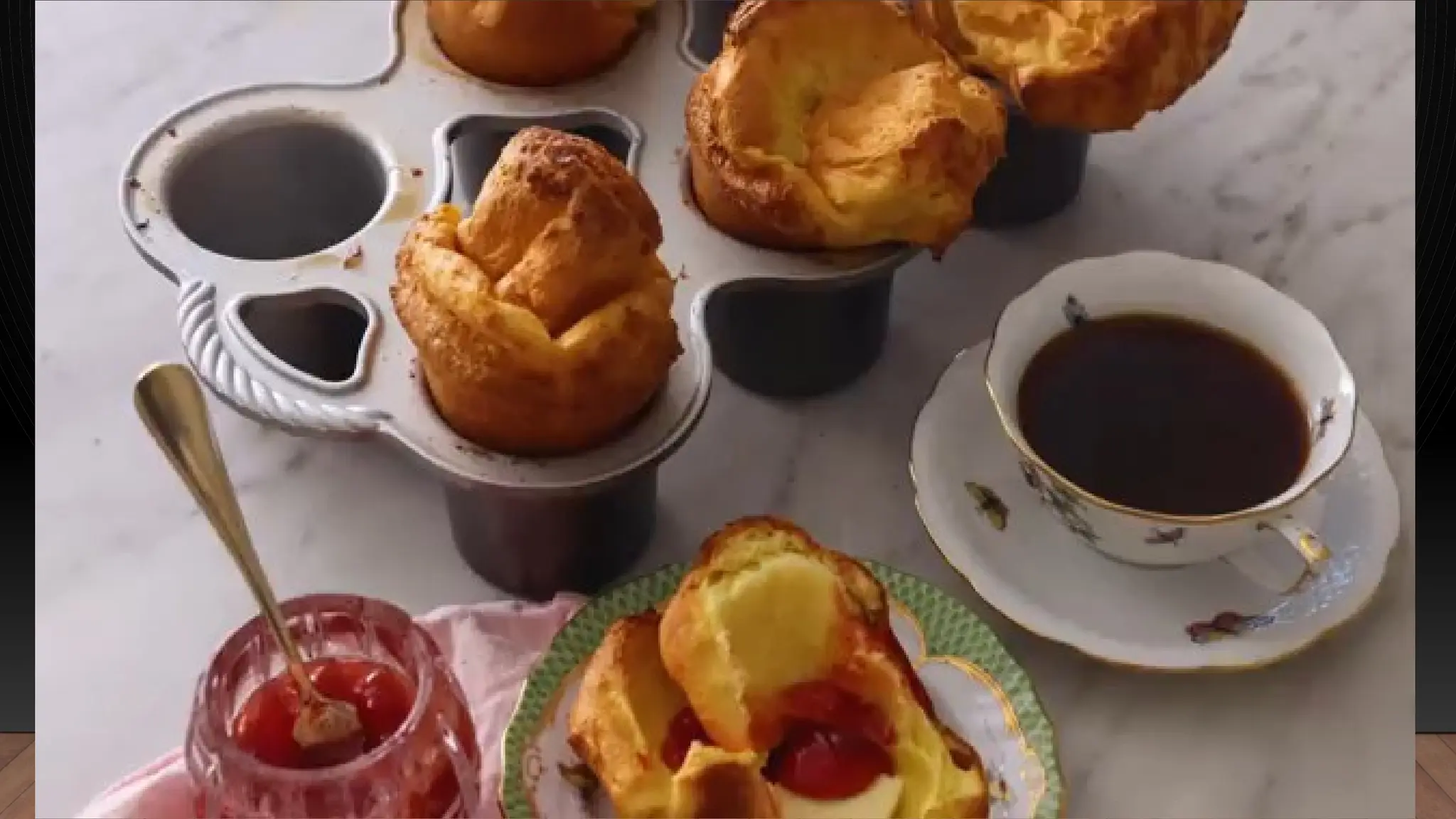
POPOVER
•Ingredients
•4 large eggs room temperature
•1½ cups whole milk (360mL)
•¾ teaspoon salt
•1½ cups all-purpose flour (180g)
•3 tablespoons unsalted butter melted
Instructions
• Position an oven rack to the lowest level in the oven and preheat the oven to 450° F. (Make sure
the other rack is removed or at the top of the oven, as the popovers will rise dramatically while
baking.) Spray a 6-well popover pan with cooking spray.
• In a blender; blend together the eggs, milk, and salt on medium-high speed until well combined,
about 15 seconds. Add the flour. Blend on medium-high until smooth, about 15 seconds. Add
melted butter, blend on medium-high until frothy, about 15 seconds.
• Immediately pour the batter into the prepared pan, filling each well. Place on a rimmed baking
sheet to catch any drips in the oven.
• Bake on the lowest oven rack for 20 minutes.Without opening the oven, reduce the temperature
to 350°F, and continue baking until deep golden brown, about 18 to 20 minutes more.
Immediately after they come out of the oven, gently puncture each popover in the center with a
pairing knife and remove from the pan. Serve warm.

CLASSIFICATION OF BAKBERYB PRODUCTS.pptx

  • 1.
    TYPES, KINDS AND CLASSIFICATIO N OFBAKERY PRODUCTS TLE BPP 9/10
  • 2.
    • This learningmodule discusses the basic concept in baking. It also focuses on the baking tools and equipment. In baking their uses, functions, and its classification. A well- equipped cooking environment is the cook’s best friend either it be home or restaurant. • When you have the right kitchen tools, you feel at ease and stay focus on preparing the meal. It is important tool that will help you in making the delicious and fresh bakery products. • Thus, they come in various sizes and shapes.
  • 3.
    VOCABULARY LIST • Bake– To cook food in a dry heat method in an oven. • Batter- a mixture of flour and liquid such as water, milk, and eggs used to prepare various food. • Beat- To make the mixture smooth using a hand or electric mixer • Blend- To combine ingredients and produce a homogeneous mixture. • Dough-a A soft thick mass or mixture of dry and liquid ingredients that is kneaded and shape • Dust- To sprinkle a surface with flour to avoid a mixture to stick into it. • Egg wash- It is composed of a mixture of a beaten eggs mixed with liquid, usually water or milk which is brushed onto the bread
  • 4.
    VOCABULARY LIST Fermentation- Theprocess of converting sugarinto alcohol to produce carbon dioxide. Grease- To brush baking pans with shortening. Knead- To press, stretch and fold dough until gluten is developed. Mis-en-Place- A French term which means “put in place” that includes assembling all the necessary ingredients, equipment and tools. Pre-heat- to heat the oven prior to baking to achieve the required heat. Sift- To pass through a sifter Stir In – To add another ingredient in the mixture Yeast- Microorganisms that produce carbon dioxide gas when it mixes with carbohydrates, causing the dough to rise.
  • 5.
    PRE-TEST COLUMN A 1. Itis a dough which is low fat and sugar. 2. It is a staple food prepared from dough of flour and water, usually by baking. 3. It is a general term that includes stirring, beating, blending, binding, creaming, whipping and folding. 4. They are really “little cakes”, flat, sweet and small. 5. It is utilized for combining enriched dough, meaning dough that contains fat, sugar, and sometimes eggs and milk. COLUMN B a. Mixing b. Bread c. Modified straight Dough d. Cookies e. Lean Dough
  • 6.
    TYPES, KINDS CLASSIFICATIONOF BAKERY PRODUCTS
  • 7.
    BREAD • Bread isstaple food from a dough of flour and water, usually by baking. • Throughout recorded history it has been a prominent food in large parts of the world and is one the oldest man-made foods, having been of significant importance since the dawn of agriculture. • Bread may be leavened by processes such as reliance on naturally occurring sourdough microbes, chemicals, industrially produced yeast, or high- pressure aeration. Commercial bread commonly contains additives to improve flavor, texture, color, shelf life, nutrition, and ease of manufacturing. • Bread plays essential roles in religious rituals and secular culture.
  • 8.
    KINDS OF DOUGHIN BAKING • Lean Dough is a dough low in fat and sugar. These are higher in fat and sugar and sometimes contain eggs and milk solids, because they are richer, they have a softer crust. The basic ingredients for bread which includes flour, yeast, salts, a little sugar and shortening makes up the lean dough. This dough is made up into Pan de Sal, Pan Amerikano, French Bread and other crusty bread varieties. Rich Dough are yeast-based doughs that contain butter, cream, fat or eggs. Rich dough produces a bread that is soft with a tender cake-like texture. Aside from the basic ingredients for dough, rich dough has butter, nuts, fruits, eggs and condiments. Milk is often used, too. Rich dough also uses more sugar. This dough is used in making rolls, coffee cakes and the sweet bread varieties.
  • 9.
    METHODS OF MIXINGDOUGH: • Mixing is a general term that includes stirring, beating, blending, binding, creaming, whipping, and folding. • In mixing, two or more ingredients are evenly dispersed in one nother until they become one product. Each mixing method gives a different texture and character to the baked good. • Straight Dough Method • Modified Straight Dough Method • Sponge Dough Method
  • 10.
    STRAIGHT DOUGH METHOD This method combines all the ingredients together at one time to make the dough. The dough is kneaded and set aside to rise. •Steps involved in the straight dough method: •Step 1: Mixing the Dough. Bread dough can be mixed by hand or in a machine •Step 2: Kneading the dough by hand • Step 3: First rise • Step 4: Shaping the dough and the final rise • Step 5: Testing • Step 6: Baking
  • 11.
    MODIFIED STRAIGHT DOUGHMETHOD •utilized for combining enriched dough, meaning dough that contains fat, sugar, and sometimes eggs and milk. The purpose of the modified straight dough method is to ensure even distribution of the fat and sugar present in enriched dough. This method is very simple but requires a few more steps compared to The Straight Dough Method. Steps in Making Modified Straight Dough Method 1. Mix the yeast with the liquid. 2. Combine the fat, sugar, salt, and flavorings. If the bread includes dry milk powder, this will also be added in this step. 3. Add the eggs, one at a time, mixing until fully combined before adding the next egg. 4. Add the liquid/yeast mixture and stir to combine. 5. Add the flour and mix until it is all saturated.
  • 12.
    6. Follow therecipe’s procedure for either kneading or following the stretch and fold method for building the gluten structure. 7.Follow the recipe’s procedure for fermentation. 8.Release the gas out of the dough by pressing down in the middle and folding the sides over the top of the dough, “punching”. 10Shape the bread and let it rise until double in volume. 11.Bake.
  • 13.
    SPONGE DOUGH METHOD •Thesponge and dough method is a two-step bread making process: in the first step a sponge is made and allowed to ferment for a period of time, and in the second step the sponge is added to the final dough's ingredients, creating the total formula. In French baking the sponge and dough method is known as levain-levure.
  • 15.
    CHARACTERISTICS OF A WELL-MADEBREAD • Whether you are a bread fiend or someone who just enjoys a good sandwich, there’s no reason you shouldn’t be able to tell the difference between a loaf of bread and a truly great loaf of bread. • You might be wondering how one loaf of bread differs from any other loaf of bread, but any quality bakery will be able to tell you that there certainly is a difference. • While you might not be employed at a quality bakery, it’s possible for you to be able to quality-check bread like the best of them. Below, we have crafted a guide that describes five of the most important qualities you should be looking for in a great loaf of bread. 1. Crust 2. Air Pockets 3. Glossy Interior 4. Flavor 5. Finish
  • 16.
    CRUST A bread withouta nice, crispy crust is not a bread that is worth your time. Artisan bread should have a variety of hues in its crust, ranging from golden brown to a light golden color. This ensures you will have the best tasting experience.
  • 17.
    AIR POCKETS Wheat flour iscommonly used to make bread because it holds two gluten-forming proteins, but some bakers over-work their dough and end up with a bread that is far too dense. What you should be looking for in fresh bread is a variety of bubble sizes.
  • 18.
    GLOSSY INTERIOR Not every breadshould look wet on the inside, but a quality bread will have a slightly glossy finish on the inside. In addition, it will spring back when you press your finger into it.
  • 19.
    FLAVOR If a breadbakery claims to make a good, flavored bread, you should be able to smell that flavor before you even bite into a piece. Any decent bread should have a good flavor; it should not taste like eating air!
  • 20.
    FINISH While a loafof bread does not have to look gorgeous to be tasty, a pretty bread certainly makes eating more enticing. A good finish or glaze, especially on sweet breads, should be an indicator of quality.
  • 21.
    COOKIES • Cookies aregenerally easy to make and one of the first things a beginning baker makes. 1. Molded Cookies 2. Dropped Cookies 3. Rolled Cookies 4. Pressed Cookies 5. Refrigerator Cookies 6. Bar Cookies 7. No Bake Cookies
  • 22.
    MOLDED COOKIES Molded cookiesare usually round and are formed by rolling the dough with your hands. They may be pressed flat with a fork like peanut butter cookies. Keep your fingers or utensils lightly dusted with flour or sugar to keep the dough from sticking.
  • 23.
    DROPPED COOKIES • droppedcookies are usually the easiest kind of cookie to make. Dropped cookies are made by dropping soft dough by the teaspoonful onto a cookie sheet. • Make sure you leave enough room between cookies for spreading. • Usually 2 inches is a good rule of thumb unless your recipe specifies otherwise. • If uniform size is important you may wish to use a cookie scoop.
  • 24.
    ROLLED COOKIES • Thedough for rolled cookies, or cut out cookies, is rather stiff. • It is rolled into a sheet onto a lightly floured board and then cut into shapes with a knife or cookie cutters. • Work with only a portion of the dough at a time. Use as little flour as possible to keep your cookies from getting tough. Rolling out thinner will produce a crisper cookie and thicker will make a softer and chewier cookie.
  • 25.
    PRESSED COOKIES • Acookie press is used to make pressed cookies like spritz cookies. The dough should be soft enough to be put through a cookie press but must be stiff enough to hold a shape. If the dough is too soft, refrigerate for a while. If the dough is too stiff, add an egg yolk and try again.
  • 26.
    REFRIGERATOR COOKIES • Also knownas sliced cookies, these cookies are made by rolling the dough into a thick bar. The dough is then chilled in the refrigerator until ready to bake. • Make sure you wrap the rolls good, so they will not absorb other odors from your refrigerator. Dough may be kept up to a week like this. After chilling, the dough is thinly sliced with a sharp knife and then baked.
  • 27.
    BAR COOKIES • Barsor squares are more like cakes and are a softer type of cookie. They may be crisp or chewy. They may also be layered or filled. • Brownies are one good example of bar cookie. • They are baked in a baking pan with sides. Make sure you use the proper size of pan or your bars may not turn out right. When done these cake-type cookies are cut into squares. Most bars will cut better if allowed to cool first.
  • 28.
    NO BAKE COOKIES •These cookies do not require the use of an oven. They are technically not a type of cookie. They are usually very rich and more like a candy. • No bake chocolate oatmeal cookies are a good example. • These are best made like candy with a double boiler and a candy thermometer.
  • 29.
    MIXING TECHNIQUES • Creaming • Cutting-in •Folding • Cut and Fold • Beating • Stirring • Whipping • Sifting
  • 30.
    CREAMING • It isrubbing one or two ingredients in a bowl with the help of a wooden spoon or electric mixer to make a soft fluffy mixture. The creamed mixture should have both smooth and grainy particles.
  • 31.
    CUTTING-IN • Mixing fatand flour with the use of pastry blender or two knives in a scissor-like manner. This method cuts fat into small pieces, coating them with flour to form coarse, granular mixtures for pastries and biscuits.
  • 32.
    FOLDING • This isworking with two ingredients very gently to retain air in the mixture. It often involves one delicately textured ingredient such as beaten egg white or whipped cream, which would be reduced to nothing if handled crudely and a batter type mix.
  • 33.
    CUT AND FOLD •A combination of two motions cutting vertically through the mixture and turning over and over by gliding the rubber scraper across the bottom and sliding along the sides of the mixing bowl.
  • 34.
    BEATING • It isdone to incorporate air in a mixture by mechanical agitation. • could be done with the use of wire whips, eggbeaters, and electric mixers.
  • 35.
    STIRRING • It isoften done with a wooden spoon, rotating it through a mixture if necessary, usually until the ingredients are combined.
  • 36.
    WHIPPING  It isa process of beating eggs and cream to fill them with air and make them thick and fluffy. •
  • 37.
    SIFTING It is theprocess of separating the coarse particles in the dry ingredients by passing through a sieve. Air is incorporated through this method.
  • 38.
    MUFFIN A muffin isan individual-sized, baked product. It can refer to two distinct items, a part-raised flatbread that is baked and then cooked on a griddle (typically unsweetened) and a cupcake-like quick bread (often sweetened) that is chemically leavened and then baked in a mold.
  • 39.
    MUFFIN While quick breadmuffins are often sweetened, there are savory varieties made with ingredients such as corn and cheese. The flatbread is of British or European derivation, and dates from at least the early 18th century, while the quick bread originated in North America during the 19th century. Both are common worldwide today
  • 40.
    • Outside Characteristicsof Muffins and Quick Bread  Shape: Uniform, well-rounded top, free from peaks and no cracks  Size: Uniform, large in proportion to weight  Color: Uniform golden brown  Crust: Tender, pebbled or slightly rough and shiny • Inside Characteristics of Muffins and Quick Bread  Color: Creamy, white, or slightly yellow, free from streaks  Grain: Round, even cells, free from tunnels  Texture: Tender, moist, light  Flavor: Pleasing, well blended with no bitterness
  • 41.
    BISCUITS •Biscuits are smallflaky quick breads. It is a variety of small baked goods with a firm browned crust and a soft, crumbly interior. They are usually made with baking powder or baking soda as a chemical leavening agent rather than yeast.
  • 42.
    BISCUITS Two Ways toMake Biscuits Using solid fats -Solid fats are cut into the flour with a fork, a pair of knives or a pastry blender until it coats the flour and is crumbly and mealy. Liquid is added to make a soft dough and then the mixture is rapidly but lightly kneaded to evenly distribute the mixture and sufficiently develop the gluten for a flaky product. Using liquid shortening or “Wet to Dry Method” - Liquid shortening, or oil is added to the liquid ingredients and mixed with the dry ingredients to make a soft dough. It is kneaded rapidly but lightly and treated like the solid fat dough.
  • 43.
    OUTSIDE CHARACTERISTICS OF BISCUITS Shape: Uniform, straight sides and level tops on rolled biscuits.  Size: Uniform, twice the size of unbaked biscuits  Color: Uniform golden-brown tops and bottoms, sides lighter: free from yellow or brown spots  Crust: Tender, moderately smooth; free from excess flour Inside Characteristics of Biscuits  Color: Creamy white, free from yellow or brown spots  Grain: Flaky, pulling off in thin sheets, medium fine, even cells  Texture: Tender, slightly moist, light  Flavor: Pleasing, well blended with no bitterness
  • 45.
    POPOVER •Ingredients •4 large eggsroom temperature •1½ cups whole milk (360mL) •¾ teaspoon salt •1½ cups all-purpose flour (180g) •3 tablespoons unsalted butter melted
  • 46.
    Instructions • Position anoven rack to the lowest level in the oven and preheat the oven to 450° F. (Make sure the other rack is removed or at the top of the oven, as the popovers will rise dramatically while baking.) Spray a 6-well popover pan with cooking spray. • In a blender; blend together the eggs, milk, and salt on medium-high speed until well combined, about 15 seconds. Add the flour. Blend on medium-high until smooth, about 15 seconds. Add melted butter, blend on medium-high until frothy, about 15 seconds. • Immediately pour the batter into the prepared pan, filling each well. Place on a rimmed baking sheet to catch any drips in the oven. • Bake on the lowest oven rack for 20 minutes.Without opening the oven, reduce the temperature to 350°F, and continue baking until deep golden brown, about 18 to 20 minutes more. Immediately after they come out of the oven, gently puncture each popover in the center with a pairing knife and remove from the pan. Serve warm.

Editor's Notes

  • #7  vvv. Vvvvfxxc vvv very. Vm