PREPARING YEAST
BREAD
Prepared by: Mascardo, Wendy Joy A.
Basic Yeast Bread
Ingredients:
There are only four yeast bread ingredients you really
need: flour, yeast, water, and salt. All the other
ingredients in a recipe are there to add flavor, nutrition,
color, and to change the characteristics of the crumb.
Basic Yeast Bread
Ingredients:
1. Flour
it serves as the base ingredient
and the starting point in all baked
goods.
Basic Yeast Bread
Ingredients:
1. Flour
It holds ingredients together,
resulting in batter or dough.
Basic Yeast Bread
Ingredients:
1. Flour
The strength and texture of baked
goods result from the gluten that
develops when the protein in flour
is combined with moisture and heat.
Basic Yeast Bread
Ingredients:
2. Yeast
Essential to the rise of the bread, not only
because it produces carbon dioxide, but
also because it produces alcohol that
evaporates as the bread bakes, and because
it helps develop and strengthen the gluten
network.
Basic Yeast Bread
Ingredients:
3. Water
Serves as a solvent and
dispersing agent (for salt, sugar,
and yeast).
Basic Yeast Bread
Ingredients:
3. Water
Necessary for yeast fermentation
and reproduction; softer dough will
ferment more quickly than dry
dough.
Basic Yeast Bread
Ingredients:
3. Water
Responsible for the consistency
of the bread dough.
Basic Yeast Bread
Ingredients:
4. Salt
When added to bread dough, salt
works to tighten the gluten strands
that are formed, which makes them
stronger.
Basic Yeast Bread
Ingredients:
4. Salt
By strengthen these gluten strands,
salt enables the dough to hold
carbon dioxide more efficiently.
The role of fermentation
in yeast bread making
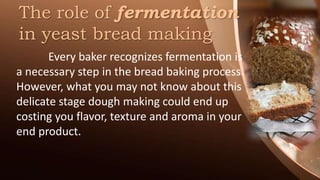
Every baker recognizes fermentation is
a necessary step in the bread baking process.
However, what you may not know about this
delicate stage dough making could end up
costing you flavor, texture and aroma in your
end product.
The role of fermentation
in yeast bread making
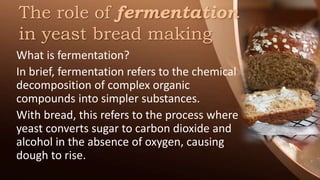
What is fermentation?
In brief, fermentation refers to the chemical
decomposition of complex organic
compounds into simpler substances.
With bread, this refers to the process where
yeast converts sugar to carbon dioxide and
alcohol in the absence of oxygen, causing
dough to rise.
The role of fermentation
in yeast bread making
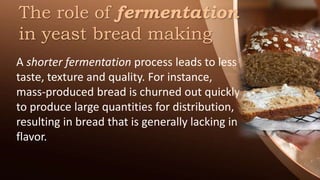
A shorter fermentation process leads to less
taste, texture and quality. For instance,
mass-produced bread is churned out quickly
to produce large quantities for distribution,
resulting in bread that is generally lacking in
flavor.
The role of fermentation
in yeast bread making
In general, five stages (5)
comprise the fermentation
process:
The role of fermentation
in yeast bread making
Pre-ferment- an optional step, pre-
ferment is the preparation made and
fermented from a portion of the final
dough, prior to mixing. Used for many
artisan breads, it introduces flour, water,
yeast and sometimes salt to a longer
fermentation period before incorporation.
This step enhances flavor and shelf life.
The role of fermentation
in yeast bread making
First Fermentation- after adding the pre-
ferment to the final dough, the first
fermentation takes place; this can take as
long as eight hours for artisan bread and
as short as zero to 15 minutes for no-time
dough.
The role of fermentation
in yeast bread making
Second fermentation- after the first
punch, this second round takes
place. In the case of Ciabatta bread,
this may involve three or more
stages.

The role of fermentation
in yeast bread making
Proofing- after make-up or shaping, the
bread is proofed and prepared for baking.
This process can last anywhere from one
hour to one day.
The role of fermentation
in yeast bread making
Baking- finally, the loaves of bread expand
by means of yeast and steam during the
baking process.
The role of fermentation
in yeast bread making
Remember:
Flour absorption, yeast level and
processing method, among others-
affect the fermentation process,
ultimately time and temperature equal
quality and consistency.
Methods of mixing in
Yeast Bread
Straight Dough Method
This method combines all the
ingredients together at one time
to make the dough. The dough is
kneaded and set aside to rise.
Methods of mixing in
Yeast Bread
Sponge and Dough Method
This method mixes part of the liquid,
flour, and all of the yeast to make a
soft mixture which is set aside to rise
until bubbly. Then, the remaining
ingredients are added and the mixture
is treated as straight dough.
Methods of mixing in
Yeast Bread
NO-knead Dough Method
This a method of bread baking that
uses a very long fermentation (rising)
time instead of kneading to form
gluten strands that gives the bread its
texture. It is characterized by a low
yeast content and a very wet dough.
Traditional Proofing Method
One-Bowl Method
Batter (NO KNEAD) Breads
Process in making Yeast
Bread
Traditional Proofing Method
These instructions will teach you how to
make yeast bread the traditional ways,
by proofing the yeast first, then add
remaining ingredients, kneading the
dough, proofing it, shaping it into
loaves or rolls, then baking to
perfection.
Process in making Yeast
Bread
One-Bowl Mixing Method
 easier than the traditional method,
but still must be careful with the
water temperature and make sure
follow the instructions carefully.
Process in making Yeast
Bread
One-Bowl Mixing Method
 Measure and heat liquids to 120 to
130 Fahrenheit. This temperature is
higher than traditional proofing
methods because the yeast is
combined with other ingredients.
Process in making Yeast
Bread
One-Bowl Mixing Method
 Combine part of the flour, yeast, and
other dry ingredients.
 Add liquid to flour and yeast mixture
and beat with electric mixer or by
hand until a smooth batter forms.
Process in making Yeast
Bread
One-Bowl Mixing Method
 Gradually add remaining flour, using
a dough hook or by hand, until the
dough becomes too stiff to stir.
Process in making Yeast
Bread
One-Bowl Mixing Method
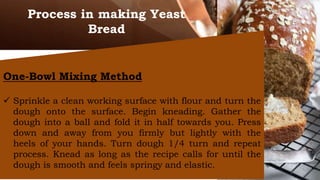
 Sprinkle a clean working surface with flour and turn the
dough onto the surface. Begin kneading. Gather the
dough into a ball and fold it in half towards you. Press
down and away from you firmly but lightly with the
heels of your hands. Turn dough 1/4 turn and repeat
process. Knead as long as the recipe calls for until the
dough is smooth and feels springy and elastic.
Process in making Yeast
Bread
One-Bowl Mixing Method
 Grease a clean mixing bowl with shortening. Place
the kneaded dough in the bowl and turn it so all
surfaces are greased. Cover the bowl with a towel
and set in a warm spot to rise according to the
recipe. For my warm spot, an oven with a pilot
light is perfect. If you have an electric oven, turn
on the oven light and let the dough rise there.
When the dough is doubled, press fingers into the
dough and the indentation will remain when you
remove your fingers.
Process in making Yeast
Bread
One-Bowl Mixing Method
 Punch down dough and let it sit for
10 minutes before proceeding if the
recipe calls for it. If the recipe calls
for a second rise, put the dough back
in the bowl, cover it, and let rise.
 Punch down again if necessary.
Process in making Yeast
Bread
One-Bowl Mixing Method
 Divide dough into pieces as called for in
the recipe. Flatten dough pieces and roll up
tightly, jelly-roll fashion. Pinch edges to seal.
Place in greased loaf pans so the short sides
touch the pan. Cover and let rise again until
the dough fills the pan and rises 1" over the
top.
Process in making Yeast
Bread
One-Bowl Mixing Method
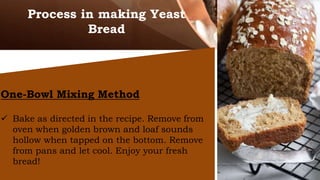
 Bake as directed in the recipe. Remove from
oven when golden brown and loaf sounds
hollow when tapped on the bottom. Remove
from pans and let cool. Enjoy your fresh
bread!
Process in making Yeast
Bread
Batter (or No Knead) Breads
Batter breads are usually made in the same way as
the one-bowl method, except less flour is used so the
dough remains too sticky to handle. After beating in
the required amount of flour, the dough is either
ready to be put into greased pans, rise, and bake, or
rises once before it's put into the pans. Batter breads
are considered easier to make simply because you
don't have to knead them. The new method for (No
knead) uses the batter bread method.
Process in making Yeast
Bread
References:
Larsen L. (2019). Basic Yeast Bread Ingredients. Retrieved from https://www.thespruceeats.com/yeast-bread-
ingredients-478798
Larsen L. (2019). Ways to Make Yeast Bread. Retrieved from https://www.thespruceeats.com/step-by-step-yeast-
bread-481242
Lovejoy R. (2021). What are the Functions of Flour in Baking?. Retrieved from https://oureverydaylife.com/functions-
flour-baking-8798.html
Lawandi J. (2015). The Science Behind Yeast and How It Makes Bread Rise. Retrieved from https://www-thekitchn-
com.cdn.ampproject.org/v/s/www.thekitchn.com/the-science-behind-yeast-and-how-it-makes-bread-rise-
226483?amp_js_v=a6&amp_gsa=1&amp=1&usqp=mq331AQKKAFQArABIIACAw%3D%3D#aoh=16377301986808&ref
errer=https%3A%2F%2Fwww.google.com&amp_tf=From%20%251%24s&ampshare=https%3A%2F%2Fwww.thekitchn.c
om%2Fthe-science-behind-yeast-and-how-it-makes-bread-rise-226483
King Arthur Baking Company (2021). Water. Retrieved from
https://www.kingarthurbaking.com/pro/reference/water#:~:text=Water%20serves%20as%20a%20solvent,the%20cons
istency%20of%20bread%20dough.
Weekley B. (2017). Understanding the Role of Fermentation. Retrieved from
https://www.bakemag.com/articles/5275-understanding-the-role-of-fermentation
Thank you for
listening!

Yeast bread making

  • 1.
    PREPARING YEAST BREAD Prepared by:Mascardo, Wendy Joy A.
  • 2.
    Basic Yeast Bread Ingredients: Thereare only four yeast bread ingredients you really need: flour, yeast, water, and salt. All the other ingredients in a recipe are there to add flavor, nutrition, color, and to change the characteristics of the crumb.
  • 3.
    Basic Yeast Bread Ingredients: 1.Flour it serves as the base ingredient and the starting point in all baked goods.
  • 4.
    Basic Yeast Bread Ingredients: 1.Flour It holds ingredients together, resulting in batter or dough.
  • 5.
    Basic Yeast Bread Ingredients: 1.Flour The strength and texture of baked goods result from the gluten that develops when the protein in flour is combined with moisture and heat.
  • 6.
    Basic Yeast Bread Ingredients: 2.Yeast Essential to the rise of the bread, not only because it produces carbon dioxide, but also because it produces alcohol that evaporates as the bread bakes, and because it helps develop and strengthen the gluten network.
  • 7.
    Basic Yeast Bread Ingredients: 3.Water Serves as a solvent and dispersing agent (for salt, sugar, and yeast).
  • 8.
    Basic Yeast Bread Ingredients: 3.Water Necessary for yeast fermentation and reproduction; softer dough will ferment more quickly than dry dough.
  • 9.
    Basic Yeast Bread Ingredients: 3.Water Responsible for the consistency of the bread dough.
  • 10.
    Basic Yeast Bread Ingredients: 4.Salt When added to bread dough, salt works to tighten the gluten strands that are formed, which makes them stronger.
  • 11.
    Basic Yeast Bread Ingredients: 4.Salt By strengthen these gluten strands, salt enables the dough to hold carbon dioxide more efficiently.
  • 12.
    The role offermentation in yeast bread making Every baker recognizes fermentation is a necessary step in the bread baking process. However, what you may not know about this delicate stage dough making could end up costing you flavor, texture and aroma in your end product.
  • 13.
    The role offermentation in yeast bread making What is fermentation? In brief, fermentation refers to the chemical decomposition of complex organic compounds into simpler substances. With bread, this refers to the process where yeast converts sugar to carbon dioxide and alcohol in the absence of oxygen, causing dough to rise.
  • 14.
    The role offermentation in yeast bread making A shorter fermentation process leads to less taste, texture and quality. For instance, mass-produced bread is churned out quickly to produce large quantities for distribution, resulting in bread that is generally lacking in flavor.
  • 15.
    The role offermentation in yeast bread making In general, five stages (5) comprise the fermentation process:
  • 16.
    The role offermentation in yeast bread making Pre-ferment- an optional step, pre- ferment is the preparation made and fermented from a portion of the final dough, prior to mixing. Used for many artisan breads, it introduces flour, water, yeast and sometimes salt to a longer fermentation period before incorporation. This step enhances flavor and shelf life.
  • 17.
    The role offermentation in yeast bread making First Fermentation- after adding the pre- ferment to the final dough, the first fermentation takes place; this can take as long as eight hours for artisan bread and as short as zero to 15 minutes for no-time dough.
  • 18.
    The role offermentation in yeast bread making Second fermentation- after the first punch, this second round takes place. In the case of Ciabatta bread, this may involve three or more stages.
  • 19.
    The role offermentation in yeast bread making Proofing- after make-up or shaping, the bread is proofed and prepared for baking. This process can last anywhere from one hour to one day.
  • 20.
    The role offermentation in yeast bread making Baking- finally, the loaves of bread expand by means of yeast and steam during the baking process.
  • 21.
    The role offermentation in yeast bread making Remember: Flour absorption, yeast level and processing method, among others- affect the fermentation process, ultimately time and temperature equal quality and consistency.
  • 22.
    Methods of mixingin Yeast Bread Straight Dough Method This method combines all the ingredients together at one time to make the dough. The dough is kneaded and set aside to rise.
  • 23.
    Methods of mixingin Yeast Bread Sponge and Dough Method This method mixes part of the liquid, flour, and all of the yeast to make a soft mixture which is set aside to rise until bubbly. Then, the remaining ingredients are added and the mixture is treated as straight dough.
  • 24.
    Methods of mixingin Yeast Bread NO-knead Dough Method This a method of bread baking that uses a very long fermentation (rising) time instead of kneading to form gluten strands that gives the bread its texture. It is characterized by a low yeast content and a very wet dough.
  • 25.
    Traditional Proofing Method One-BowlMethod Batter (NO KNEAD) Breads Process in making Yeast Bread
  • 26.
    Traditional Proofing Method Theseinstructions will teach you how to make yeast bread the traditional ways, by proofing the yeast first, then add remaining ingredients, kneading the dough, proofing it, shaping it into loaves or rolls, then baking to perfection. Process in making Yeast Bread
  • 27.
    One-Bowl Mixing Method easier than the traditional method, but still must be careful with the water temperature and make sure follow the instructions carefully. Process in making Yeast Bread
  • 28.
    One-Bowl Mixing Method Measure and heat liquids to 120 to 130 Fahrenheit. This temperature is higher than traditional proofing methods because the yeast is combined with other ingredients. Process in making Yeast Bread
  • 29.
    One-Bowl Mixing Method Combine part of the flour, yeast, and other dry ingredients.  Add liquid to flour and yeast mixture and beat with electric mixer or by hand until a smooth batter forms. Process in making Yeast Bread
  • 30.
    One-Bowl Mixing Method Gradually add remaining flour, using a dough hook or by hand, until the dough becomes too stiff to stir. Process in making Yeast Bread
  • 31.
    One-Bowl Mixing Method Sprinkle a clean working surface with flour and turn the dough onto the surface. Begin kneading. Gather the dough into a ball and fold it in half towards you. Press down and away from you firmly but lightly with the heels of your hands. Turn dough 1/4 turn and repeat process. Knead as long as the recipe calls for until the dough is smooth and feels springy and elastic. Process in making Yeast Bread
  • 32.
    One-Bowl Mixing Method Grease a clean mixing bowl with shortening. Place the kneaded dough in the bowl and turn it so all surfaces are greased. Cover the bowl with a towel and set in a warm spot to rise according to the recipe. For my warm spot, an oven with a pilot light is perfect. If you have an electric oven, turn on the oven light and let the dough rise there. When the dough is doubled, press fingers into the dough and the indentation will remain when you remove your fingers. Process in making Yeast Bread
  • 33.
    One-Bowl Mixing Method Punch down dough and let it sit for 10 minutes before proceeding if the recipe calls for it. If the recipe calls for a second rise, put the dough back in the bowl, cover it, and let rise.  Punch down again if necessary. Process in making Yeast Bread
  • 34.
    One-Bowl Mixing Method Divide dough into pieces as called for in the recipe. Flatten dough pieces and roll up tightly, jelly-roll fashion. Pinch edges to seal. Place in greased loaf pans so the short sides touch the pan. Cover and let rise again until the dough fills the pan and rises 1" over the top. Process in making Yeast Bread
  • 35.
    One-Bowl Mixing Method Bake as directed in the recipe. Remove from oven when golden brown and loaf sounds hollow when tapped on the bottom. Remove from pans and let cool. Enjoy your fresh bread! Process in making Yeast Bread
  • 36.
    Batter (or NoKnead) Breads Batter breads are usually made in the same way as the one-bowl method, except less flour is used so the dough remains too sticky to handle. After beating in the required amount of flour, the dough is either ready to be put into greased pans, rise, and bake, or rises once before it's put into the pans. Batter breads are considered easier to make simply because you don't have to knead them. The new method for (No knead) uses the batter bread method. Process in making Yeast Bread
  • 37.
    References: Larsen L. (2019).Basic Yeast Bread Ingredients. Retrieved from https://www.thespruceeats.com/yeast-bread- ingredients-478798 Larsen L. (2019). Ways to Make Yeast Bread. Retrieved from https://www.thespruceeats.com/step-by-step-yeast- bread-481242 Lovejoy R. (2021). What are the Functions of Flour in Baking?. Retrieved from https://oureverydaylife.com/functions- flour-baking-8798.html Lawandi J. (2015). The Science Behind Yeast and How It Makes Bread Rise. Retrieved from https://www-thekitchn- com.cdn.ampproject.org/v/s/www.thekitchn.com/the-science-behind-yeast-and-how-it-makes-bread-rise- 226483?amp_js_v=a6&amp_gsa=1&amp=1&usqp=mq331AQKKAFQArABIIACAw%3D%3D#aoh=16377301986808&ref errer=https%3A%2F%2Fwww.google.com&amp_tf=From%20%251%24s&ampshare=https%3A%2F%2Fwww.thekitchn.c om%2Fthe-science-behind-yeast-and-how-it-makes-bread-rise-226483 King Arthur Baking Company (2021). Water. Retrieved from https://www.kingarthurbaking.com/pro/reference/water#:~:text=Water%20serves%20as%20a%20solvent,the%20cons istency%20of%20bread%20dough. Weekley B. (2017). Understanding the Role of Fermentation. Retrieved from https://www.bakemag.com/articles/5275-understanding-the-role-of-fermentation
  • 38.