KINDS OF DOUGH
Prepared by: Maria Merllan Estrellante Mier
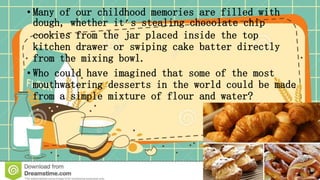
• Many of our childhood memories are filled with
dough, whether it’s stealing chocolate chip
cookies from the jar placed inside the top
kitchen drawer or swiping cake batter directly
from the mixing bowl.
• Who could have imagined that some of the most
mouthwatering desserts in the world could be made
from a simple mixture of flour and water?
History of Dough
• The origin of dough is so ancient that no one
knows exactly when it was first made. However,
prehistoric archeological findings showed that
people may have begun using flour in their diet
about 30,000 years ago.
• During that time, simple water was added to flour
to create the first dough. It was then flattened
and cooked over hot stones. These early creations
were invented due to mistakes.
• It took over almost 20,000 more years before people
started cultivating wheat and making food out of it.
• This way, they were able to settle down, feed more
people, and create an improved social structure
which made the basis of present-day societies.
•Some years later, people discovered yeast,
which took the dough to a whole new level.
•As cultures have developed, so have the
recipes for dough.
Dough and Batter:
What’s the Difference?
• The dough is a mixture of chiefly flour
with low water content. As such, it is from
enough to be kneaded by hands and molded
into shapes.
•Batters contain more liquid content than
dough and have a runny texture. They are
usually mixed with hand or electric mixers.
Main Categories of Dough
•For the sake of practicality, the
several hundred kinds of dough
can be subdivided into two main
categories: leavened and
unleavened dough.
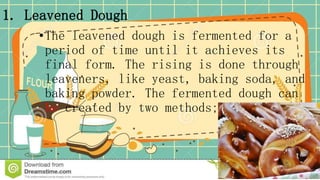
1. Leavened Dough
•The leavened dough is fermented for a
period of time until it achieves its
final form. The rising is done through
leaveners, like yeast, baking soda, and
baking powder. The fermented dough can
be created by two methods;
a. Sponge Dough Method
•The sponge dough method involves creating
a mixture of flour, water, and yeast,
which is left to rise until it at least
doubles in size. Then more flour, sugar,
salt, and fat are added to the dough and
kneaded. This method gives the bread a
flakier texture with a slightly different
flavor.
b. Straight Dough Method
•In the straight dough method, all the
ingredients are combined in a single session
and then kneaded to a smooth and elastic
consistency. Kneading depends on the type of
bread you want to make.
•Examples of baked food made from leavened
dough include all kinds of pieces of bread,
pizza, pretzels, and most rolls.
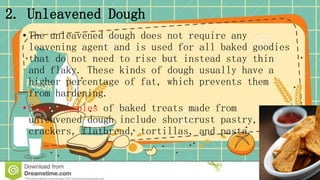
2. Unleavened Dough
• The unleavened dough does not require any
leavening agent and is used for all baked goodies
that do not need to rise but instead stay thin
and flaky. These kinds of dough usually have a
higher percentage of fat, which prevents them
from hardening.
• Some examples of baked treats made from
unleavened dough include shortcrust pastry,
crackers, flatbread, tortillas, and pasta.
Types of Pastry Dough
•If you are interested in making
pastries, you will find that dough can
be categorized as laminated and non-
laminated. Both these types of dough
can be leavened or unleavened.
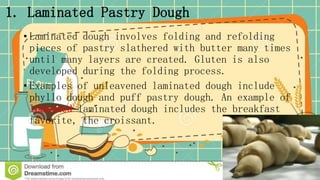
1. Laminated Pastry Dough
• Laminated dough involves folding and refolding
pieces of pastry slathered with butter many times
until many layers are created. Gluten is also
developed during the folding process.
• Examples of unleavened laminated dough include
phyllo dough and puff pastry dough. An example of
leavened laminated dough includes the breakfast
favorite, the croissant.
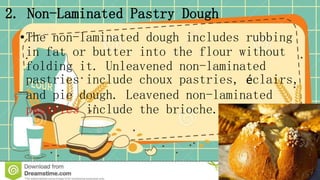
2. Non-Laminated Pastry Dough
•The non-laminated dough includes rubbing
in fat or butter into the flour without
folding it. Unleavened non-laminated
pastries include choux pastries, éclairs,
and pie dough. Leavened non-laminated
pastries include the brioche.
Texture of Dough
•Dough that has a higher amount of fat,
less water, and less gluten, is less
elastic than bread dough and can be
made with two different textures: flaky
and mealy.
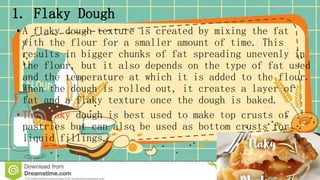
1. Flaky Dough
• A flaky dough texture is created by mixing the fat
with the flour for a smaller amount of time. This
results in bigger chunks of fat spreading unevenly in
the flour, but it also depends on the type of fat used
and the temperature at which it is added to the flour.
When the dough is rolled out, it creates a layer of
fat and a flaky texture once the dough is baked.
• The flaky dough is best used to make top crusts of
pastries but can also be used as bottom crusts for
liquid fillings.
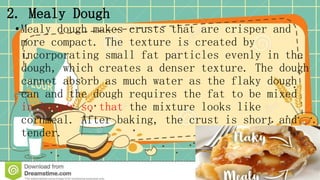
2. Mealy Dough
•Mealy dough makes crusts that are crisper and
more compact. The texture is created by
incorporating small fat particles evenly in the
dough, which creates a denser texture. The dough
cannot absorb as much water as the flaky dough
can and the dough requires the fat to be mixed
in longer so that the mixture looks like
cornmeal. After baking, the crust is short and
tender.
•This kind of dough works well for liquid
fillings, like custard, especially if you
don’t blind-bake the crust (partially
baking the crust beforehand). It is also
the perfect dough for making bottom
crusts of fruit pies as it does not get
soggy.
Types of Dough
•There are several kinds of dough that have
been created around the world. Some of the
most popular types are listed below:
1. Bread Dough
2. Sourdough
3. Rich Dough
4. Pie Dough
5. Pate Brisee
6. Pate Sucree
7. Pate Sablee
8. Puff Pastry Dough
9. Phyllo Dough
10. Choux Pastry Dough
11. Croissant Dough
12. Brioche Dough
13. Kourou Dough
14. Pasta Dough
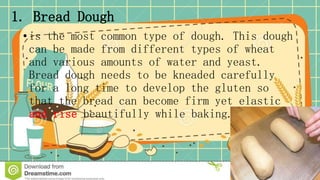
1. Bread Dough
•is the most common type of dough. This dough
can be made from different types of wheat
and various amounts of water and yeast.
Bread dough needs to be kneaded carefully
for a long time to develop the gluten so
that the bread can become firm yet elastic
and rise beautifully while baking.
•Bread dough can be made from a single
or a combination of flour giving it a
different taste and texture. There are
some bread types that use baking soda
as leaveners instead of yeast. This
bread is known as soda bread.
2. Sourdough
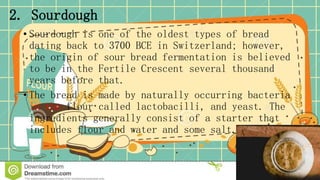
• Sourdough is one of the oldest types of bread
dating back to 3700 BCE in Switzerland; however,
the origin of sour bread fermentation is believed
to be in the Fertile Crescent several thousand
years before that.
• The bread is made by naturally occurring bacteria
in the flour called lactobacilli, and yeast. The
ingredients generally consist of a starter that
includes flour and water and some salt.
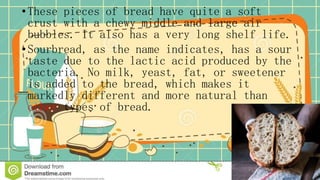
•These pieces of bread have quite a soft
crust with a chewy middle and large air
bubbles. It also has a very long shelf life.
•Sourbread, as the name indicates, has a sour
taste due to the lactic acid produced by the
bacteria. No milk, yeast, fat, or sweetener
is added to the bread, which makes it
markedly different and more natural than
other types of bread.
3. Rich Dough
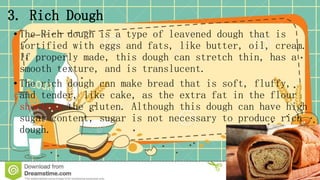
• The Rich dough is a type of leavened dough that is
fortified with eggs and fats, like butter, oil, cream.
If properly made, this dough can stretch thin, has a
smooth texture, and is translucent.
• The rich dough can make bread that is soft, fluffy,
and tender, like cake, as the extra fat in the flour
shortens the gluten. Although this dough can have high
sugar content, sugar is not necessary to produce rich
dough.
4. Pie Dough
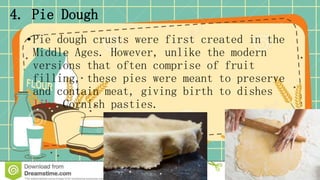
•Pie dough crusts were first created in the
Middle Ages. However, unlike the modern
versions that often comprise of fruit
filling, these pies were meant to preserve
and contain meat, giving birth to dishes
like Cornish pasties.
• Pie dough is made from a few standard
ingredients including flour, water, salt,
and fat in different ratios. Some more
advanced recipes also include baking powder
or vinegar, or flavoring agents like eggs,
lemon juice, cider, and sugar.
• The flour is often all-purpose but can be a
combination of bread, pastry, or cake flour.
•The fat incorporated into the pie dough can be
butter, shortening, or lard and even oil and is
used cold and hard. The success of a pie crust
depends on how cold the ingredients are kept,
how the fat is distributed into the flour, and
how much gluten is developed. The resulting
texture can be flaky or mealy and tender, with
a beautiful golden brown color.
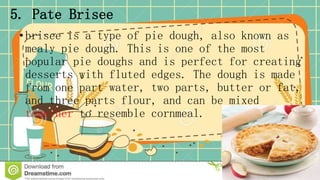
5. Pate Brisee
•brisee is a type of pie dough, also known as
mealy pie dough. This is one of the most
popular pie doughs and is perfect for creating
desserts with fluted edges. The dough is made
from one part water, two parts, butter or fat,
and three parts flour, and can be mixed
together to resemble cornmeal.
•This delicious French pastry dough is
made without sugar and works well for
liquid fillings, like custards. It also
typically contains one egg for every
pound of flour and other ingredients like
lemon juice, salt, and vanilla extract,
for flavor.
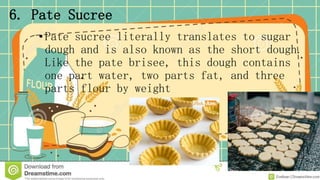
6. Pate Sucree
• Pate sucree literally translates to sugar
dough and is also known as the short dough.
Like the pate brisee, this dough contains
one part water, two parts fat, and three
parts flour by weight
•It also contains an egg for every pound of
flour and has several flavoring agents, just
like pate brisee.
•However, it has a much higher sugar content,
giving it a sweet taste. The flavor is more
cookie-like also and it is the preferred dough
for making dessert tarts and cookies.
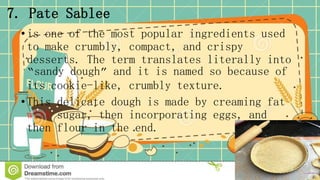
7. Pate Sablee
•is one of the most popular ingredients used
to make crumbly, compact, and crispy
desserts. The term translates literally into
“sandy dough” and it is named so because of
its cookie-like, crumbly texture.
•This delicate dough is made by creaming fat
with sugar, then incorporating eggs, and
then flour in the end.
•The crust is either partially or whole baked
prior to filling (blind baking). Some
recipes also require egg yolks for a more
tender crust, though this is not necessary.
•The dough is quite sweet as it requires 15
percent sugar and sometimes 15 percent
ground almonds as well. It can also be baked
as it is to make delicious cookies.
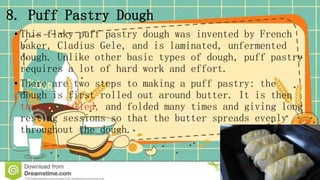
8. Puff Pastry Dough
• This flaky puff pastry dough was invented by French
baker, Cladius Gele, and is laminated, unfermented
dough. Unlike other basic types of dough, puff pastry
requires a lot of hard work and effort.
• There are two steps to making a puff pastry: the
dough is first rolled out around butter. It is then
turned, rolled, and folded many times and giving long
resting sessions so that the butter spreads evenly
throughout the dough.
•As the dough is baked, the water evaporates and
the butter melts, separating the layers of
dough and giving the puff pastry its
distinctive layers and buttery, crisp, and
flaky texture.
•Because of its many fine layers, the pastry is
also known as leaf pastry.
•Puff pastry dough can be used to make napoleons
or other desserts or savories.
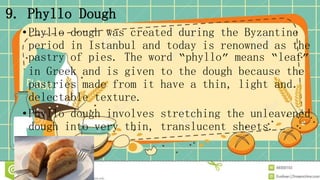
9. Phyllo Dough
•Phyllo dough was created during the Byzantine
period in Istanbul and today is renowned as the
pastry of pies. The word “phyllo” means “leaf”
in Greek and is given to the dough because the
pastries made from it have a thin, light and
delectable texture.
•Phyllo dough involves stretching the unleavened
dough into very thin, translucent sheets.
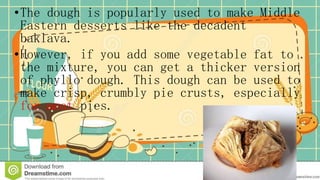
•The dough is popularly used to make Middle
Eastern desserts like the decadent
baklava.
•However, if you add some vegetable fat to
the mixture, you can get a thicker version
of phyllo dough. This dough can be used to
make crisp, crumbly pie crusts, especially
for meat pies.
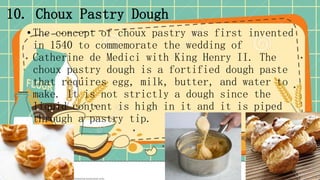
10. Choux Pastry Dough
• The concept of choux pastry was first invented
in 1540 to commemorate the wedding of
Catherine de Medici with King Henry II. The
choux pastry dough is a fortified dough paste
that requires egg, milk, butter, and water to
make. It is not strictly a dough since the
liquid content is high in it and it is piped
through a pastry tip.
• If the dough is formed perfectly, it can produce
a crispy crust, a light interior, and a perfect
golden brown color. During baking, water
evaporates, leaving the center somewhat empty and
hollow.
• This space can be filled with whipped cream,
custard, or jelly. Therefore, the dough is used
to make a mouthwatering variety of desserts,
including éclairs, cream puffs, croquembouche,
profiteroles, and Paris-Brest.
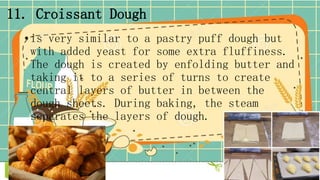
11. Croissant Dough
• is very similar to a pastry puff dough but
with added yeast for some extra fluffiness.
The dough is created by enfolding butter and
taking it to a series of turns to create
central layers of butter in between the
dough sheets. During baking, the steam
separates the layers of dough.
•Although a lot of hard work is involved
in it, if the lamination is successful,
the resulting bread is very light and
flaky in texture.
•This dough can also be wrapped around
chocolate or almond paste before they are
baked.
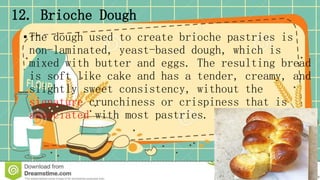
12. Brioche Dough
•The dough used to create brioche pastries is
non-laminated, yeast-based dough, which is
mixed with butter and eggs. The resulting bread
is soft like cake and has a tender, creamy, and
slightly sweet consistency, without the
signature crunchiness or crispiness that is
associated with most pastries.
•This dough is typically rolled into
balls to make its characteristic round
shape though it can also be made into
an ordinary loaf shape. Brioche
Nanterre is made by placing two loaf-
shaped sections of brioche dough side
by side and baking them. When the dough
rises, the two separate sections fuse
together.
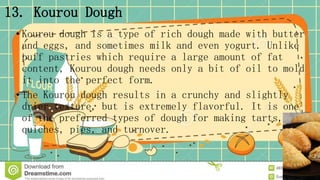
13. Kourou Dough
• Kourou dough is a type of rich dough made with butter
and eggs, and sometimes milk and even yogurt. Unlike
puff pastries which require a large amount of fat
content, Kourou dough needs only a bit of oil to mold
it into the perfect form.
• The Kourou dough results in a crunchy and slightly
drier texture, but is extremely flavorful. It is one
of the preferred types of dough for making tarts,
quiches, pies, and turnover.
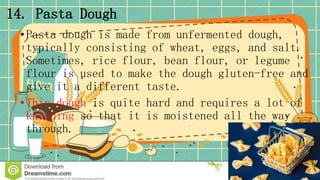
14. Pasta Dough
•Pasta dough is made from unfermented dough,
typically consisting of wheat, eggs, and salt.
Sometimes, rice flour, bean flour, or legume
flour is used to make the dough gluten-free and
give it a different taste.
•This dough is quite hard and requires a lot of
kneading so that it is moistened all the way
through.
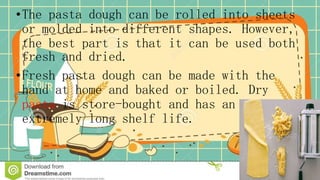
•The pasta dough can be rolled into sheets
or molded into different shapes. However,
the best part is that it can be used both
fresh and dried.
•Fresh pasta dough can be made with the
hand at home and baked or boiled. Dry
pasta is store-bought and has an
extremely long shelf life.
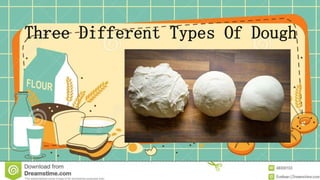
Three Different Types Of Dough
•There are three different types of dough
leavened dough, dough made with boiling
water, and unleavened dough. This is mainly
about their textures and how to use them for
your home baking. Start by opening a bag of
flour and add 200 grams of flour to each of
the three bowls. The first bowl is for
making the unleavened dough by adding yeast
and warm water.
•Knead it together until the dough is well-
formed. In the second bowl, you will be
making the dough by adding salt and boiling
water. Let it cool down a bit then knead the
dough. In the third bowl, you will be making
an unleavened dough by adding salt and warm
water. Knead it into a dough and set it
aside. Cover the three bowls and let them
rest for at least two hours.
• After two hours, the side of the dough will
be the same in the second and the third bowl
but in the first bowl, the dough will have
doubled in size. The leavened dough can be
stretched, so the dough has elasticity and
can’t be stretched too long. This dough
also has lots of bubbles on the inside, the
bubble texture is very useful in making
steamed buns or bread which are very soft.
•For the dough with the boiling water,
it breaks when stretched and there is
not much elasticity on the dough. Since
most of the flour has been cooked by
boiling water and only gluten is left
in the dough, you can easily roll it
out and make it very thin. Most of the
time, this dough is used with other
types of dough.
•This dough can also absorb more water
which means a softer texture in the
final product. For the unleavened
dough, it can be stretched for a long
which means that the gluten was well-
developed. This dough can be used to
make dumplings and noodles.
•Each of the mentioned dough can be used
on their own but the most interesting
part is how you combine them. You can
combine the dough made with boiling
water and unleavened dough to make all
kinds of pan-cooked flatbread. Since
you want the softness of the dough made
with boiling water and chewiness from
the unleaved dough.
•You can also combine the leavened dough
with the unleavened dough. You can also
combine the leavened dough with dough
made with boiling water, the best example
of this dough is the Japanese soft bread.
You can also mix the three doughs.
•If you understand these three basic types
of dough, you can use them in your own
dough-making to make the textures and
taste that you want.
 THANK YOU ! 
-ma’am Lyn

Advance Baking 11 (kinds dough).pptx

  • 1.
    KINDS OF DOUGH Preparedby: Maria Merllan Estrellante Mier
  • 2.
    • Many ofour childhood memories are filled with dough, whether it’s stealing chocolate chip cookies from the jar placed inside the top kitchen drawer or swiping cake batter directly from the mixing bowl. • Who could have imagined that some of the most mouthwatering desserts in the world could be made from a simple mixture of flour and water?
  • 3.
    History of Dough •The origin of dough is so ancient that no one knows exactly when it was first made. However, prehistoric archeological findings showed that people may have begun using flour in their diet about 30,000 years ago. • During that time, simple water was added to flour to create the first dough. It was then flattened and cooked over hot stones. These early creations were invented due to mistakes.
  • 4.
    • It tookover almost 20,000 more years before people started cultivating wheat and making food out of it. • This way, they were able to settle down, feed more people, and create an improved social structure which made the basis of present-day societies. •Some years later, people discovered yeast, which took the dough to a whole new level. •As cultures have developed, so have the recipes for dough.
  • 5.
    Dough and Batter: What’sthe Difference? • The dough is a mixture of chiefly flour with low water content. As such, it is from enough to be kneaded by hands and molded into shapes. •Batters contain more liquid content than dough and have a runny texture. They are usually mixed with hand or electric mixers.
  • 6.
    Main Categories ofDough •For the sake of practicality, the several hundred kinds of dough can be subdivided into two main categories: leavened and unleavened dough.
  • 7.
    1. Leavened Dough •Theleavened dough is fermented for a period of time until it achieves its final form. The rising is done through leaveners, like yeast, baking soda, and baking powder. The fermented dough can be created by two methods;
  • 8.
    a. Sponge DoughMethod •The sponge dough method involves creating a mixture of flour, water, and yeast, which is left to rise until it at least doubles in size. Then more flour, sugar, salt, and fat are added to the dough and kneaded. This method gives the bread a flakier texture with a slightly different flavor.
  • 9.
    b. Straight DoughMethod •In the straight dough method, all the ingredients are combined in a single session and then kneaded to a smooth and elastic consistency. Kneading depends on the type of bread you want to make. •Examples of baked food made from leavened dough include all kinds of pieces of bread, pizza, pretzels, and most rolls.
  • 10.
    2. Unleavened Dough •The unleavened dough does not require any leavening agent and is used for all baked goodies that do not need to rise but instead stay thin and flaky. These kinds of dough usually have a higher percentage of fat, which prevents them from hardening. • Some examples of baked treats made from unleavened dough include shortcrust pastry, crackers, flatbread, tortillas, and pasta.
  • 11.
    Types of PastryDough •If you are interested in making pastries, you will find that dough can be categorized as laminated and non- laminated. Both these types of dough can be leavened or unleavened.
  • 12.
    1. Laminated PastryDough • Laminated dough involves folding and refolding pieces of pastry slathered with butter many times until many layers are created. Gluten is also developed during the folding process. • Examples of unleavened laminated dough include phyllo dough and puff pastry dough. An example of leavened laminated dough includes the breakfast favorite, the croissant.
  • 13.
    2. Non-Laminated PastryDough •The non-laminated dough includes rubbing in fat or butter into the flour without folding it. Unleavened non-laminated pastries include choux pastries, éclairs, and pie dough. Leavened non-laminated pastries include the brioche.
  • 14.
    Texture of Dough •Doughthat has a higher amount of fat, less water, and less gluten, is less elastic than bread dough and can be made with two different textures: flaky and mealy.
  • 15.
    1. Flaky Dough •A flaky dough texture is created by mixing the fat with the flour for a smaller amount of time. This results in bigger chunks of fat spreading unevenly in the flour, but it also depends on the type of fat used and the temperature at which it is added to the flour. When the dough is rolled out, it creates a layer of fat and a flaky texture once the dough is baked. • The flaky dough is best used to make top crusts of pastries but can also be used as bottom crusts for liquid fillings.
  • 16.
    2. Mealy Dough •Mealydough makes crusts that are crisper and more compact. The texture is created by incorporating small fat particles evenly in the dough, which creates a denser texture. The dough cannot absorb as much water as the flaky dough can and the dough requires the fat to be mixed in longer so that the mixture looks like cornmeal. After baking, the crust is short and tender.
  • 17.
    •This kind ofdough works well for liquid fillings, like custard, especially if you don’t blind-bake the crust (partially baking the crust beforehand). It is also the perfect dough for making bottom crusts of fruit pies as it does not get soggy.
  • 18.
    Types of Dough •Thereare several kinds of dough that have been created around the world. Some of the most popular types are listed below: 1. Bread Dough 2. Sourdough 3. Rich Dough 4. Pie Dough 5. Pate Brisee 6. Pate Sucree 7. Pate Sablee 8. Puff Pastry Dough 9. Phyllo Dough 10. Choux Pastry Dough 11. Croissant Dough 12. Brioche Dough 13. Kourou Dough 14. Pasta Dough
  • 19.
    1. Bread Dough •isthe most common type of dough. This dough can be made from different types of wheat and various amounts of water and yeast. Bread dough needs to be kneaded carefully for a long time to develop the gluten so that the bread can become firm yet elastic and rise beautifully while baking.
  • 20.
    •Bread dough canbe made from a single or a combination of flour giving it a different taste and texture. There are some bread types that use baking soda as leaveners instead of yeast. This bread is known as soda bread.
  • 21.
    2. Sourdough • Sourdoughis one of the oldest types of bread dating back to 3700 BCE in Switzerland; however, the origin of sour bread fermentation is believed to be in the Fertile Crescent several thousand years before that. • The bread is made by naturally occurring bacteria in the flour called lactobacilli, and yeast. The ingredients generally consist of a starter that includes flour and water and some salt.
  • 22.
    •These pieces ofbread have quite a soft crust with a chewy middle and large air bubbles. It also has a very long shelf life. •Sourbread, as the name indicates, has a sour taste due to the lactic acid produced by the bacteria. No milk, yeast, fat, or sweetener is added to the bread, which makes it markedly different and more natural than other types of bread.
  • 23.
    3. Rich Dough •The Rich dough is a type of leavened dough that is fortified with eggs and fats, like butter, oil, cream. If properly made, this dough can stretch thin, has a smooth texture, and is translucent. • The rich dough can make bread that is soft, fluffy, and tender, like cake, as the extra fat in the flour shortens the gluten. Although this dough can have high sugar content, sugar is not necessary to produce rich dough.
  • 24.
    4. Pie Dough •Piedough crusts were first created in the Middle Ages. However, unlike the modern versions that often comprise of fruit filling, these pies were meant to preserve and contain meat, giving birth to dishes like Cornish pasties.
  • 25.
    • Pie doughis made from a few standard ingredients including flour, water, salt, and fat in different ratios. Some more advanced recipes also include baking powder or vinegar, or flavoring agents like eggs, lemon juice, cider, and sugar. • The flour is often all-purpose but can be a combination of bread, pastry, or cake flour.
  • 26.
    •The fat incorporatedinto the pie dough can be butter, shortening, or lard and even oil and is used cold and hard. The success of a pie crust depends on how cold the ingredients are kept, how the fat is distributed into the flour, and how much gluten is developed. The resulting texture can be flaky or mealy and tender, with a beautiful golden brown color.
  • 27.
    5. Pate Brisee •briseeis a type of pie dough, also known as mealy pie dough. This is one of the most popular pie doughs and is perfect for creating desserts with fluted edges. The dough is made from one part water, two parts, butter or fat, and three parts flour, and can be mixed together to resemble cornmeal.
  • 28.
    •This delicious Frenchpastry dough is made without sugar and works well for liquid fillings, like custards. It also typically contains one egg for every pound of flour and other ingredients like lemon juice, salt, and vanilla extract, for flavor.
  • 29.
    6. Pate Sucree •Pate sucree literally translates to sugar dough and is also known as the short dough. Like the pate brisee, this dough contains one part water, two parts fat, and three parts flour by weight
  • 30.
    •It also containsan egg for every pound of flour and has several flavoring agents, just like pate brisee. •However, it has a much higher sugar content, giving it a sweet taste. The flavor is more cookie-like also and it is the preferred dough for making dessert tarts and cookies.
  • 31.
    7. Pate Sablee •isone of the most popular ingredients used to make crumbly, compact, and crispy desserts. The term translates literally into “sandy dough” and it is named so because of its cookie-like, crumbly texture. •This delicate dough is made by creaming fat with sugar, then incorporating eggs, and then flour in the end.
  • 32.
    •The crust iseither partially or whole baked prior to filling (blind baking). Some recipes also require egg yolks for a more tender crust, though this is not necessary. •The dough is quite sweet as it requires 15 percent sugar and sometimes 15 percent ground almonds as well. It can also be baked as it is to make delicious cookies.
  • 33.
    8. Puff PastryDough • This flaky puff pastry dough was invented by French baker, Cladius Gele, and is laminated, unfermented dough. Unlike other basic types of dough, puff pastry requires a lot of hard work and effort. • There are two steps to making a puff pastry: the dough is first rolled out around butter. It is then turned, rolled, and folded many times and giving long resting sessions so that the butter spreads evenly throughout the dough.
  • 34.
    •As the doughis baked, the water evaporates and the butter melts, separating the layers of dough and giving the puff pastry its distinctive layers and buttery, crisp, and flaky texture. •Because of its many fine layers, the pastry is also known as leaf pastry. •Puff pastry dough can be used to make napoleons or other desserts or savories.
  • 35.
    9. Phyllo Dough •Phyllodough was created during the Byzantine period in Istanbul and today is renowned as the pastry of pies. The word “phyllo” means “leaf” in Greek and is given to the dough because the pastries made from it have a thin, light and delectable texture. •Phyllo dough involves stretching the unleavened dough into very thin, translucent sheets.
  • 36.
    •The dough ispopularly used to make Middle Eastern desserts like the decadent baklava. •However, if you add some vegetable fat to the mixture, you can get a thicker version of phyllo dough. This dough can be used to make crisp, crumbly pie crusts, especially for meat pies.
  • 37.
    10. Choux PastryDough • The concept of choux pastry was first invented in 1540 to commemorate the wedding of Catherine de Medici with King Henry II. The choux pastry dough is a fortified dough paste that requires egg, milk, butter, and water to make. It is not strictly a dough since the liquid content is high in it and it is piped through a pastry tip.
  • 38.
    • If thedough is formed perfectly, it can produce a crispy crust, a light interior, and a perfect golden brown color. During baking, water evaporates, leaving the center somewhat empty and hollow. • This space can be filled with whipped cream, custard, or jelly. Therefore, the dough is used to make a mouthwatering variety of desserts, including éclairs, cream puffs, croquembouche, profiteroles, and Paris-Brest.
  • 39.
    11. Croissant Dough •is very similar to a pastry puff dough but with added yeast for some extra fluffiness. The dough is created by enfolding butter and taking it to a series of turns to create central layers of butter in between the dough sheets. During baking, the steam separates the layers of dough.
  • 40.
    •Although a lotof hard work is involved in it, if the lamination is successful, the resulting bread is very light and flaky in texture. •This dough can also be wrapped around chocolate or almond paste before they are baked.
  • 41.
    12. Brioche Dough •Thedough used to create brioche pastries is non-laminated, yeast-based dough, which is mixed with butter and eggs. The resulting bread is soft like cake and has a tender, creamy, and slightly sweet consistency, without the signature crunchiness or crispiness that is associated with most pastries.
  • 42.
    •This dough istypically rolled into balls to make its characteristic round shape though it can also be made into an ordinary loaf shape. Brioche Nanterre is made by placing two loaf- shaped sections of brioche dough side by side and baking them. When the dough rises, the two separate sections fuse together.
  • 43.
    13. Kourou Dough •Kourou dough is a type of rich dough made with butter and eggs, and sometimes milk and even yogurt. Unlike puff pastries which require a large amount of fat content, Kourou dough needs only a bit of oil to mold it into the perfect form. • The Kourou dough results in a crunchy and slightly drier texture, but is extremely flavorful. It is one of the preferred types of dough for making tarts, quiches, pies, and turnover.
  • 44.
    14. Pasta Dough •Pastadough is made from unfermented dough, typically consisting of wheat, eggs, and salt. Sometimes, rice flour, bean flour, or legume flour is used to make the dough gluten-free and give it a different taste. •This dough is quite hard and requires a lot of kneading so that it is moistened all the way through.
  • 45.
    •The pasta doughcan be rolled into sheets or molded into different shapes. However, the best part is that it can be used both fresh and dried. •Fresh pasta dough can be made with the hand at home and baked or boiled. Dry pasta is store-bought and has an extremely long shelf life.
  • 46.
  • 47.
    •There are threedifferent types of dough leavened dough, dough made with boiling water, and unleavened dough. This is mainly about their textures and how to use them for your home baking. Start by opening a bag of flour and add 200 grams of flour to each of the three bowls. The first bowl is for making the unleavened dough by adding yeast and warm water.
  • 48.
    •Knead it togetheruntil the dough is well- formed. In the second bowl, you will be making the dough by adding salt and boiling water. Let it cool down a bit then knead the dough. In the third bowl, you will be making an unleavened dough by adding salt and warm water. Knead it into a dough and set it aside. Cover the three bowls and let them rest for at least two hours.
  • 49.
    • After twohours, the side of the dough will be the same in the second and the third bowl but in the first bowl, the dough will have doubled in size. The leavened dough can be stretched, so the dough has elasticity and can’t be stretched too long. This dough also has lots of bubbles on the inside, the bubble texture is very useful in making steamed buns or bread which are very soft.
  • 50.
    •For the doughwith the boiling water, it breaks when stretched and there is not much elasticity on the dough. Since most of the flour has been cooked by boiling water and only gluten is left in the dough, you can easily roll it out and make it very thin. Most of the time, this dough is used with other types of dough.
  • 51.
    •This dough canalso absorb more water which means a softer texture in the final product. For the unleavened dough, it can be stretched for a long which means that the gluten was well- developed. This dough can be used to make dumplings and noodles.
  • 52.
    •Each of thementioned dough can be used on their own but the most interesting part is how you combine them. You can combine the dough made with boiling water and unleavened dough to make all kinds of pan-cooked flatbread. Since you want the softness of the dough made with boiling water and chewiness from the unleaved dough.
  • 53.
    •You can alsocombine the leavened dough with the unleavened dough. You can also combine the leavened dough with dough made with boiling water, the best example of this dough is the Japanese soft bread. You can also mix the three doughs. •If you understand these three basic types of dough, you can use them in your own dough-making to make the textures and taste that you want.
  • 54.
     THANK YOU!  -ma’am Lyn