Report of Industrial Training
At
BASF India Ltd.
Dahej Site
Submitted By
Palash Ramakant Kumbhare
In partial fulfilment of the requirements for the award of the Degree of
BACHELOR OF TECHNOLOGY (B.TECH.)
IN
CHEMICAL ENGINEERING
College of Engineering & Technology, Babhulgaon (Jh), Akola
Maharashtra, 444104
SANT GADGE BABA AMRAVATI UNIVERSITY, AMARAVATI
ABOUT THE INDUSTRY
BASF had celebrated150 Years anniversary on 23rd
April 2015
BASF is the largest chemical producer in the world and is headquartered
in Ludwigshafen, Germany.[2] The BASF Group comprises subsidiaries and
joint ventures in more than 80 countries and operates six integrated production
sites and 390 other production sites in Europe, Asia, Australia, Americas and
Africa.[3] Its headquarters is located in Ludwigshafen am Rhein (Rhineland-
Palatinate, Germany). BASF has customers in over 200 countries and supplies
products to a wide variety of industries. Despite its size and global presence,
BASF has received relatively little public attention since abandoning its
consumer productlines in the 1990s.
At the end of 2015, the company employed more than 112,000 people,
with over 52,800 in Germany alone. In 2015, BASF posted sales of €70.4
billion and income from operations before special items of about €6.7 billion.
The company is currently expanding its international activities with a particular
focus on Asia. Between 1990 and 2005, the company invested €5.6 billion in
Asia, for example in sites near Nanjing and Shanghai, China and Mangalore in
India.
BASF (Badische Anilin und Soda Fabrik) or, in English (Baden Aniline
and Soda Factory) was founded on 6 April 1865 in Mannheim, in the German-
speaking country of Baden by Friedrich Engelhorn. It had been responsible for
setting up a gasworks and street lighting for the town council in 1861. The
gasworks produced tar as a by product, and Engelhorn used this for the
production of dyes. BASF was set up in 1865 to produce other chemicals
necessary for dye production, notably soda and acids. The plant, however, was
erected on the other side of the Rhine river at Ludwigshafen because the town
council of Mannheim was afraid that the air pollution of the chemical plant
could bother the inhabitants of the town. In 1866 the dye production processes
were also moved to the BASF site.
BASF is a pioneer in manufacturing and developing biodegradable
plastic, namely, Ecoflex. Ecovio consists of Ecoflex and a high content of
polylactic acid.
In 2006 BASF was praised by the Climate Leadership Index for their
efforts in problems with climate change and greenhouse gases in our world. In
recent years the BASF Company has set aside a large portion of their R&D
budget on resource conservation.
BASF India’s chemical production complex at Dahej, Gujarat, started
operation in October 2014. At approximately INR 10 billion ($180 million), it is
the biggest investment made by BASF on India.
The complex is located at the 453km2 Dahej Petroleum, Chemicals and
Petrochemicals Investment Region (PCPIR). Planning for the project started in
mid 2011, the investment decision was made in April 2012 and construction
activities were completed in 2014 with zero lost-time incidents.
ACKNOWLEDGEMENT
It is always a pleasure to remind the fine people in the Engineering
Workshops for their sincere guidance I received to uphold my practical as well
as theoretical skills in engineering.
I would like to thanks to Dr. S. K. Deshmukh, M.Tech., Ph.D, Principal
of our college and Dr. P. V. Thorat, M.Tech., Ph.D, (Chemical Engineering)
Head of Department.
I would also like thanks to Prof. D. P. Sakharkar and Prof. S. S. Tayde
T&P Department (Chemical Engineering) to give the information and arrange
the industrial training for students, making them aware of industrial field
knowledge and industrial problems etc.
I would also like thanks to Mr. Rajesh Satam (PM, Operation Head) and
Mr. Bhargav Thakkar (PM, Executive) and all the DCS operators to give me
the brief knowledge about the plant.
CERTIFICATE
It is to certify that Mr. Palash Ramakant Kumbhare has completed his
15 days industrial training in BASF India Ltd. at Dahej site from dated
07/06/2016 to 22/06/2016, in a satisfactory manner for the partial fulfilment of
the requirement for the Degree of Bachelor of Technology (Chemical
Engineering).
Mr. Bhargav Thakkar Mr. Rajesh Satam
(PM, Executive) (PM, Operation Head)
DECLERATION
As Engineer is one who converts the theories of the textbooks into the
pratical working models and processes. We learn many things more perfectly
and accurately through observations and applications.
Learing in classes just gives us the basic idea about any process,while at
the same time industrial training helps us to understand the detailed and through
working of that particular process. Hence we can clearly understand the
principle application of the theoretical study. Industrial traininig is implemented
by our college for imparting knowledge about real operations and pocesses, and
also learn about working equipment.
This report contains the various unit operations and operational details of
the plant. This report has been prepared on the basis of information collected
and provided during the training I underwent at BASF India Pvt. Ltd., Dahej.
The information given in this report is true as per my knowledge and data
provided by the industry.
I take immense pleasure in presenting this report and sincerely apologize
for any wrong information printed in it.
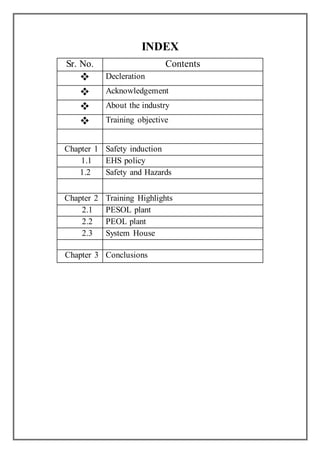
INDEX
Sr. No. Contents
 Decleration
 Acknowledgement
 About the industry
 Training objective
Chapter 1 Safety induction
1.1 EHS policy
1.2 Safety and Hazards
Chapter 2 Training Highlights
2.1 PESOL plant
2.2 PEOL plant
2.3 System House
Chapter 3 Conclusions
TRAINING OBJECTIVE
 To experience and understand real life situations in industrial
oraganizations
 To understood the process involved in manufacture of the products.
 To provide suggestions to reduce the current batch time for production
process.
 To understand hazard identification.
 To perceive safety practics and regulations in the industry.
 To keep the track of trends of reactors for studying assteffectiveness.
SAFETY INDUCTION
EHS policy
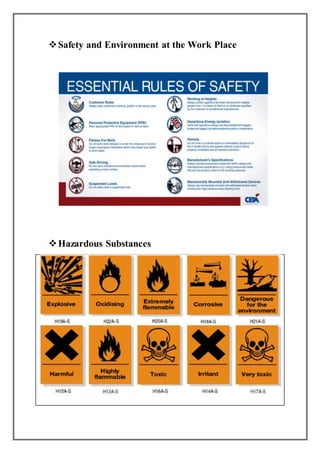
Safety and Environment at the work place
Hazardous Substances
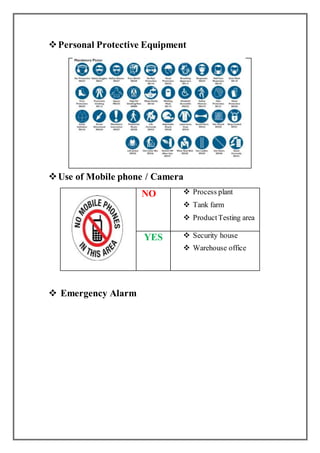
Personal protective Equipment
Use of Mobile phone / Camera
Housekeeping
Safety showers,fire extinguishers etc
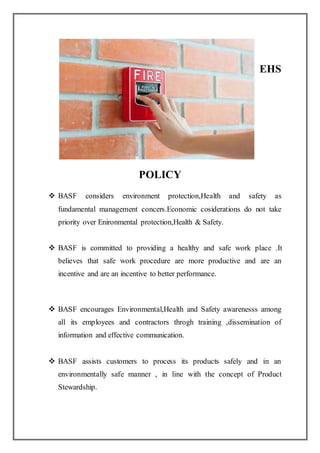
Emergency Alarm
Safety and Environment at the Work Place
Hazardous Substances
Personal Protective Equipment
Use of Mobile phone / Camera
NO  Process plant
 Tank farm
 ProductTesting area
YES  Security house
 Warehouse office
 Emergency Alarm
EHS
POLICY
 BASF considers environment protection,Health and safety as
fundamental management concers.Economic cosiderations do not take
priority over Enironmental protection,Health & Safety.
 BASF is committed to providing a healthy and safe work place .It
believes that safe work procedure are more productive and are an
incentive and are an incentive to better performance.
 BASF encourages Environmental,Health and Safety awarenesss among
all its employees and contractors throgh training ,dissemination of
information and effective communication.
 BASF assists customers to process its products safely and in an
environmentally safe manner , in line with the concept of Product
Stewardship.
 BASF manufactures products that are produced, stored, transported, used,
disposed off with minimal adverse impact on man and environment in
conformity with the principles of Sustainable Development.
 BASF as a Responsible Care Company is committed to meeting all
statutory obligations continous improvement are taken even where no
regulations exit.
Chapter 1: INTRODUCTION
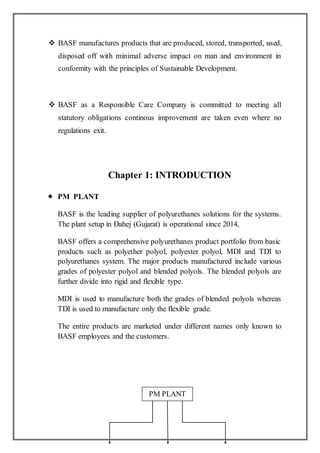
 PM PLANT
BASF is the leading supplier of polyurethanes solutions for the systems.
The plant setup in Dahej (Gujarat) is operational since 2014,
BASF offers a comprehensive polyurethanes product portfolio from basic
products such as polyether polyol, polyester polyol, MDI and TDI to
polyurethanes system. The major products manufactured include various
grades of polyester polyol and blended polyols. The blended polyols are
further divide into rigid and flexible type.
MDI is used to manufacture both the grades of blended polyols whereas
TDI is used to manufacture only the flexible grade.
The entire products are marketed under different names only known to
BASF employees and the customers.
PM PLANT
 PESOLPLANTb (Lupraphen)
RAW MATERIALS
1. Adipic Acid
2. Mono Ethylene Glycol (MEG)
3. Di Ethylene Glycol (DEG)
4. 1,4-Butanediol (BDO)
5. TYZOR Catalyst
6. Glycerine
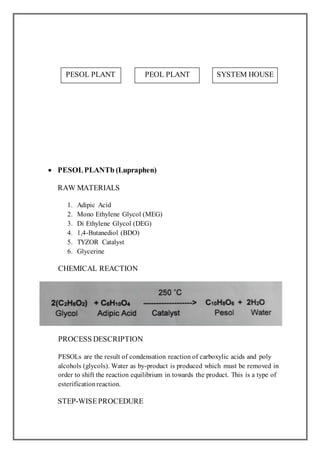
CHEMICAL REACTION
PROCESS DESCRIPTION
PESOLs are the result of condensation reaction of carboxylic acids and poly
alcohols (glycols). Water as by-product is produced which must be removed in
order to shift the reaction equilibrium in towards the product. This is a type of
esterification reaction.
STEP-WISEPROCEDURE
PESOL PLANT PEOL PLANT SYSTEM HOUSE
Step 1: Recipe selectionand Batch start phase
- Depending on the schedule, batch size is decided and recipe is taken.
- The required raw material is brought from the warehouse and loaded into
storage tanks.
Step 2: Raw material pre-charging phase
The Adipic Acid is unloaded in the silo and MEG and DEG is pumped into the
storage tanks.
Step 3: Utility start-up and checking phase
- Cooling water pumps, thermic oils heater unit, chilled water unit, nitrogen
supply, steam supply, instrument air supply etc. are started and checked.
Step 4: Raw material charging phase
- Reactor must be empty and bottom valve must be closed and vent must be
kept open.
- The hot oil is sent to the coils and heating is started.
- Reactor and silo are both inertized using nitrogen. Then MEG and DEG are
charged into the reactor.
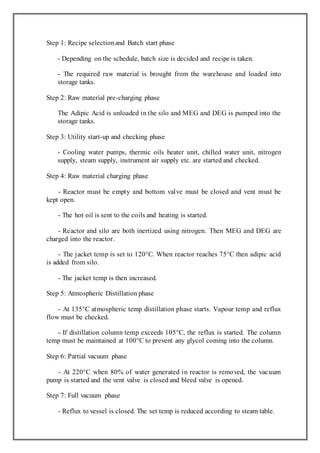
- The jacket temp is set to 120°C. When reactor reaches 75°C then adipic acid
is added from silo.
- The jacket temp is then increased.
Step 5: Atmospheric Distillation phase
- At 135°C atmospheric temp distillation phase starts. Vapour temp and reflux
flow must be checked.
- If distillation column temp exceeds 105°C, the reflux is started. The column
temp must be maintained at 100°C to prevent any glycol coming into the column.
Step 6: Partial vacuum phase
- At 220°C when 80% of water generated in reactor is removed, the vacuum
pump is started and the vent valve is closed and bleed valve is opened.
Step 7: Full vacuum phase
- Reflux to vessel is closed. The set temp is reduced according to steam table.
Step 8: Sample checking phase
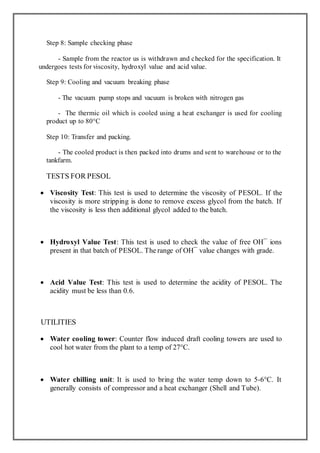
- Sample from the reactor us is withdrawn and checked for the specification. It
undergoes tests for viscosity, hydroxyl value and acid value.
Step 9: Cooling and vacuum breaking phase
- The vacuum pump stops and vacuum is broken with nitrogen gas
- The thermic oil which is cooled using a heat exchanger is used for cooling
product up to 80°C
Step 10: Transfer and packing.
- The cooled product is then packed into drums and sent to warehouse or to the
tankfarm.
TESTS FOR PESOL
 Viscosity Test: This test is used to determine the viscosity of PESOL. If the
viscosity is more stripping is done to remove excess glycol from the batch. If
the viscosity is less then additional glycol added to the batch.
 Hydroxyl Value Test: This test is used to check the value of free OH¯ ions
present in that batch of PESOL. The range of OH¯ value changes with grade.
 Acid Value Test: This test is used to determine the acidity of PESOL. The
acidity must be less than 0.6.
UTILITIES
 Water cooling tower: Counter flow induced draft cooling towers are used to
cool hot water from the plant to a temp of 27°C.
 Water chilling unit: It is used to bring the water temp down to 5-6°C. It
generally consists of compressor and a heat exchanger (Shell and Tube).
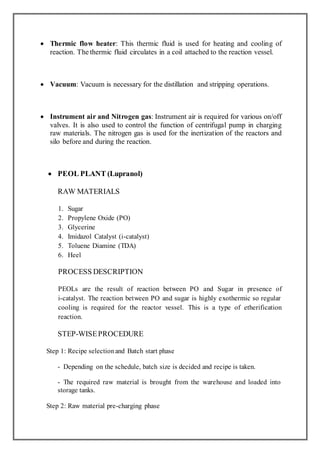
 Thermic flow heater: This thermic fluid is used for heating and cooling of
reaction. The thermic fluid circulates in a coil attached to the reaction vessel.
 Vacuum: Vacuum is necessary for the distillation and stripping operations.
 Instrument air and Nitrogen gas: Instrument air is required for various on/off
valves. It is also used to control the function of centrifugal pump in charging
raw materials. The nitrogen gas is used for the inertization of the reactors and
silo before and during the reaction.
 PEOL PLANT (Lupranol)
RAW MATERIALS
1. Sugar
2. Propylene Oxide (PO)
3. Glycerine
4. Imidazol Catalyst (i-catalyst)
5. Toluene Diamine (TDA)
6. Heel
PROCESS DESCRIPTION
PEOLs are the result of reaction between PO and Sugar in presence of
i-catalyst. The reaction between PO and sugar is highly exothermic so regular
cooling is required for the reactor vessel. This is a type of etherification
reaction.
STEP-WISEPROCEDURE
Step 1: Recipe selectionand Batch start phase
- Depending on the schedule, batch size is decided and recipe is taken.
- The required raw material is brought from the warehouse and loaded into
storage tanks.
Step 2: Raw material pre-charging phase
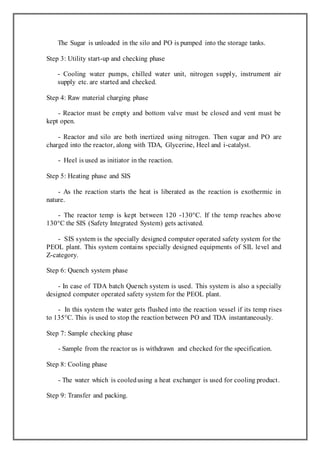
The Sugar is unloaded in the silo and PO is pumped into the storage tanks.
Step 3: Utility start-up and checking phase
- Cooling water pumps, chilled water unit, nitrogen supply, instrument air
supply etc. are started and checked.
Step 4: Raw material charging phase
- Reactor must be empty and bottom valve must be closed and vent must be
kept open.
- Reactor and silo are both inertized using nitrogen. Then sugar and PO are
charged into the reactor, along with TDA, Glycerine, Heel and i-catalyst.
- Heel is used as initiator in the reaction.
Step 5: Heating phase and SIS
- As the reaction starts the heat is liberated as the reaction is exothermic in
nature.
- The reactor temp is kept between 120 -130°C. If the temp reaches above
130°C the SIS (Safety Integrated System) gets activated.
- SIS system is the specially designed computer operated safety system for the
PEOL plant. This system contains specially designed equipments of SIL level and
Z-category.
Step 6: Quench system phase
- In case of TDA batch Quench system is used. This system is also a specially
designed computer operated safety system for the PEOL plant.
- In this system the water gets flushed into the reaction vessel if its temp rises
to 135°C. This is used to stop the reaction between PO and TDA instantaneously.
Step 7: Sample checking phase
- Sample from the reactor us is withdrawn and checked for the specification.
Step 8: Cooling phase
- The water which is cooledusing a heat exchanger is used for cooling product.
Step 9: Transfer and packing.
- The cooled product is then packed into drums and sent to warehouse or to the
tank farm.
UTILITIES
 Water cooling tower: Counter flow induced draft cooling towers are used to
cool hot water from the plant to a temp of 27°C.
 Water chilling unit: It is used to bring the water temp down. It generally
consists of compressor and a heat exchanger (Plate Type).
 Thermal oxidiser: It is used for the combustion of the unwanted and harmful
gases which pollute the air have adverse effect on the environment.
 Instrument air and Nitrogen gas: Instrument air is required for various on/off
valves. It is also used to control the function of centrifugal pump in charging
raw materials. The nitrogen gas is used for the inertization of the reactors and
silo before and during the reaction.
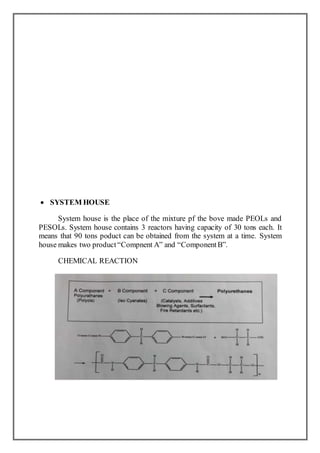
 SYSTEM HOUSE
System house is the place of the mixture pf the bove made PEOLs and
PESOLs. System house contains 3 reactors having capacity of 30 tons each. It
means that 90 tons poduct can be obtained from the system at a time. System
house makes two product“Compnent A” and “ComponentB”.
CHEMICAL REACTION
“Component A”is used in the foams of refrigerators. The main custometr
of this product is Samsung, LG, Whirlpool, etc. The quality and recipe changes
on the customers demand.
“Component B”is used in the footware soles and automobilr parts as
Dashboard, Steering Wheel etc.
 Component A
RAW MATERIALS
1. PEOL
2. Additives
3. Catalyst
4. Wter
PROCESS DESCRIPTION
All the above raw materials are added to a reactor of capacity 30 tons at
room temp. This is simple mixing of the raw material. The batch is mixed
for 24 hours at agitator at 50 rpm. The product obtained is then sent to
laboratory for testing and then it is sent to the customer.
 Component B
RAW MATERIALS
1. PESOL/PEOL
2. Methyl-diphenyl-di-isocyanide(MDI)
3. Additives{Stopper Solution (Benzoyl Chloride)}
CHEMICAL REACTION
MDI + Water(l) Urea Formate + CO2 (g)
PROCESS DESCRIPTION
ComponentB comprises of two different reactors one for manufacyuring
of PU soles solution and other for automotive applications.
- PU Soles Solution
In manufacturing of PU soles solution MDI, PESOL, and stoppersolution
is added to the reaction vessel. Here the reaction is exothermic iun nature
so cooling jacket is provided to controlthe temp. Temp must be kept
between 50-70°C. If this condition is not fulfilled then the dimerisation of
the productoccurs resulting in the failure of reavtor.
Because of the presence of PESOL the pores are formed in the product
resulting in loose bonding of the molecules of PU wich further gives it
flexibility which is the most important propertyof PU soles.
- Automotive Applications
In manufacturing, MDI, PEOL, and stoppersolution is added to the
reaction vessel. Here the reaction is exothermic iun nature so cooling
jacket is provided to controlthe temp. Temp must be kept between 50-
70°C. If this condition is not fulfilled then the dimerisation of the product
occurs resulting in the failure of reavtor.
Because of the presence of PEOL there is strong bonding of the
molecules wich gives it toughmess and rigid structure which is the most
important property for automotive applications.
CONCLUSION
In conclusion, there were many things that I learned and experienced during the
four weeks of my industrial training at BASF India Ltd., Dahej Site .The whole
training was interesting, challenging and application oriented. Through this
training I was able to gain more insight more comprehensive understanding
about the real industrial working conditions and practices. This training period
has also provided me with opportunities to develop and improve my soft and
functional skills. All of this valuable information and knowledge were not only
acquired through the direct involvements in the tasks given but also through
logical and instructive interaction with them. It is known for a fact that the
industrial training program is the best way to prepare a student for facing a real
working life and completely agree with it. As a result of this, I have gained
immense confidence to enter the employment world and build my future career.
CERTIFICATE
It is to certify that Mr. Palash Ramakant Kumbhare has completed his
15 days industrial training in BASF India Ltd. at Dahej site from dated
07/06/2016 to 22/06/2016, in a satisfactory manner for the partial fulfilment of
the requirement for the Degree of Bachelor of Technology (Chemical
Engineering).
Mr. Bhargav Thakkar Mr. Rajesh Satam
(PM, Executive) (PM, Operation Head)
Basf pesol n peol
Basf pesol n peol
Basf pesol n peol
Basf pesol n peol

Basf pesol n peol

  • 1.
    Report of IndustrialTraining At BASF India Ltd. Dahej Site Submitted By Palash Ramakant Kumbhare In partial fulfilment of the requirements for the award of the Degree of BACHELOR OF TECHNOLOGY (B.TECH.) IN CHEMICAL ENGINEERING College of Engineering & Technology, Babhulgaon (Jh), Akola Maharashtra, 444104 SANT GADGE BABA AMRAVATI UNIVERSITY, AMARAVATI
  • 2.
    ABOUT THE INDUSTRY BASFhad celebrated150 Years anniversary on 23rd April 2015 BASF is the largest chemical producer in the world and is headquartered in Ludwigshafen, Germany.[2] The BASF Group comprises subsidiaries and joint ventures in more than 80 countries and operates six integrated production sites and 390 other production sites in Europe, Asia, Australia, Americas and Africa.[3] Its headquarters is located in Ludwigshafen am Rhein (Rhineland- Palatinate, Germany). BASF has customers in over 200 countries and supplies products to a wide variety of industries. Despite its size and global presence, BASF has received relatively little public attention since abandoning its consumer productlines in the 1990s. At the end of 2015, the company employed more than 112,000 people, with over 52,800 in Germany alone. In 2015, BASF posted sales of €70.4 billion and income from operations before special items of about €6.7 billion. The company is currently expanding its international activities with a particular focus on Asia. Between 1990 and 2005, the company invested €5.6 billion in Asia, for example in sites near Nanjing and Shanghai, China and Mangalore in India. BASF (Badische Anilin und Soda Fabrik) or, in English (Baden Aniline and Soda Factory) was founded on 6 April 1865 in Mannheim, in the German- speaking country of Baden by Friedrich Engelhorn. It had been responsible for setting up a gasworks and street lighting for the town council in 1861. The gasworks produced tar as a by product, and Engelhorn used this for the production of dyes. BASF was set up in 1865 to produce other chemicals necessary for dye production, notably soda and acids. The plant, however, was erected on the other side of the Rhine river at Ludwigshafen because the town council of Mannheim was afraid that the air pollution of the chemical plant could bother the inhabitants of the town. In 1866 the dye production processes were also moved to the BASF site. BASF is a pioneer in manufacturing and developing biodegradable plastic, namely, Ecoflex. Ecovio consists of Ecoflex and a high content of polylactic acid.
  • 3.
    In 2006 BASFwas praised by the Climate Leadership Index for their efforts in problems with climate change and greenhouse gases in our world. In recent years the BASF Company has set aside a large portion of their R&D budget on resource conservation. BASF India’s chemical production complex at Dahej, Gujarat, started operation in October 2014. At approximately INR 10 billion ($180 million), it is the biggest investment made by BASF on India. The complex is located at the 453km2 Dahej Petroleum, Chemicals and Petrochemicals Investment Region (PCPIR). Planning for the project started in mid 2011, the investment decision was made in April 2012 and construction activities were completed in 2014 with zero lost-time incidents.
  • 4.
    ACKNOWLEDGEMENT It is alwaysa pleasure to remind the fine people in the Engineering Workshops for their sincere guidance I received to uphold my practical as well as theoretical skills in engineering. I would like to thanks to Dr. S. K. Deshmukh, M.Tech., Ph.D, Principal of our college and Dr. P. V. Thorat, M.Tech., Ph.D, (Chemical Engineering) Head of Department. I would also like thanks to Prof. D. P. Sakharkar and Prof. S. S. Tayde T&P Department (Chemical Engineering) to give the information and arrange the industrial training for students, making them aware of industrial field knowledge and industrial problems etc. I would also like thanks to Mr. Rajesh Satam (PM, Operation Head) and Mr. Bhargav Thakkar (PM, Executive) and all the DCS operators to give me the brief knowledge about the plant.
  • 5.
    CERTIFICATE It is tocertify that Mr. Palash Ramakant Kumbhare has completed his 15 days industrial training in BASF India Ltd. at Dahej site from dated 07/06/2016 to 22/06/2016, in a satisfactory manner for the partial fulfilment of the requirement for the Degree of Bachelor of Technology (Chemical Engineering). Mr. Bhargav Thakkar Mr. Rajesh Satam (PM, Executive) (PM, Operation Head)
  • 6.
    DECLERATION As Engineer isone who converts the theories of the textbooks into the pratical working models and processes. We learn many things more perfectly and accurately through observations and applications. Learing in classes just gives us the basic idea about any process,while at the same time industrial training helps us to understand the detailed and through working of that particular process. Hence we can clearly understand the principle application of the theoretical study. Industrial traininig is implemented by our college for imparting knowledge about real operations and pocesses, and also learn about working equipment. This report contains the various unit operations and operational details of the plant. This report has been prepared on the basis of information collected and provided during the training I underwent at BASF India Pvt. Ltd., Dahej. The information given in this report is true as per my knowledge and data provided by the industry. I take immense pleasure in presenting this report and sincerely apologize for any wrong information printed in it.
  • 7.
    INDEX Sr. No. Contents Decleration  Acknowledgement  About the industry  Training objective Chapter 1 Safety induction 1.1 EHS policy 1.2 Safety and Hazards Chapter 2 Training Highlights 2.1 PESOL plant 2.2 PEOL plant 2.3 System House Chapter 3 Conclusions
  • 8.
    TRAINING OBJECTIVE  Toexperience and understand real life situations in industrial oraganizations  To understood the process involved in manufacture of the products.  To provide suggestions to reduce the current batch time for production process.  To understand hazard identification.  To perceive safety practics and regulations in the industry.  To keep the track of trends of reactors for studying assteffectiveness.
  • 9.
    SAFETY INDUCTION EHS policy Safetyand Environment at the work place Hazardous Substances Personal protective Equipment Use of Mobile phone / Camera Housekeeping Safety showers,fire extinguishers etc Emergency Alarm
  • 10.
    Safety and Environmentat the Work Place Hazardous Substances
  • 11.
    Personal Protective Equipment Useof Mobile phone / Camera NO  Process plant  Tank farm  ProductTesting area YES  Security house  Warehouse office  Emergency Alarm
  • 12.
    EHS POLICY  BASF considersenvironment protection,Health and safety as fundamental management concers.Economic cosiderations do not take priority over Enironmental protection,Health & Safety.  BASF is committed to providing a healthy and safe work place .It believes that safe work procedure are more productive and are an incentive and are an incentive to better performance.  BASF encourages Environmental,Health and Safety awarenesss among all its employees and contractors throgh training ,dissemination of information and effective communication.  BASF assists customers to process its products safely and in an environmentally safe manner , in line with the concept of Product Stewardship.
  • 13.
     BASF manufacturesproducts that are produced, stored, transported, used, disposed off with minimal adverse impact on man and environment in conformity with the principles of Sustainable Development.  BASF as a Responsible Care Company is committed to meeting all statutory obligations continous improvement are taken even where no regulations exit. Chapter 1: INTRODUCTION  PM PLANT BASF is the leading supplier of polyurethanes solutions for the systems. The plant setup in Dahej (Gujarat) is operational since 2014, BASF offers a comprehensive polyurethanes product portfolio from basic products such as polyether polyol, polyester polyol, MDI and TDI to polyurethanes system. The major products manufactured include various grades of polyester polyol and blended polyols. The blended polyols are further divide into rigid and flexible type. MDI is used to manufacture both the grades of blended polyols whereas TDI is used to manufacture only the flexible grade. The entire products are marketed under different names only known to BASF employees and the customers. PM PLANT
  • 14.
     PESOLPLANTb (Lupraphen) RAWMATERIALS 1. Adipic Acid 2. Mono Ethylene Glycol (MEG) 3. Di Ethylene Glycol (DEG) 4. 1,4-Butanediol (BDO) 5. TYZOR Catalyst 6. Glycerine CHEMICAL REACTION PROCESS DESCRIPTION PESOLs are the result of condensation reaction of carboxylic acids and poly alcohols (glycols). Water as by-product is produced which must be removed in order to shift the reaction equilibrium in towards the product. This is a type of esterification reaction. STEP-WISEPROCEDURE PESOL PLANT PEOL PLANT SYSTEM HOUSE
  • 15.
    Step 1: Recipeselectionand Batch start phase - Depending on the schedule, batch size is decided and recipe is taken. - The required raw material is brought from the warehouse and loaded into storage tanks. Step 2: Raw material pre-charging phase The Adipic Acid is unloaded in the silo and MEG and DEG is pumped into the storage tanks. Step 3: Utility start-up and checking phase - Cooling water pumps, thermic oils heater unit, chilled water unit, nitrogen supply, steam supply, instrument air supply etc. are started and checked. Step 4: Raw material charging phase - Reactor must be empty and bottom valve must be closed and vent must be kept open. - The hot oil is sent to the coils and heating is started. - Reactor and silo are both inertized using nitrogen. Then MEG and DEG are charged into the reactor. - The jacket temp is set to 120°C. When reactor reaches 75°C then adipic acid is added from silo. - The jacket temp is then increased. Step 5: Atmospheric Distillation phase - At 135°C atmospheric temp distillation phase starts. Vapour temp and reflux flow must be checked. - If distillation column temp exceeds 105°C, the reflux is started. The column temp must be maintained at 100°C to prevent any glycol coming into the column. Step 6: Partial vacuum phase - At 220°C when 80% of water generated in reactor is removed, the vacuum pump is started and the vent valve is closed and bleed valve is opened. Step 7: Full vacuum phase - Reflux to vessel is closed. The set temp is reduced according to steam table.
  • 16.
    Step 8: Samplechecking phase - Sample from the reactor us is withdrawn and checked for the specification. It undergoes tests for viscosity, hydroxyl value and acid value. Step 9: Cooling and vacuum breaking phase - The vacuum pump stops and vacuum is broken with nitrogen gas - The thermic oil which is cooled using a heat exchanger is used for cooling product up to 80°C Step 10: Transfer and packing. - The cooled product is then packed into drums and sent to warehouse or to the tankfarm. TESTS FOR PESOL  Viscosity Test: This test is used to determine the viscosity of PESOL. If the viscosity is more stripping is done to remove excess glycol from the batch. If the viscosity is less then additional glycol added to the batch.  Hydroxyl Value Test: This test is used to check the value of free OH¯ ions present in that batch of PESOL. The range of OH¯ value changes with grade.  Acid Value Test: This test is used to determine the acidity of PESOL. The acidity must be less than 0.6. UTILITIES  Water cooling tower: Counter flow induced draft cooling towers are used to cool hot water from the plant to a temp of 27°C.  Water chilling unit: It is used to bring the water temp down to 5-6°C. It generally consists of compressor and a heat exchanger (Shell and Tube).
  • 17.
     Thermic flowheater: This thermic fluid is used for heating and cooling of reaction. The thermic fluid circulates in a coil attached to the reaction vessel.  Vacuum: Vacuum is necessary for the distillation and stripping operations.  Instrument air and Nitrogen gas: Instrument air is required for various on/off valves. It is also used to control the function of centrifugal pump in charging raw materials. The nitrogen gas is used for the inertization of the reactors and silo before and during the reaction.  PEOL PLANT (Lupranol) RAW MATERIALS 1. Sugar 2. Propylene Oxide (PO) 3. Glycerine 4. Imidazol Catalyst (i-catalyst) 5. Toluene Diamine (TDA) 6. Heel PROCESS DESCRIPTION PEOLs are the result of reaction between PO and Sugar in presence of i-catalyst. The reaction between PO and sugar is highly exothermic so regular cooling is required for the reactor vessel. This is a type of etherification reaction. STEP-WISEPROCEDURE Step 1: Recipe selectionand Batch start phase - Depending on the schedule, batch size is decided and recipe is taken. - The required raw material is brought from the warehouse and loaded into storage tanks. Step 2: Raw material pre-charging phase
  • 18.
    The Sugar isunloaded in the silo and PO is pumped into the storage tanks. Step 3: Utility start-up and checking phase - Cooling water pumps, chilled water unit, nitrogen supply, instrument air supply etc. are started and checked. Step 4: Raw material charging phase - Reactor must be empty and bottom valve must be closed and vent must be kept open. - Reactor and silo are both inertized using nitrogen. Then sugar and PO are charged into the reactor, along with TDA, Glycerine, Heel and i-catalyst. - Heel is used as initiator in the reaction. Step 5: Heating phase and SIS - As the reaction starts the heat is liberated as the reaction is exothermic in nature. - The reactor temp is kept between 120 -130°C. If the temp reaches above 130°C the SIS (Safety Integrated System) gets activated. - SIS system is the specially designed computer operated safety system for the PEOL plant. This system contains specially designed equipments of SIL level and Z-category. Step 6: Quench system phase - In case of TDA batch Quench system is used. This system is also a specially designed computer operated safety system for the PEOL plant. - In this system the water gets flushed into the reaction vessel if its temp rises to 135°C. This is used to stop the reaction between PO and TDA instantaneously. Step 7: Sample checking phase - Sample from the reactor us is withdrawn and checked for the specification. Step 8: Cooling phase - The water which is cooledusing a heat exchanger is used for cooling product. Step 9: Transfer and packing.
  • 19.
    - The cooledproduct is then packed into drums and sent to warehouse or to the tank farm. UTILITIES  Water cooling tower: Counter flow induced draft cooling towers are used to cool hot water from the plant to a temp of 27°C.  Water chilling unit: It is used to bring the water temp down. It generally consists of compressor and a heat exchanger (Plate Type).  Thermal oxidiser: It is used for the combustion of the unwanted and harmful gases which pollute the air have adverse effect on the environment.  Instrument air and Nitrogen gas: Instrument air is required for various on/off valves. It is also used to control the function of centrifugal pump in charging raw materials. The nitrogen gas is used for the inertization of the reactors and silo before and during the reaction.
  • 20.
     SYSTEM HOUSE Systemhouse is the place of the mixture pf the bove made PEOLs and PESOLs. System house contains 3 reactors having capacity of 30 tons each. It means that 90 tons poduct can be obtained from the system at a time. System house makes two product“Compnent A” and “ComponentB”. CHEMICAL REACTION
  • 21.
    “Component A”is usedin the foams of refrigerators. The main custometr of this product is Samsung, LG, Whirlpool, etc. The quality and recipe changes on the customers demand. “Component B”is used in the footware soles and automobilr parts as Dashboard, Steering Wheel etc.  Component A RAW MATERIALS 1. PEOL 2. Additives 3. Catalyst 4. Wter PROCESS DESCRIPTION All the above raw materials are added to a reactor of capacity 30 tons at room temp. This is simple mixing of the raw material. The batch is mixed for 24 hours at agitator at 50 rpm. The product obtained is then sent to laboratory for testing and then it is sent to the customer.  Component B RAW MATERIALS 1. PESOL/PEOL 2. Methyl-diphenyl-di-isocyanide(MDI) 3. Additives{Stopper Solution (Benzoyl Chloride)} CHEMICAL REACTION MDI + Water(l) Urea Formate + CO2 (g) PROCESS DESCRIPTION
  • 22.
    ComponentB comprises oftwo different reactors one for manufacyuring of PU soles solution and other for automotive applications. - PU Soles Solution In manufacturing of PU soles solution MDI, PESOL, and stoppersolution is added to the reaction vessel. Here the reaction is exothermic iun nature so cooling jacket is provided to controlthe temp. Temp must be kept between 50-70°C. If this condition is not fulfilled then the dimerisation of the productoccurs resulting in the failure of reavtor. Because of the presence of PESOL the pores are formed in the product resulting in loose bonding of the molecules of PU wich further gives it flexibility which is the most important propertyof PU soles. - Automotive Applications In manufacturing, MDI, PEOL, and stoppersolution is added to the reaction vessel. Here the reaction is exothermic iun nature so cooling jacket is provided to controlthe temp. Temp must be kept between 50- 70°C. If this condition is not fulfilled then the dimerisation of the product occurs resulting in the failure of reavtor. Because of the presence of PEOL there is strong bonding of the molecules wich gives it toughmess and rigid structure which is the most important property for automotive applications.
  • 23.
    CONCLUSION In conclusion, therewere many things that I learned and experienced during the four weeks of my industrial training at BASF India Ltd., Dahej Site .The whole training was interesting, challenging and application oriented. Through this training I was able to gain more insight more comprehensive understanding about the real industrial working conditions and practices. This training period has also provided me with opportunities to develop and improve my soft and functional skills. All of this valuable information and knowledge were not only acquired through the direct involvements in the tasks given but also through logical and instructive interaction with them. It is known for a fact that the industrial training program is the best way to prepare a student for facing a real working life and completely agree with it. As a result of this, I have gained immense confidence to enter the employment world and build my future career.
  • 24.
    CERTIFICATE It is tocertify that Mr. Palash Ramakant Kumbhare has completed his 15 days industrial training in BASF India Ltd. at Dahej site from dated 07/06/2016 to 22/06/2016, in a satisfactory manner for the partial fulfilment of the requirement for the Degree of Bachelor of Technology (Chemical Engineering).
  • 25.
    Mr. Bhargav ThakkarMr. Rajesh Satam (PM, Executive) (PM, Operation Head)