➢ Getting to Know You
➢ Manager’s Toolkit: You’ve Got to Have CHARM
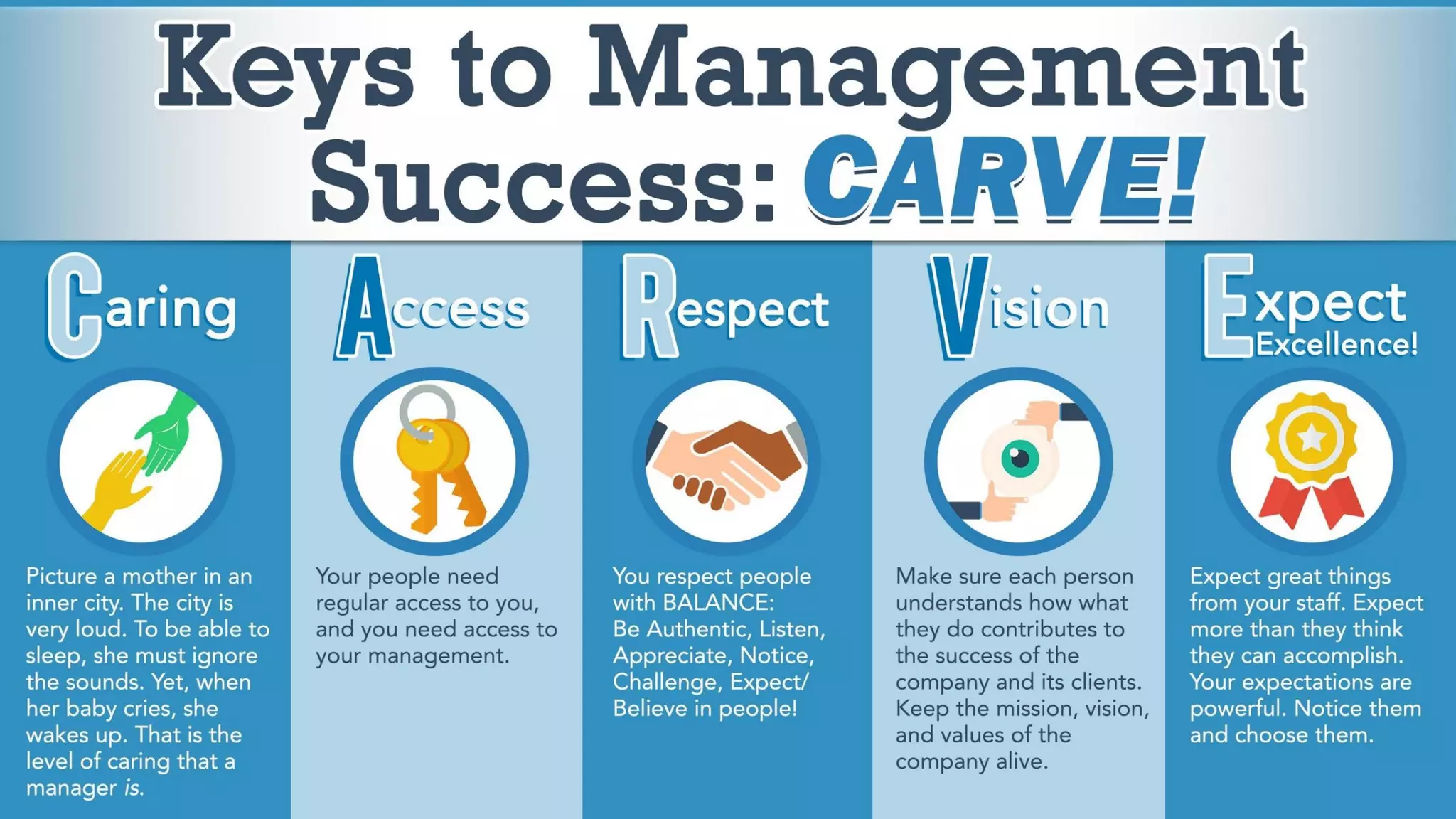
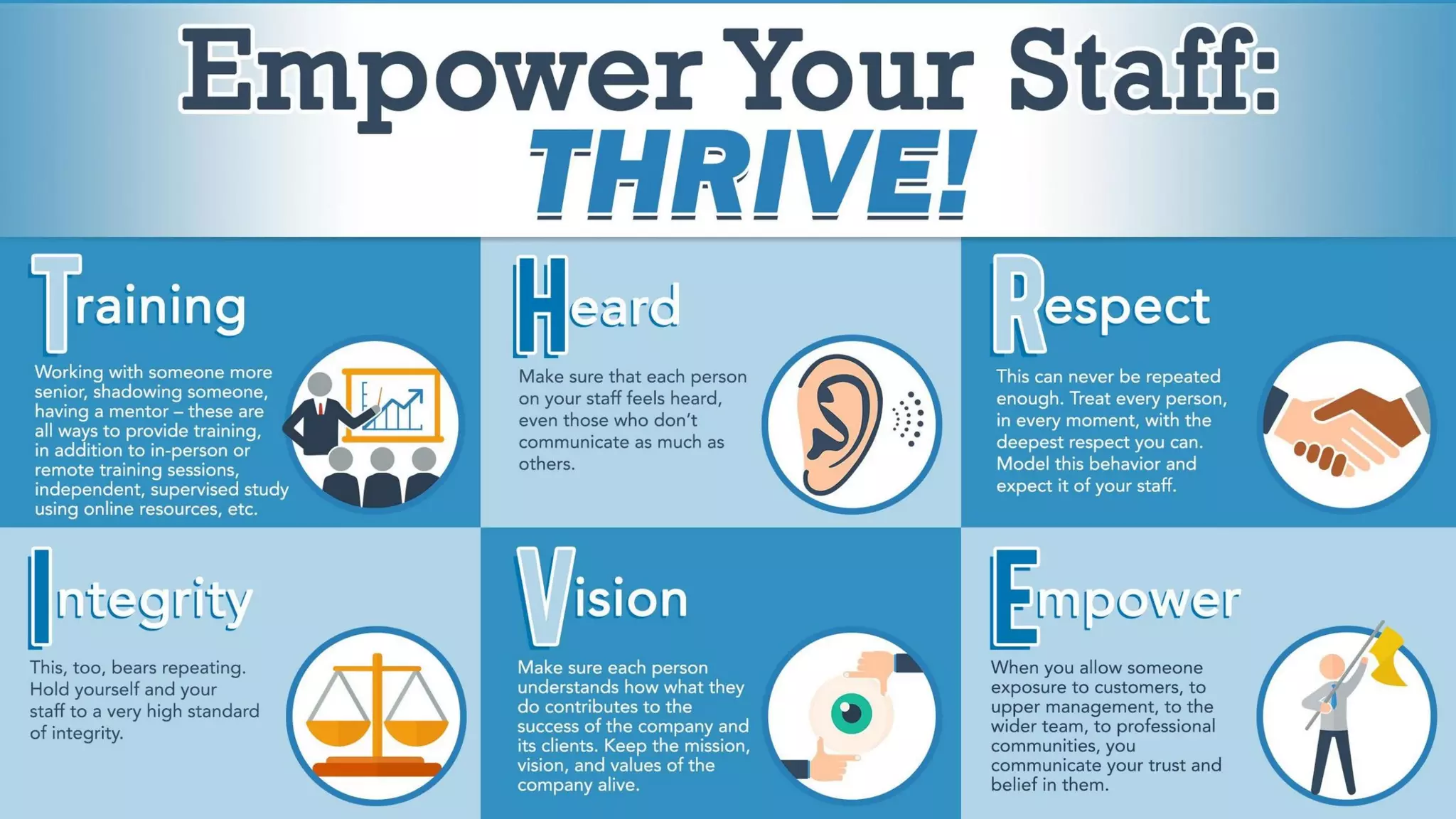
➢ Management: A Sacred Trust - CARVE! THRIVE!
➢ Keys to Success: Training
➢ Keys to Success: Motivation, Feedback - SLAP!
➢ Awareness, Bias, Culture: You, Your Organization, The
World
➢ Bonus content!
AGENDA 01
#LavaCon #SaiffSolutions #techcomm
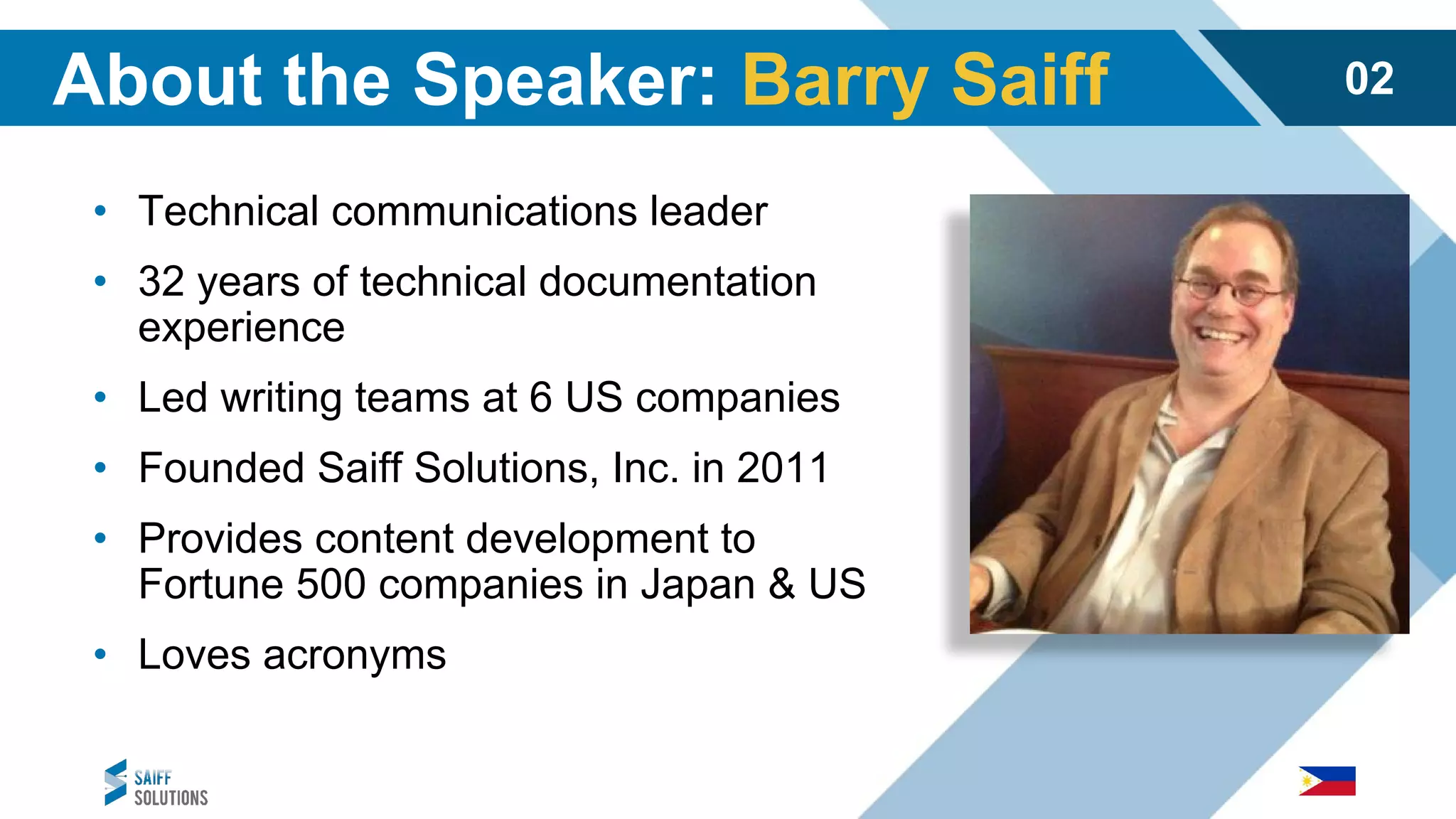
• Technical communications leader
• 32 years of technical documentation
experience
• Led writing teams at 6 US companies
• Founded Saiff Solutions, Inc. in 2011
• Provides content development to
Fortune 500 companies in Japan & US
• Loves acronyms
About the Speaker: Barry Saiff 02
Let’s Get to Know Each Other
Please tell us your
country, city, role, and
why you are here?
03
#LavaCon #SaiffSolutions #techcomm
What are Your Interests/Experiences in
Managing Technical Writers?
Have you experienced:
• Managing a team of writers?
• Leading a team, without management authority?
• Managing outsourced or offshore writers?
• Hiring? Firing?
• Working for a good manager?
• Working for a not-so-good manager?
• What else?
04
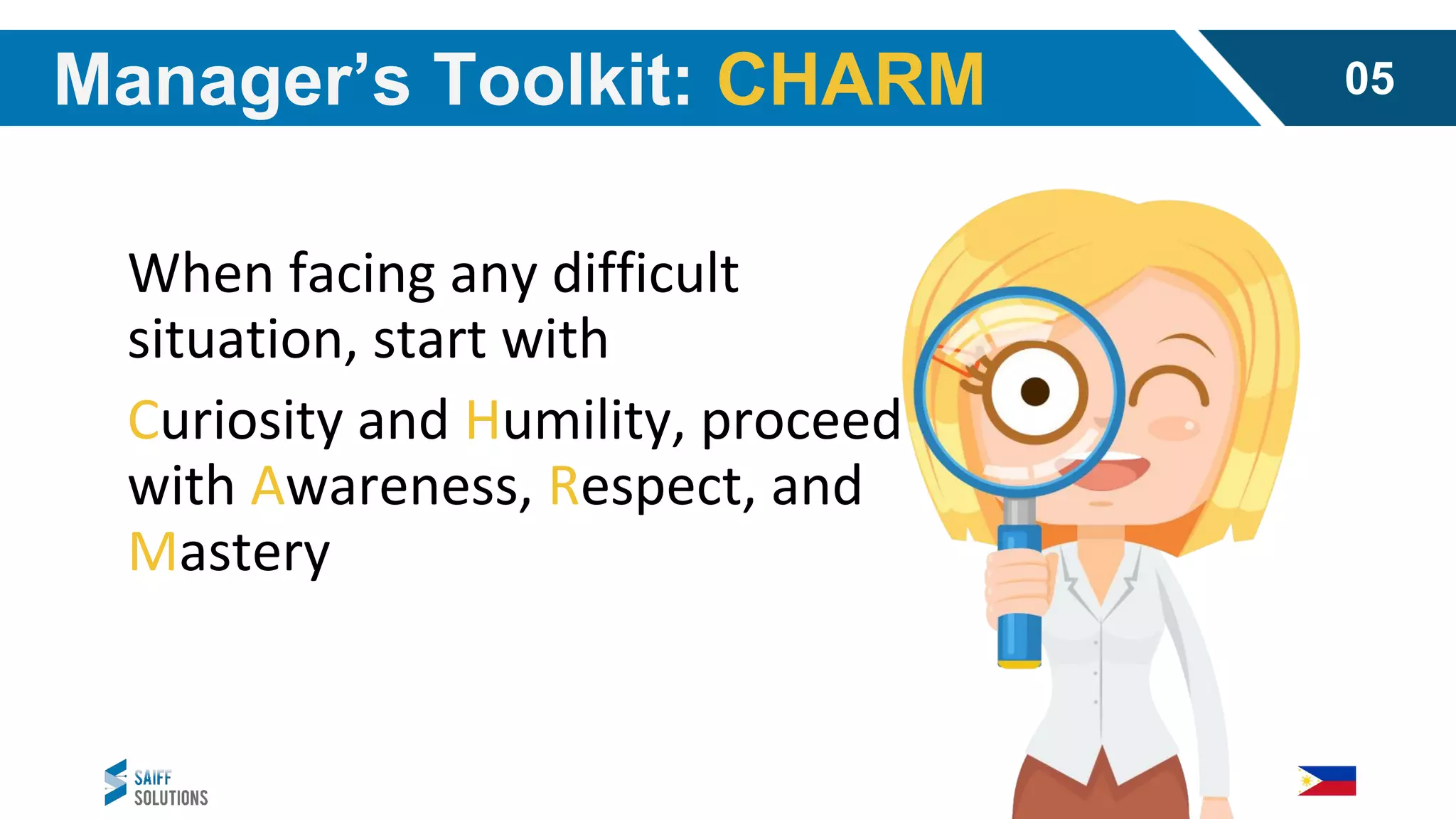
When facing any difficult
situation, start with
Curiosity and Humility, proceed
with Awareness, Respect, and
Mastery
Manager’s Toolkit: CHARM 05
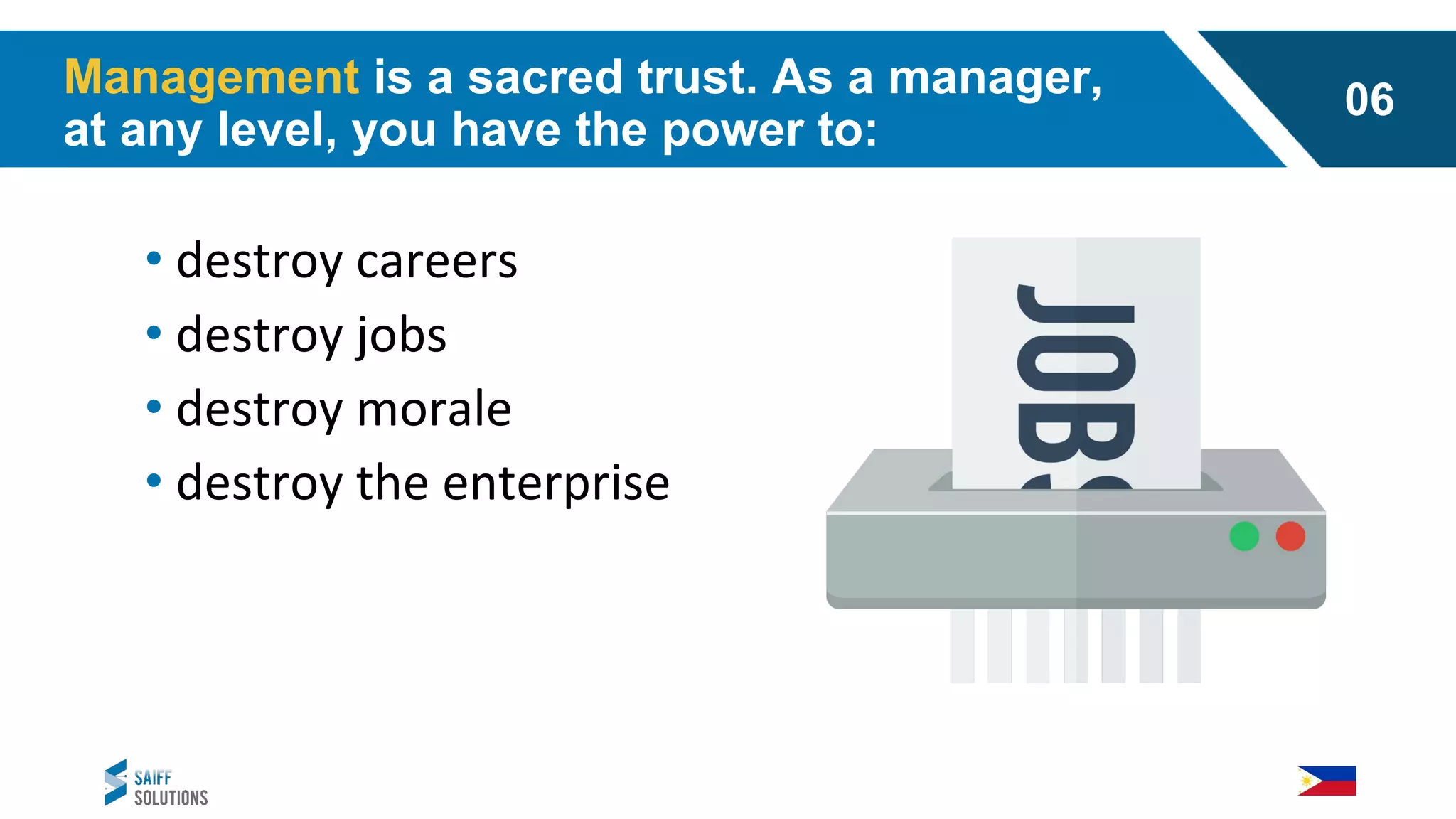
• destroy careers
• destroy jobs
• destroy morale
• destroy the enterprise
Management is a sacred trust. As a manager,
at any level, you have the power to:
06
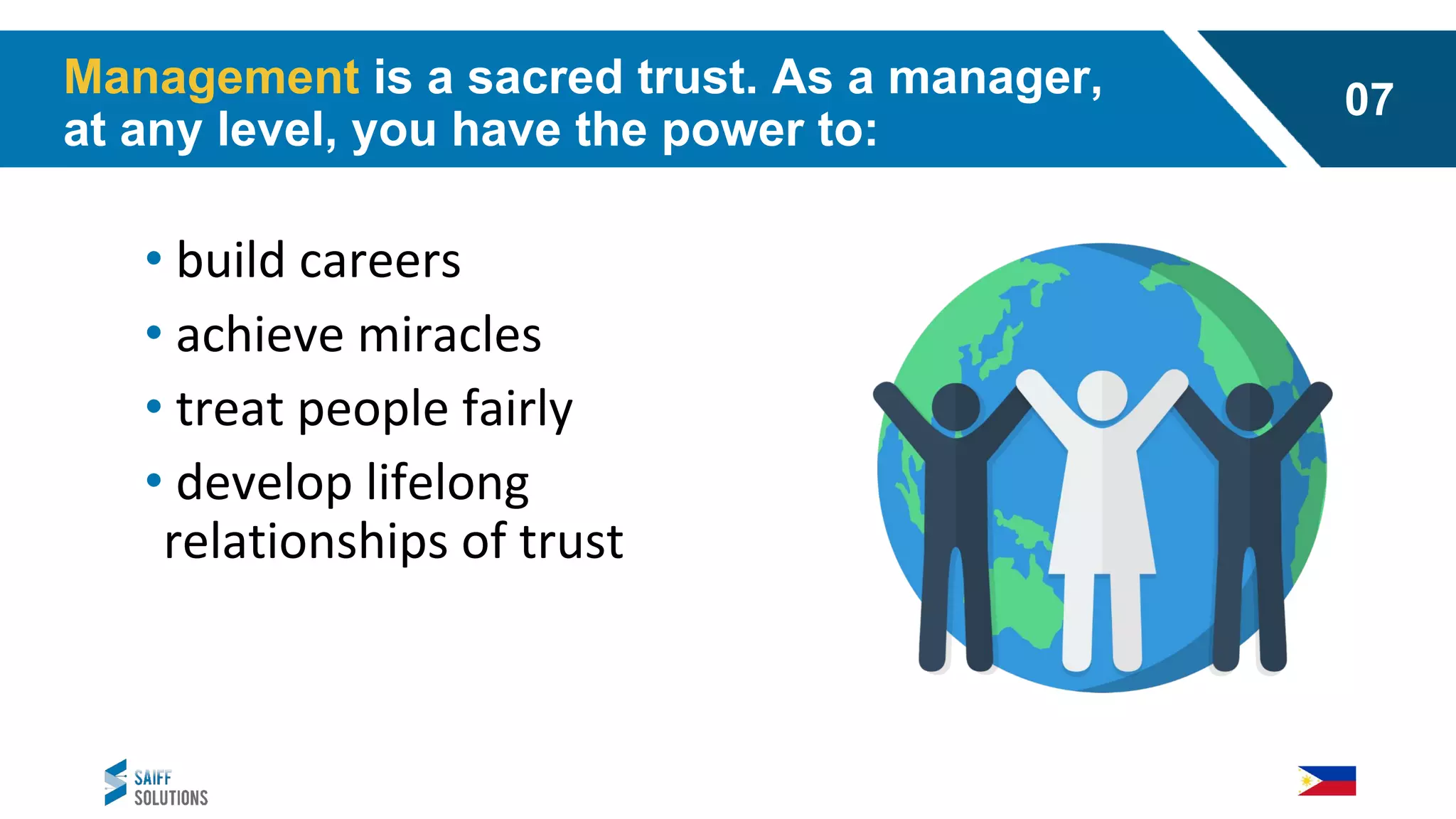
• build careers
• achieve miracles
• treat people fairly
• develop lifelong
relationships of trust
Management is a sacred trust. As a manager,
at any level, you have the power to:
07
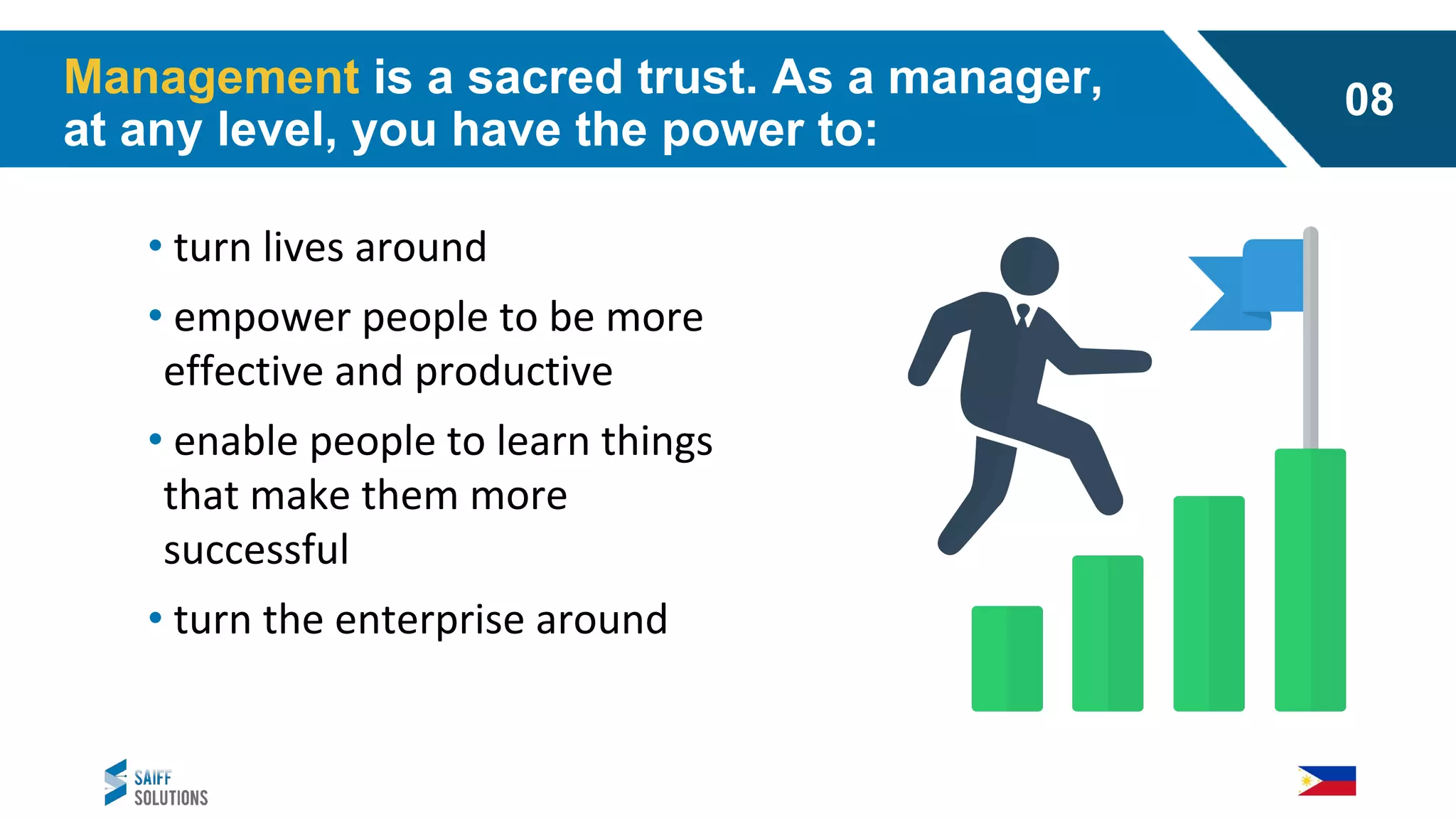
• turn lives around
• empower people to be more
effective and productive
• enable people to learn things
that make them more
successful
• turn the enterprise around
Management is a sacred trust. As a manager,
at any level, you have the power to:
08
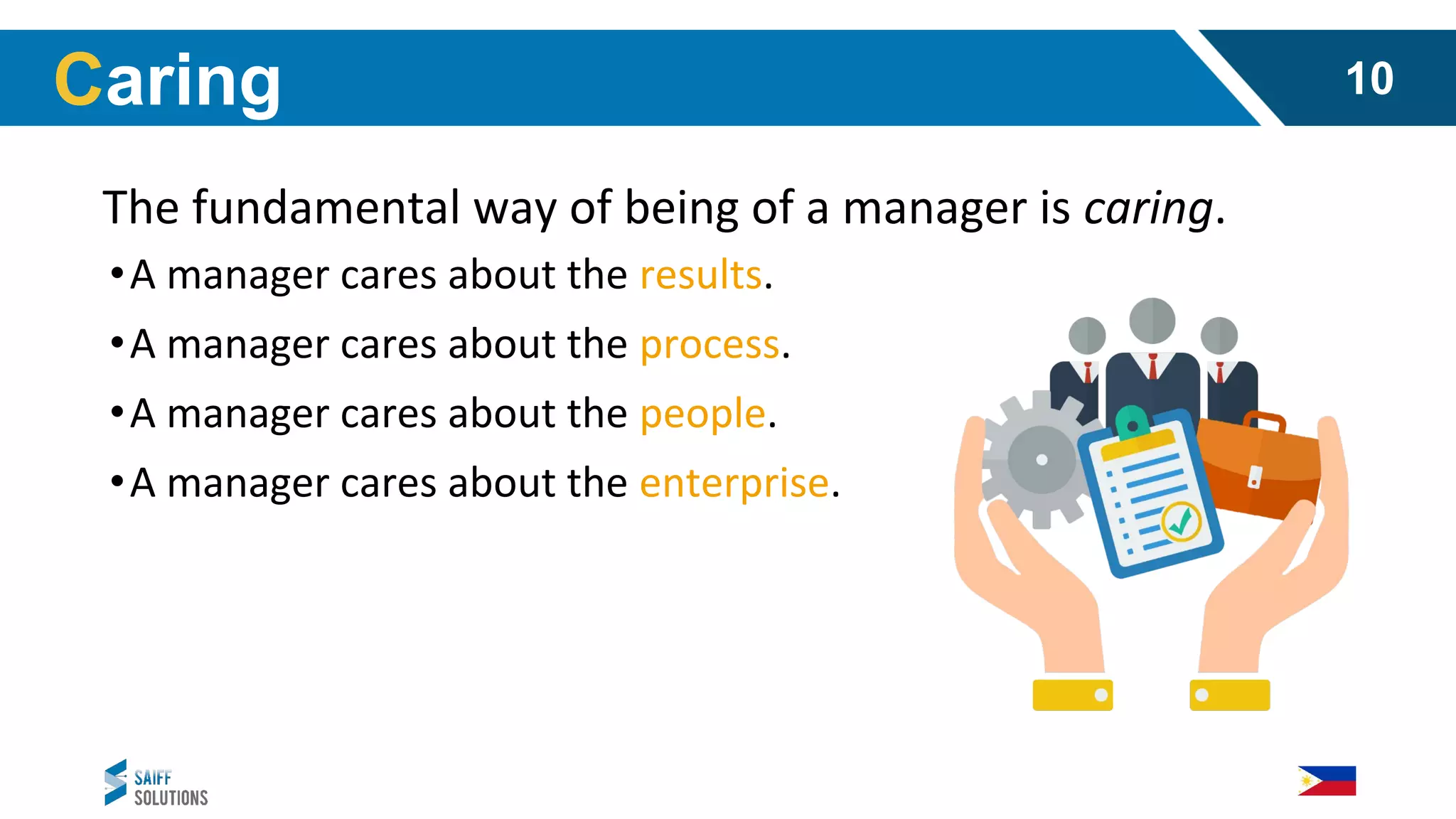
The fundamental way of being of a manager is caring.
•A manager cares about the results.
•A manager cares about the process.
•A manager cares about the people.
•A manager cares about the enterprise.
Caring 10
•A manager is trusted with power, and
faces opportunities to abuse that power.
•A manager must, at times, be selfless,
and act against their own (narrowly
conceived) self-interest.
Caring: Responsibility 11
• A good manager is a creator of healthy administration, and an
enemy of bureaucratic corruption and inertia.
• The mission, the customers, the enterprise, the people, and
the results are more important than the rules.
• A good manager strives for continuous improvement, rational
administration, fairness, and productivity gains.
Caring: Bureaucracy 12
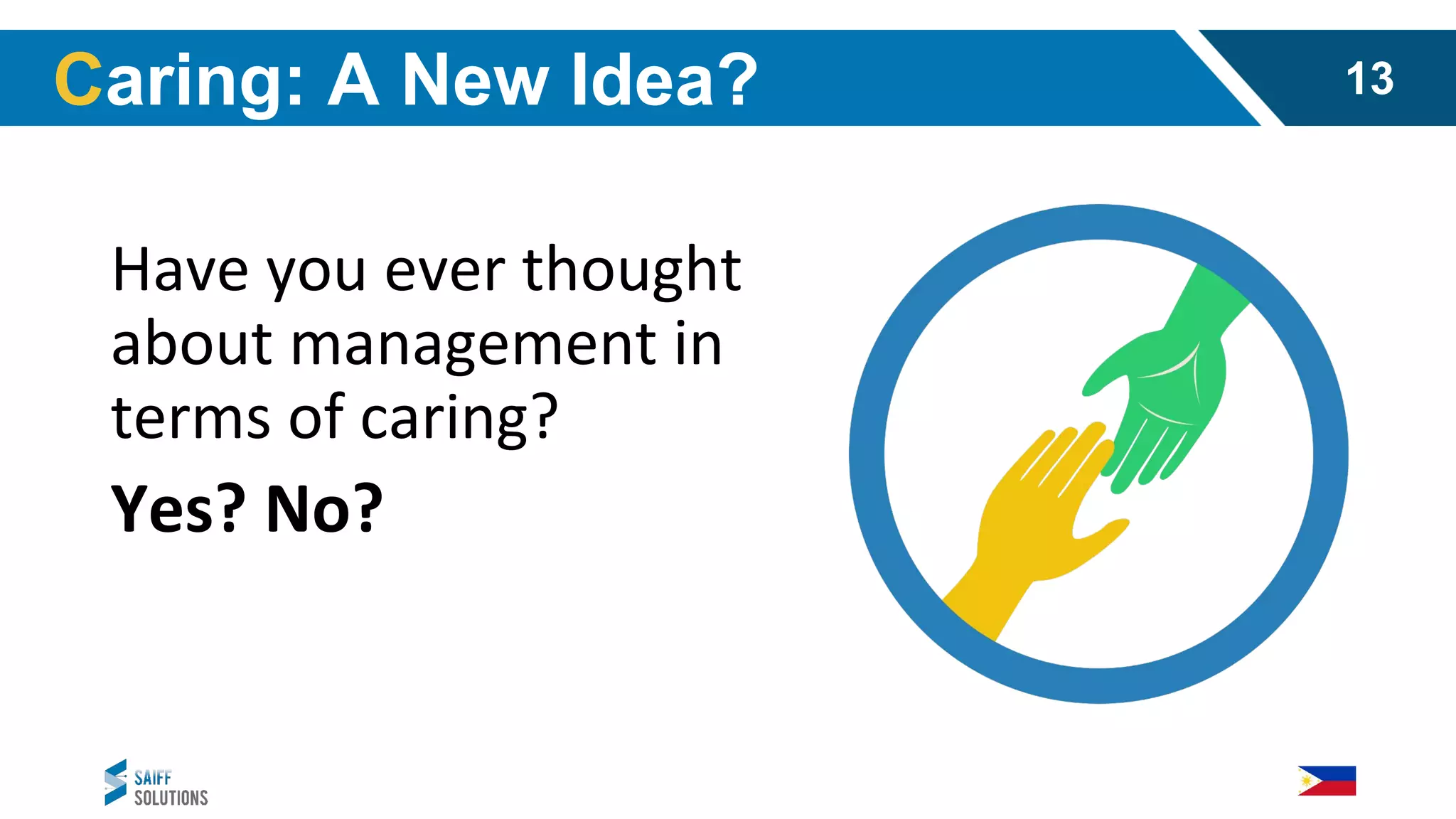
Have you ever thought
about management in
terms of caring?
Yes? No?
Caring: A New Idea? 13
Your people need regular access
to you, and you need access to
your management.
Have you ever had difficulties or stress at
work because your manager had no time for
you?
Yes? No?
Access 14
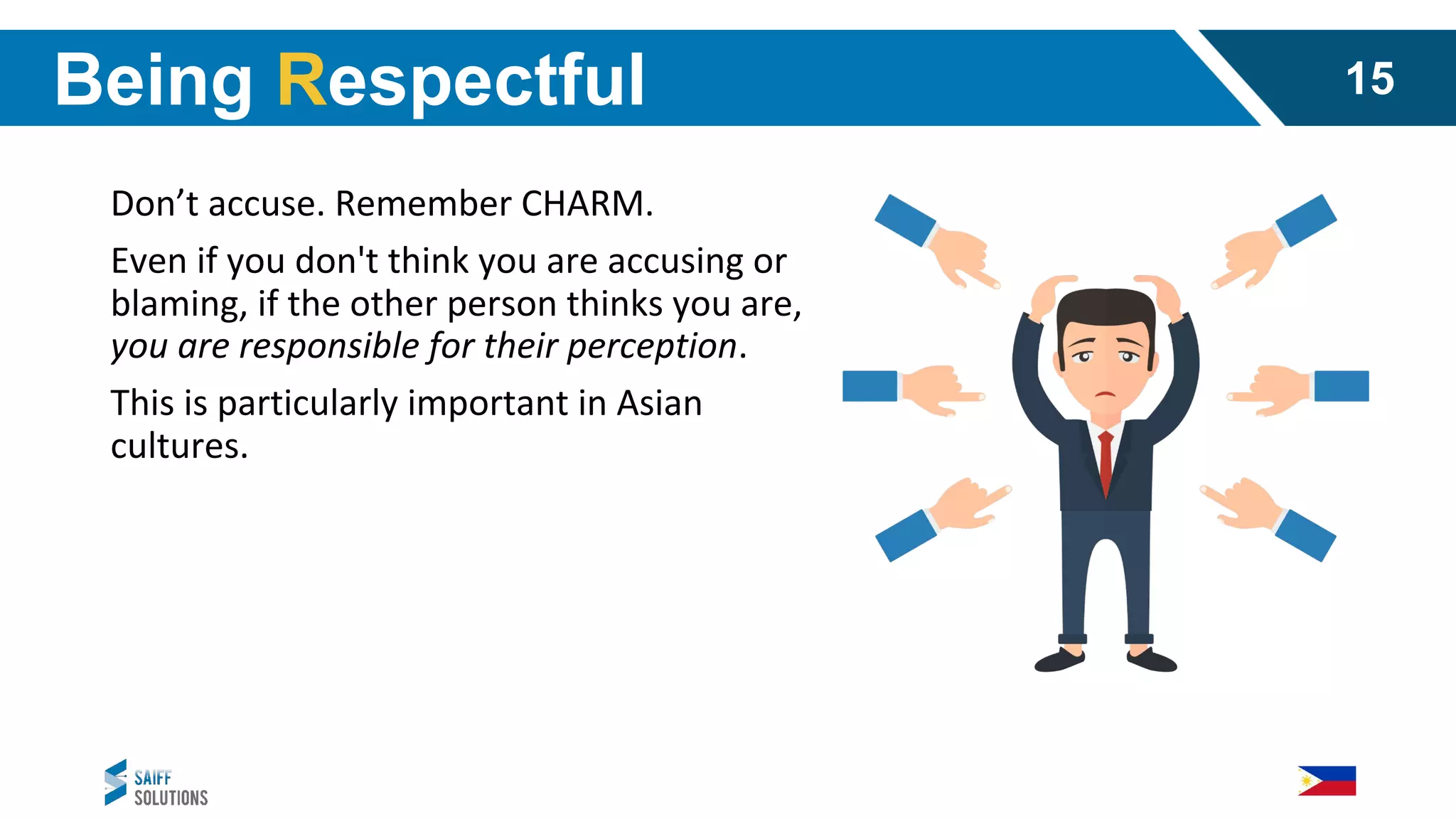
Don’t accuse. Remember CHARM.
Even if you don't think you are accusing or
blaming, if the other person thinks you are,
you are responsible for their perception.
This is particularly important in Asian
cultures.
Being Respectful 15
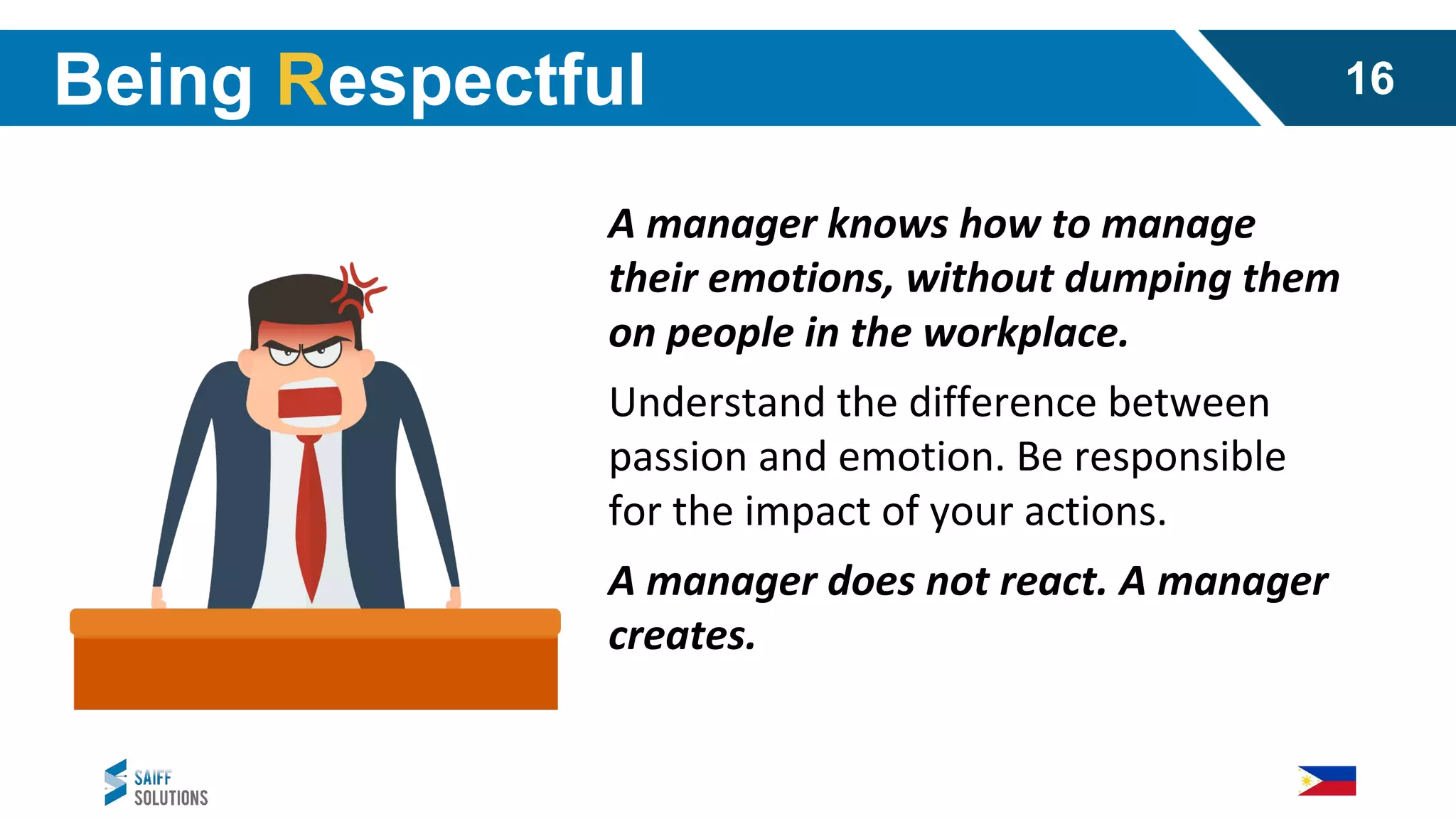
A manager knows how to manage
their emotions, without dumping them
on people in the workplace.
Understand the difference between
passion and emotion. Be responsible
for the impact of your actions.
A manager does not react. A manager
creates.
Being Respectful 16
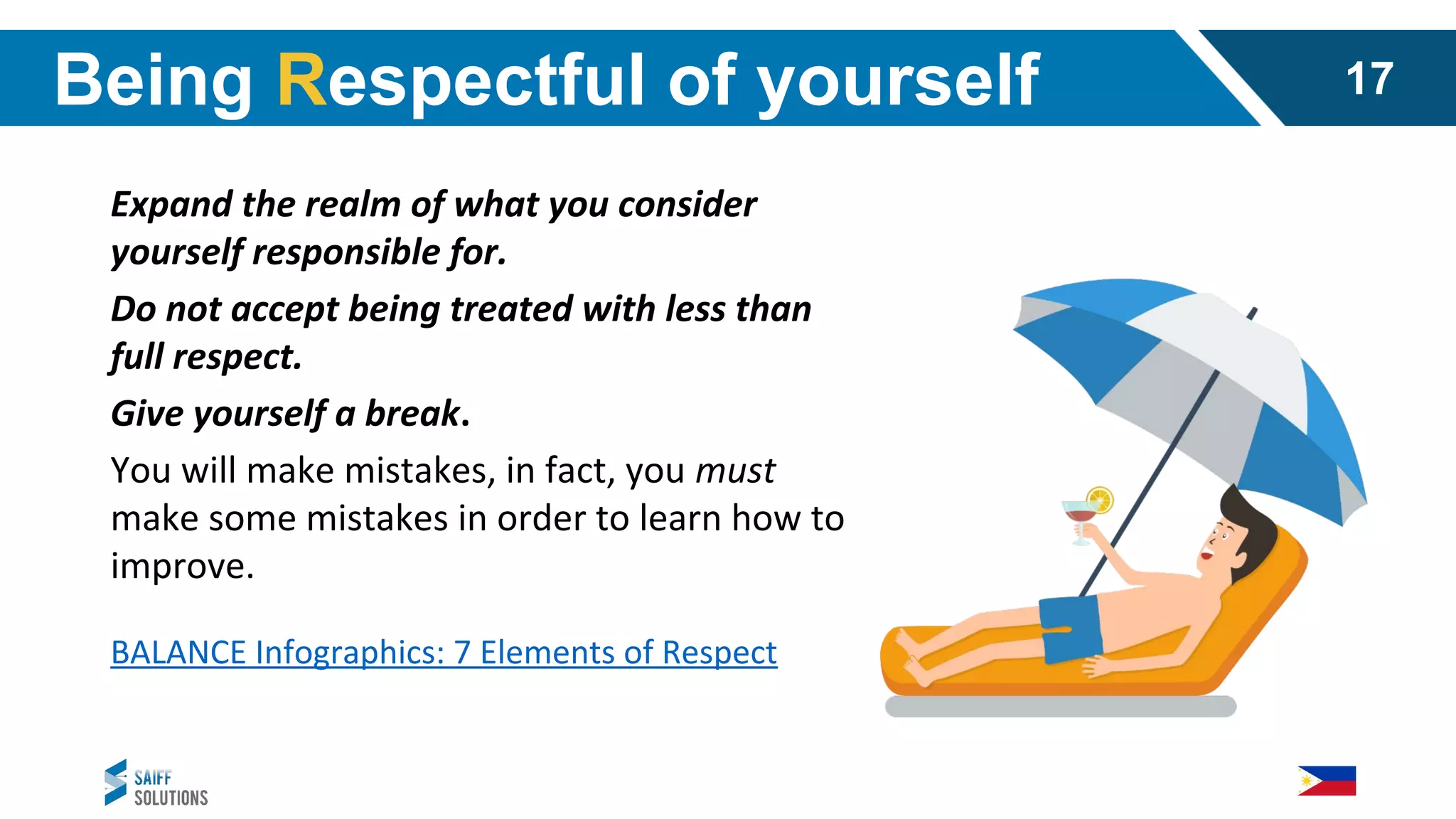
Expand the realm of what you consider
yourself responsible for.
Do not accept being treated with less than
full respect.
Give yourself a break.
You will make mistakes, in fact, you must
make some mistakes in order to learn how to
improve.
BALANCE Infographics: 7 Elements of Respect
Being Respectful of yourself 17
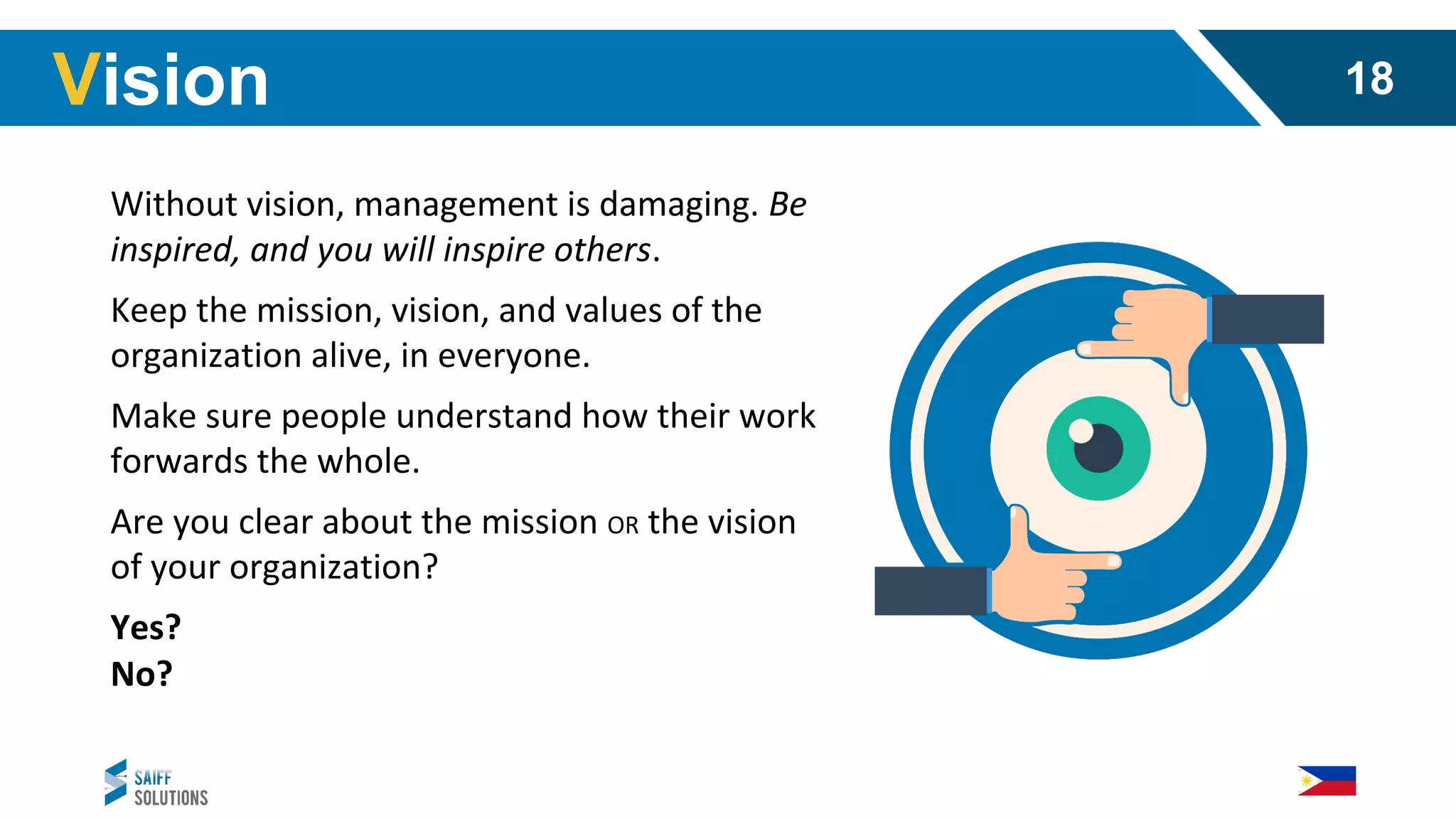
Without vision, management is damaging. Be
inspired, and you will inspire others.
Keep the mission, vision, and values of the
organization alive, in everyone.
Make sure people understand how their work
forwards the whole.
Are you clear about the mission OR the vision
of your organization?
Yes?
No?
Vision 18
Dr. Wayne Dyer was well known for
the idea, based on extensive research,
that we create what we expect.
Be aware of your expectations.
Choose them wisely.
Expect Excellence! 19
Caring – Trust = Micromanagement
Trust is the currency of business success.
Without trust, nothing is possible.
You must calibrate trust for each person/situation.
What do you trust me for? Do you trust me to do my job well?
Would you trust me to protect your daughter from harm? These
are very different questions.
TRUST 20
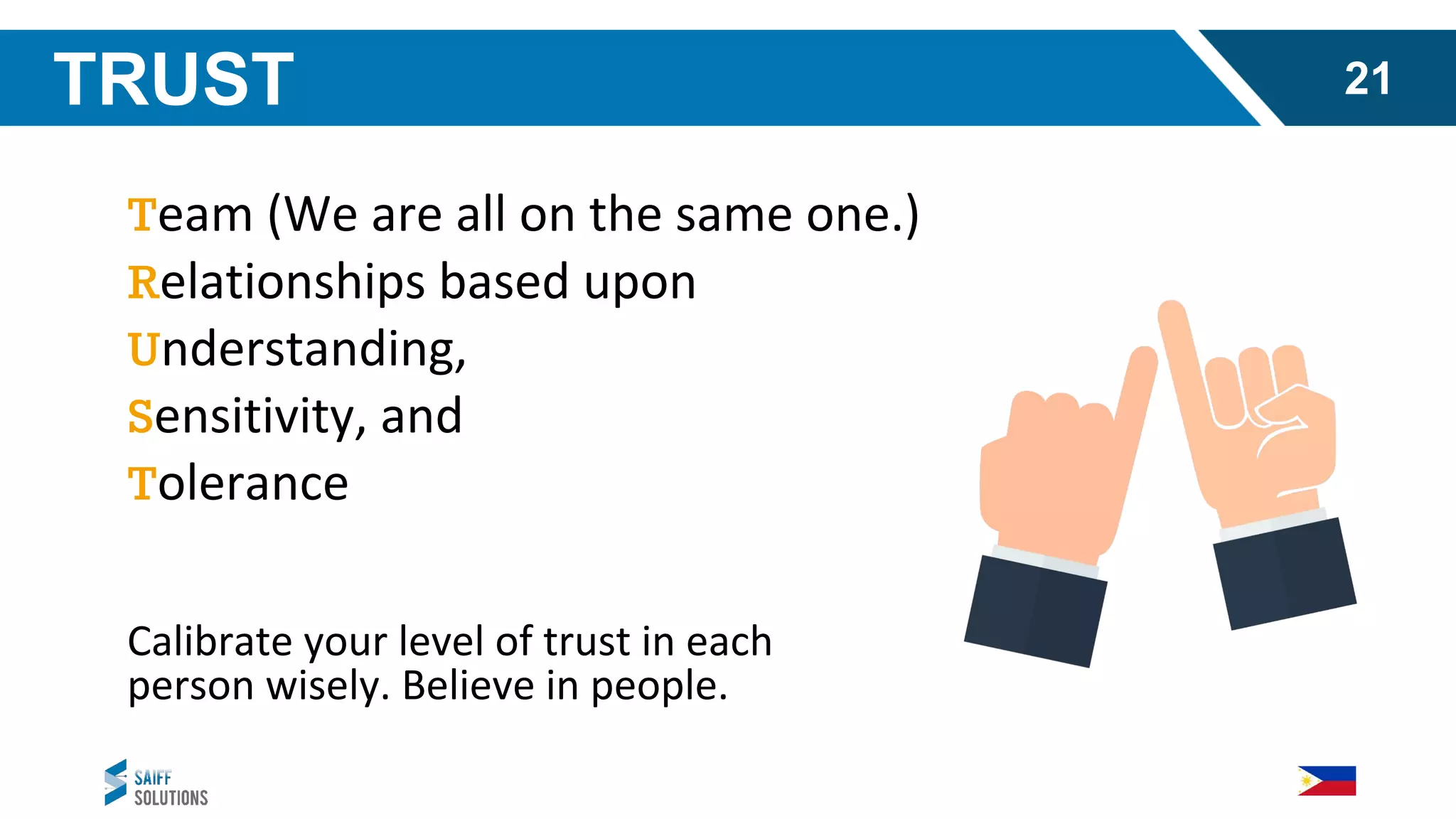
Team (We are all on the same one.)
Relationships based upon
Understanding,
Sensitivity, and
Tolerance
TRUST
Calibrate your level of trust in each
person wisely. Believe in people.
21
Question for managers: Who am I being?
Get clear on who you are, as a manager and a
leader. For example, here is my statement:
I am an authentic, caring, challenging, dedicated
mentor.
What is yours? (Feel free to steal from mine.)
To get clear on your statement:
• Notice, ask for feedback
• Envision (Whom do you aspire to be like?)
Being 22
An inauthentic manager is an ineffective manager.
To increase authenticity, clarify your inauthenticities.
Everyone has inuathenticities.
Ask for help:
• What don’t you believe? How would you not trust me?
Ask yourself: What do I really care about? What don’t I?
Separate the facts from your story.
Get training: Never stop learning about yourself.
Highly recommended: http://www.landmarkworldwide.com
Being Authentic 23
● Examine: How might I be the source of the problem?
● Learn from failures and successes.
● Do not cut corners (deceive, break the law, share
information prematurely or inappropriately).
● Work at least as hard, and smart, as your staff.
● Hold yourself accountable for the results of your
team,
and for your impact on their self-image &
performance.
● Model behaviors and attitudes you want to develop.
THRIVE: INTEGRITY 25
Why are promises important?
● Descriptive language vs Creative language
● Flowers
● Personal power: What is it? What is its source?
● Beyond keeping promises - Honoring your word:
○ When you cannot, pro-actively take
responsibility for mitigating the impacts on
others.
○ Calibrate your promises: Not too much, not too
little either – expect great things!
INTEGRITY: The Power of Your Word 26
What, in your experience, are the most
difficult management issues?
27
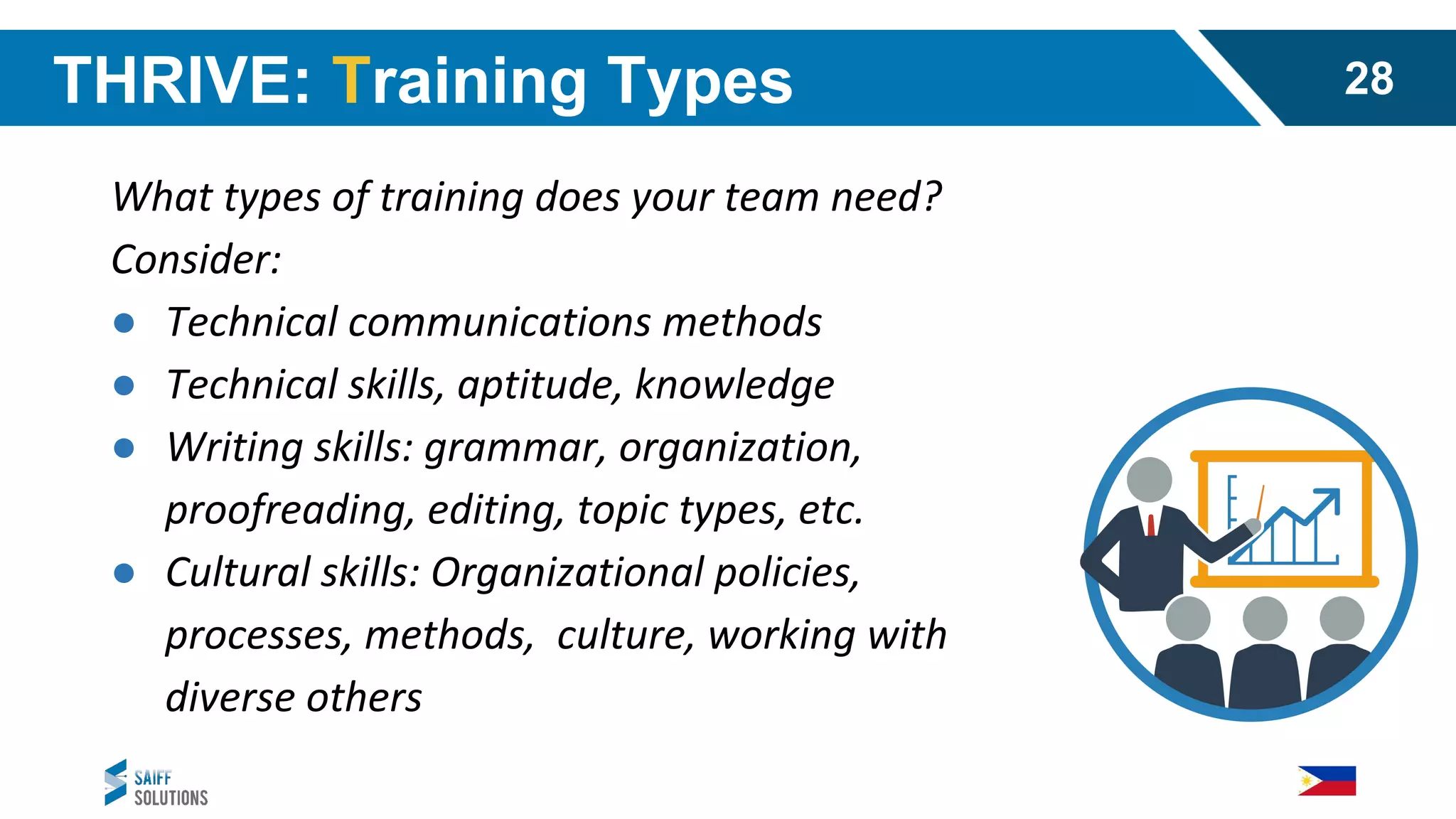
THRIVE: Training Types
What types of training does your team need?
Consider:
● Technical communications methods
● Technical skills, aptitude, knowledge
● Writing skills: grammar, organization,
proofreading, editing, topic types, etc.
● Cultural skills: Organizational policies,
processes, methods, culture, working with
diverse others
28
● Work skills: time/work management, project
management, leading meetings, leading teams,
collaboration
● Transformational training - How to:
○ Be coachable
○ Release/replace life-long habits
○ Exceed your limits
○ Increase awareness: How am I being?
○ Culture: strengths, weaknesses of?
○ Increase empathy - for self and others
THRIVE: Training Types 29
Imagine: Your boss tells you (for the first
time) that you are failing at x, y, and z, and
you are being demoted, or fired.
Would you rather have had a chance
to improve first?
Would you rather have had some
effective training?
Enable Excellence: Training - Why? 30
Three Key Factors for Motivation:
1. Autonomy
2. Mastery
3. Purpose
Great 11-minute video on motivation:
https://www.youtube.com/watch?v=u6XAPnuF
Two Orientations of Motivation:
• Toward (things you want)
• Away from (things you don’t want)
Motivation: A, M, P, T, AF 32
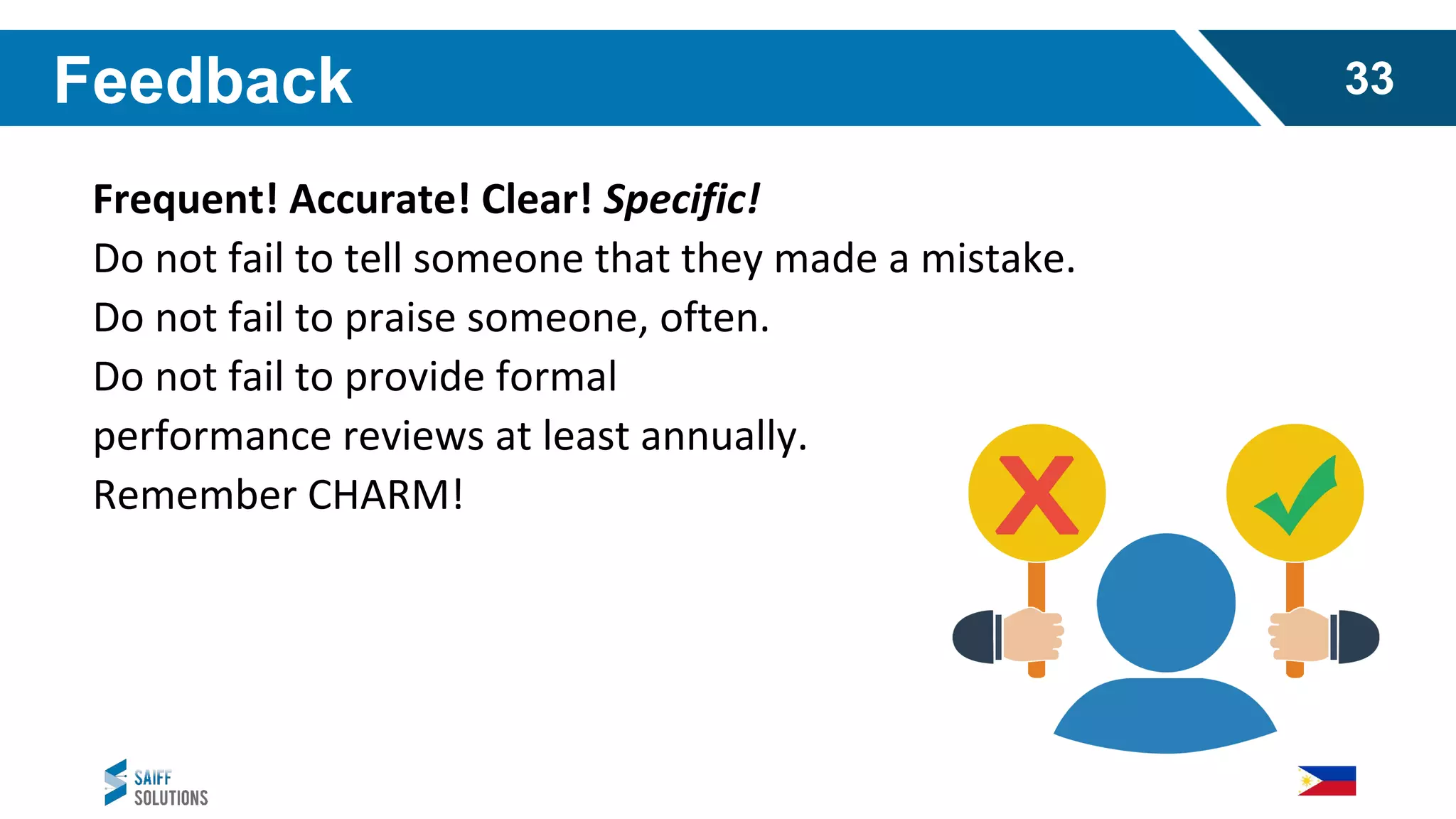
Frequent! Accurate! Clear! Specific!
Do not fail to tell someone that they made a mistake.
Do not fail to praise someone, often.
Do not fail to provide formal
performance reviews at least annually.
Remember CHARM!
Feedback 33
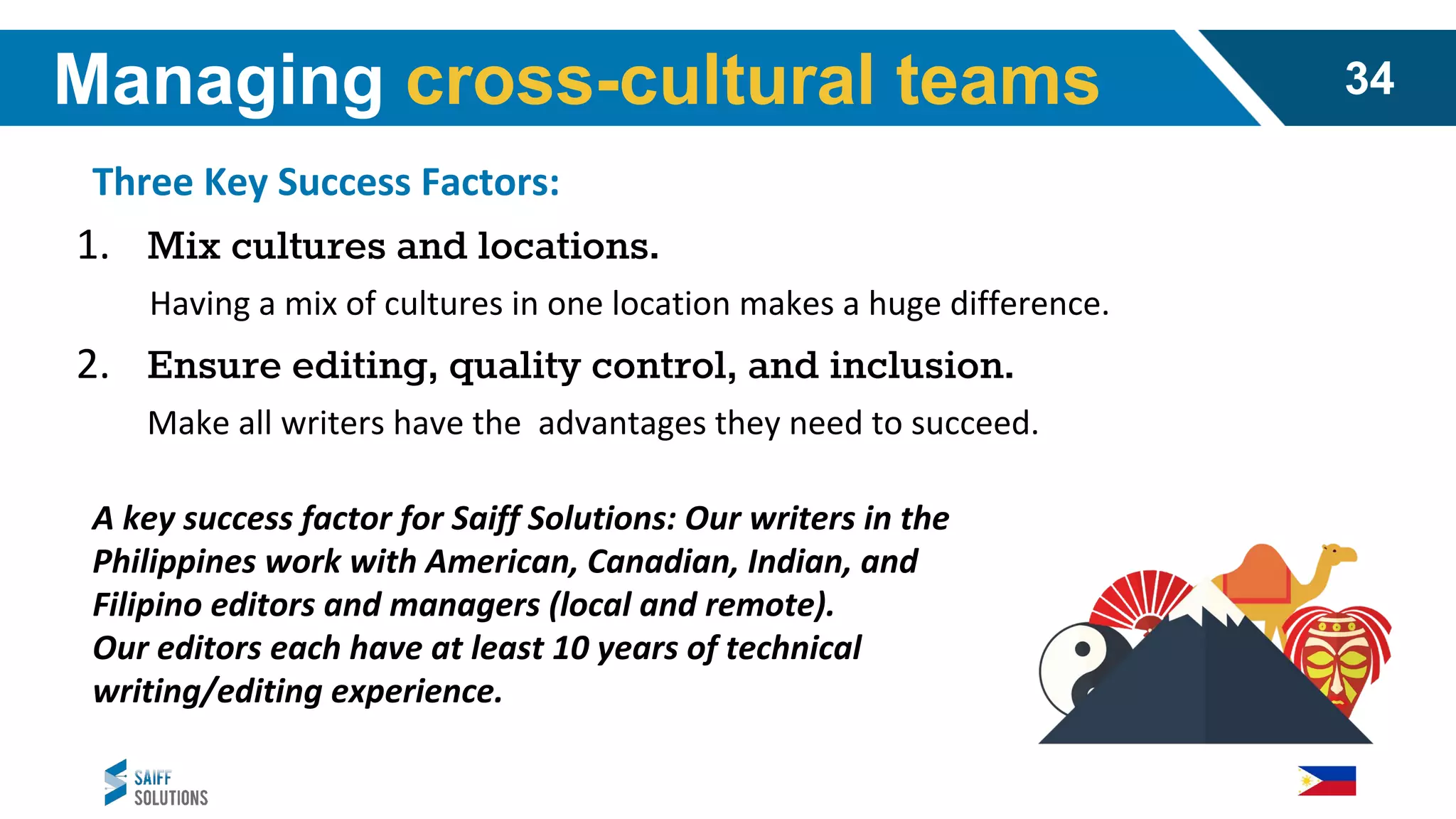
Three Key Success Factors:
1. Mix cultures and locations.
Having a mix of cultures in one location makes a huge difference.
2. Ensure editing, quality control, and inclusion.
Make all writers have the advantages they need to succeed.
A key success factor for Saiff Solutions: Our writers in the
Philippines work with American, Canadian, Indian, and
Filipino editors and managers (local and remote).
Our editors each have at least 10 years of technical
writing/editing experience.
Managing cross-cultural teams 34
3. Embrace differences by increasing your awareness!
Understanding cultural differences – between countries, professions, departments,
companies – is crucial to your success. Consider:
• How do these people learn best?
• How do they typically handle conflict?
• What does “Yes” mean to them?
Learn to listen newly: hear what you are missing
Learn to speak newly: add what you assume and others do not
Continually expand your awareness to new levels.
You cannot succeed in this without getting to know people well.
Managing cross-cultural teams 35
•Management entails awesome responsibility and awesome
opportunity. Both are magnified by a mixture of cultures.
•Many Asians are socialized to defer to authority figures, and
foreigners, even those not in positions of authority. They may be
unwilling to say “no” or disagree with you, to ask questions or ask for
help, especially if you (even unknowingly) raise your voice or exhibit
frustration or anger.
•They may hide from you the impact of how you are being.
•Many Americans, Japanese, and others regularly raise their voices, or
interpret silence as a sign of agreement and support.
Managing cross-cultural teams 36
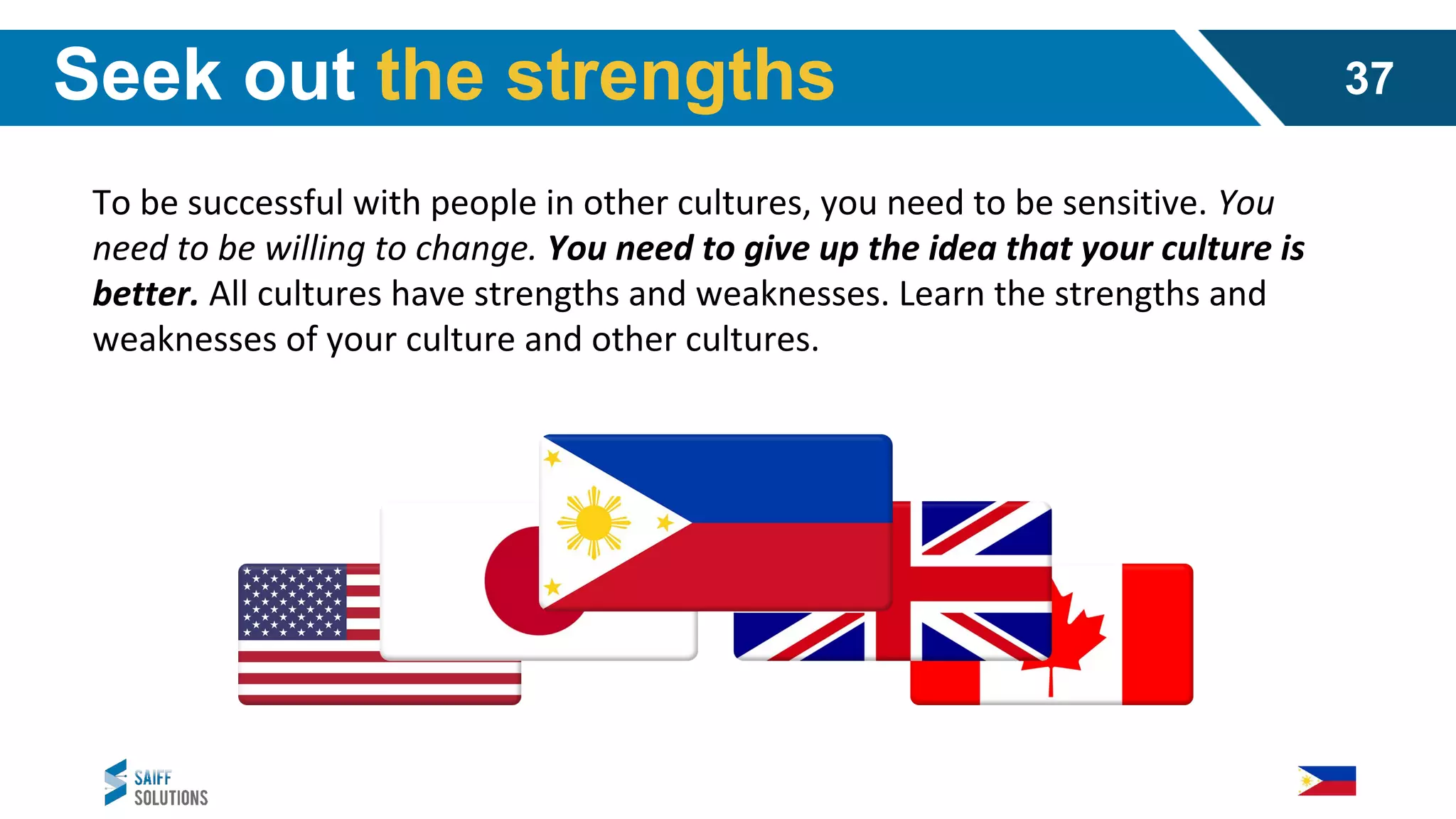
To be successful with people in other cultures, you need to be sensitive. You
need to be willing to change. You need to give up the idea that your culture is
better. All cultures have strengths and weaknesses. Learn the strengths and
weaknesses of your culture and other cultures.
Seek out the strengths 37
I could benefit from a conversation
about…?
What management challenge are
you facing now?
38
• BALANCE Infographics: 7 Elements of Respect
• The 7 Habits of Highly Effective Technical Writers
• Global Content Creation – Making it Work
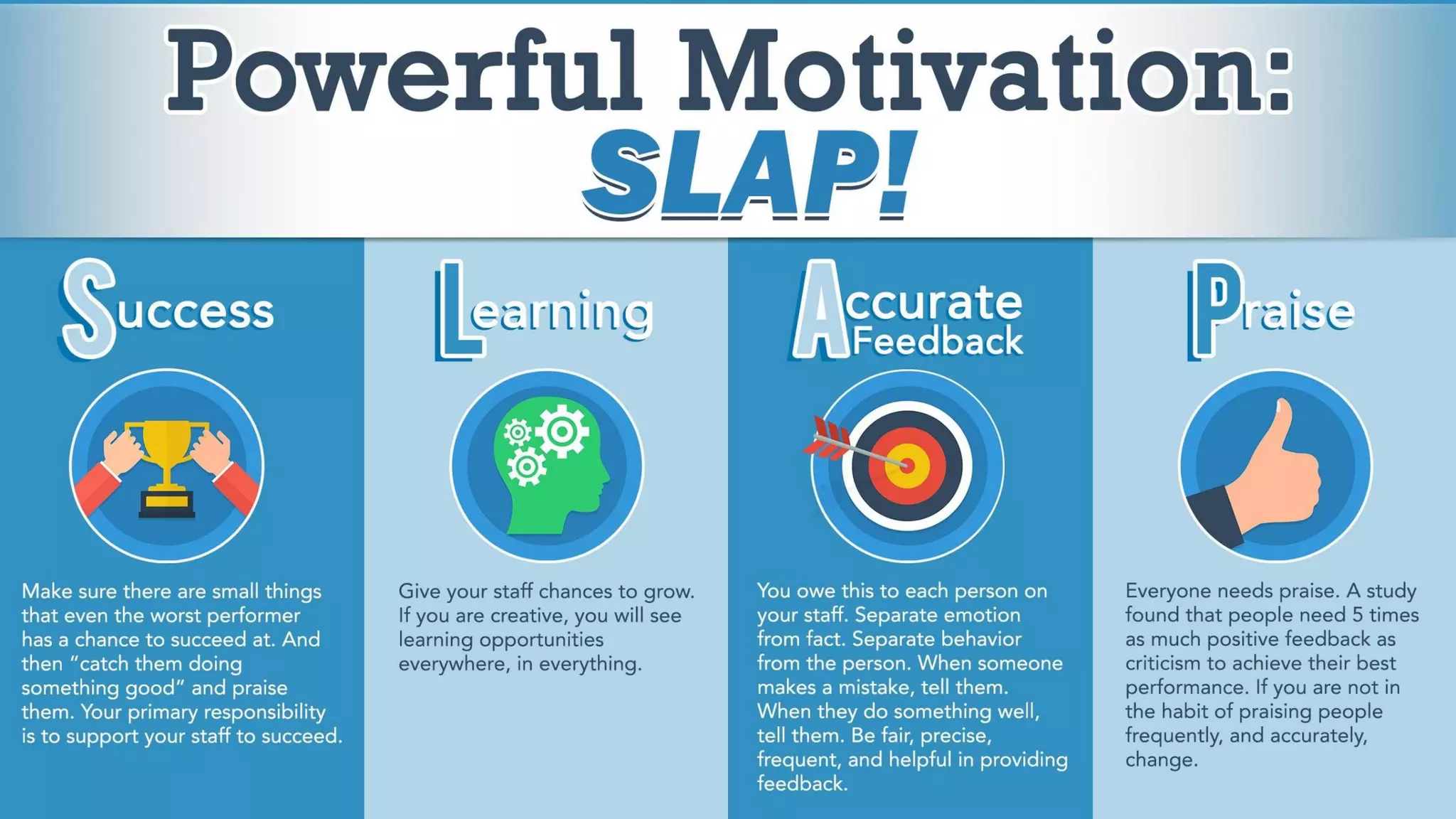
• A Motivating SLAP
• 2016 New Years Free Gifts
• What do good technical writers do? Why do we need them?
• You can find all of the above at:
http://saiffsolutions.com/home/category/blog
• Great 11-minute video on motivation:
https://www.youtube.com/watch?v=u6XAPnuFjJc
BONUS: Resources 39
Email: barrysaiff@saiffsolutions.com
Skype: SaiffSolutions
Contact: +1 415 350 2959
+63 917 872 0929
Web: www.saiffsolutions.com
Visit our Saiff Solutions booth to pick up
organization-transforming freebies and
have a candid conversation with us on
your content challenges.
#LavaCon #SaiffSolutions #techcomm
ALL QUESTIONS ARE WELCOME 40
BONUS: Creativity in the Face of Stress
A good manager creates and protects a healthy culture.
Culture lives in the details -- in every moment, every action and
interaction.
Think about how you deal with stress. You are a role model for
your team. Your stress level impacts them.
Successful managers rely on the 4 Cs:
• Curiosity, Caring, Competence, and Creativity
41

Barry Saiff: CARVE and SLAP Your Way to THRIVE as a Manager

  • 2.
    ➢ Getting toKnow You ➢ Manager’s Toolkit: You’ve Got to Have CHARM ➢ Management: A Sacred Trust - CARVE! THRIVE! ➢ Keys to Success: Training ➢ Keys to Success: Motivation, Feedback - SLAP! ➢ Awareness, Bias, Culture: You, Your Organization, The World ➢ Bonus content! AGENDA 01 #LavaCon #SaiffSolutions #techcomm
  • 3.
    • Technical communicationsleader • 32 years of technical documentation experience • Led writing teams at 6 US companies • Founded Saiff Solutions, Inc. in 2011 • Provides content development to Fortune 500 companies in Japan & US • Loves acronyms About the Speaker: Barry Saiff 02
  • 4.
    Let’s Get toKnow Each Other Please tell us your country, city, role, and why you are here? 03 #LavaCon #SaiffSolutions #techcomm
  • 5.
    What are YourInterests/Experiences in Managing Technical Writers? Have you experienced: • Managing a team of writers? • Leading a team, without management authority? • Managing outsourced or offshore writers? • Hiring? Firing? • Working for a good manager? • Working for a not-so-good manager? • What else? 04
  • 6.
    When facing anydifficult situation, start with Curiosity and Humility, proceed with Awareness, Respect, and Mastery Manager’s Toolkit: CHARM 05
  • 7.
    • destroy careers •destroy jobs • destroy morale • destroy the enterprise Management is a sacred trust. As a manager, at any level, you have the power to: 06
  • 8.
    • build careers •achieve miracles • treat people fairly • develop lifelong relationships of trust Management is a sacred trust. As a manager, at any level, you have the power to: 07
  • 9.
    • turn livesaround • empower people to be more effective and productive • enable people to learn things that make them more successful • turn the enterprise around Management is a sacred trust. As a manager, at any level, you have the power to: 08
  • 11.
    The fundamental wayof being of a manager is caring. •A manager cares about the results. •A manager cares about the process. •A manager cares about the people. •A manager cares about the enterprise. Caring 10
  • 12.
    •A manager istrusted with power, and faces opportunities to abuse that power. •A manager must, at times, be selfless, and act against their own (narrowly conceived) self-interest. Caring: Responsibility 11
  • 13.
    • A goodmanager is a creator of healthy administration, and an enemy of bureaucratic corruption and inertia. • The mission, the customers, the enterprise, the people, and the results are more important than the rules. • A good manager strives for continuous improvement, rational administration, fairness, and productivity gains. Caring: Bureaucracy 12
  • 14.
    Have you everthought about management in terms of caring? Yes? No? Caring: A New Idea? 13
  • 15.
    Your people needregular access to you, and you need access to your management. Have you ever had difficulties or stress at work because your manager had no time for you? Yes? No? Access 14
  • 16.
    Don’t accuse. RememberCHARM. Even if you don't think you are accusing or blaming, if the other person thinks you are, you are responsible for their perception. This is particularly important in Asian cultures. Being Respectful 15
  • 17.
    A manager knowshow to manage their emotions, without dumping them on people in the workplace. Understand the difference between passion and emotion. Be responsible for the impact of your actions. A manager does not react. A manager creates. Being Respectful 16
  • 18.
    Expand the realmof what you consider yourself responsible for. Do not accept being treated with less than full respect. Give yourself a break. You will make mistakes, in fact, you must make some mistakes in order to learn how to improve. BALANCE Infographics: 7 Elements of Respect Being Respectful of yourself 17
  • 19.
    Without vision, managementis damaging. Be inspired, and you will inspire others. Keep the mission, vision, and values of the organization alive, in everyone. Make sure people understand how their work forwards the whole. Are you clear about the mission OR the vision of your organization? Yes? No? Vision 18
  • 20.
    Dr. Wayne Dyerwas well known for the idea, based on extensive research, that we create what we expect. Be aware of your expectations. Choose them wisely. Expect Excellence! 19
  • 21.
    Caring – Trust= Micromanagement Trust is the currency of business success. Without trust, nothing is possible. You must calibrate trust for each person/situation. What do you trust me for? Do you trust me to do my job well? Would you trust me to protect your daughter from harm? These are very different questions. TRUST 20
  • 22.
    Team (We areall on the same one.) Relationships based upon Understanding, Sensitivity, and Tolerance TRUST Calibrate your level of trust in each person wisely. Believe in people. 21
  • 23.
    Question for managers:Who am I being? Get clear on who you are, as a manager and a leader. For example, here is my statement: I am an authentic, caring, challenging, dedicated mentor. What is yours? (Feel free to steal from mine.) To get clear on your statement: • Notice, ask for feedback • Envision (Whom do you aspire to be like?) Being 22
  • 24.
    An inauthentic manageris an ineffective manager. To increase authenticity, clarify your inauthenticities. Everyone has inuathenticities. Ask for help: • What don’t you believe? How would you not trust me? Ask yourself: What do I really care about? What don’t I? Separate the facts from your story. Get training: Never stop learning about yourself. Highly recommended: http://www.landmarkworldwide.com Being Authentic 23
  • 26.
    ● Examine: Howmight I be the source of the problem? ● Learn from failures and successes. ● Do not cut corners (deceive, break the law, share information prematurely or inappropriately). ● Work at least as hard, and smart, as your staff. ● Hold yourself accountable for the results of your team, and for your impact on their self-image & performance. ● Model behaviors and attitudes you want to develop. THRIVE: INTEGRITY 25
  • 27.
    Why are promisesimportant? ● Descriptive language vs Creative language ● Flowers ● Personal power: What is it? What is its source? ● Beyond keeping promises - Honoring your word: ○ When you cannot, pro-actively take responsibility for mitigating the impacts on others. ○ Calibrate your promises: Not too much, not too little either – expect great things! INTEGRITY: The Power of Your Word 26
  • 28.
    What, in yourexperience, are the most difficult management issues? 27
  • 29.
    THRIVE: Training Types Whattypes of training does your team need? Consider: ● Technical communications methods ● Technical skills, aptitude, knowledge ● Writing skills: grammar, organization, proofreading, editing, topic types, etc. ● Cultural skills: Organizational policies, processes, methods, culture, working with diverse others 28
  • 30.
    ● Work skills:time/work management, project management, leading meetings, leading teams, collaboration ● Transformational training - How to: ○ Be coachable ○ Release/replace life-long habits ○ Exceed your limits ○ Increase awareness: How am I being? ○ Culture: strengths, weaknesses of? ○ Increase empathy - for self and others THRIVE: Training Types 29
  • 31.
    Imagine: Your bosstells you (for the first time) that you are failing at x, y, and z, and you are being demoted, or fired. Would you rather have had a chance to improve first? Would you rather have had some effective training? Enable Excellence: Training - Why? 30
  • 33.
    Three Key Factorsfor Motivation: 1. Autonomy 2. Mastery 3. Purpose Great 11-minute video on motivation: https://www.youtube.com/watch?v=u6XAPnuF Two Orientations of Motivation: • Toward (things you want) • Away from (things you don’t want) Motivation: A, M, P, T, AF 32
  • 34.
    Frequent! Accurate! Clear!Specific! Do not fail to tell someone that they made a mistake. Do not fail to praise someone, often. Do not fail to provide formal performance reviews at least annually. Remember CHARM! Feedback 33
  • 35.
    Three Key SuccessFactors: 1. Mix cultures and locations. Having a mix of cultures in one location makes a huge difference. 2. Ensure editing, quality control, and inclusion. Make all writers have the advantages they need to succeed. A key success factor for Saiff Solutions: Our writers in the Philippines work with American, Canadian, Indian, and Filipino editors and managers (local and remote). Our editors each have at least 10 years of technical writing/editing experience. Managing cross-cultural teams 34
  • 36.
    3. Embrace differencesby increasing your awareness! Understanding cultural differences – between countries, professions, departments, companies – is crucial to your success. Consider: • How do these people learn best? • How do they typically handle conflict? • What does “Yes” mean to them? Learn to listen newly: hear what you are missing Learn to speak newly: add what you assume and others do not Continually expand your awareness to new levels. You cannot succeed in this without getting to know people well. Managing cross-cultural teams 35
  • 37.
    •Management entails awesomeresponsibility and awesome opportunity. Both are magnified by a mixture of cultures. •Many Asians are socialized to defer to authority figures, and foreigners, even those not in positions of authority. They may be unwilling to say “no” or disagree with you, to ask questions or ask for help, especially if you (even unknowingly) raise your voice or exhibit frustration or anger. •They may hide from you the impact of how you are being. •Many Americans, Japanese, and others regularly raise their voices, or interpret silence as a sign of agreement and support. Managing cross-cultural teams 36
  • 38.
    To be successfulwith people in other cultures, you need to be sensitive. You need to be willing to change. You need to give up the idea that your culture is better. All cultures have strengths and weaknesses. Learn the strengths and weaknesses of your culture and other cultures. Seek out the strengths 37
  • 39.
    I could benefitfrom a conversation about…? What management challenge are you facing now? 38
  • 40.
    • BALANCE Infographics:7 Elements of Respect • The 7 Habits of Highly Effective Technical Writers • Global Content Creation – Making it Work • A Motivating SLAP • 2016 New Years Free Gifts • What do good technical writers do? Why do we need them? • You can find all of the above at: http://saiffsolutions.com/home/category/blog • Great 11-minute video on motivation: https://www.youtube.com/watch?v=u6XAPnuFjJc BONUS: Resources 39
  • 41.
    Email: barrysaiff@saiffsolutions.com Skype: SaiffSolutions Contact:+1 415 350 2959 +63 917 872 0929 Web: www.saiffsolutions.com Visit our Saiff Solutions booth to pick up organization-transforming freebies and have a candid conversation with us on your content challenges. #LavaCon #SaiffSolutions #techcomm ALL QUESTIONS ARE WELCOME 40
  • 42.
    BONUS: Creativity inthe Face of Stress A good manager creates and protects a healthy culture. Culture lives in the details -- in every moment, every action and interaction. Think about how you deal with stress. You are a role model for your team. Your stress level impacts them. Successful managers rely on the 4 Cs: • Curiosity, Caring, Competence, and Creativity 41