Barcelona’s New Bus Network
Josep Mension
Director Central Services &
Deputy Chief Officer of TMB Bus Network
Rethinking Bus Network Design & Operation
CIVITAS Study Tour,
Nantes, 24th February 2015
0
Contents
1
• Background
• The Goals
• The New Bus Network
• The Orthogonal & Diagonal Routes
• The Assessment of the Model
• The Interchange Areas
• Implementing First Phases: 1, 2 & 3
• Final Comments & Some Figures
• Next Steps
Barcelona’s New Bus Network
Background
2
• Background
• The Goals
• The New Bus Network
• The Orthogonal & Diagonal Routes
• The Assessment of the Model
• The Interchange Areas
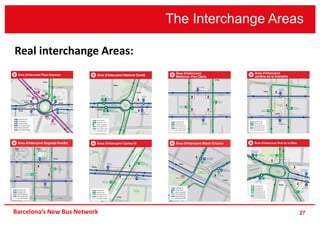
• Implementing First Phases: 1, 2 & 3
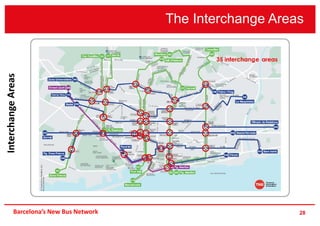
• Final Comments & Some figures
• Next Steps
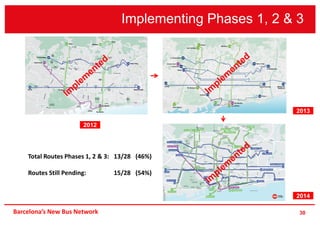
Barcelona’s New Bus Network
Background
3Barcelona’s New Bus Network
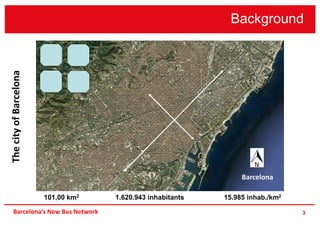
101,00 km2 1.620.943 inhabitants 15.985 inhab./km2
Barcelona
ThecityofBarcelona
Background
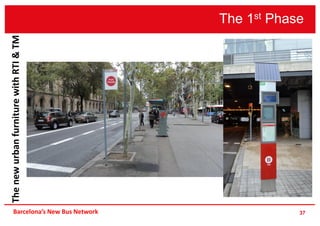
4
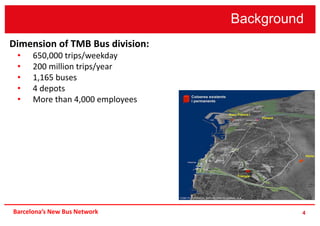
Dimension of TMB Bus division:
• 650,000 trips/weekday
• 200 million trips/year
• 1,165 buses
• 4 depots
• More than 4,000 employees
Barcelona’s New Bus Network
Background
5
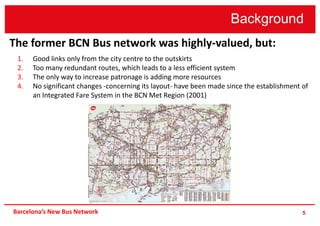
The former BCN Bus network was highly-valued, but:
1. Good links only from the city centre to the outskirts
2. Too many redundant routes, which leads to a less efficient system
3. The only way to increase patronage is adding more resources
4. No significant changes -concerning its layout- have been made since the establishment of
an Integrated Fare System in the BCN Met Region (2001)
Barcelona’s New Bus Network
The Goals
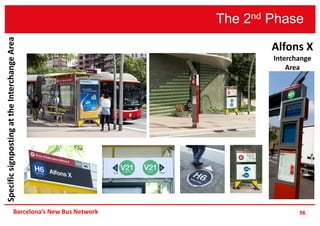
6
• Background
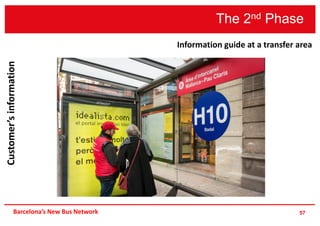
• The Goals
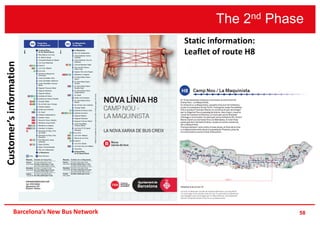
• The New Bus Network
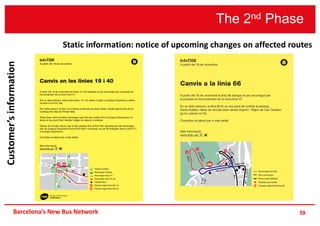
• The Orthogonal Routes
• The Assessment of the Model
• The Interchange Areas
• Implementing First Phases: 1, 2 & 3
• Final Comments & Some Figures
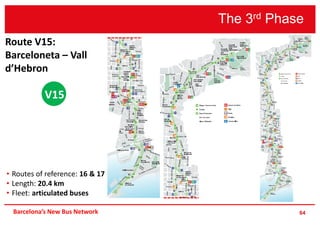
Barcelona’s New Bus Network
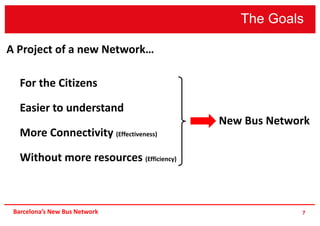
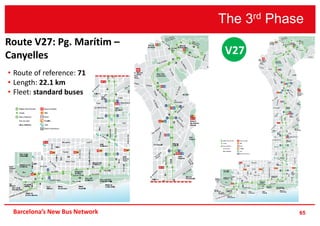
The Goals
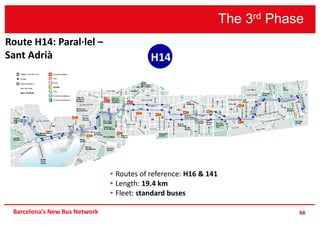
7
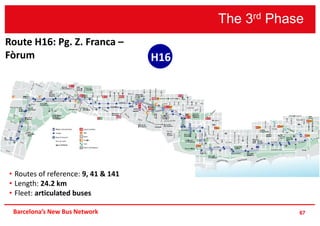
For the Citizens
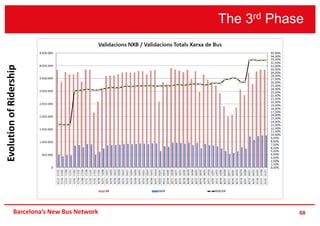
Easier to understand
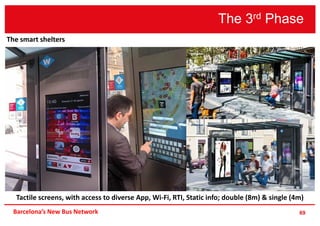
More Connectivity (Effectiveness)
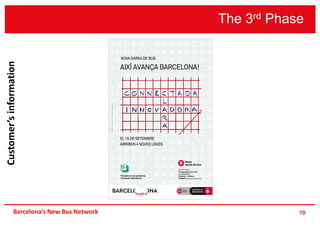
Without more resources (Efficiency)
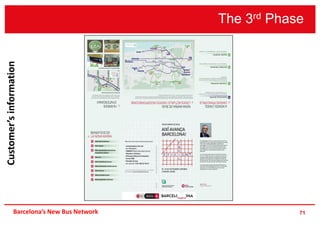
New Bus Network
Barcelona’s New Bus Network
A Project of a new Network…
The New Bus Network
8
• Background
• The Goals
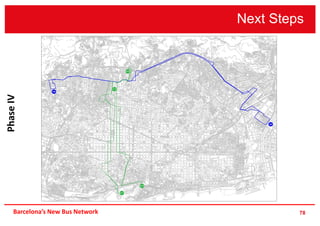
• The New Bus Network
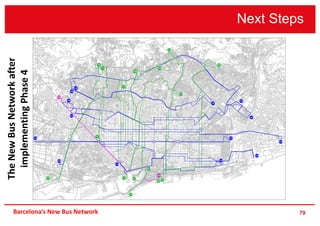
• The Orthogonal & Diagonal Routes
• The Assessment of the Model
• The Interchange Areas
• Implementing First Phases: 1, 2 & 3
• Final Comments & Some Figures
• Next Steps
Barcelona’s New Bus Network
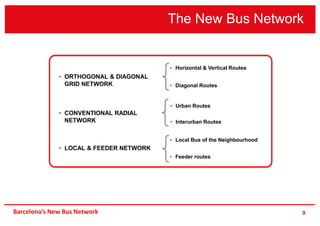
The New Bus Network
9
• Horizontal & Vertical Routes
• Diagonal Routes
• Urban Routes
• Interurban Routes
• Local Bus of the Neighbourhood
• Feeder routes
• ORTHOGONAL & DIAGONAL
GRID NETWORK
• CONVENTIONAL RADIAL
NETWORK
• LOCAL & FEEDER NETWORK
Barcelona’s New Bus Network
The Orthogonal & Diagonal Routes
10
• Background
• The Goals
• The New Bus Network
• The Orthogonal & Diagonal Routes
• The Assessment of the Model
• The Interchange Areas
• Implementing First Phases: 1, 2 & 3
• Final Comments & Some Figures
• Next Steps
Barcelona’s New Bus Network
11
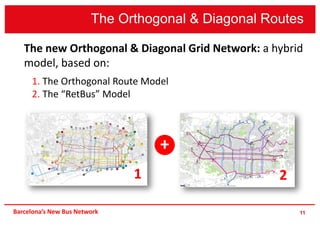
The new Orthogonal & Diagonal Grid Network: a hybrid
model, based on:
1. The Orthogonal Route Model
2. The “RetBus” Model
+
1 2
The Orthogonal & Diagonal Routes
Barcelona’s New Bus Network
12
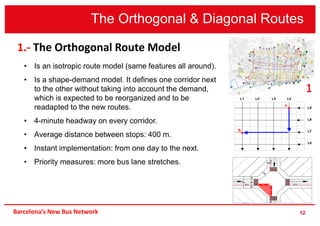
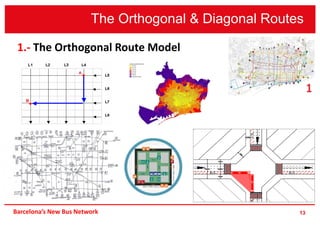
1.- The Orthogonal Route Model
The Orthogonal & Diagonal Routes
• Is an isotropic route model (same features all around).
• Is a shape-demand model. It defines one corridor next
to the other without taking into account the demand,
which is expected to be reorganized and to be
readapted to the new routes.
• 4-minute headway on every corridor.
• Average distance between stops: 400 m.
• Instant implementation: from one day to the next.
• Priority measures: more bus lane stretches.
Barcelona’s New Bus Network
13
1.- The Orthogonal Route Model
The Orthogonal & Diagonal Routes
Barcelona’s New Bus Network
14
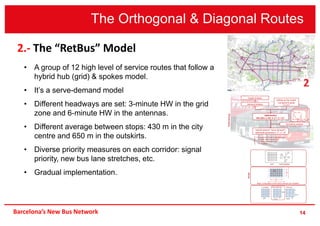
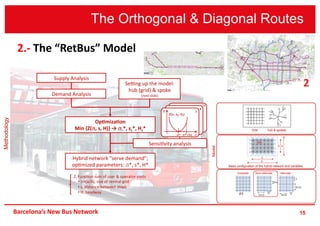
2.- The “RetBus” Model
The Orthogonal & Diagonal Routes
Basic configuration of the hybrid network and variables
Grid hub & spokes
Complete Semi-alternate Alternate
Model
b
B
a A
S
Methodology
Supply Analysis
Se ng up the model:
hub (grid) & spoke
(next slide)
Op miza on
Min {Z(a, s, H)} → ac*, sc*, Hc*
Demand Analysis
Hybrid network “serve demand”;
op mized parameters: a*, s*, H*
Z, Func on sum of user & operator costs
• a=(a/A), size of central grid
• s, distance between stops
• H, headway
Sensi vity analysis
s
H
a
• A group of 12 high level of service routes that follow a
hybrid hub (grid) & spokes model.
• It’s a serve-demand model
• Different headways are set: 3-minute HW in the grid
zone and 6-minute HW in the antennas.
• Different average between stops: 430 m in the city
centre and 650 m in the outskirts.
• Diverse priority measures on each corridor: signal
priority, new bus lane stretches, etc.
• Gradual implementation.
Barcelona’s New Bus Network
15
2.- The “RetBus” Model
The Orthogonal & Diagonal Routes
Basic configuration of the hybrid network and variables
Grid hub & spokes
Complete Semi-alternate Alternate
Model
b
B
a A
S
Methodology
Supply Analysis
Se ng up the model:
hub (grid) & spoke
(next slide)
Op miza on
Min {Z(a, s, H)} → ac*, sc*, Hc*
Demand Analysis
Hybrid network “serve demand”;
op mized parameters: a*, s*, H*
Z, Func on sum of user & operator costs
• a=(a/A), size of central grid
• s, distance between stops
• H, headway
Sensi vity analysis
s
H
a
Barcelona’s New Bus Network
16
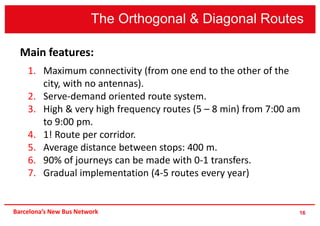
Main features:
1. Maximum connectivity (from one end to the other of the
city, with no antennas).
2. Serve-demand oriented route system.
3. High & very high frequency routes (5 – 8 min) from 7:00 am
to 9:00 pm.
4. 1! Route per corridor.
5. Average distance between stops: 400 m.
6. 90% of journeys can be made with 0-1 transfers.
7. Gradual implementation (4-5 routes every year)
The Orthogonal & Diagonal Routes
Barcelona’s New Bus Network
17
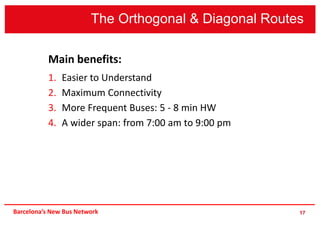
Main benefits:
1. Easier to Understand
2. Maximum Connectivity
3. More Frequent Buses: 5 - 8 min HW
4. A wider span: from 7:00 am to 9:00 pm
The Orthogonal & Diagonal Routes
Barcelona’s New Bus Network
The Orthogonal & Diagonal Routes
18
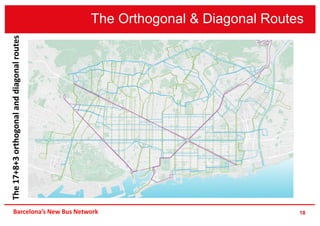
The17+8+3orthogonalanddiagonalroutes
Barcelona’s New Bus Network
The Orthogonal & Diagonal Routes
19
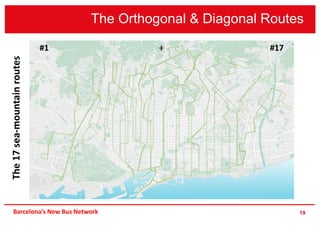
The17sea-mountainroutes
Barcelona’s New Bus Network
#1 ÷ #17
The Orthogonal & Diagonal Routes
20
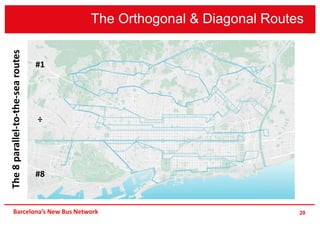
The8parallel-to-the-searoutes
Barcelona’s New Bus Network
#1
÷
#8
The Orthogonal & Diagonal Routes
21
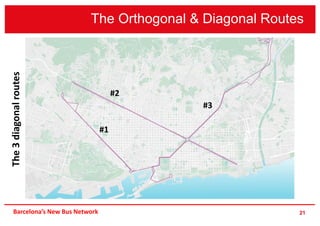
The3diagonalroutes
Barcelona’s New Bus Network
#2
#1
#3
22
The Orthogonal & Diagonal Routes
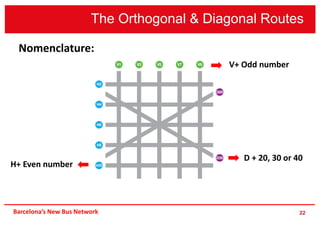
Nomenclature:
Barcelona’s New Bus Network
V+ Odd number
H+ Even number
D + 20, 30 or 40
The Assessment of the Model
23
• Background
• The Goals
• The New Bus Network
• The Orthogonal & Diagonal Routes
• The Assessment of the Model
• The Interchange Areas
• Implementing First Phases: 1, 2 & 3
• Final Comments & Some Figures
• Steps
Barcelona’s New Bus Network
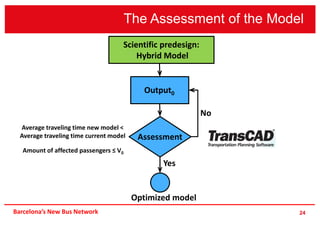
The Assessment of the Model
24
Output0
Yes
No
Assessment
Optimized model
Average traveling time new model <
Average traveling time current model
Amount of affected passengers ≤ V0
Scientific predesign:
Hybrid Model
Barcelona’s New Bus Network
The Interchange Areas
25
• Background
• The Goals
• The New Bus Network
• The Orthogonal & Diagonal Routes
• The Assessment of the Model
• The Interchange Areas
• Implementing First Phases: 1, 2 & 3
• Final Comments & Some Figures
• Next Steps
Barcelona’s New Bus Network
The Interchange Areas
26
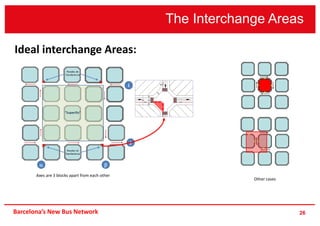
Axes are 3 blocks apart from each other
Other cases
Ideal interchange Areas:
Barcelona’s New Bus Network
27
The Interchange Areas
Barcelona’s New Bus Network
Real interchange Areas:
The Interchange Areas
28Barcelona’s New Bus Network
InterchangeAreas
Implementing Phases 1, 2 & 3
29
• Background
• The Goals
• The New Bus Network
• The Orthogonal & Diagonal Routes
• The Assessment of the Model
• The Interchangers
• Implementing First Phases: 1, 2 & 3
• Final Comments & Some Figures
• Next Steps
Barcelona’s New Bus Network
Implementing Phases 1, 2 & 3
30
Total Routes Phases 1, 2 & 3: 13/28 (46%)
Routes Still Pending: 15/28 (54%)
2012
2013
2014
Barcelona’s New Bus Network
The 1st Phase
31Barcelona’s New Bus Network
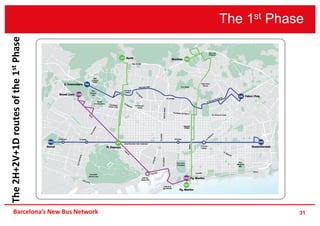
The2H+2V+1Droutesofthe1stPhase
The 1st Phase
32Barcelona’s New Bus Network
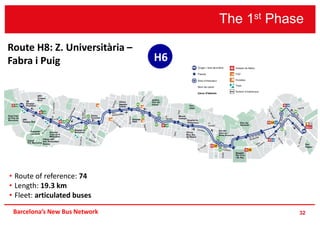
H6
Route H8: Z. Universitària –
Fabra i Puig
• Route of reference: 74
• Length: 19.3 km
• Fleet: articulated buses
The 1st Phase
33Barcelona’s New Bus Network
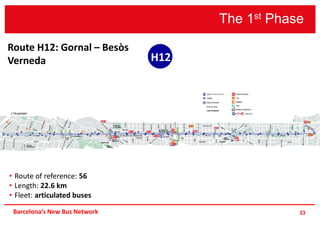
H12
Route H12: Gornal – Besòs
Verneda
• Route of reference: 56
• Length: 22.6 km
• Fleet: articulated buses
The 1st Phase
34Barcelona’s New Bus Network
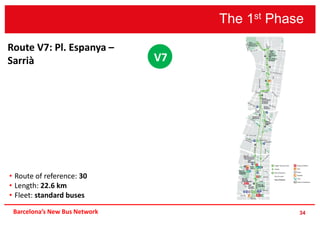
Route V7: Pl. Espanya –
Sarrià
• Route of reference: 30
• Length: 22.6 km
• Fleet: standard buses
V7
The 1st Phase
35Barcelona’s New Bus Network
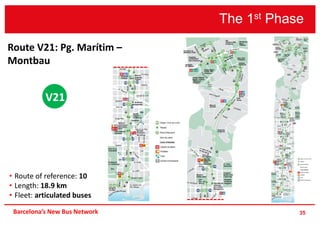
Route V21: Pg. Marítim –
Montbau
• Route of reference: 10
• Length: 18.9 km
• Fleet: articulated buses
V21
The 1st Phase
36Barcelona’s New Bus Network
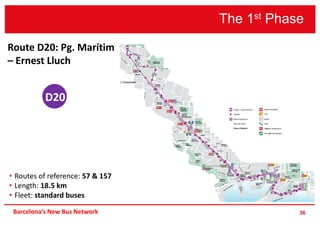
Route D20: Pg. Marítim
– Ernest Lluch
• Routes of reference: 57 & 157
• Length: 18.5 km
• Fleet: standard buses
D20
The 1st Phase
37Barcelona’s New Bus Network
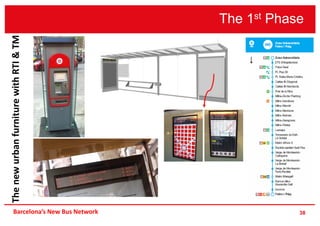
ThenewurbanfurniturewithRTI&TM
The 1st Phase
38
ThenewurbanfurniturewithRTI&TM
Barcelona’s New Bus Network
The 1st Phase
39ITS & Smart Mobility a Catalunya 2015
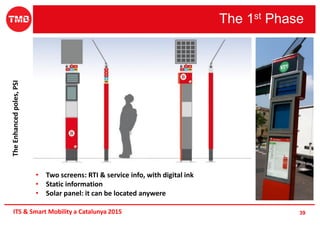
• Two screens: RTI & service info, with digital ink
• Static information
• Solar panel: it can be located anywere
TheEnhancedpoles,PSI
The 1st Phase
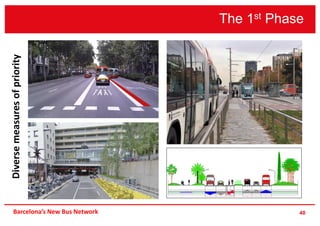
40
Diversemeasuresofpriority
Barcelona’s New Bus Network
The 1st Phase
41
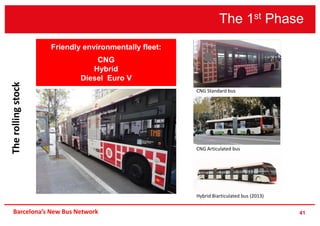
Therollingstock
CNG Standard bus
CNG Articulated bus
Hybrid Biarticulated bus (2013)
Friendly environmentally fleet:
CNG
Hybrid
Diesel Euro V
Barcelona’s New Bus Network
The 1st Phase
42
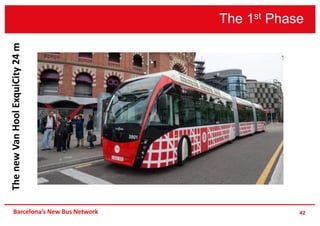
ThenewVanHoolExquiCity24m
Barcelona’s New Bus Network
The 1st Phase
43
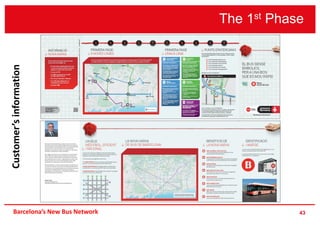
Customer’sinformation
Barcelona’s New Bus Network
The 1st Phase
44Barcelona’s New Bus Network
Customer’sinformation
The 1st Phase
45Barcelona’s New Bus Network
Evaluation:
CSSoftheNewBusNetwork
The 2nd Phase
46Barcelona’s New Bus Network
The3H+2Vroutesofthe2ndPhase
The 2nd Phase
47Barcelona’s New Bus Network
Global1stand2ndPhase
The 2nd Phase
48Barcelona’s New Bus Network
H8
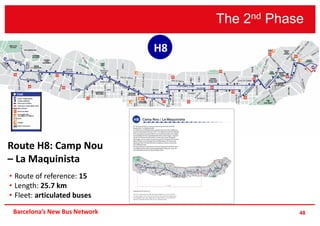
Route H8: Camp Nou
– La Maquinista
• Route of reference: 15
• Length: 25.7 km
• Fleet: articulated buses
49Barcelona’s New Bus Network
H10
The 2nd Phase
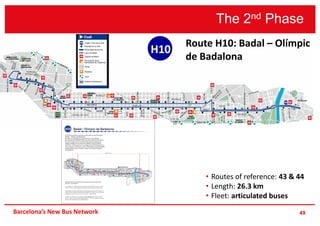
Route H10: Badal – Olímpic
de Badalona
• Routes of reference: 43 & 44
• Length: 26.3 km
• Fleet: articulated buses
The 2nd Phase
50Barcelona’s New Bus Network
H16
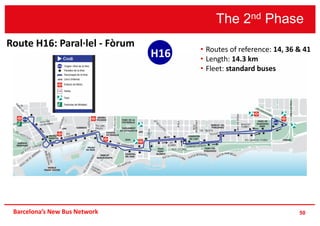
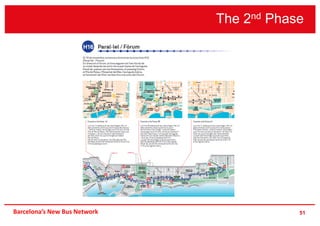
Route H16: Paral·lel - Fòrum • Routes of reference: 14, 36 & 41
• Length: 14.3 km
• Fleet: standard buses
The 2nd Phase
51Barcelona’s New Bus Network
The 2nd Phase
52Barcelona’s New Bus Network
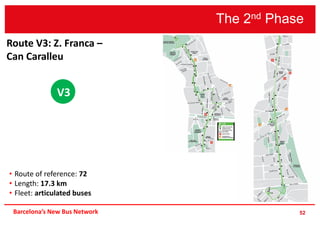
V3
Route V3: Z. Franca –
Can Caralleu
• Route of reference: 72
• Length: 17.3 km
• Fleet: articulated buses
The 2nd Phase
53Barcelona’s New Bus Network
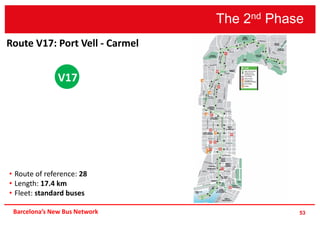
Route V17: Port Vell - Carmel
V17
• Route of reference: 28
• Length: 17.4 km
• Fleet: standard buses
The 2nd Phase
54Barcelona’s New Bus Network
The 2nd Phase
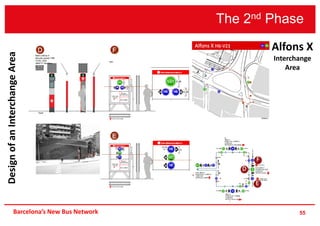
55Barcelona’s New Bus Network
Alfons X
Interchange
Area
DesignofanInterchangeArea
The 2nd Phase
56Barcelona’s New Bus Network
Alfons X
Interchange
Area
SpecificsignpostingattheInterchangeArea
The 2nd Phase
57Barcelona’s New Bus Network
Customer’sinformation
Information guide at a transfer area
The 2nd Phase
58Barcelona’s New Bus Network
Customer’sinformation
Static information:
Leaflet of route H8
The 2nd Phase
59Barcelona’s New Bus Network
Customer’sinformation
Static information: notice of upcoming changes on affected routes
The 2nd Phase
60Barcelona’s New Bus Network
EvolutionofRidership
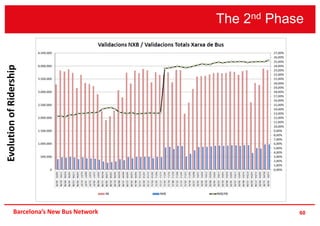
The 2nd Phase
61Barcelona’s New Bus Network
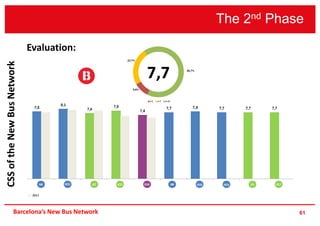
Evaluation:
CSSoftheNewBusNetwork
The 3rd Phase
62Barcelona’s New Bus Network
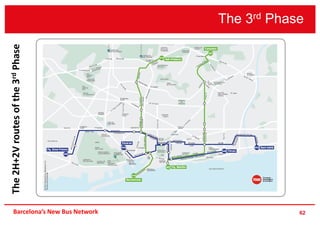
The2H+2Vroutesofthe3rdPhase
The 3rd Phase
63Barcelona’s New Bus Network
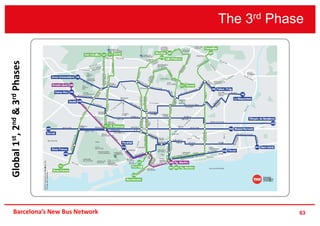
Global1st,2nd&3rdPhases
The 3rd Phase
64Barcelona’s New Bus Network
• Routes of reference: 16 & 17
• Length: 20.4 km
• Fleet: articulated buses
V15
Route V15:
Barceloneta – Vall
d’Hebron
The 3rd Phase
65Barcelona’s New Bus Network
• Route of reference: 71
• Length: 22.1 km
• Fleet: standard buses
V27
Route V27: Pg. Marítim –
Canyelles
The 3rd Phase
66Barcelona’s New Bus Network
• Routes of reference: H16 & 141
• Length: 19.4 km
• Fleet: standard buses
H14
Route H14: Paral·lel –
Sant Adrià
The 3rd Phase
67Barcelona’s New Bus Network
• Routes of reference: 9, 41 & 141
• Length: 24.2 km
• Fleet: articulated buses
H16
Route H16: Pg. Z. Franca –
Fòrum
The 3rd Phase
68Barcelona’s New Bus Network
EvolutionofRidership
The 3rd Phase
69Barcelona’s New Bus Network
Tactile screens, with access to diverse App, Wi-Fi, RTI, Static info; double (8m) & single (4m)
The smart shelters
The 3rd Phase
70Barcelona’s New Bus Network
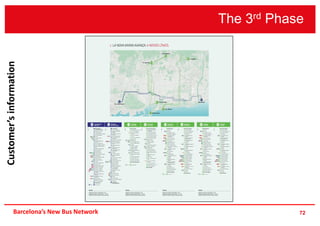
Customer’sinformation
The 3rd Phase
71Barcelona’s New Bus Network
Customer’sinformation
The 3rd Phase
72Barcelona’s New Bus Network
Customer’sinformation
The 3rd Phase
73Barcelona’s New Bus Network
Evaluation:
CSSoftheNewBusNetwork
Final Comments & Some Figures
74
• Background
• The Goals
• The New Bus Network
• The Orthogonal & Diagonal Routes
• The Assessment of the Model
• The Interchangers
• Implementing First Phases: 1, 2 & 3
• Final Comments & Some Figures
• Next Steps
Barcelona’s New Bus Network
Final Comments & Some Figures
75Barcelona’s New Bus Network
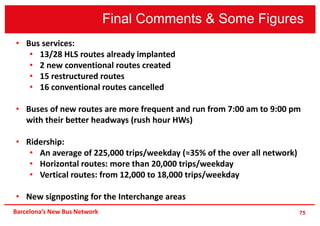
• Bus services:
• 13/28 HLS routes already implanted
• 2 new conventional routes created
• 15 restructured routes
• 16 conventional routes cancelled
• Buses of new routes are more frequent and run from 7:00 am to 9:00 pm
with their better headways (rush hour HWs)
• Ridership:
• An average of 225,000 trips/weekday (≈35% of the over all network)
• Horizontal routes: more than 20,000 trips/weekday
• Vertical routes: from 12,000 to 18,000 trips/weekday
• New signposting for the Interchange areas
Final Comments & Some Figures
76Barcelona’s New Bus Network
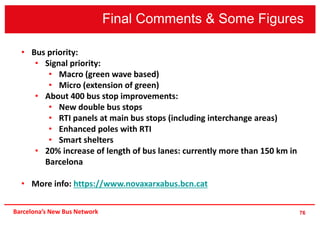
• Bus priority:
• Signal priority:
• Macro (green wave based)
• Micro (extension of green)
• About 400 bus stop improvements:
• New double bus stops
• RTI panels at main bus stops (including interchange areas)
• Enhanced poles with RTI
• Smart shelters
• 20% increase of length of bus lanes: currently more than 150 km in
Barcelona
• More info: https://www.novaxarxabus.bcn.cat
Next Steps
77
• Background
• The Goals
• The New Bus Network
• The Orthogonal & Diagonal Routes
• The Assessment of the Model
• The Interchangers
• Implementing First Phases: 1, 2 & 3
• Final Comments & Some Figures
• Next Steps
Barcelona’s New Bus Network
Next Steps
78Barcelona’s New Bus Network
PhaseIV
Next Steps
79Barcelona’s New Bus Network
TheNewBusNetworkafter
implementingPhase4
Thank you
jmension@tmb.cat

Barcelona's new bus network

  • 1.
    Barcelona’s New BusNetwork Josep Mension Director Central Services & Deputy Chief Officer of TMB Bus Network Rethinking Bus Network Design & Operation CIVITAS Study Tour, Nantes, 24th February 2015 0
  • 2.
    Contents 1 • Background • TheGoals • The New Bus Network • The Orthogonal & Diagonal Routes • The Assessment of the Model • The Interchange Areas • Implementing First Phases: 1, 2 & 3 • Final Comments & Some Figures • Next Steps Barcelona’s New Bus Network
  • 3.
    Background 2 • Background • TheGoals • The New Bus Network • The Orthogonal & Diagonal Routes • The Assessment of the Model • The Interchange Areas • Implementing First Phases: 1, 2 & 3 • Final Comments & Some figures • Next Steps Barcelona’s New Bus Network
  • 4.
    Background 3Barcelona’s New BusNetwork 101,00 km2 1.620.943 inhabitants 15.985 inhab./km2 Barcelona ThecityofBarcelona
  • 5.
    Background 4 Dimension of TMBBus division: • 650,000 trips/weekday • 200 million trips/year • 1,165 buses • 4 depots • More than 4,000 employees Barcelona’s New Bus Network
  • 6.
    Background 5 The former BCNBus network was highly-valued, but: 1. Good links only from the city centre to the outskirts 2. Too many redundant routes, which leads to a less efficient system 3. The only way to increase patronage is adding more resources 4. No significant changes -concerning its layout- have been made since the establishment of an Integrated Fare System in the BCN Met Region (2001) Barcelona’s New Bus Network
  • 7.
    The Goals 6 • Background •The Goals • The New Bus Network • The Orthogonal Routes • The Assessment of the Model • The Interchange Areas • Implementing First Phases: 1, 2 & 3 • Final Comments & Some Figures Barcelona’s New Bus Network
  • 8.
    The Goals 7 For theCitizens Easier to understand More Connectivity (Effectiveness) Without more resources (Efficiency) New Bus Network Barcelona’s New Bus Network A Project of a new Network…
  • 9.
    The New BusNetwork 8 • Background • The Goals • The New Bus Network • The Orthogonal & Diagonal Routes • The Assessment of the Model • The Interchange Areas • Implementing First Phases: 1, 2 & 3 • Final Comments & Some Figures • Next Steps Barcelona’s New Bus Network
  • 10.
    The New BusNetwork 9 • Horizontal & Vertical Routes • Diagonal Routes • Urban Routes • Interurban Routes • Local Bus of the Neighbourhood • Feeder routes • ORTHOGONAL & DIAGONAL GRID NETWORK • CONVENTIONAL RADIAL NETWORK • LOCAL & FEEDER NETWORK Barcelona’s New Bus Network
  • 11.
    The Orthogonal &Diagonal Routes 10 • Background • The Goals • The New Bus Network • The Orthogonal & Diagonal Routes • The Assessment of the Model • The Interchange Areas • Implementing First Phases: 1, 2 & 3 • Final Comments & Some Figures • Next Steps Barcelona’s New Bus Network
  • 12.
    11 The new Orthogonal& Diagonal Grid Network: a hybrid model, based on: 1. The Orthogonal Route Model 2. The “RetBus” Model + 1 2 The Orthogonal & Diagonal Routes Barcelona’s New Bus Network
  • 13.
    12 1.- The OrthogonalRoute Model The Orthogonal & Diagonal Routes • Is an isotropic route model (same features all around). • Is a shape-demand model. It defines one corridor next to the other without taking into account the demand, which is expected to be reorganized and to be readapted to the new routes. • 4-minute headway on every corridor. • Average distance between stops: 400 m. • Instant implementation: from one day to the next. • Priority measures: more bus lane stretches. Barcelona’s New Bus Network
  • 14.
    13 1.- The OrthogonalRoute Model The Orthogonal & Diagonal Routes Barcelona’s New Bus Network
  • 15.
    14 2.- The “RetBus”Model The Orthogonal & Diagonal Routes Basic configuration of the hybrid network and variables Grid hub & spokes Complete Semi-alternate Alternate Model b B a A S Methodology Supply Analysis Se ng up the model: hub (grid) & spoke (next slide) Op miza on Min {Z(a, s, H)} → ac*, sc*, Hc* Demand Analysis Hybrid network “serve demand”; op mized parameters: a*, s*, H* Z, Func on sum of user & operator costs • a=(a/A), size of central grid • s, distance between stops • H, headway Sensi vity analysis s H a • A group of 12 high level of service routes that follow a hybrid hub (grid) & spokes model. • It’s a serve-demand model • Different headways are set: 3-minute HW in the grid zone and 6-minute HW in the antennas. • Different average between stops: 430 m in the city centre and 650 m in the outskirts. • Diverse priority measures on each corridor: signal priority, new bus lane stretches, etc. • Gradual implementation. Barcelona’s New Bus Network
  • 16.
    15 2.- The “RetBus”Model The Orthogonal & Diagonal Routes Basic configuration of the hybrid network and variables Grid hub & spokes Complete Semi-alternate Alternate Model b B a A S Methodology Supply Analysis Se ng up the model: hub (grid) & spoke (next slide) Op miza on Min {Z(a, s, H)} → ac*, sc*, Hc* Demand Analysis Hybrid network “serve demand”; op mized parameters: a*, s*, H* Z, Func on sum of user & operator costs • a=(a/A), size of central grid • s, distance between stops • H, headway Sensi vity analysis s H a Barcelona’s New Bus Network
  • 17.
    16 Main features: 1. Maximumconnectivity (from one end to the other of the city, with no antennas). 2. Serve-demand oriented route system. 3. High & very high frequency routes (5 – 8 min) from 7:00 am to 9:00 pm. 4. 1! Route per corridor. 5. Average distance between stops: 400 m. 6. 90% of journeys can be made with 0-1 transfers. 7. Gradual implementation (4-5 routes every year) The Orthogonal & Diagonal Routes Barcelona’s New Bus Network
  • 18.
    17 Main benefits: 1. Easierto Understand 2. Maximum Connectivity 3. More Frequent Buses: 5 - 8 min HW 4. A wider span: from 7:00 am to 9:00 pm The Orthogonal & Diagonal Routes Barcelona’s New Bus Network
  • 19.
    The Orthogonal &Diagonal Routes 18 The17+8+3orthogonalanddiagonalroutes Barcelona’s New Bus Network
  • 20.
    The Orthogonal &Diagonal Routes 19 The17sea-mountainroutes Barcelona’s New Bus Network #1 ÷ #17
  • 21.
    The Orthogonal &Diagonal Routes 20 The8parallel-to-the-searoutes Barcelona’s New Bus Network #1 ÷ #8
  • 22.
    The Orthogonal &Diagonal Routes 21 The3diagonalroutes Barcelona’s New Bus Network #2 #1 #3
  • 23.
    22 The Orthogonal &Diagonal Routes Nomenclature: Barcelona’s New Bus Network V+ Odd number H+ Even number D + 20, 30 or 40
  • 24.
    The Assessment ofthe Model 23 • Background • The Goals • The New Bus Network • The Orthogonal & Diagonal Routes • The Assessment of the Model • The Interchange Areas • Implementing First Phases: 1, 2 & 3 • Final Comments & Some Figures • Steps Barcelona’s New Bus Network
  • 25.
    The Assessment ofthe Model 24 Output0 Yes No Assessment Optimized model Average traveling time new model < Average traveling time current model Amount of affected passengers ≤ V0 Scientific predesign: Hybrid Model Barcelona’s New Bus Network
  • 26.
    The Interchange Areas 25 •Background • The Goals • The New Bus Network • The Orthogonal & Diagonal Routes • The Assessment of the Model • The Interchange Areas • Implementing First Phases: 1, 2 & 3 • Final Comments & Some Figures • Next Steps Barcelona’s New Bus Network
  • 27.
    The Interchange Areas 26 Axesare 3 blocks apart from each other Other cases Ideal interchange Areas: Barcelona’s New Bus Network
  • 28.
    27 The Interchange Areas Barcelona’sNew Bus Network Real interchange Areas:
  • 29.
    The Interchange Areas 28Barcelona’sNew Bus Network InterchangeAreas
  • 30.
    Implementing Phases 1,2 & 3 29 • Background • The Goals • The New Bus Network • The Orthogonal & Diagonal Routes • The Assessment of the Model • The Interchangers • Implementing First Phases: 1, 2 & 3 • Final Comments & Some Figures • Next Steps Barcelona’s New Bus Network
  • 31.
    Implementing Phases 1,2 & 3 30 Total Routes Phases 1, 2 & 3: 13/28 (46%) Routes Still Pending: 15/28 (54%) 2012 2013 2014 Barcelona’s New Bus Network
  • 32.
    The 1st Phase 31Barcelona’sNew Bus Network The2H+2V+1Droutesofthe1stPhase
  • 33.
    The 1st Phase 32Barcelona’sNew Bus Network H6 Route H8: Z. Universitària – Fabra i Puig • Route of reference: 74 • Length: 19.3 km • Fleet: articulated buses
  • 34.
    The 1st Phase 33Barcelona’sNew Bus Network H12 Route H12: Gornal – Besòs Verneda • Route of reference: 56 • Length: 22.6 km • Fleet: articulated buses
  • 35.
    The 1st Phase 34Barcelona’sNew Bus Network Route V7: Pl. Espanya – Sarrià • Route of reference: 30 • Length: 22.6 km • Fleet: standard buses V7
  • 36.
    The 1st Phase 35Barcelona’sNew Bus Network Route V21: Pg. Marítim – Montbau • Route of reference: 10 • Length: 18.9 km • Fleet: articulated buses V21
  • 37.
    The 1st Phase 36Barcelona’sNew Bus Network Route D20: Pg. Marítim – Ernest Lluch • Routes of reference: 57 & 157 • Length: 18.5 km • Fleet: standard buses D20
  • 38.
    The 1st Phase 37Barcelona’sNew Bus Network ThenewurbanfurniturewithRTI&TM
  • 39.
  • 40.
    The 1st Phase 39ITS& Smart Mobility a Catalunya 2015 • Two screens: RTI & service info, with digital ink • Static information • Solar panel: it can be located anywere TheEnhancedpoles,PSI
  • 41.
  • 42.
    The 1st Phase 41 Therollingstock CNGStandard bus CNG Articulated bus Hybrid Biarticulated bus (2013) Friendly environmentally fleet: CNG Hybrid Diesel Euro V Barcelona’s New Bus Network
  • 43.
  • 44.
  • 45.
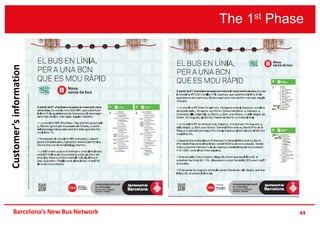
    The 1st Phase 44Barcelona’sNew Bus Network Customer’sinformation
  • 46.
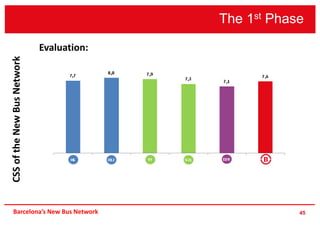
    The 1st Phase 45Barcelona’sNew Bus Network Evaluation: CSSoftheNewBusNetwork
  • 47.
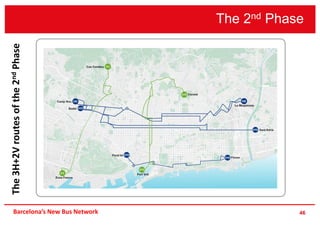
    The 2nd Phase 46Barcelona’sNew Bus Network The3H+2Vroutesofthe2ndPhase
  • 48.
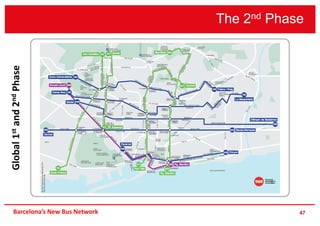
    The 2nd Phase 47Barcelona’sNew Bus Network Global1stand2ndPhase
  • 49.
    The 2nd Phase 48Barcelona’sNew Bus Network H8 Route H8: Camp Nou – La Maquinista • Route of reference: 15 • Length: 25.7 km • Fleet: articulated buses
  • 50.
    49Barcelona’s New BusNetwork H10 The 2nd Phase Route H10: Badal – Olímpic de Badalona • Routes of reference: 43 & 44 • Length: 26.3 km • Fleet: articulated buses
  • 51.
    The 2nd Phase 50Barcelona’sNew Bus Network H16 Route H16: Paral·lel - Fòrum • Routes of reference: 14, 36 & 41 • Length: 14.3 km • Fleet: standard buses
  • 52.
  • 53.
    The 2nd Phase 52Barcelona’sNew Bus Network V3 Route V3: Z. Franca – Can Caralleu • Route of reference: 72 • Length: 17.3 km • Fleet: articulated buses
  • 54.
    The 2nd Phase 53Barcelona’sNew Bus Network Route V17: Port Vell - Carmel V17 • Route of reference: 28 • Length: 17.4 km • Fleet: standard buses
  • 55.
  • 56.
    The 2nd Phase 55Barcelona’sNew Bus Network Alfons X Interchange Area DesignofanInterchangeArea
  • 57.
    The 2nd Phase 56Barcelona’sNew Bus Network Alfons X Interchange Area SpecificsignpostingattheInterchangeArea
  • 58.
    The 2nd Phase 57Barcelona’sNew Bus Network Customer’sinformation Information guide at a transfer area
  • 59.
    The 2nd Phase 58Barcelona’sNew Bus Network Customer’sinformation Static information: Leaflet of route H8
  • 60.
    The 2nd Phase 59Barcelona’sNew Bus Network Customer’sinformation Static information: notice of upcoming changes on affected routes
  • 61.
    The 2nd Phase 60Barcelona’sNew Bus Network EvolutionofRidership
  • 62.
    The 2nd Phase 61Barcelona’sNew Bus Network Evaluation: CSSoftheNewBusNetwork
  • 63.
    The 3rd Phase 62Barcelona’sNew Bus Network The2H+2Vroutesofthe3rdPhase
  • 64.
    The 3rd Phase 63Barcelona’sNew Bus Network Global1st,2nd&3rdPhases
  • 65.
    The 3rd Phase 64Barcelona’sNew Bus Network • Routes of reference: 16 & 17 • Length: 20.4 km • Fleet: articulated buses V15 Route V15: Barceloneta – Vall d’Hebron
  • 66.
    The 3rd Phase 65Barcelona’sNew Bus Network • Route of reference: 71 • Length: 22.1 km • Fleet: standard buses V27 Route V27: Pg. Marítim – Canyelles
  • 67.
    The 3rd Phase 66Barcelona’sNew Bus Network • Routes of reference: H16 & 141 • Length: 19.4 km • Fleet: standard buses H14 Route H14: Paral·lel – Sant Adrià
  • 68.
    The 3rd Phase 67Barcelona’sNew Bus Network • Routes of reference: 9, 41 & 141 • Length: 24.2 km • Fleet: articulated buses H16 Route H16: Pg. Z. Franca – Fòrum
  • 69.
    The 3rd Phase 68Barcelona’sNew Bus Network EvolutionofRidership
  • 70.
    The 3rd Phase 69Barcelona’sNew Bus Network Tactile screens, with access to diverse App, Wi-Fi, RTI, Static info; double (8m) & single (4m) The smart shelters
  • 71.
    The 3rd Phase 70Barcelona’sNew Bus Network Customer’sinformation
  • 72.
    The 3rd Phase 71Barcelona’sNew Bus Network Customer’sinformation
  • 73.
    The 3rd Phase 72Barcelona’sNew Bus Network Customer’sinformation
  • 74.
    The 3rd Phase 73Barcelona’sNew Bus Network Evaluation: CSSoftheNewBusNetwork
  • 75.
    Final Comments &Some Figures 74 • Background • The Goals • The New Bus Network • The Orthogonal & Diagonal Routes • The Assessment of the Model • The Interchangers • Implementing First Phases: 1, 2 & 3 • Final Comments & Some Figures • Next Steps Barcelona’s New Bus Network
  • 76.
    Final Comments &Some Figures 75Barcelona’s New Bus Network • Bus services: • 13/28 HLS routes already implanted • 2 new conventional routes created • 15 restructured routes • 16 conventional routes cancelled • Buses of new routes are more frequent and run from 7:00 am to 9:00 pm with their better headways (rush hour HWs) • Ridership: • An average of 225,000 trips/weekday (≈35% of the over all network) • Horizontal routes: more than 20,000 trips/weekday • Vertical routes: from 12,000 to 18,000 trips/weekday • New signposting for the Interchange areas
  • 77.
    Final Comments &Some Figures 76Barcelona’s New Bus Network • Bus priority: • Signal priority: • Macro (green wave based) • Micro (extension of green) • About 400 bus stop improvements: • New double bus stops • RTI panels at main bus stops (including interchange areas) • Enhanced poles with RTI • Smart shelters • 20% increase of length of bus lanes: currently more than 150 km in Barcelona • More info: https://www.novaxarxabus.bcn.cat
  • 78.
    Next Steps 77 • Background •The Goals • The New Bus Network • The Orthogonal & Diagonal Routes • The Assessment of the Model • The Interchangers • Implementing First Phases: 1, 2 & 3 • Final Comments & Some Figures • Next Steps Barcelona’s New Bus Network
  • 79.
    Next Steps 78Barcelona’s NewBus Network PhaseIV
  • 80.
    Next Steps 79Barcelona’s NewBus Network TheNewBusNetworkafter implementingPhase4
  • 81.