Baptist History
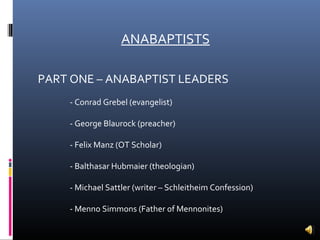
ANABAPTISTS

PART ONE – ANABAPTIST LEADERS
    - Conrad Grebel (evangelist)

    - George Blaurock (preacher)

    - Felix Manz (OT Scholar)

    - Balthasar Hubmaier (theologian)

    - Michael Sattler (writer – Schleitheim Confession)

    - Menno Simmons (Father of Mennonites)
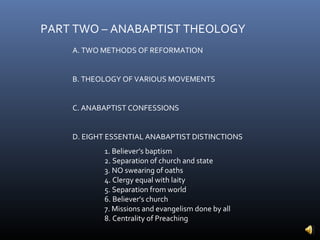
PART TWO – ANABAPTIST THEOLOGY
    A. TWO METHODS OF REFORMATION


    B. THEOLOGY OF VARIOUS MOVEMENTS


    C. ANABAPTIST CONFESSIONS


    D. EIGHT ESSENTIAL ANABAPTIST DISTINCTIONS
           1. Believer’s baptism
           2. Separation of church and state
           3. NO swearing of oaths
           4. Clergy equal with laity
           5. Separation from world
           6. Believer’s church
           7. Missions and evangelism done by all
           8. Centrality of Preaching
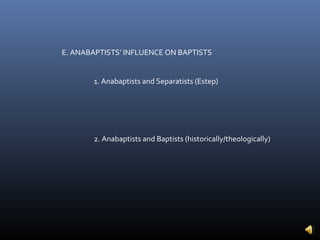
E. ANABAPTISTS’ INFLUENCE ON BAPTISTS


       1. Anabaptists and Separatists (Estep)


       2. Anabaptists and Baptists (historically/theologically)
BAPTIST HISTORY
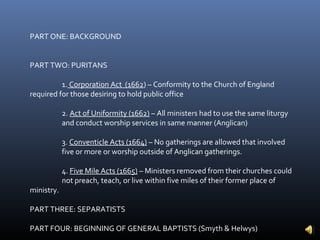
PART ONE: BACKGROUND


PART TWO: PURITANS

          1. Corporation Act (1662) – Conformity to the Church of England
required for those desiring to hold public office

            2. Act of Uniformity (1662) – All ministers had to use the same liturgy
            and conduct worship services in same manner (Anglican)

            3. Conventicle Acts (1664) – No gatherings are allowed that involved
            five or more or worship outside of Anglican gatherings.

            4. Five Mile Acts (1665) – Ministers removed from their churches could
            not preach, teach, or live within five miles of their former place of
ministry.

PART THREE: SEPARATISTS

PART FOUR: BEGINNING OF GENERAL BAPTISTS (Smyth & Helwys)
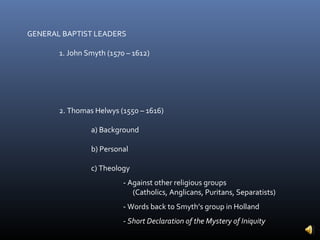
GENERAL BAPTIST LEADERS

       1. John Smyth (1570 – 1612)


       2. Thomas Helwys (1550 – 1616)

                a) Background

                b) Personal

                c) Theology
                          - Against other religious groups
                             (Catholics, Anglicans, Puritans, Separatists)
                          - Words back to Smyth’s group in Holland
                          - Short Declaration of the Mystery of Iniquity
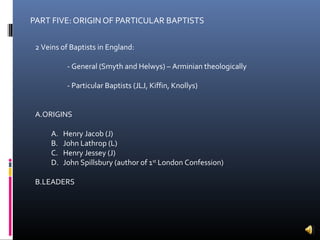
PART FIVE: ORIGIN OF PARTICULAR BAPTISTS

 2 Veins of Baptists in England:

            - General (Smyth and Helwys) – Arminian theologically

            - Particular Baptists (JLJ, Kiffin, Knollys)


 A.ORIGINS

      A.   Henry Jacob (J)
      B.   John Lathrop (L)
      C.   Henry Jessey (J)
      D.   John Spillsbury (author of 1st London Confession)

 B.LEADERS
BAPTIST HISTORY
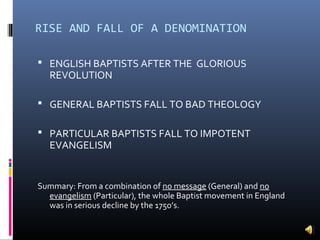
RISE AND FALL OF A DENOMINATION

ď‚§ ENGLISH BAPTISTS AFTER THE GLORIOUS
   REVOLUTION

ď‚§ GENERAL BAPTISTS FALL TO BAD THEOLOGY

ď‚§ PARTICULAR BAPTISTS FALL TO IMPOTENT
   EVANGELISM


Summary: From a combination of no message (General) and no
  evangelism (Particular), the whole Baptist movement in England
  was in serious decline by the 1750’s.

Baptist history ppt 2 b

  • 1.
  • 2.
    ANABAPTISTS PART ONE –ANABAPTIST LEADERS - Conrad Grebel (evangelist) - George Blaurock (preacher) - Felix Manz (OT Scholar) - Balthasar Hubmaier (theologian) - Michael Sattler (writer – Schleitheim Confession) - Menno Simmons (Father of Mennonites)
  • 3.
    PART TWO –ANABAPTIST THEOLOGY A. TWO METHODS OF REFORMATION B. THEOLOGY OF VARIOUS MOVEMENTS C. ANABAPTIST CONFESSIONS D. EIGHT ESSENTIAL ANABAPTIST DISTINCTIONS 1. Believer’s baptism 2. Separation of church and state 3. NO swearing of oaths 4. Clergy equal with laity 5. Separation from world 6. Believer’s church 7. Missions and evangelism done by all 8. Centrality of Preaching
  • 4.
    E. ANABAPTISTS’ INFLUENCEON BAPTISTS 1. Anabaptists and Separatists (Estep) 2. Anabaptists and Baptists (historically/theologically)
  • 5.
  • 6.
    PART ONE: BACKGROUND PARTTWO: PURITANS 1. Corporation Act (1662) – Conformity to the Church of England required for those desiring to hold public office 2. Act of Uniformity (1662) – All ministers had to use the same liturgy and conduct worship services in same manner (Anglican) 3. Conventicle Acts (1664) – No gatherings are allowed that involved five or more or worship outside of Anglican gatherings. 4. Five Mile Acts (1665) – Ministers removed from their churches could not preach, teach, or live within five miles of their former place of ministry. PART THREE: SEPARATISTS PART FOUR: BEGINNING OF GENERAL BAPTISTS (Smyth & Helwys)
  • 7.
    GENERAL BAPTIST LEADERS 1. John Smyth (1570 – 1612) 2. Thomas Helwys (1550 – 1616) a) Background b) Personal c) Theology - Against other religious groups (Catholics, Anglicans, Puritans, Separatists) - Words back to Smyth’s group in Holland - Short Declaration of the Mystery of Iniquity
  • 8.
    PART FIVE: ORIGINOF PARTICULAR BAPTISTS 2 Veins of Baptists in England: - General (Smyth and Helwys) – Arminian theologically - Particular Baptists (JLJ, Kiffin, Knollys) A.ORIGINS A. Henry Jacob (J) B. John Lathrop (L) C. Henry Jessey (J) D. John Spillsbury (author of 1st London Confession) B.LEADERS
  • 9.
  • 10.
    RISE AND FALLOF A DENOMINATION  ENGLISH BAPTISTS AFTER THE GLORIOUS REVOLUTION  GENERAL BAPTISTS FALL TO BAD THEOLOGY  PARTICULAR BAPTISTS FALL TO IMPOTENT EVANGELISM Summary: From a combination of no message (General) and no evangelism (Particular), the whole Baptist movement in England was in serious decline by the 1750’s.