processes + patterns best practices on steroids EuroIA 2007, Barcelona Peter Boersma, Info.nl
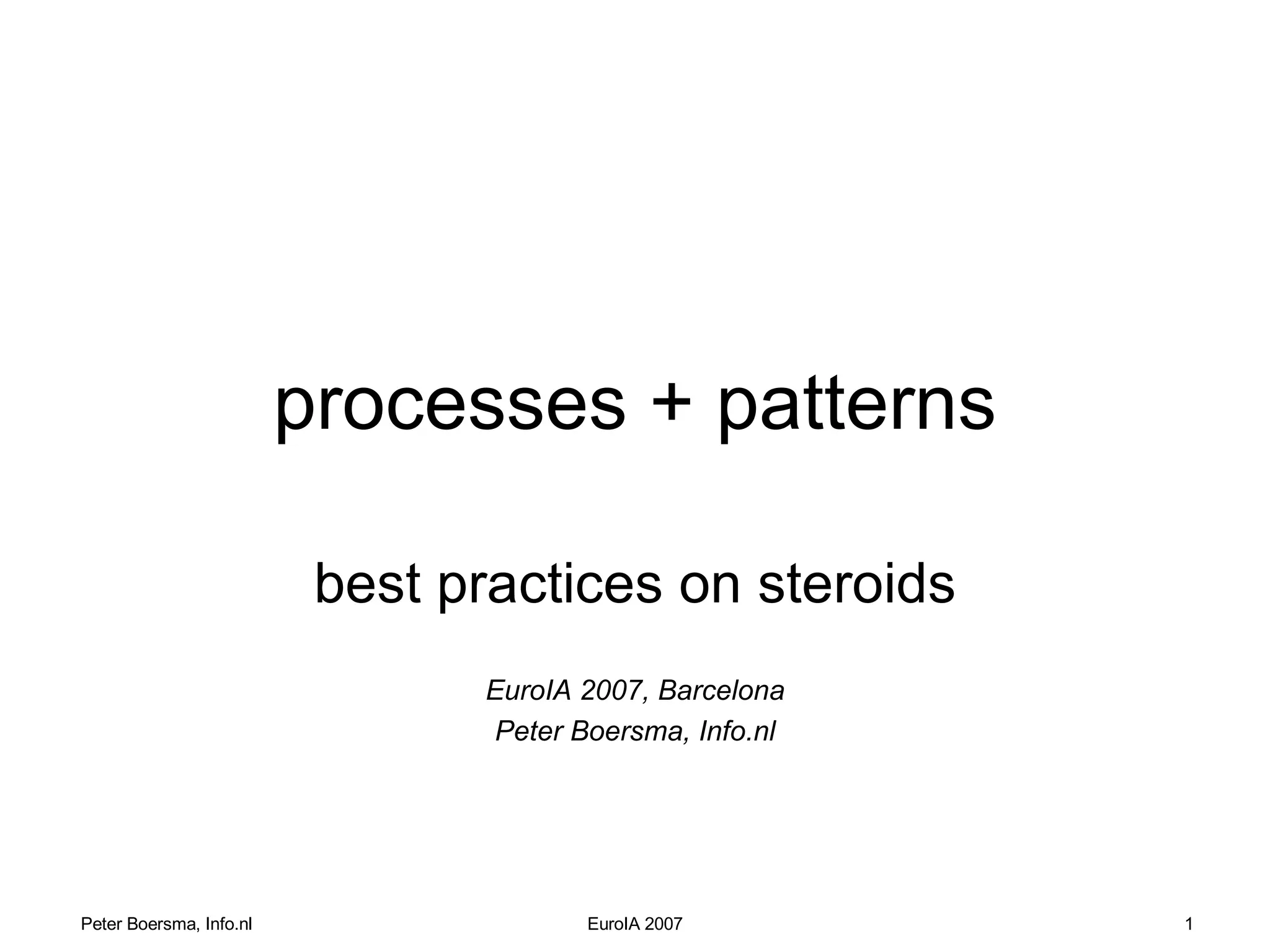
processes + patterns best practices on steroids EuroIA 2007, Barcelona Peter Boersma, Info.nl design design
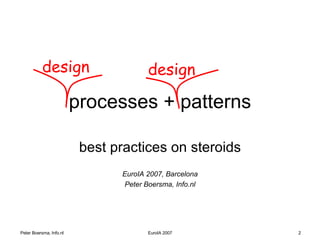
processes + patterns best practices on steroids EuroIA 2007, Barcelona Peter Boersma, Info.nl patterns design
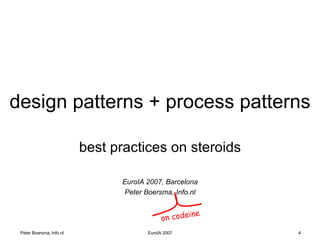
design patterns + process patterns best practices on steroids EuroIA 2007, Barcelona Peter Boersma, Info.nl on codeïne
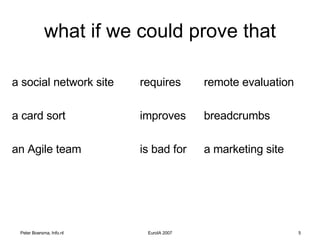
what if we could prove that a social network site requires remote evaluation a card sort improves breadcrumbs an Agile team is bad for a marketing site
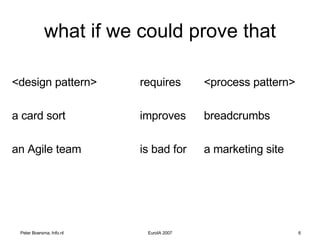
what if we could prove that <design pattern> requires <process pattern> a card sort improves breadcrumbs an Agile team is bad for a marketing site
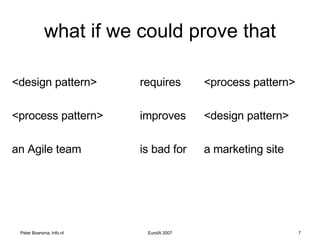
what if we could prove that <design pattern> requires <process pattern> <process pattern> improves <design pattern> an Agile team is bad for a marketing site
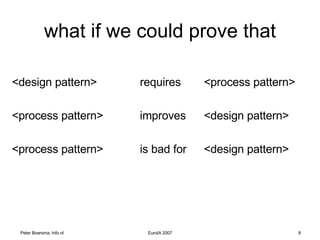
what if we could prove that <design pattern> requires <process pattern> <process pattern> improves <design pattern> <process pattern> is bad for <design pattern>
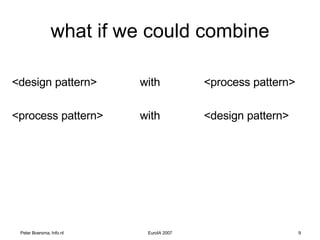
what if we could combine <design pattern> with <process pattern>  <process pattern> with <design pattern>
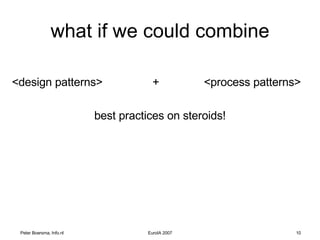
what if we could combine <design patterns>   + <process patterns>  best practices on steroids!
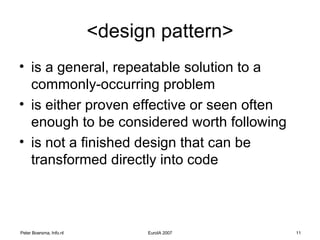
<design pattern> is a general, repeatable solution to a commonly-occurring problem is either proven effective or seen often enough to be considered worth following is not a finished design that can be transformed directly into code
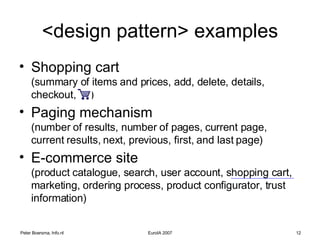
<design pattern> examples Shopping cart (summary of items and prices, add, delete, details, checkout,  ) Paging mechanism (number of results, number of pages, current page, current results, next, previous, first, and last page) E-commerce site (product catalogue, search, user account, shopping cart, marketing, ordering process, product configurator, trust information)
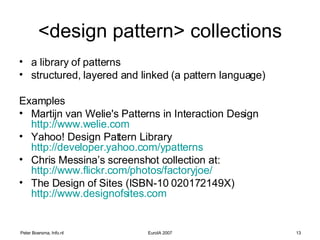
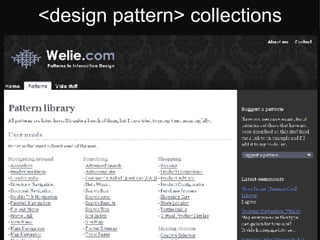
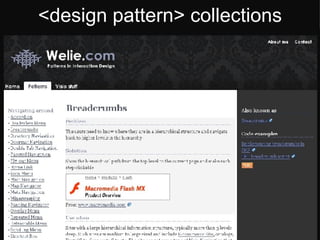
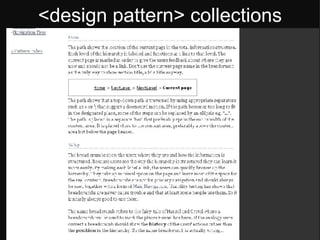
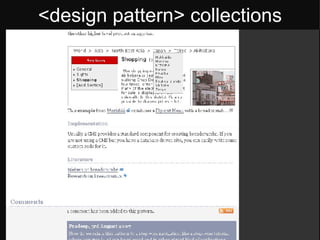
<design pattern> collections a library of patterns structured, layered and linked (a pattern language) Examples Martijn van Welie's Patterns in Interaction Design http://www.welie.com   Yahoo! Design Pattern Library http://developer.yahoo.com/ypatterns Chris Messina’s screenshot collection at: http://www.flickr.com/photos/factoryjoe/ The Design of Sites (ISBN-10  020172149X) http:// www.designofsites.com
<design pattern> collections
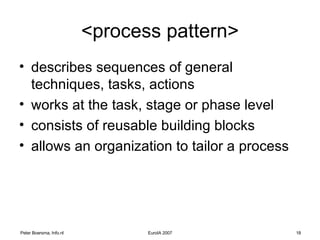
<process pattern> describes sequences of general techniques, tasks, actions works at the task, stage or phase level consists of reusable building blocks allows an organization to tailor a process
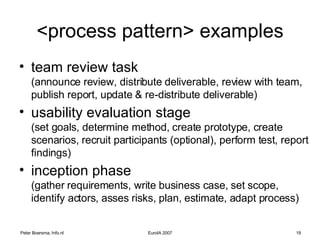
<process pattern> examples team review task (announce review, distribute deliverable, review with team, publish report, update & re-distribute deliverable) usability evaluation stage (set goals, determine method, create prototype, create scenarios, recruit participants (optional), perform test, report findings) inception phase (gather requirements, write business case, set scope, identify actors, asses risks, plan, estimate, adapt process)
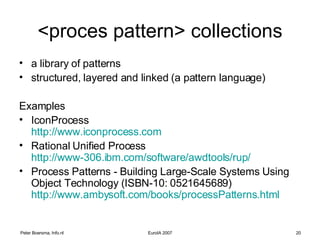
<proces pattern> collections a library of patterns structured, layered and linked (a pattern language) Examples IconProcess http://www.iconprocess.com   Rational Unified Process http://www-306.ibm.com/software/awdtools/rup/   Process Patterns - Building Large-Scale Systems Using Object Technology ( ISBN-10: 0521645689) http:// www.ambysoft.com / books / processPatterns.html
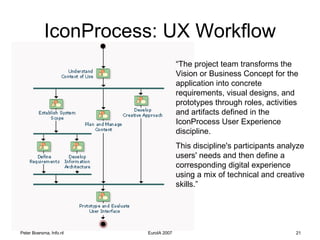
IconProcess: UX Workflow “ The project team transforms the Vision or Business Concept for the application into concrete requirements, visual designs, and prototypes through roles, activities and artifacts defined in the IconProcess User Experience discipline. This discipline's participants analyze users' needs and then define a corresponding digital experience using a mix of technical and creative skills.”
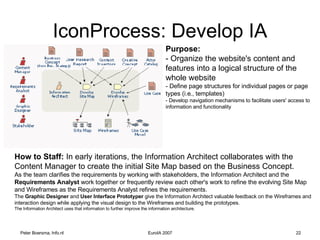
IconProcess: Develop IA Purpose: - Organize the website's content and features into a logical structure of the whole website  - Define page structures for individual pages or page types (i.e., templates)  - Develop navigation mechanisms to facilitate users' access to information and functionality How to Staff:  In early iterations, the Information Architect collaborates with the Content Manager to create the initial Site Map based on the Business Concept. As the team clarifies the requirements by working with stakeholders, the Information Architect and the  Requirements Analyst  work together or frequently review each other's work to refine the evolving Site Map and Wireframes as the Requirements Analyst refines the requirements. The  Graphic Designer  and  User Interface Prototyper  give the Information Architect valuable feedback on the Wireframes and interaction design while applying the visual design to the Wireframes and building the prototypes. The Information Architect uses that information to further improve the information architecture.
<design patterns> + <process patterns> are different yet similar give a feel for the work can be linked
the patterns are different <design patterns> describe context of use  when is it good for the user (and the business owner) to apply this pattern? <process patterns> describe context of design when do what types of designers deliver what (to the business owner) and how?
but the patterns are similar too both are driven by “forces” (&quot;users want...&quot; vs. &quot;the project requires...&quot;) both describe pre-conditions (&quot;the solution requires...&quot; vs. &quot;teams want...“) both describe post-conditions (“this makes users feel…” vs. “this makes sure teams…”) both refer to team skills (“an IA designs…” vs. “an IA designs…”)
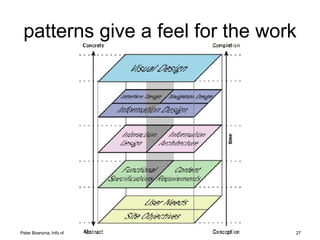
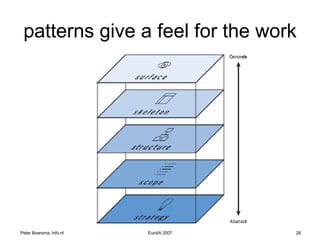
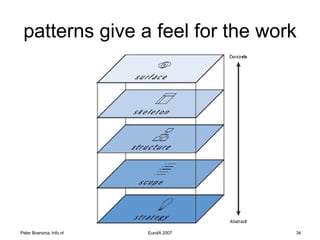
patterns give a feel for the work <design pattern> collections tell you how much you have to design from scratch and how much can be reused <process pattern> collections tell you what activities are necessary and who should perform them
patterns give a feel for the work
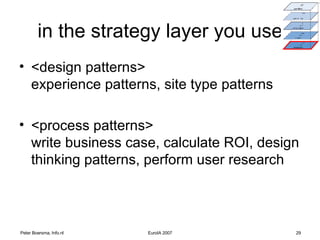
in the strategy layer you use <design patterns> experience patterns, site type patterns <process patterns> write business case, calculate ROI, design thinking patterns, perform user research
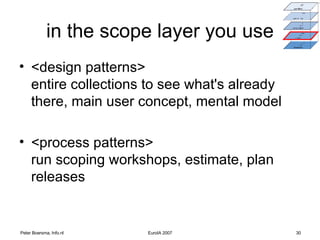
in the scope layer you use <design patterns> entire collections to see what's already there, main user concept, mental model <process patterns> run scoping workshops, estimate, plan releases
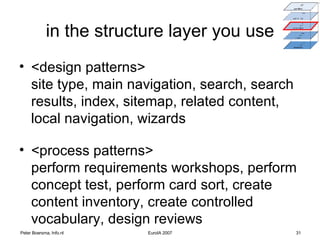
in the structure layer you use <design patterns> site type, main navigation, search, search results, index, sitemap, related content, local navigation, wizards <process patterns> perform requirements workshops, perform concept test, perform card sort, create content inventory, create controlled vocabulary, design reviews
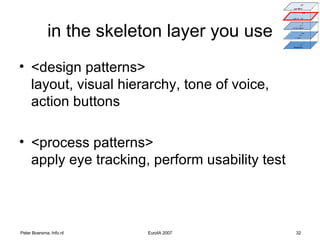
in the skeleton layer you use <design patterns> layout, visual hierarchy, tone of voice, action buttons <process patterns> apply eye tracking, perform usability test
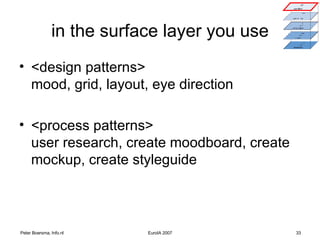
in the surface layer you use <design patterns> mood, grid, layout, eye direction <process patterns> user research, create moodboard, create mockup, create styleguide
patterns give a feel for the work
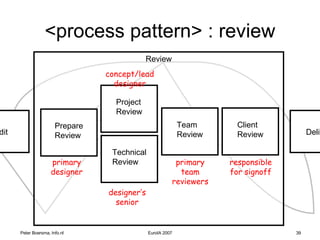
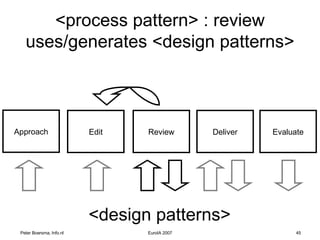
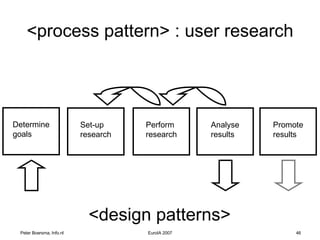
the patterns can be linked <design patterns> are used/generated when applying a <process pattern> Examples: review process, user research <process patterns> are useful when applying a <design pattern> Example: breadcrumbs
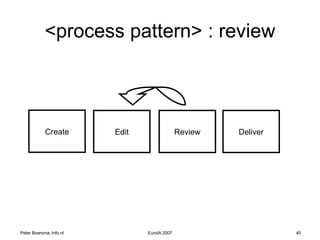
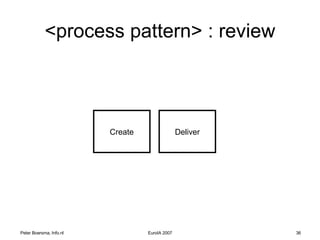
<process pattern> : review Create Deliver
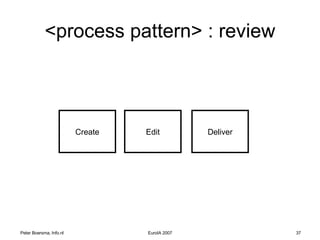
<process pattern> : review Create Deliver Edit
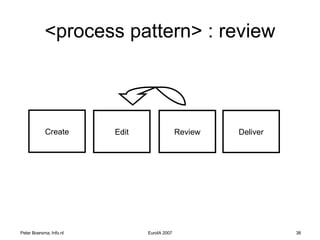
<process pattern> : review Edit Review Deliver Create
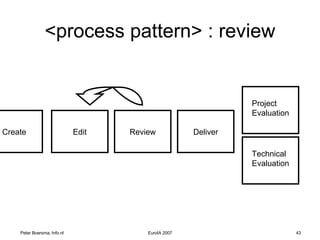
<process pattern> : review Edit Deliver Review Prepare Review Technical Review Team Review Client Review Project Review primary designer designer’s senior concept/lead designer primary team reviewers responsible for signoff
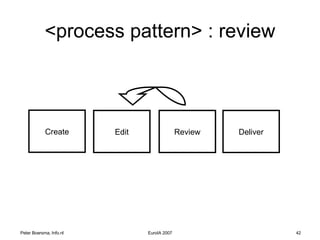
<process pattern> : review Edit Review Deliver Create
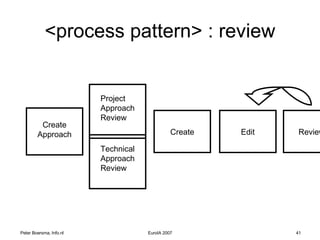
<process pattern> : review Create Edit Project Approach Review Technical Approach Review Create Approach Review
<process pattern> : review Edit Review Deliver Create
<process pattern> : review Create Edit Project Evaluation Technical Evaluation Review Deliver
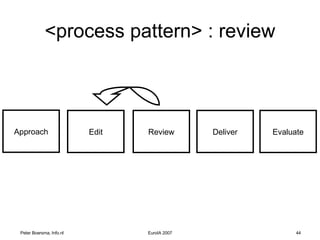
<process pattern> : review Edit Review Deliver Approach Evaluate
<process pattern> : review uses/generates <design patterns> Edit Review Deliver Approach Evaluate <design patterns>
<process pattern> : user research Set-up research Perform research Analyse results Determine goals Promote results <design patterns>
the patterns are linked <design patterns> are used/generated when applying a <process pattern> Examples: review process, user research <process patterns> are useful when applying a <design pattern> Example: breadcrumbs
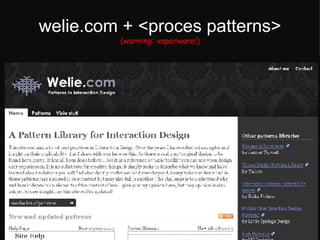
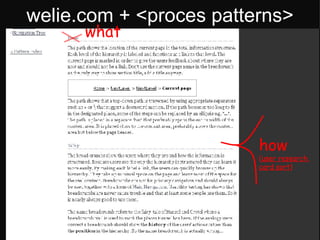
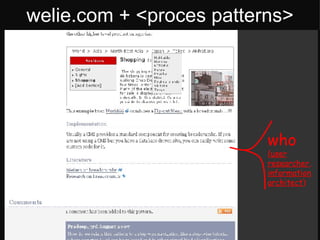
welie.com + <proces patterns> (warning: vaporware!)
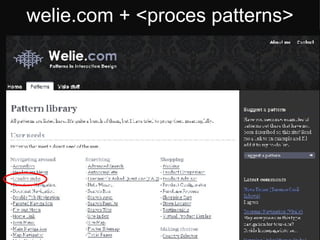
welie.com + <proces patterns>
welie.com + <proces patterns> what how ( user research ,  card sort )
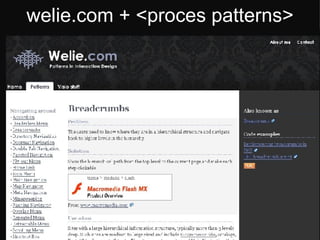
welie.com + <proces patterns> who ( user researcher ,  information architect )
the patterns are linked <design patterns> are used/generated when applying a <process pattern> Examples: review process, user research <process patterns> are useful when applying a <design pattern> Example: breadcrumbs
<design patterns> + <process patterns> are different yet similar give a feel for the work can be linked
what if we could browse <design pattern> collections and find <process patterns> associated with them browse <process pattern> collections and find <design patterns> associated with them browse pattern collections to get a feel for the work in each phase
what if we gathered data on which <design patterns> work best for which site types which <process patterns> work best for which team compositions which <design patterns> work best with which <process patterns> which design & process pattern combinations create the best sites
then we could apply that data when composing: - designs, - design processes - design teams for all types of sites explain to our clients: - why we design what we design - why we design how we design and have statistical proof
challenge “ in New York State, architects have developed a database on roof design and performance. The database tracks a growing number of the state's 10,000 buildings, recording variables of location, design conditions, specified components, testing results, and the history of problems and their solutions. By correlating design information with performance problems, the architects identify patterns of success and failure.” How Buildings Learn  - What happens after they’re built (Steward Brand)
challenge “ How interesting it would be to go even deeper in the analysis: what were the organizational patterns associated with the roof successes and failures? Which arrangements can detect crucial errors and correct them, and which cannot? The answer to that question could affect all of architecture.” How Buildings Learn  - What happens after they’re built (Steward Brand)
challenge “ in  Barcelona, Information Architects  have developed a database on  infospaces’   design patterns and process patterns .  The database tracks a growing number of  Europe’s millions of infospaces , recording variables of location, design conditions, specified components, testing results, and the history of problems and their solutions. By correlating design information with performance problems, the  Information Architects  identify patterns of success and failure.” Adapted from: How Buildings Learn  - What happens after they’re built (Steward Brand)
challenge “ How interesting it would be to go even deeper in the analysis: what were the organizational patterns associated with the  infospaces’  successes and failures? Which arrangements can detect crucial errors and correct them, and which cannot? The answer to that question could affect all of  Information Architecture .” Adapted from: How Buildings Learn  - What happens after they’re built (Steward Brand)
challenge I challenge you to think about ways to combine <design patterns> + <process patterns>
design patterns + process patterns best practices on steroids EuroIA 2007, Barcelona Peter Boersma, Info.nl

Processes + Patterns

  • 1.
    processes + patternsbest practices on steroids EuroIA 2007, Barcelona Peter Boersma, Info.nl
  • 2.
    processes + patternsbest practices on steroids EuroIA 2007, Barcelona Peter Boersma, Info.nl design design
  • 3.
    processes + patternsbest practices on steroids EuroIA 2007, Barcelona Peter Boersma, Info.nl patterns design
  • 4.
    design patterns +process patterns best practices on steroids EuroIA 2007, Barcelona Peter Boersma, Info.nl on codeïne
  • 5.
    what if wecould prove that a social network site requires remote evaluation a card sort improves breadcrumbs an Agile team is bad for a marketing site
  • 6.
    what if wecould prove that <design pattern> requires <process pattern> a card sort improves breadcrumbs an Agile team is bad for a marketing site
  • 7.
    what if wecould prove that <design pattern> requires <process pattern> <process pattern> improves <design pattern> an Agile team is bad for a marketing site
  • 8.
    what if wecould prove that <design pattern> requires <process pattern> <process pattern> improves <design pattern> <process pattern> is bad for <design pattern>
  • 9.
    what if wecould combine <design pattern> with <process pattern> <process pattern> with <design pattern>
  • 10.
    what if wecould combine <design patterns> + <process patterns> best practices on steroids!
  • 11.
    <design pattern> isa general, repeatable solution to a commonly-occurring problem is either proven effective or seen often enough to be considered worth following is not a finished design that can be transformed directly into code
  • 12.
    <design pattern> examplesShopping cart (summary of items and prices, add, delete, details, checkout, ) Paging mechanism (number of results, number of pages, current page, current results, next, previous, first, and last page) E-commerce site (product catalogue, search, user account, shopping cart, marketing, ordering process, product configurator, trust information)
  • 13.
    <design pattern> collectionsa library of patterns structured, layered and linked (a pattern language) Examples Martijn van Welie's Patterns in Interaction Design http://www.welie.com Yahoo! Design Pattern Library http://developer.yahoo.com/ypatterns Chris Messina’s screenshot collection at: http://www.flickr.com/photos/factoryjoe/ The Design of Sites (ISBN-10 020172149X) http:// www.designofsites.com
  • 14.
  • 15.
  • 16.
  • 17.
  • 18.
    <process pattern> describessequences of general techniques, tasks, actions works at the task, stage or phase level consists of reusable building blocks allows an organization to tailor a process
  • 19.
    <process pattern> examplesteam review task (announce review, distribute deliverable, review with team, publish report, update & re-distribute deliverable) usability evaluation stage (set goals, determine method, create prototype, create scenarios, recruit participants (optional), perform test, report findings) inception phase (gather requirements, write business case, set scope, identify actors, asses risks, plan, estimate, adapt process)
  • 20.
    <proces pattern> collectionsa library of patterns structured, layered and linked (a pattern language) Examples IconProcess http://www.iconprocess.com Rational Unified Process http://www-306.ibm.com/software/awdtools/rup/ Process Patterns - Building Large-Scale Systems Using Object Technology ( ISBN-10: 0521645689) http:// www.ambysoft.com / books / processPatterns.html
  • 21.
    IconProcess: UX Workflow“ The project team transforms the Vision or Business Concept for the application into concrete requirements, visual designs, and prototypes through roles, activities and artifacts defined in the IconProcess User Experience discipline. This discipline's participants analyze users' needs and then define a corresponding digital experience using a mix of technical and creative skills.”
  • 22.
    IconProcess: Develop IAPurpose: - Organize the website's content and features into a logical structure of the whole website - Define page structures for individual pages or page types (i.e., templates) - Develop navigation mechanisms to facilitate users' access to information and functionality How to Staff: In early iterations, the Information Architect collaborates with the Content Manager to create the initial Site Map based on the Business Concept. As the team clarifies the requirements by working with stakeholders, the Information Architect and the Requirements Analyst work together or frequently review each other's work to refine the evolving Site Map and Wireframes as the Requirements Analyst refines the requirements. The Graphic Designer and User Interface Prototyper give the Information Architect valuable feedback on the Wireframes and interaction design while applying the visual design to the Wireframes and building the prototypes. The Information Architect uses that information to further improve the information architecture.
  • 23.
    <design patterns> +<process patterns> are different yet similar give a feel for the work can be linked
  • 24.
    the patterns aredifferent <design patterns> describe context of use when is it good for the user (and the business owner) to apply this pattern? <process patterns> describe context of design when do what types of designers deliver what (to the business owner) and how?
  • 25.
    but the patternsare similar too both are driven by “forces” (&quot;users want...&quot; vs. &quot;the project requires...&quot;) both describe pre-conditions (&quot;the solution requires...&quot; vs. &quot;teams want...“) both describe post-conditions (“this makes users feel…” vs. “this makes sure teams…”) both refer to team skills (“an IA designs…” vs. “an IA designs…”)
  • 26.
    patterns give afeel for the work <design pattern> collections tell you how much you have to design from scratch and how much can be reused <process pattern> collections tell you what activities are necessary and who should perform them
  • 27.
    patterns give afeel for the work
  • 28.
    patterns give afeel for the work
  • 29.
    in the strategylayer you use <design patterns> experience patterns, site type patterns <process patterns> write business case, calculate ROI, design thinking patterns, perform user research
  • 30.
    in the scopelayer you use <design patterns> entire collections to see what's already there, main user concept, mental model <process patterns> run scoping workshops, estimate, plan releases
  • 31.
    in the structurelayer you use <design patterns> site type, main navigation, search, search results, index, sitemap, related content, local navigation, wizards <process patterns> perform requirements workshops, perform concept test, perform card sort, create content inventory, create controlled vocabulary, design reviews
  • 32.
    in the skeletonlayer you use <design patterns> layout, visual hierarchy, tone of voice, action buttons <process patterns> apply eye tracking, perform usability test
  • 33.
    in the surfacelayer you use <design patterns> mood, grid, layout, eye direction <process patterns> user research, create moodboard, create mockup, create styleguide
  • 34.
    patterns give afeel for the work
  • 35.
    the patterns canbe linked <design patterns> are used/generated when applying a <process pattern> Examples: review process, user research <process patterns> are useful when applying a <design pattern> Example: breadcrumbs
  • 36.
    <process pattern> :review Create Deliver
  • 37.
    <process pattern> :review Create Deliver Edit
  • 38.
    <process pattern> :review Edit Review Deliver Create
  • 39.
    <process pattern> :review Edit Deliver Review Prepare Review Technical Review Team Review Client Review Project Review primary designer designer’s senior concept/lead designer primary team reviewers responsible for signoff
  • 40.
    <process pattern> :review Edit Review Deliver Create
  • 41.
    <process pattern> :review Create Edit Project Approach Review Technical Approach Review Create Approach Review
  • 42.
    <process pattern> :review Edit Review Deliver Create
  • 43.
    <process pattern> :review Create Edit Project Evaluation Technical Evaluation Review Deliver
  • 44.
    <process pattern> :review Edit Review Deliver Approach Evaluate
  • 45.
    <process pattern> :review uses/generates <design patterns> Edit Review Deliver Approach Evaluate <design patterns>
  • 46.
    <process pattern> :user research Set-up research Perform research Analyse results Determine goals Promote results <design patterns>
  • 47.
    the patterns arelinked <design patterns> are used/generated when applying a <process pattern> Examples: review process, user research <process patterns> are useful when applying a <design pattern> Example: breadcrumbs
  • 48.
    welie.com + <procespatterns> (warning: vaporware!)
  • 49.
  • 50.
  • 51.
    welie.com + <procespatterns> what how ( user research , card sort )
  • 52.
    welie.com + <procespatterns> who ( user researcher , information architect )
  • 53.
    the patterns arelinked <design patterns> are used/generated when applying a <process pattern> Examples: review process, user research <process patterns> are useful when applying a <design pattern> Example: breadcrumbs
  • 54.
    <design patterns> +<process patterns> are different yet similar give a feel for the work can be linked
  • 55.
    what if wecould browse <design pattern> collections and find <process patterns> associated with them browse <process pattern> collections and find <design patterns> associated with them browse pattern collections to get a feel for the work in each phase
  • 56.
    what if wegathered data on which <design patterns> work best for which site types which <process patterns> work best for which team compositions which <design patterns> work best with which <process patterns> which design & process pattern combinations create the best sites
  • 57.
    then we couldapply that data when composing: - designs, - design processes - design teams for all types of sites explain to our clients: - why we design what we design - why we design how we design and have statistical proof
  • 58.
    challenge “ inNew York State, architects have developed a database on roof design and performance. The database tracks a growing number of the state's 10,000 buildings, recording variables of location, design conditions, specified components, testing results, and the history of problems and their solutions. By correlating design information with performance problems, the architects identify patterns of success and failure.” How Buildings Learn - What happens after they’re built (Steward Brand)
  • 59.
    challenge “ Howinteresting it would be to go even deeper in the analysis: what were the organizational patterns associated with the roof successes and failures? Which arrangements can detect crucial errors and correct them, and which cannot? The answer to that question could affect all of architecture.” How Buildings Learn - What happens after they’re built (Steward Brand)
  • 60.
    challenge “ in Barcelona, Information Architects have developed a database on infospaces’ design patterns and process patterns . The database tracks a growing number of Europe’s millions of infospaces , recording variables of location, design conditions, specified components, testing results, and the history of problems and their solutions. By correlating design information with performance problems, the Information Architects identify patterns of success and failure.” Adapted from: How Buildings Learn - What happens after they’re built (Steward Brand)
  • 61.
    challenge “ Howinteresting it would be to go even deeper in the analysis: what were the organizational patterns associated with the infospaces’ successes and failures? Which arrangements can detect crucial errors and correct them, and which cannot? The answer to that question could affect all of Information Architecture .” Adapted from: How Buildings Learn - What happens after they’re built (Steward Brand)
  • 62.
    challenge I challengeyou to think about ways to combine <design patterns> + <process patterns>
  • 63.
    design patterns +process patterns best practices on steroids EuroIA 2007, Barcelona Peter Boersma, Info.nl