Banking legislations & reforms
Aboutbankingsector
The Indian banking sector is an important
constituent of the Indian financial system.
The banking sector plays a vital role of promoting
business in urban as well as in rural areas in recent
years.
Without it India can not be considered as a healthy
economy.
For the past three decades India's banking system has
several outstanding achievements to its credit
Growth phases in banking sector
In over five decades since dependence, banking
system in India has passed through five distinct
phase,
Evolutionary Phase (prior to 1950)
 Foundation phase (1950-1968)
 Expansion phase (1968-1984)
 Consolidation phase (1984-1990)
 Reformatory phase (since 1990)
BANKING REGULATION ACT 1949
16th March1949
An Introduction:
 Till 1949, There was no separate Act for Banking in India.
 The Central Banking Enquiry Committee recommended the need of a separate
legislation to control banks due to mushroom growth of banks with inadequate
capital, dishonest management, speculative business etc etc..
 Accordingly a bill was introduced in parliament in March 1948.
 It was Passed in parliament in February 1949 and The Banking Regulation Act
1949 came to exist from 16th March 1949.
Definition of banking
Banking:
Sec 5 (b) of the Act defines Banking as,
“Accepting for the purpose of lending or investment, of deposits
of money from the public, repayable on demand or other wise, and
withdrawable by cheque , draft, order or otherwise.”
Banking Company:
Sec 5 (c) of the Act defines Banking as,
“A company which transacts the business of banking in India.”
Section 6
• Specified Business.
• Prohibits banking companies
from taking part in trading
and speculative activities.
• Thereby landing themselves
in danger.
Section 7(Amended in 1963)
• No company other than a
banking company shall use as
part of its name any of the words
bank, banker or banking.
• No company shall carry on the
business of banking in India
unless it uses as part of its name
at least one of such words.
Section 11
Amendment Act 1962
 Indian Banking Company commencing
Banking Business for the 1st time,
minimum paid up capital Rs. 5,00,000.
 Places in business for more than one state,
minimum paid up capital is Rs. 10,00,000.
January 1993 : Private Sector Banks shall be
Rs.100crore.
August 1996 : Local Area Banks shall be Rs. 5crore.
Section 12(1) of the act lays down that the
subscribed capital of a banking company must not be
less than one half of the authorized capital.
Amended in 1994 :The maximum voting rights of
any one shareholder is fixed by the act , as amended
in 1994 at 10% of the total voting rights.
According to sec 16: No Banking company
incorporated in India shall have as director any
person who is director of another banking company.
Amendment Act 1958: To safeguard the interest of
depositors and provide for the simplification and
speedy disposal of winding up proceeding of the
banks.
 Prohibits a banking company from making loans or
advances on the securities of its own shares.
Amended in 1962 sec 24: Every banking company
require to maintain reserves in gold, cash or highly
liquid securities.
Banking Companies & The RBI
Section 21 of the Act confer the powers of RBI to
determine the policy in relation to advances to be
followed by banking companies.
Section 22 of the Act requires every banking
company to obtain a license from the RBI for
carrying or commencing banking business in INDIA.
Section 36 of the Act Reserve bank is required to
make an annual report to the central government on
the trend and progress of banking in the country.
BANKING COMPANIES (AMENDMENT) ACT 1960
Section 34(A)
The banking company is
not required to publish
the information in the
Balance Sheet or Profit
and Loss Account which is
not required according
to the Law.
 The reserve bank and the government with
additional power aimed at rehabilitation of
bank difficulties.
BANKING COMPANIES
(secondAMENDMENT) ACT 1960
RESERVE BANK had taken power to reconstruct and
amalgamate two or more substandard banks with well
managed institutions.
Banking companies(amendment) act,1961
Objective:
1st . To strengthen the Banking system
2nd . To enable schedule bank to provide larger
credit to exporters for a longer period.
Salient features:
 Statutory Cash Balance (Sec 42) -It should be 3-15%
of their total time and demand liabilities.
Banking companies(amendment) act,1962
 Liquidity Ratio- It
showed a sizeable
decline from around
 Credit Deposit Ratio- It
showed an increment
from around
Sec 24 (Amendment) of the banking regulation
Act provides that the liquid assets required to be
maintained should be 25 % of total demand and
time liabilities instead to 20%.
Ratio of Paid up Capital and Reserve to deposits
of scheduled bank declined from about 9% in
1950 to less than 5 % in 1960.
Export finance:- Increase in the maturity
period of bills of exchange and promissory
notes from
Banking laws(application to corporative societies)act,
1966
This act came into force from 1 March,1966
All cooperative banks to which the provisions of
reserve banks of RBI Act have been extended are
now eligible to borrow in an emergency, from
RESERVE BANK.
Section 22: All existing cooperative banks are
required to apply for the license to RBI within 3
Months of the commencement of act.
Section 22 Licensing of Banking
Companies
RBI issues license to a banking company after
inspecting the books of the Banking company.
And after satisfaction of the following
conditions:
Company is in a position to settle all the claims.
Company Should not act against the depositors.
The company should have adequate capital structure and earning
prospectus
Public interest should be saved.
To follow any other condition the bank has to take prior permission of
RBI.
DEPOSIT INSURANCE CORPORATION
ACT 1962
It is an Act for the Protection of the depositors.
The DIC has an authorized capital of Rs. 1crore
which is fully paid up by RBI.
SECTION 26 : Empowers the DIC to borrow from
RBI up to maximum of Rs. 5crore.
NATIONALISATION OF
COMMERCIAL BANKS
Banking companies(acquisition of undertakings) Act
1970
Central government acquired the undertaking of
the following 14 major Indian Banks which had
deposits of less than Rs. 50crore on the last
Friday of June 1969
Nationalized banks(1st phase)
• Central bank
• Reserve Bank of India
• State Bank of India & associates (also
nationalized)
• Punjab National Bank
• Syndicate Bank
• Bank of Baroda
• United Bank of India
• UCO Bank
Cont…
• Allahabad Bank
• Bank of Baroda
• Bank of India
• Bank of Maharashtra
• Canara Bank
• Central Bank of India
• Dena Bank
• Indian Bank
• Indian Overseas Bank
OBJECTIVES
 Expansion of Banking
 Reducing Regional Imbalance
 Developing Banking Habits
 Controlling Private Monopolies
 Encouragement of new classes of entrepreneurs.
Nationalized banks(2nd phase)
• 6 More Banks have been nationalized in 1980.
• These banks are:
i. The Andhra Bank
ii. The Corporation Bank
iii. The New Bank of India
iv. The Punjab and Sind Bank
v. The Oriental Bank of Commerce
vi. The Vijaya Bank
Reformatory Phase
(1991 Onwards)
Reasons for the formation of the reforms:
Economic crises of 1991
Economy suffered from serious inflationary
pressures, emerging scarcities of essential
commodities and breakdown of fiscal discipline.
Banking sector suffered from -
 Lack of competition
 Low capital base
 Low productivity
 High intermediation cost
 Role of technology was minimal
PROBLEMS FACED BY PSBs
 Rising non-performing assets (NPAs)
 Poor credit appraisal.
 Banks and policymakers give a serious thought
to bringing some positive changes in the way
Public sector banks operate.
Banking
sector
reforms
Narsimham
Committee I
Narsimham
Committee II
The Narsimham Committee I appointed to restore the
financial health of commercial banks and to make their
functioning efficient and profitable
Recommendations aimed at changes according greater
flexibility to bank operations
The Committee submitted its report in November 1991
with 23 recommendations
FIRST PHASE OF REFORMS OF BANKING
SECTOR (1991)
The Committee submitted its
report in November 1991. The
main recommendations of this
committee were:
1. Phased reduction of statutory pre-
emption.
2. Interest rate on CRR balances
3. Phasing out of directed credit program
4. Transparency
5. Loan recovery
6. Interest rate deregulation.
7. Restructuring of banks
8. Entry of Private Banks
9. Branch Licensing
10.Capital adequacy ratio
11.Income recognition
12.Control
13.Foreign Banks
14.Supervision of banks
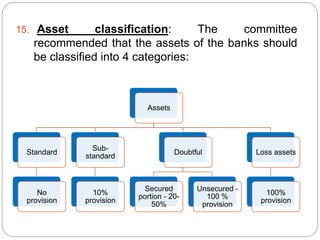
15. Asset classification: The committee
recommended that the assets of the banks should
be classified into 4 categories:
Assets
Standard
No
provision
Sub-
standard
10%
provision
Doubtful
Secured
portion - 20-
50%
Unsecured -
100 %
provision
Loss assets
100%
provision
Impact on Indian Banking Sector
 Intense competition
 Lowered pre-emptions
 Broadening the ownership
base of PSBs
 Value Added Services
SECOND PHASE OF REFORMS OF
BANKING SECTOR (1998)
 The Committee placed greater importance on structural
measures and improvement in
standards of disclosure and
levels of transparency.
 Recommendations of
Narasimhan Committee II
Implemented Recommendations
 New areas
 New instruments
 Risk management
 Customer service
 Universal banking
 Information technology
 Increase in FDI limit
 Mergers And Amalgamation
 Guidelines For Anti-Money Laundering
 Managerial Autonomy
 Increase of inflow credit
 Strengthen technology
 Base Rate System Of Interest Rates
 Adoption of global standards
 Management of NPAs
Granting of operational autonomy to public sector banks.
Introduction and phased implementation of international
best practices and norms.
Setting up of Credit Information Bureau of India Limited
(CIBIL) for information sharing on defaulters as also other
borrowers.
Introduction of automated screen-based trading in
government securities through Negotiated Dealing System
(NDS).
banking reforms
Strict norms pertaining to bad loans and restructured
assets
Consolidation and mergers and entry of new players
Continuous bank licensing
Converting some urban cooperative banks into
commercial banks
Focus on asset–liability management for banks
Increased usage of technology in banking
Focus on financial inclusion
Transparency, improvement in clearing and settlement
practices
KYC NORMS
Banks were advised to follow certain customer
identification procedure for opening of accounts.
Recommendations made by the Financial Action Task Force
(FATF) on Anti Money Laundering (AML) standards and on
Combating Financing of Terrorism (CFT).
Money laundering rules and regulation.
FUTURE AGENDA FOR REFORMS
 Increase in organisational effectiveness.
 Opening more and more banks and ATMs.
 Increase in tax rate on long term capital
again.
 Use of latest Technology.
Summarizing The Reforms
 Long term relationship
 Pervasive in covering all
problem areas
 Passed through a series of
discussion
 Mentioned in the annual
report of RBI
Banking Sector In India
Reserve Bank India
Scheduled banks
Commercial
banks
Co-operative
banks
Foreign
banks(46)
Regional
rural
banks(56)
Urban co-
operatives
(53)
State co-
operative(31)
Public sector
banks(27)
Private sectors
banks(23)
State bank of
India(6)
Other nationalized
banks(21)
Old(15) New(8)
Technology In Banking
 Revolutionized banking practices
 WAN , INFINET , IPSS
 EFT
 Debit and credit cards
 Phone banking
 ATM
 Internet banking
Group members
JYOTI YADAV
SURYADIPTA DUTTA

Banking legislations and reforms

  • 1.
  • 2.
    Aboutbankingsector The Indian bankingsector is an important constituent of the Indian financial system. The banking sector plays a vital role of promoting business in urban as well as in rural areas in recent years. Without it India can not be considered as a healthy economy. For the past three decades India's banking system has several outstanding achievements to its credit
  • 3.
    Growth phases inbanking sector In over five decades since dependence, banking system in India has passed through five distinct phase, Evolutionary Phase (prior to 1950)  Foundation phase (1950-1968)  Expansion phase (1968-1984)  Consolidation phase (1984-1990)  Reformatory phase (since 1990)
  • 4.
    BANKING REGULATION ACT1949 16th March1949
  • 5.
    An Introduction:  Till1949, There was no separate Act for Banking in India.  The Central Banking Enquiry Committee recommended the need of a separate legislation to control banks due to mushroom growth of banks with inadequate capital, dishonest management, speculative business etc etc..  Accordingly a bill was introduced in parliament in March 1948.  It was Passed in parliament in February 1949 and The Banking Regulation Act 1949 came to exist from 16th March 1949.
  • 6.
    Definition of banking Banking: Sec5 (b) of the Act defines Banking as, “Accepting for the purpose of lending or investment, of deposits of money from the public, repayable on demand or other wise, and withdrawable by cheque , draft, order or otherwise.” Banking Company: Sec 5 (c) of the Act defines Banking as, “A company which transacts the business of banking in India.”
  • 7.
    Section 6 • SpecifiedBusiness. • Prohibits banking companies from taking part in trading and speculative activities. • Thereby landing themselves in danger.
  • 8.
    Section 7(Amended in1963) • No company other than a banking company shall use as part of its name any of the words bank, banker or banking. • No company shall carry on the business of banking in India unless it uses as part of its name at least one of such words.
  • 9.
    Section 11 Amendment Act1962  Indian Banking Company commencing Banking Business for the 1st time, minimum paid up capital Rs. 5,00,000.  Places in business for more than one state, minimum paid up capital is Rs. 10,00,000. January 1993 : Private Sector Banks shall be Rs.100crore. August 1996 : Local Area Banks shall be Rs. 5crore.
  • 10.
    Section 12(1) ofthe act lays down that the subscribed capital of a banking company must not be less than one half of the authorized capital. Amended in 1994 :The maximum voting rights of any one shareholder is fixed by the act , as amended in 1994 at 10% of the total voting rights. According to sec 16: No Banking company incorporated in India shall have as director any person who is director of another banking company.
  • 11.
    Amendment Act 1958:To safeguard the interest of depositors and provide for the simplification and speedy disposal of winding up proceeding of the banks.  Prohibits a banking company from making loans or advances on the securities of its own shares. Amended in 1962 sec 24: Every banking company require to maintain reserves in gold, cash or highly liquid securities.
  • 12.
    Banking Companies &The RBI Section 21 of the Act confer the powers of RBI to determine the policy in relation to advances to be followed by banking companies. Section 22 of the Act requires every banking company to obtain a license from the RBI for carrying or commencing banking business in INDIA. Section 36 of the Act Reserve bank is required to make an annual report to the central government on the trend and progress of banking in the country.
  • 13.
    BANKING COMPANIES (AMENDMENT)ACT 1960 Section 34(A) The banking company is not required to publish the information in the Balance Sheet or Profit and Loss Account which is not required according to the Law.
  • 14.
     The reservebank and the government with additional power aimed at rehabilitation of bank difficulties. BANKING COMPANIES (secondAMENDMENT) ACT 1960
  • 15.
    RESERVE BANK hadtaken power to reconstruct and amalgamate two or more substandard banks with well managed institutions. Banking companies(amendment) act,1961
  • 16.
    Objective: 1st . Tostrengthen the Banking system 2nd . To enable schedule bank to provide larger credit to exporters for a longer period. Salient features:  Statutory Cash Balance (Sec 42) -It should be 3-15% of their total time and demand liabilities. Banking companies(amendment) act,1962
  • 17.
     Liquidity Ratio-It showed a sizeable decline from around  Credit Deposit Ratio- It showed an increment from around
  • 18.
    Sec 24 (Amendment)of the banking regulation Act provides that the liquid assets required to be maintained should be 25 % of total demand and time liabilities instead to 20%. Ratio of Paid up Capital and Reserve to deposits of scheduled bank declined from about 9% in 1950 to less than 5 % in 1960.
  • 19.
    Export finance:- Increasein the maturity period of bills of exchange and promissory notes from
  • 20.
    Banking laws(application tocorporative societies)act, 1966 This act came into force from 1 March,1966 All cooperative banks to which the provisions of reserve banks of RBI Act have been extended are now eligible to borrow in an emergency, from RESERVE BANK. Section 22: All existing cooperative banks are required to apply for the license to RBI within 3 Months of the commencement of act.
  • 21.
    Section 22 Licensingof Banking Companies RBI issues license to a banking company after inspecting the books of the Banking company. And after satisfaction of the following conditions: Company is in a position to settle all the claims. Company Should not act against the depositors. The company should have adequate capital structure and earning prospectus Public interest should be saved. To follow any other condition the bank has to take prior permission of RBI.
  • 22.
    DEPOSIT INSURANCE CORPORATION ACT1962 It is an Act for the Protection of the depositors. The DIC has an authorized capital of Rs. 1crore which is fully paid up by RBI. SECTION 26 : Empowers the DIC to borrow from RBI up to maximum of Rs. 5crore.
  • 23.
    NATIONALISATION OF COMMERCIAL BANKS Bankingcompanies(acquisition of undertakings) Act 1970 Central government acquired the undertaking of the following 14 major Indian Banks which had deposits of less than Rs. 50crore on the last Friday of June 1969
  • 24.
    Nationalized banks(1st phase) •Central bank • Reserve Bank of India • State Bank of India & associates (also nationalized) • Punjab National Bank • Syndicate Bank • Bank of Baroda • United Bank of India • UCO Bank
  • 25.
    Cont… • Allahabad Bank •Bank of Baroda • Bank of India • Bank of Maharashtra • Canara Bank • Central Bank of India • Dena Bank • Indian Bank • Indian Overseas Bank
  • 26.
    OBJECTIVES  Expansion ofBanking  Reducing Regional Imbalance  Developing Banking Habits  Controlling Private Monopolies  Encouragement of new classes of entrepreneurs.
  • 27.
    Nationalized banks(2nd phase) •6 More Banks have been nationalized in 1980. • These banks are: i. The Andhra Bank ii. The Corporation Bank iii. The New Bank of India iv. The Punjab and Sind Bank v. The Oriental Bank of Commerce vi. The Vijaya Bank
  • 30.
    Reformatory Phase (1991 Onwards) Reasonsfor the formation of the reforms: Economic crises of 1991 Economy suffered from serious inflationary pressures, emerging scarcities of essential commodities and breakdown of fiscal discipline. Banking sector suffered from -  Lack of competition  Low capital base  Low productivity  High intermediation cost  Role of technology was minimal
  • 31.
    PROBLEMS FACED BYPSBs  Rising non-performing assets (NPAs)  Poor credit appraisal.  Banks and policymakers give a serious thought to bringing some positive changes in the way Public sector banks operate.
  • 32.
  • 33.
    The Narsimham CommitteeI appointed to restore the financial health of commercial banks and to make their functioning efficient and profitable Recommendations aimed at changes according greater flexibility to bank operations The Committee submitted its report in November 1991 with 23 recommendations FIRST PHASE OF REFORMS OF BANKING SECTOR (1991)
  • 34.
    The Committee submittedits report in November 1991. The main recommendations of this committee were: 1. Phased reduction of statutory pre- emption. 2. Interest rate on CRR balances 3. Phasing out of directed credit program 4. Transparency 5. Loan recovery
  • 35.
    6. Interest ratederegulation. 7. Restructuring of banks 8. Entry of Private Banks 9. Branch Licensing 10.Capital adequacy ratio 11.Income recognition 12.Control 13.Foreign Banks 14.Supervision of banks
  • 36.
    15. Asset classification:The committee recommended that the assets of the banks should be classified into 4 categories: Assets Standard No provision Sub- standard 10% provision Doubtful Secured portion - 20- 50% Unsecured - 100 % provision Loss assets 100% provision
  • 37.
    Impact on IndianBanking Sector  Intense competition  Lowered pre-emptions  Broadening the ownership base of PSBs  Value Added Services
  • 38.
    SECOND PHASE OFREFORMS OF BANKING SECTOR (1998)  The Committee placed greater importance on structural measures and improvement in standards of disclosure and levels of transparency.  Recommendations of Narasimhan Committee II
  • 39.
    Implemented Recommendations  Newareas  New instruments  Risk management  Customer service  Universal banking  Information technology  Increase in FDI limit
  • 40.
     Mergers AndAmalgamation  Guidelines For Anti-Money Laundering  Managerial Autonomy  Increase of inflow credit  Strengthen technology  Base Rate System Of Interest Rates  Adoption of global standards  Management of NPAs
  • 41.
    Granting of operationalautonomy to public sector banks. Introduction and phased implementation of international best practices and norms. Setting up of Credit Information Bureau of India Limited (CIBIL) for information sharing on defaulters as also other borrowers. Introduction of automated screen-based trading in government securities through Negotiated Dealing System (NDS). banking reforms
  • 42.
    Strict norms pertainingto bad loans and restructured assets Consolidation and mergers and entry of new players Continuous bank licensing Converting some urban cooperative banks into commercial banks Focus on asset–liability management for banks Increased usage of technology in banking Focus on financial inclusion Transparency, improvement in clearing and settlement practices
  • 43.
    KYC NORMS Banks wereadvised to follow certain customer identification procedure for opening of accounts. Recommendations made by the Financial Action Task Force (FATF) on Anti Money Laundering (AML) standards and on Combating Financing of Terrorism (CFT). Money laundering rules and regulation.
  • 44.
    FUTURE AGENDA FORREFORMS  Increase in organisational effectiveness.  Opening more and more banks and ATMs.  Increase in tax rate on long term capital again.  Use of latest Technology.
  • 45.
    Summarizing The Reforms Long term relationship  Pervasive in covering all problem areas  Passed through a series of discussion  Mentioned in the annual report of RBI
  • 47.
    Banking Sector InIndia Reserve Bank India Scheduled banks Commercial banks Co-operative banks Foreign banks(46) Regional rural banks(56) Urban co- operatives (53) State co- operative(31) Public sector banks(27) Private sectors banks(23) State bank of India(6) Other nationalized banks(21) Old(15) New(8)
  • 48.
    Technology In Banking Revolutionized banking practices  WAN , INFINET , IPSS  EFT  Debit and credit cards  Phone banking  ATM  Internet banking
  • 49.

Editor's Notes

  • #8  the borrowing, raising, or taking up of money; the lending or advancing of money either upon or without security; and drawing, making, accepting, discounting, buying, selling, collecting and dealing in bills of exchange, hundies, promissory notes, coupons, drafts, bill of lading, railway receipts, warrants, debentures, certificates, scrips and other instruments, and securities whether transferable or negotiable or not; the granting and issuing of letters of credit, travellers cheques and circular notes; the buying, selling and dealing in bullion and specie; the buying and selling of foreign exchange including foreign bank notes; the acquiring, holding, issuing on commission, underwriting and dealing in stock, funds, shares, debentures, debenture stock, bonds, obligations, securities and investments of all kinds; the purchasing and selling of bonds, scrips or other forms of securities on behalf of constituents or others; the negotiating of loan and advances; the receiving of all kinds of bonds, scrips or valuables on deposit or for safe custody or otherwise; the providing of safe deposit vaults; the collecting and transmitting of money and securities
  • #48 List of foreign banks in India as on September 30, 2015 https://www.rbi.org.in/commonman/Upload/English/Content/PDFs/71207.pdf http://financialservices.gov.in/banking/List%20of%20RRBs.pdf http://www.bankingawareness.com/banking-gk/list-of-co-operative-banks-in-india/ http://www.iba.org.in/viewmembanks.asp?id=1 http://www.eenadupratibha.net/Pratibha/OnlineDesk/Current%20Affairs/generalawareness/public_sector_banks_private_sector.html