Economics Art - Integrated Project
State of Indian Economy at
the Eve of Independence
Features of Indian economy on the
Eve of Independence
Stagnant Economy: There was very slow or no economic growth in the country. As a
result of stagnation, there was unemployment, death, and suffering due to lack of food.
Backward Economy: Indian economy was a backward and per capita income was very
low and in India, it was just Rs. 230 from 1947-1948.
Agricultural Backwardness: With 70% of people
engaged in agriculture, its contribution to GDP was
only 50%. Productivity and production too were
extremely low.
Industrial Backwardness: Industrial sector was
not developed, there was a lack of basic and heavy
industries in the country.
Features of Indian economy on the
Eve of Independence
Widespread Poverty: The people in the country could not even meet their basic needs i.e food,
shelter and clothing. Unemployment and Illiteracy were other issues faced by the country.
Poor Infrastructure: Infrastructure like communication, transport, power or energy was
underdeveloped.
Major dependence on Imports: As a result of industrial backwardness in the country several
consumer goods like medicines were imported from
abroad.
Limited Urbanisation: Majority of the population lived in
villages meaning that they lacked opportunities outside
agriculture.
Colonial Economy: As India was a British colony,
Britishers exploited Indian economy for their own benefits.
Agriculture on the Eve of
Independence
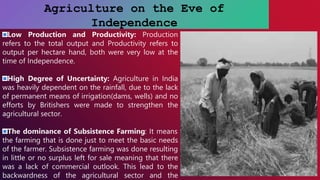
Low Production and Productivity: Production
refers to the total output and Productivity refers to
output per hectare hand, both were very low at the
time of Independence.
High Degree of Uncertainty: Agriculture in India
was heavily dependent on the rainfall, due to the lack
of permanent means of irrigation(dams, wells) and no
efforts by Britishers were made to strengthen the
agricultural sector.
The dominance of Subsistence Farming: It means
the farming that is done just to meet the basic needs
of the farmer. Subsistence farming was done resulting
in little or no surplus left for sale meaning that there
was a lack of commercial outlook. This lead to the
backwardness of the agricultural sector and the
Agriculture on the Eve of
Independence
Gulf between the Owners of the Soil and the Tillers of the Soil: The owners of the soil
shared the output with the tillers but they did not share the cost of production.For tillers
agriculture was a source of subsistence and for the owners, it was a source of income without
investment creating a wide economical gap between two.
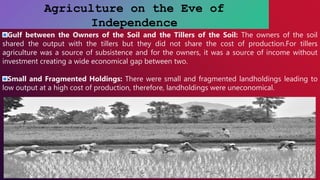
Small and Fragmented Holdings: There were small and fragmented landholdings leading to
low output at a high cost of production, therefore, landholdings were uneconomical.
Agriculture on the Eve of
Independence
Zamindari System or Land Revenue System under the British Raj
A unique land revenue system. Under this system, a triangular relationship was set up between
the government, the owners and the tillers of the soil.
This system was called “The Zamindari System”. Features of the Zamindari system are as follows:
i. Zamindars were recognized as the
permanent owners of the soil.
ii. Zamindars had to pay fixed sum or revenue
to the government as land revenue and if
they were unable to do so they stood in
danger of losing their rights.
iii. Zamindars were free to extract as much as
they want from the tillers of the soil as they
wished and could.
Agriculture on the Eve of
Independence
Zamindari System or Land Revenue System under the British Raj
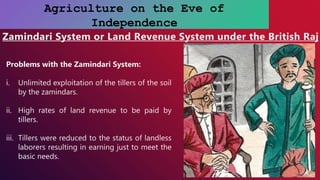
Problems with the Zamindari System:
i. Unlimited exploitation of the tillers of the soil
by the zamindars.
ii. High rates of land revenue to be paid by
tillers.
iii. Tillers were reduced to the status of landless
laborers resulting in earning just to meet the
basic needs.
Agriculture on the Eve of
Independence
Forced Commercialisation of Agriculture
Commercialization meant that there was shift from cultivation for self-consumption to cultivation
for marekt.
Reason: The British rule in India collided with the Industrial Revolution in Britain, therefore this
commercialisation of crops was done to meet the requirement of the Indigo that was used by the
textile industry in Britain for the purposes of dying/bleaching.
1. The farmers were forced to accept the advance payments for the cultivation of the Indigo.
2. Earlier farmers grew grain for their family’s consumption but now they needed cash to buy it
from the market.
3. There were uncertainties in the market due to which the farmers became indebted.
4. This indebtedness of farmers lead to the stagnation and backwardness of the agriculture.
Industrial Sector on the Eve of
Independence
Systematic de-industrialization: The decay of India’s world-famous
Handicraft industry due to the discriminatory policies of the Britishers.
Bleak growth of modern industry due to lack of investment opportunities.
Reasons behind the Decay of the Handicrafts
Discriminatory Tariff Policy: Britishers found India best source of raw
materials and best market for their finished goods. They started the
following discriminatory tariff policies:
The export of raw materials from India tariff-free, and the import of British
Industrial products in India tariff-free.
Heavy taxes was placed on the export of the Indian Handicraft products.
British finished products captured Indian markets. Therefore, the decay of
the handicrafts was the result.
Industrial Sector on the Eve of
Independence
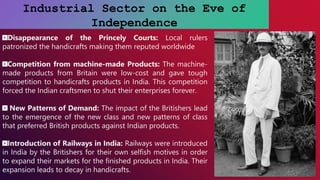
Disappearance of the Princely Courts: Local rulers
patronized the handicrafts making them reputed worldwide
Competition from machine-made Products: The machine-
made products from Britain were low-cost and gave tough
competition to handicrafts products in India. This competition
forced the Indian craftsmen to shut their enterprises forever.
New Patterns of Demand: The impact of the Britishers lead
to the emergence of the new class and new patterns of class
that preferred British products against Indian products.
Introduction of Railways in India: Railways were introduced
in India by the Britishers for their own selfish motives in order
to expand their markets for the finished products in India. Their
expansion leads to decay in handicrafts.
Industrial Sector on the Eve of
Independence
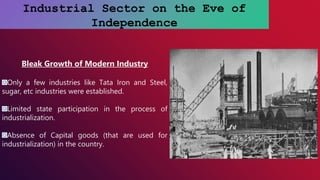
Bleak Growth of Modern Industry
Only a few industries like Tata Iron and Steel,
sugar, etc industries were established.
Limited state participation in the process of
industrialization.
Absence of Capital goods (that are used for
industrialization) in the country.
Foreign Trade on the Eve of
Independence
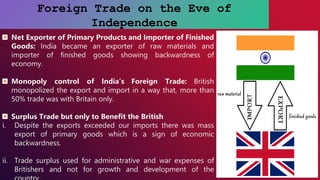
Net Exporter of Primary Products and Importer of Finished
Goods: India became an exporter of raw materials and
importer of finished goods showing backwardness of
economy.
Monopoly control of India’s Foreign Trade: British
monopolized the export and import in a way that, more than
50% trade was with Britain only.
Surplus Trade but only to Benefit the British
i. Despite the exports exceeded our imports there was mass
export of primary goods which is a sign of economic
backwardness.
ii. Trade surplus used for administrative and war expenses of
Britishers and not for growth and development of the
Demographic Profile on the Eve of
Independence
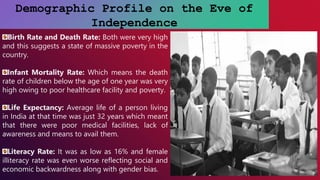
Birth Rate and Death Rate: Both were very high
and this suggests a state of massive poverty in the
country.
Infant Mortality Rate: Which means the death
rate of children below the age of one year was very
high owing to poor healthcare facility and poverty.
Life Expectancy: Average life of a person living
in India at that time was just 32 years which meant
that there were poor medical facilities, lack of
awareness and means to avail them.
Literacy Rate: It was as low as 16% and female
illiteracy rate was even worse reflecting social and
economic backwardness along with gender bias.
Occupational Structure on the Eve of
Independence
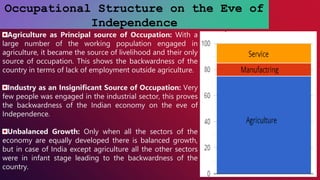
Agriculture as Principal source of Occupation: With a
large number of the working population engaged in
agriculture, it became the source of livelihood and their only
source of occupation. This shows the backwardness of the
country in terms of lack of employment outside agriculture.
Industry as an Insignificant Source of Occupation: Very
few people was engaged in the industrial sector, this proves
the backwardness of the Indian economy on the eve of
Independence.
Unbalanced Growth: Only when all the sectors of the
economy are equally developed there is balanced growth,
but in case of India except agriculture all the other sectors
were in infant stage leading to the backwardness of the
country.
Infrastructure on the Eve of
Independence
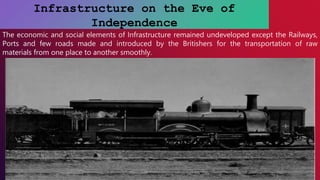
The economic and social elements of Infrastructure remained undeveloped except the Railways,
Ports and few roads made and introduced by the Britishers for the transportation of raw
materials from one place to another smoothly.
Positive Impact of British Rule in
India
Commercial Outlook of Framers: Forced
commercialization of agriculture by the Britishers forced the
farmers to have commercial outlook as they starting
producing more for the market.
New Opportunities of Employment: Introduction of
railways meant new employment opportunities outside
agriculture.
Control of Famines: No more starvation or death due to
lack of food grains was there because of rapid means of
transport reaching out in different areas.
Efficient Administration: Britishers had a well efficient
system of administration that provided a base for the
country’s future politicians and planners.
Economics Art - Integrated Project
Thank You
Aaditya Pandey Class: XII - D R o l l N o . : 1

Economics Art Integrated Project

  • 1.
    Economics Art -Integrated Project State of Indian Economy at the Eve of Independence
  • 2.
    Features of Indianeconomy on the Eve of Independence Stagnant Economy: There was very slow or no economic growth in the country. As a result of stagnation, there was unemployment, death, and suffering due to lack of food. Backward Economy: Indian economy was a backward and per capita income was very low and in India, it was just Rs. 230 from 1947-1948. Agricultural Backwardness: With 70% of people engaged in agriculture, its contribution to GDP was only 50%. Productivity and production too were extremely low. Industrial Backwardness: Industrial sector was not developed, there was a lack of basic and heavy industries in the country.
  • 3.
    Features of Indianeconomy on the Eve of Independence Widespread Poverty: The people in the country could not even meet their basic needs i.e food, shelter and clothing. Unemployment and Illiteracy were other issues faced by the country. Poor Infrastructure: Infrastructure like communication, transport, power or energy was underdeveloped. Major dependence on Imports: As a result of industrial backwardness in the country several consumer goods like medicines were imported from abroad. Limited Urbanisation: Majority of the population lived in villages meaning that they lacked opportunities outside agriculture. Colonial Economy: As India was a British colony, Britishers exploited Indian economy for their own benefits.
  • 4.
    Agriculture on theEve of Independence Low Production and Productivity: Production refers to the total output and Productivity refers to output per hectare hand, both were very low at the time of Independence. High Degree of Uncertainty: Agriculture in India was heavily dependent on the rainfall, due to the lack of permanent means of irrigation(dams, wells) and no efforts by Britishers were made to strengthen the agricultural sector. The dominance of Subsistence Farming: It means the farming that is done just to meet the basic needs of the farmer. Subsistence farming was done resulting in little or no surplus left for sale meaning that there was a lack of commercial outlook. This lead to the backwardness of the agricultural sector and the
  • 5.
    Agriculture on theEve of Independence Gulf between the Owners of the Soil and the Tillers of the Soil: The owners of the soil shared the output with the tillers but they did not share the cost of production.For tillers agriculture was a source of subsistence and for the owners, it was a source of income without investment creating a wide economical gap between two. Small and Fragmented Holdings: There were small and fragmented landholdings leading to low output at a high cost of production, therefore, landholdings were uneconomical.
  • 6.
    Agriculture on theEve of Independence Zamindari System or Land Revenue System under the British Raj A unique land revenue system. Under this system, a triangular relationship was set up between the government, the owners and the tillers of the soil. This system was called “The Zamindari System”. Features of the Zamindari system are as follows: i. Zamindars were recognized as the permanent owners of the soil. ii. Zamindars had to pay fixed sum or revenue to the government as land revenue and if they were unable to do so they stood in danger of losing their rights. iii. Zamindars were free to extract as much as they want from the tillers of the soil as they wished and could.
  • 7.
    Agriculture on theEve of Independence Zamindari System or Land Revenue System under the British Raj Problems with the Zamindari System: i. Unlimited exploitation of the tillers of the soil by the zamindars. ii. High rates of land revenue to be paid by tillers. iii. Tillers were reduced to the status of landless laborers resulting in earning just to meet the basic needs.
  • 8.
    Agriculture on theEve of Independence Forced Commercialisation of Agriculture Commercialization meant that there was shift from cultivation for self-consumption to cultivation for marekt. Reason: The British rule in India collided with the Industrial Revolution in Britain, therefore this commercialisation of crops was done to meet the requirement of the Indigo that was used by the textile industry in Britain for the purposes of dying/bleaching. 1. The farmers were forced to accept the advance payments for the cultivation of the Indigo. 2. Earlier farmers grew grain for their family’s consumption but now they needed cash to buy it from the market. 3. There were uncertainties in the market due to which the farmers became indebted. 4. This indebtedness of farmers lead to the stagnation and backwardness of the agriculture.
  • 9.
    Industrial Sector onthe Eve of Independence Systematic de-industrialization: The decay of India’s world-famous Handicraft industry due to the discriminatory policies of the Britishers. Bleak growth of modern industry due to lack of investment opportunities. Reasons behind the Decay of the Handicrafts Discriminatory Tariff Policy: Britishers found India best source of raw materials and best market for their finished goods. They started the following discriminatory tariff policies: The export of raw materials from India tariff-free, and the import of British Industrial products in India tariff-free. Heavy taxes was placed on the export of the Indian Handicraft products. British finished products captured Indian markets. Therefore, the decay of the handicrafts was the result.
  • 10.
    Industrial Sector onthe Eve of Independence Disappearance of the Princely Courts: Local rulers patronized the handicrafts making them reputed worldwide Competition from machine-made Products: The machine- made products from Britain were low-cost and gave tough competition to handicrafts products in India. This competition forced the Indian craftsmen to shut their enterprises forever. New Patterns of Demand: The impact of the Britishers lead to the emergence of the new class and new patterns of class that preferred British products against Indian products. Introduction of Railways in India: Railways were introduced in India by the Britishers for their own selfish motives in order to expand their markets for the finished products in India. Their expansion leads to decay in handicrafts.
  • 11.
    Industrial Sector onthe Eve of Independence Bleak Growth of Modern Industry Only a few industries like Tata Iron and Steel, sugar, etc industries were established. Limited state participation in the process of industrialization. Absence of Capital goods (that are used for industrialization) in the country.
  • 12.
    Foreign Trade onthe Eve of Independence Net Exporter of Primary Products and Importer of Finished Goods: India became an exporter of raw materials and importer of finished goods showing backwardness of economy. Monopoly control of India’s Foreign Trade: British monopolized the export and import in a way that, more than 50% trade was with Britain only. Surplus Trade but only to Benefit the British i. Despite the exports exceeded our imports there was mass export of primary goods which is a sign of economic backwardness. ii. Trade surplus used for administrative and war expenses of Britishers and not for growth and development of the
  • 13.
    Demographic Profile onthe Eve of Independence Birth Rate and Death Rate: Both were very high and this suggests a state of massive poverty in the country. Infant Mortality Rate: Which means the death rate of children below the age of one year was very high owing to poor healthcare facility and poverty. Life Expectancy: Average life of a person living in India at that time was just 32 years which meant that there were poor medical facilities, lack of awareness and means to avail them. Literacy Rate: It was as low as 16% and female illiteracy rate was even worse reflecting social and economic backwardness along with gender bias.
  • 14.
    Occupational Structure onthe Eve of Independence Agriculture as Principal source of Occupation: With a large number of the working population engaged in agriculture, it became the source of livelihood and their only source of occupation. This shows the backwardness of the country in terms of lack of employment outside agriculture. Industry as an Insignificant Source of Occupation: Very few people was engaged in the industrial sector, this proves the backwardness of the Indian economy on the eve of Independence. Unbalanced Growth: Only when all the sectors of the economy are equally developed there is balanced growth, but in case of India except agriculture all the other sectors were in infant stage leading to the backwardness of the country.
  • 15.
    Infrastructure on theEve of Independence The economic and social elements of Infrastructure remained undeveloped except the Railways, Ports and few roads made and introduced by the Britishers for the transportation of raw materials from one place to another smoothly.
  • 16.
    Positive Impact ofBritish Rule in India Commercial Outlook of Framers: Forced commercialization of agriculture by the Britishers forced the farmers to have commercial outlook as they starting producing more for the market. New Opportunities of Employment: Introduction of railways meant new employment opportunities outside agriculture. Control of Famines: No more starvation or death due to lack of food grains was there because of rapid means of transport reaching out in different areas. Efficient Administration: Britishers had a well efficient system of administration that provided a base for the country’s future politicians and planners.
  • 17.
    Economics Art -Integrated Project Thank You Aaditya Pandey Class: XII - D R o l l N o . : 1