Atul Abhiman Agalawe
(M. Com, B. Ed, D. B. M)
 Communication is the activity
of conveying
information through the
exchange of thoughts,
messages, or information, as
by speech, visuals, signals,
writing, or behavior.
 Communication is the sending
and receiving of spoken or
written messages between
people and places.
 Communication is an art of
exchanging ideas, facts,
information, etc. from one
person to another.
1. SENDER - initiator of the communication process
2. MESSAGE - is what will be communicated to another
party
3. ENCODING -is how the message is transmitted to
another party
4. CHANNEL - is the medium of the communication
5. RECEIVER- recipient of the message
6. DECODING - is the process where the message is
interpreted for its content
7. FEEDBACK - response of receiver to the sender
Means of
Communication
Traditional Modern
 Mail or post is a system for transporting letters and
other tangible objects such as written documents,
typically enclosed in envelops and also small packages
delivered to various places around the world.
 Organised system was started by Mughal
 Indian Post established by Warren hasting in 1688 for
company purpose and for public 1837
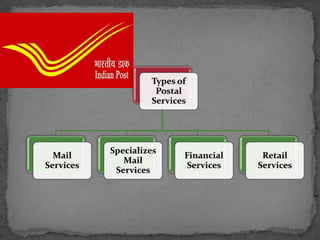
Types of
Postal
Services
Mail
Services
Specializes
Mail
Services
Financial
Services
Retail
Services
 Mail Services
1. Post Card
2. Inland Letter
3. Envelope
4. Parcel
5. Book Post
6. Telegrams
7. Telephone
 Specialized Mail services
1. Under Postal
Certificate
2. Registered Post
3. Insured Post
4. Speed Post
5. Post Restante /Direct
Post
6. Value Payable Post
 Financial Services
1. Post Office Saving
Schemes
2. Life Insurance
3. Money Remittance
Services
1. Money Order
2. Postal Order
3. Instant Money Order
4. Money Order Videsh
5. International Money
Transfer
6. Electronic
International Money
Order Services
7. Foreign Exchange
Services
8. Sales of Gold Coins
 Retail Services
1. Bill Mail
2. Retail Post
3. E-Payment
 Courier Services
 Electronic Services
 Fax
 Internet
 E-mail
 Telephone refer it is a
telecommunication
device used for sending
and receiving human
voice.
 First Telephone invented
by Alexander Graham
Bell in 1876
 Telephone services
introduced into India in
1881
 Wireless communication
is the transfer of
information between two
or more points that are not
connected by an electrical
conductor.
1) Pager Services
2) Mobile Communication
3) Broadband
Communication
4) Next Generation
Network
5) Indian Satellites
Communication
Communication

Communication

  • 1.
    Atul Abhiman Agalawe (M.Com, B. Ed, D. B. M)
  • 2.
     Communication isthe activity of conveying information through the exchange of thoughts, messages, or information, as by speech, visuals, signals, writing, or behavior.  Communication is the sending and receiving of spoken or written messages between people and places.  Communication is an art of exchanging ideas, facts, information, etc. from one person to another.
  • 4.
    1. SENDER -initiator of the communication process 2. MESSAGE - is what will be communicated to another party 3. ENCODING -is how the message is transmitted to another party 4. CHANNEL - is the medium of the communication 5. RECEIVER- recipient of the message 6. DECODING - is the process where the message is interpreted for its content 7. FEEDBACK - response of receiver to the sender
  • 5.
  • 6.
     Mail orpost is a system for transporting letters and other tangible objects such as written documents, typically enclosed in envelops and also small packages delivered to various places around the world.  Organised system was started by Mughal  Indian Post established by Warren hasting in 1688 for company purpose and for public 1837
  • 7.
  • 8.
     Mail Services 1.Post Card 2. Inland Letter 3. Envelope 4. Parcel 5. Book Post 6. Telegrams 7. Telephone  Specialized Mail services 1. Under Postal Certificate 2. Registered Post 3. Insured Post 4. Speed Post 5. Post Restante /Direct Post 6. Value Payable Post
  • 9.
     Financial Services 1.Post Office Saving Schemes 2. Life Insurance 3. Money Remittance Services 1. Money Order 2. Postal Order 3. Instant Money Order 4. Money Order Videsh 5. International Money Transfer 6. Electronic International Money Order Services 7. Foreign Exchange Services 8. Sales of Gold Coins  Retail Services 1. Bill Mail 2. Retail Post 3. E-Payment
  • 10.
     Courier Services Electronic Services  Fax  Internet  E-mail
  • 11.
     Telephone referit is a telecommunication device used for sending and receiving human voice.  First Telephone invented by Alexander Graham Bell in 1876  Telephone services introduced into India in 1881
  • 12.
     Wireless communication isthe transfer of information between two or more points that are not connected by an electrical conductor. 1) Pager Services 2) Mobile Communication 3) Broadband Communication 4) Next Generation Network 5) Indian Satellites