BANKING INDUSTRY IN INDIA
INDEX
Sr no.   Particulars                                           Page no.

1        Introduction

         1.1 Industry definition
         1.2 History of Banking in India
         1.3 Bank Definition
         1.4 Banking definition

2        Types of bank

         2.1 Central bank
         2.2 Commercial Banks
                  a Public Sector Banks
                  b Private Sectors Banks
                  c Foreign Banks
                  d Development Banks
         2.3.Co-operative Banks

         2.4 Scheduled Banks

         2.5 Non-scheduled bank in India


3        Banking products & services

         3.1 Primary functions

              a) Accepting deposits
                         1 Types of Bank Accounts
                             I Checking Account/ current a/c
                             II Savings Account
                             III Money Market Account
                            IV Certificate of Deposit/ fixed
                            V Recurring deposit a/c

         b) Granting loans and advances
I Loans

                          II Advances
                                    i Cash Credit

                                    ii Overdraft

                                    iii Discounting of Bills
     3.2 Secondary functions

     3.3 Online banking

     3.4 Mobile Banking Services
4    Reserve Bank of India

     4.1 R.B.I profile.
     4.2 Major RBI Functions

5     Role of Banks


6    Role of Banks in Indian Economy


7    Growth of bank in India


8    India's GDP Growth to make the Indian Banking Industry
     third largest in the World by 2025


9    Banking Sector in India: Counting on Credit Growth


10   Banking reform


11   Top Banking Companies in India
12   Top Private Banks in India


13   Punch lines of banks in India


14   CMDs & CEOs of Banks in India 2011


15   Logos of bank in India


16   Merger &Acquisition of banks in India after 1991


17   Career Opportunities in Banking
1 Banking Industry in India


1.1Industry definition:

The Banking industry comprises of segments that provide financial assistance and advisory
services to its customers by means of varied functions such as commercial banking,
wholesale banking, personal banking, internet banking, mobile banking, credit unions,
investment banking and the like.

With years, banks are also adding services to their customers. The Indian banking industry is
passing through a phase of customers market. The customers have more choices in choosing
their banks. A competition has been established within the banks operating in India.

With stiff competition and advancement of technology, the services provided by banks have
become more easy and convenient. The past days are witness to an hour wait before
withdrawing cash from accounts or a cheque from north of the country being cleared in one
month in the south.

Banks are among the main participants of the financial system in India. Banking offers
several facilities & Opportunities. This section provides comprehensive and updated
information, guidance and assistance in all areas of banking in India.

Bank of Hindustan, set up in 1870, was the earliest Indian Bank . Banking in India on modern
lines started with the establishment of three presidency banks under Presidency Bank's act
1876 i.e. Bank of Calcutta, Bank of Bombay and Bank of Madras.

The commercial banking structure in India consists of: Scheduled Commercial Banks &
Unscheduled Banks. Banking Regulation Act of India, 1949 defines Banking as "accepting,
for the purpose of lending or investment of deposits of money from the public, repayable on
demand or otherwise and withdrawable by cheques, draft, order or otherwise."
The arrival of foreign and private banks with their superior state-of-the-art technology-based
services pushed Indian Banks also to follow suit by going in for the latest technologies so as
to meet the threat of competition and retain customer base.

The evolution of IT services outsourcing in the Indian banks has presently moved on to the
level of Facilities Management (FM). Banks now looking at business process management
(BPM) to increase returns on investment, improve customer relationship management (CRM)
and employee productivity.

For, these entities sustaining long-term customer relationship management (CRM) has
become a challenge with almost everyone in the market with similar products


Industry Segments:

Public Sector Banks:

Almost 80% of the business is still controlled by Public Sector Banks (PSBs). PSBs are still
dominating the commercial banking system. Shares of the leading PSBs are already listed on
the stock exchanges.

The PSBs will play an important role in the industry due to its number of branches and
foreign banks facing the constraint of limited number of branches. Hence, in order to achieve
an efficient banking system, the onus is on the Government to encourage the PSBs to be run
on professional lines.

Private Sector Banks:

The RBI has given licenses to new private sector banks as part of the liberalization process.
The RBI has also been granting licenses to industrial houses. Many banks are successfully
running in the retail and consumer segments but are yet to deliver services to industrial
finance, retail trade, small business and agricultural finance.
Foreign banks:

Foreign banks have been operating in India for decades with a few of them having operations
in India for over a century. The number of foreign bank branches in India has increased
significantly in recent years since RBI issued a number of licenses - well beyond the
commitments made to the World Trade Organization. The presence of foreign banks in India
has benefited the financial system by enhancing competition, resulting in higher efficiency.
There has also been transfer of technology and specialized skills which has had some
"demonstration effect" as Indian banks too have upgraded their skills, improved their scale of
operations and diversified into other activities. At a time when access to foreign currency
funds was a constraint for the Indian companies, the presence of foreign banks in India
enabled large Indian companies to access foreign currency resources from the overseas
branches of these banks. Also with the presence of foreign banks, as borrowers in the money
market and their operation in the foreign exchange market has resulted in the creation and
deepening of the inter-bank money market. Now, it is the challenge for the supervisors to
maximize the advantages and minimize the disadvantages of the foreign banks' local
presence.


1.2 History of Banking in India

Banking in India originated in the last decades of the 18th century. The first banks were The
General Bank of India, which started in 1786, and Bank of Hindustan, which started in 1790;
both are now defunct. The oldest bank in existence in India is the State Bank of India, which
originated in the Bank of Calcutta in June 1806, which almost immediately became the Bank
of Bengal. This was one of the three presidency banks, the other two being the Bank of
Bombay and the Bank of Madras, all three of which were established under charters from the
British East India Company. For many years the Presidency banks acted as quasi-central
banks, as did their successors. The three banks merged in 1921 to form the Imperial Bank of
India, which, upon India's independence, became the State Bank of India in 1955.

            A bank is a financial institution and a financial intermediary that accepts deposits
and channels those deposits into lending activities, either directly or through capital markets.
A bank connects customers with capital deficits to customers with capital surpluses.
1.3 Bank Definition

Definition of a bank varies from country to country. See the relevant country page (below)
for more information.

1. Under English common law, a banker is defined as a person who carries on the business of
banking, which is specified as:[6]

       conducting current accounts for his customers
       paying cheques drawn on him, and
       Collecting cheques for his customers.


2. A corporation empowered to deal with cash, domestic and foreign, and to receive the
deposits of money and to loan those monies to third-parties.


3. In 1899, the United States Supreme Court (Austen) used these words to define a bank:

"A bank is an institution, usually incorporated with power to issue its promissory notes
intended to circulate as money (known as bank notes); or to receive the money of others on
general deposit, to form a joint fund that shall be used by the institution, for its own benefit,
for one or more of the purposes of making temporary loans and discounts; of dealing in notes,
foreign and domestic bills of exchange, coin, bullion, credits, and the remission of money; or
with both these powers, and with the privileges, in addition to these basic powers, of
receiving special deposits and making collections for the holders of negotiable paper, if the
institution sees fit to engage in such business."

4. An establishment authorized by a government to accept deposits, pay interest, clear checks,
make loans, act as an intermediary in financial transactions, and provide other financial
services to its customers.

5. Bank is a lawful organization, which accepts deposits that can be withdrawn on
Demand. It also lends money to individuals and business houses that need it.
1.4Banking definition


In general terms, the business activity of accepting and safeguarding money owned by other
individuals and entities, and then lending out this money in order to earn a profit.

‗Banking‘ as an activity involves
Acceptance of deposits and lending or investment of money. It facilitates business activities
by Providing money and certain services that help in exchange of goods and services.
Therefore,Banking is an important auxiliary to trade. It not only provides money for the
production of Goods and services but also facilitates their exchange between the buyer and
seller.


2 Types of bank


There are various types of banks which operate in our country to meet the financial
requirements Of different categories of people engaged in agriculture, business, profession,
etc. On the basis of Functions, the banking institutions in India may be divided into the
following types:

          2.1 Central bank

                     A central bank, reserve bank, or monetary authority is a public
institution that manages the nation's currency, money supply, and interest rates. Central banks
also usually oversee the commercial banking system of their respective countries. In contrast
to a commercial bank, a central bank possesses a monopoly on increasing the nation's
monetary base, and usually also prints the national currency, which usually serves as the
nation's legal tender.[1][2] Examples include the European Central Bank (ECB), the Federal
Reserve of the United States, and the People's Bank of China.[3]

The primary function of a central bank is to manage the nation's money supply (monetary
policy), through active duties such as managing interest rates, setting the reserve requirement,
and acting as a lender of last resort to the banking sector during times of bank insolvency or
financial crisis. Central banks usually also have supervisory powers, intended to prevent
commercial banks and other financial institutions from reckless or fraudulent behavior.
Central banks in most developed nations are institutionally designed to be independent from
political interference.


        2.2 Commercial Banks

                          Commercial Banks are banking institutions that accept deposits and
grant short-term loans and Advances to their customers. In addition to giving short-term
loans, commercial banks also give Medium-term and long-term loan to business enterprises.
Now-a-days some of the commercial Banks are also providing housing loan on a long-term
basis to individuals. There are also many Other functions of commercial banks, which are
discussed later in this lesson.


Types of Commercial banks: Commercial banks are of three types i.e., Public sector banks,
Private sector banks and foreign banks.
(i) Public Sector Banks: These are banks where majority stake is held by the Government of
India or Reserve Bank of India. Examples of public sector banks are: State Bank of India,
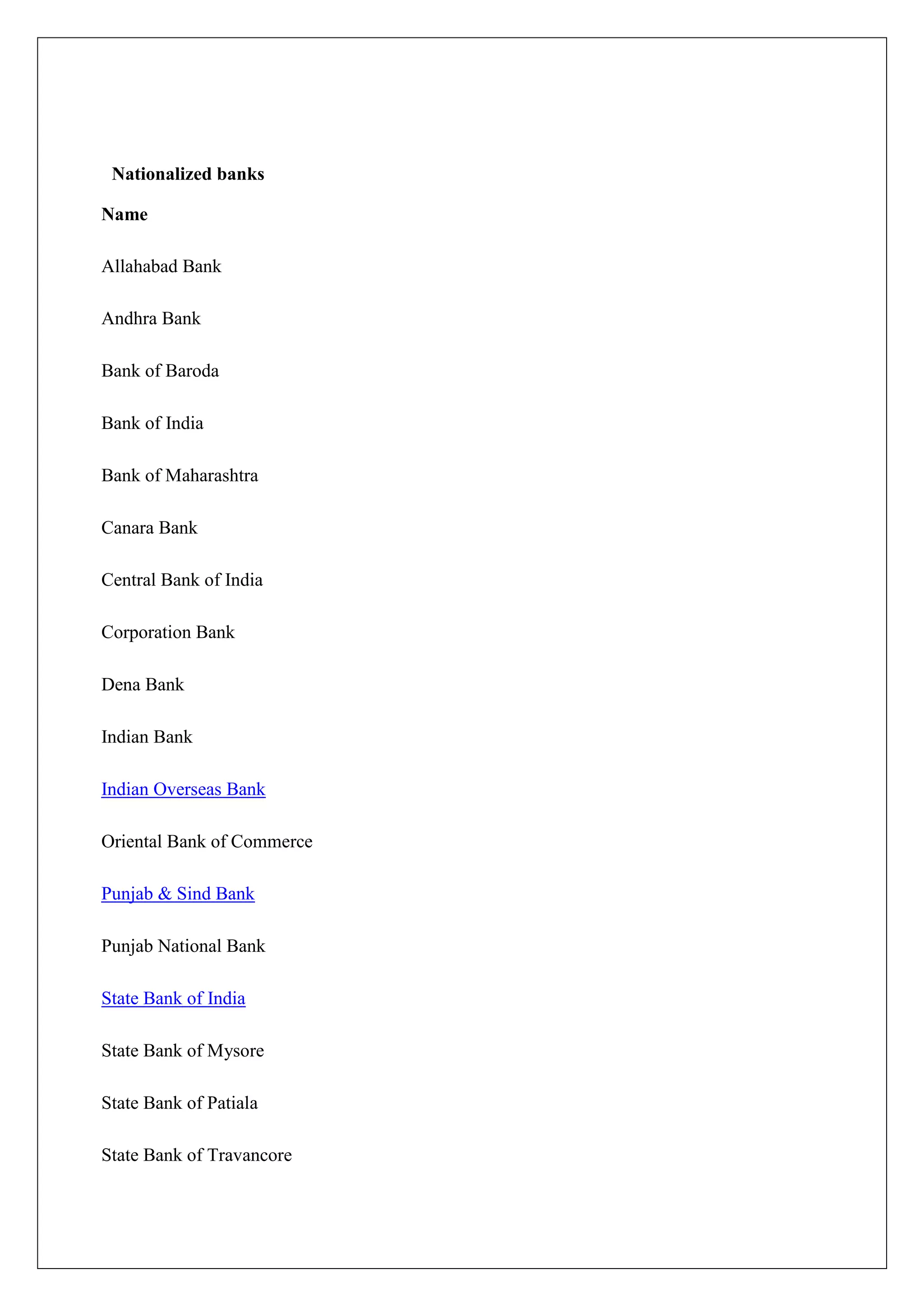
Nationalized banks

Name

Allahabad Bank

Andhra Bank

Bank of Baroda

Bank of India

Bank of Maharashtra

Canara Bank

Central Bank of India

Corporation Bank

Dena Bank

Indian Bank

Indian Overseas Bank

Oriental Bank of Commerce

Punjab & Sind Bank

Punjab National Bank

State Bank of India

State Bank of Mysore

State Bank of Patiala

State Bank of Travancore
Syndicate Bank

UCO Bank

Union Bank of India

United Bank of India

Vijaya Bank


 Their public sector banks

        IDBI Bank

        Dhanlaxmi Bank

        Jammu & Kashmir Bank

        Nainital Bank
        Lakshmi Vilas Bank

        South Indian Bank


 (ii) Private Sectors Banks: In case of private sector banks majority of share capital of the
 Bank is held by private individuals. These banks are registered as companies with limited
 Liability. For example: The Jammu and Kashmir Bank Ltd., Bank of Rajasthan Ltd.,
 Development Credit Bank Ltd, Lord Krishna Bank Ltd., Bharat Overseas Bank Ltd.,Global
 Trust Bank, Vysya Bank, etc.


 1. Bank of Punjab Ltd. (since merged with Centurian Bank)


 2. Centurian Bank of Punjab (since merged with HDFC Bank)
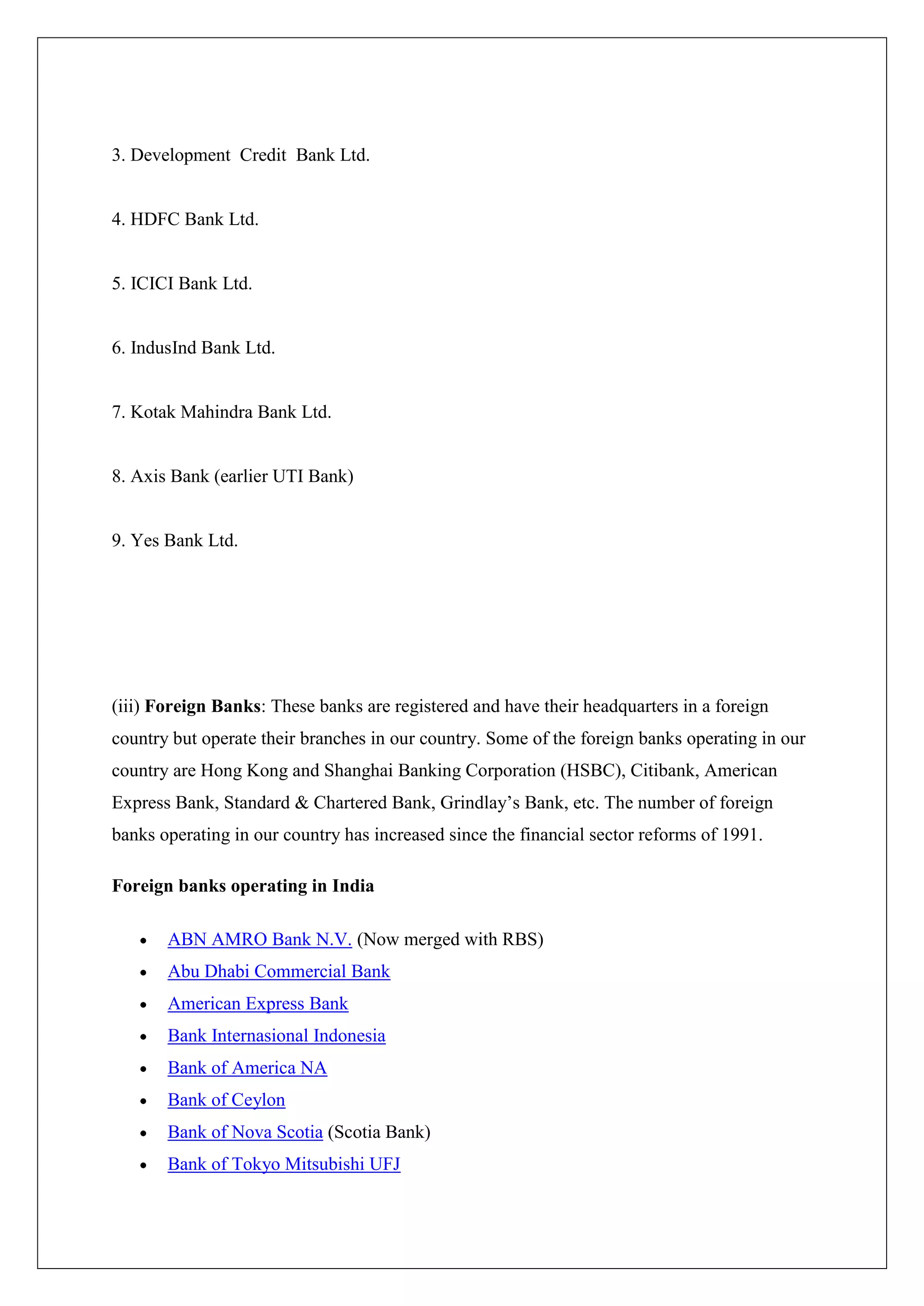
3. Development Credit Bank Ltd.


4. HDFC Bank Ltd.


5. ICICI Bank Ltd.


6. IndusInd Bank Ltd.


7. Kotak Mahindra Bank Ltd.


8. Axis Bank (earlier UTI Bank)


9. Yes Bank Ltd.


(iii) Foreign Banks: These banks are registered and have their headquarters in a foreign
country but operate their branches in our country. Some of the foreign banks operating in our
country are Hong Kong and Shanghai Banking Corporation (HSBC), Citibank, American
Express Bank, Standard & Chartered Bank, Grindlay‘s Bank, etc. The number of foreign
banks operating in our country has increased since the financial sector reforms of 1991.

Foreign banks operating in India

       ABN AMRO Bank N.V. (Now merged with RBS)
       Abu Dhabi Commercial Bank
       American Express Bank
       Bank Internasional Indonesia
       Bank of America NA
       Bank of Ceylon
       Bank of Nova Scotia (Scotia Bank)
       Bank of Tokyo Mitsubishi UFJ
Barclays Bank PLC
      BNP Paribas
      Calyon Bank
      Chinatrust Commercial Bank
      Citibank N.A.
      DBS Bank
      Deutsche Bank AG
      HSBC
      JPMorgan Chase Bank
      Krung Thai Bank
      Mashreq Bank psc
      Mizuho Corporate Bank
      Royal Bank of Scotland
      Shinhan Bank
      SCOTIA BANK
      Société Générale
      Sonali Bank
      Standard Chartered Bank
      State Bank of Mauritius
      UBS
      VTB [1]


iv) Development Banks
Business often requires medium and long-term capital for purchase of machinery and
equipment,

      Development Banks
      Industrial Development Bank of India (IDBI)
      Industrial Finance Corporation of India (IFCI)
      Export - Import Bank of India (Exim Bank)
      Industrial Reconstruction Bank of India (IRBI) now (Industrial Investment
      Bank of India)
      National Bank for Agriculture and Rural Development (NABARD)
Small Industries Development Bank of India (SIDBI)
       National Housing Bank (NHB)

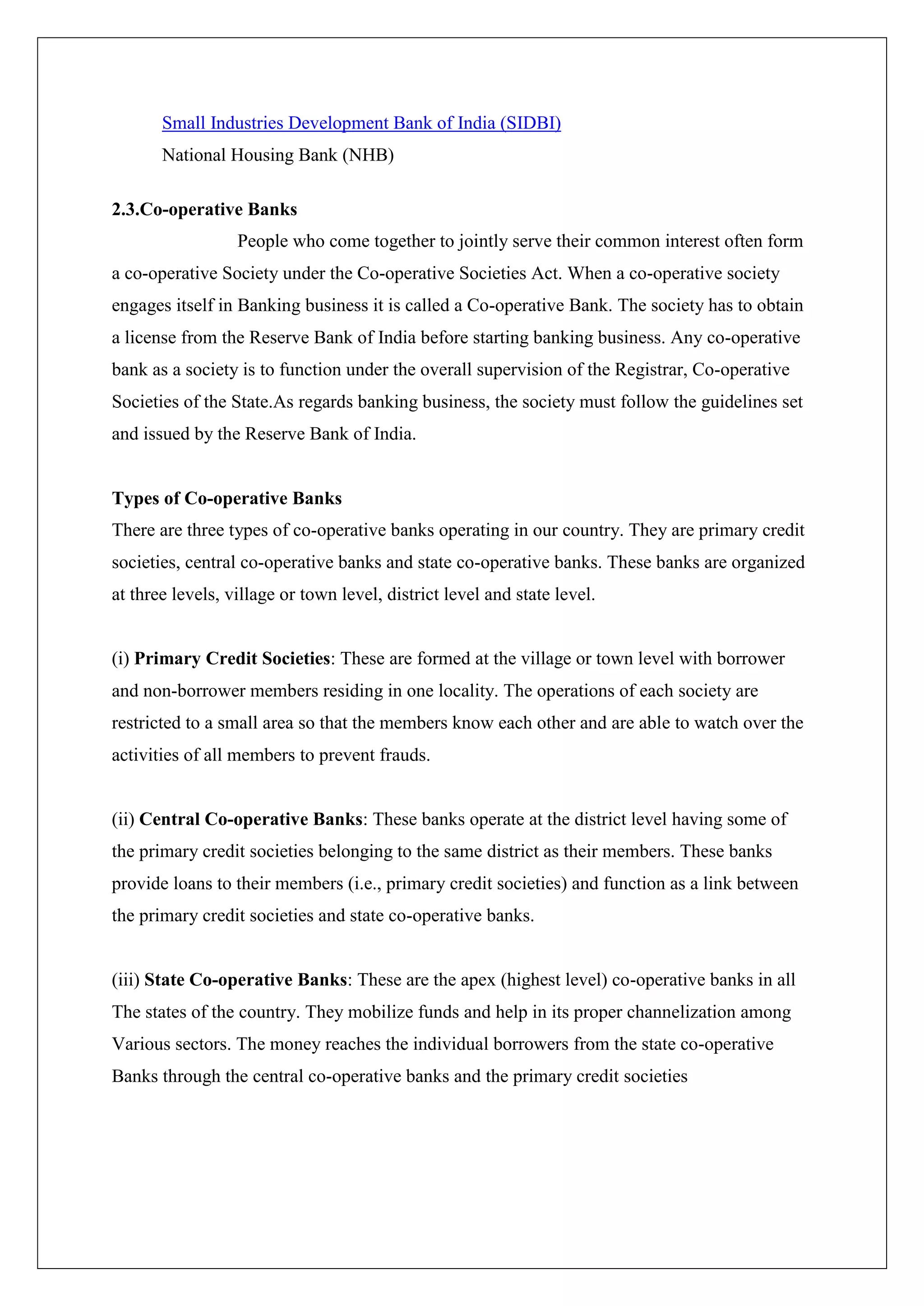
2.3.Co-operative Banks
                  People who come together to jointly serve their common interest often form
a co-operative Society under the Co-operative Societies Act. When a co-operative society
engages itself in Banking business it is called a Co-operative Bank. The society has to obtain
a license from the Reserve Bank of India before starting banking business. Any co-operative
bank as a society is to function under the overall supervision of the Registrar, Co-operative
Societies of the State.As regards banking business, the society must follow the guidelines set
and issued by the Reserve Bank of India.


Types of Co-operative Banks
There are three types of co-operative banks operating in our country. They are primary credit
societies, central co-operative banks and state co-operative banks. These banks are organized
at three levels, village or town level, district level and state level.


(i) Primary Credit Societies: These are formed at the village or town level with borrower
and non-borrower members residing in one locality. The operations of each society are
restricted to a small area so that the members know each other and are able to watch over the
activities of all members to prevent frauds.


(ii) Central Co-operative Banks: These banks operate at the district level having some of
the primary credit societies belonging to the same district as their members. These banks
provide loans to their members (i.e., primary credit societies) and function as a link between
the primary credit societies and state co-operative banks.


(iii) State Co-operative Banks: These are the apex (highest level) co-operative banks in all
The states of the country. They mobilize funds and help in its proper channelization among
Various sectors. The money reaches the individual borrowers from the state co-operative
Banks through the central co-operative banks and the primary credit societies
2.4Scheduled Banks


                Scheduled Banks in India are those banks which have been included in the
Second Schedule of Reserve Bank of India (RBI) Act, 1934.[1] RBI in turn includes only
those banks in this schedule which satisfy the criteria laid down vide section 42 (6) (a) of the
Act.


2.5Non-scheduled bank in India


             "Non-scheduled bank in India" means a banking company as defined in clause
(c) of section 5 of the Banking Regulation Act, 1949 (10 of 1949), which is not a scheduled
bank.
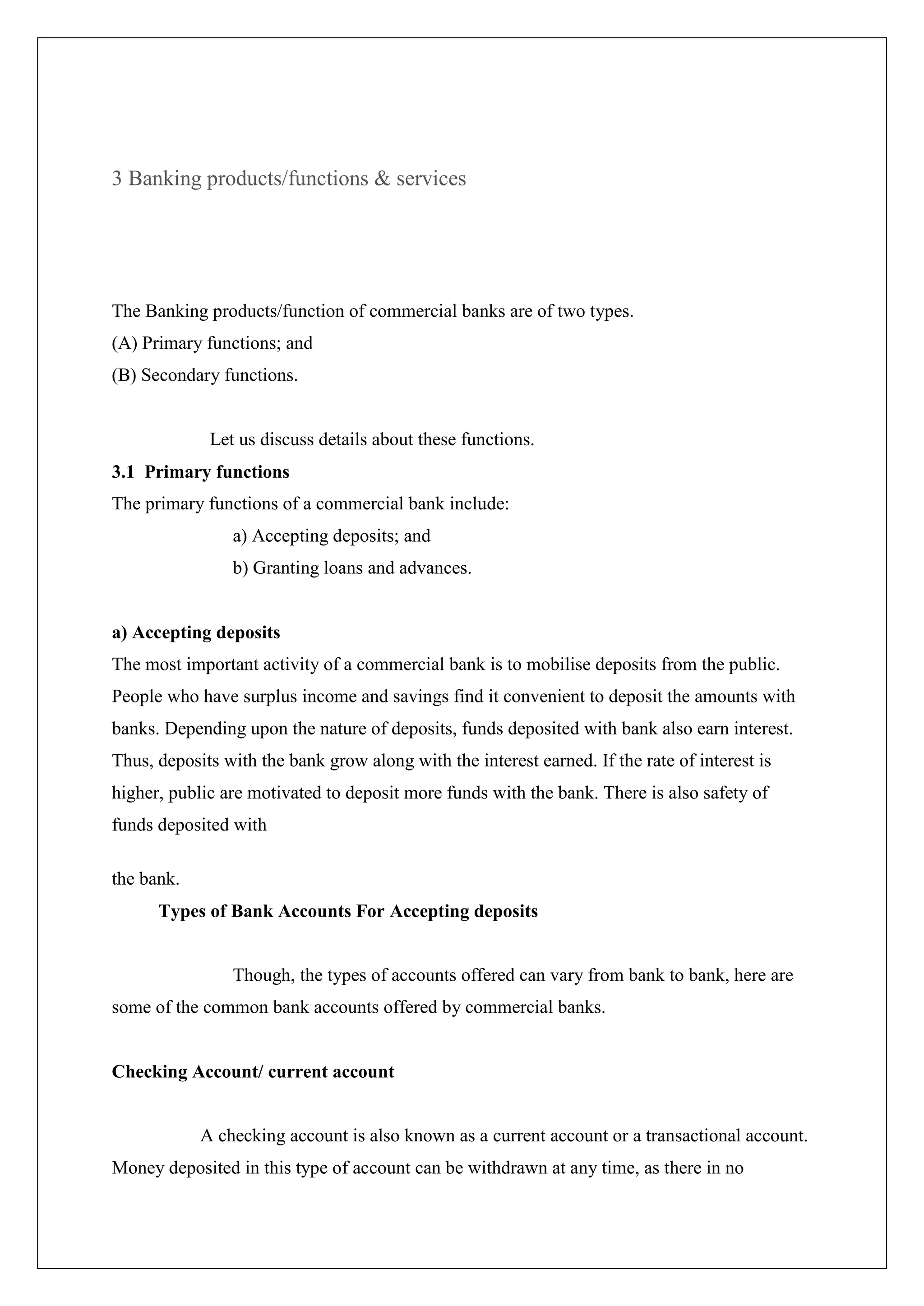
3 Banking products/functions & services


The Banking products/function of commercial banks are of two types.
(A) Primary functions; and
(B) Secondary functions.


             Let us discuss details about these functions.
3.1 Primary functions
The primary functions of a commercial bank include:
                a) Accepting deposits; and
                b) Granting loans and advances.


a) Accepting deposits
The most important activity of a commercial bank is to mobilise deposits from the public.
People who have surplus income and savings find it convenient to deposit the amounts with
banks. Depending upon the nature of deposits, funds deposited with bank also earn interest.
Thus, deposits with the bank grow along with the interest earned. If the rate of interest is
higher, public are motivated to deposit more funds with the bank. There is also safety of
funds deposited with

the bank.
      Types of Bank Accounts For Accepting deposits


                Though, the types of accounts offered can vary from bank to bank, here are
some of the common bank accounts offered by commercial banks.


Checking Account/ current account


            A checking account is also known as a current account or a transactional account.
Money deposited in this type of account can be withdrawn at any time, as there in no
restriction on the number of withdrawals and the amount of money withdrawn. Customers are
generally given paper checks to carry out day-to-day transactions, like paying bills, making
purchases, or transferring money to another account. ATM (Automated Teller Machine)
facility is also provided to the customers. However, no interest is paid on the deposited
money and sometimes, customers have to pay a charge to the banks for rendering this service.
This type of account is generally maintained by businessmen or concerns, as they have to
make a number of financial transactions each day. A transactional account is sometimes
called a demand deposit account, as no notice is required to withdraw money, i.e. money is
available on demand.


Savings Account


           Savings accounts are aimed towards mobilizing small savings from the general
public. There are certain restrictions regarding the number of withdrawals and the amount to
be withdrawn in a particular time period. However, money deposited in this account, earns a
fair rate of interest. Though the customers can't withdraw their money with checks, they can
avail the ATM facility for the same. A passbook is also provided, which keeps track of all the
financial transactions.


Money Market Account


          A money market account is a type of deposit account, in which money can be
deposited to earn a higher rate of interest than the savings account. However, a minimum
balance is required to be maintained to earn interest and avoid fees. There is also a limit on
the number of transactions that can be carried out in a particular month. The customers are
usually allowed to make 6 withdrawals per month.


Certificate of Deposit/ fixed deposit account


 A certificate of deposit is also known as time deposit or fixed deposit account. This type of
bank account requires the customers to deposit a certain sum of money for a fixed time
period. The money deposited in this account can't be withdrawn before the date of maturity.
However, some banks allow customers to withdraw money before maturity, by charging a
penalty. The rate of interest paid on time deposits is usually higher than the other types of
bank accounts. In addition to this, the interest paid on this account depends on the maturity
period, i.e. longer the maturity period, the higher is the rate of interest paid.


Banking institutions offer several different types of bank accounts to satisfy the individual
needs of their customers. These bank accounts enable the public to deposit their money in
banks and thereby earn a monetary return.

The Recurring deposit

       The Recurring deposit account is an account in the bank (or a Post office in some
countries) where an investor deposits a fixed amount of money every month for a fixed
tenure (mostly ranging from one year to five years). This scheme is meant for investors who
want to deposit a fixed amount every month, in order to get a lump sum after some years. The
small monthly savings in the Recurring Deposit scheme enable the depositor to accumulate a
handsome amount on maturity. Interest at term deposit rates is computable on quarterly
compounded basis.


b) Grant of loans and advances
        The second important function of a commercial bank is to grant loans and advances.
Such loans and advances are given to members of the public and to the business community
at a higher rate
of interest than allowed by banks on various deposit accounts. The rate of interest charged on
loans and advances varies according to the purpose and period of loan and also the mode of
repayment.


             i)     Loans
                    A loan is granted for a specific time period. Generally commercial banks
                    provide short-term loans. But term loans, i.e., loans for more than a year
                    may also be granted. The borrower may be given the entire amount in
lump sum or in installments. Loans are generally granted against the
                    security of certain assets. A loan is normally repaid in installments.
                    However, it may also be repaid in lump sum.
           ii)       Advances
                        An advance is a credit facility provided by the bank to its customers. It
                 differs from loan in the sense that loans may be granted for longer period, but
                 advances are normally granted for a short period of time. Further the purpose
                 of granting advances is to meet the day-to-day requirements of business. The
                 rate of interest charged on advances varies from bank to bank. Interest is
                 charged only on the amount withdrawn and not on the sanctioned amount.


           o Types of Advances
        Banks grant short-term financial assistance by way of cash credit, overdraft and bill
       discounting.
       Let us learn about these.


       a) Cash Credit
       Cash credit is an arrangement whereby the bank allows the borrower to draw amount
up to a specified limit. The amount is credited to the account of the customer. The customer
can withdraw this amount as and when he requires. Interest is charged on the amount actually
withdrawn. Cash Credit is granted as per terms and conditions agreed with the customers.


     b) Overdraft
          Overdraft is also a credit facility granted by bank. A customer who has a current
account with the bank is allowed to withdraw more than the amount of credit balance in his
account. It is a temporary arrangement. Overdraft facility with a specified limit may be
allowed either on the security of assets, or on personal security, or both.


   c) Discounting of Bills
         Banks provide short-term finance by discounting bills, that is, making payment of
the amount before the due date of the bills after deducting a certain rate of discount. The
party gets the funds without waiting for the date of maturity of the bills. In case any bill is
dishonored on the due date, the bank can recover the amount from the customer.
3.2 Secondary functions
                   In addition to the primary functions of accepting deposits and lending
money, banks perform a number of other functions, which are called secondary functions.
These are as follows


a. Issuing letters of credit, travelers cheque, etc.
b. Undertaking safe custody of valuables, important document and securities by         providing
safe deposit vaults or lockers.
c. Providing customers with facilities of foreign exchange dealings.
d. Transferring money from one account to another; and from one branch to another branch
of the bank through cheque, pay order, demand draft.
e. Standing guarantee on behalf of its customers, for making payment for purchase of goods,
machinery, vehicles etc.
f. Collecting and supplying business information.
g. Providing reports on the credit worthiness of customers.
i. Providing consumer finance for individuals by way of loans on easy terms for purchase of
consumer durables like televisions, refrigerators, etc.
j. Educational loans to students at reasonable rate of interest for higher studies, especially for
professional courses.


 3.3    Online banking

                       Online banking (or Internet banking) allows customers to conduct

financial transactions on a secure website operated by their retail or virtual bank, credit union
or building society.

E-banking solutions have many features and capabilities in common, but traditionally also
have some that are application specific.

The common features fall broadly into several categories

    Transactional (e.g., performing a financial transaction such as an account to account
    transfer, paying a bill, wire transfer, apply for a loan, new account, etc.)
o   Payments to third parties, including bill payments and telegraphic/wire transfers
    o   Funds transfers between a customer's own transactional account and savings accounts
    o   Investment purchase or sale
    o   Loan applications and transactions, such as repayments of enrollments

   Non-transactional (e.g., online statements, cheque links, cobrowsing, chat)
    o   Viewing recent transactions
    o   Downloading bank statements, for example in PDF format
    o   Viewing images of paid cheques
   Financial Institution Administration
   Management of multiple users having varying levels of authority
   Transaction approval process

Features commonly unique to Internet banking include

   Personal financial management support, such as importing data into personal accounting
   software. Some online banking platforms support account aggregation to allow the
   customers to monitor all of their accounts in one place whether they are with their main
   bank or with other institutions


   3.4 Mobile Banking Services

                                Banks offering mobile access are mostly supporting some or all
   of the following services:


        Account Information


           o Mini-statements and checking of account history
           o Alerts on account activity or passing of set thresholds
           o Monitoring of term deposits
           o Access to loan statements
           o Access to card statements
           o Mutual funds / equity statements
o Insurance policy management
   o Pension plan management
Payments & Transfers


   o Domestic and international fund transfers
   o Micro-payment handling
   o Mobile recharging
   o Commercial payment processing
   o Bill payment processing
Investments


   o Portfolio management services
   o Real-time stock quotes
   o Personalized alerts and notifications on security prices


Support


   o Status of requests for credit, including mortgage approval, and insurance
      coverage


   o Check (cheque) book and card requests
   o Exchange of data messages and email
4 Reserve Bank of India


The RBI headquarters in Mumbai


4.1 R.B.I profile.


Headquarters           Mumbai, Maharashtra Coordinates:

Established            1 April 1935

Governor              Duvvuri Subbarao

Central bank of           India

Currency              Indian rupee
Reserves              US$30,210 crore (US$302.1 billion)

Base borrowing rate      8.50%

Base deposit rate        6.00%

Website               http://www.rbi.org.in

Structure             Central Board of Directors
                       The Board consists of a governor, four deputy governors, four
                       directors to represent the regional boards, one from the
                       Ministry of Finance and ten other directors from various fields.

                            Supportive bodies
                       The Reserve Bank of India has four regional representations:
                       North in New Delhi, South in Chennai, East in Kolkata and
                       West in Mumbai. The representations are formed by five
                       members, appointed for four years by the central government

                            Offices and branchs

                            4 zonal offices.
                              New Delhi, Chennai, Kolkata and Mumbai.

                            22 regional offices
                                       Few of them are located in Ahmedabad,
                              Bangalore, Bhopal, Bhubaneswar, Chandigarh,
                              Chennai, Delhi, Guwahati, Hyderabad, Jaipur, Jammu,
                              Kanpur, Kolkata, Lucknow, Mumbai, Nagpur, Patna,
                              and Thiruvananthapuram.
4.2 Major RBI Functions.


Monetary Authority:

       Formulates implements and monitors the monetary policy.
       Objective: maintaining price stability and ensuring adequate flow of credit to
       productive sectors.

Regulator and supervisor of the financial system:

       Prescribes broad parameters of banking operations within which the country's banking
       and financial system functions.
       Objective: maintain public confidence in the system, protect depositors' interest and
       provide cost-effective banking services to the public.

Manager of Foreign Exchange

       Manages the Foreign Exchange Management Act, 1999.
       Objective: to facilitate external trade and payment and promote orderly development
       and maintenance of foreign exchange market in India.

Issuer of currency:

       Issues and exchanges or destroys currency and coins not fit for circulation.
       Objective: to give the public adequate quantity of supplies of currency notes and coins
       and in good quality.

Developmental role

Performs a wide range of promotional functions to support national objectives.
Banks to the Government:
                   The RBI is the Banker's agent and adviser to the government. It accepts
deposits and make payments on behalf of the Government. Issue of loans, management of
public debt, sale of treasury bills are undertaken by the bank. It helps the government in
ensuring better co-ordination of monetary and fiscal policies. It provides short term loans
namely "ways and means advances" to the Central Government and State Government. These
loans have to be rapid within a period of 3 months.
                   It represents the government in various international organizations like IMF,
World Bank etc. It sends its official as representative of the government for international
seminars and conferences. All important policy decision are taken by the government in
consultation with the RBI. It advises the government on important matters like agricultural
credit, devaluation of rupee, credit policy for the industrial and export sectors etc.


 Banker's Bank:
           RBI acts as a banker for all the commercial banks. All scheduled banks come under
the direct control of RBI. All commercial as well as schedule bank has to keep a minimum
reserve with the RBI. They have to submit weekly reports to RBI about their transactions. By
performing 3 functions, the RBI helps the member banks significantly. They are given below
such as:
(a) It acts as the lender of the last resort.
(b) It is the custodian of cash reserves of commercial banks.
(c) It clears, transfers the transaction. It acts as the central clearing house.


Credit control:
                  The central bank uses the quantitative and qualitative tools to control credit. It
is one of the principal functions of RBI. It helps the bank to ensure exchange rate stability
and price stability. In quantitative credit control, the volume of credit is controlled and in
qualitative credit control, the direction of credit is regulated. Bank rate, open market
operations and cash reserve ratio are used under the quantitative method. In selective credit
control, the weapons used are variation in margin requirements, moral suasion, rationing of
credit, issue of directives etc. At present selective control has been given much importance
and it is more suitable for India.

Monetary policy

                 Monetary policy is the process by which the monetary authority of a country
controls the supply of money, often targeting a rate of interest for the purpose of promoting
economic growth and stability.[1] [2] The official goals usually include relatively stable prices
and low unemployment. Monetary theory provides insight into how to craft optimal monetary
policy. It is referred to as either being expansionary or contractionary, where an expansionary
policy increases the total supply of money in the economy more rapidly than usual, and
contractionary policy expands the money supply more slowly than usual or even shrinks it.
Expansionary policy is traditionally used to try to combat unemployment in a recession by
lowering interest rates in the hope that easy credit will entice businesses into expanding.
Contractionary policy is intended to slow inflation in hopes of avoiding the resulting
distortions and deterioration of asset values.

Monetary policy differs from fiscal policy, which refers to taxation, government spending,
and associated borrowing

Aims of Monetary policy

   •   MP is a part of general economic policy of the govt.
   •   Thus MP contributes to the achievement of the goals of economic policy.
   •   Objective of MP may be:

                               Full employment

                               Stable exchange rate

                               Healthy Bop

                               Economic growth

                               Reasonable Price Stability

                              Greater equality in distribution of income & wealth
Financial stability


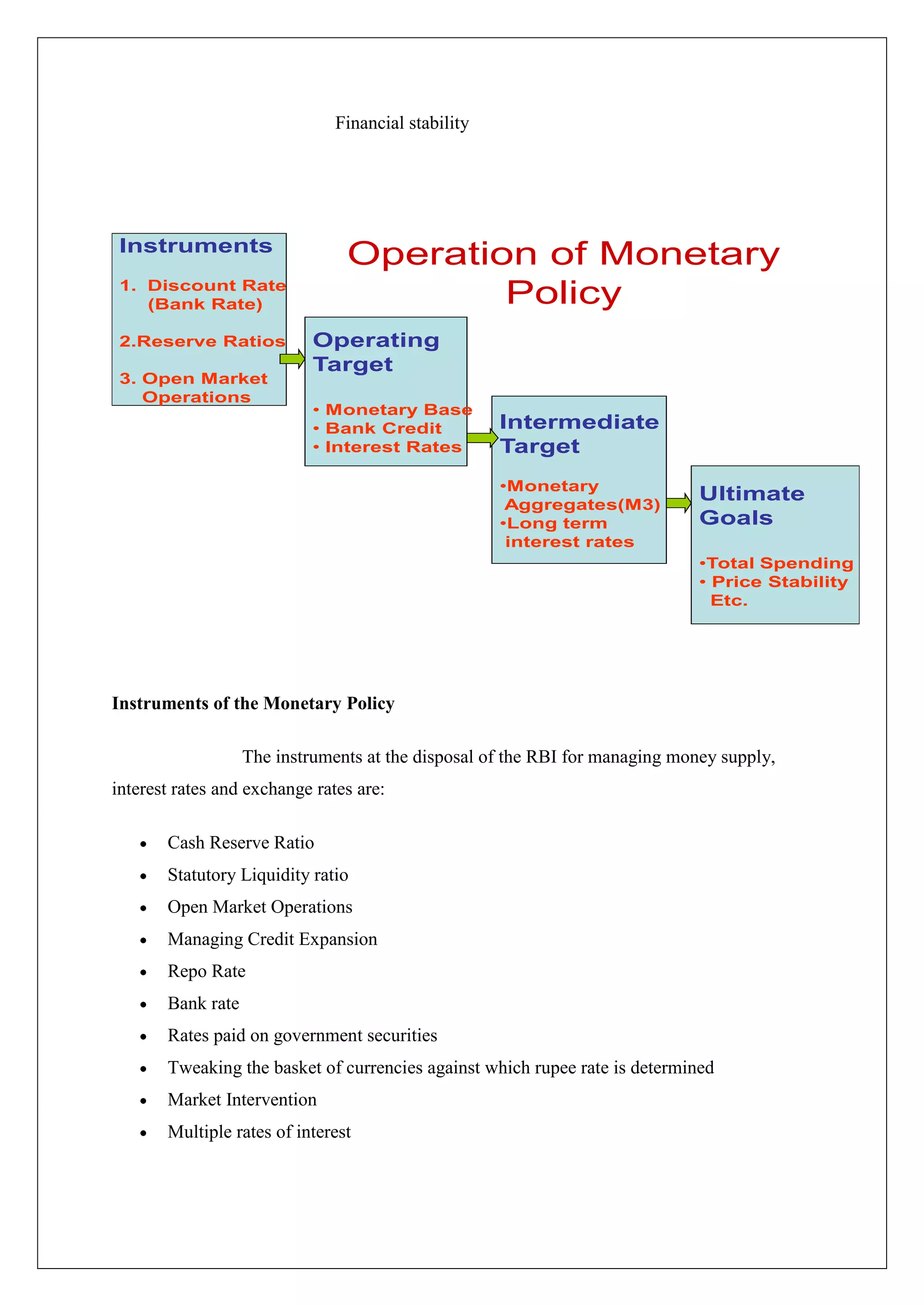
 Instruments
                                Operation of Monetary
 1. Discount Rate
    (Bank Rate)                         Policy
 2.Reserve Ratios           Operating
                            Target
 3. Open Market
    Operations
                            • Monetary Base
                            • Bank Credit            Intermediate
                            • Interest Rates         Target
                                                     •Monetary
                                                      Aggregates(M3)
                                                                              Ultimate
                                                     •Long term               Goals
                                                      interest rates
                                                                              •Total Spending
                                                                              • Price Stability
                                                                                Etc.


Instruments of the Monetary Policy

                   The instruments at the disposal of the RBI for managing money supply,
interest rates and exchange rates are:

       Cash Reserve Ratio
       Statutory Liquidity ratio
       Open Market Operations
       Managing Credit Expansion
       Repo Rate
       Bank rate
       Rates paid on government securities
       Tweaking the basket of currencies against which rupee rate is determined
       Market Intervention
       Multiple rates of interest
Cash Reserve Ratio:

                   Banks reserve liquidity through their power to create credit.
Presently in India, banks are required to maintain the following reserves:

    o   Cash Reserve ratio: 8.25% of demand and time deposits (w.e.f. 24.05.2008)
    o   Statutory Liquidity ratio: 25% of demand and time deposits

Just as additional cash inflows enable the banking system to create credit, any
increase in CRR will require the banking system to contract credit by a large amount.

Statutory Liquidity ratio

              SLR (Statutory Liquidity ratio) is a requirement peculiar to India. In
addition to ensuring that banks can fall back on the readily saleable government
deposits in the event of a run on the bank, it was a prescription to divert bank deposits
to meet government investment expenditure.


Open Market Operations:

              Banks as well as other financial institutions, such as insurance
companies, mutual funds and corporate with surplus cash are big investors in
government securities. When RBI wishes to inject liquidity into the market, it has
another option of buying government securities. When RBI offers to buy the
securities at a rate that is better than the rate prevailing in the market, some of the
investors can sell their holdings and the cash inflow would lead to credit creation of a
large magnitude.

Similarly, when RBI sells government securities at a higher rate than market rate, RBI
absorbs funds and the banking system contracts credit by a large magnitude to reduce
liquidity. This is known as open market operation.
Managing Credit Expansion:

           CRR and OMO reduce liquidity in the system and reduce the ability of
banks to create credit. RBI also controls sector specific expansion of credit by
specifying maximum amounts that can be lent, minimum margins to be maintained
and higher risk weights.

When RBI feels that banks have overextended themselves to certain sectors, the flow
of credit to certain sectors is leading to an imbalanced growth of the economy or it
wants to control the price of certain commodities by preventing hoarding by
wholesalers with borrowed funds, RBI makes sector specific or commodity specific
interventions.


Repo rate:

                 Repo rate or repurchase rate is a swap deal involving the immediate
sale of securities and simultaneous purchase of those securities at a future date, at a
designated price. It could also be an overnight deal with sale taking place on day one
and repurchase on day two. The repurchase price is adjusted for the interest payable
for the use of funds for the period of contract. Reverse repo involves the immediate
purchase and future sale of those same securities. RBI uses repo and reverse repo to
control liquidity on a day-to-day basis.

Bank rate:

             RBI provides refinance to banks against funds deployed by banks in
specified sectors such as export finance portfolio of the banks. In the past, the bank
rate used to be the primary interest rate tool of RBI. But over a period of time the repo
rate has presently emerged as the primary interest rate tool and bank rate has lost
much of its relevance. Changes in the bank rate are a signal to the market regarding
the direction in which the RBI would like interest rates to move.
Rates paid on government securities:

                       RBI, as a banker to the government, helps government to borrow
    from the market by selling their securities. RBI also determines the timing, size, and
    rate paid on the issues. Rates offered by RBI on government securities are both a
    reflection of the market and also an indicator to the market on the direction of interest
    rate movements.

    Tweaking the basket of currencies:

                      The exchange rate of rupee is calculated by RBI based on the
    exchange rates of basket of currencies of countries with which India has significant
    trade transactions. RBI maintains confidentiality about the weight age given to each
    currency in the basket and when RBI wishes to manage the extent of volatility in the
    exchange rate of rupee, RBI adjusts the weight ages properly.


    Market intervention:

                       Large balance of payment surpluses and build up of Forex reserves
    are bound to strengthen the rupee in the exchange market. This market force cannot
    be counted by RBI for long periods of time. However, by intervening in the market by
    offering to buy any amount of foreign currency at a particular rate, RBI can prevent
    the sudden strengthening of rupee. RBI seeks to smoothen the movement of rates in
    either direction so than importers and exporters have time to adjust to the changing
    exchange rate scenario and are not caught by surprise by violent rate movements,
    which could cripple them.

•   Multiple rates of interest –

           Under rbi fixes the credit quotas for various commercial bank.& commercial
    bank borrows funds from rbi within their quotas they are charges interest at bank
    rates. But if it is borrowed more than quotas then they are charged higher interest rates
    i.e. more than bank rates .
•   Policy rates, Reserve ratios, lending, and deposit rates as of 14 September, 2011


                                                  •   6.0%
•   Bank Rate

                                                  •   8.25%
•   Repo Rate

                                                  •   7.25%
•   Reverse Repo Rate

                                                  •   6.0%
•   Cash Reserve Ratio (CRR)

                                                  •   24.0%
•   Statutory Liquidity Ratio (SLR)

                                                  •   9.50%–10.75%
•   Base Rate

                                                  •   4%
•   Reserve Bank Rate

                                                  •   8.50%–9.50%
•   Deposit Rate
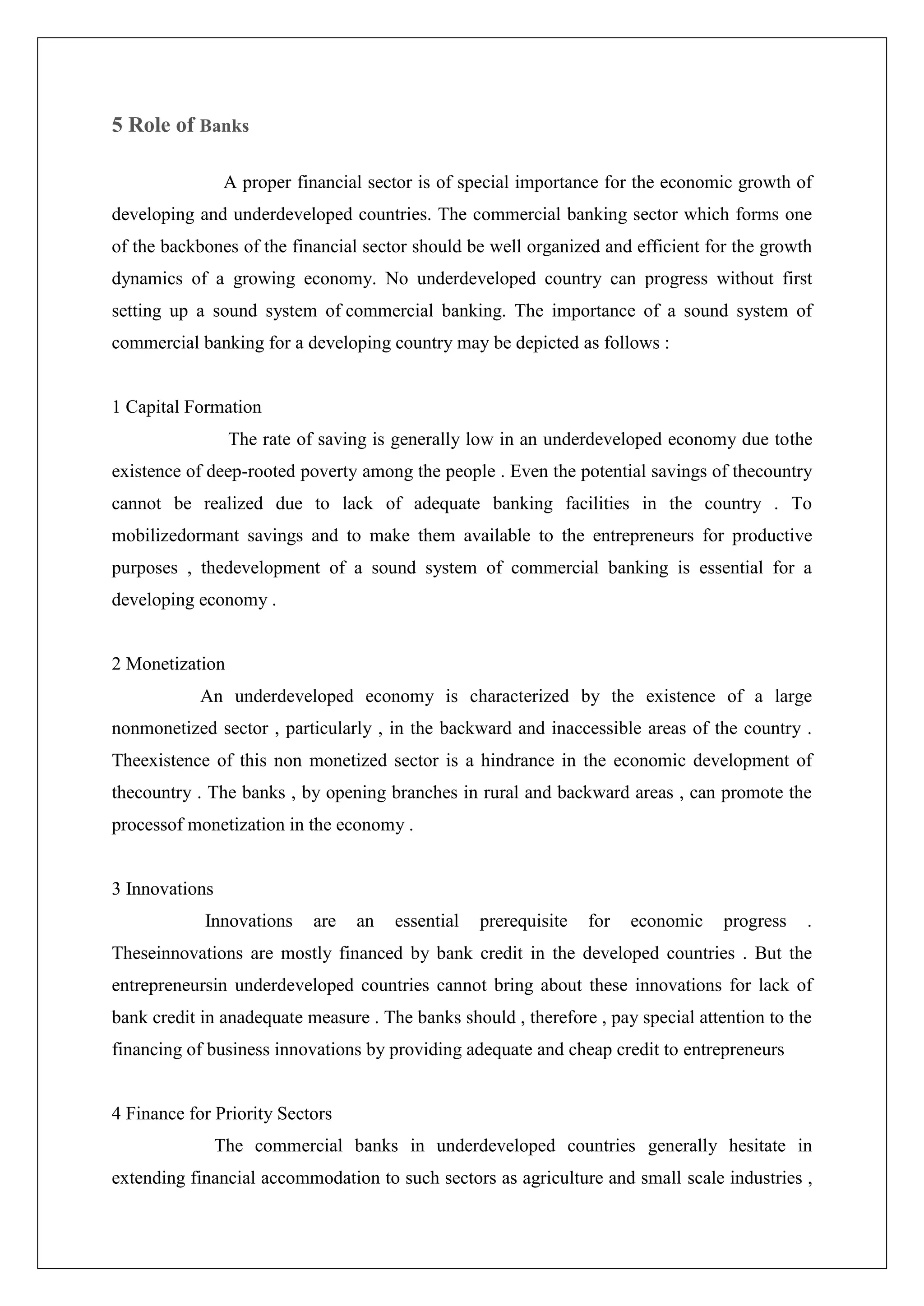
5 Role of Banks

                 A proper financial sector is of special importance for the economic growth of
developing and underdeveloped countries. The commercial banking sector which forms one
of the backbones of the financial sector should be well organized and efficient for the growth
dynamics of a growing economy. No underdeveloped country can progress without first
setting up a sound system of commercial banking. The importance of a sound system of
commercial banking for a developing country may be depicted as follows :


1 Capital Formation
                 The rate of saving is generally low in an underdeveloped economy due tothe
existence of deep-rooted poverty among the people . Even the potential savings of thecountry
cannot be realized due to lack of adequate banking facilities in the country . To
mobilizedormant savings and to make them available to the entrepreneurs for productive
purposes , thedevelopment of a sound system of commercial banking is essential for a
developing economy .


2 Monetization
            An underdeveloped economy is characterized by the existence of a large
nonmonetized sector , particularly , in the backward and inaccessible areas of the country .
Theexistence of this non monetized sector is a hindrance in the economic development of
thecountry . The banks , by opening branches in rural and backward areas , can promote the
processof monetization in the economy .


3 Innovations
            Innovations     are   an   essential   prerequisite   for   economic   progress   .
Theseinnovations are mostly financed by bank credit in the developed countries . But the
entrepreneursin underdeveloped countries cannot bring about these innovations for lack of
bank credit in anadequate measure . The banks should , therefore , pay special attention to the
financing of business innovations by providing adequate and cheap credit to entrepreneurs


4 Finance for Priority Sectors
                The commercial banks in underdeveloped countries generally hesitate in
extending financial accommodation to such sectors as agriculture and small scale industries ,
on account of the risks involved there in . They mostly extend credit to trade and commerce
where the risk involved is far less .But for the development of these countries it inessential
that the banks take risk in extending credit facilities to the priority sectors, such as agriculture
and small scale industries.


5 Provision for Medium and Long term Finance
                The commercial banks in underdeveloped countries invariably give loans and
advances for a short period of time . They generally hesitate to extend medium and long term
loans to businessmen. As is well known , the new business need medium and long term loans
for their proper establishment . The commercial banks should ,therefore , change their
policies in favor of granting medium and long term accommodation to business and industry .


6 Cheap Money Policy
                The commercial banks in an underdeveloped economy should follow cheap
money policy to stimulate economic activity or to meet the threat of business recession.
Infact , cheap money policy is the only policy which can help promote the economic growth
of an underdeveloped country . It is heartening to note that recently the commercial banks
have reduced their lending interest rates considerably .


7 Need for a Sound Banking System
                          A sound system of commercial banking is an essential prerequisite
for the economic development of a backward country .
6 Role of Banks in Indian Economy

                In India , as in many developing countries , the commercial banking sector
has been the dominant element in the country‘s financial system . The sector has performed
the key functions of providing liquidity and payment services to the real sector and has
accounted for the Bulk of the financial intermediation process . Besides institutionalizing
savings , the banking sector has contributed to the process of economic development by
serving as a major source of credit to households , government , business and to weaker
sectors of the economy like village and small scale industries and agriculture. Over the years,
over 30-40% of gross household savings , have been in the form of bank deposits and around
60% of the assets of all financial institutions accounted for by commercial banks. An
important landmark in the development of banking sector in recent years has been the
initiation if reforms following the recommendations of the first Narasimham Committee on
Financial System. In reviewing the strengths and weaknesses of these banks , the Committee
suggested several measures to transform the Indian banking sector from a highly regulated to
amore market oriented system and to enable it to compete effectively in an increasingly
globalised environment . Many of the recommendations of the Committee especially those
pertaining to Interest rate , an institution of prudential regulation and transparent accounting
norms were in line with banking policy reforms implemented by a host of developing
countries since 1970‟ s .
7. Growth of bank in India

Market Overview

The banking industry too has evolved rapidly over the last few years in India due to the
availability of cheaper technology and falling communication costs. De-regulation,
competition from non-financial players, new compliance requirements, and changing
customer expectations has added complexity and challenges to banking systems and
processes.

Banks, however, face an uphill task in reaching out to the customers in remote locations such
as villages. There is a lower level of literacy and access to Internet. Setting up branches
involves higher cost and operating expenses, and lower return on investment. Given the 742-
million rural population, the penetration of deposit accounts languishes at a deplorable 18 per
cent. (Source: Extending Banking to the poor in India‖, Amit Singhal and Bikram Duggal,
ICICI Bank).

Qualitative growth :

The growth of banking in the coming years is likely to be more qualitative than quantitative,
according to the report. Based on the projections made in the "India Vision 2020" prepared
by the Planning Commission and the Draft 10th Plan, the report forecasts that the pace of
expansion in the balance-sheets of banks is likely to decelerate.

The total assets of all scheduled commercial banks by end-March 2010 is estimated at Rs 40,
90,000 crore. That will form about 65 per cent of GDP at current market prices as compared
to 67 per cent in 2002-03. Banks assets are expected to grow at an annual composite rate of
growth of 13.4 per cent during the rest of the decade against 16.7 per cent between 1994-95
and 2002-03.

On the liability side, there is likely to be large additions to capital base and reserves. As the
reliance on borrowed funds increases, the pace of deposit growth may slow down. On the
asset side, the pace of growth in both advances and investments is forecast to weaken.
The high GDP growth in India is creating lots of job opportunities in urban and semi-urban
India and it will go further into rural India — increasing the potential for rural
entrepreneurships and rural growth with higher per-capita income and savings opportunities.

Investment in Indian market

India, among the European investors, is believed to be a good investment despite political
uncertainty, bureaucratic hassles, shortages of power and infrastructural deficiencies. India
presents a vast potential for overseas investment and is actively encouraging the entrance of
foreign players into the market. No companies, of any size, aspiring to be a global player can,
for long ignore this country which is expected to become one of the top three emerging
economies.

Market potential:

India is the fifth largest economy in the world (ranking above France, Italy, the United
Kingdom, and Russia) and has the third largest GDP in the entire continent of Asia. It is also
the second largest among emerging nations. (These indicators are based on purchasing power
parity.) India is also one of the few markets in the world which offers high prospects for
growth and earning potential in practically all areas of business. Yet, despite the practically
unlimited possibilities in India for overseas businesses, the world's most populous democracy
has, until fairly recently, failed to get the kind of enthusiastic attention generated by other
emerging economies such as China.


2.2 Trend Analysis

Financial And Banking Sector Reforms

The last decade witnessed the maturity of India's financial markets. Since 1991, every
governments of India took major steps in reforming the financial sector of the country. The
important achievements in the following fields is discussed under separate heads:

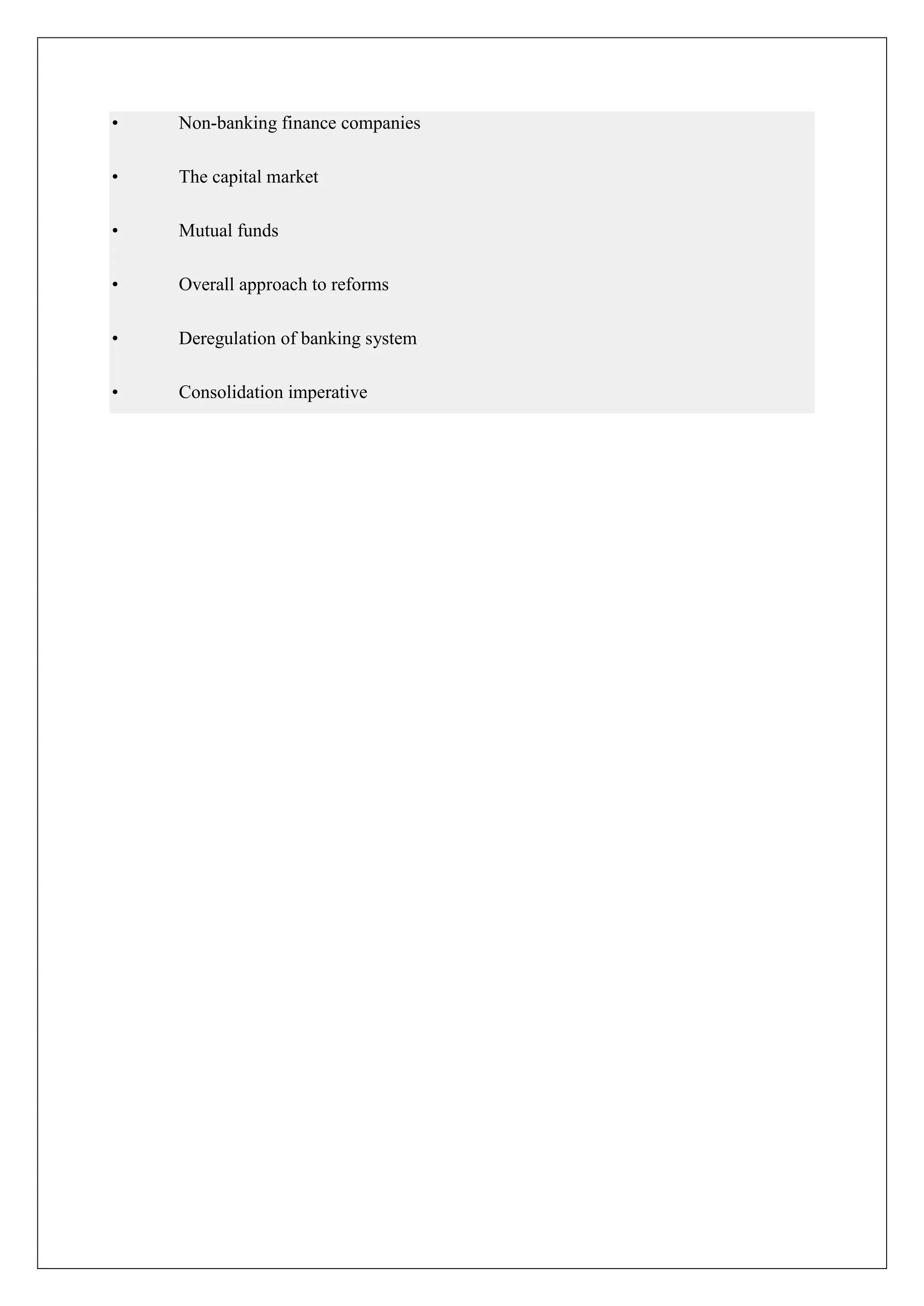
•        Financial markets

•        Regulators
•   Non-banking finance companies

•   The capital market

•   Mutual funds

•   Overall approach to reforms

•   Deregulation of banking system

•   Consolidation imperative
8 . India's GDP Growth to make the Indian Banking Industry third largest
in the World by 2025

               A study titled Being five star in productivity — road map for excellence in
Indian banking was released FICCI-IBA-BCG on 22 August 2011, the eve of IBA-FICCI
annual banking conference. The theme for the banking conference was decided to be
Productivity Excellence.

            According to the study, India's gross domestic product (GDP) growth will make
the Indian banking industry third largest in the world by 2025. The report chalked out an
action agenda for banks, based on insights from an extensive productivity benchmarking
exercise conducted across 40 banks.

              The report highlighted that banks have to strive for excellence on five
dimensions: branch sales and service, new channels, lean operations, organisation design and
bad debt management.

            The report stated that branches of banks can generate higher levels of revenue for
the banks. Indian banks deploy 62 per cent of staff in customer facing roles as against the
benchmark of 82 per cent observed by BCG globally.

            Break-out growth in usage of new channels will characterise the next decade in
Indian banking. Among the new channels, mobile phones, propelled by 3G and smart phone
technology, will emerge as an undisputed winner by 2020 accounting for 20-30 per cent of
total transactions. ATMs have seen exponential growth in usage but are far from maturity
with just about 50 per cent adoption even in metros. New channels will not only enhance the
productivity but can be a source of new customer acquisition.Indian banks, the report
mentioned were to be doing well overall with industry cost-income ratio below 50 per cent.

             However, there remained plenty of scope for betterment. On an average, Indian
banks have about 20 per cent of staff deployed in back-office processing (for some banks, as
high as 40 per cent) as against a global best of 10 per cent observed by BCG. Process re-
engineering and operating model change if employed could help reduce costs, improve
service, and contain operating risks.

           Public sector banks were found to be under-investing in technology with spends at
about 25 per cent of global benchmarks. An Indian banks average administrative overhead at
about 11 per cent of the total staff is in line with what BCG has observed globally.

                The banking industry was holding low headcount in HR and finance roles.
Variable pay at 2 per cent of fixed compensation is far below the 12-15 per cent that is
optimal for incentive compensation. The public sector as per the report urgently needed an
adjustment in its compensation structure. The industry has an impressive bad debt
performance and the bad debt levels in priority sectors of MSME and agriculture are
significantly                                                                          high.
The report suggested major overhaul of NPA management processes at banks. Some banks
have alarmingly high NPA levels in relatively safe products such as home loans.

           The report stressed on a whole new paradigm for risk management encompassing
operating model, technology, experience and expertise retention, and minimum critical size
of book.
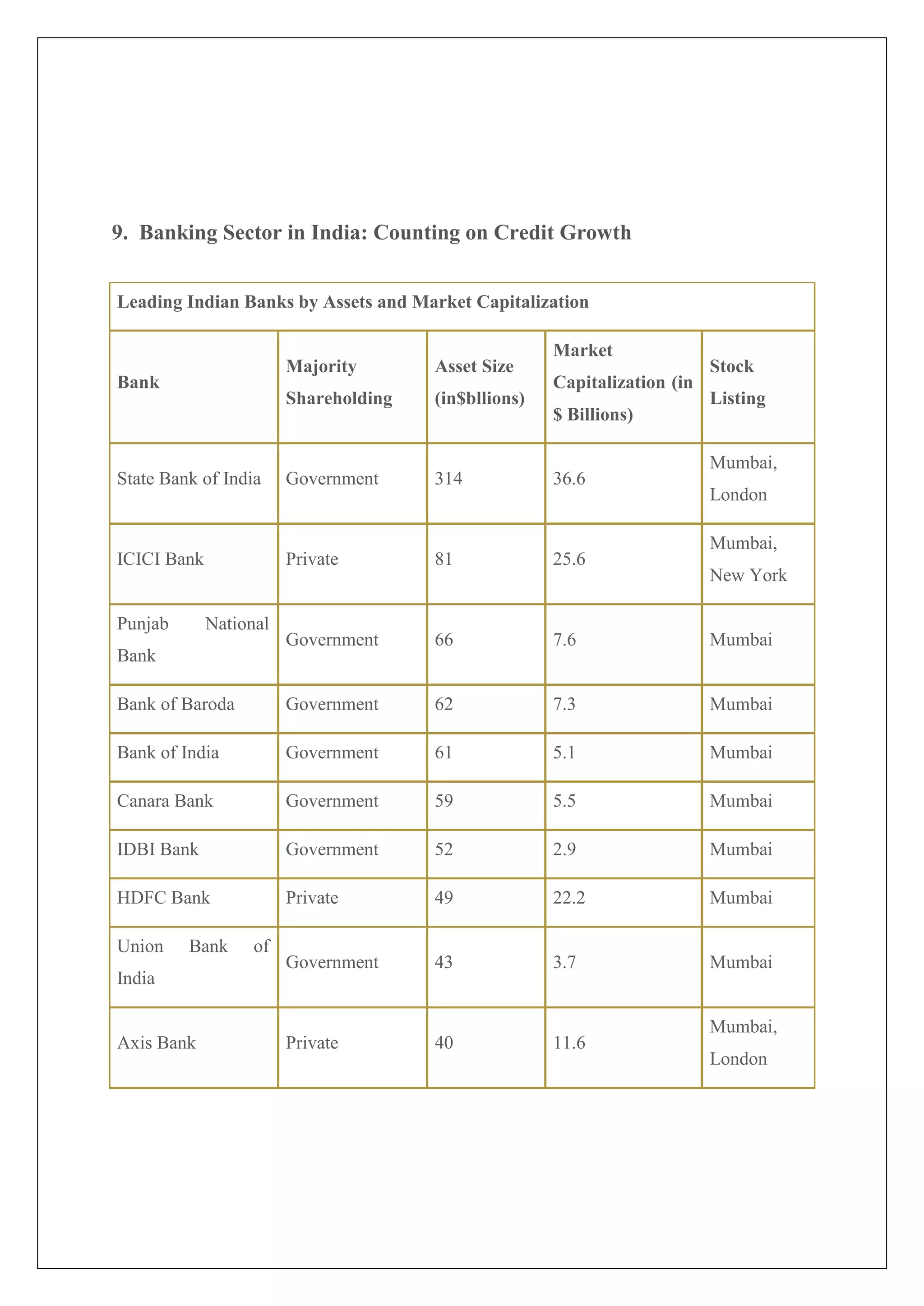
9. Banking Sector in India: Counting on Credit Growth


Leading Indian Banks by Assets and Market Capitalization

                                                      Market
                        Majority       Asset Size                          Stock
Bank                                                  Capitalization (in
                        Shareholding   (in$bllions)                        Listing
                                                      $ Billions)

                                                                           Mumbai,
State Bank of India     Government     314            36.6
                                                                           London

                                                                           Mumbai,
ICICI Bank              Private        81             25.6
                                                                           New York

Punjab       National
                        Government     66             7.6                  Mumbai
Bank

Bank of Baroda          Government     62             7.3                  Mumbai

Bank of India           Government     61             5.1                  Mumbai

Canara Bank             Government     59             5.5                  Mumbai

IDBI Bank               Government     52             2.9                  Mumbai

HDFC Bank               Private        49             22.2                 Mumbai

Union    Bank      of
                        Government     43             3.7                  Mumbai
India

                                                                           Mumbai,
Axis Bank               Private        40             11.6
                                                                           London
10. Banking reform


Indian banking has come a long way since India embarked on the reforms path about a
decade-and-a-half ago in 1991-92. The reforms have unleashed tremendous change in the
banking sector. Today, Indian banks are as technology-savvy as their counterparts in
developed countries. On the networking front, branch banking – the traditional forte, coupled
with ATM networks-the now imperative, have evolved to place the banking services on a
new trajectory. The competitive forces have led to the emergence of Internet and mobile
banking too, to let banks attract and retain customers.
The banking sector is also gearing up to embrace the Basel II regime, to benchmark with the
global standards. Similarly, retail lending has emerged as another major opportunity for
banks. All these factors are driving up competition, which in turn forcing banks to innovate.
A slew of innovative products, which could not be imagined even a couple of years ago, are a
reality now. Even mundane products like Saving Account, Personal Loans and Home Loans
have become subjects of innovation.
1.First Banking Sector Reforms (1991)
The Narasimham Committee had proposed wide-ranging reforms for:
1. Improving the financial viability of the banks;
2. Improving the macroeconomic policy framework for banks;
3. Increasing their autonomy from government directions;
4. Allowing a greater entry to the private sector in banking;
5. Liberalizing the capital markets;
6. Improvement in the financial health and competitive position of the banks;
7. Furthering operational flexibility and competition among the financial institutions.


A number of reforms initiatives have been taken to remove or minimize the distortions
impinging upon the efficient and profitable functioning of banks. These include the
followings:
1. Reduction in SLR & CRR
2. Transparent guidelines or norms for entry and exit of private sector banks
3. Public sector banks have been allowed for direct access to capital markets
4. The regulated interest rates have been rationalized and simplified.
5. Branch licensing policy has been liberalized
6. A board for Financial Bank Supervision has been established to strengthen the supervisory
system of the RBI.


These and other measures that have been taken would help the highly regulated and directed
banking system to transform itself into one characterized by openness, competition,
prudential and supervisory discipline. They will also make the new challenges particularly
the growing demands from customers for high quality 56 services. The objective of this is to
study, describe and analyze the impact of banking sector reforms on the performance of
commercial banks. On the basis of the impact of these reforms, to suggest third new modified
reforms in the changing scenario.
2. Second Banking Sector Reforms (1998)
By mid-1997, the RBI reported that the reform process had started yielding results. But as
observed by the NC in its second report, the improvement has arrested the deterioration of the
system earlier but there is still a considerable distance to traverse. There has been
improvement in several of the quantitative indices but there are many areas in which
weaknesses still persist. These include customer service, technological up gradation,
improvement in house keeping in terms of reconciliation of entries and balancing of books.
The second report was submitted on 23rd April, 1998, which sets the pace for the second
generation of banking sector reforms. These include:
1. Merge strong banks, close weak banks unviable ones
2. Two or three banks with international orientation, 8 to 10 national banks and a large
number of local banks
3. Increase Capital Adequacy to match enhanced banking risk
4. Rationalize branches and staff, review recruitment
5. De-politicize Bank Boards under RBI supervision
6. Integrate NBFCs activities with banks.


But many cities saw no purpose in setting up the second NC on banking sector reforms within
six years and before the full implementation of the recommendations of the first report of
1991. Strictly speaking, there were no new recommendations made in the second report
except two on:
1. Merger of strong units of banks
2. Adaptation of the ―narrow banking‖ concept to rehabilitate the weak banks.


Various reform measures introduced in India have indeed strengthened the Indian banking
system in preparation for the global challenges ahead.
Some of the reforms introduced and their impact on banks and furnished in the table (Indian
banking on the reforms path)
After the brief introduction of theme, section II fixes the objectives, hypotheses and
methodology along with the database. Section III reviews the related studies and section IV
highlights the major issues faced by Indian banking sector. Section V analyses the results and
discussions whereas section VII exhibits the future agenda for the third reforms and
concludes the paper.
11 .Top Banking Companies in India


  •   Banking in India began in the year 1786 with the establishment of the General Bank
      of India and later Bank of Hindustan came into existence. However, these two banks
      are not currently functioning in India.
  •   At present, the oldest bank in India position is held by the State Bank of India, which
      came into existence in the year 1806. Now, not only public sector banks, but a number
      of private sector banks are also functioning in India. The list of leader in the banking
      sector is given below:
  •   Top ten banks in India:
  •   State Bank of India
  •   HDFC Bank
  •   Axis Bank
  •   Bank of India
  •   Punjab National Bank
  •   Bank of Baroda
  •   ICICI Bank Limited
  •   Union Bank of India
  •   Citibank
  •   Canara Bank
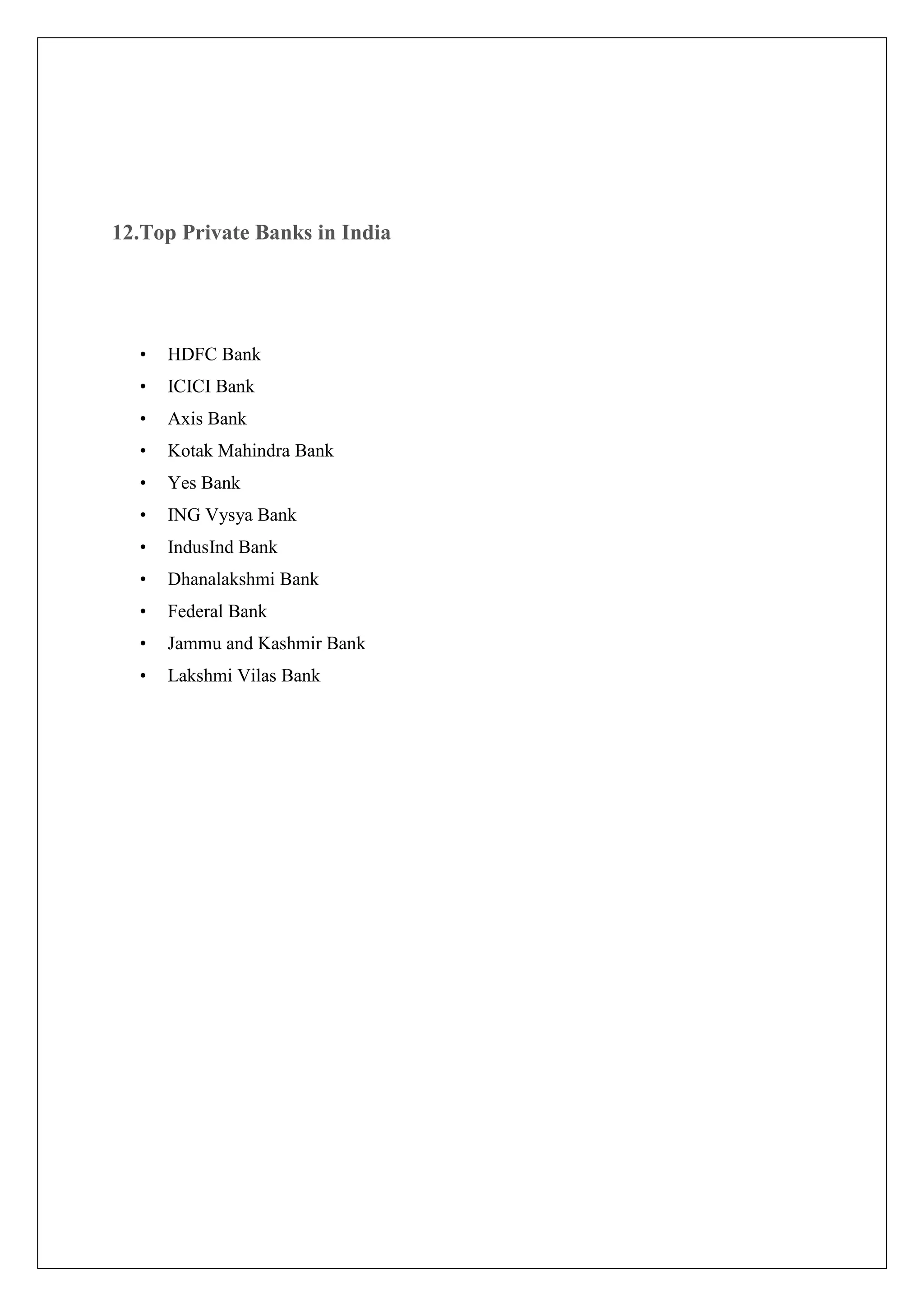
12.Top Private Banks in India


  •   HDFC Bank
  •   ICICI Bank
  •   Axis Bank
  •   Kotak Mahindra Bank
  •   Yes Bank
  •   ING Vysya Bank
  •   IndusInd Bank
  •   Dhanalakshmi Bank
  •   Federal Bank
  •   Jammu and Kashmir Bank
  •   Lakshmi Vilas Bank
13. Punch lines of banks in India


      1. Union Bank of India --      Good people to bank with


      2.   Indian Overseas Bank --   Good people to grow with


      3. Syndicate Bank --           Your Faithful and Friendly Financial Partner


      4. Federal Bank --             Your Perfect Banking Partner


      5. United Bank of India --      The Bank that begins with U


      6.   HDFC --                   We Understand Your World


      7. Bank Of Baroda --            India's International Bank


      8.   Yes Bank --                 Experience our expertise


      9. Allahabad Bank --            A tradition of trust


      10. Bank of India --                Relationships beyond Banking
11. Oriental Bank of Commerce -- where every individual is committed


12.   Dena Bank --                 Trusted Family Bank


13. Indian Bank --         Taking Banking Technology to Common Man


14. IDBI Bank --     Banking for all; not just for Big boys; "Aao Sochein Bada"


15. Canara Bank -- it's easy to change for those who you love; Together we can do...


16. Vijaya Bank --             A Friend You can Bank Upon


17. Punjab National Bank --      A Name you can Bank Upon


18. Central Bank of India --          Build A Better Life Around Us


19. J & K Bank --                    Serving to Empower


20. ICICI Bank --                    "Hum Hai na..."


21. Andhra Bank --                Much more to do. With YOU in focus


22. Bank of Rajasthan --              Together we Prosper
23. SBI Bank - Nations banks on us; Pure Banking Nothing Else; With you all the
way.


24. Lakshmi Vilas Bank --            The Changing Face of Prosperity


25. UCO Bank --                         Honours Your Trust


26. Karur Vysya Bank --                 Smart way to Bank


27. South Indian Bank --       Experience Next Generation Banking
14. CMDs & CEOs of Banks in India 2011

                            (As of 20.11.2011)
         SBI & Associates

         State Bank of India              Pratip Chaudhuri, CMD

         State Bank of Bikaner And
                                          Shiv Kumar,MD
         Jaipur

         State Bank of Hyderabad          M Bhagavantha Rao,MD

         State Bank of Mysore             Dilip Mavinkurve,MD

         State Bank of Patiala            Ashok Nayar,MD

         State Bank of Travancore         P. Nanda Kumaran,MD

         Nationalised Banks

         Allahabad Bank                   J. P. Dua,CMD

         Andhra Bank                      R. Ramchandran,CMD

         Bank of Baroda                   M D. Mallya,CMD

         Bank of India                    Alok Kumar Mishra,CMD

         Bank of Maharashtra              Anup Sankar Bhattacharya,CMD

         Canara Bank                      S Raman,CMD

         Central Bank of India            M.V.Tanksale,CMD

         Corporation Bank                 Ajai Kumar,CMD

         Dena Bank                        Smt. Nupur Mitra,CMD

         IDBI Bank Ltd                    R. M. Malla,CMD
Indian Bank                 T. M. Bhasin,CMD

Indian Overseas Bank        M.Narendra,CMD

Oriental Bank of Commerce   Nagesh Pydah,CMD

Punjab And Sind Bank        Devendra Pal Singh, IAS,CMD

Punjab National Bank        K. R. Kamath,CMD

Syndicate Bank              Basant Seth,CMD

UCO Bank                    Arun Kaul,CMD

Union Bank of India         M. V. Nair,CMD

United Bank of India        Bhaskar Sen,CMD

Vijaya Bank                 H.S Upendra Kamath,CMD

Private Banks

Axis Bank                   Smt. Shikha Sharma,MD & CEO

Catholic Syrian Bank        Shri.V.P Iswardas ,MD & CEO

City Union Bank             Balasubramanian S,

Development Credit Bank     Murali M. Natrajan,MD & CEO

Dhanalakshmi Bank           Amitabh Chaturvedi,MD & CEO

Federal Bank                Shyam Srinivasan,MD & CEO

HDFC Bank                   Adtya Puri, MD & CEO

ICICI Bank                  Smt Chanda Kochar, MD & CEO

Indusind Bank               Romesh Sobti, MD & CEO

ING Vysya Bank              Shailendra Bhandari, MD & CEO

Jammu & Kashmir Bank        Mushtaq Ahmad, MD & CEO
Karnataka Bank             P. Jayarama Bhat, MD & CEO

Karur Vysya Bank           K. Venkataraman, MD & CEO

Kotak Mahindra Bank        Uday Kotak , MD

Lakshmi Vilas Bank         P.R. Somasundaram, MD

Nainital Bank              Animesh Chauhan,Chairman CEO

Ratnakar Bank              Vishwavir Ahuja, MD & CEO

South Indian Bank          Dr.V.A.JOSEPH, MD & CEO

                           Thiru A.K. Jagannathan, MD &
Tamilnad Mercantile Bank
                           CEO

                           Rana Kapoor, Founder/MD &
Yes Bank's Ltd
                           CEO

Foreign Banks : Country
Heads India

                           Pramit Jhaveri, Citi Country
City Bank
                           Officer, India

                           Naina Lal Kidwai,Country Head,
HSBC Bank
                           HSBC

                           Sunil Kaushal, chief of India
Standard Chartered Bank
                           operations
15. Logos of bank in India
City union bank   development credit bank
Nainital bank
16. Merger &Acquisition of banks in India after 1991
17. Career Opportunities in Banking

Banking is one of the most sought after career choice among the students. It is an entry into a
well paid, secure and status career. Though it may appear that these jobs are meant for
commerce/economics students but the fact is that majority of bank officers are from different
streams of education. Further, it is also not a fact that top positions in Foreign/Multinational
Banks are held by MBA's from Premier Management Institutes. Though the Public sector
Banks are now appointing management graduates, CAs and CFAs but bright graduates from
any subject can get entry in the Public sector Banks through an All India Examination
conducted by them.

The emergence of technology-driven new private banks have broadened the scope and range
of banking service and entry of Financial Institutions are into the short-term lending business,
is resulting in needs for more professionals. Now banks are in the mutual funds ,
securitisation business credit cards, consumer loans, housing loans, housing loans besides
trading in gold and forex activities.

Generally banks look for good communication skills, good interpersonal skills, the ability to
deal with customers, an alert nature, and basic knowledge of the industry. However to join
foreign or private sector banks at higher than entry level one needs specialisation in some
specific areas. For example expertise in project analysis, credit appraisal skills, managing
huge loan portfolios general and foreign exchange and money .Good computer knowledge is
always preferred.

There are front office personnel in all banks, and then there are supervisors who handle most
back office operations like completion of transactions, general ledger work, overall
supervision.Banks are now offering good salary packages. Most Public sector officers can
begin in the Rs 6000-8000 per month scale. MBAs recruited by private and foreign banks are
given plum packages to the extent of about Rs 25000-30000 a month.


 Bank job Openings India
Indian professionals have many growth opportunities in the Banking Jobs in
  India Sector. With the right qualification, enthusiasm and dedication, Indian
  professionals have made an indelible impression on the global scenario. The Banking
  Jobs in India sector offers opportunities galore for Indian professionals. It has been
  predicted that the opportunities both on the national and global front, are going to
  increase specially for banking tellers and other administrative support International
  Banking Jobs. A study has projected that there will be an increase of 16 % between
  2005 to 2012 in the employment in the International Banking Jobs sector.

          There will be a boom in the banking sector with the increase in
  thetechnology and population all over the world. Opportunities Galore

     In the banking sector, the bank personnel are employed at 2 levels :


   CLERICAL: This level entails the maintenance of the account books and the
  documents, and attend to customers at the counter.


  MANAGERIAL :The duties include organizing, controlling and supervising Bank Job
  Openings India activities and holding overall charge of one or more departments or
  branches.


* Duties of workers in specialized areas are :


  Personnel - recruiting and training staff, planning career development of
  trainees, advising students about careers in banking;


  Marketing - designing campaigns to promote new and existing services, researching
  customers' banking habits to find new opportunities for the bank;


  Operations - processing transactions and loans, researching new technology or
  different working methods to increase the bank's efficiency;


  Electronic Services- writing a new section on the bank's website, developing
  interactive digital TV banking services;
Card Services- authorizing and issuing cards, managing transactions;


       Credit and Risk- analyzing loans and deciding whether to approve them.


       The various Occupations in the Industry are :


       Management, business, and financial occupations


Chief executives

General and operations managers
Marketing and sales managers
Computer and information systems managers
Financial managers
Human resources, training, and labor relations specialists
Management analysts
Accountants and auditors
Credit analysts
Financial analysts
Personal financial advisors
Loan counselors
Loan officers
Professional and related occupations

     Computer programmers
     Computer software engineers
     Computer support specialists
     Computer systems analysts


Sales and related occupations


       Securities, commodities, and     financial
       services sales agents


Office and administrative support occupations

       First-line supervisors/managers of office
       and administrative support workers
       Bill and account collectors
       Bookkeeping, accounting, and auditing
       clerks
       Tellers
       Credit authorizers, checkers, and clerks
       Customer service representatives
       Loan interviewers and clerks
       New accounts clerks
       Executive secretaries and administrative
       assistants
       Secretaries, except legal, medical, and
       executive
Office clerks, general


The Eligibility Criteria


The international recruiters are very particular when it comes to qualifications. The candidate
needs to be a graduate from a wide range of degree subjects. For specialist roles within a
bank, a candidate could be a graduate in the following disciplines:
       Economics
       Business studies
       Banking and finance
       Financial services
       Computing.
banking industry in india

banking industry in india

  • 1.
  • 2.
    INDEX Sr no. Particulars Page no. 1 Introduction 1.1 Industry definition 1.2 History of Banking in India 1.3 Bank Definition 1.4 Banking definition 2 Types of bank 2.1 Central bank 2.2 Commercial Banks a Public Sector Banks b Private Sectors Banks c Foreign Banks d Development Banks 2.3.Co-operative Banks 2.4 Scheduled Banks 2.5 Non-scheduled bank in India 3 Banking products & services 3.1 Primary functions a) Accepting deposits 1 Types of Bank Accounts I Checking Account/ current a/c II Savings Account III Money Market Account IV Certificate of Deposit/ fixed V Recurring deposit a/c b) Granting loans and advances
  • 3.
    I Loans II Advances i Cash Credit ii Overdraft iii Discounting of Bills 3.2 Secondary functions 3.3 Online banking 3.4 Mobile Banking Services 4 Reserve Bank of India 4.1 R.B.I profile. 4.2 Major RBI Functions 5 Role of Banks 6 Role of Banks in Indian Economy 7 Growth of bank in India 8 India's GDP Growth to make the Indian Banking Industry third largest in the World by 2025 9 Banking Sector in India: Counting on Credit Growth 10 Banking reform 11 Top Banking Companies in India
  • 4.
    12 Top Private Banks in India 13 Punch lines of banks in India 14 CMDs & CEOs of Banks in India 2011 15 Logos of bank in India 16 Merger &Acquisition of banks in India after 1991 17 Career Opportunities in Banking
  • 5.
    1 Banking Industryin India 1.1Industry definition: The Banking industry comprises of segments that provide financial assistance and advisory services to its customers by means of varied functions such as commercial banking, wholesale banking, personal banking, internet banking, mobile banking, credit unions, investment banking and the like. With years, banks are also adding services to their customers. The Indian banking industry is passing through a phase of customers market. The customers have more choices in choosing their banks. A competition has been established within the banks operating in India. With stiff competition and advancement of technology, the services provided by banks have become more easy and convenient. The past days are witness to an hour wait before withdrawing cash from accounts or a cheque from north of the country being cleared in one month in the south. Banks are among the main participants of the financial system in India. Banking offers several facilities & Opportunities. This section provides comprehensive and updated information, guidance and assistance in all areas of banking in India. Bank of Hindustan, set up in 1870, was the earliest Indian Bank . Banking in India on modern lines started with the establishment of three presidency banks under Presidency Bank's act 1876 i.e. Bank of Calcutta, Bank of Bombay and Bank of Madras. The commercial banking structure in India consists of: Scheduled Commercial Banks & Unscheduled Banks. Banking Regulation Act of India, 1949 defines Banking as "accepting, for the purpose of lending or investment of deposits of money from the public, repayable on demand or otherwise and withdrawable by cheques, draft, order or otherwise."
  • 6.
    The arrival offoreign and private banks with their superior state-of-the-art technology-based services pushed Indian Banks also to follow suit by going in for the latest technologies so as to meet the threat of competition and retain customer base. The evolution of IT services outsourcing in the Indian banks has presently moved on to the level of Facilities Management (FM). Banks now looking at business process management (BPM) to increase returns on investment, improve customer relationship management (CRM) and employee productivity. For, these entities sustaining long-term customer relationship management (CRM) has become a challenge with almost everyone in the market with similar products Industry Segments: Public Sector Banks: Almost 80% of the business is still controlled by Public Sector Banks (PSBs). PSBs are still dominating the commercial banking system. Shares of the leading PSBs are already listed on the stock exchanges. The PSBs will play an important role in the industry due to its number of branches and foreign banks facing the constraint of limited number of branches. Hence, in order to achieve an efficient banking system, the onus is on the Government to encourage the PSBs to be run on professional lines. Private Sector Banks: The RBI has given licenses to new private sector banks as part of the liberalization process. The RBI has also been granting licenses to industrial houses. Many banks are successfully running in the retail and consumer segments but are yet to deliver services to industrial finance, retail trade, small business and agricultural finance.
  • 7.
    Foreign banks: Foreign bankshave been operating in India for decades with a few of them having operations in India for over a century. The number of foreign bank branches in India has increased significantly in recent years since RBI issued a number of licenses - well beyond the commitments made to the World Trade Organization. The presence of foreign banks in India has benefited the financial system by enhancing competition, resulting in higher efficiency. There has also been transfer of technology and specialized skills which has had some "demonstration effect" as Indian banks too have upgraded their skills, improved their scale of operations and diversified into other activities. At a time when access to foreign currency funds was a constraint for the Indian companies, the presence of foreign banks in India enabled large Indian companies to access foreign currency resources from the overseas branches of these banks. Also with the presence of foreign banks, as borrowers in the money market and their operation in the foreign exchange market has resulted in the creation and deepening of the inter-bank money market. Now, it is the challenge for the supervisors to maximize the advantages and minimize the disadvantages of the foreign banks' local presence. 1.2 History of Banking in India Banking in India originated in the last decades of the 18th century. The first banks were The General Bank of India, which started in 1786, and Bank of Hindustan, which started in 1790; both are now defunct. The oldest bank in existence in India is the State Bank of India, which originated in the Bank of Calcutta in June 1806, which almost immediately became the Bank of Bengal. This was one of the three presidency banks, the other two being the Bank of Bombay and the Bank of Madras, all three of which were established under charters from the British East India Company. For many years the Presidency banks acted as quasi-central banks, as did their successors. The three banks merged in 1921 to form the Imperial Bank of India, which, upon India's independence, became the State Bank of India in 1955. A bank is a financial institution and a financial intermediary that accepts deposits and channels those deposits into lending activities, either directly or through capital markets. A bank connects customers with capital deficits to customers with capital surpluses.
  • 8.
    1.3 Bank Definition Definitionof a bank varies from country to country. See the relevant country page (below) for more information. 1. Under English common law, a banker is defined as a person who carries on the business of banking, which is specified as:[6] conducting current accounts for his customers paying cheques drawn on him, and Collecting cheques for his customers. 2. A corporation empowered to deal with cash, domestic and foreign, and to receive the deposits of money and to loan those monies to third-parties. 3. In 1899, the United States Supreme Court (Austen) used these words to define a bank: "A bank is an institution, usually incorporated with power to issue its promissory notes intended to circulate as money (known as bank notes); or to receive the money of others on general deposit, to form a joint fund that shall be used by the institution, for its own benefit, for one or more of the purposes of making temporary loans and discounts; of dealing in notes, foreign and domestic bills of exchange, coin, bullion, credits, and the remission of money; or with both these powers, and with the privileges, in addition to these basic powers, of receiving special deposits and making collections for the holders of negotiable paper, if the institution sees fit to engage in such business." 4. An establishment authorized by a government to accept deposits, pay interest, clear checks, make loans, act as an intermediary in financial transactions, and provide other financial services to its customers. 5. Bank is a lawful organization, which accepts deposits that can be withdrawn on Demand. It also lends money to individuals and business houses that need it.
  • 9.
    1.4Banking definition In generalterms, the business activity of accepting and safeguarding money owned by other individuals and entities, and then lending out this money in order to earn a profit. ‗Banking‘ as an activity involves Acceptance of deposits and lending or investment of money. It facilitates business activities by Providing money and certain services that help in exchange of goods and services. Therefore,Banking is an important auxiliary to trade. It not only provides money for the production of Goods and services but also facilitates their exchange between the buyer and seller. 2 Types of bank There are various types of banks which operate in our country to meet the financial requirements Of different categories of people engaged in agriculture, business, profession, etc. On the basis of Functions, the banking institutions in India may be divided into the following types: 2.1 Central bank A central bank, reserve bank, or monetary authority is a public institution that manages the nation's currency, money supply, and interest rates. Central banks
  • 10.
    also usually overseethe commercial banking system of their respective countries. In contrast to a commercial bank, a central bank possesses a monopoly on increasing the nation's monetary base, and usually also prints the national currency, which usually serves as the nation's legal tender.[1][2] Examples include the European Central Bank (ECB), the Federal Reserve of the United States, and the People's Bank of China.[3] The primary function of a central bank is to manage the nation's money supply (monetary policy), through active duties such as managing interest rates, setting the reserve requirement, and acting as a lender of last resort to the banking sector during times of bank insolvency or financial crisis. Central banks usually also have supervisory powers, intended to prevent commercial banks and other financial institutions from reckless or fraudulent behavior. Central banks in most developed nations are institutionally designed to be independent from political interference. 2.2 Commercial Banks Commercial Banks are banking institutions that accept deposits and grant short-term loans and Advances to their customers. In addition to giving short-term loans, commercial banks also give Medium-term and long-term loan to business enterprises. Now-a-days some of the commercial Banks are also providing housing loan on a long-term basis to individuals. There are also many Other functions of commercial banks, which are discussed later in this lesson. Types of Commercial banks: Commercial banks are of three types i.e., Public sector banks, Private sector banks and foreign banks. (i) Public Sector Banks: These are banks where majority stake is held by the Government of India or Reserve Bank of India. Examples of public sector banks are: State Bank of India,
  • 11.
    Nationalized banks Name Allahabad Bank AndhraBank Bank of Baroda Bank of India Bank of Maharashtra Canara Bank Central Bank of India Corporation Bank Dena Bank Indian Bank Indian Overseas Bank Oriental Bank of Commerce Punjab & Sind Bank Punjab National Bank State Bank of India State Bank of Mysore State Bank of Patiala State Bank of Travancore
  • 12.
    Syndicate Bank UCO Bank UnionBank of India United Bank of India Vijaya Bank Their public sector banks IDBI Bank Dhanlaxmi Bank Jammu & Kashmir Bank Nainital Bank Lakshmi Vilas Bank South Indian Bank (ii) Private Sectors Banks: In case of private sector banks majority of share capital of the Bank is held by private individuals. These banks are registered as companies with limited Liability. For example: The Jammu and Kashmir Bank Ltd., Bank of Rajasthan Ltd., Development Credit Bank Ltd, Lord Krishna Bank Ltd., Bharat Overseas Bank Ltd.,Global Trust Bank, Vysya Bank, etc. 1. Bank of Punjab Ltd. (since merged with Centurian Bank) 2. Centurian Bank of Punjab (since merged with HDFC Bank)
  • 13.
    3. Development CreditBank Ltd. 4. HDFC Bank Ltd. 5. ICICI Bank Ltd. 6. IndusInd Bank Ltd. 7. Kotak Mahindra Bank Ltd. 8. Axis Bank (earlier UTI Bank) 9. Yes Bank Ltd. (iii) Foreign Banks: These banks are registered and have their headquarters in a foreign country but operate their branches in our country. Some of the foreign banks operating in our country are Hong Kong and Shanghai Banking Corporation (HSBC), Citibank, American Express Bank, Standard & Chartered Bank, Grindlay‘s Bank, etc. The number of foreign banks operating in our country has increased since the financial sector reforms of 1991. Foreign banks operating in India ABN AMRO Bank N.V. (Now merged with RBS) Abu Dhabi Commercial Bank American Express Bank Bank Internasional Indonesia Bank of America NA Bank of Ceylon Bank of Nova Scotia (Scotia Bank) Bank of Tokyo Mitsubishi UFJ
  • 14.
    Barclays Bank PLC BNP Paribas Calyon Bank Chinatrust Commercial Bank Citibank N.A. DBS Bank Deutsche Bank AG HSBC JPMorgan Chase Bank Krung Thai Bank Mashreq Bank psc Mizuho Corporate Bank Royal Bank of Scotland Shinhan Bank SCOTIA BANK Société Générale Sonali Bank Standard Chartered Bank State Bank of Mauritius UBS VTB [1] iv) Development Banks Business often requires medium and long-term capital for purchase of machinery and equipment, Development Banks Industrial Development Bank of India (IDBI) Industrial Finance Corporation of India (IFCI) Export - Import Bank of India (Exim Bank) Industrial Reconstruction Bank of India (IRBI) now (Industrial Investment Bank of India) National Bank for Agriculture and Rural Development (NABARD)
  • 15.
    Small Industries DevelopmentBank of India (SIDBI) National Housing Bank (NHB) 2.3.Co-operative Banks People who come together to jointly serve their common interest often form a co-operative Society under the Co-operative Societies Act. When a co-operative society engages itself in Banking business it is called a Co-operative Bank. The society has to obtain a license from the Reserve Bank of India before starting banking business. Any co-operative bank as a society is to function under the overall supervision of the Registrar, Co-operative Societies of the State.As regards banking business, the society must follow the guidelines set and issued by the Reserve Bank of India. Types of Co-operative Banks There are three types of co-operative banks operating in our country. They are primary credit societies, central co-operative banks and state co-operative banks. These banks are organized at three levels, village or town level, district level and state level. (i) Primary Credit Societies: These are formed at the village or town level with borrower and non-borrower members residing in one locality. The operations of each society are restricted to a small area so that the members know each other and are able to watch over the activities of all members to prevent frauds. (ii) Central Co-operative Banks: These banks operate at the district level having some of the primary credit societies belonging to the same district as their members. These banks provide loans to their members (i.e., primary credit societies) and function as a link between the primary credit societies and state co-operative banks. (iii) State Co-operative Banks: These are the apex (highest level) co-operative banks in all The states of the country. They mobilize funds and help in its proper channelization among Various sectors. The money reaches the individual borrowers from the state co-operative Banks through the central co-operative banks and the primary credit societies
  • 16.
    2.4Scheduled Banks Scheduled Banks in India are those banks which have been included in the Second Schedule of Reserve Bank of India (RBI) Act, 1934.[1] RBI in turn includes only those banks in this schedule which satisfy the criteria laid down vide section 42 (6) (a) of the Act. 2.5Non-scheduled bank in India "Non-scheduled bank in India" means a banking company as defined in clause (c) of section 5 of the Banking Regulation Act, 1949 (10 of 1949), which is not a scheduled bank.
  • 17.
    3 Banking products/functions& services The Banking products/function of commercial banks are of two types. (A) Primary functions; and (B) Secondary functions. Let us discuss details about these functions. 3.1 Primary functions The primary functions of a commercial bank include: a) Accepting deposits; and b) Granting loans and advances. a) Accepting deposits The most important activity of a commercial bank is to mobilise deposits from the public. People who have surplus income and savings find it convenient to deposit the amounts with banks. Depending upon the nature of deposits, funds deposited with bank also earn interest. Thus, deposits with the bank grow along with the interest earned. If the rate of interest is higher, public are motivated to deposit more funds with the bank. There is also safety of funds deposited with the bank. Types of Bank Accounts For Accepting deposits Though, the types of accounts offered can vary from bank to bank, here are some of the common bank accounts offered by commercial banks. Checking Account/ current account A checking account is also known as a current account or a transactional account. Money deposited in this type of account can be withdrawn at any time, as there in no
  • 18.
    restriction on thenumber of withdrawals and the amount of money withdrawn. Customers are generally given paper checks to carry out day-to-day transactions, like paying bills, making purchases, or transferring money to another account. ATM (Automated Teller Machine) facility is also provided to the customers. However, no interest is paid on the deposited money and sometimes, customers have to pay a charge to the banks for rendering this service. This type of account is generally maintained by businessmen or concerns, as they have to make a number of financial transactions each day. A transactional account is sometimes called a demand deposit account, as no notice is required to withdraw money, i.e. money is available on demand. Savings Account Savings accounts are aimed towards mobilizing small savings from the general public. There are certain restrictions regarding the number of withdrawals and the amount to be withdrawn in a particular time period. However, money deposited in this account, earns a fair rate of interest. Though the customers can't withdraw their money with checks, they can avail the ATM facility for the same. A passbook is also provided, which keeps track of all the financial transactions. Money Market Account A money market account is a type of deposit account, in which money can be deposited to earn a higher rate of interest than the savings account. However, a minimum balance is required to be maintained to earn interest and avoid fees. There is also a limit on the number of transactions that can be carried out in a particular month. The customers are usually allowed to make 6 withdrawals per month. Certificate of Deposit/ fixed deposit account A certificate of deposit is also known as time deposit or fixed deposit account. This type of bank account requires the customers to deposit a certain sum of money for a fixed time period. The money deposited in this account can't be withdrawn before the date of maturity. However, some banks allow customers to withdraw money before maturity, by charging a penalty. The rate of interest paid on time deposits is usually higher than the other types of
  • 19.
    bank accounts. Inaddition to this, the interest paid on this account depends on the maturity period, i.e. longer the maturity period, the higher is the rate of interest paid. Banking institutions offer several different types of bank accounts to satisfy the individual needs of their customers. These bank accounts enable the public to deposit their money in banks and thereby earn a monetary return. The Recurring deposit The Recurring deposit account is an account in the bank (or a Post office in some countries) where an investor deposits a fixed amount of money every month for a fixed tenure (mostly ranging from one year to five years). This scheme is meant for investors who want to deposit a fixed amount every month, in order to get a lump sum after some years. The small monthly savings in the Recurring Deposit scheme enable the depositor to accumulate a handsome amount on maturity. Interest at term deposit rates is computable on quarterly compounded basis. b) Grant of loans and advances The second important function of a commercial bank is to grant loans and advances. Such loans and advances are given to members of the public and to the business community at a higher rate of interest than allowed by banks on various deposit accounts. The rate of interest charged on loans and advances varies according to the purpose and period of loan and also the mode of repayment. i) Loans A loan is granted for a specific time period. Generally commercial banks provide short-term loans. But term loans, i.e., loans for more than a year may also be granted. The borrower may be given the entire amount in
  • 20.
    lump sum orin installments. Loans are generally granted against the security of certain assets. A loan is normally repaid in installments. However, it may also be repaid in lump sum. ii) Advances An advance is a credit facility provided by the bank to its customers. It differs from loan in the sense that loans may be granted for longer period, but advances are normally granted for a short period of time. Further the purpose of granting advances is to meet the day-to-day requirements of business. The rate of interest charged on advances varies from bank to bank. Interest is charged only on the amount withdrawn and not on the sanctioned amount. o Types of Advances Banks grant short-term financial assistance by way of cash credit, overdraft and bill discounting. Let us learn about these. a) Cash Credit Cash credit is an arrangement whereby the bank allows the borrower to draw amount up to a specified limit. The amount is credited to the account of the customer. The customer can withdraw this amount as and when he requires. Interest is charged on the amount actually withdrawn. Cash Credit is granted as per terms and conditions agreed with the customers. b) Overdraft Overdraft is also a credit facility granted by bank. A customer who has a current account with the bank is allowed to withdraw more than the amount of credit balance in his account. It is a temporary arrangement. Overdraft facility with a specified limit may be allowed either on the security of assets, or on personal security, or both. c) Discounting of Bills Banks provide short-term finance by discounting bills, that is, making payment of the amount before the due date of the bills after deducting a certain rate of discount. The party gets the funds without waiting for the date of maturity of the bills. In case any bill is dishonored on the due date, the bank can recover the amount from the customer.
  • 21.
    3.2 Secondary functions In addition to the primary functions of accepting deposits and lending money, banks perform a number of other functions, which are called secondary functions. These are as follows a. Issuing letters of credit, travelers cheque, etc. b. Undertaking safe custody of valuables, important document and securities by providing safe deposit vaults or lockers. c. Providing customers with facilities of foreign exchange dealings. d. Transferring money from one account to another; and from one branch to another branch of the bank through cheque, pay order, demand draft. e. Standing guarantee on behalf of its customers, for making payment for purchase of goods, machinery, vehicles etc. f. Collecting and supplying business information. g. Providing reports on the credit worthiness of customers. i. Providing consumer finance for individuals by way of loans on easy terms for purchase of consumer durables like televisions, refrigerators, etc. j. Educational loans to students at reasonable rate of interest for higher studies, especially for professional courses. 3.3 Online banking Online banking (or Internet banking) allows customers to conduct financial transactions on a secure website operated by their retail or virtual bank, credit union or building society. E-banking solutions have many features and capabilities in common, but traditionally also have some that are application specific. The common features fall broadly into several categories Transactional (e.g., performing a financial transaction such as an account to account transfer, paying a bill, wire transfer, apply for a loan, new account, etc.)
  • 22.
    o Payments to third parties, including bill payments and telegraphic/wire transfers o Funds transfers between a customer's own transactional account and savings accounts o Investment purchase or sale o Loan applications and transactions, such as repayments of enrollments Non-transactional (e.g., online statements, cheque links, cobrowsing, chat) o Viewing recent transactions o Downloading bank statements, for example in PDF format o Viewing images of paid cheques Financial Institution Administration Management of multiple users having varying levels of authority Transaction approval process Features commonly unique to Internet banking include Personal financial management support, such as importing data into personal accounting software. Some online banking platforms support account aggregation to allow the customers to monitor all of their accounts in one place whether they are with their main bank or with other institutions 3.4 Mobile Banking Services Banks offering mobile access are mostly supporting some or all of the following services: Account Information o Mini-statements and checking of account history o Alerts on account activity or passing of set thresholds o Monitoring of term deposits o Access to loan statements o Access to card statements o Mutual funds / equity statements
  • 23.
    o Insurance policymanagement o Pension plan management Payments & Transfers o Domestic and international fund transfers o Micro-payment handling o Mobile recharging o Commercial payment processing o Bill payment processing Investments o Portfolio management services o Real-time stock quotes o Personalized alerts and notifications on security prices Support o Status of requests for credit, including mortgage approval, and insurance coverage o Check (cheque) book and card requests o Exchange of data messages and email
  • 24.
    4 Reserve Bankof India The RBI headquarters in Mumbai 4.1 R.B.I profile. Headquarters Mumbai, Maharashtra Coordinates: Established 1 April 1935 Governor Duvvuri Subbarao Central bank of India Currency Indian rupee
  • 25.
    Reserves US$30,210 crore (US$302.1 billion) Base borrowing rate 8.50% Base deposit rate 6.00% Website http://www.rbi.org.in Structure Central Board of Directors The Board consists of a governor, four deputy governors, four directors to represent the regional boards, one from the Ministry of Finance and ten other directors from various fields. Supportive bodies The Reserve Bank of India has four regional representations: North in New Delhi, South in Chennai, East in Kolkata and West in Mumbai. The representations are formed by five members, appointed for four years by the central government Offices and branchs 4 zonal offices. New Delhi, Chennai, Kolkata and Mumbai. 22 regional offices Few of them are located in Ahmedabad, Bangalore, Bhopal, Bhubaneswar, Chandigarh, Chennai, Delhi, Guwahati, Hyderabad, Jaipur, Jammu, Kanpur, Kolkata, Lucknow, Mumbai, Nagpur, Patna, and Thiruvananthapuram.
  • 26.
    4.2 Major RBIFunctions. Monetary Authority: Formulates implements and monitors the monetary policy. Objective: maintaining price stability and ensuring adequate flow of credit to productive sectors. Regulator and supervisor of the financial system: Prescribes broad parameters of banking operations within which the country's banking and financial system functions. Objective: maintain public confidence in the system, protect depositors' interest and provide cost-effective banking services to the public. Manager of Foreign Exchange Manages the Foreign Exchange Management Act, 1999. Objective: to facilitate external trade and payment and promote orderly development and maintenance of foreign exchange market in India. Issuer of currency: Issues and exchanges or destroys currency and coins not fit for circulation. Objective: to give the public adequate quantity of supplies of currency notes and coins and in good quality. Developmental role Performs a wide range of promotional functions to support national objectives.
  • 27.
    Banks to theGovernment: The RBI is the Banker's agent and adviser to the government. It accepts deposits and make payments on behalf of the Government. Issue of loans, management of public debt, sale of treasury bills are undertaken by the bank. It helps the government in ensuring better co-ordination of monetary and fiscal policies. It provides short term loans namely "ways and means advances" to the Central Government and State Government. These loans have to be rapid within a period of 3 months. It represents the government in various international organizations like IMF, World Bank etc. It sends its official as representative of the government for international seminars and conferences. All important policy decision are taken by the government in consultation with the RBI. It advises the government on important matters like agricultural credit, devaluation of rupee, credit policy for the industrial and export sectors etc. Banker's Bank: RBI acts as a banker for all the commercial banks. All scheduled banks come under the direct control of RBI. All commercial as well as schedule bank has to keep a minimum reserve with the RBI. They have to submit weekly reports to RBI about their transactions. By performing 3 functions, the RBI helps the member banks significantly. They are given below such as: (a) It acts as the lender of the last resort. (b) It is the custodian of cash reserves of commercial banks. (c) It clears, transfers the transaction. It acts as the central clearing house. Credit control: The central bank uses the quantitative and qualitative tools to control credit. It is one of the principal functions of RBI. It helps the bank to ensure exchange rate stability and price stability. In quantitative credit control, the volume of credit is controlled and in qualitative credit control, the direction of credit is regulated. Bank rate, open market operations and cash reserve ratio are used under the quantitative method. In selective credit control, the weapons used are variation in margin requirements, moral suasion, rationing of
  • 28.
    credit, issue ofdirectives etc. At present selective control has been given much importance and it is more suitable for India. Monetary policy Monetary policy is the process by which the monetary authority of a country controls the supply of money, often targeting a rate of interest for the purpose of promoting economic growth and stability.[1] [2] The official goals usually include relatively stable prices and low unemployment. Monetary theory provides insight into how to craft optimal monetary policy. It is referred to as either being expansionary or contractionary, where an expansionary policy increases the total supply of money in the economy more rapidly than usual, and contractionary policy expands the money supply more slowly than usual or even shrinks it. Expansionary policy is traditionally used to try to combat unemployment in a recession by lowering interest rates in the hope that easy credit will entice businesses into expanding. Contractionary policy is intended to slow inflation in hopes of avoiding the resulting distortions and deterioration of asset values. Monetary policy differs from fiscal policy, which refers to taxation, government spending, and associated borrowing Aims of Monetary policy • MP is a part of general economic policy of the govt. • Thus MP contributes to the achievement of the goals of economic policy. • Objective of MP may be: Full employment Stable exchange rate Healthy Bop Economic growth Reasonable Price Stability Greater equality in distribution of income & wealth
  • 29.
    Financial stability Instruments Operation of Monetary 1. Discount Rate (Bank Rate) Policy 2.Reserve Ratios Operating Target 3. Open Market Operations • Monetary Base • Bank Credit Intermediate • Interest Rates Target •Monetary Aggregates(M3) Ultimate •Long term Goals interest rates •Total Spending • Price Stability Etc. Instruments of the Monetary Policy The instruments at the disposal of the RBI for managing money supply, interest rates and exchange rates are: Cash Reserve Ratio Statutory Liquidity ratio Open Market Operations Managing Credit Expansion Repo Rate Bank rate Rates paid on government securities Tweaking the basket of currencies against which rupee rate is determined Market Intervention Multiple rates of interest
  • 30.
    Cash Reserve Ratio: Banks reserve liquidity through their power to create credit. Presently in India, banks are required to maintain the following reserves: o Cash Reserve ratio: 8.25% of demand and time deposits (w.e.f. 24.05.2008) o Statutory Liquidity ratio: 25% of demand and time deposits Just as additional cash inflows enable the banking system to create credit, any increase in CRR will require the banking system to contract credit by a large amount. Statutory Liquidity ratio SLR (Statutory Liquidity ratio) is a requirement peculiar to India. In addition to ensuring that banks can fall back on the readily saleable government deposits in the event of a run on the bank, it was a prescription to divert bank deposits to meet government investment expenditure. Open Market Operations: Banks as well as other financial institutions, such as insurance companies, mutual funds and corporate with surplus cash are big investors in government securities. When RBI wishes to inject liquidity into the market, it has another option of buying government securities. When RBI offers to buy the securities at a rate that is better than the rate prevailing in the market, some of the investors can sell their holdings and the cash inflow would lead to credit creation of a large magnitude. Similarly, when RBI sells government securities at a higher rate than market rate, RBI absorbs funds and the banking system contracts credit by a large magnitude to reduce liquidity. This is known as open market operation.
  • 31.
    Managing Credit Expansion: CRR and OMO reduce liquidity in the system and reduce the ability of banks to create credit. RBI also controls sector specific expansion of credit by specifying maximum amounts that can be lent, minimum margins to be maintained and higher risk weights. When RBI feels that banks have overextended themselves to certain sectors, the flow of credit to certain sectors is leading to an imbalanced growth of the economy or it wants to control the price of certain commodities by preventing hoarding by wholesalers with borrowed funds, RBI makes sector specific or commodity specific interventions. Repo rate: Repo rate or repurchase rate is a swap deal involving the immediate sale of securities and simultaneous purchase of those securities at a future date, at a designated price. It could also be an overnight deal with sale taking place on day one and repurchase on day two. The repurchase price is adjusted for the interest payable for the use of funds for the period of contract. Reverse repo involves the immediate purchase and future sale of those same securities. RBI uses repo and reverse repo to control liquidity on a day-to-day basis. Bank rate: RBI provides refinance to banks against funds deployed by banks in specified sectors such as export finance portfolio of the banks. In the past, the bank rate used to be the primary interest rate tool of RBI. But over a period of time the repo rate has presently emerged as the primary interest rate tool and bank rate has lost much of its relevance. Changes in the bank rate are a signal to the market regarding the direction in which the RBI would like interest rates to move.
  • 32.
    Rates paid ongovernment securities: RBI, as a banker to the government, helps government to borrow from the market by selling their securities. RBI also determines the timing, size, and rate paid on the issues. Rates offered by RBI on government securities are both a reflection of the market and also an indicator to the market on the direction of interest rate movements. Tweaking the basket of currencies: The exchange rate of rupee is calculated by RBI based on the exchange rates of basket of currencies of countries with which India has significant trade transactions. RBI maintains confidentiality about the weight age given to each currency in the basket and when RBI wishes to manage the extent of volatility in the exchange rate of rupee, RBI adjusts the weight ages properly. Market intervention: Large balance of payment surpluses and build up of Forex reserves are bound to strengthen the rupee in the exchange market. This market force cannot be counted by RBI for long periods of time. However, by intervening in the market by offering to buy any amount of foreign currency at a particular rate, RBI can prevent the sudden strengthening of rupee. RBI seeks to smoothen the movement of rates in either direction so than importers and exporters have time to adjust to the changing exchange rate scenario and are not caught by surprise by violent rate movements, which could cripple them. • Multiple rates of interest – Under rbi fixes the credit quotas for various commercial bank.& commercial bank borrows funds from rbi within their quotas they are charges interest at bank rates. But if it is borrowed more than quotas then they are charged higher interest rates i.e. more than bank rates .
  • 33.
    Policy rates, Reserve ratios, lending, and deposit rates as of 14 September, 2011 • 6.0% • Bank Rate • 8.25% • Repo Rate • 7.25% • Reverse Repo Rate • 6.0% • Cash Reserve Ratio (CRR) • 24.0% • Statutory Liquidity Ratio (SLR) • 9.50%–10.75% • Base Rate • 4% • Reserve Bank Rate • 8.50%–9.50% • Deposit Rate
  • 34.
    5 Role ofBanks A proper financial sector is of special importance for the economic growth of developing and underdeveloped countries. The commercial banking sector which forms one of the backbones of the financial sector should be well organized and efficient for the growth dynamics of a growing economy. No underdeveloped country can progress without first setting up a sound system of commercial banking. The importance of a sound system of commercial banking for a developing country may be depicted as follows : 1 Capital Formation The rate of saving is generally low in an underdeveloped economy due tothe existence of deep-rooted poverty among the people . Even the potential savings of thecountry cannot be realized due to lack of adequate banking facilities in the country . To mobilizedormant savings and to make them available to the entrepreneurs for productive purposes , thedevelopment of a sound system of commercial banking is essential for a developing economy . 2 Monetization An underdeveloped economy is characterized by the existence of a large nonmonetized sector , particularly , in the backward and inaccessible areas of the country . Theexistence of this non monetized sector is a hindrance in the economic development of thecountry . The banks , by opening branches in rural and backward areas , can promote the processof monetization in the economy . 3 Innovations Innovations are an essential prerequisite for economic progress . Theseinnovations are mostly financed by bank credit in the developed countries . But the entrepreneursin underdeveloped countries cannot bring about these innovations for lack of bank credit in anadequate measure . The banks should , therefore , pay special attention to the financing of business innovations by providing adequate and cheap credit to entrepreneurs 4 Finance for Priority Sectors The commercial banks in underdeveloped countries generally hesitate in extending financial accommodation to such sectors as agriculture and small scale industries ,
  • 35.
    on account ofthe risks involved there in . They mostly extend credit to trade and commerce where the risk involved is far less .But for the development of these countries it inessential that the banks take risk in extending credit facilities to the priority sectors, such as agriculture and small scale industries. 5 Provision for Medium and Long term Finance The commercial banks in underdeveloped countries invariably give loans and advances for a short period of time . They generally hesitate to extend medium and long term loans to businessmen. As is well known , the new business need medium and long term loans for their proper establishment . The commercial banks should ,therefore , change their policies in favor of granting medium and long term accommodation to business and industry . 6 Cheap Money Policy The commercial banks in an underdeveloped economy should follow cheap money policy to stimulate economic activity or to meet the threat of business recession. Infact , cheap money policy is the only policy which can help promote the economic growth of an underdeveloped country . It is heartening to note that recently the commercial banks have reduced their lending interest rates considerably . 7 Need for a Sound Banking System A sound system of commercial banking is an essential prerequisite for the economic development of a backward country .
  • 36.
    6 Role ofBanks in Indian Economy In India , as in many developing countries , the commercial banking sector has been the dominant element in the country‘s financial system . The sector has performed the key functions of providing liquidity and payment services to the real sector and has accounted for the Bulk of the financial intermediation process . Besides institutionalizing savings , the banking sector has contributed to the process of economic development by serving as a major source of credit to households , government , business and to weaker sectors of the economy like village and small scale industries and agriculture. Over the years, over 30-40% of gross household savings , have been in the form of bank deposits and around 60% of the assets of all financial institutions accounted for by commercial banks. An important landmark in the development of banking sector in recent years has been the initiation if reforms following the recommendations of the first Narasimham Committee on Financial System. In reviewing the strengths and weaknesses of these banks , the Committee suggested several measures to transform the Indian banking sector from a highly regulated to amore market oriented system and to enable it to compete effectively in an increasingly globalised environment . Many of the recommendations of the Committee especially those pertaining to Interest rate , an institution of prudential regulation and transparent accounting norms were in line with banking policy reforms implemented by a host of developing countries since 1970‟ s .
  • 37.
    7. Growth ofbank in India Market Overview The banking industry too has evolved rapidly over the last few years in India due to the availability of cheaper technology and falling communication costs. De-regulation, competition from non-financial players, new compliance requirements, and changing customer expectations has added complexity and challenges to banking systems and processes. Banks, however, face an uphill task in reaching out to the customers in remote locations such as villages. There is a lower level of literacy and access to Internet. Setting up branches involves higher cost and operating expenses, and lower return on investment. Given the 742- million rural population, the penetration of deposit accounts languishes at a deplorable 18 per cent. (Source: Extending Banking to the poor in India‖, Amit Singhal and Bikram Duggal, ICICI Bank). Qualitative growth : The growth of banking in the coming years is likely to be more qualitative than quantitative, according to the report. Based on the projections made in the "India Vision 2020" prepared by the Planning Commission and the Draft 10th Plan, the report forecasts that the pace of expansion in the balance-sheets of banks is likely to decelerate. The total assets of all scheduled commercial banks by end-March 2010 is estimated at Rs 40, 90,000 crore. That will form about 65 per cent of GDP at current market prices as compared to 67 per cent in 2002-03. Banks assets are expected to grow at an annual composite rate of growth of 13.4 per cent during the rest of the decade against 16.7 per cent between 1994-95 and 2002-03. On the liability side, there is likely to be large additions to capital base and reserves. As the reliance on borrowed funds increases, the pace of deposit growth may slow down. On the asset side, the pace of growth in both advances and investments is forecast to weaken.
  • 38.
    The high GDPgrowth in India is creating lots of job opportunities in urban and semi-urban India and it will go further into rural India — increasing the potential for rural entrepreneurships and rural growth with higher per-capita income and savings opportunities. Investment in Indian market India, among the European investors, is believed to be a good investment despite political uncertainty, bureaucratic hassles, shortages of power and infrastructural deficiencies. India presents a vast potential for overseas investment and is actively encouraging the entrance of foreign players into the market. No companies, of any size, aspiring to be a global player can, for long ignore this country which is expected to become one of the top three emerging economies. Market potential: India is the fifth largest economy in the world (ranking above France, Italy, the United Kingdom, and Russia) and has the third largest GDP in the entire continent of Asia. It is also the second largest among emerging nations. (These indicators are based on purchasing power parity.) India is also one of the few markets in the world which offers high prospects for growth and earning potential in practically all areas of business. Yet, despite the practically unlimited possibilities in India for overseas businesses, the world's most populous democracy has, until fairly recently, failed to get the kind of enthusiastic attention generated by other emerging economies such as China. 2.2 Trend Analysis Financial And Banking Sector Reforms The last decade witnessed the maturity of India's financial markets. Since 1991, every governments of India took major steps in reforming the financial sector of the country. The important achievements in the following fields is discussed under separate heads: • Financial markets • Regulators
  • 39.
    Non-banking finance companies • The capital market • Mutual funds • Overall approach to reforms • Deregulation of banking system • Consolidation imperative
  • 40.
    8 . India'sGDP Growth to make the Indian Banking Industry third largest in the World by 2025 A study titled Being five star in productivity — road map for excellence in Indian banking was released FICCI-IBA-BCG on 22 August 2011, the eve of IBA-FICCI annual banking conference. The theme for the banking conference was decided to be Productivity Excellence. According to the study, India's gross domestic product (GDP) growth will make the Indian banking industry third largest in the world by 2025. The report chalked out an action agenda for banks, based on insights from an extensive productivity benchmarking exercise conducted across 40 banks. The report highlighted that banks have to strive for excellence on five dimensions: branch sales and service, new channels, lean operations, organisation design and bad debt management. The report stated that branches of banks can generate higher levels of revenue for the banks. Indian banks deploy 62 per cent of staff in customer facing roles as against the benchmark of 82 per cent observed by BCG globally. Break-out growth in usage of new channels will characterise the next decade in Indian banking. Among the new channels, mobile phones, propelled by 3G and smart phone technology, will emerge as an undisputed winner by 2020 accounting for 20-30 per cent of total transactions. ATMs have seen exponential growth in usage but are far from maturity with just about 50 per cent adoption even in metros. New channels will not only enhance the productivity but can be a source of new customer acquisition.Indian banks, the report mentioned were to be doing well overall with industry cost-income ratio below 50 per cent. However, there remained plenty of scope for betterment. On an average, Indian banks have about 20 per cent of staff deployed in back-office processing (for some banks, as
  • 41.
    high as 40per cent) as against a global best of 10 per cent observed by BCG. Process re- engineering and operating model change if employed could help reduce costs, improve service, and contain operating risks. Public sector banks were found to be under-investing in technology with spends at about 25 per cent of global benchmarks. An Indian banks average administrative overhead at about 11 per cent of the total staff is in line with what BCG has observed globally. The banking industry was holding low headcount in HR and finance roles. Variable pay at 2 per cent of fixed compensation is far below the 12-15 per cent that is optimal for incentive compensation. The public sector as per the report urgently needed an adjustment in its compensation structure. The industry has an impressive bad debt performance and the bad debt levels in priority sectors of MSME and agriculture are significantly high. The report suggested major overhaul of NPA management processes at banks. Some banks have alarmingly high NPA levels in relatively safe products such as home loans. The report stressed on a whole new paradigm for risk management encompassing operating model, technology, experience and expertise retention, and minimum critical size of book.
  • 42.
    9. Banking Sectorin India: Counting on Credit Growth Leading Indian Banks by Assets and Market Capitalization Market Majority Asset Size Stock Bank Capitalization (in Shareholding (in$bllions) Listing $ Billions) Mumbai, State Bank of India Government 314 36.6 London Mumbai, ICICI Bank Private 81 25.6 New York Punjab National Government 66 7.6 Mumbai Bank Bank of Baroda Government 62 7.3 Mumbai Bank of India Government 61 5.1 Mumbai Canara Bank Government 59 5.5 Mumbai IDBI Bank Government 52 2.9 Mumbai HDFC Bank Private 49 22.2 Mumbai Union Bank of Government 43 3.7 Mumbai India Mumbai, Axis Bank Private 40 11.6 London
  • 43.
    10. Banking reform Indianbanking has come a long way since India embarked on the reforms path about a decade-and-a-half ago in 1991-92. The reforms have unleashed tremendous change in the banking sector. Today, Indian banks are as technology-savvy as their counterparts in developed countries. On the networking front, branch banking – the traditional forte, coupled with ATM networks-the now imperative, have evolved to place the banking services on a new trajectory. The competitive forces have led to the emergence of Internet and mobile banking too, to let banks attract and retain customers. The banking sector is also gearing up to embrace the Basel II regime, to benchmark with the global standards. Similarly, retail lending has emerged as another major opportunity for banks. All these factors are driving up competition, which in turn forcing banks to innovate. A slew of innovative products, which could not be imagined even a couple of years ago, are a reality now. Even mundane products like Saving Account, Personal Loans and Home Loans have become subjects of innovation. 1.First Banking Sector Reforms (1991) The Narasimham Committee had proposed wide-ranging reforms for: 1. Improving the financial viability of the banks; 2. Improving the macroeconomic policy framework for banks; 3. Increasing their autonomy from government directions; 4. Allowing a greater entry to the private sector in banking; 5. Liberalizing the capital markets; 6. Improvement in the financial health and competitive position of the banks; 7. Furthering operational flexibility and competition among the financial institutions. A number of reforms initiatives have been taken to remove or minimize the distortions impinging upon the efficient and profitable functioning of banks. These include the followings: 1. Reduction in SLR & CRR 2. Transparent guidelines or norms for entry and exit of private sector banks
  • 44.
    3. Public sectorbanks have been allowed for direct access to capital markets 4. The regulated interest rates have been rationalized and simplified. 5. Branch licensing policy has been liberalized 6. A board for Financial Bank Supervision has been established to strengthen the supervisory system of the RBI. These and other measures that have been taken would help the highly regulated and directed banking system to transform itself into one characterized by openness, competition, prudential and supervisory discipline. They will also make the new challenges particularly the growing demands from customers for high quality 56 services. The objective of this is to study, describe and analyze the impact of banking sector reforms on the performance of commercial banks. On the basis of the impact of these reforms, to suggest third new modified reforms in the changing scenario. 2. Second Banking Sector Reforms (1998) By mid-1997, the RBI reported that the reform process had started yielding results. But as observed by the NC in its second report, the improvement has arrested the deterioration of the system earlier but there is still a considerable distance to traverse. There has been improvement in several of the quantitative indices but there are many areas in which weaknesses still persist. These include customer service, technological up gradation, improvement in house keeping in terms of reconciliation of entries and balancing of books. The second report was submitted on 23rd April, 1998, which sets the pace for the second generation of banking sector reforms. These include: 1. Merge strong banks, close weak banks unviable ones 2. Two or three banks with international orientation, 8 to 10 national banks and a large number of local banks 3. Increase Capital Adequacy to match enhanced banking risk 4. Rationalize branches and staff, review recruitment 5. De-politicize Bank Boards under RBI supervision 6. Integrate NBFCs activities with banks. But many cities saw no purpose in setting up the second NC on banking sector reforms within six years and before the full implementation of the recommendations of the first report of
  • 45.
    1991. Strictly speaking,there were no new recommendations made in the second report except two on: 1. Merger of strong units of banks 2. Adaptation of the ―narrow banking‖ concept to rehabilitate the weak banks. Various reform measures introduced in India have indeed strengthened the Indian banking system in preparation for the global challenges ahead. Some of the reforms introduced and their impact on banks and furnished in the table (Indian banking on the reforms path) After the brief introduction of theme, section II fixes the objectives, hypotheses and methodology along with the database. Section III reviews the related studies and section IV highlights the major issues faced by Indian banking sector. Section V analyses the results and discussions whereas section VII exhibits the future agenda for the third reforms and concludes the paper.
  • 46.
    11 .Top BankingCompanies in India • Banking in India began in the year 1786 with the establishment of the General Bank of India and later Bank of Hindustan came into existence. However, these two banks are not currently functioning in India. • At present, the oldest bank in India position is held by the State Bank of India, which came into existence in the year 1806. Now, not only public sector banks, but a number of private sector banks are also functioning in India. The list of leader in the banking sector is given below: • Top ten banks in India: • State Bank of India • HDFC Bank • Axis Bank • Bank of India • Punjab National Bank • Bank of Baroda • ICICI Bank Limited • Union Bank of India • Citibank • Canara Bank
  • 47.
    12.Top Private Banksin India • HDFC Bank • ICICI Bank • Axis Bank • Kotak Mahindra Bank • Yes Bank • ING Vysya Bank • IndusInd Bank • Dhanalakshmi Bank • Federal Bank • Jammu and Kashmir Bank • Lakshmi Vilas Bank
  • 48.
    13. Punch linesof banks in India 1. Union Bank of India -- Good people to bank with 2. Indian Overseas Bank -- Good people to grow with 3. Syndicate Bank -- Your Faithful and Friendly Financial Partner 4. Federal Bank -- Your Perfect Banking Partner 5. United Bank of India -- The Bank that begins with U 6. HDFC -- We Understand Your World 7. Bank Of Baroda -- India's International Bank 8. Yes Bank -- Experience our expertise 9. Allahabad Bank -- A tradition of trust 10. Bank of India -- Relationships beyond Banking
  • 49.
    11. Oriental Bankof Commerce -- where every individual is committed 12. Dena Bank -- Trusted Family Bank 13. Indian Bank -- Taking Banking Technology to Common Man 14. IDBI Bank -- Banking for all; not just for Big boys; "Aao Sochein Bada" 15. Canara Bank -- it's easy to change for those who you love; Together we can do... 16. Vijaya Bank -- A Friend You can Bank Upon 17. Punjab National Bank -- A Name you can Bank Upon 18. Central Bank of India -- Build A Better Life Around Us 19. J & K Bank -- Serving to Empower 20. ICICI Bank -- "Hum Hai na..." 21. Andhra Bank -- Much more to do. With YOU in focus 22. Bank of Rajasthan -- Together we Prosper
  • 50.
    23. SBI Bank- Nations banks on us; Pure Banking Nothing Else; With you all the way. 24. Lakshmi Vilas Bank -- The Changing Face of Prosperity 25. UCO Bank -- Honours Your Trust 26. Karur Vysya Bank -- Smart way to Bank 27. South Indian Bank -- Experience Next Generation Banking
  • 51.
    14. CMDs &CEOs of Banks in India 2011 (As of 20.11.2011) SBI & Associates State Bank of India Pratip Chaudhuri, CMD State Bank of Bikaner And Shiv Kumar,MD Jaipur State Bank of Hyderabad M Bhagavantha Rao,MD State Bank of Mysore Dilip Mavinkurve,MD State Bank of Patiala Ashok Nayar,MD State Bank of Travancore P. Nanda Kumaran,MD Nationalised Banks Allahabad Bank J. P. Dua,CMD Andhra Bank R. Ramchandran,CMD Bank of Baroda M D. Mallya,CMD Bank of India Alok Kumar Mishra,CMD Bank of Maharashtra Anup Sankar Bhattacharya,CMD Canara Bank S Raman,CMD Central Bank of India M.V.Tanksale,CMD Corporation Bank Ajai Kumar,CMD Dena Bank Smt. Nupur Mitra,CMD IDBI Bank Ltd R. M. Malla,CMD
  • 52.
    Indian Bank T. M. Bhasin,CMD Indian Overseas Bank M.Narendra,CMD Oriental Bank of Commerce Nagesh Pydah,CMD Punjab And Sind Bank Devendra Pal Singh, IAS,CMD Punjab National Bank K. R. Kamath,CMD Syndicate Bank Basant Seth,CMD UCO Bank Arun Kaul,CMD Union Bank of India M. V. Nair,CMD United Bank of India Bhaskar Sen,CMD Vijaya Bank H.S Upendra Kamath,CMD Private Banks Axis Bank Smt. Shikha Sharma,MD & CEO Catholic Syrian Bank Shri.V.P Iswardas ,MD & CEO City Union Bank Balasubramanian S, Development Credit Bank Murali M. Natrajan,MD & CEO Dhanalakshmi Bank Amitabh Chaturvedi,MD & CEO Federal Bank Shyam Srinivasan,MD & CEO HDFC Bank Adtya Puri, MD & CEO ICICI Bank Smt Chanda Kochar, MD & CEO Indusind Bank Romesh Sobti, MD & CEO ING Vysya Bank Shailendra Bhandari, MD & CEO Jammu & Kashmir Bank Mushtaq Ahmad, MD & CEO
  • 53.
    Karnataka Bank P. Jayarama Bhat, MD & CEO Karur Vysya Bank K. Venkataraman, MD & CEO Kotak Mahindra Bank Uday Kotak , MD Lakshmi Vilas Bank P.R. Somasundaram, MD Nainital Bank Animesh Chauhan,Chairman CEO Ratnakar Bank Vishwavir Ahuja, MD & CEO South Indian Bank Dr.V.A.JOSEPH, MD & CEO Thiru A.K. Jagannathan, MD & Tamilnad Mercantile Bank CEO Rana Kapoor, Founder/MD & Yes Bank's Ltd CEO Foreign Banks : Country Heads India Pramit Jhaveri, Citi Country City Bank Officer, India Naina Lal Kidwai,Country Head, HSBC Bank HSBC Sunil Kaushal, chief of India Standard Chartered Bank operations
  • 54.
    15. Logos ofbank in India
  • 56.
    City union bank development credit bank
  • 58.
  • 60.
    16. Merger &Acquisitionof banks in India after 1991
  • 61.
    17. Career Opportunitiesin Banking Banking is one of the most sought after career choice among the students. It is an entry into a well paid, secure and status career. Though it may appear that these jobs are meant for commerce/economics students but the fact is that majority of bank officers are from different streams of education. Further, it is also not a fact that top positions in Foreign/Multinational Banks are held by MBA's from Premier Management Institutes. Though the Public sector Banks are now appointing management graduates, CAs and CFAs but bright graduates from any subject can get entry in the Public sector Banks through an All India Examination conducted by them. The emergence of technology-driven new private banks have broadened the scope and range of banking service and entry of Financial Institutions are into the short-term lending business, is resulting in needs for more professionals. Now banks are in the mutual funds , securitisation business credit cards, consumer loans, housing loans, housing loans besides trading in gold and forex activities. Generally banks look for good communication skills, good interpersonal skills, the ability to deal with customers, an alert nature, and basic knowledge of the industry. However to join foreign or private sector banks at higher than entry level one needs specialisation in some specific areas. For example expertise in project analysis, credit appraisal skills, managing huge loan portfolios general and foreign exchange and money .Good computer knowledge is always preferred. There are front office personnel in all banks, and then there are supervisors who handle most back office operations like completion of transactions, general ledger work, overall supervision.Banks are now offering good salary packages. Most Public sector officers can begin in the Rs 6000-8000 per month scale. MBAs recruited by private and foreign banks are given plum packages to the extent of about Rs 25000-30000 a month. Bank job Openings India
  • 62.
    Indian professionals havemany growth opportunities in the Banking Jobs in India Sector. With the right qualification, enthusiasm and dedication, Indian professionals have made an indelible impression on the global scenario. The Banking Jobs in India sector offers opportunities galore for Indian professionals. It has been predicted that the opportunities both on the national and global front, are going to increase specially for banking tellers and other administrative support International Banking Jobs. A study has projected that there will be an increase of 16 % between 2005 to 2012 in the employment in the International Banking Jobs sector. There will be a boom in the banking sector with the increase in thetechnology and population all over the world. Opportunities Galore In the banking sector, the bank personnel are employed at 2 levels : CLERICAL: This level entails the maintenance of the account books and the documents, and attend to customers at the counter. MANAGERIAL :The duties include organizing, controlling and supervising Bank Job Openings India activities and holding overall charge of one or more departments or branches. * Duties of workers in specialized areas are : Personnel - recruiting and training staff, planning career development of trainees, advising students about careers in banking; Marketing - designing campaigns to promote new and existing services, researching customers' banking habits to find new opportunities for the bank; Operations - processing transactions and loans, researching new technology or different working methods to increase the bank's efficiency; Electronic Services- writing a new section on the bank's website, developing interactive digital TV banking services;
  • 63.
    Card Services- authorizingand issuing cards, managing transactions; Credit and Risk- analyzing loans and deciding whether to approve them. The various Occupations in the Industry are : Management, business, and financial occupations Chief executives General and operations managers Marketing and sales managers Computer and information systems managers Financial managers Human resources, training, and labor relations specialists Management analysts Accountants and auditors Credit analysts Financial analysts Personal financial advisors Loan counselors Loan officers
  • 64.
    Professional and relatedoccupations Computer programmers Computer software engineers Computer support specialists Computer systems analysts Sales and related occupations Securities, commodities, and financial services sales agents Office and administrative support occupations First-line supervisors/managers of office and administrative support workers Bill and account collectors Bookkeeping, accounting, and auditing clerks Tellers Credit authorizers, checkers, and clerks Customer service representatives Loan interviewers and clerks New accounts clerks Executive secretaries and administrative assistants Secretaries, except legal, medical, and executive
  • 65.
    Office clerks, general TheEligibility Criteria The international recruiters are very particular when it comes to qualifications. The candidate needs to be a graduate from a wide range of degree subjects. For specialist roles within a bank, a candidate could be a graduate in the following disciplines: Economics Business studies Banking and finance Financial services Computing.