PARTIAL DIALLEL
MATING DESIGN
SUBMITTED TO – DR PK PANDAY
SUBMITTED BY – BALRAM (53086)
• Concept was given by kempthrone in 1957 and was further elaborated by curnow in
1961.
• This method is also known as fractional diallel.
• This is defined as the no of sampled crosses per parent or per array in al possible
combinations of a given set of parents.
• A partial diallel mating design is a plant breeding method used to assess the
genetic potential of different plant genotypes, and to estimate the heritability of
specific traits. In this design, a subset of the possible crosses between different
genotypes are made, with each genotype being crossed with a subset of the other
genotypes.
MAIN STEPS :-
• 1. Selection of parents with phenotypic diversity. Inbreds lines, strains, germplasm
lines, and cultivars can be used as parents.
• 2. Makings sample crosses to decide the no of crosses to be affected for
evolution.
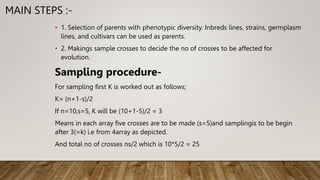
Sampling procedure-
For sampling first K is worked out as follows;
K= (n+1-s)/2
If n=10,s=5, K will be (10+1-5)/2 = 3
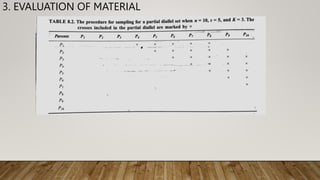
Means in each array five crosses are to be made (s=5)and samplingis to be begin
after 3(=k) i.e from 4array as depicted.
And total no of crosses ns/2 which is 10*5/2 = 25
3. EVALUATION OF MATERIAL
EXAMPLE
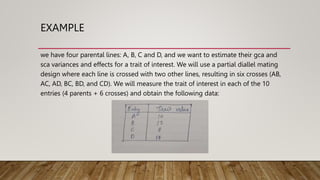
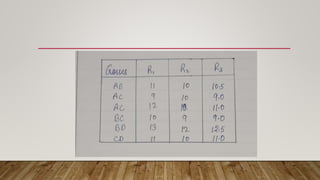
we have four parental lines: A, B, C and D, and we want to estimate their gca and
sca variances and effects for a trait of interest. We will use a partial diallel mating
design where each line is crossed with two other lines, resulting in six crosses (AB,
AC, AD, BC, BD, and CD). We will measure the trait of interest in each of the 10
entries (4 parents + 6 crosses) and obtain the following data:
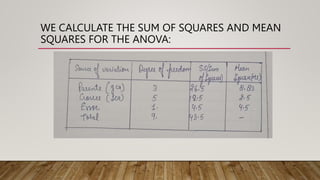
WE CALCULATE THE SUM OF SQUARES AND MEAN
SQUARES FOR THE ANOVA:
• From the mean squares, we can estimate the gca and sca variances and effects:
• Gca variance = MS(gca) / (number of parents) = 8.83 / 4 = 2.21
• Sca variance = MS(sca) / (number of crosses) = 2.5 / 6 = 0.42
• We can estimate the effects of the inbred lines and their interactions as follows:
• The overall mean yield is 11.0 (the average of all the observations).
• The effect of line A is (10.5+9.0+11)/3 – 11.0 = -0.833
• The effect of line B is (10.5+9.0+12.5)/3 – 11= -0.33
• The effect of line C is (12.5+11.+11)/3 -11 = 0.5
• The interaction effect between lines A and D is 11–( -0.833+(-0.33)+11) = 1.163
• The interaction effect between lines B and C is 13-(-0.33+0.5+11) = 1.83
RESULTS
• We can see that there is significant variation due to both lines and crosses,
indicating that both genetic and non-genetic factors are contributing to the
variation in grain yield. We can also estimate the general combining ability (GCA)
and specific combining ability (SCA) effects for each line and cross, respectively,
to gain insight into the genetic basis of grain yield in this population.
USES OF PARTIAL DIALLEL MATING DESIGN
• Estimating genetic parameters: Partial diallel designs can be used to estimate genetic
parameters such as heritability, additive and dominance effects, and gene action. By
analyzing the variation in trait expression among different crosses, it is possible to estimate
the relative importance of genetic effects in controlling the trait.
• Selecting parents for breeding: Partial diallel designs can be used to identify the best
parents to use in a breeding program. By analyzing the performance of different crosses, it is
possible to identify parents with desirable genetic traits that can be used to develop new
varieties with improved traits.
• Studying gene-environment interactions: Partial diallel designs can be used to study
gene-environment interactions. By testing different crosses under different
environmental conditions, it is possible to identify genetic variation in response to
different environments. This can help breeders develop varieties that perform well
under a range of environmental conditions.
• Developing hybrids: Partial diallel designs can be used to develop hybrids with
desirable traits. By crossing parents with complementary genetic traits, it is possible
to create hybrids with superior performance. This is commonly used in plant
breeding to develop hybrid crops that have higher yield potential or better disease
resistance than their parental lines.
THE ADVANTAGES OF USING A PARTIAL DIALLEL
MATING DESIGN INCLUDE:
• Reduced experimental cost: Since the number of crosses is reduced in a partial diallel
mating design, the experimental cost is also reduced compared to a complete diallel
mating design.
• More efficient use of resources: A partial diallel mating design enables the efficient use
of limited resources such as time, space, and plant material.
• Heritability, genetic advance and heritability can also be evaluated.
Thanks

Balram ppt for quantitative genetics.pptx

  • 1.
    PARTIAL DIALLEL MATING DESIGN SUBMITTEDTO – DR PK PANDAY SUBMITTED BY – BALRAM (53086)
  • 2.
    • Concept wasgiven by kempthrone in 1957 and was further elaborated by curnow in 1961. • This method is also known as fractional diallel. • This is defined as the no of sampled crosses per parent or per array in al possible combinations of a given set of parents. • A partial diallel mating design is a plant breeding method used to assess the genetic potential of different plant genotypes, and to estimate the heritability of specific traits. In this design, a subset of the possible crosses between different genotypes are made, with each genotype being crossed with a subset of the other genotypes.
  • 3.
    MAIN STEPS :- •1. Selection of parents with phenotypic diversity. Inbreds lines, strains, germplasm lines, and cultivars can be used as parents. • 2. Makings sample crosses to decide the no of crosses to be affected for evolution. Sampling procedure- For sampling first K is worked out as follows; K= (n+1-s)/2 If n=10,s=5, K will be (10+1-5)/2 = 3 Means in each array five crosses are to be made (s=5)and samplingis to be begin after 3(=k) i.e from 4array as depicted. And total no of crosses ns/2 which is 10*5/2 = 25
  • 4.
  • 5.
    EXAMPLE we have fourparental lines: A, B, C and D, and we want to estimate their gca and sca variances and effects for a trait of interest. We will use a partial diallel mating design where each line is crossed with two other lines, resulting in six crosses (AB, AC, AD, BC, BD, and CD). We will measure the trait of interest in each of the 10 entries (4 parents + 6 crosses) and obtain the following data:
  • 7.
    WE CALCULATE THESUM OF SQUARES AND MEAN SQUARES FOR THE ANOVA:
  • 8.
    • From themean squares, we can estimate the gca and sca variances and effects: • Gca variance = MS(gca) / (number of parents) = 8.83 / 4 = 2.21 • Sca variance = MS(sca) / (number of crosses) = 2.5 / 6 = 0.42
  • 9.
    • We canestimate the effects of the inbred lines and their interactions as follows: • The overall mean yield is 11.0 (the average of all the observations). • The effect of line A is (10.5+9.0+11)/3 – 11.0 = -0.833 • The effect of line B is (10.5+9.0+12.5)/3 – 11= -0.33 • The effect of line C is (12.5+11.+11)/3 -11 = 0.5 • The interaction effect between lines A and D is 11–( -0.833+(-0.33)+11) = 1.163 • The interaction effect between lines B and C is 13-(-0.33+0.5+11) = 1.83
  • 10.
    RESULTS • We cansee that there is significant variation due to both lines and crosses, indicating that both genetic and non-genetic factors are contributing to the variation in grain yield. We can also estimate the general combining ability (GCA) and specific combining ability (SCA) effects for each line and cross, respectively, to gain insight into the genetic basis of grain yield in this population.
  • 11.
    USES OF PARTIALDIALLEL MATING DESIGN • Estimating genetic parameters: Partial diallel designs can be used to estimate genetic parameters such as heritability, additive and dominance effects, and gene action. By analyzing the variation in trait expression among different crosses, it is possible to estimate the relative importance of genetic effects in controlling the trait. • Selecting parents for breeding: Partial diallel designs can be used to identify the best parents to use in a breeding program. By analyzing the performance of different crosses, it is possible to identify parents with desirable genetic traits that can be used to develop new varieties with improved traits.
  • 12.
    • Studying gene-environmentinteractions: Partial diallel designs can be used to study gene-environment interactions. By testing different crosses under different environmental conditions, it is possible to identify genetic variation in response to different environments. This can help breeders develop varieties that perform well under a range of environmental conditions. • Developing hybrids: Partial diallel designs can be used to develop hybrids with desirable traits. By crossing parents with complementary genetic traits, it is possible to create hybrids with superior performance. This is commonly used in plant breeding to develop hybrid crops that have higher yield potential or better disease resistance than their parental lines.
  • 13.
    THE ADVANTAGES OFUSING A PARTIAL DIALLEL MATING DESIGN INCLUDE: • Reduced experimental cost: Since the number of crosses is reduced in a partial diallel mating design, the experimental cost is also reduced compared to a complete diallel mating design. • More efficient use of resources: A partial diallel mating design enables the efficient use of limited resources such as time, space, and plant material. • Heritability, genetic advance and heritability can also be evaluated.
  • 14.