Creating a space for student collaboration
Averil Bolster & Peter Levrai
University of Turku (work), University of the Basque Country (PhD candidates)
21st Language Centre Days (18th - 19th May 2022)
University of Vaasa
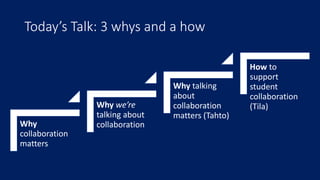
Today’s Talk: 3 whys and a how
Why
collaboration
matters
Why we’re
talking about
collaboration
Why talking
about
collaboration
matters (Tahto)
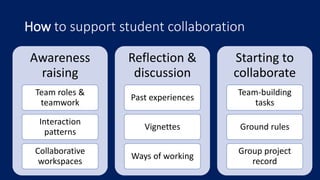
How to
support
student
collaboration
(Tila)
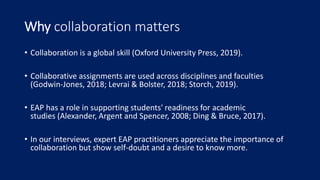
Why collaboration matters
• Collaboration is a global skill (Oxford University Press, 2019).
• Collaborative assignments are used across disciplines and faculties
(Godwin-Jones, 2018; Levrai & Bolster, 2018; Storch, 2019).
• EAP has a role in supporting students' readiness for academic
studies (Alexander, Argent and Spencer, 2008; Ding & Bruce, 2017).
• In our interviews, expert EAP practitioners appreciate the importance of
collaboration but show self-doubt and a desire to know more.
Why we’re talking about collaboration
• Wrote an award-winning course
incorporating collaborative assignments.
• Available for free download -
https://developeap.weebly.com
• Developed a framework to support group
essays (Levrai & Bolster, 2018).
• Led into our PhD research interests.
Why we’re talking about collaboration
Exploring teacher
attitudes and
influences in the
use (or not) of
student
collaboration in
university courses
in English
Towards a
framework for
assessing
collaborative
assignments EAP 20
interviews
conducted
(to date)
16
interviews
conducted
(to date)
31
surveys conducted (to date)
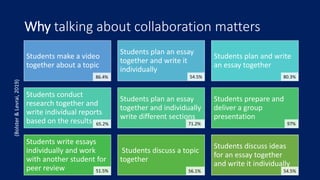
Why talking about collaboration matters
Students make a video
together about a topic
Students plan an essay
together and write it
individually
Students plan and write
an essay together
Students conduct
research together and
write individual reports
based on the results
Students plan an essay
together and individually
write different sections
Students prepare and
deliver a group
presentation
Students write essays
individually and work
with another student for
peer review
Students discuss a topic
together
Students discuss ideas
for an essay together
and write it individually
97%
86.4%
51.5%
65.2%
80.3%
54.5%
71.2%
56.1% 54.5%
(Bolster
&
Levrai,
2019)
Understanding the distinctions
• You’re working with other people but it’s your
outcome that matters
Group work
• You’re working towards a common goal but you have
a specific responsibility
Co-operation
• You’re working towards a common goal, with shared
ownership and responsibility
Collaboration
(Hathorn & Ingram,
2002; Kozar, 2010; Paulus
2005; Storch 2019​)
Is it collaboration? Literature perspective
Students make a video
together about a topic
Students plan an essay
together and write it
individually
Students plan and write
an essay together
Students conduct
research together and
write individual reports
based on the results
Students plan an essay
together and individually
write different sections
Students prepare and
deliver a group
presentation
Students write essays
individually and work
with another student for
peer review
Students discuss a topic
together
Students discuss ideas
for an essay together
and write it individually
97%
86.4%
51.5%
65.2%
80.3%
54.5%
71.2%
56.1% 54.5%
Bolster
&
Levrai,
2019
Collaboration in EAP – a definition
A collaborative assignment is one where learners work together,
making equitable contributions towards the development of an indivisible
artefact for which they share responsibility and ownership. During the
development of the artefact, learners may work synchronously or
asynchronously, face-to-face or online, but there is interdependence
between group members, drawing on all their strengths.
(Bolster & Levrai, 2019)
Why the confusion? Early observations (n=31)
0
2
4
6
8
10
12
14
16
18
As a student Professionally
Experiencing collaboration
Never Rarely Sometimes Often
0
2
4
6
8
10
12
14
16
18
As part of studies As part of professional
development
Learning about collaboration
Never Rarely Sometimes Often
*
Lortie (1975)
Confusion leads to different approaches
Sends the
students off
and waits
for them to
finish
Parking
attendant
Gets
involved if
there’s a
problem
Traffic
police
In the
group,
actively
participating
Back seat
driver
Hands
off
Hands
on
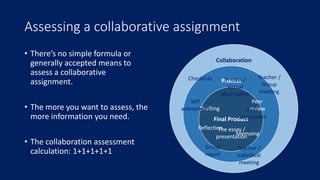
Assessing a collaborative assignment
• There’s no simple formula or
generally accepted means to
assess a collaborative
assignment.
• The more you want to assess, the
more information you need.
• The collaboration assessment
calculation: 1+1+1+1+1 = 1
Collaboration
Process
Final Product
The essay /
presentation
Drafting
Peer
review
Memoing
Reflection
Self
assessment Peer
assessment
Teacher /
Group
meeting
Checklists In class /
virtual
observation
Group
report
Teacher /
individual
meeting
Student collaboration doesn’t just happen
• Everyone needs support.
Teachers
• What it is
• How to scaffold
• How to assess
Students
• What it is
• How to approach it
• Tools to help
How to support student collaboration
Awareness
raising
Team roles &
teamwork
Interaction
patterns
Collaborative
workspaces
Reflection &
discussion
Past experiences
Vignettes
Ways of working
Starting to
collaborate
Team-building
tasks
Ground rules
Group project
record
Conclusions
• The more important collaboration is as a learning outcome, the more
we have to put into it.
• We can help students develop a highly transferable skillset but, as a
community, we need a 'pedagogy of collaboration' (Bikowski, 2015).
• Facilitating and assessing student collaboration needs to be part of
ongoing professional development and teacher training and
discussions over coffee.
References
Alexander, O., Argent, S., & Spencer, J. (2008). EAP essentials: A teacher's guide to principles and practice. Garnet Education.
Bikowski, D. (2015). The Pedagogy of Collaboration: teaching effectively within an evolving technology landscape. Innovation in English
language teacher education, 223-231. British Council.
Bolster, A. & Levrai, P. (2017). Develop EAP: A sustainable academic English skills course. https://developeap.weebly.com/resources.html
Bolster, A. & Levrai, P. (2019). Student Collaboration in English for Academic Purposes - Theory, Practitioner Perceptions and
Reality. Kielikeskus tutkii. 4, 9-26. https://www.utupub.fi/handle/10024/148437
Ding, A. & Bruce, I. (2017). The English for Academic Purposes Practitioner. Palgrave Macmillan.
Godwin-Jones, R. (2018). Second language writing online: An update. Language Learning & Technology, 22(1), 1–15.
Hathorn, L and Ingram. A. (2002). Online Collaboration: Making it Work. Educational Technology, 41 (2), 33-40.
Kozar, O. (2010). Towards Better Group Work: Seeing the Difference between Cooperation and Collaboration. English Teaching Forum 48(2), 16-
23.
Levrai, P. & Bolster, A. 2018. A framework to support group essay writing in English for Academic Purposes: a case study from an English-
medium instruction context. Assessment & Evaluation in Higher Education, 44(2), 186-202.
Lortie, D. C. (1975). Schoolteacher: A sociological study. University of Chicago Press.
Oxford University Press (2019) Global Skills: Creating empowered 21st century learners. Oxford University Press.
https://elt.oup.com/feature/global/expert/global-skills?cc=fi&selLanguage=en
Paulus, T. M. (2005). Collaboration or cooperation? Analyzing small group interactions in educational environments. In Computer-
supported collaborative learning in higher education (pp. 100-124). IGI Global.
Storch, N. (2019). Collaborative Writing. Language Teaching, 52(1), 40-59.
Thank
you!
aebols@utu.fi
pflevr@utu.fi

Creating a space for student collaboration.ppsx

  • 1.
    Creating a spacefor student collaboration Averil Bolster & Peter Levrai University of Turku (work), University of the Basque Country (PhD candidates) 21st Language Centre Days (18th - 19th May 2022) University of Vaasa
  • 2.
    Today’s Talk: 3whys and a how Why collaboration matters Why we’re talking about collaboration Why talking about collaboration matters (Tahto) How to support student collaboration (Tila)
  • 3.
    Why collaboration matters •Collaboration is a global skill (Oxford University Press, 2019). • Collaborative assignments are used across disciplines and faculties (Godwin-Jones, 2018; Levrai & Bolster, 2018; Storch, 2019). • EAP has a role in supporting students' readiness for academic studies (Alexander, Argent and Spencer, 2008; Ding & Bruce, 2017). • In our interviews, expert EAP practitioners appreciate the importance of collaboration but show self-doubt and a desire to know more.
  • 4.
    Why we’re talkingabout collaboration • Wrote an award-winning course incorporating collaborative assignments. • Available for free download - https://developeap.weebly.com • Developed a framework to support group essays (Levrai & Bolster, 2018). • Led into our PhD research interests.
  • 5.
    Why we’re talkingabout collaboration Exploring teacher attitudes and influences in the use (or not) of student collaboration in university courses in English Towards a framework for assessing collaborative assignments EAP 20 interviews conducted (to date) 16 interviews conducted (to date) 31 surveys conducted (to date)
  • 6.
    Why talking aboutcollaboration matters Students make a video together about a topic Students plan an essay together and write it individually Students plan and write an essay together Students conduct research together and write individual reports based on the results Students plan an essay together and individually write different sections Students prepare and deliver a group presentation Students write essays individually and work with another student for peer review Students discuss a topic together Students discuss ideas for an essay together and write it individually 97% 86.4% 51.5% 65.2% 80.3% 54.5% 71.2% 56.1% 54.5% (Bolster & Levrai, 2019)
  • 7.
    Understanding the distinctions •You’re working with other people but it’s your outcome that matters Group work • You’re working towards a common goal but you have a specific responsibility Co-operation • You’re working towards a common goal, with shared ownership and responsibility Collaboration (Hathorn & Ingram, 2002; Kozar, 2010; Paulus 2005; Storch 2019​)
  • 8.
    Is it collaboration?Literature perspective Students make a video together about a topic Students plan an essay together and write it individually Students plan and write an essay together Students conduct research together and write individual reports based on the results Students plan an essay together and individually write different sections Students prepare and deliver a group presentation Students write essays individually and work with another student for peer review Students discuss a topic together Students discuss ideas for an essay together and write it individually 97% 86.4% 51.5% 65.2% 80.3% 54.5% 71.2% 56.1% 54.5% Bolster & Levrai, 2019
  • 9.
    Collaboration in EAP– a definition A collaborative assignment is one where learners work together, making equitable contributions towards the development of an indivisible artefact for which they share responsibility and ownership. During the development of the artefact, learners may work synchronously or asynchronously, face-to-face or online, but there is interdependence between group members, drawing on all their strengths. (Bolster & Levrai, 2019)
  • 10.
    Why the confusion?Early observations (n=31) 0 2 4 6 8 10 12 14 16 18 As a student Professionally Experiencing collaboration Never Rarely Sometimes Often 0 2 4 6 8 10 12 14 16 18 As part of studies As part of professional development Learning about collaboration Never Rarely Sometimes Often * Lortie (1975)
  • 11.
    Confusion leads todifferent approaches Sends the students off and waits for them to finish Parking attendant Gets involved if there’s a problem Traffic police In the group, actively participating Back seat driver Hands off Hands on
  • 12.
    Assessing a collaborativeassignment • There’s no simple formula or generally accepted means to assess a collaborative assignment. • The more you want to assess, the more information you need. • The collaboration assessment calculation: 1+1+1+1+1 = 1 Collaboration Process Final Product The essay / presentation Drafting Peer review Memoing Reflection Self assessment Peer assessment Teacher / Group meeting Checklists In class / virtual observation Group report Teacher / individual meeting
  • 13.
    Student collaboration doesn’tjust happen • Everyone needs support. Teachers • What it is • How to scaffold • How to assess Students • What it is • How to approach it • Tools to help
  • 14.
    How to supportstudent collaboration Awareness raising Team roles & teamwork Interaction patterns Collaborative workspaces Reflection & discussion Past experiences Vignettes Ways of working Starting to collaborate Team-building tasks Ground rules Group project record
  • 15.
    Conclusions • The moreimportant collaboration is as a learning outcome, the more we have to put into it. • We can help students develop a highly transferable skillset but, as a community, we need a 'pedagogy of collaboration' (Bikowski, 2015). • Facilitating and assessing student collaboration needs to be part of ongoing professional development and teacher training and discussions over coffee.
  • 16.
    References Alexander, O., Argent,S., & Spencer, J. (2008). EAP essentials: A teacher's guide to principles and practice. Garnet Education. Bikowski, D. (2015). The Pedagogy of Collaboration: teaching effectively within an evolving technology landscape. Innovation in English language teacher education, 223-231. British Council. Bolster, A. & Levrai, P. (2017). Develop EAP: A sustainable academic English skills course. https://developeap.weebly.com/resources.html Bolster, A. & Levrai, P. (2019). Student Collaboration in English for Academic Purposes - Theory, Practitioner Perceptions and Reality. Kielikeskus tutkii. 4, 9-26. https://www.utupub.fi/handle/10024/148437 Ding, A. & Bruce, I. (2017). The English for Academic Purposes Practitioner. Palgrave Macmillan. Godwin-Jones, R. (2018). Second language writing online: An update. Language Learning & Technology, 22(1), 1–15. Hathorn, L and Ingram. A. (2002). Online Collaboration: Making it Work. Educational Technology, 41 (2), 33-40. Kozar, O. (2010). Towards Better Group Work: Seeing the Difference between Cooperation and Collaboration. English Teaching Forum 48(2), 16- 23. Levrai, P. & Bolster, A. 2018. A framework to support group essay writing in English for Academic Purposes: a case study from an English- medium instruction context. Assessment & Evaluation in Higher Education, 44(2), 186-202. Lortie, D. C. (1975). Schoolteacher: A sociological study. University of Chicago Press. Oxford University Press (2019) Global Skills: Creating empowered 21st century learners. Oxford University Press. https://elt.oup.com/feature/global/expert/global-skills?cc=fi&selLanguage=en Paulus, T. M. (2005). Collaboration or cooperation? Analyzing small group interactions in educational environments. In Computer- supported collaborative learning in higher education (pp. 100-124). IGI Global. Storch, N. (2019). Collaborative Writing. Language Teaching, 52(1), 40-59.
  • 17.

Editor's Notes

  • #3 Tahto—wilful determination for action and Tila —the creation of situational spaces
  • #6 Introduce ourselves and PhD studies. Explain why we’re doing them, what our focus is, and where we are so far. Outline that it’s these early results that will inform the talk. Be ready to add bio data e.g. years of experience of participants, no. of nationalities, countries working in
  • #9 Video is greyed out in case they did actually collaborate in the making of it
  • #10 Support from Kielikeskus and/or BALEAP
  • #11 Collaboration education: Highlight little in the way of direct education about collaboration. And is it fair to say that it comes in higher level studies e.g. MA? Experience of collaboration: experience as a student is asterisked because in interviews it seemed people were really talking about groupwork more generally than collaborative assignments specifically and, also, this tended to be at post-graduate level – may be reflective of age and time undergraduate studies were done but seemed consistant across the population.
  • #12 This draws from interviews with some people being very involved and others leaving it to them. Can highlight the different roles teachers take on
  • #13 Discuss discomfort at assessing collaboration and that it can never be done perfectly – will always be a compromise and need an effort/reward analysis – is it worth doing all the assessment for one overall assignment? Can make the real world argument for stopping at assessing the essay – it’s the product that matters. But most interviewees think we do need to go further, they just don’t know how
  • #15 Quite a lot of talking here – explaining what each one involves. The collaborative workspaces bit links to the ‘Talo’ in our abstract. Equality & mutuality for interaction patterns. Ground rules, 3C – communication, contribution, compromise