Supporting
Teachers To
Support
Student
Collaboration
Averil Bolster & Peter Levrai
Turku University, Finland (Professional)
University of the Basque Country (Doctoral)
CERLCES 2022 - Porto, Portugal
Overview
Technology in education
Our research into student collaboration
Early findings
Recommendation for CPD
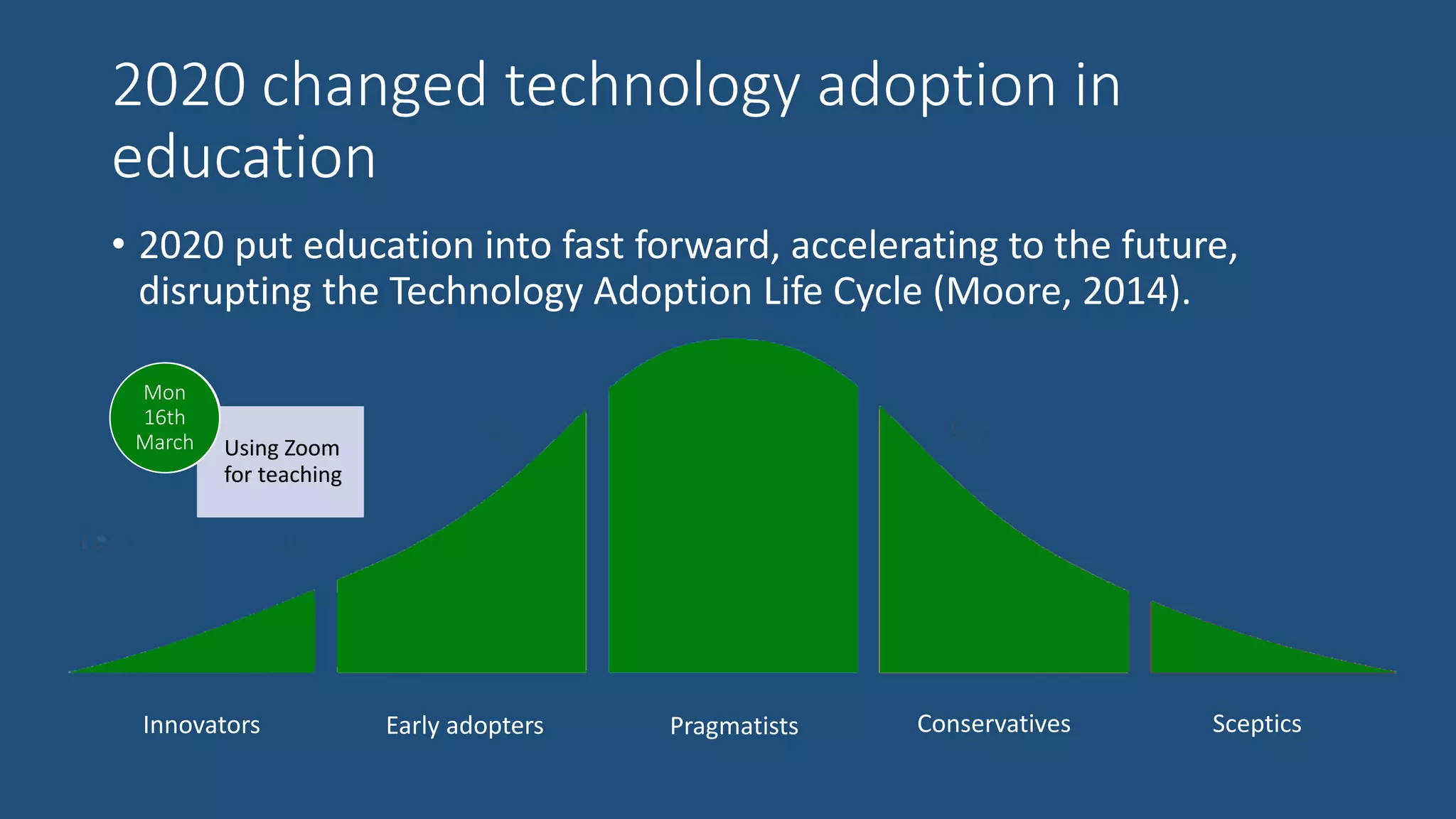
2020 changed technology adoption in
education
Innovators Early adopters Pragmatists Conservatives Sceptics
• 2020 put education into fast forward, accelerating to the future,
disrupting the Technology Adoption Life Cycle (Moore, 2014).
Using Zoom
for teaching
Fri 13th
March
Using Zoom
for teaching
Mon
16th
March
How we can use technology: The SAMR
Model (Puentedure, 2006)
SUBSTITUTION
Technology acts as a direct substitute, with no
functional change
AUGMENTATION
Technology acts as a direct substitute, with functional
improvement
MODIFICATION
Technology allows for significant task redesign
REDEFINITION
Technology allows for the creation of new tasks, previously unimaginable
S
A
M
R
ENHANCEMENT
TRANSFORMATION
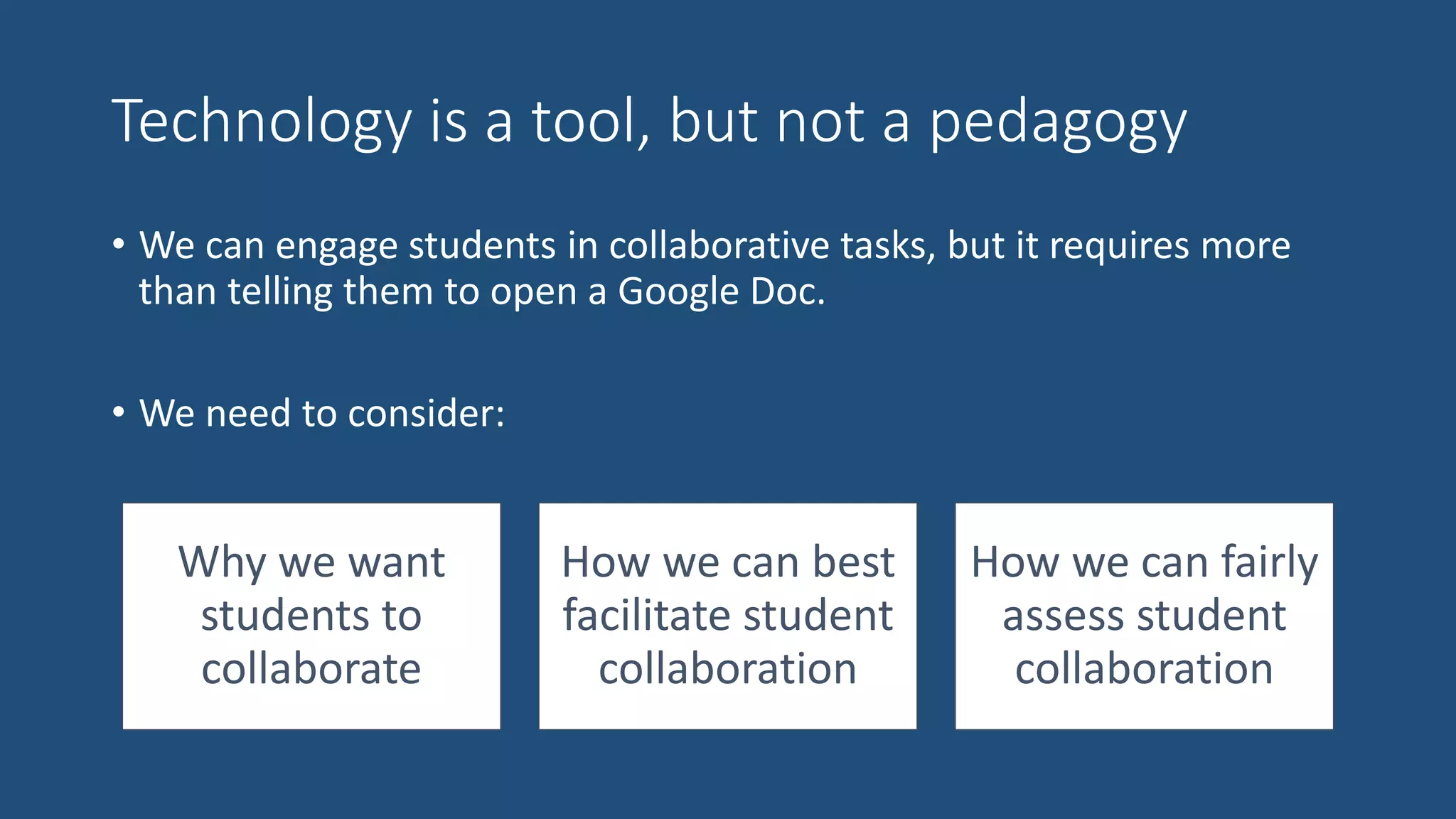
Technology is a tool, but not a pedagogy
• We can engage students in collaborative tasks, but it requires more
than telling them to open a Google Doc.
• We need to consider:
Why we want
students to
collaborate
How we can best
facilitate student
collaboration
How we can fairly
assess student
collaboration
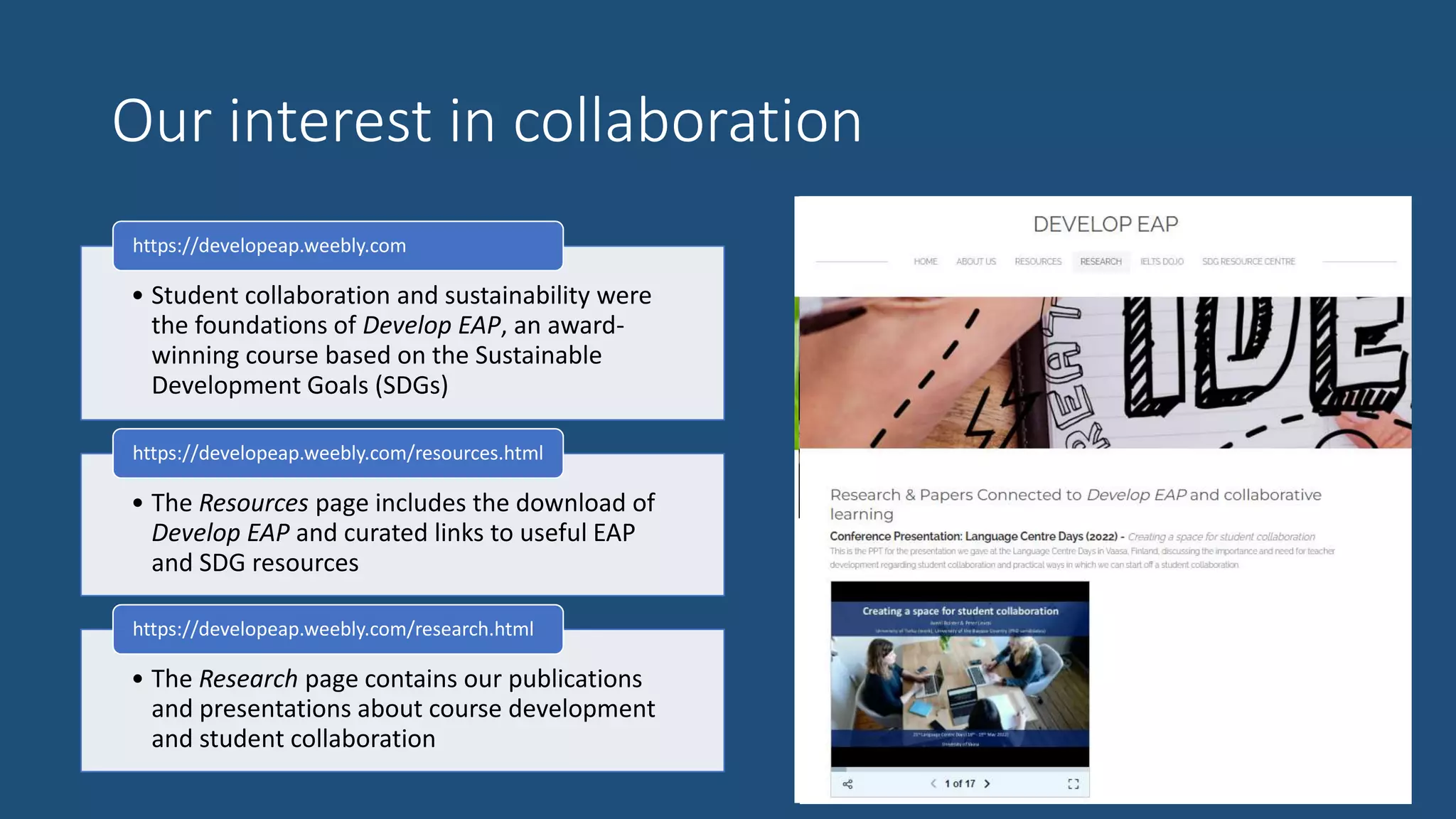
Our interest in collaboration
• Student collaboration and sustainability were
the foundations of Develop EAP, an award-
winning course based on the Sustainable
Development Goals (SDGs)
https://developeap.weebly.com
• The Resources page includes the download of
Develop EAP and curated links to useful EAP
and SDG resources
https://developeap.weebly.com/resources.html
• The Research page contains our publications
and presentations about course development
and student collaboration
https://developeap.weebly.com/research.html
Researching collaboration
• Following a Grounded Theory approach utilising surveys and in-depth
interviews.
Exploring teacher
attitudes and
influences in the
use (or not) of
student
collaboration in
university courses
in English
Towards a
framework for
assessing
collaborative
assignments EAP
20 interviews
(to date)
16 interviews
(to date)
31 surveys (to date)
Rationale for student collaboration
• Grounded in Vygotsky’s (1978) Socio-Cultural Theory (SCT).
• Collaboration supports student-centred learning.​
Collaborative
scaffold (Ohta,
1995)
More
Knowledgeable
Other (MKO)
Zone of
Proximal
Development
(ZPD)
Learner can do
unaided
Learner can do
with guidance
(ZPD)
Learner cannot
do
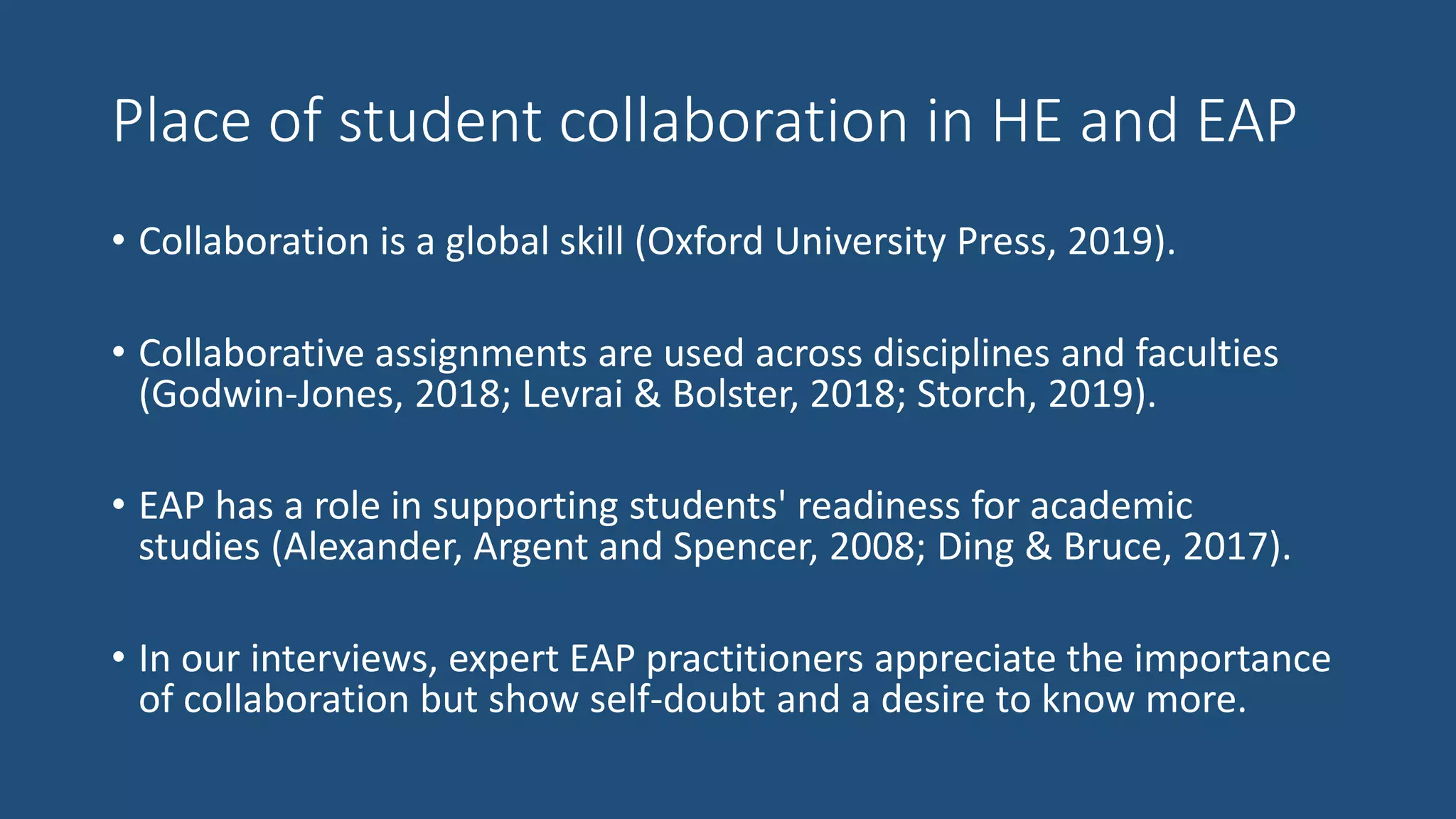
Place of student collaboration in HE and EAP
• Collaboration is a global skill (Oxford University Press, 2019).
• Collaborative assignments are used across disciplines and faculties
(Godwin-Jones, 2018; Levrai & Bolster, 2018; Storch, 2019).
• EAP has a role in supporting students' readiness for academic
studies (Alexander, Argent and Spencer, 2008; Ding & Bruce, 2017).
• In our interviews, expert EAP practitioners appreciate the importance
of collaboration but show self-doubt and a desire to know more.
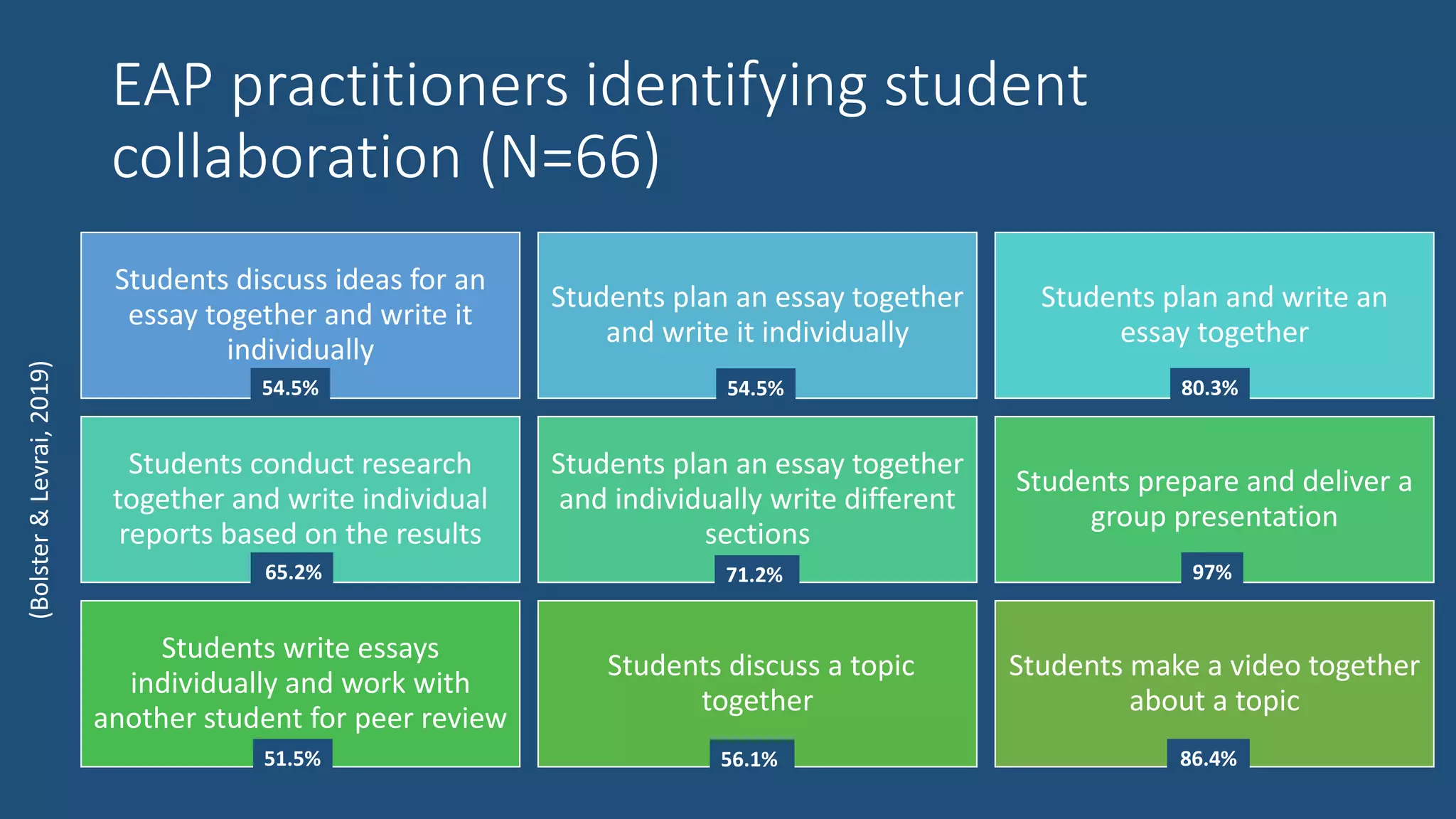
EAP practitioners identifying student
collaboration (N=66)
Students discuss ideas for an
essay together and write it
individually
Students plan an essay together
and write it individually
Students plan and write an
essay together
Students conduct research
together and write individual
reports based on the results
Students plan an essay together
and individually write different
sections
Students prepare and deliver a
group presentation
Students write essays
individually and work with
another student for peer review
Students discuss a topic
together
Students make a video together
about a topic
97%
86.4%
51.5%
65.2%
80.3%
54.5%
71.2%
56.1%
54.5%
(Bolster
&
Levrai,
2019)
Students discuss ideas for an
essay together and write it
individually
Students plan an essay together
and write it individually
Students plan and write an
essay together
Students conduct research
together and write individual
reports based on the results
Students plan an essay together
and individually write different
sections
Students prepare and deliver a
group presentation
Students write essays
individually and work with
another student for peer review
Students discuss a topic
together
Students make a video together
about a topic
How the literature identifies student
collaboration
97%
86.4%
51.5%
65.2%
80.3%
54.5%
71.2%
56.1%
54.5%
(Bolster
&
Levrai,
2019)
Collaboration
Common
goal
Shared
responsibility
Shared
ownership
Indivisible
whole
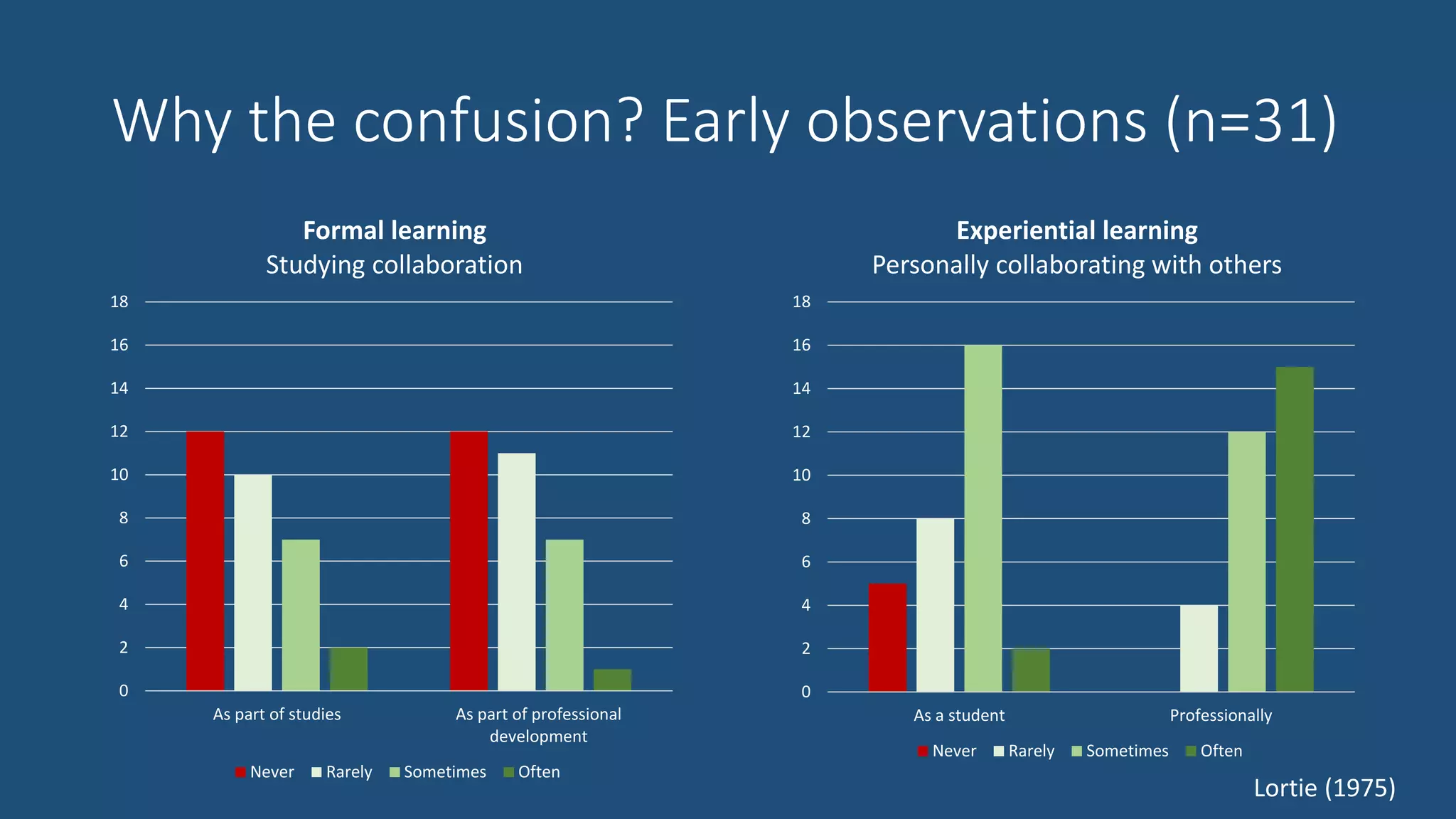
Why the confusion? Early observations (n=31)
0
2
4
6
8
10
12
14
16
18
As a student Professionally
Experiential learning
Personally collaborating with others
Never Rarely Sometimes Often
0
2
4
6
8
10
12
14
16
18
As part of studies As part of professional
development
Formal learning
Studying collaboration
Never Rarely Sometimes Often
Lortie (1975)
Result: a range of different approaches
Sends the
students off
and waits for
them to
finish
Parking
attendant
Checks in
with groups
halfway
through the
process or if
there’s a
problem
Pit crew
In the group,
actively
participating
Back seat
driver
Hands
off
Hands
on
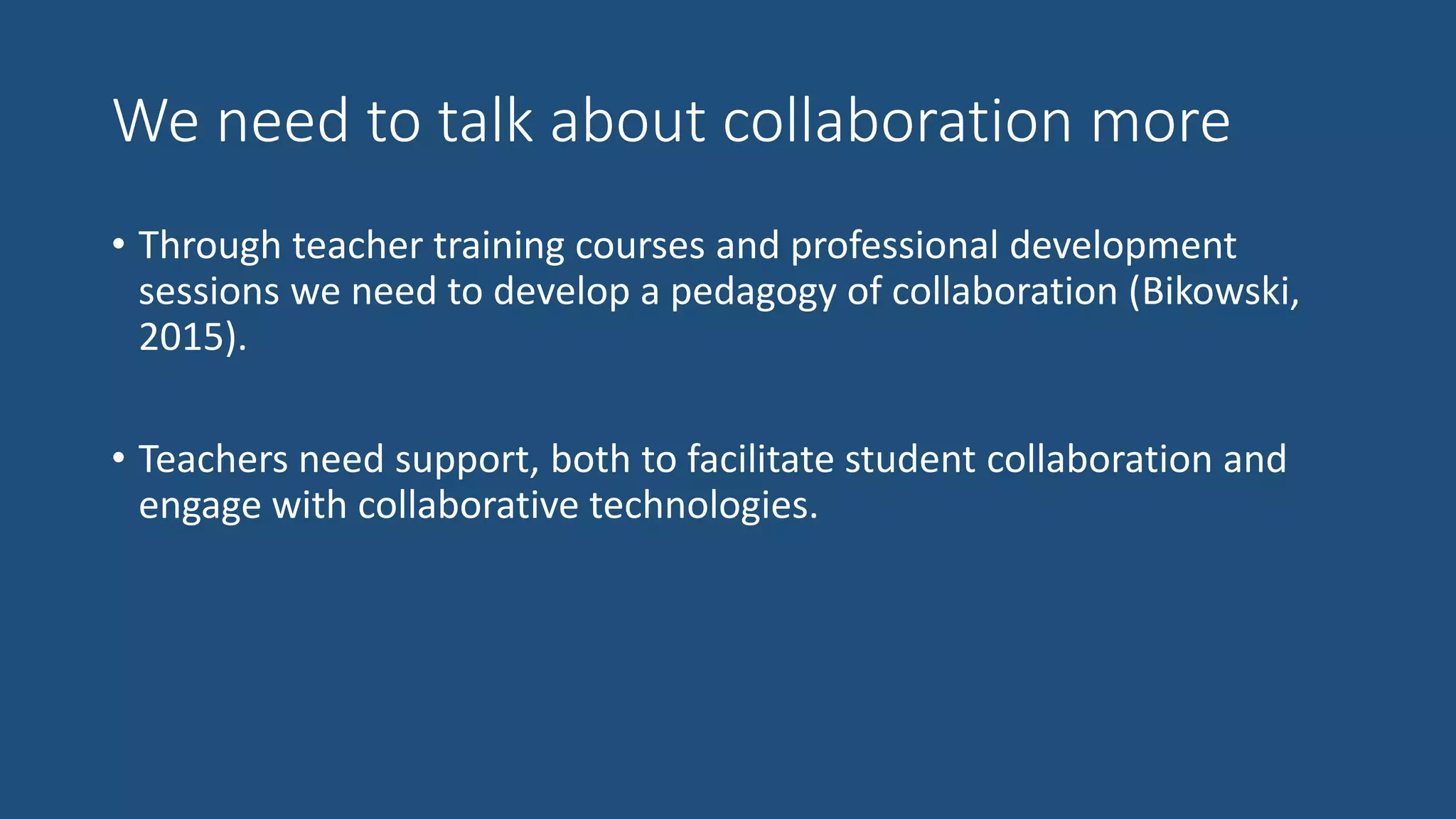
We need to talk about collaboration more
• Through teacher training courses and professional development
sessions we need to develop a pedagogy of collaboration (Bikowski,
2015).
• Teachers need support, both to facilitate student collaboration and
engage with collaborative technologies.
1st step: a definition for collaboration in EAP
A collaborative assignment is one where learners work together,
making equitable contributions towards the development of an indivisible
artefact for which they share responsibility and ownership. During the
development of the artefact, learners may work synchronously or
asynchronously, face-to-face or online, but there is interdependence
between group members, drawing on all their strengths.
(Bolster & Levrai, 2019)
2nd step: supporting teachers to support students
Awareness raising
Team roles &
teamwork
Interaction
patterns
Collaborative
workspaces
Reflection &
discussion
Past experiences
Vignettes
Ways of working
Starting a student
collaboration
Team-building
tasks
Ground rules
Group project
record
Conclusion
• Pedagogy should guide us, not
tools.
• Our pedagogy for student
collaboration is
underdeveloped.
• As a community, we need to
talk more about collaboration.
References
Alexander, O., Argent, S., & Spencer, J. (2008). EAP essentials: A teacher's guide to principles and practice. Garnet Education.
Bikowski, D. (2015). The Pedagogy of Collaboration: teaching effectively within an evolving technology landscape. Innovation in English language teacher
education, 223-231. British Council.
Bolster, A. & Levrai, P. (2019). Student Collaboration in English for Academic Purposes - Theory, Practitioner Perceptions and Reality. Kielikeskus tutkii. 4,
9-26. https://www.utupub.fi/handle/10024/148437
Ding, A. & Bruce, I. (2017). The English for Academic Purposes Practitioner. Palgrave Macmillan.
Godwin-Jones, R. (2018). Second language writing online: An update. Language Learning & Technology, 22(1), 1–15.
Levrai, P. & Bolster, A. 2018. A framework to support group essay writing in English for Academic Purposes: a case study from an English-medium
instruction context. Assessment & Evaluation in Higher Education, 44(2), 186-202.
Lortie, D. C. (1975). Schoolteacher: A sociological study. University of Chicago Press.
Moore, G. (2014). Crossing the Chasm, 3rd Edition: Marketing and Selling Disruptive Products to Mainstream Customers. Harper Business.
Ohta, A. (1995). Applying Sociocultural Theory to an Analysis of Learner Discourse: Learner-Learner Collaborative Interaction in the Zone of Proximal
Development. Issues in Applied Linguistics, 6(2), 93-121.
Oxford University Press (2019) Global Skills: Creating empowered 21st century learners. Oxford University Press.
https://elt.oup.com/feature/global/expert/global-skills?cc=fi&selLanguage=en
Puentedura, R. (2006). Transformation, technology, and education [Blog post]. Retrieved from http://hippasus.com/resources/tte/.
Storch, N. (2019). Collaborative Writing. Language Teaching, 52(1), 40-59.
​Vygotsky, L. S. (1978). Mind in society: The development of higher psychological processes. Cambridge, MA: Harvard University Press.
Images from Pexels
Any questions?
Averil Bolster Peter Levrai
aebols@utu.fi pflevr@utu.fi

Supporting teachers to support student collaboration

  • 1.
    Supporting Teachers To Support Student Collaboration Averil Bolster& Peter Levrai Turku University, Finland (Professional) University of the Basque Country (Doctoral) CERLCES 2022 - Porto, Portugal
  • 2.
    Overview Technology in education Ourresearch into student collaboration Early findings Recommendation for CPD
  • 3.
    2020 changed technologyadoption in education Innovators Early adopters Pragmatists Conservatives Sceptics • 2020 put education into fast forward, accelerating to the future, disrupting the Technology Adoption Life Cycle (Moore, 2014). Using Zoom for teaching Fri 13th March Using Zoom for teaching Mon 16th March
  • 4.
    How we canuse technology: The SAMR Model (Puentedure, 2006) SUBSTITUTION Technology acts as a direct substitute, with no functional change AUGMENTATION Technology acts as a direct substitute, with functional improvement MODIFICATION Technology allows for significant task redesign REDEFINITION Technology allows for the creation of new tasks, previously unimaginable S A M R ENHANCEMENT TRANSFORMATION
  • 5.
    Technology is atool, but not a pedagogy • We can engage students in collaborative tasks, but it requires more than telling them to open a Google Doc. • We need to consider: Why we want students to collaborate How we can best facilitate student collaboration How we can fairly assess student collaboration
  • 6.
    Our interest incollaboration • Student collaboration and sustainability were the foundations of Develop EAP, an award- winning course based on the Sustainable Development Goals (SDGs) https://developeap.weebly.com • The Resources page includes the download of Develop EAP and curated links to useful EAP and SDG resources https://developeap.weebly.com/resources.html • The Research page contains our publications and presentations about course development and student collaboration https://developeap.weebly.com/research.html
  • 7.
    Researching collaboration • Followinga Grounded Theory approach utilising surveys and in-depth interviews. Exploring teacher attitudes and influences in the use (or not) of student collaboration in university courses in English Towards a framework for assessing collaborative assignments EAP 20 interviews (to date) 16 interviews (to date) 31 surveys (to date)
  • 8.
    Rationale for studentcollaboration • Grounded in Vygotsky’s (1978) Socio-Cultural Theory (SCT). • Collaboration supports student-centred learning.​ Collaborative scaffold (Ohta, 1995) More Knowledgeable Other (MKO) Zone of Proximal Development (ZPD) Learner can do unaided Learner can do with guidance (ZPD) Learner cannot do
  • 9.
    Place of studentcollaboration in HE and EAP • Collaboration is a global skill (Oxford University Press, 2019). • Collaborative assignments are used across disciplines and faculties (Godwin-Jones, 2018; Levrai & Bolster, 2018; Storch, 2019). • EAP has a role in supporting students' readiness for academic studies (Alexander, Argent and Spencer, 2008; Ding & Bruce, 2017). • In our interviews, expert EAP practitioners appreciate the importance of collaboration but show self-doubt and a desire to know more.
  • 10.
    EAP practitioners identifyingstudent collaboration (N=66) Students discuss ideas for an essay together and write it individually Students plan an essay together and write it individually Students plan and write an essay together Students conduct research together and write individual reports based on the results Students plan an essay together and individually write different sections Students prepare and deliver a group presentation Students write essays individually and work with another student for peer review Students discuss a topic together Students make a video together about a topic 97% 86.4% 51.5% 65.2% 80.3% 54.5% 71.2% 56.1% 54.5% (Bolster & Levrai, 2019)
  • 11.
    Students discuss ideasfor an essay together and write it individually Students plan an essay together and write it individually Students plan and write an essay together Students conduct research together and write individual reports based on the results Students plan an essay together and individually write different sections Students prepare and deliver a group presentation Students write essays individually and work with another student for peer review Students discuss a topic together Students make a video together about a topic How the literature identifies student collaboration 97% 86.4% 51.5% 65.2% 80.3% 54.5% 71.2% 56.1% 54.5% (Bolster & Levrai, 2019) Collaboration Common goal Shared responsibility Shared ownership Indivisible whole
  • 12.
    Why the confusion?Early observations (n=31) 0 2 4 6 8 10 12 14 16 18 As a student Professionally Experiential learning Personally collaborating with others Never Rarely Sometimes Often 0 2 4 6 8 10 12 14 16 18 As part of studies As part of professional development Formal learning Studying collaboration Never Rarely Sometimes Often Lortie (1975)
  • 13.
    Result: a rangeof different approaches Sends the students off and waits for them to finish Parking attendant Checks in with groups halfway through the process or if there’s a problem Pit crew In the group, actively participating Back seat driver Hands off Hands on
  • 14.
    We need totalk about collaboration more • Through teacher training courses and professional development sessions we need to develop a pedagogy of collaboration (Bikowski, 2015). • Teachers need support, both to facilitate student collaboration and engage with collaborative technologies.
  • 15.
    1st step: adefinition for collaboration in EAP A collaborative assignment is one where learners work together, making equitable contributions towards the development of an indivisible artefact for which they share responsibility and ownership. During the development of the artefact, learners may work synchronously or asynchronously, face-to-face or online, but there is interdependence between group members, drawing on all their strengths. (Bolster & Levrai, 2019)
  • 16.
    2nd step: supportingteachers to support students Awareness raising Team roles & teamwork Interaction patterns Collaborative workspaces Reflection & discussion Past experiences Vignettes Ways of working Starting a student collaboration Team-building tasks Ground rules Group project record
  • 17.
    Conclusion • Pedagogy shouldguide us, not tools. • Our pedagogy for student collaboration is underdeveloped. • As a community, we need to talk more about collaboration.
  • 18.
    References Alexander, O., Argent,S., & Spencer, J. (2008). EAP essentials: A teacher's guide to principles and practice. Garnet Education. Bikowski, D. (2015). The Pedagogy of Collaboration: teaching effectively within an evolving technology landscape. Innovation in English language teacher education, 223-231. British Council. Bolster, A. & Levrai, P. (2019). Student Collaboration in English for Academic Purposes - Theory, Practitioner Perceptions and Reality. Kielikeskus tutkii. 4, 9-26. https://www.utupub.fi/handle/10024/148437 Ding, A. & Bruce, I. (2017). The English for Academic Purposes Practitioner. Palgrave Macmillan. Godwin-Jones, R. (2018). Second language writing online: An update. Language Learning & Technology, 22(1), 1–15. Levrai, P. & Bolster, A. 2018. A framework to support group essay writing in English for Academic Purposes: a case study from an English-medium instruction context. Assessment & Evaluation in Higher Education, 44(2), 186-202. Lortie, D. C. (1975). Schoolteacher: A sociological study. University of Chicago Press. Moore, G. (2014). Crossing the Chasm, 3rd Edition: Marketing and Selling Disruptive Products to Mainstream Customers. Harper Business. Ohta, A. (1995). Applying Sociocultural Theory to an Analysis of Learner Discourse: Learner-Learner Collaborative Interaction in the Zone of Proximal Development. Issues in Applied Linguistics, 6(2), 93-121. Oxford University Press (2019) Global Skills: Creating empowered 21st century learners. Oxford University Press. https://elt.oup.com/feature/global/expert/global-skills?cc=fi&selLanguage=en Puentedura, R. (2006). Transformation, technology, and education [Blog post]. Retrieved from http://hippasus.com/resources/tte/. Storch, N. (2019). Collaborative Writing. Language Teaching, 52(1), 40-59. ​Vygotsky, L. S. (1978). Mind in society: The development of higher psychological processes. Cambridge, MA: Harvard University Press. Images from Pexels
  • 19.
    Any questions? Averil BolsterPeter Levrai aebols@utu.fi pflevr@utu.fi