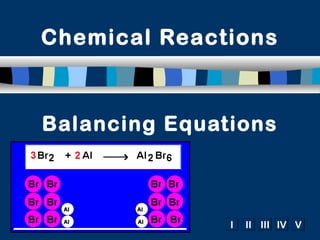
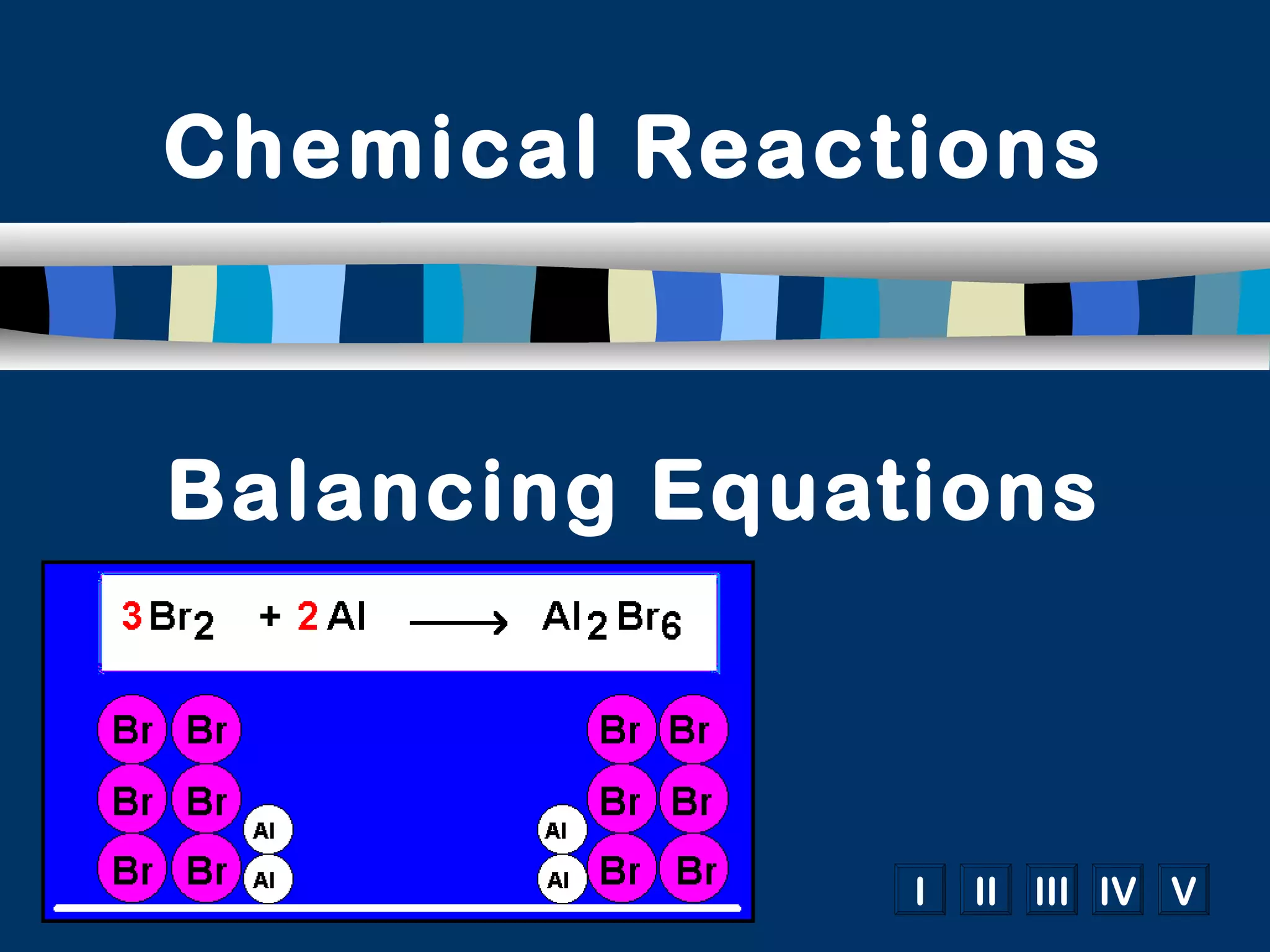
Chemical Reactions


Balancing Equations


               I   II III IV V
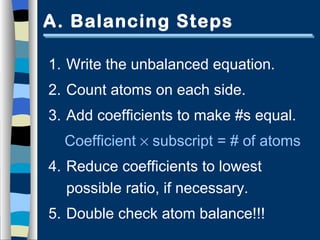
A. Balancing Steps

1. Write the unbalanced equation.
2. Count atoms on each side.
3. Add coefficients to make #s equal.
  Coefficient × subscript = # of atoms
4. Reduce coefficients to lowest
   possible ratio, if necessary.
5. Double check atom balance!!!
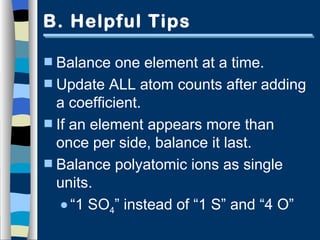
B. Helpful Tips

s Balance one element at a time.
s Update ALL atom counts after adding
  a coefficient.
s If an element appears more than
  once per side, balance it last.
s Balance polyatomic ions as single
  units.
   • “1 SO4” instead of “1 S” and “4 O”
C. Balancing Example
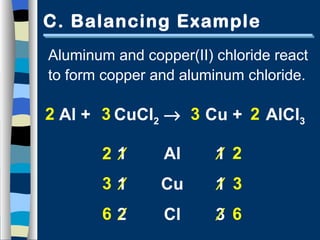
Aluminum and copper(II) chloride react
to form copper and aluminum chloride.

2 Al + 3 CuCl2 → 3 Cu + 2 AlCl3

        ⁄
       21       Al      ⁄
                        1 2
        ⁄
       31       Cu      ⁄
                        1 3
        ⁄
       62       Cl      ⁄
                        3 6

Balancing equations

  • 1.
  • 2.
    A. Balancing Steps 1.Write the unbalanced equation. 2. Count atoms on each side. 3. Add coefficients to make #s equal. Coefficient × subscript = # of atoms 4. Reduce coefficients to lowest possible ratio, if necessary. 5. Double check atom balance!!!
  • 3.
    B. Helpful Tips sBalance one element at a time. s Update ALL atom counts after adding a coefficient. s If an element appears more than once per side, balance it last. s Balance polyatomic ions as single units. • “1 SO4” instead of “1 S” and “4 O”
  • 4.
    C. Balancing Example Aluminumand copper(II) chloride react to form copper and aluminum chloride. 2 Al + 3 CuCl2 → 3 Cu + 2 AlCl3 ⁄ 21 Al ⁄ 1 2 ⁄ 31 Cu ⁄ 1 3 ⁄ 62 Cl ⁄ 3 6