SCIENCE 10
Quarter 4
BALANCING CHEMICAL
EQUATIONS
Guiroy, Blezy V.
UNLOCKING OF TERMS
• Matter
• Pure Substance
• Elements
• Compounds
• Chemical Reaction
• Chemical Equation
TERMS
MATTER
- anything that has space
and occupies mass
PURE SUBSTANCE
- sample of matter that has definite
chemical and physical properties.
TERMS
ELEMENT
- Simplest from of pure substance
COMPOUND
- pure substance that is made up of
two or more elements bonded chemically
MOLECULAR SHAPES
Pure
Substances
Made of one
type of matter
Elements
Made of one
type of atom
Compounds
Made of 2 or
More atoms bonded
together
Homogeneous
one phase
MATTER
Made of Atoms
Has Mass &
takes up Space
Heterogeneous
Made of more
than one phase
Can be separated
Mixtures
Made of
more than one
type of matter
Atom + Atom
= Element
Molecule + Molecule
= Compound
Atom + Atom
= Molecule
Example:
Juice
Examples:
Trail Mix
Salad
TERMS
CHEMICAL REACTIONS
- process in which the physical and
chemical properties of the original substances
change as new substances with different
physical and chemical properties are formed.
CHEMICAL EQUATION
- symbolic representation of a chemical
reaction in the form of symbols and chemical
formulas
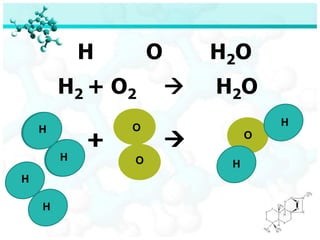
H2 + O2  H2O
H O H2O
Reactant Product
Beginning of
the reaction
Formed after
the reaction
H2 + O2  H2O
H O H2O
+ 
H
H
H
H
O
O
O
LAW OF CONSERVATION
OF MASS
During chemical reaction, atoms are
neither created nor destroyed. The
number of atoms remains constant
throughout the reaction. Since the
number of atoms doesn’t change, the
mass must remain constant as well.
H2 + O2  H2O
H2 + O2  H2O
H O H2O
+ 
+ 
H
H
O
O
H
H
O
H
H
H2 + O2  H2O
H O H2O
+ 
+ 
H
H
O
O
H
H
O
H
H
H
H
O
H2 + O2  H2O
H
H
H
H
O
O H
H
O
2H2 + O2  2H2O
H
H
H
H
O
O H
H
O
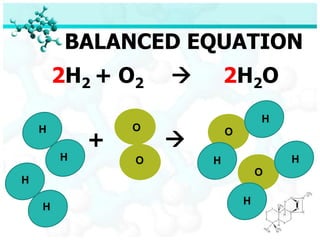
2H2 + O2  2H2O
BALANCED EQUATION
+ 
H
H
O
O
H
H
O
H
H
H
H
O
2H2
O2
Na
2H2O
Na(NO3)2
2Na(NO3)2
O
O
O
O
O
O
N
N
Na
O
O
O
O
O
O
N
N
Na
O
O
O
O
O
O
N
N
Na
Na + FeCl2  NaCl + Fe
When sodium metal reacts with
iron (II) chloride, iron metal and
sodium chloride are formed.
Na + FeCl2  NaCl + Fe
Na
Cl
Fe
Na + FeCl2  NaCl + Fe
Step 1. Identify the reactant and the product.
Reactant: Na + FeCl2
Product: NaCl+ Fe
Na + FeCl2  NaCl + Fe
Step 2. List all the elements found on the
chemical equation
__ Na + __ FeCl2  __ NaCl + __Fe
-Na-
-Fe-
-Cl-
Na + FeCl2  NaCl + Fe
Step 3. Identify the number of atoms
present in every element in the
reactant side
__ Na + __ FeCl2  __ NaCl + __Fe
1 -Na-
1 -Fe-
2 -Cl-
Na + FeCl2  NaCl + Fe
Step 4. Identify the number of atoms
present in every element in the
product side
__ Na + __ FeCl2  __ NaCl + __Fe
-Na- 1
-Fe- 1
-Cl- 1
Na + FeCl2  NaCl + Fe
Step 5. Check if the number of atoms
on both reactant and product side is
the same/balanced
__ Na + __ FeCl2  __ NaCl + __Fe
1 -Na- 1
1 -Fe- 1
2 -Cl- 1
Na + FeCl2  NaCl + Fe
Step 6. Write coefficient in each element/compound to
change the number of atoms in an element and check if
the number of atoms on both reactant and product side
is the same/balanced
__ Na + __ FeCl2  2NaCl + __Fe
1 -Na- 1
1 -Fe- 1
2 -Cl- 1
Na + FeCl2  NaCl + Fe
Step 6. Write coefficient in each element/compound to
change the number of atoms in an element and check if
the number of atoms on both reactant and product side
is the same/balanced
__ Na + __ FeCl2  2NaCl + __Fe
1 -Na- 1
1 -Fe- 1
2 -Cl- 2
Na + FeCl2  NaCl + Fe
Step 6. Write coefficient in each element/compound to
change the number of atoms in an element and check if
the number of atoms on both reactant and product side
is the same/balanced
__ Na + __ FeCl2  2NaCl + __Fe
1 -Na- 2
1 -Fe- 1
2 -Cl- 2
Na + FeCl2  NaCl + Fe
Step 6. Write coefficient in each element/compound to
change the number of atoms in an element and check if
the number of atoms on both reactant and product side
is the same/balanced
2Na + FeCl2  2NaCl + Fe
2 -Na- 2
1 -Fe- 1
2 -Cl- 2
NaOH + H2SO4  Na2SO4 + H2O
When dissolved sodium hydroxide
reacts with sulfuric acid, aqueous
sodium sulfate and water are
formed.
NaOH+ H2SO4  Na2SO4 + H2O
Step 1. Identify the reactant and the product.
Reactant: NaOH+ H2SO4
Product: Na2SO4 + H2O
NaOH+ H2SO4  Na2SO4 + H2O
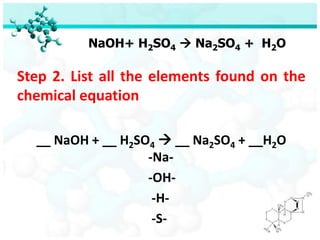
Step 2. List all the elements found on the
chemical equation
__ NaOH + __ H2SO4  __ Na2SO4 + __H2O
-Na-
-OH-
-H-
-S-
NaOH+ H2SO4  Na2SO4 + H2O
Step 3. Identify the number of atoms
present in every element in the
reactant side
__ NaOH + __ H2SO4  __ Na2SO4 + __H2O
1 -Na-
6 -O-
3 -H-
4 -S-
NaOH+ H2SO4  Na2SO4 + H2O
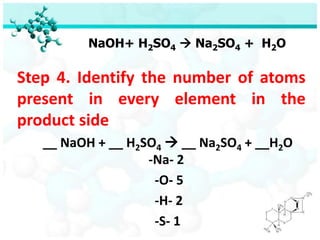
Step 4. Identify the number of atoms
present in every element in the
product side
__ NaOH + __ H2SO4  __ Na2SO4 + __H2O
-Na- 2
-O- 5
-H- 2
-S- 1
NaOH+ H2SO4  Na2SO4 + H2O
Step 5. Check if the number of atoms
on both reactant and product side is
the same/balanced
__ NaOH + __ H2SO4  __ Na2SO4 + __H2O
1 -Na- 2
5 -O- 5
3 -H- 2
1 -S- 1
NaOH+ H2SO4  Na2SO4 + H2O
Step 6. Write coefficient in each element/compound to
change the number of atoms in an element and check if
the number of atoms on both reactant and product side
is the same/balanced
2 NaOH + H2SO4  Na2SO4 + 2 H2O
2 -Na- 2
5 -O- 5
3 -H- 2
1 -S- 1
NaOH+ H2SO4  Na2SO4 + H2O
Step 6. Write coefficient in each element/compound to
change the number of atoms in an element and check if
the number of atoms on both reactant and product side
is the same/balanced
2 NaOH + H2SO4  Na2SO4 + 2 H2O
2 -Na- 2
6 -O- 6
4 -H- 4
1 -S- 1
BALANCE
A
B
C
QUIZ TIME
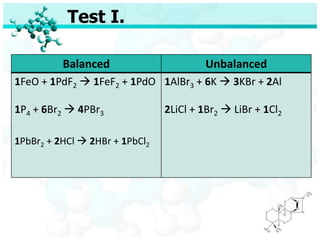
Test I.
Balanced Unbalanced
1AlBr3 + 6K  3KBr + 2Al
1FeO + 1PdF2  1FeF2 + 1PdO
1P4 + 6Br2  4PBr3
2LiCl + 1Br2  LiBr + 1Cl2
1PbBr2 + 2HCl  2HBr + 1PbCl2
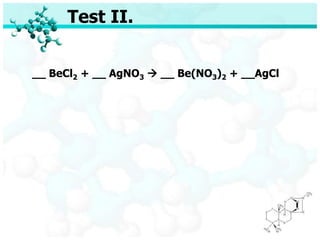
Test II.
__ BeCl2 + __ AgNO3  __ Be(NO3)2 + __AgCl
QUIZ TIME
Test I.
Balanced Unbalanced
1AlBr3 + 6K  3KBr + 2Al
1FeO + 1PdF2  1FeF2 + 1PdO
1P4 + 6Br2  4PBr3
2LiCl + 1Br2  LiBr + 1Cl2
1PbBr2 + 2HCl  2HBr + 1PbCl2
Test I.
1FeO + 1PdF2  1FeF2 + 1PdO
1P4 + 6Br2  4PBr3
2LiCl + 1Br2  LiBr + 1Cl2
1PbBr2 + 2HCl  2HBr + 1PbCl2
Balanced Unbalanced
1AlBr3 + 6K  3KBr + 2Al
Test I.
Balanced Unbalanced
1FeO + 1PdF2  1FeF2 + 1PdO 1AlBr3 + 6K  3KBr + 2Al
2LiCl + 1Br2  LiBr + 1Cl2
1PbBr2 + 2HCl  2HBr + 1PbCl2
Test I.
Balanced Unbalanced
1FeO + 1PdF2  1FeF2 + 1PdO
1P4 + 6Br2  4PBr3
1AlBr3 + 6K  3KBr + 2Al
2LiCl + 1Br2  LiBr + 1Cl2
1PbBr2 + 2HCl  2HBr + 1PbCl2
Test I.
Balanced Unbalanced
1FeO + 1PdF2  1FeF2 + 1PdO
1P4 + 6Br2  4PBr3
1AlBr3 + 6K  3KBr + 2Al
2LiCl + 1Br2  LiBr + 1Cl2
1PbBr2 + 2HCl  2HBr + 1PbCl2
Test I.
Balanced Unbalanced
1FeO + 1PdF2  1FeF2 + 1PdO
1P4 + 6Br2  4PBr3
1PbBr2 + 2HCl  2HBr + 1PbCl2
1AlBr3 + 6K  3KBr + 2Al
2LiCl + 1Br2  LiBr + 1Cl2
Test II.
__ BeCl2 + __ AgNO3  __ Be(NO3)2 + __AgCl
Test II.
__ BeCl2 + __ AgNO3  __ Be(NO3)2 + __AgCl
– Be –
– Cl –
– Ag –
– N –
– O –
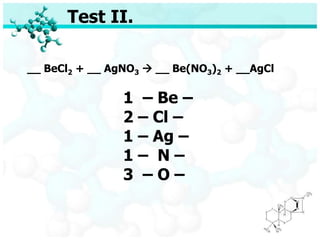
Test II.
__ BeCl2 + __ AgNO3  __ Be(NO3)2 + __AgCl
1 – Be –
2 – Cl –
1 – Ag –
1 – N –
3 – O –
Test II.
__ BeCl2 + __ AgNO3  __ Be(NO3)2 + __AgCl
1 – Be – 1
2 – Cl – 1
1 – Ag – 1
1 – N – 2
3 – O – 6
Test II.
__ BeCl2 + __ AgNO3  __ Be(NO3)2 + 2AgCl
1 – Be – 1
2 – Cl – 1x2=2
1 – Ag – 1x2=2
1 – N – 2
3 – O – 6
Test II.
__ BeCl2 + 2AgNO3  __ Be(NO3)2 + 2AgCl
1 – Be – 1
2 – Cl – 1x2=2
2=2x1 – Ag – 1x2=2
2=2x1 – N – 2
6=2x3 – O – 6
Test II.
Balanced Equation:
1BeCl2 + 2AgNO3  1Be(NO3)2 + 2AgCl
or
BeCl2 + 2AgNO3  Be(NO3)2 + 2AgCl
THE END!

demonstration-balancing equation.pptx

  • 1.
  • 2.
  • 3.
    UNLOCKING OF TERMS •Matter • Pure Substance • Elements • Compounds • Chemical Reaction • Chemical Equation
  • 4.
    TERMS MATTER - anything thathas space and occupies mass PURE SUBSTANCE - sample of matter that has definite chemical and physical properties.
  • 5.
    TERMS ELEMENT - Simplest fromof pure substance COMPOUND - pure substance that is made up of two or more elements bonded chemically
  • 6.
    MOLECULAR SHAPES Pure Substances Made ofone type of matter Elements Made of one type of atom Compounds Made of 2 or More atoms bonded together Homogeneous one phase MATTER Made of Atoms Has Mass & takes up Space Heterogeneous Made of more than one phase Can be separated Mixtures Made of more than one type of matter Atom + Atom = Element Molecule + Molecule = Compound Atom + Atom = Molecule Example: Juice Examples: Trail Mix Salad
  • 7.
    TERMS CHEMICAL REACTIONS - processin which the physical and chemical properties of the original substances change as new substances with different physical and chemical properties are formed. CHEMICAL EQUATION - symbolic representation of a chemical reaction in the form of symbols and chemical formulas
  • 8.
    H2 + O2 H2O H O H2O Reactant Product Beginning of the reaction Formed after the reaction
  • 9.
    H2 + O2 H2O H O H2O +  H H H H O O O
  • 10.
    LAW OF CONSERVATION OFMASS During chemical reaction, atoms are neither created nor destroyed. The number of atoms remains constant throughout the reaction. Since the number of atoms doesn’t change, the mass must remain constant as well.
  • 11.
    H2 + O2 H2O
  • 12.
    H2 + O2 H2O H O H2O +  +  H H O O H H O H H
  • 13.
    H2 + O2 H2O H O H2O +  +  H H O O H H O H H H H O
  • 14.
    H2 + O2 H2O H H H H O O H H O
  • 15.
    2H2 + O2 2H2O H H H H O O H H O
  • 16.
    2H2 + O2 2H2O BALANCED EQUATION +  H H O O H H O H H H H O
  • 17.
  • 18.
  • 20.
    Na + FeCl2 NaCl + Fe When sodium metal reacts with iron (II) chloride, iron metal and sodium chloride are formed.
  • 21.
    Na + FeCl2 NaCl + Fe Na Cl Fe
  • 22.
    Na + FeCl2 NaCl + Fe Step 1. Identify the reactant and the product. Reactant: Na + FeCl2 Product: NaCl+ Fe
  • 23.
    Na + FeCl2 NaCl + Fe Step 2. List all the elements found on the chemical equation __ Na + __ FeCl2  __ NaCl + __Fe -Na- -Fe- -Cl-
  • 24.
    Na + FeCl2 NaCl + Fe Step 3. Identify the number of atoms present in every element in the reactant side __ Na + __ FeCl2  __ NaCl + __Fe 1 -Na- 1 -Fe- 2 -Cl-
  • 25.
    Na + FeCl2 NaCl + Fe Step 4. Identify the number of atoms present in every element in the product side __ Na + __ FeCl2  __ NaCl + __Fe -Na- 1 -Fe- 1 -Cl- 1
  • 26.
    Na + FeCl2 NaCl + Fe Step 5. Check if the number of atoms on both reactant and product side is the same/balanced __ Na + __ FeCl2  __ NaCl + __Fe 1 -Na- 1 1 -Fe- 1 2 -Cl- 1
  • 27.
    Na + FeCl2 NaCl + Fe Step 6. Write coefficient in each element/compound to change the number of atoms in an element and check if the number of atoms on both reactant and product side is the same/balanced __ Na + __ FeCl2  2NaCl + __Fe 1 -Na- 1 1 -Fe- 1 2 -Cl- 1
  • 28.
    Na + FeCl2 NaCl + Fe Step 6. Write coefficient in each element/compound to change the number of atoms in an element and check if the number of atoms on both reactant and product side is the same/balanced __ Na + __ FeCl2  2NaCl + __Fe 1 -Na- 1 1 -Fe- 1 2 -Cl- 2
  • 29.
    Na + FeCl2 NaCl + Fe Step 6. Write coefficient in each element/compound to change the number of atoms in an element and check if the number of atoms on both reactant and product side is the same/balanced __ Na + __ FeCl2  2NaCl + __Fe 1 -Na- 2 1 -Fe- 1 2 -Cl- 2
  • 30.
    Na + FeCl2 NaCl + Fe Step 6. Write coefficient in each element/compound to change the number of atoms in an element and check if the number of atoms on both reactant and product side is the same/balanced 2Na + FeCl2  2NaCl + Fe 2 -Na- 2 1 -Fe- 1 2 -Cl- 2
  • 31.
    NaOH + H2SO4 Na2SO4 + H2O When dissolved sodium hydroxide reacts with sulfuric acid, aqueous sodium sulfate and water are formed.
  • 32.
    NaOH+ H2SO4 Na2SO4 + H2O
  • 33.
    NaOH+ H2SO4 Na2SO4 + H2O Step 1. Identify the reactant and the product. Reactant: NaOH+ H2SO4 Product: Na2SO4 + H2O
  • 34.
    NaOH+ H2SO4 Na2SO4 + H2O Step 2. List all the elements found on the chemical equation __ NaOH + __ H2SO4  __ Na2SO4 + __H2O -Na- -OH- -H- -S-
  • 35.
    NaOH+ H2SO4 Na2SO4 + H2O Step 3. Identify the number of atoms present in every element in the reactant side __ NaOH + __ H2SO4  __ Na2SO4 + __H2O 1 -Na- 6 -O- 3 -H- 4 -S-
  • 36.
    NaOH+ H2SO4 Na2SO4 + H2O Step 4. Identify the number of atoms present in every element in the product side __ NaOH + __ H2SO4  __ Na2SO4 + __H2O -Na- 2 -O- 5 -H- 2 -S- 1
  • 37.
    NaOH+ H2SO4 Na2SO4 + H2O Step 5. Check if the number of atoms on both reactant and product side is the same/balanced __ NaOH + __ H2SO4  __ Na2SO4 + __H2O 1 -Na- 2 5 -O- 5 3 -H- 2 1 -S- 1
  • 38.
    NaOH+ H2SO4 Na2SO4 + H2O Step 6. Write coefficient in each element/compound to change the number of atoms in an element and check if the number of atoms on both reactant and product side is the same/balanced 2 NaOH + H2SO4  Na2SO4 + 2 H2O 2 -Na- 2 5 -O- 5 3 -H- 2 1 -S- 1
  • 39.
    NaOH+ H2SO4 Na2SO4 + H2O Step 6. Write coefficient in each element/compound to change the number of atoms in an element and check if the number of atoms on both reactant and product side is the same/balanced 2 NaOH + H2SO4  Na2SO4 + 2 H2O 2 -Na- 2 6 -O- 6 4 -H- 4 1 -S- 1
  • 40.
  • 43.
  • 44.
    Test I. Balanced Unbalanced 1AlBr3+ 6K  3KBr + 2Al 1FeO + 1PdF2  1FeF2 + 1PdO 1P4 + 6Br2  4PBr3 2LiCl + 1Br2  LiBr + 1Cl2 1PbBr2 + 2HCl  2HBr + 1PbCl2
  • 45.
    Test II. __ BeCl2+ __ AgNO3  __ Be(NO3)2 + __AgCl
  • 46.
  • 47.
    Test I. Balanced Unbalanced 1AlBr3+ 6K  3KBr + 2Al 1FeO + 1PdF2  1FeF2 + 1PdO 1P4 + 6Br2  4PBr3 2LiCl + 1Br2  LiBr + 1Cl2 1PbBr2 + 2HCl  2HBr + 1PbCl2
  • 48.
    Test I. 1FeO +1PdF2  1FeF2 + 1PdO 1P4 + 6Br2  4PBr3 2LiCl + 1Br2  LiBr + 1Cl2 1PbBr2 + 2HCl  2HBr + 1PbCl2 Balanced Unbalanced 1AlBr3 + 6K  3KBr + 2Al
  • 49.
    Test I. Balanced Unbalanced 1FeO+ 1PdF2  1FeF2 + 1PdO 1AlBr3 + 6K  3KBr + 2Al 2LiCl + 1Br2  LiBr + 1Cl2 1PbBr2 + 2HCl  2HBr + 1PbCl2
  • 50.
    Test I. Balanced Unbalanced 1FeO+ 1PdF2  1FeF2 + 1PdO 1P4 + 6Br2  4PBr3 1AlBr3 + 6K  3KBr + 2Al 2LiCl + 1Br2  LiBr + 1Cl2 1PbBr2 + 2HCl  2HBr + 1PbCl2
  • 51.
    Test I. Balanced Unbalanced 1FeO+ 1PdF2  1FeF2 + 1PdO 1P4 + 6Br2  4PBr3 1AlBr3 + 6K  3KBr + 2Al 2LiCl + 1Br2  LiBr + 1Cl2 1PbBr2 + 2HCl  2HBr + 1PbCl2
  • 52.
    Test I. Balanced Unbalanced 1FeO+ 1PdF2  1FeF2 + 1PdO 1P4 + 6Br2  4PBr3 1PbBr2 + 2HCl  2HBr + 1PbCl2 1AlBr3 + 6K  3KBr + 2Al 2LiCl + 1Br2  LiBr + 1Cl2
  • 53.
    Test II. __ BeCl2+ __ AgNO3  __ Be(NO3)2 + __AgCl
  • 54.
    Test II. __ BeCl2+ __ AgNO3  __ Be(NO3)2 + __AgCl – Be – – Cl – – Ag – – N – – O –
  • 55.
    Test II. __ BeCl2+ __ AgNO3  __ Be(NO3)2 + __AgCl 1 – Be – 2 – Cl – 1 – Ag – 1 – N – 3 – O –
  • 56.
    Test II. __ BeCl2+ __ AgNO3  __ Be(NO3)2 + __AgCl 1 – Be – 1 2 – Cl – 1 1 – Ag – 1 1 – N – 2 3 – O – 6
  • 57.
    Test II. __ BeCl2+ __ AgNO3  __ Be(NO3)2 + 2AgCl 1 – Be – 1 2 – Cl – 1x2=2 1 – Ag – 1x2=2 1 – N – 2 3 – O – 6
  • 58.
    Test II. __ BeCl2+ 2AgNO3  __ Be(NO3)2 + 2AgCl 1 – Be – 1 2 – Cl – 1x2=2 2=2x1 – Ag – 1x2=2 2=2x1 – N – 2 6=2x3 – O – 6
  • 59.
    Test II. Balanced Equation: 1BeCl2+ 2AgNO3  1Be(NO3)2 + 2AgCl or BeCl2 + 2AgNO3  Be(NO3)2 + 2AgCl
  • 60.