BAKING SCIENCE AND TECHNOLOGY
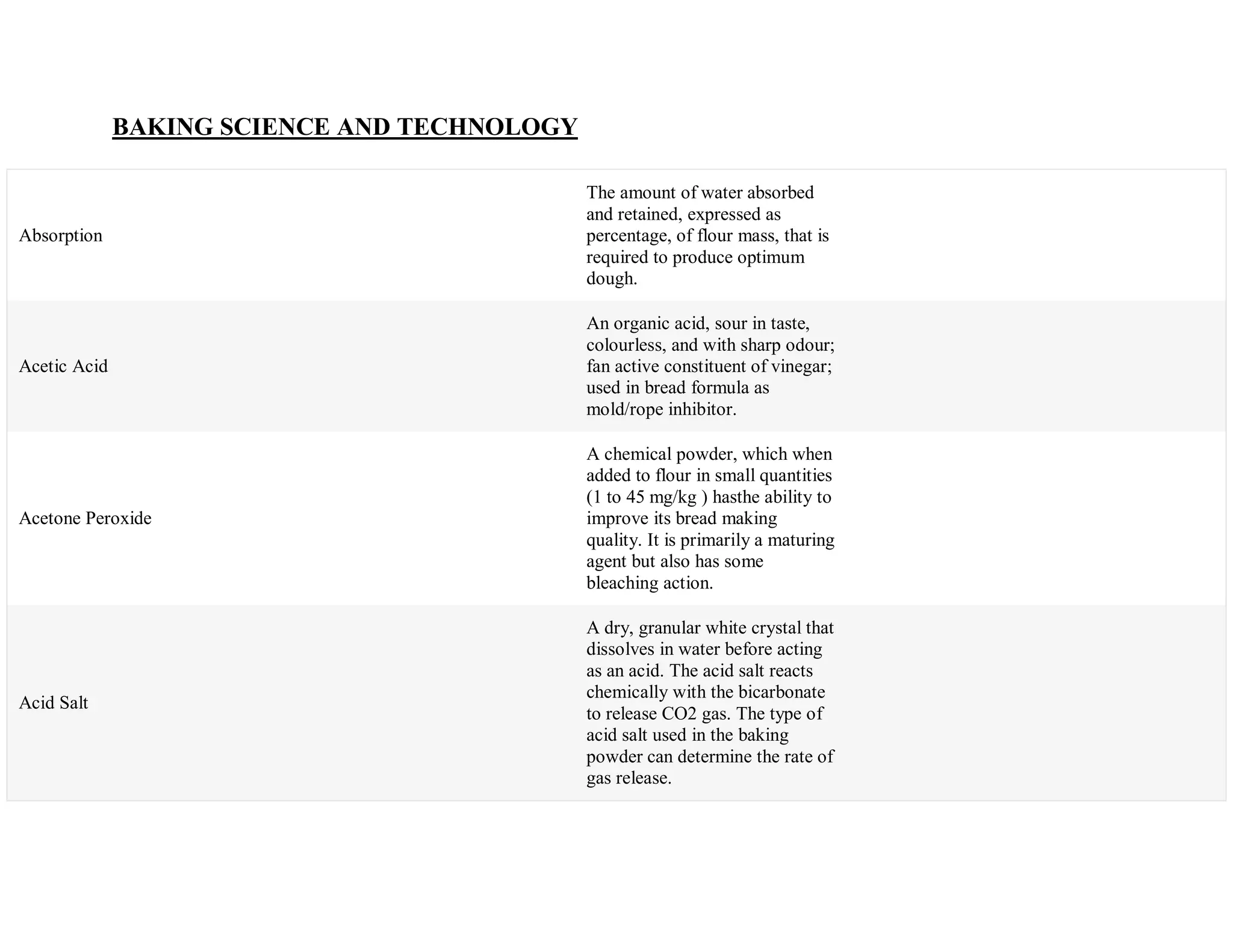
Absorption
The amount of water absorbed
and retained, expressed as
percentage, of flour mass, that is
required to produce optimum
dough.
Acetic Acid
An organic acid, sour in taste,
colourless, and with sharp odour;
fan active constituent of vinegar;
used in bread formula as
mold/rope inhibitor.
Acetone Peroxide
A chemical powder, which when
added to flour in small quantities
(1 to 45 mg/kg ) hasthe ability to
improve its bread making
quality. It is primarily a maturing
agent but also has some
bleaching action.
Acid Salt
A dry, granular white crystal that
dissolves in water before acting
as an acid. The acid salt reacts
chemically with the bicarbonate
to release CO2 gas. The type of
acid salt used in the baking
powder can determine the rate of
gas release.
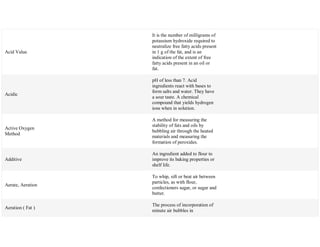
Acid Value
It is the number of milligrams of
potassium hydroxide required to
neutralize free fatty acids present
in 1 g of the fat, and is an
indication of the extent of free
fatty acids present in an oil or
fat.
Acidic
pH of less than 7. Acid
ingredients react with bases to
form salts and water. They have
a sour taste. A chemical
compound that yields hydrogen
ions when in solution.
Active Oxygen
Method
A method for measuring the
stability of fats and oils by
bubbling air through the heated
materials and measuring the
formation of peroxides.
Additive
An ingredient added to flour to
improve its baking properties or
shelf life.
Aerate, Aeration
To whip, sift or beat air between
particles, as with flour,
confectioners sugar, or sugar and
butter.
Aeration ( Fat )
The process of incorporation of
minute air bubbles in
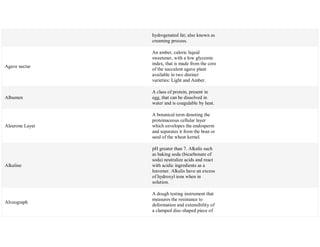
hydrogenated fat; also known as
creaming process.
Agave nectar
An amber, caloric liquid
sweetener, with a low glycemic
index, that is made from the core
of the succulent agave plant
available in two distinct
varieties: Light and Amber.
Albumen
A class of protein, present in
egg, that can be dissolved in
water and is coagulable by heat.
Aleurone Layer
A botanical term denoting the
proteinaceous cellular layer
which envelopes the endosperm
and separates it from the bran or
seed of the wheat kernel.
Alkaline
pH greater than 7. Alkalis such
as baking soda (bicarbonate of
soda) neutralize acids and react
with acidic ingredients as a
leavener. Alkalis have an excess
of hydroxyl ions when in
solution.
Alveograph
A dough testing instrument that
measures the resistance to
deformation and extensibility of
a clamped disc-shaped piece of
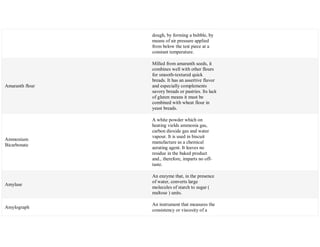
dough, by forming a bubble, by
means of air pressure applied
from below the test piece at a
constant temperature.
Amaranth flour
Milled from amaranth seeds, it
combines well with other flours
for smooth-textured quick
breads. It has an assertive flavor
and especially complements
savory breads or pastries. Its lack
of gluten means it must be
combined with wheat flour in
yeast breads.
Ammonium
Bicarbonate
A white powder which on
heating vields ammonia gas,
carbon dioxide gas and water
vapour. It is used in biscuit
manufacture as a chemical
aerating agent. It leaves no
residue in the baked product
and., therefore, imparts no off-
taste.
Amylase
An enzyme that, in the presence
of water, converts large
molecules of starch to sugar (
maltose ) units.
Amylograph
An instrument that measures the
consistency or viscosity of a
slurry of starchy flour and water
as it is heated through a pre-
determined cycle. The viscosity
is measured by the resistance
that the slurry offers to a mixing
paddle. It is used to measure the
amylase activity of flours.
Antioxidants
Naturally-occuring substances or
synthetic chemical compounds
which can retard the
development of oxidative
rancidity in fats and fat-
containing foodstuffs. Sugar and
lecithin are examples of natural
antioxidants, while butylated
hydroxy-anisole ( BHA ),
butylated hydroxy toluene ( BHT
) and dodecyl gallate are
examples of chemical
antioxidants.
Antistaling Agents
Substances such as sodium
stearate, polyoxyethylene
monostearate and glyceryl mono
stearate ( GMS ), that retard the
staling of baked products.
Artificial Sweetener
Non-nutritive (contain no
nutrients), high-intensity sugar
substitutes
Artisan
Skilled craftsman or trade; baker
who produces bread or bakery
goods using production methods
that are part hand-made. Often
refers to European crusty breads
or low-ratio cakes and desserts.
Ascorbic Acid (
Vitamin C )
A naturally occuring vitamin that
is used in the baking industry as
an improving agent. Its overall
effect on the physical properties
of dough depend both on its
oxidizing and reducing actions.
Ash Content
The amount of incombustible
residue, left after incinerating a
weighed amount of a material
and expressed as percentage.
Bake
Cooking food in dry heat,
especially in an oven.
Bake Test
A test designed to show the
baking properties of flour when
subjected to the parameters of
bulk production, and carried out
under controlled conditions.
Baker‘s % Formula
Ingredient weight divided by
total flour weight X 100 =
bakers% for that ingredient.
Baker‘s Percent
In baking formulas primarily
based on flour, each ingredient‘s
weight is measured as a
percentage of the total flour
weight (100 percent).
Baking Loss
The loss of mass in a product as
a result of baking. In the case of
non fermented products, the
difference in mass between the
dough or batter from the moment
when it is put in the oven and
when it emerges as a baked
product. This includes the loss of
fat to the baking sheet or tin.
Baking mix
A combination of pre-measured
baking dry ingredients (Ex:
flours, meal, leavening, sugars,
salt, spices).
Baking Powder
A balanced mixture of sodium
bicarbonate and an acid. Baking
powders when moistened and
heated produce a leavening gas
in batters and doughs. They
should leave only tasteless,
harmless residues. The acid
substances commonly used are
tartaric acid, cream of tartar,
calcium acidphosphate, sodium
acid pyrophosphate, and sodium
aluminium phosphate.
Baking sheet
A sheet of metal that is rigid and
is used for baking cookies,
breads, biscuits, etc. It usually
has one or more edges that is
turned up for ease in removing
from the oven. Types include
shiny, heavy-gauge aluminum,
the standard used in most test
kitchens for even baking and
browning.Darkened, heavy-
gauge pans will produce
especially crisp exterior crusts
desired for specialty baked
goods. Insulated baking sheets
are two sheets of aluminum with
air space between, and are
especially good for soft cookies
or tender-crust breads or rolls.
Also, see Cookie sheet, Insulated
bakeware, and Jelly roll pan
glossary listings.
Baking soda
A base, alkaline in nature,
formed when sodium carbonate
(purified form of mineral trona)
is mixed with carbon dioxide and
water to form sodium
bicarbonate. Baking soda is the
source of CO2 gas in leavening
systems. It neutralizes acids in
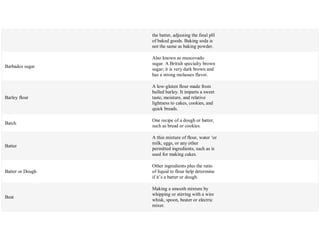
the batter, adjusting the final pH
of baked goods. Baking soda is
not the same as baking powder.
Barbados sugar
Also known as muscovado
sugar. A British specialty brown
sugar; it is very dark brown and
has a strong molasses flavor.
Barley flour
A low-gluten flour made from
hulled barley. It imparts a sweet
taste, moisture, and relative
lightness to cakes, cookies, and
quick breads.
Batch
One recipe of a dough or batter,
such as bread or cookies.
Batter
A thin mixture of flour, water ‗or
milk, eggs, or any other
permitted ingredients, such as is
used for making cakes.
Batter or Dough
Other ingredients plus the ratio
of liquid to flour help determine
if it‘s a batter or dough.
Beat
Making a smooth mixture by
whipping or stirring with a wire
whisk, spoon, beater or electric
mixer.
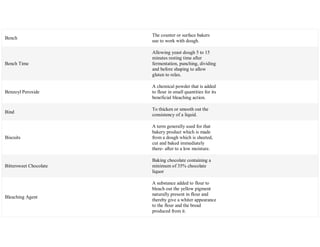
Bench
The counter or surface bakers
use to work with dough.
Bench Time
Allowing yeast dough 5 to 15
minutes resting time after
fermentation, punching, dividing
and before shaping to allow
gluten to relax.
Benzoyl Peroxide
A chemical powder that is added
to flour in small quantities for its
beneficial bleaching action.
Bind
To thicken or smooth out the
consistency of a liquid.
Biscuits
A term generally used for that
bakery product which is made
from a dough which is sheeted,
cut and baked immediately
there- after to a low moisture.
Bittersweet Chocolate
Baking chocolate containing a
minimum of 35% chocolate
liquor
Bleaching Agent
A substance added to flour to
bleach out the yellow pigment
naturally present in flour and
thereby give a whiter appearance
to the flour and the bread
produced from it.
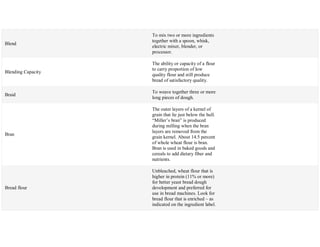
Blend
To mix two or more ingredients
together with a spoon, whisk,
electric mixer, blender, or
processor.
Blending Capacity
The ability or capacity of a flour
to carry proportion of low
quality flour and still produce
bread of satisfactory quality.
Braid
To weave together three or more
long pieces of dough.
Bran
The outer layers of a kernel of
grain that lie just below the hull.
―Miller‘s bran‖ is produced
during milling when the bran
layers are removed from the
grain kernel. About 14.5 percent
of whole wheat flour is bran.
Bran is used in baked goods and
cereals to add dietary fiber and
nutrients.
Bread flour
Unbleached, wheat flour that is
higher in protein (11% or more)
for better yeast bread dough
development and preferred for
use in bread machines. Look for
bread flour that is enriched – as
indicated on the ingredient label.
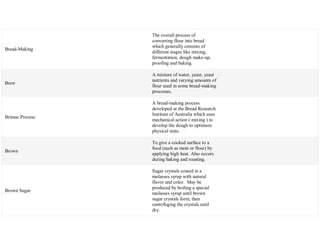
Bread-Making
The overall process of
converting flour into bread
which generally consists of
different stages like mixing,
fermentation, dough make-up,
proofing and baking.
Brew
A mixture of water, yeast, yeast
nutrients and varying amounts of
flour used in some bread-making
processes.
Brimac Process
A bread-making process
developed at the Bread Research
Institute of Australia which uses
mechanical action ( mixing ) to
develop the dough to optimum
physical state.
Brown
To give a cooked surface to a
food (such as meat or flour) by
applying high heat. Also occurs
during baking and roasting.
Brown Sugar
Sugar crystals coated in a
molasses syrup with natural
flavor and color. May be
produced by boiling a special
molasses syrup until brown
sugar crystals form, then
centrifuging the crystals until
dry.
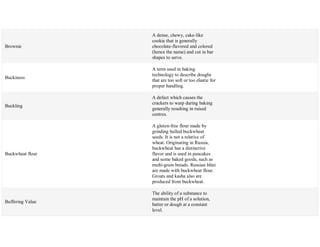
Brownie
A dense, chewy, cake-like
cookie that is generally
chocolate-flavored and colored
(hence the name) and cut in bar
shapes to serve.
Buckiness
A term used in baking
technology to describe doughs
that are too soft or too elastic for
proper handling.
Buckling
A defect which causes the
crackers to warp during baking
generally resulting in raised
centres.
Buckwheat flour
A gluten-free flour made by
grinding hulled buckwheat
seeds. It is not a relative of
wheat. Originating in Russia,
buckwheat has a distinctive
flavor and is used in pancakes
and some baked goods, such as
multi-grain breads. Russian blini
are made with buckwheat flour.
Groats and kasha also are
produced from buckwheat.
Buffering Value
The ability of a substance to
maintain the pH of a solution,
batter or dough at a constant
level.
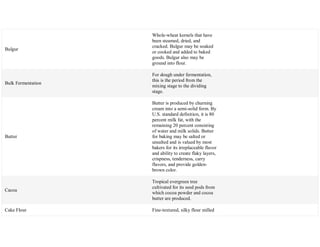
Bulgur
Whole-wheat kernels that have
been steamed, dried, and
cracked. Bulgur may be soaked
or cooked and added to baked
goods. Bulgur also may be
ground into flour.
Bulk Fermentation
For dough under fermentation,
this is the period from the
mixing stage to the dividing
stage.
Butter
Butter is produced by churning
cream into a semi-solid form. By
U.S. standard definition, it is 80
percent milk fat, with the
remaining 20 percent consisting
of water and milk solids. Butter
for baking may be salted or
unsalted and is valued by most
bakers for its irreplaceable flavor
and ability to create flaky layers,
crispness, tenderness, carry
flavors, and provide golden-
brown color.
Cacoa
Tropical evergreen tree
cultivated for its seed pods from
which cocoa powder and cocoa
butter are produced.
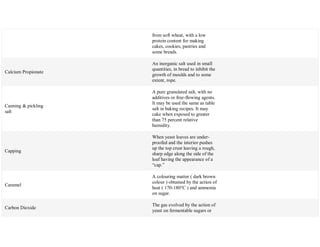
Cake Flour Fine-textured, silky flour milled
from soft wheat, with a low
protein content for making
cakes, cookies, pastries and
some breads.
Calcium Propionate
An inorganic salt used in small
quantities, in bread to inhibit the
growth of moulds and to some
extent, rope.
Canning & pickling
salt
A pure granulated salt, with no
additives or free-flowing agents.
It may be used the same as table
salt in baking recipes. It may
cake when exposed to greater
than 75 percent relative
humidity.
Capping
When yeast loaves are under-
proofed and the interior pushes
up the top crust leaving a rough,
sharp edge along the side of the
loaf having the appearance of a
―cap.‖
Caramel
A colouring matter ( dark brown
colour ) obtained by the action of
heat ( 170-180°C ) and ammonia
on sugar.
Carbon Dioxide
The gas evolved by the action of
yeast on fermentable sugars or
by the action of baking powder
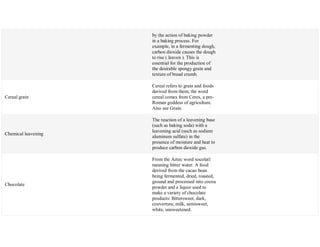
in a baking process. For
example, in a fermenting dough,
carbon dioxide causes the dough
to rise ( leaven ). This is
essential for the production of
the desirable spongy grain and
texture of bread crumb.
Cereal grain
Cereal refers to grain and foods
derived from them; the word
cereal comes from Ceres, a pre-
Roman goddess of agriculture.
Also see Grain.
Chemical leavening
The reaction of a leavening base
(such as baking soda) with a
leavening acid (such as sodium
aluminum sulfate) in the
presence of moisture and heat to
produce carbon dioxide gas.
Chocolate
From the Aztec word xocolatl
meaning bitter water. A food
derived from the cacao bean
being fermented, dried, roasted,
ground and processed into cocoa
powder and a liquor used to
make a variety of chocolate
products: Bittersweet, dark,
couverture, milk, semisweet,
white, unsweetened.
Chorbywood Bread
Process
Bread-making process developed
by the British Baking Industries
Research Association,
Chorbywood, UK, which uses
high-speed mixing for the
optimal development of dough,
thereby eliminating the need of
bulk fermentation.
CO2
Carbon dioxide; the gas released
from leavening reactions and
fermentation that creates bubbles
and space in a batter or dough.
Coarse
Refers to the crumb structure of
some baked goods.
Coarse Salt
Large crystals of salt, such as
Kosher, rock salt, some sea salts,
pretzel salt
Coat
To thoroughly cover a food with
a liquid or dry mixture.
Cocoa butter
The portion of fat in the cacao
bean.
Cocoa powder
Unsweetened cocoa powder
made from cacao beans that are
fermented, dried, roasted, and
cracked. The nibs (small pieces)
are ground to extract about 75
percent of the cocoa butter – a
thick paste which is called
chocolate liquor. This is dried
and ground to powder.
Composite Flour
A flour made by blending
varying amounts of non-wheat
flour with wheat flour and used
for production of baked goods
that are traditionally made from
wheat flour.
Conditioned Raisins
Moistened raisins before mixing
into a batter or dough to prevent
the raisin from grabbing
moisture from the mixture or
baked product, making the baked
product crumbly. How to
condition raisins: Cover raisins
in tap water (80º F.) for 5 to 10
minutes; drain off water.
Measure raisins needed; place
remainder in sealable food
container or bag. Store
refrigerated. More at
www.LoveYourRaisins.com.
Confectioners‘ or
powdered sugar
A granulated sugar that has been
crushed into a fine powder. A
small amount (about 3 percent)
of cornstarch is added to prevent
clumping.
Consistancy ( Dough
)
The feel or firmness of a dough (
also called viscosity ) as
measured by Farniograph or a
similar instrument. It signifies
the handling properties of a
dough.
Continuous Process
In relation to bread making,
refers to an automatic process
that is essentially continuous
from the mixing of the dough to
the exit of the bread from the
oven.
Convection oven
A gas or electric oven equipped
with a fan that continually
circulates the hot oven air around
the product. Circulating hot air
allows products to bake on
several racks at one time.
Conventional Process
In relation to bread making,
refers to older processes such as
the straight dough or the sponge
and dough processes involving
bulk fermentation.
Cookie
A small sweet baked product. It
includes items like small fancy
cakes, biscuits, pastries, etc.
Cooling To let food stand until it no
longer feels warm to thetouch.
Baked goods are cooled on wire
racks to avoid soggybottom
crusts; cool baked goods before
wrapping and storing.
Cooling rack
A rectangular grid of thick wire
with ―feet‖ that raise it above the
countertop. They are used to
cool cakes, cookies, and other
baked goods when they come out
of the oven. Products are cooled
while in their pan for a short
time and after the product is
removed from the pan prior to
storing or freezing. Yeast breads
are removed from the pans and
onto the rack as soon as they
come out of the oven to prevent
a soggy crust.
Corn Flour
Flour obtained by milling of the
grain of maize.
Corn starch
The fine, powdery flour obtained
from the endosperm of corn used
as a thickener for pie fillings and
puddings; in combination with
wheat flour in cakes, cookies,
pastries, it produces a fine-
textured product. Cornstarch
may be referred to as cornflour
in some recipes. More at
www.argostarch.com.
Corn Syrup
A sweetner prepared by
hydrolysing maize starch by
means of either acids or
enzymes. It is the ‗commercial
liquid glucose‘ used in sugar and
flour confectionery.
Courverture
chocolate
Professional quality glossy
coating chocolate.
Cream
In bakery trade the term ‗cream‘
means basically a homogenous
mixed preparation of
hydrogenated fat or bakery
shortening, icing sugar, flavours
and permitted food colours with
or without other ingredients in
small proportions.
Cream of Tartar
An acidic salt—potassium
hydrogen tartrate (also referred
to as tartaric acid); stabilizes
beaten egg whites and leavens
some baked goods.
Creaming
The action of whipping fat in a
manner such that it will
incorporate minute air bubbles
and become light and ‗creamy‘
in texture. In bakeries, fat is
generally ‗creamed‘ with other
ingredients such as sugar, which
facilitates the creaming process.
‗Creaming Quality‘ as applied to
fat is the ability to absorb air
during mixing.
Crepe
The French word for pancake;
paper-thin, flexible egg-rich
pancakes used to wrap or fold
around sweet or savory
ingredients as a first or main
course.
Crispness
Eating quality of biscuits which
makes it crunchy to bite;
opposite to soggy or soft.
Critical Mixing
Speed
It is the lowest mixing speed of a
dough mixer that can develop a
dough in a mechanical
development bread – making
process.
Crumb Grain
The cell structure exhibiting size
and shape of bread crumb
determined by visual
examination.
Crumb Texture
The cell structure exhibiting
hardness, coarseness and
silkiness of bread crumb as
determined by feel.
Crush
To pulverize, as with herbs and
spices used in baking.
Crust
The caramelized crisp or chewy
outer layer of a baked product
that covers the crumb or more
tender inside.
Cupping
A defect which causes biscuits to
warp during baking and the sides
to rise. This is the opposite of
‗buckling‘.
Cutting Machine
A machine used for cutting the
dough sheet into specified sizes
and shapes for biscuits. It
consists of one or more sets of
rollers, which sheet out the
dough and a cutting section
which simultaneously cuts out
the biscuits and embosses them
with an appropriate design.
Cysteine
A naturally~occuring amino
‗acid that contains sulphur. It is
used in the baking industry,
particularly in chemical
development bread-making
process, because of its ability to
reduce the mixing requirement
for optimum dough
development. It is, however, not
permitted, as yet, under the PFA
rules.
Dark chocolate:
is also bittersweet, semi-sweet,
and sweet dark chocolate; all
contain cacao beans, sugar, an
emulsifier such as soy lecithin to
preserve texture, and flavorings
such as vanilla but do not
contain milk solids. They are
distinguished by the amount of
cocoa powder: 30% (sweet dark)
to 70%, 75%, or even above
80%, for extremely dark bars.
Degerminated
To remove the germ portion of a
grain kernel,leaving bran and or
endosperm.
Degradation
Breakdown of large molecules of
any substance into smaller
fragments. Here it pertains to the
breakdown of starch by amylases
or proteins by proteases.
Demera Sugar
A light brown sugar with large
golden crystals which is slightly
sticky from adhering molasses. It
is popular in England for tea,
coffee, or to top hot cereals.
Denaturation
The destruction of the natural
properties of proteins by
physical or chemical means. An
example of denaturation is the
cooking of flour proteins in
dough to produce the semi-rigid
structure of bread – a thermal
denaturation of proteins.
Developer Mixer
A dough mixer that is used to
develop the dough to its optimal
physical state for bread-making.
Dextrins
Modified starch prepared from
starch by heat treatment in the
dry state, with or without the
addition of small quantities of
chemical reagents.
Dextrose
Also dextroglucose and known
as glucose, this sugar is the chief
source of energy in the body.
Glucose is chemically
considered a simple sugar or
monosaccharide and naturally
occurs and is derived from plant
starches such as corn.
Diastatic Activity
In flour quality evaluation, it is
the measure of the activity of the
starch degrading enzymes of the
flour. It can be expressed in
terms of the maltose ( sugar )
produced or in terms of tlie peak
viscosity in the Amylograph test.
Dilatation of Fats
When fats change from solid to
liquid at the same temperature,
there is an increase in volume.
Measurement of this increase is
used to estimate the amount of
solid fat present in a mixture at
any given temperature.
Dissolve
Stirring a dry substance into a
liquid until solids are no longer
remaining. (For example: stirring
sugar into water, yeast into
water, etc.).
Divider
A machine used in bread-making
to divide a large piece of dough
into desired size pieces.
Dock
A baking technique in which
regularly spaced holes are poked
all over the surface of a dough to
promote a crisp baked surface
(crackers, pet treats, pie shells,
all may be docked before
baking).
Docking
Slashing or making incisions in
the surface of bread or rolls for
proper expansion while baking.
Done just before baking.
Dot
To place small dabs or pieces of
butter or batter over the surface
of a food, such as with a pie, just
before the top crust isadded and
baking begins.
Dough
A mixture of flour and liquids,
and may have other ingredients,
that is thick enough to be
handled, kneaded or shaped.
Dough Development
The elaboration of the physical
properties of a dough that are the
best for the production of bread.
This can be achieved by
fermentation as in dough
ripening or maturing, by mixing
as in mechanical development or
by a combination of certain
chemicals and mixing as in
chemical development.
Dough Expansion
Test ( Pelshenke )
The time required for a dough
ball made from wheat meal,
water and yeast and suspended in
water at 30°C to disintegrate. It
is a rough measure of the quality
of wheat protein for bread-
making and is used in screening
for baking quality in new
varieties of wheat during the
early generations.
Dough Maturing
Agents
Chemical substances such as
potassium bromate, potassium
iodate, ascorbic acid ( Vitamin C
) which when added to dough in
small amount improve the
handling and bread- making
quality of the dough.
Dough scraper, dough
or bench knife
A flat, heavy metal blade (about
3 X 5-inches) with straight sides,
sharp corners and a handle on
top edge for moving, kneading,
clean-cutting dough, incising, or
even cleaning work surfaces.
Dough Tests
Tests made on doughs to obtain
information on the bread-making
quality of the flour or to
determine the effects of various
added ingredients.
Drain
To remove liquid from a food
product.
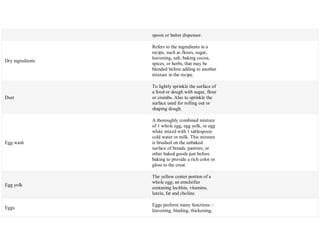
Drop
To deposit even portions of
dough on a baking sheet using
spoon or batter dispenser.
Dry ingredients
Refers to the ingredients in a
recipe, such as flours, sugar,
leavening, salt, baking cocoa,
spices, or herbs, that may be
blended before adding to another
mixture in the recipe.
Dust
To lightly sprinkle the surface of
a food or dough with sugar, flour
or crumbs. Also to sprinkle the
surface used for rolling out or
shaping dough.
Egg wash
A thoroughly combined mixture
of 1 whole egg, egg yolk, or egg
white mixed with 1 tablespoon
cold water or milk. This mixture
is brushed on the unbaked
surface of breads, pastries, or
other baked goods just before
baking to provide a rich color or
gloss to the crust.
Egg yolk
The yellow center portion of a
whole egg; an emulsifier
contaning lecithin, vitamins,
lutein, fat and choline.
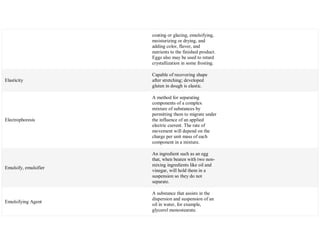
Eggs
Eggs perform many functions –
leavening, binding, thickening,
coating or glazing, emulsifying,
moisturizing or drying, and
adding color, flavor, and
nutrients to the finished product.
Eggs also may be used to retard
crystallization in some frosting.
Elasticity
Capable of recovering shape
after stretching; developed
gluten in dough is elastic.
Electrophoresis
A method for separating
components of a complex
mixture of substances by
permitting them to migrate under
the influence of an applied
electric current. The rate of
movement will depend on the
charge per unit mass of each
component in a mixture.
Emulsify, emulsifier
An ingredient such as an egg
that, when beaten with two non-
mixing ingredients like oil and
vinegar, will hold them in a
suspension so they do not
separate.
Emulsifying Agent
A substance that assists in the
dispersion and suspension of an
oil in water, for example,
glycerol monostearate.
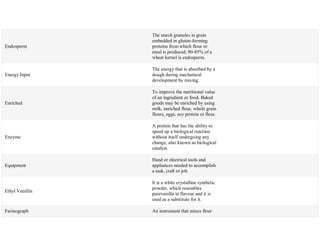
Endosperm
The starch granules in grain
embedded in gluten-forming
proteins from which flour or
meal is produced; 80-85% of a
wheat kernel is endosperm.
Energy Input
The energy that is absorbed by a
dough during mechanical
development by mixing.
Enriched
To improve the nutritional value
of an ingredient or food. Baked
goods may be enriched by using
milk, enriched flour, whole grain
flours, eggs, soy protein or flour.
Enzyme
A protein that has the ability to
speed up a biological reaction
without itself undergoing any
change, also known as biological
catalyst.
Equipment
Hand or electrical tools and
appliances needed to accomplish
a task, craft or job.
Ethyl Vanillin
It is a white crystalline synthetic
powder, which resembles
purevanilla in flavour and it is
used as a substitute for it.
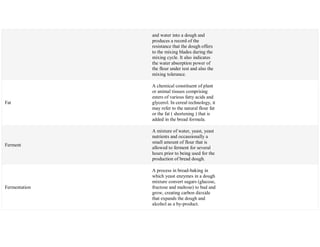
Farinograph An instrument that mixes flour
and water into a dough and
produces a record of the
resistance that the dough offers
to the mixing blades during the
mixing cycle. It also indicates
the water absorption power of
the flour under test and also the
mixing tolerance.
Fat
A chemical constituent of plant
or animal tissues comprising
esters of various fatty acids and
glycerol. In cereal technology, it
may refer to the natural flour fat
or the fat ( shortening ) that is
added in the bread formula.
Ferment
A mixture of water, yeast, yeast
nutrients and occassionally a
small amount of flour that is
allowed to ferment for several
hours prior to being used for the
production of bread dough.
Fermentation
A process in bread-baking in
which yeast enzymes in a dough
mixture convert sugars (glucose,
fructose and maltose) to bud and
grow, creating carbon dioxide
that expands the dough and
alcohol as a by-product.
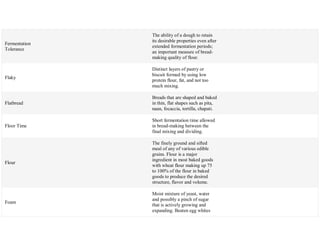
Fermentation
Tolerance
The ability of a dough to retain
its desirable properties even after
extended formentation periods;
an important measure of bread-
making quality of flour.
Flaky
Distinct layers of pastry or
biscuit formed by using low
protein flour, fat, and not too
much mixing.
Flatbread
Breads that are shaped and baked
in thin, flat shapes such as pita,
naan, focaccia, tortilla, chapati.
Floor Time
Short fermentation time allowed
in bread-making between the
final mixing and dividing.
Flour
The finely ground and sifted
meal of any of various edible
grains. Flour is a major
ingredient in most baked goods
with wheat flour making up 75
to 100% of the flour in baked
goods to produce the desired
structure, flavor and volume.
Foam
Moist mixture of yeast, water
and possibly a pinch of sugar
that is actively growing and
expanding. Beaten egg whites
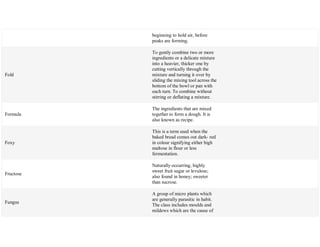
beginning to hold air, before
peaks are forming.
Fold
To gently combine two or more
ingredients or a delicate mixture
into a heavier, thicker one by
cutting vertically through the
mixture and turning it over by
sliding the mixing tool across the
bottom of the bowl or pan with
each turn. To combine without
stirring or deflating a mixture.
Formula
The ingredients that are mixed
together to form a dough. It is
also known as recipe.
Foxy
This is a term used when the
baked bread comes out dark- red
in colour signifying either high
maltose in flour or less
fermentation.
Fructose
Naturally occurring, highly
sweet fruit sugar or levulose;
also found in honey; sweeter
than sucrose.
Fungus
A group of micro plants which
are generally parasitic in habit.
The class includes moulds and
mildews which are the cause of
spoilage in baked products.
Gas Production
The ability of a bread dough to
produce carbon dioxide during
fermentation. It is used in the
assessment of bread- making
quality of flour.
Gas Retention
The ability of a bread dough to
retain the gas ( carbon dioxide )
produced during fermentation. It
is used in the assessment of
bread-making quality of flour.
Gassing Power
Measure of the ability of a bread
dough ( including all ingredients
) to produce gas ( carbon dioxide
) that is required for leavening (
rising ). This is also a measure of
baking quality of flour.
Gelatine
An animal protein, which has the
property of swelling in cold
water and dissolving in hot
water. It is gummy by nature.
When hot solutions of gelatine
are cooled, they form jellies.
Gelatinizatian
The breakdown of the granular
structure of starch as by heating
a starch slurry or a dough. The
starch granules swell and
subsequently burst.
Gelatinization is important in
relation to the development of
crumb structure of bread.
Glassine
This is a super calendered,
smooth, dense, transparent or
semi-transparent sheet of paper
used as a protective wrapper.
The paper is grease resistant and
has a high resistance to the
passage of air and other vapours.
Gliadin
The fraction of wheat flour
proteins that can be dissolved in
a 70 percent solution of ethyl
alcohol. It is also classified as
prolamine. It provides elasticity
to dough.
Glucose
Also dextroglucose and called
dextrose; commonly found in
grapes, corn starch and honey
and is about 30% as sweet as
sucrose (sugar).
Gluten
The elastic, expandable structure
in a dough or batter capable of
trapping gas, expanding and
when baked becoming part of the
structure of baked products.
Wheat flour simple proteins
(peptides), glutenin and gliadin,
combine with water when
stirred, mixed and kneaded to
align and form gluten‘s long
elastic structure. Gluten
containing grains are wheat, rye,
triticale, emmer wheat and
barley.
Gluten Swelling Test
A test for bread-making quality
which determines the volume of
gluten swollen in a dilute
solution of lactic acid, also
known as ‗ Rerliner test‘ and is
similar to the ‗Sedimentation
test‘.
Gluten-free
Grains or grain-based foods that
do not contain gluten or the
components of gluten, the
peptides glutenin and gliadin.
Glutenin
The fraction of wheat flour
proteins that is insoluble in
water, salt solution, or 70 percent
ethyl alcohol solution, but is
soluble in dilute alkali. It
provides strength to dough.
Glyceryl
Monostearate
It is used as a ‗fat extender‘ and
as a ‗bread softener‘, as it has
excellent emulsifying properties
and shows an affinity for both fat
and water.
Golden Syrup
A partly refined sugar syrup
made from partial inversion of
sugar ( sucrose ) using acid or
enzyme or both. It has a nice
golden brown colour and is used
in baked goods for its colour
forming and flavouring qualities.
Granulation
The coarseness or fineness of a
powder such as flour or sugar. In
baking technology, it pertains to
the particle size and size
distribution of the flour.
Grease
Rub oil, shortening, butter or fat
over surface of cooking utensil
or on a food. May also use a
lecithin based, non-fat cooking
spray, unless bake ware does not
recommend it.
Greaseproof Paper
This is a protective wrapping
paper used for wrapping food
products and other articles.
Griddle
Heavy-weight flat, rimless pan
for baking flatbreads using as
little fat as possible; flipping is
done halfway through baking;
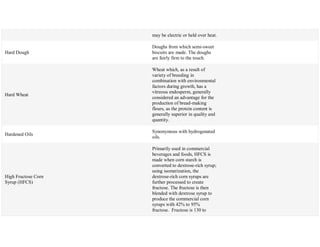
may be electric or held over heat.
Hard Dough
Doughs from which semi-sweet
biscuits are made. The doughs
are fairly firm to the touch.
Hard Wheat
Wheat which, as a result of
variety of breeding in
combination with environmental
factors during growth, has a
vitreous endosperm, generally
considered an advantage for the
production of bread-making
flours, as the protein content is
generally superior in quality and
quantity.
Hardened Oils
Synonymous with hydrogenated
oils.
High Fructose Corn
Syrup (HFCS)
Primarily used in commercial
beverages and foods, HFCS is
made when corn starch is
converted to dextrose-rich syrup;
using isomerization, the
dextrose-rich corn syrups are
further processed to create
fructose. The fructose is then
blended with dextrose syrup to
produce the commercial corn
syrups with 42% to 95%
fructose. Fructose is 130 to
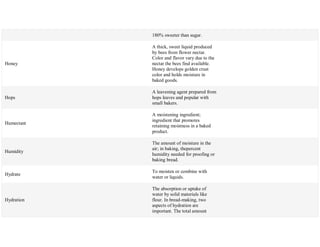
180% sweeter than sugar.
Honey
A thick, sweet liquid produced
by bees from flower nectar.
Color and flavor vary due to the
nectar the bees find available.
Honey develops golden crust
color and holds moisture in
baked goods.
Hops
A leavening agent prepared from
hops leaves and popular with
small bakers.
Humectant
A moistening ingredient;
ingredient that promotes
retaining moistness in a baked
product.
Humidity
The amount of moisture in the
air; in baking, thepercent
humidity needed for proofing or
baking bread.
Hydrate
To moisten or combine with
water or liquids.
Hydration
The absorption or uptake of
water by solid materials like
flour. In bread-making, two
aspects of hydration are
important. The total amount
absorbed ( hydration capacity )
by the flour and the rate at which
it is absorbed ( rate of hydration
).
Icing
A coat of sugar that is used to
dress baked products.
Improving Agent
Any substance that is added to
flour or to dough to improve its
performance during bread-
making and to improve the
quality of the bread that can be
produced from the flour.
Inactivation
The destruction of the natural
catalytic activity -of the enzyme
by chemical or physical means.
Ingredient Any part of a mixture.
Ingredient list Any part of a mixture.
Intermediate Proof
The stage in the bread-making
process where the dough is
allowed to rest ( relax ) for short
period up to 12 minutes between
the dividing and moulding. Also
referred to as ‗first proof‘.
Invert sugar
Sugar syrup exposed to a small
amount of acid and heating to
break sucrose into glucose and
fructose to reduce the size of the
crystals. Invert sugar is used for
fondant icings for cakes.
Iodine Value
An indication of the degree of
unsatura tion of oils or fats. It is
measured as the percentage of
iodine that is absorbed by the oil
or fat on the basis of its own
mass.
Iodized salt
Table salt with added sodium
iodide to help prevent
hypothyroidism in regions low
on natural iodine.
Kneading
To mix dough using a pressing
and folding motion, turning and
folding the dough onto itself
until gluten strands form and the
dough is smooth and elastic.
Knock Back
The punching or kneading of the
dough during bulk fermentation
to expel some of the carbon
dioxide and improve subsequent
fermentation.
Kosher salt
An additive-free, coarse-grained
salt, preferred by some bakers
and used by Jewish Kosher
butchers and food processors;
also called coarse salt.
Kraft
A term used for strong papers
primarily used for wrapping,
manufactured from long-fibred
raw material and pulped by
sulphite process.
Lactic Acid
The organic acid formed by
Lactobacilli fermentation, for
example, when milk sours. It is
also produced during dough
fermentation and is considered to
be important in bread flavour.
Lactose
Milk sugar; the sugar naturally
occurring in milk.
Lean dough
A dough prepared with little or
no fat, sugar, or milk.
Leavening
Ingredients used in baked goods
to lighten the texture, develop
flavor, produce distinctive cell
structure and increase volume.
Leavening agents include heat
and moisture (steam), beaten
eggs or egg whites, baking soda,
baking powder, cream of tartar,
and yeast. Historical terms for
leavening: Latin = levre = to
raise; also called ―lifter.‖
Leavening Agent
Any substance such as yeast or
sodium bicarbonate, used to raise
or leaven dough by producing
carbon dioxide.
Lecithin
Belongs to the class of
substances known as lipoids,
which are combinations of fat
with nitrogen-containing
substances and phosphorous. It is
normally extracted from
soyabean. It is also present in
egg yolk. It acts as an emulsifier
and is close to fat in chemical
composition.
Lifter
An old-fashioned term for the
leavening or ―lifter‖ in a batter
or dough.
Liquid
A source of water, fluid or
moisture in a batter, dough or
mixture.
Loaf
A portion of bread dough baked
in one piece or form
Low fat
3 grams of fat or less per serving
or reference amount.
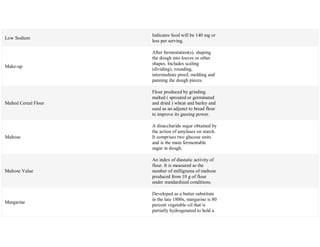
Low Sodium
Indicates food will be 140 mg or
less per serving.
Make-up
After fermentation(s), shaping
the dough into loaves or other
shapes. Includes scaling
(dividing), rounding,
intermediate proof, molding and
panning the dough pieces.
Malted Cereal Flour
Flour produced by grinding
malted ( sprouted or germinated
and dried ) wheat and barley and
used as an adjunct to bread flour
to improve its gassing power.
Maltose
A disaccharide sugar obtained by
the action of amylases on starch.
It comprises two glucose units
and is the main fermentable
sugar in dough.
Maltose Value
An index of diastatic activity of
flour. It is measured as the
number of milligrams of maltose
produced from 10 g of flour
under standardized conditions.
Margarine
Developed as a butter substitute
in the late 1800s, margarine is 80
percent vegetable oil that is
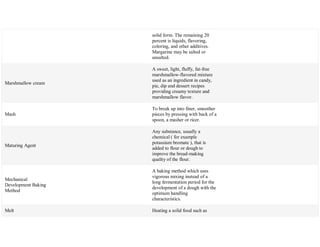
partially hydrogenated to hold a
solid form. The remaining 20
percent is liquids, flavoring,
coloring, and other additives.
Margarine may be salted or
unsalted.
Marshmallow cream
A sweet, light, fluffy, fat-free
marshmallow-flavored mixture
used as an ingredient in candy,
pie, dip and dessert recipes
providing creamy texture and
marshmallow flavor.
Mash
To break up into finer, smoother
pieces by pressing with back of a
spoon, a masher or ricer.
Maturing Agent
Any substance, usually a
chemical ( for example
potassium bromate ), that is
added to flour or dough to
improve the bread-making
quality of the flour.
Mechanical
Development Baking
Method
A baking method which uses
vigorous mixing instead of a
long fermentation period for the
development of a dough with the
optimum handling
characteristics.
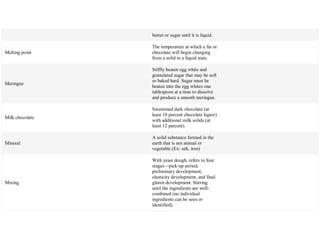
Melt Heating a solid food such as
butter or sugar until it is liquid.
Melting point
The temperature at which a fat or
chocolate will begin changing
from a solid to a liquid state.
Meringue
Stiffly beaten egg white and
granulated sugar that may be soft
or baked hard. Sugar must be
beaten into the egg whites one
tablespoon at a time to dissolve
and produce a smooth meringue.
Milk chocolate
Sweetened dark chocolate (at
least 10 percent chocolate liquor)
with additional milk solids (at
least 12 percent).
Mineral
A solid substance formed in the
earth that is not animal or
vegetable (Ex: salt, iron)
Mixing
With yeast dough, refers to four
stages—pick-up period,
preliminary development,
elasticity development, and final
gluten development. Stirring
until the ingredients are well-
combined (no individual
ingredients can be seen or
identified).
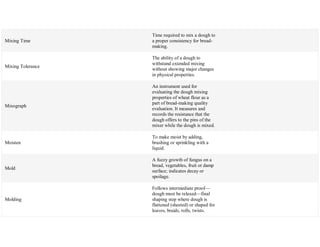
Mixing Time
Time required to mix a dough to
a proper consistency for bread-
making.
Mixing Tolerance
The ability of a dough to
withstand extended mixing
without showing major changes
in physical properties.
Mixograph
An instrument used for
evaluating the dough mixing
properties of wheat flour as a
part of bread-making quality
evaluation. It measures and
records the resistance that the
dough offers to the pins of the
mixer while the dough is mixed.
Moisten
To make moist by adding,
brushing or sprinkling with a
liquid.
Mold
A fuzzy growth of fungus on a
bread, vegetables, fruit or damp
surface; indicates decay or
spoilage.
Molding
Follows intermediate proof—
dough must be relaxed—final
shaping step where dough is
flattened (sheeted) or shaped for
loaves, braids, rolls, twists.
Monocalcium
Phosphate
A chemical substance added to
dough as a yeast nutrient. The
main nutrients provided by this
substance are calcium and
phosphorous.
Muffin
Small, cake-like sweet or savory
leavened breads.
Muffin mixing
method
Use of two bowls, mixing fluid
ingredients and dry ingredients
separately; stirring to combine is
done very quickly and with as
few stirs as possible to prevent
gluten formation.
Nibs
Cocoa nibs are simply roasted
cocoa beans separated from their
husks and broken in to small
bits; may be used in cookies or
as a topping in place of nuts.
Nut flour
Nut meats, toasted or untoasted,
that are finely ground for pastry
crusts, breads, cakes, and
cookies.
Nutrition Facts
A box on the food label offering
serving size and basic nutrition
information for a food
ingredient, recipe or product.
Nuts
The dry fruit of trees, legumes,
or seeds; an edible kernel
encased in a hard, dry shell. Rich
in nutrients, flavor, and texture,
nuts provide sensory appeal to
baked goods and other menu
items. Nuts may be as high as 90
percent fat, but the fat is
primarily the healthful,
monounsaturated type.
Oils
The liquid fat pressed from
plants and their nuts or seeds.
The oil is extracted either by
solvent-extraction or cold-
pressed. Common types used in
home baking are soybean,
safflower, corn, sunflower,
canola, and olive oils. No oil
derived from a plant contains
cholesterol, but they will vary in
amounts of poly- and mono-
unsaturates and saturated fat.
Old dough
Yeast dough that is overproofed;
dough may have tripled in
volume and fallen.
Oven
An oven may be defined as an
enclosed area with parts which
supply heat and air flow in order
to cook food.
Oven proofing
Allowing dough to proof beyond
a full doubling of size; if dough
actually proofs and falls again,
the product will not recover.
Product will be very open
grained, have a crumbly texture,
undesirable flavor, pale crust,
strong aroma and poor keeping
quality.
Oven Spring
Increase in the volume of the
dough during baking. This is
equal to the volume of the baked
loaf minus volume of the dough
when put in the oven.
Oxidation
One of the ways by which the
handling properties of dough can
be improved so as to improve the
quality of bread. It is brought
about by substances referred to
as oxidants, improvers or
maturing agents.
Pancake
One of humans‘ oldest bread
forms, hundreds of types are
shared cultures; batter may be
thick or thin, and is baked on a
very hot surface for breakfast,
lunch, dinner or a snack. (Ex:
crepes, blinis, hotcakes,
flapjacks).
Panning
The stage in the bread-making
process when the moulded
dough piece is placed in the
baking pan or tins.
Parchment paper
Sheets of grease and moisture
resistant paper used in baking to
line pans; replaces greasing or
spraying pans. Products are
shaped or distributed directly on
the paper and are easily removed
after baking. Great for making
disposable pastry bags too.
Patent Flour
The portion of a straight-run
flour, better in colour and with a
lower ash content than the
remainder of the flour. The first
processes used to make such
flour were patented and hence
the name.
Pekar Test
A test of flour quality made by
comparing the colour of a flour
against a standard sample. Each
sample is placed side by side on
a flat rectangular piece of wood,
pressed down to a smooth
surface and compared with the
standard.
Physical Dough Test Wheat quality tests that are
based on a measurement of some
physical properties ( for example
elasticity, viscosity, resistance to
extension ) of a dough produced
by mixing flour and water and
other ingredients as required.
Pie
A sweet or savory dish made
with one or two crusts and filling
(pudding, fruit, meat or
vegetables).
Plane Sifter
A sifting machine consisting of a
number of super-imposed sieves
gyrating together in a horizontal
plane, having a rotary motion.
Pliable
Easily bent or moulded, flexible.
It pertains to dough that can be
readily moulded into loaf-size
piece.
Pneumatic Conveying
The transporting of material in
enclosed tubes using air under
negative or positive pressure as
the conveying medium.
Porous
May refer to the honeycomb-like
structure of white pan bread.
Portion
(v.) to evenly divide batter or
dough to place on prepared
baking pans; n: the amount a
person is served.
Potassium Bromate
A chemical substance ( salt )
comprising of potassium,
bromine and oxygen that is used
in the baking industry as a dough
maturing agent ( improver ). It is
a slow improver.
Potassium Iodate
A chemical substance
comprising of potassium, iodine
and oxygen ( KI03 ) that is used
in the baking industry as a dough
maturing agent ( improver ). It is
comparatively a fast improver.
Preheat
Heating the empty oven to the
recommended temperature
before placing the product to be
baked init.
Proofing
The stage in the bread-making
process when the dough is
allowed to rise under the action
of carbon dioxide produced by
fermentation.
Protease
An enzyme ( biological catalyst )
that brings about a breakdown of
proteins. In the baking industry,
this enzyme from cereal or
fungal sources is used to
improve the handling properties
of dough.
Protein
One of the chief constituents of
plant and animal tissues
containing carbon, hydrogen,
oxygen, nitrogen and frequently
sulphur. In wheat, protein is
important for baking and
nutritional qualities.
Pumpernickel
A medium- to coarsely ground,
rye flour, light brown in color. It
may be labeled ―medium rye.‖ A
mixture of rye and wheat flour
used to produce a distinctive
bread. Molasses are usually used
to add color and flavor.
Quinoa flour
A gluten-free flour made from
grinding quinoa grain. It is
highly nutritious and yields a
tender, moist crumb in cookies,
pancakes, waffles, and
fruitcakes.
Rancid
Having the bad smell or taste of
spoiled (oxidized) fats or oils;
nuts may also be rancid; rancid
fats are a carcinogen and should
not be consumed.
Raw Sugar
About 98 percent sucrose and tan
or brown in appearance; it is a
coarse, granulated solid obtained
on evaporation of clarified sugar
cane juice.
Reduced sodium
A food has reduced the sodium
content by 25%; there is 25%
less sodium per serving than the
original food.
Reducing Agent
A chemical substance that is
capable of adding hydrogen or
removing oxygen from another
substance, hence reducing it.
Also, in some instances it is
capable of splitting chemical
bonds. In baking, it usually
refers to agents, for example
cysteine that can break ( cleave )
the disulfide bonds in flour
proteins. In chemical or
mechanical development of
doughs, it helps in reducing the
mixing time.
Rest time
After kneading, punching or
rounding, dough benefits from a
brief (10 to 30 minutes)
intermission in handling. The
dough will be more easily rolled
or shaped. Keep dough covered
with bowl or plastic food wrap
sprayed with pan spray while it
rests so ―skin‖ doesn‘t form.
Yeast dough: called an
intermediate proof.
Ripening
The development of proper
physical properties of doughs
that are required for bread-
making during fermentation.
Rope
A bacterial infection occuring in
bread during periods of hot
wheather. First sign of a rope is a
sour ‗Fruity‘ odour followed by
a stickiness in the crumb and
darkening of crumb colour
usually in patches. Rope can
become evident within 24 hours
after baking. This can be
controlled by high standards of
cleanliness and by use of suitable
antibacterial agents.
Ropy Bread
Bread in which certain spore-
forming bacteria ( mostly
Bacillus subtilis and related
species ) have developed during
storage, with the effect that the
bread produces a characteristic
smell and shows in its interior
characteristic signs of decay;
these may include the conversion
of the crumb into a moist, sticky
substance, leaving slimy thrc ads
when extended.
Rotary Moulding
Machine
A biscuit forming machine in
which an engraved roller is used
to form the biscuit.
Rounding
Shaping dough so that a smooth
surface encases the dough,
sealing it as it rests.
Rye Bread
Bread made of coarse or not too
fine meal milled from rye, with
no intentional addition of any
other cereal.
Rye flour
Milled from rye grain, the flour
is darker, heavier, and low in
gluten. It is sold as light, dark, or
medium for home baking. The
light and medium rye flour have
most of the bran removed. Dark
rye flour is whole grain.
Salinity
(Sodium Chloride – NaCl) can
be produced three ways: Open-
air evaporation of salt brine in
shallow ponds (sea salt). By
mining of rock salt deposits. By
boiling and evaporation of
higher purity brine. Salt
contributes to flavor in baked
goods, and controls fermentation
of yeast in breads. Coarse grades
are available for use as toppings
on soft pretzels and other
specialty breads.
Salt
The level of saltiness in a food,
water or product.
Salt substitute
Usually potassium chloride in
granular form, intended for
lowering sodium intake;
generally bitter in taste. It is not
recommended for baking.
Saturated fats
Fats that are solid enough at
room temperature (70° F.) to
hold their shape; usually animal
fats, though palm or coconut oil
are also included.
Scone
A Scottish biscuit-like bread
made with oats, flour, butter and
leavened with baking powder;
savory or sweet and frequently
served with breakfast or tea.
Scratch baking
Baking method that begins with
measuring basic ingredients such
as flour, sugar, butter and
leavening. It requires a recipe
rather than convenience
products, like mixes.
Sealing
Pinching the edges of dough that
are brought together; securing or
closing two sides of dough,
packaging or product edges.
Seize
Refers to melting chocolate that
becomes a thick, lumpy mass
due to even a small amount of
steam or moisture getting into
the melting chocolate. Chocolate
may be unseized (although
texture is still affected) by
stirring in 1 tablespoon or less of
vegetable oil, cocoa butter or
clarified butter per 6 oz. Of
chocolate until smooth.
Semi-sweet
chocolate:
Baking chocolate that contains
between 15 percent and 35
percent chocolate liquor, cocoa
butter, sugar, lecithin, and
vanilla. It may be used
interchangeablyin some recipes
that call for bittersweet or sweet
chocolate, but is not
interchangeable with milk
chocolate.
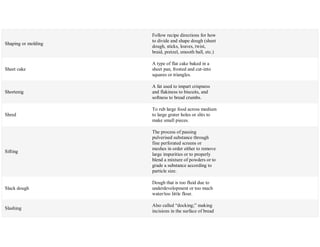
Shaping or molding
Follow recipe directions for how
to divide and shape dough (sheet
dough, sticks, loaves, twist,
braid, pretzel, smooth ball, etc.)
Sheet cake
A type of flat cake baked in a
sheet pan, frosted and cut-into
squares or triangles.
Shortenig
A fat used to impart crispness
and flakiness to biscuits, and
softness to bread crumbs.
Shred
To rub large food across medium
to large grater holes or slits to
make small pieces.
Sifting
The process of passing
pulverised substance through
fine perforated screens or
meshes in order either to remove
large impurities or to properly
blend a mixture of powders or to
grade a substance according to
particle size.
Slack dough
Dough that is too fluid due to
underdevelopment or too much
water/too little flour.
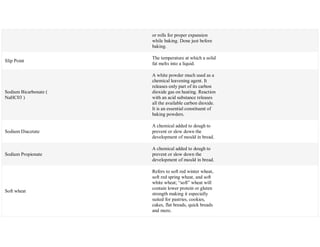
Slashing
Also called ―docking;‖ making
incisions in the surface of bread
or rolls for proper expansion
while baking. Done just before
baking.
Slip Point
The temperature at which a solid
fat melts into a liquid.
Sodium Bicarbonate (
NaHC03 )
A white powder much used as a
chemical leavening agent. It
releases only part of its carbon
dioxide gas on heating. Reaction
with an acid substance releases
all the available carbon dioxide.
It is an essential constituent of
baking powders.
Sodium Diacetate
A chemical added to dough to
prevent or slow down the
development of mould in bread.
Sodium Propionate
A chemical added to dough to
prevent or slow down the
development of mould in bread.
Soft wheat
Refers to soft red winter wheat,
soft red spring wheat, and soft
white wheat; ―soft‖ wheat will
contain lower protein or gluten
strength making it especially
suited for pastries, cookies,
cakes, flat breads, quick breads
and more.
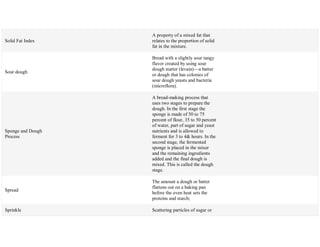
Solid Fat Index
A property of a mixed fat that
relates to the proportion of solid
fat in the mixture.
Sour dough
Bread with a slightly sour tangy
flavor created by using sour
dough starter (levain)—a batter
or dough that has colonies of
sour dough yeasts and bacteria
(microflora).
Sponge and Dough
Process
A bread-making process that
uses two stages to prepare the
dough. In the first stage the
sponge is made of 50 to 75
percent of flour, 35 to 50 percent
of water, part of sugar and yeast
nutrients and is allowed to
ferment for 3 to 4& hours. In the
second stage, the fermented
sponge is placed in the mixer
and the remaining ingredients
added and the final dough is
mixed. This is called the dough
stage.
Spread
The amount a dough or batter
flattens out on a baking pan
before the oven heat sets the
proteins and starch;
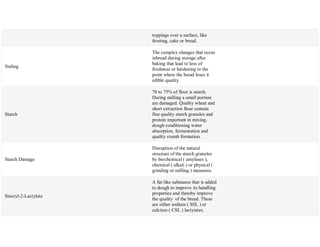
Sprinkle Scattering particles of sugar or
toppings over a surface, like
frosting, cake or bread.
Staling
The complex changes that occur
inbread during storage after
baking that lead to loss of
freshness or hardening to the
point where the bread loses it
edible quality.
Starch
70 to 75% of flour is starch.
During milling a small portion
are damaged. Quality wheat and
short extraction flour contain
fine quality starch granules and
protein important in mixing,
dough conditioning water
absorption, fermentation and
quality crumb formation.
Starch Damage
Disruption of the natural
structure of the starch granules
by biochemical ( amylases ),
chemical ( alkali ) or physical (
grinding or milling ) measures.
Steoryl-2-Lactylate
A fat-like substance that is added
to dough to improve its handling
properties and thereby improve
the quality of the bread. These
are either sodium ( SSL ) or
calcium ( CSL ) lactyiates.
Stevia
Also known as sweetleaf; a
naturally occurring sweetener
native to Central and South
America; 400 times sweeter than
sugar.
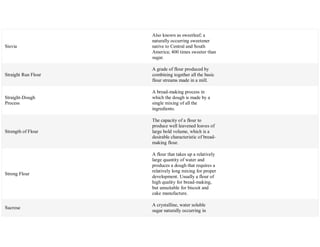
Straight Run Flour
A grade of flour produced by
combining together all the basic
flour streams made in a mill.
Straight-Dough
Process
A bread-making process in
which the dough is made by a
single mixing of all the
ingredients.
Strength of Flour
The capacity of a flour to
produce well leavened loaves of
large bold volume, which is a
desirable characteristic of bread-
making flour.
Strong Flour
A flour that takes up a relatively
large quantity of water and
produces a dough that requires a
relatively long mixing for proper
development. Usually a flour of
high quality for bread-making,
but unsuitable for biscuit and
cake manufacture.
Sucrose
A crystalline, water soluble
sugar naturally occurring in
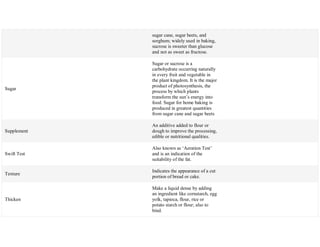
sugar cane, sugar beets, and
sorghum; widely used in baking,
sucrose is sweeter than glucose
and not as sweet as fructose.
Sugar
Sugar or sucrose is a
carbohydrate occurring naturally
in every fruit and vegetable in
the plant kingdom. It is the major
product of photosynthesis, the
process by which plants
transform the sun‘s energy into
food. Sugar for home baking is
produced in greatest quantities
from sugar cane and sugar beets
Supplement
An additive added to flour or
dough to improve the processing,
edible or nutritional qualities.
Swift Test
Also known as ‗Aeration Test‘
and is an indication of the
suitability of the fat.
Texture
Indicates the appearance of a cut
portion of bread or cake.
Thicken
Make a liquid dense by adding
an ingredient like cornstarch, egg
yolk, tapioca, flour, rice or
potato starch or flour; also to
bind.
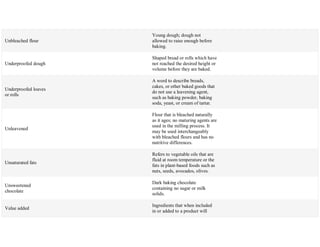
Unbleached flour
Young dough; dough not
allowed to raise enough before
baking.
Underproofed dough
Shaped bread or rolls which have
not reached the desired height or
volume before they are baked.
Underproofed loaves
or rolls
A word to describe breads,
cakes, or other baked goods that
do not use a leavening agent,
such as baking powder, baking
soda, yeast, or cream of tartar.
Unleavened
Flour that is bleached naturally
as it ages; no maturing agents are
used in the milling process. It
may be used interchangeably
with bleached flours and has no
nutritive differences.
Unsaturated fats
Refers to vegetable oils that are
fluid at room temperature or the
fats in plant-based foods such as
nuts, seeds, avocados, olives.
Unsweetened
chocolate
Dark baking chocolate
containing no sugar or milk
solids.
Value added
Ingredients that when included
in or added to a product will
increase the nutritional, market
or consumer value of a baked
good.
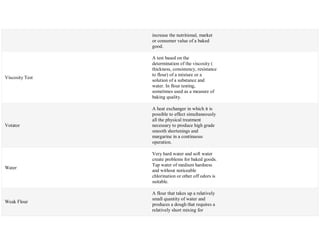
Viscosity Test
A test based on the
determination of the viscosity (
thickness, consistency, resistance
to flour) of a mixture or a
solution of a substance and
water. In flour testing,
sometimes used as a measure of
baking quality.
Votator
A heat exchanger in which it is
possible to effect simultaneously
all the physical treatment
necessary to produce high grade
smooth shortenings and
margarine in a continuous
operation.
Water
Very hard water and soft water
create problems for baked goods.
Tap water of medium hardness
and without noticeable
chlorination or other off odors is
suitable.
Weak Flour
A flour that takes up a relatively
small quantity of water and
produces a dough that requires a
relatively short mixing for
development. Usually a flour of
low quality for bread-making,
but preferable for biscuits and
cake making.
Wheat Bread
Bread made of flour or meal
milled from wheat, with no
intentional addition of another
cereal.
Wheat flour
Flour milled from soft (lower
protein) red or white wheat for
cakes, pastries, waffles, and
other products, or hard white or
red wheat for pizza crust, yeast
breads, bagels, and some rolls or
hearth breads. High-protein
durum wheat will be used for
flour or semolina for some
specialty breads, but is primarily
a pasta wheat. Home baking
(called ―family flour‖ in the
milling industry) wheat flour
may be: Unbleached or bleached
all-purpose, cake, pastry, whole
wheat, stone-ground or graham,
ultra-grain and bread flour.
White chocolate
A mixture of sugar, cocoa butter,
milk solids, lecithin, and vanilla.
If cocoa butter is not mentioned,
the product is confectionary or
summer coating, not white
chocolate. It is not a true
chocolate due to no chocolate
liquor present. Chips or pieces
and coating chunks are popular
home baking ingredients.
Whole grain
Whole grain Using whole kernel
or ground whole kernels of a
grain (barley, corn, oats, wheat,
soy, rye) in a food at 51% or
more of the flour weight. There
must be more flour than sugar
and fat for the food to be a―grain
food‖ product. 16 grams of
whole grain flour or meal per
serving is 1/3 of the daily need
for whole grain in a diet. Learn
more:
www.wholegrainscouncil.org or
www.bellinstitute.com.
Yeast
Any of the family of fungi that
can grow in presence of starch or
sugar to produce carbon dioxide
( and alcohol ); used as a
leavening agent in bread. It is
used in baking industry in
compressed form ( fresh ) or dry
powdered form. ( granules )
Yeast Nutrient Inorganic substances required for
proper yeast activity ( for
example, nitrogen and
phosphorous ).
Yield
The amount of product obtained
as a result of a given amount of
ingredients.

BAKING SCIENCE AND TECHNOLOGY

  • 1.
    BAKING SCIENCE ANDTECHNOLOGY Absorption The amount of water absorbed and retained, expressed as percentage, of flour mass, that is required to produce optimum dough. Acetic Acid An organic acid, sour in taste, colourless, and with sharp odour; fan active constituent of vinegar; used in bread formula as mold/rope inhibitor. Acetone Peroxide A chemical powder, which when added to flour in small quantities (1 to 45 mg/kg ) hasthe ability to improve its bread making quality. It is primarily a maturing agent but also has some bleaching action. Acid Salt A dry, granular white crystal that dissolves in water before acting as an acid. The acid salt reacts chemically with the bicarbonate to release CO2 gas. The type of acid salt used in the baking powder can determine the rate of gas release.
  • 2.
    Acid Value It isthe number of milligrams of potassium hydroxide required to neutralize free fatty acids present in 1 g of the fat, and is an indication of the extent of free fatty acids present in an oil or fat. Acidic pH of less than 7. Acid ingredients react with bases to form salts and water. They have a sour taste. A chemical compound that yields hydrogen ions when in solution. Active Oxygen Method A method for measuring the stability of fats and oils by bubbling air through the heated materials and measuring the formation of peroxides. Additive An ingredient added to flour to improve its baking properties or shelf life. Aerate, Aeration To whip, sift or beat air between particles, as with flour, confectioners sugar, or sugar and butter. Aeration ( Fat ) The process of incorporation of minute air bubbles in
  • 3.
    hydrogenated fat; alsoknown as creaming process. Agave nectar An amber, caloric liquid sweetener, with a low glycemic index, that is made from the core of the succulent agave plant available in two distinct varieties: Light and Amber. Albumen A class of protein, present in egg, that can be dissolved in water and is coagulable by heat. Aleurone Layer A botanical term denoting the proteinaceous cellular layer which envelopes the endosperm and separates it from the bran or seed of the wheat kernel. Alkaline pH greater than 7. Alkalis such as baking soda (bicarbonate of soda) neutralize acids and react with acidic ingredients as a leavener. Alkalis have an excess of hydroxyl ions when in solution. Alveograph A dough testing instrument that measures the resistance to deformation and extensibility of a clamped disc-shaped piece of
  • 4.
    dough, by forminga bubble, by means of air pressure applied from below the test piece at a constant temperature. Amaranth flour Milled from amaranth seeds, it combines well with other flours for smooth-textured quick breads. It has an assertive flavor and especially complements savory breads or pastries. Its lack of gluten means it must be combined with wheat flour in yeast breads. Ammonium Bicarbonate A white powder which on heating vields ammonia gas, carbon dioxide gas and water vapour. It is used in biscuit manufacture as a chemical aerating agent. It leaves no residue in the baked product and., therefore, imparts no off- taste. Amylase An enzyme that, in the presence of water, converts large molecules of starch to sugar ( maltose ) units. Amylograph An instrument that measures the consistency or viscosity of a
  • 5.
    slurry of starchyflour and water as it is heated through a pre- determined cycle. The viscosity is measured by the resistance that the slurry offers to a mixing paddle. It is used to measure the amylase activity of flours. Antioxidants Naturally-occuring substances or synthetic chemical compounds which can retard the development of oxidative rancidity in fats and fat- containing foodstuffs. Sugar and lecithin are examples of natural antioxidants, while butylated hydroxy-anisole ( BHA ), butylated hydroxy toluene ( BHT ) and dodecyl gallate are examples of chemical antioxidants. Antistaling Agents Substances such as sodium stearate, polyoxyethylene monostearate and glyceryl mono stearate ( GMS ), that retard the staling of baked products. Artificial Sweetener Non-nutritive (contain no nutrients), high-intensity sugar substitutes
  • 6.
    Artisan Skilled craftsman ortrade; baker who produces bread or bakery goods using production methods that are part hand-made. Often refers to European crusty breads or low-ratio cakes and desserts. Ascorbic Acid ( Vitamin C ) A naturally occuring vitamin that is used in the baking industry as an improving agent. Its overall effect on the physical properties of dough depend both on its oxidizing and reducing actions. Ash Content The amount of incombustible residue, left after incinerating a weighed amount of a material and expressed as percentage. Bake Cooking food in dry heat, especially in an oven. Bake Test A test designed to show the baking properties of flour when subjected to the parameters of bulk production, and carried out under controlled conditions. Baker‘s % Formula Ingredient weight divided by total flour weight X 100 = bakers% for that ingredient.
  • 7.
    Baker‘s Percent In bakingformulas primarily based on flour, each ingredient‘s weight is measured as a percentage of the total flour weight (100 percent). Baking Loss The loss of mass in a product as a result of baking. In the case of non fermented products, the difference in mass between the dough or batter from the moment when it is put in the oven and when it emerges as a baked product. This includes the loss of fat to the baking sheet or tin. Baking mix A combination of pre-measured baking dry ingredients (Ex: flours, meal, leavening, sugars, salt, spices). Baking Powder A balanced mixture of sodium bicarbonate and an acid. Baking powders when moistened and heated produce a leavening gas in batters and doughs. They should leave only tasteless, harmless residues. The acid substances commonly used are tartaric acid, cream of tartar, calcium acidphosphate, sodium acid pyrophosphate, and sodium
  • 8.
    aluminium phosphate. Baking sheet Asheet of metal that is rigid and is used for baking cookies, breads, biscuits, etc. It usually has one or more edges that is turned up for ease in removing from the oven. Types include shiny, heavy-gauge aluminum, the standard used in most test kitchens for even baking and browning.Darkened, heavy- gauge pans will produce especially crisp exterior crusts desired for specialty baked goods. Insulated baking sheets are two sheets of aluminum with air space between, and are especially good for soft cookies or tender-crust breads or rolls. Also, see Cookie sheet, Insulated bakeware, and Jelly roll pan glossary listings. Baking soda A base, alkaline in nature, formed when sodium carbonate (purified form of mineral trona) is mixed with carbon dioxide and water to form sodium bicarbonate. Baking soda is the source of CO2 gas in leavening systems. It neutralizes acids in
  • 9.
    the batter, adjustingthe final pH of baked goods. Baking soda is not the same as baking powder. Barbados sugar Also known as muscovado sugar. A British specialty brown sugar; it is very dark brown and has a strong molasses flavor. Barley flour A low-gluten flour made from hulled barley. It imparts a sweet taste, moisture, and relative lightness to cakes, cookies, and quick breads. Batch One recipe of a dough or batter, such as bread or cookies. Batter A thin mixture of flour, water ‗or milk, eggs, or any other permitted ingredients, such as is used for making cakes. Batter or Dough Other ingredients plus the ratio of liquid to flour help determine if it‘s a batter or dough. Beat Making a smooth mixture by whipping or stirring with a wire whisk, spoon, beater or electric mixer.
  • 10.
    Bench The counter orsurface bakers use to work with dough. Bench Time Allowing yeast dough 5 to 15 minutes resting time after fermentation, punching, dividing and before shaping to allow gluten to relax. Benzoyl Peroxide A chemical powder that is added to flour in small quantities for its beneficial bleaching action. Bind To thicken or smooth out the consistency of a liquid. Biscuits A term generally used for that bakery product which is made from a dough which is sheeted, cut and baked immediately there- after to a low moisture. Bittersweet Chocolate Baking chocolate containing a minimum of 35% chocolate liquor Bleaching Agent A substance added to flour to bleach out the yellow pigment naturally present in flour and thereby give a whiter appearance to the flour and the bread produced from it.
  • 11.
    Blend To mix twoor more ingredients together with a spoon, whisk, electric mixer, blender, or processor. Blending Capacity The ability or capacity of a flour to carry proportion of low quality flour and still produce bread of satisfactory quality. Braid To weave together three or more long pieces of dough. Bran The outer layers of a kernel of grain that lie just below the hull. ―Miller‘s bran‖ is produced during milling when the bran layers are removed from the grain kernel. About 14.5 percent of whole wheat flour is bran. Bran is used in baked goods and cereals to add dietary fiber and nutrients. Bread flour Unbleached, wheat flour that is higher in protein (11% or more) for better yeast bread dough development and preferred for use in bread machines. Look for bread flour that is enriched – as indicated on the ingredient label.
  • 12.
    Bread-Making The overall processof converting flour into bread which generally consists of different stages like mixing, fermentation, dough make-up, proofing and baking. Brew A mixture of water, yeast, yeast nutrients and varying amounts of flour used in some bread-making processes. Brimac Process A bread-making process developed at the Bread Research Institute of Australia which uses mechanical action ( mixing ) to develop the dough to optimum physical state. Brown To give a cooked surface to a food (such as meat or flour) by applying high heat. Also occurs during baking and roasting. Brown Sugar Sugar crystals coated in a molasses syrup with natural flavor and color. May be produced by boiling a special molasses syrup until brown sugar crystals form, then centrifuging the crystals until dry.
  • 13.
    Brownie A dense, chewy,cake-like cookie that is generally chocolate-flavored and colored (hence the name) and cut in bar shapes to serve. Buckiness A term used in baking technology to describe doughs that are too soft or too elastic for proper handling. Buckling A defect which causes the crackers to warp during baking generally resulting in raised centres. Buckwheat flour A gluten-free flour made by grinding hulled buckwheat seeds. It is not a relative of wheat. Originating in Russia, buckwheat has a distinctive flavor and is used in pancakes and some baked goods, such as multi-grain breads. Russian blini are made with buckwheat flour. Groats and kasha also are produced from buckwheat. Buffering Value The ability of a substance to maintain the pH of a solution, batter or dough at a constant level.
  • 14.
    Bulgur Whole-wheat kernels thathave been steamed, dried, and cracked. Bulgur may be soaked or cooked and added to baked goods. Bulgur also may be ground into flour. Bulk Fermentation For dough under fermentation, this is the period from the mixing stage to the dividing stage. Butter Butter is produced by churning cream into a semi-solid form. By U.S. standard definition, it is 80 percent milk fat, with the remaining 20 percent consisting of water and milk solids. Butter for baking may be salted or unsalted and is valued by most bakers for its irreplaceable flavor and ability to create flaky layers, crispness, tenderness, carry flavors, and provide golden- brown color. Cacoa Tropical evergreen tree cultivated for its seed pods from which cocoa powder and cocoa butter are produced. Cake Flour Fine-textured, silky flour milled
  • 15.
    from soft wheat,with a low protein content for making cakes, cookies, pastries and some breads. Calcium Propionate An inorganic salt used in small quantities, in bread to inhibit the growth of moulds and to some extent, rope. Canning & pickling salt A pure granulated salt, with no additives or free-flowing agents. It may be used the same as table salt in baking recipes. It may cake when exposed to greater than 75 percent relative humidity. Capping When yeast loaves are under- proofed and the interior pushes up the top crust leaving a rough, sharp edge along the side of the loaf having the appearance of a ―cap.‖ Caramel A colouring matter ( dark brown colour ) obtained by the action of heat ( 170-180°C ) and ammonia on sugar. Carbon Dioxide The gas evolved by the action of yeast on fermentable sugars or
  • 16.
    by the actionof baking powder in a baking process. For example, in a fermenting dough, carbon dioxide causes the dough to rise ( leaven ). This is essential for the production of the desirable spongy grain and texture of bread crumb. Cereal grain Cereal refers to grain and foods derived from them; the word cereal comes from Ceres, a pre- Roman goddess of agriculture. Also see Grain. Chemical leavening The reaction of a leavening base (such as baking soda) with a leavening acid (such as sodium aluminum sulfate) in the presence of moisture and heat to produce carbon dioxide gas. Chocolate From the Aztec word xocolatl meaning bitter water. A food derived from the cacao bean being fermented, dried, roasted, ground and processed into cocoa powder and a liquor used to make a variety of chocolate products: Bittersweet, dark, couverture, milk, semisweet, white, unsweetened.
  • 17.
    Chorbywood Bread Process Bread-making processdeveloped by the British Baking Industries Research Association, Chorbywood, UK, which uses high-speed mixing for the optimal development of dough, thereby eliminating the need of bulk fermentation. CO2 Carbon dioxide; the gas released from leavening reactions and fermentation that creates bubbles and space in a batter or dough. Coarse Refers to the crumb structure of some baked goods. Coarse Salt Large crystals of salt, such as Kosher, rock salt, some sea salts, pretzel salt Coat To thoroughly cover a food with a liquid or dry mixture. Cocoa butter The portion of fat in the cacao bean. Cocoa powder Unsweetened cocoa powder made from cacao beans that are fermented, dried, roasted, and cracked. The nibs (small pieces) are ground to extract about 75
  • 18.
    percent of thecocoa butter – a thick paste which is called chocolate liquor. This is dried and ground to powder. Composite Flour A flour made by blending varying amounts of non-wheat flour with wheat flour and used for production of baked goods that are traditionally made from wheat flour. Conditioned Raisins Moistened raisins before mixing into a batter or dough to prevent the raisin from grabbing moisture from the mixture or baked product, making the baked product crumbly. How to condition raisins: Cover raisins in tap water (80º F.) for 5 to 10 minutes; drain off water. Measure raisins needed; place remainder in sealable food container or bag. Store refrigerated. More at www.LoveYourRaisins.com. Confectioners‘ or powdered sugar A granulated sugar that has been crushed into a fine powder. A small amount (about 3 percent) of cornstarch is added to prevent clumping.
  • 19.
    Consistancy ( Dough ) Thefeel or firmness of a dough ( also called viscosity ) as measured by Farniograph or a similar instrument. It signifies the handling properties of a dough. Continuous Process In relation to bread making, refers to an automatic process that is essentially continuous from the mixing of the dough to the exit of the bread from the oven. Convection oven A gas or electric oven equipped with a fan that continually circulates the hot oven air around the product. Circulating hot air allows products to bake on several racks at one time. Conventional Process In relation to bread making, refers to older processes such as the straight dough or the sponge and dough processes involving bulk fermentation. Cookie A small sweet baked product. It includes items like small fancy cakes, biscuits, pastries, etc. Cooling To let food stand until it no
  • 20.
    longer feels warmto thetouch. Baked goods are cooled on wire racks to avoid soggybottom crusts; cool baked goods before wrapping and storing. Cooling rack A rectangular grid of thick wire with ―feet‖ that raise it above the countertop. They are used to cool cakes, cookies, and other baked goods when they come out of the oven. Products are cooled while in their pan for a short time and after the product is removed from the pan prior to storing or freezing. Yeast breads are removed from the pans and onto the rack as soon as they come out of the oven to prevent a soggy crust. Corn Flour Flour obtained by milling of the grain of maize. Corn starch The fine, powdery flour obtained from the endosperm of corn used as a thickener for pie fillings and puddings; in combination with wheat flour in cakes, cookies, pastries, it produces a fine- textured product. Cornstarch may be referred to as cornflour
  • 21.
    in some recipes.More at www.argostarch.com. Corn Syrup A sweetner prepared by hydrolysing maize starch by means of either acids or enzymes. It is the ‗commercial liquid glucose‘ used in sugar and flour confectionery. Courverture chocolate Professional quality glossy coating chocolate. Cream In bakery trade the term ‗cream‘ means basically a homogenous mixed preparation of hydrogenated fat or bakery shortening, icing sugar, flavours and permitted food colours with or without other ingredients in small proportions. Cream of Tartar An acidic salt—potassium hydrogen tartrate (also referred to as tartaric acid); stabilizes beaten egg whites and leavens some baked goods. Creaming The action of whipping fat in a manner such that it will incorporate minute air bubbles and become light and ‗creamy‘
  • 22.
    in texture. Inbakeries, fat is generally ‗creamed‘ with other ingredients such as sugar, which facilitates the creaming process. ‗Creaming Quality‘ as applied to fat is the ability to absorb air during mixing. Crepe The French word for pancake; paper-thin, flexible egg-rich pancakes used to wrap or fold around sweet or savory ingredients as a first or main course. Crispness Eating quality of biscuits which makes it crunchy to bite; opposite to soggy or soft. Critical Mixing Speed It is the lowest mixing speed of a dough mixer that can develop a dough in a mechanical development bread – making process. Crumb Grain The cell structure exhibiting size and shape of bread crumb determined by visual examination. Crumb Texture The cell structure exhibiting hardness, coarseness and
  • 23.
    silkiness of breadcrumb as determined by feel. Crush To pulverize, as with herbs and spices used in baking. Crust The caramelized crisp or chewy outer layer of a baked product that covers the crumb or more tender inside. Cupping A defect which causes biscuits to warp during baking and the sides to rise. This is the opposite of ‗buckling‘. Cutting Machine A machine used for cutting the dough sheet into specified sizes and shapes for biscuits. It consists of one or more sets of rollers, which sheet out the dough and a cutting section which simultaneously cuts out the biscuits and embosses them with an appropriate design. Cysteine A naturally~occuring amino ‗acid that contains sulphur. It is used in the baking industry, particularly in chemical development bread-making process, because of its ability to
  • 24.
    reduce the mixingrequirement for optimum dough development. It is, however, not permitted, as yet, under the PFA rules. Dark chocolate: is also bittersweet, semi-sweet, and sweet dark chocolate; all contain cacao beans, sugar, an emulsifier such as soy lecithin to preserve texture, and flavorings such as vanilla but do not contain milk solids. They are distinguished by the amount of cocoa powder: 30% (sweet dark) to 70%, 75%, or even above 80%, for extremely dark bars. Degerminated To remove the germ portion of a grain kernel,leaving bran and or endosperm. Degradation Breakdown of large molecules of any substance into smaller fragments. Here it pertains to the breakdown of starch by amylases or proteins by proteases. Demera Sugar A light brown sugar with large golden crystals which is slightly sticky from adhering molasses. It is popular in England for tea,
  • 25.
    coffee, or totop hot cereals. Denaturation The destruction of the natural properties of proteins by physical or chemical means. An example of denaturation is the cooking of flour proteins in dough to produce the semi-rigid structure of bread – a thermal denaturation of proteins. Developer Mixer A dough mixer that is used to develop the dough to its optimal physical state for bread-making. Dextrins Modified starch prepared from starch by heat treatment in the dry state, with or without the addition of small quantities of chemical reagents. Dextrose Also dextroglucose and known as glucose, this sugar is the chief source of energy in the body. Glucose is chemically considered a simple sugar or monosaccharide and naturally occurs and is derived from plant starches such as corn. Diastatic Activity In flour quality evaluation, it is the measure of the activity of the
  • 26.
    starch degrading enzymesof the flour. It can be expressed in terms of the maltose ( sugar ) produced or in terms of tlie peak viscosity in the Amylograph test. Dilatation of Fats When fats change from solid to liquid at the same temperature, there is an increase in volume. Measurement of this increase is used to estimate the amount of solid fat present in a mixture at any given temperature. Dissolve Stirring a dry substance into a liquid until solids are no longer remaining. (For example: stirring sugar into water, yeast into water, etc.). Divider A machine used in bread-making to divide a large piece of dough into desired size pieces. Dock A baking technique in which regularly spaced holes are poked all over the surface of a dough to promote a crisp baked surface (crackers, pet treats, pie shells, all may be docked before baking).
  • 27.
    Docking Slashing or makingincisions in the surface of bread or rolls for proper expansion while baking. Done just before baking. Dot To place small dabs or pieces of butter or batter over the surface of a food, such as with a pie, just before the top crust isadded and baking begins. Dough A mixture of flour and liquids, and may have other ingredients, that is thick enough to be handled, kneaded or shaped. Dough Development The elaboration of the physical properties of a dough that are the best for the production of bread. This can be achieved by fermentation as in dough ripening or maturing, by mixing as in mechanical development or by a combination of certain chemicals and mixing as in chemical development. Dough Expansion Test ( Pelshenke ) The time required for a dough ball made from wheat meal, water and yeast and suspended in water at 30°C to disintegrate. It is a rough measure of the quality
  • 28.
    of wheat proteinfor bread- making and is used in screening for baking quality in new varieties of wheat during the early generations. Dough Maturing Agents Chemical substances such as potassium bromate, potassium iodate, ascorbic acid ( Vitamin C ) which when added to dough in small amount improve the handling and bread- making quality of the dough. Dough scraper, dough or bench knife A flat, heavy metal blade (about 3 X 5-inches) with straight sides, sharp corners and a handle on top edge for moving, kneading, clean-cutting dough, incising, or even cleaning work surfaces. Dough Tests Tests made on doughs to obtain information on the bread-making quality of the flour or to determine the effects of various added ingredients. Drain To remove liquid from a food product. Drop To deposit even portions of dough on a baking sheet using
  • 29.
    spoon or batterdispenser. Dry ingredients Refers to the ingredients in a recipe, such as flours, sugar, leavening, salt, baking cocoa, spices, or herbs, that may be blended before adding to another mixture in the recipe. Dust To lightly sprinkle the surface of a food or dough with sugar, flour or crumbs. Also to sprinkle the surface used for rolling out or shaping dough. Egg wash A thoroughly combined mixture of 1 whole egg, egg yolk, or egg white mixed with 1 tablespoon cold water or milk. This mixture is brushed on the unbaked surface of breads, pastries, or other baked goods just before baking to provide a rich color or gloss to the crust. Egg yolk The yellow center portion of a whole egg; an emulsifier contaning lecithin, vitamins, lutein, fat and choline. Eggs Eggs perform many functions – leavening, binding, thickening,
  • 30.
    coating or glazing,emulsifying, moisturizing or drying, and adding color, flavor, and nutrients to the finished product. Eggs also may be used to retard crystallization in some frosting. Elasticity Capable of recovering shape after stretching; developed gluten in dough is elastic. Electrophoresis A method for separating components of a complex mixture of substances by permitting them to migrate under the influence of an applied electric current. The rate of movement will depend on the charge per unit mass of each component in a mixture. Emulsify, emulsifier An ingredient such as an egg that, when beaten with two non- mixing ingredients like oil and vinegar, will hold them in a suspension so they do not separate. Emulsifying Agent A substance that assists in the dispersion and suspension of an oil in water, for example, glycerol monostearate.
  • 31.
    Endosperm The starch granulesin grain embedded in gluten-forming proteins from which flour or meal is produced; 80-85% of a wheat kernel is endosperm. Energy Input The energy that is absorbed by a dough during mechanical development by mixing. Enriched To improve the nutritional value of an ingredient or food. Baked goods may be enriched by using milk, enriched flour, whole grain flours, eggs, soy protein or flour. Enzyme A protein that has the ability to speed up a biological reaction without itself undergoing any change, also known as biological catalyst. Equipment Hand or electrical tools and appliances needed to accomplish a task, craft or job. Ethyl Vanillin It is a white crystalline synthetic powder, which resembles purevanilla in flavour and it is used as a substitute for it. Farinograph An instrument that mixes flour
  • 32.
    and water intoa dough and produces a record of the resistance that the dough offers to the mixing blades during the mixing cycle. It also indicates the water absorption power of the flour under test and also the mixing tolerance. Fat A chemical constituent of plant or animal tissues comprising esters of various fatty acids and glycerol. In cereal technology, it may refer to the natural flour fat or the fat ( shortening ) that is added in the bread formula. Ferment A mixture of water, yeast, yeast nutrients and occassionally a small amount of flour that is allowed to ferment for several hours prior to being used for the production of bread dough. Fermentation A process in bread-baking in which yeast enzymes in a dough mixture convert sugars (glucose, fructose and maltose) to bud and grow, creating carbon dioxide that expands the dough and alcohol as a by-product.
  • 33.
    Fermentation Tolerance The ability ofa dough to retain its desirable properties even after extended formentation periods; an important measure of bread- making quality of flour. Flaky Distinct layers of pastry or biscuit formed by using low protein flour, fat, and not too much mixing. Flatbread Breads that are shaped and baked in thin, flat shapes such as pita, naan, focaccia, tortilla, chapati. Floor Time Short fermentation time allowed in bread-making between the final mixing and dividing. Flour The finely ground and sifted meal of any of various edible grains. Flour is a major ingredient in most baked goods with wheat flour making up 75 to 100% of the flour in baked goods to produce the desired structure, flavor and volume. Foam Moist mixture of yeast, water and possibly a pinch of sugar that is actively growing and expanding. Beaten egg whites
  • 34.
    beginning to holdair, before peaks are forming. Fold To gently combine two or more ingredients or a delicate mixture into a heavier, thicker one by cutting vertically through the mixture and turning it over by sliding the mixing tool across the bottom of the bowl or pan with each turn. To combine without stirring or deflating a mixture. Formula The ingredients that are mixed together to form a dough. It is also known as recipe. Foxy This is a term used when the baked bread comes out dark- red in colour signifying either high maltose in flour or less fermentation. Fructose Naturally occurring, highly sweet fruit sugar or levulose; also found in honey; sweeter than sucrose. Fungus A group of micro plants which are generally parasitic in habit. The class includes moulds and mildews which are the cause of
  • 35.
    spoilage in bakedproducts. Gas Production The ability of a bread dough to produce carbon dioxide during fermentation. It is used in the assessment of bread- making quality of flour. Gas Retention The ability of a bread dough to retain the gas ( carbon dioxide ) produced during fermentation. It is used in the assessment of bread-making quality of flour. Gassing Power Measure of the ability of a bread dough ( including all ingredients ) to produce gas ( carbon dioxide ) that is required for leavening ( rising ). This is also a measure of baking quality of flour. Gelatine An animal protein, which has the property of swelling in cold water and dissolving in hot water. It is gummy by nature. When hot solutions of gelatine are cooled, they form jellies. Gelatinizatian The breakdown of the granular structure of starch as by heating a starch slurry or a dough. The starch granules swell and
  • 36.
    subsequently burst. Gelatinization isimportant in relation to the development of crumb structure of bread. Glassine This is a super calendered, smooth, dense, transparent or semi-transparent sheet of paper used as a protective wrapper. The paper is grease resistant and has a high resistance to the passage of air and other vapours. Gliadin The fraction of wheat flour proteins that can be dissolved in a 70 percent solution of ethyl alcohol. It is also classified as prolamine. It provides elasticity to dough. Glucose Also dextroglucose and called dextrose; commonly found in grapes, corn starch and honey and is about 30% as sweet as sucrose (sugar). Gluten The elastic, expandable structure in a dough or batter capable of trapping gas, expanding and when baked becoming part of the structure of baked products. Wheat flour simple proteins
  • 37.
    (peptides), glutenin andgliadin, combine with water when stirred, mixed and kneaded to align and form gluten‘s long elastic structure. Gluten containing grains are wheat, rye, triticale, emmer wheat and barley. Gluten Swelling Test A test for bread-making quality which determines the volume of gluten swollen in a dilute solution of lactic acid, also known as ‗ Rerliner test‘ and is similar to the ‗Sedimentation test‘. Gluten-free Grains or grain-based foods that do not contain gluten or the components of gluten, the peptides glutenin and gliadin. Glutenin The fraction of wheat flour proteins that is insoluble in water, salt solution, or 70 percent ethyl alcohol solution, but is soluble in dilute alkali. It provides strength to dough. Glyceryl Monostearate It is used as a ‗fat extender‘ and as a ‗bread softener‘, as it has excellent emulsifying properties
  • 38.
    and shows anaffinity for both fat and water. Golden Syrup A partly refined sugar syrup made from partial inversion of sugar ( sucrose ) using acid or enzyme or both. It has a nice golden brown colour and is used in baked goods for its colour forming and flavouring qualities. Granulation The coarseness or fineness of a powder such as flour or sugar. In baking technology, it pertains to the particle size and size distribution of the flour. Grease Rub oil, shortening, butter or fat over surface of cooking utensil or on a food. May also use a lecithin based, non-fat cooking spray, unless bake ware does not recommend it. Greaseproof Paper This is a protective wrapping paper used for wrapping food products and other articles. Griddle Heavy-weight flat, rimless pan for baking flatbreads using as little fat as possible; flipping is done halfway through baking;
  • 39.
    may be electricor held over heat. Hard Dough Doughs from which semi-sweet biscuits are made. The doughs are fairly firm to the touch. Hard Wheat Wheat which, as a result of variety of breeding in combination with environmental factors during growth, has a vitreous endosperm, generally considered an advantage for the production of bread-making flours, as the protein content is generally superior in quality and quantity. Hardened Oils Synonymous with hydrogenated oils. High Fructose Corn Syrup (HFCS) Primarily used in commercial beverages and foods, HFCS is made when corn starch is converted to dextrose-rich syrup; using isomerization, the dextrose-rich corn syrups are further processed to create fructose. The fructose is then blended with dextrose syrup to produce the commercial corn syrups with 42% to 95% fructose. Fructose is 130 to
  • 40.
    180% sweeter thansugar. Honey A thick, sweet liquid produced by bees from flower nectar. Color and flavor vary due to the nectar the bees find available. Honey develops golden crust color and holds moisture in baked goods. Hops A leavening agent prepared from hops leaves and popular with small bakers. Humectant A moistening ingredient; ingredient that promotes retaining moistness in a baked product. Humidity The amount of moisture in the air; in baking, thepercent humidity needed for proofing or baking bread. Hydrate To moisten or combine with water or liquids. Hydration The absorption or uptake of water by solid materials like flour. In bread-making, two aspects of hydration are important. The total amount
  • 41.
    absorbed ( hydrationcapacity ) by the flour and the rate at which it is absorbed ( rate of hydration ). Icing A coat of sugar that is used to dress baked products. Improving Agent Any substance that is added to flour or to dough to improve its performance during bread- making and to improve the quality of the bread that can be produced from the flour. Inactivation The destruction of the natural catalytic activity -of the enzyme by chemical or physical means. Ingredient Any part of a mixture. Ingredient list Any part of a mixture. Intermediate Proof The stage in the bread-making process where the dough is allowed to rest ( relax ) for short period up to 12 minutes between the dividing and moulding. Also referred to as ‗first proof‘. Invert sugar Sugar syrup exposed to a small amount of acid and heating to
  • 42.
    break sucrose intoglucose and fructose to reduce the size of the crystals. Invert sugar is used for fondant icings for cakes. Iodine Value An indication of the degree of unsatura tion of oils or fats. It is measured as the percentage of iodine that is absorbed by the oil or fat on the basis of its own mass. Iodized salt Table salt with added sodium iodide to help prevent hypothyroidism in regions low on natural iodine. Kneading To mix dough using a pressing and folding motion, turning and folding the dough onto itself until gluten strands form and the dough is smooth and elastic. Knock Back The punching or kneading of the dough during bulk fermentation to expel some of the carbon dioxide and improve subsequent fermentation. Kosher salt An additive-free, coarse-grained salt, preferred by some bakers and used by Jewish Kosher
  • 43.
    butchers and foodprocessors; also called coarse salt. Kraft A term used for strong papers primarily used for wrapping, manufactured from long-fibred raw material and pulped by sulphite process. Lactic Acid The organic acid formed by Lactobacilli fermentation, for example, when milk sours. It is also produced during dough fermentation and is considered to be important in bread flavour. Lactose Milk sugar; the sugar naturally occurring in milk. Lean dough A dough prepared with little or no fat, sugar, or milk. Leavening Ingredients used in baked goods to lighten the texture, develop flavor, produce distinctive cell structure and increase volume. Leavening agents include heat and moisture (steam), beaten eggs or egg whites, baking soda, baking powder, cream of tartar, and yeast. Historical terms for leavening: Latin = levre = to
  • 44.
    raise; also called―lifter.‖ Leavening Agent Any substance such as yeast or sodium bicarbonate, used to raise or leaven dough by producing carbon dioxide. Lecithin Belongs to the class of substances known as lipoids, which are combinations of fat with nitrogen-containing substances and phosphorous. It is normally extracted from soyabean. It is also present in egg yolk. It acts as an emulsifier and is close to fat in chemical composition. Lifter An old-fashioned term for the leavening or ―lifter‖ in a batter or dough. Liquid A source of water, fluid or moisture in a batter, dough or mixture. Loaf A portion of bread dough baked in one piece or form Low fat 3 grams of fat or less per serving or reference amount.
  • 45.
    Low Sodium Indicates foodwill be 140 mg or less per serving. Make-up After fermentation(s), shaping the dough into loaves or other shapes. Includes scaling (dividing), rounding, intermediate proof, molding and panning the dough pieces. Malted Cereal Flour Flour produced by grinding malted ( sprouted or germinated and dried ) wheat and barley and used as an adjunct to bread flour to improve its gassing power. Maltose A disaccharide sugar obtained by the action of amylases on starch. It comprises two glucose units and is the main fermentable sugar in dough. Maltose Value An index of diastatic activity of flour. It is measured as the number of milligrams of maltose produced from 10 g of flour under standardized conditions. Margarine Developed as a butter substitute in the late 1800s, margarine is 80 percent vegetable oil that is partially hydrogenated to hold a
  • 46.
    solid form. Theremaining 20 percent is liquids, flavoring, coloring, and other additives. Margarine may be salted or unsalted. Marshmallow cream A sweet, light, fluffy, fat-free marshmallow-flavored mixture used as an ingredient in candy, pie, dip and dessert recipes providing creamy texture and marshmallow flavor. Mash To break up into finer, smoother pieces by pressing with back of a spoon, a masher or ricer. Maturing Agent Any substance, usually a chemical ( for example potassium bromate ), that is added to flour or dough to improve the bread-making quality of the flour. Mechanical Development Baking Method A baking method which uses vigorous mixing instead of a long fermentation period for the development of a dough with the optimum handling characteristics. Melt Heating a solid food such as
  • 47.
    butter or sugaruntil it is liquid. Melting point The temperature at which a fat or chocolate will begin changing from a solid to a liquid state. Meringue Stiffly beaten egg white and granulated sugar that may be soft or baked hard. Sugar must be beaten into the egg whites one tablespoon at a time to dissolve and produce a smooth meringue. Milk chocolate Sweetened dark chocolate (at least 10 percent chocolate liquor) with additional milk solids (at least 12 percent). Mineral A solid substance formed in the earth that is not animal or vegetable (Ex: salt, iron) Mixing With yeast dough, refers to four stages—pick-up period, preliminary development, elasticity development, and final gluten development. Stirring until the ingredients are well- combined (no individual ingredients can be seen or identified).
  • 48.
    Mixing Time Time requiredto mix a dough to a proper consistency for bread- making. Mixing Tolerance The ability of a dough to withstand extended mixing without showing major changes in physical properties. Mixograph An instrument used for evaluating the dough mixing properties of wheat flour as a part of bread-making quality evaluation. It measures and records the resistance that the dough offers to the pins of the mixer while the dough is mixed. Moisten To make moist by adding, brushing or sprinkling with a liquid. Mold A fuzzy growth of fungus on a bread, vegetables, fruit or damp surface; indicates decay or spoilage. Molding Follows intermediate proof— dough must be relaxed—final shaping step where dough is flattened (sheeted) or shaped for loaves, braids, rolls, twists.
  • 49.
    Monocalcium Phosphate A chemical substanceadded to dough as a yeast nutrient. The main nutrients provided by this substance are calcium and phosphorous. Muffin Small, cake-like sweet or savory leavened breads. Muffin mixing method Use of two bowls, mixing fluid ingredients and dry ingredients separately; stirring to combine is done very quickly and with as few stirs as possible to prevent gluten formation. Nibs Cocoa nibs are simply roasted cocoa beans separated from their husks and broken in to small bits; may be used in cookies or as a topping in place of nuts. Nut flour Nut meats, toasted or untoasted, that are finely ground for pastry crusts, breads, cakes, and cookies. Nutrition Facts A box on the food label offering serving size and basic nutrition information for a food ingredient, recipe or product.
  • 50.
    Nuts The dry fruitof trees, legumes, or seeds; an edible kernel encased in a hard, dry shell. Rich in nutrients, flavor, and texture, nuts provide sensory appeal to baked goods and other menu items. Nuts may be as high as 90 percent fat, but the fat is primarily the healthful, monounsaturated type. Oils The liquid fat pressed from plants and their nuts or seeds. The oil is extracted either by solvent-extraction or cold- pressed. Common types used in home baking are soybean, safflower, corn, sunflower, canola, and olive oils. No oil derived from a plant contains cholesterol, but they will vary in amounts of poly- and mono- unsaturates and saturated fat. Old dough Yeast dough that is overproofed; dough may have tripled in volume and fallen. Oven An oven may be defined as an enclosed area with parts which supply heat and air flow in order to cook food.
  • 51.
    Oven proofing Allowing doughto proof beyond a full doubling of size; if dough actually proofs and falls again, the product will not recover. Product will be very open grained, have a crumbly texture, undesirable flavor, pale crust, strong aroma and poor keeping quality. Oven Spring Increase in the volume of the dough during baking. This is equal to the volume of the baked loaf minus volume of the dough when put in the oven. Oxidation One of the ways by which the handling properties of dough can be improved so as to improve the quality of bread. It is brought about by substances referred to as oxidants, improvers or maturing agents. Pancake One of humans‘ oldest bread forms, hundreds of types are shared cultures; batter may be thick or thin, and is baked on a very hot surface for breakfast, lunch, dinner or a snack. (Ex: crepes, blinis, hotcakes, flapjacks).
  • 52.
    Panning The stage inthe bread-making process when the moulded dough piece is placed in the baking pan or tins. Parchment paper Sheets of grease and moisture resistant paper used in baking to line pans; replaces greasing or spraying pans. Products are shaped or distributed directly on the paper and are easily removed after baking. Great for making disposable pastry bags too. Patent Flour The portion of a straight-run flour, better in colour and with a lower ash content than the remainder of the flour. The first processes used to make such flour were patented and hence the name. Pekar Test A test of flour quality made by comparing the colour of a flour against a standard sample. Each sample is placed side by side on a flat rectangular piece of wood, pressed down to a smooth surface and compared with the standard. Physical Dough Test Wheat quality tests that are
  • 53.
    based on ameasurement of some physical properties ( for example elasticity, viscosity, resistance to extension ) of a dough produced by mixing flour and water and other ingredients as required. Pie A sweet or savory dish made with one or two crusts and filling (pudding, fruit, meat or vegetables). Plane Sifter A sifting machine consisting of a number of super-imposed sieves gyrating together in a horizontal plane, having a rotary motion. Pliable Easily bent or moulded, flexible. It pertains to dough that can be readily moulded into loaf-size piece. Pneumatic Conveying The transporting of material in enclosed tubes using air under negative or positive pressure as the conveying medium. Porous May refer to the honeycomb-like structure of white pan bread. Portion (v.) to evenly divide batter or dough to place on prepared
  • 54.
    baking pans; n:the amount a person is served. Potassium Bromate A chemical substance ( salt ) comprising of potassium, bromine and oxygen that is used in the baking industry as a dough maturing agent ( improver ). It is a slow improver. Potassium Iodate A chemical substance comprising of potassium, iodine and oxygen ( KI03 ) that is used in the baking industry as a dough maturing agent ( improver ). It is comparatively a fast improver. Preheat Heating the empty oven to the recommended temperature before placing the product to be baked init. Proofing The stage in the bread-making process when the dough is allowed to rise under the action of carbon dioxide produced by fermentation. Protease An enzyme ( biological catalyst ) that brings about a breakdown of proteins. In the baking industry, this enzyme from cereal or
  • 55.
    fungal sources isused to improve the handling properties of dough. Protein One of the chief constituents of plant and animal tissues containing carbon, hydrogen, oxygen, nitrogen and frequently sulphur. In wheat, protein is important for baking and nutritional qualities. Pumpernickel A medium- to coarsely ground, rye flour, light brown in color. It may be labeled ―medium rye.‖ A mixture of rye and wheat flour used to produce a distinctive bread. Molasses are usually used to add color and flavor. Quinoa flour A gluten-free flour made from grinding quinoa grain. It is highly nutritious and yields a tender, moist crumb in cookies, pancakes, waffles, and fruitcakes. Rancid Having the bad smell or taste of spoiled (oxidized) fats or oils; nuts may also be rancid; rancid fats are a carcinogen and should not be consumed.
  • 56.
    Raw Sugar About 98percent sucrose and tan or brown in appearance; it is a coarse, granulated solid obtained on evaporation of clarified sugar cane juice. Reduced sodium A food has reduced the sodium content by 25%; there is 25% less sodium per serving than the original food. Reducing Agent A chemical substance that is capable of adding hydrogen or removing oxygen from another substance, hence reducing it. Also, in some instances it is capable of splitting chemical bonds. In baking, it usually refers to agents, for example cysteine that can break ( cleave ) the disulfide bonds in flour proteins. In chemical or mechanical development of doughs, it helps in reducing the mixing time. Rest time After kneading, punching or rounding, dough benefits from a brief (10 to 30 minutes) intermission in handling. The dough will be more easily rolled or shaped. Keep dough covered
  • 57.
    with bowl orplastic food wrap sprayed with pan spray while it rests so ―skin‖ doesn‘t form. Yeast dough: called an intermediate proof. Ripening The development of proper physical properties of doughs that are required for bread- making during fermentation. Rope A bacterial infection occuring in bread during periods of hot wheather. First sign of a rope is a sour ‗Fruity‘ odour followed by a stickiness in the crumb and darkening of crumb colour usually in patches. Rope can become evident within 24 hours after baking. This can be controlled by high standards of cleanliness and by use of suitable antibacterial agents. Ropy Bread Bread in which certain spore- forming bacteria ( mostly Bacillus subtilis and related species ) have developed during storage, with the effect that the bread produces a characteristic smell and shows in its interior characteristic signs of decay;
  • 58.
    these may includethe conversion of the crumb into a moist, sticky substance, leaving slimy thrc ads when extended. Rotary Moulding Machine A biscuit forming machine in which an engraved roller is used to form the biscuit. Rounding Shaping dough so that a smooth surface encases the dough, sealing it as it rests. Rye Bread Bread made of coarse or not too fine meal milled from rye, with no intentional addition of any other cereal. Rye flour Milled from rye grain, the flour is darker, heavier, and low in gluten. It is sold as light, dark, or medium for home baking. The light and medium rye flour have most of the bran removed. Dark rye flour is whole grain. Salinity (Sodium Chloride – NaCl) can be produced three ways: Open- air evaporation of salt brine in shallow ponds (sea salt). By mining of rock salt deposits. By boiling and evaporation of
  • 59.
    higher purity brine.Salt contributes to flavor in baked goods, and controls fermentation of yeast in breads. Coarse grades are available for use as toppings on soft pretzels and other specialty breads. Salt The level of saltiness in a food, water or product. Salt substitute Usually potassium chloride in granular form, intended for lowering sodium intake; generally bitter in taste. It is not recommended for baking. Saturated fats Fats that are solid enough at room temperature (70° F.) to hold their shape; usually animal fats, though palm or coconut oil are also included. Scone A Scottish biscuit-like bread made with oats, flour, butter and leavened with baking powder; savory or sweet and frequently served with breakfast or tea. Scratch baking Baking method that begins with measuring basic ingredients such as flour, sugar, butter and
  • 60.
    leavening. It requiresa recipe rather than convenience products, like mixes. Sealing Pinching the edges of dough that are brought together; securing or closing two sides of dough, packaging or product edges. Seize Refers to melting chocolate that becomes a thick, lumpy mass due to even a small amount of steam or moisture getting into the melting chocolate. Chocolate may be unseized (although texture is still affected) by stirring in 1 tablespoon or less of vegetable oil, cocoa butter or clarified butter per 6 oz. Of chocolate until smooth. Semi-sweet chocolate: Baking chocolate that contains between 15 percent and 35 percent chocolate liquor, cocoa butter, sugar, lecithin, and vanilla. It may be used interchangeablyin some recipes that call for bittersweet or sweet chocolate, but is not interchangeable with milk chocolate.
  • 61.
    Shaping or molding Followrecipe directions for how to divide and shape dough (sheet dough, sticks, loaves, twist, braid, pretzel, smooth ball, etc.) Sheet cake A type of flat cake baked in a sheet pan, frosted and cut-into squares or triangles. Shortenig A fat used to impart crispness and flakiness to biscuits, and softness to bread crumbs. Shred To rub large food across medium to large grater holes or slits to make small pieces. Sifting The process of passing pulverised substance through fine perforated screens or meshes in order either to remove large impurities or to properly blend a mixture of powders or to grade a substance according to particle size. Slack dough Dough that is too fluid due to underdevelopment or too much water/too little flour. Slashing Also called ―docking;‖ making incisions in the surface of bread
  • 62.
    or rolls forproper expansion while baking. Done just before baking. Slip Point The temperature at which a solid fat melts into a liquid. Sodium Bicarbonate ( NaHC03 ) A white powder much used as a chemical leavening agent. It releases only part of its carbon dioxide gas on heating. Reaction with an acid substance releases all the available carbon dioxide. It is an essential constituent of baking powders. Sodium Diacetate A chemical added to dough to prevent or slow down the development of mould in bread. Sodium Propionate A chemical added to dough to prevent or slow down the development of mould in bread. Soft wheat Refers to soft red winter wheat, soft red spring wheat, and soft white wheat; ―soft‖ wheat will contain lower protein or gluten strength making it especially suited for pastries, cookies, cakes, flat breads, quick breads and more.
  • 63.
    Solid Fat Index Aproperty of a mixed fat that relates to the proportion of solid fat in the mixture. Sour dough Bread with a slightly sour tangy flavor created by using sour dough starter (levain)—a batter or dough that has colonies of sour dough yeasts and bacteria (microflora). Sponge and Dough Process A bread-making process that uses two stages to prepare the dough. In the first stage the sponge is made of 50 to 75 percent of flour, 35 to 50 percent of water, part of sugar and yeast nutrients and is allowed to ferment for 3 to 4& hours. In the second stage, the fermented sponge is placed in the mixer and the remaining ingredients added and the final dough is mixed. This is called the dough stage. Spread The amount a dough or batter flattens out on a baking pan before the oven heat sets the proteins and starch; Sprinkle Scattering particles of sugar or
  • 64.
    toppings over asurface, like frosting, cake or bread. Staling The complex changes that occur inbread during storage after baking that lead to loss of freshness or hardening to the point where the bread loses it edible quality. Starch 70 to 75% of flour is starch. During milling a small portion are damaged. Quality wheat and short extraction flour contain fine quality starch granules and protein important in mixing, dough conditioning water absorption, fermentation and quality crumb formation. Starch Damage Disruption of the natural structure of the starch granules by biochemical ( amylases ), chemical ( alkali ) or physical ( grinding or milling ) measures. Steoryl-2-Lactylate A fat-like substance that is added to dough to improve its handling properties and thereby improve the quality of the bread. These are either sodium ( SSL ) or calcium ( CSL ) lactyiates.
  • 65.
    Stevia Also known assweetleaf; a naturally occurring sweetener native to Central and South America; 400 times sweeter than sugar. Straight Run Flour A grade of flour produced by combining together all the basic flour streams made in a mill. Straight-Dough Process A bread-making process in which the dough is made by a single mixing of all the ingredients. Strength of Flour The capacity of a flour to produce well leavened loaves of large bold volume, which is a desirable characteristic of bread- making flour. Strong Flour A flour that takes up a relatively large quantity of water and produces a dough that requires a relatively long mixing for proper development. Usually a flour of high quality for bread-making, but unsuitable for biscuit and cake manufacture. Sucrose A crystalline, water soluble sugar naturally occurring in
  • 66.
    sugar cane, sugarbeets, and sorghum; widely used in baking, sucrose is sweeter than glucose and not as sweet as fructose. Sugar Sugar or sucrose is a carbohydrate occurring naturally in every fruit and vegetable in the plant kingdom. It is the major product of photosynthesis, the process by which plants transform the sun‘s energy into food. Sugar for home baking is produced in greatest quantities from sugar cane and sugar beets Supplement An additive added to flour or dough to improve the processing, edible or nutritional qualities. Swift Test Also known as ‗Aeration Test‘ and is an indication of the suitability of the fat. Texture Indicates the appearance of a cut portion of bread or cake. Thicken Make a liquid dense by adding an ingredient like cornstarch, egg yolk, tapioca, flour, rice or potato starch or flour; also to bind.
  • 67.
    Unbleached flour Young dough;dough not allowed to raise enough before baking. Underproofed dough Shaped bread or rolls which have not reached the desired height or volume before they are baked. Underproofed loaves or rolls A word to describe breads, cakes, or other baked goods that do not use a leavening agent, such as baking powder, baking soda, yeast, or cream of tartar. Unleavened Flour that is bleached naturally as it ages; no maturing agents are used in the milling process. It may be used interchangeably with bleached flours and has no nutritive differences. Unsaturated fats Refers to vegetable oils that are fluid at room temperature or the fats in plant-based foods such as nuts, seeds, avocados, olives. Unsweetened chocolate Dark baking chocolate containing no sugar or milk solids. Value added Ingredients that when included in or added to a product will
  • 68.
    increase the nutritional,market or consumer value of a baked good. Viscosity Test A test based on the determination of the viscosity ( thickness, consistency, resistance to flour) of a mixture or a solution of a substance and water. In flour testing, sometimes used as a measure of baking quality. Votator A heat exchanger in which it is possible to effect simultaneously all the physical treatment necessary to produce high grade smooth shortenings and margarine in a continuous operation. Water Very hard water and soft water create problems for baked goods. Tap water of medium hardness and without noticeable chlorination or other off odors is suitable. Weak Flour A flour that takes up a relatively small quantity of water and produces a dough that requires a relatively short mixing for
  • 69.
    development. Usually aflour of low quality for bread-making, but preferable for biscuits and cake making. Wheat Bread Bread made of flour or meal milled from wheat, with no intentional addition of another cereal. Wheat flour Flour milled from soft (lower protein) red or white wheat for cakes, pastries, waffles, and other products, or hard white or red wheat for pizza crust, yeast breads, bagels, and some rolls or hearth breads. High-protein durum wheat will be used for flour or semolina for some specialty breads, but is primarily a pasta wheat. Home baking (called ―family flour‖ in the milling industry) wheat flour may be: Unbleached or bleached all-purpose, cake, pastry, whole wheat, stone-ground or graham, ultra-grain and bread flour. White chocolate A mixture of sugar, cocoa butter, milk solids, lecithin, and vanilla. If cocoa butter is not mentioned, the product is confectionary or
  • 70.
    summer coating, notwhite chocolate. It is not a true chocolate due to no chocolate liquor present. Chips or pieces and coating chunks are popular home baking ingredients. Whole grain Whole grain Using whole kernel or ground whole kernels of a grain (barley, corn, oats, wheat, soy, rye) in a food at 51% or more of the flour weight. There must be more flour than sugar and fat for the food to be a―grain food‖ product. 16 grams of whole grain flour or meal per serving is 1/3 of the daily need for whole grain in a diet. Learn more: www.wholegrainscouncil.org or www.bellinstitute.com. Yeast Any of the family of fungi that can grow in presence of starch or sugar to produce carbon dioxide ( and alcohol ); used as a leavening agent in bread. It is used in baking industry in compressed form ( fresh ) or dry powdered form. ( granules ) Yeast Nutrient Inorganic substances required for
  • 71.
    proper yeast activity( for example, nitrogen and phosphorous ). Yield The amount of product obtained as a result of a given amount of ingredients.