Determining the ERP
package-selecting criteria
The case of Turkish manufacturing companies
Birdog˘an Baki
Department of Business Administration, Karadeniz Technical University,
Trabzon, Turkey, and
Kemal C¸akar
Small and Medium Industry Development Organisation, Trabzon, Turkey
Abstract
Purpose – To determine what criteria are used in enterprise resource planning (ERP) selection
process and what criteria are the most important for firms.
Design/methodology/approach – Through an extensive literature review, 15 selection criteria for
the ERP selection process were identified and two were added after initial interviews. A questionnaire
including these criteria was formed to secure data from companies. A single informant method was
used for each company. To measure the importance of various critical factors a five-point Likert scale
was used in the questionnaire.
Findings – Fit with parent/allied organisation systems is identified as the most important selection
criterion. Cross-module integration, compatibility between other systems, and references of the vendor
are identified important factors respectively. Statistically significant differences were also determined
between companies using MRP/MRPII versus those using own or no program for “better fit with
organisational structure” and “fit with parent/allied organisational systems” criteria.
Research limitations/implications – The effect of each selection criterion on ERP
implementations failure rates is still to be investigated.
Practical implications – Useful information about selection criteria on ERP systems for both
vendors and firms planning to use these systems.
Originality/value – Two new selection criteria were proposed for the ERP system selection process
and some important differences between the criteria used by firms from developed countries and
developing countries are determined.
Keywords Manufacturing resource planning, Selection, Surveys, Turkey
Paper type Research paper
Introduction
Every companies collects, generates, and stores vast quantities of data. In most
companies, information is spread across dozens or even hundreds of separate computer
systems, each housed in an individual function, business unit, region, factory or office
(Davenport, 1998). Enterprise resource planning (ERP) systems integrate the
fragmented information to support decision-making.
ERP systems are integrated, enterprise wide systems, which automate core
corporate activities such as manufacturing, human resources, finance and supply chain
management. By using this system companies can achieve many improvements such
as easier access to reliable information, elimination of redundant data and operations,
reduction of cycle times, increased efficiency hence reducing costs. In global
competitive conditions ERP has risen in strategic significance and choosing the right
The Emerald Research Register for this journal is available at The current issue and full text archive of this journal is available at
www.emeraldinsight.com/researchregister www.emeraldinsight.com/1463-7154.htm
ERP package-
selecting criteria
75
Business Process Management
Journal
Vol. 11 No. 1, 2005
pp. 75-86
q Emerald Group Publishing Limited
1463-7154
DOI 10.1108/14637150510578746
ERP package has been more important. Determining the ERP Package Selecting
Criteria has also gained a crucial role because of all these reasons.
After deciding that ERP is right for the company, selecting the right ERP provider
gains importance. Selecting an ERP system involves more than interviewing a few
vendors. The right ERP provider must be a long-term partner (Travis, 1999). After an
internal need assessment the next step is assembling the team to provide the best ERP
solution. In this stage the first decision facing the team is whether to purchase
integrated or best-of-breed solutions (Hecht, 1997). Most of the manufacturing firms
prefer an integrated solution. For American manufacturing companies the rate using a
best-of-breed ERP solution is only 3.9 per cent (Mabert et al., 2000). In the Turkish case,
all companies we interviewed are also using an integrated solution.
ERP software product purchasing is a high cost and risky process. From this aspect,
it is critical to make this project successful for an organisation. To be successful, the
right solution should be selected and selected software package must be used
effectively. In this research we aimed to determine what criteria should be used in
selecting the right ERP solution and also which of them are more important in selecting
process for Turkish manufacturing companies.
Literature review
The increased competition, along with the rapid development of new information
technologies, has forced more and more businesses to rely on information systems.
Using information technology based on computer to support decision-making can be a
powerful competitive weapon, especially when its adoption is aligned with corporate
strategy. In order to take the advantage of using computers, the computerisation
strategy should cope with the corporate goals and business needs of delivery, quality,
and cost control. From this view, as a computer system, a selected ERP solution should
be able to support decision-making (Liang and Hung, 1997; Chung and Chik, 2001). If
the right ERP solution is selected, it can be an excellent decision support tool that will
provide a competitive advantage (Mabert et al., 2001).
There are number of solutions in the ERP market and every solution has different
features. As ERP packages cost hundreds of thousands and even millions of dollars,
purchasing an ERP solution is a high expenditure activity that consumes a significant
portion of companies’ capital budgets (Verville and Hallingten, 2002). Selecting the
right solution is a gruelling process for companies. It can take about 14 months with 20
employees (Hecht, 1997). Among the number of the alternatives, companies use some
criteria for determining the right ERP solution. In the evaluation process, companies
can develop a matrix and assign weights and scores for each criterion (Verville and
Hallingten, 2002).
According to some researchers, selecting the right solution is a critical success
factor for ERP system success. Somers and Nelson (2001) stressed that the choice of the
package involves important decisions related to budgets, timeframes, goals, and
deliverables that will shape the entire projects. Choosing the right ERP solution that
best matches the organisational information needs and processes is critical to ensure
minimal modification and successful implementation and use. On the other hand the
wrong software do not fit the organisation’s strategic goal or business (Somers and
Nelson, 2001). Software and hardware characteristics are critical for ERP
implementation success. Conducting a requirements analysis in the early stage of
BPMJ
11,1
76
the project implementation and thoroughly reviewing a number of hardware/software
solutions might result in the system that better fit to the users’ requirements (Petroni,
2002).
Hecht (1997) presents six major criteria for selection and evaluation process:
functionality, technical architecture, cost, service and support, ability to execute, and
vision. Bernroider and Koch (2001) investigated differences in characteristics of the
ERP system selection process between small or medium and large organisations. They
used 29 different ERP selection criteria and determined only 12 criteria that have
strong relationship to organisation size. The criteria for selection of a particular ERP
system show different priorities related to organisational size. Organisational
flexibility, extra organisational ties with customers and suppliers and internationality
are more important for the bigger. Cost and adaptability are more important criteria in
selecting process for smaller companies (Bernroider and Koch, 2001).
In Kumar et al. (2003) research functionality, system reliability, and fit with
parent/allied organisation systems are determined as the three most important criteria.
Verville and Hallingten (2002) determined three distinct types of criteria for evaluation:
vendor, functionality and technical. Vendor evaluation criteria included size, financial
stability, reputation of vendor etc., functional criteria dealt with the features of the
software, and included functionalities specific to front-end interfaces, user friendliness
and so on. Technical criteria dealt with the specifics of the systems architecture,
integration, performance, and security etc.
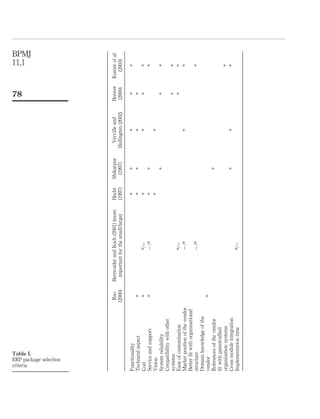
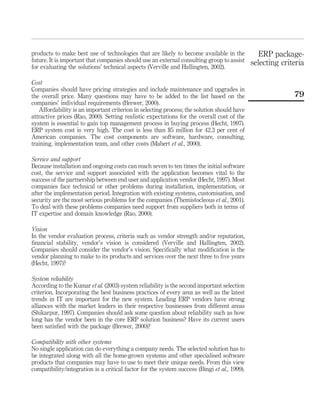
Table I summarises the result of the literature review about the selection criteria.
Functionality
Functionality is the most important evaluation factor. According to Hecht (1997) this
factor should not carry more than one-third of the weight in the overall decision in
evaluation process. The first issue for the functionality is its comprehensiveness. The
solution should have enough or even more modules related to companies’ core
activities such as human resources, material management, project management,
production planning, supply chain management etc. (Brewer, 2000). Functional
evaluation should be done by a cross-functional team. According to Illa et al. (2000)
functionality has three main aspects: which functional areas does the product cover;
how flexible the product is with respect to adaptability and openness; and some ERP
specific features.
Technical criteria
The choice of hardware and software has a major bearing on the acceptance of a
system (Poon and Wagner, 2001). The solution should address the current trends in IT.
Users need to check the currency of IT trends in the ERP product and examine if the
vendor is committed to incorporating the latest trends in IT in the product (Shikarpur,
1997).
Technical architecture uncovers the fit between IS and the end user’s needs by
looking at the environment in which the application is available (database, server, and
client environments), the user-interface capabilities, the software architecture of the
application, the development and management tools associated with the application,
and the data and process models available within the application (Hecht, 1997).
According to Rao (2000) companies ensure that the suppliers undertake to upgrade the
ERP package-
selecting criteria
77
Rao
(2000)
BernroiderandKoch(2001)(more
importantforthesmall/large)
Hecht
(1997)
Shikarpur
(1997)
Vervilleand
Hallingten(2002)
Brewer
(2000)
Kumaretal.
(2003)
Functionality*****
Technicalaspect*****
Cost**/2****
Serviceandsupport*2/****
Vision**
Systemreliability***
Compatibilitywithother
systems**
Easeofcustomisation*/2**
Marketpositionofthevendor2/***
Betterfitwithorganisational
structure2/**
Domainknowledgeofthe
vendor*
Referencesofthevendor*
fitwithparent/allied
organisationsystems*
Crossmoduleintegration***
Implementationtime*/2
Table I.
ERP package selection
criteria
BPMJ
11,1
78
products to make best use of technologies that are likely to become available in the
future. It is important that companies should use an external consulting group to assist
for evaluating the solutions’ technical aspects (Verville and Hallingten, 2002).
Cost
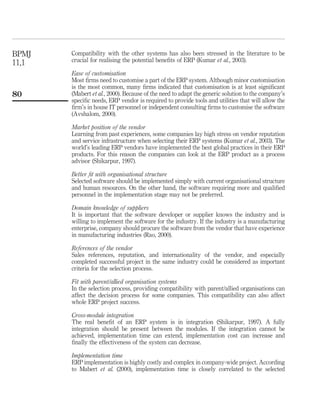
Companies should have pricing strategies and include maintenance and upgrades in
the overall price. Many questions may have to be added to the list based on the
companies’ individual requirements (Brewer, 2000).
Affordability is an important criterion in selecting process; the solution should have
attractive prices (Rao, 2000). Setting realistic expectations for the overall cost of the
system is essential to gain top management process in buying process (Hecht, 1997).
ERP system cost is very high. The cost is less than $5 million for 42.3 per cent of
American companies. The cost components are software, hardware, consulting,
training, implementation team, and other costs (Mabert et al., 2000).
Service and support
Because installation and ongoing costs can reach seven to ten times the initial software
cost, the service and support associated with the application becomes vital to the
success of the partnership between end user and application vendor (Hecht, 1997). Most
companies face technical or other problems during installation, implementation, or
after the implementation period. Integration with existing systems, customisation, and
security are the most serious problems for the companies (Themistocleous et al., 2001).
To deal with these problems companies need support from suppliers both in terms of
IT expertise and domain knowledge (Rao, 2000).
Vision
In the vendor evaluation process, criteria such as vendor strength and/or reputation,
financial stability, vendor’s vision is considered (Verville and Hallingten, 2002).
Companies should consider the vendor’s vision. Specifically what modification is the
vendor planning to make to its products and services over the next three to five years
(Hecht, 1997)?
System reliability
According to the Kumar et al. (2003) system reliability is the second important selection
criterion. Incorporating the best business practices of every area as well as the latest
trends in IT are important for the new system. Leading ERP vendors have strong
alliances with the market leaders in their respective businesses from different areas
(Shikarpur, 1997). Companies should ask some question about reliability such as how
long has the vendor been in the core ERP solution business? Have its current users
been satisfied with the package (Brewer, 2000)?
Compatibility with other systems
No single application can do everything a company needs. The selected solution has to
be integrated along with all the home-grown systems and other specialised software
products that companies may have to use to meet their unique needs. From this view
compatibility/integration is a critical factor for the system success (Bingi et al., 1999).
ERP package-
selecting criteria
79
Compatibility with the other systems has also been stressed in the literature to be
crucial for realising the potential benefits of ERP (Kumar et al., 2003).
Ease of customisation
Most firms need to customise a part of the ERP system. Although minor customisation
is the most common, many firms indicated that customisation is at least significant
(Mabert et al., 2000). Because of the need to adapt the generic solution to the company’s
specific needs, ERP vendor is required to provide tools and utilities that will allow the
firm’s in house IT personnel or independent consulting firms to customise the software
(Avshalom, 2000).
Market position of the vendor
Learning from past experiences, some companies lay high stress on vendor reputation
and service infrastructure when selecting their ERP systems (Kumar et al., 2003). The
world’s leading ERP vendors have implemented the best global practices in their ERP
products. For this reason the companies can look at the ERP product as a process
advisor (Shikarpur, 1997).
Better fit with organisational structure
Selected software should be implemented simply with current organisational structure
and human resources. On the other hand, the software requiring more and qualified
personnel in the implementation stage may not be preferred.
Domain knowledge of suppliers
It is important that the software developer or supplier knows the industry and is
willing to implement the software for the industry. If the industry is a manufacturing
enterprise, company should procure the software from the vendor that have experience
in manufacturing industries (Rao, 2000).
References of the vendor
Sales references, reputation, and internationality of the vendor, and especially
completed successful project in the same industry could be considered as important
criteria for the selection process.
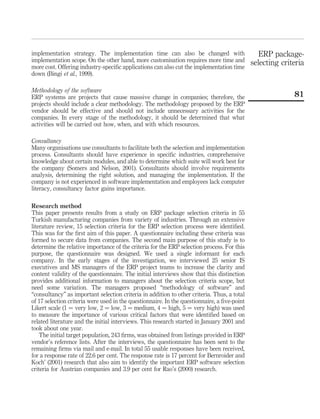
Fit with parent/allied organisation systems
In the selection process, providing compatibility with parent/allied organisations can
affect the decision process for some companies. This compatibility can also affect
whole ERP project success.
Cross-module integration
The real benefit of an ERP system is in integration (Shikarpur, 1997). A fully
integration should be present between the modules. If the integration cannot be
achieved, implementation time can extend, implementation cost can increase and
finally the effectiveness of the system can decrease.
Implementation time
ERP implementation is highly costly and complex in company-wide project. According
to Mabert et al. (2000), implementation time is closely correlated to the selected
BPMJ
11,1
80
implementation strategy. The implementation time can also be changed with
implementation scope. On the other hand, more customisation requires more time and
more cost. Offering industry-specific applications can also cut the implementation time
down (Bingi et al., 1999).
Methodology of the software
ERP systems are projects that cause massive change in companies; therefore, the
projects should include a clear methodology. The methodology proposed by the ERP
vendor should be effective and should not include unnecessary activities for the
companies. In every stage of the methodology, it should be determined that what
activities will be carried out how, when, and with which resources.
Consultancy
Many organisations use consultants to facilitate both the selection and implementation
process. Consultants should have experience in specific industries, comprehensive
knowledge about certain modules, and able to determine which suite will work best for
the company (Somers and Nelson, 2001). Consultants should involve requirements
analysis, determining the right solution, and managing the implementation. If the
company is not experienced in software implementation and employees lack computer
literacy, consultancy factor gains importance.
Research method
This paper presents results from a study on ERP package selection criteria in 55
Turkish manufacturing companies from variety of industries. Through an extensive
literature review, 15 selection criteria for the ERP selection process were identified.
This was for the first aim of this paper. A questionnaire including these criteria was
formed to secure data from companies. The second main purpose of this study is to
determine the relative importance of the criteria for the ERP selection process. For this
purpose, the questionnaire was designed. We used a single informant for each
company. In the early stages of the investigation, we interviewed 25 senior IS
executives and MS managers of the ERP project teams to increase the clarity and
content validity of the questionnaire. The initial interviews show that this distinction
provides additional information to managers about the selection criteria scope, but
need some variation. The managers proposed “methodology of software” and
“consultancy” as important selection criteria in addition to other criteria. Thus, a total
of 17 selection criteria were used in the questionnaire. In the questionnaire, a five-point
Likert scale (1 ¼ very low, 2 ¼ low, 3 ¼ medium, 4 ¼ high, 5 ¼ very high) was used
to measure the importance of various critical factors that were identified based on
related literature and the initial interviews. This research started in January 2001 and
took about one year.
The initial target population, 243 firms, was obtained from listings provided in ERP
vendor’s reference lists. After the interviews, the questionnaire has been sent to the
remaining firms via mail and e-mail. In total 55 usable responses have been received,
for a response rate of 22.6 per cent. The response rate is 17 percent for Bernroider and
Koch’ (2001) research that also aim to identify the important ERP software selection
criteria for Austrian companies and 3.9 per cent for Rao’s (2000) research.
ERP package-
selecting criteria
81
Results
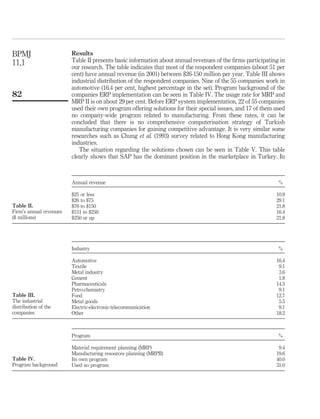
Table II presents basic information about annual revenues of the firms participating in
our research. The table indicates that most of the respondent companies (about 51 per
cent) have annual revenue (in 2001) between $26-150 million per year. Table III shows
industrial distribution of the respondent companies. Nine of the 55 companies work in
automotive (16.4 per cent, highest percentage in the set). Program background of the
companies ERP implementation can be seen in Table IV. The usage rate for MRP and
MRP II is on about 29 per cent. Before ERP system implementation, 22 of 55 companies
used their own program offering solutions for their special issues, and 17 of them used
no company-wide program related to manufacturing. From these rates, it can be
concluded that there is no comprehensive computerisation strategy of Turkish
manufacturing companies for gaining competitive advantage. It is very similar some
researches such as Chung et al. (1993) survey related to Hong Kong manufacturing
industries.
The situation regarding the solutions chosen can be seen in Table V. This table
clearly shows that SAP has the dominant position in the marketplace in Turkey. In
Annual revenue %
$25 or less 10.9
$26 to $75 29.1
$76 to $150 21.8
$151 to $250 16.4
$250 or up 21.8
Table II.
Firm’s annual revenues
($ millions)
Industry %
Automotive 16.4
Textile 9.1
Metal industry 3.6
Cement 1.8
Pharmaceuticals 14.5
Petro-chemistry 9.1
Food 12.7
Metal goods 5.5
Electric-electronic-telecommunication 9.1
Other 18.2
Table III.
The industrial
distribution of the
companies
Program %
Material requirement planning (MRP) 9.4
Manufacturing resources planning (MRPII) 19.6
Its own program 40.0
Used no program 31.0
Table IV.
Program background
BPMJ
11,1
82
Bernroider and Koch (2000) research, these rates are nearly the same, especially for
SAP, for Austrian manufacturing companies.
Table VI presents the mean rankings for the ERP selection criteria in descending
order of importance.
Fit with parent/allied organisation systems is identified as the most important
selection criterion (4.7895), which is the third for the Canadian companies in Kumar et al.
(2003) research. We think that the high mean value of this factor indicates that
parent/allied organisations can affect the selection process for the respondent companies.
The managers viewed cross module integration (mean: 4.7222) as the second most
important selection criterion. The most important expectation from the new ERP system
is “integration”. On the other hand, compatibility between ERP and the current other
systems should be provided to reach whole integration. From this aspect, compatibility
with other systems was identified the third most important selection criterion. Because
most of the companies focus on integration, compatibility and fit, the cost aspect of the
selection process become a matter of secondary importance.
In Kumar et al. (2003) research the most important criteria are identified as
functionality and system reliability that are the sixth and seventh for the Turkish
companies respectively. In Bernroider and Koch (2001) research, good support is the
Very low
(%)
Low
(%)
Medium
(%)
High
(%)
Very high
(%) Mean
Standard
deviation
Fit with parent/allied organisation
systems – – – 21.1 78.9 4.7895 0.4189
Cross module integration – – 3.7 20.4 75.9 4.7222 0.5290
Compatibility with other systems 2.0 2.0 12.0 34.0 50.0 4.2800 0.9044
References of the vendor 1.9 1.9 11.1 40.7 44.4 4.2407 0.8673
Vision – 4.0 14.0 38.0 44.0 4.2200 0.8401
Functionality 1.9 1.9 24.2 22.09 49.1 4.1543 0.9072
System reliability – – 14.8 62.0 23.2 4.0833 0.7759
Consultancy – 9.4 18.9 28.3 43.4 4.0566 1.0079
Technical aspect 1.0 8.2 15.6 39.0 36.2 4.0117 0.9373
Implementation time – 2.0 26.0 48.0 24.0 3.9400 0.7669
Methodology of the software – 9.7 28.3 30.8 31.2 3.8345 0.8974
Market position of the vendor – 6.8 31.2 30.2 31.8 3.8700 1.1308
Ease of customisation 2.0 8.0 26.0 32.0 32.0 3.8400 1.0373
Better fit with organisational
structure – 14.1 21.1 32.2 32.6 3.8332 0.9609
Service and support 6.8 11.4 16.4 28.6 36.8 3.7713 1.0716
Cost 9.6 11.5 15.4 30.8 32.7 3.6538 1.3119
Domain knowledge of the vendor 5.6 18.5 22.2 31.5 22.2 3.4630 1.1929
Table VI.
Mean rankings of the
selection criteria
Type of software %
SAP 65.5
Baan 12.7
QAD 1.8
Other 20.0
Table V.
Chosen ERP software
ERP package-
selecting criteria
83
most important criterion for large firms and adaptability and flexibility of software for
the small- to medium-sized companies, which are the 15th and 13th in our research
respectively.
Table VII indicates that there is no statistically significant difference between
companies that used MRP/MRP II versus used own or no program (with the exception
of better fit with organisational structure, fit with parent/allied organisation systems).
Companies used MRP/MRP II program before ERP are more experienced; because of
this they emphasised that the selected software should be compatible with
organisational structure. The first expectation from the ERP system is providing
integration. From this aspect, the companies used MRP/MRPII systems before stressed
the fit with parent/allied organisation systems. All of the companies identified this
criterion as “very high”.
Conclusion
ERP is a total software application package providing integrated information system
solutions that produce information to decision support systems. Therefore, it is needed
to choose software that uses less resources and produce more output.
An ERP solution covers all the functions, even customers of the company. There are
many different ERP solutions that have a number of modules. ERP is a generic solution
but every firm is unique. Every solution has special features but companies should
choose the most suitable solution to meet their needs. Companies aiming to gain
competitive advantage must choose the best solution that will reflect their strong
aspect and support the rest. This can be achieved using a methodology in the selection
process.
This research has attempted to fill the gap related to the scarcity of the studies
concerning software selection criteria and lack of related studies for Turkish
Used
MRP/MRPII
Used own or no
program
Selection criteria Mean SD Mean SD t-value
Functionality 4.21 0.72 4.13 0.73 0.360
Technical aspect 3.92 0.94 4.08 0.66 20.553
Cost 3.93 1.33 3.54 1.30 0.968
Service and support 3.70 0.87 3.82 0.84 20.409
Vision 4.53 0.64 4.09 0.89 2.006
System reliability 3.90 0.57 4.15 0.54 21.481
Compatibility with other systems 4.47 0.74 4.20 0.96 1.059
Ease of customisation 4.20 0.77 3.69 1.11 1.879
Market position of the vendor 3.88 0.97 3.86 0.94 0.064
Better fit with organisational structure 4.17 0.64 3.70 0.69 2.116*
Domain knowledge of the vendor 3.50 0.94 3.45 1.28 0.155
References of the vendor 4.14 0.77 4.27 0.91 20.527
Methodology of software 3.55 0.81 3.99 0.76 21.676
Fit with parent/allied organisation systems 5.00 0.00 4.71 0.47 2.280*
Cross-module integration 4.86 0.36 4.67 0.57 1.373
Implementation time 4.00 0.85 3.91 0.74 0.340
Consultancy 3.69 1.03 4.17 0.98 21.482
Note: *Statistically significant at the 0.05 level
Table VII.
Companies used
MRP/MRPII versus used
own or no program
BPMJ
11,1
84
companies. A total of 17 main selection criteria for ERP selection process have been
identified, based on related literature and interviews with the managers. In this paper,
fit with parent/allied organisation systems, cross module integration, compatibility
with other systems have been identified as the most important selection criteria. It is
also determined statistically significant differences between companies used
MRP/MRP II versus used own or no program for “better fit with organisational
structure” and “fit with parent/allied organisational systems” criteria. For further
research, the effect of the each selection criteria on ERP implementations failure rates
can be investigated.
References
Avshalom, A. (2000), “A new approach to ERP customisation”, available at: www.erpfans.com/
erpfans/eshbel.htm
Bernroider, E. and Koch, S. (2000), “Differences in characteristics of the ERP system selection
process between small or medium and large organizations”, Proceedings of the Americas
Conference on Information Systems (AMCIS 2000), Long Beach, CA, pp. 1022-8.
Bernroider, E. and Koch, S. (2001), “ERP selection process in midsize and large organizations”,
Business Process Management Journal, Vol. 7 No. 3, pp. 251-7.
Bingi, P., Sharma, M.K. and Godla, J.K. (1999), “Critical issues affecting an ERP implementation”,
Information Systems Management, Vol. 16 No. 3, pp. 7-12.
Brewer, G. (2000), “On the road to successful ERP”, Instrumentation & Control Systems, Vol. 73
No. 5, pp. 49-58.
Chung, W.W.C. and Chik, S.K.O. (2001), “Computerization strategy for small manufacturing
enterprises in Hong Kong”, International Journal of Computer Integrated Manufacturing,
Vol. 14 No. 2, pp. 141-53.
Chung, W.W.C., Tam, M.M.C., Saxena, K.B.C. and Yung, K.L. (1993), “Evaluation of DSS use in
Hong Kong manufacturing industries”, Computers in Industry: An International Journal,
Vol. 21 No. 3, pp. 307-24.
Davenport, T.H. (1998), “Putting the enterprise into the enterprise system”, Harvard Business
Review, Vol. 16 No. 4, pp. 121-31.
Hecht, B. (1997), “Choose the right ERP software”, Datamation, Vol. 43 No. 3, pp. 56-8.
Illa, X.B., Franch, X. and Pastor, J.A. (2000), “Formalising ERP selection criteria”, 10th
International Workshop on Software Specification and Design, IEEE, San Diego, CA.
Kumar, V., Maheshwari, B. and Kumar, U. (2003), “An investigation of critical management
issues in ERP implementation: empirical evidence from Canadian organization’s”,
Technovation, Vol. 23, pp. 793-807.
Liang, T.P. and Hung, S.Y. (1997), “DSS and EIS applications in Taiwan”, Information
Technology & People, Vol. 10 No. 4, pp. 303-15.
Mabert, A.V., Soni, A. and Venkataramanan, M. (2000), “Enterprise resource planning:
measuring value”, Production and Inventory Management Journal, 3rd/4th quarter,
pp. 46-51.
Mabert, A.V., Soni, A. and Venkataramanan, M.A. (2001), “Enterprise resource planning:
common myths versus evolving reality”, Business Horizons, May-June, pp. 69-76.
Petroni, A. (2002), “Critical factors of MRP implementation in small and medium-sized firms”,
International Journal of Operations & Production Management, Vol. 22 No. 3, pp. 329-48.
ERP package-
selecting criteria
85
Poon, P. and Wagner, C. (2001), “Critical success factors revisited: success and failure cases of
information systems for senior executives”, Decision Support Systems, Vol. 30, pp. 393-418.
Rao, S.S. (2000), “Enterprise resource planning: business needs and technologies”, Industrial
Management & Data Systems, Vol. 100 No. 2, pp. 81-8.
Shikarpur, D. (1997), “The dilemma of buying ERP”, Dataquest India, October, available at:
www.dqindia.com/Oct159/3ij1141101.html
Somers, T.M. and Nelson, K. (2001), “The impact of critical success factors across the stages of
enterprise resource planning implementation”, Proceedings of the 34th Hawaii
International Conference on System Sciences, Mavis, HI, pp. 2936-45.
Themistocleous, M., Irani, Z., O’Keefe, R.M. and Paul, R. (2001), “ERP problems and application
integration issues: an empirical survey”, Proceedings of 34th Hawaii International
Conference on System Sciences, pp. 3775-84.
Travis, M.D. (1999), “ERP selection”, APICS Magazine, Vol. 8 No. 6, available at:
www.apics.org/magazine/ june99/ERPTravis.htm
Verville, J. and Hallingten, A. (2002), “An investigation of the decision process for selecting an
ERP software: the case of ESC”, Management Decision, Vol. 40 No. 3, pp. 206-16.
BPMJ
11,1
86

Baki2005

  • 1.
    Determining the ERP package-selectingcriteria The case of Turkish manufacturing companies Birdog˘an Baki Department of Business Administration, Karadeniz Technical University, Trabzon, Turkey, and Kemal C¸akar Small and Medium Industry Development Organisation, Trabzon, Turkey Abstract Purpose – To determine what criteria are used in enterprise resource planning (ERP) selection process and what criteria are the most important for firms. Design/methodology/approach – Through an extensive literature review, 15 selection criteria for the ERP selection process were identified and two were added after initial interviews. A questionnaire including these criteria was formed to secure data from companies. A single informant method was used for each company. To measure the importance of various critical factors a five-point Likert scale was used in the questionnaire. Findings – Fit with parent/allied organisation systems is identified as the most important selection criterion. Cross-module integration, compatibility between other systems, and references of the vendor are identified important factors respectively. Statistically significant differences were also determined between companies using MRP/MRPII versus those using own or no program for “better fit with organisational structure” and “fit with parent/allied organisational systems” criteria. Research limitations/implications – The effect of each selection criterion on ERP implementations failure rates is still to be investigated. Practical implications – Useful information about selection criteria on ERP systems for both vendors and firms planning to use these systems. Originality/value – Two new selection criteria were proposed for the ERP system selection process and some important differences between the criteria used by firms from developed countries and developing countries are determined. Keywords Manufacturing resource planning, Selection, Surveys, Turkey Paper type Research paper Introduction Every companies collects, generates, and stores vast quantities of data. In most companies, information is spread across dozens or even hundreds of separate computer systems, each housed in an individual function, business unit, region, factory or office (Davenport, 1998). Enterprise resource planning (ERP) systems integrate the fragmented information to support decision-making. ERP systems are integrated, enterprise wide systems, which automate core corporate activities such as manufacturing, human resources, finance and supply chain management. By using this system companies can achieve many improvements such as easier access to reliable information, elimination of redundant data and operations, reduction of cycle times, increased efficiency hence reducing costs. In global competitive conditions ERP has risen in strategic significance and choosing the right The Emerald Research Register for this journal is available at The current issue and full text archive of this journal is available at www.emeraldinsight.com/researchregister www.emeraldinsight.com/1463-7154.htm ERP package- selecting criteria 75 Business Process Management Journal Vol. 11 No. 1, 2005 pp. 75-86 q Emerald Group Publishing Limited 1463-7154 DOI 10.1108/14637150510578746
  • 2.
    ERP package hasbeen more important. Determining the ERP Package Selecting Criteria has also gained a crucial role because of all these reasons. After deciding that ERP is right for the company, selecting the right ERP provider gains importance. Selecting an ERP system involves more than interviewing a few vendors. The right ERP provider must be a long-term partner (Travis, 1999). After an internal need assessment the next step is assembling the team to provide the best ERP solution. In this stage the first decision facing the team is whether to purchase integrated or best-of-breed solutions (Hecht, 1997). Most of the manufacturing firms prefer an integrated solution. For American manufacturing companies the rate using a best-of-breed ERP solution is only 3.9 per cent (Mabert et al., 2000). In the Turkish case, all companies we interviewed are also using an integrated solution. ERP software product purchasing is a high cost and risky process. From this aspect, it is critical to make this project successful for an organisation. To be successful, the right solution should be selected and selected software package must be used effectively. In this research we aimed to determine what criteria should be used in selecting the right ERP solution and also which of them are more important in selecting process for Turkish manufacturing companies. Literature review The increased competition, along with the rapid development of new information technologies, has forced more and more businesses to rely on information systems. Using information technology based on computer to support decision-making can be a powerful competitive weapon, especially when its adoption is aligned with corporate strategy. In order to take the advantage of using computers, the computerisation strategy should cope with the corporate goals and business needs of delivery, quality, and cost control. From this view, as a computer system, a selected ERP solution should be able to support decision-making (Liang and Hung, 1997; Chung and Chik, 2001). If the right ERP solution is selected, it can be an excellent decision support tool that will provide a competitive advantage (Mabert et al., 2001). There are number of solutions in the ERP market and every solution has different features. As ERP packages cost hundreds of thousands and even millions of dollars, purchasing an ERP solution is a high expenditure activity that consumes a significant portion of companies’ capital budgets (Verville and Hallingten, 2002). Selecting the right solution is a gruelling process for companies. It can take about 14 months with 20 employees (Hecht, 1997). Among the number of the alternatives, companies use some criteria for determining the right ERP solution. In the evaluation process, companies can develop a matrix and assign weights and scores for each criterion (Verville and Hallingten, 2002). According to some researchers, selecting the right solution is a critical success factor for ERP system success. Somers and Nelson (2001) stressed that the choice of the package involves important decisions related to budgets, timeframes, goals, and deliverables that will shape the entire projects. Choosing the right ERP solution that best matches the organisational information needs and processes is critical to ensure minimal modification and successful implementation and use. On the other hand the wrong software do not fit the organisation’s strategic goal or business (Somers and Nelson, 2001). Software and hardware characteristics are critical for ERP implementation success. Conducting a requirements analysis in the early stage of BPMJ 11,1 76
  • 3.
    the project implementationand thoroughly reviewing a number of hardware/software solutions might result in the system that better fit to the users’ requirements (Petroni, 2002). Hecht (1997) presents six major criteria for selection and evaluation process: functionality, technical architecture, cost, service and support, ability to execute, and vision. Bernroider and Koch (2001) investigated differences in characteristics of the ERP system selection process between small or medium and large organisations. They used 29 different ERP selection criteria and determined only 12 criteria that have strong relationship to organisation size. The criteria for selection of a particular ERP system show different priorities related to organisational size. Organisational flexibility, extra organisational ties with customers and suppliers and internationality are more important for the bigger. Cost and adaptability are more important criteria in selecting process for smaller companies (Bernroider and Koch, 2001). In Kumar et al. (2003) research functionality, system reliability, and fit with parent/allied organisation systems are determined as the three most important criteria. Verville and Hallingten (2002) determined three distinct types of criteria for evaluation: vendor, functionality and technical. Vendor evaluation criteria included size, financial stability, reputation of vendor etc., functional criteria dealt with the features of the software, and included functionalities specific to front-end interfaces, user friendliness and so on. Technical criteria dealt with the specifics of the systems architecture, integration, performance, and security etc. Table I summarises the result of the literature review about the selection criteria. Functionality Functionality is the most important evaluation factor. According to Hecht (1997) this factor should not carry more than one-third of the weight in the overall decision in evaluation process. The first issue for the functionality is its comprehensiveness. The solution should have enough or even more modules related to companies’ core activities such as human resources, material management, project management, production planning, supply chain management etc. (Brewer, 2000). Functional evaluation should be done by a cross-functional team. According to Illa et al. (2000) functionality has three main aspects: which functional areas does the product cover; how flexible the product is with respect to adaptability and openness; and some ERP specific features. Technical criteria The choice of hardware and software has a major bearing on the acceptance of a system (Poon and Wagner, 2001). The solution should address the current trends in IT. Users need to check the currency of IT trends in the ERP product and examine if the vendor is committed to incorporating the latest trends in IT in the product (Shikarpur, 1997). Technical architecture uncovers the fit between IS and the end user’s needs by looking at the environment in which the application is available (database, server, and client environments), the user-interface capabilities, the software architecture of the application, the development and management tools associated with the application, and the data and process models available within the application (Hecht, 1997). According to Rao (2000) companies ensure that the suppliers undertake to upgrade the ERP package- selecting criteria 77
  • 4.
  • 5.
    products to makebest use of technologies that are likely to become available in the future. It is important that companies should use an external consulting group to assist for evaluating the solutions’ technical aspects (Verville and Hallingten, 2002). Cost Companies should have pricing strategies and include maintenance and upgrades in the overall price. Many questions may have to be added to the list based on the companies’ individual requirements (Brewer, 2000). Affordability is an important criterion in selecting process; the solution should have attractive prices (Rao, 2000). Setting realistic expectations for the overall cost of the system is essential to gain top management process in buying process (Hecht, 1997). ERP system cost is very high. The cost is less than $5 million for 42.3 per cent of American companies. The cost components are software, hardware, consulting, training, implementation team, and other costs (Mabert et al., 2000). Service and support Because installation and ongoing costs can reach seven to ten times the initial software cost, the service and support associated with the application becomes vital to the success of the partnership between end user and application vendor (Hecht, 1997). Most companies face technical or other problems during installation, implementation, or after the implementation period. Integration with existing systems, customisation, and security are the most serious problems for the companies (Themistocleous et al., 2001). To deal with these problems companies need support from suppliers both in terms of IT expertise and domain knowledge (Rao, 2000). Vision In the vendor evaluation process, criteria such as vendor strength and/or reputation, financial stability, vendor’s vision is considered (Verville and Hallingten, 2002). Companies should consider the vendor’s vision. Specifically what modification is the vendor planning to make to its products and services over the next three to five years (Hecht, 1997)? System reliability According to the Kumar et al. (2003) system reliability is the second important selection criterion. Incorporating the best business practices of every area as well as the latest trends in IT are important for the new system. Leading ERP vendors have strong alliances with the market leaders in their respective businesses from different areas (Shikarpur, 1997). Companies should ask some question about reliability such as how long has the vendor been in the core ERP solution business? Have its current users been satisfied with the package (Brewer, 2000)? Compatibility with other systems No single application can do everything a company needs. The selected solution has to be integrated along with all the home-grown systems and other specialised software products that companies may have to use to meet their unique needs. From this view compatibility/integration is a critical factor for the system success (Bingi et al., 1999). ERP package- selecting criteria 79
  • 6.
    Compatibility with theother systems has also been stressed in the literature to be crucial for realising the potential benefits of ERP (Kumar et al., 2003). Ease of customisation Most firms need to customise a part of the ERP system. Although minor customisation is the most common, many firms indicated that customisation is at least significant (Mabert et al., 2000). Because of the need to adapt the generic solution to the company’s specific needs, ERP vendor is required to provide tools and utilities that will allow the firm’s in house IT personnel or independent consulting firms to customise the software (Avshalom, 2000). Market position of the vendor Learning from past experiences, some companies lay high stress on vendor reputation and service infrastructure when selecting their ERP systems (Kumar et al., 2003). The world’s leading ERP vendors have implemented the best global practices in their ERP products. For this reason the companies can look at the ERP product as a process advisor (Shikarpur, 1997). Better fit with organisational structure Selected software should be implemented simply with current organisational structure and human resources. On the other hand, the software requiring more and qualified personnel in the implementation stage may not be preferred. Domain knowledge of suppliers It is important that the software developer or supplier knows the industry and is willing to implement the software for the industry. If the industry is a manufacturing enterprise, company should procure the software from the vendor that have experience in manufacturing industries (Rao, 2000). References of the vendor Sales references, reputation, and internationality of the vendor, and especially completed successful project in the same industry could be considered as important criteria for the selection process. Fit with parent/allied organisation systems In the selection process, providing compatibility with parent/allied organisations can affect the decision process for some companies. This compatibility can also affect whole ERP project success. Cross-module integration The real benefit of an ERP system is in integration (Shikarpur, 1997). A fully integration should be present between the modules. If the integration cannot be achieved, implementation time can extend, implementation cost can increase and finally the effectiveness of the system can decrease. Implementation time ERP implementation is highly costly and complex in company-wide project. According to Mabert et al. (2000), implementation time is closely correlated to the selected BPMJ 11,1 80
  • 7.
    implementation strategy. Theimplementation time can also be changed with implementation scope. On the other hand, more customisation requires more time and more cost. Offering industry-specific applications can also cut the implementation time down (Bingi et al., 1999). Methodology of the software ERP systems are projects that cause massive change in companies; therefore, the projects should include a clear methodology. The methodology proposed by the ERP vendor should be effective and should not include unnecessary activities for the companies. In every stage of the methodology, it should be determined that what activities will be carried out how, when, and with which resources. Consultancy Many organisations use consultants to facilitate both the selection and implementation process. Consultants should have experience in specific industries, comprehensive knowledge about certain modules, and able to determine which suite will work best for the company (Somers and Nelson, 2001). Consultants should involve requirements analysis, determining the right solution, and managing the implementation. If the company is not experienced in software implementation and employees lack computer literacy, consultancy factor gains importance. Research method This paper presents results from a study on ERP package selection criteria in 55 Turkish manufacturing companies from variety of industries. Through an extensive literature review, 15 selection criteria for the ERP selection process were identified. This was for the first aim of this paper. A questionnaire including these criteria was formed to secure data from companies. The second main purpose of this study is to determine the relative importance of the criteria for the ERP selection process. For this purpose, the questionnaire was designed. We used a single informant for each company. In the early stages of the investigation, we interviewed 25 senior IS executives and MS managers of the ERP project teams to increase the clarity and content validity of the questionnaire. The initial interviews show that this distinction provides additional information to managers about the selection criteria scope, but need some variation. The managers proposed “methodology of software” and “consultancy” as important selection criteria in addition to other criteria. Thus, a total of 17 selection criteria were used in the questionnaire. In the questionnaire, a five-point Likert scale (1 ¼ very low, 2 ¼ low, 3 ¼ medium, 4 ¼ high, 5 ¼ very high) was used to measure the importance of various critical factors that were identified based on related literature and the initial interviews. This research started in January 2001 and took about one year. The initial target population, 243 firms, was obtained from listings provided in ERP vendor’s reference lists. After the interviews, the questionnaire has been sent to the remaining firms via mail and e-mail. In total 55 usable responses have been received, for a response rate of 22.6 per cent. The response rate is 17 percent for Bernroider and Koch’ (2001) research that also aim to identify the important ERP software selection criteria for Austrian companies and 3.9 per cent for Rao’s (2000) research. ERP package- selecting criteria 81
  • 8.
    Results Table II presentsbasic information about annual revenues of the firms participating in our research. The table indicates that most of the respondent companies (about 51 per cent) have annual revenue (in 2001) between $26-150 million per year. Table III shows industrial distribution of the respondent companies. Nine of the 55 companies work in automotive (16.4 per cent, highest percentage in the set). Program background of the companies ERP implementation can be seen in Table IV. The usage rate for MRP and MRP II is on about 29 per cent. Before ERP system implementation, 22 of 55 companies used their own program offering solutions for their special issues, and 17 of them used no company-wide program related to manufacturing. From these rates, it can be concluded that there is no comprehensive computerisation strategy of Turkish manufacturing companies for gaining competitive advantage. It is very similar some researches such as Chung et al. (1993) survey related to Hong Kong manufacturing industries. The situation regarding the solutions chosen can be seen in Table V. This table clearly shows that SAP has the dominant position in the marketplace in Turkey. In Annual revenue % $25 or less 10.9 $26 to $75 29.1 $76 to $150 21.8 $151 to $250 16.4 $250 or up 21.8 Table II. Firm’s annual revenues ($ millions) Industry % Automotive 16.4 Textile 9.1 Metal industry 3.6 Cement 1.8 Pharmaceuticals 14.5 Petro-chemistry 9.1 Food 12.7 Metal goods 5.5 Electric-electronic-telecommunication 9.1 Other 18.2 Table III. The industrial distribution of the companies Program % Material requirement planning (MRP) 9.4 Manufacturing resources planning (MRPII) 19.6 Its own program 40.0 Used no program 31.0 Table IV. Program background BPMJ 11,1 82
  • 9.
    Bernroider and Koch(2000) research, these rates are nearly the same, especially for SAP, for Austrian manufacturing companies. Table VI presents the mean rankings for the ERP selection criteria in descending order of importance. Fit with parent/allied organisation systems is identified as the most important selection criterion (4.7895), which is the third for the Canadian companies in Kumar et al. (2003) research. We think that the high mean value of this factor indicates that parent/allied organisations can affect the selection process for the respondent companies. The managers viewed cross module integration (mean: 4.7222) as the second most important selection criterion. The most important expectation from the new ERP system is “integration”. On the other hand, compatibility between ERP and the current other systems should be provided to reach whole integration. From this aspect, compatibility with other systems was identified the third most important selection criterion. Because most of the companies focus on integration, compatibility and fit, the cost aspect of the selection process become a matter of secondary importance. In Kumar et al. (2003) research the most important criteria are identified as functionality and system reliability that are the sixth and seventh for the Turkish companies respectively. In Bernroider and Koch (2001) research, good support is the Very low (%) Low (%) Medium (%) High (%) Very high (%) Mean Standard deviation Fit with parent/allied organisation systems – – – 21.1 78.9 4.7895 0.4189 Cross module integration – – 3.7 20.4 75.9 4.7222 0.5290 Compatibility with other systems 2.0 2.0 12.0 34.0 50.0 4.2800 0.9044 References of the vendor 1.9 1.9 11.1 40.7 44.4 4.2407 0.8673 Vision – 4.0 14.0 38.0 44.0 4.2200 0.8401 Functionality 1.9 1.9 24.2 22.09 49.1 4.1543 0.9072 System reliability – – 14.8 62.0 23.2 4.0833 0.7759 Consultancy – 9.4 18.9 28.3 43.4 4.0566 1.0079 Technical aspect 1.0 8.2 15.6 39.0 36.2 4.0117 0.9373 Implementation time – 2.0 26.0 48.0 24.0 3.9400 0.7669 Methodology of the software – 9.7 28.3 30.8 31.2 3.8345 0.8974 Market position of the vendor – 6.8 31.2 30.2 31.8 3.8700 1.1308 Ease of customisation 2.0 8.0 26.0 32.0 32.0 3.8400 1.0373 Better fit with organisational structure – 14.1 21.1 32.2 32.6 3.8332 0.9609 Service and support 6.8 11.4 16.4 28.6 36.8 3.7713 1.0716 Cost 9.6 11.5 15.4 30.8 32.7 3.6538 1.3119 Domain knowledge of the vendor 5.6 18.5 22.2 31.5 22.2 3.4630 1.1929 Table VI. Mean rankings of the selection criteria Type of software % SAP 65.5 Baan 12.7 QAD 1.8 Other 20.0 Table V. Chosen ERP software ERP package- selecting criteria 83
  • 10.
    most important criterionfor large firms and adaptability and flexibility of software for the small- to medium-sized companies, which are the 15th and 13th in our research respectively. Table VII indicates that there is no statistically significant difference between companies that used MRP/MRP II versus used own or no program (with the exception of better fit with organisational structure, fit with parent/allied organisation systems). Companies used MRP/MRP II program before ERP are more experienced; because of this they emphasised that the selected software should be compatible with organisational structure. The first expectation from the ERP system is providing integration. From this aspect, the companies used MRP/MRPII systems before stressed the fit with parent/allied organisation systems. All of the companies identified this criterion as “very high”. Conclusion ERP is a total software application package providing integrated information system solutions that produce information to decision support systems. Therefore, it is needed to choose software that uses less resources and produce more output. An ERP solution covers all the functions, even customers of the company. There are many different ERP solutions that have a number of modules. ERP is a generic solution but every firm is unique. Every solution has special features but companies should choose the most suitable solution to meet their needs. Companies aiming to gain competitive advantage must choose the best solution that will reflect their strong aspect and support the rest. This can be achieved using a methodology in the selection process. This research has attempted to fill the gap related to the scarcity of the studies concerning software selection criteria and lack of related studies for Turkish Used MRP/MRPII Used own or no program Selection criteria Mean SD Mean SD t-value Functionality 4.21 0.72 4.13 0.73 0.360 Technical aspect 3.92 0.94 4.08 0.66 20.553 Cost 3.93 1.33 3.54 1.30 0.968 Service and support 3.70 0.87 3.82 0.84 20.409 Vision 4.53 0.64 4.09 0.89 2.006 System reliability 3.90 0.57 4.15 0.54 21.481 Compatibility with other systems 4.47 0.74 4.20 0.96 1.059 Ease of customisation 4.20 0.77 3.69 1.11 1.879 Market position of the vendor 3.88 0.97 3.86 0.94 0.064 Better fit with organisational structure 4.17 0.64 3.70 0.69 2.116* Domain knowledge of the vendor 3.50 0.94 3.45 1.28 0.155 References of the vendor 4.14 0.77 4.27 0.91 20.527 Methodology of software 3.55 0.81 3.99 0.76 21.676 Fit with parent/allied organisation systems 5.00 0.00 4.71 0.47 2.280* Cross-module integration 4.86 0.36 4.67 0.57 1.373 Implementation time 4.00 0.85 3.91 0.74 0.340 Consultancy 3.69 1.03 4.17 0.98 21.482 Note: *Statistically significant at the 0.05 level Table VII. Companies used MRP/MRPII versus used own or no program BPMJ 11,1 84
  • 11.
    companies. A totalof 17 main selection criteria for ERP selection process have been identified, based on related literature and interviews with the managers. In this paper, fit with parent/allied organisation systems, cross module integration, compatibility with other systems have been identified as the most important selection criteria. It is also determined statistically significant differences between companies used MRP/MRP II versus used own or no program for “better fit with organisational structure” and “fit with parent/allied organisational systems” criteria. For further research, the effect of the each selection criteria on ERP implementations failure rates can be investigated. References Avshalom, A. (2000), “A new approach to ERP customisation”, available at: www.erpfans.com/ erpfans/eshbel.htm Bernroider, E. and Koch, S. (2000), “Differences in characteristics of the ERP system selection process between small or medium and large organizations”, Proceedings of the Americas Conference on Information Systems (AMCIS 2000), Long Beach, CA, pp. 1022-8. Bernroider, E. and Koch, S. (2001), “ERP selection process in midsize and large organizations”, Business Process Management Journal, Vol. 7 No. 3, pp. 251-7. Bingi, P., Sharma, M.K. and Godla, J.K. (1999), “Critical issues affecting an ERP implementation”, Information Systems Management, Vol. 16 No. 3, pp. 7-12. Brewer, G. (2000), “On the road to successful ERP”, Instrumentation & Control Systems, Vol. 73 No. 5, pp. 49-58. Chung, W.W.C. and Chik, S.K.O. (2001), “Computerization strategy for small manufacturing enterprises in Hong Kong”, International Journal of Computer Integrated Manufacturing, Vol. 14 No. 2, pp. 141-53. Chung, W.W.C., Tam, M.M.C., Saxena, K.B.C. and Yung, K.L. (1993), “Evaluation of DSS use in Hong Kong manufacturing industries”, Computers in Industry: An International Journal, Vol. 21 No. 3, pp. 307-24. Davenport, T.H. (1998), “Putting the enterprise into the enterprise system”, Harvard Business Review, Vol. 16 No. 4, pp. 121-31. Hecht, B. (1997), “Choose the right ERP software”, Datamation, Vol. 43 No. 3, pp. 56-8. Illa, X.B., Franch, X. and Pastor, J.A. (2000), “Formalising ERP selection criteria”, 10th International Workshop on Software Specification and Design, IEEE, San Diego, CA. Kumar, V., Maheshwari, B. and Kumar, U. (2003), “An investigation of critical management issues in ERP implementation: empirical evidence from Canadian organization’s”, Technovation, Vol. 23, pp. 793-807. Liang, T.P. and Hung, S.Y. (1997), “DSS and EIS applications in Taiwan”, Information Technology & People, Vol. 10 No. 4, pp. 303-15. Mabert, A.V., Soni, A. and Venkataramanan, M. (2000), “Enterprise resource planning: measuring value”, Production and Inventory Management Journal, 3rd/4th quarter, pp. 46-51. Mabert, A.V., Soni, A. and Venkataramanan, M.A. (2001), “Enterprise resource planning: common myths versus evolving reality”, Business Horizons, May-June, pp. 69-76. Petroni, A. (2002), “Critical factors of MRP implementation in small and medium-sized firms”, International Journal of Operations & Production Management, Vol. 22 No. 3, pp. 329-48. ERP package- selecting criteria 85
  • 12.
    Poon, P. andWagner, C. (2001), “Critical success factors revisited: success and failure cases of information systems for senior executives”, Decision Support Systems, Vol. 30, pp. 393-418. Rao, S.S. (2000), “Enterprise resource planning: business needs and technologies”, Industrial Management & Data Systems, Vol. 100 No. 2, pp. 81-8. Shikarpur, D. (1997), “The dilemma of buying ERP”, Dataquest India, October, available at: www.dqindia.com/Oct159/3ij1141101.html Somers, T.M. and Nelson, K. (2001), “The impact of critical success factors across the stages of enterprise resource planning implementation”, Proceedings of the 34th Hawaii International Conference on System Sciences, Mavis, HI, pp. 2936-45. Themistocleous, M., Irani, Z., O’Keefe, R.M. and Paul, R. (2001), “ERP problems and application integration issues: an empirical survey”, Proceedings of 34th Hawaii International Conference on System Sciences, pp. 3775-84. Travis, M.D. (1999), “ERP selection”, APICS Magazine, Vol. 8 No. 6, available at: www.apics.org/magazine/ june99/ERPTravis.htm Verville, J. and Hallingten, A. (2002), “An investigation of the decision process for selecting an ERP software: the case of ESC”, Management Decision, Vol. 40 No. 3, pp. 206-16. BPMJ 11,1 86