International Journal of Electrical and Computer Engineering (IJECE)
Vol. 8, No. 2, April 2018, pp. 1150~1155
ISSN: 2088-8708, DOI: 10.11591/ijece.v8i2.pp1150-1155  1150
Journal homepage: http://iaescore.com/journals/index.php/IJECE
Investigation and Study of Vital Factors in Selection,
Implementation and Satisfaction of ERP in Small and Medium
Scale Industries
Kanchana V1
, Sri Ranjini S2
1
Department of Computer Science, Amrita Vishwa Vidyapeetham University, Mysuru Campus, India
2
Department of Management and Commerce, Amrita Vishwa Vidyapeetham, Amrita University, Mysuru Campus, India
Article Info ABSTRACT
Article history:
Received Oct 30, 2017
Revised Feb 20, 2018
Accepted Feb 28, 2018
Small and Medium Scale Enterprises in India are the most productive job
designers and forerunners in developing new ideas in the field of business.
SMEs not only play a vital role in providing large scale employment
openings at reasonably lower capital than large businesses but also help in
industrialization of rural areas in India. SMEs are complementary to large
industries as subsidiary units and this sector contributes immensely to the
socio-economic development of the country. Small and Medium scale
industries have grown tremendously in the last 5 decades. In spite of high
enthusiasm and intrinsic capabilities to grow, there are a number of problems
faced by SME‟s; one of them is the „technological obsolescence‟. The SME
sector in order to outcome this challenge must make advances in the field of
engineering and technology. Adoption of Information Communication
Technology in their business process can enhance their productivity and
global competency.in the market. In this connection Enterprise Resource
Planning plays a vital role in the SME‟s business process strategy. Hence
there is a need for the motivation to implement ERP and find whether the
current ICT solution the industries using are adequate for their strategy. In
this paper we try to find out which ERP vendors does the SME sectors prefer,
are the features of the ERP system and the implementation methodology
selected have met the business goals and user satisfaction.
Keyword:
ERP
Factors
ICT
Implementation
SME
Vendors
Copyright © 2018 Institute of Advanced Engineering and Science.
All rights reserved.
Corresponding Author:
Kanchana V,
Department of Computer Science,
Amrita Vishwa Vidyapeetham University,
#114, 7th
Cross, Bogadi 2nd
Stage, Mysuru-570026, India.
Email: kanchana.subbaiah@gmail.com
1. INTRODUCTION
Small and medium scale industries are important for the growth and development of the nation‟s
economic growth. Information Technology has become an integral part in any type of enterprise. Today,
technology up gradation plays a crucial role in enhancing the competitiveness and in fostering the growth of
SMEs. The business process is becoming complex day by day requiring more internal data flow for decision
making, timely report generation, inventory management and resource management. In this regard, business
managers need efficient information systems to handle the huge data flows and manage the information
generated by the enterprise resulting in improvement in cost reduction, increased productivity and customer
satisfaction. ERP is an integrated system which has the properties of the transaction processing to decision
support system, everything in a single bowl. Compared to other information systems such as spreadsheet
which have analytical tool which support decision making and Tally an accounting package, ERP offers an
Int J Elec & Comp Eng ISSN: 2088-8708 
Investigation and Study of Vital Factors in Selection, Implementation and Satisfaction of …. (Kanchana V)
1151
integrated package where the managers can efficiently use it to improve internal communication, productivity
and get a visually pleasing report for decision making.
Indian small and medium enterprises (SMEs) are looking to the cloud, analytics and mobile
solutions to improve operations and become more efficient, according to a new research report by Circle
Research, according to a press release issued by enterprise application software company SAP, which
sponsored the research.
To sustain in the market and improve the productivity are forcing them to completely reconsider
traditional business models and adopt cutting edge technologies like cloud and big data. Where these
technologies help SMEs to achieve business success and fulfill their ambitions. In this paper we try to know
how many SMEs have put into use ERP for their business and find it helpful for the working in their
organization.
Kanishka Samudaya Nanayakkara et.al [1] work shows that there is a significant impact to the
achievement of the ERP execution venture if ERP usage group comprises of high number of Early Adopters
(or superior opinion leaders). Kanishka Samudaya Nanayakkara et.al [2] works on the construction
organizations in Sri Lanka and sows that the influencing factor for implementation and success for an ERP is
not only the IT factors but also non IT factors also influence in the selection. The factors were grouped into
Major factors, Moderate factors and Minor factors. It is also has been observed in their work that Some of the
factors that usually perceived as important in the selection stage are actually not significantly important in the
ERP implementation process and its success [3]. According to the ERP report of 2015 one of the factors for
implementing ERP was to replace the old ERP or legacy systems to new ERP systems. It is also reported that
most of the manufacturing companies have implemented ERP the growth rate is increased from 27 percent to
43 percent. The success factors of the ERP implementation was less since the implementation took most of
the time and were over budget. [4] According to the report by Panorama Consulting shows that the Titans of
ERP vendors such as SAP, Oracle, Microsoft Dynamics or Infor ERP solutions, the study shows that SAP is
the most commonly short-listed ERP system of the four. SAP is followed by Oracle, Microsoft and Infor.
Ahmed J. Aljaaf et.al [5] their study shows that change management strategies‟ are important in adopting
new system by the employees, which reduces staff resistance by clear and systematic implementation of
ERP. With the support of top managers, feedback management and opportunities to change plays an
important role in implementation of ERP. The study tells us that by practicing team approach and having
champion teams, organizations would be capable of creating cooperation and thus strengthen application of
enterprise resource management. H. Gupta et.al [6] enlisted three critical success factors to succeed in ERP
implementation they are: Top Management responsible for the entire ERP implementation, Project
Management which focuses on pre-implementation, implementation, post implementation phases and Change
Management which plays a vital role in implementing ERP. These factors were evaluated using the Plan-Do-
Check-Act evaluation method which evaluated each phase of implementation in the Project Management.
Ewa Ziemba and Iwona Obłąk, [8] in their paper they explained the nature of business process management,
especially in public administration in Poland. They grouped the factors into the following category namely:
a. Factors related to public procurement procedure;
b. Factors related to government processes management;
c. Factors related to project team competences (knowledge and skills of the project team related to
implementation of information systems, especially erp systems in public administration); and
d. Factors related to the project management.
Among these the important factor is the public procurement procedure. Legal regulations in the
public procurement procedure make the ERP implementation delay due to prolongation of the purchase and
also the implementation time. In public administration, the scope of changes is quite extensive and mainly
includes changes in government processes; hence the change management factor also affects the prolongation
of the ERP implementation. An article by Daphne Rich and Jens Dibbern [9] has written the impacts of post
implementation phase of ERP system. They have considered and adapted all the elements of the IS success
models for the post implementation phase. It mainly tells about the variations in user satisfaction. The overall
Usefulness of the ERP implementation lies on the End User Satisfaction (EUS).
H1: A higher degree of Usefulness leads to a higher degree of overall EUS.
P. T. Kale et al. [11] Vendors need to lengthen the ERP solution to better meet the requirements of
SMEs. Since the financial resources of SMEs are limited, the cost of ERP system needs to be further reduced.
SMEs on their part need to carefully evaluate their current IT systems and document its shortcomings. They
discussed the issues and challenges of ERP implementation.
Bernhard Wieder et al. [12] in their research studied the performance indicators on financial and
non-financial sectors when adopting ERP systems for their business domain. Using ERPS adoption, ERPS
history and ERPS extension (with a SCMS) as independent variables and KPIs for supply chain performance
and firm performance as dependent variables, they found that the higher the overall firm performance, but
 ISSN: 2088-8708
Int J Elec & Comp Eng, Vol. 8, No. 2, April 2018 : 1150 – 1155
1152
again surprisingly not the supply chain performance. But extending the ERP System there was increase in the
supply chain performance.
2. METHODOLOGY AND EXPERIMENT RESULTS
The main aim of our research is to determine the vital factors in selection, implementation and
satisfaction of ERP. A survey was conducted in Small and Medium Scale Industries in and around South
India. Data were gathered from the firms which have implemented and not implemented ERP systems.
Sample sizes of 40 SMEs were selected by the method of simple random sampling. Data gathering tool in
this study is a questionnaire that was prepared after examining relevant texts and related indexes were
extracted. Only one survey questionnaire was sent to an ERP organization user. The respondents were
manager, inventory manager, production manager and marketing executive. Since some of the SMEs did not
return the questionnaire and some questionnaires were partially filled, we had to discard 12 questionnaires
and finally the analysis was conducted for 28 companies only. To ensure that the inquiries that ought to be
incorporated into the survey the past work of the researches were reviewed. Based on the factors the
following hypothesis was constructed.
H1: Organizations efficiency and productivity improved by implementing ERP systems
H2: Big Bang methodology was used to implement ERP systems.
H3: Enhancing the current ERP system to match the current general strategies of the enterprise.
H4: The majority of the organizations go for vendors well known example SAP.
2.1. Benefits
ERP systems are used to provide the same updated and accurate information across different
functions is what makes the application so valuable to enterprises. The advantage of these systems is the
same information is viewed by all the people in different departments. The ERP system forwards this updated
and accurate information to the next concerned department, which is defined in the workflow. Apart from
the low cost ownership the implementation of ERP systems gives more advantage to the organization like
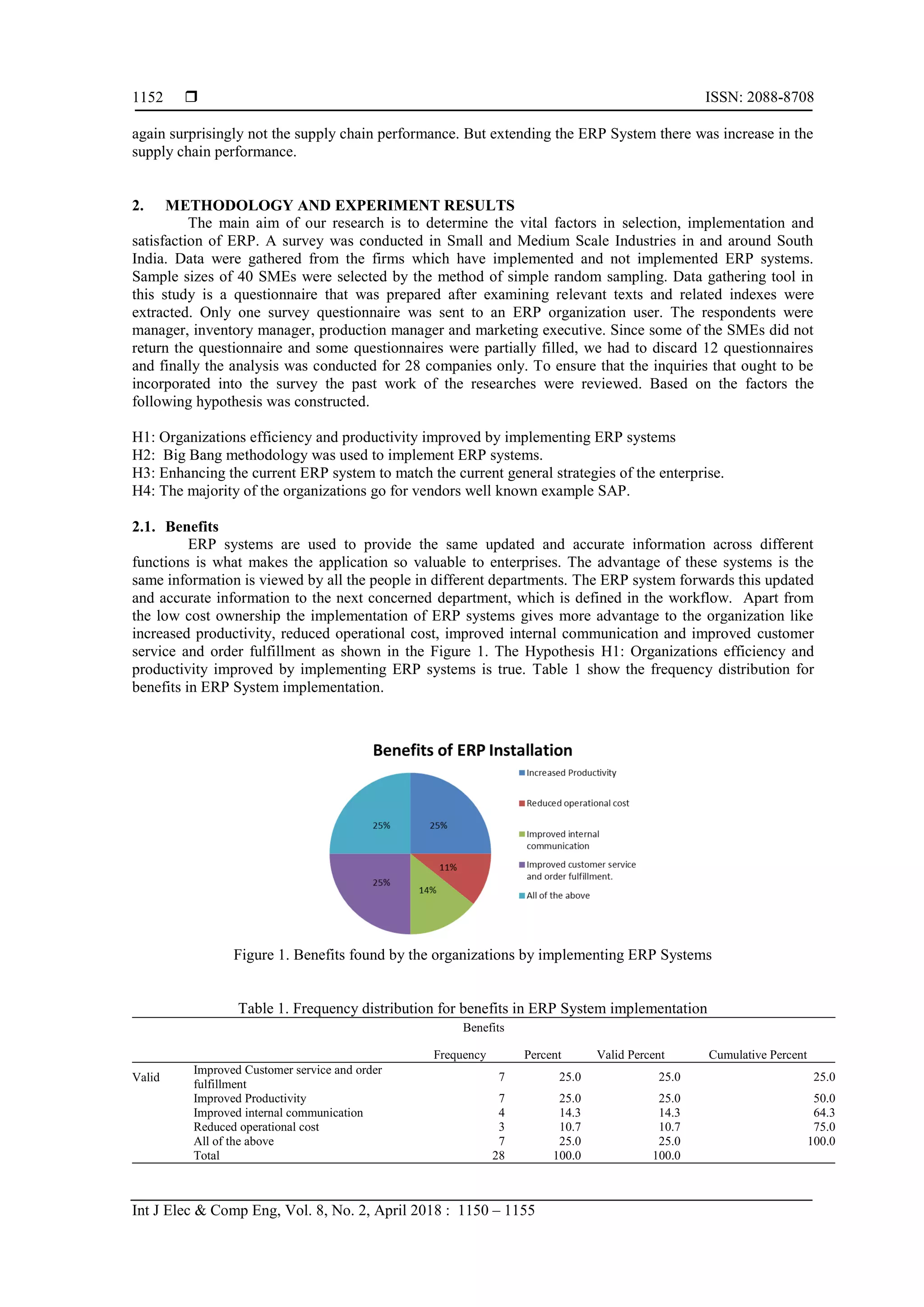
increased productivity, reduced operational cost, improved internal communication and improved customer
service and order fulfillment as shown in the Figure 1. The Hypothesis H1: Organizations efficiency and
productivity improved by implementing ERP systems is true. Table 1 show the frequency distribution for
benefits in ERP System implementation.
Figure 1. Benefits found by the organizations by implementing ERP Systems
Table 1. Frequency distribution for benefits in ERP System implementation
Benefits
Frequency Percent Valid Percent Cumulative Percent
Valid
Improved Customer service and order
fulfillment
7 25.0 25.0 25.0
Improved Productivity 7 25.0 25.0 50.0
Improved internal communication 4 14.3 14.3 64.3
Reduced operational cost 3 10.7 10.7 75.0
All of the above 7 25.0 25.0 100.0
Total 28 100.0 100.0
Int J Elec & Comp Eng ISSN: 2088-8708 
Investigation and Study of Vital Factors in Selection, Implementation and Satisfaction of …. (Kanchana V)
1153
2.2. Implementation Approach
When a new system needs to be implemented in an organization there are many ways they can
implement. The different ways are:
Big Bang approach where all the modules of the system are implemented together and the go live date for all
the sections/departments will be the same. In phased approach the adaptation happens in sequential manner,
in parallel approach the old and new system will be alive for some time until the end users become
acquainted to the new system. Hybrid approach combines both phased and parallel approach. According
to our study, most of the organizations used Big Bang approach to implement the ERP system. The frequency
of these approaches is shown in the Table 2 below. Hence the Hypothesis H2: Big Bang methodology was
used to implement ERP systems is true.
Table 2. Frequency distribution for Methodology
Methodology
Frequency Percent Valid Percent Cumulative Percent
Valid Big Bang 9 32.1 32.1 32.1
Phased 8 28.6 28.6 60.7
Parallel 7 25.0 25.0 85.7
Hybrid 4 14.3 14.3 100.0
Total 28 100.0 100.0
2.3. Vendors
Vendors are people who develop ERP packages. They are the people who invested huge amount of
money, time and effort in research and development of ERP solutions. There are many vendors in the
marketplace; selection of the right ERP vendor contributes to the success of the ERP implementation. The
bigger vendor does not always mean better. The reasons for opting bigger ones are financial stability,
longevity and various spectrums of offerings. Small vendors that are not known may carry increased risks in
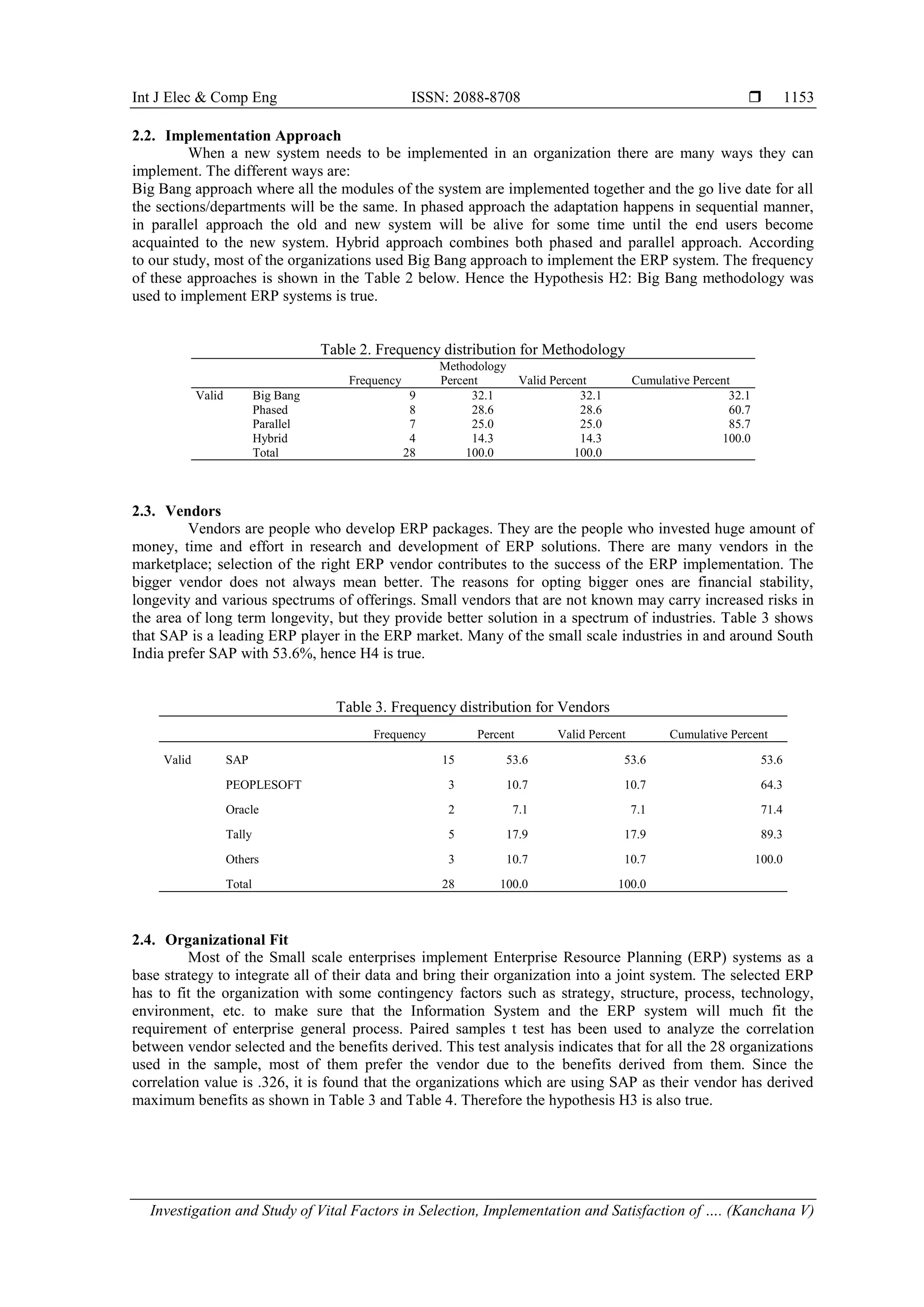
the area of long term longevity, but they provide better solution in a spectrum of industries. Table 3 shows
that SAP is a leading ERP player in the ERP market. Many of the small scale industries in and around South
India prefer SAP with 53.6%, hence H4 is true.
Table 3. Frequency distribution for Vendors
Frequency Percent Valid Percent Cumulative Percent
Valid SAP 15 53.6 53.6 53.6
PEOPLESOFT 3 10.7 10.7 64.3
Oracle 2 7.1 7.1 71.4
Tally 5 17.9 17.9 89.3
Others 3 10.7 10.7 100.0
Total 28 100.0 100.0
2.4. Organizational Fit
Most of the Small scale enterprises implement Enterprise Resource Planning (ERP) systems as a
base strategy to integrate all of their data and bring their organization into a joint system. The selected ERP
has to fit the organization with some contingency factors such as strategy, structure, process, technology,
environment, etc. to make sure that the Information System and the ERP system will much fit the
requirement of enterprise general process. Paired samples t test has been used to analyze the correlation
between vendor selected and the benefits derived. This test analysis indicates that for all the 28 organizations
used in the sample, most of them prefer the vendor due to the benefits derived from them. Since the
correlation value is .326, it is found that the organizations which are using SAP as their vendor has derived
maximum benefits as shown in Table 3 and Table 4. Therefore the hypothesis H3 is also true.
 ISSN: 2088-8708
Int J Elec & Comp Eng, Vol. 8, No. 2, April 2018 : 1150 – 1155
1154
Table 4. Paired Sample T Test
Paired Samples Statistics
Correlation Sig. Mean N Std. Deviation Std. Error Mean
Pair 1 Vendor
.326 .091
2.21
28
1.524 .288
Benefits 2.86 1.557 .294
Table 5. Paired Sample T Test
Paired Samples Test
Paired Differences
t df Sig. (2-tailed)Mean Std. Deviation Std. Error Mean
95% Confidence Interval of the
Difference
Lower Upper
P
a
i
r
1
Vendor
Benefits
-.643 1.789 .338 -1.337 .051 -1.901 27 .068
3. CONCLUSION
This study aims to improve understanding of critical factors affecting ERP implementation success
in South India. As indicated by our study, at present we found that SAP is the real driving Vendor in India.
ERP frameworks executed by SME parts have discovered advantages like increment in efficiency,
improvement in order fulfillment and interior correspondence additionally expanded because of joint
framework and real diminishment in operational expense was watched. The research result shows that
organizational fit of ERP impacts execution achievement when the choice of ERP depends on upon
comprehended ERP dealers.
However, because of the little sample size in the review, there are a few confinements in the
speculation of the examination results to a bigger population. Meanwhile, ERP execution is not a transient
errand persevering only a couple of months, but a long-term program which may last for one or several years.
Factors affecting ERP implementation are complex and abundant, thus many researchers conduct case study
only to find out some specific problems with ERP implementation. Undoubtedly, detailed case study is a
powerful tool to solicit important issues disregarding to its disadvantage of generalization problems. Along
these lines, contextual investigation and an expansive study would be a perfect technique to specialists in the
ERP field.
REFERENCES
[1] Yousef Khaleel, Anmar Abuhamdah, Mutaz Abu Sara, Bassam Al-Tamimi, “Components and Analysis Method of
Enterprise Resource Planning Requirements in Small and Medium Enterprises,” International Journal of Electrical
and Computer Engineering (IJECE) Vol. 6, No. 2, April 2016, pp. 682~689 ISSN: 2088-8708.
[2] Moh‟D Suliman Shakkah, Khaled Alaqeel, Ali Alfageeh, Rahmat Budiarto, “An Investigation Study on
Optimizing Enterprise Resource Planning (ERP) Implementation in Emerging Public University: Al Baha
University Case Study,” International Journal of Electrical and Computer Engineering (IJECE) Vol. 6, No. 4,
August 2016.
[3] Kanishka Samudaya Nanayakkara, Nisanka Kusumsiri, Prasad Perera, "Adaptation of Diffusion of Innovations
Theory for Successful ERP Implementation", International Journal of Computer Science And Technology,
ISSN : 0976-8491 (Online) | ISSN : 2229-4333 (Print), IJCST Vol. 7, Issue 1, Jan - March 2016, pp. 25-30
[4] Kanishka Samudaya Nanayakkara, Prasad Perera, Asoka Perera, 2015, “Factors Incompatibility of Selection and
implementation of ERP Systems for Construction Organizations - Lessons from Sri Lanka,” International Journal
of Computer Science And Technology, IJCST, ISSN : 0976-8491 (Online) | ISSN : 2229-4333 (Print), Vol. 6,
Issue 3, pp 9-15
[5] A Panorama Consulting Solutions Research Report 2015, Panorama-Consulting.com
[6] CLASH OF THE TITANS 2016, “An Independent Comparison of SAP, Oracle, Microsoft Dynamics and Infor,”
Panorama-Consulting.com.
[7] Manouchehr Hayati, Elham Vahedi, Saeed Najafi Tavani, Abbas Shirian and Mohammad Reza Ebrahimi, “Study of
Factors Affecting Success of ERP System Implementation in Iranian Organizations with Change Management
Approach,” Research Journal of Recent Sciences, ISSN 2277-2502, Vol. 3(11), 70-78, November (2014)
Int J Elec & Comp Eng ISSN: 2088-8708 
Investigation and Study of Vital Factors in Selection, Implementation and Satisfaction of …. (Kanchana V)
1155
[8] H. Gupta, K. T. Aye, R. Balakrishnan, S. Rajagopal, Y.-Y. Nguwi, 2014, “Formulating, Implementing and
Evaluating ERP in Small and Medium Scale Industries,” International Journal of Advances in Computer Science
and Technology, ISSN 2320 – 2602, p 386-389
[9] Yousef Khaleel, Anmar Abuhamdah, Mutaz Abu Sara, Bassam Al-Tamimi, “Components and Analysis Method of
Enterprise Resource Planning Requirements in Small and Medium Enterprises”, International Journal of Electrical
and Computer Engineering (IJECE), ISSN: 2088-8708, Vol. 6, No. 2, April 2016, pp. 682-689
[10] Ewa Ziemba, Iwona Obłąk, 2013, “Critical Success Factors for ERP Systems Implementation in Public
Administration,” Interdisciplinary Journal of Information, Knowledge, and Management Volume 8, 2013, pp. 1-19
[11] Daphne Rich, Jens Dibbern, 2010, “End-User Satisfaction in ERP Post-Implementation: An Investigation of
Maintenance Activities, User Support Services and System Integration”, Article.
[12] Sabherwal, R., A. Jeyaraj, et al. 2006, "Information System Success: Individual and Organizational Determinants,"
Manage. Sci, 52 (12): 1849-1864.
[13] P. T. Kale, S. S. Banwait and S. C. Laroiya, 2007, “Enterprise Resource Planning Implementation in Indian SMEs:
Issues and Challenges,” National Institute of Technical Teachers' Training and Research, pp. 242-248
[14] Bernhard Wieder, Peter Booth, Zoltan P. Matolcsy and Maria-Luise Ossimitz, 2006, “The impact of ERP systems
on firm and business process performance,” Journal of Enterprise Information Management, Vol. 19 No. 1, 2006,
pp. 13-29
[15] Ashish Kr. Dixit, Om Prakash, 2011, “A Study of Issues Affecting ERP Implementation in SMEs,” Journal of Arts,
Science & Commerce, E-ISSN 2229-4686, ISSN 2231-4172, Volume 2, issue-2 April 2011, pp. 77-85
[16] Basu, R., Upadhyay, P., Das, M.C. & Dan, P.K., 2012, “An approach to identify issues affecting ERP
implementation in Indian SMEs,” Journal of Industrial Engineering and Management, 5(1), 133-154.
[17] Shubham Goswami and Prof. S. S. Sarangdevot, 2012, “Study of Critical Success Factors for Enterprise System in
Indian SMEs,” A Refeered Quarterly Journal Vol.4, Issue 1.
[18] Veena Bansal, 2013, “Identifying Critical Success Factors for ERP in SMEs through a Case Study,” International
Journal of Future Computer and Communication, Vol. 2, No. 5.
[19] Prashanth, B.N. et al., “Exchange of Data between PLM and ERP Systems through Middleware Integration,”
Software Engineering and Technology, [S.l.], v. 3, n. 8, p. 372-380, Aug. 2011. ISSN 0974 – 9632.
[20] Sri Ranjini and Kanchana V. "An Investigation of the Critical Features which Influence SMEs for not Adopting
ERP in their Business Process," International Journal of Control Theory and Applications, No.9 (2016) Issue:43
(2016), p. 143-150
BIOGRAPHIES OF AUTHORS
Ms. Kanchana V, working as Assistant Professor in Department of Computer Science, Amrita
Vishwa Vidyapeetham, Amrita University, Mysuru Campus, Karnataka, India. She has received
MCA degree from VTU, Belgaum and M.Tech from KSOU. Her research interest includes
Information Science and Management, Software Engineering.
Ms. Sri Ranjini S, working as Assistant Professor in Department of Management and Commerce,
Amrita Vishwa Vidyapeetham, Amrita University, Mysuru Campus, Karnataka, India. She is
currently pursuing her research in Knowledge Management in Bharathiar University, Coimbatore,
Tamil Nadu, India.

Investigation and Study of Vital Factors in Selection, Implementation and Satisfaction of ERP in Small and Medium Scale Industries

  • 1.
    International Journal ofElectrical and Computer Engineering (IJECE) Vol. 8, No. 2, April 2018, pp. 1150~1155 ISSN: 2088-8708, DOI: 10.11591/ijece.v8i2.pp1150-1155  1150 Journal homepage: http://iaescore.com/journals/index.php/IJECE Investigation and Study of Vital Factors in Selection, Implementation and Satisfaction of ERP in Small and Medium Scale Industries Kanchana V1 , Sri Ranjini S2 1 Department of Computer Science, Amrita Vishwa Vidyapeetham University, Mysuru Campus, India 2 Department of Management and Commerce, Amrita Vishwa Vidyapeetham, Amrita University, Mysuru Campus, India Article Info ABSTRACT Article history: Received Oct 30, 2017 Revised Feb 20, 2018 Accepted Feb 28, 2018 Small and Medium Scale Enterprises in India are the most productive job designers and forerunners in developing new ideas in the field of business. SMEs not only play a vital role in providing large scale employment openings at reasonably lower capital than large businesses but also help in industrialization of rural areas in India. SMEs are complementary to large industries as subsidiary units and this sector contributes immensely to the socio-economic development of the country. Small and Medium scale industries have grown tremendously in the last 5 decades. In spite of high enthusiasm and intrinsic capabilities to grow, there are a number of problems faced by SME‟s; one of them is the „technological obsolescence‟. The SME sector in order to outcome this challenge must make advances in the field of engineering and technology. Adoption of Information Communication Technology in their business process can enhance their productivity and global competency.in the market. In this connection Enterprise Resource Planning plays a vital role in the SME‟s business process strategy. Hence there is a need for the motivation to implement ERP and find whether the current ICT solution the industries using are adequate for their strategy. In this paper we try to find out which ERP vendors does the SME sectors prefer, are the features of the ERP system and the implementation methodology selected have met the business goals and user satisfaction. Keyword: ERP Factors ICT Implementation SME Vendors Copyright © 2018 Institute of Advanced Engineering and Science. All rights reserved. Corresponding Author: Kanchana V, Department of Computer Science, Amrita Vishwa Vidyapeetham University, #114, 7th Cross, Bogadi 2nd Stage, Mysuru-570026, India. Email: kanchana.subbaiah@gmail.com 1. INTRODUCTION Small and medium scale industries are important for the growth and development of the nation‟s economic growth. Information Technology has become an integral part in any type of enterprise. Today, technology up gradation plays a crucial role in enhancing the competitiveness and in fostering the growth of SMEs. The business process is becoming complex day by day requiring more internal data flow for decision making, timely report generation, inventory management and resource management. In this regard, business managers need efficient information systems to handle the huge data flows and manage the information generated by the enterprise resulting in improvement in cost reduction, increased productivity and customer satisfaction. ERP is an integrated system which has the properties of the transaction processing to decision support system, everything in a single bowl. Compared to other information systems such as spreadsheet which have analytical tool which support decision making and Tally an accounting package, ERP offers an
  • 2.
    Int J Elec& Comp Eng ISSN: 2088-8708  Investigation and Study of Vital Factors in Selection, Implementation and Satisfaction of …. (Kanchana V) 1151 integrated package where the managers can efficiently use it to improve internal communication, productivity and get a visually pleasing report for decision making. Indian small and medium enterprises (SMEs) are looking to the cloud, analytics and mobile solutions to improve operations and become more efficient, according to a new research report by Circle Research, according to a press release issued by enterprise application software company SAP, which sponsored the research. To sustain in the market and improve the productivity are forcing them to completely reconsider traditional business models and adopt cutting edge technologies like cloud and big data. Where these technologies help SMEs to achieve business success and fulfill their ambitions. In this paper we try to know how many SMEs have put into use ERP for their business and find it helpful for the working in their organization. Kanishka Samudaya Nanayakkara et.al [1] work shows that there is a significant impact to the achievement of the ERP execution venture if ERP usage group comprises of high number of Early Adopters (or superior opinion leaders). Kanishka Samudaya Nanayakkara et.al [2] works on the construction organizations in Sri Lanka and sows that the influencing factor for implementation and success for an ERP is not only the IT factors but also non IT factors also influence in the selection. The factors were grouped into Major factors, Moderate factors and Minor factors. It is also has been observed in their work that Some of the factors that usually perceived as important in the selection stage are actually not significantly important in the ERP implementation process and its success [3]. According to the ERP report of 2015 one of the factors for implementing ERP was to replace the old ERP or legacy systems to new ERP systems. It is also reported that most of the manufacturing companies have implemented ERP the growth rate is increased from 27 percent to 43 percent. The success factors of the ERP implementation was less since the implementation took most of the time and were over budget. [4] According to the report by Panorama Consulting shows that the Titans of ERP vendors such as SAP, Oracle, Microsoft Dynamics or Infor ERP solutions, the study shows that SAP is the most commonly short-listed ERP system of the four. SAP is followed by Oracle, Microsoft and Infor. Ahmed J. Aljaaf et.al [5] their study shows that change management strategies‟ are important in adopting new system by the employees, which reduces staff resistance by clear and systematic implementation of ERP. With the support of top managers, feedback management and opportunities to change plays an important role in implementation of ERP. The study tells us that by practicing team approach and having champion teams, organizations would be capable of creating cooperation and thus strengthen application of enterprise resource management. H. Gupta et.al [6] enlisted three critical success factors to succeed in ERP implementation they are: Top Management responsible for the entire ERP implementation, Project Management which focuses on pre-implementation, implementation, post implementation phases and Change Management which plays a vital role in implementing ERP. These factors were evaluated using the Plan-Do- Check-Act evaluation method which evaluated each phase of implementation in the Project Management. Ewa Ziemba and Iwona Obłąk, [8] in their paper they explained the nature of business process management, especially in public administration in Poland. They grouped the factors into the following category namely: a. Factors related to public procurement procedure; b. Factors related to government processes management; c. Factors related to project team competences (knowledge and skills of the project team related to implementation of information systems, especially erp systems in public administration); and d. Factors related to the project management. Among these the important factor is the public procurement procedure. Legal regulations in the public procurement procedure make the ERP implementation delay due to prolongation of the purchase and also the implementation time. In public administration, the scope of changes is quite extensive and mainly includes changes in government processes; hence the change management factor also affects the prolongation of the ERP implementation. An article by Daphne Rich and Jens Dibbern [9] has written the impacts of post implementation phase of ERP system. They have considered and adapted all the elements of the IS success models for the post implementation phase. It mainly tells about the variations in user satisfaction. The overall Usefulness of the ERP implementation lies on the End User Satisfaction (EUS). H1: A higher degree of Usefulness leads to a higher degree of overall EUS. P. T. Kale et al. [11] Vendors need to lengthen the ERP solution to better meet the requirements of SMEs. Since the financial resources of SMEs are limited, the cost of ERP system needs to be further reduced. SMEs on their part need to carefully evaluate their current IT systems and document its shortcomings. They discussed the issues and challenges of ERP implementation. Bernhard Wieder et al. [12] in their research studied the performance indicators on financial and non-financial sectors when adopting ERP systems for their business domain. Using ERPS adoption, ERPS history and ERPS extension (with a SCMS) as independent variables and KPIs for supply chain performance and firm performance as dependent variables, they found that the higher the overall firm performance, but
  • 3.
     ISSN: 2088-8708 IntJ Elec & Comp Eng, Vol. 8, No. 2, April 2018 : 1150 – 1155 1152 again surprisingly not the supply chain performance. But extending the ERP System there was increase in the supply chain performance. 2. METHODOLOGY AND EXPERIMENT RESULTS The main aim of our research is to determine the vital factors in selection, implementation and satisfaction of ERP. A survey was conducted in Small and Medium Scale Industries in and around South India. Data were gathered from the firms which have implemented and not implemented ERP systems. Sample sizes of 40 SMEs were selected by the method of simple random sampling. Data gathering tool in this study is a questionnaire that was prepared after examining relevant texts and related indexes were extracted. Only one survey questionnaire was sent to an ERP organization user. The respondents were manager, inventory manager, production manager and marketing executive. Since some of the SMEs did not return the questionnaire and some questionnaires were partially filled, we had to discard 12 questionnaires and finally the analysis was conducted for 28 companies only. To ensure that the inquiries that ought to be incorporated into the survey the past work of the researches were reviewed. Based on the factors the following hypothesis was constructed. H1: Organizations efficiency and productivity improved by implementing ERP systems H2: Big Bang methodology was used to implement ERP systems. H3: Enhancing the current ERP system to match the current general strategies of the enterprise. H4: The majority of the organizations go for vendors well known example SAP. 2.1. Benefits ERP systems are used to provide the same updated and accurate information across different functions is what makes the application so valuable to enterprises. The advantage of these systems is the same information is viewed by all the people in different departments. The ERP system forwards this updated and accurate information to the next concerned department, which is defined in the workflow. Apart from the low cost ownership the implementation of ERP systems gives more advantage to the organization like increased productivity, reduced operational cost, improved internal communication and improved customer service and order fulfillment as shown in the Figure 1. The Hypothesis H1: Organizations efficiency and productivity improved by implementing ERP systems is true. Table 1 show the frequency distribution for benefits in ERP System implementation. Figure 1. Benefits found by the organizations by implementing ERP Systems Table 1. Frequency distribution for benefits in ERP System implementation Benefits Frequency Percent Valid Percent Cumulative Percent Valid Improved Customer service and order fulfillment 7 25.0 25.0 25.0 Improved Productivity 7 25.0 25.0 50.0 Improved internal communication 4 14.3 14.3 64.3 Reduced operational cost 3 10.7 10.7 75.0 All of the above 7 25.0 25.0 100.0 Total 28 100.0 100.0
  • 4.
    Int J Elec& Comp Eng ISSN: 2088-8708  Investigation and Study of Vital Factors in Selection, Implementation and Satisfaction of …. (Kanchana V) 1153 2.2. Implementation Approach When a new system needs to be implemented in an organization there are many ways they can implement. The different ways are: Big Bang approach where all the modules of the system are implemented together and the go live date for all the sections/departments will be the same. In phased approach the adaptation happens in sequential manner, in parallel approach the old and new system will be alive for some time until the end users become acquainted to the new system. Hybrid approach combines both phased and parallel approach. According to our study, most of the organizations used Big Bang approach to implement the ERP system. The frequency of these approaches is shown in the Table 2 below. Hence the Hypothesis H2: Big Bang methodology was used to implement ERP systems is true. Table 2. Frequency distribution for Methodology Methodology Frequency Percent Valid Percent Cumulative Percent Valid Big Bang 9 32.1 32.1 32.1 Phased 8 28.6 28.6 60.7 Parallel 7 25.0 25.0 85.7 Hybrid 4 14.3 14.3 100.0 Total 28 100.0 100.0 2.3. Vendors Vendors are people who develop ERP packages. They are the people who invested huge amount of money, time and effort in research and development of ERP solutions. There are many vendors in the marketplace; selection of the right ERP vendor contributes to the success of the ERP implementation. The bigger vendor does not always mean better. The reasons for opting bigger ones are financial stability, longevity and various spectrums of offerings. Small vendors that are not known may carry increased risks in the area of long term longevity, but they provide better solution in a spectrum of industries. Table 3 shows that SAP is a leading ERP player in the ERP market. Many of the small scale industries in and around South India prefer SAP with 53.6%, hence H4 is true. Table 3. Frequency distribution for Vendors Frequency Percent Valid Percent Cumulative Percent Valid SAP 15 53.6 53.6 53.6 PEOPLESOFT 3 10.7 10.7 64.3 Oracle 2 7.1 7.1 71.4 Tally 5 17.9 17.9 89.3 Others 3 10.7 10.7 100.0 Total 28 100.0 100.0 2.4. Organizational Fit Most of the Small scale enterprises implement Enterprise Resource Planning (ERP) systems as a base strategy to integrate all of their data and bring their organization into a joint system. The selected ERP has to fit the organization with some contingency factors such as strategy, structure, process, technology, environment, etc. to make sure that the Information System and the ERP system will much fit the requirement of enterprise general process. Paired samples t test has been used to analyze the correlation between vendor selected and the benefits derived. This test analysis indicates that for all the 28 organizations used in the sample, most of them prefer the vendor due to the benefits derived from them. Since the correlation value is .326, it is found that the organizations which are using SAP as their vendor has derived maximum benefits as shown in Table 3 and Table 4. Therefore the hypothesis H3 is also true.
  • 5.
     ISSN: 2088-8708 IntJ Elec & Comp Eng, Vol. 8, No. 2, April 2018 : 1150 – 1155 1154 Table 4. Paired Sample T Test Paired Samples Statistics Correlation Sig. Mean N Std. Deviation Std. Error Mean Pair 1 Vendor .326 .091 2.21 28 1.524 .288 Benefits 2.86 1.557 .294 Table 5. Paired Sample T Test Paired Samples Test Paired Differences t df Sig. (2-tailed)Mean Std. Deviation Std. Error Mean 95% Confidence Interval of the Difference Lower Upper P a i r 1 Vendor Benefits -.643 1.789 .338 -1.337 .051 -1.901 27 .068 3. CONCLUSION This study aims to improve understanding of critical factors affecting ERP implementation success in South India. As indicated by our study, at present we found that SAP is the real driving Vendor in India. ERP frameworks executed by SME parts have discovered advantages like increment in efficiency, improvement in order fulfillment and interior correspondence additionally expanded because of joint framework and real diminishment in operational expense was watched. The research result shows that organizational fit of ERP impacts execution achievement when the choice of ERP depends on upon comprehended ERP dealers. However, because of the little sample size in the review, there are a few confinements in the speculation of the examination results to a bigger population. Meanwhile, ERP execution is not a transient errand persevering only a couple of months, but a long-term program which may last for one or several years. Factors affecting ERP implementation are complex and abundant, thus many researchers conduct case study only to find out some specific problems with ERP implementation. Undoubtedly, detailed case study is a powerful tool to solicit important issues disregarding to its disadvantage of generalization problems. Along these lines, contextual investigation and an expansive study would be a perfect technique to specialists in the ERP field. REFERENCES [1] Yousef Khaleel, Anmar Abuhamdah, Mutaz Abu Sara, Bassam Al-Tamimi, “Components and Analysis Method of Enterprise Resource Planning Requirements in Small and Medium Enterprises,” International Journal of Electrical and Computer Engineering (IJECE) Vol. 6, No. 2, April 2016, pp. 682~689 ISSN: 2088-8708. [2] Moh‟D Suliman Shakkah, Khaled Alaqeel, Ali Alfageeh, Rahmat Budiarto, “An Investigation Study on Optimizing Enterprise Resource Planning (ERP) Implementation in Emerging Public University: Al Baha University Case Study,” International Journal of Electrical and Computer Engineering (IJECE) Vol. 6, No. 4, August 2016. [3] Kanishka Samudaya Nanayakkara, Nisanka Kusumsiri, Prasad Perera, "Adaptation of Diffusion of Innovations Theory for Successful ERP Implementation", International Journal of Computer Science And Technology, ISSN : 0976-8491 (Online) | ISSN : 2229-4333 (Print), IJCST Vol. 7, Issue 1, Jan - March 2016, pp. 25-30 [4] Kanishka Samudaya Nanayakkara, Prasad Perera, Asoka Perera, 2015, “Factors Incompatibility of Selection and implementation of ERP Systems for Construction Organizations - Lessons from Sri Lanka,” International Journal of Computer Science And Technology, IJCST, ISSN : 0976-8491 (Online) | ISSN : 2229-4333 (Print), Vol. 6, Issue 3, pp 9-15 [5] A Panorama Consulting Solutions Research Report 2015, Panorama-Consulting.com [6] CLASH OF THE TITANS 2016, “An Independent Comparison of SAP, Oracle, Microsoft Dynamics and Infor,” Panorama-Consulting.com. [7] Manouchehr Hayati, Elham Vahedi, Saeed Najafi Tavani, Abbas Shirian and Mohammad Reza Ebrahimi, “Study of Factors Affecting Success of ERP System Implementation in Iranian Organizations with Change Management Approach,” Research Journal of Recent Sciences, ISSN 2277-2502, Vol. 3(11), 70-78, November (2014)
  • 6.
    Int J Elec& Comp Eng ISSN: 2088-8708  Investigation and Study of Vital Factors in Selection, Implementation and Satisfaction of …. (Kanchana V) 1155 [8] H. Gupta, K. T. Aye, R. Balakrishnan, S. Rajagopal, Y.-Y. Nguwi, 2014, “Formulating, Implementing and Evaluating ERP in Small and Medium Scale Industries,” International Journal of Advances in Computer Science and Technology, ISSN 2320 – 2602, p 386-389 [9] Yousef Khaleel, Anmar Abuhamdah, Mutaz Abu Sara, Bassam Al-Tamimi, “Components and Analysis Method of Enterprise Resource Planning Requirements in Small and Medium Enterprises”, International Journal of Electrical and Computer Engineering (IJECE), ISSN: 2088-8708, Vol. 6, No. 2, April 2016, pp. 682-689 [10] Ewa Ziemba, Iwona Obłąk, 2013, “Critical Success Factors for ERP Systems Implementation in Public Administration,” Interdisciplinary Journal of Information, Knowledge, and Management Volume 8, 2013, pp. 1-19 [11] Daphne Rich, Jens Dibbern, 2010, “End-User Satisfaction in ERP Post-Implementation: An Investigation of Maintenance Activities, User Support Services and System Integration”, Article. [12] Sabherwal, R., A. Jeyaraj, et al. 2006, "Information System Success: Individual and Organizational Determinants," Manage. Sci, 52 (12): 1849-1864. [13] P. T. Kale, S. S. Banwait and S. C. Laroiya, 2007, “Enterprise Resource Planning Implementation in Indian SMEs: Issues and Challenges,” National Institute of Technical Teachers' Training and Research, pp. 242-248 [14] Bernhard Wieder, Peter Booth, Zoltan P. Matolcsy and Maria-Luise Ossimitz, 2006, “The impact of ERP systems on firm and business process performance,” Journal of Enterprise Information Management, Vol. 19 No. 1, 2006, pp. 13-29 [15] Ashish Kr. Dixit, Om Prakash, 2011, “A Study of Issues Affecting ERP Implementation in SMEs,” Journal of Arts, Science & Commerce, E-ISSN 2229-4686, ISSN 2231-4172, Volume 2, issue-2 April 2011, pp. 77-85 [16] Basu, R., Upadhyay, P., Das, M.C. & Dan, P.K., 2012, “An approach to identify issues affecting ERP implementation in Indian SMEs,” Journal of Industrial Engineering and Management, 5(1), 133-154. [17] Shubham Goswami and Prof. S. S. Sarangdevot, 2012, “Study of Critical Success Factors for Enterprise System in Indian SMEs,” A Refeered Quarterly Journal Vol.4, Issue 1. [18] Veena Bansal, 2013, “Identifying Critical Success Factors for ERP in SMEs through a Case Study,” International Journal of Future Computer and Communication, Vol. 2, No. 5. [19] Prashanth, B.N. et al., “Exchange of Data between PLM and ERP Systems through Middleware Integration,” Software Engineering and Technology, [S.l.], v. 3, n. 8, p. 372-380, Aug. 2011. ISSN 0974 – 9632. [20] Sri Ranjini and Kanchana V. "An Investigation of the Critical Features which Influence SMEs for not Adopting ERP in their Business Process," International Journal of Control Theory and Applications, No.9 (2016) Issue:43 (2016), p. 143-150 BIOGRAPHIES OF AUTHORS Ms. Kanchana V, working as Assistant Professor in Department of Computer Science, Amrita Vishwa Vidyapeetham, Amrita University, Mysuru Campus, Karnataka, India. She has received MCA degree from VTU, Belgaum and M.Tech from KSOU. Her research interest includes Information Science and Management, Software Engineering. Ms. Sri Ranjini S, working as Assistant Professor in Department of Management and Commerce, Amrita Vishwa Vidyapeetham, Amrita University, Mysuru Campus, Karnataka, India. She is currently pursuing her research in Knowledge Management in Bharathiar University, Coimbatore, Tamil Nadu, India.