Association for Information Systems
AIS Electronic Library (AISeL)
AMCIS 2001 Proceedings
Americas Conference on Information Systems
(AMCIS)
December 2001
A Case Study Analysis of Factors for Success in
ERP System Implementations
Meg Murray
Kennesaw State University
George Coffin
Science Applications International Corporation
Follow this and additional works at: http://aisel.aisnet.org/amcis2001
This material is brought to you by the Americas Conference on Information Systems (AMCIS) at AIS Electronic Library (AISeL). It has been accepted
for inclusion in AMCIS 2001 Proceedings by an authorized administrator of AIS Electronic Library (AISeL). For more information, please contact
elibrary@aisnet.org.
Recommended Citation
Murray, Meg and Coffin, George, "A Case Study Analysis of Factors for Success in ERP System Implementations" (2001). AMCIS
2001 Proceedings. 196.
http://aisel.aisnet.org/amcis2001/196
brought to you by CORE
View metadata, citation and similar papers at core.ac.uk
provided by AIS Electronic Library (AISeL)
1012 2001 — Seventh Americas Conference on Information Systems
A CASE STUDY ANALYSIS OF FACTORS FOR SUCCESS
IN ERP SYSTEM IMPLEMENTATIONS
Meg G. Murray
Kennesaw State University
mcmurray@kennesaw.edu
George W. Coffin
Science Applications International
Corporation (SAIC)
george.w.coffin@saic.com
Abstract
Enterprise Resource Planning systems are complex systems that integrate data and business processes. ERP
implementations have been plagued with failure but ERP continues to be adopted and is expanding into new
areas. This paper identifies frequently cited factors of success, describes them within the context of supporting
evidence and compares identified factors with actual practice using two case studies. Successful ERP
implementations begin witheducation that requiresorganizationstodevelopanunderstanding oftheirbusiness
processes and to map those processes to a fully integrated ERP system. The focus should be on improving the
way an organization conducts business by exploiting the capabilities of ERP and recognizing the dynamism
of an enterprise initiative that represents change.
Keywords: Enterprise resource planning
Introduction
In the past, information systemswere developed based on independent requirements from individual functional areas to automate
manual systems. As one requirement was satisfied, others were identified and were either added to existing applications in a
piecemeal fashion or new standalone applications were developed. Applications in one organization did not share data and
processing with other organizations. The outcome was duplicated data represented in multiple formats across multiple
applications inmultiple locations. As a result, an authoritative source for data elements wasnoteasily discerned and reports,more
often than not, reflected inconsistent data and resulting information. These systems have become monolithic 'stove pipes' that
lack the flexibility to satisfy an enterprise’s requirements for integrated, consistent, and near real-time information. Furthermore,
these monolithic systems have become so complex they require extensive resources to maintain and to incorporate new
requirements. In the late 1990’s, industry was focused on Best Practices, ISO 9000 certification, and the need to respond quickly
to the year 2000 dilemma. As a result, many companies found it prudent to replace these old monolithic systems.
Today, information systems are being built based on fully integrated data and process models that are focused on the enterprise.
These systems are no longer monolithic 'stove pipes.' Rather, they are highly flexible distributed tools that ensure data integrity
and reliability. Furthermore, current information systems have the ability to adapt quickly to changes in business rules and
processes without having to make complex changes to coding structures. Once an integrated system is in place, the accessibility
of reliable information can be instantaneous. Recognizing a crucial need for an integrated information system within a corporate
enterprise makes the selection and implementation of an Enterprise Resource Planning (ERP) system essential to operational
effectiveness. ERP is now considered the price of entry into running a business (Kumar and Van Hillegersberg, 2000).
ERP systems are information systems that "integrate information and information-based processes within and across functional
areas in an organization" (Kumar and Van Hillegersberg, 2000, p.23). The goal behind an ERP system is to integrate data and
business processes from all departments and functions into a single computer system. An ERP system consolidates these
processes into one software application utilizing one centralized database. ERP permeates throughout an enterprise impacting
employees in all areas of the firm from manufacturing to finance to purchasing to human resources.
Murray & Coffin/Success Factors in ERP System Implementation
2001 — Seventh Americas Conference on Information Systems 1013
Future of ERP
From the beginning, ERP implementations have been plagued by failure. Many of these failures have been featured in trade
journals. Most organizations experience challenges in their ERP implementations but too much money has been spent and too
much time invested for organizations to abandon their ERP strategy. Even companies who failed in their initial attempts to bring
such systems into production, such as Dow Chemical who halted their first ERP project after seven years and $500 million, are
trying again. A recently completed survey of US manufacturing firms cited that 75% of the respondents were pursuing an ERP
approach and 44% had already implemented this type of software (Mabert et al. 2000). The authors suggest that ERP is pervasive
in manufacturing and it is likely to increase in importance. They conclude that extremes are reported in the popular press while
common outcomes are ignored.
Reports about the demise of ERP are premature. ERP software solutions extend beyond their traditional manufacturing and
logistics base to other industries such as banking, finance, insurance and retail operations (Kumar and Van Hillegersberg, 2000).
These systems are incorporating applications that support marketing, sales, and customer relationship management and the next
generation of ERP systems will incorporate Internet technologies. The focus is moving beyond internal business processes to
external connectivity between ERP systems of suppliers and customers (Mullin, 2001). The untapped market of midsize
companies is being embraced and ERP adoption is expanding geographically into such countries as the United Kingdom, India,
Japan, China and Brazil (Kumar and Van Hillegersberg, 2000). ERP vendors are changing their business model as they move
towards a component strategy that separates ERP systems into modules that can be adopted individually. As ERP systems
continue to infiltrate the enterprise, models for successful implementation become paramount.
ERP Implementation Factors of Success
Implementing an ERP system is a major undertaking. An often-referenced META Group study cited that the average ERP
implementation takes 23 months at a cost of $15 million (META Group, 1999). Considerable media attention has been given to
high profile ERP failures and factors attributed to these failures have been cited in the literature. Correspondingly, best practices
for successful implementation have also been identified. This paper identifies frequently cited factors of successdescribed within
the context of supporting evidence and compares the identified factors with actual practice using two case studies.
Factor 1: Executive Support Is Pervasive and Accountability Measures for Success Are Applied
Executive support is a key success factor for any initiative an organization undertakes. Executive support is paramount for ERP
systems because they imply fundamental organizational change (Prasad et al. 1999). Implementing an ERP system is not just
installing another software package; ERP transforms the way an organization does business. In fact, change management is often
used in conjunction with ERP implementations.
Successful implementations have shown that effective change management driven from the top isakey factor. Managementmust
be involved from the beginning and remain involved by monitoring progress and providing direction. Responsibility for
implementationcannotsimplybehandedoverthetoITdepartment(Prasadetal.1999). ERPimplementationstestaccountability,
responsibility and communication (Koch et al. 1999). Measures of accountability must be formalized and tied directly to
management performance plans.
Factor 2: BusinessProcesses/rulesAreWellUnderstood and Functional Requirements Built from These Processes
Are Clearly Defined Before Selecting an ERP Product
The most cited reason for abandonment of an ERP project is the discovery that the system does not correlate with the
organization’s current business practices (Koch et al. 1999). ERPs have been designed around the idealistic view that there is
one 'universal' set of best practices. ERPs employ the traditional hierarchical, functional view of organizations (Kumar and Van
Hillegersberg, 2000) so a mismatch between company specific business practices and the ERP model may exist.
According to Baker (2000), most problems in ERP implementations are related to defining what the ERP system should do. This
is difficult because employees cannot always articulate exactly what they do, why they do it or why they do it in a particular
manner. Functional requirements should describe data relationships, process relationships and work flows. Jenson and Johnson
(1999) recommend blueprinting the ‘current state’of organizational processes. Theysuggestusingbusinessmodelingtechniques,
Enterprise Systems
1014 2001 — Seventh Americas Conference on Information Systems
documenting business events, identifying tasks and who performs them and diagramming the flow of information. They also
suggest conducting a gap analysis comparing current practices with those provided by the ERP system.
Factor 3: Minimal Customization Is Utilized
ERP systems were designed to be generic representations of business procedures. Often implementing an ERP system means that
business processes must be changed to accommodate the software or the software must be changed to accommodate business
practices (Holland and Light, 1999). Harris (2000) advises that changes to the software be avoided. Organizational defined
business requirements often result in complex customizations. Further, many firms make needless changes because the people
making the changes do not understand the firm’s business practices or the interrelatedness of one business practice to another.
Each required modification should be identified prior to implementation and its impact on cost, maintenance and affect on other
parts of the system evaluated (Harris, 2000). Designing the system to handle exceptions is not what ERP systems are about
(Schultz, 2000).
The main considerations related to customization center around the need to have technical expertise in-house to manage the
customized code and implications of what happens to the customization when new releases are announced. The choice between
organizational practice and following the methods inherent within the ERP system often means hard choices and difficult trade-
offs must be made.
Factor 4: ERP Is Treated as a Program Not a Project
The Project Management Body of Knowledge (2000) defines projects and programs. "Projects are temporary endeavors
undertaken to create aunique product or service" (p. 204 ). Projects have a beginning and end. Programs are more comprehensive
usually including a group of related projects. Programs are ongoing. While the various phases of an ERP implementation should
be treated as discrete yet integrated projects, ERP as a whole must be viewed as a program. However, most companies treat their
ERP implementations as they would any other software project (Koch et al. 1999). Once the installation is complete, they view
the project as over. Organizations must not be too ambitious too soon. One in four companies report a drop in productivity after
their systems went live (Koch et al. 1999). This is attributed to the fact that things look differently and comfortable practices have
been altered. Firmsoften mistakenly implement ERP applications believing that standardized software willstandardized business
processes (Harris. 2000). The software might complement standardized practices but change takes time. ERP should be
considered an ongoing activity (Krumwiede, 2000).
Factor 5: Organization Wide Education and Adequate Training Are Provided
Training is always cited as a necessity but is often reduced when budget overruns are encountered. According to the trade press,
without proper training, 30-40% of front-line workers will not be able to handle the new system. These people, however, are now
making decisions that impact other departments (Prasad et al. 1999). ERP training is complex as it extends beyond learning a
new software interface to learning a new set of processes. Technical training is not enough; education of the broad user
community including senior management is necessary (Wheatley, 2000). This education must begin pre-ERP selection and
include "figuring out the underlying flow of information through the business itself" (p. 86).
ERP demands rigorous and continuous training (Prasad et al. 1999). The necessary transfer of knowledge cannot be achieved
in a short manner of time. According to Wheatly (2000) what is needed is, "broad-based holistic education in the company's ERP-
mediated business processes" (p. 86). The focus of education is 'what' and 'why' while the focus of training is 'how.' Both are
important to successful ERP implementations.
Factor 6: Realistic Expectations in Regards to ROI and Reduced IT/IS Costs Exist
Chief Information Officers reported frustrations withERP include justifying aReturn on Investment (ROI) before initialpurchase
and finding the ROI after implementation (Vickers, 2000). One misleading legacy of traditional software projects is that results
are seen immediately after implementation (Koch et al. 1999). This is not the case with ERP. In fact, initially, lost productivity
and increased IT support costs may result as employees learn to adapt old habits to new ways of performing their work (Schultz,
2000). ROIs are only seen after the system has been running long enough for the organization to concentrate on making
improvements in the business processes affected by the system.
Murray & Coffin/Success Factors in ERP System Implementation
2001 — Seventh Americas Conference on Information Systems 1015
Many of the benefits offered by ERP systems, such as support functions like finance and human resources, are not direct
contributors to the bottom line. Other efficiencies such as user-satisfaction, improved functionality, improved workflow, better
access to accurate data and better analytical and reporting tools are not easy to measure in quantified dollars. It may take 2-3 years
before an ERP system impacts the bottom line (Vickers, 2000). Organizations that focus on intangible benefits or recognize that
the integration provided by ERP systems is now a necessary cost of business, do not ascribe to unrealistic expectations. ROI
should be used as means to an end, not as the end itself.
Factor 7: Realistic Deadlines for Implementation Are Set
Estimates of the time it takes to install an ERP solution range from 14 months to 4 years with most implementations extending
well beyond initial deadlines. Factors that affect implementation time include the number of modules being implemented, scope
of the implementation, the extent of customization and the number of interfaces with other applications (Prasad et al. 1999).
Organizations must be prepared to make hard decisions in relation to deadlines. “It is an almost universal fault of human nature
to promise too much, too soon, with too few resources” (Rooney and Bangert, 2000, p. 64). Unrealistic deadlines result in
compression of necessary components such as testing and training. Go-live should be postponed if tests are not successful or
training has not been completed.
Case Studies
Two case studies were conducted to compare identified factors of success with practice. In order to maintain the confidentiality
of the clients, identities are not presented. Case A is a subsidiary of a Fortune 500 company that began their ERP strategy in 1996
but discontinued it in 2000. Case B is a government organization that began their implementation in 1997 and it is still ongoing.
Both organizations used a phased approach to implementation. The strategy used by Case A defined their phases based on
individual ERP modules (human resources, finance and procurement). Modules were brought into production separately in a
successive fashion. The initial focus for Case B was limited to human resource and payroll functions. Their approach was to
phase-in the ERP system by individually replacing 13 legacy systems.
Subsidiary of a Fortune 500 Company – 1996 – 2000
Executive involvement was evidence early on and executive support continued throughout the project. Case A began their ERP
implementation strategy following best practices. Prior to initiating the ERP selection process, they achieved ISO 9000
certification. This required them to document and streamline their business processes. The requirements document, however,
was based on the process flows supported by legacy systems and did not address organizational data requirements or workflows.
In order to meet specified functional requirements, many modifications to the generic ERP software were required. When a new
version of the software was released, an upgrade path was abandoned. Management and the user-community cited that the
processes and customizations previously mandated were not necessary. Also, the IS implementationteampresented a strong case
that upgrading would be more costly and time consuming than re-implementing a new ‘vanilla’ version. When the subsidiary
was acquired, the new executive management discontinued the project based on the assessment that re-implementation would
take three years.
Case A followed a basic project management process to understanding change, implementing new systems and selecting
appropriate solutions. After the selection of a vendor, ERP was designated an IS department implementation project and while
executive support for the project remained positive, executive involvement diminished.
Case A provided extensive education that spanned the organization. Seminars were brought onsite to educate executives and
senior management on the principles of ERP. In addition, each department received generic overviews and tailored workshops
related to their specific operational functions. The members of the ERP project team participated in all of the educational
offerings. The objectives were to develop an understanding of ERP, how it would change jobs and the benefits it would provide.
According to project management, not only did the education program provide an excellent means to communicate with and
educate staff, it facilitated change management and fostered ‘buy-in.’ One aspect that was not included in the education program
was training on specific customizations made to the software.
Enterprise Systems
1016 2001 — Seventh Americas Conference on Information Systems
The initial justification for ERP was reduced IS/IT costs. This did not materialize. Savings were offset by implementation costs
that included the need for additional staff to support modules put into production. A gain in efficiency in purchase order
processing and data integration throughout the supply chain was reported. The project was discontinued before any monetary
ROI was realized.
After initial education sessions and product selection, the implementation was turned over to the IS department with a deadline
to be fully operational within a year. This included making all specified customizations. In order to meet deadlines, numerous
short cutswere taken. Configuration managementcontrolswereby-passed,testing timeand methodswerereducedand regression
testing became superficial. Each module put into production required additional technical intervention to support users and
resolve problems. The project fell more than a year behind schedule.
The project was successfully launched and modules were put into production but the ERP system never achieved its expected
potential. ERP was not perceived to be an ongoing activity but as another IS project. When the subsidiary was acquired and the
assessment given that re-implementation was necessary in order to upgrade to the next version of the software, a decision by the
new executive team was made to discontinue the project.
Government Organization – 1997 – 2001
The initial focus of this organization's ERP strategy was on human resources and payroll. The objective was to replace the 13
existing legacy systemsthatperformed thesefunctions. Executive participation beyond two project managers was not evidenced.
Those charged with responsibility for ERP had a limited understanding of the organization’s business practices. The policies and
procedures that existed did not fully describe or adequately define business processes. ERP team members with functional
backgrounds were focused on a specific functionality as provided within one of the 13 legacy systems. Their experience and
business knowledge was limited to their interaction with one of these systems.
Requirements for an ERP system were written at a high level and did not address business processes, data relationships or
workflows. For example, the functional requirements document specified that the ERP implementation must be transparent to
the users, could not impact personnel activities, must only replace field entry systems, must support existing business processes
and interfaces to the 13 legacy systems must not impact existing systems or require changes to those systems. The functional
requirements also included a specification that the system must distribute data across approximately 300 locations.
Prior to procuring the ERP package, a fit analysis was conducted indicating no better than a 30% fit with the software from a
leading ERP vendor. In spite of this finding, the ERP software was procured from this vendor. To address the gap between what
the software provided and the requirements identified by the organization, significant customizations were required. Additional
customization was undertaken to insure that processes that currently existed within the legacy systems were maintained. No
investigation was conducted to determine if those processes could be improved, modified or even adapted to the new product.
Customizations were also required for interfaces to the new system and to give the new product the same look and feel as the
legacy systems. The first phase was deployed with 95% customized software.
ERP was not viewed as a long-term process or as a long-standing program. It was identified as an IS department project with an
expected duration of 18 months. Two project teams were setup to implement the selected product – a functional project team
responsible for functional requirements and a technical project team responsible for customizations. This separation of
responsibilities complicated project coordination. The project managers did not view their involvement as long-term and saw
their role aslimited totheir area of responsibility. Functionalbaselines,allocatedbaselinesandproductbaselineswerenotdefined
and release planning was non-existent.
No education was provided to the users or project team members prior to the selection of the ERP product solution. Product
training was provided to key personnel. These key personnel received training from the vendor and also worked directly with
the implementation contractor to produce customized training for the organization. Training was provided 3 months prior to the
initial expected go-live date for the first phase of the project. This occurred 21 months later. During this time span, software was
not available for practicing skills taught during training nor was additional training provided.
The business case presented to justify an ERP system was heavily weighted with estimates of cost savings in the area of IS
support. Excluding implementation costs, savings that might result from the replacement of two legacy systems were offset by
the support costs incurred for the new system. These costs are estimated to be four times greater than that expended for the
systems being replaced.
Murray & Coffin/Success Factors in ERP System Implementation
2001 — Seventh Americas Conference on Information Systems 1017
The project was initially expected to take eighteen months. The first implementation phase took 3 and ½ years and provided less
than 50% of the functionality specified in the requirements document. Eighteen months later, the development of the remaining
functionality was still ongoing.
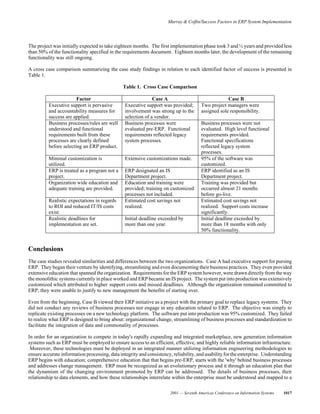
A cross case comparison summarizing the case study findings in relation to each identified factor of success is presented in
Table 1.
Table 1. Cross Case Comparison
Factor Case A Case B
Executive support is pervasive
and accountability measures for
success are applied.
Executive support was provided;
involvement was strong up to the
selection of a vendor.
Two project managers were
assigned sole responsibility.
Business processes/rules are well
understood and functional
requirements built from these
processes are clearly defined
before selecting an ERP product.
Business processes were
evaluated pre-ERP. Functional
requirements reflected legacy
system processes.
Business processes were not
evaluated. High level functional
requirements provided.
Functional specifications
reflected legacy system
processes.
Minimal customization is
utilized.
Extensive customizations made. 95% of the software was
customized.
ERP is treated as a program not a
project.
ERP designated an IS
Department project.
ERP identified as an IS
Department project.
Organization wide education and
adequate training are provided.
Education and training were
provided; training on customized
processes not included.
Training was provided but
occurred almost 21 months
before go-live.
Realistic expectations in regards
to ROI and reduced IT/IS costs
exist.
Estimated cost savings not
realized.
Estimated cost savings not
realized. Support costs increase
significantly.
Realistic deadlines for
implementation are set.
Initial deadline exceeded by
more than one year.
Initial deadline exceeded by
more than 18 months with only
50% functionality.
Conclusions
The case studies revealed similarities and differences between the two organizations. Case A had executive support for pursing
ERP. They began their venture by identifying, streamlining and even documenting their business practices. They even provided
extensive education that spanned the organization. Requirements for the ERP system however, were drawn directly from the way
the monolithic systems currently in place worked and ERP became an IS project. The system put into production was extensively
customized which attributed to higher support costs and missed deadlines. Although the organization remained committed to
ERP, they were unable to justify to new management the benefits of starting over.
Even from the beginning, Case B viewed their ERP initiative as a project with the primary goal to replace legacy systems. They
did not conduct any reviews of business processes nor engage in any education related to ERP. The objective was simply to
replicate existing processes on a new technology platform. The software put into production was 95% customized. They failed
to realize what ERP is designed to bring about: organizational change, streamlining of business processes and standardization to
facilitate the integration of data and commonality of processes.
In order for an organization to compete in today's rapidly expanding and integrated marketplace, new generation information
systems such as ERP must be employed to ensure access to an efficient, effective, and highly reliable information infrastructure.
Moreover, these technologies must be deployed in an integrated manner utilizing information engineering methodologies to
ensure accurate information processing, data integrity and consistency, reliability, and usability for the enterprise. Understanding
ERP begins with education; comprehensive education that that begins pre-ERP, starts with the 'why' behind business processes
and addresses change management. ERP must be recognized as an evolutionary process and it through an education plan that
the dynamism of the changing environment promoted by ERP can be addressed. The details of business processes, their
relationship to data elements, and how these relationships interrelate within the enterprise must be understood and mapped to a
Enterprise Systems
1018 2001 — Seventh Americas Conference on Information Systems
fully integrated ERPsystem. System requirements should focuson datarelationships,dependencies,businessrules,processflows
and workflows. Majordisconnectswith the productandexistingbusinessprocessesshouldbedocumentedandevaluatedso work
arounds are provided with a minimum of customization. Rather than focusing on reduced operations costs and ROI, the focus
should be improving the way the organization conducts business by exploiting the capabilities of ERP technology. Only then will
financial benefits be realized. ERP should not be viewed simply as another IS department project. ERP implementation is
complex, impacts many facets of the organization and is as dynamic as any enterprise program initiative that fosters change.
References
Baker, P. "When Implementation Starts to Wobble," Works Management (53:11), November 2000, pp. 16-19.
Harris, R. "Customization versus Standardization: Striking a balance in ERP software," Machine Design (72:14), July 20, 2000,
pp. 64-69.
Holland, C. P. and Light, B. “A Critical Success Factors Model for ERP Implementation,” IEEE Software (16:3), May/June
1999, pp. 30-36.
Jenson, R. L. and Johnson, I. R. "The Enterprise Resource Planning System as a Strategic Solution," Information Strategy: The
Executive's Journal (15:4), Summer 1999, pp. 26 - 34.
Koch, C., Slater, D. and Baatz, E. "The ABCs of ERP," CIO available: http://www.cio.com/forums/erp/edit/122299_erp.html,
December 22, 1999.
Krumwiede, K. R. "Reaping the Promise of Enterprise Resource Systems," Strategic Finance (82:4), October 2000, pp. 48-52.
Kumar, K. and Van Hillegersberg, J. "ERP Experiences and Evolution," Communications of the ACM (43:4), April 2000, pp.
23-26.
Mabert, V., Soni, A. and Venkataramanan, M. A. "Enterprise Resource Planning Survey of US Manufacturing Firms,"
Production and Inventory Management Journal (41:2), Second Quarter 2000, pp. 52-58.
META Group. "ERP Implementation Study Reveals Costs, Benefits," APICS- The Performance Advantage, October 1999, pp.
7.
Mullin, R. "Exchanges Weigh in on ERP Link-ups," Chemical Week (163:5), January 31, 2001, pp. 32.
Prasad, B., Sharma, M. K. and Godla, J. K. “Critical Issues Affecting an ERP Implementation," Information Systems
Management (16:3), Summer 1999, pp. 7-15.
Project Management Institute. A Guide to the Project Management Body of Knowledge, 2000 Edition, Newtown Square,
Pennsylvania: PMI, 2000.
Rooney, C. and Bangert, C. "Avoiding the Pitfalls in ERP Implementation," Adhesives Age (43:2), December 2000, pp. 64.
Schulz, J. D. "Hunt for Best Practices.," Traffic World (263:13), September 25, 2000, pp. 41-42.
Vickers V. "The Real ERP Fast Track: Forget ROI and Go Vanilla," Enterprise Systems Journal (15:5), May 2000, pp. 46-48.
Wheatley, M. "ERP Training Stinks," CIO Magazine (13:16), June 1, 2000, pp. 86.

301338685.pdf

  • 1.
    Association for InformationSystems AIS Electronic Library (AISeL) AMCIS 2001 Proceedings Americas Conference on Information Systems (AMCIS) December 2001 A Case Study Analysis of Factors for Success in ERP System Implementations Meg Murray Kennesaw State University George Coffin Science Applications International Corporation Follow this and additional works at: http://aisel.aisnet.org/amcis2001 This material is brought to you by the Americas Conference on Information Systems (AMCIS) at AIS Electronic Library (AISeL). It has been accepted for inclusion in AMCIS 2001 Proceedings by an authorized administrator of AIS Electronic Library (AISeL). For more information, please contact elibrary@aisnet.org. Recommended Citation Murray, Meg and Coffin, George, "A Case Study Analysis of Factors for Success in ERP System Implementations" (2001). AMCIS 2001 Proceedings. 196. http://aisel.aisnet.org/amcis2001/196 brought to you by CORE View metadata, citation and similar papers at core.ac.uk provided by AIS Electronic Library (AISeL)
  • 2.
    1012 2001 —Seventh Americas Conference on Information Systems A CASE STUDY ANALYSIS OF FACTORS FOR SUCCESS IN ERP SYSTEM IMPLEMENTATIONS Meg G. Murray Kennesaw State University mcmurray@kennesaw.edu George W. Coffin Science Applications International Corporation (SAIC) george.w.coffin@saic.com Abstract Enterprise Resource Planning systems are complex systems that integrate data and business processes. ERP implementations have been plagued with failure but ERP continues to be adopted and is expanding into new areas. This paper identifies frequently cited factors of success, describes them within the context of supporting evidence and compares identified factors with actual practice using two case studies. Successful ERP implementations begin witheducation that requiresorganizationstodevelopanunderstanding oftheirbusiness processes and to map those processes to a fully integrated ERP system. The focus should be on improving the way an organization conducts business by exploiting the capabilities of ERP and recognizing the dynamism of an enterprise initiative that represents change. Keywords: Enterprise resource planning Introduction In the past, information systemswere developed based on independent requirements from individual functional areas to automate manual systems. As one requirement was satisfied, others were identified and were either added to existing applications in a piecemeal fashion or new standalone applications were developed. Applications in one organization did not share data and processing with other organizations. The outcome was duplicated data represented in multiple formats across multiple applications inmultiple locations. As a result, an authoritative source for data elements wasnoteasily discerned and reports,more often than not, reflected inconsistent data and resulting information. These systems have become monolithic 'stove pipes' that lack the flexibility to satisfy an enterprise’s requirements for integrated, consistent, and near real-time information. Furthermore, these monolithic systems have become so complex they require extensive resources to maintain and to incorporate new requirements. In the late 1990’s, industry was focused on Best Practices, ISO 9000 certification, and the need to respond quickly to the year 2000 dilemma. As a result, many companies found it prudent to replace these old monolithic systems. Today, information systems are being built based on fully integrated data and process models that are focused on the enterprise. These systems are no longer monolithic 'stove pipes.' Rather, they are highly flexible distributed tools that ensure data integrity and reliability. Furthermore, current information systems have the ability to adapt quickly to changes in business rules and processes without having to make complex changes to coding structures. Once an integrated system is in place, the accessibility of reliable information can be instantaneous. Recognizing a crucial need for an integrated information system within a corporate enterprise makes the selection and implementation of an Enterprise Resource Planning (ERP) system essential to operational effectiveness. ERP is now considered the price of entry into running a business (Kumar and Van Hillegersberg, 2000). ERP systems are information systems that "integrate information and information-based processes within and across functional areas in an organization" (Kumar and Van Hillegersberg, 2000, p.23). The goal behind an ERP system is to integrate data and business processes from all departments and functions into a single computer system. An ERP system consolidates these processes into one software application utilizing one centralized database. ERP permeates throughout an enterprise impacting employees in all areas of the firm from manufacturing to finance to purchasing to human resources.
  • 3.
    Murray & Coffin/SuccessFactors in ERP System Implementation 2001 — Seventh Americas Conference on Information Systems 1013 Future of ERP From the beginning, ERP implementations have been plagued by failure. Many of these failures have been featured in trade journals. Most organizations experience challenges in their ERP implementations but too much money has been spent and too much time invested for organizations to abandon their ERP strategy. Even companies who failed in their initial attempts to bring such systems into production, such as Dow Chemical who halted their first ERP project after seven years and $500 million, are trying again. A recently completed survey of US manufacturing firms cited that 75% of the respondents were pursuing an ERP approach and 44% had already implemented this type of software (Mabert et al. 2000). The authors suggest that ERP is pervasive in manufacturing and it is likely to increase in importance. They conclude that extremes are reported in the popular press while common outcomes are ignored. Reports about the demise of ERP are premature. ERP software solutions extend beyond their traditional manufacturing and logistics base to other industries such as banking, finance, insurance and retail operations (Kumar and Van Hillegersberg, 2000). These systems are incorporating applications that support marketing, sales, and customer relationship management and the next generation of ERP systems will incorporate Internet technologies. The focus is moving beyond internal business processes to external connectivity between ERP systems of suppliers and customers (Mullin, 2001). The untapped market of midsize companies is being embraced and ERP adoption is expanding geographically into such countries as the United Kingdom, India, Japan, China and Brazil (Kumar and Van Hillegersberg, 2000). ERP vendors are changing their business model as they move towards a component strategy that separates ERP systems into modules that can be adopted individually. As ERP systems continue to infiltrate the enterprise, models for successful implementation become paramount. ERP Implementation Factors of Success Implementing an ERP system is a major undertaking. An often-referenced META Group study cited that the average ERP implementation takes 23 months at a cost of $15 million (META Group, 1999). Considerable media attention has been given to high profile ERP failures and factors attributed to these failures have been cited in the literature. Correspondingly, best practices for successful implementation have also been identified. This paper identifies frequently cited factors of successdescribed within the context of supporting evidence and compares the identified factors with actual practice using two case studies. Factor 1: Executive Support Is Pervasive and Accountability Measures for Success Are Applied Executive support is a key success factor for any initiative an organization undertakes. Executive support is paramount for ERP systems because they imply fundamental organizational change (Prasad et al. 1999). Implementing an ERP system is not just installing another software package; ERP transforms the way an organization does business. In fact, change management is often used in conjunction with ERP implementations. Successful implementations have shown that effective change management driven from the top isakey factor. Managementmust be involved from the beginning and remain involved by monitoring progress and providing direction. Responsibility for implementationcannotsimplybehandedoverthetoITdepartment(Prasadetal.1999). ERPimplementationstestaccountability, responsibility and communication (Koch et al. 1999). Measures of accountability must be formalized and tied directly to management performance plans. Factor 2: BusinessProcesses/rulesAreWellUnderstood and Functional Requirements Built from These Processes Are Clearly Defined Before Selecting an ERP Product The most cited reason for abandonment of an ERP project is the discovery that the system does not correlate with the organization’s current business practices (Koch et al. 1999). ERPs have been designed around the idealistic view that there is one 'universal' set of best practices. ERPs employ the traditional hierarchical, functional view of organizations (Kumar and Van Hillegersberg, 2000) so a mismatch between company specific business practices and the ERP model may exist. According to Baker (2000), most problems in ERP implementations are related to defining what the ERP system should do. This is difficult because employees cannot always articulate exactly what they do, why they do it or why they do it in a particular manner. Functional requirements should describe data relationships, process relationships and work flows. Jenson and Johnson (1999) recommend blueprinting the ‘current state’of organizational processes. Theysuggestusingbusinessmodelingtechniques,
  • 4.
    Enterprise Systems 1014 2001— Seventh Americas Conference on Information Systems documenting business events, identifying tasks and who performs them and diagramming the flow of information. They also suggest conducting a gap analysis comparing current practices with those provided by the ERP system. Factor 3: Minimal Customization Is Utilized ERP systems were designed to be generic representations of business procedures. Often implementing an ERP system means that business processes must be changed to accommodate the software or the software must be changed to accommodate business practices (Holland and Light, 1999). Harris (2000) advises that changes to the software be avoided. Organizational defined business requirements often result in complex customizations. Further, many firms make needless changes because the people making the changes do not understand the firm’s business practices or the interrelatedness of one business practice to another. Each required modification should be identified prior to implementation and its impact on cost, maintenance and affect on other parts of the system evaluated (Harris, 2000). Designing the system to handle exceptions is not what ERP systems are about (Schultz, 2000). The main considerations related to customization center around the need to have technical expertise in-house to manage the customized code and implications of what happens to the customization when new releases are announced. The choice between organizational practice and following the methods inherent within the ERP system often means hard choices and difficult trade- offs must be made. Factor 4: ERP Is Treated as a Program Not a Project The Project Management Body of Knowledge (2000) defines projects and programs. "Projects are temporary endeavors undertaken to create aunique product or service" (p. 204 ). Projects have a beginning and end. Programs are more comprehensive usually including a group of related projects. Programs are ongoing. While the various phases of an ERP implementation should be treated as discrete yet integrated projects, ERP as a whole must be viewed as a program. However, most companies treat their ERP implementations as they would any other software project (Koch et al. 1999). Once the installation is complete, they view the project as over. Organizations must not be too ambitious too soon. One in four companies report a drop in productivity after their systems went live (Koch et al. 1999). This is attributed to the fact that things look differently and comfortable practices have been altered. Firmsoften mistakenly implement ERP applications believing that standardized software willstandardized business processes (Harris. 2000). The software might complement standardized practices but change takes time. ERP should be considered an ongoing activity (Krumwiede, 2000). Factor 5: Organization Wide Education and Adequate Training Are Provided Training is always cited as a necessity but is often reduced when budget overruns are encountered. According to the trade press, without proper training, 30-40% of front-line workers will not be able to handle the new system. These people, however, are now making decisions that impact other departments (Prasad et al. 1999). ERP training is complex as it extends beyond learning a new software interface to learning a new set of processes. Technical training is not enough; education of the broad user community including senior management is necessary (Wheatley, 2000). This education must begin pre-ERP selection and include "figuring out the underlying flow of information through the business itself" (p. 86). ERP demands rigorous and continuous training (Prasad et al. 1999). The necessary transfer of knowledge cannot be achieved in a short manner of time. According to Wheatly (2000) what is needed is, "broad-based holistic education in the company's ERP- mediated business processes" (p. 86). The focus of education is 'what' and 'why' while the focus of training is 'how.' Both are important to successful ERP implementations. Factor 6: Realistic Expectations in Regards to ROI and Reduced IT/IS Costs Exist Chief Information Officers reported frustrations withERP include justifying aReturn on Investment (ROI) before initialpurchase and finding the ROI after implementation (Vickers, 2000). One misleading legacy of traditional software projects is that results are seen immediately after implementation (Koch et al. 1999). This is not the case with ERP. In fact, initially, lost productivity and increased IT support costs may result as employees learn to adapt old habits to new ways of performing their work (Schultz, 2000). ROIs are only seen after the system has been running long enough for the organization to concentrate on making improvements in the business processes affected by the system.
  • 5.
    Murray & Coffin/SuccessFactors in ERP System Implementation 2001 — Seventh Americas Conference on Information Systems 1015 Many of the benefits offered by ERP systems, such as support functions like finance and human resources, are not direct contributors to the bottom line. Other efficiencies such as user-satisfaction, improved functionality, improved workflow, better access to accurate data and better analytical and reporting tools are not easy to measure in quantified dollars. It may take 2-3 years before an ERP system impacts the bottom line (Vickers, 2000). Organizations that focus on intangible benefits or recognize that the integration provided by ERP systems is now a necessary cost of business, do not ascribe to unrealistic expectations. ROI should be used as means to an end, not as the end itself. Factor 7: Realistic Deadlines for Implementation Are Set Estimates of the time it takes to install an ERP solution range from 14 months to 4 years with most implementations extending well beyond initial deadlines. Factors that affect implementation time include the number of modules being implemented, scope of the implementation, the extent of customization and the number of interfaces with other applications (Prasad et al. 1999). Organizations must be prepared to make hard decisions in relation to deadlines. “It is an almost universal fault of human nature to promise too much, too soon, with too few resources” (Rooney and Bangert, 2000, p. 64). Unrealistic deadlines result in compression of necessary components such as testing and training. Go-live should be postponed if tests are not successful or training has not been completed. Case Studies Two case studies were conducted to compare identified factors of success with practice. In order to maintain the confidentiality of the clients, identities are not presented. Case A is a subsidiary of a Fortune 500 company that began their ERP strategy in 1996 but discontinued it in 2000. Case B is a government organization that began their implementation in 1997 and it is still ongoing. Both organizations used a phased approach to implementation. The strategy used by Case A defined their phases based on individual ERP modules (human resources, finance and procurement). Modules were brought into production separately in a successive fashion. The initial focus for Case B was limited to human resource and payroll functions. Their approach was to phase-in the ERP system by individually replacing 13 legacy systems. Subsidiary of a Fortune 500 Company – 1996 – 2000 Executive involvement was evidence early on and executive support continued throughout the project. Case A began their ERP implementation strategy following best practices. Prior to initiating the ERP selection process, they achieved ISO 9000 certification. This required them to document and streamline their business processes. The requirements document, however, was based on the process flows supported by legacy systems and did not address organizational data requirements or workflows. In order to meet specified functional requirements, many modifications to the generic ERP software were required. When a new version of the software was released, an upgrade path was abandoned. Management and the user-community cited that the processes and customizations previously mandated were not necessary. Also, the IS implementationteampresented a strong case that upgrading would be more costly and time consuming than re-implementing a new ‘vanilla’ version. When the subsidiary was acquired, the new executive management discontinued the project based on the assessment that re-implementation would take three years. Case A followed a basic project management process to understanding change, implementing new systems and selecting appropriate solutions. After the selection of a vendor, ERP was designated an IS department implementation project and while executive support for the project remained positive, executive involvement diminished. Case A provided extensive education that spanned the organization. Seminars were brought onsite to educate executives and senior management on the principles of ERP. In addition, each department received generic overviews and tailored workshops related to their specific operational functions. The members of the ERP project team participated in all of the educational offerings. The objectives were to develop an understanding of ERP, how it would change jobs and the benefits it would provide. According to project management, not only did the education program provide an excellent means to communicate with and educate staff, it facilitated change management and fostered ‘buy-in.’ One aspect that was not included in the education program was training on specific customizations made to the software.
  • 6.
    Enterprise Systems 1016 2001— Seventh Americas Conference on Information Systems The initial justification for ERP was reduced IS/IT costs. This did not materialize. Savings were offset by implementation costs that included the need for additional staff to support modules put into production. A gain in efficiency in purchase order processing and data integration throughout the supply chain was reported. The project was discontinued before any monetary ROI was realized. After initial education sessions and product selection, the implementation was turned over to the IS department with a deadline to be fully operational within a year. This included making all specified customizations. In order to meet deadlines, numerous short cutswere taken. Configuration managementcontrolswereby-passed,testing timeand methodswerereducedand regression testing became superficial. Each module put into production required additional technical intervention to support users and resolve problems. The project fell more than a year behind schedule. The project was successfully launched and modules were put into production but the ERP system never achieved its expected potential. ERP was not perceived to be an ongoing activity but as another IS project. When the subsidiary was acquired and the assessment given that re-implementation was necessary in order to upgrade to the next version of the software, a decision by the new executive team was made to discontinue the project. Government Organization – 1997 – 2001 The initial focus of this organization's ERP strategy was on human resources and payroll. The objective was to replace the 13 existing legacy systemsthatperformed thesefunctions. Executive participation beyond two project managers was not evidenced. Those charged with responsibility for ERP had a limited understanding of the organization’s business practices. The policies and procedures that existed did not fully describe or adequately define business processes. ERP team members with functional backgrounds were focused on a specific functionality as provided within one of the 13 legacy systems. Their experience and business knowledge was limited to their interaction with one of these systems. Requirements for an ERP system were written at a high level and did not address business processes, data relationships or workflows. For example, the functional requirements document specified that the ERP implementation must be transparent to the users, could not impact personnel activities, must only replace field entry systems, must support existing business processes and interfaces to the 13 legacy systems must not impact existing systems or require changes to those systems. The functional requirements also included a specification that the system must distribute data across approximately 300 locations. Prior to procuring the ERP package, a fit analysis was conducted indicating no better than a 30% fit with the software from a leading ERP vendor. In spite of this finding, the ERP software was procured from this vendor. To address the gap between what the software provided and the requirements identified by the organization, significant customizations were required. Additional customization was undertaken to insure that processes that currently existed within the legacy systems were maintained. No investigation was conducted to determine if those processes could be improved, modified or even adapted to the new product. Customizations were also required for interfaces to the new system and to give the new product the same look and feel as the legacy systems. The first phase was deployed with 95% customized software. ERP was not viewed as a long-term process or as a long-standing program. It was identified as an IS department project with an expected duration of 18 months. Two project teams were setup to implement the selected product – a functional project team responsible for functional requirements and a technical project team responsible for customizations. This separation of responsibilities complicated project coordination. The project managers did not view their involvement as long-term and saw their role aslimited totheir area of responsibility. Functionalbaselines,allocatedbaselinesandproductbaselineswerenotdefined and release planning was non-existent. No education was provided to the users or project team members prior to the selection of the ERP product solution. Product training was provided to key personnel. These key personnel received training from the vendor and also worked directly with the implementation contractor to produce customized training for the organization. Training was provided 3 months prior to the initial expected go-live date for the first phase of the project. This occurred 21 months later. During this time span, software was not available for practicing skills taught during training nor was additional training provided. The business case presented to justify an ERP system was heavily weighted with estimates of cost savings in the area of IS support. Excluding implementation costs, savings that might result from the replacement of two legacy systems were offset by the support costs incurred for the new system. These costs are estimated to be four times greater than that expended for the systems being replaced.
  • 7.
    Murray & Coffin/SuccessFactors in ERP System Implementation 2001 — Seventh Americas Conference on Information Systems 1017 The project was initially expected to take eighteen months. The first implementation phase took 3 and ½ years and provided less than 50% of the functionality specified in the requirements document. Eighteen months later, the development of the remaining functionality was still ongoing. A cross case comparison summarizing the case study findings in relation to each identified factor of success is presented in Table 1. Table 1. Cross Case Comparison Factor Case A Case B Executive support is pervasive and accountability measures for success are applied. Executive support was provided; involvement was strong up to the selection of a vendor. Two project managers were assigned sole responsibility. Business processes/rules are well understood and functional requirements built from these processes are clearly defined before selecting an ERP product. Business processes were evaluated pre-ERP. Functional requirements reflected legacy system processes. Business processes were not evaluated. High level functional requirements provided. Functional specifications reflected legacy system processes. Minimal customization is utilized. Extensive customizations made. 95% of the software was customized. ERP is treated as a program not a project. ERP designated an IS Department project. ERP identified as an IS Department project. Organization wide education and adequate training are provided. Education and training were provided; training on customized processes not included. Training was provided but occurred almost 21 months before go-live. Realistic expectations in regards to ROI and reduced IT/IS costs exist. Estimated cost savings not realized. Estimated cost savings not realized. Support costs increase significantly. Realistic deadlines for implementation are set. Initial deadline exceeded by more than one year. Initial deadline exceeded by more than 18 months with only 50% functionality. Conclusions The case studies revealed similarities and differences between the two organizations. Case A had executive support for pursing ERP. They began their venture by identifying, streamlining and even documenting their business practices. They even provided extensive education that spanned the organization. Requirements for the ERP system however, were drawn directly from the way the monolithic systems currently in place worked and ERP became an IS project. The system put into production was extensively customized which attributed to higher support costs and missed deadlines. Although the organization remained committed to ERP, they were unable to justify to new management the benefits of starting over. Even from the beginning, Case B viewed their ERP initiative as a project with the primary goal to replace legacy systems. They did not conduct any reviews of business processes nor engage in any education related to ERP. The objective was simply to replicate existing processes on a new technology platform. The software put into production was 95% customized. They failed to realize what ERP is designed to bring about: organizational change, streamlining of business processes and standardization to facilitate the integration of data and commonality of processes. In order for an organization to compete in today's rapidly expanding and integrated marketplace, new generation information systems such as ERP must be employed to ensure access to an efficient, effective, and highly reliable information infrastructure. Moreover, these technologies must be deployed in an integrated manner utilizing information engineering methodologies to ensure accurate information processing, data integrity and consistency, reliability, and usability for the enterprise. Understanding ERP begins with education; comprehensive education that that begins pre-ERP, starts with the 'why' behind business processes and addresses change management. ERP must be recognized as an evolutionary process and it through an education plan that the dynamism of the changing environment promoted by ERP can be addressed. The details of business processes, their relationship to data elements, and how these relationships interrelate within the enterprise must be understood and mapped to a
  • 8.
    Enterprise Systems 1018 2001— Seventh Americas Conference on Information Systems fully integrated ERPsystem. System requirements should focuson datarelationships,dependencies,businessrules,processflows and workflows. Majordisconnectswith the productandexistingbusinessprocessesshouldbedocumentedandevaluatedso work arounds are provided with a minimum of customization. Rather than focusing on reduced operations costs and ROI, the focus should be improving the way the organization conducts business by exploiting the capabilities of ERP technology. Only then will financial benefits be realized. ERP should not be viewed simply as another IS department project. ERP implementation is complex, impacts many facets of the organization and is as dynamic as any enterprise program initiative that fosters change. References Baker, P. "When Implementation Starts to Wobble," Works Management (53:11), November 2000, pp. 16-19. Harris, R. "Customization versus Standardization: Striking a balance in ERP software," Machine Design (72:14), July 20, 2000, pp. 64-69. Holland, C. P. and Light, B. “A Critical Success Factors Model for ERP Implementation,” IEEE Software (16:3), May/June 1999, pp. 30-36. Jenson, R. L. and Johnson, I. R. "The Enterprise Resource Planning System as a Strategic Solution," Information Strategy: The Executive's Journal (15:4), Summer 1999, pp. 26 - 34. Koch, C., Slater, D. and Baatz, E. "The ABCs of ERP," CIO available: http://www.cio.com/forums/erp/edit/122299_erp.html, December 22, 1999. Krumwiede, K. R. "Reaping the Promise of Enterprise Resource Systems," Strategic Finance (82:4), October 2000, pp. 48-52. Kumar, K. and Van Hillegersberg, J. "ERP Experiences and Evolution," Communications of the ACM (43:4), April 2000, pp. 23-26. Mabert, V., Soni, A. and Venkataramanan, M. A. "Enterprise Resource Planning Survey of US Manufacturing Firms," Production and Inventory Management Journal (41:2), Second Quarter 2000, pp. 52-58. META Group. "ERP Implementation Study Reveals Costs, Benefits," APICS- The Performance Advantage, October 1999, pp. 7. Mullin, R. "Exchanges Weigh in on ERP Link-ups," Chemical Week (163:5), January 31, 2001, pp. 32. Prasad, B., Sharma, M. K. and Godla, J. K. “Critical Issues Affecting an ERP Implementation," Information Systems Management (16:3), Summer 1999, pp. 7-15. Project Management Institute. A Guide to the Project Management Body of Knowledge, 2000 Edition, Newtown Square, Pennsylvania: PMI, 2000. Rooney, C. and Bangert, C. "Avoiding the Pitfalls in ERP Implementation," Adhesives Age (43:2), December 2000, pp. 64. Schulz, J. D. "Hunt for Best Practices.," Traffic World (263:13), September 25, 2000, pp. 41-42. Vickers V. "The Real ERP Fast Track: Forget ROI and Go Vanilla," Enterprise Systems Journal (15:5), May 2000, pp. 46-48. Wheatley, M. "ERP Training Stinks," CIO Magazine (13:16), June 1, 2000, pp. 86.