

MODULE
2
VINOD PANDEY
Vinod pandey
Breads: Varieties of
various breads and
common faults
Bread
 Bread is a staple food prepared from
a dough of flour and water, usually
by baking.
 Bread is served in various forms with any
meal of the day.
 Bread has a social and emotional significance
beyond its importance as nourishment.
Types of bread
 Wholemeal bread
 Multigrain and kibbled Bread
 Rye Breads
 Fruit Bread
Methods of bread making
Straight Dough method
 All the ingredients are mixed together, and
the dough is fermented for a predetermined
time.
 The fermentation time of the straight dough
depends on the strength of the flour. Strong
flour requires more fermentation time to
mature adequately.
No time dough method
 Dough is fermented in the usual manner. It is just
allowed a brief period (about 30 mins) for it to
recover from the strains of mixing.
 Since dough is not fermented the two functions of
fermentation (i. e production of gas and
conditioning of gluten) are achieved to some extent
by increasing the quantity of yeast ( 2 to 3 times of
original quantity)and by making the dough little
slacker and warmer.
Salt delayed method
 This a slight variation of straight method, where all
the ingredients are mixed except salt and fat.
 As a salt has a controlling effect on enzymatic action
on yeast, the speed of fermentation of a salt less
dough will be faster, and a reduction in total
fermentation time will be faster.
Sponge and dough method
 Strong flour take too long for conditioning and
should not be used for making bread by straight
dough method. For such flours sponge and
dough method is more suitable where the
problem of controlling the dough temperature
time is not so acute.
 Flour, proportionate amount of water, yeast and
sugar are mixed together. Longer fermenting
sponges may also contain some amount of as
well. Mix all the ingredients evenly.
Ferment and dough method
 This is a variation of sponge and dough method.
 Very often a bread formula may contain milk, eggs,
substantial quantity of fat and sugar.
 All these formula ingredients will have a retarding
effect on yeast activity.
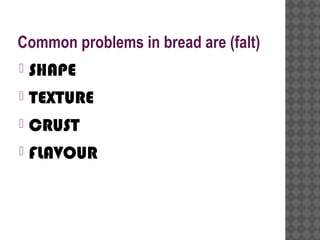
Common problems in bread are (falt)
 SHAPE
 TEXTURE
 CRUST
 FLAVOUR
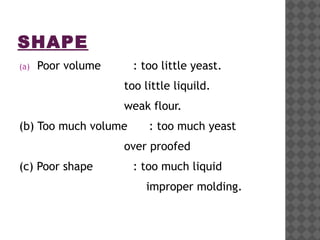
SHAPE
(a) Poor volume : too little yeast.
too little liquild.
weak flour.
(b) Too much volume : too much yeast
over proofed
(c) Poor shape : too much liquid
improper molding.
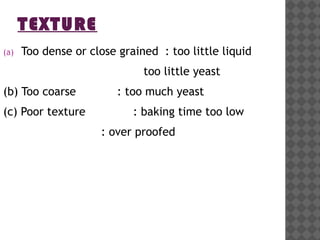
TEXTURE
(a) Too dense or close grained : too little liquid
too little yeast
(b) Too coarse : too much yeast
(c) Poor texture : baking time too low
: over proofed
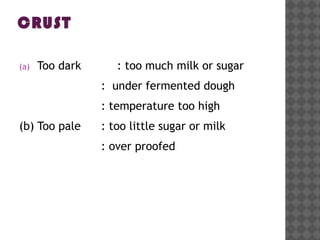
CRUST
(a) Too dark : too much milk or sugar
: under fermented dough
: temperature too high
(b) Too pale : too little sugar or milk
: over proofed
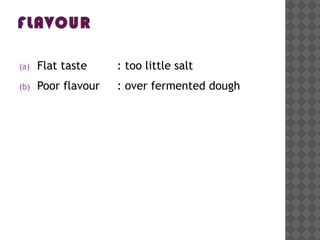
FLAVOUR
(a) Flat taste : too little salt
(b) Poor flavour : over fermented dough
THANK YOU

Bread and common problem

  • 1.
  • 2.
    Breads: Varieties of variousbreads and common faults
  • 3.
    Bread  Bread is a staplefood prepared from a dough of flour and water, usually by baking.  Bread is served in various forms with any meal of the day.  Bread has a social and emotional significance beyond its importance as nourishment.
  • 4.
    Types of bread Wholemeal bread  Multigrain and kibbled Bread  Rye Breads  Fruit Bread
  • 5.
    Methods of breadmaking Straight Dough method  All the ingredients are mixed together, and the dough is fermented for a predetermined time.  The fermentation time of the straight dough depends on the strength of the flour. Strong flour requires more fermentation time to mature adequately.
  • 6.
    No time doughmethod  Dough is fermented in the usual manner. It is just allowed a brief period (about 30 mins) for it to recover from the strains of mixing.  Since dough is not fermented the two functions of fermentation (i. e production of gas and conditioning of gluten) are achieved to some extent by increasing the quantity of yeast ( 2 to 3 times of original quantity)and by making the dough little slacker and warmer.
  • 7.
    Salt delayed method This a slight variation of straight method, where all the ingredients are mixed except salt and fat.  As a salt has a controlling effect on enzymatic action on yeast, the speed of fermentation of a salt less dough will be faster, and a reduction in total fermentation time will be faster.
  • 8.
    Sponge and doughmethod  Strong flour take too long for conditioning and should not be used for making bread by straight dough method. For such flours sponge and dough method is more suitable where the problem of controlling the dough temperature time is not so acute.  Flour, proportionate amount of water, yeast and sugar are mixed together. Longer fermenting sponges may also contain some amount of as well. Mix all the ingredients evenly.
  • 9.
    Ferment and doughmethod  This is a variation of sponge and dough method.  Very often a bread formula may contain milk, eggs, substantial quantity of fat and sugar.  All these formula ingredients will have a retarding effect on yeast activity.
  • 10.
    Common problems inbread are (falt)  SHAPE  TEXTURE  CRUST  FLAVOUR
  • 11.
    SHAPE (a) Poor volume: too little yeast. too little liquild. weak flour. (b) Too much volume : too much yeast over proofed (c) Poor shape : too much liquid improper molding.
  • 12.
    TEXTURE (a) Too denseor close grained : too little liquid too little yeast (b) Too coarse : too much yeast (c) Poor texture : baking time too low : over proofed
  • 13.
    CRUST (a) Too dark: too much milk or sugar : under fermented dough : temperature too high (b) Too pale : too little sugar or milk : over proofed
  • 14.
    FLAVOUR (a) Flat taste: too little salt (b) Poor flavour : over fermented dough
  • 15.