BACTERIAL STRUCTURE &
GROWTH
MEDI 3104
Dr Meher Rizvi
Associate Professor
Deptt of Microbiology and
Immunology
Response to infection and
pathobiology
GRAM’S
Gram positive cocci in
chains
Gram positive cocci in
clusters
Gram negative bacilli in
no specific arrangement
Zeihl Neelsen stain: Acid fast bacilli
Spiral bacteria:
Treponema pallidum
Silver impregnation Capsulated bacteria:
Streptococcus pneumoniae
Electron microscope image
Eukaryote vs Prokaryote
Eukaryotes Prokaryotes
True nucleus Primitive nucleus
Nuclear membrane No Nuclear membrane
Chromosomes Single strand of DNA
Cytoplasmic structures present Absent
80S Ribosomes 70S Ribosomes
Asexual & Sexual Reproduction Asexual
Respiration via Mitochondria Cytoplasmic membrane
Parts of a cell
Cell wall
Cell membrane
Cytoplasm
Nucleiod
Ribosomes
Granules/inclusion
bodies
Mesosomes
Appendages
 Pili
 Flagella
 Capsule
 Spores
 Plasmids
Bacterial Cell Wall
Antigenic Structure of Enterobacteriaceae
S. typhi
O antigen
side chain
(Fimbriae)
Somatic O antigen raises good specific antibodies. Serological
diagnosis of Vibrio, Salmonella, Shigella, E. coli
depends on O antigen
Cell wall
• Peptidoglycan
• N acetyl glucosamine & N acetyl Muramic acid
• Protect the cell from osmotic changes
• Rigidity
• Multilayered in Gram positive
• Teichoic acid
• Mono to bi layered in Gram negative
Tetrapeptide
side chain
Pentaglycine
bridge
Special components of Gram
positive cell wall
Teichoic acid
SPA / M PROTEIN
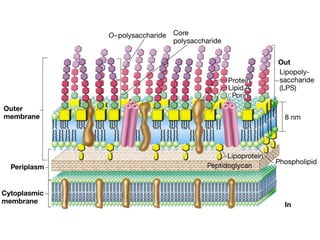
GRAM NEGATIVE CELL WALL
Outer membrane- Gram negative bacteria only
2 layers of lipids
Inner layer-phospholipids
Outer layer- Lipopolysaccharide: 3 regions
Lipid A (endotoxin: pyrogenic, lethal, necrotic,
anticomplementary)
Core polysaccharide
O antigen (Somatic O antigen)
Functions of Bacterial cell Wall
Rigid structure
•Maintains cell shape
•Protects the bacteria from the effects of osmotic pressure
•Takes part in cell division
•Virulence:
•Endotoxin in Gram negative bacteria
•Protein M of Streptococcus pyogenes
•Protein A of Staphylococcus aureus
•Supports the surface appendages like pili , fimbriae, flagella
•Immunity (Antibodies raised against LPS, Teichoic acid)
A double layer of lipids -
present in all bacteria
Cytoplasmic membrane
Cytoplasmic membrane :Cytoplasmic membrane :
• Selective permeability
• Contains proteins which transport metabolites
• Into the cell : e.g. nutrient uptake
• Out of the cell: e.g. waste excretion
• Performs the functions of respiration, lipid & cell wall
synthesis
• electron transport
• energy production (site of ATP production)
• Detects and responds to chemicals in surroundings
Cytoplasm
Plasmids:
Small,circular,extrachromosomal , double-
stranded DNA molecules
Capable of self-replication
Contain genes that confer properties:
•Antibiotic resistance ,
•Virulence factors
Plasmids are not essential for cellular survival
The bacterial genome consists of a single,
double stranded circular molecule without
a nuclear membrane
CYTOPLASMIC STRUCTURES
• Nucleiod
• Chromosomal DNA
• Plasmids
• Ribosome – 70S :50S & 30S ( Site of protein synthesis)
• Intracytoplasmic Inclusion bodies
• Storage of excess food and energy
• Metachromatic granules/ Babes ernst granules
Accumulates when a cell is grown in
nutritional deficiency
• Mesosomes: respiration, cell wall formation,
• Chromosome replication
External structures :External structures :
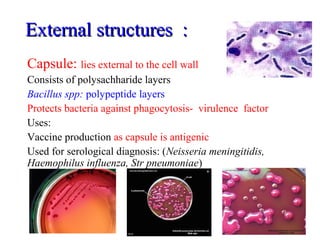
Capsule: lies external to the cell wall
Consists of polysachharide layers
Bacillus spp: polypeptide layers
Protects bacteria against phagocytosis- virulence factor
Uses:
Vaccine production as capsule is antigenic
Used for serological diagnosis: (Neisseria meningitidis,
Haemophilus influenza, Str pneumoniae)
Flagella
Monotrichate Amphitrichate Lophotrichate Peritrichate
• Originates from cytoplasmic membrane
• Provides motility to bacteria
• Bacteria move towards food – chemotaxis
• Identification of bacteria (H antigen)
• Can have one or many flagella
• Pathogenesis: Motility is a virulence factor
• H antigen: Raises good antibodies. Used in
serological diagnosis ( Salmonella)
Fimbriae :Fimbriae :
• Short protein fibres- fimbriae cover the whole surface of
bacterial cell
• Help bacteria to adhere to surface of host cells
• Are important virulence factors
• Pili : Protein fibres, longer than fimbriae, one or few per
bacterial cell
• F ( Fertility ) pili allow bacteria to transfer
chromosomal and extra-chromosomal genetic material to
other bacteria
Common pili or fimbriae: fine , rigid numerous, related to
bacterial adhesion
Sex pili: longer and coarser, only 1-4, related to bacterial
conjugation
Sex pili
Endospores
Chapter 4
 Extremely Resistant structures
 Heat, irradiation, cold
 Boiling >1 hr still viable
 Produced in unfavourable conditions
 Location important in classification
 Central, Subterminal, Terminal
 Bacillus stearothermophilus -spores
 Used for quality control of heat sterilization equipment
 Bacillus anthracis - spores
 Used in biological warfare
Endospores
(spores)
• Produced when starved
• Contain Dipicolinic acid
• Bacillus and Clostridium
 Identification of
Bacteria
BACTERIAL GROWTHBACTERIAL GROWTH
Bacteria multiply by binary fission
Stationary Phase
Storage granules form
Sporulation occurs
Exotoxins, antibiotics, bacteriocins
produced
Stationary Phase:
Growth stops
Nutrients exhausted
Toxic products accumulate
Generation time
Generation time
Time taken by a particular organism to double its number
Escherichia coli- Vibrio cholerae - 20 min
(Disease develops in few hours )
Mycobacterium tuberculosis- 20 hours
( Disease develops in months )
Mycobacterium leprae- 20 days
( Disease develops in years)
Practical implications
Escherichia coli and Vibrio cholerae grow in the laboratory in
18-24 hours
Results of culture available in 24-48 hours
Mycobacterium tuberculosis requires 4-6 weeks to grow in the
laboratory
Results of culture are available in 8 weeks or more
REQUIREMENT FOR BACTERIAL GROWTH
- proper nutrients ( carbon, nitrogen )
- proper pH ( optimum 6.8 – 7.2 )
- proper temperature - optimum 370
C
- proper atmosphere (aerobic , anaerobic, micro-aerophilic )
- proper osmolality
• Culture medium - Solid , Liquid ( Broth )
Nutritional Requirement for Growth:
Autotrophs : Can manufacture their own food
(free living in nature, in soil, water etc.)
Heterotrophs : Require organic ready made food
Most medically important bacteria are heterotrophs
Oxygen requirement:
Aerobes : Require oxygen
Anaerobes: Grow in the absence of oxygen
Microaerophilic : Reduced concentration of O2: 5-7%
Anaerobic jarIncubator
Oil as preservative
Temperature requirement for growth :Temperature requirement for growth :
• Psychrophiles : Optimum temperature : 15-200
C
• Mesophiles: Optimum temperature : 30-370
C
• Medically important bacteria are mesophiles, adapted to the
human body normal temperature
• Thermophiles: Optimum temperature : 50-600
C
Temperature requirement for growthTemperature requirement for growth
pH
• Most pathogenic bacteria grow between pH 6.5 and
7.5
• Acid (below pH 4) good preservative for pickles,
sauerkraut, cheeses
• Exceptions to the rule:
• Acidophiles can live at low pH
• Many bacteria and viruses survive
low pH of stomach to infect intestines
• Helicobacter pylori lives in stomach under mucus
layer
Thank you!!!!!

Bacterial structure and growth

  • 1.
    BACTERIAL STRUCTURE & GROWTH MEDI3104 Dr Meher Rizvi Associate Professor Deptt of Microbiology and Immunology Response to infection and pathobiology
  • 2.
    GRAM’S Gram positive cocciin chains Gram positive cocci in clusters Gram negative bacilli in no specific arrangement Zeihl Neelsen stain: Acid fast bacilli
  • 3.
    Spiral bacteria: Treponema pallidum Silverimpregnation Capsulated bacteria: Streptococcus pneumoniae
  • 4.
  • 5.
    Eukaryote vs Prokaryote EukaryotesProkaryotes True nucleus Primitive nucleus Nuclear membrane No Nuclear membrane Chromosomes Single strand of DNA Cytoplasmic structures present Absent 80S Ribosomes 70S Ribosomes Asexual & Sexual Reproduction Asexual Respiration via Mitochondria Cytoplasmic membrane
  • 6.
    Parts of acell Cell wall Cell membrane Cytoplasm Nucleiod Ribosomes Granules/inclusion bodies Mesosomes Appendages  Pili  Flagella  Capsule  Spores  Plasmids
  • 8.
  • 12.
    Antigenic Structure ofEnterobacteriaceae S. typhi O antigen side chain (Fimbriae) Somatic O antigen raises good specific antibodies. Serological diagnosis of Vibrio, Salmonella, Shigella, E. coli depends on O antigen
  • 13.
    Cell wall • Peptidoglycan •N acetyl glucosamine & N acetyl Muramic acid • Protect the cell from osmotic changes • Rigidity • Multilayered in Gram positive • Teichoic acid • Mono to bi layered in Gram negative
  • 14.
  • 15.
    Special components ofGram positive cell wall Teichoic acid SPA / M PROTEIN
  • 16.
    GRAM NEGATIVE CELLWALL Outer membrane- Gram negative bacteria only 2 layers of lipids Inner layer-phospholipids Outer layer- Lipopolysaccharide: 3 regions Lipid A (endotoxin: pyrogenic, lethal, necrotic, anticomplementary) Core polysaccharide O antigen (Somatic O antigen)
  • 17.
    Functions of Bacterialcell Wall Rigid structure •Maintains cell shape •Protects the bacteria from the effects of osmotic pressure •Takes part in cell division •Virulence: •Endotoxin in Gram negative bacteria •Protein M of Streptococcus pyogenes •Protein A of Staphylococcus aureus •Supports the surface appendages like pili , fimbriae, flagella •Immunity (Antibodies raised against LPS, Teichoic acid)
  • 18.
    A double layerof lipids - present in all bacteria Cytoplasmic membrane
  • 19.
    Cytoplasmic membrane :Cytoplasmicmembrane : • Selective permeability • Contains proteins which transport metabolites • Into the cell : e.g. nutrient uptake • Out of the cell: e.g. waste excretion • Performs the functions of respiration, lipid & cell wall synthesis • electron transport • energy production (site of ATP production) • Detects and responds to chemicals in surroundings
  • 20.
  • 21.
    Plasmids: Small,circular,extrachromosomal , double- strandedDNA molecules Capable of self-replication Contain genes that confer properties: •Antibiotic resistance , •Virulence factors Plasmids are not essential for cellular survival The bacterial genome consists of a single, double stranded circular molecule without a nuclear membrane
  • 22.
    CYTOPLASMIC STRUCTURES • Nucleiod •Chromosomal DNA • Plasmids • Ribosome – 70S :50S & 30S ( Site of protein synthesis) • Intracytoplasmic Inclusion bodies • Storage of excess food and energy • Metachromatic granules/ Babes ernst granules Accumulates when a cell is grown in nutritional deficiency • Mesosomes: respiration, cell wall formation, • Chromosome replication
  • 23.
    External structures :Externalstructures : Capsule: lies external to the cell wall Consists of polysachharide layers Bacillus spp: polypeptide layers Protects bacteria against phagocytosis- virulence factor Uses: Vaccine production as capsule is antigenic Used for serological diagnosis: (Neisseria meningitidis, Haemophilus influenza, Str pneumoniae)
  • 24.
    Flagella Monotrichate Amphitrichate LophotrichatePeritrichate • Originates from cytoplasmic membrane • Provides motility to bacteria • Bacteria move towards food – chemotaxis • Identification of bacteria (H antigen) • Can have one or many flagella • Pathogenesis: Motility is a virulence factor • H antigen: Raises good antibodies. Used in serological diagnosis ( Salmonella)
  • 25.
    Fimbriae :Fimbriae : •Short protein fibres- fimbriae cover the whole surface of bacterial cell • Help bacteria to adhere to surface of host cells • Are important virulence factors • Pili : Protein fibres, longer than fimbriae, one or few per bacterial cell • F ( Fertility ) pili allow bacteria to transfer chromosomal and extra-chromosomal genetic material to other bacteria
  • 26.
    Common pili orfimbriae: fine , rigid numerous, related to bacterial adhesion Sex pili: longer and coarser, only 1-4, related to bacterial conjugation Sex pili
  • 27.
  • 28.
    Chapter 4  ExtremelyResistant structures  Heat, irradiation, cold  Boiling >1 hr still viable  Produced in unfavourable conditions  Location important in classification  Central, Subterminal, Terminal  Bacillus stearothermophilus -spores  Used for quality control of heat sterilization equipment  Bacillus anthracis - spores  Used in biological warfare
  • 29.
    Endospores (spores) • Produced whenstarved • Contain Dipicolinic acid • Bacillus and Clostridium  Identification of Bacteria
  • 30.
  • 32.
    Stationary Phase Storage granulesform Sporulation occurs Exotoxins, antibiotics, bacteriocins produced Stationary Phase: Growth stops Nutrients exhausted Toxic products accumulate
  • 33.
  • 34.
    Generation time Time takenby a particular organism to double its number Escherichia coli- Vibrio cholerae - 20 min (Disease develops in few hours ) Mycobacterium tuberculosis- 20 hours ( Disease develops in months ) Mycobacterium leprae- 20 days ( Disease develops in years)
  • 35.
    Practical implications Escherichia coliand Vibrio cholerae grow in the laboratory in 18-24 hours Results of culture available in 24-48 hours Mycobacterium tuberculosis requires 4-6 weeks to grow in the laboratory Results of culture are available in 8 weeks or more
  • 36.
    REQUIREMENT FOR BACTERIALGROWTH - proper nutrients ( carbon, nitrogen ) - proper pH ( optimum 6.8 – 7.2 ) - proper temperature - optimum 370 C - proper atmosphere (aerobic , anaerobic, micro-aerophilic ) - proper osmolality • Culture medium - Solid , Liquid ( Broth )
  • 37.
    Nutritional Requirement forGrowth: Autotrophs : Can manufacture their own food (free living in nature, in soil, water etc.) Heterotrophs : Require organic ready made food Most medically important bacteria are heterotrophs Oxygen requirement: Aerobes : Require oxygen Anaerobes: Grow in the absence of oxygen Microaerophilic : Reduced concentration of O2: 5-7% Anaerobic jarIncubator Oil as preservative
  • 38.
    Temperature requirement forgrowth :Temperature requirement for growth : • Psychrophiles : Optimum temperature : 15-200 C • Mesophiles: Optimum temperature : 30-370 C • Medically important bacteria are mesophiles, adapted to the human body normal temperature • Thermophiles: Optimum temperature : 50-600 C
  • 39.
    Temperature requirement forgrowthTemperature requirement for growth
  • 40.
    pH • Most pathogenicbacteria grow between pH 6.5 and 7.5 • Acid (below pH 4) good preservative for pickles, sauerkraut, cheeses • Exceptions to the rule: • Acidophiles can live at low pH • Many bacteria and viruses survive low pH of stomach to infect intestines • Helicobacter pylori lives in stomach under mucus layer
  • 42.

Editor's Notes

  • #2 Bacteria were earlier considered to be nothing more than a bag of enzymes until the electron microscope was discovered when it was discovered that it is a complex well defined structure.
  • #6 Cytoplasmic structures: mitochondria, golgi apparatus and endoplasmic reticulum, food vacuole etc
  • #11 Figure: 04-28 Caption: Cell walls of Bacteria. (a,b) Schematic diagrams of gram-positive and gram-negative cell walls.
  • #12 Bacterial cell wall is more complex than eukaryotic cell wall. Peptidoglycan does not exist in any other living thing. Good news. Because cell wall acting antibiotics will not damage host cells Caption: Teichoic acids. (b) Summary diagram of the gram-positive cell wall.
  • #13 Figure: 04-36 Caption: The gram-negative cell wall. Note that although the outer membrane is often called the "second lipid bilayer," the chemistry and architecture of this layer differs in many ways from that of the cytoplasmic membrane. (a) Arrangement of lipopolysaccharide, lipid A, phospholipid, porins, and lipoprotein in the outer membrane. See Figure 4.35 for details of the structure of LPS. Lipid A can be toxic in humans, and if so, is referred to as endotoxin (Section 21.12). (b) Molecular model of porin proteins. Note the three pores present, one formed from each of the proteins forming a porin molecule. The view is perpendicular to the plane of the membrane. Model based on X-ray diffraction studies of Rhodobacter blasticus porin.