SAFE LIFTING
Avoiding a Painful Back
2
Back Injuries
⚫ Back injuries account for nearly 20% of all
injuries and illnesses in the workplace.
⚫ Back injuries cost the nation an estimated 20 to
50 billion dollars per year.
3
Slips, Trips and Falls
⚫ On stairways alone, falls result in over two
million disabling injuries yearly.
⚫ There are thousands more minor injuries
caused by slips, trips, and falls each year.
⚫ Most alarming of all is, the fact that industrial
falls cause over 1000 deaths each year.
⚫ Slips, trips and falls account for 15 to 20
percent of all workers' compensation costs.
4
Leading Back Injury Factors
⚫ Poor posture
⚫ Poor physical condition
⚫ Incorrect lifting
⚫ Jobs that require high energy
5
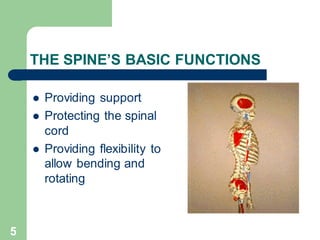
THE SPINE’S BASIC FUNCTIONS
⚫ Providing support
⚫ Protecting the spinal
cord
⚫ Providing flexibility to
allow bending and
rotating
6
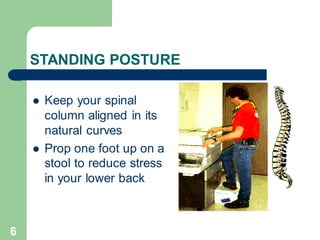
STANDING POSTURE
⚫ Keep your spinal
column aligned in its
natural curves
⚫ Prop one foot up on a
stool to reduce stress
in your lower back
7
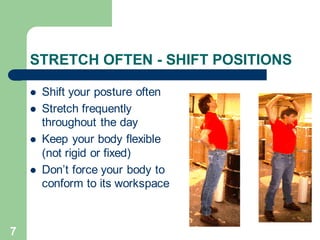
STRETCH OFTEN - SHIFT POSITIONS
⚫ Shift your posture often
⚫ Stretch frequently
throughout the day
⚫ Keep your body flexible
(not rigid or fixed)
⚫ Don’t force your body to
conform to its workspace
8
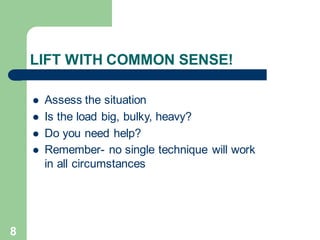
LIFT WITH COMMON SENSE!
⚫ Assess the situation
⚫ Is the load big, bulky, heavy?
⚫ Do you need help?
⚫ Remember- no single technique will work
in all circumstances
9
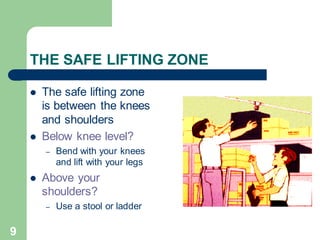
THE SAFE LIFTING ZONE
⚫ The safe lifting zone
is between the knees
and shoulders
⚫ Below knee level?
– Bend with your knees
and lift with your legs
⚫ Above your
shoulders?
– Use a stool or ladder
10
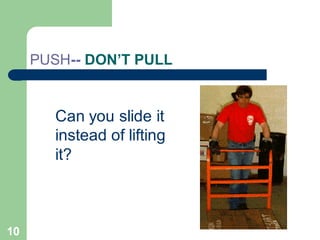
PUSH-- DON’T PULL
Can you slide it
instead of lifting
it?
11
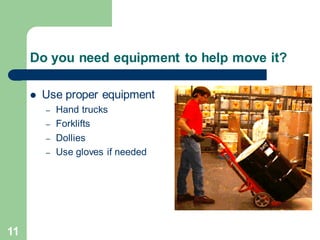
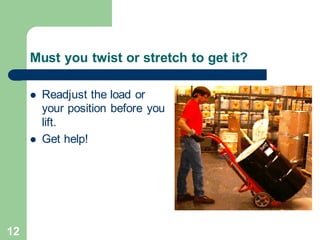
Do you need equipment to help move it?
⚫ Use proper equipment
– Hand trucks
– Forklifts
– Dollies
– Use gloves if needed
12
Must you twist or stretch to get it?
⚫ Readjust the load or
your position before you
lift.
⚫ Get help!
13
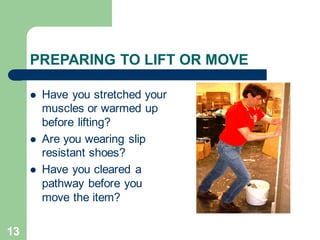
PREPARING TO LIFT OR MOVE
⚫ Have you stretched your
muscles or warmed up
before lifting?
⚫ Are you wearing slip
resistant shoes?
⚫ Have you cleared a
pathway before you
move the item?
14
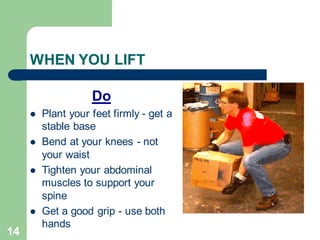
WHEN YOU LIFT
Do
⚫ Plant your feet firmly - get a
stable base
⚫ Bend at your knees - not
your waist
⚫ Tighten your abdominal
muscles to support your
spine
⚫ Get a good grip - use both
hands
15
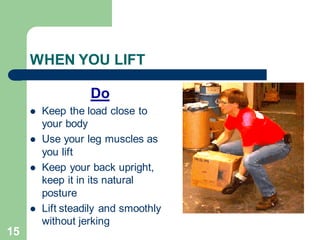
WHEN YOU LIFT
Do
⚫ Keep the load close to
your body
⚫ Use your leg muscles as
you lift
⚫ Keep your back upright,
keep it in its natural
posture
⚫ Lift steadily and smoothly
without jerking
16
WHEN YOU LIFT
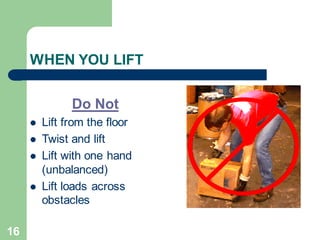
Do Not
⚫ Lift from the floor
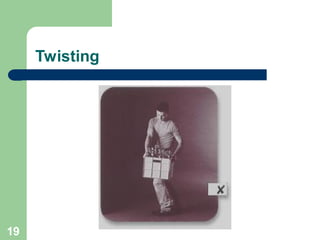
⚫ Twist and lift
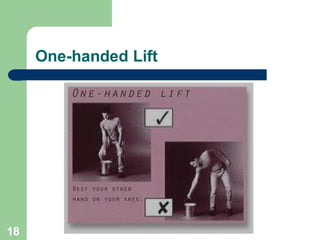
⚫ Lift with one hand
(unbalanced)
⚫ Lift loads across
obstacles
17
WHEN YOU LIFT
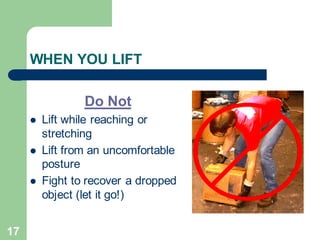
Do Not
⚫ Lift while reaching or
stretching
⚫ Lift from an uncomfortable
posture
⚫ Fight to recover a dropped
object (let it go!)
18
One-handed Lift
19
Twisting
20
General Safety Rules
⚫ Make your safety your first consideration in every
situation.
⚫ Keep your work area clean and free from loose
objects, stumbling or slipping hazards (including
electrical wires from equipment).
⚫ Be aware of walking surfaces. Extra care is needed on
wet or icy surfaces.
⚫ Never leave an unsafe condition unmarked or
unguarded.
⚫ Always post “wet floor” signs when needed.
21
General Safety Rules (continued)
⚫ Wear adequate shoes that are not open and that give
good support and slip resistance.
⚫ Never use broken or damaged ladders or other
equipment.
⚫ Ladders in front of doors should be marked or posted
with warning barricades.
⚫ Use care when working on stairways.
⚫ Be cautious when working to keep from tripping over
equipment such as buckets, vacuum cleaners, and
other tools.
22
REMEMBER!
⚫ Your work day is one third of your total day
⚫ Plan your tasks carefully to avoid a painful
back
⚫ Managing your back is your responsibility

Manual Handling- Safe Lifting .pdf

  • 1.
  • 2.
    2 Back Injuries ⚫ Backinjuries account for nearly 20% of all injuries and illnesses in the workplace. ⚫ Back injuries cost the nation an estimated 20 to 50 billion dollars per year.
  • 3.
    3 Slips, Trips andFalls ⚫ On stairways alone, falls result in over two million disabling injuries yearly. ⚫ There are thousands more minor injuries caused by slips, trips, and falls each year. ⚫ Most alarming of all is, the fact that industrial falls cause over 1000 deaths each year. ⚫ Slips, trips and falls account for 15 to 20 percent of all workers' compensation costs.
  • 4.
    4 Leading Back InjuryFactors ⚫ Poor posture ⚫ Poor physical condition ⚫ Incorrect lifting ⚫ Jobs that require high energy
  • 5.
    5 THE SPINE’S BASICFUNCTIONS ⚫ Providing support ⚫ Protecting the spinal cord ⚫ Providing flexibility to allow bending and rotating
  • 6.
    6 STANDING POSTURE ⚫ Keepyour spinal column aligned in its natural curves ⚫ Prop one foot up on a stool to reduce stress in your lower back
  • 7.
    7 STRETCH OFTEN -SHIFT POSITIONS ⚫ Shift your posture often ⚫ Stretch frequently throughout the day ⚫ Keep your body flexible (not rigid or fixed) ⚫ Don’t force your body to conform to its workspace
  • 8.
    8 LIFT WITH COMMONSENSE! ⚫ Assess the situation ⚫ Is the load big, bulky, heavy? ⚫ Do you need help? ⚫ Remember- no single technique will work in all circumstances
  • 9.
    9 THE SAFE LIFTINGZONE ⚫ The safe lifting zone is between the knees and shoulders ⚫ Below knee level? – Bend with your knees and lift with your legs ⚫ Above your shoulders? – Use a stool or ladder
  • 10.
    10 PUSH-- DON’T PULL Canyou slide it instead of lifting it?
  • 11.
    11 Do you needequipment to help move it? ⚫ Use proper equipment – Hand trucks – Forklifts – Dollies – Use gloves if needed
  • 12.
    12 Must you twistor stretch to get it? ⚫ Readjust the load or your position before you lift. ⚫ Get help!
  • 13.
    13 PREPARING TO LIFTOR MOVE ⚫ Have you stretched your muscles or warmed up before lifting? ⚫ Are you wearing slip resistant shoes? ⚫ Have you cleared a pathway before you move the item?
  • 14.
    14 WHEN YOU LIFT Do ⚫Plant your feet firmly - get a stable base ⚫ Bend at your knees - not your waist ⚫ Tighten your abdominal muscles to support your spine ⚫ Get a good grip - use both hands
  • 15.
    15 WHEN YOU LIFT Do ⚫Keep the load close to your body ⚫ Use your leg muscles as you lift ⚫ Keep your back upright, keep it in its natural posture ⚫ Lift steadily and smoothly without jerking
  • 16.
    16 WHEN YOU LIFT DoNot ⚫ Lift from the floor ⚫ Twist and lift ⚫ Lift with one hand (unbalanced) ⚫ Lift loads across obstacles
  • 17.
    17 WHEN YOU LIFT DoNot ⚫ Lift while reaching or stretching ⚫ Lift from an uncomfortable posture ⚫ Fight to recover a dropped object (let it go!)
  • 18.
  • 19.
  • 20.
    20 General Safety Rules ⚫Make your safety your first consideration in every situation. ⚫ Keep your work area clean and free from loose objects, stumbling or slipping hazards (including electrical wires from equipment). ⚫ Be aware of walking surfaces. Extra care is needed on wet or icy surfaces. ⚫ Never leave an unsafe condition unmarked or unguarded. ⚫ Always post “wet floor” signs when needed.
  • 21.
    21 General Safety Rules(continued) ⚫ Wear adequate shoes that are not open and that give good support and slip resistance. ⚫ Never use broken or damaged ladders or other equipment. ⚫ Ladders in front of doors should be marked or posted with warning barricades. ⚫ Use care when working on stairways. ⚫ Be cautious when working to keep from tripping over equipment such as buckets, vacuum cleaners, and other tools.
  • 22.
    22 REMEMBER! ⚫ Your workday is one third of your total day ⚫ Plan your tasks carefully to avoid a painful back ⚫ Managing your back is your responsibility