BACK TO THE FUTURE:
OIESS2025 - Burrows - Rosetta
Dr R.J. (Bob) Williams [Retired]
Cartographer
Topographic Surveyor,
Geographer & Geospatial Scientist
30 Oct – 1 Nov 2018
I don't think of what I do as science fiction,
I think of it as historical reports of events that haven't happened yet!
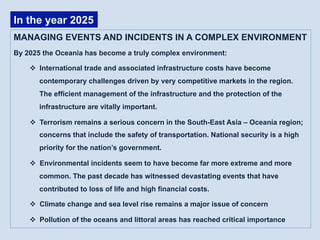
MANAGING EVENTS AND INCIDENTS IN A COMPLEX ENVIRONMENT
By 2025 the Oceania has become a truly complex environment:
v  International trade and associated infrastructure costs have become
contemporary challenges driven by very competitive markets in the region.
The efficient management of the infrastructure and the protection of the
infrastructure are vitally important.
v  Terrorism remains a serious concern in the South-East Asia – Oceania region;
concerns that include the safety of transportation. National security is a high
priority for the nation’s government.
v  Environmental incidents seem to have become far more extreme and more
common. The past decade has witnessed devastating events that have
contributed to loss of life and high financial costs.
v  Climate change and sea level rise remains a major issue of concern
v  Pollution of the oceans and littoral areas has reached critical importance
In the year 2025
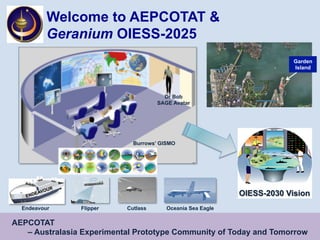
Welcome to AEPCOTAT &
Geranium OIESS-2025
AEPCOTAT
– Australasia Experimental Prototype Community of Today and Tomorrow
Garden
Island
OIESS-2030 Vision
Burrows’ GISMO
Dr Bob
SAGE Avatar
Endeavour Flipper Oceania Sea Eagle
Cutlass
ENDEAVOUR
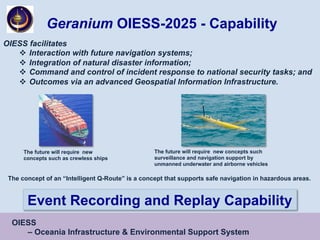
OIESS facilitates
v  Interaction with future navigation systems;
v  Integration of natural disaster information;
v  Command and control of incident response to national security tasks; and
v  Outcomes via an advanced Geospatial Information Infrastructure.
Event Recording and Replay Capability
The future will require new
concepts such as crewless ships
The concept of an “Intelligent Q-Route” is a concept that supports safe navigation in hazardous areas.
The future will require new concepts such
surveillance and navigation support by
unmanned underwater and airborne vehicles
Geranium OIESS-2025 - Capability
OIESS
– Oceania Infrastructure & Environmental Support System
Navigation
TOPICS
Environmental
Protection
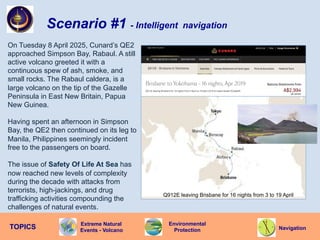
Q912E leaving Brisbane for 16 nights from 3 to 19 April
Scenario #1 - Intelligent navigation
On Tuesday 8 April 2025, Cunard’s QE2
approached Simpson Bay, Rabaul. A still
active volcano greeted it with a
continuous spew of ash, smoke, and
small rocks. The Rabaul caldera, is a
large volcano on the tip of the Gazelle
Peninsula in East New Britain, Papua
New Guinea.
Having spent an afternoon in Simpson
Bay, the QE2 then continued on its leg to
Manila, Philippines seemingly incident
free to the passengers on board.
The issue of Safety Of Life At Sea has
now reached new levels of complexity
during the decade with attacks from
terrorists, high-jackings, and drug
trafficking activities compounding the
challenges of natural events.
Extreme Natural
Events - Volcano
The Endeavour is the Geranium OIESS’s
deployable asset and has a range of highly
advanced capabilities. These include:
v  Cutlass - a ‘drone’ with sensors capable
of measuring gasses and soils that
enable the on-board Incident Response
Cell to determine ‘safety’ for the tourists;
v  Flipper - an unmanned underwater
vehicle with a range of sensors to assist
in navigation.
Scenario #1 - Geranium assets
PNT [Position / Navigation / Timing]
Multi-Level Security
OIESS
Contribution
to a
Secure
World
Cutlass has a truly unique capability that is
required for this voyage by QE2. Cyber-terrorists
have disrupted and disabled GPS and,
subsequently, precision navigation using space-
based systems. However, during the preceding
decade hydrographers have modified
existing lighthouses throughout
the archipelago with geodetic
accuracy. Cutlass is then able
to calculate a ‘Q-route’ and
escort/pilot QE2 safely.
Another of Geranium’s assets is access to the
highly classified Oceania Sea Eagle which
monitors maritime traffic of all types as well as on-
shore weapons of terrorist groups.
OIESS Sea Eagle
Cutlass
Endeavour
Flipper
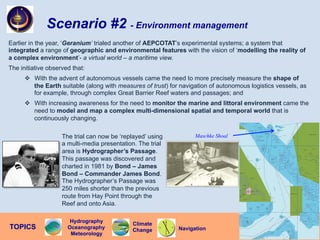
Scenario #2 - Environment management
Earlier in the year, ‘Geranium’ trialed another of AEPCOTAT’s experimental systems; a system that
integrated a range of geographic and environmental features with the vision of ‘modelling the reality of
a complex environment’- a virtual world – a maritime view.
The initiative observed that:
v  With the advent of autonomous vessels came the need to more precisely measure the shape of
the Earth suitable (along with measures of trust) for navigation of autonomous logistics vessels, as
for example, through complex Great Barrier Reef waters and passages; and
v  With increasing awareness for the need to monitor the marine and littoral environment came the
need to model and map a complex multi-dimensional spatial and temporal world that is
continuously changing.
The trial can now be ‘replayed’ using
a multi-media presentation. The trial
area is Hydrographer’s Passage.
This passage was discovered and
charted in 1981 by Bond – James
Bond – Commander James Bond.
The Hydrographer’s Passage was
250 miles shorter than the previous
route from Hay Point through the
Reef and onto Asia.
Navigation
TOPICS
Climate
Change
Hydrography
Oceanography
Meteorology
Maschke Shoal
#	
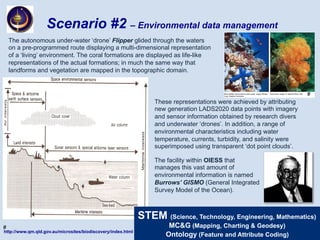
Scenario #2 – Environmental data management
The autonomous under-water ‘drone’ Flipper glided through the waters
on a pre-programmed route displaying a multi-dimensional representation
of a ‘living’ environment. The coral formations are displayed as life-like
representations of the actual formations; in much the same way that
landforms and vegetation are mapped in the topographic domain.
STEM (Science, Technology, Engineering, Mathematics)
MC&G (Mapping, Charting & Geodesy)
Ontology (Feature and Attribute Coding)
The facility within OIESS that
manages this vast amount of
environmental information is named
Burrows’ GISMO (General Integrated
Survey Model of the Ocean).
These representations were achieved by attributing
new generation LADS2020 data points with imagery
and sensor information obtained by research divers
and underwater ‘drones’. In addition, a range of
environmental characteristics including water
temperature, currents, turbidity, and salinity were
superimposed using transparent ‘dot point clouds’.
http://www.qm.qld.gov.au/microsites/biodiscovery/index.html
#
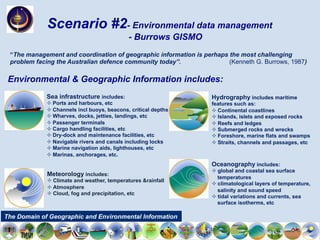
Oceanography includes:
² global and coastal sea surface
temperatures
² climatological layers of temperature,
salinity and sound speed
² tidal variations and currents, sea
surface isotherms, etc
Hydrography includes maritime
features such as:
² Continental coastlines
² Islands, islets and exposed rocks
² Reefs and ledges
² Submerged rocks and wrecks
² Foreshore, marine flats and swamps
² Straits, channels and passages, etc
Meteorology includes:
² Climate and weather, temperatures &rainfall
² Atmosphere
² Cloud, fog and precipitation, etc
Sea infrastructure includes:
² Ports and harbours, etc
² Channels incl buoys, beacons, critical depths
² Wharves, docks, jetties, landings, etc
² Passenger terminals
² Cargo handling facilities, etc
² Dry-dock and maintenance facilities, etc
² Navigable rivers and canals including locks
² Marine navigation aids, lighthouses, etc
² Marinas, anchorages, etc.
Environmental & Geographic Information includes:
Scenario #2- Environmental data management
- Burrows GISMO
“The management and coordination of geographic information is perhaps the most challenging
problem facing the Australian defence community today”. (Kenneth G. Burrows, 1987)
The Domain of Geographic and Environmental Information
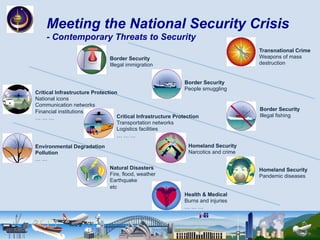
Meeting the National Security Crisis
- Contemporary Threats to Security
Border Security
Illegal immigration
Critical Infrastructure Protection
National icons
Communication networks
Financial institutions
… … …
Environmental Degradation
Pollution
… …
Health & Medical
Burns and injuries
… … …
Border Security
Illegal fishing
Homeland Security
Narcotics and crime
Natural Disasters
Fire, flood, weather
Earthquake
etc
Homeland Security
Pandemic diseases
Border Security
People smuggling
Critical Infrastructure Protection
Transportation networks
Logistics facilities
… … …
Transnational Crime
Weapons of mass
destruction
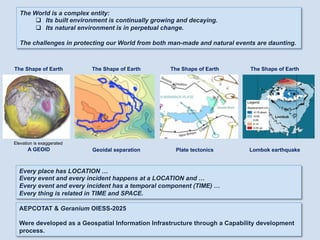
Every place has LOCATION …
Every event and every incident happens at a LOCATION and …
Every event and every incident has a temporal component (TIME) …
Every thing is related in TIME and SPACE.
The World is a complex entity:
q  Its built environment is continually growing and decaying.
q  Its natural environment is in perpetual change.
The challenges in protecting our World from both man-made and natural events are daunting.
AEPCOTAT & Geranium OIESS-2025
Were developed as a Geospatial Information Infrastructure through a Capability development
process.
The Shape of Earth
A GEOID
The Shape of Earth
Geoidal separation
The Shape of Earth
Lombok earthquake
The Shape of Earth
Plate tectonics
Elevation is exaggerated
Geranium OIESS
v  A Command Support Infrastructure
Resources
Coordination of:
agency collaboration
emergency services
integrated communications
asset management
Intelligence
Collaboration with:
national security agencies
maritime agencies
aeronautical agencies
emergency management agencies
Higher
Authority
Surveillance &
Monitoring
NOAA photo
Support for:
natural disasters
incidents and events
terrorist activities
illegal fishing
illegal migration
Coordination
Consider OIESS as being within a next-generation
NATIONAL DISASTER ORGANISATION [NDO]
OIESS
Support for:
navigation
terrorist emergencies
maritime search and rescue
multi-agency disaster relief
illegal fishing
illegal immigration
integrated communications
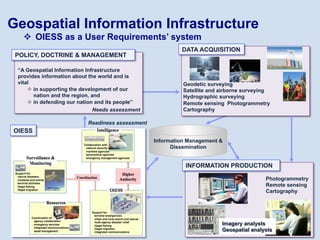
Photogrammetry
Remote sensing
Cartography
INFORMATION PRODUCTION
DATA ACQUISITION
Information Management &
Dissemination
Geodetic surveying
Satellite and airborne surveying
Hydrographic surveying
Remote sensing Photogrammetry
Cartography
POLICY, DOCTRINE & MANAGEMENT
“A Geospatial Information Infrastructure
provides information about the world and is
vital
² in supporting the development of our
nation and the region, and
² in defending our nation and its people”
Imagery analysts
Geospatial analysts
OIESS
Readiness assessment
Geospatial Information Infrastructure
v  OIESS as a User Requirements’ system
Needs assessment
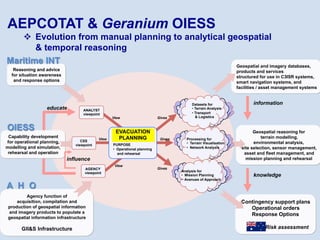
Reasoning and advice
for situation awareness
and response options
Geospatial and imagery databases,
products and services
structured for use in C3ISR systems,
smart navigation systems, and
facilities / asset management systems
Geospatial reasoning for
terrain modelling,
environmental analysis,
site selection, sensor management,
asset and fleet management, and
mission planning and rehearsal
View
View
Gives
View
Processing for
•  Terrain Visualisation
•  Network Analysis
Analysis for
•  Mission Planning
•  Avenues of Approach
Datasets for
• Terrain Analysis
• Transport
& Logistics
e.g. ACTIVITY
•  Evacuation planning
PURPOSE
•  Operational planning
and rehearsal
ANALYST
viewpoint
AGENCY
viewpoint
CSS
viewpoint
Gives
Gives
Contingency support plans
Operational orders
Response Options
Risk assessment
Capability development
for operational planning,
modelling and simulation,
rehearsal and operation
educate
influence
information
knowledge
EVACUATION
PLANNING
AEPCOTAT & Geranium OIESS
v  Evolution from manual planning to analytical geospatial
& temporal reasoning
A H O
Agency function of
acquisition, compilation and
production of geospatial information
and imagery products to populate a
geospatial information infrastructure
GII&S Infrastructure
OIESS
Maritime INT
Can such a ‘paradigm shift’ be made to address 2025 vision and beyond … ?
THE ROSETTA MISSION
November 12, 2014
WELCOME	TO	A	COMET	
Photo:	ESA	
We've turned science fiction into science fact today.
	
This is a big step for human civilisation
ESA’s Director General Jean-Jacques Dordain
Our ambitious Rosetta mission has secured
another place in the history books
Warwick Holmes told ABC
from the ESA's operations centre in Darmstady, Germany.
BACK TO THE FUTURE – Ben Bova 1989
“I don't think of what I do as science fiction, I think of it as historical reports of events
that haven't happened yet”
Ben Bova# presented the Keynote Address “Welcome to Moonbase’ [2020] to the ASPRS/ACSM/AUTO-
CARTO 9 Conference, Baltimore
THE ROSETTA MISSION – Rosetta’s WORLD
January 20, 2014
Date: 27 March 2014 Satellite:
Rosetta
Depicts: Star field with comet 67P/
Churyumov-Gerasimenko
Photo:	ESA	
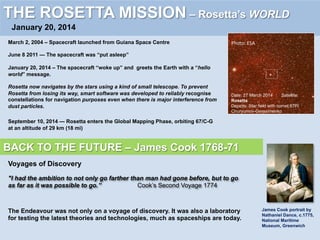
March 2, 2004 – Spacecraft launched from Guiana Space Centre
June 8 2011 — The spacecraft was “put asleep”
January 20, 2014 – The spacecraft “woke up” and greets the Earth with a “hello
world” message.
Rosetta now navigates by the stars using a kind of small telescope. To prevent
Rosetta from losing its way, smart software was developed to reliably recognise
constellations for navigation purposes even when there is major interference from
dust particles.
September 10, 2014 — Rosetta enters the Global Mapping Phase, orbiting 67/C-G
at an altitude of 29 km (18 mi)
"I had the ambition to not only go farther than man had gone before, but to go
as far as it was possible to go.” Cook’s Second Voyage 1774
The Endeavour was not only on a voyage of discovery. It was also a laboratory
for testing the latest theories and technologies, much as spaceships are today.
BACK TO THE FUTURE – James Cook 1768-71
Voyages of Discovery
James Cook portrait by
Nathaniel Dance, c.1775,
National Maritime
Museum, Greenwich
THE ROSETTA MISSION – Philae’s WORLD
November 12, 2014
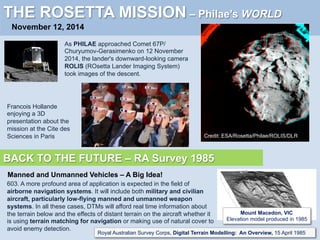
As PHILAE approached Comet 67P/
Churyumov-Gerasimenko on 12 November
2014, the lander's downward-looking camera
ROLIS (ROsetta Lander Imaging System)
took images of the descent.
Francois Hollande
enjoying a 3D
presentation about the
mission at the Cite des
Sciences in Paris Credit: ESA/Rosetta/Philae/ROLIS/DLR
BACK TO THE FUTURE – RA Survey 1985
603. A more profound area of application is expected in the field of
airborne navigation systems. It will include both military and civilian
aircraft, particularly low-flying manned and unmanned weapon
systems. In all these cases, DTMs will afford real time information about
the terrain below and the effects of distant terrain on the aircraft whether it
is using terrain matching for navigation or making use of natural cover to
avoid enemy detection.
Royal Australian Survey Corps, Digital Terrain Modelling: An Overview, 15 April 1985
Mount Macedon, VIC
Elevation model produced in 1985
Manned and Unmanned Vehicles – A Big Idea!
THE ROSETTA MISSION – Philae’s WORLD
November 12, 2014
BACK TO THE FUTURE – RA Survey 1981
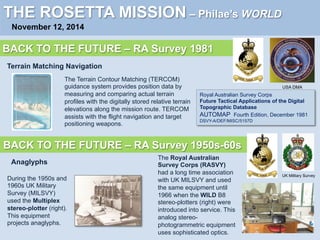
Terrain Matching Navigation
The Terrain Contour Matching (TERCOM)
guidance system provides position data by
measuring and comparing actual terrain
profiles with the digitally stored relative terrain
elevations along the mission route. TERCOM
assists with the flight navigation and target
positioning weapons.
Royal Australian Survey Corps
Future Tactical Applications of the Digital
Topographic Database
AUTOMAP Fourth Edition, December 1981
DSVY-A/DEF/MISC/5157D
USA DMA
BACK TO THE FUTURE – RA Survey 1950s-60s
Anaglyphs
UK Military Survey
The Royal Australian
Survey Corps (RASVY)
had a long time association
with UK MILSVY and used
the same equipment until
1966 when the WILD B8
stereo-plotters (right) were
introduced into service. This
analog stereo-
photogrammetric equipment
uses sophisticated optics.
During the 1950s and
1960s UK Military
Survey (MILSVY)
used the Multiplex
stereo-plotter (right).
This equipment
projects anaglyphs.
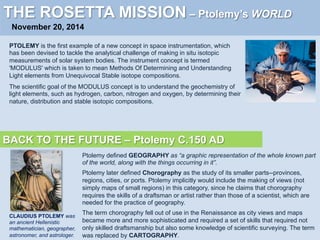
THE ROSETTA MISSION – Ptolemy’s WORLD
November 20, 2014
PTOLEMY is the first example of a new concept in space instrumentation, which
has been devised to tackle the analytical challenge of making in situ isotopic
measurements of solar system bodies. The instrument concept is termed
'MODULUS' which is taken to mean Methods Of Determining and Understanding
Light elements from Unequivocal Stable isotope compositions.
The scientific goal of the MODULUS concept is to understand the geochemistry of
light elements, such as hydrogen, carbon, nitrogen and oxygen, by determining their
nature, distribution and stable isotopic compositions.
BACK TO THE FUTURE – Ptolemy C.150 AD
CLAUDIUS PTOLEMY was
an ancient Hellenistic
mathematician, geographer,
astronomer, and astrologer.
Ptolemy defined GEOGRAPHY as “a graphic representation of the whole known part
of the world, along with the things occurring in it”.
Ptolemy later defined Chorography as the study of its smaller parts--provinces,
regions, cities, or ports. Ptolemy implicitly would include the making of views (not
simply maps of small regions) in this category, since he claims that chorography
requires the skills of a draftsman or artist rather than those of a scientist, which are
needed for the practice of geography.
The term chorography fell out of use in the Renaissance as city views and maps
became more and more sophisticated and required a set of skills that required not
only skilled draftsmanship but also some knowledge of scientific surveying. The term
was replaced by CARTOGRAPHY.
THE ROSETTA MISSION – OSIRIS
January 22, 2015
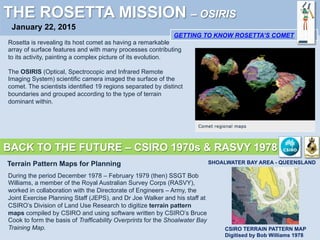
Rosetta is revealing its host comet as having a remarkable
array of surface features and with many processes contributing
to its activity, painting a complex picture of its evolution.
GETTING TO KNOW ROSETTA’S COMET
The OSIRIS (Optical, Spectrocopic and Infrared Remote
Imaging System) scientific camera imaged the surface of the
comet. The scientists identified 19 regions separated by distinct
boundaries and grouped according to the type of terrain
dominant within.
BACK TO THE FUTURE – CSIRO 1970s & RASVY 1978
Terrain Pattern Maps for Planning
CSIRO TERRAIN PATTERN MAP
Digitised by Bob Williams 1978
SHOALWATER BAY AREA - QUEENSLAND
During the period December 1978 – February 1979 (then) SSGT Bob
Williams, a member of the Royal Australian Survey Corps (RASVY),
worked in collaboration with the Directorate of Engineers – Army, the
Joint Exercise Planning Staff (JEPS), and Dr Joe Walker and his staff at
CSIRO’s Division of Land Use Research to digitize terrain pattern
maps compiled by CSIRO and using software written by CSIRO’s Bruce
Cook to form the basis of Trafficability Overprints for the Shoalwater Bay
Training Map.
THE ROSETTA MISSION – Rosetta and Philae
Voyage of Discovery – The Search for Knowledge
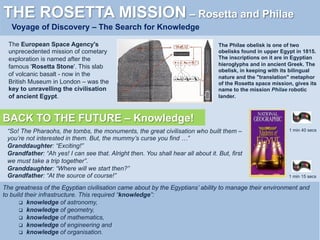
The Philae obelisk is one of two
obelisks found in upper Egypt in 1815.
The inscriptions on it are in Egyptian
hieroglyphs and in ancient Greek. The
obelisk, in keeping with its bilingual
nature and the "translation" metaphor
of the Rosetta space mission, gives its
name to the mission Philae robotic
lander.
The European Space Agency's
unprecedented mission of cometary
exploration is named after the
famous 'Rosetta Stone'. This slab
of volcanic basalt - now in the
British Museum in London – was the
key to unravelling the civilisation
of ancient Egypt.
“So! The Pharaohs, the tombs, the monuments, the great civilisation who built them –
you’re not interested in them. But, the mummy’s curse you find …”
Granddaughter: “Exciting!”
Grandfather: “Ah yes! I can see that. Alright then. You shall hear all about it. But, first
we must take a trip together”.
Granddaughter: “Where will we start then?”
Grandfather: “At the source of course!”
The greatness of the Egyptian civilisation came about by the Egyptians’ ability to manage their environment and
to build their infrastructure. This required “knowledge”:
q  knowledge of astronomy,
q  knowledge of geometry,
q  knowledge of mathematics,
q  knowledge of engineering and
q  knowledge of organisation.
BACK TO THE FUTURE – Knowledge!
1 min 40 secs
1 min 15 secs
“The search for “origins” in the history of technology is often disappointing. Each
origin uncovers some predecessors vanishing into the mists. More importantly, the
distinct competitors turn out to be much more entwined than imagined. This paper
will describe the community into which automated cartography emerged. Being
“first” is only something that is apparent in retrospect.
It makes sense to remember a bit more about the pre-history of
geographic information systems, not just to get the history right,
but to understand how the events of prior periods influence the
way the technology develops”.
Nick Chrisman is author of CHARTING THE UNKNOWN: How Computer
Mapping at Harvard Became GIS. This book presents a history of GIS
technology that takes readers back more than four decades to the Harvard
Laboratory for Computer Graphics and Spatial Analysis, where a variety of
professionals converged to rethink thematic mapping, spatial analysis, and
what we now call GIS. Lavishly illustrated, this book explores some of the
themes addressed by this fertile interdisciplinary collaboration.
The Rosetta mission demonstrates an interesting concept - the ‘search for origins’.
Now, with a vision for 2025 for Geranium OIESS, it is worth reviewing our heritage.
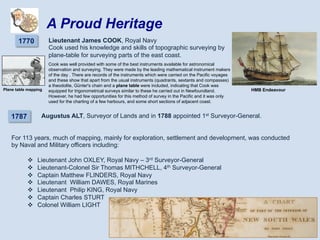
1770 Lieutenant James COOK, Royal Navy
Cook used his knowledge and skills of topographic surveying by
plane-table for surveying parts of the east coast.
For 113 years, much of mapping, mainly for exploration, settlement and development, was conducted
by Naval and Military officers including:
v  Lieutenant John OXLEY, Royal Navy – 3rd Surveyor-General
v  Lieutenant-Colonel Sir Thomas MITHCHELL, 4th Surveyor-General
v  Captain Matthew FLINDERS, Royal Navy
v  Lieutenant William DAWES, Royal Marines
v  Lieutenant Philip KING, Royal Navy
v  Captain Charles STURT
v  Colonel William LIGHT
1787 Augustus ALT, Surveyor of Lands and in 1788 appointed 1st Surveyor-General.
A Proud Heritage
Plane table mapping HMB Endeavour
Cook was well provided with some of the best instruments available for astronomical
observation and surveying. They were made by the leading mathematical instrument makers
of the day . There are records of the instruments which were carried on the Pacific voyages
and these show that apart from the usual instruments (quadrants, sextants and compasses)
a theodolite, Günter's chain and a plane table were included, indicating that Cook was
equipped for trigonometrical surveys similar to these he carried out in Newfoundland.
However, he had few opportunities for this method of survey in the Pacific and it was only
used for the charting of a few harbours, and some short sections of adjacent coast.
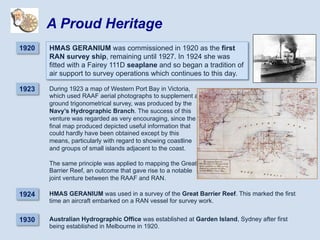
During 1923 a map of Western Port Bay in Victoria,
which used RAAF aerial photographs to supplement a
ground trigonometrical survey, was produced by the
Navy’s Hydrographic Branch. The success of this
venture was regarded as very encouraging, since the
final map produced depicted useful information that
could hardly have been obtained except by this
means, particularly with regard to showing coastline
and groups of small islands adjacent to the coast.
The same principle was applied to mapping the Great
Barrier Reef, an outcome that gave rise to a notable
joint venture between the RAAF and RAN.
1920 HMAS GERANIUM was commissioned in 1920 as the first
RAN survey ship, remaining until 1927. In 1924 she was
fitted with a Fairey 111D seaplane and so began a tradition of
air support to survey operations which continues to this day.
A Proud Heritage
1930 Australian Hydrographic Office was established at Garden Island, Sydney after first
being established in Melbourne in 1920.
1923
1924 HMAS GERANIUM was used in a survey of the Great Barrier Reef. This marked the first
time an aircraft embarked on a RAN vessel for survey work.
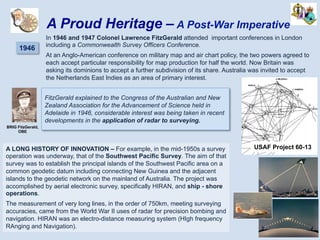
1946
In 1946 and 1947 Colonel Lawrence FitzGerald attended important conferences in London
including a Commonwealth Survey Officers Conference.
At an Anglo-American conference on military map and air chart policy, the two powers agreed to
each accept particular responsibility for map production for half the world. Now Britain was
asking its dominions to accept a further subdivision of its share. Australia was invited to accept
the Netherlands East Indies as an area of primary interest.
A Proud Heritage – A Post-War Imperative
A LONG HISTORY OF INNOVATION – For example, in the mid-1950s a survey
operation was underway, that of the Southwest Pacific Survey. The aim of that
survey was to establish the principal islands of the Southwest Pacific area on a
common geodetic datum including connecting New Guinea and the adjacent
islands to the geodetic network on the mainland of Australia. The project was
accomplished by aerial electronic survey, specifically HIRAN, and ship - shore
operations.
The measurement of very long lines, in the order of 750km, meeting surveying
accuracies, came from the World War II uses of radar for precision bombing and
navigation. HIRAN was an electro-distance measuring system (HIgh frequency
RAnging and Navigation).
BRIG FitzGerald,
OBE
FitzGerald explained to the Congress of the Australian and New
Zealand Association for the Advancement of Science held in
Adelaide in 1946, considerable interest was being taken in recent
developments in the application of radar to surveying.
USAF Project 60-13
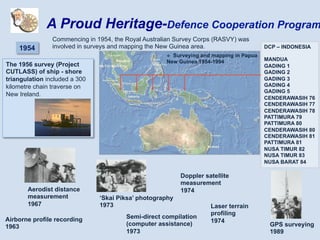
v  Surveying and mapping in Papua
New Guinea 1954-1994
DCP – INDONESIA
MANDUA
GADING 1
GADING 2
GADING 3
GADING 4
GADING 5
CENDERAWASIH 76
CENDERAWASIH 77
CENDERAWASIH 78
PATTIMURA 79
PATTIMURA 80
CENDERAWASIH 80
CENDERAWASIH 81
PATTIMURA 81
NUSA TIMUR 82
NUSA TIMUR 83
NUSA BARAT 84
Airborne profile recording
1963
Aerodist distance
measurement
1967
Doppler satellite
measurement
1974
‘Skai Piksa’ photography
1973 Laser terrain
profiling
1974
Semi-direct compilation
(computer assistance)
1973
GPS surveying
1989
1954
Commencing in 1954, the Royal Australian Survey Corps (RASVY) was
involved in surveys and mapping the New Guinea area.
A Proud Heritage-Defence Cooperation Program
The 1956 survey (Project
CUTLASS) of ship - shore
triangulation included a 300
kilometre chain traverse on
New Ireland.
Under the DCP, RASVY completed many cooperative and collaborative projects with
nations in Australia’s area of strategic interest. These projects included:
v  ground surveys, and definition of geodetic datums,
v  air photography, and mapping, and charting
v  assistance with definition of Exclusive Economic Zones,
v  provision of equipment and technology transfer and
v  training of officers and technicians.
1970-92
A Proud Heritage-Defence Cooperation Program
Projects commenced in 1970 in Indonesia and expanded over 25 years to include:
v  Solomon Islands, Fiji, Tonga, Cook Islands, Kiribati, Nauru, Tuvalu, Vanuatu , Western Samoa.
Technical Advisers were posted to national survey and mapping organisations in:
v  Fiji, Indonesia, Malaysia, Papua New Guinea, Solomon Islands and Vanuatu.
All field survey operations outside Australia, and indeed in Australia, would not have been possible without essential
support of most other Army Corps (Engineers; Signals; Aviation [Cessna, Porter, Sioux, Kiowa]; Chaplains; Medical;
Dentist; Transport; Ordnance; Electrical and Mechanical Engineers; Pay; Catering; Service); the Royal Australian Navy
(Hydrographic Service [Landing craft, Patrol boats]); and, at times, the Royal New Zealand Navy
(Hydrographic Service); the Royal Australian Air Force [Canberra, Hercules, Caribou, Iroquois]; and civil charter
fixed wing and helicopters for aerial survey work and transport.
Two members of the Australian Defence Force died on military survey operations in the 1970s in Papua New Guinea
and in Indonesia.
Army Survey’s DCP activity came to an abrupt end in 1995 !
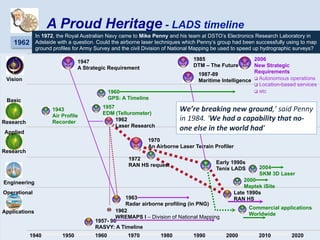
Vision
Applied
Research
Basic
Research
Engineering
Operational
Applications
1947
A Strategic Requirement
1943
Air Profile
Recorder
1970
An Airborne Laser Terrain Profiler
1962
Laser Research
1963
Radar airborne profiling (in PNG)
1962
WREMAPS I – Division of National Mapping
Early 1990s
Tenix LADS
Late 1990s
RAN HS
Commercial applications
Worldwide
1957
EDM (Tellurometer)
1940 1950 1960 1970 1980 1990 2000 2010 2020
1960
GPS: A Timeline
2000
Maptek iSite
2004
SKM 3D Laser
2006
New Strategic
Requirements
q  Autonomous operations
q  Location-based services
q  etc
1957- 96
RASVY: A Timeline
1985
DTM – The Future
1987-89
Maritime Intelligence
1972
RAN HS request
We’re	breaking	new	ground,’	said	Penny	
in	1984.	‘We	had	a	capability	that	no-
one	else	in	the	world	had’	
1962
A Proud Heritage - LADS timeline
In 1972, the Royal Australian Navy came to Mike Penny and his team at DSTO’s Electronics Research Laboratory in
Adelaide with a question. Could the airborne laser techniques which Penny’s group had been successfully using to map
ground profiles for Army Survey and the civil Division of National Mapping be used to speed up hydrographic surveys?
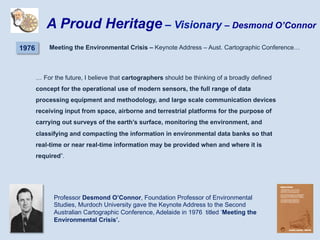
… For the future, I believe that cartographers should be thinking of a broadly defined
concept for the operational use of modern sensors, the full range of data
processing equipment and methodology, and large scale communication devices
receiving input from space, airborne and terrestrial platforms for the purpose of
carrying out surveys of the earth’s surface, monitoring the environment, and
classifying and compacting the information in environmental data banks so that
real-time or near real-time information may be provided when and where it is
required”.
Professor Desmond O’Connor, Foundation Professor of Environmental
Studies, Murdoch University gave the Keynote Address to the Second
Australian Cartographic Conference, Adelaide in 1976 titled ‘Meeting the
Environmental Crisis’.
A Proud Heritage – Visionary – Desmond O’Connor
1976 Meeting the Environmental Crisis – Keynote Address – Aust. Cartographic Conference…
A Proud Heritage – CSIRO – BRIAN
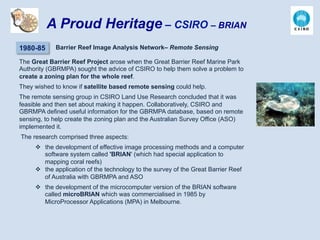
1980-85 Barrier Reef Image Analysis Network– Remote Sensing
The Great Barrier Reef Project arose when the Great Barrier Reef Marine Park
Authority (GBRMPA) sought the advice of CSIRO to help them solve a problem to
create a zoning plan for the whole reef.
They wished to know if satellite based remote sensing could help.
The remote sensing group in CSIRO Land Use Research concluded that it was
feasible and then set about making it happen. Collaboratively, CSIRO and
GBRMPA defined useful information for the GBRMPA database, based on remote
sensing, to help create the zoning plan and the Australian Survey Office (ASO)
implemented it.
The research comprised three aspects:
v  the development of effective image processing methods and a computer
software system called 'BRIAN' (which had special application to
mapping coral reefs)
v  the application of the technology to the survey of the Great Barrier Reef
of Australia with GBRMPA and ASO
v  the development of the microcomputer version of the BRIAN software
called microBRIAN which was commercialised in 1985 by
MicroProcessor Applications (MPA) in Melbourne.
The Strategic and Defence Studies Centre
organised a two-day workshop on Geographic
Information Systems (GIS) on 20-21 August
1987 at the Australian National University.
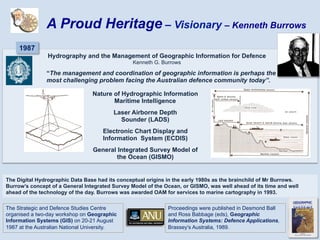
The Digital Hydrographic Data Base had its conceptual origins in the early 1980s as the brainchild of Mr Burrows.
Burrow’s concept of a General Integrated Survey Model of the Ocean, or GISMO, was well ahead of its time and well
ahead of the technology of the day. Burrows was awarded OAM for services to marine cartography in 1993.
“The management and coordination of geographic information is perhaps the
most challenging problem facing the Australian defence community today”.
Hydrography and the Management of Geographic Information for Defence
Kenneth G. Burrows
Nature of Hydrographic Information
Maritime Intelligence
Laser Airborne Depth
Sounder (LADS)
Electronic Chart Display and
Information System (ECDIS)
General Integrated Survey Model of
the Ocean (GISMO)
Proceedings were published in Desmond Ball
and Ross Babbage (eds), Geographic
Information Systems: Defence Applications,
Brassey's Australia, 1989.
A Proud Heritage – Visionary – Kenneth Burrows
1987
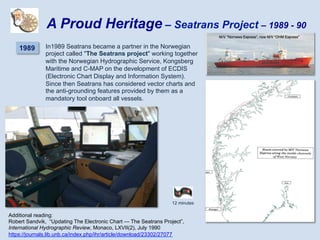
In1989 Seatrans became a partner in the Norwegian
project called "The Seatrans project" working together
with the Norwegian Hydrographic Service, Kongsberg
Maritime and C-MAP on the development of ECDIS
(Electronic Chart Display and Information System).
Since then Seatrans has considered vector charts and
the anti-grounding features provided by them as a
mandatory tool onboard all vessels.
12 minutes
A Proud Heritage – Seatrans Project – 1989 - 90
1989
Additional reading:
Robert Sandvik, “Updating The Electronic Chart — The Seatrans Project”,
International Hydrographic Review, Monaco, LXVII(2), July 1990
https://journals.lib.unb.ca/index.php/ihr/article/download/23302/27077
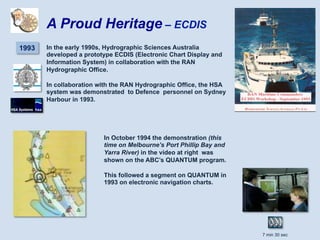
In the early 1990s, Hydrographic Sciences Australia
developed a prototype ECDIS (Electronic Chart Display and
Information System) in collaboration with the RAN
Hydrographic Office.
In collaboration with the RAN Hydrographic Office, the HSA
system was demonstrated to Defence personnel on Sydney
Harbour in 1993.
In October 1994 the demonstration (this
time on Melbourne’s Port Phillip Bay and
Yarra River) in the video at right was
shown on the ABC’s QUANTUM program.
This followed a segment on QUANTUM in
1993 on electronic navigation charts.
A Proud Heritage – ECDIS
1993
7 min 30 sec
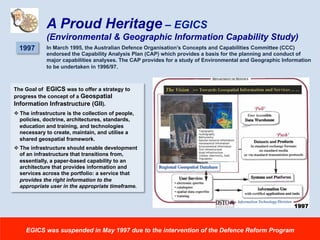
A Proud Heritage – EGICS
(Environmental & Geographic Information Capability Study)
1997 In March 1995, the Australian Defence Organisation’s Concepts and Capabilities Committee (CCC)
endorsed the Capability Analysis Plan (CAP) which provides a basis for the planning and conduct of
major capabilities analyses. The CAP provides for a study of Environmental and Geographic Information
to be undertaken in 1996/97.
The Goal of EGICS was to offer a strategy to
progress the concept of a Geospatial
Information Infrastructure (GII).
v The infrastructure is the collection of people,
policies, doctrine, architectures, standards,
education and training, and technologies
necessary to create, maintain, and utilise a
shared geospatial framework.
v The infrastructure should enable development
of an infrastructure that transitions from,
essentially, a paper-based capability to an
architecture that provides information and
services across the portfolio: a service that
provides the right information to the
appropriate user in the appropriate timeframe.
EGICS was suspended in May 1997 due to the intervention of the Defence Reform Program
1997
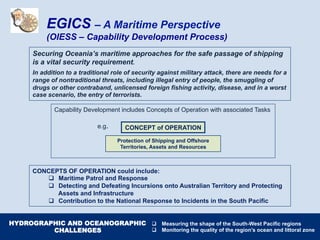
Capability Development includes Concepts of Operation with associated Tasks
e.g.
CONCEPTS OF OPERATION could include:
q  Maritime Patrol and Response
q  Detecting and Defeating Incursions onto Australian Territory and Protecting
Assets and Infrastructure
q  Contribution to the National Response to Incidents in the South Pacific
Securing Oceania’s maritime approaches for the safe passage of shipping
is a vital security requirement.
In addition to a traditional role of security against military attack, there are needs for a
range of nontraditional threats, including illegal entry of people, the smuggling of
drugs or other contraband, unlicensed foreign fishing activity, disease, and in a worst
case scenario, the entry of terrorists.
CONCEPT of OPERATION
Protection of Shipping and Offshore
Territories, Assets and Resources
EGICS – A Maritime Perspective
(OIESS – Capability Development Process)
HYDROGRAPHIC AND OCEANOGRAPHIC
CHALLENGES
q  Measuring the shape of the South-West Pacific regions
q  Monitoring the quality of the region’s ocean and littoral zone
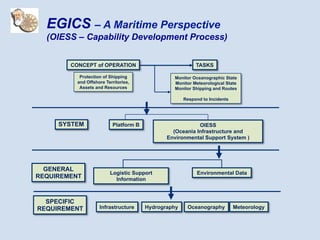
CONCEPT of OPERATION
Protection of Shipping
and Offshore Territories,
Assets and Resources
Monitor Oceanographic State
Monitor Meteorological State
Monitor Shipping and Routes
Respond to Incidents
TASKS
SYSTEM Platform B OIESS
(Oceania Infrastructure and
Environmental Support System )
GENERAL
REQUIREMENT
Environmental Data
Logistic Support
Information
Infrastructure
SPECIFIC
REQUIREMENT Hydrography Oceanography Meteorology
EGICS – A Maritime Perspective
(OIESS – Capability Development Process)
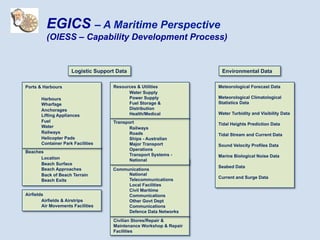
Meteorological Forecast Data
Meteorological Climatological
Statistics Data
Water Turbidity and Visibility Data
Tidal Heights Prediction Data
Tidal Stream and Current Data
Sound Velocity Profiles Data
Marine Biological Noise Data
Seabed Data
Current and Surge Data
Environmental Data
Civilian Stores/Repair &
Maintenance Workshop & Repair
Facilities
Communications
National
Telecommunications
Local Facilities
Civil Maritime
Communications
Other Govt Dept
Communications
Defence Data Networks
Transport
Railways
Roads
Ships - Australian
Major Transport
Operations
Transport Systems -
National
Resources & Utilities
Water Supply
Power Supply
Fuel Storage &
Distribution
Health/Medical
Airfields
Airfields & Airstrips
Air Movements Facilities
Beaches
Location
Beach Surface
Beach Approaches
Back of Beach Terrain
Beach Exits
Ports & Harbours
Harbours
Wharfage
Anchorages
Lifting Appliances
Fuel
Water
Railways
Helicopter Pads
Container Park Facilities
Logistic Support Data
EGICS – A Maritime Perspective
(OIESS – Capability Development Process)
Communications
• Bathymetry / Bottom topography
• Bottom slope
• Bottom morphology (type, trafficability)
• Underwater obstacles and obstructions
• Beaches (composition, slope, obstacles)
• Riverine (width, depth, gradient)
• Land (vegetation, trafficability)
• Q-Routes
• Magnetic
• Miscellaneous (fishing, shipping,
industrial, marine life)
Content
Bottom characteristics
Material composition category
Material composition secondary
Material composition underlying
Physical surface characteristics
BF010
MCC
MCS
MCU
PSC
7 attributes
20 attributes
Obstruction (nautical)
Wreck
BD070
BD180
13 attributes
2 attributes
14 attributes
Route (Maritime)
Swept area
Maritime area
FC165
FC177
FC031
incl MAC Maritime Area Category 80 values
incl Dredged channel
Mine danger area
Anchorage (general)
Oil field
Seal sanctuary
- Littoral Information [Example with DIGEST Features and Attributes]
EGICS – A Maritime Perspective
(OIESS – Capability Development Process)
BB - Hydrography-Ports and Harbors
BB005 US-Harbor UK-Harbour
BB006 US-Harbor Complex UK-Harbour Complex
BB007 Channel Edge
BB010 Anchorage
BB011 Anchorage (Complex Feature)
BB012 Anchor Berth
BB019 Anchor
BB020 Berth
BB021 Mooring Trot
BB022 Basin
BB030 Bollard
BB040 Breakwater/Groyne
BB041 Breakwater
BB042 Mole
BB043 Groin
BB050 Calling-In Point
BB079 Mooring/Warping Facility
BB080 Dolphin
BB081 Shoreline Construction
BB090 US-Drydock UK-Dry Dock
BB100 US-Fish Stakes UK-Fishing Stakes
BB105 US-Fishing Harbor UK-Fishing Harbour
BB110 Fish Traps/Fish Weirs
BB111 Tunny (Tuna) Nets Area
BB115 US-Gridiron UK-Gridiron/Careening Grid
BB140 US-Jetty UK-Training Wall
BB150 Landing Place
BB151 Landing Stairs
BB155 Maritime Station/Maritime Signal Station
BB160 Mooring Ring
BB170 US-Offshore Loading Facility UK-Single Point Mooring
BB180 Oyster Bed/Mussel Bed
BB190 US-Pier/Wharf/Quay UK-Pier/Wharf/Quay/Jetty
BB198 Fender
BB199 Floating Dock
BB200 Pump Out Facility
BB201 Small Craft Facility
BB202 Ice Boom
BB220 Ramp (Maritime)
BB221 Log Ramp
BB225 Rip Rap
BB226 Revetment (Shore Protection)
BB230 Seawall
BB240 Slipway/Patent Slip
BB250 Watering Place
AFA 21 No Ticket Sales
AFA 22 Yacht Club
AFA 23 Boat Hoist
AFA 24 Boat Yard
AFA 25 Hotel Accommodation
AFA 26 Restaurant
AFA 27 Desalination facilities
AFA 28 Parking Lot
AFA 29 Parking for boats and trailers
AFA 30 Recreational Vehicle Park
AFA 31 Campground
AFA 32 Sewerage pump-out station
AFA 33 Emergency telephone
AFA 34 Landing and launching place for boats
AFA 35 Scrubbing Berth
AFA 36 Picnic Area
AFA 37 Mechanics Workshop
AFA 38 Guard or Security Service
AFA 995 None
AFA 997 Unpopulated
AFA 998 Not Applicable
AFA Available Facilities - Facilities available at or in the near vicinity
AFA 0 Unknown
AFA 1 Visitors Berth
AFA 2 Visitors Mooring
AFA 3 Sailmaker
AFA 4 Chandler
AFA 5 Provisions
AFA 6 Physician/Doctor
AFA 7 Pharmacy/Chemist
AFA 8 Drinking Water
AFA 9 Fuel Station
AFA 10 Electricity
AFA 11 Bottle Gas/LPG
AFA 12 Showers
AFA 13 Launderette
AFA 14 Toilets
AFA 15 Post Box
AFA 16 Public Telephone
AFA 17 Refuse Bin
AFA 18 Water Police
AFA 19 Helipad
AFA 20 Ticket Sales
B — Hydrography
BA Coastal Hydrography
BB Ports and Harbors
BC NAVAIDS
BD Dangers/Hazards
BE Depth Information
BF Bottom Features
BG Tide and Current Information
BH Inland Water
BI Miscellaneous Inland Water
BJ Snow/Ice
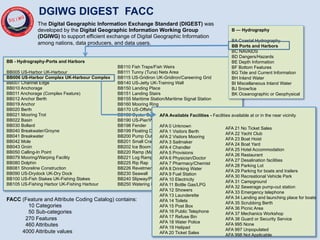
BK Oceanographic or Geophysical
The Digital Geographic Information Exchange Standard (DIGEST) was
developed by the Digital Geographic Information Working Group
(DGIWG) to support efficient exchange of Digital Geographic Information
among nations, data producers, and data users.
DGIWG DIGEST FACC
FACC (Feature and Attribute Coding Catalog) contains:
10 Categories
50 Sub-categories
270 Features
460 Attributes
4000 Attribute values
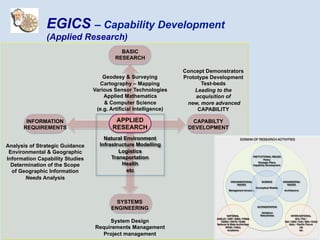
APPLIED
RESEARCH
Natural Environment
Infrastructure Modelling
Logistics
Transportation
Health
etc
BASIC
RESEARCH
Geodesy & Surveying
Cartography – Mapping
Various Sensor Technologies
Applied Mathematics
& Computer Science
(e.g. Artificial Intelligence)
CAPABILTY
DEVELOPMENT
INFORMATION
REQUIREMENTS
Analysis of Strategic Guidance
Environmental & Geographic
Information Capability Studies
Determination of the Scope
of Geographic Information
Needs Analysis
SYSTEMS
ENGINEERING
System Design
Requirements Management
Project management
EGICS – Capability Development
(Applied Research)
APPLIED
RESEARCH
Concept Demonstrators
Prototype Development
Test-beds
Leading to the
acquisition of
new, more advanced
CAPABILITY
“Geographic Intelligence: The Key to Information Superiority”, Presented by Dr Bob Williams at the Joint
AURISA and Institution of Surveyors Conference Adelaide, South Australia, 25-202 November 2002
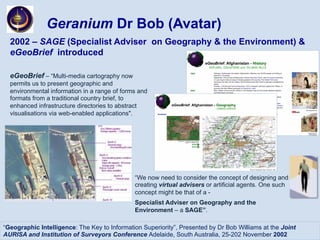
eGeoBrief – “Multi-media cartography now
permits us to present geographic and
environmental information in a range of forms and
formats from a traditional country brief, to
enhanced infrastructure directories to abstract
visualisations via web-enabled applications".
Geranium Dr Bob (Avatar)
2002 – SAGE (Specialist Adviser on Geography & the Environment) &
eGeoBrief introduced
“We now need to consider the concept of designing and
creating virtual advisers or artificial agents. One such
concept might be that of a -
Specialist Adviser on Geography and the
Environment – a SAGE”.
So is OIESS achievable?
We have the technology – although some initiatives
may ‘take time’ for adoption!
We have evidence that ‘visionary’ projects and
missions can be successful – ROSETTA !
We have a ‘PROUD HISTORY’ of innovation in the core
scientific disciplines of geodesy and cartography and
core technologies of surveying and mapping.
It’s time to embark on another
Voyage of Discovery!
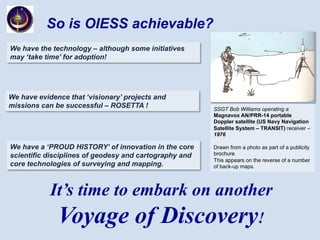
SSGT Bob Williams operating a
Magnavox AN/PRR-14 portable
Doppler satellite (US Navy Navigation
Satellite System – TRANSIT) receiver –
1976
Drawn from a photo as part of a publicity
brochure
This appears on the reverse of a number
of back-up maps.
Robert (Bob) Williams
BA Comp Stud. (Carto major) - Canberra CAE, MSc (Cartography) – U Wisconsin, PhD – UNSW @ ADFA
Topographic surveyor (trade training), Cartographer and geospatial scientist
One of Australia’s Military Mapmakers
Videre Parare Est
“I would be happy indeed if I could leave this conference feeling that some enthusiasm
has been aroused for broadening the concept of cartography away from the relatively
simple concept of drawing maps. …
When we consider the magnitude of the [environmental] problem, the aspirations for
‘change’, the technological possibilities open to us, and our responsibilities to the people
of our world, I hope that historians will not look back and say that we missed what might
be our greatest (perhaps last) opportunity”.
I acknowledge and thank the convenor of HYDRO18,
the Australasian Hydrographic Society, for its support
and approval to share this presentation.
REFERENCES
Burrows, Kenneth (1989), “Hydrography and the Management of Geographic Information for Defence”, in Geographic
Information Systems: Defence Applications, Desmond Ball and Ross Babbage (eds), Brassey's Australia.
Williams, R.J. (1989). Analysis of Geographic Information: A Cognitive Approach, A thesis submitted for the degree of
Doctor of Philosophy, The University of New South Wales, Australian Defence Force Academy, Canberra
Williams, R.J. (2002). “Geographic Intelligence: The Key to Information Superiority”, Joint AURISA and Institution of
Surveyors Conference Adelaide, South Australia, 25 November.
Williams, R.J. (2011). “Welcome To Te Ika a Maui OIESS 2020” presented at the Spatial Sciences & Surveying Biennial
Conference 2011, Wellington, New Zealand.
QUOTES
James Cook (1774). "I had the ambition to not only go farther than man had gone before, but to go as far as it was possible
to go”. Cook’s Second Voyage.
Desmond O’Connor (1976). “For the future, I believe that cartographers should be thinking of a broadly defined concept for
the operational use of modern sensors, the full range of data processing equipment and methodology, and large scale
communication devices receiving input from space, airborne and terrestrial platforms for the purpose of carrying out surveys
of the earth’s surface, monitoring the environment, and classifying and compacting the information in environmental data
banks so that real-time or near real-time information may be provided when and where it is required” gave the Keynote
address titled ‘Meeting the Environmental Crisis’ to the Second Australian Cartographic Conference, Adelaide.
Kenneth G. Burrows (1987) “The management and coordination of geographic information is perhaps the most challenging
problem facing the Australian defence community today”, presented at the Strategic and Defence Studies Centre organised
workshop on Geographic Information Systems (GIS) on 20-21 August 1987 at the Australian National University
Ben Bova (1989). “I don't think of what I do as science fiction, I think of it as historical reports of events that haven't
happened yet”, presented in the Keynote Address “Welcome to Moonbase’ [2020] to the ASPRS/ACSM/AUTO-CARTO 9
Conference, Baltimore.
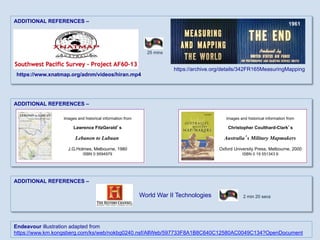
ADDITIONAL REFERENCES –
Images and historical information from
Christopher Coulthard-Clark’s
Australia’s Military Mapmakers
Oxford University Press, Melbourne, 2000
ISBN 0 19 551343 6
Images and historical information from
Lawrence FitzGerald’s
Lebanon to Labuan
J.G.Holmes, Melbourne, 1980
ISBN 0 9594979
2 min 20 secs
https://www.xnatmap.org/adnm/videos/hiran.mp4
https://archive.org/details/342FR165MeasuringMapping
25 mins
World War II Technologies
1961
Endeavour illustration adapted from
https://www.km.kongsberg.com/ks/web/nokbg0240.nsf/AllWeb/597733F8A1B8C640C12580AC0049C134?OpenDocument
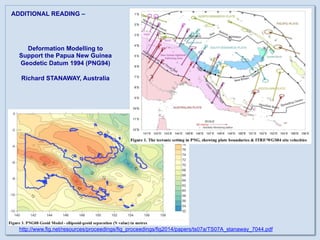
Deformation Modelling to
Support the Papua New Guinea
Geodetic Datum 1994 (PNG94)
Richard STANAWAY, Australia
ADDITIONAL READING –
http://www.fig.net/resources/proceedings/fig_proceedings/fig2014/papers/ts07a/TS07A_stanaway_7044.pdf

Back to the Future: OIESS 2025, Burrows and Rosetta

  • 1.
    BACK TO THEFUTURE: OIESS2025 - Burrows - Rosetta Dr R.J. (Bob) Williams [Retired] Cartographer Topographic Surveyor, Geographer & Geospatial Scientist 30 Oct – 1 Nov 2018 I don't think of what I do as science fiction, I think of it as historical reports of events that haven't happened yet!
  • 2.
    MANAGING EVENTS ANDINCIDENTS IN A COMPLEX ENVIRONMENT By 2025 the Oceania has become a truly complex environment: v  International trade and associated infrastructure costs have become contemporary challenges driven by very competitive markets in the region. The efficient management of the infrastructure and the protection of the infrastructure are vitally important. v  Terrorism remains a serious concern in the South-East Asia – Oceania region; concerns that include the safety of transportation. National security is a high priority for the nation’s government. v  Environmental incidents seem to have become far more extreme and more common. The past decade has witnessed devastating events that have contributed to loss of life and high financial costs. v  Climate change and sea level rise remains a major issue of concern v  Pollution of the oceans and littoral areas has reached critical importance In the year 2025
  • 3.
    Welcome to AEPCOTAT& Geranium OIESS-2025 AEPCOTAT – Australasia Experimental Prototype Community of Today and Tomorrow Garden Island OIESS-2030 Vision Burrows’ GISMO Dr Bob SAGE Avatar Endeavour Flipper Oceania Sea Eagle Cutlass ENDEAVOUR
  • 4.
    OIESS facilitates v  Interactionwith future navigation systems; v  Integration of natural disaster information; v  Command and control of incident response to national security tasks; and v  Outcomes via an advanced Geospatial Information Infrastructure. Event Recording and Replay Capability The future will require new concepts such as crewless ships The concept of an “Intelligent Q-Route” is a concept that supports safe navigation in hazardous areas. The future will require new concepts such surveillance and navigation support by unmanned underwater and airborne vehicles Geranium OIESS-2025 - Capability OIESS – Oceania Infrastructure & Environmental Support System
  • 5.
    Navigation TOPICS Environmental Protection Q912E leaving Brisbanefor 16 nights from 3 to 19 April Scenario #1 - Intelligent navigation On Tuesday 8 April 2025, Cunard’s QE2 approached Simpson Bay, Rabaul. A still active volcano greeted it with a continuous spew of ash, smoke, and small rocks. The Rabaul caldera, is a large volcano on the tip of the Gazelle Peninsula in East New Britain, Papua New Guinea. Having spent an afternoon in Simpson Bay, the QE2 then continued on its leg to Manila, Philippines seemingly incident free to the passengers on board. The issue of Safety Of Life At Sea has now reached new levels of complexity during the decade with attacks from terrorists, high-jackings, and drug trafficking activities compounding the challenges of natural events. Extreme Natural Events - Volcano
  • 6.
    The Endeavour isthe Geranium OIESS’s deployable asset and has a range of highly advanced capabilities. These include: v  Cutlass - a ‘drone’ with sensors capable of measuring gasses and soils that enable the on-board Incident Response Cell to determine ‘safety’ for the tourists; v  Flipper - an unmanned underwater vehicle with a range of sensors to assist in navigation. Scenario #1 - Geranium assets PNT [Position / Navigation / Timing] Multi-Level Security OIESS Contribution to a Secure World Cutlass has a truly unique capability that is required for this voyage by QE2. Cyber-terrorists have disrupted and disabled GPS and, subsequently, precision navigation using space- based systems. However, during the preceding decade hydrographers have modified existing lighthouses throughout the archipelago with geodetic accuracy. Cutlass is then able to calculate a ‘Q-route’ and escort/pilot QE2 safely. Another of Geranium’s assets is access to the highly classified Oceania Sea Eagle which monitors maritime traffic of all types as well as on- shore weapons of terrorist groups. OIESS Sea Eagle Cutlass Endeavour Flipper
  • 7.
    Scenario #2 -Environment management Earlier in the year, ‘Geranium’ trialed another of AEPCOTAT’s experimental systems; a system that integrated a range of geographic and environmental features with the vision of ‘modelling the reality of a complex environment’- a virtual world – a maritime view. The initiative observed that: v  With the advent of autonomous vessels came the need to more precisely measure the shape of the Earth suitable (along with measures of trust) for navigation of autonomous logistics vessels, as for example, through complex Great Barrier Reef waters and passages; and v  With increasing awareness for the need to monitor the marine and littoral environment came the need to model and map a complex multi-dimensional spatial and temporal world that is continuously changing. The trial can now be ‘replayed’ using a multi-media presentation. The trial area is Hydrographer’s Passage. This passage was discovered and charted in 1981 by Bond – James Bond – Commander James Bond. The Hydrographer’s Passage was 250 miles shorter than the previous route from Hay Point through the Reef and onto Asia. Navigation TOPICS Climate Change Hydrography Oceanography Meteorology Maschke Shoal
  • 8.
    # Scenario #2 –Environmental data management The autonomous under-water ‘drone’ Flipper glided through the waters on a pre-programmed route displaying a multi-dimensional representation of a ‘living’ environment. The coral formations are displayed as life-like representations of the actual formations; in much the same way that landforms and vegetation are mapped in the topographic domain. STEM (Science, Technology, Engineering, Mathematics) MC&G (Mapping, Charting & Geodesy) Ontology (Feature and Attribute Coding) The facility within OIESS that manages this vast amount of environmental information is named Burrows’ GISMO (General Integrated Survey Model of the Ocean). These representations were achieved by attributing new generation LADS2020 data points with imagery and sensor information obtained by research divers and underwater ‘drones’. In addition, a range of environmental characteristics including water temperature, currents, turbidity, and salinity were superimposed using transparent ‘dot point clouds’. http://www.qm.qld.gov.au/microsites/biodiscovery/index.html #
  • 9.
    Oceanography includes: ² global andcoastal sea surface temperatures ² climatological layers of temperature, salinity and sound speed ² tidal variations and currents, sea surface isotherms, etc Hydrography includes maritime features such as: ² Continental coastlines ² Islands, islets and exposed rocks ² Reefs and ledges ² Submerged rocks and wrecks ² Foreshore, marine flats and swamps ² Straits, channels and passages, etc Meteorology includes: ² Climate and weather, temperatures &rainfall ² Atmosphere ² Cloud, fog and precipitation, etc Sea infrastructure includes: ² Ports and harbours, etc ² Channels incl buoys, beacons, critical depths ² Wharves, docks, jetties, landings, etc ² Passenger terminals ² Cargo handling facilities, etc ² Dry-dock and maintenance facilities, etc ² Navigable rivers and canals including locks ² Marine navigation aids, lighthouses, etc ² Marinas, anchorages, etc. Environmental & Geographic Information includes: Scenario #2- Environmental data management - Burrows GISMO “The management and coordination of geographic information is perhaps the most challenging problem facing the Australian defence community today”. (Kenneth G. Burrows, 1987) The Domain of Geographic and Environmental Information
  • 10.
    Meeting the NationalSecurity Crisis - Contemporary Threats to Security Border Security Illegal immigration Critical Infrastructure Protection National icons Communication networks Financial institutions … … … Environmental Degradation Pollution … … Health & Medical Burns and injuries … … … Border Security Illegal fishing Homeland Security Narcotics and crime Natural Disasters Fire, flood, weather Earthquake etc Homeland Security Pandemic diseases Border Security People smuggling Critical Infrastructure Protection Transportation networks Logistics facilities … … … Transnational Crime Weapons of mass destruction
  • 11.
    Every place hasLOCATION … Every event and every incident happens at a LOCATION and … Every event and every incident has a temporal component (TIME) … Every thing is related in TIME and SPACE. The World is a complex entity: q  Its built environment is continually growing and decaying. q  Its natural environment is in perpetual change. The challenges in protecting our World from both man-made and natural events are daunting. AEPCOTAT & Geranium OIESS-2025 Were developed as a Geospatial Information Infrastructure through a Capability development process. The Shape of Earth A GEOID The Shape of Earth Geoidal separation The Shape of Earth Lombok earthquake The Shape of Earth Plate tectonics Elevation is exaggerated
  • 12.
    Geranium OIESS v  ACommand Support Infrastructure Resources Coordination of: agency collaboration emergency services integrated communications asset management Intelligence Collaboration with: national security agencies maritime agencies aeronautical agencies emergency management agencies Higher Authority Surveillance & Monitoring NOAA photo Support for: natural disasters incidents and events terrorist activities illegal fishing illegal migration Coordination Consider OIESS as being within a next-generation NATIONAL DISASTER ORGANISATION [NDO] OIESS Support for: navigation terrorist emergencies maritime search and rescue multi-agency disaster relief illegal fishing illegal immigration integrated communications
  • 13.
    Photogrammetry Remote sensing Cartography INFORMATION PRODUCTION DATAACQUISITION Information Management & Dissemination Geodetic surveying Satellite and airborne surveying Hydrographic surveying Remote sensing Photogrammetry Cartography POLICY, DOCTRINE & MANAGEMENT “A Geospatial Information Infrastructure provides information about the world and is vital ² in supporting the development of our nation and the region, and ² in defending our nation and its people” Imagery analysts Geospatial analysts OIESS Readiness assessment Geospatial Information Infrastructure v  OIESS as a User Requirements’ system Needs assessment
  • 14.
    Reasoning and advice forsituation awareness and response options Geospatial and imagery databases, products and services structured for use in C3ISR systems, smart navigation systems, and facilities / asset management systems Geospatial reasoning for terrain modelling, environmental analysis, site selection, sensor management, asset and fleet management, and mission planning and rehearsal View View Gives View Processing for •  Terrain Visualisation •  Network Analysis Analysis for •  Mission Planning •  Avenues of Approach Datasets for • Terrain Analysis • Transport & Logistics e.g. ACTIVITY •  Evacuation planning PURPOSE •  Operational planning and rehearsal ANALYST viewpoint AGENCY viewpoint CSS viewpoint Gives Gives Contingency support plans Operational orders Response Options Risk assessment Capability development for operational planning, modelling and simulation, rehearsal and operation educate influence information knowledge EVACUATION PLANNING AEPCOTAT & Geranium OIESS v  Evolution from manual planning to analytical geospatial & temporal reasoning A H O Agency function of acquisition, compilation and production of geospatial information and imagery products to populate a geospatial information infrastructure GII&S Infrastructure OIESS Maritime INT
  • 15.
    Can such a‘paradigm shift’ be made to address 2025 vision and beyond … ? THE ROSETTA MISSION November 12, 2014 WELCOME TO A COMET Photo: ESA We've turned science fiction into science fact today. This is a big step for human civilisation ESA’s Director General Jean-Jacques Dordain Our ambitious Rosetta mission has secured another place in the history books Warwick Holmes told ABC from the ESA's operations centre in Darmstady, Germany. BACK TO THE FUTURE – Ben Bova 1989 “I don't think of what I do as science fiction, I think of it as historical reports of events that haven't happened yet” Ben Bova# presented the Keynote Address “Welcome to Moonbase’ [2020] to the ASPRS/ACSM/AUTO- CARTO 9 Conference, Baltimore
  • 16.
    THE ROSETTA MISSION– Rosetta’s WORLD January 20, 2014 Date: 27 March 2014 Satellite: Rosetta Depicts: Star field with comet 67P/ Churyumov-Gerasimenko Photo: ESA March 2, 2004 – Spacecraft launched from Guiana Space Centre June 8 2011 — The spacecraft was “put asleep” January 20, 2014 – The spacecraft “woke up” and greets the Earth with a “hello world” message. Rosetta now navigates by the stars using a kind of small telescope. To prevent Rosetta from losing its way, smart software was developed to reliably recognise constellations for navigation purposes even when there is major interference from dust particles. September 10, 2014 — Rosetta enters the Global Mapping Phase, orbiting 67/C-G at an altitude of 29 km (18 mi) "I had the ambition to not only go farther than man had gone before, but to go as far as it was possible to go.” Cook’s Second Voyage 1774 The Endeavour was not only on a voyage of discovery. It was also a laboratory for testing the latest theories and technologies, much as spaceships are today. BACK TO THE FUTURE – James Cook 1768-71 Voyages of Discovery James Cook portrait by Nathaniel Dance, c.1775, National Maritime Museum, Greenwich
  • 17.
    THE ROSETTA MISSION– Philae’s WORLD November 12, 2014 As PHILAE approached Comet 67P/ Churyumov-Gerasimenko on 12 November 2014, the lander's downward-looking camera ROLIS (ROsetta Lander Imaging System) took images of the descent. Francois Hollande enjoying a 3D presentation about the mission at the Cite des Sciences in Paris Credit: ESA/Rosetta/Philae/ROLIS/DLR BACK TO THE FUTURE – RA Survey 1985 603. A more profound area of application is expected in the field of airborne navigation systems. It will include both military and civilian aircraft, particularly low-flying manned and unmanned weapon systems. In all these cases, DTMs will afford real time information about the terrain below and the effects of distant terrain on the aircraft whether it is using terrain matching for navigation or making use of natural cover to avoid enemy detection. Royal Australian Survey Corps, Digital Terrain Modelling: An Overview, 15 April 1985 Mount Macedon, VIC Elevation model produced in 1985 Manned and Unmanned Vehicles – A Big Idea!
  • 18.
    THE ROSETTA MISSION– Philae’s WORLD November 12, 2014 BACK TO THE FUTURE – RA Survey 1981 Terrain Matching Navigation The Terrain Contour Matching (TERCOM) guidance system provides position data by measuring and comparing actual terrain profiles with the digitally stored relative terrain elevations along the mission route. TERCOM assists with the flight navigation and target positioning weapons. Royal Australian Survey Corps Future Tactical Applications of the Digital Topographic Database AUTOMAP Fourth Edition, December 1981 DSVY-A/DEF/MISC/5157D USA DMA BACK TO THE FUTURE – RA Survey 1950s-60s Anaglyphs UK Military Survey The Royal Australian Survey Corps (RASVY) had a long time association with UK MILSVY and used the same equipment until 1966 when the WILD B8 stereo-plotters (right) were introduced into service. This analog stereo- photogrammetric equipment uses sophisticated optics. During the 1950s and 1960s UK Military Survey (MILSVY) used the Multiplex stereo-plotter (right). This equipment projects anaglyphs.
  • 19.
    THE ROSETTA MISSION– Ptolemy’s WORLD November 20, 2014 PTOLEMY is the first example of a new concept in space instrumentation, which has been devised to tackle the analytical challenge of making in situ isotopic measurements of solar system bodies. The instrument concept is termed 'MODULUS' which is taken to mean Methods Of Determining and Understanding Light elements from Unequivocal Stable isotope compositions. The scientific goal of the MODULUS concept is to understand the geochemistry of light elements, such as hydrogen, carbon, nitrogen and oxygen, by determining their nature, distribution and stable isotopic compositions. BACK TO THE FUTURE – Ptolemy C.150 AD CLAUDIUS PTOLEMY was an ancient Hellenistic mathematician, geographer, astronomer, and astrologer. Ptolemy defined GEOGRAPHY as “a graphic representation of the whole known part of the world, along with the things occurring in it”. Ptolemy later defined Chorography as the study of its smaller parts--provinces, regions, cities, or ports. Ptolemy implicitly would include the making of views (not simply maps of small regions) in this category, since he claims that chorography requires the skills of a draftsman or artist rather than those of a scientist, which are needed for the practice of geography. The term chorography fell out of use in the Renaissance as city views and maps became more and more sophisticated and required a set of skills that required not only skilled draftsmanship but also some knowledge of scientific surveying. The term was replaced by CARTOGRAPHY.
  • 20.
    THE ROSETTA MISSION– OSIRIS January 22, 2015 Rosetta is revealing its host comet as having a remarkable array of surface features and with many processes contributing to its activity, painting a complex picture of its evolution. GETTING TO KNOW ROSETTA’S COMET The OSIRIS (Optical, Spectrocopic and Infrared Remote Imaging System) scientific camera imaged the surface of the comet. The scientists identified 19 regions separated by distinct boundaries and grouped according to the type of terrain dominant within. BACK TO THE FUTURE – CSIRO 1970s & RASVY 1978 Terrain Pattern Maps for Planning CSIRO TERRAIN PATTERN MAP Digitised by Bob Williams 1978 SHOALWATER BAY AREA - QUEENSLAND During the period December 1978 – February 1979 (then) SSGT Bob Williams, a member of the Royal Australian Survey Corps (RASVY), worked in collaboration with the Directorate of Engineers – Army, the Joint Exercise Planning Staff (JEPS), and Dr Joe Walker and his staff at CSIRO’s Division of Land Use Research to digitize terrain pattern maps compiled by CSIRO and using software written by CSIRO’s Bruce Cook to form the basis of Trafficability Overprints for the Shoalwater Bay Training Map.
  • 21.
    THE ROSETTA MISSION– Rosetta and Philae Voyage of Discovery – The Search for Knowledge The Philae obelisk is one of two obelisks found in upper Egypt in 1815. The inscriptions on it are in Egyptian hieroglyphs and in ancient Greek. The obelisk, in keeping with its bilingual nature and the "translation" metaphor of the Rosetta space mission, gives its name to the mission Philae robotic lander. The European Space Agency's unprecedented mission of cometary exploration is named after the famous 'Rosetta Stone'. This slab of volcanic basalt - now in the British Museum in London – was the key to unravelling the civilisation of ancient Egypt. “So! The Pharaohs, the tombs, the monuments, the great civilisation who built them – you’re not interested in them. But, the mummy’s curse you find …” Granddaughter: “Exciting!” Grandfather: “Ah yes! I can see that. Alright then. You shall hear all about it. But, first we must take a trip together”. Granddaughter: “Where will we start then?” Grandfather: “At the source of course!” The greatness of the Egyptian civilisation came about by the Egyptians’ ability to manage their environment and to build their infrastructure. This required “knowledge”: q  knowledge of astronomy, q  knowledge of geometry, q  knowledge of mathematics, q  knowledge of engineering and q  knowledge of organisation. BACK TO THE FUTURE – Knowledge! 1 min 40 secs 1 min 15 secs
  • 22.
    “The search for“origins” in the history of technology is often disappointing. Each origin uncovers some predecessors vanishing into the mists. More importantly, the distinct competitors turn out to be much more entwined than imagined. This paper will describe the community into which automated cartography emerged. Being “first” is only something that is apparent in retrospect. It makes sense to remember a bit more about the pre-history of geographic information systems, not just to get the history right, but to understand how the events of prior periods influence the way the technology develops”. Nick Chrisman is author of CHARTING THE UNKNOWN: How Computer Mapping at Harvard Became GIS. This book presents a history of GIS technology that takes readers back more than four decades to the Harvard Laboratory for Computer Graphics and Spatial Analysis, where a variety of professionals converged to rethink thematic mapping, spatial analysis, and what we now call GIS. Lavishly illustrated, this book explores some of the themes addressed by this fertile interdisciplinary collaboration. The Rosetta mission demonstrates an interesting concept - the ‘search for origins’. Now, with a vision for 2025 for Geranium OIESS, it is worth reviewing our heritage.
  • 23.
    1770 Lieutenant JamesCOOK, Royal Navy Cook used his knowledge and skills of topographic surveying by plane-table for surveying parts of the east coast. For 113 years, much of mapping, mainly for exploration, settlement and development, was conducted by Naval and Military officers including: v  Lieutenant John OXLEY, Royal Navy – 3rd Surveyor-General v  Lieutenant-Colonel Sir Thomas MITHCHELL, 4th Surveyor-General v  Captain Matthew FLINDERS, Royal Navy v  Lieutenant William DAWES, Royal Marines v  Lieutenant Philip KING, Royal Navy v  Captain Charles STURT v  Colonel William LIGHT 1787 Augustus ALT, Surveyor of Lands and in 1788 appointed 1st Surveyor-General. A Proud Heritage Plane table mapping HMB Endeavour Cook was well provided with some of the best instruments available for astronomical observation and surveying. They were made by the leading mathematical instrument makers of the day . There are records of the instruments which were carried on the Pacific voyages and these show that apart from the usual instruments (quadrants, sextants and compasses) a theodolite, Günter's chain and a plane table were included, indicating that Cook was equipped for trigonometrical surveys similar to these he carried out in Newfoundland. However, he had few opportunities for this method of survey in the Pacific and it was only used for the charting of a few harbours, and some short sections of adjacent coast.
  • 24.
    During 1923 amap of Western Port Bay in Victoria, which used RAAF aerial photographs to supplement a ground trigonometrical survey, was produced by the Navy’s Hydrographic Branch. The success of this venture was regarded as very encouraging, since the final map produced depicted useful information that could hardly have been obtained except by this means, particularly with regard to showing coastline and groups of small islands adjacent to the coast. The same principle was applied to mapping the Great Barrier Reef, an outcome that gave rise to a notable joint venture between the RAAF and RAN. 1920 HMAS GERANIUM was commissioned in 1920 as the first RAN survey ship, remaining until 1927. In 1924 she was fitted with a Fairey 111D seaplane and so began a tradition of air support to survey operations which continues to this day. A Proud Heritage 1930 Australian Hydrographic Office was established at Garden Island, Sydney after first being established in Melbourne in 1920. 1923 1924 HMAS GERANIUM was used in a survey of the Great Barrier Reef. This marked the first time an aircraft embarked on a RAN vessel for survey work.
  • 25.
    1946 In 1946 and1947 Colonel Lawrence FitzGerald attended important conferences in London including a Commonwealth Survey Officers Conference. At an Anglo-American conference on military map and air chart policy, the two powers agreed to each accept particular responsibility for map production for half the world. Now Britain was asking its dominions to accept a further subdivision of its share. Australia was invited to accept the Netherlands East Indies as an area of primary interest. A Proud Heritage – A Post-War Imperative A LONG HISTORY OF INNOVATION – For example, in the mid-1950s a survey operation was underway, that of the Southwest Pacific Survey. The aim of that survey was to establish the principal islands of the Southwest Pacific area on a common geodetic datum including connecting New Guinea and the adjacent islands to the geodetic network on the mainland of Australia. The project was accomplished by aerial electronic survey, specifically HIRAN, and ship - shore operations. The measurement of very long lines, in the order of 750km, meeting surveying accuracies, came from the World War II uses of radar for precision bombing and navigation. HIRAN was an electro-distance measuring system (HIgh frequency RAnging and Navigation). BRIG FitzGerald, OBE FitzGerald explained to the Congress of the Australian and New Zealand Association for the Advancement of Science held in Adelaide in 1946, considerable interest was being taken in recent developments in the application of radar to surveying. USAF Project 60-13
  • 26.
    v  Surveying andmapping in Papua New Guinea 1954-1994 DCP – INDONESIA MANDUA GADING 1 GADING 2 GADING 3 GADING 4 GADING 5 CENDERAWASIH 76 CENDERAWASIH 77 CENDERAWASIH 78 PATTIMURA 79 PATTIMURA 80 CENDERAWASIH 80 CENDERAWASIH 81 PATTIMURA 81 NUSA TIMUR 82 NUSA TIMUR 83 NUSA BARAT 84 Airborne profile recording 1963 Aerodist distance measurement 1967 Doppler satellite measurement 1974 ‘Skai Piksa’ photography 1973 Laser terrain profiling 1974 Semi-direct compilation (computer assistance) 1973 GPS surveying 1989 1954 Commencing in 1954, the Royal Australian Survey Corps (RASVY) was involved in surveys and mapping the New Guinea area. A Proud Heritage-Defence Cooperation Program The 1956 survey (Project CUTLASS) of ship - shore triangulation included a 300 kilometre chain traverse on New Ireland.
  • 27.
    Under the DCP,RASVY completed many cooperative and collaborative projects with nations in Australia’s area of strategic interest. These projects included: v  ground surveys, and definition of geodetic datums, v  air photography, and mapping, and charting v  assistance with definition of Exclusive Economic Zones, v  provision of equipment and technology transfer and v  training of officers and technicians. 1970-92 A Proud Heritage-Defence Cooperation Program Projects commenced in 1970 in Indonesia and expanded over 25 years to include: v  Solomon Islands, Fiji, Tonga, Cook Islands, Kiribati, Nauru, Tuvalu, Vanuatu , Western Samoa. Technical Advisers were posted to national survey and mapping organisations in: v  Fiji, Indonesia, Malaysia, Papua New Guinea, Solomon Islands and Vanuatu. All field survey operations outside Australia, and indeed in Australia, would not have been possible without essential support of most other Army Corps (Engineers; Signals; Aviation [Cessna, Porter, Sioux, Kiowa]; Chaplains; Medical; Dentist; Transport; Ordnance; Electrical and Mechanical Engineers; Pay; Catering; Service); the Royal Australian Navy (Hydrographic Service [Landing craft, Patrol boats]); and, at times, the Royal New Zealand Navy (Hydrographic Service); the Royal Australian Air Force [Canberra, Hercules, Caribou, Iroquois]; and civil charter fixed wing and helicopters for aerial survey work and transport. Two members of the Australian Defence Force died on military survey operations in the 1970s in Papua New Guinea and in Indonesia. Army Survey’s DCP activity came to an abrupt end in 1995 !
  • 28.
    Vision Applied Research Basic Research Engineering Operational Applications 1947 A Strategic Requirement 1943 AirProfile Recorder 1970 An Airborne Laser Terrain Profiler 1962 Laser Research 1963 Radar airborne profiling (in PNG) 1962 WREMAPS I – Division of National Mapping Early 1990s Tenix LADS Late 1990s RAN HS Commercial applications Worldwide 1957 EDM (Tellurometer) 1940 1950 1960 1970 1980 1990 2000 2010 2020 1960 GPS: A Timeline 2000 Maptek iSite 2004 SKM 3D Laser 2006 New Strategic Requirements q  Autonomous operations q  Location-based services q  etc 1957- 96 RASVY: A Timeline 1985 DTM – The Future 1987-89 Maritime Intelligence 1972 RAN HS request We’re breaking new ground,’ said Penny in 1984. ‘We had a capability that no- one else in the world had’ 1962 A Proud Heritage - LADS timeline In 1972, the Royal Australian Navy came to Mike Penny and his team at DSTO’s Electronics Research Laboratory in Adelaide with a question. Could the airborne laser techniques which Penny’s group had been successfully using to map ground profiles for Army Survey and the civil Division of National Mapping be used to speed up hydrographic surveys?
  • 29.
    … For thefuture, I believe that cartographers should be thinking of a broadly defined concept for the operational use of modern sensors, the full range of data processing equipment and methodology, and large scale communication devices receiving input from space, airborne and terrestrial platforms for the purpose of carrying out surveys of the earth’s surface, monitoring the environment, and classifying and compacting the information in environmental data banks so that real-time or near real-time information may be provided when and where it is required”. Professor Desmond O’Connor, Foundation Professor of Environmental Studies, Murdoch University gave the Keynote Address to the Second Australian Cartographic Conference, Adelaide in 1976 titled ‘Meeting the Environmental Crisis’. A Proud Heritage – Visionary – Desmond O’Connor 1976 Meeting the Environmental Crisis – Keynote Address – Aust. Cartographic Conference…
  • 30.
    A Proud Heritage– CSIRO – BRIAN 1980-85 Barrier Reef Image Analysis Network– Remote Sensing The Great Barrier Reef Project arose when the Great Barrier Reef Marine Park Authority (GBRMPA) sought the advice of CSIRO to help them solve a problem to create a zoning plan for the whole reef. They wished to know if satellite based remote sensing could help. The remote sensing group in CSIRO Land Use Research concluded that it was feasible and then set about making it happen. Collaboratively, CSIRO and GBRMPA defined useful information for the GBRMPA database, based on remote sensing, to help create the zoning plan and the Australian Survey Office (ASO) implemented it. The research comprised three aspects: v  the development of effective image processing methods and a computer software system called 'BRIAN' (which had special application to mapping coral reefs) v  the application of the technology to the survey of the Great Barrier Reef of Australia with GBRMPA and ASO v  the development of the microcomputer version of the BRIAN software called microBRIAN which was commercialised in 1985 by MicroProcessor Applications (MPA) in Melbourne.
  • 31.
    The Strategic andDefence Studies Centre organised a two-day workshop on Geographic Information Systems (GIS) on 20-21 August 1987 at the Australian National University. The Digital Hydrographic Data Base had its conceptual origins in the early 1980s as the brainchild of Mr Burrows. Burrow’s concept of a General Integrated Survey Model of the Ocean, or GISMO, was well ahead of its time and well ahead of the technology of the day. Burrows was awarded OAM for services to marine cartography in 1993. “The management and coordination of geographic information is perhaps the most challenging problem facing the Australian defence community today”. Hydrography and the Management of Geographic Information for Defence Kenneth G. Burrows Nature of Hydrographic Information Maritime Intelligence Laser Airborne Depth Sounder (LADS) Electronic Chart Display and Information System (ECDIS) General Integrated Survey Model of the Ocean (GISMO) Proceedings were published in Desmond Ball and Ross Babbage (eds), Geographic Information Systems: Defence Applications, Brassey's Australia, 1989. A Proud Heritage – Visionary – Kenneth Burrows 1987
  • 32.
    In1989 Seatrans becamea partner in the Norwegian project called "The Seatrans project" working together with the Norwegian Hydrographic Service, Kongsberg Maritime and C-MAP on the development of ECDIS (Electronic Chart Display and Information System). Since then Seatrans has considered vector charts and the anti-grounding features provided by them as a mandatory tool onboard all vessels. 12 minutes A Proud Heritage – Seatrans Project – 1989 - 90 1989 Additional reading: Robert Sandvik, “Updating The Electronic Chart — The Seatrans Project”, International Hydrographic Review, Monaco, LXVII(2), July 1990 https://journals.lib.unb.ca/index.php/ihr/article/download/23302/27077
  • 33.
    In the early1990s, Hydrographic Sciences Australia developed a prototype ECDIS (Electronic Chart Display and Information System) in collaboration with the RAN Hydrographic Office. In collaboration with the RAN Hydrographic Office, the HSA system was demonstrated to Defence personnel on Sydney Harbour in 1993. In October 1994 the demonstration (this time on Melbourne’s Port Phillip Bay and Yarra River) in the video at right was shown on the ABC’s QUANTUM program. This followed a segment on QUANTUM in 1993 on electronic navigation charts. A Proud Heritage – ECDIS 1993 7 min 30 sec
  • 34.
    A Proud Heritage– EGICS (Environmental & Geographic Information Capability Study) 1997 In March 1995, the Australian Defence Organisation’s Concepts and Capabilities Committee (CCC) endorsed the Capability Analysis Plan (CAP) which provides a basis for the planning and conduct of major capabilities analyses. The CAP provides for a study of Environmental and Geographic Information to be undertaken in 1996/97. The Goal of EGICS was to offer a strategy to progress the concept of a Geospatial Information Infrastructure (GII). v The infrastructure is the collection of people, policies, doctrine, architectures, standards, education and training, and technologies necessary to create, maintain, and utilise a shared geospatial framework. v The infrastructure should enable development of an infrastructure that transitions from, essentially, a paper-based capability to an architecture that provides information and services across the portfolio: a service that provides the right information to the appropriate user in the appropriate timeframe. EGICS was suspended in May 1997 due to the intervention of the Defence Reform Program 1997
  • 35.
    Capability Development includesConcepts of Operation with associated Tasks e.g. CONCEPTS OF OPERATION could include: q  Maritime Patrol and Response q  Detecting and Defeating Incursions onto Australian Territory and Protecting Assets and Infrastructure q  Contribution to the National Response to Incidents in the South Pacific Securing Oceania’s maritime approaches for the safe passage of shipping is a vital security requirement. In addition to a traditional role of security against military attack, there are needs for a range of nontraditional threats, including illegal entry of people, the smuggling of drugs or other contraband, unlicensed foreign fishing activity, disease, and in a worst case scenario, the entry of terrorists. CONCEPT of OPERATION Protection of Shipping and Offshore Territories, Assets and Resources EGICS – A Maritime Perspective (OIESS – Capability Development Process) HYDROGRAPHIC AND OCEANOGRAPHIC CHALLENGES q  Measuring the shape of the South-West Pacific regions q  Monitoring the quality of the region’s ocean and littoral zone
  • 36.
    CONCEPT of OPERATION Protectionof Shipping and Offshore Territories, Assets and Resources Monitor Oceanographic State Monitor Meteorological State Monitor Shipping and Routes Respond to Incidents TASKS SYSTEM Platform B OIESS (Oceania Infrastructure and Environmental Support System ) GENERAL REQUIREMENT Environmental Data Logistic Support Information Infrastructure SPECIFIC REQUIREMENT Hydrography Oceanography Meteorology EGICS – A Maritime Perspective (OIESS – Capability Development Process)
  • 37.
    Meteorological Forecast Data MeteorologicalClimatological Statistics Data Water Turbidity and Visibility Data Tidal Heights Prediction Data Tidal Stream and Current Data Sound Velocity Profiles Data Marine Biological Noise Data Seabed Data Current and Surge Data Environmental Data Civilian Stores/Repair & Maintenance Workshop & Repair Facilities Communications National Telecommunications Local Facilities Civil Maritime Communications Other Govt Dept Communications Defence Data Networks Transport Railways Roads Ships - Australian Major Transport Operations Transport Systems - National Resources & Utilities Water Supply Power Supply Fuel Storage & Distribution Health/Medical Airfields Airfields & Airstrips Air Movements Facilities Beaches Location Beach Surface Beach Approaches Back of Beach Terrain Beach Exits Ports & Harbours Harbours Wharfage Anchorages Lifting Appliances Fuel Water Railways Helicopter Pads Container Park Facilities Logistic Support Data EGICS – A Maritime Perspective (OIESS – Capability Development Process) Communications
  • 38.
    • Bathymetry /Bottom topography • Bottom slope • Bottom morphology (type, trafficability) • Underwater obstacles and obstructions • Beaches (composition, slope, obstacles) • Riverine (width, depth, gradient) • Land (vegetation, trafficability) • Q-Routes • Magnetic • Miscellaneous (fishing, shipping, industrial, marine life) Content Bottom characteristics Material composition category Material composition secondary Material composition underlying Physical surface characteristics BF010 MCC MCS MCU PSC 7 attributes 20 attributes Obstruction (nautical) Wreck BD070 BD180 13 attributes 2 attributes 14 attributes Route (Maritime) Swept area Maritime area FC165 FC177 FC031 incl MAC Maritime Area Category 80 values incl Dredged channel Mine danger area Anchorage (general) Oil field Seal sanctuary - Littoral Information [Example with DIGEST Features and Attributes] EGICS – A Maritime Perspective (OIESS – Capability Development Process)
  • 39.
    BB - Hydrography-Portsand Harbors BB005 US-Harbor UK-Harbour BB006 US-Harbor Complex UK-Harbour Complex BB007 Channel Edge BB010 Anchorage BB011 Anchorage (Complex Feature) BB012 Anchor Berth BB019 Anchor BB020 Berth BB021 Mooring Trot BB022 Basin BB030 Bollard BB040 Breakwater/Groyne BB041 Breakwater BB042 Mole BB043 Groin BB050 Calling-In Point BB079 Mooring/Warping Facility BB080 Dolphin BB081 Shoreline Construction BB090 US-Drydock UK-Dry Dock BB100 US-Fish Stakes UK-Fishing Stakes BB105 US-Fishing Harbor UK-Fishing Harbour BB110 Fish Traps/Fish Weirs BB111 Tunny (Tuna) Nets Area BB115 US-Gridiron UK-Gridiron/Careening Grid BB140 US-Jetty UK-Training Wall BB150 Landing Place BB151 Landing Stairs BB155 Maritime Station/Maritime Signal Station BB160 Mooring Ring BB170 US-Offshore Loading Facility UK-Single Point Mooring BB180 Oyster Bed/Mussel Bed BB190 US-Pier/Wharf/Quay UK-Pier/Wharf/Quay/Jetty BB198 Fender BB199 Floating Dock BB200 Pump Out Facility BB201 Small Craft Facility BB202 Ice Boom BB220 Ramp (Maritime) BB221 Log Ramp BB225 Rip Rap BB226 Revetment (Shore Protection) BB230 Seawall BB240 Slipway/Patent Slip BB250 Watering Place AFA 21 No Ticket Sales AFA 22 Yacht Club AFA 23 Boat Hoist AFA 24 Boat Yard AFA 25 Hotel Accommodation AFA 26 Restaurant AFA 27 Desalination facilities AFA 28 Parking Lot AFA 29 Parking for boats and trailers AFA 30 Recreational Vehicle Park AFA 31 Campground AFA 32 Sewerage pump-out station AFA 33 Emergency telephone AFA 34 Landing and launching place for boats AFA 35 Scrubbing Berth AFA 36 Picnic Area AFA 37 Mechanics Workshop AFA 38 Guard or Security Service AFA 995 None AFA 997 Unpopulated AFA 998 Not Applicable AFA Available Facilities - Facilities available at or in the near vicinity AFA 0 Unknown AFA 1 Visitors Berth AFA 2 Visitors Mooring AFA 3 Sailmaker AFA 4 Chandler AFA 5 Provisions AFA 6 Physician/Doctor AFA 7 Pharmacy/Chemist AFA 8 Drinking Water AFA 9 Fuel Station AFA 10 Electricity AFA 11 Bottle Gas/LPG AFA 12 Showers AFA 13 Launderette AFA 14 Toilets AFA 15 Post Box AFA 16 Public Telephone AFA 17 Refuse Bin AFA 18 Water Police AFA 19 Helipad AFA 20 Ticket Sales B — Hydrography BA Coastal Hydrography BB Ports and Harbors BC NAVAIDS BD Dangers/Hazards BE Depth Information BF Bottom Features BG Tide and Current Information BH Inland Water BI Miscellaneous Inland Water BJ Snow/Ice BK Oceanographic or Geophysical The Digital Geographic Information Exchange Standard (DIGEST) was developed by the Digital Geographic Information Working Group (DGIWG) to support efficient exchange of Digital Geographic Information among nations, data producers, and data users. DGIWG DIGEST FACC FACC (Feature and Attribute Coding Catalog) contains: 10 Categories 50 Sub-categories 270 Features 460 Attributes 4000 Attribute values
  • 40.
    APPLIED RESEARCH Natural Environment Infrastructure Modelling Logistics Transportation Health etc BASIC RESEARCH Geodesy& Surveying Cartography – Mapping Various Sensor Technologies Applied Mathematics & Computer Science (e.g. Artificial Intelligence) CAPABILTY DEVELOPMENT INFORMATION REQUIREMENTS Analysis of Strategic Guidance Environmental & Geographic Information Capability Studies Determination of the Scope of Geographic Information Needs Analysis SYSTEMS ENGINEERING System Design Requirements Management Project management EGICS – Capability Development (Applied Research) APPLIED RESEARCH Concept Demonstrators Prototype Development Test-beds Leading to the acquisition of new, more advanced CAPABILITY
  • 41.
    “Geographic Intelligence: TheKey to Information Superiority”, Presented by Dr Bob Williams at the Joint AURISA and Institution of Surveyors Conference Adelaide, South Australia, 25-202 November 2002 eGeoBrief – “Multi-media cartography now permits us to present geographic and environmental information in a range of forms and formats from a traditional country brief, to enhanced infrastructure directories to abstract visualisations via web-enabled applications". Geranium Dr Bob (Avatar) 2002 – SAGE (Specialist Adviser on Geography & the Environment) & eGeoBrief introduced “We now need to consider the concept of designing and creating virtual advisers or artificial agents. One such concept might be that of a - Specialist Adviser on Geography and the Environment – a SAGE”.
  • 42.
    So is OIESSachievable? We have the technology – although some initiatives may ‘take time’ for adoption! We have evidence that ‘visionary’ projects and missions can be successful – ROSETTA ! We have a ‘PROUD HISTORY’ of innovation in the core scientific disciplines of geodesy and cartography and core technologies of surveying and mapping. It’s time to embark on another Voyage of Discovery! SSGT Bob Williams operating a Magnavox AN/PRR-14 portable Doppler satellite (US Navy Navigation Satellite System – TRANSIT) receiver – 1976 Drawn from a photo as part of a publicity brochure This appears on the reverse of a number of back-up maps.
  • 43.
    Robert (Bob) Williams BAComp Stud. (Carto major) - Canberra CAE, MSc (Cartography) – U Wisconsin, PhD – UNSW @ ADFA Topographic surveyor (trade training), Cartographer and geospatial scientist One of Australia’s Military Mapmakers Videre Parare Est “I would be happy indeed if I could leave this conference feeling that some enthusiasm has been aroused for broadening the concept of cartography away from the relatively simple concept of drawing maps. … When we consider the magnitude of the [environmental] problem, the aspirations for ‘change’, the technological possibilities open to us, and our responsibilities to the people of our world, I hope that historians will not look back and say that we missed what might be our greatest (perhaps last) opportunity”.
  • 44.
    I acknowledge andthank the convenor of HYDRO18, the Australasian Hydrographic Society, for its support and approval to share this presentation.
  • 45.
    REFERENCES Burrows, Kenneth (1989),“Hydrography and the Management of Geographic Information for Defence”, in Geographic Information Systems: Defence Applications, Desmond Ball and Ross Babbage (eds), Brassey's Australia. Williams, R.J. (1989). Analysis of Geographic Information: A Cognitive Approach, A thesis submitted for the degree of Doctor of Philosophy, The University of New South Wales, Australian Defence Force Academy, Canberra Williams, R.J. (2002). “Geographic Intelligence: The Key to Information Superiority”, Joint AURISA and Institution of Surveyors Conference Adelaide, South Australia, 25 November. Williams, R.J. (2011). “Welcome To Te Ika a Maui OIESS 2020” presented at the Spatial Sciences & Surveying Biennial Conference 2011, Wellington, New Zealand. QUOTES James Cook (1774). "I had the ambition to not only go farther than man had gone before, but to go as far as it was possible to go”. Cook’s Second Voyage. Desmond O’Connor (1976). “For the future, I believe that cartographers should be thinking of a broadly defined concept for the operational use of modern sensors, the full range of data processing equipment and methodology, and large scale communication devices receiving input from space, airborne and terrestrial platforms for the purpose of carrying out surveys of the earth’s surface, monitoring the environment, and classifying and compacting the information in environmental data banks so that real-time or near real-time information may be provided when and where it is required” gave the Keynote address titled ‘Meeting the Environmental Crisis’ to the Second Australian Cartographic Conference, Adelaide. Kenneth G. Burrows (1987) “The management and coordination of geographic information is perhaps the most challenging problem facing the Australian defence community today”, presented at the Strategic and Defence Studies Centre organised workshop on Geographic Information Systems (GIS) on 20-21 August 1987 at the Australian National University Ben Bova (1989). “I don't think of what I do as science fiction, I think of it as historical reports of events that haven't happened yet”, presented in the Keynote Address “Welcome to Moonbase’ [2020] to the ASPRS/ACSM/AUTO-CARTO 9 Conference, Baltimore.
  • 46.
    ADDITIONAL REFERENCES – ADDITIONALREFERENCES – ADDITIONAL REFERENCES – Images and historical information from Christopher Coulthard-Clark’s Australia’s Military Mapmakers Oxford University Press, Melbourne, 2000 ISBN 0 19 551343 6 Images and historical information from Lawrence FitzGerald’s Lebanon to Labuan J.G.Holmes, Melbourne, 1980 ISBN 0 9594979 2 min 20 secs https://www.xnatmap.org/adnm/videos/hiran.mp4 https://archive.org/details/342FR165MeasuringMapping 25 mins World War II Technologies 1961 Endeavour illustration adapted from https://www.km.kongsberg.com/ks/web/nokbg0240.nsf/AllWeb/597733F8A1B8C640C12580AC0049C134?OpenDocument
  • 47.
    Deformation Modelling to Supportthe Papua New Guinea Geodetic Datum 1994 (PNG94) Richard STANAWAY, Australia ADDITIONAL READING – http://www.fig.net/resources/proceedings/fig_proceedings/fig2014/papers/ts07a/TS07A_stanaway_7044.pdf