
Inéov, 7th of JuneGreen IT & DC ConsolidationYannick Tricaud
AgendaGreen IT : context & foundationsGreen IT : Strategy & Prospective CG Datacenter :  The world’ s most sustainable data centerDatacenter Consolidation
Green IT / Green Computing  : Few numbersIT energy management is the analysis and management of energy demand within the information technology arena. IT energy demand accounts for approximately 2% of global energy demand, approximately the same level as aviation. IT can account for 25% of a modern office building’s energy cost.The main sources of IT energy demand are PCs and Monitors, accounting for 39% of energy use, followed by data centers and servers, accounting for 23% of energy use.Communication & Information Infrastructure (TIC) eat 13,5 % of the power in France and are responsible of 5% of CO2 footprint in the country. PC consumption of electricity increases by 5% every year. Electrical power accounts for 10 % within CIO budget. Electrical power cost over PC lifecycle is now much higher than PC purchase. PC manufacturing in China rejects 24 times more CO2 than a one year usage in France.. Average Server Utilization rate : < 6 % (even below 3% for 30 % installed into one DC) 5 à 10 % for Wintel server, 20 % for Unix, between 50 à 60 % for large systems => 20% in average for large company (IDC). DC Utilization rate : 56 % of its capability.
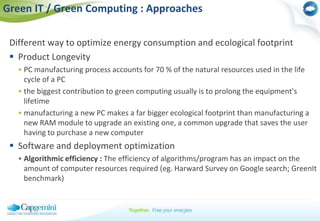
Green IT / Green Computing : ApproachesDifferent way to optimize energy consumption and ecological footprintProduct LongevityPC manufacturing process accounts for 70 % of the natural resources used in the life cycle of a PCthe biggest contribution to green computing usually is to prolong the equipment's lifetimemanufacturing a new PC makes a far bigger ecological footprintthan manufacturing a new RAM module to upgrade an existing one, a common upgrade that saves the user having to purchase a new computerSoftware and deployment optimizationAlgorithmic efficiency : The efficiency of algorithms/program has an impact on the amount of computer resources required (eg. Harward Survey on Google search; GreenIt benchmark)
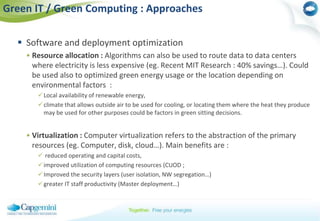
Green IT / Green Computing : ApproachesSoftware and deployment optimizationResource allocation : Algorithms can also be used to route data to data centers where electricity is less expensive (eg. Recent MIT Research : 40% savings…). Could be used also to optimized green energy usage or the location depending on environmental factors  :Local availability of renewable energy,
climate that allows outside air to be used for cooling, or locating them where the heat they produce may be used for other purposes could be factors in green sitting decisions.Virtualization : Computer virtualization refers to the abstraction of the primary resources (eg. Computer, disk, cloud…). Main benefits are :reduced operating and capital costs,
improved utilization of computing resources (CUOD ;
Improved the security layers (user isolation, NW segregation…)
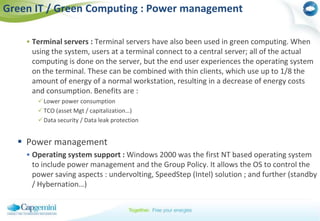
greater IT staff productivity (Master deployment…)Green IT / Green Computing : Power managementTerminal servers : Terminal servers have also been used in green computing. When using the system, users at a terminal connect to a central server; all of the actual computing is done on the server, but the end user experiences the operating system on the terminal. These can be combined with thin clients, which use up to 1/8 the amount of energy of a normal workstation, resulting in a decrease of energy costs and consumption. Benefits are : Lower power consumption
TCO (asset Mgt / capitalization…)
Data security / Data leak protectionPower managementOperating system support : Windows 2000 was the first NT based operating system to include power management and the Group Policy. It allows the OS to control the power saving aspects : undervolting, SpeedStep (Intel) solution ; and further (standby / Hybernation…)
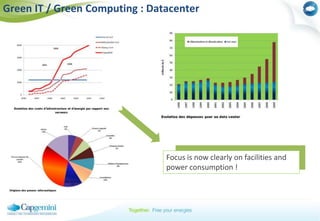
Green IT / Green Computing : Datacenter Focus is now clearly on facilities and power consumption !
Cap Gemini Merlin DC : The world’ s most sustainable data center.
What we set out to achieve: – A World Leading Data CentreSustainability –Reduce power, Reduce Water, Reduce contaminants
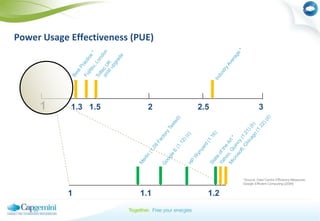
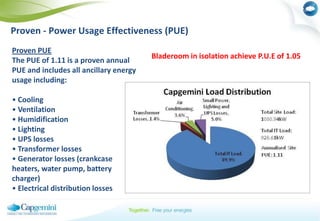
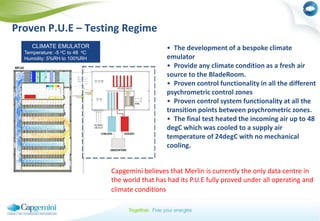
Energy Efficiency – World leading PUE
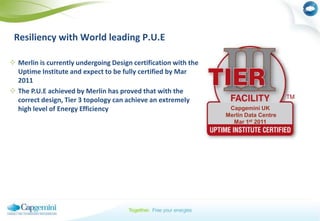
Resilient –Tier 3 Certification
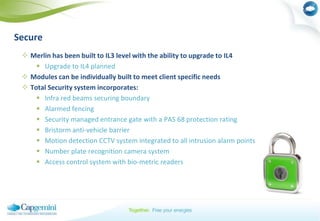
Secure –IL3 with flexibility and limited impact to change
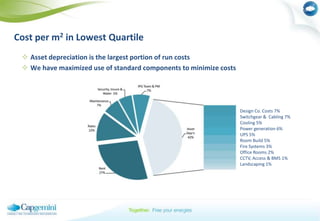
Cost per square metre in lowest quartile –Equipment choice, Asset depreciation
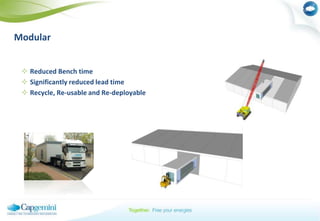
Modular –Reuse, Recycle, Redeploy
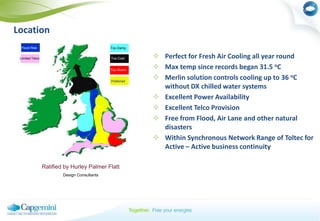
Location –Reuse an existing building, low carbon impactSustainabilityRecycling / Re-use, reduction in Embedded Carbon
Existing building
Dust, noise and other pollution associated with site works is almost entirely eliminated
Modules 100% reusable
95% is recyclable
Sustainable materials
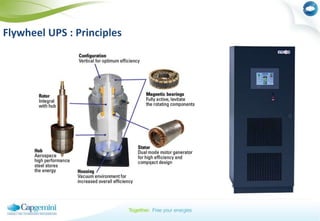
No Batteries – flywheel UPS
Merlin uses 30% less than traditional Water cooled Data centre facilities
A centralised production facility reduces transport and vehicle movements and associated CO2 emissions Energy Efficiency100% fresh air cooling (subject to record weather and emergency conditions)

B7 merlin

  • 1.
    Inéov, 7th ofJuneGreen IT & DC ConsolidationYannick Tricaud
  • 2.
    AgendaGreen IT :context & foundationsGreen IT : Strategy & Prospective CG Datacenter : The world’ s most sustainable data centerDatacenter Consolidation
  • 3.
    Green IT /Green Computing  : Few numbersIT energy management is the analysis and management of energy demand within the information technology arena. IT energy demand accounts for approximately 2% of global energy demand, approximately the same level as aviation. IT can account for 25% of a modern office building’s energy cost.The main sources of IT energy demand are PCs and Monitors, accounting for 39% of energy use, followed by data centers and servers, accounting for 23% of energy use.Communication & Information Infrastructure (TIC) eat 13,5 % of the power in France and are responsible of 5% of CO2 footprint in the country. PC consumption of electricity increases by 5% every year. Electrical power accounts for 10 % within CIO budget. Electrical power cost over PC lifecycle is now much higher than PC purchase. PC manufacturing in China rejects 24 times more CO2 than a one year usage in France.. Average Server Utilization rate : < 6 % (even below 3% for 30 % installed into one DC) 5 à 10 % for Wintel server, 20 % for Unix, between 50 à 60 % for large systems => 20% in average for large company (IDC). DC Utilization rate : 56 % of its capability.
  • 4.
    Green IT /Green Computing : ApproachesDifferent way to optimize energy consumption and ecological footprintProduct LongevityPC manufacturing process accounts for 70 % of the natural resources used in the life cycle of a PCthe biggest contribution to green computing usually is to prolong the equipment's lifetimemanufacturing a new PC makes a far bigger ecological footprintthan manufacturing a new RAM module to upgrade an existing one, a common upgrade that saves the user having to purchase a new computerSoftware and deployment optimizationAlgorithmic efficiency : The efficiency of algorithms/program has an impact on the amount of computer resources required (eg. Harward Survey on Google search; GreenIt benchmark)
  • 5.
    Green IT /Green Computing : ApproachesSoftware and deployment optimizationResource allocation : Algorithms can also be used to route data to data centers where electricity is less expensive (eg. Recent MIT Research : 40% savings…). Could be used also to optimized green energy usage or the location depending on environmental factors :Local availability of renewable energy,
  • 6.
    climate that allowsoutside air to be used for cooling, or locating them where the heat they produce may be used for other purposes could be factors in green sitting decisions.Virtualization : Computer virtualization refers to the abstraction of the primary resources (eg. Computer, disk, cloud…). Main benefits are :reduced operating and capital costs,
  • 7.
    improved utilization ofcomputing resources (CUOD ;
  • 8.
    Improved the securitylayers (user isolation, NW segregation…)
  • 9.
    greater IT staffproductivity (Master deployment…)Green IT / Green Computing : Power managementTerminal servers : Terminal servers have also been used in green computing. When using the system, users at a terminal connect to a central server; all of the actual computing is done on the server, but the end user experiences the operating system on the terminal. These can be combined with thin clients, which use up to 1/8 the amount of energy of a normal workstation, resulting in a decrease of energy costs and consumption. Benefits are : Lower power consumption
  • 10.
    TCO (asset Mgt/ capitalization…)
  • 11.
    Data security /Data leak protectionPower managementOperating system support : Windows 2000 was the first NT based operating system to include power management and the Group Policy. It allows the OS to control the power saving aspects : undervolting, SpeedStep (Intel) solution ; and further (standby / Hybernation…)
  • 12.
    Green IT /Green Computing : Datacenter Focus is now clearly on facilities and power consumption !
  • 13.
    Cap Gemini MerlinDC : The world’ s most sustainable data center.
  • 14.
    What we setout to achieve: – A World Leading Data CentreSustainability –Reduce power, Reduce Water, Reduce contaminants
  • 15.
    Energy Efficiency –World leading PUE
  • 16.
    Resilient –Tier 3Certification
  • 17.
    Secure –IL3 withflexibility and limited impact to change
  • 18.
    Cost per squaremetre in lowest quartile –Equipment choice, Asset depreciation
  • 19.
  • 20.
    Location –Reuse anexisting building, low carbon impactSustainabilityRecycling / Re-use, reduction in Embedded Carbon
  • 21.
  • 22.
    Dust, noise andother pollution associated with site works is almost entirely eliminated
  • 23.
  • 24.
  • 25.
  • 26.
    No Batteries –flywheel UPS
  • 27.
    Merlin uses 30%less than traditional Water cooled Data centre facilities
  • 28.
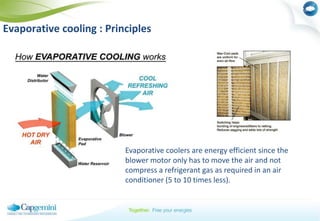
    A centralised productionfacility reduces transport and vehicle movements and associated CO2 emissions Energy Efficiency100% fresh air cooling (subject to record weather and emergency conditions)

Editor's Notes

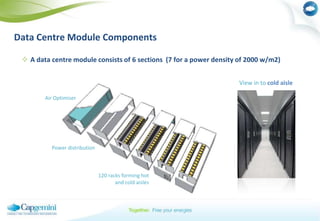
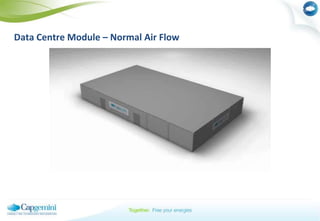
  • #11 Data centre modules are manufactured and transportedLimits environmental impact of constructionModules can be deployed and re-deployed to anywhere with power and communications – 100% reusableModules not containers! Internal space is highly configurableCareful choice of components – highly recyclableRe-use an existing buildingClose to 100% fresh air coolingA revolution on data – measurements in every corridor, aisle and rack – advanced control that regulates air conditioning without wasting fan powerHot and cold aisles cut energy loss to a minimumLess than a third of a swimming pool of water used per yearModules have very low embedded carbonSustainable materials - Flywheels not batteries
  • #12 Data centre modules are manufactured and transportedLimits environmental impact of constructionModules can be deployed and re-deployed to anywhere with power and communications – 100% reusableModules not containers! Internal space is highly configurableCareful choice of components – highly recyclableRe-use an existing buildingClose to 100% fresh air coolingA revolution on data – measurements in every corridor, aisle and rack – advanced control that regulates air conditioning without wasting fan powerHot and cold aisles cut energy loss to a minimumLess than a third of a swimming pool of water used per yearModules have very low embedded carbonSustainable materials - Flywheels not batteries
  • #13 If every datacentre in the UK was as efficient as Merlin, we would save 2300 MW of power.
  • #14 If every datacentre in the UK was as efficient as Merlin, we would save 2300 MW of power.
  • #16 Tier 3 is described generically as ‘concurrently maintainable’. This means that we are able to change every single component of the datacentre without causing any impact to the operational running.We join an exclusive club - Only one existing constructed datacentre in Europe certified as Tier 3 by the Uptime Institute (Fujitsu, North London)One additional has certified design documents (Telecommunications and Data Centre Services, UK). One in 10 Globally
  • #18 Modules are buildings with a structural guarantee of 60 years. Can be mounted outside without a building.Emphasise modules NOT containers. Containers and sea crates, built for high density, not configurable or flexible. The datacentre modules are flexible and can be configured for client needs (e.g. security)Modules can be sold to clients at the end of a deal – redeployable, reusable
  • #27 Capex is the largest element of the run cost, making up almost halfData centre modules sized to support use of standard build ‘off the shelf’ components – manufactured in large production runs at lowest costStandard parts also means faster delivery – so we can deploy new modules in 22 weeksModularity allows us to scale quickly to avoid large bench costsSome ‘fixed costs’ converted to variable – e.g. flywheels versus UPS