An Innovative Soft Ware
              for Learning to Write Tamil Lesson Plan

                                       Dr. S. K. Panneer Selvam
                               Assistant Professor, Department of Education,
                               Bharathidasan University, Tiruchirappalli,TN
                                          skpskpbdu@gmail.com


Introduction
Quality Education is indispensable for ameliorating the secondary education to stand on the platform
of globalization. It can be acquired by revamping the quality of Secondary Teacher Education through
the degree course of Bachelor of Education. Teachers are responsible facilitators for ensuring the
quality education. Teacher Education can assist to enrich the quality of teachers by implementing
innovative methods in teaching learning process. Most of the students are unable to read and write
Tamil without mistakes in Tamilnadu. Even if the Tamil is the mother-tongue of the learners, they are
unable to write correct Tamil. Parents and learners are attracted by learning English and neglect
learning Tamil language. It paves way to the learners for committing more mistakes. Errors of
learning Tamil can be rectified through effective teaching learning process. Innovative effective
method has to be investigated for easy understanding of the language. Hence innovative teaching-
learning software was prepared for error free successful learning to write Tamil lesson plan.

Need of the Study
Effective teaching is based on the planning of lesson plan which is depending upon unit plan. Writing
and preparing a lesson plan for macro-classroom is essential for a perfect teacher-trainee or in service
teacher. Most of the teacher-trainees of selecting their optional-I as Tamil at Bachelor Education level
were unable to write lesson plan in Tamil from some Educational colleges situated around the Trichy
district. Lesson plan is the skeleton of the teaching learning process. If the student-teacher is unable to
write an appropriate lesson plan for particular unit of the lesson for /poem/prose/grammar, his
teaching can not be more effective. Acquiring practice in lesson plan writing may eliminate the
problems of the teacher-trainees in teaching learning process. Learning to write Tamil lesson plan
among the teacher-trainees was identified by administering a diagnostic-test .Teacher-trainees of
Tamil scored very less mark in writing lesson plan. Hence the researcher endeavoured to prepare
innovative Software for the teacher-trainees to eliminate the problems in conventional methods of
learning to write Tamil lesson plan.

Statement of the Problem
Teacher-trainees of optional I as Tamil in Bachelor of Education have problems in writing lesson plan
in Tamil by conventional method.


                                                    65
Objectives of the study
    1.      To measure the learning hurdles in writing Tamil lesson plan.
    2.      To find out the significant difference in achievement mean score between pre-test of    control
            group and post-test of control group in learning to write Tamil lesson plan.
    3.      To find out the significant difference in achievement mean score between pre-test of
            experimental group and post –test of experimental group in learning to write Tamil lesson
            plan.
    4.      To measure the effectiveness of innovative software in learning to write Tamil lesson plan.

Hypotheses of the study
    1.      Teacher-trainees of optional I as Tamil in Bachelor of Education have problems in      writing
            lesson plan in Tamil by conventional method.
    2.      There is no significant difference in achievement mean score between pre-test of control group
            and post-test of control group in learning to write Tamil lesson plan.
    3.      There is no significant difference in achievement mean score between pre-test of experimental
            group and post-test of experimental group in learning to write Tamil lesson plan.
    4.      Innovative software is more effective than conventional methods in learning to write Tamil
            lesson plan.

Methodology

Experimental method was followed in the study.

Sample

One hundred Teacher trainees of B.Ed were selected from Indira Ganesan college of Education, Trichy
as sample for the study. Fifty Teacher-trainees were considered as Controlled group and another Fifty
Teacher-trainees were considered as Experimental group.

Tool

Researcher’s self-made criterion reference test was used as a tool for the study.

Reliability of the tool

The co-efficient correlation was found 0.78 in the tool through split-half method.

Validity of the tool

Face validity and Content validity was established for the test through expert suggestions. Hence
reliability and validity were properly established for the study. ‘t’ test was used as a statistical
technique for the study.

Procedure of the study

       1.    Problems identification by administering diagnostic test.
       2.    Preparation of innovative software and validation.
       3.     Pre-test-treatment-post-test.
       4.    Finding the effectiveness of the software.
       5.     Implementation of the study.

                                                      66
Data collection
The researcher administered a diagnostic test to identify the problems of the Teacher-trainees in
learning to write Tamil lesson plan with permission of Principal of the college. Pre-test –Treatment-
Post-test was used for the control group in conventional method. Pre- test- using the innovative
software and post -test was administered for the research.

Hypothesis testing
Alternative Hypothesis-1

Teacher-trainees of optional I as Tamil in Bachelor of Education have problems in writing lesson
plan in Tamil by conventional method.

Teacher-trainees scored 24% of marks in writing Tamil lesson plan. Seventy six percentages of teacher-
trainees committed the mistakes in writing lesson plan. It substantiates that the problems existing in
writing lesson plan among the teacher-trainees in Tamil by conventional method. Hence the Teacher-
trainees of optional I as Tamil in Bachelor of Education have problems in writing lesson plan in Tamil
by conventional method.

Null-Hypothesis-2

There is no significant difference in achievement mean score between pre-test of control group and
post-test of control group in learning to write Tamil lesson plan.

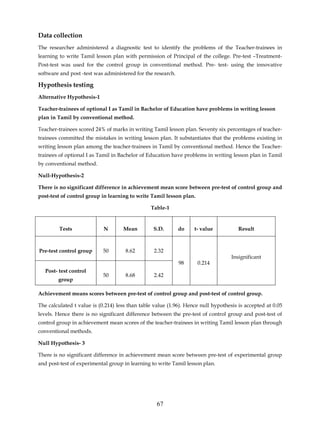
                                                Table-1


         Tests              N       Mean         S.D.        do    t- value           Result


Pre-test control group     50        8.62        2.32
                                                                                   Insignificant
                                                             98      0.214
   Post- test control
                           50        8.68        2.42
        group

Achievement means scores between pre-test of control group and post-test of control group.

The calculated t value is (0.214) less than table value (1.96). Hence null hypothesis is accepted at 0.05
levels. Hence there is no significant difference between the pre-test of control group and post-test of
control group in achievement mean scores of the teacher-trainees in writing Tamil lesson plan through
conventional methods.

Null Hypothesis- 3

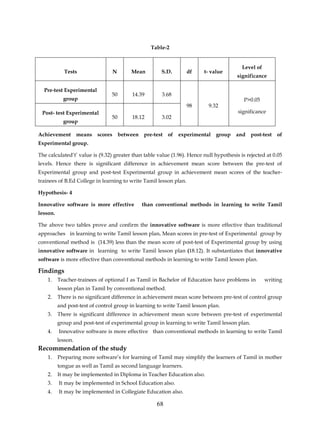
There is no significant difference in achievement mean score between pre-test of experimental group
and post-test of experimental group in learning to write Tamil lesson plan.


                                                   67
Table-2


                                                                                          Level of
            Tests                    N       Mean         S.D.      df    t- value
                                                                                        significance

  Pre-test Experimental
                                 50          14.39        3.68
            group                                                                          P>0.05
                                                                    98      9.32
 Post- test Experimental                                                                significance
                                 50          18.12        3.02
            group

Achievement         means   scores       between   pre-test of   experimental   group   and   post-test   of
Experimental group.

The calculated‘t’ value is (9.32) greater than table value (1.96). Hence null hypothesis is rejected at 0.05
levels. Hence there is significant difference in achievement mean score between the pre-test of
Experimental group and post-test Experimental group in achievement mean scores of the teacher-
trainees of B.Ed College in learning to write Tamil lesson plan.

Hypothesis- 4

Innovative software is more effective              than conventional methods in learning to write Tamil
lesson.

The above two tables prove and confirm the innovative software is more effective than traditional
approaches in learning to write Tamil lesson plan. Mean scores in pre-test of Experimental group by
conventional method is (14.39) less than the mean score of post-test of Experimental group by using
innovative software in learning to write Tamil lesson plan (18.12). It substantiates that innovative
software is more effective than conventional methods in learning to write Tamil lesson plan.

Findings
    1.    Teacher-trainees of optional I as Tamil in Bachelor of Education have problems in          writing
          lesson plan in Tamil by conventional method.
    2.    There is no significant difference in achievement mean score between pre-test of control group
          and post-test of control group in learning to write Tamil lesson plan.
    3.    There is significant difference in achievement mean score between pre-test of experimental
          group and post-test of experimental group in learning to write Tamil lesson plan.
    4.    Innovative software is more effective than conventional methods in learning to write Tamil
          lesson.
Recommendation of the study
    1.    Preparing more software’s for learning of Tamil may simplify the learners of Tamil in mother
          tongue as well as Tamil as second language learners.
    2.    It may be implemented in Diploma in Teacher Education also.
    3.    It may be implemented in School Education also.
    4.    It may be implemented in Collegiate Education also.

                                                        68
Conclusion
Like this study can eliminate the problems of the learners in all levels of education.

References
    1.   Kwok-Keung LAU(1992) On The Objectives of Teacher, Education Journal Vol. 20 No, pp. 43-
         48   by The Chinese Universityof Hong Kong Faculty of Education,
    2.   Wahab, Norshahriah and Zaman, Halimah Badioze (2007) Multimedia courseware Package
         for learning English based on learning styles (mel-e). in: ICEEI2007 Bandung, Indonesia.
    3.   Britten, J.S. and Cassady, J.C. (2005) The Technology Integration Assessment
         Instrument: Understanding Planned Use of Technology by Classroom Teachers: Computers in
         the Schools Vol. 22, No. 3/4, pp. 49-61.


                                                    69

B6 panneerselvam

  • 2.
    An Innovative SoftWare for Learning to Write Tamil Lesson Plan Dr. S. K. Panneer Selvam Assistant Professor, Department of Education, Bharathidasan University, Tiruchirappalli,TN skpskpbdu@gmail.com Introduction Quality Education is indispensable for ameliorating the secondary education to stand on the platform of globalization. It can be acquired by revamping the quality of Secondary Teacher Education through the degree course of Bachelor of Education. Teachers are responsible facilitators for ensuring the quality education. Teacher Education can assist to enrich the quality of teachers by implementing innovative methods in teaching learning process. Most of the students are unable to read and write Tamil without mistakes in Tamilnadu. Even if the Tamil is the mother-tongue of the learners, they are unable to write correct Tamil. Parents and learners are attracted by learning English and neglect learning Tamil language. It paves way to the learners for committing more mistakes. Errors of learning Tamil can be rectified through effective teaching learning process. Innovative effective method has to be investigated for easy understanding of the language. Hence innovative teaching- learning software was prepared for error free successful learning to write Tamil lesson plan. Need of the Study Effective teaching is based on the planning of lesson plan which is depending upon unit plan. Writing and preparing a lesson plan for macro-classroom is essential for a perfect teacher-trainee or in service teacher. Most of the teacher-trainees of selecting their optional-I as Tamil at Bachelor Education level were unable to write lesson plan in Tamil from some Educational colleges situated around the Trichy district. Lesson plan is the skeleton of the teaching learning process. If the student-teacher is unable to write an appropriate lesson plan for particular unit of the lesson for /poem/prose/grammar, his teaching can not be more effective. Acquiring practice in lesson plan writing may eliminate the problems of the teacher-trainees in teaching learning process. Learning to write Tamil lesson plan among the teacher-trainees was identified by administering a diagnostic-test .Teacher-trainees of Tamil scored very less mark in writing lesson plan. Hence the researcher endeavoured to prepare innovative Software for the teacher-trainees to eliminate the problems in conventional methods of learning to write Tamil lesson plan. Statement of the Problem Teacher-trainees of optional I as Tamil in Bachelor of Education have problems in writing lesson plan in Tamil by conventional method. 65
  • 3.
    Objectives of thestudy 1. To measure the learning hurdles in writing Tamil lesson plan. 2. To find out the significant difference in achievement mean score between pre-test of control group and post-test of control group in learning to write Tamil lesson plan. 3. To find out the significant difference in achievement mean score between pre-test of experimental group and post –test of experimental group in learning to write Tamil lesson plan. 4. To measure the effectiveness of innovative software in learning to write Tamil lesson plan. Hypotheses of the study 1. Teacher-trainees of optional I as Tamil in Bachelor of Education have problems in writing lesson plan in Tamil by conventional method. 2. There is no significant difference in achievement mean score between pre-test of control group and post-test of control group in learning to write Tamil lesson plan. 3. There is no significant difference in achievement mean score between pre-test of experimental group and post-test of experimental group in learning to write Tamil lesson plan. 4. Innovative software is more effective than conventional methods in learning to write Tamil lesson plan. Methodology Experimental method was followed in the study. Sample One hundred Teacher trainees of B.Ed were selected from Indira Ganesan college of Education, Trichy as sample for the study. Fifty Teacher-trainees were considered as Controlled group and another Fifty Teacher-trainees were considered as Experimental group. Tool Researcher’s self-made criterion reference test was used as a tool for the study. Reliability of the tool The co-efficient correlation was found 0.78 in the tool through split-half method. Validity of the tool Face validity and Content validity was established for the test through expert suggestions. Hence reliability and validity were properly established for the study. ‘t’ test was used as a statistical technique for the study. Procedure of the study 1. Problems identification by administering diagnostic test. 2. Preparation of innovative software and validation. 3. Pre-test-treatment-post-test. 4. Finding the effectiveness of the software. 5. Implementation of the study. 66
  • 4.
    Data collection The researcheradministered a diagnostic test to identify the problems of the Teacher-trainees in learning to write Tamil lesson plan with permission of Principal of the college. Pre-test –Treatment- Post-test was used for the control group in conventional method. Pre- test- using the innovative software and post -test was administered for the research. Hypothesis testing Alternative Hypothesis-1 Teacher-trainees of optional I as Tamil in Bachelor of Education have problems in writing lesson plan in Tamil by conventional method. Teacher-trainees scored 24% of marks in writing Tamil lesson plan. Seventy six percentages of teacher- trainees committed the mistakes in writing lesson plan. It substantiates that the problems existing in writing lesson plan among the teacher-trainees in Tamil by conventional method. Hence the Teacher- trainees of optional I as Tamil in Bachelor of Education have problems in writing lesson plan in Tamil by conventional method. Null-Hypothesis-2 There is no significant difference in achievement mean score between pre-test of control group and post-test of control group in learning to write Tamil lesson plan. Table-1 Tests N Mean S.D. do t- value Result Pre-test control group 50 8.62 2.32 Insignificant 98 0.214 Post- test control 50 8.68 2.42 group Achievement means scores between pre-test of control group and post-test of control group. The calculated t value is (0.214) less than table value (1.96). Hence null hypothesis is accepted at 0.05 levels. Hence there is no significant difference between the pre-test of control group and post-test of control group in achievement mean scores of the teacher-trainees in writing Tamil lesson plan through conventional methods. Null Hypothesis- 3 There is no significant difference in achievement mean score between pre-test of experimental group and post-test of experimental group in learning to write Tamil lesson plan. 67
  • 5.
    Table-2 Level of Tests N Mean S.D. df t- value significance Pre-test Experimental 50 14.39 3.68 group P>0.05 98 9.32 Post- test Experimental significance 50 18.12 3.02 group Achievement means scores between pre-test of experimental group and post-test of Experimental group. The calculated‘t’ value is (9.32) greater than table value (1.96). Hence null hypothesis is rejected at 0.05 levels. Hence there is significant difference in achievement mean score between the pre-test of Experimental group and post-test Experimental group in achievement mean scores of the teacher- trainees of B.Ed College in learning to write Tamil lesson plan. Hypothesis- 4 Innovative software is more effective than conventional methods in learning to write Tamil lesson. The above two tables prove and confirm the innovative software is more effective than traditional approaches in learning to write Tamil lesson plan. Mean scores in pre-test of Experimental group by conventional method is (14.39) less than the mean score of post-test of Experimental group by using innovative software in learning to write Tamil lesson plan (18.12). It substantiates that innovative software is more effective than conventional methods in learning to write Tamil lesson plan. Findings 1. Teacher-trainees of optional I as Tamil in Bachelor of Education have problems in writing lesson plan in Tamil by conventional method. 2. There is no significant difference in achievement mean score between pre-test of control group and post-test of control group in learning to write Tamil lesson plan. 3. There is significant difference in achievement mean score between pre-test of experimental group and post-test of experimental group in learning to write Tamil lesson plan. 4. Innovative software is more effective than conventional methods in learning to write Tamil lesson. Recommendation of the study 1. Preparing more software’s for learning of Tamil may simplify the learners of Tamil in mother tongue as well as Tamil as second language learners. 2. It may be implemented in Diploma in Teacher Education also. 3. It may be implemented in School Education also. 4. It may be implemented in Collegiate Education also. 68
  • 6.
    Conclusion Like this studycan eliminate the problems of the learners in all levels of education. References 1. Kwok-Keung LAU(1992) On The Objectives of Teacher, Education Journal Vol. 20 No, pp. 43- 48 by The Chinese Universityof Hong Kong Faculty of Education, 2. Wahab, Norshahriah and Zaman, Halimah Badioze (2007) Multimedia courseware Package for learning English based on learning styles (mel-e). in: ICEEI2007 Bandung, Indonesia. 3. Britten, J.S. and Cassady, J.C. (2005) The Technology Integration Assessment Instrument: Understanding Planned Use of Technology by Classroom Teachers: Computers in the Schools Vol. 22, No. 3/4, pp. 49-61. 69