Template based Multilingual Summary Generation

                       Subalalitha C.N, E.Umamaheswari, T V Geetha,
                           Ranjani Parthasarathi & Madhan Karky
                                       subalalitha@gmail.com
                                   Tamil Computing Lab (TaCoLa)
                       College of Engineering Guindy Anna University, Chennai.

Abstract

Summarization of large text documents becomes an essential task in many Natural Language
processing (NLP) applications. Certain NLP applications deal with domain specific text documents
and demand for a domain specific summary. When the essential facts are extracted specific to the
domain, the summary proves to be more efficient. The proposed system builds a bilingual summary
for an Information Retrieval (IR) system named CoRee, which tackles Tamil Language and English
Language text documents [1]. As the input documents are tourism domain specific documents, the
summary is extracted based on specially designed seven tourism specific templates 7 both for Tamil
and English. The templates are filled in with the required information extracted from the UNL
representation and a bilingual summary is generated for each text document irrespective of the
language of input text document. The efficiency of the summary has been tested manually and it has
achieved 90% efficiency. This efficiency depends on factors other than summary generation such as
enconversion accuracy and dictionary entry coverage. The proposed system can be extended for many
languages in future.
1. Introduction
Automatic summary generation has been a research problem for over 40 years [2]. Summarizing the
texts helps in avoiding information overload and also saves time. Multi lingual Natural Language
applications have emerged in great number in recent years. This makes the need for a multi lingual
summary generation a quintessential task. Alkesh patel et al have come up with a multi lingual
summary generation by using structural and statistical factors [2]. David Kirk Evans has generated
multi lingual summary using text similarities existing in the sentences [3]. Dragomir Radev et al have
developed a multi lingual summary generation tool named MEAD using centroid and query based
methods. They have also used many learning techniques such as decision trees, Support Vector
Machines (SVM) and Maximum Entropy [4].
All the   above works on multi lingual summarization have not used           a interlingua document
representation . We propose that a multi lingual summary can be generated with much more ease by
using a interlingua document representation language called, “Universal Networking Language”
(UNL) [5]. UNL converts every term present in a natural language text document into a language
independent concept, thereby making the applications built using it a language independent one. The
proposed work extracts a domain specific summary, as the UNL documents used are tourism domain
specific. Tourism specific templates are framed and the sentences fitting the templates are chosen and
formed as a summary.


                                                282
The rest of the paper is organized as follows. Section 2 gives a brief introduction about UNL. Section 3
describes the proposed summarization technique. Section 4 discusses the evaluation of the proposed
work. Section 5 reveals the enhancements needed to the proposed work and Section 6 gives the
conclusion of the paper.

2. Universal Networking Language
UNL is an intermediate language that processes knowledge across language barriers. UNL captures
the semantics of the natural language text by converting the terms present in the document to
concepts. These concepts are connected to the other concept through UNL relations . There are 46
UNL relations like plf(Place From), plt(Place To), tmf(Time from), tmt(Time to) etc [1]. This process of
converting a natural language text to UNL document is known as Enconversion and the reverse
process is known as Deconversion. The UNL document is normally represented as a graph where the
nodes are concepts and edges are UNL relations. An example UNL graph is shown for the example 1.

Example 1: John was playing in the garden .


                            john(iof>person)                   agt


                                                                       play(icl>action)
                                                   plc


                               garden(icl>place)


                                   Figure 1: UNL graph for Example 1


The nodes of graph namely, “John(iof>person)”, “Play(icl>action)” and garden(icl>place) represent
the terms John, playing and garden present in the example 1. The semantic constraints in the concepts,
“iof>person”, “icl>action” and “icl>place” denotes the context in which the concepts occur. The edges
namely, “agt” and “plc” indicates that, the concepts involved are agents and place. From the above
discussion, it is shown that the UNL inherits many semantic information from the natural language
text and portrays in a language independent fashion.

The proposed work uses Tamil language text documents and English                  language documents
enconverted to UNL for summary extraction which is described in the next section.

3. Template based Information Extraction
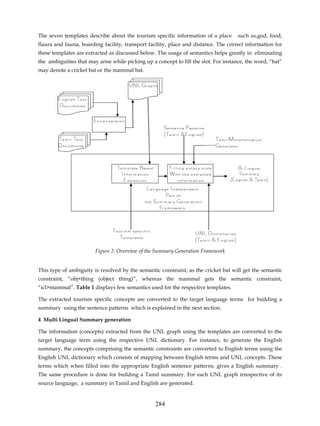
As discussed earlier, the summary is generated using the tourism specific templates. Figure 2 shows
the over view of the proposed summary generation framework. The Framework consists of both
language dependent and independent parts. The functionalities involving UNL are language
independent and the inputs supplied to the framework to generate bi lingual summary are the
language dependent parts. The bilingual summary generation is explained in the coming sections.


                                                   283
The seven templates describe about the tourism specific information of a place       such as,god, food,
flaura and fauna, boarding facility, transport facility, place and distance. The correct information for
these templates are extracted as discussed below. The usage of semantics helps greatly in eliminating
the ambiguities that may arise while picking up a concept to fill the slot. For instance, the word, “bat”
may denote a cricket bat or the mammal bat.


                        Figure 2: Overview of the Summary Generation Framework


This type of ambiguity is resolved by the semantic constraint, as the cricket bat will get the semantic
constraint, “obj<thing (object thing)”, whereas the mammal gets the semantic constraint,
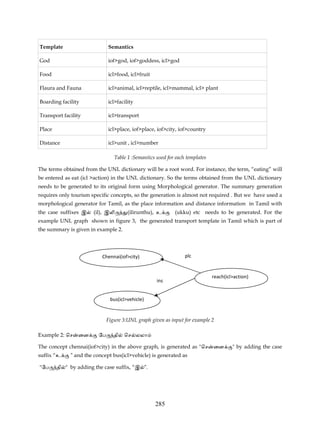
“icl>mammal”. Table 1 displays few semantics used for the respective templates.

The extracted tourism specific concepts are converted to the target language terms for building a
summary using the sentence patterns which is explained in the next section.

4 Multi Lingual Summary generation

The information (concepts) extracted from the UNL graph using the templates are converted to the
target language term using the respective UNL dictionary. For instance, to generate the English
summary, the concepts comprising the semantic constraints are converted to English terms using the
English UNL dictionary which consists of mapping between English terms and UNL concepts. These
terms which when filled into the appropriate English sentence patterns, gives a English summary .
The same procedure is done for building a Tamil summary. For each UNL graph irrespective of its
source language, a summary in Tamil and English are generated.


                                                  284
Template                      Semantics

God                           iof>god, iof>goddess, icl>god

Food                          icl>food, icl>fruit

Flaura and Fauna              icl>animal, icl>reptile, icl>mammal, icl> plant

Boarding facility             icl>facility

Transport facility            icl>transport

Place                         icl>place, iof>place, iof>city, iof>country

Distance                      icl>unit , icl>number

                                  Table 1 :Semantics used for each templates

The terms obtained from the UNL dictionary will be a root word. For instance, the term, “eating” will
be entered as eat (icl >action) in the UNL dictionary. So the terms obtained from the UNL dictionary
needs to be generated to its original form using Morphological generator. The summary generation
requires only tourism specific concepts, so the generation is almost not required . But we have used a
morphological generator for Tamil, as the place information and distance information in Tamil with
the case suffixes இ    (il), இ           (ilirunthu), உ      (ukku) etc needs to be generated. For the
example UNL graph shown in figure 3, the generated transport template in Tamil which is part of
the summary is given in example 2.


                          Chennai(iof>city)                       plc


                                                                               reach(icl>action)
                                                     ins


                                 bus(icl>vehicle)


                              Figure 3:UNL graph given as input for example 2

Example 2: ெச   ைன       ேப       தி   ெச லலா

The concept chennai(iof>city) in the above graph, is generated as "ெச          ைன       " by adding the case
suffix “உ    ” and the concept bus(icl>vehicle) is generated as

"ேப     தி " by adding the case suffix, “இ ”.


                                                    285
5. Performance Evaluation
The proposed work has been tested with 33,000 Tamil and English text documents enconverted to
UNL graphs. The performance of the methodology proposed has been evaluated using human
judgement. The accuracy of the summary generated has achieved 90% . Apart from the summary
generation factors such as tourism specific concept extraction , the accuracy also depends on the
quality of enconversion and dictionary entry. By improving these factors, the accuracy can further
be improved.

6. Conclusion and Future work
The proposed work generates a tourism specific bilingual summary using the intermediate document
representation, UNL and tourism specific templates. The bilingual summary is generated in a simple
and efficient manner compared to the earlier work done for multi lingual summary generation. The
only over head involved is developing a enconverter framework.

As future enhancements, sentence patterns can be replaced by selecting the sentences having high
sentence score based on its sentence position and the frequency of concepts. Query specific summary
can also be generated on line, as the summary discussed here is a tourism specific generated off line
using the templates. The evaluation of the generated summary can also be done by comparing it with
the human generated summary. By doing this, many factors to make the machine generated summary
compatible with human generated summary may evolve.

Reference
       Elanchezhiyan K, T V Geetha, Ranjani Parthasarathi & Madhan Karky, CoRe – Concept Based
       Query Expansion, Tamil Internet Conference, Coimbatore, 2010.
       Alkesh Patel , Tanveer Siddiqui , U. S. Tiwary , “A language independent approach to multilingual
       text summarization”, Conference RIAO2007, Pittsburgh PA, U.S.A. May 30-June 1, 2007
       David    Kirk   Evans,    “Identifying   Similarity   in   Text:   Multi-Lingual   Analysis   for
       Summarization ”,    Doctor of Philosophy thesis,      Graduate School of Arts and Sciences ,
       Columbia University, 2005
       Radev, Allison, Blair-Goldensohn et al (2004), MEAD – a              platform for multidocument
       multilingual text summarization
       The Universal Networking Language (UNL) Specifications Version 3 Edition 3, UNL Center
       UNDL Foundation December 2004.
       Jagadeesh J, Prasad Pingali, Vasudeva Varma, “ Sentence Extraction Based Single Document
       Summarization” Workshop on Document Summarization, March, 2005, IIIT Allahabad.
       Naresh Kumar Nagwani, Dr. Shrish Verma , “A Frequent Term and Semantic Similarity based
       Single   Document Text Summarization Algorithm ” International Journal of Computer
       Applications (0975 – 8887) Volume 17– No.2, March 2011 .
       Prof. R. Nedunchelian, “Centroid Based Summarization of Multiple Documents Implemented using
       Timestamps ” First International Conference on Emerging Trends in Engineering and
       Technology, IEEE 2008


                                                 286

I4 madankarky3 subalalitha

  • 2.
    Template based MultilingualSummary Generation Subalalitha C.N, E.Umamaheswari, T V Geetha, Ranjani Parthasarathi & Madhan Karky subalalitha@gmail.com Tamil Computing Lab (TaCoLa) College of Engineering Guindy Anna University, Chennai. Abstract Summarization of large text documents becomes an essential task in many Natural Language processing (NLP) applications. Certain NLP applications deal with domain specific text documents and demand for a domain specific summary. When the essential facts are extracted specific to the domain, the summary proves to be more efficient. The proposed system builds a bilingual summary for an Information Retrieval (IR) system named CoRee, which tackles Tamil Language and English Language text documents [1]. As the input documents are tourism domain specific documents, the summary is extracted based on specially designed seven tourism specific templates 7 both for Tamil and English. The templates are filled in with the required information extracted from the UNL representation and a bilingual summary is generated for each text document irrespective of the language of input text document. The efficiency of the summary has been tested manually and it has achieved 90% efficiency. This efficiency depends on factors other than summary generation such as enconversion accuracy and dictionary entry coverage. The proposed system can be extended for many languages in future. 1. Introduction Automatic summary generation has been a research problem for over 40 years [2]. Summarizing the texts helps in avoiding information overload and also saves time. Multi lingual Natural Language applications have emerged in great number in recent years. This makes the need for a multi lingual summary generation a quintessential task. Alkesh patel et al have come up with a multi lingual summary generation by using structural and statistical factors [2]. David Kirk Evans has generated multi lingual summary using text similarities existing in the sentences [3]. Dragomir Radev et al have developed a multi lingual summary generation tool named MEAD using centroid and query based methods. They have also used many learning techniques such as decision trees, Support Vector Machines (SVM) and Maximum Entropy [4]. All the above works on multi lingual summarization have not used a interlingua document representation . We propose that a multi lingual summary can be generated with much more ease by using a interlingua document representation language called, “Universal Networking Language” (UNL) [5]. UNL converts every term present in a natural language text document into a language independent concept, thereby making the applications built using it a language independent one. The proposed work extracts a domain specific summary, as the UNL documents used are tourism domain specific. Tourism specific templates are framed and the sentences fitting the templates are chosen and formed as a summary. 282
  • 3.
    The rest ofthe paper is organized as follows. Section 2 gives a brief introduction about UNL. Section 3 describes the proposed summarization technique. Section 4 discusses the evaluation of the proposed work. Section 5 reveals the enhancements needed to the proposed work and Section 6 gives the conclusion of the paper. 2. Universal Networking Language UNL is an intermediate language that processes knowledge across language barriers. UNL captures the semantics of the natural language text by converting the terms present in the document to concepts. These concepts are connected to the other concept through UNL relations . There are 46 UNL relations like plf(Place From), plt(Place To), tmf(Time from), tmt(Time to) etc [1]. This process of converting a natural language text to UNL document is known as Enconversion and the reverse process is known as Deconversion. The UNL document is normally represented as a graph where the nodes are concepts and edges are UNL relations. An example UNL graph is shown for the example 1. Example 1: John was playing in the garden . john(iof>person) agt play(icl>action) plc garden(icl>place) Figure 1: UNL graph for Example 1 The nodes of graph namely, “John(iof>person)”, “Play(icl>action)” and garden(icl>place) represent the terms John, playing and garden present in the example 1. The semantic constraints in the concepts, “iof>person”, “icl>action” and “icl>place” denotes the context in which the concepts occur. The edges namely, “agt” and “plc” indicates that, the concepts involved are agents and place. From the above discussion, it is shown that the UNL inherits many semantic information from the natural language text and portrays in a language independent fashion. The proposed work uses Tamil language text documents and English language documents enconverted to UNL for summary extraction which is described in the next section. 3. Template based Information Extraction As discussed earlier, the summary is generated using the tourism specific templates. Figure 2 shows the over view of the proposed summary generation framework. The Framework consists of both language dependent and independent parts. The functionalities involving UNL are language independent and the inputs supplied to the framework to generate bi lingual summary are the language dependent parts. The bilingual summary generation is explained in the coming sections. 283
  • 4.
    The seven templatesdescribe about the tourism specific information of a place such as,god, food, flaura and fauna, boarding facility, transport facility, place and distance. The correct information for these templates are extracted as discussed below. The usage of semantics helps greatly in eliminating the ambiguities that may arise while picking up a concept to fill the slot. For instance, the word, “bat” may denote a cricket bat or the mammal bat. Figure 2: Overview of the Summary Generation Framework This type of ambiguity is resolved by the semantic constraint, as the cricket bat will get the semantic constraint, “obj<thing (object thing)”, whereas the mammal gets the semantic constraint, “icl>mammal”. Table 1 displays few semantics used for the respective templates. The extracted tourism specific concepts are converted to the target language terms for building a summary using the sentence patterns which is explained in the next section. 4 Multi Lingual Summary generation The information (concepts) extracted from the UNL graph using the templates are converted to the target language term using the respective UNL dictionary. For instance, to generate the English summary, the concepts comprising the semantic constraints are converted to English terms using the English UNL dictionary which consists of mapping between English terms and UNL concepts. These terms which when filled into the appropriate English sentence patterns, gives a English summary . The same procedure is done for building a Tamil summary. For each UNL graph irrespective of its source language, a summary in Tamil and English are generated. 284
  • 5.
    Template Semantics God iof>god, iof>goddess, icl>god Food icl>food, icl>fruit Flaura and Fauna icl>animal, icl>reptile, icl>mammal, icl> plant Boarding facility icl>facility Transport facility icl>transport Place icl>place, iof>place, iof>city, iof>country Distance icl>unit , icl>number Table 1 :Semantics used for each templates The terms obtained from the UNL dictionary will be a root word. For instance, the term, “eating” will be entered as eat (icl >action) in the UNL dictionary. So the terms obtained from the UNL dictionary needs to be generated to its original form using Morphological generator. The summary generation requires only tourism specific concepts, so the generation is almost not required . But we have used a morphological generator for Tamil, as the place information and distance information in Tamil with the case suffixes இ (il), இ (ilirunthu), உ (ukku) etc needs to be generated. For the example UNL graph shown in figure 3, the generated transport template in Tamil which is part of the summary is given in example 2. Chennai(iof>city) plc reach(icl>action) ins bus(icl>vehicle) Figure 3:UNL graph given as input for example 2 Example 2: ெச ைன ேப தி ெச லலா The concept chennai(iof>city) in the above graph, is generated as "ெச ைன " by adding the case suffix “உ ” and the concept bus(icl>vehicle) is generated as "ேப தி " by adding the case suffix, “இ ”. 285
  • 6.
    5. Performance Evaluation Theproposed work has been tested with 33,000 Tamil and English text documents enconverted to UNL graphs. The performance of the methodology proposed has been evaluated using human judgement. The accuracy of the summary generated has achieved 90% . Apart from the summary generation factors such as tourism specific concept extraction , the accuracy also depends on the quality of enconversion and dictionary entry. By improving these factors, the accuracy can further be improved. 6. Conclusion and Future work The proposed work generates a tourism specific bilingual summary using the intermediate document representation, UNL and tourism specific templates. The bilingual summary is generated in a simple and efficient manner compared to the earlier work done for multi lingual summary generation. The only over head involved is developing a enconverter framework. As future enhancements, sentence patterns can be replaced by selecting the sentences having high sentence score based on its sentence position and the frequency of concepts. Query specific summary can also be generated on line, as the summary discussed here is a tourism specific generated off line using the templates. The evaluation of the generated summary can also be done by comparing it with the human generated summary. By doing this, many factors to make the machine generated summary compatible with human generated summary may evolve. Reference Elanchezhiyan K, T V Geetha, Ranjani Parthasarathi & Madhan Karky, CoRe – Concept Based Query Expansion, Tamil Internet Conference, Coimbatore, 2010. Alkesh Patel , Tanveer Siddiqui , U. S. Tiwary , “A language independent approach to multilingual text summarization”, Conference RIAO2007, Pittsburgh PA, U.S.A. May 30-June 1, 2007 David Kirk Evans, “Identifying Similarity in Text: Multi-Lingual Analysis for Summarization ”, Doctor of Philosophy thesis, Graduate School of Arts and Sciences , Columbia University, 2005 Radev, Allison, Blair-Goldensohn et al (2004), MEAD – a platform for multidocument multilingual text summarization The Universal Networking Language (UNL) Specifications Version 3 Edition 3, UNL Center UNDL Foundation December 2004. Jagadeesh J, Prasad Pingali, Vasudeva Varma, “ Sentence Extraction Based Single Document Summarization” Workshop on Document Summarization, March, 2005, IIIT Allahabad. Naresh Kumar Nagwani, Dr. Shrish Verma , “A Frequent Term and Semantic Similarity based Single Document Text Summarization Algorithm ” International Journal of Computer Applications (0975 – 8887) Volume 17– No.2, March 2011 . Prof. R. Nedunchelian, “Centroid Based Summarization of Multiple Documents Implemented using Timestamps ” First International Conference on Emerging Trends in Engineering and Technology, IEEE 2008 286