Special Indices for LaaLaLaa Lyric Analysis
                                &
                     Generation Framework
           Suriyah M, Madhan Karky, T V Geetha, & Ranjani Parthasarathi
                            {suriyah.cse@gmail.com, madhankarky@gmail.com,
                                   tv_g@hotmail.com, rp@annauniv.edux}
                                      Tamil Computing Lab (TaCoLa),
                        College of Engineering Guindy, Anna University, Chennai.

Abstract
With the advent of computational tools for creativity, it becomes inevitable to design data structures
which cater to the specific needs of the creative form considered. A lyric generator has to retrieve
words fast based on Part of Speech and rhyme. This paper aims at building special indices for the
LaaLaLaa Lyric Generator framework based on POS and rhyme to facilitate faster retrieval. The
retrieval times of the proposed model and the conservative word indexed model are compared. The
indexing is based on the KNM(Kuril, Nedil, Mei) pattern and the letters that occur in the rhyming
spots of the words. The data structure is organized as hash tables to ensure best retrieval complexity.
Separate hash tables for each POS and rhyming scheme are created and populated. Here, the key
would be the meter pattern with the letters occurring at the rhyming spots and the value would be the
list of all those words which fall under the key’s constraint. When the word indexed and meter rhyme
indexed retrievals were compared, the latter reduced the average retrieval time drastically. There
were not steep variations in the retrieval times as was in the former approach. This remarkable
efficiency was traded-off with space.

1. Introduction
Tamil, one of the oldest languages, has a very rich literary history dating back to two thousand years.
We have more than two thousand lyrics being written in this language in the form of film songs,
advertisements, jingles, private albums etc. With the advent of computational tools for creativity, it
becomes inevitable to design data structures which cater to the specific needs of the creative form
considered. Tools for poem generation, story generation and lyric generation have been proposed.

A poem has to have three qualities – meaningfulness, poeticness and grammaticality [1]. A lyric is a
poem which has constraints of having to satisfy a tune and a theme. This paper talks about building
special indices for the LaaLaLaa lyric generator framework[2] to aid faster retrieval of words based on
POS and rhyme.

A lyric generator would require the retrieval of words of a particular meter and particular letters at
rhyming spots. This would maximize the poeticness of the lyric generated with the increase in
rhymes. This retrieval process, when carried out on an un-indexed word database, is too expensive
as it would take separate processing for meter, and each of the three rhymes in Tamil. To facilitate
faster retrieval of words satisfying these constraints, the word database has to be indexed based on


                                                 287
meter-pattern and rhyme. This makes indexing of the word database based on the abovesaid
constraints necessary.

This paper is organized as eight sections. The second section discusses about a few existing works in
this area. The third section gives an overview of the Rhyme schemes in Tamil. An overall view of the
system is given by the fourth section while the fifth section talks about the approach proposed for
indexing. This work concludes with the results obtained and scope for future work in this area.

2. Background
Though significant number of works has been done in the arena of poetry generation in other
languages, there is only less number in Tamil.

The “Automatic Generation of Tamil Lyrics for Melodies” [3] identifies the required syllable pattern
for the lyric and passes this to a sentence generation module which generates meaningful phrases that
match the pattern. This system generates rhyme based on maximum substring match and fails to
make use of the three rhyming schemes that are specific to Tamil language. “LaaLaLaa - A Tamil Lyric
Analysis and Generation Framework” [2] generates Tamil lyrics for POS tagged pattern with words
from a rhyme finder according to rhyming schemes in Tamil. Nichols et al[5] investigate the
assumption that songwriters tend to align low-level features of a song’s text with musical features. K.
Narayana Murthy[4] suggests having a non-dense TRIE index in main memory and a dense index file
stored in secondary memory.

Anna Babarczy et al[6] suggested a hypothesis that a metaphoric sentence should include both source-
domain and target-domain expressions. This assumption was tested relying on three different
methods of selecting target-domain and source-domain expressions: a psycholinguistic word
association method, a dictionary method and a corpus-based method. Hu, Downie and Ehmann[7]
examine the role lyric text can play in improving audio music mood classification. Mahedero et al[8]
argue that a textual analysis of a song can generate ground truth data that can be used to validate
results from purely acoustic methods. Mayer et al[9] present a novel set of features developed for
textual analysis of song lyrics, and combine them with and compare them to classical bag-of-words
indexing approaches and results for musical genre classification on a test collection in order to
demonstrate our analysis. “Semantic analysis of song lyrics” studies the use of song lyrics for
automatic indexing of music. Netzer et al explore the usage of Word Association Norms (WANs) as
an alternative lexical knowledge source to analyze linguistic computational creativity. Logan et al. use
song lyrics for tracks by 399 artists to determine artist similarity[12].

3. Rhyme Schemes and Rhyme Patterns
Rhyme Schemes: English has number of rhyme effects like assonance, consonance, perfect, imperfect,
masculine, feminine etc. This arises from the variation in stress patterns of words, lack of clear cut
description about the spots where rhymes can occur.

In Tamil, the grapheme and phoneme are bound stronger than in English. There are 3 characteristic
rhyme schemes in Tamil – Monai (ேமாைன), Edhugai (எ ைக) and Iyaibu (இைய ).

Two words are said to rhyme in monai if their first letters are the same, in edhugai if their second
letters are the same and in iyaibu if their last letters are the same.

                                                     288
Examples: பறைவ and ப ைச rhyme in monai as they start with the same letter.

அ     வ and வ                 rhyme in edhugai as they share the same second letter.

யா ைக and வா                      ைக rhyme in iyaibu as they share the same last letter.

            As one may infer, two words can rhyme in more than one pattern also.


Examples: அ          வ and                வ rhyme in edhugai and iyaibu.

கவ ைதக           and கவ ஞ க                       rhyme in all the three schemes.

Meter Pattern: One way of classifying alphabets of the Tamil language is based on the time interval
(மா திைர - maathirai) for which they are pronounced. One maathirai corresponds to the time taken
to wink the eyelid. The types of letters in this classification are

Nedil (N) (ெந           ) - Those alphabets which are pronounced for the time interval of 2 maathirai.

Kuril (K) (     றி    ) - Alphabets which take 1 maathirai to be pronounced.

Mei (M) (ெம          ) - Alphabets which are pronounced for 0.5 maathirai.

Meter pattern of a word refers to its Kuril Nedil Mei pattern.

For example, the meter pattern of the word பாட                        is NKM as பா is a Nedil(N), ட is a Kuril(K) and
    is a Mei(M).

The indexing methodology proposed needs to take care of both meter pattern and rhyme to facilitate
faster retrieval of words for the LaaLaLaa Lyric Generation and Analysis framework[2].

4. Overview of the System

                                   Word object
     Word                           convertor
      DB
                       Rhyme                        Meter
                      extractor                     Pattern
                                                   Extractor
                                  Index Builder


                      Rhyme Meter
                      Index


Figure 1. Overview of the system.

Each word from the word database is converted to an object. Meter pattern and the alphabets at the
Rhyming positions of each word are found out by Meter Pattern Extractor and Rhyme Extractor
respectively. Using the data obtained, the Index builder builds the Rhyme Meter Index aiding faster
retrieval than the normal un-indexed retrieval.


                                                                  289
5. Indexing Algorithm

                                                Part of Speech
                                                             Letter1        Words
                                              MeterPattern1
                                                             Letter2        Words
                                ேமாைன
                                                             Letter1        Words
                                              MeterPattern2
                                                             Letter2        Words
                                                             Letter1        Words
                                              MeterPattern1
                                                             Letter2        Words
                                 எ     ைக
                                                             Letter1        Words
                                              MeterPattern2
                                                             Letter2        Words
                                                             Letter1        Words
                                              MeterPattern1
                                                             Letter2        Words
                                 இைய
                                                             Letter1        Words
                                              MeterPattern2
                                                             Letter2        Words
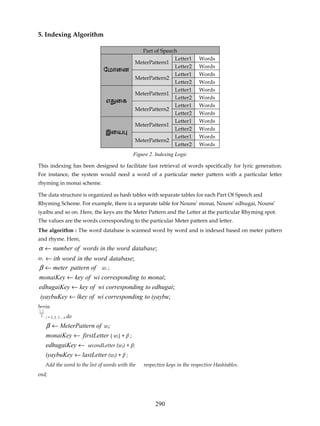
                                             Figure 2. Indexing Logic

This indexing has been designed to facilitate fast retrieval of words specifically for lyric generation.
For instance, the system would need a word of a particular meter pattern with a particular letter
rhyming in monai scheme.

The data structure is organized as hash tables with separate tables for each Part Of Speech and
Rhyming Scheme. For example, there is a separate table for Nouns’ monai, Nouns’ edhugai, Nouns’
iyaibu and so on. Here, the keys are the Meter Pattern and the Letter at the particular Rhyming spot.
The values are the words corresponding to the particular Meter pattern and letter.
The algorithm : The word database is scanned word by word and is indexed based on meter pattern
and rhyme. Here,
α ← number of words in the word database;
wi← ith word in the word database;
β ← meter pattern of wi ;
monaiKey ← key of wi corresponding to monai;
edhugaiKey ← key of wi corresponding to edhugai;
iyaybuKey ← lkey of wi corresponding to iyaybu;
begin
     i = 1, 2, 3 …α do

     β ← MeterPattern of        w i;
     monaiKey ← firstLetter ( wi) + β ;
     edhugaiKey ← secondLetter (wi) + β;
     iyaybuKey ← lastLetter (wi) + β ;
     Add the word to the list of words with the   respective keys in the respective Hashtables.
end;


                                                       290
For each word in the word database, meter pattern is extracted first followed by letters at the rhyming
spots namely, first, second and last positions (for monai, edhugai and iyaibu respectively). Keys for
monai, edhugai and iyaybu are found out using the abovesaid equations. The word is added to the
monai, edhugai and iyaibu hashtables with keys monaiKey, edhugaiKey and iyaybuKey respectively
if those keys don’t appear previously in the tables. Else, the word is added to the list of words with
that key.

Hash-tables are chosen for the implementation as they have the retrieval complexity of O(1).

6. Results


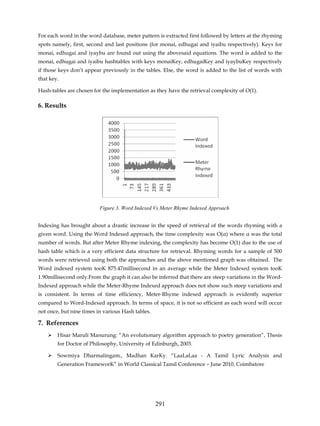
                          Figure 3. Word Indexed Vs Meter Rhyme Indexed Approach


Indexing has brought about a drastic increase in the speed of retrieval of the words rhyming with a
given word. Using the Word Indexed approach, the time complexity was O(α) where α was the total
number of words. But after Meter Rhyme indexing, the complexity has become O(1) due to the use of
hash table which is a very efficient data structure for retrieval. Rhyming words for a sample of 500
words were retrieved using both the approaches and the above mentioned graph was obtained. The
Word indexed system tooK 875.47millisecond in an average while the Meter Indexed system tooK
1.90millisecond only.From the graph it can also be inferred that there are steep variations in the Word-
Indexed approach while the Meter-Rhyme Indexed approach does not show such steep variations and
is consistent. In terms of time efficiency, Meter-Rhyme indexed approach is evidently superior
compared to Word-Indexed approach. In terms of space, it is not so efficient as each word will occur
not once, but nine times in various Hash tables.

7. References
        Hisar Maruli Manurung: “An evolutionary algorithm approach to poetry generation”, Thesis
        for Doctor of Philosophy, University of Edinburgh, 2003.

        Sowmiya Dharmalingam., Madhan KarKy. “LaaLaLaa - A Tamil Lyric Analysis and
        Generation FrameworK” in World Classical Tamil Conference – June 2010, Coimbatore


                                                   291
RamaKrishnan, A., S. Kuppan, and S.L. Devi. “Automatic Generation of Tamil Lyrics for
Melodies”     in   NAACL HLT WorKshop on Computational Approaches to Linguistic
Creativity. 2009. Colorado.

K. Narayana Murthy "An Indexing Technique for Efficient Retrieval from Large Dictionaries",
National     Conference   on   Information   Technology   NCIT-97,   21-23   December   1997,
Bhubaneswar.

Eric Nichols, Dan Morris, Sumit Basu, Christopher Raphael, “Relationships between lyrics
and melody in popular music”, ISMIR 2009, October 2009, Japan.

Anna Babarczy, IldiKó Bencze, István FeKete, Eszter Simon, “The Automatic Identification of
Conceptual Metaphors in Hungarian Texts: A Corpus-Based Analysis”, Proceedings of The
seventh international conference on Language Resources and Evaluation (LREC), 2010, Malta.

Xiao Hu, J. Stephen Downie, Andreas F. Ehmann, “Lyric Text Mining in Music Mood
Classification”, ISMIR 2009, Japan.

Jose P. G. Mahedero, Alvaro Martınez, Pedro Cano, “Natural Language Processing of Lyrics”,
Proceedings of the 13th annual ACM internationalconference on Multimedia, New YorK, NY,
USA, 2005.

Rudolf Mayer, Robert Neumayer, Andreas Rauber, “Rhyme and style features for musical
genre classification by lyrics”, Proceedings of the 9th International Conference on Music
Information Retrieval (ISMIR’08), Philadelphia, PA, USA, September 14-18, 2008.

Beth Logan, Andrew KositsKy, Pedro Moreno, “Semantic analysis of Song Lyrics”, IEEE
International Conference on Multimedia and Expo (ICME), June 2004.

Yael Netzer, David Gabay,Yoav Goldberg, Michael Elhadad, “GaiKu : Generating HaiKu
with Word Associations Norms”, Workshop on Computational Approaches to Linguistic
Creativity, CALC-2009 in conjunction with NAACL-HLT 2009, Boulder, Colorado.

B. Logan, A. KositsKy, and P. Moreno, “Semantic Analysis of Song Lyrics”, in Proc IEEE
ICME, 2004.


                                         292

I5 geetha4 suraiya

  • 2.
    Special Indices forLaaLaLaa Lyric Analysis & Generation Framework Suriyah M, Madhan Karky, T V Geetha, & Ranjani Parthasarathi {suriyah.cse@gmail.com, madhankarky@gmail.com, tv_g@hotmail.com, rp@annauniv.edux} Tamil Computing Lab (TaCoLa), College of Engineering Guindy, Anna University, Chennai. Abstract With the advent of computational tools for creativity, it becomes inevitable to design data structures which cater to the specific needs of the creative form considered. A lyric generator has to retrieve words fast based on Part of Speech and rhyme. This paper aims at building special indices for the LaaLaLaa Lyric Generator framework based on POS and rhyme to facilitate faster retrieval. The retrieval times of the proposed model and the conservative word indexed model are compared. The indexing is based on the KNM(Kuril, Nedil, Mei) pattern and the letters that occur in the rhyming spots of the words. The data structure is organized as hash tables to ensure best retrieval complexity. Separate hash tables for each POS and rhyming scheme are created and populated. Here, the key would be the meter pattern with the letters occurring at the rhyming spots and the value would be the list of all those words which fall under the key’s constraint. When the word indexed and meter rhyme indexed retrievals were compared, the latter reduced the average retrieval time drastically. There were not steep variations in the retrieval times as was in the former approach. This remarkable efficiency was traded-off with space. 1. Introduction Tamil, one of the oldest languages, has a very rich literary history dating back to two thousand years. We have more than two thousand lyrics being written in this language in the form of film songs, advertisements, jingles, private albums etc. With the advent of computational tools for creativity, it becomes inevitable to design data structures which cater to the specific needs of the creative form considered. Tools for poem generation, story generation and lyric generation have been proposed. A poem has to have three qualities – meaningfulness, poeticness and grammaticality [1]. A lyric is a poem which has constraints of having to satisfy a tune and a theme. This paper talks about building special indices for the LaaLaLaa lyric generator framework[2] to aid faster retrieval of words based on POS and rhyme. A lyric generator would require the retrieval of words of a particular meter and particular letters at rhyming spots. This would maximize the poeticness of the lyric generated with the increase in rhymes. This retrieval process, when carried out on an un-indexed word database, is too expensive as it would take separate processing for meter, and each of the three rhymes in Tamil. To facilitate faster retrieval of words satisfying these constraints, the word database has to be indexed based on 287
  • 3.
    meter-pattern and rhyme.This makes indexing of the word database based on the abovesaid constraints necessary. This paper is organized as eight sections. The second section discusses about a few existing works in this area. The third section gives an overview of the Rhyme schemes in Tamil. An overall view of the system is given by the fourth section while the fifth section talks about the approach proposed for indexing. This work concludes with the results obtained and scope for future work in this area. 2. Background Though significant number of works has been done in the arena of poetry generation in other languages, there is only less number in Tamil. The “Automatic Generation of Tamil Lyrics for Melodies” [3] identifies the required syllable pattern for the lyric and passes this to a sentence generation module which generates meaningful phrases that match the pattern. This system generates rhyme based on maximum substring match and fails to make use of the three rhyming schemes that are specific to Tamil language. “LaaLaLaa - A Tamil Lyric Analysis and Generation Framework” [2] generates Tamil lyrics for POS tagged pattern with words from a rhyme finder according to rhyming schemes in Tamil. Nichols et al[5] investigate the assumption that songwriters tend to align low-level features of a song’s text with musical features. K. Narayana Murthy[4] suggests having a non-dense TRIE index in main memory and a dense index file stored in secondary memory. Anna Babarczy et al[6] suggested a hypothesis that a metaphoric sentence should include both source- domain and target-domain expressions. This assumption was tested relying on three different methods of selecting target-domain and source-domain expressions: a psycholinguistic word association method, a dictionary method and a corpus-based method. Hu, Downie and Ehmann[7] examine the role lyric text can play in improving audio music mood classification. Mahedero et al[8] argue that a textual analysis of a song can generate ground truth data that can be used to validate results from purely acoustic methods. Mayer et al[9] present a novel set of features developed for textual analysis of song lyrics, and combine them with and compare them to classical bag-of-words indexing approaches and results for musical genre classification on a test collection in order to demonstrate our analysis. “Semantic analysis of song lyrics” studies the use of song lyrics for automatic indexing of music. Netzer et al explore the usage of Word Association Norms (WANs) as an alternative lexical knowledge source to analyze linguistic computational creativity. Logan et al. use song lyrics for tracks by 399 artists to determine artist similarity[12]. 3. Rhyme Schemes and Rhyme Patterns Rhyme Schemes: English has number of rhyme effects like assonance, consonance, perfect, imperfect, masculine, feminine etc. This arises from the variation in stress patterns of words, lack of clear cut description about the spots where rhymes can occur. In Tamil, the grapheme and phoneme are bound stronger than in English. There are 3 characteristic rhyme schemes in Tamil – Monai (ேமாைன), Edhugai (எ ைக) and Iyaibu (இைய ). Two words are said to rhyme in monai if their first letters are the same, in edhugai if their second letters are the same and in iyaibu if their last letters are the same. 288
  • 4.
    Examples: பறைவ andப ைச rhyme in monai as they start with the same letter. அ வ and வ rhyme in edhugai as they share the same second letter. யா ைக and வா ைக rhyme in iyaibu as they share the same last letter. As one may infer, two words can rhyme in more than one pattern also. Examples: அ வ and வ rhyme in edhugai and iyaibu. கவ ைதக and கவ ஞ க rhyme in all the three schemes. Meter Pattern: One way of classifying alphabets of the Tamil language is based on the time interval (மா திைர - maathirai) for which they are pronounced. One maathirai corresponds to the time taken to wink the eyelid. The types of letters in this classification are Nedil (N) (ெந ) - Those alphabets which are pronounced for the time interval of 2 maathirai. Kuril (K) ( றி ) - Alphabets which take 1 maathirai to be pronounced. Mei (M) (ெம ) - Alphabets which are pronounced for 0.5 maathirai. Meter pattern of a word refers to its Kuril Nedil Mei pattern. For example, the meter pattern of the word பாட is NKM as பா is a Nedil(N), ட is a Kuril(K) and is a Mei(M). The indexing methodology proposed needs to take care of both meter pattern and rhyme to facilitate faster retrieval of words for the LaaLaLaa Lyric Generation and Analysis framework[2]. 4. Overview of the System Word object Word convertor DB Rhyme Meter extractor Pattern Extractor Index Builder Rhyme Meter Index Figure 1. Overview of the system. Each word from the word database is converted to an object. Meter pattern and the alphabets at the Rhyming positions of each word are found out by Meter Pattern Extractor and Rhyme Extractor respectively. Using the data obtained, the Index builder builds the Rhyme Meter Index aiding faster retrieval than the normal un-indexed retrieval. 289
  • 5.
    5. Indexing Algorithm Part of Speech Letter1 Words MeterPattern1 Letter2 Words ேமாைன Letter1 Words MeterPattern2 Letter2 Words Letter1 Words MeterPattern1 Letter2 Words எ ைக Letter1 Words MeterPattern2 Letter2 Words Letter1 Words MeterPattern1 Letter2 Words இைய Letter1 Words MeterPattern2 Letter2 Words Figure 2. Indexing Logic This indexing has been designed to facilitate fast retrieval of words specifically for lyric generation. For instance, the system would need a word of a particular meter pattern with a particular letter rhyming in monai scheme. The data structure is organized as hash tables with separate tables for each Part Of Speech and Rhyming Scheme. For example, there is a separate table for Nouns’ monai, Nouns’ edhugai, Nouns’ iyaibu and so on. Here, the keys are the Meter Pattern and the Letter at the particular Rhyming spot. The values are the words corresponding to the particular Meter pattern and letter. The algorithm : The word database is scanned word by word and is indexed based on meter pattern and rhyme. Here, α ← number of words in the word database; wi← ith word in the word database; β ← meter pattern of wi ; monaiKey ← key of wi corresponding to monai; edhugaiKey ← key of wi corresponding to edhugai; iyaybuKey ← lkey of wi corresponding to iyaybu; begin i = 1, 2, 3 …α do β ← MeterPattern of w i; monaiKey ← firstLetter ( wi) + β ; edhugaiKey ← secondLetter (wi) + β; iyaybuKey ← lastLetter (wi) + β ; Add the word to the list of words with the respective keys in the respective Hashtables. end; 290
  • 6.
    For each wordin the word database, meter pattern is extracted first followed by letters at the rhyming spots namely, first, second and last positions (for monai, edhugai and iyaibu respectively). Keys for monai, edhugai and iyaybu are found out using the abovesaid equations. The word is added to the monai, edhugai and iyaibu hashtables with keys monaiKey, edhugaiKey and iyaybuKey respectively if those keys don’t appear previously in the tables. Else, the word is added to the list of words with that key. Hash-tables are chosen for the implementation as they have the retrieval complexity of O(1). 6. Results Figure 3. Word Indexed Vs Meter Rhyme Indexed Approach Indexing has brought about a drastic increase in the speed of retrieval of the words rhyming with a given word. Using the Word Indexed approach, the time complexity was O(α) where α was the total number of words. But after Meter Rhyme indexing, the complexity has become O(1) due to the use of hash table which is a very efficient data structure for retrieval. Rhyming words for a sample of 500 words were retrieved using both the approaches and the above mentioned graph was obtained. The Word indexed system tooK 875.47millisecond in an average while the Meter Indexed system tooK 1.90millisecond only.From the graph it can also be inferred that there are steep variations in the Word- Indexed approach while the Meter-Rhyme Indexed approach does not show such steep variations and is consistent. In terms of time efficiency, Meter-Rhyme indexed approach is evidently superior compared to Word-Indexed approach. In terms of space, it is not so efficient as each word will occur not once, but nine times in various Hash tables. 7. References Hisar Maruli Manurung: “An evolutionary algorithm approach to poetry generation”, Thesis for Doctor of Philosophy, University of Edinburgh, 2003. Sowmiya Dharmalingam., Madhan KarKy. “LaaLaLaa - A Tamil Lyric Analysis and Generation FrameworK” in World Classical Tamil Conference – June 2010, Coimbatore 291
  • 7.
    RamaKrishnan, A., S.Kuppan, and S.L. Devi. “Automatic Generation of Tamil Lyrics for Melodies” in NAACL HLT WorKshop on Computational Approaches to Linguistic Creativity. 2009. Colorado. K. Narayana Murthy "An Indexing Technique for Efficient Retrieval from Large Dictionaries", National Conference on Information Technology NCIT-97, 21-23 December 1997, Bhubaneswar. Eric Nichols, Dan Morris, Sumit Basu, Christopher Raphael, “Relationships between lyrics and melody in popular music”, ISMIR 2009, October 2009, Japan. Anna Babarczy, IldiKó Bencze, István FeKete, Eszter Simon, “The Automatic Identification of Conceptual Metaphors in Hungarian Texts: A Corpus-Based Analysis”, Proceedings of The seventh international conference on Language Resources and Evaluation (LREC), 2010, Malta. Xiao Hu, J. Stephen Downie, Andreas F. Ehmann, “Lyric Text Mining in Music Mood Classification”, ISMIR 2009, Japan. Jose P. G. Mahedero, Alvaro Martınez, Pedro Cano, “Natural Language Processing of Lyrics”, Proceedings of the 13th annual ACM internationalconference on Multimedia, New YorK, NY, USA, 2005. Rudolf Mayer, Robert Neumayer, Andreas Rauber, “Rhyme and style features for musical genre classification by lyrics”, Proceedings of the 9th International Conference on Music Information Retrieval (ISMIR’08), Philadelphia, PA, USA, September 14-18, 2008. Beth Logan, Andrew KositsKy, Pedro Moreno, “Semantic analysis of Song Lyrics”, IEEE International Conference on Multimedia and Expo (ICME), June 2004. Yael Netzer, David Gabay,Yoav Goldberg, Michael Elhadad, “GaiKu : Generating HaiKu with Word Associations Norms”, Workshop on Computational Approaches to Linguistic Creativity, CALC-2009 in conjunction with NAACL-HLT 2009, Boulder, Colorado. B. Logan, A. KositsKy, and P. Moreno, “Semantic Analysis of Song Lyrics”, in Proc IEEE ICME, 2004. 292