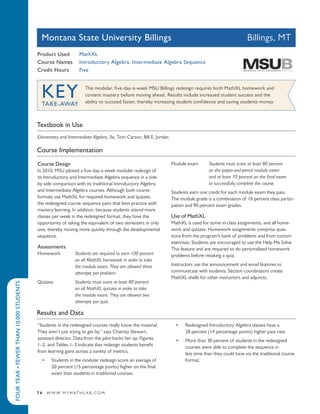
Montana State University Billings                                                                          Billings, MT
                                         Product Used              MathXL
                                         Course Names              Introductory Algebra, Intermediate Algebra Sequence
                                         Credit Hours              Five


                                           KEY
                                           TAKE-AWAY
                                                                      The modular, five-day-a-week MSU Billings redesign requires both MathXL homework and
                                                                      content mastery before moving ahead. Results include increased student success and the
                                                                      ability to succeed faster, thereby increasing student confidence and saving students money.


                                         Textbook in Use
                                         Elementary and Intermediate Algebra, 3e, Tom Carson, Bill E. Jordan

                                         Course Implementation
                                         Course Design                                                         Module exam        Students must score at least 80 percent
                                         In 2010, MSU piloted a five-day-a-week modular redesign of                               on the paper-and-pencil module exam
                                         its Introductory and Intermediate Algebra sequence in a side-                            and at least 70 percent on the final exam
                                         by-side comparison with its traditional Introductory Algebra                             to successfully complete the course.
                                         and Intermediate Algebra courses. Although both course                Students earn one credit for each module exam they pass.
                                         formats use MathXL for required homework and quizzes,                 The module grade is a combination of 10 percent class partici-
                                         the redesigned course sequence pairs that best practice with          pation and 90 percent exam grades.
                                         mastery learning. In addition, because students attend more
                                         classes per week in the redesigned format, they have the              Use of MathXL
                                         opportunity of taking the equivalent of two semesters in only         MathXL is used for some in-class assignments, and all home-
                                         one, thereby moving more quickly through the developmental            work and quizzes. Homework assignments comprise ques-
                                         sequence.                                                             tions from the program’s bank of problems and from custom
                                                                                                               exercises. Students are encouraged to use the Help Me Solve
                                         Assessments                                                           This feature and are required to do personalized homework
                                         Homework                Students are required to earn 100 percent     problems before retaking a quiz.
                                                                 on all MathXL homework in order to take
                                                                 the module exam. They are allowed three       Instructors use the announcement and email features to
                                                                 attempts per problem.                         communicate with students. Section coordinators create
                                                                                                               MathXL shells for other instructors and adjuncts.
                                         Quizzes                 Students must score at least 80 percent
FOUR YEAR • FEWER THAN 10,000 STUDENTS


                                                                 on all MathXL quizzes in order to take
                                                                 the module exam. They are allowed two
                                                                 attempts per quiz.

                                         Results and Data
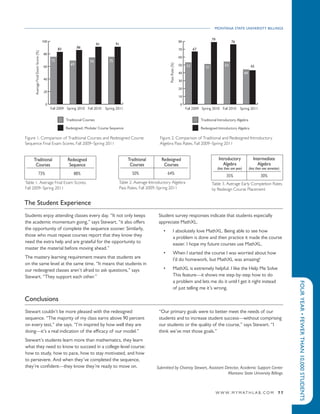
                                         “Students in the redesigned courses really know the material.           •    Redesigned Introductory Algebra classes have a
                                         They aren’t just trying to get by,” says Chairsty Stewart,                   28 percent (14 percentage points) higher pass rate.
                                         assistant director. Data from the pilot backs her up. Figures           •    More than 30 percent of students in the redesigned
                                         1–2, and Tables 1–3 indicate that redesign students benefit                  courses were able to complete the sequence in
                                         from learning gains across a variety of metrics.                             less time than they could have via the traditional course
                                              •     Students in the modular redesign score an average of              format.
                                                    20 percent (15 percentage points) higher on the final
                                                    exam than students in traditional courses.


                                         76       W W W. M Y M AT H L A B . C O M
MONTANA STATE UNIVERSITY BILLINGS


         100                                                                         80

                                                                                     70
          80
                                                                                     60

          60                                                                         50

                                                                                     40
          40                                                                         30

                                                                                     20
          20
                                                                                     10

             0                                                                        0


Figure 1. Comparison of Traditional Courses and Redesigned Course        Figure 2. Comparison of Traditional and Redesigned Introductory
Sequence Final Exam Scores, Fall 2009–Spring 2011                        Algebra Pass Rates, Fall 2009–Spring 2011


     Traditional        Redesigned                      Traditional       Redesigned                         Introductory             Intermediate
      Courses            Sequence                        Courses           Courses                              Algebra                  Algebra
                                                                                                            (less than one year)   (less than one semester)
       73%                 88%                            50%                  64%
                                                                                                                   35%                      30%
Table 1. Average Final Exam Scores,                Table 2. Average Introductory Algebra                Table 3. Average Early Completion Rates
Fall 2009–Spring 2011                              Pass Rates, Fall 2009–Spring 2011                    by Redesign Course Placement


The Student Experience
Students enjoy attending classes every day. “It not only keeps           Student survey responses indicate that students especially
the academic momentum going,” says Stewart, “it also offers              appreciate MathXL.
the opportunity of complete the sequence sooner. Similarly,                •     I absolutely love MathXL. Being able to see how
those who must repeat courses report that they know they                         a problem is done and then practice it made the course
need the extra help and are grateful for the opportunity to                      easier. I hope my future courses use MathXL.
master the material before moving ahead.”
                                                                           •     When I started the course I was worried about how
The mastery learning requirement means that students are                         I’d do homework, but MathXL was amazing!
on the same level at the same time. “It means that students in
our redesigned classes aren’t afraid to ask questions,” says               •     MathXL is extremely helpful. I like the Help Me Solve
Stewart. “They support each other.”                                              This feature—it shows me step-by-step how to do
                                                                                 a problem and lets me do it until I get it right instead


                                                                                                                                                              FOUR YEAR • FEWER THAN 10,000 STUDENTS
                                                                                 of just telling me it’s wrong.

Conclusions
Stewart couldn’t be more pleased with the redesigned                     “Our primary goals were to better meet the needs of our
sequence. “The majority of my class earns above 90 percent               students and to increase student success—without comprising
on every test,” she says. “I’m inspired by how well they are             our students or the quality of the course,” says Stewart. “I
doing—it’s a real indication of the efficacy of our model.”              think we’ve met those goals.”
Stewart’s students learn more than mathematics, they learn
what they need to know to succeed in a college-level course:
how to study, how to pace, how to stay motivated, and how
to persevere. And when they’ve completed the sequence,
they’re confident—they know they’re ready to move on.                   Submitted by Chairsty Stewart, Assistant Director, Academic Support Center
                                                                                                                  Montana State University Billings


                                                                                                           W W W. M Y M AT H L A B . C O M               77

Pearson white paper

  • 1.
    Montana State UniversityBillings Billings, MT Product Used MathXL Course Names Introductory Algebra, Intermediate Algebra Sequence Credit Hours Five KEY TAKE-AWAY The modular, five-day-a-week MSU Billings redesign requires both MathXL homework and content mastery before moving ahead. Results include increased student success and the ability to succeed faster, thereby increasing student confidence and saving students money. Textbook in Use Elementary and Intermediate Algebra, 3e, Tom Carson, Bill E. Jordan Course Implementation Course Design Module exam Students must score at least 80 percent In 2010, MSU piloted a five-day-a-week modular redesign of on the paper-and-pencil module exam its Introductory and Intermediate Algebra sequence in a side- and at least 70 percent on the final exam by-side comparison with its traditional Introductory Algebra to successfully complete the course. and Intermediate Algebra courses. Although both course Students earn one credit for each module exam they pass. formats use MathXL for required homework and quizzes, The module grade is a combination of 10 percent class partici- the redesigned course sequence pairs that best practice with pation and 90 percent exam grades. mastery learning. In addition, because students attend more classes per week in the redesigned format, they have the Use of MathXL opportunity of taking the equivalent of two semesters in only MathXL is used for some in-class assignments, and all home- one, thereby moving more quickly through the developmental work and quizzes. Homework assignments comprise ques- sequence. tions from the program’s bank of problems and from custom exercises. Students are encouraged to use the Help Me Solve Assessments This feature and are required to do personalized homework Homework Students are required to earn 100 percent problems before retaking a quiz. on all MathXL homework in order to take the module exam. They are allowed three Instructors use the announcement and email features to attempts per problem. communicate with students. Section coordinators create MathXL shells for other instructors and adjuncts. Quizzes Students must score at least 80 percent FOUR YEAR • FEWER THAN 10,000 STUDENTS on all MathXL quizzes in order to take the module exam. They are allowed two attempts per quiz. Results and Data “Students in the redesigned courses really know the material. • Redesigned Introductory Algebra classes have a They aren’t just trying to get by,” says Chairsty Stewart, 28 percent (14 percentage points) higher pass rate. assistant director. Data from the pilot backs her up. Figures • More than 30 percent of students in the redesigned 1–2, and Tables 1–3 indicate that redesign students benefit courses were able to complete the sequence in from learning gains across a variety of metrics. less time than they could have via the traditional course • Students in the modular redesign score an average of format. 20 percent (15 percentage points) higher on the final exam than students in traditional courses. 76 W W W. M Y M AT H L A B . C O M
  • 2.
    MONTANA STATE UNIVERSITYBILLINGS 100 80 70 80 60 60 50 40 40 30 20 20 10 0 0 Figure 1. Comparison of Traditional Courses and Redesigned Course Figure 2. Comparison of Traditional and Redesigned Introductory Sequence Final Exam Scores, Fall 2009–Spring 2011 Algebra Pass Rates, Fall 2009–Spring 2011 Traditional Redesigned Traditional Redesigned Introductory Intermediate Courses Sequence Courses Courses Algebra Algebra (less than one year) (less than one semester) 73% 88% 50% 64% 35% 30% Table 1. Average Final Exam Scores, Table 2. Average Introductory Algebra Table 3. Average Early Completion Rates Fall 2009–Spring 2011 Pass Rates, Fall 2009–Spring 2011 by Redesign Course Placement The Student Experience Students enjoy attending classes every day. “It not only keeps Student survey responses indicate that students especially the academic momentum going,” says Stewart, “it also offers appreciate MathXL. the opportunity of complete the sequence sooner. Similarly, • I absolutely love MathXL. Being able to see how those who must repeat courses report that they know they a problem is done and then practice it made the course need the extra help and are grateful for the opportunity to easier. I hope my future courses use MathXL. master the material before moving ahead.” • When I started the course I was worried about how The mastery learning requirement means that students are I’d do homework, but MathXL was amazing! on the same level at the same time. “It means that students in our redesigned classes aren’t afraid to ask questions,” says • MathXL is extremely helpful. I like the Help Me Solve Stewart. “They support each other.” This feature—it shows me step-by-step how to do a problem and lets me do it until I get it right instead FOUR YEAR • FEWER THAN 10,000 STUDENTS of just telling me it’s wrong. Conclusions Stewart couldn’t be more pleased with the redesigned “Our primary goals were to better meet the needs of our sequence. “The majority of my class earns above 90 percent students and to increase student success—without comprising on every test,” she says. “I’m inspired by how well they are our students or the quality of the course,” says Stewart. “I doing—it’s a real indication of the efficacy of our model.” think we’ve met those goals.” Stewart’s students learn more than mathematics, they learn what they need to know to succeed in a college-level course: how to study, how to pace, how to stay motivated, and how to persevere. And when they’ve completed the sequence, they’re confident—they know they’re ready to move on. Submitted by Chairsty Stewart, Assistant Director, Academic Support Center Montana State University Billings W W W. M Y M AT H L A B . C O M 77