Download to read offline
![Ahmad M. Alkandari Int. Journal of Engineering Research and Applications www.ijera.com
ISSN : 2248-9622, Vol. 5, Issue 5, ( Part -2) May 2015, pp.08-13
www.ijera.com 8 | P a g e
Using Z-Transform for Electric Loads Modeling in the Presence
of Harmonics
Ahmad M. Alkandari, Osamah Alduaij
College of Technological Studies Electrical Engineering Technology Department Shuweikh, Kuwait
Higher Energy Institute Electrical power department Kuwait
Abstract
An approach based on Z-transform is presented to obtain a single phase electric loads model in the presence of
harmonics. The impedance or admittance of the load is expressed as a linear autoregressive exogenous input
(ARX). The parameters of this series are identified using the least error squares (LES) algorithm. This algorithm
uses the digitized samples of the load-input voltage and the resulting output current. Having identified the ARX
parameters model, the impedance, or admittance of the equivalent circuit of the load can be written in the time
domain. Using the well-known definition of the perunit Z, the admittance of the load can be expressed in the
frequency domain. The proposed algorithm can easily be used to model the impedance or admittance of the
electric distribution network on the harmonic polluted environment, as well as the transmission network, for load
flow, stability analysis and harmonics filter design. The results of simulated and actual recorded data are
reported in this paper.
Keywords: Z transform, electric load modeling, harmonics, LES estimation
I. INTRODUCTION
The widespread use of power electronics in
transmission and distribution of electric systems as
well as nonlinear loads such as electric drives, arc
furnace, all kind of lighting devices produce
harmonics in the power networks and an accurate
model of power system components is essential.
Modeling of electric loads in the presence of
harmonics pays the attention of researchers and
power engineering utility companies to predict the
load effects during power system transients as well as
steady state power flow analysis.
Many techniques are developed in the last two
decades, and are grouped into two categories; the
time domain approach and frequency domain
approach. Some of these techniques have been
applied to model the nonlinear single-phase and three
phase loads.
Reference [1] presents a noninvasive method for
modeling three-phase harmonic load incorporating
harmonic sources for composite power system loads.
The proposed technique is based on the presence of a
dominant harmonic source that closes to the load. The
method is shown to perform quite well in a laboratory
test, but it fails when applied to modeling of an
industrial load.
References [2] and [12] present a technique for
modeling linear or nonlinear loads in the presence or
absence of harmonics in the time-domain. The
principle of energy stored in the load elements is
applied. The residual currents as well as the mismatch
current for different harmonic frequencies in the
voltage or current waveforms are calculated. The
accuracy of the model produced in this reference is
tested using the HARMFLO program that calculates
the power flow at different harmonic orders.
A method for modeling distribution load
impedances as unbalanced three phase impedance
matrices for detailed harmonic studies is presented in
Reference [3]. The linear time series is used, the
parameters of this series are calculated using the least
error squares algorithm and they are considered
constant during the horizon time
References [4]-[6] propose different approach for
modeling nonlinear dynamic loads. The load is
presented by a set of differential equations that relate
the active power and load voltage. The models
developed are used for voltage stability, and transient
studies.
Reference [7] developed a computer program
that simulates the effect of harmonics introduced at
distribution level by nonlinear loads. A table of
harmonics (amplitude and phase) represents each load
device, of the current when energized by a sinusoidal
voltage. The purpose of the program is to allow load-
flow studies to include effects of harmonics
particularly on the customer supply voltage. The
three-phase load in the program is assumed to be
balanced.
The time domain controlled voltage source is
presented in Reference [8] for modeling the arc
furnace load. The developed model is based on a
piece wise linear approximation of the v -i
characteristic of arc furnace load. The active power
RESEARCH ARTICLE OPEN ACCESS](https://image.slidesharecdn.com/b505020813-150511084147-lva1-app6891/85/Using-Z-Transform-for-Electric-Loads-Modeling-in-the-Presence-of-Harmonics-1-320.jpg)
![Ahmad M. Alkandari Int. Journal of Engineering Research and Applications www.ijera.com
ISSN : 2248-9622, Vol. 5, Issue 5, ( Part -2) May 2015, pp.08-13
www.ijera.com 8 | P a g e
Using Z-Transform for Electric Loads Modeling in the Presence
of Harmonics
Ahmad M. Alkandari, Osamah Alduaij
College of Technological Studies Electrical Engineering Technology Department Shuweikh, Kuwait
Higher Energy Institute Electrical power department Kuwait
Abstract
An approach based on Z-transform is presented to obtain a single phase electric loads model in the presence of
harmonics. The impedance or admittance of the load is expressed as a linear autoregressive exogenous input
(ARX). The parameters of this series are identified using the least error squares (LES) algorithm. This algorithm
uses the digitized samples of the load-input voltage and the resulting output current. Having identified the ARX
parameters model, the impedance, or admittance of the equivalent circuit of the load can be written in the time
domain. Using the well-known definition of the perunit Z, the admittance of the load can be expressed in the
frequency domain. The proposed algorithm can easily be used to model the impedance or admittance of the
electric distribution network on the harmonic polluted environment, as well as the transmission network, for load
flow, stability analysis and harmonics filter design. The results of simulated and actual recorded data are
reported in this paper.
Keywords: Z transform, electric load modeling, harmonics, LES estimation
I. INTRODUCTION
The widespread use of power electronics in
transmission and distribution of electric systems as
well as nonlinear loads such as electric drives, arc
furnace, all kind of lighting devices produce
harmonics in the power networks and an accurate
model of power system components is essential.
Modeling of electric loads in the presence of
harmonics pays the attention of researchers and
power engineering utility companies to predict the
load effects during power system transients as well as
steady state power flow analysis.
Many techniques are developed in the last two
decades, and are grouped into two categories; the
time domain approach and frequency domain
approach. Some of these techniques have been
applied to model the nonlinear single-phase and three
phase loads.
Reference [1] presents a noninvasive method for
modeling three-phase harmonic load incorporating
harmonic sources for composite power system loads.
The proposed technique is based on the presence of a
dominant harmonic source that closes to the load. The
method is shown to perform quite well in a laboratory
test, but it fails when applied to modeling of an
industrial load.
References [2] and [12] present a technique for
modeling linear or nonlinear loads in the presence or
absence of harmonics in the time-domain. The
principle of energy stored in the load elements is
applied. The residual currents as well as the mismatch
current for different harmonic frequencies in the
voltage or current waveforms are calculated. The
accuracy of the model produced in this reference is
tested using the HARMFLO program that calculates
the power flow at different harmonic orders.
A method for modeling distribution load
impedances as unbalanced three phase impedance
matrices for detailed harmonic studies is presented in
Reference [3]. The linear time series is used, the
parameters of this series are calculated using the least
error squares algorithm and they are considered
constant during the horizon time
References [4]-[6] propose different approach for
modeling nonlinear dynamic loads. The load is
presented by a set of differential equations that relate
the active power and load voltage. The models
developed are used for voltage stability, and transient
studies.
Reference [7] developed a computer program
that simulates the effect of harmonics introduced at
distribution level by nonlinear loads. A table of
harmonics (amplitude and phase) represents each load
device, of the current when energized by a sinusoidal
voltage. The purpose of the program is to allow load-
flow studies to include effects of harmonics
particularly on the customer supply voltage. The
three-phase load in the program is assumed to be
balanced.
The time domain controlled voltage source is
presented in Reference [8] for modeling the arc
furnace load. The developed model is based on a
piece wise linear approximation of the v -i
characteristic of arc furnace load. The active power
RESEARCH ARTICLE OPEN ACCESS](https://image.slidesharecdn.com/b505020813-150511084147-lva1-app6891/75/Using-Z-Transform-for-Electric-Loads-Modeling-in-the-Presence-of-Harmonics-1-2048.jpg)
![Ahmad M. Alkandari Int. Journal of Engineering Research and Applications www.ijera.com
ISSN : 2248-9622, Vol. 5, Issue 5, ( Part -2) May 2015, pp.08-13
www.ijera.com 9 | P a g e
consumed by the load is considered in the proposed
load model, thus making the proposed load model
depending on the operating conditions of the load.
Reference [9] describes an improved model of
rotating loads in complex load areas, for harmonic
penetration analyses applied to distribution systems.
The analysis is performed in the frequency domain.
The proposed model can be used for simulating large
complex load areas within harmonic studies for which
the injection current method has been found to be still
sufficiently accurate.
Reference [10] presents two time domain
techniques for load modeling in the presence of
harmonics. In the first techniques, the harmonic
contents of the load voltage and current waveforms
are assumed to be known in advance. While, the
second technique uses directly samples of load
voltage and current waveforms. The least error
squares parameter estimation algorithm is used to
estimate the load resistance, inductance and
capacitance. Residual current, results from
incomplete extraction of the parameters for all
significant signal frequencies, is also estimated.
Harmonics that are not common between load voltage
and current waveforms are also identified.
Effects of load modeling for undervoltage load
shedding are presented in Reference [11]. A dynamic
and static load models are presented for showing how
much load be to shed and what influence different
load models have on the simulation result as well as
on the analysis.
The analysis of the load harmonic model under
unbalanced condition is presented in Reference [13].
Different load models at the frequency domain have
been derived for linear and nonlinear loads. The
models of linear and non-linear loads are
incorporated to the three-phase harmonic load flow
formulation.
An approach to non-linear load modeling in the
time domain has been developed in Reference [14].
The nonlinear load model accommodates both steady
state and dynamic behavior. Two models are used;
the first one is a polynomial function of second order
of normalized voltage for the active and reactive
powers, while in the second model the active and
reactive powers are nonlinear functions of the
normalized voltage and the frequency deviation. The
proposed load models are capable of representing the
interaction between network conditions and load.
Reference [15] presents the use of chaotic
dynamics to describe the operation of nonlinear loads.
The proposed approach is applied to electric arc
furnace. A tuning mode is described to develop the
parameters of a chaotic model, this model is trained
to have time and frequency response that are tuned
match the current from the arc furnace.
Reference [16] presents a fast and efficient on-line
identification of non-linear loads in power systems.
The proposed technique is an application of a discrete
time-dynamic filter based on stochastic estimation
theory which is suitable for estimating parameters on-
line. The algorithm uses sets of digital samples of the
distorted voltage and current waveforms of the non-
linear load to estimate the harmonic contents of these
two signals. The non-linear load admittance is then
calculated from these contents.
This paper presents an approach based on the Z-
transform to model single phase electric loads in the
presence of harmonics. The impedance or admittance
of the load is expressed as linear autoregressive
exogenous input (ARX). The parameters of this series
are identified using the least error squares (LES)
estimation algorithm, where the digitized samples of
the load input voltage and the resulting output current
are used. Having identified the ARX parameters
model, the impedance, or admittance of the
equivalent circuit of the load can be expressed in time
domain. Using the well-known definition of the
perunit Z, the admittance of the load can be written in
the frequency domain. The proposed algorithm can
easily be used to model the impedance or admittance
of the electric distribution network on the harmonic
polluted environment, as well as the transmission
network, for load flow, stability analysis and
harmonics filter design. Results of simulated and
actual recorded data for modeling single-phase loads
in the presence of harmonics are reported in this
paper
II. MODELING SINGLE PHASE
LOADS
The current is written as ARX series with the
previous current samples are taken into consideration.
The input voltage applied and the resulting current
produced can be written as an ARX series as [18]
(1)n)-v(tb...2)-v(tb1)-v(tbv(t)bm)-i(ta...2)-i(ta1)-i(tai(t) n21om21
Where a1, a2, am and b1, b2,.., bm are the load parameter to be estimated. Using the unit operator Z defined as:
Z-1
v(t) = v(t-1) and Z-m
v(t) = v(t-m), then equation(6) can be written as
(2))v(z)Zb...ZbZb(bi(z))Za...ZaZaZa(1 -n
n
-2
2
-1
10
-m
m
-3
3
-2
2
-1
1 ](https://image.slidesharecdn.com/b505020813-150511084147-lva1-app6891/85/Using-Z-Transform-for-Electric-Loads-Modeling-in-the-Presence-of-Harmonics-2-320.jpg)
![Ahmad M. Alkandari Int. Journal of Engineering Research and Applications www.ijera.com
ISSN : 2248-9622, Vol. 5, Issue 5, ( Part -2) May 2015, pp.08-13
www.ijera.com 10 | P a g e
The load admittance, which can be considered as a transfer function, can be written as:
(3)
(Z)D
(Z)N
v(z)
(z)i
(z)Y
Where
(4))Zb...ZbZb(b(Z)N
n-
n
-2
2
-1
10
And
(5))Za.ZaZaZa(1D(Z) -m
m
-3
3
-2
2
-1
1
Equation (1) can be written in a vector form as:
Where
I(t) is an mx1 vector samples of the current
A(t) is the m x (m+ n) matrix of measurements whose elements contain the previous and recent current and
voltage samples
X is the (m+n) x1 load model parameters to be identified and
m x1 errors vector to be minimized.
The solution to equation (11) based on least error squares algorithm is
X = [AT
(t) A (t)]-1
AT
(t) I (t) (7)
Having identified the load model parameters from equation (7), then the load admittance of equation (3) can be
calculated at any harmonic frequency f, just by replacing Z by )
f
f
(-j2expZ
s
, with fs is the sampling
frequency used to obtain the earlier required samples in equation (1).
Having identified the parameters vector X(t), then the admittance Yof the load model can be calculated
from equations (3) to (5), by substituting for the value of Z in these equations. Note that after substitution for Z,
these equations turn out to be complex equations. The value of Y is the amplitude of
)(
N(
D
, and the phase
angle is the difference between the angles of N () and D ().
III. RESULTS FOR MODEL [10]
The test example is an actual recorded data for a large 1250 HP induction motor connected to a 44 kV
power system bus [10]. A 6-pulse converter type drives the motor, which is the source of harmonics. The load
voltage and current waveforms are given in Figure (1). The harmonics contents of these waveforms are:
v(t)=0.2822cos(t - 28.6o
) + 0.0016cos(3t-22.5o
) + 0.01152 cos(5t -162.4o
) + 0.01274 cos(7t+145.2o
)
i(t)=-cos(t + 100o
)+0.027 cos (3t) +0.151 cos (5) + 0.1335 cos(7t)](https://image.slidesharecdn.com/b505020813-150511084147-lva1-app6891/85/Using-Z-Transform-for-Electric-Loads-Modeling-in-the-Presence-of-Harmonics-3-320.jpg)
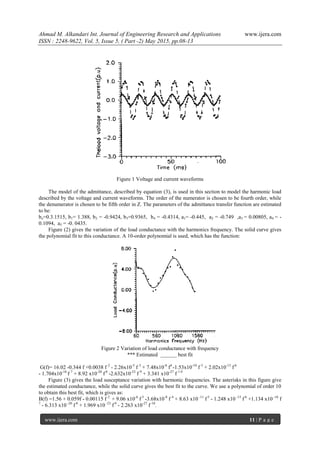
![Ahmad M. Alkandari Int. Journal of Engineering Research and Applications www.ijera.com
ISSN : 2248-9622, Vol. 5, Issue 5, ( Part -2) May 2015, pp.08-13
www.ijera.com 12 | P a g e
Figure 3 Variation of load susceptance with frequency
*** Estimated ______ best fit
Examining the two figures and the fitted
equations for the conductance and the susceptance,
one can notice that:
The load has a dc conductance as well as an a.c
conductance that depends on the harmonic frequency.
The load conductance is always positive
irrespective to the frequency in question.
The load susceptance changes its sign depending
on the harmonics frequency.
The load has many resonance frequencies, where the
value of the susceptance equals zero.
IV. CONCLUSIONS
The harmonic model of a single-phase load is
presented in this paper, in the time domain. The
model is a rational function of the load admittance,
where the recent and previous samples of the voltage
and current waveforms are used. The least errors
square algorithm is used to estimate the parameters of
the load. A set of polynomial equations for the
conductance and the susceptance of the model are
derived. It has been noticed that the proposed model
is suitable for the harmonic analysis of the system that
contains such nonlinear loads. The model can be used
in harmonic power flow analysis, and system stability
analysis.
The developed model in this paper is for single-
phase loads. It is worthwhile to develop a suitable
model for a three phase unbalanced load, which is our
current research.
REFERENCES.
[1] E. W. Palmer, and G. F. Ledwich, “
Determination of a Three Phase Load
Model Using Background Harmonic Levels”
IEEE inter. Conf. on Advances in Power
System Control, Operation and
Management, November 1991, Hong Kong,
pp.727-736.
[2] S. Varadan, and E.B. Makram, “
Generalized Load Modeling in the Presence
of Harmonics and Distortion”, Twenty-Fifth
Southeastern Symposium on System Theory,
1993. Proceedings SSST’93. 7-9 March
1993, IEEE Catalog Number 93TH0530-6,
pp.124- 128.
[3] E.W Palmer, and G.F.Ledwich, “ Three
Phase harmonic Modelling of Power System
Loads”, IEE Proceedings-C, Vol.140, No.3,
pp.206-212, 1993.
[4] D. Karisson, and D.J. Hill, “ Modeling and
Identification on Nonlinear Dynamic Loads
In Power Systems”, IEEE Transactions on
Power Systems, Vol.9, No.1, pp.157-166,
1994.
[5] I. A. Hiskens, and J. V. Milanocic’, Load
Modeling in Studies of Power System
Damping”, IEEE Transactions on Power
Systems, Vol.10, N0.4 pp.1781-1788, 1995.
[6] P. Ju, E. Handschin and D. Karlsson, “
Nonlinear Dynamic Load Modeling Model
and Parameter Estimation”, IEEE
Transactions on Power Systems, Vol.11,
No.4, pp.1689-1697, 1996.
[7] R. Mancini, et-al, “ An Area Substation
Load Model in The presence of Harmonics”,
IEEE Transactions on Power Delivery,
Vol.11, No.4, pp.2013-2019, 1996.
[8] S. varadan, E.B. Makram, and A. A. Girgis,
“ A New Time Domain Voltage Source
Model for an Arc Furnace Using EMTP”,
IEEE Transactions on Power Delivery,
Vol.11, No.3, pp.1685-1691, 1996.](https://image.slidesharecdn.com/b505020813-150511084147-lva1-app6891/85/Using-Z-Transform-for-Electric-Loads-Modeling-in-the-Presence-of-Harmonics-5-320.jpg)
![Ahmad M. Alkandari Int. Journal of Engineering Research and Applications www.ijera.com
ISSN : 2248-9622, Vol. 5, Issue 5, ( Part -2) May 2015, pp.08-13
www.ijera.com 13 | P a g e
[9] R. Lamedica, et-al, “ A Model of Large
Load areas for Harmonic Studies in
Distribution Networks”, IEEE Transactions
on Power Delivery, Vol.12, No.1, pp.418-
425, 1997.
[10] S.. A. Soliman, A. M. Al-Kandari, and M E.
El-Hawary, ” Time Domain Estimation
Techniques for Harmonic Load Models”
Electric machines and Power Systems,
Vol.25, pp.885-896, 1997.
[11] .S. Arnborg, et-al, “ On Influence of Load
Modeling for Under voltage Load Shedding
Studies”, IEEE transactions on Power
Systems, Vol.13, No.2, pp.395-400, 1998.
[12] M. M. El-Arinin, “ A Time Domain Load
Modeling Technique and Harmonics
Analysis”, 8th International Conference on
Harmonics and Quality of Power.
Proceedings of’ 1998, Vol.2, pp.930-938,
IEEE Catalog # 98EX227, 1998.
[13] L. Sainz, et-al, “ Load Modeling for
Unbalanced Harmonic Power Flow
Studies”, 8th International Conference on
Harmonics and Quality of Power.
Proceedings of’ 1998, Vol.2, pp.665-671,
IEEE Catalog # 98EX227, 1998.
[14] M. Reformat, et-al, “Nonlinear Load
Modeling for Simulation in Time Domain”,
8th International Conference on Harmonics
and Quality of Power. Proceedings of’ 1998,
Vol.2, pp.506-510, IEEE Catalog #
98EX227, 1998.
[15] E. O’Neill-Carrillo, et-al, “Nonlinear
Deterministic Modeling of Highly Varying
Loads”, IEEE Transactions on Power
Delivery, Vol.14, No.2, pp.537-542, 1999.
[16] Ahmed M. AL-Kandari, Khaled M. EL-
Naggar,” Recursive identification of
harmonic loads in power systems”.
International Journal of Electrical Power &
Energy Systems Volume 28, Issue 8,
October 2006, Pages 531-536](https://image.slidesharecdn.com/b505020813-150511084147-lva1-app6891/85/Using-Z-Transform-for-Electric-Loads-Modeling-in-the-Presence-of-Harmonics-6-320.jpg)

- The document presents an approach to model single-phase electric loads in the presence of harmonics using Z-transform. - The impedance or admittance of the load is expressed as an autoregressive model with exogenous inputs (ARX). The parameters are identified using least error squares estimation based on voltage and current samples. - With the identified ARX parameters, the admittance can be determined in the time and frequency domains. The approach can model loads and distribution networks for load flow and harmonic analysis.


