B. Ramya Int. Journal of Engineering Research and Applications www.ijera.com 
ISSN : 2248-9622, Vol. 4, Issue 9( Version 1), September 2014, pp.23-26 
www.ijera.com 23 | P a g e 
Study and Analysis of Six Stroke Engine B. Ramya Asst. professor, Department of civil engineering Dadi Institute of Engineering and Technology, Anakapalle, Visakhapatnam. Abstract Six Stroke engine, the name itself indicates a cycle of six strokes out of which two are useful power strokes. According to its mechanical design, the six-stroke engine with external and internal combustion and double flow is similar to the actual internal reciprocating combustion engine. However, it differentiates itself entirely, due to its thermodynamic cycle and a modified cylinder head with two supplementary chambers: combustion and an air heating chamber, both independent from the cylinder. In this the cylinder and the combustion chamber are separated which gives more freedom for design analysis. In addition to the two valves in the four stroke engine two more valves are incorporated which are operated by a piston arrangement. The Six Stroke is thermodynamically more efficient because the change in volume of the power stroke is greater than the intake stroke and the compression stroke. The main advantages of six stroke engine includes reduction in fuel consumption by 40%, two power strokes in the six stroke cycle, dramatic reduction in pollution, adaptability to multi fuel operation. Six stroke engine’s adoption by the automobile industry would have a tremendous impact on the environment and world economy . 
I. INTRODUCTION 
In internal combustion engines, operating on different cycles have one common feature, combustion occurring in the cylinder after each compression, resulting in gas expansion that acts directly on the piston (work) and limited to 180 degrees of crankshaft angle. According to its mechanical design, the six- stroke engine with external and internal combustion and double flow is similar to the actual internal reciprocating combustion engine. However, it differentiates itself entirely, due to its thermodynamic cycle and a modified cylinder head with two supplementary chambers: Combustion, does not occur within the cylinder within the cylinder but in the supplementary combustion chamber, does not act immediately on the piston, and it’s duration is independent from the 180 degrees of crankshaft rotation that occurs during the expansion of the combustion gases (work). 
The combustion chamber is totally enclosed within the air-heating chamber. By heat exchange through the glowing combustion chamber walls, air pressure in the heating chamber increases and generate power for an a supplementary work stroke. Several advantages result from this, one very important being the increase in thermal efficiency. In the contemporary internal combustion engine, the necessary cooling of the combustion chamber walls generate important calorific losses. In the main cylinder, combustion takes place every turn as in a two-stroke engine and lubrication as in a four-stroke engine. 
Fuel injection can take place in the piston charger, in the gas transfer channel or in the combustion chamber. It is also possible to charge two working cylinders with one piston charger. The combination of compact design for the combustion chamber together with no loss of air and fuel is claimed to give the engine more torque, more power and better fuel consumption. 
II. ANALYSIS OF SIX STROKE ENGINE 
In six stroke cycle, two parallel functions occur in two chambers which result in eight event cycle : four event internal combustion cycle and four event internal combustion cycles . In the internal combustion there is direct contact between air and the working fluid, whereas there is no direct contact between air and the working fluid in the external combustion process. Those events that affect the motion of the crankshaft are called dynamic events and those, which do not effect are called static events. 
III. ANALYSIS OF EIGHT EVENTS OF SIX STROKE ENGINE: 
Event 1: Pure air intake in the cylinder . 
1. Intake valve. 
2. Heating chamber valve 
3. Combustion chamber valve. 
4. Exhaust valve 
5. Cylinder 
6. Combustion chamber. 
7. Air heating chamber. 
RESEARCH ARTICLE OPEN ACCESS
B. Ramya Int. Journal of Engineering Research and Applications www.ijera.com 
ISSN : 2248-9622, Vol. 4, Issue 9( Version 1), September 2014, pp.23-26 
www.ijera.com 24 | P a g e 
8. Wall of combustion chamber. 
9. Fuel injector. 
10. Heater plug . 
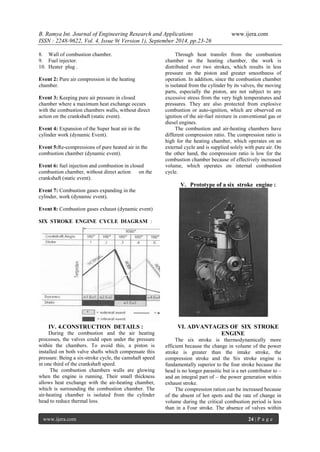
Event 2: Pure air compression in the heating chamber. Event 3: Keeping pure air pressure in closed chamber where a maximum heat exchange occurs with the combustion chambers walls, without direct action on the crankshaft (static event). Event 4: Expansion of the Super heat air in the cylinder work (dynamic Event). Event 5:Re-compressions of pure heated air in the combustion chamber (dynamic event). Event 6: fuel injection and combustion in closed combustion chamber, without direct action on the crankshaft (static event). Event 7: Combustion gases expanding in the cylinder, work (dynamic event). Event 8: Combustion gases exhaust (dynamic event) SIX STROKE ENGINE CYCLE DIAGRAM : 
IV. 4.CONSTRUCTION DETAILS : 
During the combustion and the air heating processes, the valves could open under the pressure within the chambers. To avoid this, a piston is installed on both valve shafts which compensate this pressure. Being a six-stroke cycle, the camshaft speed in one third of the crankshaft speed. The combustion chambers walls are glowing when the engine is running. Their small thickness allows heat exchange with the air-heating chamber, which is surrounding the combustion chamber. The air-heating chamber is isolated from the cylinder head to reduce thermal loss. 
Through heat transfer from the combustion chamber to the heating chamber, the work is distributed over two strokes, which results in less pressure on the piston and greater smoothness of operation. In addition, since the combustion chamber is isolated from the cylinder by its valves, the moving parts, especially the piston, are not subject to any excessive stress from the very high temperatures and pressures. They are also protected from explosive combustion or auto-ignition, which are observed on ignition of the air-fuel mixture in conventional gas or diesel engines. The combustion and air-heating chambers have different compression ratio. The compression ratio is high for the heating chamber, which operates on an external cycle and is supplied solely with pure air. On the other hand, the compression ratio is low for the combustion chamber because of effectively increased volume, which operates on internal combustion cycle. 
V. Prototype of a six stroke engine : 
VI. ADVANTAGES OF SIX STROKE ENGINE 
The six stroke is thermodynamically more efficient because the change in volume of the power stroke is greater than the intake stroke, the compression stroke and the Six stroke engine is fundamentally superior to the four stroke because the head is no longer parasitic but is a net contributor to – and an integral part of – the power generation within exhaust stroke. 
The compression ration can be increased because of the absent of hot spots and the rate of change in volume during the critical combustion period is less than in a Four stroke. The absence of valves within
B. Ramya Int. Journal of Engineering Research and Applications www.ijera.com 
ISSN : 2248-9622, Vol. 4, Issue 9( Version 1), September 2014, pp.23-26 
www.ijera.com 25 | P a g e 
the combustion chamber allows considerable design 
freedom. 
Main advantages of the six-stroke engine: 
I. Reduction in fuel consumption by at least 
40%: 
An operating efficiency of approximately 50%, 
hence the large reduction in specific consumption. 
the Operating efficiency of current petrol engine is of 
the order of 30%. The specific power of the six-stroke 
engine will not be less than that of a four-stroke 
petrol engine, the increase in thermal 
efficiency compensating for the issue due to the two 
additional strokes. 
II.Two expansions (work) in six strokes: 
Since the work cycles occur on two strokes (3600 
out of 10800 ) or 8% more than in a four-stroke 
engine (1800 out of 720 ), the torque is much more 
even. This lead to very smooth operation at low 
speed without any significant effects on consumption 
and the emission of pollutants, the combustion not 
being affected by the engine speed. These advantages 
are very important in improving the performance of 
car in town traffic. 
III.Dramatic reduction in pollution: 
Chemical, noise and thermal pollution are 
reduced, on the one hand, in proportion to the 
reduction in specific consumption, and on the other, 
through the engine’s own characteristics which will 
help to considerably lower HC, CO and NOx 
emissions. Furthermore, it’s ability to run with fuels 
of vegetable origin and weakly pollutant gases under 
optimum conditions, gives it qualities which will 
allow it to match up to the strictest standards. 
IV.Multifuel: 
Multifuel par excellence, it can use the most 
varied fuels, of any origin (fossil or vegetable), from 
diesel to L.P.G. or animal grease. The difference in 
inflammability or antiknock rating does not present 
any problem in combustion. It’s light, standard petrol 
engine construction, and the low compression ration 
of the combustion chamber; do not exclude the use of 
diesel fuel. Methanol-petrol mixture is also 
recommended. 
VII. GRAPHS FOR SIX STROKE 
ENGINE : 
Volume Angle Diagram For Six Stroke : 
Torque-Angle Diagram For Six Stroke : 
VIII. CONCLUSION 
It is commercially obvious that the big market 
it for automobile, heavy goods, construction site 
and farm vehicle. This is a priority for the six 
stroke engine ,reducing fuel consumption and 
pollution without any effect on performance will 
reassessed the concept of the automobile . There is, 
at this day, no wonder solution for the replacement of 
the internal combustion engine. Only improvements 
of the current technology can help it progress within 
reasonable time and financial limits. The six-stroke 
engine fits perfectly into this view. It’s adoption by 
the automobile industry would have a tremendous 
impact on the environment and world economy, 
assuming up to 40% reduction in fuel consumption 
and 60% to 90% in polluting emissions, depending 
on the type of the fuel being used . 
REFERENCES 
[1] Altin R, Cetinkaya S, Yucesu HS. The 
potential of using vegetable oil fuels as fuel 
for diesel engines. International Journal of
B. Ramya Int. Journal of Engineering Research and Applications www.ijera.com 
ISSN : 2248-9622, Vol. 4, Issue 9( Version 1), September 2014, pp.23-26 
www.ijera.com 26 | P a g e 
Energy Conversion and Management 2000;42:529–38. 248. [2] Nwafor OMI. Effect of advanced injection timing on the performance of rapeseed oil in diesel engines. International Journal of Renewable Energy 2000;21:433–44. [3] Nwafor OMI. The effect of elevated fuel inlet temperature on performance of diesel engine running on neat vegetable oil at constant speed conditions. Renewable Energy 2003;28:171–81. [4] Kaupp A, Goss JR. Small scale gas producer engine systems. Wiesbaden: Friedr Vieweg and Sohn Braunschweg; 1984. [5] Vyarawalla F, Parikh PP, Dak H C, Jain BC. Utilization of biomass for motive power generation: gasifier engine system. Biomass 1984;3:227–42. [6] Parikh PP, Bhave AG, Kapse DV. Shashikantha. Study of thermal and emission performance of small gasifier dual fuel engine systems. International Journal of Biomass 1989;19:75–97. [7] Vellguth G. Performance of vegetable oils and their monoesters as fuels for diesel engines. SAE 1983;831358. [8] Demirbas A. Biodiesel production from vegetable oils via catalytic and noncatalytic Supercritical methanol transesterification methods. International Journal of Progress in Energy and Combustion Science 2005;31:466–87. [9] Jajoo BN, Keoti RS. Evaluation of vegetable oils as supplementary fuels for diesel engines. Proceedings of the XV National Conference on I.C. Engines and Combustion, Anna University, Chennai-25; 1997

Study and Analysis of Six Stroke Engine

  • 1.
    B. Ramya Int.Journal of Engineering Research and Applications www.ijera.com ISSN : 2248-9622, Vol. 4, Issue 9( Version 1), September 2014, pp.23-26 www.ijera.com 23 | P a g e Study and Analysis of Six Stroke Engine B. Ramya Asst. professor, Department of civil engineering Dadi Institute of Engineering and Technology, Anakapalle, Visakhapatnam. Abstract Six Stroke engine, the name itself indicates a cycle of six strokes out of which two are useful power strokes. According to its mechanical design, the six-stroke engine with external and internal combustion and double flow is similar to the actual internal reciprocating combustion engine. However, it differentiates itself entirely, due to its thermodynamic cycle and a modified cylinder head with two supplementary chambers: combustion and an air heating chamber, both independent from the cylinder. In this the cylinder and the combustion chamber are separated which gives more freedom for design analysis. In addition to the two valves in the four stroke engine two more valves are incorporated which are operated by a piston arrangement. The Six Stroke is thermodynamically more efficient because the change in volume of the power stroke is greater than the intake stroke and the compression stroke. The main advantages of six stroke engine includes reduction in fuel consumption by 40%, two power strokes in the six stroke cycle, dramatic reduction in pollution, adaptability to multi fuel operation. Six stroke engine’s adoption by the automobile industry would have a tremendous impact on the environment and world economy . I. INTRODUCTION In internal combustion engines, operating on different cycles have one common feature, combustion occurring in the cylinder after each compression, resulting in gas expansion that acts directly on the piston (work) and limited to 180 degrees of crankshaft angle. According to its mechanical design, the six- stroke engine with external and internal combustion and double flow is similar to the actual internal reciprocating combustion engine. However, it differentiates itself entirely, due to its thermodynamic cycle and a modified cylinder head with two supplementary chambers: Combustion, does not occur within the cylinder within the cylinder but in the supplementary combustion chamber, does not act immediately on the piston, and it’s duration is independent from the 180 degrees of crankshaft rotation that occurs during the expansion of the combustion gases (work). The combustion chamber is totally enclosed within the air-heating chamber. By heat exchange through the glowing combustion chamber walls, air pressure in the heating chamber increases and generate power for an a supplementary work stroke. Several advantages result from this, one very important being the increase in thermal efficiency. In the contemporary internal combustion engine, the necessary cooling of the combustion chamber walls generate important calorific losses. In the main cylinder, combustion takes place every turn as in a two-stroke engine and lubrication as in a four-stroke engine. Fuel injection can take place in the piston charger, in the gas transfer channel or in the combustion chamber. It is also possible to charge two working cylinders with one piston charger. The combination of compact design for the combustion chamber together with no loss of air and fuel is claimed to give the engine more torque, more power and better fuel consumption. II. ANALYSIS OF SIX STROKE ENGINE In six stroke cycle, two parallel functions occur in two chambers which result in eight event cycle : four event internal combustion cycle and four event internal combustion cycles . In the internal combustion there is direct contact between air and the working fluid, whereas there is no direct contact between air and the working fluid in the external combustion process. Those events that affect the motion of the crankshaft are called dynamic events and those, which do not effect are called static events. III. ANALYSIS OF EIGHT EVENTS OF SIX STROKE ENGINE: Event 1: Pure air intake in the cylinder . 1. Intake valve. 2. Heating chamber valve 3. Combustion chamber valve. 4. Exhaust valve 5. Cylinder 6. Combustion chamber. 7. Air heating chamber. RESEARCH ARTICLE OPEN ACCESS
  • 2.
    B. Ramya Int.Journal of Engineering Research and Applications www.ijera.com ISSN : 2248-9622, Vol. 4, Issue 9( Version 1), September 2014, pp.23-26 www.ijera.com 24 | P a g e 8. Wall of combustion chamber. 9. Fuel injector. 10. Heater plug . Event 2: Pure air compression in the heating chamber. Event 3: Keeping pure air pressure in closed chamber where a maximum heat exchange occurs with the combustion chambers walls, without direct action on the crankshaft (static event). Event 4: Expansion of the Super heat air in the cylinder work (dynamic Event). Event 5:Re-compressions of pure heated air in the combustion chamber (dynamic event). Event 6: fuel injection and combustion in closed combustion chamber, without direct action on the crankshaft (static event). Event 7: Combustion gases expanding in the cylinder, work (dynamic event). Event 8: Combustion gases exhaust (dynamic event) SIX STROKE ENGINE CYCLE DIAGRAM : IV. 4.CONSTRUCTION DETAILS : During the combustion and the air heating processes, the valves could open under the pressure within the chambers. To avoid this, a piston is installed on both valve shafts which compensate this pressure. Being a six-stroke cycle, the camshaft speed in one third of the crankshaft speed. The combustion chambers walls are glowing when the engine is running. Their small thickness allows heat exchange with the air-heating chamber, which is surrounding the combustion chamber. The air-heating chamber is isolated from the cylinder head to reduce thermal loss. Through heat transfer from the combustion chamber to the heating chamber, the work is distributed over two strokes, which results in less pressure on the piston and greater smoothness of operation. In addition, since the combustion chamber is isolated from the cylinder by its valves, the moving parts, especially the piston, are not subject to any excessive stress from the very high temperatures and pressures. They are also protected from explosive combustion or auto-ignition, which are observed on ignition of the air-fuel mixture in conventional gas or diesel engines. The combustion and air-heating chambers have different compression ratio. The compression ratio is high for the heating chamber, which operates on an external cycle and is supplied solely with pure air. On the other hand, the compression ratio is low for the combustion chamber because of effectively increased volume, which operates on internal combustion cycle. V. Prototype of a six stroke engine : VI. ADVANTAGES OF SIX STROKE ENGINE The six stroke is thermodynamically more efficient because the change in volume of the power stroke is greater than the intake stroke, the compression stroke and the Six stroke engine is fundamentally superior to the four stroke because the head is no longer parasitic but is a net contributor to – and an integral part of – the power generation within exhaust stroke. The compression ration can be increased because of the absent of hot spots and the rate of change in volume during the critical combustion period is less than in a Four stroke. The absence of valves within
  • 3.
    B. Ramya Int.Journal of Engineering Research and Applications www.ijera.com ISSN : 2248-9622, Vol. 4, Issue 9( Version 1), September 2014, pp.23-26 www.ijera.com 25 | P a g e the combustion chamber allows considerable design freedom. Main advantages of the six-stroke engine: I. Reduction in fuel consumption by at least 40%: An operating efficiency of approximately 50%, hence the large reduction in specific consumption. the Operating efficiency of current petrol engine is of the order of 30%. The specific power of the six-stroke engine will not be less than that of a four-stroke petrol engine, the increase in thermal efficiency compensating for the issue due to the two additional strokes. II.Two expansions (work) in six strokes: Since the work cycles occur on two strokes (3600 out of 10800 ) or 8% more than in a four-stroke engine (1800 out of 720 ), the torque is much more even. This lead to very smooth operation at low speed without any significant effects on consumption and the emission of pollutants, the combustion not being affected by the engine speed. These advantages are very important in improving the performance of car in town traffic. III.Dramatic reduction in pollution: Chemical, noise and thermal pollution are reduced, on the one hand, in proportion to the reduction in specific consumption, and on the other, through the engine’s own characteristics which will help to considerably lower HC, CO and NOx emissions. Furthermore, it’s ability to run with fuels of vegetable origin and weakly pollutant gases under optimum conditions, gives it qualities which will allow it to match up to the strictest standards. IV.Multifuel: Multifuel par excellence, it can use the most varied fuels, of any origin (fossil or vegetable), from diesel to L.P.G. or animal grease. The difference in inflammability or antiknock rating does not present any problem in combustion. It’s light, standard petrol engine construction, and the low compression ration of the combustion chamber; do not exclude the use of diesel fuel. Methanol-petrol mixture is also recommended. VII. GRAPHS FOR SIX STROKE ENGINE : Volume Angle Diagram For Six Stroke : Torque-Angle Diagram For Six Stroke : VIII. CONCLUSION It is commercially obvious that the big market it for automobile, heavy goods, construction site and farm vehicle. This is a priority for the six stroke engine ,reducing fuel consumption and pollution without any effect on performance will reassessed the concept of the automobile . There is, at this day, no wonder solution for the replacement of the internal combustion engine. Only improvements of the current technology can help it progress within reasonable time and financial limits. The six-stroke engine fits perfectly into this view. It’s adoption by the automobile industry would have a tremendous impact on the environment and world economy, assuming up to 40% reduction in fuel consumption and 60% to 90% in polluting emissions, depending on the type of the fuel being used . REFERENCES [1] Altin R, Cetinkaya S, Yucesu HS. The potential of using vegetable oil fuels as fuel for diesel engines. International Journal of
  • 4.
    B. Ramya Int.Journal of Engineering Research and Applications www.ijera.com ISSN : 2248-9622, Vol. 4, Issue 9( Version 1), September 2014, pp.23-26 www.ijera.com 26 | P a g e Energy Conversion and Management 2000;42:529–38. 248. [2] Nwafor OMI. Effect of advanced injection timing on the performance of rapeseed oil in diesel engines. International Journal of Renewable Energy 2000;21:433–44. [3] Nwafor OMI. The effect of elevated fuel inlet temperature on performance of diesel engine running on neat vegetable oil at constant speed conditions. Renewable Energy 2003;28:171–81. [4] Kaupp A, Goss JR. Small scale gas producer engine systems. Wiesbaden: Friedr Vieweg and Sohn Braunschweg; 1984. [5] Vyarawalla F, Parikh PP, Dak H C, Jain BC. Utilization of biomass for motive power generation: gasifier engine system. Biomass 1984;3:227–42. [6] Parikh PP, Bhave AG, Kapse DV. Shashikantha. Study of thermal and emission performance of small gasifier dual fuel engine systems. International Journal of Biomass 1989;19:75–97. [7] Vellguth G. Performance of vegetable oils and their monoesters as fuels for diesel engines. SAE 1983;831358. [8] Demirbas A. Biodiesel production from vegetable oils via catalytic and noncatalytic Supercritical methanol transesterification methods. International Journal of Progress in Energy and Combustion Science 2005;31:466–87. [9] Jajoo BN, Keoti RS. Evaluation of vegetable oils as supplementary fuels for diesel engines. Proceedings of the XV National Conference on I.C. Engines and Combustion, Anna University, Chennai-25; 1997